She Brought a Flood Map to the Pasture, but the Boundary Wasn’t the Only Truth Buried There
Chapter 1: The Water Was Standing Where the Map Said It Couldn’t
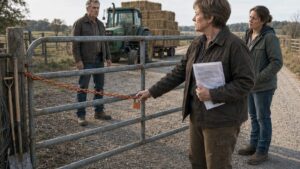
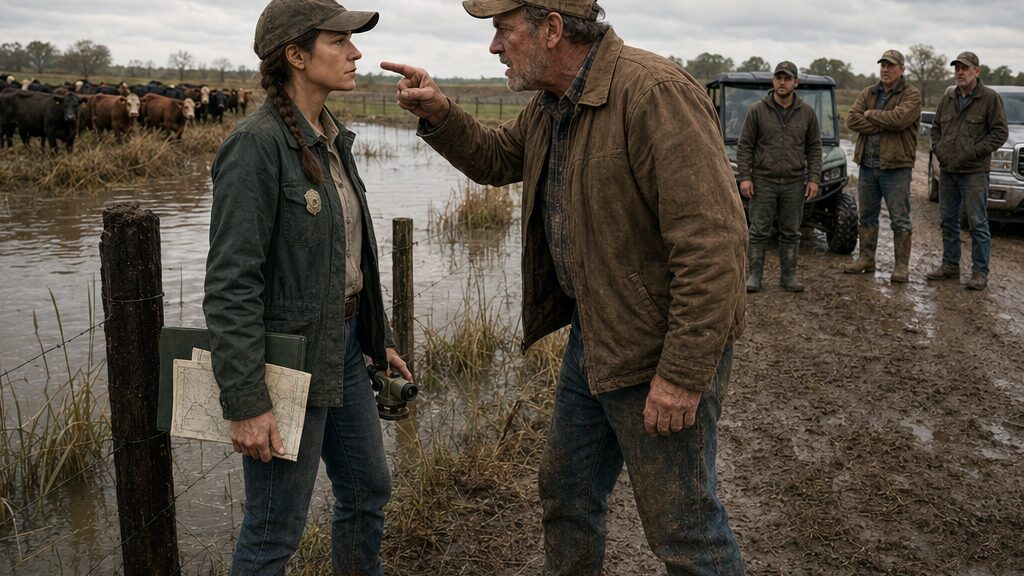
Gregory Allen’s finger stopped inches from Samantha Rivera’s face.
“You take one more step onto that field,” he said, “and I call the sheriff.”
Behind him, brown water covered the low pasture in a sheet broken only by reeds, fence posts, and the dark backs of cattle crowded onto higher ground. One cow bawled from the far side of the flooded lane. Gregory’s hired hand stood beside a utility vehicle, watching without pretending not to.
Samantha kept both hands occupied: the green county folder under one arm, the folded drainage map in the other. Her boots had already sunk an inch into the mud.
“You requested an assessment after the south ditch backed up,” she said.
“I requested the county clear its ditch. I didn’t request a Rivera walking my property.”
So he had recognized her before she introduced herself.
She had known that might happen. She had simply decided it did not need to matter.
“This isn’t a property survey,” she said. “I’m checking the drainage outlet.”
“The outlet’s where it’s always been.”
“Then this should be quick.”
Gregory shifted to block the narrow path between the fence and the flooded grass. He was broader than she remembered, though age had softened his shoulders and deepened the lines around his mouth. When Samantha had been a child, he had occasionally leaned from his truck window to speak with her father. Never long. Never warmly.
Now he looked at her county badge as if it were something she had stolen.
“You people sit behind a desk for ten years,” he said, loud enough for the hired hand, “then come back with a colored map and tell us which way water runs.”
Samantha looked past him.
The water nearest the fence trembled in a light current. Bits of straw and foam moved north toward the barn road.
According to the map under her arm, they should have been moving south.
She stepped sideways.
Gregory moved with her. “I said no.”
“And I heard you.”
“Doesn’t sound like it.”
She pulled a measuring rod from the side pocket of her field bag and extended it. “The county easement allows inspection within fifteen feet of the recorded drainage line.”
“That line is wrong.”
The words came too quickly.
Samantha looked at him. Gregory’s jaw tightened.
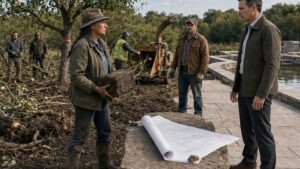
She unfolded the map against a wet fence post. The wind lifted one corner, and she pinned it beneath the green folder. Blue lines marked the approved route through the lower pasture. Black contour numbers crossed the paper in narrow arcs. The recorded culvert sat thirty yards south of where the water was collecting.
Two neighboring cattle operators had stopped on the gravel road. They remained beside their pickup, drawn by the standing water or Gregory’s voice. Samantha could feel the shape the scene had taken: older farmer, younger county employee, family name everyone knew.
Gregory pointed at the map. “That paper doesn’t know this ground.”
“No,” Samantha said. “But elevations do.”
She placed the rod beside the fence post and checked the reading on her handheld level. Then she walked six paces along the easement, ignoring Gregory when he followed close enough that she could hear his breathing.
A second reading.
Then a third.
The numbers confirmed what the moving straw had already shown her.
Samantha returned to the map and drew a small pencil mark.
Gregory gave a humorless laugh. “You came out here to prove something.”
“I came out here because three properties have reported water where they didn’t have it last spring.”
“Your mother’s property being one of them.”
“Yes.”
That admission caused a small movement among the men by the road. Gregory noticed it too.
“There it is,” he said. “County badge on the outside, Rivera grudge underneath.”
Samantha felt heat rise behind her collar. She had not listed the family connection in her preliminary notes because the complaint covered four parcels and the initial assignment had been automatic. She had told herself the relationship would be irrelevant unless the inspection became an enforcement matter.
Facts first. Explanation later.
It had always been easier that way.
She folded one side of the map back, exposing the culvert notation. “The grade shown here drops seventeen inches from this post to the southern outlet.”
“So?”
“So the surface water is moving north.”
The hired hand looked toward the pasture.
Gregory did not.
Samantha continued, quieter now. “For the filed plan to be accurate, water would have to be flowing uphill.”
No one spoke.
A cow stepped from a patch of grass and plunged knee-deep into brown water. The animal jerked back, sending ripples across the submerged fence wire.
Samantha tapped the map. “Either the outlet was moved, the pipe was redirected, or this record never matched what was built.”
Gregory lowered his hand.
It was a small surrender, but everyone saw it.
Samantha refolded the map and slid it into the green folder. “I need access to the north bank.”
“You’ll get a board order first.”
“If the blockage threatens livestock or adjoining land, I can request emergency access.”
“Request whatever you like.”
His anger had changed. It was no longer broad and performative. It had narrowed into attention.
Samantha noticed mud on the cuffs of his jeans, darker than the mud near the road. Fresh clay, gray-brown and heavy. The same kind found around buried tile lines.
She looked toward the north end of the pasture, where reeds concealed a low rise.
Gregory stepped between her and the view.
“Who told you to use that map?” he asked.
“It’s the current filed survey.”
“Current,” he repeated.
The word sounded almost like an accusation.
Samantha closed the folder. “Is there another one?”
Gregory glanced toward the two men at the road. When he spoke again, his voice was lower.
“You think you’re the first Rivera to stand here with measurements and tell us where that line belongs?”
A pressure opened beneath Samantha’s ribs.
“My father surveyed this tract,” she said.
Gregory’s expression hardened, but something else moved beneath it—old resentment, perhaps, or fear.
“He did more than survey it.”
Samantha waited.
The pasture water pushed steadily north, carrying straw across the place where the county map insisted the land rose.
Gregory leaned closer.
“Your father approved that drainage line himself.”
Chapter 2: Her Father’s Signature Was Already in the County File
The county survey clerk recognized Samantha before she gave her name.
“You’re Ruth Rivera’s girl,” the clerk said, one hand resting on the archive-room door. “I thought you moved away.”
“I did.”
The clerk’s eyes dropped to the green folder. “This about the Allen ground?”
Samantha did not answer immediately, and the hesitation answered for her.
By noon, mud had dried in pale flakes along her boots. She had returned to the county building without going home, filed an incident note, and requested the original drainage survey for Gregory’s parcel and the adjoining Rivera tract.
The clerk unlocked the archive room.
“Most of that should be scanned,” she said.
“The scanned file has a page replacement notation.”
“That happens.”
“It doesn’t say what was replaced.”
The clerk gave her a look that suggested explanations were not always stored with records. She led Samantha past shelves of plat books, easement binders, and gray boxes labeled by township.
The Allen-Rivera file occupied half a carton.
Samantha carried it to a metal table beneath a humming fluorescent light. The first folder held inspection notes from recent years: sediment complaints, weed-control notices, a denied request to widen a field crossing. Nothing explained the water moving north.
The second folder contained the survey.
She recognized the fold pattern before she opened it.
The county copy had three vertical creases and one diagonal bend across the lower corner. The field map she had carried that morning had been scanned from this sheet. Even the faint brown stain near the legend appeared in the digital version.
Samantha laid tracing paper over the drawing and marked the recorded route. The culvert crossed the southern boundary, then turned east toward the public ditch. The grades were tidy. Too tidy.
Halfway down the page, a notation in blue ink read: REVISED PER FIELD AGREEMENT.
No agreement was attached.
She turned the sheet over.
A second piece of paper had been mounted to the back with old transparent tape. Its edges had yellowed. Beneath it, the original page number remained visible.
The clerk leaned over Samantha’s shoulder. “That’s odd.”
“Can we remove it?”
“Not without preservation approval.”
Samantha angled the page beneath the desk lamp. The mounted sheet was slightly narrower than the paper below it. Along the exposed margin, a pencil line curved north instead of south.
Her pulse began to beat in her fingertips.
The clerk brought a light board from another room. Together they placed the survey on the illuminated surface.
Two maps appeared at once.
The filed ink route ran south.
The buried pencil route crossed the low ground northward, exactly where Samantha had seen the current moving.
At the bottom of the replacement sheet were two signatures.
One belonged to a county engineer long retired.
The other read William Rivera.
Her father’s handwriting had always leaned forward as if even his name had somewhere urgent to be. Samantha had seen it on tool labels, birthday cards, seed invoices, and the note he left on the refrigerator the morning she drove away.
She had not seen it in six years.
For several seconds, she stared without understanding the words around it.
The clerk shifted her weight. “You all right?”
Samantha placed both palms on the table. “I need a certified copy of this page and the replacement log.”
“There may not be a log that old.”
“Then I need a statement that there isn’t one.”
The clerk went to the copier.
Samantha remained beside the light board. She had gone to the records office expecting confirmation that Gregory or his father had moved a pipe. Instead, the paper suggested the contradiction had been installed into the official record before the map ever reached him.
Her father had signed it.
The office door opened behind her.
Edward Clark entered without knocking. He wore a pressed work shirt and carried no folder, which meant someone had called him.
“Samantha,” he said. “My office.”
“I’m in the middle of a records review.”
“I can see that.”
The clerk returned, then quietly retreated with the copies still in her hand.
Edward waited until the archive-room door closed.
“You didn’t disclose that your family owns an affected parcel.”
“The assignment came through the general complaint queue.”
“That wasn’t my point.”
“I haven’t issued findings.”
“You entered Allen’s property.”
“I stayed within the recorded easement.”
“Which your father apparently helped establish.”
The sentence landed harder because Edward delivered it without accusation.
Samantha removed the survey from the light board. “Did you know about this revision?”
“I knew there had been an adjustment years ago.”
“An adjustment that makes water run uphill?”
Edward’s mouth tightened. “This county has hundreds of old field agreements. People solved problems with the information and money they had.”
“Did the board approve this one?”
“I haven’t reviewed the file.”
“You came here before reviewing it.”
“I came because Gregory called two board members and said a county employee with a family interest threatened emergency enforcement.”
Samantha looked at the replacement sheet.
Edward lowered his voice. “You should have disclosed the connection.”
He was right, and she resented him for it.
“I’ll add it to the report.”
“You’ll pause the inspection until the board decides whether to reassign it.”
“The water is still moving onto adjoining land.”
“Then document immediate hazards. Nothing else.”
He held out his hand for the folder.
Samantha did not give it to him. “This survey was physically altered.”
“And you are not the person who gets to decide what that means alone.”
By the time she left the county building, the certified copies were sealed in an envelope, and the original file remained with the clerk. Edward had not suspended her formally, but he had taken away the clean authority she carried into the pasture.
She drove to the Rivera farmhouse near dusk.
Ruth’s truck stood beside the equipment shed. The lower field behind the house shimmered in patches where water had begun filling old tire ruts. Samantha parked near the porch but did not get out at once.
The envelope lay on the passenger seat.
Her father’s signature showed faintly through the paper.
Inside, Ruth was trimming beans at the kitchen table. She looked up when Samantha entered, then at the green folder.
“I heard you were at Allen’s.”
“Who called?”
“People don’t need to call. Two trucks slow down on that road and the county knows by lunch.”
Samantha placed the certified copy on the table.
Ruth’s knife stopped.
“Did Dad approve this?”
Her mother did not touch the paper. “Where did you get it?”
“The county file.”
“That isn’t what I asked.”
“His signature is on it.”
Ruth gathered the cut beans into a bowl with the flat of the knife. One slipped free and rolled across the table.
Samantha unfolded the copy. “The original line went north. Somebody covered it with a replacement sheet and filed the route south.”
Ruth’s eyes remained on the signature.
“Was he paid?” Samantha asked.
“No.”
“Did Gregory’s family pressure him?”
Ruth’s lips pressed together.
Samantha heard Edward’s voice again: You are not the person who gets to decide what that means alone.
She hated that everyone seemed to know a portion of her father she had never been given.
“I need the truth,” she said.
Ruth finally looked at her. “No. You need a clean answer.”
“What’s the difference?”
“A clean answer lets you leave again.”
The words struck with the accuracy of something long saved.
Samantha folded the copy along its existing creases. “Is there another survey?”
Ruth turned toward the dark window above the sink.
“Mom.”
After a long silence, Ruth said, “The map in that county file is not the one your father drew.”
Chapter 3: The Original Survey Was Hidden Behind the Feed Ledger
Ruth unlocked the cabinet in the equipment shed and removed a feed ledger thick enough to require both hands.
Samantha stood beside the workbench, watching dust settle around them. The shed smelled of oil, dry grain, and the cold iron of tools that had belonged to her father. Above the bench hung the outline of a wrench no one had replaced after his death.
“You kept it out here?” Samantha asked.
“I kept it where no one looked.”
Ruth set the ledger down. Its green cloth cover had faded nearly gray, and the pages bulged with receipts and handwritten totals.
Samantha reached for it.
Her mother placed one palm on top.
“Once you open this,” Ruth said, “you don’t get to pretend your father was the only person who made a choice.”
“I’m not pretending anything.”
“You came in last night asking whether he was paid.”
“Because his signature is on a false survey.”
Ruth removed her hand. “Then look.”
The ledger was heavier than it appeared. Samantha opened it near the middle and found columns of feed purchases, calf weights, fuel charges, and mortgage payments written in Ruth’s narrow script. Several pages had been cut away close to the binding.
Behind them lay a folded sheet of survey paper.
The creases matched the county map.
Samantha lifted it carefully. Unlike the filed copy, this one carried pencil grades, soil notes, and corrections in three different shades of graphite. Her father’s initials appeared near each measurement point. The drainage line began at the western rise, crossed the low Allen pasture, and continued north through a strip later incorporated into Gregory’s parcel.
“This is the field original,” she said.
Ruth sat on an overturned bucket. “It’s one of them.”
“One of how many?”
“Your father redrew it more than once.”
Samantha spread the paper across the workbench. A rusted bolt held one corner flat. She traced the line with her finger.
The original outlet lay beneath the reeds she had tried to reach that morning.
The county map did not merely contain a clerical error. The official route had been shifted away from the natural grade and placed along a boundary that would keep the drain off the Allen low ground.
“Why?” she asked.
Ruth looked toward the open shed door. Beyond it, evening light caught the water accumulating in the lower Rivera field.
“Your father thought it would be temporary.”
“That’s not an answer.”
“It’s the one I have.”
Samantha searched the margins. Most notes were technical: tile depth, clay layer, expected fall. Near the northern turn, her father had written a warning in block letters.
SOUTH DIVERSION MAY HOLD IN DRY YEARS. FAILURE WILL BACK WATER ACROSS BOTH TRACTS.
Below it, in smaller handwriting: Restore original outlet before permanent fencing.
Samantha read the lines twice.
“He knew.”
“Yes.”
“He knew exactly what would happen.”
“He knew what could happen.”
“Standing water is reaching our field now.”
“I can see it.”
The restraint in Ruth’s voice made Samantha angrier than denial would have.
She turned the map toward her mother. “Who ordered the diversion?”
“No one ordered your father.”
“So it was his idea.”
“I didn’t say that.”
“You’re not saying anything.”
Ruth rose from the bucket. “Because you keep asking for one name. There isn’t one.”
Samantha folded her arms. “Try me.”
For a moment, neither moved. Rain ticks from an earlier shower slid from the roof edge outside and struck an empty metal pan with irregular taps.
Ruth opened the ledger to a section near the back. A mortgage payment had been entered in full, then crossed out. Beneath it, a smaller figure appeared beside a notation: Allen advance.
Samantha bent closer.
The date was twenty-two years earlier.
“What is this?”
“Money.”
“I can see that.”
“Then don’t ask questions like you can’t.”
The old defensiveness between them returned with frightening ease. Samantha had spent years reducing conversations with her mother to weather, taxes, and necessary repairs. Facts that did not require either of them to admit what had happened after her father died.
She pointed to the entry. “Why did the Allens pay our mortgage?”
Ruth closed the ledger halfway. “They didn’t pay it.”
“It says Allen advance.”
“Gregory’s father covered part of one installment.”
“In exchange for the drainage change?”
Ruth looked away.
That was enough to harden Samantha’s suspicion, but not enough to satisfy it.
She took out her phone and photographed the ledger page.
Ruth’s head snapped back. “Don’t.”
“This may be evidence.”
“It is a household account book.”
“It records money changing hands during a boundary revision.”
“It records one farmer helping another.”
“By buying a false map?”
Ruth struck the ledger shut. The sound filled the shed.
“Your father was not bought.”
Samantha’s reply came before she could stop it. “Then why did he sign?”
Ruth’s face changed—not into anger, but injury.
Samantha wished immediately that she could take the question back. Not because it was unfair, but because she had asked it like a prosecutor instead of a daughter.
Ruth touched the ledger’s worn edge. “That year the well nearly went dry. Feed doubled. Your father had borrowed against the equipment already.”
“You never told me.”
“You were ten.”
“You could have told me later.”
“Later, you had already decided what kind of man he was.”
Samantha felt the old kitchen argument rise between them: her suitcase by the door, her father refusing to sell the north field to pay for her graduate program, Samantha accusing him of loving acreage more than people. He had died in the equipment shed eighteen months later, before either of them found a way back.
She forced her attention to the map. “Financial trouble explains pressure. It doesn’t explain the line.”
Ruth nodded once. “No.”
“Did Gregory’s father demand the change?”
“He asked for the low pasture to remain usable. Your father needed the northern strip kept out of the sale appraisal. The county wanted a route that didn’t require a new public crossing.”
“So everyone got something.”
“For a while.”
“And everyone signed?”
“Not everyone signed the same paper.”
Samantha looked up.
Ruth opened the ledger again and removed a smaller folded document tucked behind the map. It was a photocopy of a proposed easement, unsigned. The original drainage route crossed what had then been Allen property before exiting through Rivera ground. A handwritten note at the bottom said the agreement would be reviewed after five years.
It never had been.
“This doesn’t prove who authorized the filed change,” Samantha said.
“No.”
“It doesn’t prove Gregory knew.”
“No.”
“Then what are you protecting?”
Ruth’s shoulders lowered. “The difference between a desperate choice and the thing people call it twenty years later.”
Samantha stared at the warning in her father’s handwriting. Restore original outlet before permanent fencing.
“Did he try to restore it?”
“He talked about it.”
“That isn’t what I asked.”
“He marked the ground. He met Gregory twice after Gregory’s father died. Then your father got sick.”
Samantha knew the sequence that followed: hospital appointments he dismissed as routine, missed calls, the final collapse before dawn.
“He could have told the county.”
“He could have told many people many things.”
Ruth folded the unsigned easement, but Samantha took it before she could hide it again.
“You knew the filed survey was false.”
“I knew it wasn’t complete.”
“That is not a meaningful distinction.”
“It was when both farms were one bad month from auction.”
Samantha gathered the map, the photocopy, and her phone. “I have to report this.”
Ruth’s eyes sharpened. “Report what? A proposal no one signed? A warning in pencil? Money between men who are dead?”
“I report that the county record contradicts the field original.”
“And then Gregory loses the lower pasture.”
“If the outlet is there, he may have to.”
“And what do we lose?”
Samantha looked through the shed door at the water spreading across their field.
“The right to pretend it isn’t already costing us.”
Ruth flinched.
Samantha began refolding the original map. It resisted along the altered creases, as though the paper remembered a different shape.
Before she slid it into the green folder, Ruth spoke.
“Gregory’s father didn’t pay your father for the map.”
Samantha waited.
“He paid part of our mortgage because the bank had posted a notice. Your father changed the drainage route afterward because he believed he owed him.”
The ledger lay open between them, the amount small enough to seem ordinary and large enough to have changed two families.
Ruth placed her fingers over the entry.
“It wasn’t a sale,” she said. “It was gratitude that turned into a debt no one knew how to stop paying.”
Chapter 4: The Farm He Defended Was Already Failing
A veterinary truck came down Gregory Allen’s lane before sunrise with its headlights off.
Samantha watched it turn onto the county road from the cab of her parked truck. The driver glanced toward her, then accelerated without waving. Behind the barn, metal gates rattled and cattle shifted in a pen too small for the number crowded inside it.
The county had issued a temporary livestock-impact inspection after Samantha submitted the reversed-grade measurements. Edward had assigned another technician to the boundary review, but no one else was available to assess whether the flooding posed an immediate animal-welfare risk.
He had approved Samantha’s visit with one written condition: no conclusions regarding ownership, fault, or historical alterations.
Gregory appeared at the barn door as she approached.
“You camping out now?”
“I arrived at the scheduled time.”
“It’s not seven.”
“It’s six fifty-eight.”
He looked past her toward the road where the veterinary truck had disappeared. “You see something interesting?”
“I saw a vehicle leave.”
“Then your eyes work.”
The ground near the barn had become soft enough to hold deep hoofprints. Water filled the shallow drainage cuts along the approach, stopping less than twenty yards from the main doors.
Samantha opened the green folder. “How many cattle have been moved from the lower pasture?”
“Some.”
“How many?”
“Enough.”
“The emergency form requires a number.”
Gregory unlatched the barn gate. “Count them.”
Inside, the air was thick with hay dust and the heat of crowded animals. Several stalls stood empty, their doors tied open. The remaining cattle pressed against temporary panels assembled across the center aisle.
Samantha counted twice.
The total was less than half the herd listed in the county agricultural record.
“Where are the rest?” she asked.
“Higher ground.”
“On this property?”
Gregory pulled a bale apart with a hay hook. “They’re safe.”
“That wasn’t my question.”
He drove the hook into the twine and cut it. “You always talk like a form?”
“Only when someone won’t answer one.”
A cough came from the far pen. One cow held its head low while another favored a rear leg. Samantha wrote down the ear-tag numbers.
On a shelf beside the feed room, three envelopes lay beneath a wrench. Red payment notices showed through their plastic windows. One had been opened and folded back over itself. A feed supplier’s invoice sat underneath, stamped PAST DUE.
Gregory saw her looking.
“Those part of your drainage inspection?”
“No.”
“Then keep your eyes on the cattle.”
She did. But the empty stalls had already said what he would not.
“You’ve been moving them at night,” she said.
Gregory stopped working the hay.
“The veterinary truck came before daylight. The road by the northern gate is cut up with fresh trailer tracks. You don’t want the neighbors seeing how many are gone.”
“They’re not gone.”
“You relocated them.”
“I put them where they can stand.”
His voice cracked on the final word, anger splitting open just enough to reveal what was underneath.
Samantha lowered the folder.
“Where?”
“A leased pen twelve miles east.”
“How long can you afford that?”
He gave her a look that made the overdue invoices unnecessary.
For the first time, she saw the confrontation at the flooded pasture without the pointing finger. Gregory had stood between her and the north bank because the field was not just disputed acreage. It was the section that carried his herd through spring. If the drainage line were restored across it, he would lose the lowest, richest ground he owned.
Understanding did not make his threats acceptable. It did make them legible.
“I can recommend temporary assistance for relocation costs,” she said.
He laughed once. “County help. That’ll arrive right after the auction notice.”
“Then give me accurate numbers.”
“So you can calculate how much of my farm to condemn?”
“So I can document what the water is already doing.”
Gregory dragged the hay toward the pen. “The water came from the Rivera side.”
“The grade says otherwise.”
“The grade on which map?”
Samantha’s hand tightened around the folder.
He knew.
Before she could ask how much, the hired hand entered through the rear door. “Pump’s primed.”
Gregory nodded.
Samantha turned. “What pump?”
Neither man answered.
She followed them outside and around the barn. A diesel pump sat on a trailer beside the flooded approach. A thick intake hose disappeared into the standing water. The discharge line ran west, across the upper lane, and through a gap in the fence.
Toward Rivera land.
“You don’t have authorization for that,” Samantha said.
Gregory checked a fuel valve. “I have cattle standing in mud.”
“You’ll transfer the flooding to the adjoining field.”
“That field’s empty.”
“It belongs to my mother.”
“There’s the county neutrality again.”
Samantha stepped between him and the starter. “Turn it on and I issue an immediate stop order.”
“On what authority? Edward hasn’t signed one.”
“Emergency discharge across a parcel line doesn’t require board approval.”
Gregory looked at her badge, then at the water creeping toward the barn.
“You think being fair means watching everything drown evenly?”
“No. It means you don’t save your ground by choosing someone else’s.”
His hired hand stood back, eyes lowered.
Gregory’s face had lost the theatrical anger from their first encounter. What remained was exhaustion sharpened by humiliation.
“If I lose those low acres,” he said, “I sell a third of the herd. Maybe more. The leased pen is costing me every day. Feed’s costing me twice what grass would. You show me where your form has a line for that.”
Samantha thought of the ledger in Ruth’s shed. Allen advance. A desperate choice recorded as an ordinary transaction.
“I know the farm is failing,” she said.
Gregory flinched as if she had struck him.
Then his expression closed.
“You know nothing about my farm.”
He reached past her and hit the starter.
The engine coughed, caught, and rose into a hard mechanical roar. The intake hose jumped. Brown water surged through the discharge line.
Samantha pulled out her phone and began recording the location, equipment, and direction of flow.
Gregory watched her do it.
“You’ll have the written order within the hour,” she said.
“Send it.”
Water burst from the far end of the hose beyond the fence, carving a pale channel through the Rivera grass.
By the time Samantha reached her mother’s lower field, the first muddy stream had already entered the tire ruts and begun spreading between them.
Chapter 5: The County Called It Stability, but the Water Called It Something Else
Edward removed Samantha’s map from the presentation table before the drainage-board members entered the room.
“You won’t need this,” he said.
Samantha watched him roll the field original around his hand.
“That is evidence.”
“It is an unauthenticated private document.”
“It matches the physical grade.”
“We are here to address Allen’s unauthorized pumping, not conduct a trial about decisions made twenty-two years ago.”
He placed the map on a side cabinet behind his chair.
The hearing room smelled of old coffee and damp coats. Through the windows, the courthouse lawn shone with rain. Gregory sat at the opposite table beside a worn document envelope. Ruth had not come.
Two neighboring cattle operators occupied the back row. Neither met Samantha’s eye.
Edward lowered his voice. “Keep your report narrow. The board can order the pump removed today. That solves the immediate problem.”
“It doesn’t solve the blocked outlet.”
“It stops additional discharge onto Rivera land.”
“Until the next storm.”
“The county needs an actionable issue, not a family history.”
Samantha looked at the empty space where the map had been.
For most of her career, narrow had meant defensible. Establish one fact, support it, avoid conclusions the record could not carry. But the record itself had been narrowed until the land no longer fit inside it.
The board members entered. Edward called the hearing to order and described the matter as an emergency review of unauthorized water transfer between adjoining agricultural parcels.
Samantha testified first.
She gave the pump location, discharge rate, photographs, and estimated acreage affected on Rivera land. Gregory did not challenge the measurements. He sat with both hands around the document envelope.
When Samantha began explaining the northward surface flow, Edward interrupted.
“Is that necessary to determine whether the pump crossed the parcel boundary?”
“It is necessary to determine why the water accumulated.”
“The board will consider underlying drainage separately.”
“Based on which survey?”
Edward’s expression warned her to stop.
One board member leaned forward. “There’s more than one?”
Samantha looked at the cabinet behind Edward.
“Yes.”
The room shifted.
Edward said, “A private map has been presented without chain-of-custody verification.”
“It was found with family farm records,” Samantha said. “Its grades match the land. The filed map does not.”
Gregory spoke for the first time. “Her father signed the filed map.”
“I am aware of that.”
“Did you put that in your report?”
“No. The report before the board concerns the pump.”
“Convenient.”
The word found its mark because it was true. Samantha had criticized Edward for narrowing the matter while doing the same thing whenever the facts reached her own family.
She stood, walked behind Edward’s chair, and retrieved the rolled map.
He did not try to stop her, but his jaw tightened.
Samantha returned to the presentation table and laid the field original beneath a clear plastic cover. Then she placed the certified county copy beside it. She aligned the fold lines.
The diagonal crease crossed both sheets at precisely the same angle. The stain near the legend matched. So did three original grade marks visible beneath the mounted replacement page.
“These began as the same document,” Samantha said. “The filed version redirects the outlet south, against the measured fall of the ground. The field original sends it north through the Allen low pasture.”
One board member moved closer.
Edward remained seated. “Even if that is correct, it does not establish wrongdoing.”
“No. It establishes that treating the pump as an isolated violation would leave the cause untouched.”
Gregory leaned back. “Now tell them whose name is at the bottom.”
Samantha looked at her father’s signature.
The old instinct rose: answer only what had been asked, separate personal history from technical conclusions, keep control by withholding whatever others might misuse.
She let the silence last one breath too long.
Then she said, “William Rivera signed the revised filing. He was my father.”
A murmur passed through the back row.
Edward looked down at his notes.
Samantha continued before anyone else could shape the admission.
“I did not disclose my family connection before the first inspection. That was an error. I believed the measurements made the connection irrelevant. They did not.”
Gregory’s eyes narrowed, surprised by the concession.
“The water still moves north,” she said. “My mistake does not change the grade. My father’s signature does not make the filed route physically possible. It means the county has to examine how and why the record changed, including my family’s part in it.”
Edward rubbed one thumb along the edge of the table. “The board has maintained this route for two decades without a formal dispute.”
“Maintained what?” Samantha asked. “The ditch? The filed line? Or the agreement everyone knew enough not to write down?”
No one answered.
That silence revealed more than a denial would have.
One board member stared at Edward. “Were you aware of an informal agreement?”
“I was aware that the families had accommodated one another.”
“By altering an easement?”
“By maintaining stability.”
Outside, rain tapped against the windows.
Samantha looked toward the sound. Water did not care what the county called stability. It followed the lowest ground until someone blocked it, then spread the cost outward.
Gregory opened his envelope.
“I have something,” he said.
He removed a photocopied mortgage statement and slid it across the table. An old bank notice showed an amount due on the Rivera farm. Beneath it was a receipt bearing the Allen name.
“My father covered that payment,” Gregory said. “Same month William Rivera filed the change.”
The board member nearest him picked it up. “Are you alleging payment for the revision?”
“I’m saying her family benefited.”
Samantha recognized the figure from Ruth’s ledger.
“Your father’s payment was recorded as an advance,” she said.
Gregory looked sharply at her. “You found the book.”
“Yes.”
“Then you know this wasn’t one farmer stealing from another.”
“I know money moved before the map changed.”
His mouth hardened. “Your father came to ours. Not the other way around.”
“That isn’t what Ruth said.”
At her mother’s name, Gregory glanced toward the rear door.
It opened.
Ruth entered carrying the green feed ledger against her chest and the unsigned easement in one hand. Her coat was wet at the shoulders. She did not look at Samantha.
Edward stood halfway. “Mrs. Rivera, this is an administrative hearing.”
“I know what room I’m in.”
“You may submit documents through the clerk.”
“I’m not here to submit them.”
Ruth walked to the front table and set the ledger beside the two maps.
For a moment, the three records lay together: the filed truth, the hidden truth, and the household account of what fear had cost.
Ruth looked at the board.
“I need to testify,” she said. “And I need to do it under oath.”
Chapter 6: Her Mother Had Mistaken Silence for Mercy
Ruth placed one finger beside the false boundary and said, “That handwriting is mine.”
Samantha looked down.
The notation was small, almost lost among the survey marks: Hold south line until review. She had assumed her father wrote it in haste. Now she recognized the narrow upright letters from the feed ledger.
Edward asked the clerk to swear Ruth in.
No one spoke while she raised her right hand.
When she sat, she kept the original map open in front of her. The paper shook slightly beneath her fingertips.
“Tell the board why your handwriting appears on the survey,” Edward said.
Ruth looked at Samantha before answering.
“The drought had gone into its second year. Our well was weak. Feed prices had climbed, and my husband had borrowed against the baler and both tractors. We received a bank notice giving us thirty days.”
Gregory stared at the mortgage receipt.
“His father paid part of that installment,” Ruth continued. “Not as a purchase. Not with a written condition. He said neighbors carried one another when they could.”
“Then why was the drainage line changed?” a board member asked.
“Because the original route crossed the Allen low pasture. They were preparing to fence and seed it. If the easement stayed there, the appraisal came in lower. My husband believed he owed them room.”
Gregory said, “My father never asked him to falsify anything.”
“No,” Ruth replied. “He asked him to find another way.”
The distinction settled heavily in the room.
Ruth touched the unsigned easement. “The plan was to divert the outlet south for five years. The county engineer said it could work if the seasons stayed dry and the culvert was kept clear. After five years, both families were supposed to review it and restore the northern route if water began backing up.”
“What happened after five years?” Edward asked.
“Nothing.”
“Why?”
“Because by then the Allens had built permanent fence. We had refinanced. The county engineer retired. And everyone involved had something to lose by reopening it.”
Samantha watched her mother’s hands.
“You knew the warning was there,” she said.
Ruth nodded.
“You knew it could flood both tracts.”
“Yes.”
“Why didn’t you tell me when Dad died?”
Ruth’s gaze did not move away. “Because the farm insurance was under review. Because Gregory had just buried his father. Because you had come home for three days and could barely look at the house.”
“That wasn’t your decision to make.”
“No. It was mine to live with.”
The answer did not ask forgiveness.
That made it harder to reject.
A board member turned the unsigned agreement over. “Mrs. Rivera, did your husband intend to correct the filing?”
“He marked the original outlet the summer before he got sick. He met Gregory twice.”
Samantha looked across the table.
Gregory’s face had gone still.
“What happened in those meetings?” she asked.
Gregory did not answer.
Ruth did. “Your father wanted the north easement restored in stages. Gregory said he couldn’t lose the ground all at once.”
“Did Dad agree to wait?”
“He agreed to one season.”
Gregory looked at Ruth. “That’s not how I remember it.”
“How do you remember it?”
“He said we’d revisit after harvest.”
“And then?”
“He died.”
The room fell quiet.
Samantha saw her father as she had last seen him alive: one hand on the truck door, refusing to ask her to stay. She had spent years preserving that moment because anger was easier to carry than unfinished love. Now even his mistake had become more complicated. He had meant to repair the damage, but intention had not moved the water.
Ruth folded her hands. “After he died, I told Gregory I would not challenge the line. I thought keeping both farms intact was the least harmful choice.”
“You thought silence was mercy,” Samantha said.
“Yes.”
“It wasn’t.”
“No.”
The simple agreement broke something open between them—not reconciliation, but the end of pretending they disagreed only about paperwork.
Edward asked, “Did the county board know the route was temporary?”
Ruth looked toward the older board members. “People knew pieces. Enough to avoid asking for the whole.”
Edward lowered his eyes.
Samantha turned to Gregory. “When did you alter the culvert again?”
His head lifted.
Ruth looked at him sharply. “Again?”
Samantha opened the inspection photographs. “Fresh clay was disturbed near the northern outlet. The water volume exceeds what the original south diversion could carry. Someone widened or extended the buried connection.”
Gregory’s hired hand, seated near the rear wall, stared at the floor.
Edward said, “Mr. Allen, you are not required to answer an allegation outside the stated hearing notice.”
Gregory looked at the flooded-field photographs, then at the mortgage receipt his father had kept.
“It was six years ago,” he said.
Edward stopped speaking.
Gregory leaned forward, forearms on the table. “We had two wet springs back-to-back. Water started coming through the old tile. The north field stayed soft until June. I put in a larger pipe to push more toward the south ditch.”
“Without an easement amendment,” Samantha said.
“Yes.”
“Without notifying the Rivera property.”
“Yes.”
“Knowing the filed grade was inaccurate?”
He looked at her. “Knowing the route had worked most years.”
“That isn’t the same thing.”
“No.”
The admission carried no drama. Only fatigue.
A board member asked, “Why not request a formal review?”
Gregory gave a short laugh. “And tell the county the line it had inspected for twenty years wasn’t the line in the ground? Tell the bank my best pasture depended on an arrangement that might disappear? Tell every neighbor I couldn’t keep the herd without borrowed land and buried pipe?”
“So you enlarged it,” Samantha said.
“I chose the farm.”
The words echoed the accusation she had once thrown at her father.
She felt their cruelty from the other side now.
Choosing the farm had never meant choosing one thing. It meant choosing which loss another person would be made to carry.
The board recessed at dusk.
On the courthouse steps, Ruth stood beneath the stone overhang while rain fell beyond the columns. Samantha joined her, holding the original map inside the green folder.
“I should have told you,” Ruth said.
“Yes.”
“I thought if I kept his worst choice from becoming the only thing people remembered, I was protecting him.”
“You were protecting yourself too.”
Ruth nodded. “Yes.”
Samantha wanted an apology large enough to restore the years between them. Ruth’s quiet honesty offered nothing so easy.
Inside, a door opened.
Edward stepped out with the written interim decision.
“The board is ordering the pump removed immediately,” he said. “A corrective drainage recommendation is due tomorrow morning.”
“From whom?” Samantha asked.
“From you.”
She stared at him. “You questioned my impartiality.”
“I still do.”
“Then assign someone else.”
“There is no one else with the field measurements, both maps, and the technical history. You may recuse yourself, but if you do, the board will issue a temporary closure of the disputed outlet and refer the full matter to the state. That could take months.”
Months would leave Gregory’s cattle displaced and Ruth’s lower field under water.
Edward handed her the order.
“You have until eight,” he said. “Recommend enforcement, a corrective easement, or recusal.”
He returned inside.
Ruth watched Samantha read the page.
“What will you do?” she asked.
Samantha looked through the rain toward the dark line of farms beyond town. Whatever she proposed would expose her father, cost Gregory land, bind Ruth’s property, and become the record everyone had avoided creating.
For the first time, the map offered no place to hide.
Chapter 7: Samantha Redrew the Line Without Erasing the People
Gregory was waiting beside the blocked culvert when Samantha arrived.
He stood with both hands in his coat pockets, facing the flooded pasture as if he had been there long enough to watch the darkness lift from it. The pump trailer was gone. Mud marked the place where its tires had rested.
“You recommend closing the north field?” he asked before she shut the truck door.
“I recommend reopening the original outlet.”
“That’s the same thing.”
“No. It isn’t.”
Samantha carried the green folder to the fence post where Gregory had pointed in her face three days earlier. The wood was still dark from rain. She laid the original map across it, then covered it with the filed copy and a sheet of clear drafting film.
Gregory came closer but did not touch the papers.
The drainage-board members arrived in two county vehicles. Edward stepped out last, carrying the interim order. Ruth remained near Samantha’s truck, her arms folded against the morning cold.
An equipment contractor walked the edge of the standing water with a measuring wheel. He drove three orange stakes into the ground, each one following the natural fall toward the northern outlet.
The line crossed Allen land.
Then it crossed Rivera land.
Edward looked at Samantha. “Present your recommendation.”
She had spent most of the night working at the kitchen table while Ruth sat in the next room without turning on the television. Samantha had tested three alternatives. One preserved Gregory’s low pasture but sent water toward another neighbor. One protected Rivera ground by deepening the public ditch, at a cost the county would never approve quickly. The third required both families to give up land.
It was the only one that followed the grade.
Samantha placed a ruler against the map.
“The filed south route should be abandoned,” she said. “The enlarged Allen connection should be removed. The original northern outlet should be restored through a shared drainage easement.”
Gregory looked down at the line. “How much?”
“Just under nine acres of your low pasture would become restricted-use ground during wet periods.”
“That is my best grass.”
“I know.”
“And the Rivera side?”
Samantha moved the ruler west. “Six acres of our lower field would enter the easement. No permanent structures, no filling, and limited planting within the channel setback.”
Ruth’s head lifted.
One board member asked, “You are including your family parcel in the enforcement recommendation?”
“Yes.”
Edward studied Samantha instead of the map. “Is that technically required?”
“The outlet cannot be restored without it.”
“There may be a narrower route.”
“There is. It would place the entire burden on Allen ground and create a sharper cut beside the cattle lane.”
Gregory glanced at her.
Samantha continued. “That would be easier for the Rivera property. It would not be the safest design.”
The contractor crouched beside the nearest stake and pressed a soil probe into the mud. “She’s right about the cut. You’d lose the lane after a heavy season.”
Gregory rubbed one hand across his mouth.
“So this is fairness?” he asked. “Everybody loses something?”
“No,” Samantha said. “Fairness is not dividing the damage evenly. It’s putting the water where the land can carry it and naming who is responsible for the cost.”
The words drew the board’s attention.
She opened the folder and removed her written recommendation.
“The original temporary diversion was created by William Rivera with the knowledge of both families and informal county acceptance. Gregory Allen later enlarged the connection without authorization. The county failed to review a temporary arrangement after repeated inspections.”
Edward’s expression tightened.
Samantha met his eyes. “Those findings belong in the order.”
“They expose the county to liability.”
“They describe the record.”
“They describe your interpretation.”
“They describe my father too.”
No one answered that.
Samantha handed copies to the board members, Gregory, and Ruth. The final page divided the correction costs. Gregory would pay for removing the enlarged pipe and part of the restored crossing. The county would fund excavation and acknowledge its procedural failure. Rivera land would provide the western section of the easement without compensation beyond tax adjustment.
Ruth read the last page twice.
“This takes the lower field out of future sale value,” she said.
“Yes.”
“You decided that last night?”
“I recommended it.”
“Without asking me.”
Samantha felt every face turn toward them.
Her old habit had followed her all the way to the solution. She had included the Rivera sacrifice because it was technically right, then assumed the correctness relieved her of explaining it to the person who would live with it.
“No,” Samantha said. “I didn’t ask.”
Ruth held the paper at her side.
“I should have.”
The admission remained between them. It did not undo the decision, but it changed who Samantha was while making it.
Ruth looked toward the flooded field. “Would another route work as well?”
“No.”
“Then put that in the easement. Don’t put my consent where it isn’t.”
“I won’t.”
Ruth signed the acknowledgment of receipt, not the consent line.
Gregory had not opened his pen.
“If I give up nine acres,” he said, “I sell cattle.”
Samantha nodded. “Probably.”
“And if I refuse?”
“The board can close the whole disputed area until the state completes review.”
“How long?”
“Months.”
The cattle crowded on the high ground beyond him. Their hooves had worn the grass to black mud.
Gregory looked at Edward. “And the county admits its part?”
Edward glanced at the board members. “The final language will be reviewed.”
Samantha closed the folder. “Then I withdraw my recommendation.”
Edward stared at her. “On what basis?”
“An easement that records only private fault repeats the same problem. If the county will not name its role, refer it to the state.”
The threat cost Gregory more than it cost Edward, and Samantha knew it. Her stomach tightened as soon as she said it.
Gregory knew too.
“You’d leave the field closed to prove a sentence?” he asked.
“No. I’d leave it closed rather than build another correction on a partial record.”
For several seconds, the only sound was water moving through reeds.
Then one board member spoke quietly to Edward. Another joined him. Their discussion stayed low, but the decision showed first in Edward’s shoulders.
He took the order from his folder and crossed out a paragraph.
“The county will acknowledge failure to review and enforce the temporary arrangement,” he said. “Subject to counsel’s wording.”
Samantha did not smile.
Gregory read the revised page. He looked at the orange stakes, then at the cattle lane the safer route would preserve.
At last he signed.
The contractor began gathering measurements for the excavation. Board members moved toward their vehicles. Ruth walked back to the truck without waiting for Samantha.
Gregory remained beside the fence post.
“You drew the line through your own ground,” he said.
“It was already there.”
“No. The water was there. The line is what makes people admit it.”
He picked up the old filed map, then set it down again.
“Show me where the fence has to move.”
Chapter 8: When the Water Moved Again, Nothing Returned to What It Was
Water ran through the reopened channel for the first time in years.
It did not rush. It moved in a steady brown ribbon beneath the new crossing, carrying twigs and foam away from the pasture that had held them for months. The ground on either side remained scarred by excavation, and orange flags still marked the easement.
Samantha stood on the cattle lane with the corrected map tucked beneath her arm.
Gregory’s herd was smaller now.
A livestock trailer had taken twenty-three cattle to auction the previous week. The remaining animals grazed on the upper field beyond a new fence, where the grass was thinner but dry.
Gregory had kept the farm.
That was not the same as keeping everything.
The equipment contractor shut down the excavator. In the sudden quiet, Samantha heard water passing through the restored outlet and striking stones her father had once marked in pencil.
Gregory approached carrying a weathered wooden stake.
She recognized it from the old boundary. One end was dark with soil. Faded paint still marked the false south line.
“I found this behind the barn,” he said.
“The contractor can dispose of it.”
Gregory looked toward the new fence. “I thought about putting it back.”
Samantha waited.
He handed it to her instead.
The gesture was not an apology. It required more of him than one might have.
She accepted the stake.
“The county records office has the final easement,” she said. “Both maps are attached.”
“Which one do they call the original?”
“They call them both part of the record.”
Gregory gave a small nod. “Better than pretending one never existed.”
Across the pasture, his hired hand opened a gate. The cattle moved through slowly, testing the unfamiliar lane.
Ruth watched from the Rivera side of the channel. Since the hearing, she and Samantha had spoken about practical things: tax adjustments, fencing costs, the lost planting area. They had not spoken again about William’s last year or the silence after his death.
Truth had entered the house, but it had not made the rooms easier.
That afternoon, Samantha drove Ruth home.
The lower field had begun to drain. Water no longer filled the tire ruts, though flattened grass showed where it had stood. The new easement cut through the property in a shallow curve.
Ruth looked at the old boundary stake in the truck bed.
“Gregory gave you that?”
“Yes.”
“What will you do with it?”
“I don’t know.”
Ruth unlocked the farmhouse door. On the kitchen table lay William’s carpenter pencil, the flat red kind he used for marking lumber and maps. Ruth had taken it from the equipment shed and placed it there without explanation.
Samantha set the green folder beside it.
“The county accepted the revised order,” she said.
“I heard.”
“The tax adjustment won’t cover all the lost value.”
“I heard that too.”
Samantha pulled out a chair but did not sit. “I should have told you before recommending the easement.”
“Yes.”
“I knew the route was right.”
“That didn’t make the land yours to offer.”
“No.”
Ruth touched the pencil with one finger. “Your father used to do that. He would decide the practical answer, then act surprised that other people still had feelings about it.”
Samantha almost defended him. Then she almost defended herself.
Instead she said, “I know.”
Ruth looked at her for a long moment.
“You sound more like him every year.”
It was not clear whether she meant it as comfort.
Samantha unfolded the corrected map across the table. The new blue line crossed Allen pasture, entered Rivera ground, and reached the public ditch along the measured fall. The old routes remained beneath it in lighter markings. Nothing had been erased.
She placed her father’s pencil beside the new easement.
“He meant to fix it,” Ruth said.
“I believe that.”
“He wasn’t given time.”
“He had time before he got sick.”
Ruth’s mouth tightened, but she nodded.
Samantha sat down.
“I spent years remembering only the last thing I said to him,” she said. “Now everyone keeps giving me reasons to replace it with something kinder.”
“I’m not asking you to.”
“No. But you did ask me to protect him.”
“I asked you not to reduce him.”
Samantha looked at the map. “Those aren’t always different.”
Ruth lowered herself into the chair opposite her.
Outside, the restored channel carried water past the house. Its sound was faint through the closed windows, continuous enough to disappear if no one listened for it.
“I don’t know how to forgive you yet,” Samantha said.
Ruth folded her hands. “I know.”
The answer hurt, but it did not demand that Samantha lie.
She opened the green folder and removed the certified map set. The county clerk had offered to store the corrected copy in the restricted archive with the historical survey. Samantha had refused.
It would remain in the ordinary drainage drawer, available to any landowner who asked for it.
No hidden cabinet. No mounted replacement page. No paper folded around another version of the truth.
Ruth rose to make coffee. She placed a second cup beside Samantha without asking whether she would stay.
Samantha did.
Before evening, she carried the old boundary stake to the equipment shed. She did not burn it or drive it into new ground. She laid it along the wall beneath the empty outline of her father’s wrench.
When she returned to the kitchen, the map remained open on the table.
Ruth had moved nothing.
Samantha set William’s pencil across the newly drawn line, not to hide it, but to hold the paper flat while water moved beyond the window in the direction it had always needed to go.
The story has ended.