They Painted Over His Farm Access Marker—Then He Followed Every Fee Back to the Ledger
Chapter 1: The Number Beneath the Gray Paint
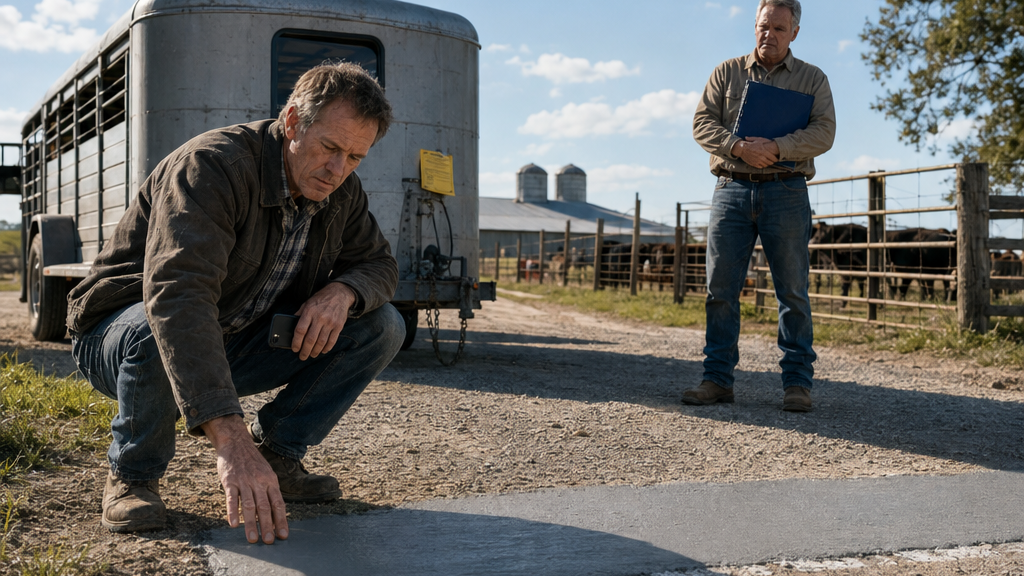
The gray paint was still tacky enough to hold dust when Daniel Moore stopped his pickup at the end of the farm lane.
For eleven years, a white number had sat on the flattened edge of the shared gravel road where his turnout widened toward the cattle pens. It was not decorative. The private road association used those numbers to identify approved entrances for farm machinery, livestock trailers, fuel deliveries, and emergency access.
Daniel’s was gone.
A dull rectangle of fresh gray covered the pavement where the number had been.
He left the truck idling and walked toward it.
The morning feed run could wait two minutes. The livestock hauler due at nine could not.
Daniel crouched, ran one finger along the edge of the paint, and rubbed the residue between his thumb and forefinger. Fresh enough to mark his skin.
Someone had done it recently.
A yellow card fluttered under the windshield wiper of his stock trailer twenty yards away.
He pulled it loose.
UNREGISTERED ACCESS USE.
The amount printed beneath the violation code was large enough to make him read it twice.
Daniel glanced from the notice to the gray rectangle.
Then he looked up the road.
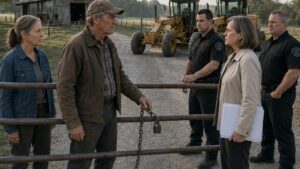
Donald Baker’s pickup was parked near the association mailbox cluster.
Donald stood beside it with a thick blue binder tucked beneath one arm.
Daniel folded the notice once and walked toward him.
“What happened to my number?”
Donald did not look surprised.
“The access classification was updated.”
“When?”
“Last week.”
Daniel looked back toward the gray patch. “Nobody told me.”
“Notice went out.”
“I didn’t get one.”
Donald shifted the binder higher against his side. He was in his early sixties, broad through the chest, with the patient expression of a man who had spent years listening to complaints he considered repetitive.
“You used the entrance this morning,” Donald said.
“I live there.”
“With a livestock trailer parked through an unregistered agricultural turnout.”
Daniel stared at him for a moment.
“The turnout became unregistered because somebody painted over its number?”
Donald’s expression tightened slightly.
“The number was removed because the designation changed.”
Daniel held up the yellow card. “And now I’m being cited because the number is gone.”
“You’re being cited because you used an access point that no longer qualifies under the current schedule.”
Daniel felt the first clean surge of anger.
He had known Donald for twenty years. They had sat through drainage meetings together, helped pull a feed truck from a ditch one February, and argued politely over whether a culvert should be twelve inches wider. Donald could be stubborn, but until now Daniel had considered him predictable.
Predictable men did not usually erase a marker first and explain the rule afterward.
“How was it changed?” Daniel asked.
“Association authority.”
“That’s not what I asked.”
Donald opened the blue binder.
Colored tabs divided the pages.
“Section six gives the board authority to revise access classifications based on usage.”
Daniel looked at the paragraph Donald indicated.
He did not touch the binder.
“Where’s the vote?”
Donald closed it.
“The board handled it.”
“What meeting?”
“You’re getting into procedural details.”
“That’s where rules usually live.”
Donald’s jaw set.
Daniel could see the argument opening in front of him—the kind that lasted years if a man stepped into it wrong.
His father had hated road fights.
A road belonged to everybody who needed it, he used to say. That meant you could spend the rest of your life proving you were right and still have to wave at the same man from the tractor the next morning.
Daniel had carried that lesson longer than he had carried most things his father taught him.
So he said nothing more.
He walked back to the turnout.
The hauler would arrive in less than an hour. He needed the entrance clear.
But before moving the trailer, Daniel took out his phone and photographed the gray patch from three angles. He placed the yellow violation notice beside it and took another photo.
Then he noticed something.
Along the lower edge of the new paint, a thin crescent of white showed through.
Daniel crouched again.
He pulled an old plastic feed-store loyalty card from his wallet. The store had stopped using the program years ago, but he kept the card because it was stiff enough to scrape frost from a gauge without scratching it.
He pressed one edge beneath the gray coating.
A strip peeled away.
White appeared underneath.
Daniel stopped.
He scraped another inch.
Then another.
A diagonal stroke emerged.
He knew the shape before enough of it was visible to prove anything.
The old number had not been removed.
It had been covered.
Donald had walked closer without Daniel hearing him.
“You shouldn’t be damaging association markings.”
Daniel sat back on his heels.
“I’m uncovering one.”
“That surface was repainted as part of the classification change.”
Daniel lifted his phone and took another picture.
Half the original numeral showed beneath the gray.
He placed the violation notice beside it again.
Click.
Donald’s face changed.
Not dramatically. Just enough.
Daniel stood.
“Who authorized the repainting?”
“I told you. The association.”
“Work-order number?”
Donald said nothing.
Daniel waited.
A truck rattled over the bridge farther down the road, tires crunching gravel. Neither man looked toward it.
“Board vote?” Daniel asked.
Donald’s voice hardened. “Daniel, this is exactly why these rules exist. Heavy-use entrances cost more to maintain. You’ve been bringing larger trailers through there.”
“I’ve brought cattle through there since before you were president.”
“And usage changes.”
“Then show me the change.”
Donald tucked the binder beneath his arm again.
“You already violated the current classification this morning.”
Daniel held the yellow card between two fingers.
“What happens if I use my own entrance again?”
“The next violation costs more.”
“How much?”
“Depends on the schedule.”
“The schedule you haven’t shown me?”
Donald looked toward the barns, perhaps deciding whether Daniel was baiting him.
Daniel was not.
That bothered him more.
He had spent years keeping accounts for a regional agricultural cooperative before returning to the farm full time. Numbers did not have tempers. Records did not care who had been president longer or whose family had owned land first.
If a charge existed, there should be a schedule.
If a classification changed, there should be a record.
If someone painted over an approved access number, there should be an authorization.
Daniel slipped the feed-store card back into his wallet.
“I’ll need the work order,” he said.
Donald’s patience disappeared.
“You need to comply with the access rules.”
“I can do both.”
“You’re making this more complicated than it is.”
Daniel looked down at the half-exposed number and the yellow notice beside it.
“No,” he said quietly. “I think somebody already did that.”
The livestock hauler arrived at eight fifty-three.
Daniel guided him through the same turnout.
Before the trailer wheels crossed from gravel onto his lane, Daniel photographed them.
Donald was still beside the association mailboxes.
He watched the whole thing.
That afternoon, Daniel found a second yellow envelope clipped beneath the lid of his mailbox.
He did not open it immediately.
He turned back toward the turnout and saw Donald’s truck pulling away.
For the first time, Daniel wondered whether the missing work order was an oversight.
Or whether there had never been one.
Chapter 2: The Rule Daniel Already Paid Once
Daniel found the registration sheet inside a cardboard file box marked ROAD—DRAINAGE in his father’s handwriting.
The box had spent nine years on the top shelf of the farmhouse office closet.
By Monday afternoon, its contents covered most of Daniel’s desk.
Meeting notices. Culvert estimates. Gravel invoices. Insurance certificates. Maps copied so many times that parcel lines faded into gray fuzz.
Then, halfway through a folder held together with a rusting metal clip, he found the page.
AGRICULTURAL ACCESS REGISTRATION.
His parcel number appeared near the top.
Beneath it:
Access 14.
Approved agricultural turnout.
Daniel sat still.
The document was dated eleven years earlier and signed by the association president who had served before Donald.
A later renewal form was stapled behind it.
Then another.
The most recent copy was only three years old.
Nothing on any page showed expiration.
Daniel set his phone beside the paperwork and opened the photograph from that morning.
Gray paint.
Scraped edge.
Half the old white number exposed.
He enlarged the image until the rough texture of the pavement filled the screen.
Fourteen.
Not memory.
Not habit.
Not his father’s opinion.
Fourteen.
He called the association office before he could talk himself out of it.
Donald answered.
“I found the registration.”
A pause.
“What registration?”
“Access Fourteen. Original designation and renewals.”
“The system has changed since then.”
“Show me where it changed.”
“The current rules govern.”
Daniel looked toward the blue sky reflected faintly in the office window.
“Do the current rules cancel existing access registrations?”
“You paid the heavy-use administrative charge in June.”
Daniel frowned.
“That was for the gravel repair after the feed truck came through in the rain.”
“It was assessed under the heavy-use provisions.”
“You called it a road repair contribution.”
“It was invoiced through the same authority.”
Daniel searched the desk.
He found the June bill beneath two fertilizer receipts.
The amount was modest. He remembered paying it the day it arrived.
No argument.
No meeting.
No question.
He had thought keeping peace over a few hundred dollars was cheaper than spending a summer fighting with Donald.
Now Donald was using the payment as proof Daniel had accepted something broader.
“You’re saying because I paid one road charge, I agreed my access could be reclassified?”
“I’m saying you accepted the association’s authority to assess heavy-use charges.”
“That’s not the same thing.”
“It’s part of the same schedule.”
“Send me the schedule.”
Donald exhaled through his nose.
“It’s available at the office.”
“I’ll come get it.”
Daniel arrived before five.
Donald had already placed the blue binder on the front counter.
The association office occupied one room in an old maintenance building near the bridge. Fluorescent lights buzzed overhead. A coffee maker sat unplugged beside a stack of road maps.
Donald opened the binder to a tab marked ACCESS.
“There.”
Daniel read slowly.
Heavy-use charges could be assessed for damage or exceptional wear associated with commercial or agricultural traffic.
Nothing in the language said an existing approved entrance became unregistered because a charge had once been paid.
Daniel turned another page.
“Where’s the fee schedule?”
Donald pointed toward a photocopied sheet.
There were amounts for culvert installation, emergency grading, ditch work, gate damage, and special equipment use.
The figure on Daniel’s yellow notice was not listed.
Neither was the amount on the second yellow envelope he had opened before leaving home.
“What’s this one based on?”
Donald glanced at it.
“Administrative processing.”
“It isn’t on the schedule.”
“It’s permitted under board discretion.”
Daniel looked back at the rules.
“Where?”
Donald tapped the binder.
“General enforcement authority.”
“That doesn’t establish an amount.”
“We’re not going to parse every sentence.”
Daniel almost smiled.
A decade earlier, he would have.
At the cooperative, he had once spent two days tracing seven cents through a feed inventory report because if one number was wrong for no reason, another usually was too.
But farming had changed his appetite for small battles.
He folded the second notice and put it in his pocket.
“Show me the minutes where Access Fourteen was reclassified.”
“I don’t have them in front of me.”
“When can I see them?”
“I’ll have to check.”
Daniel left without raising his voice.
That bothered him.
Not Donald.
Himself.
At home, he placed the registration sheet beside the photograph of the painted pavement.
Paper on one side.
Paint on the other.
Two versions of the same entrance.
He began a legal pad.
Registration date.
Renewal date.
June road charge.
First violation.
Second violation.
He wrote the published fee amounts beneath them.
Then he drew a line beside the two charges that did not appear anywhere in the schedule.
The next afternoon, another envelope arrived.
This one charged him for trailer use.
Daniel read it standing beside the mailbox.
He felt something close to shame.
Not because the fee was large.
Because Donald had been right about one thing.
Daniel had paid the first disputed charge.
He had not asked what authority supported it. He had not requested minutes. He had not wanted to be the man who turned every association matter into a quarrel.
A quiet payment had seemed decent.
Now that quiet payment had become evidence against him.
Wednesday evening, Samuel Young drove into Daniel’s yard in an old flatbed truck.
He did not get out immediately.
Samuel and Daniel had never been close. They borrowed tools occasionally, exchanged hay prices, and helped each other when equipment failed at inconvenient times. That was enough for most rural friendships.
Samuel finally climbed down holding an envelope.
“Heard you and Donald are having a disagreement.”
“Seems Donald’s heard it too.”
Samuel gave a humorless half smile.
“I figured maybe you’d done something.”
Daniel looked at him.
Samuel shrugged. “You know how stories travel.”
“I know.”
Samuel handed him three pages.
The charges were six months apart.
One read TRAILER ROAD USE.
Another read SPECIAL EQUIPMENT ADMINISTRATION.
The third read PROCESSING—HEAVY ACCESS.
Daniel read the amounts.
Different labels.
Different totals.
Same trailer plate number typed at the bottom.
Samuel rested both hands on the truck bed.
“That trailer hasn’t changed in nine years.”
Daniel looked back at the papers.
“Did you ask?”
“Once.”
“What’d Donald say?”
“That the schedule changed.”
Daniel held the three bills side by side.
“Did he show you where?”
Samuel shook his head.
For a few seconds neither man spoke.
Then Samuel said, “I thought this was about your entrance.”
Daniel looked at the gray patch visible down the lane.
“So did I.”
Chapter 3: More Than One Farmer’s Fine
Samuel laid all three invoices across Daniel’s kitchen table Saturday morning and placed a coffee mug on the corner of the oldest one to keep the ceiling fan from lifting it.
“Same trailer,” he said. “Same road. Three names for the charge.”
Daniel set the published fee schedule beside them.
The largest amount Samuel had paid did not appear anywhere on it.
Neither did the second largest.
Daniel had invited no one else.
That was deliberate.
Samuel had suggested asking two neighboring landowners to stop by, but Daniel refused.
“I’m comparing paper,” he told him. “I’m not starting a meeting.”
Samuel leaned back.
“You think there’s a difference?”
“Yes.”
Samuel gave him a long look. “Donald’s already telling people you want special access because you run cattle.”
Daniel’s jaw tightened.
That was exactly the sort of thing he had hoped to prevent.
One man raises a question.
Another man gives it a motive.
By Sunday everybody knows the motive but nobody remembers the question.
Daniel pointed at Samuel’s invoices.
“This is what I care about.”
“Then you might care about more than mine.”
Samuel opened a folder.
Inside were photocopies.
A ditch-cleaning surcharge from one landowner.
A “seasonal equipment processing” fee from another.
A road-use penalty assessed to someone whose combine had never left his own parcel but whose contracted grain hauler had used the shared road.
Daniel looked up.
“You asked them for these?”
“They offered once they heard what happened to your number.”
Daniel stared at Samuel.
“You said you weren’t starting a meeting.”
“I didn’t. The mailboxes did.”
That afternoon Daniel drove the length of the private road.
Not knocking on doors.
Not yet.
He stopped at the association mailboxes and studied the notice board.
The current fee schedule was pinned beneath a plastic cover.
He photographed it.
Then he compared the posted version with his copy.
Identical.
No processing charge.
No seasonal administration.
No trailer-registration penalty.
A pickup slowed behind him.
Rebecca Nelson lowered her window.
“You collecting evidence?”
Daniel stepped away from the board.
“I’m reading what’s posted.”
Rebecca shut off the engine.
She was the association treasurer and had served on the board longer than Donald had been president. Daniel knew her as careful, courteous, and almost impossible to pull into an argument.
“That’s become evidence lately,” she said.
Daniel held up the schedule.
“Are there other fee sheets?”
Rebecca’s eyes moved toward the road.
“There are discretionary charges.”
“Where are the amounts approved?”
“The board gives the president latitude.”
“That’s not an amount.”
Rebecca looked at him then.
“You sound like an accountant again.”
“I used to be one.”
“I remember.”
Daniel folded his copy.
“Samuel has three different fees for the same trailer.”
Rebecca’s expression changed.
Only slightly.
Enough.
“You’ve seen them?”
“I’ve seen enough.”
“Are they authorized?”
She did not answer.
Daniel waited.
Cars moved somewhere beyond the tree line, but on the private road the only sound was a loose mailbox door tapping in the wind.
Finally Rebecca said, “The road account is under pressure.”
“That wasn’t my question.”
“It should be part of your question.”
She restarted the pickup.
Before driving away, she said, “Don’t assume a bad set of numbers always means somebody took something.”
Daniel stood beside the mailboxes after she left.
That line stayed with him.
At home, he began a spreadsheet.
He had not built one from scratch in years.
Columns came back to him like muscle memory.
Date.
Property.
Charge description.
Published category.
Amount.
Known road work.
He entered his own fees first.
Then Samuel’s.
Then the copies Samuel had brought.
The pattern sharpened before supper.
Charges with similar purposes had different names.
Different properties had paid different amounts.
Several administrative fees clustered near months when major road work occurred.
Daniel stopped typing.
He opened the association newsletter archive on his laptop.
Spring grading.
Culvert replacement.
Emergency gravel after heavy rain.
He entered the dates.
The irregular fees sat close to them.
Not perfectly.
But close enough to notice.
Sunday evening, Samuel returned.
Daniel showed him the screen.
Samuel squinted at the columns.
“So he’s using fines to pay for repairs?”
“I don’t know.”
“Looks like it.”
“It looks like something. That’s not the same.”
Samuel crossed his arms.
“You always this careful?”
“When numbers can ruin somebody, yes.”
Samuel studied him.
“Donald isn’t careful with yours.”
Daniel closed the laptop halfway.
“That doesn’t give me permission to be careless with his.”
Samuel was quiet for a moment.
Then he nodded.
Monday morning, Rebecca called Daniel before he finished feeding.
“I need to tell you something before you start asking for records.”
Daniel stepped into the barn aisle, away from the bawling calves.
“All right.”
“The association has enough cash to operate,” she said, “but not enough margin.”
“How little?”
“I’m not discussing balances over the phone.”
“Then what are you telling me?”
“That if you start pulling numbers apart, understand what you’re pulling apart.”
Daniel looked toward the open barn door.
The shared road lay beyond the pasture, pale and hard in the morning light.
“You think I should stop?”
“I think you should know there are people on this road who can’t absorb another large dues increase.”
“I didn’t ask for one.”
“No. But the gravel company did. The insurance carrier did. The culvert contractor did.”
Daniel said nothing.
Rebecca lowered her voice.
“Donald has been trying to keep assessments flat.”
“How?”
Another pause.
“That’s what you’re going to ask, isn’t it?”
“Yes.”
He heard her breathe out.
“Then don’t start with fines.”
“What should I start with?”
“Deposits.”
Daniel straightened.
“Which deposits?”
“The penalty deposits.”
“And compare them to what?”
This time Rebecca took several seconds.
“The maintenance account.”
The line went quiet after she said it, as though she regretted the words before Daniel could answer.
Then she added, “I’m not saying what you think I’m saying.”
“I don’t know what I think yet.”
“That may be the smartest thing you’ve said.”
She hung up.
Daniel remained in the barn aisle with the phone in his hand.
The calves shifted behind the gate.
He looked at the spreadsheet on his screen through the office window.
Until that moment, he had been trying to prove that Donald had invented charges.
Rebecca had just given him a different question.
What if the money had not vanished?
What if it had gone exactly where the road needed it?
Chapter 4: The Money That Kept the Road Open
Daniel totaled the penalty receipts twice.
Both times he got the same number.
He sat back from the farmhouse computer and stared at the last cell in the spreadsheet as if it might change out of embarrassment.
It did not.
He had entered eighteen months of payments from copies Samuel had collected, his own notices, and the association records Rebecca had made available after Daniel submitted a written request. Not every owner had been willing to share invoices, so the total was incomplete.
Even so, the amount clearly identified as penalties and administrative charges was already higher than the penalty revenue reported in the association’s annual summary.
Daniel checked the dates again.
Then he checked his formulas.
The old habits returned without effort. At the cooperative, the quickest way to make a mistake was to become excited by what you thought the numbers proved.
So he assumed he was wrong.
He recalculated manually.
Same result.
He printed the spreadsheet and carried it to the kitchen table.
Two columns sat side by side.
Money collected.
Money officially categorized.
They did not reconcile.
On Tuesday evening, Daniel drove to the association office.
Rebecca had arranged for him to review deposit summaries, maintenance reports, and approved contractor bills. Donald was there when Daniel arrived, the blue binder open on the counter.
“You’re not taking originals,” Donald said.
“I didn’t ask to.”
“No photographs of bank information.”
“I need transaction dates and categories.”
“You can copy what the board has authorized.”
Daniel pulled out a legal pad.
“What hasn’t the board authorized?”
Donald looked at him.
Rebecca, seated behind a folding table, intervened.
“He means personal account details.”
Daniel nodded and sat down.
For two hours he copied dates.
Gravel payments.
Culvert work.
Insurance premiums.
Emergency grading.
The association’s ordinary income came mostly from annual assessments. It was easy to follow.
The irregular money was not.
Several deposits combined dues, penalties, and what the records called administrative receipts. Later entries shifted portions of those deposits into maintenance without clearly identifying which dollars had come from which category.
Daniel drew lines between dates.
A cluster of penalty receipts appeared in March.
Two weeks later came a large gravel payment.
Another cluster followed early summer.
Then a culvert contractor was paid.
He stopped writing.
Rebecca noticed.
“What?”
Daniel pointed at the dates.
“These amounts are moving near maintenance payments.”
Donald closed a drawer harder than necessary.
“Of course they are. It’s one association.”
“That doesn’t answer how they were categorized.”
“The road needed work.”
Daniel looked at him. “I know.”
For the first time since the gray paint appeared, Donald seemed more tired than angry.
He pulled out a chair.
“You want to know what happens if we wait for perfect accounting categories before fixing a washout?”
“I want to know whether people were charged under rules they could actually read.”
“That road doesn’t care what the label says when water cuts through it.”
“No. But the people paying do.”
Donald leaned forward.
“People also care when their ambulance can’t get through because we didn’t gravel the grade.”
Rebecca said quietly, “Donald.”
He ignored her.
“You know how many times we proposed raising annual assessments?”
Daniel did know.
Twice in recent years.
Both proposals had failed.
One by a wide margin.
Daniel looked back at the records.
That was the first moment the shape of the problem changed.
He had been looking for money that disappeared.
Instead, some of it seemed to have gone exactly where Donald claimed the association needed it.
By Thursday, Daniel had enough invoices to test the idea.
He lined up the unexplained difference against outstanding and recently paid maintenance bills.
The numbers were not exact.
But they were close.
Closer than coincidence felt comfortable.
One culvert invoice had been paid three weeks late.
The spring gravel contract had nearly emptied the operating account.
An insurance renewal had increased sharply.
Daniel rubbed both hands over his face.
If Donald had simply stolen the money, the answer would have been easier.
Call a meeting.
Show the totals.
Demand an explanation.
But if the extra charges had been keeping the road open, exposing the system without replacing it could leave every farmer and acreage owner with a different problem.
Daniel thought of his father.
Never turn a shared road into a feud.
For years Daniel had heard that as advice to avoid confrontation.
Now he wondered whether his father had meant something harder: solve the road, not just the argument.
On Friday evening, Daniel returned to the records room.
Donald was gone.
Rebecca had left a box of older invoices on the table.
The blue binder remained on a shelf.
Daniel took it down.
For weeks Donald had used the binder as if its thickness settled every question. Daniel opened each tab carefully.
Access.
Drainage.
Assessments.
Enforcement.
Minutes.
He compared citations to approved policies.
Some matched.
Others pointed only to general language giving the board power to maintain the road.
Nothing established the specific processing charges Daniel had seen.
Then, inside the maintenance section, he found a contractor invoice.
ROAD MARKING AND ACCESS IDENTIFICATION.
The date was three days before Daniel discovered the gray paint.
Several entrances were listed.
Most had routine notes beside them.
Refresh number.
Replace faded marker.
Clear edge.
Beside Daniel’s turnout was a different instruction.
ACCESS 14 — COVER EXISTING DESIGNATION.
Daniel read it twice.
At the bottom was a handwritten authorization line.
D. Baker.
There was no board approval number.
No meeting reference.
No attached access review.
Daniel photographed the invoice identification number, then checked the meeting minutes from the month before.
Nothing.
He checked the month after.
Nothing.
Rebecca entered carrying a stack of folders.
She stopped when she saw the invoice.
“You found that.”
“You knew about it?”
“I knew the contractor did the work.”
“That’s not what I asked.”
Rebecca set down the folders.
“No. I didn’t know there was no vote reference.”
Daniel tapped the authorization line.
“Donald signed it.”
“Yes.”
“And then cited me for using an unregistered entrance.”
Rebecca’s face tightened.
“He thought your equipment use should have moved you into the heavy schedule.”
“Then why not vote on it?”
“I don’t know.”
Daniel looked at the invoice again.
The financial problem could explain why Donald wanted more revenue.
It could not explain why he had created the condition used to penalize Daniel.
Unless the two things were connected.
He closed the binder.
Rebecca remained standing across from him.
“You need to be careful what you say next.”
“I have been.”
“I mean publicly.”
Daniel looked at the signature.
For weeks he had been asking whether Donald had improvised the access change.
Now he had an answer.
Donald had ordered it.
The question was why he had needed Daniel’s entrance to disappear first.
Chapter 5: What Rebecca Chose Not to Ask
“The spring gravel bill could not have been paid from dues alone.”
Rebecca said it beside Daniel’s pickup the next morning before he had even shut the door.
They were in the feed store parking lot, both there early enough that only two other vehicles sat near the loading dock.
Daniel looked at her.
“You asked to meet.”
“I know.”
“And that’s where you want to start?”
“Yes.”
She held a paper cup of coffee with both hands.
“The association was short before the gravel contract. Not technically insolvent. But close enough that one emergency could have put us there.”
“How close?”
Rebecca glanced toward the store.
“Close enough that Donald started moving every discretionary dollar he could find.”
“Including penalties.”
“Yes.”
“And charges that weren’t on the published schedule?”
Rebecca’s silence answered before she did.
“Some of them.”
Daniel felt no satisfaction.
He had imagined this conversation several times. In those versions, Rebecca admitted something clean. A fact that divided right from wrong.
The real version was messier.
“How long did you know?”
“I knew the maintenance account was tight.”
“That isn’t what I asked.”
“I knew Donald was using administrative income to cover maintenance.”
“Did you know where the administrative income came from?”
“Not every charge.”
“Did you ask?”
Rebecca stared into her coffee.
“No.”
The word came quietly.
Daniel leaned against the truck.
“Why?”
“Because I knew what the other option was.”
“A dues increase.”
“A large one.”
“That still doesn’t make the charges authorized.”
“I know.”
“Did you know then?”
Rebecca finally looked at him.
“I knew enough to ask more questions than I did.”
That landed harder than any denial would have.
She described the previous year’s meetings.
The gravel supplier raised rates.
Insurance increased.
Two culverts needed work sooner than expected.
Donald proposed higher assessments.
Owners objected.
One elderly landowner said another increase might force a sale.
Another had medical bills.
Several larger farms argued that acreage owners should pay more because they expected smoother roads.
The acreage owners argued farm equipment caused most of the wear.
The proposal died.
Then another.
“We kept saying we’d revisit it,” Rebecca said. “And every month there was another bill.”
“So Donald found money somewhere else.”
“He called it targeted cost recovery.”
Daniel almost laughed, but there was nothing funny in it.
“Did the board approve that phrase?”
“Not formally.”
“Did the board approve the charges?”
“Some.”
“Which ones?”
Rebecca looked away.
“That became harder to answer than it should have.”
Daniel rubbed the side of his jaw.
He thought of Samuel’s three invoices.
Different labels.
Same trailer.
“Did other board members know?”
“They knew the budget was being stretched.”
“Did they know how?”
Rebecca hesitated.
“Some preferred not to.”
There it was.
Not a conspiracy.
Something more ordinary.
People who wanted the road fixed.
People who did not want the cost attached plainly to their own names.
A president willing to make decisions nobody wanted voted on.
A treasurer willing to accept deposits without forcing the question of where each charge came from.
Daniel had wanted a villain because villains simplified responsibility.
Rebecca was taking that away from him.
That evening he drove to her farmhouse.
They sat on the front porch with a copy of the annual budget between them.
Daniel had calculated what transparent maintenance would cost.
Rebecca studied the estimate.
“You know what this means.”
“Yes.”
“Your assessment goes up too.”
“I can read.”
“More than some.”
“I run heavier equipment.”
She nodded.
Daniel looked at the figure beside his parcel.
He did not like it.
Not even a little.
His cattle margins had narrowed that year. Diesel was still high. A veterinary bill from spring had landed badly.
The number was manageable.
But it was not painless.
Rebecca watched him.
“This is why Donald did it.”
Daniel looked up sharply.
“No. This is why he was afraid to bring it to a vote.”
“That’s what I mean.”
“It matters how you say it.”
Rebecca folded her arms.
“He thought people would refuse.”
“They might have.”
“And then?”
“Then the board has to make another legal choice.”
“Which one?”
“Cut work. Delay projects. Raise dues differently. Change the formula. Borrow if the rules allow it. But you don’t invent fines because the right answer is unpopular.”
Rebecca looked down at the budget.
“You really believe they’ll vote for this?”
Daniel did not answer immediately.
That was the uncomfortable part.
He did not know.
A truck passed on the road beyond her house.
The sound faded.
Rebecca said, “Donald didn’t start out trying to punish people.”
“I didn’t say he did.”
“He was trying to keep the road from becoming everybody’s problem.”
“It already is everybody’s problem.”
She nodded slowly.
Daniel gathered the papers.
At the association office the next morning, Rebecca showed him additional monthly reports.
Several board signatures appeared at the bottom.
No one had objected to the rising administrative-income line.
No one had demanded a detailed schedule.
Daniel placed his finger on one month.
“You signed this.”
“I did.”
“You knew it was unusually high.”
“Yes.”
“And you didn’t ask.”
“No.”
He expected defensiveness.
Instead Rebecca said, “I told myself Donald knew which properties were creating extra cost. It was easier to believe that than tell three retired people their dues might jump.”
Daniel looked at her.
That was the surprise he had not prepared for.
Rebecca had not been protecting Donald.
She had been protecting an outcome she preferred.
The distinction did not absolve her.
But it made the failure belong to more than one person.
Before Daniel could respond, the office door opened.
Donald entered carrying the blue binder.
He placed an envelope on the desk.
“Formal notice.”
Daniel opened it.
A board hearing had been scheduled for the following Thursday.
Subject: suspension of heavy-equipment access privileges.
Daniel read the final paragraph.
Pending review, additional violations could result in temporary restrictions on commercial livestock and machinery traffic through Access Fourteen.
He raised his eyes.
“You’re trying to suspend an entrance you already painted out.”
“I’m trying to bring your traffic under the same rules as everybody else.”
“By removing the designation first?”
Donald’s face reddened.
“You keep acting like paint is the issue.”
“It became the issue when you used it as evidence.”
“The issue is cost.”
Daniel held up the hearing notice.
“No. Cost is one issue.”
Donald took a step closer.
“Then bring your paperwork Thursday.”
Daniel folded the notice.
He thought of the maintenance estimates at Rebecca’s house.
Of his own increased assessment.
Of his father’s warning.
Until that morning, Daniel could still imagine exposing Donald’s system and walking away once his own access was restored.
The hearing notice removed that option.
If he challenged the numbers now, he would also have to tell everyone what honest numbers would cost them.
Chapter 6: The Hearing About One Entrance
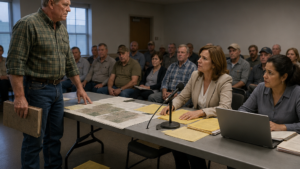
Donald opened the meeting by asking the board to suspend Daniel Moore’s agricultural access.
No introduction.
No discussion of the gray paint.
No mention of the invoices Daniel had requested.
Just the motion, spoken into the volunteer fire hall while folding chairs scraped against the concrete floor.
“Pending compliance with the current heavy-use schedule,” Donald added.
Daniel sat in the second row with a folder on his lap.
Samuel occupied the chair beside him.
Rebecca sat at the folding table with the other board members.
The blue binder rested in front of Donald.
About two dozen landowners had come.
That was more than attended most annual meetings.
Donald looked toward Daniel.
“You’ll have an opportunity to respond.”
Daniel stood.
“I’d rather ask one question first.”
Donald’s mouth tightened.
“About the access hearing?”
“Yes.”
Daniel walked to the front and placed three things on the table.
A photograph of the gray-painted number.
The original Access Fourteen registration.
The contractor invoice ordering the designation covered.
He turned the photograph so everyone could see it.
“Was there a recorded board vote authorizing this?”
Donald glanced at the other board members.
“The president has authority to administer access classifications.”
“That wasn’t my question.”
A chair creaked somewhere behind Daniel.
Donald put both palms on the table.
“I ordered the repainting.”
The room changed.
Not loudly.
No one gasped.
But bodies shifted.
Rebecca looked down.
Daniel kept his voice level.
“Was there a vote?”
“No.”
“Was there a written reclassification approved by the board?”
Donald hesitated.
“The access needed review because your equipment use had increased.”
“Yes or no?”
“No formal vote.”
Daniel nodded.
For weeks, that answer would have felt like victory.
Instead he looked toward the landowners.
“This photograph is why I started asking questions.”
Donald interrupted.
“This hearing is about heavy-use access, not paint.”
Daniel turned to him.
“Then let’s talk about heavy-use charges.”
He opened his folder.
Donald’s expression changed.
Daniel did not begin with his own fines.
That had been the temptation.
Instead he looked at Rebecca.
“Can you confirm the total penalty and administrative income recorded over the last eighteen months?”
Rebecca stiffened.
Donald said, “That’s outside the scope of this hearing.”
Daniel kept his eyes on Rebecca.
“Can you confirm it?”
One board member leaned toward her.
Rebecca opened a report.
She read the number quietly.
Daniel asked, “Does that total include all processing charges collected from individual properties?”
Rebecca paused.
“No.”
Murmurs moved through the chairs.
Donald picked up the blue binder.
“We have multiple accounting categories.”
“I know,” Daniel said.
He laid Samuel’s invoices beside the binder.
“Where in the published fee schedule are these amounts?”
Donald did not look at them.
“Discretionary enforcement authority.”
“Show the approved amounts.”
“You’ve made your point.”
“No.”
Daniel surprised himself with the firmness of the word.
He had spent years stepping away from exactly this kind of moment.
Not because he lacked arguments.
Because he feared what happened after them.
He remembered his father warning about road feuds.
But his father had never told him to pretend a bad culvert was sound because mentioning the crack might offend the man who installed it.
Daniel faced the room.
“My access should not have been painted over without a vote. That part is simple.”
A few heads nodded.
“But if I stop there, I’m doing the same thing I’ve accused the board of doing.”
Donald stared at him.
Daniel continued.
“I’m only talking about the part that costs me.”
The room went still.
He looked toward Rebecca.
“Tell them about the maintenance account.”
Donald’s chair moved sharply.
“Rebecca—”
She opened another folder.
“The road would likely have finished the year in deficit without additional administrative and penalty revenue.”
That produced more reaction than the unauthorized repainting.
Someone near the back asked, “How much deficit?”
Another voice said, “What additional revenue?”
Donald raised one hand.
“This is exactly what I have been trying to prevent.”
Daniel looked at him.
“Then explain it.”
Donald stood.
For the first time that evening, the blue binder remained closed.
“You all voted down assessment increases,” he said. “Twice.”
No one interrupted.
“Gravel went up. Insurance went up. Culvert work went up. We had storm damage. Every meeting, people wanted the road maintained and assessments frozen.”
“That doesn’t authorize hidden fees,” Samuel said.
Donald turned toward him.
“You want your road washed out?”
“No.”
“You want the bridge approach graded?”
“Yes.”
“You want emergency access?”
“Yes.”
“Then it costs money.”
Samuel leaned back.
“I know what money costs.”
Donald looked around the room.
“I made choices because somebody had to.”
Daniel heard truth in that.
Not enough truth.
But some.
He pointed to the repainting invoice.
“Did keeping the road open require you to erase my number?”
Donald’s expression hardened.
“Your cattle traffic was heavier than the old classification accounted for.”
“Then bring a reclassification to the board.”
“And spend three meetings listening to everybody argue about whose truck weighs what while the bill sits unpaid?”
“Yes.”
Donald blinked.
Daniel had not raised his voice.
“Yes,” he repeated. “If that’s the process.”
The room stayed quiet.
“That’s the part nobody likes,” Daniel said. “The process is slow. The bill still comes. People get angry. But if you decide the answer first and make the paperwork fit later, then the rules don’t mean anything.”
Rebecca closed her folder.
One board member asked, “How much are we actually short?”
Donald did not answer.
Daniel could have.
He had estimates.
But not a complete budget.
Not yet.
If he threw out a number now, it would become the next rumor before sunrise.
He gathered his papers.
“I’m not asking you to vote Donald out tonight.”
Several people looked surprised.
Donald most of all.
Samuel leaned toward Daniel. “You sure?”
Daniel nodded.
He looked at the board.
“I’m asking you not to suspend my access tonight either.”
One board member whispered to another.
Rebecca said, “That seems reasonable until the financial review is complete.”
Donald sat slowly.
Daniel continued.
“Give me one week.”
“For what?” someone asked.
“To put the whole thing in one place. Every approved charge I can verify. Every penalty category. Maintenance costs. What the road actually needs next year.”
Donald gave a short laugh.
“And then what?”
“Then nobody gets to say they didn’t know.”
Daniel looked around the fire hall.
“And nobody gets to pretend fixing this is free.”
That silenced the room again.
The board postponed the suspension vote.
People remained after the meeting, speaking in low clusters.
Some were angry at Donald.
Others were angry at the idea of higher assessments.
A few seemed angry at Daniel for forcing both subjects into the same room.
Samuel helped him gather papers.
“You could’ve buried him tonight.”
Daniel slid the registration into his folder.
“That wouldn’t fix the road.”
Outside, Donald stood beside his pickup.
Daniel walked past.
“Moore.”
Daniel stopped.
Donald’s face was tired.
“You think they’ll thank you when they see the real number?”
“No.”
“Then why are you doing this?”
Daniel thought about the gray paint covering the white number.
Because it had been easier for Donald to hide a designation than ask people to accept a harder rule.
Because it had been easier for Daniel to pay a questionable charge than ask what it meant.
Different choices.
Same instinct.
Avoid the argument now.
Pay for it later.
“I want the number to be honest,” Daniel said.
Donald looked toward the road.
“So do I.”
Daniel almost replied.
Instead he got into his truck.
He had one week to prove two things at once:
that the association had crossed a line,
and that staying on the right side of it would cost every one of them more.
Chapter 7: Nineteen Thousand In, Eleven Thousand Named
Daniel put two numbers on the projection screen.
$19,184.
$11,027.
He did not put Donald’s name beside either one.
The volunteer fire hall went quiet anyway.
The projector hummed against the back wall. Folding chairs filled nearly every open section of floor this time, and several landowners stood along the side because there were no seats left. Daniel could feel their attention moving from the first number to the second and back again.
Samuel sat near the aisle.
Rebecca was at the board table with a calculator, three folders, and the expression of someone who had already decided not to look away.
Donald sat at the far end.
The blue binder was closed in front of him.
Daniel faced the room.
“The first number is what I can document as penalties, processing charges, administrative charges, and special road-use assessments collected during the last eighteen months.”
Someone in the back asked, “All from fines?”
“No.”
Daniel pointed to the lower figure.
“The second number is what I can clearly follow through categories that were approved, published, or consistently reported.”
A man near the wall said, “So eight thousand dollars is missing.”
Daniel shook his head.
“No.”
That answer produced immediate murmuring.
Daniel waited.
“I’m not saying eight thousand dollars was stolen. The records do not support that statement.”
He changed the slide.
Now the screen showed several maintenance invoices.
Gravel.
Culvert work.
Emergency grading.
Insurance.
Daniel had put dates beside each one.
“Most of the difference appears to have gone into actual association expenses.”
The room settled again.
Donald looked toward him for the first time.
Daniel continued.
“That matters.”
He pointed to a spring gravel invoice.
“This was real work.”
Then to an insurance statement.
“So was this.”
Then a culvert repair.
“And this.”
A woman in the front row folded her arms.
“If the money fixed the road, what are we doing here?”
Daniel had expected the question.
He clicked to the next image.
A photograph of his entrance filled the screen.
Fresh gray paint covered the number.
Beside it was the contractor invoice directing Access Fourteen to be covered.
“This is why.”
No one spoke.
Daniel walked toward the screen.
“If Donald had proposed a higher assessment, we could have voted yes or no. If the board had proposed a new heavy-use formula, we could have argued about it. If the road needed emergency money, the rules gave us ways to deal with that.”
He looked at Donald.
“What we did instead was charge individual properties under amounts and labels they could not find in the published schedule.”
Donald leaned forward.
“We recovered costs from the people creating them.”
“Sometimes.”
Daniel clicked again.
Samuel’s three invoices appeared.
Same trailer.
Three different descriptions.
Three different amounts.
“No consistent formula explains these.”
A board member asked Rebecca, “Did we approve them?”
Rebecca looked through her papers.
“Not as a schedule.”
“Did we approve individual amounts?”
“Some maintenance-related charges, yes. Not all of these.”
Donald opened the blue binder.
“The board delegated administrative discretion.”
Daniel nodded.
“It did.”
Donald looked almost relieved.
“Then there you have it.”
“No.”
Daniel’s answer came calmly.
“Discretion is not the same as an unpublished fee system.”
Donald stood.
“Do you know how many hours I spent trying to keep that road usable while everybody complained about assessments?”
“Yes.”
“No, you don’t.”
Donald rested both hands on the table.
“You showed up tonight with spreadsheets. I showed up after storms. I called the grader. I found contractors when everybody else was busy. I argued with the insurance company. I took calls at six in the morning because somebody’s trailer couldn’t get around a washout.”
Daniel let him finish.
Nothing Donald said was false.
That was the hard part.
Donald looked around the hall.
“Everybody wants clean procedures until the road is under water.”
Several people avoided his eyes.
Daniel said, “That’s why I included the maintenance costs.”
He changed slides again.
This time the screen showed a proposed budget.
No penalty assumptions.
No hidden processing line.
Just road expenses, projected maintenance, reserves, and assessments.
A low groan moved through the room.
Someone said, “That can’t be right.”
“It is.”
Another landowner said, “That’s almost forty percent higher.”
“For some parcels.”
“What about farms?”
“Higher.”
Daniel clicked once more.
His own parcel appeared.
The increase beside his name was one of the largest.
Samuel turned slightly in his chair.
Daniel could feel the room recalculating him.
Until that moment, some people had probably assumed his goal was simple: cancel his fines, restore his entrance, embarrass Donald.
Daniel pointed to his own number.
“If we use the maintenance costs we actually expect next year, and if we stop treating fines as operating income, this is my share.”
A man near the rear said, “You’re agreeing to that?”
“I’m saying I won’t ask you to accept a number I won’t accept myself.”
The room grew very still.
Daniel remembered the first disputed road charge he had paid without asking questions.
At the time, silence had felt responsible.
Cheap, even.
Pay it.
Move on.
Keep peace.
But a fee paid quietly had become precedent. A decision nobody challenged became authority. A board that did not want to ask where the money came from learned not to ask.
Daniel turned toward Rebecca.
“Can the road operate on this budget?”
She studied the figures before answering.
“Yes.”
“With a reserve?”
“A modest one.”
“With no projected penalty revenue?”
“Yes.”
Donald looked at the screen.
His anger seemed to drain, leaving something heavier behind.
“You think people will vote for this?”
Daniel said, “I don’t know.”
“That’s why I did what I did.”
A few heads turned.
Donald continued.
“You know what happens when assessments rise. People postpone payments. They blame the board. Some of them really can’t afford it.”
Rebecca looked down at her hands.
Daniel said, “I know.”
“You don’t have three retirees calling you because they’re afraid they’ll have to sell.”
“No.”
“Then don’t stand there like this was easy.”
Daniel lowered the remote.
“I’m not.”
Donald’s eyes narrowed.
Daniel pointed to the screen.
“If it were easy, we wouldn’t be here.”
That quieted the room more effectively than accusation would have.
Rebecca opened one of her folders.
“I need to say something.”
Donald looked at her.
She did not look back.
“I knew the maintenance account was falling behind. I knew administrative income was being used to close the gap.”
A board member asked, “You knew about all these fees?”
“No.”
Rebecca swallowed.
“But I also did not insist on knowing.”
No one interrupted her.
“I thought keeping assessments down was protecting people. And every month we got through made it easier to tell myself we could fix the accounting later.”
She looked at Donald.
“That was my failure too.”
Daniel watched the room absorb that.
There would be no clean villain tonight.
Just choices.
Some worse than others.
Some made from fear.
Some from pride.
Some from convenience.
Daniel clicked back to the photograph of Access Fourteen.
“The problem with hiding a number,” he said, “is eventually nobody knows which rule they’re standing on.”
He set the remote on the table.
“I want my unauthorized penalties voided.”
Donald stared at him.
“I want Samuel’s charges reviewed. Same for anyone else charged under unpublished amounts.”
A woman near the front nodded.
“And I want Access Fourteen restored unless the board changes its classification through a recorded vote.”
Several people murmured agreement.
Daniel raised a hand.
“But that is not the whole motion.”
The hall quieted.
“I also want the budget reopened tonight and the assessment formula voted on at a properly noticed meeting.”
Someone immediately objected.
“You want us to pay more.”
“Yes.”
The answer came before Daniel had time to soften it.
The same man shook his head.
“You caused all this over a painted number and now you’re asking for more money?”
Daniel looked at the gray rectangle on the screen.
“No. I’m asking us to stop pretending the road costs less than it does.”
For several seconds no one said anything.
Then Samuel stood.
“I’ve got a motion.”
Donald closed his eyes briefly.
Samuel faced the board.
“Void penalties that can’t be tied to an approved schedule. Restore Moore’s entrance pending any lawful reclassification. Reopen next year’s budget. And no more administrative charges unless the amount is published and voted.”
A board member said, “What about Donald?”
Samuel looked toward him.
“What about him?”
“Removal.”
Samuel shook his head.
“Not in this motion.”
A few voices objected.
Samuel did not raise his voice.
“We came here to fix a road association, not hold an execution.”
Donald looked at him sharply.
Samuel continued.
“If people want a leadership vote, schedule one. But don’t mix it into the accounting because everybody’s mad.”
Daniel felt something in his chest loosen.
Not relief.
Recognition.
That was the road he had been trying to find.
Accountability without spectacle.
The motion was seconded.
Discussion began immediately.
It was not graceful.
People argued about axle weight, frontage, acreage, retired owners, emergency reserves, and whether farm operations should pay more. One landowner accused the board of hiding everything. Another admitted he had voted against both previous dues increases without ever asking how the difference would be covered.
No one applauded.
By the time the preliminary vote was taken, everyone looked tired.
The unauthorized penalties would be suspended and reviewed.
Access Fourteen would be restored.
The budget would be reopened.
A formal leadership vote would follow after the financial records were corrected.
Outside, Samuel stood beside Daniel under the parking-lot light.
“You know your assessment’s going up.”
Daniel folded his papers.
“I noticed.”
Samuel laughed once.
“That might be the least satisfying victory I’ve ever seen.”
Daniel looked through the fire hall window.
Donald was still inside, alone at the board table.
The blue binder sat in front of him.
“Maybe that’s because it isn’t one yet,” Daniel said.
Chapter 8: The Number Painted Back in White
The gravel contractor returned three weeks later with a bucket of white marking paint.
Daniel saw the truck from the barn and walked down the lane before the driver had even lowered the tailgate.
The gray rectangle was still there.
Rain and tires had dulled it, but not erased it.
The contractor unfolded a printed road map and placed it on the hood.
“Access Fourteen?”
Daniel nodded.
The contractor checked the map twice.
“Approved agricultural.”
“That’s what it says.”
The man crouched beside the pavement and taped out the stencil.
Daniel almost told him the old number was still underneath.
Then he decided it did not matter.
This time the number was not being uncovered from an argument.
It was being put there openly.
The board had approved the updated access map at a recorded meeting two nights earlier.
Every entrance designation appeared in the minutes.
So did the new heavy-use formula.
Daniel’s livestock and machinery traffic would cost him more next year.
Not through penalties.
Through an assessment everyone could see.
The contractor shook the paint.
A familiar pickup slowed on the road.
Daniel looked up.
Donald Baker parked beside the mailbox cluster.
For a moment Daniel wondered if he had come to stop the work.
Then Donald opened the passenger door and lifted out the blue binder.
He also carried a cardboard records box.
The contractor began spraying.
White paint filled the stencil.
Donald walked toward Daniel.
“I’m taking these to Rebecca.”
Daniel looked at the box.
“Corrected files?”
“As corrected as we could get them.”
Donald held out the binder.
Daniel did not take it.
“That belongs to the association.”
“I know.”
Donald looked toward the contractor.
The first digit was already visible.
One.
“You got what you wanted.”
Daniel looked at him.
“No.”
Donald gave him a tired half smile.
“Still difficult.”
“My fines are voided. The number’s back. That’s what I wanted at the start.”
“But?”
Daniel watched the contractor reposition the stencil.
“But the road still costs what it costs.”
Donald’s smile disappeared.
“Yes.”
At the leadership meeting the previous week, Donald had resigned before the vote.
No speech.
No accusation.
He simply said he no longer believed he could serve effectively after the board removed sole enforcement discretion from the president’s role.
He remained an association member.
His land still bordered the same road.
His truck would still use the same bridge.
That mattered more to Daniel than it might have once.
Rebecca stayed as treasurer, but the new financial procedures required two signatures for transfers, quarterly reports to all members, and published schedules for every recurring fee.
She had proposed most of those changes herself.
Daniel had supported them.
Then he had voted for the new assessment.
His own annual road cost increased enough that he had gone home afterward and recalculated two equipment purchases he had planned for winter.
Quiet justice was apparently not cheap.
Donald set the records box on the hood of his pickup.
“You know what bothered me most?”
Daniel waited.
“You were right about the process.”
Daniel said nothing.
Donald looked at the fresh paint.
“I still think the old formula undercharged heavy farms.”
“It did.”
Donald turned toward him.
That answer surprised him.
Daniel continued.
“We proved that too.”
“So you agree I was right.”
“About the cost.”
“Not the rest.”
“No.”
Donald nodded once.
The contractor peeled up the stencil.
Fourteen appeared in bright white against the road edge.
Clean.
Almost too clean.
Donald stared at it.
“I should’ve taken it to the board.”
“Yes.”
“They would’ve fought for two months.”
“Probably.”
“And the gravel bill still would’ve come.”
“Yes.”
Donald gave a short breath that was nearly a laugh.
“You make it sound simple.”
“I don’t think it was simple.”
Daniel looked toward his fields.
“What you did was easier.”
Donald’s face tightened.
“For a while.”
“That’s usually the problem.”
The contractor packed his equipment and drove toward the next access point.
Dust rose behind him.
Donald lifted the blue binder again.
At the association office, Rebecca met them at the door.
Daniel had not planned to go, but Donald asked him to carry the records box.
Inside, the folding table was covered with corrected statements.
Rebecca handed Daniel a copy of the final review.
His penalties showed zero balance.
Samuel’s three charges had been reversed.
Several other owners received credits.
Some credits would be applied against the new assessments rather than refunded immediately because the association could not afford a large cash drain.
Nobody loved that solution.
It had passed anyway.
Daniel scanned the report.
“Looks right.”
Rebecca gave him a narrow look.
“That from the farmer or the accountant?”
“Unfortunately both.”
Donald placed the binder on the table.
Rebecca opened the front cover.
For years, the binder had been Donald’s answer to every dispute.
Rules.
Authority.
Procedure.
Now colored tabs had been added.
APPROVED FEES.
RECORDED VOTES.
ACCESS CHANGES.
QUARTERLY REPORTS.
Rebecca looked at Donald.
“You want your copy of the resignation letter?”
“No.”
She nodded and filed it.
Nothing about the moment felt triumphant.
Daniel found that reassuring.
Outside, Donald climbed into his pickup.
Before closing the door, he looked toward Daniel.
“You going to run that cattle trailer over Fourteen tomorrow?”
“Probably.”
“Try not to tear up the shoulder.”
Daniel almost smiled.
“I’m paying for it now.”
Donald shook his head and drove away.
That afternoon, Daniel sat at his kitchen table with the first invoice under the new assessment formula.
The number was unpleasant.
Clear, but unpleasant.
He found himself staring at it longer than necessary.
There had been a time, not long before, when he might have folded it, written the check, and said nothing simply to avoid another argument.
Now the number bothered him for a different reason.
Not because it was hidden.
Because it was real.
He signed the payment.
The next morning the livestock hauler arrived shortly after eight.
Daniel opened the gate and walked toward the turnout.
The white Fourteen had dried overnight.
Tire marks from ordinary traffic crossed near it, but the paint remained bright.
The hauler slowed.
“Good here?”
Daniel looked down the shared road.
Past the mailboxes.
Past the repaired culvert.
Past the stretch that would receive new gravel before winter because everyone had finally agreed what it cost.
“Good here.”
The truck turned.
Its trailer wheels rolled across the entrance without hesitation.
Daniel stepped aside and watched it pass.
For years he had thought keeping peace meant leaving certain things alone.
A charge.
A decision.
A bad explanation.
A neighbor’s pride.
But some things did not disappear because nobody named them.
They simply hardened.
Like paint over an old number.
Daniel waited until the trailer cleared the gate.
Then he looked once more at the white Fourteen beneath his boots and walked back toward the cattle pens.
The story has ended.