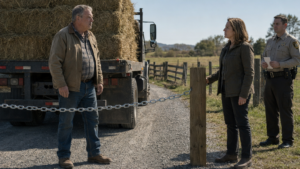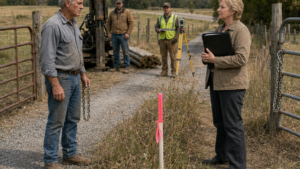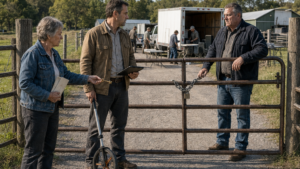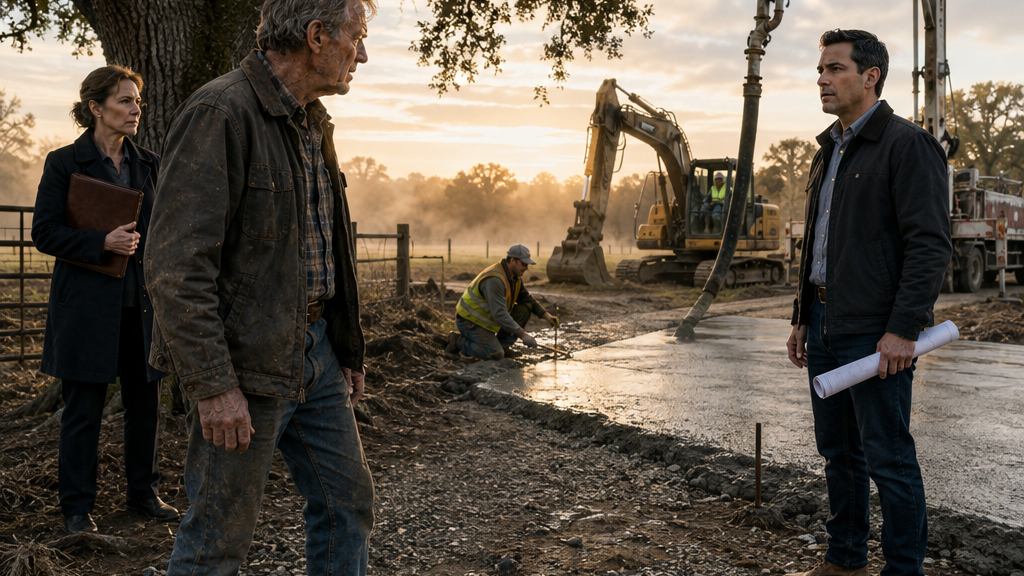
They Poured Concrete Across His Family Farm—Then the Old Gravel Lane Exposed What They Never Owned
Chapter 1: The Concrete Was Already Past the Oak Trees
William Walker woke to the sound of a concrete truck backing up.
The warning beeps came through the bedroom wall in slow, mechanical bursts.
Beep.
Beep.
Beep.
He sat upright before he was fully awake.
No one poured concrete on a cattle farm before sunrise unless they were trying to finish something before somebody objected.
William pulled on his jeans, shoved his feet into work boots, and stepped outside without bothering with coffee.
The eastern lane was already lit by portable work lamps.
Two trucks stood beyond the fence line. A pump hose stretched across the old gravel track his father had laid down decades earlier. Three men in reflective vests worked around fresh forms, and a ribbon of wet gray concrete had already pushed past the first oak tree.
William stopped walking.
The lane had always been narrow enough that two pickups had to ease past each other. Fourteen feet, give or take. Gravel in the center, grass feathering along both sides. The two oaks had grown there longer than William had been alive.
Now half the gravel had vanished beneath concrete.
Jason Perez stood near the pump truck with a rolled set of plans under one arm.
William called across the machinery. “Shut it down.”
Jason looked over.
He did not look surprised.
That bothered William more than if he had.
“Morning, William.”
“I said shut it down.”
The pump operator glanced toward Jason.
Jason lifted one hand but did not signal a stop. “We’re inside the access corridor.”
“You’re inside my farm.”
“We’ve been through this.”
“No. You sent me a letter saying you disagreed with me. That isn’t the same thing.”
The concrete continued sliding through the hose.
William stepped onto the old gravel and walked toward the forms.
Jason moved into his path.
“Don’t get near the equipment.”
“Then turn it off.”
“We have a pour scheduled.”
“And I sent you certified notice not to use this lane.”
“I received it.”
That stopped William.
Jason had never admitted that so plainly before.
“You received it,” William repeated.
“Yes.”
“And you poured anyway.”
Jason’s jaw tightened. “Because our position hasn’t changed.”
The operator looked from one man to the other.
William pointed at the controls. “You keep pouring after being told the land is disputed, that’s your decision. But I want your name written down before you do it.”
The operator lowered his hand from the lever.
For the first time that morning, the pump went quiet.
Jason exhaled through his nose.
“You’re making this harder than it needs to be.”
William looked past him at the concrete.
It had crossed the line where the gravel had always narrowed beside the first oak. The edge of the slab sat close enough to the trunk that wet cement had splashed onto exposed roots.
“Harder for who?”
Jason opened the plan set against the hood of a company pickup.
He had always dressed too clean for the site. Even now, before six in the morning, his boots looked new enough to return.
He tapped a highlighted strip.
“This is established access. It’s been used for decades.”
William did not look at the paper.
“My father let people through.”
“That’s not what the records show.”
“What records?”
Jason pulled a document from the folder.
Across the top was a property sketch William recognized from an older subdivision planning packet. A faded line ran along his eastern boundary. Beside it were the words access lane.
William finally looked.
Jason saw the hesitation.
“There,” he said. “That’s what we’ve been telling you.”
“A planning map doesn’t give you my dirt.”
“It supports continuous use.”
“For what?”
“Access.”
“For tractors? Trucks? Concrete pads?”
Jason’s mouth hardened.
“For access, William.”
The pump operator had shut the engine down now. The sudden silence made the birds in the hedgerow sound unnaturally loud.
William studied the map again.
He knew the lane had been used before Jason ever showed up. He knew his father had allowed the previous owner to bring hay wagons through when the lower field flooded.
He also knew there were parts of that history he had never explained to Jason.
Not because he thought they mattered.
At least, that was what he had told himself.
A pickup turned into the farm entrance behind him.
The licensed surveyor stepped out carrying a tripod and case.
Jason looked toward the truck.
“You called him?”
“Yesterday.”
“You knew we were pouring today?”
“I saw your forms.”
Jason folded the map. “This is unnecessary.”
“Then it won’t take long.”
The surveyor worked without entering the argument. He checked the recorded description William had provided, set his equipment, then walked the eastern strip with a locator and narrow shovel.
William followed.
Jason followed too.
Near the old oak, the surveyor scraped gravel aside.
Nothing.
He shifted eighteen inches toward the grass.
The shovel struck metal with a thin click.
William felt the sound in his chest.
The surveyor knelt and cleared the dirt with his fingers until the dark top of an old iron pin appeared.
“There it is.”
Jason said nothing.
The surveyor sighted back toward the next monument and checked his instrument.
Then he walked to the new concrete.
He measured once.
Again.
He looked at the plans.
“How far?” William asked.
The surveyor did not answer immediately.
Jason stepped closer. “This pin may not control the easement.”
“I didn’t ask about the easement,” William said. “I asked where my boundary is.”
The surveyor finally pointed.
“The deed line runs here.”
He marked the ground with a bright stake.
The concrete extended beyond it.
William looked at Jason.
Jason looked at the fresh slab.
For several seconds, nobody spoke.
Then Jason said, “Property ownership and access rights are two different questions.”
William had expected denial.
That answer was worse.
Because it was careful.
Because it sounded like something Jason had already been told by a lawyer.
A second vehicle arrived shortly after seven.
Heather Adams got out holding a leather folder and a travel mug. She had represented William once before on a farm lease and had warned him over the phone not to touch the new concrete, block equipment physically, or make promises to anybody.
She crouched beside the exposed pin.
Then she walked the edge of the slab.
“How far across?” she asked.
The surveyor gave her the measurement.
Heather nodded once.
William waited for her to say what he wanted to hear.
Instead she turned to Jason.
“You’re asserting an easement?”
“Yes.”
“Recorded?”
“Prescriptive.”
William looked at her.
Heather’s expression changed only slightly, but he saw it.
Not fear.
Calculation.
Jason continued. “Longstanding use. Known use. Continuous access. The route predates both the development and my involvement.”
Heather closed her folder.
“Do you have counsel handling that claim?”
“Yes.”
“Good. Have them contact me.”
Jason gave a short nod.
William watched him walk back toward the crew.
“Tell them they stay off this side until we sort it out,” Heather said.
Jason stopped.
“I can stop today’s pour. I’m not conceding access.”
“I didn’t ask you to.”
He stared at her a moment, then signaled the crew.
The men began disconnecting the hose.
William should have felt relieved.
The concrete was on his side of the line. A professional surveyor had said so in front of everyone. Work had stopped.
Instead he felt an old discomfort gathering behind his ribs.
Heather waited until Jason was out of hearing.
“How long has that lane been used by the neighboring property?”
William looked toward the gravel.
“My whole life, off and on.”
“By permission?”
“Sometimes.”
“Sometimes?”
“My father let them through.”
“How often?”
“It depended.”
“Did he ever put anything in writing?”
William rubbed dirt from the toe of his boot.
Heather’s voice stayed level.
“William.”
“He wasn’t a paperwork man.”
“That’s not what I asked.”
He looked at the exposed survey pin beside the wet concrete.
The iron was dark with age.
His father had known exactly where it was.
And suddenly the question was no longer whether Jason had crossed William’s boundary.
The concrete already answered that.
The question was what William’s own family had allowed people to believe about the fourteen feet before Jason Perez ever arrived.
Chapter 2: The Fourteen Feet Everyone Remembered Differently
The first time William found an excavator parked beneath the eastern oak, he told himself it would be gone by lunch.
It was still there after dark.
The machine sat with its bucket lowered into the grass, its tracks pressed deep into ground where William’s father had once scattered gravel by hand. A fuel can rested against the trunk.
William moved the can.
He did not call anyone.
That had been nearly two years before the concrete.
At first the neighboring development had seemed temporary in the way all construction looked temporary from a distance. Survey flags appeared. Brush disappeared. Trucks came and went.
Jason Perez introduced himself at William’s gate one afternoon with a firm handshake and an apology for dust.
“We may have a few deliveries cut through that side lane,” he had said. “Same route the old owner used.”
William had looked toward the east field.
“For how long?”
“Just while we’re getting established.”
William should have asked what that meant.
Instead he said, “Keep them off the wet ground.”
Jason smiled. “Absolutely.”
For a while, that was how it worked.
A pickup one day.
A flatbed the next week.
Then dump trucks.
Then tracked equipment.
By late summer, the lane no longer had two shallow tire paths. It had become one broad bed of crushed gravel and compacted soil.
Emma noticed before William admitted there was a problem.
She had grown up on the farm but lived twenty minutes away now. She came by most Sundays and still walked directly to the barn before entering the house, as if checking whether the place had changed while she was gone.
One afternoon she stood beside the eastern oak and pressed her boot into a rut.
“This wasn’t here last month.”
“It’ll settle.”
“That’s not settling.”
“They’re finishing grading.”
“You’ve been saying they’re finishing for a year.”
William picked up a broken branch and threw it into the loader bucket.
Emma looked at him.
“Did you give them permission?”
“I didn’t give them anything.”
“That isn’t an answer.”
He disliked the tone because it sounded like something he might have used on her when she was sixteen.
“The old neighbor used the lane.”
“So?”
“So it’s not as simple as you think.”
Emma glanced toward the development, where a dump truck was already turning toward them.
“Then make it simple.”
William stepped aside as the truck rolled past.
Dust lifted around them.
The driver raised two fingers from the steering wheel.
William returned the gesture automatically.
Emma stared at him.
“That,” she said, “is exactly the problem.”
He knew what she meant.
His father had been the same way.
If the neighbor needed to reach a back pasture during flood season, he could cross.
If a hay wagon bogged down on the county road shoulder, he could use the gravel lane.
If somebody needed to bring cattle through after a fence broke, nobody stopped to draft terms.
You asked.
You were told yes or no.
Then you remembered whose land you were standing on.
William had assumed everybody still understood that.
The construction crews did not.
By the following spring, one of the oaks began dropping leaves early.
William crouched beside the trunk and saw where machine tracks had packed the soil hard around exposed roots. One section of bark had been scraped raw.
That afternoon he went to Jason’s site office.
Jason listened while looking at a scheduling board.
“I’ll tell them to give the trees more room.”
“I want the heavy equipment off the lane.”
Jason turned.
“You’re closing access?”
“I’m telling you to use your own entrance.”
“Our main entrance isn’t ready for heavy trucks.”
“That sounds like your problem.”
Jason’s expression cooled.
“We’ve been using this route since before I came onto the project.”
“You’ve been using it because I didn’t make an issue out of it.”
“That’s not how our people understand it.”
“Then your people understand it wrong.”
Jason studied him.
“William, I’m trying not to turn this into something bigger.”
“So am I.”
Yet William left without putting anything in writing.
Another month passed.
The trucks continued.
Emma asked again.
“Why haven’t you told him the old arrangement was temporary?”
“I told him to stay off.”
“You told him in a trailer with no witness and no letter.”
“He heard me.”
“Dad.”
William opened the refrigerator.
“What?”
“You keep acting like people are supposed to know what Grandpa meant forty years ago.”
“They did know.”
“Then why are we having this conversation?”
He closed the refrigerator harder than he intended.
Emma went quiet.
That bothered him more than arguing would have.
The next morning William drove into town.
At the post office, he mailed a certified letter drafted from notes Heather had helped him clean up over the phone. It stated that he did not consent to continued construction traffic across the eastern strip and demanded that the development cease using it.
The clerk slid the receipt beneath the glass.
William stood there holding the little tracking stub.
It seemed ridiculous that four decades of handshakes could come down to a barcode and a signature.
At home he placed the receipt on the kitchen table.
Beside it lay an old photograph Emma had found in a drawer.
The picture showed William’s father standing near the eastern oak with a hay wagon in the lane behind him. Another man was at the wagon wheel.
On the back, in his mother’s handwriting, was a date from years earlier.
Emma picked up the certified receipt.
“You should’ve done this six months ago.”
“I know.”
She looked surprised.
William rarely gave ground that quickly.
Three days later, Jason responded.
Not by phone.
By letter.
The development company acknowledged William’s objection but stated that it considered the lane a historically established access route and reserved all claimed rights associated with continuous use.
William read the paragraph twice.
Then a third time.
Emma leaned against the counter.
“What does that mean?”
“It means he thinks telling him no doesn’t matter.”
Heather was less dramatic when William called.
“It means they’re preserving their position.”
“Do they have one?”
“I need history before I tell you that.”
William looked again at the old photograph.
“My father let the neighbor through.”
“How often?”
“I don’t know.”
“Then find out.”
That evening he and Emma climbed into the farmhouse attic.
The heat had collected beneath the roof despite the season. Cardboard boxes lined the rafters. Farm receipts. Equipment manuals. Old seed catalogs. Tax statements tied with string.
Emma opened a metal file box and sneezed.
William found his father’s notebooks near the bottom.
They were pocket-sized, stained around the edges, each year written on the cover in pencil.
His father recorded everything.
Calves born.
Fence posts replaced.
Diesel bought.
Hay cut.
Neighbors helped.
William sat on the attic floor and turned pages beneath the yellow bulb.
Then Emma touched his arm.
“Here.”
Beside a spring date from decades earlier, his father had written the former neighbor’s name.
Under it was one word.
Permission.
William turned several pages.
The word appeared again.
Another year.
Permission.
Then again beside a note about wet fields.
Emma looked at him.
“That helps us, right?”
William did not answer.
Because three pages later he found a different entry.
It mentioned use of the east lane.
And this one did not say when the permission ended.
Chapter 3: His Father’s Handwriting Changed the Case
The notebook entry was only nine words long, but William read it until the handwriting seemed to shift on the page.
East lane okay for access when lower road bad.
No date range.
No condition about tractors.
No phrase saying once or this season.
Nothing explaining whether his father meant a favor for that week or an arrangement meant to last.
Emma stood across the kitchen table.
“That doesn’t say permanent.”
“It doesn’t say temporary.”
“Everything else says permission.”
“Not this one.”
The notebooks lay between them in uneven stacks.
William had brought them downstairs after midnight and slept badly. By breakfast, he had separated every page mentioning the neighboring property.
Most helped him.
That one did not.
Heather arrived at nine.
She read the disputed entry once.
Then she read the pages around it.
William watched her expression, hoping for some small sign that it meant less than he feared.
She gave him none.
“You knew your father let them use the lane?”
“Yes.”
“How much did you know when you first called me?”
“That they crossed sometimes.”
Heather looked up.
“And you didn’t think that was important?”
“I thought permission meant permission.”
“It does. But frequency matters. Circumstances matter. Whether permission was asked for matters. Whether anyone later treated it as a right matters.”
“I never did.”
“You’re not the only person whose conduct matters.”
William pushed back from the table.
“So now their concrete stays?”
“I didn’t say that.”
“You’re talking like it.”
“I’m talking like your attorney.”
Emma folded her arms.
Heather continued.
“The surveyed boundary tells us where ownership lies. It does not answer every possible access question. Jason’s claim is that long use created rights separate from ownership. We need facts, not the version of the facts you wish your father had written down.”
William stared at the notebook.
Heather tapped the page lightly.
“If this becomes formal and they produce evidence you knew about but didn’t tell me, we have a credibility problem before we even get to the property problem.”
That landed harder than William expected.
“My father wasn’t giving land away.”
“I believe you. But belief is not what we’re organizing.”
Emma looked toward him.
He knew what she was thinking.
This was what she had been trying to tell him for months.
Silence did not become clearer just because everyone involved had once been friendly.
By noon they were at the county records office.
The clerk brought out plats, recorded deeds, subdivision documents and older survey references. William recognized property lines he had seen all his life rendered in black ink and measurements.
The neighboring parcel had changed owners twice since his father’s time.
None of the deeds they reviewed contained an obvious recorded easement across William’s fourteen-foot strip.
That should have felt decisive.
Heather would not let him treat it that way.
“No recorded easement is useful,” she said. “It is not the same as proving no other claim can exist.”
William muttered, “You ever give good news without taking half of it back?”
“When I have some.”
Emma smiled despite herself.
Then the clerk brought out an older development planning map.
William stopped smiling.
A thin line ran along the eastern side of his property.
Access lane.
The same words Jason had shown him at the concrete pour.
Heather leaned closer.
“This isn’t a deed.”
“No,” William said.
“But somebody relied on it.”
The map had been created years before Jason’s company bought the adjoining land. Whoever prepared it had apparently treated the lane as part of the neighboring parcel’s practical access system.
William felt the argument shifting again.
Not against him exactly.
Into uncertainty.
Back at the farm, he spread the notebooks across the kitchen table once more.
This time he read them differently.
Not looking for proof that his father owned the lane. Nobody disputed that.
He looked for how the lane had actually been used.
One entry mentioned allowing a hay wagon through because the lower road was flooded.
Another recorded permission for cattle after a washout.
A third said, Told him east lane fine until field dries.
Emma leaned over his shoulder.
“There.”
William marked it.
Two years later, another note:
Asked again about east lane. Said okay through harvest.
Emma sat down.
“If it were his right, why would he keep asking?”
William said nothing.
He turned another page.
Permission for equipment Tuesday.
Another.
Let them through after storm.
Again.
East lane okay this week.
The pattern was not a single permanent grant.
It was repeated permission.
The difference felt obvious now that he saw the pages together.
And embarrassing.
His father had documented the thing William had assumed did not require documentation.
Not formally.
Not legally.
But enough to show a habit: someone asked, his father answered.
William had inherited the land and somehow discarded the part of the habit that made the arrangement work.
He kept saying yes by never saying no.
Emma watched him.
“You thought you were doing what Grandpa did.”
William rubbed a thumb along the notebook’s worn edge.
“He didn’t hate paperwork as much as I remembered.”
She almost laughed.
“He wrote down every time somebody borrowed a post driver.”
“He wrote down who returned it broken too.”
For the first time in days, William smiled.
Then his phone rang.
Heather.
“I spoke with Jason’s attorney.”
William straightened.
“And?”
“They have the planning map. They also have statements that the lane was used by prior owners.”
“We know that.”
“Yes. But Jason was told something stronger when the property was purchased.”
“What?”
“That the eastern access had always gone with the property.”
William looked toward the window.
Through the glass he could see part of the lane and one bright survey stake beside the new concrete.
“Who told him?”
“They’re tracing it.”
Heather paused.
“William, I want you to hear something before you decide Jason fabricated this whole thing. He may have inherited a bad assumption.”
“He kept using my land after I told him to stop.”
“That may become the important distinction. But first we need the history clean.”
The following afternoon, William and Emma drove to see the former neighboring landowner.
The man met them beside a detached garage and listened while William explained the dispute.
When William mentioned the east lane, recognition came immediately.
“Your dad let us through there plenty.”
William’s stomach tightened.
Emma asked, “Did you understand it as your legal access?”
The former neighbor frowned.
“No.”
“Did anyone tell you it belonged to your parcel?”
“No. It was Walker ground.”
William leaned forward.
“You always asked?”
The man looked almost offended by the question.
“Of course I asked.”
“Every time?”
“If I needed it for more than a quick pass, yes. Your dad could be particular about that lane.”
William blinked.
“Particular?”
“He didn’t care about helping. He cared about people assuming.”
The sentence hung there.
The former neighbor scratched his cheek.
“One year I sent a hired man through without telling him. Your father stopped the tractor halfway down and made him turn around. Next morning I went over, asked, and your dad said yes.”
Emma glanced at William.
William looked down.
All those years he had remembered his father as a man who settled boundaries with handshakes.
He had forgotten that a handshake required somebody to ask first.
On the drive home, Emma did not say I told you so.
That made it worse.
At the farm entrance, a line of construction trucks waited on the neighboring road.
Instead of turning toward the unfinished main entrance, every driver was looking toward the old gravel lane.
And for the first time William understood that Jason’s mistake had not begun with concrete.
It had begun much earlier, when somebody converted a repeated favor into a line on a map and handed that assumption forward as if nobody would ever ask where it came from.
Chapter 4: The Shortcut Was Worth More Than Anyone Admitted
Jason Perez offered William money the morning after the former neighbor confirmed the lane had always required permission.
Not an apology.
Not an explanation.
Money.
He arrived at the farm gate just after seven with no crew behind him and no plans tucked under his arm. He held a plain envelope instead.
William stayed on his side of the gate.
“What’s that?”
“A proposal.”
“For what?”
“Temporary access.”
William looked at him for a long moment.
“You told me you already had access.”
Jason’s face tightened.
“We’re trying to avoid making this more expensive than it needs to be.”
“That wasn’t my question.”
Jason glanced toward the development entrance down the road.
A line of trucks waited there.
The company’s legal entrance had been cut into the neighboring parcel months earlier, but the approach remained unfinished. Drainage pipe lay beside the ditch. Fresh orange flags traced the route through churned clay.
It could be used eventually.
Not today.
Jason held the envelope through the gate.
“Thirty days. Limited hours. Heavy equipment only. We’ll repair any rutting.”
William did not take it.
“What happens after thirty days?”
“We reassess.”
“Meaning you ask for another thirty.”
“Meaning the main entrance should be ready.”
“Should be?”
Jason lowered the envelope.
“We’re behind.”
William almost smiled, but there was nothing satisfying about it.
“How far?”
Jason said nothing.
“That lane of mine. How much time is it saving you?”
Jason looked toward the waiting trucks again.
“Enough.”
That answer told William more than the letter inside the envelope could have.
He opened the gate just far enough to step through.
“You’ve spent months telling me this was your right.”
“I said we have a claim.”
“You poured concrete on it.”
“We believed the claim was sound.”
“And now you want to rent it.”
Jason’s patience slipped.
“I’m trying to solve the practical problem.”
“No. You’re trying to keep using the practical solution.”
The two men stood beside the fence while a truck engine idled down the road.
Finally Jason said, “The alternate entrance needs a larger culvert and additional base work. We can’t bring loaded concrete trucks over it yet. If we reroute all deliveries, I lose at least three weeks.”
“Then lose three weeks.”
“You think that’s nothing?”
“I think it isn’t my schedule.”
Jason rubbed a hand over his face.
For the first time since William had met him, he looked tired rather than polished.
“We have financing milestones tied to completion dates. Subcontractors scheduled in sequence. Miss one window, you don’t just move one truck. You move six trades.”
William understood that kind of pressure better than Jason probably expected. A late hay cutting could push baling into rain. A broken tractor on the wrong morning could undo a week.
But a farmer paid for his own delay.
He did not move the fence onto somebody else’s ground.
William tapped the envelope.
“Take it back.”
Jason did.
At Heather Adams’s office later that morning, William placed the old notebooks, copies of the county records, the planning map and Jason’s proposed temporary-access agreement across a conference table.
Heather read the agreement.
Then she set it beside Jason’s earlier letter asserting established rights.
“Interesting.”
Emma leaned forward. “Because he’s changing his story?”
“Because he’s acknowledging uncertainty.”
William pointed at the papers.
“He doesn’t get to call it his right one day and rent it the next.”
“He can,” Heather said. “People make alternative arguments all the time.”
“That sounds convenient.”
“It’s not about convenience. His company can maintain a legal position and still negotiate temporary access.”
William frowned.
Heather continued.
“But his offer does tell us something important. The lane has economic value to them right now.”
Emma said, “How much?”
Heather looked at William.
“That’s what we need to understand before anyone signs anything.”
They drove past the development that afternoon.
Instead of turning onto William’s gravel lane, a dump truck attempted the lawful entrance. Its rear wheels sank at the edge of the unfinished approach. The driver backed out and stopped traffic while another machine dragged base rock toward the ditch.
William watched from his pickup.
A second truck turned toward his lane out of habit.
Then stopped at the temporary barrier William had placed across it.
The driver sat there, unsure.
A site worker jogged over and redirected him.
The interruption lasted less than five minutes.
But five minutes repeated across dozens of deliveries became hours.
Hours became money.
Jason had not been defending an ancient principle.
He had been defending the cheapest route.
Heather confirmed the larger pattern two days later.
“The old use and the new use are not identical,” she told William.
They sat at his kitchen table this time.
“The former neighbor described occasional access tied to weather, pasture conditions, and specific needs. Your father’s notes support that.”
“And Jason?”
“He’s using the strip as a construction corridor. Frequency is higher. Weight is higher. Duration is different. He also added physical improvements.”
“The concrete.”
“The concrete matters.”
Emma asked, “So he loses?”
Heather gave her the same look she had given William after the survey.
“Not automatically.”
William groaned.
Heather ignored him.
“But the distinction is important. Even if some historic access right could be argued, that doesn’t necessarily mean unlimited heavy construction use or permanent structures.”
William looked toward the window.
A truck passed on the county road and continued to the development entrance instead of turning toward his farm.
For once, the old lane stayed empty.
“Jason knows this?”
“He knows enough to be worried.”
That evening Jason called.
William almost let it ring out.
He answered on the fourth ring.
“What?”
Jason skipped the greeting.
“My office wants to know what number gets us through the next six weeks.”
“No number.”
“Everybody has a number.”
“Then yours is the cost of finishing your own entrance.”
Silence.
Then Jason said, “You think I made this decision alone?”
William leaned against the barn door.
“I think your name was on the crew orders.”
“You have no idea what happens on a project like this when ownership issues come up late.”
“They didn’t come up late. I told you.”
“I sent it up.”
“And?”
“They told me legal would sort it out.”
“So you kept using the lane.”
“I was told to keep the project moving.”
There it was.
Not innocence.
Not exactly.
But not the clean arrogance William had assigned him either.
Jason continued.
“We had title summaries, old maps, prior-use statements. Everyone treated that corridor as established.”
“Everyone except the man who owned it.”
“I know that now.”
William heard the difference in his voice.
Not surrender.
Recognition.
“You knew it before the concrete,” William said.
Jason did not answer.
That silence told him enough.
The following morning a tree specialist arrived.
He spent nearly two hours around the oaks, checking bark wounds, soil compaction and root flare. He drove a narrow probe into the ground at measured intervals.
At the second oak, the probe barely penetrated.
The specialist crouched and scraped away gravel.
“Machinery’s been running here a lot?”
“For two years.”
“Heavy?”
“Yes.”
The specialist nodded slowly.
“The root zone’s badly compacted.”
William looked up into the canopy.
Leaves on one side had already thinned.
“Can it recover?”
“Maybe.”
“That doesn’t sound good.”
“It depends whether the traffic stops.”
William glanced at the deep tracks running beside the trunk.
The specialist stood.
“If they keep driving over this area, you may lose it.”
The lane suddenly seemed smaller than fourteen feet.
It was no longer a legal corridor, a shortcut or a line on an old planning map.
It was packed soil around roots his father had worked around for forty years.
William had spent months asking who was right.
Now he had a different question.
How much of the farm would still be left to win if he waited for everyone else to decide?
Chapter 5: The Letter Did Not Win—The Choice After It Did
The county plan showed the concrete in the wrong place before anyone said a word.
William stood beside Heather at the building department counter while the inspector spread the approved site sheet beneath fluorescent lights.
The printed edge of the development’s access improvement stopped short of William’s recorded boundary.
The slab outside did not.
Heather placed the survey overlay on top.
The difference was obvious enough that even William could see it.
The inspector traced the lines with one finger.
“This is what was submitted?”
“Yes,” Heather said.
“And this is what was built?”
“Yes.”
The inspector looked at William.
“Any recorded agreement authorizing construction beyond the parcel line?”
“No.”
“Any temporary construction easement?”
“No.”
“Written permission?”
William almost laughed.
“No.”
The inspector straightened the papers.
“I’ll need to see the field condition.”
By noon, county vehicles were parked beside the old gravel lane.
Jason arrived ten minutes later.
He did not bother pretending he was pleased to see them.
The excavator sat where the concrete ended, its bucket resting on the ground. Survey stakes now marked the line at intervals along the strip. Beyond them, tire tracks cut through the grass toward the trees.
The inspector measured.
He photographed the concrete.
He checked the permit sheet again.
Then he asked Jason, “Who authorized the field adjustment?”
Jason’s eyes shifted toward William and Heather.
“There were site conditions.”
“What conditions?”
“The access alignment in the field did not match what our crews understood from the historic corridor.”
“That isn’t what I asked.”
Jason looked down at the concrete.
“I approved continuing the work.”
William felt a sharp satisfaction rise in him.
Then Heather touched his sleeve lightly.
Not now.
The inspector asked, “Were you aware the ownership line was disputed?”
Jason waited.
“Yes.”
“When?”
“Before the pour.”
William’s satisfaction sharpened into anger.
He had known.
Not guessed.
Not discovered afterward.
Known there was a dispute and poured anyway.
The inspector wrote something on his clipboard.
“Work affecting this strip is suspended pending review.”
Jason looked up.
“We have crews mobilized.”
“Not on this section.”
“What about previously completed work?”
“That will be addressed separately.”
For the first time since the conflict began, machinery remained silent because an authority other than William had said so.
The excavator operator climbed down.
The key came out of the ignition.
No truck crossed the old lane.
William stood beside the exposed iron pin and watched Jason make two calls near the pickup.
He had imagined that moment more than once.
He thought it would feel like winning.
Instead he saw the compacted soil around the oak and the concrete sitting hard against the drainage fall.
The damage remained.
Heather joined him.
“You were right about the boundary.”
“I know.”
“You were right to object in writing.”
“I know.”
He looked at her.
“So why don’t you look happy?”
“Because I’m waiting for you to say the letter solved everything.”
William gave a dry laugh.
“I was about to.”
“It didn’t.”
He frowned.
Heather nodded toward the lane.
“Your letter matters because it removed ambiguity about your position. It tells us there was a point after which they knew continued use was disputed.”
“It stopped their continuous claim.”
“Maybe it affects parts of their argument. Maybe not the way people like to describe it over coffee. Property claims depend on facts, law, timing and jurisdiction. What the letter clearly does is prove you withdrew consent and put them on notice.”
William looked toward Jason.
“And he kept going.”
“Yes.”
That was stronger than the version William had wanted to believe.
Not because the letter was magic.
Because Jason had a choice after receiving it.
And made the wrong one.
Heather opened her folder.
“We also have the prior owner’s statement, your father’s notes, the planning map, the survey and the permit discrepancy. Together, they tell a much clearer story than any one piece alone.”
William thought of the notebook entry that had frightened him.
East lane okay for access when lower road bad.
On its own, it looked broad.
Beside twenty years of repeated requests, it looked different.
The same was true of the certified letter.
Its power came from what happened before and after it.
The county’s written suspension arrived the next day.
Three days later, the development company’s representative proposed a resolution.
The concrete could be removed immediately.
The disputed strip could be graded.
The company would pay a negotiated amount for professional costs and surface damage.
William read the proposal in Heather’s office.
“Immediate removal,” he said.
Heather nodded.
“That’s what you wanted.”
“Yes.”
“So why are you looking at it like that?”
Because that morning, the tree specialist had called.
The second oak’s root system likely extended beneath part of the concrete edge. Breaking the slab with standard heavy equipment could tear already stressed roots.
William had spent weeks wanting the concrete gone.
Now removing it too fast might finish what putting it there had started.
“We can’t just bring a breaker in,” he said.
Heather leaned back.
“No.”
“They have to cut it.”
“Probably in sections.”
“And lift it from the other side.”
“Likely.”
“They compacted the drainage swale too.”
“That needs assessment.”
William pushed the proposal away.
Heather studied him.
“This will make settlement harder.”
“I don’t care.”
“You care about cost.”
“I care about them fixing what they changed.”
“That costs more.”
“Then it costs more.”
He heard the stubbornness in his own voice.
For once, Heather did not challenge it.
At the farm later that afternoon, Jason stood near the stopped excavator.
William walked toward him.
“You heard about the removal plan?”
“Yes.”
“Can’t happen the way they wrote it.”
Jason’s expression tightened immediately.
“William, we’re offering to take it out.”
“You break it in place, you can damage the roots.”
“So now you don’t want it removed?”
“I want it removed correctly.”
Jason stared at him.
“You know what this is costing us every day?”
William glanced toward the unused lane.
“Yes.”
“You think that doesn’t matter?”
“It matters to you.”
Jason stepped closer.
“You wanted the work stopped. It’s stopped. You wanted the concrete gone. We agreed to remove it. Every time we get near an answer, the terms move.”
William almost snapped back.
Then he remembered how many months Jason had heard William say nothing.
Maybe from Jason’s side, the line really did keep moving.
William forced his voice lower.
“The terms didn’t move. My understanding did.”
Jason frowned.
“I didn’t know removal could hurt the tree.”
“So what do you want?”
William pointed.
“Concrete cut into sections. Lift from the development side. No tracked machine over the root zone. Drainage restored to original grade. Compacted soil treated. Tree care included.”
Jason laughed once without humor.
“That is not removal. That’s restoration.”
“Yes.”
The word sat between them.
That was the difference.
William had spent most of the conflict wanting Jason to undo an offense.
Now he wanted the land restored.
Those were not the same thing.
Two days later the company increased its cash offer instead.
Leave part of the slab.
Accept compensation.
Grant continued access under written terms.
Heather slid the proposal across her desk.
“The number is substantial.”
William barely looked at it.
“What happens to the drainage?”
“They propose modifications.”
“The oak?”
“Monitoring.”
“The concrete stays?”
“Most of it.”
William pushed the paper back.
“No.”
Heather did not move it toward him again.
“Think before you answer formally.”
“I have.”
“This could cover your legal expense and then some.”
“I didn’t hire you to sell them the damage.”
“That isn’t what I said.”
William stood.
He looked through her office window toward the courthouse square, then back at the offer.
Months earlier, he would have taken a county order demanding immediate demolition as complete victory.
Now he understood that punishment could be as careless as the original construction.
He picked up the proposal.
Then tore nothing.
Made no speech.
He simply placed it back on Heather’s desk.
“Tell them a check that leaves their concrete on my farm isn’t a settlement.”
Chapter 6: He Could Have Taken the Check and Walked Away
The next offer contained a number large enough to make William sit down.
Heather placed the document in front of him without comment.
Emma sat beside him.
William read the amount twice.
Then he read the condition beneath it.
Permanent access easement.
The development company would pay the settlement, fund tree treatment, modify drainage and cover William’s professional expenses.
In return, the fourteen-foot lane would remain legally available to the neighboring parcel under specified conditions.
William looked at Heather.
“That’s why the number is higher.”
“Yes.”
“How much higher?”
“You can see it.”
“I mean how much of that money is for the lane.”
Heather folded her hands.
“Enough that they clearly still value it.”
Emma took the proposal.
Her eyes moved slowly down the page.
William expected her to reject it immediately.
Instead she said, “This would change things.”
He turned toward her.
“What things?”
“The farm.”
“In what way?”
She placed the paper on the table.
“You’ve talked for years about replacing the south barn roof. The fencing needs work. The tractor isn’t getting younger.”
“Neither am I.”
“That’s my point.”
William stared at her.
Emma continued carefully.
“If the easement were narrow enough, if heavy construction use ended, if everything was written—”
“You want to give them the lane?”
“I want to think about what we’re actually saying no to.”
His chair scraped when he leaned back.
“After all this?”
“Because of all this.”
Heather said nothing.
William felt suddenly outnumbered even though nobody had raised a voice.
Emma tapped the document.
“You keep saying Grandpa helped neighbors.”
“He did.”
“And you keep saying the problem was people assuming.”
“Yes.”
“So what if nobody has to assume anymore?”
William looked toward Heather.
She remained deliberately neutral.
“This is your decision,” she said.
“That’s lawyer language for you think she has a point.”
“It’s lawyer language for exactly what I said.”
Emma gave William a tired look.
“I’m not saying take it. I’m saying stop acting like any written access is surrender.”
He stood and walked outside.
The eastern lane was quiet.
No trucks had crossed it since the county suspension.
Without machinery, the strip looked smaller again.
Almost ordinary.
He walked past the first oak and onto the remaining gravel.
The old lane curved slightly where his father had once adjusted it around a wet patch. William remembered riding beside him on a tractor as a boy, asking why they did not straighten it.
Because water doesn’t care where you wish the road was, his father had said.
You work with what’s there.
William had remembered that sentence for fifty years.
He had not followed it.
He had spent the first year of Jason’s construction wishing the crews would somehow understand a rule William never clearly stated.
Then he had spent the next months wanting documents to prove the situation was simpler than it was.
The farm had never been simple.
His father allowed access.
His father also required people to ask.
Both were true.
Near the second oak, William stopped.
Fresh survey stakes stood where the gravel met disturbed soil.
One stake leaned slightly from rain.
He straightened it.
Emma found him there twenty minutes later.
“You mad?”
“Yes.”
“At me?”
“Some.”
“Fair.”
She stood beside him.
The oak canopy above them was thinner on the development side.
William kicked a loose stone back into the lane.
“You’d take the deal?”
“I didn’t say that.”
“You were close.”
“I said written access isn’t automatically wrong.”
“It puts something permanent on the property.”
“So does pretending nobody after you will ever need to make a decision.”
That struck where she intended.
William looked at her.
Emma’s voice softened.
“Dad, someday this isn’t going to be your problem.”
He turned away.
She let the silence sit.
Finally he said, “I thought if I did things the way he did, I couldn’t mess it up.”
“Grandpa?”
William nodded.
“He never needed lawyers for this stuff.”
“He wrote everything down.”
“Not legally.”
“No. But he made people ask.”
William looked at the gravel beneath his boots.
“I didn’t.”
Emma waited.
“I let those trucks come through because saying no felt like making trouble. Then when I finally said it, I was furious they hadn’t guessed the line I never drew.”
“That doesn’t excuse Jason pouring concrete.”
“No.”
“And it doesn’t mean you owe them access.”
“No.”
“But?”
William exhaled.
“But maybe this isn’t about doing what Dad would’ve done.”
Emma nodded.
“Maybe it’s about leaving less confusion than he left you.”
That afternoon William called Heather.
“I’m not taking the permanent easement.”
“Understood.”
“But I don’t want the lane barricaded forever either.”
Heather paused.
“Explain.”
“Emergency use only. Defined conditions. No construction traffic. No improvements. No assumption that access runs with anything unless the document says it does.”
“That’s different from what they offered.”
“I know.”
“And it will lower the settlement.”
“I know.”
“Potentially a lot.”
“I know.”
Heather waited, perhaps expecting him to reconsider.
He did not.
“Then tell me your terms.”
They spent the next several days reducing William’s thoughts into something another person could not mistake for a handshake.
The permanent concrete had to be removed using a method approved around the oak roots.
Compacted soil had to be rehabilitated.
Drainage restored to surveyed grade.
Tree treatment funded for a defined period.
Professional expenses reimbursed.
Documented damage compensated.
The development’s regular traffic had to use its own lawful entrance once completed.
Any future emergency use of the old lane would be narrow, conditional and written.
No construction shortcut.
No permanent structures.
No widening.
No silent conversion of permission into entitlement.
When Heather finished reading the draft, she looked at William.
“This is a harder deal for them than the cash settlement.”
“It’s a better deal for the land.”
“And less money for you.”
“Yes.”
“You’re certain?”
William thought of the number in the earlier proposal.
It could have paid for a new tractor.
A roof.
Fencing.
Maybe more.
Then he thought of the concrete crossing the gravel where his father had once made neighbors stop and ask.
“Yes.”
Jason requested a meeting at the development site.
William agreed.
They stood near the unfinished lawful entrance while a crew installed the larger culvert that should have been there months earlier.
Jason held William’s counterproposal.
“You realize this means we spend more on restoration and still lose normal use of the lane.”
“Yes.”
“You could take the larger settlement.”
“I could.”
Jason studied him.
“Then why not?”
William looked toward his farm.
“Because I don’t want to get paid for pretending the problem never mattered.”
Jason’s expression changed slightly.
“You think that’s what I’m doing?”
“I think you had people above you telling you to keep moving.”
Jason said nothing.
“And you kept moving.”
“Yes.”
The admission came without defense.
William waited.
Jason folded the proposal.
“I thought legal would solve it before it mattered.”
“You poured before they did.”
“Yes.”
For a moment neither man spoke.
Then Jason looked back toward the culvert installation.
“They wanted schedule certainty.”
“So did I.”
Jason gave a tired half-smile.
“You know, your lane saved us seven minutes per truck.”
William stared at him.
“All this for seven minutes?”
“Seven minutes times forty or fifty trips on a busy day.”
There it was.
The true size of the shortcut.
Not fourteen feet.
Not one old map.
Minutes multiplied until they became money.
Jason tapped the folded proposal against his palm.
“I’ll send it up.”
“When?”
“Today.”
William nodded and walked back toward his pickup.
At the door, Jason called after him.
“If they say no?”
William turned.
“Then we let them say no in writing.”
Three days later Heather called.
“They accepted the restoration framework.”
William closed his eyes briefly.
“All of it?”
“Not all. They want to negotiate the amount and tree-care period.”
“But the concrete?”
“Removed.”
“Drainage?”
“Restored.”
“Regular access?”
“Their entrance.”
William looked across the pasture toward the eastern oaks.
“And the permanent easement?”
“Gone from the proposal.”
He did not celebrate.
He simply rested one hand on the kitchen counter.
The final numbers could still move.
The work could still go wrong.
One oak could still die.
But for the first time, the central question had changed.
The development no longer asked what price would buy William’s silence.
Now it had to answer what it would cost to put the land back.
Chapter 7: When the Machines Came Back, They Faced the Other Direction
The excavator returned on a Tuesday morning, but this time its bucket was pointed away from William’s farm.
He stood beside the eastern lane with his hands in his jacket pockets while the operator positioned the machine on the development side of the survey stakes.
No tracks crossed the gravel.
No one asked him to move.
The concrete that had once looked permanent now carried a grid of saw cuts.
A smaller crew worked slowly around the oak roots, lifting sections instead of breaking the slab apart in place. Each piece rose with a scrape of stone and dust, swung across the boundary, and settled onto a waiting trailer.
William watched the first section leave.
Underneath it, flattened gravel appeared.
Not pretty.
Not restored.
But still there.
Emma came up beside him carrying two coffees.
“You going to stand here all day?”
“Probably.”
She handed him one.
“You know they have inspectors for that.”
“I know.”
“And a restoration plan.”
“I know.”
“And Heather threatened everybody with enough paperwork to flatten a barn.”
William looked at her.
“She did not threaten anybody.”
Emma smiled into her cup.
“She used lawyer words. Same thing.”
He almost smiled back.
The settlement had taken another month to finish.
The final amount was less than the permanent-easement offer, but still substantial—well into six figures once removal, drainage work, tree treatment, surveying costs, attorney fees and documented damage were included.
William had not celebrated the number.
Most of it already had a destination.
Contractors.
Professionals.
Restoration work.
Monitoring.
The remaining damages felt less like a prize than a receipt for trouble he would have preferred never happened.
By noon, three concrete sections were gone.
The operator shut down while the tree specialist inspected exposed soil.
William walked closer.
The specialist pointed toward a group of roots.
“Here.”
A thick root had been bruised where the concrete edge had pressed against compacted fill, but it had not been severed.
“That good?”
“Better than it could’ve been.”
William looked up at the oak.
“What about the canopy?”
“First tree looks promising. Second one, I’m not making promises.”
William nodded.
Months earlier he would have pressed for certainty.
Now he understood why careful people sometimes refused to give it.
Across the lane, Jason Perez arrived alone.
No company representative.
No attorney.
No rolled plans.
He wore work boots that finally looked like they belonged on a construction site.
William watched him speak with the operator, then walk toward the survey stakes.
Jason stopped several feet away.
“Looks clean so far.”
“It does.”
“The drainage crew starts tomorrow.”
William nodded.
Jason put his hands on his hips and studied the stripped ground.
For a few seconds they watched the same thing without arguing about what it meant.
Then Jason said, “I should’ve stopped after your letter.”
William looked at him.
Jason kept his eyes on the work.
“I sent it upstairs. They told me the easement position was strong. I told myself that meant I didn’t have to slow down.”
“You knew there was a question.”
“Yes.”
“You poured anyway.”
“Yes.”
There was no excuse attached to it this time.
William found that strangely easier to hear.
Jason stepped toward one of the bright stakes.
“I also should’ve checked what that old planning map was based on.”
William rubbed his thumb against the coffee cup.
“I should’ve said something long before the letter.”
Jason glanced at him.
William continued.
“First truck that came through, I figured everybody understood how that lane worked.”
“They didn’t.”
“No.”
“I didn’t.”
“No.”
Jason gave a small nod.
It was not an apology large enough to erase the damage.
William did not need one that was.
They walked the boundary together.
At the northern end, the fresh survey marks showed where the restored gravel would stop. The old lane had widened over two years of construction traffic, spreading into grass and root zone.
The restoration plan narrowed it back.
Fourteen feet.
No more.
Jason stopped near the second oak.
“The company wanted to fence the whole boundary after this.”
William looked at him.
“I told them not to.”
“That surprise you?”
“A little.”
William pointed toward the lane.
“I’m not closing it permanently.”
Jason frowned.
“Heather mentioned something about emergency access.”
“Written access.”
“For emergencies only.”
“And limited service situations if both sides agree beforehand.”
Jason studied him.
“You’re still letting us use it?”
“I’m letting specific people use it under specific conditions.”
“That sounds like the same thing with more paper.”
William shook his head.
“No. The paper is the difference.”
Jason looked at the gravel.
William continued.
“My father let your old neighbor through all the time. The mistake wasn’t that he helped him. The mistake was everybody afterward remembering the help and forgetting the asking.”
Jason considered that.
“And now everybody asks.”
“Now everybody knows they have to.”
The drainage work began the next morning.
The crew removed compacted fill, rebuilt the shallow fall beside the lane, and reopened the path water had taken before construction traffic flattened it.
William checked the grade with the surveyor.
Not because he distrusted the crew.
Because he had finally stopped treating verification as an insult.
A week later, fresh gravel went down.
The new surface looked almost too clean against the old grass.
Emma walked it with him that evening.
At the first oak, tiny buds were visible along several branches.
She pointed.
“See that?”
“I see it.”
“You going to admit that’s good news?”
“I’ll admit it when it turns into leaves.”
She laughed.
“You’re impossible.”
“Probably.”
At the second oak, there was less to celebrate.
The tree specialist had marked several dead limbs for removal and warned that decline could continue despite treatment.
William rested one hand against the bark.
Not everything could be restored simply because somebody paid for restoration.
Emma stood beside him.
“You okay?”
He looked at the scraped place where machinery had damaged the trunk months earlier.
“I kept thinking if I waited long enough, somebody would do the right thing without me having to force the issue.”
“Grandpa?”
“Everybody.”
Emma was quiet.
William looked down the lane.
“I thought keeping peace meant not making people uncomfortable.”
“And now?”
“Sometimes they ought to be uncomfortable.”
She smiled.
“That sounds healthier.”
“Don’t get used to it.”
Several weeks later, the development’s main entrance opened.
Loaded trucks began using the larger culvert and stabilized approach that should have carried them from the beginning.
The eastern lane became quiet again.
Not abandoned.
Defined.
Heather sent William the final recorded access agreement in a thick envelope.
He opened it at the kitchen table.
Emergency use.
Advance permission except in genuine emergencies.
No construction traffic.
No widening.
No permanent structures.
No transfer of broader rights through ordinary use.
Clear language.
More language than his father would ever have tolerated.
William signed it anyway.
Emma witnessed his signature.
When he finished, she picked up one of the old farm notebooks from the shelf.
“You know what Grandpa would say about all this?”
William capped the pen.
“He’d complain about the attorney bill.”
“Absolutely.”
“And then he’d write the amount down.”
Emma laughed.
William did too.
Later that afternoon he walked to the eastern boundary alone.
The temporary work barriers were gone.
The excavator was gone.
The concrete was gone.
Fresh gravel ran between the grass, narrow again, curving slightly near the low ground where his father had never tried to force a straight line.
At the survey boundary, the new gravel stopped cleanly.
Beyond it, the development’s restored soil had been seeded.
William could see faint green beginning to show.
He stood near the first oak.
Above him, new leaves had opened along the branches facing the lane.
The second tree remained thinner.
Time would decide that one.
William bent and picked up a loose piece of gravel.
For most of his life, the lane had meant trust because nobody needed to explain it.
Then it had meant the opposite: somebody else’s certainty built on his silence.
Now it meant something more useful.
A favor could still be a favor.
A neighbor could still ask.
A gate did not have to become a wall.
But generosity worked only when everyone knew where permission ended.
William dropped the stone back onto the lane.
It landed just inside the line.
The story has ended.