They Ordered Him to Stop Building His Lakeside Cabin—Then the Old Farm Survey Put the Boundary Forty-Three Feet Away
Chapter 1: The Man Who Came to Stop the Cabin
“Shut the saw down.”
Brian Martin heard the words before he saw who had spoken them.
The circular saw whining near the open wall of the cabin went silent. The contractor straightened from the stack of cedar boards, one gloved hand still resting on the saw handle.
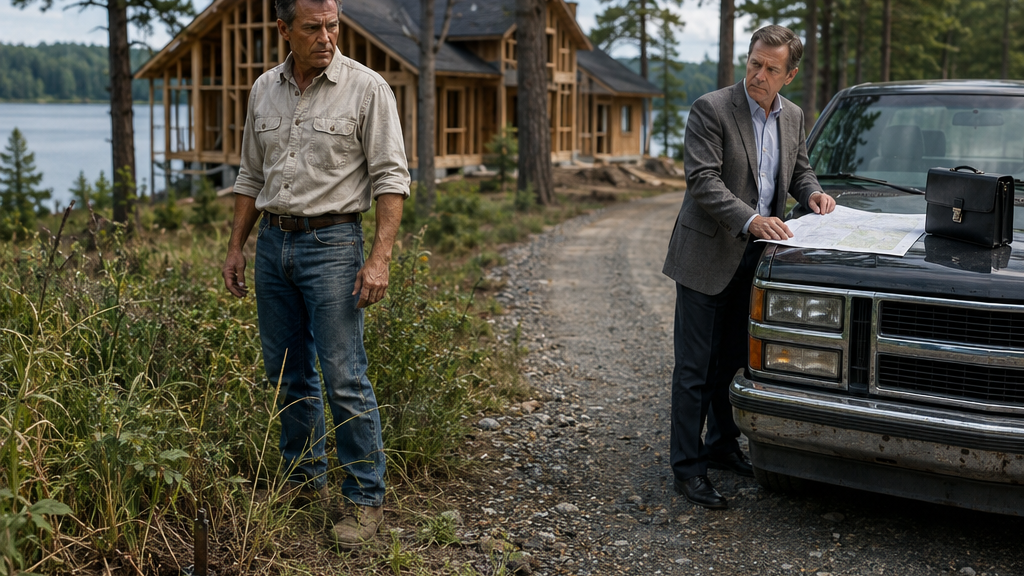
At the edge of the gravel turnout stood Richard Nelson.
He looked wrong against the unfinished cabin and the dark green lake beyond it. Gray slacks. Polished shoes already powdered with road dust. A pressed shirt beneath a sport coat despite the late-spring heat. In one hand he carried a black leather briefcase.
Brian climbed down from the temporary porch platform.
“Something I can help you with?”
Richard glanced past him at the exposed rafters.
“You’ve been notified twice. Construction stops today.”
The contractor looked at Brian.
Brian felt heat move up the back of his neck, but he kept his voice even.
“Did the county stop the permit?”
“No.”
“Did the building inspector?”
“No.”
“Then you don’t tell my crew when they work.”
Richard set the briefcase on the hood of Brian’s pickup.
“The Lake Harrison Property Association has architectural authority over this parcel. You have not submitted plans, exterior materials, setback drawings, or landscaping approval.”
Brian almost laughed.
“My land isn’t in your association.”
Richard opened the briefcase.
“That’s your position.”
“It’s the deed’s position.”
Richard removed a folded map and placed it on the hood.
The contractor took two steps backward, distancing himself from both men.
Brian noticed.
That bothered him more than Richard’s tone.
Four months of work had brought the cabin to this stage. Foundation set. Walls framed. Roof half sheathed. Lumber ordered. Windows due the following week. Every day the crew stood idle cost money.
Richard flattened the map with both hands.
A thick blue line curved around the lake subdivision, then continued along the gravel road toward Brian’s tract.
“Your parcel is here.”
His finger landed inside the blue line.
Brian stared at it.
The map was clean, professionally printed, marked with subdivision lots and road names. His own ground appeared as a rectangular piece along the edge.
“You made this?”
“It’s the association jurisdiction map.”
“That wasn’t what I asked.”
Richard’s jaw tightened.
“It’s based on recorded community documents.”
Brian leaned closer.
“Show me the recorded boundary.”
“I just did.”
“No. You showed me a colored line on paper.”
Richard looked up.
Brian pointed toward the road.
“Walk me to it.”
“To what?”
“The boundary. You say my cabin is inside it. Show me where your association ends and my land begins.”
For the first time since arriving, Richard hesitated.
It lasted only a second.
“That’s not how jurisdiction is determined.”
“Property lines usually manage to exist somewhere on the ground.”
Richard gathered the map, but Brian stopped him with two fingers on one corner.
“Is there a monument? Pin? Stone? Fence line? Anything?”
Richard’s expression hardened.
“You’re attempting to reduce recorded restrictions to a survey-marker argument.”
“I’m asking you where the line is.”
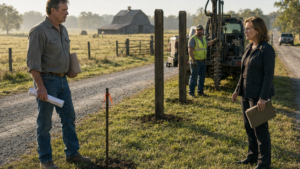
Near the ditch, knee-high grass moved in a light breeze. Beyond it, scrub blackberry and young pine crowded the shoulder where Brian’s acreage widened toward the lake.
He had walked that edge dozens of times.
There was an old rusted piece of iron down there somewhere. He remembered catching his boot on it during the first week after closing. He had assumed it was part of an abandoned fence.
He had never bothered to look closely.
Richard slid the map free.
“You should have resolved these issues before beginning construction.”
That landed harder than Brian wanted it to.
Because there was one part of that sentence he could not dismiss.
He had checked the deed himself. Checked the tax parcel. Checked the county permit requirements. He had even searched the association name in the recorded documents supplied at closing.
But he had not ordered a new boundary survey.
He had told himself he didn’t need one.
The old parcel description seemed clear. The previous farm tract had existed before the lake subdivision. The gravel road and tree line made the separation look obvious.
Brian had spent thirty years in construction. He trusted measurements.
Yet somehow, on his own land, he had trusted appearances.
Behind him, the contractor cleared his throat.
“Brian.”
He turned.
“I’m not trying to get in the middle of this, but if somebody’s talking injunctions, I need to know where we stand.”
Richard answered before Brian could.
“If work continues after notice, the association is prepared to seek emergency relief.”
Brian stared at him.
There it was.
Not a letter anymore.
Not a rule sheet tucked under the windshield wiper.
A threat that could reach his crew, his schedule, and the money already tied up in materials.
“Give us ten minutes,” Brian told the contractor.
The man nodded and motioned the other worker toward the truck.
When they were alone, Brian looked again toward the ditch.
“You’ve got a survey supporting that map?”
Richard closed the briefcase.
“We have decades of association records.”
“That’s not what I asked.”
“And you’ve spent weeks telling us documents don’t apply to you because you don’t like what they say.”
Brian stepped closer.
“I don’t care whether I like them. I care whether they apply.”
Richard’s voice dropped.
“Then prove they don’t.”
The sentence hung between them.
Brian looked at the unfinished cabin. Sunlight passed straight through the open window frames and striped the plywood floor. From the lake side, the building still looked almost skeletal.
Four months earlier, that emptiness had felt like possibility.
Now it looked expensive.
Brian walked to the roadside grass.
He stopped near the place where he remembered striking his boot against the old metal.
Nothing showed above the weeds.
He nudged the vegetation aside with his work shoe.
Richard watched from beside the pickup.
“What are you doing?”
“Looking.”
“For what?”
Brian did not answer.
He crouched and pulled away dead grass, but found only soil and roots. Maybe he had remembered the spot wrong.
He stood again.
Richard checked his watch.
“You have until Monday morning.”
Brian turned.
“For what?”
“To confirm compliance or provide documentation sufficient for the board to suspend enforcement. Otherwise our counsel proceeds.”
“You came here telling my crew to stop, and now I have until Monday?”
“I came because you ignored the notices.”
“I responded to both.”
“You rejected both.”
“Because I’m not a member.”
Richard picked up the briefcase.
“That is exactly what you need to establish.”
He walked toward his vehicle.
Brian called after him.
“Richard.”
The association president stopped.
“If your map is right, I’ll deal with it.”
Richard looked back.
“And if it isn’t?”
Brian glanced toward the weeds beside the road.
“Then you’re going to have to explain why you came onto my property and ordered my crew around.”
Richard gave no answer.
His car disappeared down the gravel road a minute later.
The contractor approached again.
“So?”
Brian watched the dust settle.
“No framing until I sort this out.”
The disappointment on the man’s face was restrained but unmistakable.
“I’ll move the crew to the other job.”
Brian nodded.
The trucks left one after another, carrying the sound of work with them.
By noon, the cabin stood silent.
Brian went inside, climbed the temporary steps, and pulled the deed packet from the metal file box beneath the folding table.
He spread every page out.
Then he read the legal description again.
This time, he did not read it looking for proof that he was right.
He read it looking for what he might have missed.
Chapter 2: What the Deed Never Said
The first violation notice had arrived before the cabin had walls.
Brian found it four months earlier clipped beneath the windshield wiper of his pickup, sealed inside a clear plastic sleeve against the February drizzle.
ARCHITECTURAL REVIEW REQUIRED.
He had read the first line twice before looking up at the empty clearing.
At that point there was almost nothing to review.
The old farm parcel sloped gently toward the lake. Pines enclosed the western side. An abandoned pasture fence disappeared into brush toward the north. The excavator had cut the building pad two days before.
Brian read the rest of the letter from the driver’s seat.
Roof pitch.
Exterior color.
Minimum landscaping.
Setback approval.
Tree-removal limitations.
Association review fee.
At the bottom was Richard Nelson’s name.
Brian folded the letter, placed it in the glove compartment, and went back to helping the contractor lay out the foundation.
That evening, in the small travel trailer he was using until the cabin was weather-tight, Brian opened his closing folder.
The property had once belonged to a much larger farm. When the lake subdivision was created decades earlier, developers had purchased the shoreline east of the road. Brian’s tract remained on the outer edge, with enough lake frontage to make it valuable but none of the subdivision roads, streetlights, or uniform lots.
That separation was one reason he had bought it.
After years of building homes for other people, Brian wanted a place where he could decide whether a porch post was cedar or pine without submitting a color sample to anyone.
He read his deed.
Then he read it again.
No Lake Harrison Property Association.
No declaration of covenants.
No architectural committee.
No reference to a recorded covenant book and page.
He sent Richard a short response the next morning.
My recorded deed does not identify this parcel as subject to your association. Please provide the recorded instrument imposing the restrictions cited in your notice.
Richard replied that afternoon.
The property, he wrote, was located within the association’s jurisdiction and had historically been treated as such.
Brian printed the email and wrote one word across the margin.
How?
He did not ask anyone else.
That was the mistake he would later have trouble admitting.
He could have called a title examiner then. He could have ordered a survey. He could have taken the legal description to the county recorder before pouring concrete.
Instead, he trusted his own reading.
Three weeks later the footings were in.
While checking the access road before a concrete truck arrived, Brian stepped off the gravel shoulder to move a fallen branch.
His boot struck something solid.
He looked down.
A dark iron nub, no wider than his thumb, protruded through the dead grass.
Brian kicked the grass aside.
Probably an old fence pin, he decided.
The original farm had been littered with them.
The concrete truck appeared at the road entrance, and Brian forgot about it.
By the time the second notice arrived, the foundation walls had cured.
This one came by certified mail.
Brian signed for it at the county post office.
FAILURE TO COMPLY MAY RESULT IN FINES AND LEGAL ENFORCEMENT.
He read the letter standing beside the counter.
The association now objected to the cabin’s siding, the planned metal roof, the number of trees removed near the lake, and the absence of an approved landscape buffer.
Brian called Richard from the parking lot.
“You’re threatening fines on property I never joined to your organization.”
Richard sounded tired rather than angry.
“Brian, this has been explained.”
“No, it’s been asserted.”
“The previous owners paid assessments.”
That gave Brian pause.
“What assessments?”
“Annual association assessments.”
“Why aren’t they on my closing statement?”
“You’d need to discuss that with your title company.”
Brian leaned against the truck.
“Send me the covenant that binds my parcel.”
“I can send the applicable restrictions.”
“That’s not the same thing.”
Silence.
Then Richard said, “You’re making this harder than it needs to be.”
Brian looked across the parking lot toward the courthouse roof.
“Maybe somebody did that before I got here.”
He ended the call.
That afternoon he went through the deed packet again.
Nothing.
He searched the county’s online index by his parcel number, by the prior owner’s name, and by the association name.
Still nothing attaching his tract to the subdivision covenants.
The absence felt like victory.
For two days, Brian walked around with the confidence of a man who believed the argument was already over.
The foundation passed county inspection.
Framing began.
The lake opened through the trees exactly where he had imagined seeing it from the future kitchen.
Then, late one afternoon, Brian watched the contractor chalk the location of the west wall and felt a quiet discomfort he could not place.
His mind went back to Richard’s sentence.
The previous owners paid assessments.
Brian pulled his survey information from the closing folder.
There wasn’t one.
There was an old parcel sketch reproduced from county tax mapping, dimensions listed beside approximate lines, and the legal description from the deed.
No current survey certification.
No marked monuments.
No signed boundary drawing from a licensed surveyor.
Brian stared at the papers.
He had criticized Richard for relying on an association map.
But Brian had begun construction relying on a tax sketch and his own confidence that the woods and road represented the property line.
He disliked that realization enough that he almost ignored it.
Instead, he called the county recorder.
The clerk confirmed the deed reference but explained that deeds and plats did not always answer the same question.
“If there’s an older subdivision plat or farm survey,” the clerk said, “you may want to look at those separately.”
Brian drove to the records office the next morning.
He spent nearly two hours with plat books and scanned images.
The older documents were difficult to reconcile. Some showed the subdivision. Some showed the farm tracts. One referenced a road easement. Another used monument calls that made no sense without seeing the ground.
Nothing plainly said his parcel had joined the association.
That reassured him.
What did not reassure him was how much he did not understand.
He ordered copies.
Two days later Richard sent him another email.
Attached was a clean color map.
The blue association boundary ran west of the road.
Straight through Brian’s tract.
Brian enlarged the image until the pixels blurred.
According to that map, his cabin foundation sat well inside association territory.
He placed Richard’s map beside the legal description from his deed.
Both looked official.
Both could not describe the same reality.
Brian looked through the trailer window toward the roadside weeds.
For the first time, he remembered the piece of iron his boot had struck.
Chapter 3: Forty-Three Feet Beyond Their Line
The surveyor measured twice before saying anything.
Brian watched him reset the equipment beside the gravel road, sight toward the trees, then check the receiver in his hand.
Richard stood twenty yards away beside his car with his arms folded.
The cabin crew had not returned.
Monday morning had arrived with the property quiet except for birds and the faint slap of water below the bank.
“Well?” Brian asked.
The licensed surveyor studied his field notes.
“His map line and the recorded plat line aren’t in the same place.”
Richard stepped closer.
“By how much?”
The surveyor looked toward the ditch.
“At this section? Roughly forty-three feet.”
No one spoke.
Brian felt the number before he understood it.
Forty-three feet.
Not inches.
Not a drafting difference.
Forty-three feet of ground.
Richard shook his head.
“That’s inconsistent with the association map.”
“I’m aware,” the surveyor said.
“What are you using?”
“The recorded subdivision plat, Brian’s legal description, and monument calls from the older farm survey.”
Richard pointed toward the equipment.
“GPS?”
“Among other things.”
“I want the association’s documents incorporated before anybody announces a conclusion.”
The surveyor remained expressionless.
“I’m not announcing a legal conclusion. I’m telling you where the recorded geometry takes me.”
Brian looked toward the weeds.
“Where should the monument be?”
The surveyor gave him a bearing and indicated a point near the road.
Brian walked there.
At first he saw nothing.
Then recognition sharpened inside him.
“This is where I hit something with my boot.”
He crouched.
Dead grass had collapsed under new spring growth. Brian pulled it aside with both hands.
Richard came closer despite himself.
Brian dug into the matted weeds.
His fingers touched metal.
He cleared more dirt.
A rust-dark iron pin emerged from the ground.
For several seconds, none of them moved.
The surveyor stepped over, knelt, and examined it without touching it first.
“That may be our monument.”
Richard stared.
Brian sat back on his heels.
The old pin was ugly, ordinary, and almost lost beneath the ditch grass.
He had walked past it for months.
He had nearly built an entire argument without realizing the ground itself had been waiting to contradict somebody.
The surveyor took measurements from the monument.
Then he checked the recorded plat again.
“It fits.”
Brian stood.
“Fits what?”
“The old call.”
“And the association line?”
The surveyor pointed west.
“Would be about forty-three feet that direction if their map is drawn as shown.”
Brian turned toward Richard.
Richard’s face had lost its earlier certainty, but not its discipline.
“A monument doesn’t automatically determine covenant applicability.”
Brian almost answered sharply.
Instead, he stopped.
Three months earlier he would have called that evasion.
Now he understood enough to know Richard might be right about one thing.
A boundary pin could establish a subdivision line.
It did not necessarily explain every agreement that might burden land outside it.
“Fine,” Brian said.
He walked to his pickup.
“Let’s look at everything.”
He lowered the tailgate, then changed his mind and spread the survey copy across the hood, weighting one corner with his tape measure.
Richard approached reluctantly.
The surveyor placed a finger on the old subdivision line.
“This is the recorded boundary.”
Then he pointed to Brian’s tract.
“This deed description begins outside it.”
Brian traced the distance visually.
The forty-three feet seemed absurd now that he could see it laid out.
The association’s map had swallowed an entire strip of land between the road and the recorded subdivision boundary.
His cabin stood beyond that strip.
Outside.
Richard leaned over the hood.
“Where did you get this plat?”
“County records,” Brian said.
Richard ignored him.
The surveyor answered.
“Recorded original.”
“What year?”
“1978.”
Something changed in Richard’s face.
Not surprise exactly.
Recognition.
It vanished quickly.
Brian noticed anyway.
“You’ve seen it.”
Richard straightened.
“I’ve seen several historical plats.”
“This one?”
“I don’t recall every document I’ve reviewed.”
Brian looked at him for a long moment.
The surveyor continued marking reference points.
Brian should have felt triumphant.
Instead, he felt something more cautious.
He remembered accusing Richard of substituting confidence for evidence.
He had done his own version of the same thing by starting construction without a survey.
The difference was that now there was physical evidence in front of all three men.
Brian pointed to the iron pin.
“So if that is the subdivision monument, my cabin isn’t inside the subdivision.”
“The geometry supports that,” the surveyor said.
Richard closed his eyes briefly.
Then he walked back to his car.
Brian expected him to leave.
Instead, Richard opened the rear door and removed a thick accordion folder.
He returned with it tucked under one arm.
“What’s that?” Brian asked.
“The part you keep acting like doesn’t exist.”
Richard laid the folder beside the survey.
Inside were photocopied ledgers, assessment sheets, correspondence, and payment records.
He opened to a tab marked with Brian’s parcel number.
Brian’s irritation returned.
“An internal spreadsheet doesn’t change a recorded boundary.”
“No,” Richard said. “But thirty years of property owners paying the association may matter.”
He removed the first page.
A photocopy of an old check.
The payer name belonged to a former owner of Brian’s tract.
Memo line: ROAD / ASSOCIATION.
Another check followed.
Then another.
Different years.
Same property.
Richard placed a ledger page beside them.
Brian recognized the parcel description.
Annual payments appeared year after year.
Some were marked road maintenance.
Some simply association.
Later entries were labeled assessment.
Brian’s confidence tightened into something less comfortable.
“How far back?”
“Early nineties in this file.”
“And before that?”
“I’d have to check archived records.”
Brian looked toward the iron pin.
Forty-three feet outside.
That part had not moved.
But the history around it suddenly had.
Richard turned several pages.
“This parcel received road grading, snow clearing during bad winters, drainage work, and access maintenance funded through the association. Owners paid regularly.”
“Paying for a road isn’t the same as joining covenants.”
“Maybe not.”
It was the first time Richard had conceded anything.
He tapped another page.
“But if these owners considered themselves members, or if there was an annexation, your deed may not tell the whole story.”
Brian looked at the surveyor.
The man did not offer an opinion.
That silence told Brian more than reassurance would have.
Richard gathered the records slowly.
“The board will hold enforcement until we sort out the boundary discrepancy.”
Brian looked at him.
“You were ready to file against me this morning.”
“And now I have information I didn’t have this morning.”
Brian almost challenged that.
He remembered the flicker of recognition when Richard heard the year 1978.
Not surprise.
Recognition.
But he let it go for the moment.
“When do I restart work?”
“When we know whether the association has another basis for jurisdiction.”
Brian’s mouth tightened.
“You don’t get to keep me stopped indefinitely because your map is wrong.”
Richard met his eyes.
“And you don’t get to pretend three decades of records disappeared because you found a pin in the weeds.”
The words should have angered Brian.
Instead, they forced him to look again at the copied checks.
The first question had been simple.
Where was the boundary?
Now the ground had answered it.
The harder question sat in black ink across thirty years of paper.
Brian picked up one of the photocopies.
The old check carried the address of his parcel.
On the memo line, in faded handwriting, were three words:
Lake road maintenance.
Brian stared at them.
If the former owners had never belonged to the association, why had they been paying it for thirty years?
Chapter 4: The Payments That Made Everyone Look Wrong
Brian found the first bill in a county file that had nothing to do with covenants.
It was attached to an old property-transfer record from fifteen years earlier, folded behind a tax document and nearly missed by the clerk who brought him the folder.
LAKE HARRISON PROPERTY ASSOCIATION.
Below that, his parcel number.
Brian read the amount twice.
It matched one of the payments Richard had shown him.
He sat back from the records-room table.
“So they were billing this property before the last owner?”
The county recorder looked over from her desk.
“We don’t maintain association billing records.”
“I know. I’m asking why this copy is here.”
She came around the counter and examined it.
“Probably submitted with the transfer documents. Sometimes parties include things that aren’t required.”
Brian turned the page over.
Nothing.
He had spent the previous three days looking for a document that would explain the checks.
Instead, he kept finding more checks.
The oldest association ledger Richard had provided showed regular payments from Brian’s parcel. Some said assessment. Others said maintenance. A few included no description at all.
That inconsistency irritated him.
If the land had truly belonged to the association, why had nobody been able to produce the instrument that put it there?
But if it had never belonged, why had owner after owner paid?
The title examiner he had hired gave him the least satisfying answer possible.
“Because people pay things for reasons other than legal obligation.”
Brian frowned.
“That’s supposed to help?”
“It’s supposed to stop you from jumping ahead.”
The examiner laid two sheets side by side.
“One is a recorded restriction. The other is evidence of conduct. They can matter differently.”
Brian looked through the glass doors toward the courthouse hallway.
“I’m getting tired of everybody telling me what something might mean.”
“Then keep digging until you know.”
That evening, Brian drove past his cabin without turning in.
The unfinished frame was visible through the pines, wrapped now in pale house membrane where the crew had protected exposed sections before leaving.
He kept going.
Three properties down the gravel road, Michelle Clark was pulling weeds from a narrow garden beside her garage.
Brian had spoken to her only twice since buying the land.
She looked up when his pickup stopped.
“If this is about the association,” she said, “I’ve already heard.”
“I figured.”
“Richard called me.”
Brian got out.
“What did he say?”
“That you’re challenging the boundary.”
“I’m checking it.”
“He used a different word.”
Brian almost smiled.
“Do you have a deed copy?”
Michelle straightened slowly.
“Why?”
“Because your tract sits on the same side of the old subdivision line as mine.”
Her expression changed.
“I pay dues.”
“I know.”
“So did the people who owned mine before me.”
“I know that too.”
She wiped dirt from her hands.
“What exactly are you trying to prove?”
“That’s the problem. Three days ago I thought I knew.”
Inside her kitchen, Michelle brought out a fireproof document pouch.
Brian resisted the urge to reach for it immediately.
She watched him carefully.
“I don’t want my name in some lawsuit.”
“I haven’t filed one.”
“You’re going against the board.”
“I’m looking at property records.”
“For some people that’s the same thing.”
She pushed the deed across the table.
Brian read it.
Then he read the second page.
No covenant reference.
He checked the parcel description against the copy of the old plat he had brought.
The same gap appeared.
Michelle leaned against the counter.
“Well?”
“I don’t see anything here that attaches your parcel.”
She folded her arms.
“That doesn’t mean it isn’t attached somewhere else.”
“No.”
The answer came more easily now.
Brian had learned that much.
“No, it doesn’t.”
She looked surprised that he had admitted it.
He showed her the recorded subdivision boundary.
Then the newer association map.
Her property, like his, appeared to shift from outside one line to inside the other.
Michelle pulled out a chair.
“How far?”
“I don’t know on yours yet.”
“On yours?”
“Forty-three feet at the road.”
She stared at him.
“You’re saying their line is off by forty-three feet?”
“I’m saying the recorded plat and their map disagree by that much where my tract is.”
Michelle looked toward the window.
“I’ve paid them for twelve years.”
There was no outrage in her voice.
Only calculation.
“Road grading,” she said. “Snow clearing. Culvert work once. They handle all of it.”
“That may be what the money was for.”
“They call it dues.”
“Now.”
She looked back at him.
“What does that mean?”
“I don’t know yet.”
Michelle closed the deed folder.
“My husband used to say we should ask why we got violation letters when the houses across the road didn’t.”
Brian waited.
“He hated conflict,” she said. “So did I. We paid the fine for the shed color and moved on.”
Brian glanced at the deed again.
“What fine?”
“Three hundred dollars.”
“For paint?”
“For not submitting approval first.”
Something inside Brian shifted.
His dispute had been easy to frame as his own.
His cabin. His deed. His money.
Michelle’s shed made that smaller.
Not because three hundred dollars mattered more than his construction costs, but because the same uncertainty had apparently been sitting on other properties for years.
They drove together to the road where Brian’s parcel began.
He showed her the cleaned iron pin.
The surveyor had placed a small temporary flag beside it, bright enough to make the old metal visible from the shoulder.
Michelle crouched.
“That little thing?”
“That little thing.”
“And this is what the original map uses?”
“One of the monument calls.”
She stood and looked toward her house down the lane.
Brian unfolded photocopies across the pickup hood.
His parcel.
Michelle’s parcel.
Two others.
When the maps were aligned, the old subdivision boundary ran in a consistent line along the outer edge.
The association’s newer map pushed outward across all four.
Michelle touched one of the neighboring tracts.
“Edward Smith.”
“You know him?”
“He’s been here longer than anybody.”
Brian looked toward the narrow farmhouse farther up the road.
“I’ve met him.”
“Then you know he hates meetings.”
“I gathered that.”
Michelle gave him a tired look.
“He also remembers everything.”
By the next afternoon, Brian had spoken with two more owners.
One wanted copies.
The other refused even to look.
“You get them mad enough,” the man told Brian from behind his screen door, “they stop maintaining the road. Then what?”
“They can’t just—”
“Don’t tell me what they can’t do. I’ve lived here twenty-two years. We finally got the drainage fixed. I’m not starting a war over lines on paper.”
Brian walked back to his truck with the answer bothering him.
He had been thinking of compliance as weakness.
But for people who depended on the road every day, the association was not merely a collection of rules. It was the grader after a storm. Gravel after washouts. Culvert clearing in spring.
That evening, he found Edward Smith sitting on a wooden chair outside his farmhouse, sharpening a mower blade by hand.
Edward listened without interrupting.
When Brian finished, the older man spat a fleck of metal dust from his lip.
“You’re asking the wrong question.”
Brian leaned against the porch post.
“What’s the right one?”
“Not why we paid them.”
Edward ran the file once more along the blade.
“You need to ask what we called the money when we started paying.”
Brian looked at him.
Edward set the file down.
“It wasn’t dues.”
Chapter 5: The Road Agreement Nobody Had Read
Edward Smith brought the photocopy out in a dented metal recipe box.
Brian had expected a deed, maybe an old plat.
Instead, Edward lifted the box onto his kitchen table, pushed aside envelopes and appliance manuals, and pulled out three yellowed pages held together with a rusting staple.
“There.”
Brian picked them up.
The heading was typed unevenly.
PRIVATE ROAD MAINTENANCE UNDERSTANDING.
No association logo.
No declaration language.
No architectural restrictions.
Just six landowners, a gravel road, and a list of costs.
“You signed this?”
Edward pointed toward the bottom.
His name was there in faded blue ink.
“1981.”
Brian read the first paragraph.
Owners of several farm tracts outside the newly developed lakeside lots agreed to contribute toward grading and gravel because they used part of the same access road.
“That’s it?”
“That was it then.”
Brian turned the page.
The amounts were handwritten beside each parcel.
“What happened later?”
Edward poured coffee into two mismatched mugs.
“The subdivision got organized. They had more houses, more money, somebody who could collect payments without chasing everybody down.”
“So you paid the association.”
“We paid through them.”
“That’s different.”
Edward handed him a mug.
“It was to us.”
Brian looked again at the paper.
Nothing said the outer parcels joined the subdivision.
Nothing gave the association authority over roofs, landscaping, paint colors, docks, or cabin plans.
“Why didn’t anybody record this?”
Edward gave a humorless smile.
“You’re looking at six farmers in 1981. Recording a road-sharing note wasn’t high on the list.”
Brian felt irritation rise.
Not at Edward exactly.
At thirty-five years of informality.
“At some point somebody started calling these dues.”
“Yep.”
“And nobody objected?”
“I objected once.”
“What happened?”
“They changed the invoice back to road maintenance for a few years.”
Brian stared at him.
“Then?”
Edward shrugged.
“New treasurer. New forms. It changed again.”
“You just paid it?”
“The grader still came.”
That answer stopped Brian.
Edward sat across from him.
“You’ve got a way of asking questions like anybody who didn’t do what you would’ve done was asleep.”
Brian looked up.
“I didn’t say that.”
“Don’t have to.”
The words landed cleanly.
Brian thought of the neighbor behind the screen door. Michelle paying the shed fine. His own certainty that people had simply surrendered something.
Edward took a sip of coffee.
“You bought land because you didn’t want people in your business. We wanted the road passable. Those aren’t opposite things.”
Brian lowered his eyes to the agreement.
“No.”
It cost him something to say it.
“No, they aren’t.”
They drove to the county archive together that afternoon.
The road agreement itself was not recorded, but Edward remembered the farm owner whose property had been subdivided around the lake. That name led the clerk to an older plat cabinet.
The 1978 plat came out in a large protective sleeve.
Brian had seen a reduced copy.
The original was different.
Lines that had looked cramped on the scan opened clearly across the sheet.
The subdivision lots ended on one side of the monument line.
The remaining farm tracts began on the other.
A notation near the roadway identified access rights.
Nothing indicated that the farm tracts were part of the subdivision.
Edward bent over the table.
“There.”
His finger stopped near the corner.
A small symbol marked the monument.
Brian compared it to the surveyor’s field sketch.
The iron pin.
The same point.
The same line.
The same forty-three-foot separation at Brian’s parcel.
The clerk brought another document requested by the title examiner.
A later road easement.
Again, the outer tracts received access.
Again, no annexation language.
Brian exhaled.
For the first time, the history formed a coherent shape.
The outer owners had not paid because they belonged to the association.
They paid because they shared a road with it.
Over time, invoices changed.
People changed.
Language changed.
The distinction disappeared.
Richard’s ledgers were not fake.
They had simply been allowed to mean more than the original arrangement supported.
Edward tapped the plat.
“That’s why I told you it wasn’t dues.”
Brian looked at him.
“Why didn’t you stop them when they started enforcing rules?”
Edward’s face tightened.
“I was sixty-eight when they sent me the first landscaping notice. My wife was sick. I had other things to fight.”
Brian said nothing.
“That answer good enough?”
“Yes.”
This time he meant it immediately.
The clerk returned carrying a thinner file.
“This was attached to an association records request from last year,” she said. “Your title examiner asked for anything involving annexation of the outer tracts.”
Brian opened it.
Meeting minutes.
Correspondence.
A map review.
Most pages were routine until he found a memorandum dated eight months earlier.
From: Richard Nelson.
Subject: Outer Parcel Status.
Brian read the first line.
Please confirm whether parcels west of the original subdivision monument line were ever formally annexed into Lake Harrison Property Association jurisdiction.
His thumb stopped on the edge of the paper.
Edward leaned closer.
“What?”
Brian read the next paragraph.
The memo referred to a discrepancy between the 1978 plat and the association’s current jurisdiction map.
A discrepancy.
Richard had known there was one.
Not the answer.
But the question.
Months before Brian poured concrete.
The memo requested research before further enforcement actions affecting those parcels.
Brian felt the room sharpen around him.
He turned the page.
There was a short handwritten notation on the copy.
No recorded annexation located in current file. Further title review recommended.
Brian read it again.
Richard had stood beside the unfinished cabin and said the association was fully prepared to enforce.
He had threatened legal action.
He had ordered the crew to stop.
And before doing any of it, he had already asked whether the association legally controlled the land at all.
Edward watched Brian’s expression.
“He know?”
“He knew there was a problem.”
“That ain’t the same as knowing the answer.”
Brian looked at him.
Edward held his gaze.
It irritated Brian because it was true.
The memo did not prove Richard knew the association had no authority.
It proved Richard knew the authority was uncertain.
That distinction mattered.
It also made what happened next harder to excuse.
Brian made a copy.
On the drive back, he passed the association entrance.
Richard’s truck sat outside the meeting building.
Brian almost turned in.
Instead, he kept driving.
Anger wanted a confrontation.
The documents required something better.
He called the title examiner from the road.
“I found Richard’s memo.”
A pause.
“I’ve seen it.”
“You knew?”
“I received the archive scan ten minutes ago.”
Brian tightened his grip on the steering wheel.
“He questioned annexation eight months ago.”
“Yes.”
“And then he tried to stop my cabin anyway.”
“Yes.”
Brian waited for the examiner to say more.
Finally he asked, “What do I do with that?”
“You ask him why.”
By the time Brian reached his property, an envelope was clipped to the temporary mailbox at the road.
Association letterhead.
Meeting request.
Richard wanted Brian at the board office Thursday evening.
Brian looked toward the survey pin, its small flag lifting beside the ditch.
For weeks he had wanted proof that Richard was wrong.
Now he had something more uncomfortable.
Proof that Richard himself had once wondered the same thing.
Chapter 6: The Question Richard Chose Not to Answer
Richard put a single sheet of paper in front of Brian and said, “Sign that, and your cabin can resume tomorrow.”
Brian did not touch it.
They were alone at one end of the association meeting room. The rest of the chairs had been pushed against the walls, leaving the long table bare except for Richard’s folder, Brian’s documents, and a photograph Brian had taken of the iron survey pin beside the road.
“What is it?”
“An enforcement waiver.”
“For me.”
“For your parcel.”
Brian read the first paragraph.
The association would suspend architectural enforcement regarding Brian’s current cabin project while reserving all other rights.
The second paragraph required both parties to treat the dispute as resolved.
The third withdrew Brian’s request that the association review neighboring outer parcels.
Brian stopped reading.
“You want me to walk away.”
“I want to resolve your problem.”
“My problem led to three other parcels.”
“Your construction is what brought you here.”
Brian pushed the paper back.
“And Michelle’s shed fine?”
Richard’s mouth tightened.
“That isn’t part of this meeting.”
“That’s exactly what this meeting is about.”
Richard leaned back.
“You asked why I continued enforcement after I questioned the map.”
Brian said nothing.
At least Richard had not pretended otherwise.
Richard opened his folder.
Inside was a budget sheet.
“Our road reserve is thirty-one thousand dollars.”
Brian waited.
“Annual road and drainage expenses average just over twenty-four.”
“So?”
“So eight outer parcels contribute to those costs.”
“Road costs. Not architectural enforcement.”
“I understand the distinction.”
“Do you?”
Richard looked at him sharply.
“Yes.”
The word was quiet.
Brian had expected defensiveness. Instead he heard fatigue.
Richard slid another page across the table.
“If those eight parcels are declared outside the association, several owners will stop paying immediately. Maybe all of them. People hear ‘not under HOA jurisdiction,’ and they hear ‘I owe you nothing.’”
“That doesn’t give you jurisdiction.”
“I know.”
Brian stared at him.
The room seemed suddenly smaller.
Richard rubbed a hand over his forehead.
“You think I don’t understand what the old plat shows?”
“I think you understood enough to ask the question eight months ago.”
“I did.”
“And you kept sending violation notices.”
“Yes.”
There it was.
Not a document.
Not a trick.
A choice.
Brian felt his anger settle into something colder.
“Why?”
Richard looked toward the dark window.
“When I took over, the association was already behind on culvert replacement. Two sections of road washed out the year before. We had owners refusing increases and threatening to sue over access conditions.”
“That’s not my problem.”
“No. But when the same road is the only practical access to your property, it becomes your problem pretty quickly.”
Brian started to answer, then stopped.
Richard noticed.
“The outer parcels have paid for decades,” he continued. “The board treated them as members because every board before us treated them as members. Their addresses were in the directory. They got invoices. They got services. Some attended meetings.”
“None of that moves a recorded boundary.”
“No.”
Richard’s voice had lost the formal edge Brian had heard at the cabin.
“I asked for the annexation record because I wanted the file cleaned up. We couldn’t find it. Counsel said long-standing conduct might still support some obligations, but they wouldn’t give me an opinion without a title review.”
“So you ordered enforcement anyway.”
Richard looked down.
“Yes.”
“Why not stop?”
“Because stopping on eight parcels would have signaled that we didn’t know what authority we had.”
Brian almost laughed.
“You didn’t.”
“I knew exactly what uncertainty would do.”
“That’s not the same thing.”
“I know that now.”
Brian studied him.
He had wanted Richard’s motive to be arrogance because arrogance was easy to oppose.
This was worse in a different way.
Richard had seen a weak foundation and decided the institution could not afford to admit it.
He had treated uncertainty as a threat to be contained.
Brian picked up the budget sheet.
The numbers were real.
Gravel.
Grading.
Drainage.
Snow clearing.
Equipment rental.
There was no luxury hidden in them.
“If the outside owners stop paying,” Brian said, “what happens?”
“We cut maintenance or raise the inside assessments significantly.”
“And if you’d told everybody the truth eight months ago?”
Richard gave him a long look.
“I should have.”
Brian waited.
“But I thought I could confirm the old arrangement before it became a public issue.”
“And until then you kept acting like the authority was settled.”
“Yes.”
The answer contained no excuse.
That made it harder to dismiss him as a fool.
Richard tapped the waiver.
“I can fix your immediate problem tonight.”
Brian looked at the paper.
The cabin flashed in his mind.
Windows delayed.
Crew moved elsewhere.
Lumber sitting under tarps.
Every week cost him.
He could sign.
Restart tomorrow.
Let the board sort out everyone else later.
He had not bought the property to become a spokesman for Michelle or Edward or anyone else.
For several seconds, the offer felt not merely tempting but reasonable.
Then he looked at the photograph of the survey pin.
A piece of iron half hidden in weeds.
He had ignored it because he assumed he already knew enough.
Richard had ignored a different warning for the same reason.
Different stakes.
Same habit.
Brian folded the waiver once.
Richard watched him.
“You signing?”
Brian tore nothing.
He simply slid the folded sheet back.
“No.”
Richard breathed out through his nose.
“Brian.”
“I’ll pay my fair share of the road.”
“That isn’t what this document says.”
“I know.”
“I’ll sign a separate road agreement based on actual costs. I’ll sit down with the other owners. I’ll help work out something that doesn’t leave the inside properties carrying everybody.”
Richard’s expression softened, but only slightly.
“But?”
“But I’m not accepting covenant authority that nobody can prove exists.”
Richard looked away.
“And I’m not taking a private exemption while Michelle and the others stay under rules you already questioned.”
“You have no authority to represent them.”
“I’m not representing them.”
Brian opened his folder.
He removed the written request prepared with the title examiner.
“I’m asking for formal review of every outer parcel shown beyond the 1978 monument line.”
Richard did not take it.
“If this goes to a full review, the board will have to notify everyone.”
“Then notify them.”
“You understand people are going to demand refunds.”
“Maybe.”
“They may refuse future payments.”
“Then explain what the road actually costs.”
“You make that sound simple.”
“No.”
Brian leaned forward.
“I’m finally admitting it isn’t.”
Richard’s eyes moved to the photograph of the iron pin.
Brian continued.
“I started building without getting a current survey because I thought reading my deed made me smarter than everybody bothering me. That cost me weeks. I’m not doing the same thing again just because this paper gets my crew back tomorrow.”
Silence filled the room.
Richard finally took the review request.
“What happens if the title examiner says some obligation does exist?”
“Then I deal with the obligation that exists.”
“And if there’s none?”
“Then you stop enforcing one that doesn’t.”
Richard looked at the document in his hands.
For the first time, Brian saw no institutional answer waiting behind his face.
Only a man calculating what truth would cost.
Richard signed the acknowledgment of receipt.
“I’ll call an emergency board meeting.”
Brian stood.
Richard remained seated.
At the door, Brian paused.
“The road matters.”
Richard looked up.
“I know.”
Brian nodded toward the budget sheet.
“I mean it. I’m not trying to get a free road.”
Something in Richard’s posture eased.
“I believe you.”
It was the first uncomplicated thing either man had said to the other.
Brian opened the door.
Behind him, Richard spoke again.
“For what it’s worth, I should have stopped enforcement when that memo came back.”
Brian turned.
Richard did not look away.
“I was afraid if I opened the question, the whole arrangement would come apart.”
Brian held his gaze.
“So you made everybody else carry the risk.”
“Yes.”
There was nothing left to argue about in that sentence.
Brian walked out.
The next morning, instead of calling his contractor, he drove to the county office and delivered copies of the review request to the title examiner.
By noon, Michelle had signed a request regarding her tract.
Edward signed another that afternoon.
Two more outer owners followed before the day ended.
At four-thirty, Brian received an email from the association.
Formal enforcement on the disputed parcels would be held pending title review.
His cabin still could not resume under the association’s waiver because he had rejected it, but the threat of immediate action had been withdrawn.
Brian read the message twice.
Then another email arrived.
The board had authorized review of every tract outside the original 1978 monument line.
Brian looked through the windshield toward the unfinished cabin.
For the first time since Richard had told the crew to stop, the question was no longer whether Brian could prove his own property rights.
Now everyone along the road would learn what those rights had been all along—and whether the road could survive the answer.
Chapter 7: The Boundary Changed, but the Road Remained
The association’s notice arrived on a Monday morning, but this time nobody told Brian to stop building.
He stood beside the unfinished porch with his phone in one hand and the survey pin visible across the gravel shoulder.
Formal covenant enforcement against the disputed outer parcels is suspended effective immediately pending correction of association jurisdiction records.
Brian read the sentence twice.
Then he kept reading.
The title review had taken nearly three months.
County records had been compared against the 1978 subdivision plat, subsequent conveyances, easements, and every annexation instrument the examiner could locate. The conclusion was careful rather than dramatic.
Brian’s tract had never been annexed into the Lake Harrison subdivision.
Neither had Michelle Clark’s.
Neither had Edward Smith’s.
Five other outer parcels fell into the same category.
The association’s architectural covenants did not bind them.
Brian lowered the phone.
Behind him, a truck rolled slowly up the lane.
The contractor leaned out the window.
“You calling me because we can work, or because you finally miss paying me?”
Brian smiled.
“Both.”
The contractor looked toward the cabin.
“So it’s over?”
Brian glanced back at the email.
“No.”
The contractor sighed.
“Of course not.”
Work resumed that afternoon.
The cabin changed quickly after months of stillness. Windows went in. The metal roof finally covered the rafters. Cedar siding began closing the framed walls that had stood exposed through most of the dispute.
For the first few days, Brian let himself enjoy the sound of saws again.
Then Michelle called.
“You seen what people are saying?”
“What people?”
“Association people.”
Brian leaned against a porch post.
“What are they saying?”
“That we’re freeloaders.”
He closed his eyes.
The title review had answered one question and opened the next exactly as Richard had warned.
Within a week, two outer parcel owners announced they would stop paying anything to the association.
One demanded repayment of years of assessments.
Another said that if the association had never controlled his property, it could maintain its own road without his help.
Brian understood the anger.
He also knew where the road went after heavy rain.
He had seen washouts eat six inches from the shoulder in a single night.
The first meeting after the review was held in the association room where Richard had once offered Brian the private waiver.
This time every chair was filled.
Brian sat beside Michelle.
Edward chose a seat near the door.
Richard sat at the end of the table but no longer occupied the center.
He had announced his resignation as association president two days earlier.
He would remain through the transition, but his authority was already shrinking around him.
A board member read the title examiner’s conclusions.
Nobody applauded.
The room simply changed.
For years, some people had believed the outer owners were members who occasionally complained.
Now everyone had to accept that the association had enforced rules where its recorded authority stopped.
A man from inside the subdivision raised his hand.
“So they get the same road for free?”
Michelle stiffened.
Brian stood before she could answer.
“No.”
Several heads turned.
The man frowned.
“You just spent months proving you don’t owe the association.”
“I proved I don’t owe architectural obedience because I use the road.”
“That sounds convenient.”
Brian felt the familiar impulse to answer harder than necessary.
He let it pass.
“The road costs money whether my cabin is in the subdivision or not.”
Richard looked up.
Brian continued.
“We need a separate agreement. Road and drainage only. Actual costs. No landscaping rules attached. No roof approval. No pretending maintenance payments make somebody an association member.”
An outer property owner spoke from the back.
“Why should we trust them with another agreement?”
Brian looked toward him.
“We shouldn’t trust anybody with an unclear agreement.”
The room quieted.
“We write one that says exactly what the money is for.”
Edward gave a small nod near the door.
Brian saw it.
Richard did too.
The discussion lasted two hours.
It was not pleasant.
Inside owners worried they would carry too much of the cost.
Outer owners feared signing away the victory they had just gained.
Michelle insisted that invoices distinguish road charges from any association dues.
Edward wanted a provision requiring annual cost statements.
Brian argued for payments based on actual road use and frontage rather than blindly copying the old assessments.
Richard spoke only when someone asked for maintenance figures.
The old authority had left his voice.
What remained was knowledge.
He knew which culvert flooded first.
He knew what grading cost.
He knew which stretch required fresh gravel after winter.
Brian found himself listening.
That irritated him less than it once would have.
Three weeks later, they had a draft.
PRIVATE ROAD MAINTENANCE AGREEMENT.
Brian smiled when he saw the heading.
Edward noticed.
“What?”
“Nothing.”
“You’ve been grinning at that page for ten seconds.”
Brian slid it toward him.
“Looks familiar.”
Edward read the heading and laughed once.
“Only took forty-five years to type it properly.”
The new agreement did what the old one had failed to do.
It identified the road.
It identified participating parcels.
It listed which costs qualified.
It specifically stated that participation did not create association membership or subject any parcel to architectural covenants.
It required yearly accounting.
No one loved every provision.
That made Brian trust it more.
Michelle signed after reading it twice.
Edward signed after asking for one sentence to be changed.
Brian signed last among the three.
When Richard approached the table, Brian looked at him.
“You still live down this road.”
Richard nodded.
“So I suppose you’re stuck with us.”
“Apparently.”
Brian handed him the pen.
Richard did not take it immediately.
“I resigned because the board needed somebody else to carry this forward.”
Brian said nothing.
Richard looked at the agreement.
“And because I should have stopped enforcement when I saw the records didn’t line up.”
“You already told me that.”
“I know.”
Richard finally took the pen.
“I’m saying it where other people can hear it now.”
There were no speeches after that.
No applause.
Richard signed as a participating property owner, not as association president.
The distinction seemed small on paper.
It was not.
By late summer, Brian’s cabin was nearly finished.
The porch faced the lake.
The cedar had begun fading slightly under the sun.
Inside, the kitchen windows framed water through the pines exactly as he had imagined months before the first violation notice arrived.
One afternoon, the contractor found Brian beside the road with a shovel.
“You’re not moving that thing, are you?”
Brian looked down.
The survey pin stood exposed in a small circle of cleared ground.
“No.”
He had placed three flat stones around it so mower tires would not hit it.
The contractor laughed.
“After everything that little pin caused, I’d have buried it.”
Brian rested both hands on the shovel handle.
“It didn’t cause anything.”
The contractor looked at him.
Brian nudged one of the stones into position.
“We caused the trouble by deciding what it meant before anybody bothered to check.”
The contractor glanced toward the completed cabin.
“You getting philosophical now?”
“Don’t spread that around.”
The contractor walked back toward the porch.
Brian remained beside the road.
A vehicle approached from the subdivision.
Richard’s pickup slowed as it passed.
For a moment Brian expected him to stop.
Instead Richard raised two fingers from the steering wheel.
Brian returned the gesture.
Nothing more.
The truck continued up the gravel lane.
The road looked the same as it had before the dispute.
Same dust.
Same shallow ditch.
Same curve toward the lake.
But the invoices arriving that fall looked different.
Brian received one for road maintenance.
Only road maintenance.
No association dues.
No architectural fee.
No covenant language.
He paid it three days early.
Michelle later told him she had done the same.
Edward mailed his with a handwritten note complaining that the gravel price was too high, which Brian considered proof that things had finally returned to normal.
On the last warm afternoon before autumn settled over the lake, Brian helped the contractor set the final porch post.
They lifted it together, fitted it beneath the beam, checked it for plumb, and drove the fasteners home.
The contractor stepped back.
“That’s the last one.”
Brian ran his palm along the cedar.
Months earlier, he had thought finishing the cabin would mean proving nobody else had the right to tell him what to do.
Standing there now, he understood the victory differently.
The association had been forced back behind its actual boundary.
The outer owners had recovered rights they should never have lost.
But Brian had also signed his name beneath an obligation he had chosen rather than one somebody had invented for him.
The distinction mattered.
He walked down the porch steps and across the gravel.
At the roadside, the old iron pin caught the late light.
It was still rusted.
Still unimpressive.
Still only a few inches above the earth.
Brian cleared one fallen leaf from beside it.
Then he left it exactly where it was.
The cabin stood behind him.
The shared road stretched ahead.
And between them, the boundary no longer needed anyone’s confidence to make it real.
The story has ended.