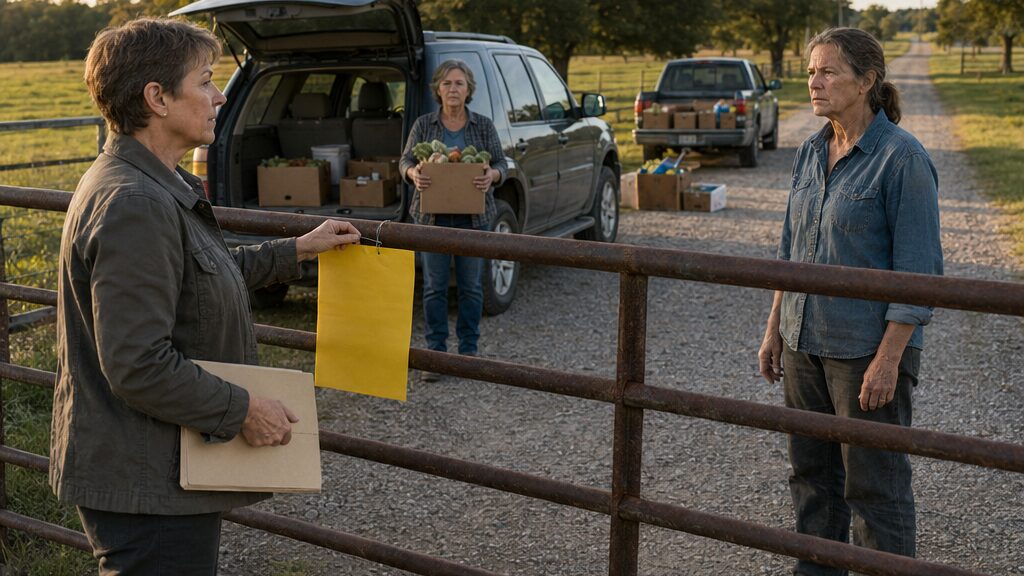
They Fined Her Farm for a Quiet Sunday Gathering, Then Her Old Ledger Exposed the Road Money
Chapter 1: The Notice Wired to Sarah Carter’s Cattle Gate
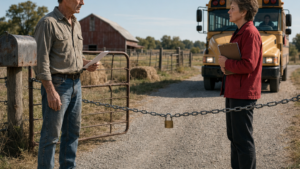
Sarah Carter saw the yellow paper before she saw Deborah Lewis.
It had been wired chest-high to the metal cattle gate at the end of Sarah’s gravel lane, bright enough to catch the eye of anyone passing on the shared farm road. Beneath it, two cardboard boxes of squash, green beans, and canned tomatoes sat in the bed of Emma Martin’s pickup.
Sarah stopped halfway down the lane.
“What is that?”
Emma followed her gaze. “I was hoping it was something you put there.”
It wasn’t.
The eight women who had spent Sunday afternoon around Sarah’s dining table were leaving in twos and threes. Nobody had been singing. Nobody had parked in a ditch. Nobody had bought anything. They had read together, drunk tea, and packed vegetables for the church pantry because Sarah’s garden had produced more beans than she could use.
One of the women shut the tailgate of Emma’s truck. Another carried an empty casserole dish toward a sedan.
Sarah walked to the gate.
The notice was printed on cooperative letterhead and protected in a clear sleeve. The wire had been twisted tightly enough around the gate that Sarah needed the small fencing pliers she kept in the truck.
She did not remove it immediately.
She read it once.
Then she read it again.
Unauthorized commercial activity.
Excessive nonresidential traffic.
Road-use violation.
Assessment due: $450.
Emma came beside her. “Commercial?”
Sarah touched the edge of the plastic sleeve.
“No money changed hands.”
Deborah’s SUV was parked twenty yards up the shared road.
That was when Sarah noticed her.
Deborah stood beside the driver’s door with her arms folded. She wore work jeans and a clean blue shirt, as if she had stopped on her way home from somewhere rather than waited deliberately for the women to leave.
Sarah looked from Deborah to the notice.
“You posted this?”
“I’m chair of the cooperative.”
“That wasn’t my question.”
Deborah’s mouth tightened. “Yes.”
The last two women stopped beside their car. Sarah could feel them pretending not to listen.
She hated that more than the amount.
Sarah had lived on the farm for thirty-eight years. Her father had kept cattle there before her. She had watched the shared road change from a rough pair of tire tracks to a crowned gravel lane wide enough for feed trucks and ambulances. She had paid every road assessment sent to her.
She had also hosted the Sunday group for nearly eleven years.
Nobody had ever called it commercial.
Sarah pointed to the line on the notice. “What exactly are you calling a business?”
Deborah nodded toward Emma’s truck.
“The distribution.”
Emma actually laughed.
Deborah did not.
Sarah said, “Those are vegetables.”
“I know what they are.”
“They’re going to a church pantry.”
“Which means goods are being collected and distributed from the property. Under the revised use rules, organized distribution that creates additional vehicle traffic is treated as nonresidential activity.”
Sarah stared at her.
Three cars had come that afternoon. Emma’s pickup made four.
A milk tanker passed the entrance every other morning. The neighboring hay operation ran loaded trailers over the same gravel twice a week during cutting season. Paul Davis sometimes brought a grader down the road before breakfast.
But eight women drinking tea had apparently become commerce because a box of beans crossed Sarah’s gate.
“Who complained?” Sarah asked.
“This isn’t complaint-based.”
“Then who reported it?”
Deborah shifted her weight. “I observed it.”
There it was.
Not a neighbor bothered by traffic. Not damage to the road. Deborah herself.
Sarah felt something hot rise behind her ribs, but years of closing farm accounts for people who arrived angry and left embarrassed had taught her not to speak during the first five seconds of anger.
She looked at the notice instead.
“Which section?”
Deborah blinked.
“The rule you’re citing. Which section?”
“Fourteen-B.”
“And when was Fourteen-B adopted?”
“At the June meeting.”
Sarah looked at Emma.
June.
Sarah had not attended.
She had not attended the March meeting either, or the one the previous November.
For years she had treated the cooperative meetings as two hours of arguments about gravel depth, mailbox shoulders, culvert weeds, and whose trailer had dragged mud across the road. Sarah paid what she owed and handled her own land.
Let people who enjoyed committees sit in folding chairs and argue.
That had been her view.
Now one of those committee decisions was wired to her gate.
Emma lowered her voice. “Sarah, we can just take the boxes from my place next week.”
“No.”
The word came out sharper than Sarah intended.
Emma studied her.
Sarah softened it. “No. That doesn’t answer this.”
Deborah uncrossed her arms. “You have the right to appeal.”
“To whom?”
“The review panel.”
“Who sits on it?”
“Three cooperative members.”
“Selected how?”
“Under the bylaws.”
Sarah waited.
Deborah finally said, “Appointed by the chair and confirmed at the June meeting.”
Emma muttered, “You appointed them.”
“I followed the bylaws.”
Sarah looked again at the notice.
That sentence bothered her more than anything else Deborah had said.
Not because it was false.
Because it might be true.
Deborah could follow the rules and still make the whole process feel fixed.
Sarah clipped the wire with her pliers.
She folded the notice once and tucked it beneath her arm.
“You’ll need to pay or file the appeal within thirty days,” Deborah said.
Sarah opened the gate.
“Then I have time.”
That evening, after the last dishes had dried and the cattle had settled behind the lower fence, Sarah put the notice on her kitchen table.
For nearly an hour she left it there.
She tried to read. She tried balancing the feed supplier statement. She even went outside and checked a trough she knew was full.
Each time she came back inside, the yellow paper was still waiting.
At last Sarah crossed the hallway to the small room she still called the office.
Most of the old accounting files had been destroyed when she retired. One object remained in the bottom drawer of the steel cabinet.
A red clothbound ledger, rubbed pale at the corners.
She had used it during the years when half her clients kept receipts in coffee cans and expected her to turn them into something the bank could understand.
Sarah carried it to the kitchen.
She opened past old ruled pages covered with faded pencil marks until she found the first clean sheet.
At the top, she wrote the date.
Below it, she wrote one number.
Then she drew a straight line beneath it.
Chapter 2: The Road Rules Deborah Said Nobody Could Ignore
“The rule applies whether anyone complained or not.”
Deborah said it from her porch two mornings later, one hand resting on the post beside her steps.
Sarah had walked over instead of calling because she wanted to hear the answer without static, excuses, or the easy ending of a phone conversation.
“So no damage has to happen,” Sarah said.
“No.”
“No blocked lane.”
“No.”
“No neighbor complaint.”
“No.”
“Just traffic you decide doesn’t belong.”
Deborah’s expression hardened. “Traffic the adopted rules define as nonresidential.”
Sarah held the folded penalty notice against her thigh.
Behind Deborah’s house, the shared gravel road curved toward the creek crossing. Fresh stone showed pale along one shoulder where repairs had been made after the spring storms.
Sarah had noticed the new gravel.
She had not asked what it cost.
Deborah stepped down from the porch. “You keep making this about your Bible group.”
“You fined my Bible group.”
“I fined a use pattern.”
“That sentence sounds better in a meeting than it does at my gate.”
For the first time, Deborah looked tired rather than stern.
“You weren’t at the meetings, Sarah.”
Sarah almost answered too quickly.
Instead she waited.
Deborah pointed toward the road.
“In March, a feed truck met a livestock trailer at the creek bend. Neither could back safely. In April, the lower ditch washed out and took half the shoulder with it. Then the insurance people came through.”
“What insurance people?”
“The cooperative’s liability carrier.”
Sarah frowned.
Deborah went inside and returned with a thin folder.
She did not hand it over, only opened it enough to show a page with several paragraphs marked in pen.
“They warned us that if we didn’t control traffic classes and document maintenance, we could lose coverage or see another increase.”
Sarah read what she could from where she stood.
Emergency access.
Commercial traffic.
Maintenance obligations.
The language was dry, but the concern underneath it was not imaginary.
An ambulance had once needed the road during a winter ice storm. Sarah remembered every household coming out with shovels and buckets of sand.
She also remembered a spring washout two years ago when a loaded cattle trailer had nearly dropped a wheel into a collapsed shoulder.
“You could have sent a letter,” Sarah said.
“We did.”
Sarah looked at her.
Deborah’s eyes flicked away.
Sarah had received meeting notices. She had stacked them beside the seed catalogs and thrown them out unread.
That was not the same as agreeing with Deborah.
But it was not nothing.
“You changed the rules because the road is costing more,” Sarah said.
“And because people keep acting as if a private farm road is the same thing it was twenty years ago.”
Deborah’s voice sharpened again.
“We have package vans every day. Contractors. Horse trailers. Feed trucks. Farm-market customers. Home businesses. Delivery drivers who follow phone maps down roads they shouldn’t be on. Everybody thinks their use is the exception.”
“My eight women aren’t wearing out your road.”
“Maybe not. But if I excuse yours, what do I say when somebody else brings fifteen customers through for a weekend sale?”
“You use judgment.”
“And then I’m accused of favoritism.”
Sarah studied her.
That was Deborah’s real fear, or at least part of it.
Not money.
Control.
If the rule bent once, Deborah believed it would stop being a rule.
Sarah understood the impulse. She had seen clients ruin books the same way, one undocumented cash withdrawal at a time because each seemed too small to matter.
Understanding did not make the gate notice decent.
“You could remove the penalty and issue a warning,” Sarah said.
“No.”
“Why?”
“Because then the first enforcement action under the new rules means nothing.”
Sarah’s jaw tightened.
“So I am the example.”
Deborah did not answer.
Sarah folded the notice smaller.
“The appeal panel?”
“What about it?”
“You appointed all three.”
“They were confirmed.”
“At a meeting you knew half the road doesn’t attend.”
Deborah’s face changed.
“That’s not my fault.”
“No,” Sarah said quietly. “It isn’t.”
The admission surprised both of them.
Sarah had skipped those meetings willingly. She had told Emma that grown people with farms to run should not need committees to tell them how to share gravel.
Now Deborah had filled the empty chairs with people willing to show up.
Sarah walked home more irritated with herself than she wanted to admit.
At the kitchen table, the red ledger lay beside the yellow notice.
She opened it.
Under 450, she wrote the annual cooperative dues she could remember paying for the past four years. Then she went to the filing cabinet and brought back check registers.
The numbers came easily.
Road assessment.
Special culvert assessment.
Storm repair assessment.
Insurance increase.
Another road assessment.
Sarah had written checks without much attention because none had been large enough to threaten the farm.
That, she realized, was exactly how small systems escaped scrutiny.
Not through enormous sums.
Through amounts ordinary people could afford to ignore.
Emma arrived just after lunch with two jars of canned tomatoes.
“You’re doing books again,” she said when she saw the table.
“Apparently.”
“I thought retirement cured you.”
“It did until somebody charged me four hundred and fifty dollars for green beans.”
Emma sat down.
Sarah showed her the insurance language Deborah had allowed her to photograph.
Emma read it twice.
“Well,” she said reluctantly, “that part isn’t foolish.”
“No.”
“Don’t sound so disappointed.”
“I would prefer a cleaner enemy.”
Emma smiled despite herself.
Sarah did not.
She drew columns in the ledger.
If Deborah was right about rising maintenance costs, the cooperative’s spending should show it. More grading after storms. More culvert work. Higher insurance. Perhaps ditch clearing.
Sarah did not need to prove theft.
She needed to see whether the rules Deborah enforced against everyone else were being enforced inside the cooperative too.
She opened the bylaws.
For the first time in years, she read them all.
By late afternoon she had found the records provision.
Members could inspect financial statements, invoices, contracts, and meeting records for a proper cooperative purpose.
Sarah took out a sheet of plain paper.
She wrote carefully, without accusation.
Four fiscal years.
All road-maintenance invoices.
Vendor agreements.
Bid records.
Payment approvals.
Meeting minutes authorizing nonemergency work.
Emma watched her sign it.
“You think they’ll give you all that?”
“They should.”
“That wasn’t what I asked.”
Sarah slid the request into an envelope.
“No,” she said. “I don’t know if they will.”
The next morning, Sarah drove to the cooperative secretary’s mailbox and placed the request inside by hand.
Before she let go, she took a photograph of the envelope with the date visible on her phone.
Then she raised the little red flag.
Chapter 3: Three Dusty Boxes and the Same Grading Company
The boxes arrived on Sarah’s porch on the tenth business day, forty-three minutes before sunset.
Three battered bankers’ boxes sat against the front door, their lids bowed and their sides gray with dust.
No note.
No index.
No explanation.
Sarah stood with one hand on the screen-door handle and looked at them.
“They waited until the deadline,” Emma said from behind her.
Sarah had almost forgotten Emma was there.
She bent and lifted the first box.
It was heavier than it looked.
“They complied,” Sarah said.
Emma took the second. “You sound disappointed.”
“I sound suspicious.”
Inside, Sarah cleared half the kitchen table.
The cooperative had given her everything and almost nothing at the same time.
Invoices were mixed with bank statements. Meeting minutes sat between insurance renewals and handwritten fuel receipts. Several years were out of order. Some pages had coffee rings. Others were photocopies of photocopies.
If the mess was intentional, Sarah could not prove it.
If it was accidental, that was not reassuring either.
She opened the red ledger.
For the first hour she sorted.
Year.
Vendor.
Work type.
Amount.
Authorization.
By nine o’clock, Emma had gone home and Sarah had found a rhythm she had not used in years.
She stopped seeing paper.
She saw patterns.
Stone supplier.
Insurance carrier.
Culvert pipe.
Vegetation clearing.
Equipment rental.
Then one name again.
Davis Grading.
Sarah wrote it down.
Six pages later, it appeared again.
Davis Grading.
Then again.
Different month. Similar amount.
She opened the second box.
Davis Grading.
Sarah sat back.
Paul Davis had served as the cooperative treasurer for years. Everybody on the road knew that. He was the man who announced assessments at meetings and occasionally left handwritten reminders in mailboxes when someone’s payment was late.
Sarah also knew he owned heavy equipment.
She had never connected the two facts because she had never had a reason to.
By the end of the first night, she had seventeen payments marked.
The next morning she fed cattle early and returned to the table before eight.
Some invoices described emergency grading after storms.
Others simply said road maintenance.
A few listed ditch work.
Several amounts were remarkably neat.
$4,500.
$6,000.
$7,500.
Sarah began a spreadsheet on her laptop.
Date.
Amount.
Description.
Approval.
Bid support.
She created the last column almost as an afterthought.
By noon, it had become the column she watched most closely.
Bid support: none found.
None found.
None found.
Sarah checked the meeting minutes.
One motion authorized emergency work after a spring washout.
Another approved a special culvert replacement.
But quarter after quarter, payments to Davis Grading appeared without any competing quote attached.
She telephoned the cooperative secretary.
“Where are the bids?”
A pause.
“For which project?”
“Any of them.”
Another pause.
“I gave you the records we have.”
Sarah tapped her pencil against the ledger.
“Does the cooperative have a procurement policy?”
“I’d have to check.”
“Please do.”
When Sarah hung up, she stared at the spreadsheet.
Twenty-two payments now.
She added them.
The total made her sit straighter.
It was already well into six figures.
By Saturday afternoon, her kitchen looked like the accounting offices she had promised herself never to recreate.
Invoices were clipped by year. Meeting minutes were spread across one chair. Bank statements covered the counter beside the coffee pot.
Emma came in carrying lunch.
“Tell me you slept.”
“I slept.”
“How long?”
Sarah ignored that.
She rotated the laptop.
“Look at this.”
Emma scanned the rows.
“That’s all one company?”
“Yes.”
“How much?”
“I’m not finished.”
“How much so far?”
Sarah told her.
Emma stopped unwrapping the sandwiches.
“For road grading?”
“Grading, ditch work, culverts, storm response.”
“Maybe the road really costs that much.”
“Maybe.”
Emma pointed at the screen. “You don’t sound like you believe that.”
Sarah tapped the bid column.
“I don’t know what I believe yet.”
That answer was technically honest.
Emotionally, she was already farther ahead.
She could feel the old part of herself waking—the part that loved a balance that did not balance because it meant there was an answer somewhere.
Late that afternoon she found four invoices issued almost exactly three months apart.
Each was for routine maintenance.
Each had a round amount.
Each was approved for payment.
Sarah pulled the corresponding meeting minutes.
No bid discussion.
No vendor comparison.
No recorded emergency.
She circled the entries in the red ledger.
Then she noticed the initials beside the approvals.
P.D.
She checked another.
P.D.
Another.
Paul Davis.
The treasurer was approving payments to Davis Grading.
Sarah’s hands went still.
Emma, reading minutes across from her, noticed.
“What?”
“I need one more thing.”
Sarah stood and went to the small filing cabinet.
Years earlier, when Paul had widened a pond access for one of Sarah’s neighbors, he had left a business card on Sarah’s gate in case she ever needed grading.
She had kept it because she kept almost every business card.
It took ten minutes to find.
When she returned to the kitchen, the card was faded at the edges.
DAVIS GRADING.
Paul Davis, Owner.
Emma read it.
Then looked at the invoices.
Then back at Sarah.
“He owns it.”
“Yes.”
“And he’s treasurer.”
“Yes.”
Emma sat down slowly.
Sarah did not feel angry now.
She felt something more dangerous.
Certain.
She opened the spreadsheet total again and began adding every Davis Grading payment from the four-year period.
By the time the sun dropped behind the pasture, the number was large enough that Sarah copied it by hand into the red ledger.
She underlined it twice.
Emma watched her.
“Are you sure all of that is bad?”
Sarah looked at the pages covering her table.
“No bids. Same company. Same approving officer.”
“That isn’t what I asked.”
Sarah closed the ledger.
For the first time that weekend, she smiled.
“I’m sure enough to start asking harder questions.”
Chapter 4: The Numbers That Almost Made Sarah Wrong
“That number isn’t honest yet.”
Richard Allen said it without raising his voice.
Sarah stood beside the scarred workbench in the cooperative equipment shed with the red ledger open in front of her. Richard had been reading over the totals for nearly ten minutes, moving one blunt finger down the page.
Sarah folded her arms.
“What part?”
“March three years ago.”
“That was Davis Grading.”
“I know who graded it.”
“No bid. Paul approved the invoice.”
Richard looked up. “That isn’t what I said.”
Sarah disliked the patience in his face.
He turned the ledger toward her and tapped the amount.
“That storm took the lower crossing out.”
Sarah remembered rain that week. She remembered mud. She did not remember the crossing.
Richard did.
“The creek came over the pipe Tuesday night. By Wednesday morning, the mail carrier wouldn’t cross it. Paul had equipment here before daylight Thursday.”
Sarah pulled the invoice copy from her folder.
Routine grading and emergency shoulder stabilization.
She had included the full amount in her questionable-contract total.
Richard pointed to another.
“And this one.”
“Same company.”
“Same flood season.”
Sarah looked at him.
Richard sighed. “Come with me.”
His farm was half a mile farther down the road.
He drove slowly, stopping near a culvert Sarah had passed hundreds of times without thinking about it. The pipe disappeared under the gravel. Grass grew thick along both banks.
Richard climbed out.
“You see that rock?”
Sarah did.
“That whole bank was gone. Water cut behind the pipe. If Paul hadn’t filled it that day, somebody would’ve lost a trailer in the hole.”
“Was there a bid?”
“No.”
“Was there a written emergency authorization?”
Richard shook his head.
“Then the process was still bad.”
“Maybe. But bad process isn’t the same as fake work.”
Sarah said nothing.
That sentence followed her back to the shed.
Richard found an old plastic tote beneath a folding table. Inside were cooperative records that had never made it into Sarah’s three boxes—storm photographs, handwritten notes, copies of county rainfall summaries.
Sarah went through them standing up.
Dates matched.
A culvert replacement she had marked suspicious followed a washed-out crossing by two days.
Another large grading bill followed a week of storms that had closed two county roads nearby.
A third invoice corresponded to emergency stone delivered after an ambulance had nearly bottomed out at the creek bend.
Sarah felt the shape of her theory change.
Not disappear.
Change.
She sat.
Richard leaned against the workbench.
“You thought you had him.”
“I found self-approved invoices to his own company.”
“You did.”
“And no bids.”
“Yes.”
“And poor records.”
“Yes.”
“But some of the work was real.”
“A lot of it was.”
Sarah looked at the number she had underlined twice.
It seemed louder now.
Not because it was large.
Because she no longer trusted it.
By evening, she had carried the tote to her kitchen with Richard’s permission.
Emma arrived while Sarah was matching storm dates to payments.
“What happened?”
Sarah did not look up.
“My total is wrong.”
Emma set down her purse.
“How wrong?”
“I don’t know yet.”
“That sounds different from yesterday.”
“It is.”
Emma pulled out a chair.
Sarah moved one invoice from the questionable stack into a new pile labeled emergency.
Then another.
Then another.
With each move, the total dropped.
The feeling was worse than finding a mistake in somebody else’s books. Sarah had built the number herself. She had enjoyed building it.
That was the part she did not want to examine.
By nine, almost forty percent of the amount she had been calling conflicted spending had a reasonable emergency explanation.
Some of those payments still lacked proper approvals. Some still represented Paul’s company doing work while Paul held office.
But they were not what Sarah had implied when she told Emma, Richard, and two other neighbors that the cooperative might have been bleeding money for years.
Emma watched her cross out a figure in the red ledger.
“You told people that number.”
“I know.”
“People repeat numbers faster than explanations.”
“I know.”
Sarah pressed the pencil harder than necessary.
Emma said, “Then correct it.”
Sarah looked up.
“Now?”
“Would you rather somebody else do it?”
Sarah pushed back from the table.
She hated the answer because Emma was right.
The next morning, Sarah called the two neighbors she had spoken with.
She did not soften it.
“My first total included emergency work I hadn’t verified. That was my mistake.”
One neighbor sounded disappointed.
The other said, “So there isn’t a problem?”
“I didn’t say that.”
“But the big number was wrong.”
“Yes.”
That word cost her something.
Sarah heard it.
So did the neighbor.
After the call, she returned to the ledger.
She rebuilt the calculation from zero.
This time every line had to answer three questions.
Was the work documented?
Was it reasonably necessary?
Who approved it?
The emergency invoices moved into one group.
The clearly authorized culvert work moved into another.
Routine grading remained.
Quarterly ditch shaping remained.
Several stretches of ordinary maintenance remained, paid to Davis Grading without competitive bids and approved by Paul himself.
Sarah checked the meeting minutes again.
No declared conflict.
No recorded abstention.
No explanation for why Paul’s company kept receiving routine work.
She wrote a new subtotal.
Smaller than the first.
Still large enough to matter.
Then she noticed something she had missed before.
The emergency work tended to be approved by multiple people, even if informally.
The routine invoices were different.
One signature appeared again and again.
Paul Davis.
Sarah pulled twelve of them into a separate stack.
No storm dates.
No urgent repair notes.
No competing quotes.
Same vendor.
Same approving officer.
She opened the red ledger and drew a single box around those entries.
The first total had made her feel victorious.
The corrected one made her careful.
That frightened her less.
At the bottom of the page, she wrote:
Legitimate work does not erase undisclosed conflict.
Then she closed the ledger.
Chapter 5: What Deborah Knew About Paul Davis’s Contracts
Deborah did not deny knowing who owned Davis Grading.
Sarah had expected resistance.
Instead, Deborah stood beside a folding chair in the equipment shed and said, “Of course I knew.”
The answer was so immediate that Sarah almost thought she had misunderstood.
“You knew Paul owned the company.”
“Yes.”
“And you knew he was approving payments to it.”
Deborah’s eyes narrowed.
“Some payments.”
“Enough.”
Sarah placed copies of the routine invoices on the workbench.
Paul was not there.
Sarah had asked Deborah to meet without him because she wanted one question answered before anything became public.
Deborah looked at the papers but did not touch them.
“You’re treating this like some city purchasing department,” she said.
“I’m treating it like cooperative money.”
“You think I don’t know that?”
“I think you let the treasurer approve work for his own company.”
Deborah drew in a slow breath.
Then she sat down.
For once, she looked older than Sarah had thought of her.
Not weak.
Tired.
“You remember the flood four years ago?”
Sarah nodded.
“The one that washed out the lower crossing.”
“Paul was here at four-thirty in the morning.”
“I know.”
“No one else would come.”
Sarah waited.
Deborah continued.
“The county wouldn’t touch us. We’re private. The nearest grading company said three days. Another wanted an emergency mobilization fee before they’d move equipment. Paul brought his loader down before breakfast.”
“That explains an emergency invoice.”
“It explains why people started calling him first.”
Sarah pointed to the routine work.
“This isn’t the same thing.”
“No.”
The word came quietly.
Sarah felt a shift.
Not surrender.
Something closer to admission.
Deborah leaned back.
“After that flood, every time the road failed, Paul handled it. Trees down, shoulder gone, ditch plugged, whatever. We stopped asking who else could do it because the answer was usually nobody soon enough.”
“And later?”
Deborah looked at the invoices.
“Later it became habit.”
“Habit doesn’t excuse this.”
“I didn’t say it did.”
Sarah had come prepared for a fight.
That made Deborah’s restraint more unsettling.
“You signed some of the meeting minutes,” Sarah said.
“Yes.”
“You saw routine work going to his company.”
“Yes.”
“You let him remain treasurer.”
“Yes.”
“Why?”
Deborah’s hand closed around the back of the folding chair.
“Because if I pushed him out and the road washed out the next week, who was going to come?”
Sarah stared at her.
“There are other contractors.”
“On paper.”
“There are three within forty miles.”
“And during storm season?”
Sarah said nothing.
Deborah gave a short, humorless laugh.
“You retired from accounting. I inherited a road nobody wants to pay enough to maintain.”
“You ran for chair.”
“I did.”
“Then you accepted the responsibility.”
“I did.”
The answer struck harder than defensiveness would have.
Deborah stood.
“You know what else I accepted? Calls at midnight because a horse trailer couldn’t get through. Calls at six in the morning because somebody’s delivery truck tore the shoulder. Insurance notices. People complaining about assessments. People skipping meetings and then getting angry when the people who attend make decisions.”
Sarah felt that last line land where it was intended.
“You’re talking about me.”
“Yes.”
The equipment shed went quiet.
Sarah looked at the workbench.
“I skipped meetings.”
“You skipped nearly all of them.”
“That doesn’t make the invoices proper.”
“No.”
Again, Deborah refused the easy argument.
Sarah picked up one invoice.
“Then why not disclose the conflict?”
Deborah’s expression changed.
There was the real weakness.
Not ignorance.
Choice.
“Because once you put it in the minutes,” Deborah said, “somebody objects. Then you need bids. Then Paul gets angry. Then maybe he stops coming when the creek rises.”
“So you hid the problem because the arrangement was convenient.”
“I kept the road open.”
“You did both.”
Deborah looked away.
Sarah understood her then, and the understanding did not make her gentler.
Deborah had not built a secret scheme to enrich herself.
She had done something more ordinary.
She had convinced herself that a useful result excused a compromised process.
Over time, necessity had become permission.
“You also fined me to prove the new rules meant something,” Sarah said.
Deborah looked back at her.
“Yes.”
Sarah had not expected that either.
“You made me an example.”
“I needed people to understand the rules weren’t optional.”
“You could have warned me.”
“I could have.”
“But you didn’t.”
“No.”
Sarah gathered the invoices.
That admission clarified everything.
Deborah was not confused.
She had chosen control.
“Then we need a review.”
Deborah’s shoulders stiffened.
“No.”
Sarah paused.
“You just admitted the process was compromised.”
“I admitted it was informal.”
“Paul approving his own company is not informal.”
“If you drag this into a public fight, he walks.”
“Maybe he should.”
“And when the road washes out?”
“We hire somebody else.”
“You don’t know they’ll come.”
“Then we write an emergency policy before the next storm.”
Deborah shook her head.
“You think procedures solve everything.”
“No. I think secrecy solves less.”
The two women stood facing each other across the scarred workbench.
Finally Deborah said, “I’m not calling a special meeting over this.”
“You may not have to call it.”
Deborah’s eyes sharpened.
Sarah carried the ledger and invoice folder home.
That evening she read the bylaws again.
Not the financial section.
The member-meeting section.
A special meeting could be required by petition if enough acreage represented by cooperative members signed.
Sarah counted the eligible properties.
Then she took out a clean sheet of paper.
At the top, she wrote a request for independent contract review, conflict-of-interest procedures, and reconsideration of the road-use penalty.
She did not write Paul’s name in the title.
She did not write Deborah’s.
This was no longer about defeating either one of them.
At least, Sarah told herself that.
She left space beneath the request for signatures.
Chapter 6: Sixty Acres of Neighbors Force One Meeting
The first landowner Sarah asked refused before she finished explaining.
“If Paul quits,” the man said, “you coming down here with a grader next time the creek comes over?”
Sarah stood beside his barn with the petition tucked under the red ledger.
“No.”
“Then I’m not signing something that runs him off.”
“It’s asking for a review.”
“Same thing around here.”
The man turned back toward the barn.
Sarah looked at the unsigned line.
That was the problem she had not fully respected.
People did not defend Paul because they loved conflicted contracts.
They defended the person who showed up when machinery was needed.
At the next farm, the answer was different but no easier.
“I don’t want higher dues.”
“At this point nobody knows if they need to rise.”
“They always rise.”
Sarah moved on.
By noon she had two signatures.
Emma’s was one of them.
Richard had not signed yet.
He read the petition twice at his kitchen table.
“You’re asking for independent bids.”
“For routine work.”
“And storms?”
“Emergency authority with disclosure afterward.”
Richard rubbed his jaw.
“That could work.”
“But?”
“You’re still angry.”
Sarah looked at him.
“So are you.”
“Not like you.”
He slid the paper back.
“I’ll sign if this is about fixing the system. Not if you’re planning to stand up there and call Paul a thief.”
“I never called him that.”
“You let people think something close to it with that first number.”
Sarah’s face warmed.
Richard did not look pleased to have said it.
That made it worse.
She left without his signature.
By Wednesday morning, Sarah had enough acres represented to make the petition possible, but only barely.
Then Emma came to her farm.
The red ledger was open on the kitchen table beside two versions of Sarah’s presentation.
The first version began with the penalty.
The second began with the contracts.
Emma read both.
“Which one are you using?”
“I haven’t decided.”
Emma sat down.
“Neither.”
Sarah looked at her.
“You asked me to help because you wanted this done right.”
“I asked you to sign.”
“You asked me to help.”
Sarah waited.
Emma turned the ledger toward herself and found the crossed-out figure.
“This goes in.”
“No.”
“Yes.”
“The corrected number is what matters.”
“The fact that you were wrong matters too.”
“I corrected it.”
“Privately.”
Sarah’s voice cooled.
“I called the people I told.”
“Some of them told other people.”
“That isn’t my responsibility.”
Emma’s expression hardened.
“That’s exactly the kind of sentence Deborah uses.”
Sarah went still.
Emma did not take it back.
For several seconds, the only sound was the refrigerator cycling on.
Finally Sarah said, “What do you want me to do?”
“Tell the whole room.”
“That my first calculation was wrong.”
“Yes.”
“They’ll use it to dismiss everything else.”
“Maybe.”
Sarah stared at the ledger.
“And if I don’t?”
Emma tapped the page once.
“Then you’re asking them to trust your numbers while hiding the one that makes you look bad.”
Sarah hated how precisely the argument fit.
She had spent a career telling farmers that a corrected mistake was stronger than an unexplained one.
Now pride had made that lesson inconvenient.
Sarah took a pencil and wrote a note at the top of her meeting outline.
Original estimate overstated.
Correct publicly.
Emma watched.
“That enough?”
“It’s a start.”
By Thursday afternoon, Richard signed.
His signature brought the petition comfortably above the acreage threshold.
Several others followed once they knew the meeting would focus on procurement rules rather than immediately firing Paul.
Sarah delivered the petition to the cooperative secretary.
The response came three hours later.
Deborah wanted to postpone the special meeting until after the annual budget vote.
Her written reason was practical: incomplete vendor review, concern about emergency road coverage, insufficient time to prepare financial responses.
Sarah almost admired the phrasing.
Almost.
She called the rural attorney whose office had once handled a boundary matter for a neighbor.
She did not ask him to threaten anyone.
She asked one question.
“If the bylaws say a qualifying petition requires a meeting within ten days, can the chair move it past that?”
The attorney asked her to read the exact section.
She did.
“No,” he said. “Not unless the members who requested it agree.”
Sarah thanked him and hung up.
She did not feel victorious.
She felt tired.
The fight had expanded far beyond $450.
That evening, the cooperative secretary sent a revised notice.
Friday.
Six-thirty.
Equipment shed.
Special member meeting.
Sarah read it at her kitchen table.
The penalty notice lay at one side.
The petition lay at the other.
Between them sat the red ledger.
She opened to a fresh page.
At the top she wrote three headings.
Emergency work.
Routine work.
Conflict disclosed?
Underneath, she copied only the entries she could defend.
No inflated total.
No assumptions.
No accusation she could not support.
The next morning, Sarah met two neighbors at the gate while they asked what she planned to say.
“My first number was wrong,” she told them.
One blinked.
“Then why are we having the meeting?”
“Because the corrected number still matters.”
That answer traveled down the road faster than the earlier one.
By afternoon, Sarah heard that Paul was furious.
She heard that Deborah had called three members personally.
She heard someone say Davis Grading might stop answering emergency calls if the cooperative questioned his invoices.
None of it changed the pages in front of her.
At five-thirty Friday, Sarah closed the ledger and carried it to her truck.
The shared road was busy with pickups heading toward the equipment shed.
For years she had watched meeting nights from her kitchen and been grateful she wasn’t involved.
Now nearly every vehicle passing her cattle gate was going to a meeting she had forced into existence.
When Sarah entered the shed, folding chairs were already filling.
Paul stood beside the workbench.
Deborah sat at the front table with the bylaws open.
Emma took a chair near the middle.
Richard stood against the wall.
Sarah placed the red ledger on the podium.
Deborah looked at the clock.
Six twenty-nine.
At six-thirty exactly, she called the special meeting to order.
Chapter 7: Sarah Reads the Corrected Numbers Before the Whole Road
Paul Davis spoke before Deborah finished recognizing the agenda.
“So are you planning to accuse me of stealing?”
The equipment shed went still.
Sarah had not yet opened the red ledger.
Paul stood near the workbench with a folder tucked under one arm. His face was red above the collar, not with embarrassment but anger that had been waiting for permission to surface.
Sarah looked at him.
“No.”
The single word unsettled the room more than an accusation would have.
Paul frowned.
Sarah placed both hands on the podium.
“I am going to show what I found.”
Deborah tapped the table lightly with one finger.
“Then keep it to the petitioned matters.”
Sarah nodded.
“That is what I intend to do.”
She opened the ledger.
The first page she turned to was not the one with Paul’s invoices.
It was the page with the crossed-out total.
Sarah could feel Emma watching from the middle row.
Richard stood against the back wall with his cap in his hands.
Sarah looked at the room.
“My first calculation was wrong.”
Several chairs shifted.
Paul let out a breath through his nose.
One of the landowners whispered something to another.
Sarah continued.
“I included emergency work that was real, necessary, and reasonably connected to storm damage. Some of that work lacked formal bidding, but it should not have been described the way I first described it.”
Paul lifted his chin.
“There you go.”
Sarah looked at him.
“I called the people I had given that number to and corrected it. I’m correcting it here too.”
Paul opened his mouth.
Deborah said, “Let her finish.”
That surprised Sarah.
Paul looked toward Deborah, then back at Sarah.
Sarah turned one page.
“This column is emergency work.”
She read dates.
A washed-out crossing.
A collapsed shoulder.
A blocked drainage ditch.
A culvert failure.
Each had supporting evidence.
Each had been removed from the figure she was presenting.
Nobody spoke.
The number that remained was smaller.
Sarah could almost feel the room preparing to dismiss it.
Then she turned to the next page.
“This column is routine maintenance paid to Davis Grading.”
Paul’s jaw tightened.
“Routine grading. Scheduled ditch shaping. Shoulder maintenance. Work without documented emergency conditions.”
She named the payments.
She named the dates.
She named the approvals.
Then she said, “I found no competing bids attached to these payments.”
Paul stepped away from the workbench.
“Because nobody else wanted the work.”
“For emergencies, you may be right.”
“For all of it.”
“Then where is that documented?”
Paul stared at her.
Sarah did not raise her voice.
“That is the problem.”
A landowner near the aisle asked, “How much are we talking about now?”
Sarah gave the corrected total.
It did not create the shock her original number would have.
Sarah was relieved by that.
The amount did not need drama.
It needed explanation.
She said, “The issue is not whether Davis Grading performed work. It did. The issue is that the cooperative treasurer repeatedly approved payments to a company he owns without a disclosed bidding process or documented conflict procedure.”
Paul slapped the folder against his palm.
“I’ve kept this road open for years.”
Richard spoke from the back.
“You have.”
Paul turned.
Richard continued.
“That doesn’t mean you should approve your own checks.”
Paul’s expression changed.
The room shifted with it.
Not against him completely.
But away from certainty.
Deborah rose.
“I need to say something.”
Sarah stepped back from the podium.
Deborah did not come forward.
She stood behind the table.
“I knew Paul owned Davis Grading.”
A murmur spread through the shed.
Deborah waited.
“I also knew we were relying on his company too often.”
Paul stared at her.
“Deborah.”
She did not look at him.
“When the road failed, he came. Other contractors often didn’t. I allowed emergency necessity to become routine practice.”
Sarah watched her carefully.
Deborah’s hands were flat on the table.
“I believed reliability mattered more than procedure.”
One of the neighbors asked, “Did you get anything out of it?”
“No.”
The answer came hard and immediate.
“No money. No share of the company. Nothing.”
Sarah believed her.
That mattered.
It did not erase anything.
Deborah continued.
“I also believed if we made every arrangement formal, we would lose the one contractor who responded when the road was in trouble.”
Paul shook his head.
“You make it sound like I held everybody hostage.”
“I didn’t say that.”
“You didn’t have to.”
He began gathering his papers.
Sarah watched him.
This was the moment she had imagined differently.
In her first version of the meeting, Paul had no defense.
Deborah had no justification.
Sarah read numbers and the room understood immediately who was right.
The real thing was harder.
Paul had done real work.
Deborah had faced real pressure.
Sarah had made a real mistake.
And the conflict still remained.
Paul picked up his folder.
“If the cooperative wants to put every ditch job out for bids, fine. Call somebody else when the creek comes up.”
A landowner said, “Nobody said that.”
Paul looked around.
“That’s what this becomes.”
Sarah closed the ledger halfway.
“No.”
Paul stopped.
“We can have an emergency policy.”
He laughed once.
“You think a policy moves gravel?”
“No. Equipment moves gravel.”
A few faces softened, but Sarah kept her eyes on Paul.
“A policy decides who has authority when everybody is tired and the road is failing. It also records what happened after.”
Paul said nothing.
Sarah opened the ledger again.
“This is what I am asking for. Competitive bids for routine work. Written disclosure when a board member’s company is considered. No officer approving payment to themselves. Emergency authority when delay would damage the road or block access. Review afterward.”
Deborah looked down at the bylaws.
“And Sarah’s penalty?” Emma asked.
The room turned.
For a moment Sarah had almost forgotten the yellow notice.
Deborah looked at her.
The silence stretched.
Finally she said, “The penalty should be withdrawn.”
Paul gave a small shake of his head, but did not speak.
Deborah continued.
“The gathering did create additional traffic.”
Sarah waited.
“But posting a penalty without a warning, when the rule was new and there was no actual obstruction or damage, was excessive.”
It was not an apology.
Sarah had not expected one.
It was enough.
The motion that followed took nearly an hour.
The cooperative voted to suspend new routine contracts with Davis Grading until an independent review of the disputed invoices was completed.
Paul was removed from decisions involving vendor selection and payment approval.
He did not vote.
Competitive bids would be required for routine work above an agreed threshold.
Emergency work could still be authorized immediately when access or property was at risk, but the decision had to be documented afterward.
A conflict-of-interest disclosure would become part of the minutes.
Nobody clapped.
Several people argued about thresholds.
One worried about delays.
Another worried about cost.
Richard asked what happened if the cheapest bidder owned equipment too small for the road.
Emma wanted written records available to every member rather than kept in boxes.
That last question brought the room back to Sarah.
Deborah looked at the red ledger.
“You’ve already built half the system.”
Sarah almost smiled.
“On paper.”
“Paper is better than what we had.”
Paul had stopped gathering his things.
He stood near the door instead.
When the meeting finally ended, he came to Sarah.
For a second she thought he might argue again.
Instead he said, “You know some of those jobs were priced under market.”
“I do.”
“And I came when nobody else did.”
“I know.”
His expression was still hard.
“You made me look crooked.”
Sarah felt the old defensive answer rise.
She could have told him he had done that himself.
Partly, it was true.
Instead she said, “I made my first number too large.”
Paul watched her.
“I corrected it.”
“That doesn’t undo it.”
“No.”
The word stayed between them.
Sarah did not reach for a cleaner ending.
Paul looked toward Deborah, then back at Sarah.
Finally he said, “If they call me during the next washout, I’ll decide then.”
He left.
Deborah remained at the table.
She stacked the bylaws slowly.
Sarah collected the ledger.
“You were right about one thing,” Deborah said.
Sarah paused.
“Which thing?”
“People should have been paying more attention.”
Sarah looked at her.
Deborah met her eyes.
“That includes me.”
Sarah considered the answer.
“It includes me too.”
They did not shake hands.
The next morning Sarah walked down to her cattle gate before feeding.
The yellow penalty notice was gone.
Only two short pieces of wire remained twisted around the metal bar.
She found the fencing pliers in her truck and removed them.
Then she noticed the top hinge sagging.
The gate had been dragging slightly for months.
Sarah had ignored it because it still opened.
She fetched a wrench.
By the time she finished, the gate swung cleanly without scraping the gravel.
Later that morning she drove to the cooperative equipment shed.
The secretary was there arranging papers from the meeting.
Sarah carried a new ledger under her arm.
Not the old red one.
This one was plain, thick, and unused.
On the first page she had drawn columns.
Date.
Work requested.
Emergency or routine.
Vendor considered.
Bid or reason for exception.
Conflict disclosed.
Approval.
Follow-up.
The secretary looked at it.
“You expecting me to fill all that out?”
“Not by yourself.”
Sarah placed it on the table.
The old red ledger remained in her hand.
The secretary raised an eyebrow.
“You volunteering?”
Sarah looked through the open shed doors toward the shared road.
A pickup passed slowly, tires pressing two dark tracks into the pale gravel.
For years Sarah had believed paying her assessment was enough.
Let other people attend meetings.
Let other people argue.
Let other people maintain the machinery of living beside one another.
That had seemed like independence.
Now she understood the cost of leaving every chair empty except the ones filled by people who wanted control badly enough to show up.
“I’ll help,” she said.
She placed the new ledger in the center of the table.
Then she closed the old red one.
The story has ended.