What Remained in the Room
Part I — The Vault at the Gala
Robert Hayes did not look at the cameras when the vault was rolled into the ballroom.
He looked at Daniel.
That was what made Emily tighten her hand around her son’s shoulder.
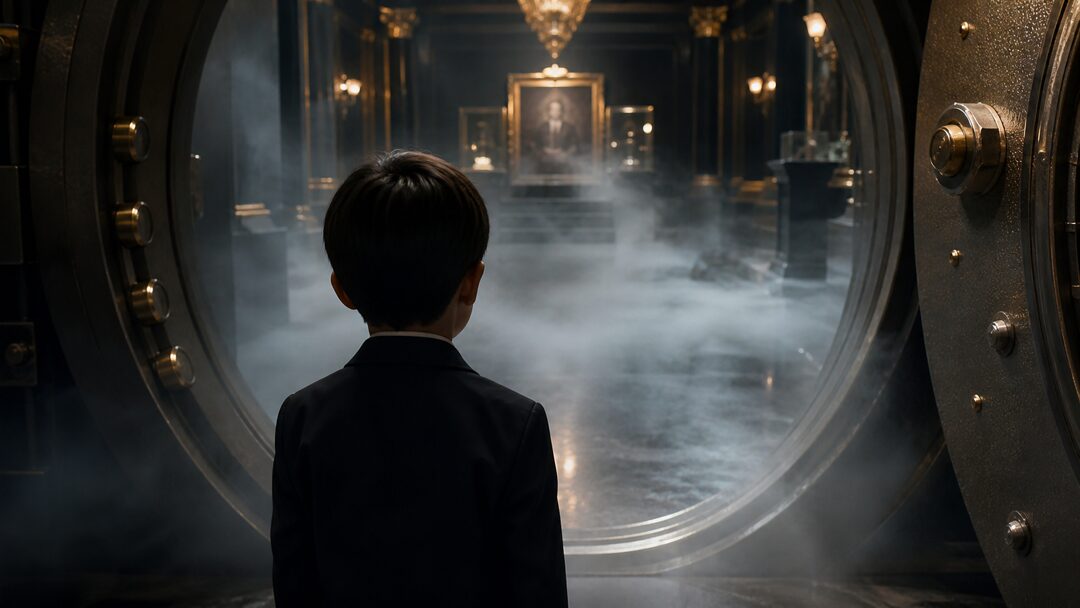
The ballroom had gone quiet in the way expensive rooms go quiet—softly, politely, with crystal glasses lowering and conversations folding themselves away. A brass-and-steel vault stood beneath the chandeliers as if someone had dragged a bank into a charity dinner. Its polished wheel gleamed under the lights. Its hinges were thick as a man’s wrist. Its door looked too heavy for any room built for music.
Robert stood beside it in his formal dress uniform, silver hair cut close, shoulders rigid, medals arranged with almost painful precision.
At sixty-eight, he still looked like a man who expected rooms to obey him.
The donors loved him for that.
The officers respected him for it.
Emily had spent ten years resenting him for it.
Daniel leaned toward her, his black suit a little too large in the shoulders. His shoes were polished so brightly that he kept looking down at them when he didn’t know where else to look.
“Mom,” he whispered, “why is there a safe?”
“It’s a vault,” Emily said.
“What’s the difference?”
“A vault makes people think what’s inside matters more.”
Daniel swallowed. “Does it?”
Emily looked at Robert again.
He was still watching Daniel.
“I don’t know,” she said.
The host of the foundation stepped to the microphone, smiling with practiced reverence. Behind him, the enormous banners of the Hayes Veterans Legacy Fund hung from the balcony. Robert’s name was printed in gold on every program at every plate.
Tonight was supposed to be simple.
A dinner. A fundraiser. A speech Robert had promised would be short. A ceremonial unveiling of some preserved object from his final deployment.
Emily had agreed to bring Daniel because Robert had asked once, quietly, without pressure.
Not commanded.
Asked.
That had been rare enough to make her say yes.
Now she regretted it.
Robert approached the microphone.
The ballroom straightened.
“Thank you for being here,” he said.
His voice was low, steady, unmistakably trained by years of being heard over noise and fear. It filled the room without effort.
“I have been given many things in my life that I did not deserve. Honors. Titles. Trust. Forgiveness.”
A few people smiled at the humility. Emily did not.
Robert continued, “Tonight, the foundation asked me to bring something from my final years of service. Something meaningful. Something worthy of preservation.”
A ripple moved through the crowd. People turned toward the vault. Daniel did too.
Robert placed one hand on the brass wheel.
Emily saw his fingers pause there.
Only for a second.
But she saw it.
“This vault has remained sealed for ten years,” Robert said. “It has not been opened for board members, donors, officers, reporters, or historians.”
The room leaned in.
Daniel leaned back.
“And tonight,” Robert said, “I will not be opening it.”
A soft murmur passed through the tables.
Robert looked at Daniel.
Emily felt it before he said the name.
“My grandson will.”
Daniel went completely still.
For a moment, he looked so small under the chandeliers that Emily almost forgot the room existed. He was ten years old. He still left cereal bowls in the sink. He still slept with one foot outside the blanket. He still hated being watched.
Robert had just placed the attention of three hundred adults on him like a coat made of stone.
“No,” Emily said under her breath.
Daniel looked up at her. “Me?”
Robert stepped away from the microphone and held out his hand.
“Daniel,” he said, not loudly, but every person heard him. “Come here, son.”
Emily’s hand tightened.
Daniel did not move.
The room waited with beautiful, merciless patience.
Emily bent toward him. “You don’t have to.”
Daniel looked across the ballroom at his grandfather.
Robert’s hand was still extended.
Not demanding.
Waiting.
And somehow, that was worse.
Daniel pulled gently away from Emily.
“It’s okay,” he whispered.
It was not okay. Emily knew it. Robert knew it. Perhaps even Daniel knew it.
But Daniel walked forward anyway.
Part II — The Boy Everyone Watched
The applause began softly, then grew.
Daniel hated applause when it was for him.
He crossed the ballroom with his eyes fixed on the carpet. Red and gold patterns blurred under his shoes. A woman at one of the front tables pressed her hand to her heart as if his walking were already meaningful to her.
That made him want to disappear.
Robert met him halfway.
Up close, Daniel could see the small things other people missed. The tight line beside his grandfather’s mouth. The pale scar near his jaw. The way one medal was not quite straight, though Robert Hayes never wore anything crooked.
“You all right?” Robert asked.
Daniel nodded because everyone was watching.
Robert lowered his voice. “Tell me the truth.”
Daniel glanced at the crowd.
Then at the vault.
“No,” he whispered.
For the first time that night, Robert almost smiled.
“That makes two of us.”
Daniel blinked.
Robert placed a hand lightly on his shoulder and turned him toward the vault. The metal door rose above Daniel like something from another time. The wheel at its center was nearly as wide as his chest.
At the tables, people whispered.
“Is that from the Hayes archive?”
“I heard it was sealed after the last operation.”
“Maybe the unit flag.”
“No, someone said classified documents.”
“Could be Michael’s medals.”
Daniel heard his father’s name like a fork dropped on marble.
Michael.
Adults used it carefully around him, as if the name had edges.
His mother said Dad when she told stories, but not often. Robert said your father, usually from a distance, as if the words belonged in a glass case. At school, people said hero when they meant someone Daniel could not remember.
He had seen his father’s face in three framed pictures at home.
One in the hallway.
One beside his mother’s bed.
One in Robert’s study, where nobody touched anything.
In all three, Michael Hayes looked young, smiling, impossible.
But the adults remembered him differently. They went quiet in different places. They stopped mid-sentence. They changed rooms without saying why.
Daniel knew his father had been loved.
He did not know what his father had sounded like when he laughed.
Robert led Daniel to the microphone.
“This is my grandson,” Robert said.
A gentle laugh moved through the room, because everyone already knew. Daniel stared at the floor.
“He has inherited more than he understands,” Robert continued. “And less than he deserves.”
Emily’s face changed.
Daniel saw it from the corner of his eye. His mother stood near the front table, still and pale, her navy dress simple among glittering gowns. She looked like someone holding a door closed from the inside.
Robert turned from the microphone.
“Daniel,” he said, “this vault belongs to you after tonight.”
A louder murmur passed through the ballroom.
Daniel looked up fast. “What?”
Robert’s eyes softened, but his posture did not. “After tonight, it is yours.”
Daniel tried to understand that. The vault was taller than he was. It looked like it belonged to a museum or a bank or some room adults entered with keys on chains.
“I don’t want it,” he said before he could stop himself.
A few people chuckled, thinking he was being charming.
Robert did not chuckle.
“No,” he said quietly. “I don’t suppose you do.”
Emily stepped forward.
“Robert.”
Her voice cut through the room more sharply than the microphone had.
Several heads turned.
Robert looked at her.
Emily did not raise her voice. She did not need to. Her anger was restrained, and restraint had always been more dangerous in her than shouting.
“May I speak to you?”
Robert glanced at Daniel, then at the crowd.
The host began moving toward the microphone, already smiling to cover discomfort. “Ladies and gentlemen, we’ll take just a brief—”
“No,” Robert said.
The host stopped.
Robert looked at Emily again. “Here is fine.”
Emily’s jaw tightened.
Daniel wanted to sink into the carpet.
“Not here,” she said.
Robert studied her for a moment.
Then he nodded.
“Daniel,” he said, “stay beside the vault. I’ll be one minute.”
That was the first time Daniel wished the vault would open and swallow him.
Part III — What Adults Refused to Say
Emily followed Robert into the side corridor behind the ballroom, where the music from the string quartet became a faint, expensive hum.
The door closed behind them.
For a moment, neither spoke.
On the wall between them hung black-and-white photographs of past foundation galas. Men in dark suits. Women in pearls. Flags. Smiles. Large checks held by grateful hands.
Emily hated those pictures.
They made grief look organized.
“What are you doing?” she asked.
Robert stood with his hands behind his back. “What I should have done years ago.”
“You should have told me before putting my son in front of a room full of strangers.”
“He isn’t only your son.”
The words landed badly.
Robert knew it the second he said them.
Emily’s eyes flashed. “Do not do that.”
He lowered his gaze.
She stepped closer. “You don’t get to disappear into silence for ten years and then decide tonight is the night Daniel becomes part of some ceremony.”
“This isn’t ceremony.”
“There are cameras in that room.”
“I asked that they not film the opening.”
“And you think that makes this private?”
Robert said nothing.
Emily laughed once, without humor. “You brought a vault into a ballroom.”
His face tightened.
She saw the crack and almost softened. Almost.
But then she thought of Daniel’s small shoulders under all those eyes.
“He needs a grandfather,” Emily said. “Not another monument.”
Robert turned his head slightly, as if she had struck him with something clean and deserved.
“He already has monuments,” she continued. “He has plaques. Programs. Foundation letters. Scholarship dinners. Every year someone tells him his father was brave, and every year he nods like he understands. He doesn’t understand. He was a baby.”
Robert looked at the closed ballroom door.
Emily lowered her voice. “And you let him grow up around all this honor without giving him one ordinary thing to hold.”
His eyes came back to her.
“I know.”
The admission stopped her.
Robert Hayes did not surrender ground easily.
But those two words had no defense in them.
Emily stared at him. “Then why tonight?”
Robert’s right hand flexed once behind his back.
“Because I waited too long.”
That was not enough. Emily’s face said so.
Robert looked older in the corridor than he had in the ballroom. Without the chandeliers and applause, the medals seemed heavier.
“I thought silence was mercy,” he said.
“It wasn’t.”
“No.”
A server passed at the far end of the corridor, saw their faces, and vanished in the other direction.
Robert took a breath.
“When Daniel was younger, I told myself he couldn’t understand. Then he was five, and I told myself he was still too tender. Then seven. Then nine.” His voice thinned but did not break. “After a while, the silence became easier to maintain than to end.”
Emily’s anger shifted. It did not leave. It changed shape.
“What’s in there, Robert?”
He did not answer.
Her eyes sharpened again. “If you’re about to give him a flag or a medal in front of donors—”
“I’m not.”
“Then what?”
Robert looked toward the ballroom.
“Something the war almost took.”
Emily froze.
She hated that word even before he finished the sentence.
War.
People used it in speeches as if it were a stage on which courage performed. Emily knew it as a room that never stopped echoing.
“What does that mean?” she asked.
Robert’s mouth tightened.
“It means there is one thing in that vault Daniel should have had before he could walk.”
“Then why didn’t he?”
Robert looked at her then.
Not like a colonel.
Not like a public symbol.
Like an old man who had failed in a place no medal could reach.
“Because every time I touched it,” he said, “I remembered the day I received it. And I was a coward.”
The word sat between them.
Emily had never heard him use it about himself.
From inside the ballroom came the low swell of polite conversation. Daniel was alone in there beside the vault, surrounded by people who knew his last name better than his heart.
Emily turned toward the door.
Robert said, “Emily.”
She stopped.
“I am not trying to take him from you.”
She did not look back. “Then don’t make him carry what you couldn’t.”
Robert nodded once, though she did not see it.
“I’m asking him to help me stop carrying it alone.”
That did make her look back.
And for the first time in years, she did not know what to say to him.
Part IV — The Thing Not on Display
When Emily and Robert returned, Daniel was standing exactly where Robert had left him.
Not because he was obedient.
Because he had been too terrified to move.
A donor in a velvet jacket was bent toward him, smiling with the broad kindness of someone who did not understand children.
“You must be very proud,” the man said.
Daniel looked at him. “Of what?”
The man blinked.
Emily reached Daniel’s side before he could answer badly enough to become a story.
“Thank you,” she said to the man, with a smile that moved him away.
Daniel exhaled.
Robert returned to the microphone, but the room was different now. The interruption had left a faint unease under the glitter. People were watching not just with curiosity, but with the hunger to know whether something private had cracked.
Robert did not satisfy them.
“The foundation has preserved many public records,” he said. “Many objects that tell the official story.”
He gestured toward the far wall.
There, under glass, stood a temporary display brought in for the gala: folded flags, citations, old photographs, a row of medals lit from above.
Daniel’s eyes moved across the display.
He had seen some of those things before. His grandfather had taken him through halls where adults spoke softly and pointed at objects Daniel was told mattered.
Then he saw the case labeled:
Captain Michael Hayes
His father’s name.
Below it were medals. A watch. A folded letter sealed under glass. A photograph of Michael with his unit, one arm around another man’s shoulders, smiling with his whole face.
Daniel stepped toward it without meaning to.
Emily noticed.
So did Robert.
Daniel stopped in front of the case.
The watch looked ordinary. The kind of thing a dad might wear while driving or fixing something under a sink. The medals looked less ordinary. They shone in a way that made him feel he was supposed to stand straighter.
“Those were Dad’s?” he asked.
Emily came beside him. “Yes.”
“Why are they here?”
“For tonight,” she said.
“Do they go back after?”
Robert answered from behind them. “Yes.”
Daniel turned. “Back where?”
“To the archive.”
Daniel looked at the vault. “Not in there?”
“No.”
The answer was immediate.
Too immediate.
Daniel frowned. “Then what’s in there?”
Robert looked at him for a long moment.
The ballroom quieted again, sensing the question had arrived before schedule.
Robert stepped closer to Daniel. He lowered himself slightly—not fully kneeling, not yet, but enough that Daniel no longer had to look so far up.
“Do you think your father belonged in that case?” Robert asked.
Daniel glanced at the medals.
Then at the photograph.
Then at his mother.
“I don’t know.”
“That’s an honest answer.”
Daniel studied the display. “People always say he was brave.”
“He was.”
“Was he funny?”
Emily’s hand rose to her mouth.
Robert’s face changed so quickly most people missed it.
Daniel did not.
“Yes,” Robert said.
The word was rough.
Daniel waited.
Robert looked at the case as if the photograph in it had accused him.
“He used to put hot sauce on everything,” Robert said. “Eggs. Soup. Steak. Once on birthday cake because your grandmother dared him.”
Daniel stared.
Emily made a small sound, almost a laugh and almost not.
“Did he eat it?” Daniel asked.
“Every bite,” Robert said. “Mary told him pride was a poor seasoning.”
Daniel smiled.
It was quick, surprised, and gone almost at once.
But Emily saw it.
So did Robert.
So did half the room.
And in that small smile, the medals lost some of their power.
Not their meaning.
Just their hold.
Daniel looked back at the vault.
“So if Dad’s brave stuff is there,” he said, pointing at the display, “then what’s in the vault?”
Robert stood slowly.
His hands were steady at his sides.
His voice was not.
“Not his brave stuff.”
Daniel waited.
Robert swallowed.
“His ours stuff.”
No one in the room moved.
Emily closed her eyes.
The phrase was clumsy. Almost childish. Not like Robert at all.
That was why it hurt.
Part V — The Door That Would Not Move
The host tried to regain control.
“Ladies and gentlemen,” he said gently, “we are honored to witness—”
Robert lifted one hand.
The host stopped again.
No one seemed offended. At this point, the room belonged to the vault, the boy, and whatever Robert could not say cleanly.
Robert approached Daniel.
“Are you still willing?” he asked.
Daniel looked at the wheel.
“How heavy is it?”
“Heavy.”
“Will I mess it up?”
“No.”
“What if I can’t turn it?”
Robert looked at the vault. “Then I’ll help.”
Daniel stared at his grandfather’s hands.
They were shaking.
Not much.
But enough.
Daniel had never seen that before. He had seen Robert carry chairs with one hand, stand through long ceremonies without shifting, carve turkey without spilling gravy, lift boxes Emily told him were too heavy.
He had never seen Robert afraid of a door.
Emily saw the shaking too.
She moved closer. “Daniel.”
He turned to her.
There was a question in her face, and a warning, and permission she did not want to give.
“You don’t have to do this,” she said.
The room disappeared for Daniel then. Not fully. He still felt it like heat at his back. But his mother’s voice made a small circle around him.
“What is it?” he asked her.
She looked at Robert.
“I don’t know,” she said.
That scared him more than anything else.
His mother knew almost everything that mattered. She knew where school forms went, how to fix the internet, how long leftovers were safe, when he was pretending not to be sad. She knew which pictures of Dad made her quiet and which ones made her smile.
If she did not know what was in the vault, then whatever was inside had been kept from both of them.
Daniel turned to Robert.
“Did my dad know?”
Robert’s throat moved.
“No.”
“Did Grandma?”
Robert’s eyes closed once.
“Yes.”
Daniel remembered Mary only through photographs and stories. Robert’s wife had died when Daniel was four. In every picture, she seemed warm in a way that did not match the Hayes house, which was clean and formal and full of things nobody touched.
“What did she say about it?” Daniel asked.
Robert’s mouth trembled before he stopped it.
“She said I’d know when it was time.”
Daniel looked at the wheel again.
“And now it’s time?”
Robert did not answer quickly.
That mattered.
“Yes,” he said at last. “If you want it to be.”
The whole room waited for a child to decide whether an old man was ready.
Daniel stepped toward the vault.
Emily’s breath caught.
Robert moved with him.
The brass wheel was cold under Daniel’s hands. He gripped it, then let go, wiping his palms on his pants.
A soft laugh moved through the room, affectionate and nervous.
Daniel flushed.
Robert turned his head slightly.
The laugh died at once.
“Both hands,” Robert said quietly.
Daniel placed both hands on the wheel.
Robert stood behind him, close but not touching.
“Clockwise,” he said.
Daniel tried.
The wheel did not move.
His shoulders tightened.
Someone near the back whispered, “Poor kid.”
Emily heard it. Her eyes snapped toward the voice.
Daniel heard it too.
His ears burned.
Robert leaned closer. “Again.”
“I can’t.”
“You can.”
“It’s too heavy.”
“It’s meant to be.”
Daniel looked back at him.
Robert’s face was pale. His hands shook harder now, no longer hidden.
“Why?” Daniel whispered.
Robert’s voice dropped until only Daniel and Emily could hear.
“Because some things should not open easily.”
Daniel did not understand.
But he understood the way Robert looked at the door.
Not like a man opening a display.
Like a man returning to a room he had locked from the outside.
Daniel turned back.
He pushed again.
The wheel gave a dull metallic groan.
The sound moved through the ballroom like thunder under the floor.
Everyone went still.
Daniel gasped. “It moved.”
Robert’s hand came over his—not taking control, only adding weight.
“Yes,” he said. “Keep going.”
Together, they turned the wheel.
One inch.
Then another.
Inside the vault, locks shifted with deep, echoing clicks.
Emily stepped closer without realizing it.
Daniel’s arms trembled.
Robert’s jaw tightened.
The final lock released with a sound like a breath being held too long.
Then the door opened.
Cold mist spilled out.
Part VI — What Was Protected
No one spoke.
The vault exhaled white vapor into the warm ballroom, curling around Daniel’s polished shoes and Robert’s dress uniform. For a moment, the chandeliers blurred behind the mist, and all the gold in the room seemed distant and useless.
Daniel stepped back.
Robert did not.
Inside the vault was not a stack of boxes.
Not a flag.
Not medals.
Not documents with blacked-out lines.
There was only a small shelf, lit from within.
On it sat one framed photograph sealed behind glass, surrounded by pale frost that clung to the edges like winter holding on.
The room leaned forward.
Then seemed ashamed of itself for doing so.
Emily brought one hand to her chest.
Robert reached into the vault carefully, almost reverently. The cold touched his fingers. He lifted the frame with both hands.
For the first time all night, he looked breakable.
He turned.
Daniel could not see the photograph yet.
He saw only the back of the frame, dark wood, protected corners, a brass plate with no inscription.
Robert lowered himself to one knee.
Not for the room.
For Daniel.
The sight made the ballroom feel suddenly too large.
“This,” Robert said, “is what I was protecting until you were old enough to hold it.”
Daniel looked at his mother.
Emily was staring at the frame as if she already knew and could not bear to know.
Robert turned it around.
Daniel saw his father first.
Not the father from the display case. Not the still, brave man under glass. Not the name adults lowered their voices around.
This Michael was sitting on the edge of a hospital bed with his sleeves rolled up, hair messy, smiling like someone had caught him laughing before he could fix his face.
He was holding a newborn badly.
Not dangerously.
Just badly enough that everyone in the picture seemed to be correcting him.
Emily was beside him, younger, exhausted, beautiful in the raw way of someone who had just become someone’s whole world. Her hand rested under the baby’s head.
Mary stood behind them, one hand on Michael’s shoulder, the other touching the baby’s blanket. She looked proud and amused and unbearably alive.
The baby’s eyes were closed.
Daniel knew before anyone told him.
“That’s me,” he said.
Emily made a sound that was not quite his name.
Daniel leaned closer.
His father’s smile filled the frame.
Not heroic.
Not polished.
Not far away.
Just there.
“Where was this?” Daniel asked.
Robert looked at Emily.
Emily answered, though her voice barely worked.
“The hospital.”
Daniel did not take his eyes off the photograph. “When?”
Robert said, “Two days before your father left.”
The words settled slowly.
Daniel understood some of them.
Not all.
Enough.
He looked at the photograph again. “Why didn’t we have this?”
Emily turned to Robert.
The question belonged to her too.
Robert kept holding the frame. His knee must have hurt, but he did not rise.
“There was a storage room,” he said. “After everything came back. Boxes. Records. Personal effects. Things damaged by water, heat, time. This was found inside one of Mary’s old bags, sealed in a cracked plastic sleeve.”
Emily stared at him. “Mary had it?”
Robert nodded.
“She wanted to make copies,” he said. “She kept saying it was the only picture where all of you were together. Then Michael left. Then…” He stopped. Not because the room did not know. Because Daniel was there.
Emily finished it for him in silence.
Robert looked down at the photograph.
“By the time I found it again, the print had started to fade. The technicians said exposure would ruin it completely unless it was preserved. I told myself I was saving it.”
Daniel looked up. “But you locked it away.”
Robert’s face tightened.
“Yes.”
The word was small.
Daniel frowned. Not angry. Trying.
“Why?”
Robert looked at him for a long time.
Then at Emily.
Then back to Daniel.
“Because if I gave it to you,” he said, “I had to admit how much you had been missing.”
Emily’s eyes filled.
Robert drew a breath.
“And if I kept it safe, I could pretend that was the same as loving you well.”
No one in the room moved.
That was the line that found everyone.
Daniel looked at the photograph.
At his father’s smile.
At his mother’s younger hand.
At the grandmother he barely remembered.
Then he looked at the old man kneeling in front of him, holding the frame as if it weighed more than the vault.
“Can I hold it?” Daniel asked.
Robert’s face changed.
He had prepared for speeches. For ceremony. For judgment. For Emily’s anger. For the room’s attention.
He had not prepared for Daniel’s simple trust.
“Yes,” he said.
He handed the frame over.
Daniel took it with both hands.
The glass was cold.
He held the last whole picture of his family against his chest, careful at first, then tighter.
Emily stepped forward and crouched beside him.
She touched the edge of the frame, not the glass.
Her thumb found Michael’s face without covering it.
“Oh,” she whispered.
It was the smallest sound.
It carried ten years.
Robert remained on one knee.
For once, nobody applauded.
Maybe because they understood this was not a performance.
Maybe because Emily’s hand was shaking now too.
Daniel looked at his mother. “Did Dad really put hot sauce on cake?”
A laugh broke out of Emily before she could stop it.
Then a sob followed it.
She nodded, pressing her fingers to her mouth. “Yes.”
Daniel looked at Robert.
Robert’s eyes were wet, though nothing fell.
“Was it chocolate?” Daniel asked.
Robert laughed once.
It sounded unused.
“Yes,” he said. “Chocolate.”
Daniel looked back at the photograph.
For the first time, his father was not only brave.
He was ridiculous.
He was warm.
He was someone who had held him wrong and loved him anyway.
That was more than a medal could do.
Emily wrapped one arm around Daniel’s shoulders. After a moment, she looked at Robert.
There was still hurt between them.
There would be.
A photograph could not give back years.
It could not answer every silence.
It could not make Robert right.
But it had opened something no vault could close again.
Emily reached out her free hand.
Robert looked at it.
Then took it.
The three of them stayed there in front of the open vault while the mist thinned around their shoes and the ballroom faded into a blur of faces, flowers, glass, and gold.
The donors had come to see what a war hero had saved.
They left understanding what an old man had almost lost.
Later, when the gala lights dimmed and the display cases were packed away, Robert did not return the photograph to the vault.
Daniel carried it himself.
Not far. Just across the ballroom to where his mother waited with his coat.
But he carried it as if something important had finally been placed in the right hands.
At the door, he stopped and looked back.
Robert stood beside the empty vault.
For the first time all night, he seemed smaller than it.
Daniel turned around.
“Grandpa?”
Robert looked up.
Daniel held the photograph a little higher. “Can you tell me more stories about him?”
Emily closed her eyes.
Robert’s answer came slowly.
Not because he did not know.
Because he finally understood that knowing was not enough.
“Yes,” he said. “All of them.”
Daniel nodded, satisfied for now.
Then he walked out with the photograph held carefully against his chest.
Robert watched him go.
The vault remained open behind him, cold mist gone, brass wheel still, its secret no longer protected by steel.
The room was quieter now.
Not empty.
Changed.
And for the first time in ten years, Robert Hayes had nothing left to guard except the people still standing close enough to reach.