They Threatened Her Farm Over a Ninety-Dollar Road Fee, Then She Asked Where the Reserve Money Went
Chapter 1: The Ninety-Dollar Charge at the Farm Gate
Ryan Moore stood in the middle of the gravel lane with one hand raised while Rebecca Hall’s tractor idled twenty feet away.
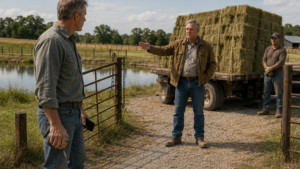
Behind her, the flat wagon carried forty-two square bales stacked three layers high. Rebecca could feel their weight every time the tractor vibrated. She had promised the buyer she would have them delivered before noon.
Ryan did not move.
Rebecca eased the throttle down and killed the engine.
“What is it?”
Ryan held a clipboard against his blue work shirt. “You still owe the ninety.”
Rebecca looked past him toward the cooperative equipment shed. Both bay doors were open. David Anderson stood near a grease-stained workbench with two other landowners, pretending not to listen.
“I told you last week,” Rebecca said. “I’ll pay an authorized assessment.”
“It is authorized.”
“Then show me.”
Ryan’s jaw tightened.
The shared lane ran from the county road past Ryan’s acreage, crossed a drainage ditch, then split toward Rebecca’s farm and two neighboring properties. For thirty-three years, Rebecca had paid for gravel, culvert work, grading, brush cutting, and every other legitimate expense the cooperative approved.
Ninety dollars was not the problem.
That was what irritated Ryan most.
He stepped closer.
“We had emergency drainage work. Everybody pays their share.”
Rebecca climbed down from the tractor. She was sixty-eight, though the stiffness in her left knee sometimes made her feel older when she spent a full morning climbing equipment. She brushed hay dust from her jeans.
“When was the vote?”
Ryan glanced toward the shed.
“The board handled it.”
“What date?”
“We don’t have to stand in the road and do this.”
“You’re the one standing in the road.”
One of the neighbors looked down quickly.
Ryan lowered his voice. “Rebecca, don’t turn ninety dollars into something it isn’t.”
She stared at him for a moment, then walked to the tractor’s storage box and removed a battered red ledger with softened corners and a faded elastic strap.
She carried it into the equipment shed.
Ryan followed.
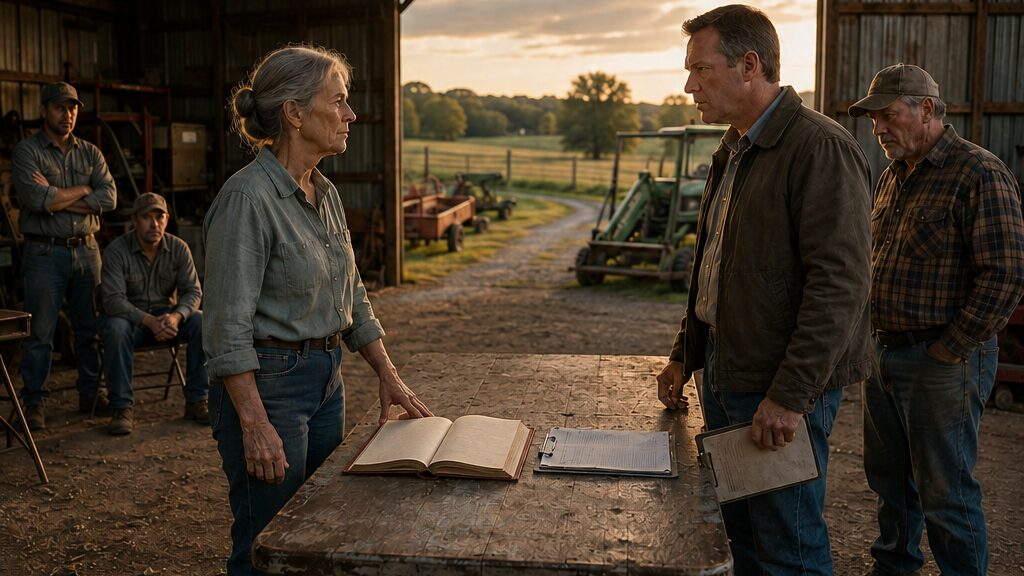
Rebecca laid the ledger on the workbench beside his clipboard.
The red book had begun as her late husband’s farm expense ledger years earlier. After his death, she kept using it—fuel purchases, fertilizer, fence wire, cooperative dues, hay receipts. Dates on the left. Amounts on the right. Notes in the margin when something did not fit neatly anywhere else.
She opened to the page marked ROAD COOPERATIVE.
“Last regular assessment,” she said. “April. Approved March twenty-sixth. Gravel and ditch mowing. Two hundred forty dollars.”
Ryan folded his arms.
“Before that, September. Culvert patch. One hundred ten.”
“I know what we charged.”
“Good. Then tell me where this ninety was approved.”
“We discussed emergency authority last year.”
“Discussed it where?”
“At the meeting.”
“What meeting?”
His eyes shifted once.
It was small, almost nothing.
Rebecca had spent twenty-six years noticing almost nothing.
Before retiring to the farm full-time, she had worked forensic accounting cases for the Treasury Department. Most investigations did not begin with dramatic evidence. They began with a date that did not line up. A signature in the wrong place. A person who answered a simple question with a longer answer than necessary.
Ryan tapped the clipboard.
“You’re being difficult.”
“No,” Rebecca said. “I’m being precise.”
The shed went quiet except for the ticking engine of the tractor outside.
Rebecca turned the ledger toward him.
“Meeting date. Vote. Contractor authorization. Reserve entry.”
Ryan stared at the columns as if she had placed something offensive on the workbench.
“This isn’t Washington,” he said. “It’s a farm road.”
“Then the records ought to be simple.”
David shifted his weight.
Ryan looked at him, then back to Rebecca.
“This lane needs work. You know that.”
“I do.”
“The lower ditch washed again. We had equipment out here. Fuel costs money. People cost money.”
“I’m not disputing that.”
“Then pay your share.”
Rebecca closed the ledger.
“Show me what my share is based on.”
For the first time, Ryan’s irritation broke through the polished calm he usually used at cooperative meetings.
“If every decision takes three weeks of discussion, this road will be gone before anybody signs anything.”
“That still doesn’t tell me when ninety dollars became an assessment.”
Ryan picked up his clipboard.
“Friday I’m sending unpaid accounts to collection.”
One of the neighbors finally looked up.
Rebecca felt heat move through her chest, but her voice stayed level.
“For ninety dollars?”
“For unpaid cooperative charges.”
“And if I don’t pay?”
Ryan hesitated.
“Members who aren’t current shouldn’t expect the cooperative to keep accommodating them.”
Rebecca looked through the open shed door toward the lane. Her tractor sat in the road with the loaded wagon behind it. Beyond the curve lay her hayfield, barn, cattle lot, and the house where she had lived long enough to know the sound of every hinge.
“What does accommodating mean?”
“You know exactly what it means.”
“No. I want you to say it.”
Ryan rubbed the side of his thumb against the clipboard.
“Gate access. Maintenance priority. Scheduling equipment. Whatever applies.”
Rebecca looked at David.
He did not meet her eyes.
That hurt more than Ryan’s threat.
The road cooperative had always been informal in the way rural arrangements often were. Someone noticed a washed shoulder. Someone called for gravel. Someone else brought a tractor. Then, usually, the members met, divided the cost, and wrote it down.
Informal was not the same as ownerless.
Rebecca picked up the red ledger.
“How much is currently in the road reserve?”
Ryan’s expression changed.
It was slight.
But it changed.
“We’re discussing your delinquent assessment.”
“I’m asking about the money used for the emergency work.”
“That’s board business.”
“I’m a member.”
“You’re a member who owes ninety dollars.”
Rebecca slipped the elastic strap around the ledger.
“Then send me the authorization.”
Ryan walked past her toward the lane.
“You’ll get your notice Friday.”
He stopped at the shed opening and spoke loudly enough for everyone inside to hear.
“And if you want to make an issue out of ninety dollars, that’s your decision. But don’t complain later when the cooperative treats you like somebody who won’t carry her share.”
Rebecca watched him walk toward his pickup.
Nobody spoke until the truck started.
David finally said, “He shouldn’t have put it that way.”
Rebecca looked at him.
“No.”
David cleared his throat. “But the ditch work was real.”
“I didn’t say it wasn’t.”
“He’s under pressure to get that road fixed.”
“So am I.”
Rebecca carried the ledger outside and climbed onto the tractor.
The buyer would be irritated. The hay would arrive late. None of that bothered her nearly as much as the fact that Ryan had been asked three times for the date of a vote and had answered every question except that one.
She restarted the tractor.
As she pulled the wagon forward, Ryan’s pickup waited at the county road.
He lowered his window as she approached.
“Friday, Rebecca.”
She did not answer.
She drove past him with the hay wagon rattling behind her.
By the time she reached the paved road, the ninety dollars no longer interested her.
The missing vote did.
Chapter 2: The Meeting That Nobody Could Produce
The collection letter arrived Thursday instead of Friday.
Rebecca found the envelope wedged behind the screen door after feeding the cattle. The cooperative’s return address was printed in the upper corner, and beneath her name someone had stamped PAYMENT DUE.
She stood on the porch and opened it with her thumbnail.
Ninety dollars.
Ten days.
Failure to bring the account current could result in collection costs and suspension of unspecified cooperative privileges.
Rebecca read the final paragraph twice.
Then she carried the letter inside and placed it beside the red ledger.
By eight-thirty she had opened three cardboard archive boxes from the closet in the small room she still called the office.
Her husband had once complained that she kept too much paper.
After he died, she had discovered she could remember the sound of his complaints more clearly than the particulars of some entire years.
She pushed that thought aside and opened the first binder.
The road cooperative was not complicated. Seven member properties. A chairman, treasurer, secretary. Regular assessments required approval recorded in meeting minutes. Emergency repairs permitted faster action, but the bylaws still required the expenditure to be documented and ratified.
Rebecca began with the previous twelve months.
March twenty-sixth: gravel resurfacing approved.
January eighteenth: no financial vote.
October third: ditch mowing and culvert clearing approved.
September: no meeting.
August: storm damage discussed. No ninety-dollar surcharge.
She went backward another year.
Then another.
At eleven fifteen, Emily Scott came through the back door carrying a paper bag.
“You didn’t answer your phone.”
Rebecca did not look up. “It’s charging.”
“It’s been charging for three hours?”
Emily set two sandwiches on the desk.
Rebecca pointed at a yellow legal pad.
“Do you remember them voting on emergency assessment authority?”
Emily stared at the boxes.
“Oh, no.”
“What?”
“You’ve started.”
“I’m reading minutes.”
“You have three boxes open.”
“There are gaps.”
Emily pulled out the chair opposite her.
“Mother, it is ninety dollars.”
Rebecca stopped writing.
“That is exactly what Ryan keeps saying.”
“Because it’s true.”
“So I should pay something because it’s small?”
“I’m saying maybe ninety dollars isn’t worth spending four days turning this room into a federal investigation.”
Rebecca’s pencil rested against the paper.
“Collection charges aren’t ninety.”
“Pay it and argue afterward.”
“That’s how unauthorized charges become authorized by habit.”
Emily sighed.
There it was—that familiar expression Rebecca disliked because it made her feel as if she had become an elderly parent before she felt elderly herself.
“You know what I mean,” Emily said.
“I do.”
“No, you know what the words mean. That isn’t always the same thing.”
Rebecca closed the binder.
Emily softened slightly.
“Is this really about the road?”
Rebecca looked toward the office window. From there she could see the top of the barn beyond the maple trees.
“If they can decide I don’t get maintenance priority because I questioned a charge, what happens when the lower crossing washes out?”
“Then you call me.”
“With what? Your sedan?”
Emily looked away.
Rebecca regretted the sharpness immediately but did not apologize.
That was another habit she had perfected in government work: when uncomfortable, move back to the facts.
She opened the binder again.
“The vote isn’t here.”
Emily stood.
“Eat your sandwich.”
After she left, Rebecca worked until late afternoon.
There was no recorded authorization.
More troubling, the meeting minutes changed style roughly eighteen months earlier. Before that point, expenditures were listed with vendor, purpose, motion, second, and vote count.
After Ryan became chairman, some entries became shorter.
“Road repairs discussed.”
“Drainage work authorized as needed.”
“Chairman to coordinate contractor.”
Those phrases bothered Rebecca because each seemed harmless alone.
Together, they formed permission without boundaries.
The next morning she walked to the equipment shed carrying photocopies.
The cooperative secretary was there filing fuel receipts into a metal cabinet.
“I need the supporting records for the emergency surcharge,” Rebecca said.
The secretary gave her an apologetic look. “Ryan said he was gathering those.”
“I asked Monday.”
“I know.”
“Can I see the invoice?”
A pause.
“I can give you what I have.”
She opened a drawer and removed a thin folder.
Inside were three invoices, a handwritten equipment log, and copies of checks.
Rebecca scanned them at the workbench.
The first invoice was for ditch clearing.
The second was for gravel.
The third was from a grading company she did not recognize.
She wrote the amounts in her ledger.
“You have the meeting record approving these?”
The secretary shook her head.
“Ryan said emergency authority covered it.”
“Where is the emergency authority recorded?”
Another apologetic expression.
“I don’t know.”
That answer did not satisfy Rebecca.
But it did something almost as important.
It confirmed that Ryan’s inability to name the vote had not simply been embarrassment under pressure. The authorization itself appeared to be missing.
Rebecca photographed every document and returned home.
She spent the afternoon comparing invoice dates with bank entries and cooperative notices.
At five ten, she reached the grading invoice again.
The amount was larger than she expected.
The description read broadly: drainage shaping, road shoulder, machine time.
No precise location.
No hourly breakdown.
No materials list.
Rebecca wrote the company name on her yellow pad.
Then she studied the mailing address.
She knew it.
Not because she had done business there.
Because every December, for years, a Christmas card had arrived from that same rural route.
Rebecca went to the kitchen drawer where she kept old address labels and found one from the previous winter.
The surname was different from the company name.
But the address matched.
It belonged to Ryan Moore’s brother-in-law.
Chapter 3: The Contractor Behind the Same Mailbox
At nine twelve Monday morning, the county records clerk turned the computer monitor toward Rebecca and tapped the registration entry with one finger.
“That’s the owner.”
Rebecca already knew the name.
She still copied it carefully into the red ledger.
The grading company had been registered two years earlier. Its mailing address matched the one on Rebecca’s old Christmas card. The registered owner was Ryan Moore’s brother-in-law.
Rebecca thanked the clerk and stepped into the hallway.
For several seconds she stood beside a bulletin board covered with tax notices and county meeting announcements.
A family connection was not proof of theft.
It was not even proof of overcharging.
But if Ryan had awarded cooperative work to a relative without disclosure, then the missing vote mattered more.
Rebecca went back to the counter.
“I need property and business records for two more vendors.”
The clerk looked at the list.
“You working for somebody?”
“Myself.”
The woman smiled faintly. “That can be the worst client.”
Rebecca almost smiled back.
By noon, the pattern had widened.
The ditch-maintenance operator appeared independent.
The gravel supplier was an established company used throughout the county.
But a smaller maintenance vendor listed on several cooperative entries used a postal box connected through public records to David Anderson’s household.
Rebecca sat in her truck with the ledger open against the steering wheel.
Ryan’s brother-in-law.
David’s household.
Two cooperative officers.
Two vendors.
She drew a line between the entries and immediately crossed it out.
That was the kind of shortcut she distrusted in other people.
Connection was not conclusion.
She drove home by way of the shared lane.
A grader was working near the lower ditch.
Its blade shaved the shoulder into a clean slope while fresh stone lay in gray ridges ahead of it.
Ryan stood beside the operator.
Rebecca slowed.
Ryan raised a hand, not quite a greeting.
She stopped the truck.
“You’ve hired more work?”
“It was already scheduled.”
“Through which contractor?”
His face hardened.
“Are you going to question every machine that comes down this road now?”
“If I’m paying for it.”
“You’re not paying for anything at the moment.”
Rebecca rested both hands on the steering wheel.
“Does your brother-in-law own the grading company?”
Ryan said nothing.
The machine idled behind him.
Finally he said, “He owns equipment.”
“That wasn’t my question.”
“Yes.”
“Was that disclosed to the cooperative?”
Ryan looked toward the grader operator as if checking whether he could hear.
“He gave us a better rate than anybody else.”
“That wasn’t my question either.”
“Rebecca.”
“Was it disclosed?”
Ryan walked closer to the truck.
“You think because you found a registration record you’ve uncovered something?”
“I think I found a relationship that should have been in the minutes.”
“We needed work done.”
“Then why hide it?”
“I didn’t hide anything.”
“You left it out.”
“Same difference to you, isn’t it?”
His voice was quieter than it had been at the shed, but there was more anger in it.
Rebecca felt the old professional instinct rising—the desire to press harder when someone became defensive.
She stopped herself.
“I’m still looking,” she said.
Ryan laughed once without humor.
“That’s what worries me.”
Rebecca drove on.
At the farm she spent the afternoon building a vendor table.
Invoice number.
Date.
Amount.
Payee.
Address.
Relationship.
Purpose.
Supporting record.
She worked in the red ledger first, then transferred the information to a spreadsheet on the old desktop computer.
By early evening, she had identified fourteen invoices worth reviewing.
Emily called.
Rebecca let the phone ring four times before answering.
“Have you eaten?”
“Yes.”
“That sounded dishonest.”
“I had crackers.”
“Mother.”
“I’m working.”
“I know.”
Rebecca looked at the spreadsheet.
“I found related vendors.”
There was silence.
“What does that mean?”
“Ryan’s brother-in-law received grading work. Another vendor is tied to David’s mailing address.”
Emily exhaled.
“Are you sure?”
“About the addresses, yes.”
“About what they mean?”
Rebecca stared at the crossed-out line in the ledger.
“No.”
That single word cost her more than she expected.
Emily said, “Good.”
“Good?”
“It means you haven’t decided the ending before you finish the middle.”
Rebecca nearly hung up.
Instead she said, “I’m going to talk to David.”
She found him the next morning near his cattle pens replacing a hinge on a feed gate.
David saw the ledger under her arm and sighed.
“I figured you’d come.”
“What is Anderson Rural Maintenance?”
He set down the wrench.
“My wife used the name for bookkeeping.”
“Bookkeeping for whom?”
“For me, mostly. Sometimes for small jobs.”
“The cooperative paid it.”
“Yes.”
“For what?”
“Brush clearing. Hauling. Fuel reimbursement. Things I did when nobody else could get here.”
“Did you vote on paying yourself?”
David rubbed his forehead.
“No.”
“Did Ryan authorize it?”
“Sometimes.”
“And other times?”
“I did the work and submitted the cost.”
Rebecca opened the ledger.
“There are no disclosures.”
“I wasn’t trying to steal from anybody.”
“I didn’t say you were.”
“You’re carrying a book full of my invoices.”
“That is not the same as accusing you.”
“It feels close.”
Rebecca closed the ledger again.
David looked toward his pasture.
Several cattle stood beneath the shade trees, tails switching.
“You want to know what those records don’t show?” he asked.
“Yes.”
“The night that lower culvert washed.”
Rebecca waited.
“My cattle truck was on the far side. Loaded. Road dropped under the rear tires while I was trying to back out.”
She remembered the storm. Everyone did. Three days of hard rain had torn ditches open throughout the valley.
David continued.
“Ryan came down with his loader at midnight. His brother-in-law brought an excavator. Nobody called a meeting. Nobody took a vote. Nobody cared who was related to who.”
Rebecca said nothing.
“We had cattle in that truck and water cutting across the road. They worked until daylight.”
“That doesn’t excuse failing to document it.”
“No.”
“Or paying related parties without disclosure.”
“No.”
“But?”
David looked directly at her.
“But before you decide those invoices mean what you think they mean, go look at the lower crossing.”
“I know the crossing.”
“You know it now.”
He picked up the wrench.
“You didn’t see it that night.”
Rebecca stood there a moment longer.
David’s records were still poor.
Ryan’s behavior was still wrong.
The missing vote remained missing.
Yet for the first time since the ninety-dollar demand, Rebecca felt the clean outline she had been drawing around the problem begin to blur.
David tightened the gate hinge and spoke without looking at her.
“Come tomorrow morning. Wear boots.”
“Why?”
“I’ll show you where my truck almost went over.”
Then he added, “Bring your ledger if you want. But bring it to look, not to convict.”
Chapter 4: What the Flood Took Before the Books Broke
David was already waiting at the lower crossing when Rebecca arrived, his boots planted in mud beside a rusted fence post.
“You brought the book,” he said.
Rebecca held the red ledger against her hip.
“You told me I could.”
“I told you to bring it to look.”
He started down the slope before she could answer.
The lane dropped toward the creek where a concrete culvert carried water beneath the gravel. Repairs had hidden most of the damage from the storm David had described, but not all of it. The downhill shoulder was lower than the rest of the road, and a crescent of exposed stone showed where moving water had eaten into the bank.
David stopped beside a patch of crushed rock.
“My rear axle was about there.”
Rebecca looked at the distance between his boot and the edge.
“That close?”
“Closer.”
He pointed toward the creek.
“Water wasn’t down there. It was across the road.”
Rebecca had remembered the storm as three days of pounding rain against the farmhouse roof. She had checked fences, moved feed, and stayed mostly on her own property.
David had been trying to get a loaded cattle truck home.
“The culvert clogged first,” he said. “Then the shoulder gave.”
He described backing the truck while water ran around the tires, the cattle shifting inside, the trailer leaning toward the washout. Ryan had arrived with a loader. His brother-in-law had brought an excavator from a job twenty miles away.
“Who called them?”
“I called Ryan.”
“And who approved the work?”
David gave her a tired look.
“Nobody held a meeting at midnight.”
“That isn’t what I asked.”
“No. It isn’t.”
They walked farther downstream.
Fresh riprap lined one bank. Rebecca crouched and touched one of the larger stones. It was settled deep enough that it had not been dumped yesterday for her benefit.
“The excavator opened the channel?” she asked.
“Yes.”
“Grader afterward?”
“Yes.”
“Truckloads of stone?”
“Eight that first day. More later.”
Rebecca opened the ledger.
David watched her write.
“You still think I’m making excuses?”
“I think emergencies explain urgency.”
“But not paperwork.”
“They don’t erase it.”
He nodded once.
“That’s fair.”
They spent most of the morning tracing repairs. David had brought old fuel receipts and two faded supplier tickets folded inside a plastic feed sack.
Rebecca compared dates and amounts.
The first ticket matched a cooperative check.
The second matched a gravel invoice.
Fuel purchases lined up with the equipment log.
One contractor payment she had marked suspicious corresponded almost exactly with machine hours David remembered from the storm.
The pattern she had expected to tighten began to loosen.
At the pasture gate, David handed her another envelope.
“Found these last night.”
Inside were photocopies of checks David had written personally.
Rebecca looked up.
“You advanced this?”
“Ryan did too.”
“Why?”
“The reserve checkbook was locked in the secretary’s office. Road was gone. We didn’t wait.”
“You were reimbursed?”
“Three weeks later.”
The amounts were not trivial.
Rebecca flipped through them slowly.
“You should have documented this.”
“I know.”
“Related contractors should have been disclosed.”
“I know.”
“You shouldn’t have signed your own reimbursement.”
“I know that too.”
His lack of resistance irritated her in a different way.
It took away the clean argument she had prepared.
David sat on the tailgate of his truck.
“You ever have one of those Treasury cases where everybody did everything right?”
“No.”
“Then why’d you expect that here?”
“I expected people handling other people’s money to know where it went.”
“That’s not the same thing.”
Rebecca closed the envelope.
“No. It isn’t.”
Mud had splashed the bottom edge of the ledger. She rubbed at it with her thumb and only spread the stain.
When she returned home, she worked differently.
Instead of grouping transactions by who received them, she grouped them by purpose.
Emergency stabilization.
Gravel.
Ditch clearing.
Equipment.
Reimbursement.
Unverified.
By evening, several transactions she had circled in red moved into categories she could explain.
She did not like how relieved that made her feel.
Emily arrived after dark carrying soup.
“You look disappointed,” she said.
“I found proof the work happened.”
Emily set the container on the table.
“And that’s disappointing?”
“It complicates things.”
“That sounds healthier.”
Rebecca gave her a look.
Emily sat down.
“So Ryan isn’t stealing?”
“I didn’t say that.”
“But you don’t know that he is.”
“No.”
Emily nodded toward the ledger.
“That must be hard on you.”
Rebecca almost snapped back, then stopped.
She had spent years teaching junior analysts that a theory was not a fact simply because it fit every piece they had seen so far. Yet she had wanted Ryan’s defensiveness to mean corruption because corruption was easier to solve than ambiguity.
She opened another folder.
“I’m separating confirmed work from unsupported payments.”
Emily leaned over the table.
“What’s that?”
Rebecca followed her finger.
One reserve withdrawal stood apart from the rest.
Eighty-four thousand dollars.
The payment had been made roughly nine months after the storm, long after the emergency work Rebecca and David had traced.
The payee name was unfamiliar.
“Was that for the road?”
Rebecca pulled the annual statement closer.
The entry carried only a short notation: capital drainage and stabilization.
No invoice was attached to the folder.
She checked the supporting records again.
Nothing.
The amount was nearly four times larger than any other single payment she had reviewed.
Emily watched her mother’s face change.
“What?”
Rebecca reached for another binder.
The same vendor appeared once more six weeks later, but only for a small adjustment payment.
She checked the cooperative’s vendor list.
The name was not there.
She checked the invoices the secretary had provided.
Nothing.
“Rebecca?”
She picked up a pencil.
“Eighty-four thousand dollars left the reserve.”
“For what?”
“That,” Rebecca said, drawing a box around the transaction, “is what I don’t know.”
Chapter 5: The Vendor That Existed Only on Paper
The county business registry returned no match.
Rebecca tried the name again with different spacing.
Nothing.
She removed one word.
Still nothing.
The records clerk leaned toward the screen.
“You sure the spelling is right?”
Rebecca slid a photocopy of the cooperative statement across the counter.
“That’s how it appears.”
The clerk searched adjoining counties, then the statewide database.
“No active registration. No dissolved registration either.”
Rebecca wrote the result in the ledger.
The eighty-four-thousand-dollar payment had gone to an entity that, on paper, did not exist.
For three minutes, the old feeling came back.
The clean line.
The sharp answer.
A large payment, a nonexistent vendor, missing documentation.
She knew how a story like that looked.
She also knew what David had shown her at the culvert.
So instead of calling Ryan, she asked the clerk another question.
“Can you search assumed business names?”
That produced something.
Not a company.
A temporary trade name filed through a bank account associated with a local equipment clearing service.
Rebecca copied the filing information.
By noon, she was sitting across from a loan officer at the small regional bank where the cooperative kept its reserve account.
The officer could not discuss private account details beyond the cooperative records Rebecca was authorized to review, but he recognized the trade name.
“It was used as a clearing account,” he said.
“For what?”
“Multiple vendors on a repair project.”
“Why not pay the vendors directly?”
He shrugged.
“You’d have to ask whoever set it up. Sometimes a primary contractor collects and distributes.”
“Was there a primary contractor?”
“Not in the way you mean.”
That answer stayed with her.
At home, Rebecca spent two days making calls.
She contacted every subcontractor name she could connect to the storm work.
A gravel hauler confirmed receiving payment through the trade name.
A machine operator remembered two checks.
A drainage crew confirmed three weeks of work along the cooperative road.
A ditch-maintenance operator faxed copies of invoices Rebecca had never seen.
She added each one to the growing file.
By Wednesday evening, the stack covered half the dining-room table.
Emily stopped in the doorway.
“You’re going to need another table.”
“I need a printer cartridge.”
“That too.”
Rebecca had begun indexing every page.
Invoices.
Bank entries.
Vendor filings.
Equipment logs.
Meeting minutes.
Maps.
By the time she crossed page two hundred, the red ledger no longer looked like the whole investigation. It looked like the key to it.
Numbers in the margins linked paper to paper.
Eighty-four thousand stopped looking like a single missing payment.
It became a container.
And most of the contents were real.
That discovery should have ended her suspicion.
Instead, it sharpened it.
The verified payments totaled roughly sixty-six thousand dollars.
Rebecca checked again.
Then a third time.
Equipment, labor, stone, culvert material, hauling, drainage.
Sixty-five thousand nine hundred and change, depending on how she treated one disputed fuel reimbursement.
Even giving Ryan the benefit of every uncertain item, nearly eighteen thousand dollars remained unsupported.
Emily found her staring at the calculator.
“How bad?”
“Not eighty-four.”
“That sounds good.”
“It means I was wrong about the vendor.”
Emily waited.
Rebecca forced herself to say it plainly.
“It wasn’t fake. It was a clearing name.”
“And the money?”
“Most of it went where it was supposed to.”
Emily sat across from her.
“Most.”
Rebecca turned the calculator around.
Emily read the number.
“Eighteen thousand?”
“Approximately.”
“That’s still a lot.”
“It is.”
“Could there be more invoices?”
“Yes.”
“Could they have forgotten them?”
“Yes.”
Emily studied her.
“You hate saying yes to those questions.”
Rebecca shut the calculator off.
“I hate pretending certainty where there isn’t any.”
That night she spread the road maps beside the ledger.
The cooperative maintained a defined corridor from the county road to the member properties. Its easement boundaries were shown on an old survey plat, though some stretches had been widened over the years by habit rather than formal amendment.
Rebecca compared the plat to the recent grading descriptions.
One invoice mentioned shoulder stabilization near the north entrance.
Another mentioned drainage shaping adjacent to proposed access.
Proposed access.
She circled the words.
Ryan owned the acreage on the north side.
For months, everyone had known he intended to divide part of it into residential lots eventually. Survey stakes had appeared along the fence line in spring.
Rebecca drove there the next morning.
She parked where the cooperative lane curved past Ryan’s property.
The repaired ditch followed the shared road as expected.
Then, near the north boundary, it widened.
Fresh grading extended beyond the ordinary shoulder.
A broad, smooth entrance had been cut into Ryan’s land.
Rebecca got out.
The gravel there was newer than the road surface. Drainage stone lined both sides. A culvert pipe ran beneath the entrance.
She stood at the edge of the cooperative lane and looked across it.
The work was useful.
Water from the uphill slope would drain better now.
That did not answer who should have paid for it.
A pickup slowed behind her.
Ryan.
He stopped but did not get out.
“What are you doing?”
“Looking.”
“You’ve been doing a lot of that.”
Rebecca pointed toward the widened entrance.
“Was cooperative money used here?”
Ryan’s face became unreadable.
“This drainage connects to the whole system.”
“That wasn’t my question.”
“You always say that.”
“Because you keep answering different ones.”
He put the truck in park.
“If this entrance hadn’t been shaped, runoff would still hit the road.”
“How much did the cooperative spend beyond its easement?”
Ryan looked ahead through the windshield.
“You don’t understand the engineering.”
“Then show me.”
“You think a county plat tells you how water moves?”
“No.”
“Exactly.”
“But invoices tell me who paid.”
Ryan’s fingers tightened around the steering wheel.
“My improvements protect that road too.”
“Your improvements.”
He looked at her then.
The correction had landed.
Rebecca did not press further.
She returned home and called the county drainage office. By late afternoon she had arranged to review a grading map filed with Ryan’s preliminary development paperwork.
The map arrived electronically the next morning.
Rebecca printed it and laid it across her dining-room table.
One line showed the cooperative easement.
Another showed Ryan’s proposed subdivision entrance.
The drainage and grading work overlapped.
Then the shaded project area continued beyond the easement.
Rebecca placed a ruler along the boundary.
The unsupported invoices were not enough by themselves.
The grading map was not enough by itself.
But together they asked a far more precise question than the one she had started with.
Someone had used cooperative-paid work to improve ground that belonged to Ryan.
And the amount that remained unexplained was almost exactly the amount assigned to that portion of the grading plan.
Chapter 6: The Road Work That Crossed the Property Line
The survey stake stood six feet beyond the cooperative easement.
Rebecca checked the measurement again.
The county drainage inspector held the other end of the tape while Ryan watched from beside his pickup.
“Boundary’s here,” the inspector said.
He pressed his boot beside the iron pin.
Rebecca looked toward the widened entrance.
The smooth grade continued past it.
Ryan folded his arms.
“The water doesn’t stop at a property line.”
“No,” Rebecca said. “But cooperative authority does.”
The inspector glanced between them and wisely returned to his measurements.
Rebecca had asked only for confirmation of the drainage corridor. She had not asked him to decide who should have paid for anything.
That question belonged to the cooperative.
By six that evening, every voting member had been asked to meet in the equipment shed.
Rebecca arrived last.
The red ledger was under her arm.
This time, she did not keep it against her chest.
She placed it open on the workbench.
Ryan stood at the far end with his usual clipboard.
David sat on a folding chair near the bay door. The cooperative secretary had stacked the meeting minutes beside him.
Nobody seemed comfortable.
Rebecca preferred that to anger.
She distributed copies of a three-page summary.
Ryan looked at the first page.
“You’ve made yourself an auditor now?”
“No.”
“What would you call this?”
“Questions with supporting documents.”
He gave a short laugh.
“Same thing with nicer wording.”
Rebecca ignored it.
“I was wrong about one thing.”
That got everyone’s attention.
“The eighty-four-thousand-dollar vendor was not fictitious. It was a temporary clearing account used to pay several crews.”
David looked up sharply.
Ryan said nothing.
“Most of those payments can be supported. I found invoices or confirmations for approximately sixty-six thousand dollars.”
One of the neighbors shifted in his chair.
“So there’s no missing eighty-four thousand?”
“No.”
The relief in the room was immediate.
Ryan seized it.
“Then we’re done.”
“No.”
Rebecca turned to the second page.
“There is still approximately eighteen thousand dollars I cannot tie to cooperative work inside the easement.”
Ryan’s jaw moved.
Rebecca continued.
“The grading maps show work continuing onto your proposed north entrance.”
“That drainage benefits the entire road.”
“Some of it does.”
“Then what are we arguing about?”
“Who paid for the portion on your property.”
Ryan slapped his clipboard against the workbench.
“You want me to apologize because runoff doesn’t obey a survey?”
“No.”
“What do you want?”
“A record.”
“I’ve told you what happened.”
“You’ve explained why you think it was justified. That isn’t the same thing as authorization.”
David raised a hand slightly.
“I signed some of those checks.”
Rebecca turned.
David looked at the floor.
“I signed them because Ryan brought the bills to me. I knew we’d done the storm work. I knew more grading was happening.”
“Did you know how far it extended?”
“No.”
“Did you ask?”
David shook his head.
“No.”
Silence settled over the shed.
It was the first admission Rebecca had heard that did not come because she had trapped someone with a document.
David continued.
“I should have.”
Ryan looked at him.
“You knew that entrance helped drainage.”
“I knew what you told me.”
“It does help drainage.”
“I’m not arguing that.”
“You’re making it sound like I stole something.”
David finally looked at him.
“I’m saying I signed checks I didn’t understand well enough.”
Ryan stepped away from the bench.
Rebecca saw something in his face she had not expected.
Not guilt.
Fear.
“I had a sale depending on access,” he said.
No one answered.
He rubbed the back of his neck.
“The north parcel can’t close without a usable entrance. I had a buyer waiting. The bank had already extended the development note twice.”
Rebecca listened.
“The road needed drainage,” Ryan continued. “My entrance needed drainage. It made no sense to do one and tear it up later to do the other.”
“So you combined them,” Rebecca said.
“Yes.”
“Without telling us.”
“I didn’t think I needed to call a vote over every bucket of stone.”
“Eighteen thousand dollars isn’t a bucket of stone.”
Ryan looked at her sharply.
“You think I pocketed eighteen thousand?”
“I didn’t say that.”
“You’ve been walking around for three weeks making everybody think I did.”
Rebecca felt the accusation land because part of it was true.
She had said very little publicly.
But she had investigated with the certainty of someone expecting to be proved right.
Ryan continued.
“You know what happens if that road fails? David can’t get cattle out. You can’t get hay trucks in. Emergency vehicles lose time. Everybody complains, but when I tell them what repairs cost, suddenly nobody wants to vote.”
“Then you make them vote.”
“And if they say no?”
“Then they own the consequence.”
“That’s easy for you to say.”
“No,” Rebecca said. “It isn’t.”
Her voice changed enough that Emily, standing near the doorway, looked at her.
Rebecca placed both palms on the workbench.
“I have more at risk on that road than ninety dollars.”
Ryan said nothing.
“If that lower crossing closes, my farm stops functioning. That is exactly why you don’t get to make private decisions with shared money.”
The shed was silent.
Rebecca turned the summary to the final page.
“The road also needs more work.”
That surprised them.
She had asked the drainage inspector for an estimate. The lower culvert was undersized. Two ditch sections needed reshaping. One shoulder required reinforcement before another heavy storm.
The projected cost was ugly.
Ryan gave a bitter smile.
“Now you understand.”
“I understand the road is in trouble.”
“And the reserve?”
“Not enough.”
One neighbor asked, “How short?”
Rebecca told them.
The number wiped away the last satisfaction anyone might have taken from Ryan’s exposure.
Even if Ryan repaid every dollar that should not have gone to his private entrance, the cooperative would still need a substantial assessment.
Rebecca looked at the red ledger.
Three weeks earlier, she had wanted Ryan to produce one missing vote.
Now she could have used the documents on the table to humiliate him.
Instead she slid the ledger toward the center of the workbench.
“I want an independent audit.”
Ryan stared at her.
“Of me?”
“Of the cooperative.”
David said, “That means my reimbursements too.”
“Yes.”
“And everybody else?”
“Yes.”
Rebecca turned the ledger so the pages faced outward.
“My records included.”
Ryan frowned.
“You want your own books reviewed?”
“If I’m asking for transparency, I don’t get an exemption.”
For the first time that evening, nobody had an immediate argument.
Rebecca looked around the shed.
“Then we rewrite the rules. Related-party vendors disclosed. Emergency spending limits. Ratification deadlines. Two signatures above an agreed amount. Every member can inspect the ledger.”
Ryan’s expression remained hard.
“And the road?”
“We repair what needs repairing.”
“With what money?”
Rebecca met his eyes.
“With money we actually vote to collect.”
Ryan looked toward the open bay, where the gravel lane disappeared into evening shadow.
“You think people will agree to that after this?”
“I don’t know.”
That answer seemed to unsettle him more than certainty would have.
Rebecca closed none of the files.
She left the red ledger open between them.
“If accountability only applies when it’s convenient,” she said, “then it isn’t accountability.”
David leaned forward.
“I’ll support the audit.”
The cooperative secretary nodded next.
One neighbor asked when they could see the full records.
Ryan remained standing at the end of the bench.
Rebecca watched his face as the balance of the room shifted—not toward her, but away from any one person controlling the answer.
Finally Ryan set his clipboard down.
“Fine.”
Rebecca did not smile.
The word was not a victory.
It was the beginning of the harder question.
Now that everyone could see what had gone wrong, they would have to decide whether they were willing to pay—financially and personally—to fix it.
Chapter 7: The Ledger Left Open on the Workbench
Ryan arrived without his clipboard.
Rebecca noticed before he said a word.
For years he had carried that brown board into every cooperative meeting, invoices and notices trapped beneath its metal clip as if the object itself granted authority. Now he walked into the equipment shed with empty hands and stood near the open bay while everyone else found a chair.
On the workbench sat the independent audit report.
Beside it lay Rebecca’s red ledger.
Six weeks had passed since the meeting where she had asked that everyone’s records be examined, including her own. The auditors had traced reimbursements, vendor payments, emergency repairs, assessments, and the work at Ryan’s north entrance.
They had found no eighty-four-thousand-dollar theft.
They had found something less dramatic and harder to dismiss.
Seventeen thousand eight hundred sixty dollars in cooperative funds had paid for grading, culvert material, and drainage work beyond the shared easement. Ryan’s property had received the direct benefit.
The report also listed smaller failures: David’s improperly documented reimbursements, missing ratifications after emergency spending, inconsistent invoices, and two instances where Rebecca herself had accepted cooperative gravel at her farm entrance without a clearly recorded allocation.
The amount connected to Rebecca was one hundred forty-two dollars.
She had paid it back the morning after receiving the draft report.
No one had asked her to.
That was why the receipt sat clipped inside the open ledger.
The cooperative secretary called the meeting to order.
Ryan remained standing.
The secretary read the auditor’s recommendations first: reimbursement of funds used outside the cooperative easement, two-signature approval above a set limit, written disclosure of related-party vendors, emergency spending authority with mandatory later ratification, and complete inspection rights for all members.
Then she reached the road itself.
The engineer’s estimate to replace the undersized culvert and stabilize the two failing shoulders was worse than Rebecca had hoped.
The reserve could not cover it.
Even after Ryan repaid the misapplied money, every property would owe a new assessment.
A legitimate one.
The irony moved through the shed without anyone saying it.
Rebecca had started this over ninety dollars.
Now her share would be several times that.
One neighbor leaned back in his folding chair.
“So after all this, we still have to pay?”
“Yes,” Rebecca said.
Ryan looked at her.
She had not intended to answer for the secretary, but the word came naturally.
The neighbor frowned. “Then what did we accomplish?”
Rebecca rested her fingertips on the edge of the red ledger.
“We found out what we’re actually paying for.”
Nobody applauded.
She was grateful for that.
The secretary moved to the reimbursement issue.
Ryan finally stepped forward.
“I’ll repay the seventeen eight sixty.”
His voice was flat.
David looked at him. “All at once?”
“No.”
Ryan glanced toward the open bay.
“I talked to the bank. I can do half now and the rest over six months.”
The cooperative secretary asked, “What does that do to your development schedule?”
Ryan gave a tired laugh.
“You already know.”
Rebecca did.
His parcel sale depended on completing the north entrance and finishing preliminary infrastructure. Pulling nearly eighteen thousand dollars back into the cooperative would delay that work.
“How long?” one neighbor asked.
“Probably a season.”
Ryan said it as though he were discussing somebody else’s land.
Rebecca watched his face.
For weeks she had imagined this moment differently.
At first she had wanted him to say, in front of everyone, that he had been wrong.
Not merely that the accounting was wrong.
That he had been wrong to stand in the road beside her hay wagon and threaten her over ninety dollars. Wrong to imply her access could be restricted. Wrong to treat questions as disloyalty.
She had built versions of that apology in her head while printing records late at night.
Now Ryan stood three yards away with no clipboard, accepting a repayment that would cost him a land sale.
It should have been enough.
Part of her still wanted the words.
The secretary asked whether Ryan accepted the audit findings.
“I accept the numbers.”
Rebecca looked up.
Ryan continued.
“I don’t agree that every decision was unreasonable. That entrance does improve runoff. The road needed work. We were going to lose another season waiting on votes.”
David shifted in his chair.
Ryan looked at Rebecca.
“And I’m not going to stand here and say I was trying to cheat everybody. I wasn’t.”
Rebecca felt the old instinct tighten inside her.
Ask the sharper question.
Force the admission.
Make the record complete.
Instead she heard Emily’s voice from weeks earlier.
You haven’t decided the ending before you finish the middle.
Rebecca looked at the audit report.
The numbers were complete enough.
Ryan had used shared funds for private benefit. His reasons did not erase that.
But his reasons existed.
“No one asked you to say you were trying to cheat everybody,” Rebecca said.
Ryan waited.
“What you did was make a decision that belonged to all of us.”
His shoulders eased by an amount so small Rebecca might once have missed it.
“Yes,” he said.
It was not an apology.
It was enough truth to move forward.
The vote on repayment passed unanimously.
The vote on the new financial rules passed next.
David raised his hand before the secretary could continue.
“I want something added.”
Everyone looked at him.
“Emergency work stays possible. We nearly lost that crossing once because there wasn’t time to call everybody.”
Rebecca nodded.
David continued.
“But any emergency spending gets written up within seven days. Who did the work, what it cost, whether anybody’s related.”
“That should be in there,” Rebecca said.
Ryan looked at her. “And if somebody refuses to vote afterward?”
“Then the board explains why it acted.”
“And if the expense was necessary?”
“Then the record will show that too.”
Ryan considered it.
“Fine.”
That rule passed unanimously as well.
Then came the road assessment.
The secretary stated each member’s share.
Rebecca opened her checkbook.
Emily, standing along the back wall, watched her with a faint smile.
Ryan noticed.
“You’re paying today?”
Rebecca wrote the amount.
“Yes.”
He looked toward the red ledger.
“After all this.”
“Especially after all this.”
She tore out the check and placed it on the workbench beside the receipt for the one hundred forty-two dollars she had repaid.
The neighbor who had complained earlier leaned forward.
“So the ninety dollars was wrong, but this isn’t?”
Rebecca capped her pen.
“The ninety was demanded without a vote.”
She tapped the newly approved assessment sheet.
“This one has a purpose, a cost, a vote, and a record.”
“That’s the difference?”
“That is the difference.”
The meeting ended without celebration.
People folded chairs.
David carried the audit binders into the metal cabinet.
The cooperative secretary taped the new inspection procedure inside the cabinet door.
Emily helped transfer the first batch of records into the simple digital system she had set up: scanned invoices, numbered folders, shared access for members who wanted it.
Rebecca watched her work.
“You don’t have to do all of those tonight.”
Emily looked over.
“I know.”
Rebecca almost told her how she preferred the folders named.
Then she stopped herself.
Emily noticed that too.
“You all right?”
“I’m practicing.”
“At what?”
“Not correcting you.”
Emily smiled. “This may be the biggest reform passed tonight.”
Outside, Ryan was standing beside his pickup.
Rebecca joined him.
For a moment neither spoke.
Then he said, “I shouldn’t have threatened your road access.”
There were the words she had wanted.
They sounded smaller than she had imagined.
“No,” Rebecca said.
Ryan looked toward the north parcel.
“I kept thinking if I could get the work done fast enough, everybody would see it made sense afterward.”
“That works until somebody asks whose money you used.”
“I know that now.”
Rebecca nodded.
Ryan opened his truck door.
“You really going to leave that ledger in there?”
She looked back through the open bay.
The battered red book lay on the workbench, pages spread flat.
For decades it had been something she carried close, a private system for making disorder behave.
“Yes.”
“Someone will spill coffee on it.”
“Probably.”
Ryan almost smiled.
Two weeks later, the new culvert was finished.
The shoulders were packed with stone, the drainage ditch cut cleanly enough to carry runoff without eating the road, and the repaired crossing was opened before the first heavy autumn rain.
Rebecca waited at the top of the lane with a loaded hay wagon.
The same tractor.
The same rattle from the hitch.
But no one stood in front of her.
David waved from beside the pasture fence.
Ryan was farther down near the cooperative shed, helping move a stack of old pipe out of the bay.
Rebecca eased the tractor downhill.
As the front tires reached the new culvert, she slowed.
For a second she remembered the ninety-dollar notice, Ryan’s clipboard, David refusing to meet her eyes, the midnight storm she had not witnessed, the phantom vendor that had not been phantom after all.
Then the rear tires crossed.
The hay wagon followed.
Nothing shifted.
Nothing sank.
The road held.
Rebecca glanced toward the equipment shed as she passed.
Through the open doorway she could see the red ledger on the workbench.
It was still open.
Someone had added a fresh entry beneath hers.
The story has ended.