He Chained My Farm Gate Shut, So I Let Eleven Mornings Tell the Truth
Chapter 1: The Chain Was on Larry’s Gate
The padlock was new.
Larry Carter knew that before he was close enough to touch it.
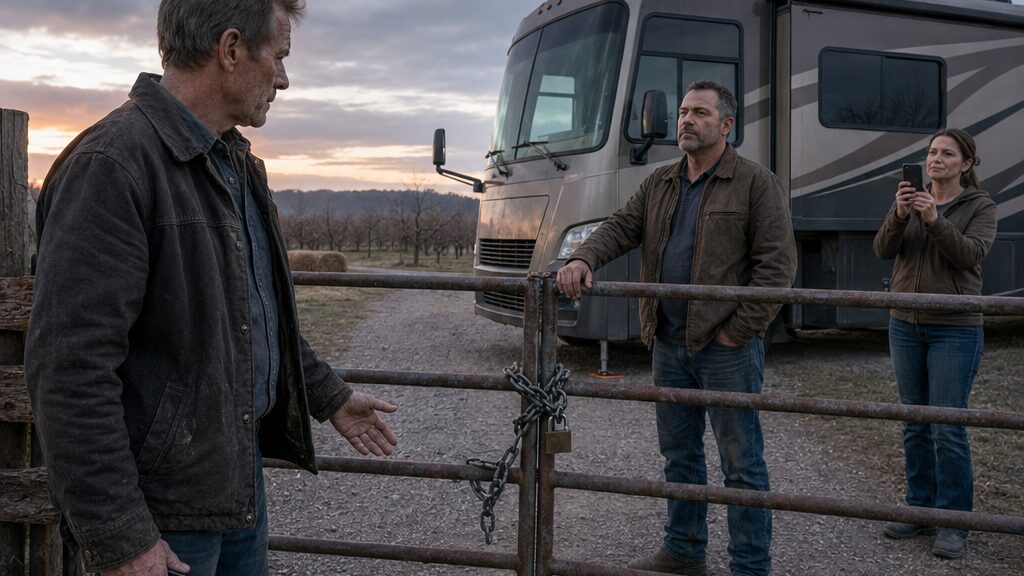
At 5:57 on Monday morning, his truck headlights washed across the metal farm gate at the end of the gravel lane, catching a bright brass body where his old black lock should have been. A heavier chain had been looped twice through the gate and the cedar post.
Larry stopped twenty feet short.
Beyond the gate, his pickup sat where he had left it the night before, nose toward the road, boxed in by the gate in front and a forty-foot RV angled across the lane behind it.
For thirty years, Larry had opened that gate before daylight without thinking.
That morning, somebody else had decided he could not.
He got out slowly.
The gravel was damp enough to hold tracks. Wide dual tires had cut fresh grooves along the lane, then turned sideways near the lower edge of the orchard. One leveling jack from the RV rested almost directly beside the gate.
Larry wrapped his hand around the chain.
Not his.
“Morning.”
The voice came from beside the RV.
A man in jeans and an unbuttoned work shirt stepped down from the folding stairs holding a stainless coffee mug. He was somewhere in his forties, broad through the shoulders, with the tired tan of someone who worked outside for a living.
Larry let go of the chain.
“You put this on my gate?”
The man glanced at it as if Larry had asked about the weather.
“Needed to keep people from messing with our spot.”
“Your spot.”
“Patrick Green.”
“I didn’t ask your name.”
Patrick took a drink.
“No, I suppose you didn’t.”
Larry looked beyond him. The RV was parked diagonally enough that even if the gate opened, his tractor could not pass. A dark utility trailer sat farther back on the adjoining parcel.
“You need to move that rig.”
Patrick smiled slightly.
“We’re not in your orchard.”
“You’re across my farm lane.”
“We were told we could stay here.”
“By who?”
“The owner next door.”
Larry looked at the gravel under Patrick’s boots.
“That doesn’t make my road his campground.”
The RV door opened again.
A blonde woman stepped down with a phone already in her hand.
“Is this him?” she asked.
Patrick gave a short laugh.
“Apparently.”
The woman lifted the phone toward Larry.
He saw the camera lens.
“You recording me?”
“Just making sure everybody behaves,” she said.
“Then point it at the lock.”
She did not.
Patrick leaned against the RV.
“Deborah, don’t worry about it.”
Larry’s jaw tightened.
“You chained me out of my own property.”
Patrick’s smile faded a little.
“You have another way in.”
“For a four-wheeler. Not a loaded truck. Not my tractor.”
“You’re making this bigger than it is.”
Larry looked at the RV again. “Move six feet.”
Patrick shook his head.
“We leveled last night.”
“So?”
“So I’m not resetting a forty-foot rig because you woke up territorial.”
Deborah’s phone shifted closer.
Larry could hear himself breathing.
He imagined taking the chain in both hands and jerking until something broke. He imagined backing his tractor down from the orchard and dragging the RV sideways.
Instead, he put both hands into his jacket pockets.
Patrick seemed to mistake the silence for uncertainty.
“This access has been used for years,” he said. “You don’t get to wake up one morning and decide nobody else can use it.”
Larry’s eyes went to him.
“What access?”
Patrick shrugged.
“The easement.”
For the first time that morning, Larry’s anger changed shape.
Not smaller.
Sharper.
“What easement?”
Patrick laughed once, without much humor.
“Come on.”
Larry did not answer.
Deborah lowered her phone an inch.
Patrick’s expression changed when he realized Larry was not pretending.
“The road easement. For the adjoining parcel.”
“This gate is on Carter land.”
“That doesn’t mean you own everybody’s right to pass.”
Larry knew there had been an old arrangement with the neighboring tract. He remembered feed trucks cutting across near the lower pasture years ago. He remembered his father waving through a hay buyer once.
But an easement wide enough for a forty-foot RV to sit across the lane?
No.
At least he did not think so.
Patrick pointed toward the gate.
“That chain stays until we get this straight.”
Larry stared at him.
“You’re telling me your lock stays on my gate?”
“I’m telling you nobody’s taking our place while we’re at work.”
Deborah said, “We’re only here for the season.”
Larry turned toward her.
“My orchard is here every season.”
She gave a small, exasperated laugh and raised the phone again.
“There. That’s exactly what the neighbor said you’d be like.”
Larry looked into the lens for one second, then past it.
He stepped away from them.
Patrick called after him.
“Where are you going?”
Larry took out his phone.
“To take pictures.”
Patrick snorted.
“Of what?”
Larry photographed the chain first.
Then the padlock.
Then the gatepost.
Then the RV from the road shoulder, showing how its rear quarter cut across the gravel lane.
He walked along the edge of the driveway.
“Seriously?” Deborah asked.
Larry ignored her.
He photographed the tire tracks and the jack.
When he crouched to frame the jack, he saw orange plastic sticking from the gravel.
He brushed away a clump of damp dirt.
A survey stake lay bent nearly flat beneath the metal foot of the leveling jack.
Larry stopped.
It was old enough to be faded but not old enough to have lost its fluorescent color.
He took three photographs.
Patrick came closer.
“What is it?”
Larry did not answer.
Patrick glanced down.
“Oh, that thing.”
“That thing marks something.”
“It’s a stick.”
“Then you won’t mind if I document where your jack is sitting.”
Patrick folded his arms.
“You planning to call the sheriff over a plastic stake?”
“No.”
That answer seemed to surprise him.
Larry stood and walked back toward the gate.
He measured the clear gravel width with his boot steps, then took another picture from the orchard side.
Deborah kept filming.
“You know,” she said, “normal people talk to their neighbors.”
Larry looked at the phone in her hand.
“I’ve been talking.”
“Doesn’t sound like it.”
Patrick gestured toward the road.
“We’ll be out eventually. Nobody’s taking your farm.”
Larry looked at the new chain.
“No. Just the entrance.”
For a moment nobody spoke.
A tractor started somewhere beyond the ridge.
Larry could smell diesel and wet leaves.
He took one last photograph of the gate with the RV behind it.
Then he walked toward the smaller footpath beside the orchard fence.
Patrick called after him.
“You really want to make this a property-line war?”
Larry turned.
Patrick’s tone was almost friendly now, as if offering him a chance to stop embarrassing himself.
“My understanding is your dad never had a problem with anybody using this road.”
Larry’s hand stopped on the fence wire.
Patrick continued.
“He didn’t treat it like some private kingdom.”
Larry faced him fully.
“You knew my father?”
“No.”
“Then don’t tell me what he treated like what.”
Patrick lifted both hands.
“I’m telling you what we were told.”
“By who?”
“The adjoining owner. He said your father let seasonal rigs use the lower edge. Said that road’s been shared longer than either of us has been arguing about it.”
Larry felt something colder than anger settle in his stomach.
His father had been dead six years.
Larry knew the fields he had planted, the wells he had repaired, the trees he had refused to cut.
But there were things his father had handled with a handshake and never discussed.
Patrick stepped backward toward the RV.
“So maybe before you start cutting locks, you should find out what you’re actually entitled to.”
Larry looked once more at the chain.
Then at the bent orange stake beneath the jack.
He did not touch either one.
For the first time that morning, he was no longer wondering only who had locked his gate.
He was wondering what Patrick knew about the road that Larry did not.
Chapter 2: Eleven Mornings Behind the Same Lock
At 5:48 the next morning, Larry photographed the gate before he touched anything.
The chain hung differently.
Patrick had moved it from the center rail to the hinge post, leaving enough slack for the gate to open twelve inches before stopping.
Larry took four pictures.
One wide.
One of the lock.
One of the chain wrapped around the post.
One showing the RV still cutting across the gravel.
Then he opened a notes file on his phone.
Tuesday. 5:48 a.m. Gate restricted. Main vehicle lane blocked.
He hated typing it.
It felt bureaucratic and weak.
His father would have cut the chain.
That thought stayed with him until he caught himself imagining how satisfying the bolt cutters would feel.
Instead, he walked the orchard.
By seven, Catherine’s car came up the secondary track and stopped beside the packing shed.
She stepped out carrying two coffees and saw his truck still trapped below.
“You didn’t cut it?”
“Not yet.”
“That is not the answer I expected.”
Larry took the coffee.
“Patrick says Dad let people use the lower road.”
Catherine looked toward the gate.
“He might have.”
Larry stared at her.
She lifted one shoulder.
“You asked.”
“No, I told you what Patrick said.”
“And I’m telling you Grandpa wasn’t as allergic to informal arrangements as you are.”
Larry walked toward the shed.
“He didn’t let people lock him out.”
“I didn’t say he did.”
Inside the small office, Catherine put her laptop on the scarred desk where Larry kept invoices, spray schedules, fuel receipts, and thirty years of paper nobody had ever properly sorted.
“Do you remember campers down there?” he asked.
“I remember horse trailers.”
“That’s not an RV.”
“I remember a motor home once.”
“When?”
“I was probably twelve.”
“That helps.”
Catherine gave him a flat look.
“You’re the one who never throws anything away.”
By Wednesday morning, Larry had three sets of photographs.
The chain changed position again.
Patrick’s truck was gone, but the RV remained.
A dark wet patch had appeared beneath the leveling system near the gravel shoulder. Larry photographed that too without deciding what it was.
Thursday brought another change.
Patrick had backed his work pickup close to the gate, leaving less turning room for farm equipment.
Larry arrived before sunrise, took pictures, then tried easing an older compact tractor through the narrow opening from the orchard side.
The rear tire came within inches of the gatepost.
He stopped.
Patrick emerged from the RV in work boots.
“You can fit.”
“Not with the wagon.”
“Then don’t bring the wagon through.”
Larry shut off the tractor.
“That lane was built for farm equipment.”
Patrick looked at him as though the statement proved nothing.
“And the easement was built for access.”
Larry held his gaze.
“You keep saying that word.”
“You keep acting like it doesn’t exist.”
Deborah appeared behind the RV curtain but did not come outside.
Larry took out his phone.
Patrick laughed.
“Another picture?”
“Another morning.”
“You planning a scrapbook?”
Larry photographed the clearance beside the tractor tire.
“No.”
That afternoon, Catherine found the first thing Larry did not want her to find.
She came into the kitchen carrying a cracked file folder with dirt along the edge.
“Before you get mad,” she said, “read this.”
Larry was standing over the sink rinsing an apple.
“What is it?”
“Old receipts.”
He dried his hands.
Most were ordinary: fertilizer, mower blades, fence staples, gravel.
Then Catherine tapped one line on a receipt from nearly twenty years earlier.
Lower roadside grading—shared parking turnout.
Larry read it twice.
“Parking turnout doesn’t mean campground.”
“I know.”
“Could mean trucks during harvest.”
“Could.”
He looked at her.
“You’re enjoying this.”
“Not even a little.”
She pulled out another receipt.
This one was from a local gravel contractor. The description mentioned widening the lower edge for seasonal access.
Larry pushed it back.
“My father paid for that.”
“Half.”
“What?”
Catherine pointed to a handwritten note in the margin.
Adjacent parcel reimbursed fifty percent.
Larry sat down.
The kitchen seemed too quiet.
“You remember this?”
“No.”
“He never told me.”
“Maybe there was nothing to tell.”
“There is now.”
Catherine folded her arms.
“That’s why you need to find the actual easement before you start telling the county Patrick has zero right to be there.”
“He locked my gate.”
“Yes.”
“He blocked my road.”
“Yes.”
“He crushed a marker.”
“Maybe.”
Larry looked up sharply.
She did not back away.
“And all of those things can still be wrong even if he’s right about one thing.”
Larry hated the sentence because it sounded reasonable.
By Friday, he had photographs from five mornings.
The pattern was clearer than any single argument.
The RV never moved.
The chain did.
Patrick’s pickup sometimes appeared beside it.
The usable lane changed by several feet depending on where he parked.
The orange survey stake remained bent beneath the jack.
The phone gallery became a row of nearly identical frames, but that sameness began to mean something.
Larry could no longer tell himself the obstruction was temporary in the ordinary sense.
It was being renewed each day.
Saturday morning made six.
He stood by the gate in a sweatshirt while Patrick tightened something beneath the RV.
“You still doing this?” Patrick asked.
Larry took the photograph.
“Doing what?”
“Trying to build a federal case.”
“County case would be enough.”
Patrick shook his head.
“You know, you could ask the adjoining owner. He’ll tell you.”
“I plan to.”
“Good.”
Patrick stood.
“Then maybe you’ll quit treating us like squatters.”
Larry slipped the phone into his pocket.
“You’re living in an RV across my farm lane.”
“We’re paying to stay on the other parcel.”
“That doesn’t make this part yours.”
Patrick wiped his hands.
“We’ll see.”
The words bothered Larry more than an insult would have.
Back in the farmhouse, Catherine had opened three cardboard boxes across the kitchen table.
“You find anything?”
“Maybe.”
She held up an old tax map.
Larry leaned over it.
A narrow line ran from the county road along the lower boundary toward the neighboring tract.
No dimensions were printed on that copy.
Catherine pointed to a faded notation.
“Recorded separately.”
Larry squinted.
“Book and page?”
“Looks like it.”
He sat beside her.
For several minutes they searched the county’s online index.
Nothing came up under the farm address.
Catherine tried the neighboring parcel.
Then Larry’s father’s name.
Then an older parcel number.
At last, one result appeared.
Catherine leaned closer to the screen.
“There.”
Larry read the entry.
Recorded access easement.
The date was thirty-two years old.
His father would have signed it when Larry was still working away from the farm.
Catherine wrote down the book and page numbers.
Larry stared at them.
Six mornings of photographs suddenly felt less like proof of a simple wrong and more like evidence in an argument whose first page he had never read.
Catherine slid the paper toward him.
“County records office opens Monday at eight.”
Larry picked it up.
For the first time since finding the chain, he wished the document did not exist.
Chapter 3: The Map Did Not Say What Larry Wanted
“You own the dirt,” the county clerk said, “but that is not the whole answer.”
Larry kept one hand in his jacket pocket around the old brass key to his farm gate.
The records office smelled faintly of paper and floor cleaner. Catherine sat beside him while the clerk placed a scanned document on the monitor and enlarged a narrow strip drawn along the Carter property line.
Larry leaned closer.
“That goes through my parcel.”
“Yes.”
“To the adjoining parcel.”
“Yes.”
“So they can drive through.”
“The recorded language grants ingress and egress.”
Larry looked at Catherine.
She said nothing.
He turned back to the clerk.
“It doesn’t say anything about parking.”
“I didn’t say it did.”
“Camping?”
“No.”
“Locking my gate?”
The clerk gave him a patient look.
“I can’t interpret enforcement questions for you. I’m showing you what was recorded.”
Larry read the document again.
The easement was old, dry, and precise in the way legal language often was until real people began arguing over it.
Twenty-foot access corridor.
Ingress and egress.
Maintenance shared proportionally.
No permanent obstruction.
Larry stopped on that phrase.
“Permanent.”
The clerk nodded.
“That’s what it says.”
“If somebody blocks it for eleven days?”
“That would be a question for land use or an attorney.”
Larry disliked answers that sent him to another desk.
He disliked even more that Patrick had been right about the existence of the easement.
Catherine pointed to a notation beside the map.
“What is this reference?”
The clerk opened another record.
It was not part of the easement itself. It was a later maintenance filing, showing shared gravel work between the Carter parcel and the neighboring tract.
Larry recognized his father’s signature.
The sight of it tightened something behind his ribs.
His father had signed with a heavy downward stroke on the C.
Larry had inherited the habit.
“There,” Catherine said quietly.
An attached note had been scanned with the maintenance record.
The handwriting was his father’s.
Summer rigs may stand by lower edge if lane kept clear.
Larry read it once.
Then again.
Catherine did not look at him.
The clerk stepped away to retrieve another file.
Larry whispered, “That isn’t permission forever.”
“No.”
“It doesn’t say RVs can live there.”
“No.”
“It says lane kept clear.”
“Yes.”
He looked at her.
“You don’t have to sound pleased.”
“I’m not pleased.”
“You’ve been telling me I was wrong for a week.”
“I’ve been telling you to check.”
“That note could mean anything.”
“It could.”
Larry stared at his father’s handwriting.
He remembered a motor home now.
Not clearly.
A cream-colored thing parked near the lower pasture one summer while Larry was away doing equipment work two counties over. He remembered driving past it once and assuming it belonged to a hay buyer.
Maybe his father had allowed it.
Maybe there had been others.
The memory irritated him because it had apparently been there all along, waiting until evidence forced him to notice it.
The clerk returned with a larger parcel map.
“This one shows the recorded dimensions more clearly.”
She spread it on the counter.
The twenty-foot corridor ran along the lower boundary, widening slightly near the county road before narrowing toward the adjoining tract.
Larry took out his phone.
He opened the photographs from the previous mornings.
The RV’s rear wheels appeared inside the lane.
The leveling jack was farther inward still.
He enlarged the image of the bent orange stake.
“Can you tell what that marker is?”
“Not from a photograph.”
“Could be the corridor boundary?”
“Could be. Could be something else. Surveyor would tell you.”
Larry measured the proportions on the map with his thumb.
If the stake marked what he suspected, Patrick’s RV was not merely beside the easement.
A substantial part of it sat inside the travel corridor.
Catherine saw the change in his expression.
“What?”
Larry showed her.
“Look at the gatepost. Then the stake.”
She compared the photograph with the map.
“Maybe.”
“He’s inside it.”
“Maybe.”
“He has a right to pass through, and he’s using that right to block the passage.”
Catherine folded the map carefully.
“That sounds like a better argument than saying he has no right at all.”
Larry’s first instinct was to reject the distinction.
He had spent seven days thinking of Patrick as someone who had simply occupied his land and invented a story about permission.
Now the truth was less satisfying.
Patrick had inherited part of a real arrangement without understanding—or without caring about—its limit.
And Larry had inherited the land without understanding all of its obligations.
Back at the farmhouse, Larry put the copied easement beside the chain photographs.
His deed remained where he had left it on the table.
For days he had imagined bringing that deed to Patrick like a final answer.
MY LAND.
That was the argument he had been rehearsing.
Now the document looked incomplete.
Catherine opened one of the old farm boxes again.
“You’re not going back down there angry, are you?”
“No.”
“That sounded angry.”
Larry ignored her.
He picked up his father’s handwritten note.
Summer rigs may stand by lower edge if lane kept clear.
The sentence bothered him because his father had understood the difference Larry had refused to consider.
Permission was not ownership.
But ownership was not absolute exclusion either.
Catherine sat opposite him.
“What are you going to tell Patrick?”
“The truth.”
“Which part?”
Larry looked at her.
“All of it.”
She waited.
He added, “There is an easement.”
“Good start.”
“He has a right to use it for access.”
“Yes.”
“He doesn’t have a right to live in the middle of it.”
“That part we need confirmed.”
Larry tapped the photographs.
“Then we’ll confirm it.”
He spent the next hour laying the county map beside photographs taken from different angles.
On the third image, the orange stake lined up with the eastern edge shown on the parcel map.
On the fifth, Patrick’s rear wheel crossed several feet beyond it.
Larry took a ruler from Catherine’s desk.
Not proof.
Not yet.
But enough to ask the right question.
That mattered.
He slipped the brass gate key from his pocket and placed it on the map.
For a week he had treated that key as evidence that the road was his to control.
Now it meant something narrower.
The gate was his.
The soil was his.
The road crossed his land.
But the right to move through part of it belonged to more than one parcel.
Larry picked up his father’s note again.
He felt embarrassed, which irritated him almost as much as Patrick’s chain.
Catherine watched him.
“You can still be right about what he’s doing now.”
Larry folded the note.
“I know.”
“You don’t sound like you know.”
He looked toward the window, down the hill where the top of Patrick’s RV was visible through the trees.
“I wanted him to be wrong about everything.”
Catherine said nothing.
That silence landed harder than correction.
Larry gathered the easement copy, the map, and three photographs.
He no longer had the clean argument he wanted.
He had something more difficult.
Patrick Green might have a lawful right to travel across part of Larry Carter’s land.
And if the measurements were what they appeared to be, Patrick was using that right to block the very corridor it protected.
Chapter 4: Permission Was Never the Same as Possession
Larry went back to the gate with the easement map folded under his arm and an offer he already disliked making.
Patrick was outside the RV, tightening a strap on the utility trailer.
Larry stopped on the gravel.
“I checked the record.”
Patrick looked over his shoulder.
“Told you.”
“There is an easement.”
Patrick smiled.
Deborah, sitting on the RV steps with a cup in both hands, looked between them.
Larry continued before Patrick could say anything else.
“It gives access to the adjoining parcel. Twenty feet.”
Patrick straightened.
“So we’re done.”
“No.”
The smile disappeared.
Larry unfolded the map against the hood of his pickup.
“You can pass through. You can’t block the passage.”
Patrick did not come closer.
“We’re not blocking anything.”
Larry pointed to the lane.
“My tractor won’t clear.”
“Your little one did.”
“My hay wagon won’t.”
“That sounds like a farm problem.”
Larry felt the old anger rise quickly, hot enough that for a second the map shook in his hand.
He flattened it against the hood.
“This is the corridor.”
Patrick finally stepped closer.
Larry showed him the recorded width and then the photographs.
“The back half of your RV is inside it.”
Patrick glanced at the images.
“You measuring property lines with a phone now?”
“No. I’m showing you why we need this moved.”
“We’re on the adjoining owner’s side.”
“The jack isn’t.”
Patrick looked toward the orange stake, still pinned beneath the metal foot.
“That doesn’t prove anything.”
“No. That’s why I’m not calling it proof.”
Patrick studied him.
Larry took a breath.
“There is room farther over.”
He pointed past the RV toward the wider shoulder of the neighboring parcel.
“If you swing the nose around and back it six or eight feet, you can stay where you’ve been paying to stay and the farm lane stays open.”
Deborah looked toward the space.
Patrick did not.
“You want me to tear down the setup, level it again, move the trailer, reconnect everything, because you don’t like looking at us?”
“This isn’t about looking at you.”
“Feels like it.”
Larry reached for the chain.
The unauthorized lock was gone now. After checking the easement, Larry had cut Patrick’s lock off the gate and replaced it with his own chain, but that morning he had deliberately left his lock open.
He lifted the loose end so Patrick could see it.
“I’m not shutting the easement.”
Patrick stared at the open lock.
“That’s supposed to impress me?”
“No.”
“Then what?”
“It’s supposed to make this simple.”
Larry let the chain fall.
“Pass through. Keep the lane clear.”
Patrick laughed once.
“You had a week to say that.”
“I had a week to find out what I was talking about.”
The answer caught Deborah’s attention.
She looked at Larry more carefully.
Patrick folded his arms.
“So now you’re the reasonable one.”
“No. Now I’ve read the paper.”
“You read one paper.”
Larry almost answered too fast.
Instead, he looked again at the RV.
“You said you’re here for the season.”
“That’s right.”
“You working the commercial project off the highway?”
Patrick’s jaw tightened slightly.
“Temporary job.”
“I don’t care where you work.”
“Then don’t bring it up.”
“I brought it up because I understand why moving the rig is a headache.”
Patrick’s expression changed—not softening, but becoming wary.
Larry went on.
“I also understand this is cheaper than renting somewhere for three months.”
Deborah looked down at her cup.
Patrick’s voice went flat.
“You don’t know anything about our situation.”
“No.”
“Then keep it about the lane.”
“That’s what I’m trying to do.”
Larry tapped the map.
“Move the RV outside the corridor. Stay on the adjoining parcel. Everybody uses what they’re entitled to use.”
Patrick looked at the open gravel beside the RV.
For the first time, Larry saw him calculate it.
There was enough room.
Not comfortably, but enough.
Deborah saw it too.
“You could probably get it over there,” she said.
Patrick turned toward her.
“Not without pulling everything.”
“I know.”
“We’d have to reset the whole thing.”
“I know.”
He looked back at Larry.
“And after we do that, what? Tomorrow he decides the trailer’s wrong too?”
Larry said, “No.”
“Then the truck.”
“No.”
“The stairs stick out six inches and suddenly that’s an emergency.”
Larry kept his hands at his sides.
“The corridor stays clear. That’s it.”
Patrick stared at him.
“You really think I’m moving now?”
Larry frowned.
“Why wouldn’t you?”
“Because you’ve spent a week treating us like we snuck in here.”
“You chained my gate.”
“You acted like we had no right to be here.”
“I was wrong about that part.”
Deborah lifted her eyes.
Patrick went still.
Larry had not planned to say it quite that plainly.
The words felt unpleasant in his mouth.
But once they were out, they also felt clean.
Patrick gave a short laugh.
“So you admit it.”
“I admit there’s an easement.”
“You admit you were wrong.”
“About the access right. Not about blocking it.”
Patrick shook his head.
“You don’t get to split it like that.”
“Yes, I do.”
“No. You came down here acting like some king of the hill. Now you find out this road has been shared for thirty years, and I’m supposed to move so you can feel like you still won something?”
Larry understood then.
The argument had moved.
Not on the map.
Inside Patrick.
Larry said, “This isn’t about winning.”
Patrick pointed at the RV.
“It is now.”
Deborah looked at him.
“Patrick.”
“What?”
“You said if he showed there was an actual travel width, we’d move.”
“I said we’d talk.”
“You said we’d move.”
Patrick’s face hardened.
“Not in front of him.”
The words hung there.
Larry looked away first.
Not because he was embarrassed for himself.
For Deborah.
Patrick seemed to realize what he had revealed.
He grabbed the strap on the trailer and pulled it harder than necessary.
Larry folded the map.
“I’ll give you until tomorrow morning.”
Patrick turned.
“For what?”
“To decide whether you want to move it yourself.”
“Or what?”
“I take the documentation to the county.”
Patrick smiled again, but there was less ease in it.
“You think they’re going to tow somebody’s home because your tractor has to turn wider?”
“I don’t know what they’re going to do.”
“Exactly.”
Larry picked up the loose chain.
Patrick called after him.
“You can’t tow a home, Larry.”
Larry stopped at the gate.
“I didn’t say I could.”
He closed his lock around the chain, then paused.
He looked at the easement map folded under his arm.
He reopened the lock.
The chain remained looped through the gate, but unlocked.
Patrick noticed.
Larry said, “Use the road. Don’t occupy it.”
Then he walked uphill.
The next morning, the RV had not moved an inch.
At 6:12, Larry’s phone buzzed with a voicemail.
He listened in the orchard office while Catherine sorted invoices.
Patrick’s voice came through with a laugh behind it.
“Just saving you some trouble, Larry. This RV is our residence right now. You don’t get to call some tow truck and drag somebody’s home away because you don’t like where it’s parked. Maybe learn the rules before you make threats.”
The message ended.
Catherine looked up.
“He sounds nervous.”
“He sounds pleased with himself.”
“Same thing sometimes.”
Larry set the phone down.
An hour later Catherine left for the bank.
At the bottom of the lane, Deborah was waiting near the gate.
She raised one hand.
Catherine stopped her car and lowered the window.
Deborah glanced toward the RV before stepping closer.
“I don’t want Patrick knowing I told you this.”
Catherine said nothing.
Deborah swallowed.
“He can move it.”
Catherine waited.
Deborah looked at the empty strip of gravel beside the RV.
“We checked before we set up. There’s enough room if he pulls the utility trailer out first.”
“Then why hasn’t he?”
Deborah’s mouth tightened.
“Because now he says moving it makes your dad look right.”
“My dad?”
“Larry.”
Catherine watched her.
Deborah rubbed her thumb along the edge of her phone.
“He thinks if he moves after all this, everybody will say Larry made him do it.”
Catherine said quietly, “Larry did ask him to.”
“I know.”
“That’s usually how disputes end.”
Deborah gave a tired laugh that carried no humor.
“You don’t know Patrick.”
Catherine looked toward the RV.
“No. But I’m starting to.”
Deborah stepped back.
“Don’t tell him I said anything.”
Catherine put the car in gear.
“I won’t.”
She drove uphill instead of toward the county road.
When she found Larry beside the packing shed, she rolled down the window.
“You need to hear something before you file anything.”
Larry walked over.
Catherine looked back toward the gate.
“Patrick knew from the beginning that RV could fit somewhere else.”
Chapter 5: The Complaint Larry Almost Filed Wrong
The county inspector read the first page of Larry’s complaint and pushed it back across the desk.
“This isn’t the complaint you want to file.”
Larry stared at him.
The two chains sat in a paper grocery sack by Larry’s chair—the bright one Patrick had used and the older chain Larry had put back on the gate afterward.
Catherine sat beside him with the easement map, eleven morning photographs, and a folder of copied records.
Larry tapped the page.
“He locked my gate and parked across my road.”
“I understand that.”
“Then what’s wrong with it?”
The inspector turned the complaint around and pointed to Larry’s first paragraph.
“You’re alleging unauthorized use of the access corridor.”
“Yes.”
“Except you’ve brought me a recorded easement showing the adjoining parcel has use rights.”
“For passage.”
“Correct.”
“Not camping.”
“That’s a different issue.”
Larry sat back.
The inspector was somewhere near Larry’s age, with reading glasses low on his nose and the unhurried manner of someone accustomed to angry people bringing him maps.
He flipped through the photographs.
“I’m not saying there isn’t a violation here.”
“It sounds like you are.”
“No. I’m saying you’ve written the broadest version of the argument, and the broadest version appears to be wrong.”
Larry felt Catherine shift beside him.
He did not look at her.
The inspector picked up a photograph of the gate.
“This chain. His?”
“Yes.”
“And this?”
Larry handed him a second image.
“Mine.”
“You removed his lock?”
“After I confirmed the gate itself is mine.”
“And then?”
“I put my chain back.”
The inspector looked at the easement language.
“Locked?”
Larry hesitated.
“First day, yes.”
Catherine glanced toward him.
The inspector noticed.
“Then what?”
“I left it unlocked once I understood the access right.”
The inspector nodded and made a note.
That small motion irritated Larry.
“What?”
“Nothing.”
“You wrote something.”
“I document statements.”
Larry leaned back.
For eleven mornings he had thought documentation belonged to him.
Now he understood what it felt like from the other side of the desk.
The inspector continued through the photographs.
RV position.
Pickup location.
Narrowed tractor clearance.
Bent orange stake.
Dark patch beneath the leveling system.
“Do you know what leaked here?”
“No.”
“Good.”
Larry frowned.
“Good?”
“You didn’t guess.”
The inspector moved to the next photograph.
Catherine hid the smallest hint of a smile.
Larry saw it.
“Don’t.”
“I didn’t say anything.”
The inspector stopped at the image of the compact tractor squeezed beside the gate.
“This was able to pass?”
“Barely.”
“What about normal farm equipment?”
“Hay wagon won’t. Full-size tractor won’t clear safely.”
“You have photographs?”
Larry slid two more across.
One showed the loaded wagon farther uphill. Another showed the lane width from the gatepost to the RV.
The inspector studied them.
“This is useful.”
Larry leaned forward.
“More useful than the deed?”
“For the issue you’re actually describing? Yes.”
Larry looked at the deed in Catherine’s folder.
All week he had treated that piece of paper like a hammer.
Here, it was barely one tool.
The inspector tapped the easement.
“This corridor exists so people can move through it.”
He tapped the RV photograph.
“If someone entitled to use the corridor occupies it in a way that materially prevents other lawful use, that’s a different question than whether they’re allowed to enter it.”
Larry said, “That’s what I’ve been saying.”
Catherine turned toward him.
The inspector did too.
Larry corrected himself.
“That’s what I’m saying now.”
The inspector held his gaze for a moment, then nodded.
“Better.”
Larry disliked him less after that.
The inspector pulled a blank form from a drawer.
“Start again.”
Larry took the pen.
The first time, he had written that Patrick had no lawful right to use Carter property.
He crossed that idea out entirely.
This time he wrote about the blocked agricultural access.
The unauthorized locking of the gate.
The daily recurrence.
The damaged or displaced marker, still to be verified.
The inability to move ordinary farm equipment through the corridor.
When he reached the section asking for relevant history, his pen stopped.
Catherine saw it.
The inspector waited.
Larry could omit the note.
It wasn’t part of the recorded easement.
It wasn’t proof Patrick had been invited by Larry’s father.
His father had been dead six years.
Nobody in the office would know unless Catherine said something.
Larry looked at the grocery sack containing the two chains.
Then at his eleven photographs.
He had built his entire case around the idea that repeated facts mattered more than somebody’s loud version of events.
He set the pen down.
“My father let seasonal rigs stop near the lower edge years ago.”
The inspector looked up.
“How do you know?”
“We found a note in old farm records.”
“Recorded?”
“No.”
“Does it say they can block the lane?”
“No. Says the lane stays clear.”
“Do you have a copy?”
Catherine placed it on the desk.
The inspector read it.
Larry watched his face for a reaction.
There wasn’t much of one.
Finally the inspector said, “This helps.”
Larry laughed without meaning to.
“You’re kidding.”
“No.”
“It helps Patrick.”
“It establishes there was a history of limited accommodation. You’re not hiding that. It also reinforces the distinction between stopping nearby and obstructing the lane.”
Larry looked at Catherine.
She raised one eyebrow.
He ignored it.
The inspector arranged the documents into two piles.
“One pile is about whether they can ever use the corridor.”
He pushed the easement and old note aside.
“The other is about what they’re doing with it now.”
He put the photographs, gate images, and equipment-clearance pictures together.
“That second pile is the one I can inspect.”
“So you’ll order him out?”
“I didn’t say that.”
Larry’s shoulders tightened.
“What happens?”
“I visit the site. Confirm corridor placement as far as county records allow. Look at access. Look at the gate. See whether the RV creates an obstruction under the applicable land-use provisions.”
“And towing?”
“If there’s authority and if correction isn’t made voluntarily, that can become an option. Not my first one.”
Patrick’s voicemail returned to Larry’s mind.
You can’t tow a home.
“It’s his residence right now.”
“That doesn’t erase property rules.”
“But it matters.”
“Yes.”
Larry had not expected the inspector to say that.
The inspector closed the file.
“People hear enforcement and imagine a truck showing up with a hook. Most of the time, the useful question is whether the problem can be corrected without making a bigger one.”
Larry thought about Patrick’s RV moving six feet.
It could.
Patrick simply had not wanted to.
“What about the marker?”
“If it’s a survey marker, damaging it may be separate. We’ll look. You may need a surveyor to restore it properly.”
Larry stood.
“When?”
The inspector checked his calendar.
“Tomorrow’s full.”
Larry said nothing.
“Day after, first thing.”
Catherine counted silently.
“That’s Thursday.”
The inspector nodded.
Larry realized it would be the twelfth morning since he had found the first lock.
“What time?”
“Six-thirty. You said the obstruction affects morning farm access.”
“It does.”
“Then I’d rather see it as it normally sits.”
Larry picked up the grocery sack.
The two chains clinked together inside.
At the door, the inspector said, “Mr. Carter.”
Larry turned.
“Don’t move anything before I get there.”
“I haven’t.”
“I mean your chain too.”
Larry nodded.
Outside, Catherine walked beside him toward the truck.
“You did better in there than I thought you would.”
“What does that mean?”
“It means you admitted Dad allowed some use without choking.”
Larry opened the truck door.
“High praise.”
She leaned against the roof.
“You realize that changed the whole complaint.”
“Yes.”
“You’re mad about it.”
“Yes.”
“But it made it stronger.”
Larry looked back at the county building.
That was the part he still had trouble accepting.
Telling the piece of the truth that weakened him had made the part that mattered harder to dismiss.
His phone buzzed.
Patrick.
Larry let it ring.
A message followed.
He opened it.
A photograph.
The RV was still exactly where it had been.
Under it, the orange stake remained flattened.
Below the picture Patrick had written only four words:
Still here. Still legal.
Larry showed Catherine.
She read it and handed the phone back.
“You answering?”
“No.”
“What are you doing?”
Larry put the phone in his pocket.
“Getting up early Thursday.”
Chapter 6: Day Twelve Put Everyone Beside the Gate
The county vehicle arrived at 6:27 Thursday morning, and Patrick’s RV had not moved.
Larry was standing beside the gate with his hands empty.
No folder.
No bolt cutters.
No argument prepared.
The inspector stepped out carrying a clipboard, measuring wheel, and folded parcel map.
Patrick came from the RV almost immediately.
Deborah followed more slowly.
“So this is what we’re doing now?” Patrick asked.
The inspector looked at him.
“I’m conducting a site inspection.”
Patrick pointed toward Larry.
“Because he complained.”
“Because a complaint was filed.”
Larry noticed the distinction.
Patrick did too.
The inspector walked first to the gate.
He photographed the chain.
Larry’s chain.
The lock hung open through one link, exactly where Larry had left it.
“Whose?”
“Mine,” Larry said.
“Locked since when?”
“Not since I confirmed the easement.”
Patrick laughed.
“Convenient.”
Larry looked at him but said nothing.
The inspector turned to Patrick.
“Did you previously place another chain or lock here?”
Patrick’s face changed slightly.
“Temporary.”
“That wasn’t my question.”
“Yes.”
“Why?”
“To secure our setup.”
“By locking the property owner out?”
Patrick glanced toward Larry.
“He had access another way.”
Larry’s hands tightened once, then relaxed.
The inspector wrote something.
Patrick frowned.
“You’re just taking his side.”
“I haven’t taken anybody’s side.”
He unhooked Larry’s chain from the gate and laid it on the gravel.
The gate swung freely.
For eleven mornings, Larry had imagined that movement as victory.
Watching it now, he felt something quieter.
The inspector pushed the gate open fully and rolled the measuring wheel along the corridor.
Patrick followed.
“So the easement is real.”
“Yes.”
“I have a right to use it.”
“If your permission from the adjoining parcel owner is valid and you’re using the recorded access for passage, the easement exists.”
Patrick looked at Larry.
“There.”
Larry said nothing.
The inspector stopped.
“Mr. Green, an easement allowing passage is not ownership of the corridor.”
Patrick’s expression hardened.
“I didn’t say it was.”
“You parked a residential vehicle in it.”
“We’re beside it.”
The inspector unfolded the map.
“Let’s determine that.”
He measured from the reference points near the gate, then along the gravel edge.
When he reached the rear of the RV, he stopped.
The measuring wheel sat beneath the overhang.
The inspector checked the map again.
“Your rear section encroaches into the travel corridor.”
Patrick shook his head.
“No.”
The inspector looked at him.
“You can disagree.”
“That’s not a surveyed line.”
“Correct. I’m not establishing a new boundary. I’m comparing the visible placement with the recorded corridor and existing reference features.”
He walked to the leveling jack.
The bent orange stake protruded from beneath it.
“Is this how you found it?” he asked Larry.
“Yes.”
“Photographs from before?”
Larry took out his phone.
He had promised himself he would not arrive waving evidence.
Now he opened the first morning’s image and handed it over.
The inspector compared them.
Patrick stepped closer.
“That could’ve been bent already.”
Larry nearly answered.
The inspector did it for him.
“Could have.”
Patrick looked relieved.
“Then—”
“But the jack is currently sitting over it.”
Patrick stopped.
The inspector photographed the position.
Deborah wrapped her arms around herself.
The morning had become brighter, and everything that had looked ambiguous in phone pictures now sat plainly in the gravel.
The RV.
The open gate.
The narrow corridor.
The jack.
The stake.
The inspector asked Larry, “Show me the equipment issue.”
Larry pointed uphill.
“My main tractor and hay wagon use this entrance.”
“Where are they?”
“Above the orchard.”
“Bring the tractor down. No wagon.”
Larry looked at him.
“You sure?”
“I want to see the ordinary movement.”
Larry walked uphill.
When he returned on the tractor, Patrick had moved his pickup but nothing else.
Larry eased toward the gate.
The left rear tire passed close to the gatepost.
The right side approached the RV.
The inspector held up one hand.
“Stop.”
Larry did.
There was clearance.
Not much.
The inspector walked behind the tractor.
“With trailer?”
“No safe turn,” Larry said.
Patrick called, “But he got through.”
The inspector looked toward him.
“Yes.”
Patrick seemed pleased.
Then the inspector added, “A farm access easement doesn’t become unobstructed merely because the smallest piece of equipment can squeeze through.”
Patrick’s smile disappeared.
Larry backed the tractor away.
He had expected satisfaction.
Instead he felt tired.
The inspector spent another twenty minutes taking measurements and asking both men the same questions in slightly different ways.
Who had authorized the RV placement?
How long was the stay intended?
Had Larry offered another location?
Could the RV physically be moved outside the active travel corridor?
Patrick answered the last question first.
“Not without a major reset.”
“That wasn’t the question,” the inspector said.
Deborah looked down.
Patrick exhaled.
“It could probably move.”
“How far?”
Patrick did not answer.
Deborah did.
“Seven feet.”
Everyone looked at her.
She rubbed her hands together.
“Maybe eight.”
Patrick’s voice went low.
“Deborah.”
She turned toward him.
“You measured it.”
His face reddened.
“Not now.”
“When?”
“Not in front of—”
He stopped.
The inspector waited.
Deborah’s voice became quieter.
“We checked it the first night. Before we put the stabilizers down. There was enough room farther over.”
Patrick stared at her.
She continued.
“He didn’t want to move after Larry complained because he said it would look like Larry made us.”
Nobody spoke.
Larry felt the sentence land, but not as triumph.
Patrick looked suddenly less like the man who had laughed at the gate and more like a tired man who had trapped himself inside his own position.
He turned away.
“We were told we could stay here.”
The inspector said, “That can still be true.”
Patrick looked back.
“What?”
“You may have permission to stay on the adjoining parcel. That does not give you permission to occupy or obstruct the access corridor.”
“So what, you’re towing us?”
“No.”
Patrick blinked.
Larry did too.
The inspector closed the clipboard.
“I’m issuing a correction notice. The RV must be repositioned outside the travel corridor within the allowed compliance period. The gate cannot be locked in a way that prevents lawful access. The damaged marker needs proper identification and restoration if it is a survey reference.”
Patrick looked at Larry.
“He wanted us gone.”
The inspector turned toward Larry.
“Is that what you’re requesting now?”
Larry opened his mouth.
The answer that had lived in him for eleven days was yes.
Gone from the lane.
Gone from the lower edge.
Gone from anything bearing the Carter name.
But he looked at the map in the inspector’s hand.
Twenty feet.
Ingress and egress.
He remembered his father’s note.
Summer rigs may stand by lower edge if lane kept clear.
Larry said, “I want my farm access clear.”
Patrick laughed bitterly.
“That’s not what you said the first week.”
“No.”
The word was harder than Larry expected.
“I was wrong about the easement.”
Patrick looked at him.
Larry continued.
“You were wrong about what it lets you do.”
The inspector said nothing.
Deborah looked between them.
Patrick shoved his hands into his pockets.
“And if we move it?”
Larry looked toward the wider gravel beyond the corridor.
“You stay where the adjoining owner gave you permission to stay.”
Patrick seemed almost disappointed by the answer.
The inspector handed him the notice.
“This isn’t a decision about whether Mr. Carter likes your RV. It’s about keeping the recorded access usable.”
Patrick read the page.
“How long?”
The inspector told him.
Patrick glanced toward the county vehicle, then toward the RV.
“So no tow truck today.”
“No.”
Larry saw the satisfaction flicker in Patrick’s face.
Then the inspector added, “If you ignore the correction, the available remedies change.”
The satisfaction disappeared.
The inspector walked back to the gate and picked up Larry’s chain from the gravel.
He handed it to him.
“Your gate.”
Larry took it.
“Your obligation too.”
Larry frowned.
The inspector pointed to the map.
“Once the obstruction is corrected, lawful passage still exists.”
Larry looked at the chain in his hands.
For almost two weeks, it had represented the thing somebody had done to him.
Now it felt heavier for another reason.
The inspector asked, “Can this gate remain usable for the easement holders after the RV is moved?”
Patrick watched him.
Deborah watched him.
Catherine, who had arrived quietly during the inspection and stood near the fence, watched him too.
Larry looked down at the open links resting across his palms.
He had spent eleven mornings proving where Patrick’s rights ended.
Now somebody was asking whether he would respect where they began.
Chapter 7: The Gate Opened Without Becoming Surrender
The RV finally moved three days later, and the first thing Larry noticed was not the open lane.
It was the ground underneath.
The gravel where Patrick’s rear wheels had rested was flattened into two broad gray scars. A shallow depression remained beneath the leveling jack, and the orange survey stake—freed at last—leaned at an angle beside it.
Larry stood near the gate while Patrick eased the RV backward, corrected once, then swung the front end toward the wider shoulder on the adjoining parcel.
Deborah walked beside the rig watching the wheels.
“Two more feet,” she called.
Patrick adjusted.
“That’s enough.”
“Another foot.”
He stopped.
Deborah looked across the lane toward Larry.
“Clear?”
Larry measured it with his eyes.
The entire gravel track was open from the gate to the orchard turn.
“Yes.”
Patrick shut off the engine.
For a few seconds there was nothing but the ticking of cooling metal.
Larry had imagined this moment many times during the previous two weeks.
In some versions, a tow truck hauled the RV away while Patrick watched.
In others, Patrick handed him the chain and apologized.
The real ending looked less impressive.
The RV was still there.
Patrick was still there.
Only the lane had changed.
The county inspector had given Patrick a compliance period, and Patrick had used nearly all of it. He had moved the utility trailer first, disconnected the water line, pulled the stabilizers, and spent most of the morning repositioning the RV.
No sheriff.
No crowd.
No dramatic removal.
Just work that could have been done eleven mornings earlier.
Patrick climbed down from the driver’s seat.
“There.”
Larry nodded.
Patrick waited.
Larry realized he expected something else.
“What?”
Patrick gestured at the road.
“You got your lane.”
“Yes.”
“So I assume next you’re going after the whole easement.”
Larry looked toward the gate.
The chain hung from one post, cleaned of mud and rust but not locked.
“No.”
Patrick frowned.
“No?”
“The recorded access stays.”
Patrick studied him as if he suspected a trick.
Larry continued.
“You’ve got permission from the adjoining owner to stay on that side. The easement gives access to the parcel. Keep the travel corridor open and we’re done.”
Patrick laughed once, but there was no amusement in it.
“That’s not what you wanted when this started.”
“No.”
Larry did not soften the answer.
Patrick looked away.
Deborah was coiling a hose beside the RV.
Larry said, “When this started, I thought the gate settled everything.”
Patrick looked back.
“You acted like it.”
“I did.”
“And now?”
Larry glanced down the open lane.
“Now I know what the papers say.”
Patrick shoved his hands into his jacket pockets.
“So you’re just going to leave it there.”
“The easement?”
“Yeah.”
“It was there before you.”
Patrick’s mouth tightened.
“That supposed to be an apology?”
“No.”
Larry saw the irritation return.
Before it could become another argument, he added, “It is me admitting I was wrong about part of it.”
Patrick stared at him.
Larry waited.
The old impulse told him to add the rest immediately—to remind Patrick about the lock, the blocked lane, the stake, the voicemail.
He didn’t.
Patrick knew those things.
After a while Patrick said, “I was told people had always parked down here.”
“They had.”
“Then I didn’t invent it.”
“No.”
Patrick nodded once.
The concession seemed to matter to him more than Larry expected.
Then Larry said, “You still chained my gate.”
Patrick looked down.
“Yes.”
“And you could’ve moved.”
A longer pause.
“Yes.”
It was not an apology.
But it was the first time Patrick had said the word without attaching a defense.
Deborah came around the front of the RV.
“The surveyor’s supposed to be here this afternoon.”
Larry looked toward the bent stake.
The county had confirmed it was associated with the old corridor reference, but restoring it properly required a licensed surveyor rather than somebody hammering plastic back into the dirt.
Patrick said, “I’ll cover it.”
Larry nodded.
“I know.”
The correction notice required him to.
Patrick heard the unspoken part anyway.
His face hardened for an instant, then relaxed.
“Right.”
By late afternoon, the marker had been reset beside a fresh reference pin. The new orange top stood straight against the gravel, brighter than the old one.
Patrick paid the surveyor before he left.
Larry watched from the orchard side.
No argument.
No delay.
When the truck disappeared down the county road, Catherine came through the gate carrying a small box of farm receipts.
“You look disappointed.”
Larry glanced at her.
“About what?”
“Nobody got hauled off.”
“I never wanted anybody hauled off.”
Catherine raised an eyebrow.
“Not even once?”
Larry considered lying.
“Once.”
She laughed.
“Only once?”
He took the box from her.
“Don’t push it.”
They walked toward the orchard.
At the gate, Catherine stopped.
“You going to lock it?”
Larry looked at the chain.
He had bought a new padlock after cutting Patrick’s off. For several days it had sat unopened on his workbench.
He could lock the gate and give lawful users a key. That would satisfy the easement if access remained available.
But he also knew what the chain had become in his own mind.
First Patrick’s insult.
Then Larry’s answer.
Then a question about who had the right to control whom.
Larry threaded the chain through the gate and post.
Catherine watched.
He left enough slack for the gate to swing.
The new lock stayed in his pocket.
“For now,” he said.
Catherine nodded.
They continued uphill.
The following morning, Larry came down before sunrise with the tractor and hay wagon.
For eleven mornings he had approached that turn expecting to see the RV blocking the gravel.
This time the lane was empty.
He slowed at the gate.
Patrick was outside his relocated RV drinking coffee.
Deborah sat on the steps.
Neither raised a phone.
Patrick lifted two fingers from the mug.
Larry returned the gesture.
That was all.
He opened the gate and drove through.
The tractor cleared easily.
So did the wagon.
Halfway onto the county road, Larry stopped.
In the mirror, something near the gate looked wrong.
He backed up.
The new orange survey stake leaned slightly toward the lane, probably disturbed when the surveyor packed the soil around it.
Larry climbed down.
He pressed the dirt around its base with his boot, then straightened the stake carefully until it stood upright.
Patrick watched from a distance.
Larry did not look toward him again.
He climbed back onto the tractor.
The gate stood open behind him.
The chain remained on the post, not as proof that Larry could keep everybody out, but as a reminder that a boundary worked in both directions.
It told other people where they had to stop.
It also told Larry where he did.
He put the tractor in gear and pulled the wagon through the gate without touching either side.
The story has ended.