The Broken Canal Sluice And The Flooded Hillside Cellar
CHAPTER 1: THE SLUICE AT WILLOW RIDGE
The Mayacamas foothills smelled of bruised pine needles, ozone, and wet dust. Heavy, purple-bellied thunderheads were stacking up along the western ridge of the Napa Valley, blocking the late afternoon sun and turning the terraced vineyards below into a patchwork of bruised greens and shadow. Up in the canyon, twenty miles of steep granite runoff were funneling into the historic stone flume of the Upper Willow Canal.
Wade Miller stood waist-deep in the churning spray on the stone catwalk of Gate Seven, leaning his weight against the iron crank wheel. His heavy rubber waders were slick with river silt, and his canvas work jacket was soaked through with sweat and mist. Beneath his boots, forty cubic feet per second of muddy mountain runoff roared through the limestone throat of the canal, carrying shattered oak branches and gravel from the storm-lashed summits above.
“Come on, you old mule,” Wade muttered under his breath, his calloused hands gripping the iron spokes.
With a rhythmic, metallic clatter, the bronze worm gear turned, lowering the six-hundred-pound cast-iron sluice plate three inches deeper into its stone guide tracks. Every inch redirected eighty gallons of floodwater per minute into the central spillway bypass, away from the narrow irrigation culverts cut into the fragile hillside terraces below. It was routine hydrologic maintenance, the same work Wade’s father and grandfather had performed along these mountain flumes for sixty years.
The sharp, petulant blast of an air horn echoed off the stone embankment behind him.
Wade didn’t look up immediately. He finished seating the heavy iron locking pin into the ratchet tooth, securing the gate against the rising water pressure, before wiping the sweat from his forehead with the back of his sodden leather work glove.
When he turned, a pristine black Mercedes-Benz G-Wagon was idling on the narrow gravel access path, its custom chrome wheels coated in wet mud. The driver’s door flew open with violent force, slamming against its rubber stop.
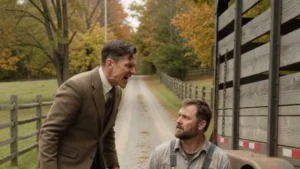
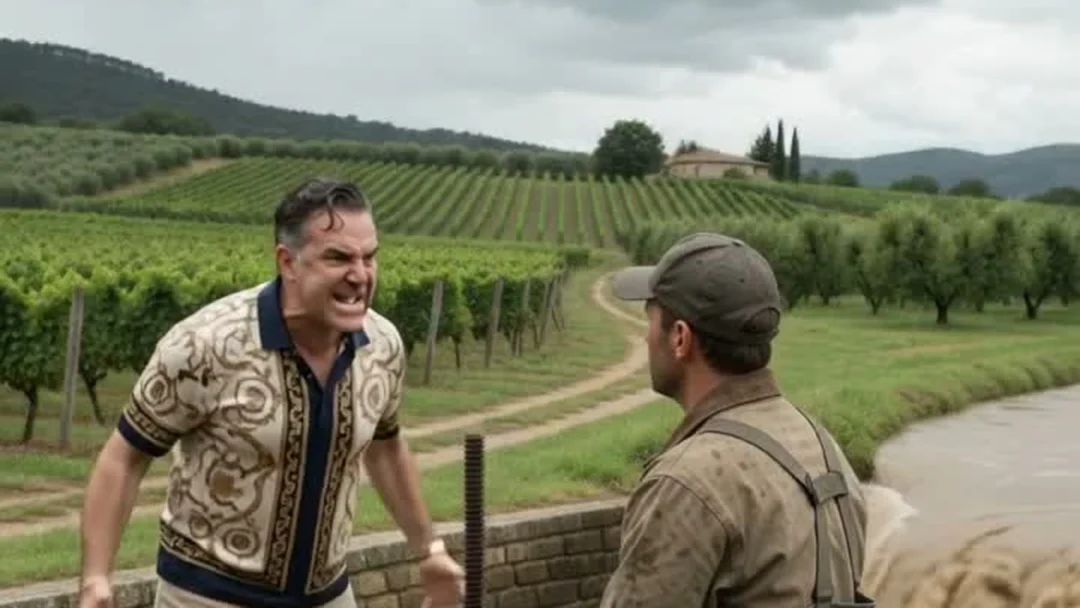
A man in his early forties stepped out into the damp grass. Julian Sterling, the managing partner of Vanguard Terraces Vineyard, looked entirely out of place against the raw, storm-darkened mountain slope. He wore an immaculate cream-colored silk polo shirt, bespoke Italian riding breeches, and knee-high calfskin boots that were already acquiring a film of red volcanic clay. His dark hair was slicked back with pomade, and a gold chronograph gleamed on his wrist as he marched toward the canal lock with clenched fists.
“Hey! You!” Julian shouted, his voice high and sharp with entitled fury. “What the hell do you think you’re doing?”
Wade stepped off the wet catwalk onto the gravel bank, keeping his voice level. “Diverting storm runoff, Mr. Sterling. We’ve got two inches of rain hitting the high ridge in the next hour. If I don’t drop Gate Seven, the canal flume will back up into the secondary culverts.”
“I don’t give a damn about your culverts!” Julian snapped, pointing an agitated, trembling finger at Wade’s county utility truck, an aging Ford F-250 with a rusted hydraulic crane bolted to the bed. “Your piece-of-junk county truck is parked right across my private bridle path! I have an equestrian trainer arriving from Santa Rosa in twenty minutes, and you’re blocking the only scenic trail leading up to the estate manor! Move it! Right now!”
Wade looked past Julian’s shoulder toward the access road. “The bridle path is a designated county utility easement, Mr. Sterling. It’s written into your deed. Gate Seven controls the pressure gradient for three miles of downstream retaining walls. The truck stays where the crane can reach the winch cable until the high-water crest passes.”
Julian’s face flushed a dark, mottled crimson. “You listen to me, you mud-booted civil servant. I didn’t pay twelve million dollars for this hillside to have my property dictated by some county wage-earner with a monkey wrench. You’re going to move that truck, or I’ll have the county water commissioner fire you before sundown!”
“Commissioner doesn’t set flood protocol, sir. The watershed does,” Wade replied calmly. “The water is rising ten inches every ten minutes. Step back from the lock platform. That catwalk isn’t safe in street boots.”
Julian’s eyes narrowed into slits of venomous arrogance. “You think you run this valley, Miller? I own the land. I own the water rights. And I say that water flows where I want it to flow!”
Before Wade could raise a hand to stop him, Julian lunged past the safety railing onto the wet stone platform. His designer riding boots slipped on the mossy granite, but he caught himself against the cast-iron gear housing. With a savage kick of his boot, Julian struck the heavy iron safety locking pin.
CLANG!
The forged steel pin flew out of its socket, tumbling over the stone parapet and vanishing into the tall grass at the edge of the canal bank.
“Mr. Sterling, don’t touch that lever!” Wade shouted, stepping forward with sudden urgency. “The pressure differential is too high!”
“Don’t tell me what to do on my own mountain!” Julian snarled.
Julian seized the red emergency bypass release bar with both hands, planting his heels on the slick stone, and yanked downward with all his weight.
CRACK-CRACK-CRACK!
The iron ratchet gears broke free with a deafening, mechanical shriek. Relieved of its counterweight and locking pin, the heavy sluice gate shot upward into its iron housing. The pent-up pressure of twenty thousand cubic feet of swollen mountain runoff slammed into the newly opened culvert throat with the force of an artillery shell. A violent, churning wave of brown foam and churning silt erupted through the lower stone archway.
Julian stumbled back against the railing, his silk shirt splattered with cold canal spray, a breathless, triumphant smirk curling on his lips. “See that? Problem solved. The bridle path is dry, and your gate is open. Now get your truck off my road!”
Wade didn’t move. He stood completely still on the gravel bank, his hands resting on his tool belt. His dark eyes shifted slowly from the spinning gear housing down the grassy hillside toward the sunken marble courtyard of Vanguard Terraces Manor, four hundred yards below.
“Suit yourself, Mr. Sterling,” Wade said, his voice flat and deadpan. “I was diverting the flash flood away from that lower drainage culvert.”
Julian frowned, his smirk faltering as the deep, low-frequency rumble of rushing water began to reverberate up through the bedrock beneath their boots. “What do you mean, the lower culvert?”
Wade pointed a gloved finger down the slope. “That old culvert hasn’t taken high-head mountain runoff since 1964. It empties directly behind your subterranean wine caves.”
Julian’s head snapped toward the valley.
Down the green hillside, a monstrous wall of brown, foam-crested floodwater exploded out of the lower stone culvert like a burst fire main. The torrent tore across the manicured lawn, ripping up imported sod and decorative shrubs before plunging straight into the sunken stone courtyard of the manor.
With a resounding CRASH that echoed across the entire valley, the muddy surge smashed through the double French oak doors of Julian’s subterranean wine cellar. A fraction of a second later, the reinforced plate-glass walls of the adjacent luxury conservatory shattered in a sparkling cascade of spray, sending thousands of gallons of churning mountain mud rushing into the subterranean vault.
Wooden vintage wine crates, hand-carved tasting tables, and fifty-gallon French oak aging barrels were plucked from the cellar floor like corks, floating out into the courtyard on a surging brown tide of silt and debris.
“My wine cellar!!” Julian shrieked, his voice cracking into an agonized wail. He dropped to his knees in the mud, clutching both sides of his head in utter, helpless horror. “My 1982 reserves! My Grand Cru collection! Close the gate! Miller, close the damn gate right now!!”
Wade looked at the empty gear socket where the safety pin had been, then looked down at Julian kneeling in the dirt.
“Can’t do it, Mr. Sterling,” Wade said calmly, as the muddy floodwater continued to thunder down the slope. “You kicked the locking pin into twenty yards of poison oak. And without that pin, the head pressure will rip the winch cable clean out of the spool.”
As Wade pulled his county radio from his vest to alert the emergency response coordinator, his eyes caught something unnatural exposed in the freshly scoured trench below the canal wall: a severed, unauthorized six-inch high-pressure steel pipe, gleaming with fresh black anti-corrosion paint, illegally tapped straight into the public aqueduct mainline.