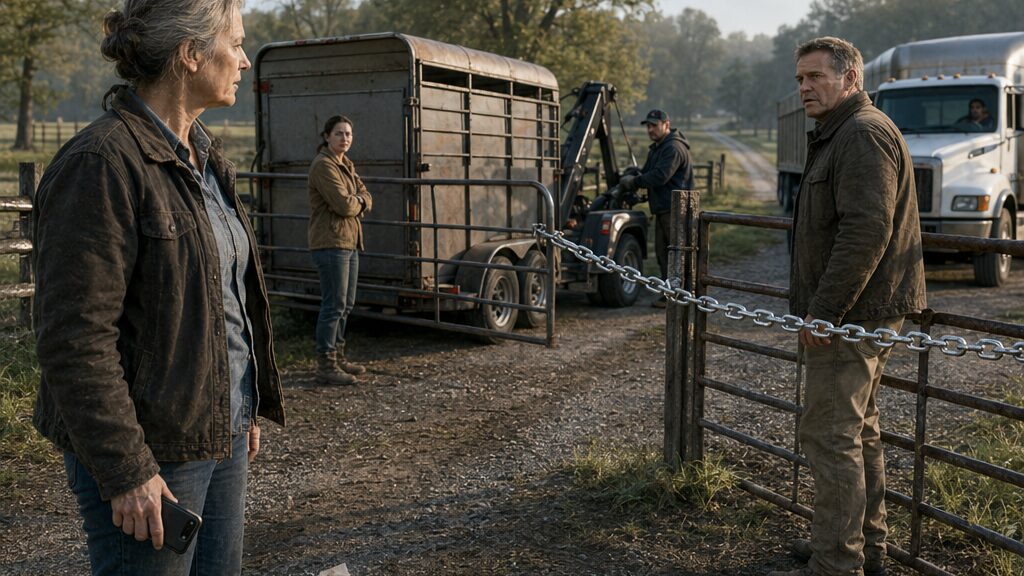
They Blocked Her Farm Road for “Community Safety”—Then She Found Who Actually Owned the Easement
Chapter 1: The Morning They Chained the Farm Road
The tow chain snapped tight around Samantha Moore’s livestock trailer just as Kathleen Miller reached the iron gate.
“Hold it.”
Her voice carried farther than she expected.
The tow operator stopped with one hand on the control lever. Samantha stood ten feet away in work boots and a faded sweatshirt, her face pale with anger. Behind the trailer, a feed truck idled on the county road, unable to turn through the narrowed entrance.
A bright new chain ran through Kathleen’s old iron gate.
She had owned that gate for thirty-one years.
Stephen Roberts stood beside it with a clipboard tucked beneath his arm.
“Kathleen,” he said, “this is association enforcement.”
She looked from him to Samantha’s trailer.
The left tire was still on the gravel lane. The right tire had sunk slightly into the shoulder. Nothing about it looked abandoned.
“What are you enforcing?”
Stephen held out a yellow sheet.
“Unregistered vehicle on association-controlled access.”
Samantha gave a short, disbelieving laugh. “It’s a stock trailer. I parked it here for twenty minutes while I changed a tire.”
Stephen did not look at her.
“The rule covers trailers too.”
The feed driver tapped his horn once.
Kathleen turned. The truck carried enough bagged feed to last her through the month. Its front wheels were angled toward the lane, but with the tow truck parked inside the gate and Samantha’s trailer half-lifted, there was no safe way through.
“How long are you going to be?” the driver called.
Kathleen held up a hand.
“Give me a minute.”
Stephen opened his clipboard.
“Any vehicle using this road has to be registered with the association. We sent notices.”
“You sent a notice about parking.”
“And access.”
“Not the same thing.”
“It is under the new policy.”
Kathleen looked at the chain again.
The gate itself was older than the association. Her husband had welded the lower hinge after a cattle truck clipped it one winter. She could still see the thicker bead of metal where the repair had been made.
Now a polished brass padlock hung from the center.
Not hers.
Samantha stepped closer. “They want two hundred dollars before they release it.”
Kathleen looked at Stephen.
“Two hundred?”
“Towing and administrative fee.”
“For twenty minutes?”
“For noncompliance.”
The word landed with more force than the amount.
Kathleen took the yellow sheet from him. There was a fee schedule stapled behind it: towing, storage, repeat violation, gate-access replacement. Enough columns to make an ordinary farm entrance look like a commercial parking lot.
She read it twice.
Then she pulled out her phone.
Stephen’s expression changed.
“What are you doing?”
“Taking a picture.”
She photographed the yellow notice, the chain, the padlock, the tow truck, the position of Samantha’s trailer, and the feed truck waiting beyond the ditch.
Then she stepped toward the gatepost and photographed the old hinge plate.
“What’s that for?” Stephen asked.
Kathleen ignored him and crouched long enough to capture the base of the post where the iron disappeared into concrete.
Samantha watched her.
The anger in her face shifted into confusion.
“Kathleen, are you with them or not?”
Kathleen stood.
“No.”
“Then tell him to open the gate.”
Stephen shook his head. “She can’t.”
Kathleen looked at him.
He seemed almost relieved to have the argument reach that point.
“This road is controlled by the association,” he said. “The board adopted the policy because nobody would follow voluntary rules. Heavy trucks have damaged the shoulders twice this year. We’ve had people blocking emergency access. Our insurer specifically told us we needed control.”
“Control,” Kathleen repeated.
“Yes.”
“Ownership?”
He hesitated only a fraction.
“The association owns and maintains the access.”
Kathleen’s eyes settled on his clipboard.
“Which recorded instrument gives you exclusive control?”
For the first time that morning, Stephen did not answer immediately.
Samantha looked between them.
The tow operator lowered his hands from the controls.
Stephen’s jaw tightened.
“That’s board business.”
“No. If you’re towing from a road because you claim you control the land, it’s land-record business.”
“We’ve already reviewed it.”
“With what deed?”
“The association records.”
“That wasn’t my question.”
The feed truck engine rumbled behind them.
Stephen flipped through two pages as if the answer might appear by force.
Kathleen waited.
Finally he said, “The development documents establish the roadway.”
“Which one?”
“You can appeal the violation if you want.”
Kathleen almost smiled.
Almost.
Instead, she photographed the fee schedule.
Stephen pulled another yellow notice from the clipboard and held it toward her.
“This one is yours.”
“For what?”
“Unauthorized commercial vehicle.”
Kathleen looked past him at the feed truck.
“My feed delivery?”
“It wasn’t pre-cleared.”
“That truck has come here every month for nine years.”
“And now there’s a policy.”
He tapped the paper against the clipboard.
Kathleen took it.
She read enough to see the road described again as association-controlled property.
There was something familiar in the wording. Not the rule itself. The phrase beneath it.
Access serving adjoining parcels.
Her attention sharpened.
“Where did you get this property description?”
Stephen gave a tired sigh.
“Kathleen, I’m not doing a title seminar at the gate.”
“No. You’re towing equipment.”
“You’ve fought every effort we’ve made to organize this road.”
Samantha looked at Kathleen.
That remark landed differently.
Kathleen felt it.
Stephen did too.
He stepped forward, took the yellow notice from Kathleen’s hand, tore it in half, then tore it again.
“If you don’t want the paper, fine.”
The pieces dropped onto the gravel.
For several seconds nobody moved.
Kathleen looked at them.
Then she bent down.
One piece had landed in a shallow puddle. Ink bled at the edge.
Stephen gave a small shake of his head, as though her crouching confirmed something he already believed.
“You can argue later,” he said. “Today we’re enforcing.”
Kathleen gathered all four pieces.
She folded them wet side inward.
“Don’t lose those tow records,” she said.
Stephen frowned.
“What?”
But she had already turned.
The feed delivery had to be rescheduled. Samantha’s trailer was taken to the impound yard. The new chain remained on the iron gate.
Kathleen did not shout.
She did not call the sheriff.
She did not threaten Stephen with court.
At the farmhouse, she put the torn notice on the kitchen counter and stood looking at it until the mud dried along its edge.
Then she walked into the small office off the hallway.
The room still had the filing cabinet her husband had complained was too heavy to move.
Kathleen knelt beside it and pulled open the bottom drawer.
Tax receipts.
Old insurance papers.
Fence invoices.
Beneath them sat a gray steel deed box with a dent in one corner.
She had not opened it since the year after her husband died.
Kathleen set it on the desk.
For a moment her hand rested on the latch.
Then she opened it.
Chapter 2: The Folded Map Beneath the Tax Receipts
The boundary line on the old plat ran straight through the road Stephen claimed belonged to the association.
Kathleen leaned closer.
“That can’t be right.”
The map had been folded into quarters so long that the paper had softened along the creases. A faded county stamp sat near the bottom. Pencil marks made years earlier crossed one corner, probably her husband’s.
The iron gate was drawn as a tiny break in the fence line.
Beyond it, the gravel access did not sit inside a separate association parcel.
It crossed hers.
Kathleen resisted the first conclusion that came to her.
Owning dirt beneath a road did not necessarily mean controlling who used it.
She knew better than that.
Twenty-three years earlier, before she returned to the farm full-time, she had spent six years researching title chains for a regional title company. Her job had consisted mostly of finding reasons not to make assumptions.
One deed rarely told the whole story.
A parcel could be owned by one person and burdened by rights held by five others.
A map could show a line but not explain the agreement behind it.
A road could look private and still carry recorded access.
That was why Stephen’s certainty bothered her more than his padlock.
Kathleen arranged the documents in date order.
The original farm deed.
A later subdivision filing.
A boundary adjustment.
Two pages referring to “access.”
One referenced an instrument number but did not include the instrument itself.
She wrote the number on an envelope.
By ten the next morning, she was at the county recorder’s office.
The clerk behind the counter recognized the type of request immediately.
“You want the historical instrument too?”
“Yes.”
“Digital index only goes back so far.”
“I know.”
The clerk glanced at her.
“You done this before?”
“A long time ago.”
The answer seemed sufficient.
Twenty minutes later, Kathleen sat at a public terminal scrolling through scanned index pages.
Stephen’s association appeared in several maintenance filings and later declarations.
What did not appear was a deed conveying the road itself.
She searched under the original developer.
Then under her parcel.
Then under the neighboring parcels.
An older entry surfaced.
Private road and access easement.
Kathleen felt a brief pulse of satisfaction.
There it was.
Not association roadway.
Not common-area conveyance.
Private road and access easement.
She ordered the image.
The clerk brought over a copy warm from the printer.
Kathleen read the first page standing up.
The developer had reserved a strip for access across what later became her farm parcel. Certain adjoining tracts were granted passage.
She read the description twice.
Then a third time.
The road itself, at least in that filing, had never been transferred into a separately owned association parcel.
Stephen had been wrong.
The thought came clean and sharp.
Then Kathleen turned the page.
Her satisfaction disappeared.
Additional easement references were listed.
She returned to the terminal.
One led to Samantha’s parcel.
Another to two smaller properties uphill.
A third referenced agricultural access “for ingress, egress, service vehicles, livestock conveyance, and ordinary farm purposes.”
Kathleen sat back.
The wording sounded old-fashioned.
Its meaning did not.
The feed truck Stephen had blocked was almost certainly covered.
So was Samantha’s livestock trailer.
But the same language also meant Kathleen could not simply announce that the road was hers and bar everybody else.
She requested certified copies.
While the clerk prepared them, Kathleen called Raymond Nelson.
He answered on the fourth ring.
“Kathleen?”
“I need you to remember something without pretending it’s proof.”
There was a pause.
“That sounds dangerous.”
“The old Miller access road.”
Another pause, longer this time.
“What about it?”
“Was the association ever deeded the road?”
“I don’t know.”
“You surveyed around here.”
“I surveyed boundaries. Not ownership.”
“You remember the old plat?”
“I remember enough to know I don’t want to testify from memory.”
Kathleen almost smiled.
“That’s why I called you.”
Raymond sighed.
“The original road crossed the Miller tract before half those houses existed. That much I remember.”
“And the gate?”
“Your husband replaced one there. The gate was there before him.”
Kathleen looked at the certified copy on the counter.
“Anything else?”
“Yes.”
His tone changed.
“There was a notation on one of the early plats. People used to misunderstand it.”
“What notation?”
“Maintenance access.”
Kathleen waited.
Raymond continued.
“Some folks read it as ownership. It wasn’t. At least not by itself.”
“Do you know the book and page?”
“No.”
“Could you find it?”
“I could point you toward where I remember seeing it. That’s all.”
“That’s enough.”
“No, Kathleen. It’s a direction. Not enough.”
She heard something in his voice that had nothing to do with this road.
“You got burned on one of these before.”
Raymond was quiet.
“Two brothers stopped speaking over a line I located thirty years ago. The line was right. Didn’t make anything else right.”
Kathleen folded the copy carefully.
“I’m not asking you to choose sides.”
“Good.”
“I’m asking where to look.”
He gave her an older plat reference.
Before hanging up, he said, “And don’t make the same mistake Roberts is making.”
“What mistake?”
“Finding one paper that says what you want and stopping there.”
Kathleen stared at the receiver after the call ended.
At the terminal, the older plat took another twenty minutes to locate.
Raymond had remembered correctly.
Near the road was a small handwritten-style notation reproduced from the original survey.
Maintenance access along private road.
Kathleen traced the printed words with one finger.
The phrase explained how Stephen might have convinced himself he had authority.
But it did not explain towing.
It did not explain fees.
And it certainly did not explain why he had spoken as if ownership were settled.
She gathered the certified records and drove home.
At the farm, the iron gate was still chained.
Someone had attached another yellow notice to it in a plastic sleeve.
Kathleen did not stop.
Inside, she spread the documents across her kitchen table.
Her parcel number appeared beneath the road description.
For one satisfying minute, she allowed herself to think the simplest version:
Stephen had chained her road.
Then she opened the second easement.
Samantha’s parcel was listed by legal description.
So were properties represented by the association.
Kathleen read the grant language slowly.
Rights of access ran with the land.
Not with Stephen.
Not with the association president.
Not with her.
The road might lie on Kathleen’s parcel.
But other people had rights in it that could outlast all of them.
She set the page beside Stephen’s torn notice.
His claim had been too broad.
Now she had to ask whether her own first reaction had been too broad as well.
Chapter 3: Ownership Was Not the Same as Control
Kathleen found her parcel number directly beneath the centerline of the gravel road.
She had expected the discovery to feel like victory.
Instead, sitting at her kitchen table on Wednesday morning, she felt the weight of every easement stacked beside it.
The underlying tract was hers.
That much the records supported.
The road was not shown as a separately deeded association parcel.
Stephen’s repeated claim that “the association owns the road” was wrong.
But ownership was only the first layer.
Kathleen had spent enough years around title work to know how dangerous the word mine could become once easements entered the sentence.
She drove to the recorder’s office again.
This time she knew exactly what she needed.
The oldest agricultural-access instrument was difficult to read. The scan had a gray shadow along one edge, and the legal description used landmarks that had disappeared decades ago.
The operative paragraph was clearer.
No gate, fence, obstruction, or other improvement shall unreasonably interfere with ordinary agricultural ingress and egress.
Kathleen stopped reading.
The iron gate itself was permitted.
Blocking it was another question.
She copied the paragraph.
Then she requested the related maintenance instrument.
It was less helpful.
Users of the road were expected to contribute to reasonable upkeep, but the document did not specify percentages, enforcement methods, or who had final authority when people disagreed.
There was the hole.
Not in the road.
In the arrangement.
Everyone had access rights.
Everyone had some maintenance responsibility.
Nobody had a clean mechanism for managing either.
Stephen had filled that vacuum with policy.
Kathleen had filled it with refusal.
She did not enjoy recognizing that.
On the way home she stopped at Samantha’s place.
The livestock trailer was back, but it sat near the barn with an orange impound tag tied to the jack handle.
Samantha was carrying a bucket toward a pen.
She saw Kathleen’s truck and set it down.
“You get your feed?”
“Yesterday.”
“Mine cost me three hundred and eighty-seven dollars.”
Kathleen got out.
“I thought the tow was two hundred.”
“Tow, storage, release charge, somebody’s idea of paperwork.”
Kathleen held up a folder.
“I found the road records.”
Samantha’s face changed immediately.
“And?”
“The association doesn’t own the road the way Stephen says.”
For half a second Samantha looked relieved.
Then she studied Kathleen.
“Who does?”
“The underlying strip is part of my parcel.”
Samantha stared at her.
Kathleen had anticipated surprise.
She had not anticipated suspicion.
“So it’s your road.”
“The land under it appears to be.”
“Appears?”
“There are easements.”
Samantha folded her arms.
“Kathleen, I need plain English.”
“You have recorded access. So do several others. Stephen can’t just erase that with a board policy.”
“Can you?”
“No.”
Samantha looked toward the lane.
The iron gate was visible in the distance.
“Did you know any of this?”
“Not the details.”
“That’s not what I asked.”
Kathleen felt irritation rise.
She pushed it down.
“I knew the road crossed our parcel. I didn’t know what every easement said.”
“But you knew more than the rest of us.”
“I knew enough not to make claims without checking.”
Samantha gave a hard laugh.
“That would’ve been useful Monday.”
“I was checking.”
“While my trailer was being hauled off.”
Kathleen’s grip tightened around the folder.
“What did you want me to do? Stand there and invent an answer?”
“I wanted to know whether you thought Stephen had the right.”
“I didn’t.”
“You didn’t say that.”
“I asked him for the instrument.”
“You asked him a lawyer question while my trailer disappeared.”
Kathleen turned her head toward the barn.
Samantha had never been confrontational with her before.
That made the words sharper.
“I’m trying to fix it.”
“I know.”
Samantha’s voice softened, but only slightly.
“That’s the problem. You always try to fix things after you decide nobody else will do it right.”
Kathleen looked back at her.
“What’s that supposed to mean?”
Samantha hesitated.
Then she walked to the trailer, pulled the impound tag free, and handed it to Kathleen.
“You remember the road meeting?”
Kathleen did not answer.
“Three years ago,” Samantha said. “After the washout.”
“I remember.”
“Stephen wanted everyone to sign a maintenance agreement.”
“That agreement gave the association too much authority.”
“Maybe it did.”
“It absolutely did.”
“But you didn’t suggest another one.”
Kathleen’s jaw tightened.
“I wasn’t going to sign away control of my property.”
Samantha’s expression sharpened.
“You just said ownership isn’t the same as control.”
The words struck with embarrassing precision.
Kathleen looked down at the impound tag.
Samantha continued.
“We had ruts deep enough to catch a hay wagon. You said everyone should maintain their own end.”
“They should.”
“There isn’t an ‘own end’ when five farms use the same entrance.”
Kathleen said nothing.
Samantha picked up the bucket again.
“I’m not saying Stephen is right. He isn’t. Towing my trailer was wrong. Locking the gate was wrong. But this didn’t start Monday.”
Kathleen wanted to argue.
She wanted to point out that refusing a badly written agreement was not the same as authorizing a tow.
Both things were true.
Neither answered Samantha.
Kathleen drove back to the farmhouse with the folder unopened on the passenger seat.
The gate chain flashed in the afternoon sun as she passed.
At home, she returned to the steel deed box.
She had searched the title papers twice.
This time she searched everything else.
At the bottom, underneath receipts for culvert pipe and a faded invoice for gravel, she found a white envelope.
Road Maintenance Proposal.
Her own handwriting appeared in one corner.
Unsigned.
Kathleen sat down.
She remembered the meeting now more clearly than she wanted.
Stephen had been newer to the association then, less certain in his manner. The road had washed badly after two weeks of rain. Everyone had complained about who was paying for gravel.
He had circulated a proposed agreement.
Kathleen had read three pages, found language giving the board power to regulate access, and slid it back across the table.
“If you want to maintain the road, maintain it,” she had said. “I’m not giving a committee authority over my gate.”
Stephen had asked whether she would help rewrite it.
She had said no.
At the time, that had felt like refusing a bad bargain.
Now the unsigned agreement looked different.
Not innocent.
Not damning.
Incomplete.
Like the road itself.
Kathleen unfolded the final page.
A handwritten note had been clipped behind it.
Three years earlier, Stephen had written that without a shared agreement the association might eventually need “formal access controls” to satisfy insurance requirements.
Kathleen stared at the line.
Then she remembered the receipts mentioned at the meeting.
If Stephen had been worrying about insurance even then, perhaps Monday’s chain had not appeared from nowhere.
That did not excuse it.
But it meant she still did not know the whole story.
Kathleen put the unsigned agreement beside the easements.
For the first time since the tow truck arrived, the question was no longer simply what Stephen had done.
It was what had been left undone before he did it.
Chapter 4: The Agreement Kathleen Would Not Sign
The unsigned maintenance agreement was still clipped exactly where Kathleen had left it three years earlier.
She spread the pages across the kitchen table and found her own refusal in the margins.
Too broad.
Board authority unclear.
Who decides “reasonable use”?
The handwriting was hers. Sharp, compressed, impatient.
She remembered Stephen standing at the other end of the table that evening, not yet gray at the temples, holding a legal pad instead of a clipboard.
The road had been a mess.
Spring rain had cut two channels through the gravel. A hay wagon had dropped one wheel into a rut deep enough to bend an axle bracket. Everyone had complained about the condition. Nobody had agreed on what to pay.
Stephen had proposed dividing costs among the parcels that used the entrance.
Kathleen had read the draft until she reached a section allowing the association to regulate access “as reasonably necessary for maintenance, safety, and preservation.”
She had pushed it away.
“I’m not giving a board control over my gate.”
Stephen had leaned forward.
“Then help rewrite it.”
“I maintain what I use.”
“You use the same entrance as everybody else.”
“So does everybody else.”
“That’s the point.”
She had stood up.
“My husband and I maintained that road before there was an association.”
Stephen’s face had tightened.
“And now there is one.”
That had been the end of the discussion as far as Kathleen was concerned.
Three years later, the same unfinished argument lay beneath her hand.
She turned to the receipts.
At first she assumed they were association expenses mixed into the packet.
Then she noticed the payment method.
Personal check.
Stephen Roberts.
One gravel load.
Another.
Drainage stone.
Equipment rental.
A handwritten reimbursement request marked partial.
Kathleen counted five separate payments.
She called Samantha.
“Did you know Stephen paid for road repairs himself?”
Silence.
Then, “Some.”
“How much is some?”
“I don’t know.”
“Why didn’t anybody tell me?”
Samantha gave a tired laugh.
“You stopped coming to meetings.”
Kathleen looked at the unsigned agreement.
“I stopped coming because every meeting turned into the road.”
“Yes.”
“And?”
“And the road didn’t stop existing because you stopped talking about it.”
Kathleen said nothing.
Samantha continued.
“The budget ran short two winters ago. Stephen paid for gravel because the washout was bad enough the propane truck wouldn’t go up.”
Kathleen picked up one receipt.
“He was reimbursed?”
“Not all of it.”
“Why?”
“People argued over who owed what.”
“Because there was no agreement.”
“Exactly.”
Kathleen hated how simple Samantha made it sound.
After the call, she drove to the association office.
It occupied one room in a converted farm-supply building near the highway. Stephen was there alone, sorting papers.
He looked up when Kathleen entered carrying the old agreement.
“I wondered when you’d find that.”
“You kept copies.”
“I keep everything.”
“So do I.”
His eyes went to the document.
Kathleen set the receipts beside it.
“You paid these?”
Stephen leaned back.
“Yes.”
“Why?”
“Because somebody had to.”
“That isn’t an answer.”
“It’s the only one there was.”
Kathleen tapped one of the receipts.
“You spent your own money on road gravel.”
“The association account was nearly empty.”
“And nobody would agree on assessments.”
“No.”
“Because nobody agreed on authority.”
Stephen looked at her.
“Because nobody agreed on anything.”
The irritation in his voice was real, but so was exhaustion.
He opened a drawer and pulled out a thin file.
“Last year a delivery truck tore the shoulder near the culvert. Before that, somebody left equipment at the fork overnight. An ambulance had to back almost seventy feet because it couldn’t turn.”
Kathleen’s attention sharpened.
“When?”
“February.”
“Why didn’t I know?”
“You weren’t the patient.”
“That doesn’t answer me.”
Stephen slid a letter across the desk.
The letterhead belonged to the association’s insurer.
Kathleen read enough to understand the problem.
Access control.
Maintenance documentation.
Emergency vehicle clearance.
Failure to address known hazards could affect renewal terms.
She put the letter down.
“So that’s where the policy came from.”
“That’s part of it.”
“Part?”
Stephen rubbed his forehead.
“I told the board we needed something enforceable before renewal. They told me to solve it.”
“And you decided towing was solving it?”
“I decided voluntary rules weren’t working.”
“That doesn’t give you ownership.”
“I know what you found.”
Kathleen looked up.
“What did I find?”
His hesitation was brief but unmistakable.
She saw it.
“You knew.”
“I knew the records weren’t clean.”
“How long?”
Stephen’s face hardened.
“That depends what you mean by knew.”
Kathleen felt anger rise again, cleaner this time.
“I mean before Monday.”
He did not answer.
She glanced around the office.
On the wall behind him was a map of the road with colored marks showing washouts, culvert edges, and turning areas. It was practical, careful work.
The same man who had done that had stood beside a tow truck and called an uncertain claim settled.
Kathleen pointed at the insurer’s letter.
“This explains why you were scared.”
“I wasn’t scared.”
“Yes, you were.”
Stephen’s mouth tightened.
“Fine. I was concerned.”
“Concern doesn’t turn a maintenance problem into property ownership.”
“No. But try telling five households to pay for gravel when half of them say the road belongs to you and the other half say the association should handle it.”
“So you decided to act like it belonged to you.”
“I decided somebody had to act.”
Kathleen looked at him for a long moment.
“That’s the part you still don’t hear.”
“What part?”
“The difference between acting and having the right.”
Stephen looked away first.
Kathleen gathered the receipts.
As she slid them back into the file, a single page caught beneath the folder.
County Land Records Inquiry.
She pulled it free.
Stephen reached for it too late.
The date was ten days before the first tow.
Kathleen read the first line.
Request for clarification regarding ownership and enforcement authority over private access roadway.
Her eyes moved down.
The response was attached.
Available records do not establish association fee title to roadway. Easement and maintenance rights require further review.
Kathleen looked at Stephen.
“You asked them.”
“Yes.”
“They told you it wasn’t clear.”
“They told me they couldn’t give a legal opinion.”
“They told you they couldn’t establish ownership.”
Stephen stood.
“And while everybody waited for another opinion, we still had an insurer deadline.”
“So you picked the answer you needed.”
“I picked the only policy the board would approve.”
“You knew it might be wrong.”
“I knew it might be challenged.”
“That isn’t the same sentence.”
Neither of them spoke.
Kathleen folded the county response and put it back on the desk.
The receipts had changed what she thought of Stephen.
The dated inquiry changed it again.
He had not invented the problem.
He had simply decided that uncertainty was permission.
And he had done it before the tow truck ever arrived.
Chapter 5: The Rule Stephen Chose to Call Settled
The county road technician read the certified plat twice before looking at Kathleen.
“I can’t certify this road belongs to the association.”
Stephen shifted beside her.
Kathleen did not.
They were standing at a high counter in the county road department on Friday morning. Between them lay copies of the deed, the private-access instrument, the agricultural easement, and Stephen’s policy.
The technician tapped the legal description.
“This appears to put the underlying strip inside the Miller parcel.”
Stephen spoke quickly.
“But the association maintains it.”
“Maintenance and ownership aren’t the same thing.”
Kathleen nearly looked at him.
She didn’t.
The technician continued.
“And these easements grant access to multiple parcels. You’d need counsel to interpret every private right involved. What I can tell you is the county does not own it.”
“Can the association enforce parking and towing?” Kathleen asked.
“That’s not a road-department determination.”
Stephen exhaled through his nose.
Kathleen gathered her papers.
“So nobody here is going to validate the policy.”
The technician shook his head.
“Not from these records.”
Outside, Stephen stopped beside Kathleen’s truck.
“You planned that.”
“What?”
“Bringing me here.”
“You came because I told you the county wouldn’t certify your claim.”
“I came because this needs an answer.”
“No. You wanted a different answer.”
Stephen looked across the parking lot.
The anger had gone out of him.
What remained looked worse.
“I have a board meeting tonight.”
Kathleen waited.
“If I walk in and say we don’t have the authority we thought we had, they’ll ask why I implemented it.”
“They should.”
“They’ll also ask what happens to insurance.”
“That’s a different problem.”
“They’re connected.”
“Not enough to make the first one disappear.”
Stephen rubbed the back of his neck.
“The insurer wanted documented controls. The board wanted something before renewal. People were refusing to pay road assessments because they said nothing was enforceable. Every time I tried to get agreement, somebody threatened to withdraw from the association.”
“So you made the rule bigger.”
“I made it clear.”
“You made it sound clear.”
He looked at her.
That distinction landed.
Kathleen lowered her voice.
“You can stop this today.”
“I can pause new fines.”
“And the chain?”
“That stays until the board votes.”
“The towing?”
“No new tows unless there’s an obstruction.”
“Refund Samantha.”
“I can’t authorize that alone.”
“You authorized the tow.”
“The contractor acted under the policy.”
“Your policy.”
Stephen’s jaw tightened again.
“I said I’ll stop new fines.”
It was the first concession he had made.
It was not enough.
By late afternoon, Kathleen was back at the farm entrance when a fertilizer delivery approached from the county road.
The driver slowed at the chained gate.
Kathleen walked out before he had to stop.
Stephen was already there.
He had opened the gate but left the chain looped around one post.
“You’re letting him through?” Kathleen asked.
“He’s on the approved list.”
The driver looked from one of them to the other.
“I just need the south fork.”
Kathleen stepped aside.
The truck cleared the opening by inches.
Its rear wheels cut close to the ditch because the chain and gate forced a tighter turn than before.
Kathleen watched the tires.
“So this is safer?”
Stephen ignored her.
The truck passed.
Ten minutes later, the sound of a siren came from the county road.
Both of them turned.
A plain ambulance slowed sharply at the entrance.
The driver tried to make the turn.
The angle was wrong.
The rear quarter came too close to the gatepost, forcing the driver to stop and back.
A second attempt took several seconds.
Nothing catastrophic happened.
Nobody was injured at the entrance.
But the delay was visible.
Concrete.
Unnecessary.
Kathleen looked at Stephen.
His face had changed.
He walked to the chain and pulled it loose from the post.
The ambulance finally turned through and continued toward one of the upper parcels.
Neither of them spoke until the sound faded.
Stephen held the chain in his hand.
“That gate was wider before.”
“The gate didn’t move.”
“The usable opening did.”
He looked at the chain.
For the first time, Kathleen heard no defense in his voice.
Only recognition.
She could have pressed harder.
Instead she said, “This is what happens when you solve one problem by pretending the others aren’t real.”
Stephen looked tired.
“You think I don’t know that now?”
Kathleen watched him coil the chain.
“Then take it off.”
“I still need the board.”
“You keep saying that whenever the decision gets expensive.”
His eyes flashed.
“And you keep pretending this started with me.”
Kathleen almost answered immediately.
Then Samantha’s words returned.
You stopped coming to meetings.
The unsigned agreement.
The gravel receipts.
Kathleen looked toward the upper road.
“No,” she said. “It didn’t.”
Stephen seemed surprised.
Kathleen continued.
“But towing trailers from a road you knew you didn’t clearly own—that started with you.”
He looked down.
“Yes.”
The word was quiet.
Not an apology.
Not yet.
But it was the first unqualified admission she had heard.
Stephen opened the gate fully and left the chain hanging from the post.
“I’ll recommend suspending enforcement tonight.”
“Recommend?”
“That’s what I can do without another vote.”
“And the fees already collected?”
“We’ll review them.”
Kathleen looked at him.
“That means delay.”
“It means review.”
“It means people already paid.”
Stephen had no answer.
Kathleen drove home before the board meeting began.
At her kitchen table she laid out every document she had collected.
Her deed.
The easements.
The agricultural-access clause.
Stephen’s county inquiry.
The insurer letter.
The towing fee schedule.
The unsigned maintenance agreement.
For three days she had imagined confronting Stephen with the right page and ending the problem.
Now the pages contradicted that fantasy.
The road was hers in one sense.
Not hers in another.
Stephen had legitimate worries and illegitimate methods.
Kathleen had legitimate objections and a history of refusing the work that might have prevented the vacuum.
A private argument between the two of them would never settle it.
She picked up the county complaint packet she had brought home.
At the top was a section she had not yet filled out.
Nature of requested action.
Kathleen uncapped her pen.
This time she did not write Stephen’s name first.
She wrote:
Unauthorized enforcement affecting shared private access.
Then she began listing every parcel whose rights crossed the road.
Chapter 6: She Filed Against the Rule, Not the Neighbors
The county complaint form gave Kathleen two boxes.
Restrict access to titled parcel.
Preserve existing easement access.
She stared at them longer than she had stared at any deed.
A week earlier, the first box might have tempted her.
The road crossed her land. Stephen had chained her gate. The association had towed a trailer from the entrance while claiming ownership it could not establish.
There was satisfaction available in the simplest response.
My land.
My gate.
My decision.
Kathleen checked the second box.
Preserve existing easement access.
Then she attached copies of Samantha’s easement and every other access instrument she had found.
At the county office on Monday, the clerk reviewed the packet.
“You’re the titled owner?”
“Underlying parcel.”
“But you’re asking the county not to restrict the other users.”
“They have recorded rights.”
The clerk looked at the stack.
“You included all of them.”
“Yes.”
“Most people don’t.”
Kathleen gave a small shrug.
“Most people should.”
The clerk stamped the first page.
The sound was heavier than Kathleen expected.
Outside, Samantha was waiting beside her truck.
“You filed it?”
Kathleen nodded.
“Against Stephen?”
“Against the policy.”
Samantha studied her.
“There’s a difference?”
“There should be.”
Kathleen handed her a copy.
“I included your easement.”
Samantha looked down.
“You didn’t have to.”
“Yes, I did.”
That answer seemed to settle something between them.
Not everything.
But something.
Later that afternoon, Kathleen received the tow records she had requested.
Seven charged vehicles.
Three trailers.
One equipment hauler.
Two delivery trucks cited but not towed.
The amounts were not enormous individually.
Together they told a different story.
The policy had not merely existed on paper. It had been used.
Kathleen copied the records and added them to the county packet.
Then she walked down to the iron gate.
The association chain was gone from the center, but Kathleen’s old private padlock still hung from a lower loop, rusted and rarely used.
She had put it there years ago for the occasional night when cattle were moved through the front pasture.
For a long time, she had thought of the lock as hers because the gate was hers.
Now she looked at it differently.
Ownership could explain possession.
It did not excuse obstruction.
Kathleen fetched bolt cutters from the barn.
The lock resisted twice.
On the third squeeze, the shackle snapped.
She removed it and left the iron gate standing free.
A truck approached from the upper lane.
Samantha slowed as she passed.
She looked at the missing lock, then at Kathleen.
Kathleen lifted the broken padlock once before dropping it into the bed of her truck.
Samantha nodded.
Nothing more was needed.
Stephen arrived before sunset.
He parked beside the ditch and got out holding no clipboard.
“I got the filing.”
Kathleen leaned against the gatepost.
“That was fast.”
“You copied the association.”
“Yes.”
“You requested review of the towing policy, the ownership claim, emergency clearance, and the maintenance arrangement.”
“Yes.”
“You also attached documents showing the neighbors’ rights.”
“Yes.”
Stephen looked irritated by the repetition.
Then he said, “You made it look like the association has been attacking everybody.”
“You were charging everybody.”
“We were trying to create order.”
“You called the road yours.”
“The board approved the language.”
“You knew the county wouldn’t establish that.”
“I told you why.”
Kathleen looked at him.
“No. You told me what you were afraid of.”
Stephen fell silent.
The distinction seemed to strike him again.
Finally he said, “This filing could jeopardize the whole association.”
“Then the association should survive without pretending it owns land it doesn’t.”
“That’s easy for you to say.”
“No, it isn’t.”
Kathleen straightened.
“I attached the maintenance agreement I refused to sign.”
Stephen’s expression changed.
“You what?”
“The old one.”
“Why?”
“Because it belongs in the record.”
“You didn’t have to do that.”
“Yes.”
She stopped.
Then, more quietly, “I did.”
Stephen stared down the road.
Kathleen continued.
“I should have helped rewrite it.”
He looked back at her.
“That doesn’t make the towing right.”
“I know.”
“I shouldn’t have treated uncertainty like permission.”
Kathleen said nothing.
He kicked lightly at the gravel near the gatepost.
“The board is furious with me.”
“Because you stopped enforcement?”
“Because I told them the title claim was uncertain.”
“You should have told them before.”
“I know.”
Again, no defense.
Kathleen glanced at the gate.
The chain was gone.
The entrance looked almost too ordinary.
Stephen noticed.
“You cut your lock.”
“Yes.”
“Why?”
“Same reason I filed the easements.”
He waited.
Kathleen said, “I don’t get to demand everybody respect my rights and then pretend theirs are inconvenient.”
Stephen gave a humorless half-smile.
“That sounds expensive.”
“It probably will be.”
His phone rang.
He answered, listened, and his posture changed.
“When?”
Kathleen watched him.
He ended the call.
“What?”
“The county scheduled a joint review.”
“When?”
“Two weeks.”
“That soon?”
“Emergency access pushed it up.”
Kathleen looked toward the bend where the ambulance had struggled through.
Stephen slipped the phone back into his pocket.
“They want title records, association minutes, maintenance history, towing authorizations, insurance correspondence, everything.”
“Good.”
He looked at her.
“You’re going to bring the unsigned agreement.”
“Yes.”
“You know the board will use it against you.”
“They should ask about it.”
Stephen gave a slow nod.
For the first time since the chain appeared, neither of them seemed interested in winning the moment.
The county review would force them to place every version of the road on the same table.
The road Stephen had claimed.
The road Kathleen had refused to share responsibility for.
The road Samantha had a legal right to use.
The road everyone depended on.
Stephen opened the iron gate and let it swing until it rested against the fence.
“They’ll ask who was responsible,” he said.
Kathleen looked down the gravel lane.
“Yes.”
“Which one of us?”
She met his eyes.
“Probably both.”
Chapter 7: The Hearing Where Neither Side Owned the Whole Truth
The county staff member opened the meeting by placing four documents on the table and saying, “Both sides have been using the word ownership too loosely.”
Nobody moved.
Kathleen sat with her certified records arranged in a narrow stack. Stephen sat across from her beside two association board members. Samantha occupied a chair near the end of the table. Raymond Nelson had been asked to attend only to explain historical survey references if needed.
The county staff member pointed to the first document.
“The underlying roadway appears to lie within the Miller parcel.”
Stephen shifted.
Then the staff member touched the second.
“These recorded easements establish access rights benefiting several adjoining parcels.”
The third.
“This maintenance language creates obligations but does not, by itself, grant the association ownership.”
Then the fourth.
“And we have found no recorded instrument establishing association authority to impose towing charges based on exclusive ownership of this roadway.”
Kathleen felt the room tighten.
One board member leaned forward.
“So the towing was unauthorized?”
The staff member chose the words carefully.
“The ownership basis stated in the policy was unsupported by the records provided. Whether every individual tow creates a separate private claim is beyond this administrative review. But the association cannot continue representing itself as fee owner of the road.”
Stephen stared at the table.
The other board member turned toward him.
“You told us the association controlled it.”
“I said the records supported association control.”
“That is not what you said at the meeting.”
Stephen looked up.
“I also told the board the county would not issue a legal opinion.”
“After the policy passed.”
Kathleen watched him absorb the accusation.
Two weeks earlier, she would have enjoyed it.
Now she found no pleasure in watching the room narrow around him.
The county staff member raised a hand.
“We’re not here to assign all responsibility to one person. The records show a longer problem.”
Kathleen knew what was coming.
Before Stephen could speak, she opened her folder.
“There is one more document.”
Samantha glanced at her.
Kathleen slid the unsigned road-maintenance agreement across the table.
“I received this three years ago.”
The board members recognized it immediately.
Kathleen continued.
“I refused to sign it.”
Stephen looked at her.
She did not look away.
“I believed it gave the association too much authority over my gate and parcel. I still believe parts of it did. But I also refused to help revise it.”
One board member frowned.
“You were asked?”
“Yes.”
“More than once,” Stephen said quietly.
Kathleen nodded.
“More than once.”
The admission seemed to change the temperature of the room.
The staff member picked up the agreement.
“So the maintenance dispute predates the current enforcement policy.”
“Yes,” Kathleen said.
“And shared costs were unresolved?”
“Yes.”
“And there was no accepted procedure for managing access obstructions?”
“No.”
Stephen leaned back.
Kathleen saw something loosen in his face.
Not victory.
Relief, perhaps, that he was no longer the only person sitting beneath the weight of the past.
The staff member turned to him.
“That does not excuse the towing.”
“I know.”
“You received a county response before implementation stating that association ownership could not be established.”
“Yes.”
“Yet the policy described the road as association-controlled property.”
Stephen nodded once.
“Why?”
One of the board members shifted as if expecting him to defend himself again.
He did not.
“Our insurer wanted documented access controls before renewal. The road budget was short. People were refusing assessments because nobody agreed who had authority.” He paused. “I thought if the rule looked temporary or uncertain, nobody would follow it.”
Kathleen heard the sentence for what it was.
Not a legal argument.
A confession of method.
“So you made uncertainty disappear on paper,” the staff member said.
“Yes.”
“And authorized towing.”
“Yes.”
Samantha spoke for the first time.
“My trailer cost me nearly four hundred dollars.”
Stephen looked toward her.
“I know.”
“You never called.”
“I should have.”
Samantha folded her arms.
“You should have stopped the tow.”
Stephen nodded.
“Yes.”
No one applauded.
No one needed to.
The county staff member moved to the final portion of the review.
The association was instructed to suspend the towing policy permanently unless a lawful future basis was established. Notices and fee schedules referring to association ownership had to be withdrawn.
Fees collected under the unsupported policy were to be reviewed for reimbursement.
The association would also have to correct its records.
Then came the part Kathleen had known was coming but still did not enjoy hearing.
“The access problem remains,” the staff member said.
A road-department representative placed photographs of the shoulder damage on the table.
“Drainage is failing along the lower section. The turn near the gate needs widening. Maintenance responsibility needs to be formalized.”
One board member exhaled.
“So after all this, we still need an agreement.”
“Yes.”
“Who controls it?”
The staff member shook his head.
“That is the wrong starting question.”
Kathleen looked at the iron gate in one photograph.
The image showed the old hinge, Stephen’s bright chain, and the narrow turn the ambulance had struggled through.
The staff member continued.
“You have title ownership, easement rights, maintenance obligations, and safety concerns. Those are different things. Your agreement needs to reflect that.”
Raymond spoke from the end of the table.
“That’s what the old records were trying to do.”
Everyone looked at him.
He raised both hands slightly.
“I’m not giving a legal opinion.”
For the first time that morning, Samantha smiled.
The meeting ended with assignments rather than victory.
A survey update.
A revised turning radius.
A temporary freeze on enforcement charges.
A reimbursement review.
A draft maintenance formula based on actual road usage and parcel benefit.
Outside the county building, Stephen stood beside Kathleen near the parking lot.
For several seconds neither spoke.
Then he said, “You could have let them think this was all me.”
Kathleen looked at him.
“It wasn’t.”
“I made the worst decision.”
“Yes.”
He gave a dry laugh.
“You don’t soften much.”
“No.”
They walked toward their trucks.
Stephen stopped.
“That agreement three years ago.”
Kathleen waited.
“I asked you to help rewrite it because you understood this stuff better than the rest of us.”
“I know.”
“You said committees turn simple problems into paperwork.”
“I probably said worse than that.”
“You did.”
Kathleen almost smiled.
Stephen looked toward the road.
“I thought if I could prove I could manage it, people would stop arguing.”
“Did they?”
“No.”
“You proved something else.”
“What?”
“That forcing agreement isn’t agreement.”
He accepted that without reply.
Then he asked, “Will you help draft the new one?”
Kathleen looked at him.
Not sign it.
Not approve his version.
Help draft it.
Three years earlier she had refused that exact responsibility because refusing had felt cleaner than negotiating.
Now nothing about the road felt clean.
That was perhaps the point.
“Yes,” she said.
Stephen nodded once.
No handshake.
No apology ceremony.
Just the beginning of work they should have done years earlier.
Chapter 8: The Gate Stayed, but the Chain Did Not
Samantha’s livestock trailer rolled through the farm entrance exactly one month after a tow truck had dragged it away.
Kathleen stood beside the iron gate and watched the wheels cross the same patch of gravel where the yellow warning had fallen into the puddle.
This time, nothing blocked the turn.
The gate had been reset six feet farther back from the road, preserving the old iron frame while widening the usable entrance. Fresh gravel had been packed along the shoulder. A new reflector marked the ditch edge for emergency vehicles.
There was no chain.
Samantha slowed.
“Feels strange.”
“What does?”
“Driving through without somebody charging me.”
Kathleen smiled.
“Don’t get comfortable. You still owe your road share.”
Samantha laughed.
“That sounds more like you.”
The revised agreement had taken four meetings.
The first nearly failed.
The second lasted three hours because no one could agree how to divide heavy-truck use from ordinary residential traffic.
By the third, Kathleen had stopped objecting to every sentence that contained the word association.
Stephen had stopped writing rules that assumed permission nobody had granted.
The final formula was inelegant but workable.
Every benefiting parcel paid a base amount.
Farms with regular heavy deliveries paid an additional usage share.
Major damage tied to a specific commercial load could be assessed separately after review.
No one could lock the shared entrance without emergency access provisions.
No towing could occur for ordinary access violations without a legal basis independent of the old ownership claim.
And no document described the road as belonging to the association.
The title remained where the records put it.
The rights remained where the easements put them.
The responsibilities were finally written down.
Samantha parked the trailer near the barn entrance.
“I got my refund yesterday.”
Kathleen looked over.
“All of it?”
“Tow and storage.”
“The administrative fee?”
“That too.”
“Good.”
Samantha leaned against the trailer.
“You?”
“I wasn’t towed.”
“No, I mean did you get anything?”
Kathleen looked toward the new gravel.
“A bill.”
Samantha laughed again.
Kathleen had expected the association correction to feel more dramatic.
Instead, most of the aftermath arrived in envelopes.
Refund checks.
Revised minutes.
Insurance questions.
Estimates for drainage work.
A survey invoice that made everyone complain until Raymond reminded them they had spent more arguing over gravel than the survey cost.
The county had not declared anyone a hero.
No judge had struck a gavel.
The association still existed.
Stephen was still its president, though only after offering to step down and being asked to finish the maintenance transition first.
Some neighbors remained angry with him.
Some remained angry with Kathleen.
One complained that the new road assessment was too high.
Another complained that it should have happened ten years earlier.
Kathleen found those arguments oddly reassuring.
Ordinary disagreement was better than false certainty.
A pickup approached from the county road carrying lumber for a temporary gate brace.
Stephen climbed out alone.
No clipboard.
Kathleen noticed that before she could stop herself.
He pulled two boards from the bed.
“You planning to supervise?” he asked.
“I thought I might.”
“Of course.”
Samantha walked over.
“The lower brace still catches trailers if it swings too far.”
Stephen crouched to inspect it.
“She’s right.”
Kathleen raised an eyebrow.
“Careful. That sounded cooperative.”
“I’m trying something new.”
Together, Stephen and the delivery driver shifted the temporary brace farther from the travel line.
Kathleen held the gate while the bolts were tightened.
The iron frame felt familiar in her hands.
Same weight.
Different meaning.
Stephen stood.
“That should clear the wide trailers.”
Samantha walked the route, measuring by eye.
“Looks better.”
Kathleen opened the gate fully.
“Bring it through.”
Samantha climbed into her truck.
The livestock trailer followed cleanly around the turn.
No tire touched the ditch.
Stephen watched it go.
“The insurer accepted the revised plan.”
Kathleen looked at him.
“You sound surprised.”
“I am.”
“What changed?”
“They wanted documented maintenance and emergency clearance.”
“They never asked you to own it.”
Stephen gave her a look.
“No.”
The answer carried enough history without explanation.
Kathleen rested one hand on the gate.
“You paid too much for gravel.”
“So I’ve been told.”
“The reimbursement schedule has you getting some back.”
“Some.”
“You should take it.”
Stephen studied her.
“I thought you’d say it was the price of being wrong.”
“You were wrong about the towing.”
“I know.”
“You weren’t wrong that the road needed maintenance.”
He nodded.
That was as close as either of them came to forgiving the other.
By late afternoon, three deliveries had used the entrance.
A feed truck.
Samantha’s trailer.
A flatbed carrying drainage pipe.
Each passed without stopping at a chain.
Kathleen spent most of the day moving between ordinary farm tasks, but every time an engine approached the gate she looked up.
Habit.
Near sunset, the last truck pulled onto the county road.
Stephen had already left.
Samantha’s trailer sat safely beyond the bend.
The entrance grew quiet.
Kathleen walked down to the iron gate.
Years earlier, her husband had repaired the lower hinge with a weld thicker than necessary. She ran her thumb over the raised metal.
For a long time after his death, she had treated the gate as one more thing she had to defend because nobody else would understand what it meant.
But a gate was not a boundary simply because it could close.
Sometimes it marked where responsibilities met.
Kathleen swung it across the entrance.
The latch settled into place.
There was still a loop where a chain could pass.
She left it empty.
The story has ended.