The Broken Canal Sluice And The Flooded Hillside Cellar
CHAPTER 7: THE LIVING WATERSHED
Wade Miller looked at the nineteenth-century water patent trembling in Julian’s hands. Then, slowly, with deliberate calm, Wade reached into the glove compartment of his truck and retrieved the battered, brass-bound leather cylinder he had carried up from the historic dam vault.
He unscrewed the threaded brass cap, slid out an aged, velvet-backed parchment document, and unrolled it across the wet hood of Julian’s Mercedes.
At the top of the parchment, printed in bold nineteenth-century typography beneath the great seal of the State of California, were the words:
THE MAYACAMAS PUBLIC TRUST WATER SOVEREIGNTY ACT OF 1884.
“Read the third paragraph, Julian,” Wade said quietly.
Julian blinked, his arrogant sneer faltering as his eyes dropped to the ornate handwritten script preserved in iron-gall ink.
“‘Be it enacted by the Legislature of the State of California,'” Wade read aloud, his voice steady, deep, and resonant across the quiet tarmac, “‘that the headwaters, natural flumes, and tributary canals of the Mayacamas Basin are declared a Sovereign and Inalienable Public Trust, forever dedicated to the common sustenance and agricultural cultivation of the residents of the valley. Any prior grant, private patent, or commercial concession is hereby formally vacated and subordinated in perpetuity to the public welfare.'”
Wade pointed to the faded signature at the bottom of the charter deed.
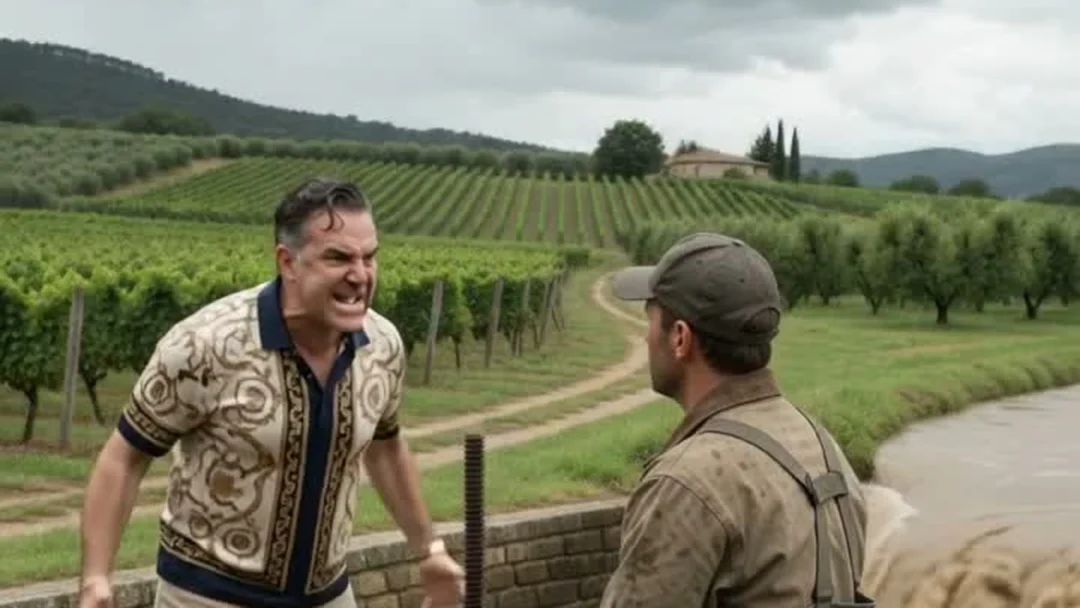
“Your Delaware shell company bought an expired title that was legally extinguished a hundred and forty-two years ago, Julian. The state Supreme Court reaffirmed this exact public trust doctrine in National Audubon Society versus Superior Court in 1983. You don’t own the water. The syndicate doesn’t own the mountain. The water belongs to the people who till this soil.”
Julian’s face drained of all color. His hands went limp, and the sheepskin patent slipped from his fingers, falling into the puddle of muddy water at his feet.
Trooper Vance stepped in, kicked Julian’s boots apart, and wrenched his arms behind his back. The stainless-steel handcuffs clicked shut with two loud, merciless snaps.
“Julian Sterling,” Vance recited, spinning the disgraced executive around and marching him toward the waiting cruiser. “You have the right to remain silent. Anything you say can and will be used against you in a court of law…”
As Julian was pushed into the back seat of the police cruiser, the three aluminum cases were opened on the tarmac by state investigators. Inside were hundreds of thousands of dollars in bearer bonds, offshore bank tokens, and the original, un-redacted geotechnical reports documenting that Julian had knowingly endangered the valley to cut construction costs.
The next morning, the sun broke over the Mayacamas Mountains in a brilliant, cloudless sky of crystalline blue. The storm had washed the valley clean, leaving the air fragrant with the sharp, invigorating perfume of wet cedar, wild mint, and sun-warmed earth.
Wade Miller stood once more on the stone catwalk of Gate Seven.
Beside him, Elena Rios and Captain Henderson watched as two county road crews finished installing a brand-new, forged-steel hydraulic gate winch, equipped with tamper-proof security locks and automated telemetry sensors.
Down in the valley below, the generational family orchards and vineyards were thriving. The clean, unmetered mountain water was flowing through every irrigation furrow, sparkling like molten silver in the morning light. Down at the manor, county building inspectors were staking fluorescent condemnation notices into the front lawn of Vanguard Terraces, marking the unpermitted subterranean caves for immediate controlled backfill and watershed restoration.
Wade reached down and turned the newly installed iron crank wheel.
With a smooth, effortless purr of greased gears, the sluice gate rose three feet, allowing thirty thousand gallons of pure, living mountain water to surge forward into the open stone canal.
Wade wiped the dust from his hands and looked out across the green, peaceful expanse of the Napa Valley. The water was where it belonged—not locked away in private vaults or sold to the highest corporate bidder, but running free through the heart of the community that had built its life upon its banks.
He pulled the leather work gloves from his belt, slapped them against his thigh, and smiled as the cool mountain spray rose up to meet the morning sun.