They Used His Farm Entrance for Saturday Parking Until Eight Yellow Mail Slips Changed Everything
Chapter 1: The Eighth Yellow Slip at the Farm Gate
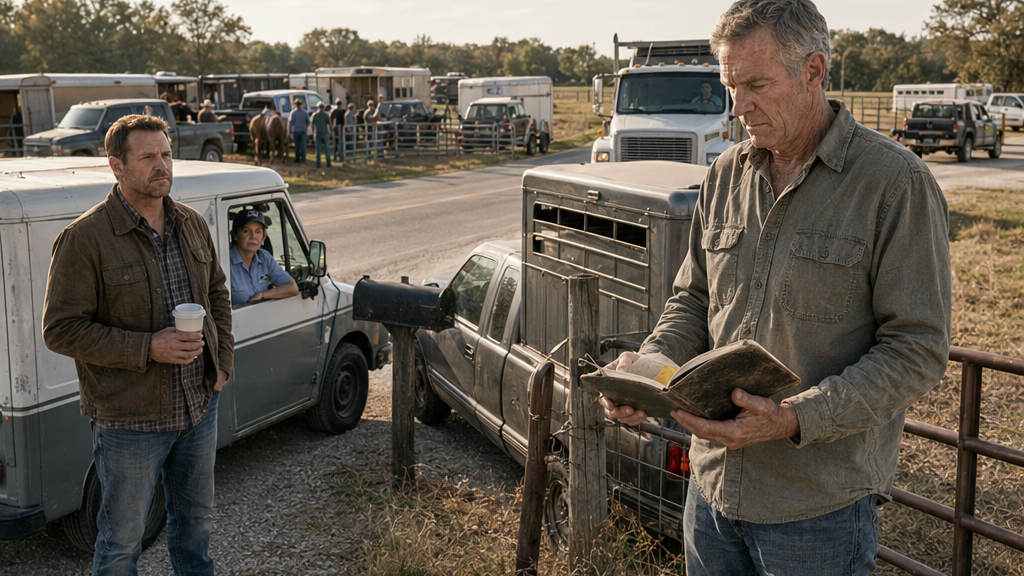
The horse trailer was angled across Jack Anderson’s gate when the mail carrier came around the bend.
Jack saw the white postal vehicle slow, saw Sandra Davis lean forward over the wheel, and for half a second he thought she might try to squeeze toward the black mailbox at the edge of the gravel.
Then she looked at the pickup parked nose-to-post beside it.
She looked at the horse trailer behind that pickup.
And she kept driving.
“Perfect,” Jack said.
Behind him, a feed-store truck idled in the county road with its flashers blinking. The driver had already tried once to swing wide enough to enter Jack’s lane, but the trailer’s rear corner left barely enough room for a car, much less a loaded straight truck.
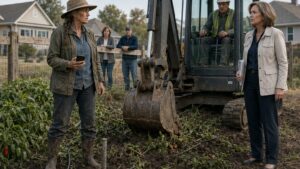
Across the road, Tyler Nelson’s Saturday livestock clinic was getting underway.
Pickup doors slammed. Horses shifted inside aluminum trailers. Somebody laughed near the temporary pens behind Tyler’s equipment shed. A hand-painted directional board pointed incoming vehicles toward the field, but the field was already crowded.
Jack walked toward the mailbox.
The pickup beside it belonged to a woman unloading two children and a canvas tack bag. She glanced at him, smiled politely, then hurried toward Tyler’s place.
Jack stopped beside the horse trailer.
There were seven yellow postal slips clipped inside the worn farm ledger on his kitchen desk.
He knew that because he had counted them that morning.
This would make eight.
The feed driver leaned out his window.
“You want me to back down to the crossroads?”
“No.” Jack studied the narrow opening. “Give me a minute.”
Tyler came across the road carrying a paper cup.
He was younger than Jack by nearly twenty years and moved with the hurried confidence of a man who had six things happening at once and believed every one of them could be handled if people would stop making complications.
“You got a delivery?” Tyler asked.
Jack looked at the truck with its flashing lights.
“That’s generally why feed trucks come.”
Tyler ignored the edge in his voice. “I’ll find whoever owns this rig.”
“You said that last Saturday.”
“People park where there’s room, Jack.”
“There isn’t room. That’s the problem.”
Tyler glanced at the mailbox.
“There’s still road there.”
“Sandra just passed without delivering.”
Tyler gave a small shrug. “That’s between you and the post office.”
Jack stared at him.
For three Saturdays, he had tried some version of the same conversation.
Don’t block the mailbox.
Leave the gate clear.
Tell people to use your field.
Tyler always answered as though Jack were demanding ownership of the county road itself.
“It’s a public shoulder,” Tyler said. “I’m not telling anybody to park in your pasture.”
“You’re letting them block an entrance I use for equipment.”
“And I’m trying to run something that brings people into the county.”
Jack almost laughed.
Instead he heard the feed truck’s air brakes hiss behind him.
He had spent most of his life believing there was value in not turning every disagreement into a formal one. You talked to the person first. You gave them a chance. You remembered that next month you might need their tractor, their trailer, their help getting a calf out of a ditch.
But lately, every time Jack tried to be reasonable, Tyler seemed to hear permission.
A pickup leaving Tyler’s property crawled past. Its driver raised two fingers from the steering wheel in greeting.
Jack returned the gesture automatically.
That was another part of it.
Everybody knew everybody.
Jack did not want to become the man who called the county because somebody parked badly.
Tyler walked toward the trailer.
“Whose gray Ford and bay mare?”
A woman near the pens raised her hand.
“Need you to move about ten feet,” Tyler called. “Feed truck has to get into Jack’s.”
She apologized immediately.
That should have made Jack feel better.
It didn’t.
Because she had parked exactly where somebody had parked the week before.
And the week before that.
Once the Ford moved, the feed driver eased into Jack’s lane with inches to spare. Gravel cracked under the truck’s tires.
Jack went back to the mailbox.
Nothing inside.
He stood there looking at the empty box until he heard Sandra’s vehicle coming back from the far end of the route.
She stopped this time.
Her window came down.
“You saw it?”
“I saw you pass.”
“I can’t pull in when they’re stacked around the box like that.”
“I know.”
Sandra reached beside her seat and handed him a yellow slip.
Jack did not have to read it. The wording was nearly identical to the other seven.
Delivery attempted.
Access obstructed.
Mail held.
Sandra gave the clinic traffic a tired glance.
“I’m not trying to get involved in whatever this is.”
“I know.”
“But if it keeps happening, my supervisor is going to ask why this stop keeps getting marked inaccessible.”
Jack folded the slip once.
Tyler had come close enough to hear.
He lifted his cup.
“See? She can deliver now.”
Sandra looked from Tyler to Jack.
“No,” she said. “I’m delivering the notice. That isn’t the same thing.”
Tyler’s smile thinned.
Jack felt something in him settle.
Not anger.
That surprised him.
He had expected the eighth slip to make him angrier than the seventh.
Instead it made the whole thing look different.
Eight was no longer bad luck.
Eight was a record.
He went inside, retrieved the brown ledger he used for cattle treatments, fuel purchases, and field repairs, then returned to the road.
Tyler watched him open it.
Seven yellow slips were clipped behind the back cover.
Jack placed the eighth beneath them.
“What are you doing?” Tyler asked.
“Keeping things straight.”
“It’s parking, Jack.”
Jack took out his phone.
He photographed the mailbox with the gray Ford now farther down the shoulder.
Then the tire tracks where it had been.
Then the remaining pickups and trailers along his frontage.
Tyler’s expression changed.
“You planning to send those somewhere?”
“I don’t know yet.”
“Then what’s the point?”
Jack looked at him.
“For three weeks, I’ve been relying on both of us to remember what happened.”
He wrote the time beside the newest slip.
“From now on, I’m putting it in writing.”
Tyler gave a short, humorless laugh.
“You’re making this bigger than it is.”
“Maybe.”
Jack walked toward the next vehicle.
He photographed its plate, its position relative to the mailbox, and the narrow gravel throat of his entrance.
Then the next.
He did not argue again.
By the time the feed truck finished unloading, Jack had photographed every vehicle using his frontage.
And for the first time since the Saturday clinics began, Tyler Nelson was no longer smiling.
Chapter 2: The Permission Jack Forgot He Had Given
Sandra stopped Jack beside the post office counter on Monday morning before he could hand over the bundle of held mail slips.
“My supervisor wants documentation.”
Jack looked at her.
“I thought these were documentation.”
“They are for the route. He wants dates, how often access is blocked, whether it’s the same vehicles, whether it’s your driveway too.”
Sandra kept her voice low. Two people waited behind Jack with padded envelopes.
“He’s not saying anybody’s committed some federal crime. He just doesn’t want the route record showing repeated inaccessible delivery without an explanation.”
Jack nodded.
That distinction mattered to him.
He had no interest in turning parking into something grander than it was.
“I have pictures.”
“How many?”
“Eight incidents.”
Sandra’s eyebrows rose slightly.
“Then take copies. Keep the originals.”
Back at the farmhouse, Jack spread everything across the kitchen table.
Eight yellow slips.
Twenty-three photographs.
Dates written in the cattle ledger.
Two feed delivery receipts showing Saturday arrival times.
He expected the sight of it to make him feel vindicated.
Instead it made him uncomfortable.
The photographs showed inconvenience, certainly.
They also showed birthday balloons tied to one truck, a child holding a riding helmet, an older couple carrying folding chairs.
Nobody in those pictures looked like an enemy.
By noon, Jack had scanned the documents and sent the route supervisor what had been requested.
His next stop was the county office.
The building smelled faintly of copier toner and old carpet. Christine Brown sat behind a counter surrounded by rolled maps and permit folders.
Jack explained the Saturday clinics, the parking, and the blocked farm entrance.
Christine listened without interrupting.
When he finished, she said, “Are you asking about ownership of the shoulder or permitted event parking?”
Jack hesitated.
“I suppose I’m asking what Tyler is allowed to use.”
“That’s not one question.”
She turned toward her computer.
“The county maintains the traveled road surface and certain drainage areas. That doesn’t automatically make every strip beside the pavement public parking.”
“That’s what I thought.”
Christine looked at him over her glasses.
“But it also doesn’t automatically make every roadside vehicle a trespass.”
Jack’s satisfaction disappeared as quickly as it had arrived.
“I’m not asking you to tell me I own the road.”
“Good.”
She entered the parcel numbers.
“What I need to know,” Jack said, “is whether he can use the frontage in front of my place for overflow every weekend.”
Christine opened several records.
“That may depend on what has been permitted before.”
Jack leaned on the counter.
“Before?”
She printed a parcel history and disappeared through a door behind the counter.
When she returned, she carried a thin archival folder.
“Your property had a temporary roadside-use notation years ago.”
Jack frowned.
“For what?”
Christine opened the folder.
A photocopied sheet lay on top.
Jack recognized his signature before he recognized the event.
The memory arrived all at once.
A spring storm years earlier had torn roofs from two houses near the river. The local church and several farmers had organized a supply collection. Tyler’s father had offered his field for trucks and volunteers.
The ground had turned to mud.
Jack had allowed vehicles to line the frontage beside his pasture for two days.
He had signed something because the county wanted confirmation that the neighboring owner consented.
Christine slid the paper toward him.
Temporary permission for roadside staging and overflow parking.
Jack read it twice.
“It was for one weekend.”
“Yes.”
“During storm cleanup.”
“Yes.”
“So it’s expired.”
“It appears event-specific.”
“Appears?”
Christine tapped a handwritten notation.
“The problem is how people remember arrangements like this.”
“I’m not asking how people remember it.”
“No. But you asked why your neighbor might think he has some basis.”
Jack said nothing.
Tyler had mentioned the old cleanup once.
Jack had dismissed it as nonsense.
That had been easier than remembering that there had been an actual piece of paper.
Christine looked at the eight yellow slips he had brought in a clear folder.
“This helps establish that you have a current access problem. But this old permission means I would not describe the history as ‘nobody was ever allowed there.’”
Jack hated how reasonable that sounded.
He had arrived expecting a line.
His land.
Tyler’s cars.
Simple.
Instead the county had handed him evidence that his own generosity had blurred the edge he was now trying to enforce.
“Could this have become permanent somehow?”
“Not from this document alone.”
“Could Tyler reasonably think it did?”
Christine leaned back.
“That’s not a permitting question.”
Jack gave her a dry look.
“That sounds convenient.”
“It’s accurate.”
He folded his arms.
Christine was not unkind, but she was immune to the satisfaction he had hoped the records would give him.
That probably made her more useful.
She searched another database.
“Tyler does have an approved temporary-use permit for agricultural instruction and limited farm-market activity.”
Jack straightened.
“So he is permitted.”
“Yes.”
“Parking?”
“There’s a site plan.”
She clicked through scanned pages.
Jack watched her face change slightly.
Not alarm.
Interest.
Christine printed another sheet.
Before giving it to him, she placed the old permission letter beside the eight yellow slips.
The contrast bothered Jack.
One piece of paper from years ago that said yes.
Eight recent pieces saying access had failed.
For the first time, he understood that Tyler’s certainty had not come entirely from arrogance.
Jack had once opened that frontage.
He had simply assumed everyone understood when it closed again.
Christine set the new page on the counter.
“This,” she said, “is different.”
Jack looked down.
The drawing showed Tyler’s equipment shed, demonstration area, livestock pens, entrance, and a rectangle marked for vehicle parking.
“What am I looking at?”
“The approved layout.”
“And?”
Christine placed one finger on the parking rectangle.
“Your frontage isn’t part of it.”
Jack studied the page.
Christine turned back to the computer.
“There’s something else.”
“What?”
She opened the permit conditions.
“Attendance and vehicle capacity.”
Jack felt the certainty he had lost begin to return, but more cautiously this time.
“How many?”
Christine read the figure, then glanced at the photographs Jack had brought.
“You said this happens every Saturday?”
“Lately.”
“And these pictures are from the same events?”
“Yes.”
She counted visible vehicles in one photograph.
Then another.
“Mr. Anderson,” she said, “before you decide what this means, you need to see the whole permit.”
Chapter 3: The Saturday Clinic Was Bigger Than Its Permit
Christine laid Tyler’s approved site sketch over an aerial parcel map and aligned the road edges.
Jack could see the problem before she explained it.
On paper, Tyler’s Saturday operation was neat.
One entrance.
One clinic area.
One strip for visitor parking.
Everything contained inside Tyler’s boundary.
In Jack’s photographs, vehicles spilled past the entrance, along the roadside ditch, beside Jack’s mailbox, and almost to his cattle gate.
“That parking rectangle holds what?” Jack asked.
Christine checked the scale.
“Depending on vehicle size, approximately twelve ordinary vehicles.”
“Half of his customers pull trailers.”
“Which would reduce that.”
Jack pointed to the event field.
“And the attendance limit?”
Christine showed him the condition.
The permit authorized small agricultural instructional events under a specified capacity. It did not ban Tyler from teaching people to handle livestock. It did not prohibit a modest farm market.
It did require the activity to remain within the approved site arrangement.
“So if twenty-five vehicles show up?”
“I didn’t say twenty-five vehicles violate the permit by themselves.”
Jack stopped.
Christine tapped the page.
“Don’t turn a permit into something it doesn’t say.”
He took his hand off the counter.
That correction stung because it was deserved.
For two days, Jack had been looking for a rule strong enough to end the argument.
Christine was forcing him to look for the truth instead.
“All right,” he said. “What does it say?”
“It says the use must substantially conform to this site plan. It says traffic cannot obstruct the county road. It says required access must remain available. And it assumes parking associated with the approved use is accommodated on the permitted parcel.”
Jack looked at his photographs again.
“What about my old permission?”
“That was not incorporated into this permit.”
“So he can’t use it.”
“He cannot point to this permit and say your frontage was approved as event parking.”
That was narrower than Jack wanted.
It was also stronger because it was exact.
Christine continued.
“If you want the county to look at compliance, we document current conditions. We don’t rewrite history, and we don’t make property rulings from this counter.”
Jack nodded.
The yellow mail slips no longer looked like the case.
They were one part of it.
Proof that the spillover had a consequence.
Not proof that Tyler had no conceivable reason for thinking roadside parking might be tolerated.
Jack gathered the papers.
“Does Tyler know what this plan says?”
“He signed the application.”
“That’s not what I asked.”
Christine paused.
“The applicant receives the approved conditions.”
Jack folded the site plan.
That answer followed him all the way home.
By late afternoon, he walked the fence line between the two farms.
Tyler’s place had changed over the previous year.
A row of portable panels formed a small handling pen behind the equipment shed. Two shade canopies stood near the demonstration ring. A refrigerated farm-market case sat under the shed roof beside stacked bags of mineral supplement.
None of it was extravagant.
That bothered Jack more than if it had been.
There was no sprawling commercial operation to resent.
Tyler was simply trying to make a farm pay.
Jack understood that problem.
Hay prices moved.
Diesel moved.
Fence wire moved.
Taxes rarely moved downward.
A farm could own hundreds of acres and still be short of cash every month.
Jack stood by the gate and studied Tyler’s approved parking area.
Christine was right.
It was small.
Much smaller than the crowds Jack had seen.
He could suddenly understand why the roadside had become important.
Without it, Tyler could either admit fewer people or spend money creating more parking.
Neither was convenient.
Jack’s phone vibrated.
A message from the postal route supervisor confirmed receipt of his photographs and asked him to continue recording any delivery obstruction.
Jack looked at the yellow slips clipped inside the ledger under his arm.
A week earlier, he would have felt pleased.
Now the request carried weight.
Documentation might solve his problem.
It could also create a problem Tyler could not afford.
Jack walked across the road.
Tyler was stacking folding chairs inside the equipment shed.
“You get the county involved?” Tyler asked without looking up.
“I asked what your permit says.”
That made Tyler stop.
Only for a second.
Then he stacked another chair.
“You went digging through my permit?”
“It’s public record.”
“Never said it wasn’t.”
Jack waited.
Tyler finally looked at him.
“Well?”
Jack held up the copy.
“Your approved parking is on your parcel.”
Tyler wiped his hands on his jeans.
“People park along county roads all over this county.”
“That isn’t the same as your event using my frontage every Saturday.”
“You used to let people park there.”
“For storm cleanup.”
Tyler pointed toward the road.
“My dad organized half that cleanup.”
“I remember.”
“And nobody acted like the shoulder turned private again on Monday morning.”
Jack felt the old instinct rise—the instinct to answer with something sharp enough to end the conversation.
He stopped himself.
“You knew what the site plan showed?”
Tyler’s jaw tightened.
“It shows a concept.”
“Christine says it’s the approved layout.”
“Oh, Christine says.”
Jack lowered the permit.
“That isn’t an answer.”
Tyler picked up another chair.
“It’s a small county, Jack. They draw boxes on maps. Real farms don’t work inside boxes.”
Neither man spoke for several seconds.
Then a pickup approached from the crossroads.
It slowed beside them.
A horse trailer followed.
The driver rolled down his window.
“Nelson clinic?”
Tyler stepped toward the road.
Jack watched him.
The approved parking area already held several pickups from people preparing for the next day.
There was still room inside Tyler’s field, but not much.
Tyler pointed toward his entrance.
“Go through the gate and stay left.”
The driver started forward.
Then Tyler added, “If that fills tomorrow, people can line up along this side like usual.”
His hand moved.
Not toward his own fence.
Toward Jack’s frontage.
Jack felt something colder than anger.
Tyler had heard him.
He had seen the permit in Jack’s hand.
He knew the issue was no longer vague.
And he was still planning around Jack’s silence.
The trailer rolled into Tyler’s field.
Jack folded the permit once and put it under his arm.
“You understood me,” he said.
Tyler looked at him.
“I understand you’re making a problem out of something we’ve managed for years.”
“No,” Jack said. “We never managed it.”
He glanced at the roadside mailbox.
“I just didn’t say anything clearly enough.”
Tyler’s face changed slightly, as if he had expected another accusation and gotten something harder to argue with.
Jack turned toward home.
Behind him, Tyler called, “You going to complain about tomorrow too?”
Jack stopped at the edge of the road.
He looked back at the equipment shed, the cramped parking strip, and the land Tyler was trying to keep productive.
Then he looked at the shoulder Tyler had just volunteered as overflow.
“Tomorrow,” Jack said, “I’m going to find out whether you actually know what you’re risking.”
He crossed the road with the permit under his arm and the eight yellow slips waiting in his ledger.
Chapter 4: Tyler Finally Tells Jack What the Crowds Are Paying For
“You want the truth?” Tyler said. “I can’t fit tomorrow’s vehicles on my place.”
Jack had barely stepped inside the equipment shed.
It was Friday evening, and Tyler was standing beside a folding table covered with registration sheets, paper cups, and a coffee can full of pens. Beyond the open shed doors, portable livestock panels made narrow silver lines across the field.
Jack had expected another argument about the road.
He had not expected an admission.
“How many are coming?” he asked.
Tyler looked down at the registration sheets.
“More than the site plan was built for.”
“That isn’t a number.”
“Twenty-three registrations. Some are families riding together.”
“And some pull trailers.”
“Yes.”
Jack held a folded envelope in one hand. Inside were copies of the eight yellow slips, several photographs, and a short letter he had written that morning.
He had rewritten the letter three times.
The first version sounded angry.
The second sounded like a county notice.
The third said what he should probably have said weeks ago:
Do not direct clinic or market traffic to park along my frontage, mailbox, or farm entrance. I am not giving permission for event parking there.
No threats.
No speeches.
Just a boundary.
Tyler noticed the envelope.
“What’s that?”
“Something I should’ve given you before this turned into eight missed deliveries.”
Tyler gave a tired laugh.
“So now we’re serving papers?”
“No.”
Jack set the envelope on the table.
“I’m making sure neither one of us gets to say later that we misunderstood.”
Tyler did not touch it.
For a moment, the only sound came from a horse shifting in a nearby pen.
Then Tyler said, “Christine call you back?”
“I saw the permit.”
“Of course you did.”
“It assumes your parking stays here.”
“I know what it says.”
That answer landed differently from every vague explanation Tyler had given before.
Jack studied him.
“You knew.”
“I knew there was a drawing.”
“You signed the conditions.”
“I signed a stack of county forms because if I didn’t, I couldn’t hold a clinic at all.”
“That doesn’t make the conditions decorative.”
Tyler pushed one of the registration sheets aside.
“You think I don’t know that?”
Jack almost answered immediately.
Instead he waited.
Tyler walked to the open shed door and looked toward the pasture.
“My dad left me land, two tractors that needed work, a roof that leaked, and enough debt to make the land look like the cheapest part of the inheritance.”
Jack said nothing.
Tyler glanced back.
“You know what the cattle brought last fall.”
“I do.”
“You know what diesel costs.”
“Yes.”
“You know what the tax bill did.”
Jack’s silence made Tyler continue.
“The clinics started because people kept asking me to show them basic handling. Loading. Pen setup. Getting a nervous animal through a chute without three people getting kicked.”
“You charge for it.”
“I charge because the bank doesn’t accept neighborly goodwill.”
There was no self-pity in the sentence. That made it harder to dismiss.
Tyler picked up the coffee can, moved it six inches, then set it back down.
“The Saturday market covers groceries some weeks. The clinics cover equipment payments. Together, they’re the first thing I’ve found that makes this place do more than break even on paper.”
Jack looked past him at the shed.
The patched roof.
The mismatched panels.
The old tractor parked beside a newer used one.
Nothing Tyler had built looked extravagant.
“If I cut attendance to what fits that parking box,” Tyler said, “I lose close to a third of the clinic money.”
“You could build more parking.”
“With what?”
“You have ground.”
“Ground isn’t gravel. Ground turns to mud. Trailers sink. People tear up the field. Then I spend money fixing a parking area so I can earn the money I needed to build it.”
Jack knew that circle.
Every farmer did.
Tyler finally picked up the envelope.
“You really going to make me shut this down over a mailbox?”
Jack felt the question strike where Tyler intended it to.
Not because it was fair.
Because it contained just enough truth to hurt.
Jack thought of the photographs on his kitchen table. He thought of Sandra driving past. He thought of the feed truck sitting in the road.
Then he thought of the old emergency permission with his own signature at the bottom.
“This isn’t only a mailbox.”
“It’s parking.”
“It’s access.”
“You got your feed delivered.”
“After somebody moved.”
“They moved.”
“Because I stood in the road waiting for them.”
Tyler looked away.
Jack softened his voice, though not the words.
“I helped make this unclear.”
Tyler looked back.
“That old cleanup weekend. I signed permission. I never thought anybody would treat that as open-ended.”
“My dad did.”
“Maybe he did.”
“And I grew up watching people use that shoulder when something big happened.”
“Saturday clinics aren’t storm cleanup.”
“No.”
The word came quietly.
Tyler rubbed his thumb along the edge of Jack’s envelope.
Then he said, “Give me until the end of the season.”
Jack had expected resistance.
The request caught him off guard.
“What?”
“Let me use the frontage through the fall schedule. I’ll keep the mailbox clear. I’ll have somebody manage parking. I’ll build more gravel after the last clinic.”
“You’ve already told people to leave the mailbox clear.”
“I’ll do it differently.”
“And the gate?”
“Clear.”
“What happens when twenty-three registrations become thirty?”
“They won’t.”
Jack looked at the sheets.
“You know that?”
“No.”
“Then you’re asking me to approve something neither one of us can control.”
Tyler’s jaw tightened.
“I’m asking you not to choke this thing before I can afford to fix it.”
“And I’m telling you I’m done lending you space by saying nothing.”
Tyler stared at him.
There it was.
The clean line Jack had spent years avoiding.
Not loud.
Not cruel.
Not negotiable through silence.
He tapped the envelope.
“Tomorrow, nobody from your event parks along my frontage.”
Tyler said nothing.
“I’m not calling anybody tonight. I’m not trying to cancel your clinic. You have until morning to tell every person coming here where they can and cannot park.”
“You know I can’t fit all of them.”
“Then fewer can come.”
“That easy for you?”
“No.”
Jack looked around the shed again.
“That’s why I came here instead of making the first conversation happen with a county truck sitting outside.”
Tyler’s face lost some of its anger.
Not all.
“You really would report it.”
“If you use my frontage after I’ve told you clearly not to, yes.”
“After years of us helping each other.”
Jack felt the old reflex to retreat.
That was how this had grown.
He let the discomfort sit.
“Helping each other only works when both people know what they agreed to.”
Tyler looked down at the envelope.
For several seconds, Jack thought he might tear it open.
Instead he placed it on top of the registration sheets.
“What time are you going to start watching the road?”
“I’m not planning to watch anything.”
Tyler gave him a look that said neither man believed that.
Jack turned toward the door.
At the threshold, Tyler spoke again.
“If I lose enough clinic dates, I may have to sell the south field.”
Jack stopped.
Tyler was not looking at him.
“I’ve been trying not to say that out loud,” he said. “Feels too much like admitting I couldn’t keep what Dad kept.”
Jack looked toward the south field beyond the pens.
He had known Tyler’s father.
He knew exactly what that land meant.
For a moment, the boundary Jack had come to draw seemed painfully narrow beside everything Tyler stood to lose.
But the yellow slips were still in the envelope.
The feed truck had still waited in the road.
Sandra had still driven past.
Jack stepped outside.
“I don’t want your farm,” he said. “I want you to stop using mine to make yours work.”
Tyler raised his eyes.
Jack crossed the gravel yard.
Behind him, the envelope remained on the registration table.
By morning, Tyler would either redirect every guest—or make Jack’s next choice for him.
Chapter 5: One Trailer After the Warning Changes the Case
At 9:17 Saturday morning, Tyler Nelson raised one arm and waved a horse trailer toward Jack’s side of the road.
Jack saw it from his gate.
For several seconds he did nothing.
The clinic had been running less than an hour. Tyler’s approved parking area was already crowded, but not full enough to explain what Jack had just seen.
The driver of the incoming pickup slowed near Tyler.
Tyler pointed once toward his own entrance, then toward the shoulder beyond it.
Toward Jack’s mailbox.
Jack had spent half the night wondering whether he had been too hard on him.
That question ended at 9:17.
The pickup rolled forward and stopped with the horse trailer along Jack’s frontage.
Its rear wheel settled beside the shallow drainage ditch.
The truck itself came to rest less than a vehicle length from the mailbox.
Jack took out his phone.
One photograph.
Then another, wide enough to show Tyler standing near the clinic entrance.
He hated the way the action felt.
Like spying.
Like building a case against somebody he had spent years calling when a fence went down.
But he had written the boundary.
Tyler had received it.
And Tyler had just directed a vehicle across it.
Jack walked toward the road.
The driver had already climbed out.
“Morning,” Jack said.
“Morning.”
“Did Tyler tell you to park here?”
The man glanced across the road.
“Said they were filling up.”
Jack nodded.
“I need you to move over to his property.”
The driver looked confused rather than hostile.
“Tyler said this was okay.”
“It isn’t.”
The man looked toward the equipment shed again.
“I’ve got a horse loaded.”
“I understand.”
“So where am I supposed to go?”
“That’s something Tyler needs to answer.”
The driver exhaled through his nose.
“This is his clinic.”
“Yes.”
“Then why am I getting caught between you two?”
Jack had no good answer.
Because that was exactly what had happened.
Tyler’s choices had pushed the inconvenience outward until customers, the mail carrier, and delivery drivers were forced to participate in a disagreement that should have stayed between two landowners.
“I’m sorry you are,” Jack said. “But you still need to move.”
The driver did.
That small compliance should have eased something in Jack.
Instead another pickup arrived ten minutes later.
Then a stock trailer.
Both slowed near Tyler’s entrance.
This time Tyler gestured them inside his own field.
Jack watched carefully.
Perhaps the first trailer had been habit.
Perhaps Tyler had caught himself.
Jack wanted to believe that.
At 10:06, Sandra’s postal vehicle came around the bend.
By then, three vehicles were lined along the road.
Two were entirely on Tyler’s side.
One pickup had edged farther down toward Jack’s mailbox while its driver unloaded supplies.
Sandra slowed.
Jack could see the problem immediately.
She would have had to angle toward the ditch to reach the box.
Instead she stopped in the road.
A vehicle came behind her.
Sandra moved forward to let it pass.
Then she pulled near Jack’s gate and lowered her window.
Jack walked over.
“You’re kidding,” he said.
“I wish I was.”
She held up another yellow slip.
Nine.
Jack looked toward the pickup.
“Driver’s right there.”
“I’m not asking route carriers to get out and locate owners at every blocked box.”
“I know.”
Sandra wrote something on the route form clipped beside her seat.
“You asked me to keep documenting it.”
“I did.”
She handed him the slip.
The paper felt lighter than it should have.
A week earlier, eight slips had made Jack feel armed.
This one did not.
This one felt like a failure.
He had spoken clearly.
He had given warning.
The same consequence had happened anyway.
Tyler came across the road before Sandra drove off.
“What now?”
Sandra answered before Jack could.
“I couldn’t access the box safely.”
Tyler looked at the pickup.
“That’s not even one of the clinic trailers.”
“It’s here for your event,” Jack said.
“So?”
“So the notice yesterday covered event traffic.”
Tyler lowered his voice.
“You’re really doing this here?”
“I didn’t park the truck.”
“No, you’re just standing around collecting evidence like I’m running some illegal operation.”
Sandra put the postal vehicle in gear.
“I’m leaving you two out of this part.”
She drove away.
Jack folded the ninth slip.
Tyler saw the motion.
For the first time, there was unease behind his irritation.
“You call the county?”
Jack did not answer immediately.
That was answer enough.
Tyler stepped closer.
“What did you tell them?”
“The truth.”
“Which version?”
Jack looked at him.
“The one where I told you in writing not to direct people onto my frontage, and this morning I watched you do it.”
Tyler’s face tightened.
“That first trailer had nowhere to turn around.”
“You told him to park here.”
“For ten minutes.”
“He told me you said the lot was filling.”
Tyler looked toward the road.
That tiny hesitation confirmed more than an argument would have.
“You’re putting customers in the middle of this,” Jack said.
“I’m trying to keep traffic moving.”
“Through my entrance.”
“No one blocked your gate this morning.”
“Not yet.”
Jack opened his ledger and placed the new slip behind the others.
Tyler stared at the stack.
“Does that make you feel good?”
“No.”
“Could’ve fooled me.”
Jack closed the ledger.
“If it made me feel good, I wouldn’t have come over yesterday.”
A vehicle appeared at the crossroads.
Not a pickup.
Not a trailer.
A county road unit.
Tyler saw it at the same moment Jack did.
The vehicle slowed as it approached the cluster of parked traffic.
Its amber light flashed once.
Clinic conversations nearest the road faded.
The deputy pulled onto the gravel edge near Jack’s entrance and stepped out carrying a tablet.
Tyler looked at Jack.
“You really called them.”
“I asked somebody to look at the access problem.”
“You could’ve waited until after the clinic.”
“That’s what I’ve been doing for weeks.”
The deputy approached without hurry.
“Mr. Anderson?”
Jack nodded.
“And Mr. Nelson?”
Tyler raised a hand.
The deputy looked along the road, then at the parked vehicles.
“I’ve got a complaint regarding event traffic, blocked rural-delivery access, and vehicles associated with a permitted use extending beyond the approved site.”
Tyler immediately said, “They’re on the county shoulder.”
“Some may be. That doesn’t answer every issue.”
The deputy looked at Jack.
“Which vehicle is currently blocking your mail access?”
Jack pointed.
The deputy took a photograph with the tablet.
Tyler crossed his arms.
“You planning to ticket everybody here?”
“I’m planning to figure out which vehicles need to move.”
“That’s going to ruin the clinic.”
“That depends on how many need to move and how quickly their owners cooperate.”
The deputy walked the shoulder.
He asked Jack where equipment entered.
He photographed the mailbox.
Then he crossed to Tyler’s property and looked at the clinic parking.
People were beginning to gather near the shed, watching.
Jack wished they would stop.
This was exactly the public spectacle he had tried to avoid.
The deputy came back.
“Mr. Nelson, did you direct any attendees to park along Mr. Anderson’s frontage after he withdrew permission?”
Tyler’s eyes moved toward Jack.
“He says he withdrew permission.”
“I gave it to him in writing yesterday,” Jack said.
The deputy held up one hand.
“I’m asking him.”
Tyler looked toward the parked vehicles.
The first trailer Jack had photographed was now gone from the shoulder.
Two other vehicles remained near the mailbox and ditch.
Tyler’s mouth tightened.
“These people came to my event.”
“That wasn’t my question.”
Silence settled over the road.
The deputy lowered the tablet.
“Mr. Nelson, which of these vehicles did you personally tell to park here?”
Jack watched Tyler understand that the question was no longer about what everyone had always assumed.
It was about what Tyler had chosen that morning, after the assumption had been taken away.
Chapter 6: The Tow Trucks Arrive, but Jack Stops Counting
The first tow truck appeared at 11:38.
The second followed less than a minute later.
Both came slowly around the bend with amber lights turning against the trees, and the effect on Tyler’s clinic was immediate.
People abandoned folding chairs.
A man carrying a lead rope began jogging toward the road.
Someone near the pens shouted that vehicles were being towed, although nothing had yet been hooked.
Jack stood beside his mailbox with the ninth yellow slip folded inside his ledger.
He wished he were anywhere else.
“This what you wanted?” Tyler asked.
He had come across the road again, pale with anger.
“No.”
“There are two tow trucks here.”
“I can see them.”
“You called the county.”
“I called about access.”
“And now my customers think they’re about to get impounded.”
The deputy overheard them.
“Nobody who moves a vehicle when instructed is getting towed just because a truck is standing here.”
Tyler turned.
“You might tell them that.”
“I’m about to.”
The deputy stepped toward the road and raised his voice.
“If you are parked outside the approved event area, check your vehicle now. We’re giving owners an opportunity to relocate before any removal.”
The panic changed shape.
Doors opened.
Engines started.
A pickup backed awkwardly away from the ditch while another driver guided it.
Two trailers left Tyler’s frontage and turned toward the crossroads.
A woman apologized to Jack as she hurried past.
“I didn’t know we weren’t supposed to park there.”
Jack felt his stomach tighten.
“You weren’t the one who should’ve had to know.”
She gave him a puzzled look, then continued toward her vehicle.
One tow operator stood beside his truck waiting.
The other spoke with the deputy.
Jack realized how easily the scene could still become the revenge story Tyler thought it was.
Tow everything.
Let everybody pay.
Make Saturday expensive enough that nobody ever parked there again.
There would have been a certain ugly efficiency to it.
The deputy came back toward Jack.
“Any reason you want us to treat cooperative owners differently?”
Jack stared at him.
“They’re moving.”
“Yes.”
“Then let them move.”
Tyler looked at Jack sharply.
The deputy nodded.
“That’s what I expected, but I wanted it clear.”
Jack closed the ledger.
“Mail needs access. My gate needs access. I don’t need twenty people punished for believing where they were told to park.”
Tyler’s expression shifted for an instant.
Then hardened again.
“You want a medal for that?”
“No.”
“Because you’ve still got tow trucks sitting in front of my farm.”
Jack turned toward him.
“You had until this morning.”
“I tried.”
“You directed at least one trailer over here yourself.”
“It needed somewhere to go.”
“That’s the entire problem.”
The deputy returned to the remaining vehicles.
Most owners moved quickly.
Two did not.
One pickup had been left with no driver immediately identifiable. Another vehicle was positioned partly in the road near the drainage edge, and no one claimed it after repeated announcements.
The tow operators began their work.
Chains rattled.
A hydraulic bed tilted.
The sound carried farther than Jack wanted.
People watched from Tyler’s field.
Some looked irritated with Jack.
Others looked irritated with Tyler.
That, too, made Jack uncomfortable.
A private boundary had become a public judgment.
The first vehicle rolled onto the flatbed.
Jack stopped counting how many others had moved.
That number did not matter.
The mailbox was visible again.
His gate was open from ditch to ditch.
For the first time in weeks, a feed truck could have entered without anyone finding an owner.
That should have been enough.
Tyler walked back toward the equipment shed.
Jack followed after a moment.
He found him behind the shed where the noise from the road was duller.
“You happy now?” Tyler asked.
Jack leaned against a fence post.
“No.”
Tyler laughed once.
“Come on.”
“I’m relieved.”
“Same thing when it isn’t your business falling apart.”
Jack looked at him.
The words were harsher than Tyler’s voice.
That mattered.
Tyler was not performing for customers now.
He was afraid.
“They’re not shutting you down today,” Jack said.
“You don’t know that.”
“The deputy said the immediate issue is parking and access.”
“And Christine will review compliance Monday.”
Jack said nothing.
Tyler kicked a clod of dirt loose with his boot.
“You think people come back after this?”
“Some will.”
“You don’t know that either.”
“No.”
Tyler looked toward the field.
“Dad kept this place through drought, bad prices, and two refinancing rounds. Everybody talks like that means he was smart. Mostly it meant he was stubborn enough to keep losing sleep.”
Jack listened.
“I told myself I wouldn’t be the one who sold.”
“You may not have to.”
“And you may have just made sure I do.”
Jack felt the accusation.
This time he did not reject it entirely.
“Maybe I should’ve drawn the line sooner.”
Tyler looked at him.
“But when I finally did,” Jack continued, “you stepped over it the next morning.”
Tyler’s shoulders lowered slightly.
Jack went on.
“That part is yours.”
For a long moment, neither spoke.
Then Tyler said, “You know why I sent that trailer over there?”
“Because your parking was filling.”
“Because I had a family coming in with a horse that panics backing up. If I sent them into the field and there wasn’t enough room to turn, I’d have had a different mess.”
“You could’ve told them not to come.”
“That’s easy to say when you aren’t counting every registration.”
“There it is.”
“What?”
“The part where my frontage becomes the thing that makes your numbers work.”
Tyler looked away.
He did not argue.
That silence was the closest thing to an admission Jack had heard.
The deputy approached them.
“Mr. Nelson, once the remaining vehicles are cleared, you can continue today provided all event traffic stays inside your site and the road remains open. Permit staff will contact you about future capacity.”
Tyler nodded once.
The deputy looked at Jack.
“Your mailbox and entrance are clear.”
“Thank you.”
“No problem.”
Jack almost corrected him.
There had been plenty of problems.
Instead he watched the deputy walk away.
The second tow truck pulled out with the unattended pickup secured behind it.
No cheering.
No satisfaction.
Just an empty stretch of gravel where cars had been.
Tyler watched it go.
“That truck owner’s going to blame me.”
“He probably should ask who told him where to park.”
Tyler gave Jack a tired look.
“Still got enough edge left for that.”
“Apparently.”
For the first time all day, something almost like a smile touched Tyler’s face.
It disappeared quickly.
The clinic resumed in a reduced, awkward form. Several attendees left. Those who stayed moved closer to the demonstration area.
Jack returned to his side of the road.
Near noon, another vehicle approached.
It was not Sandra’s postal truck; Saturday delivery had already passed.
Still, Jack found himself watching the mailbox.
Nothing blocked it.
Nothing blocked his gate.
He opened the ledger.
The ninth yellow slip sat behind the first eight.
He could have carried them across the road.
Could have shown Tyler the stack again.
Instead he closed the ledger and put it in the cab of his pickup.
An hour later, as the clinic wound down, Tyler came to Jack’s gate.
He did not step through.
Jack was replacing a hinge bolt and kept working until Tyler spoke.
“I can’t do another Saturday like this.”
Jack tightened the nut.
“Then don’t.”
“That’s not what I mean.”
Jack straightened.
Tyler looked toward his own field.
“There’s a strip behind the shed. Higher ground. It could take gravel.”
“You said you couldn’t afford it.”
“I can’t afford all of it right now.”
“Then what are you asking?”
Tyler hesitated.
Not because he lacked an answer.
Because the answer cost him pride.
“If I cut registrations for a while, I can build it in sections.”
Jack waited.
“And?”
“And if I get the county to approve a revised parking layout, would you stay out of it?”
Jack’s expression hardened.
“Stay out of what?”
“Don’t do that.”
“Do what?”
“Make me say it like I’m asking permission to run my own farm.”
Jack rested one hand on the gate.
“You’re not asking permission to run your farm.”
Tyler looked at him.
“You’re asking whether I’ll stop complaining if you stop using mine.”
The irritation drained out of Tyler’s face.
“Yes,” he said.
It was the first clean answer either man had given the other in weeks.
Jack looked at the open road between their properties.
“No more verbal arrangements.”
Tyler exhaled.
“Of course.”
“No ‘everybody knows.’ No ‘we always did it.’ If the county approves something, it goes on paper. If you need anything from my side, you ask first and it goes on paper too.”
Tyler glanced at the gate hinge Jack had been repairing.
“You really learned to love paperwork fast.”
“No.”
Jack picked up his wrench.
“I learned what happens when I trust silence to do the job.”
Tyler stood there another moment.
Then he nodded toward the south side of his equipment shed.
“Come look at the strip Monday?”
Jack hesitated.
Not yes.
Not no.
Tyler waited.
Finally Jack said, “If you’re asking me as the neighbor who knows how water moves across those fields, I’ll look.”
Tyler nodded.
“And if I ask to park anything over here?”
“The answer is no.”
That almost-smile returned.
“Fair enough.”
Tyler started across the road, then stopped halfway.
“Jack.”
“What?”
“I still think calling the county was a hard way to make the point.”
Jack leaned on the gate.
“I still think making me call them was a hard way to hear it.”
Tyler accepted that without reply.
Then he crossed back toward his farm.
For the first time since the yellow slips started accumulating, Jack watched him go without wondering what the next Saturday would bring.
The next problem would be different.
It would involve gravel, capacity, money, county approval, and two men trying to live beside each other after discovering how expensive an unspoken boundary could become.
Chapter 7: The Mailbox Stays Clear Without Closing the Neighbor’s Farm
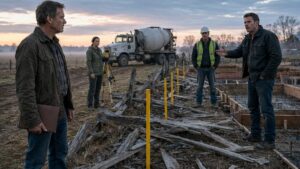
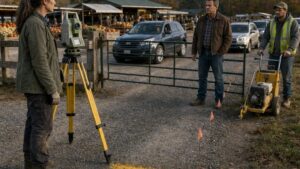
The first survey flag appeared three weeks later, bright orange against the grass behind Tyler Nelson’s equipment shed.
Jack noticed it from the road before he noticed Tyler.
A second flag stood farther back near the fence. Then a third. Together they marked a rough rectangle on the higher ground Tyler had mentioned after the tow trucks left.
For the first time, the proposed parking area was entirely on Tyler’s side.
Jack slowed his pickup but did not turn in.
Tyler was standing beside a county technician with a rolled site plan tucked beneath one arm. When he saw Jack, he lifted a hand.
Jack considered driving on.
Then Tyler called, “You said you’d look at the drainage.”
That was true.
Jack pulled through Tyler’s entrance.
The field still carried pale tire scars from the last crowded clinic. Tyler had not held another full-size Saturday event since the county review. He had run one smaller session with fewer trailers, and the roadside had remained clear.
Tyler pointed toward the flagged area.
“This is what they’ll approve if I grade it right.”
Jack walked the perimeter.
The ground rose gently away from the ditch. It was better than the low strip Tyler had previously tried to use.
“You’ll need to crown it,” Jack said.
“That’s what they told me.”
“And don’t push runoff toward the shed.”
Tyler gave him a thin smile.
“That’s what you told me.”
“Then why’d you ask?”
“Wanted to see if the county was wrong.”
Jack almost smiled back.
They walked the edge in silence.
The new plan was not generous. That was obvious immediately.
Tyler would lose part of a small grazing strip. The gravel would cost money. The turning radius meant he could not squeeze as many trailers into the space as he had once hoped.
But it would work.
More importantly, it would work without requiring Jack’s shoulder.
Christine Brown arrived before noon with a folder and a measuring wheel. She moved between the flags, checking dimensions against the revised site plan.
“Until this is built,” she said, “attendance remains at the reduced capacity.”
Tyler nodded.
Jack watched him sign the revised conditions on the hood of Christine’s county vehicle.
A month earlier, Tyler would have argued about every phrase.
Now he read each page.
“Parking associated with the event remains within the approved area,” Christine said.
Tyler initialed the line.
“Road access remains unobstructed.”
Another initial.
“No overflow parking on neighboring frontage without separate written permission from the affected owner.”
Tyler stopped.
He glanced toward Jack.
Christine noticed.
“Problem?”
“No.”
He initialed that line too.
Jack felt the irony more sharply than he expected.
The county had reduced a month of anger, assumptions, missed mail, and tow trucks to one sentence that could have prevented nearly all of it.
Written permission.
He had spent years thinking putting things on paper made neighbor relationships colder.
Now he wondered whether leaving everything unwritten had been the colder choice.
Christine gathered the forms.
“If construction stays inside this plan, call for final inspection when the base is compacted.”
Tyler nodded.
“And the reduced attendance stays in place until then?”
“Yes.”
Tyler exhaled.
“I understand.”
Christine looked at Jack.
“Anything else from you?”
Jack nearly said no.
Then he thought of the old storm-cleanup letter.
“Yes.”
Tyler turned.
Jack rested one hand on the hood.
“That old permission I signed. I want something in the file saying it was temporary and that I don’t consider it continuing permission.”
Christine nodded.
“That’s reasonable.”
Tyler said nothing.
Jack looked at him.
“I should’ve done it years ago.”
Tyler’s expression changed.
Not relief exactly.
Something quieter.
“Would’ve saved us both some trouble.”
“Yes.”
The admission was harder than Jack expected.
It would have been easy to say Tyler had caused everything after that first warning.
And Tyler had caused the worst part.
He had knowingly directed vehicles toward Jack’s frontage after being told not to.
But Jack could also see the earlier chain more clearly now.
A storm.
A neighborly favor.
A signed permission.
Years of occasional roadside use.
No explicit withdrawal.
Then Tyler inheriting both the farm and the assumption.
Jack had treated his own intention as though everyone else should have been able to see it.
Christine closed the folder.
“I’ll add the clarification.”
She drove away.
Tyler watched the county vehicle disappear around the bend.
Then he said, “You know I still think you could’ve come over sooner.”
Jack looked at him.
“I did come over.”
“You complained sooner.”
“That’s different?”
“Yes.”
Jack waited.
Tyler kicked at one of the orange flags.
“You told me the mailbox was blocked. You told me the gate was a problem. You didn’t tell me the whole frontage was off-limits until you put it in writing.”
Jack considered arguing.
Then didn’t.
“You’re right.”
Tyler looked up, surprised.
Jack continued.
“I thought saying it once was enough. Then I thought saying it irritated was enough. Then I thought you ought to know what I meant.”
“That sounds like you.”
“It does.”
Tyler nodded toward the road.
“I also knew by the end that I was pushing it.”
Jack said nothing.
“I kept telling myself the shoulder wasn’t really yours to control,” Tyler said. “That if the county maintained the road, I wasn’t taking anything from you.”
“The mailbox?”
“Knew that was getting hard to defend.”
“The gate?”
Tyler rubbed the back of his neck.
“Knew that too.”
There it was.
Not an excuse.
Not a confession dramatic enough to fix anything.
Just the truth Jack had needed much earlier.
Tyler had started with an assumption he could reasonably make.
Then the assumption became useful.
Then, when it stopped being reasonable, he kept using it because his income depended on it.
“I was scared,” Tyler said.
Jack looked at the flagged parking area.
“I know.”
“That doesn’t make it right.”
“No.”
Tyler nodded.
Neither man apologized.
Jack was glad.
An apology might have made the moment easier and less honest.
Four Saturdays later, gravel covered the flagged rectangle.
Tyler had reduced the clinic schedule and borrowed equipment instead of hiring all the work out. The finished turnout was plain, compact, and wide enough for trailers to turn without backing toward the road.
There were fewer registrations.
Jack could tell by the number of pickups.
Tyler could tell by the money.
Neither mentioned it.
That Saturday, Jack was repairing a latch near the front pasture when Sandra’s postal vehicle came around the bend.
He straightened automatically.
For weeks, the sight of that vehicle had made him check the roadside before anything else.
The mailbox stood clear.
No pickups.
No trailers.
No one unloading tack.
Sandra slowed, pulled alongside the box, placed the mail inside, and drove on without stopping.
Jack watched her disappear down the road.
The ordinary ease of it felt almost ridiculous.
A mail carrier had delivered the mail.
That was all.
Yet for several seconds Jack remained beside the fence with one hand on the latch.
Across the road, Tyler was directing a trailer into the new gravel turnout.
The driver turned easily.
No one came near Jack’s gate.
No one needed Jack to explain anything.
That evening, Jack opened the worn farm ledger at his kitchen table.
The yellow slips were still clipped inside.
Nine now.
He removed eight of them and placed them in the county correspondence folder with the photographs and the old storm-cleanup permission.
The ninth he kept.
Not because he expected another fight.
Because he wanted to remember the moment the problem had stopped being about other people’s behavior alone.
He clipped the single slip behind the ledger’s back cover.
Then he took out a clean sheet of paper.
The agreement he drafted was short.
No event parking along Jack’s frontage without specific written permission.
Farm entrance and mailbox access to remain clear at all times.
Any temporary exception to state a date, purpose, and end time.
Nothing assumed.
Nothing permanent because somebody remembered it differently.
The next morning, Jack carried two copies across the road.
Tyler read them on the hood of his pickup.
“You really have changed,” he said.
“Don’t sound so disappointed.”
Tyler signed.
Jack signed beneath him.
They each kept a copy.
No witnesses.
No ceremony.
Just two farmers standing beside a road where a disagreement had nearly cost one man access and the other part of his livelihood.
Tyler folded his copy.
“You planning to make me sign something every time I borrow a wrench now?”
“No.”
“Tractor?”
“Depends which one.”
Tyler laughed.
It was the first easy laugh Jack had heard from him since before the parking trouble began.
Jack closed the ledger.
The remaining yellow slip pressed lightly against the back cover.
Across the road, the new turnout held three pickups and two trailers, all inside Tyler’s boundary.
Jack’s gate stood open.
The mailbox stood clear.
Nothing about the arrangement was generous enough to be mistaken for permission.
That, Jack had finally learned, was what allowed it to remain neighborly.
The story has ended.