His Neighbor Reported the Grass Every Monday—Then the Farm Records Revealed What He Really Wanted
Chapter 1: The Fourth Monday at the Farm Gate
Anthony Hall heard the county truck before he saw it.
Its tires made a dry grinding sound on the gravel road just as he killed the mower beside the cattle gate. He stood with one hand on the handle and watched the white pickup come around the bend for the fourth Monday in a row.
The verge was already cut.
That was the part that made him stare.
He had started before seven, running the mower from the cedar gatepost down to the shallow drainage swale, then trimming around the mailbox and the old fence brace where taller grass liked to hide. Nothing along the road came close to the county’s limit. He knew because he had checked it himself after the second complaint.
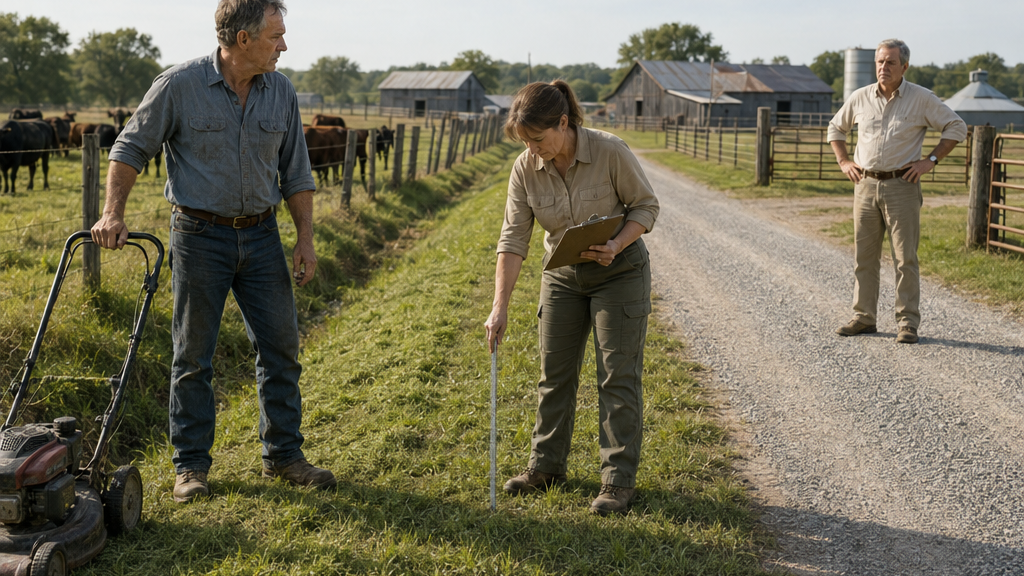
Sarah Moore parked with two wheels on the gravel and stepped out carrying a clipboard and the same metal measuring stick she had used the previous week.
“Morning, Anthony.”
“Sarah.”
She glanced toward the fresh-cut strip.
“I know.”
Anthony rested both hands on the mower handle. “Do you?”
She gave him a tired look that told him she did not enjoy being there any more than he enjoyed seeing her.
“Complaint came in at eight-oh-three.”
Anthony looked down the road.
Gregory Davis was standing beside his own gate.
Not working. Not moving cattle. Not fixing fence.
Standing.
Gregory wore work pants and a pale button-down shirt with the sleeves rolled once at the wrists. From fifty yards away, he could have passed for a man waiting on a delivery. Anthony knew better.
Sarah followed his gaze but said nothing.
“This makes four?” Anthony asked.
“Four site visits.”
“And three cleared.”
Sarah nodded.
Anthony stepped away from the mower.
“Then let’s make it four.”
Sarah walked to the thickest patch near the ditch. The grass there had been sheltered beneath the mower deck where the ground dipped. She pressed the measuring stick into the soil.
Before she lowered her eyes to read it, Gregory called from across the road.
“Four and three-eighths there.”
Sarah stopped.
Anthony looked at him.
Gregory seemed to realize a fraction too late what he had said.
Sarah bent again. She moved the stems aside carefully and checked the measurement from ground level.
“Three and seven-eighths.”
Anthony said nothing.
Gregory folded his arms.
“There were taller seed heads there this morning.”
“I cut this morning,” Anthony said.
“I measured it before you cut.”
That answer landed differently than the complaint itself.
For three weeks Anthony had imagined Gregory noticing the verge while driving past. Maybe stopping once. Maybe deciding the county rule applied more strictly to other people than to himself.
But Gregory had been coming over with a ruler.
Sarah wrote on her inspection sheet.
Anthony watched her pen move.
“What measurement are you recording?”
“Three and seven-eighths.”
“Can you put that exact number on the sheet?”
She looked up.
“I generally mark compliant.”
“I’d like the measurement.”
Sarah studied him for a second, then wrote again.
“Done.”
“And the complaint number?”
She read it aloud.
Anthony pulled his phone from his pocket and entered it.
Gregory gave a short laugh from the opposite gate. “You planning to frame it?”
Anthony looked at him.
“No.”
That was all.
The old Anthony—ten years younger, before his father got sick, before the farm became his responsibility alone—might have walked across the road and asked Gregory exactly what kind of man spent Monday mornings measuring somebody else’s grass.
Instead he put the phone away.
Sarah checked two more points along the verge. Both were comfortably under the limit.
“Nothing actionable,” she said.
“Again,” Anthony replied.
“Again.”
She sounded almost apologetic.
Anthony nodded toward the clipboard. “Does four cleared complaints change anything?”
“Not automatically.”
“So if another one comes next Monday?”
“If it alleges a current violation, I may have to check it.”
Anthony stared at her.
“You could come out here every Monday all summer?”
Sarah shifted the clipboard against her hip. “I’m not saying I want to.”
“That wasn’t my question.”
“No,” she said. “There isn’t an automatic cutoff just because earlier complaints were unfounded.”
Gregory turned toward his house as if the conversation no longer concerned him.
Anthony watched him go.
The measuring stick remained planted in the grass beside Sarah’s boot, a thin steel line standing upright in a strip Anthony had already mowed twice in eight days.
For years, that roadside verge had been nothing more than work. Cut it before weeds seeded. Keep the drainage open. Trim around the posts. Move on to something that mattered.
Now another man had turned it into evidence.
Sarah pulled the stick from the ground.
“For what it’s worth,” she said quietly, “you’re compliant today.”
Anthony almost laughed.
“Apparently today is the important word.”
She did not disagree.
After the county truck left, Anthony rolled the mower back toward the equipment shed. He made it halfway before shutting it off again.
Across the road, Gregory’s gate was closed.
Anthony could see the roof of an old utility trailer behind the fence and the gray end of stacked lumber beside a shed. He had noticed both a hundred times without caring.
He still did not care.
Not yet.
What bothered him was the number Gregory had called out before Sarah measured.
Four and three-eighths.
Not “too high.”
Not “looks over.”
A measurement.
Anthony went inside, washed the grass dust from his hands, and sat at the kitchen table with his laptop.
The county website took longer to navigate than it should have. He found the land-use department, then the public-records request page.
For a moment he stared at the empty description box.
His father had hated paperwork. Said a man could lose half a day proving something everybody already knew.
Anthony used to agree.
Then he typed his parcel number.
He requested every complaint associated with the property for the previous three years, including dates, allegation categories, disposition, and any available complaint documentation.
He read it once.
Then he added one more sentence.
Please include the originating address where disclosure is permitted by law.
Anthony clicked Submit.
The confirmation number appeared on the screen.
For the first time since the county truck had begun arriving on Mondays, he was no longer wondering whether Gregory would complain again.
He wanted to know when Gregory had started.
Chapter 2: The Property Across the Gravel Road
Two nights later, rain came hard enough to move gravel.
Anthony saw the problem before breakfast.
Brown water had crossed half the association road below Gregory’s frontage and spread into a shallow fan where truck tires had already carved two muddy ruts. A mat of leaves, cut vines, and loose boards had collected against the mouth of Gregory’s culvert.
Anthony stopped his pickup in the lane.
The road was narrow there. On one side, Anthony’s pasture fence followed the curve. On the other, Gregory’s frontage rose slightly toward an equipment shed. Water should have passed through the culvert and into the lower drainage channel.
Instead it was running across the road.
Anthony got out.
His boots sank along the shoulder.
A length of rusting farm equipment sat close to the ditch, and behind it was the utility trailer he had noticed Monday. One tire had gone soft. Several pieces of lumber were stacked beside the fence, some extending beyond the covered shed.
None of it had mattered to him before.
That irritated him almost as much as the sight itself.
Gregory had trained him to look.
Anthony walked to the blocked culvert. The debris was thick enough that water pulsed through only one dark opening near the bottom.
A heavy feed truck coming through fast could break the road edge apart.
He took out his phone.
One photograph of the culvert.
One of the runoff crossing the gravel.
One wider photograph showing the equipment beside the drainage line.
Then he lowered the phone.
It would have been easy.
Sarah’s department had an online complaint form. Anthony could have filled it out from the cab before driving back to the barn. He already knew enough county language to make it sound official.
Blocked drainage.
Improper exterior storage.
Possible encroachment.
He imagined Sarah’s white truck turning into Gregory’s drive.
For one satisfying second, he understood exactly why Gregory kept filing reports.
Then Anthony put the phone in his pocket.
He found a rake in the bed of the pickup and pulled loose debris from the downstream side of the road where it had gathered around the ditch.
He did not touch Gregory’s culvert.
The distinction mattered to him.
He was still clearing gravel from the edge when Gregory came down the slope.
“You taking pictures of my place?”
Anthony kept raking.
“I took pictures of the road.”
“I saw where your phone was pointed.”
Anthony leaned the rake against the truck.
“Your culvert’s blocked.”
“It drains.”
“Not enough.”
Gregory looked toward the muddy water.
“The whole county got rain.”
“The whole county isn’t washing across this bend.”
Gregory’s jaw tightened.
“You planning to report me now?”
Anthony wiped one hand on his jeans.
“No.”
The answer seemed to annoy Gregory more than yes would have.
“No?”
“I haven’t decided there’s anything worth reporting.”
Gregory looked toward Anthony’s pasture.
“You seem pretty interested in county rules all of a sudden.”
Anthony almost answered that he had not been the one inviting the county onto the road every Monday.
Instead he said, “I’m interested in why you knew the grass measurement before Sarah did.”
Gregory’s expression barely changed.
“I told you. I measured it.”
“At what time?”
“Early.”
“Why?”
“Because it was high.”
“It passed.”
“After you cut it.”
“That’s generally how mowing works.”
Gregory exhaled through his nose.
For a moment neither man spoke. Water trickled over the gravel between them.
Anthony looked past him at the old trailer, then deliberately looked back to the road.
Gregory noticed.
“You’ve got something to say, say it.”
“I don’t care what you store behind your fence.”
“Then stop photographing it.”
“I photographed the drainage.”
Gregory gave a small shake of his head.
“You always do this.”
Anthony’s shoulders stiffened.
“Do what?”
“Act like every conversation is somebody trying to take something from you.”
There it was.
Not grass.
Not weeds.
Something older.
Anthony remembered Gregory stopping by in late spring, asking if he had ten minutes to discuss “road improvements.” Anthony had been greasing the hay mower. He had not even turned the machine off.
If this is about widening onto my side, the answer’s no.
Gregory had said they ought to sit down with the association plat.
Anthony had told him there was nothing to discuss.
At the time, it had felt efficient.
Now he wondered whether that had been the first move in a game he had refused to admit was being played.
“What exactly did you want to discuss that day?” Anthony asked.
Gregory glanced toward the bend.
“We’ve been over it.”
“No. You asked for a meeting. I said no. That isn’t the same thing.”
Gregory’s mouth tightened with something that might have been satisfaction.
“The association has a road problem.”
“You have a road problem.”
“I chair the association.”
“That doesn’t make my land association property.”
“No one said it did.”
“Then why are we talking?”
Gregory stepped closer to the edge of the gravel.
“Because every time somebody brings up the road, you hear the word easement and shut the door.”
Anthony felt his temper rise exactly where Gregory expected it to.
“My father watched three feet become five once already.”
“That was drainage work thirty years ago.”
“And the fence never moved back.”
Gregory looked away.
Anthony knew he had made his point.
He also knew he had proved Gregory’s.
They had both inherited arguments along with acreage.
Gregory pointed toward the muddy curve.
“You see that?”
“I’m standing in it.”
“That bend handles feed trucks, hay trailers, cattle trailers, school buses farther up, and whatever emergency vehicle has to get through someday. We need room.”
“Then maintain the road you have.”
“It’s not that simple.”
Anthony picked up the rake.
“Usually isn’t.”
Gregory took two steps toward his gate, then stopped.
“You want the grass complaints to disappear?”
Anthony’s hand tightened around the rake handle.
Gregory looked directly at him.
“Be more cooperative about the road.”
For several seconds the only sound was runoff slipping over stone.
Anthony set the rake down again.
“What did you just say?”
Gregory’s face changed, not with regret exactly, but with recognition that he had said too much.
“I said if we solved the bigger maintenance issues, everybody could stop wasting time on little ones.”
“No. You said the grass complaints would disappear.”
“I’m talking about cooperation.”
Anthony pulled out his phone.
Not to record him.
To look at the photographs he had just taken.
Blocked culvert. Muddy road. Trailer. Lumber.
He could file three complaints before Gregory reached his porch.
Instead Anthony locked the screen.
“Fix your culvert,” he said.
Then he got into the pickup.
As he drove away, Gregory’s words stayed with him more stubbornly than any accusation about grass.
The complaints would disappear if Anthony became more cooperative about the road.
For the first time, the grass itself no longer seemed to be the subject.
Chapter 3: The Easement Nobody Mentioned
The records envelope was thick enough that Anthony thought the clerk had given him somebody else’s file.
She slid it across the county counter with a receipt clipped to the front.
“Digital copies are included on the drive.”
“All of this is mine?”
“All associated with the parcel number you requested.”
Anthony stared at the stack.
He had expected four complaints.
Maybe six.
There were eleven entries.
He carried the records home without opening them and laid them across the kitchen table beside his coffee. The oldest complaint was nearly three years old and had nothing to do with Gregory: a sight-distance concern after a storm dropped a limb near the entrance.
Then there was almost nothing.
Two years clean.
One minor drainage inquiry.
Then, suddenly, a cluster.
Grass height.
Roadside weeds.
Vegetation near the gravel shoulder.
Obstruction of sight line.
Grass height again.
Every recent complaint had been closed with no violation or corrected-before-inspection language.
Anthony wrote the dates on a yellow pad.
May 18.
May 25.
June 1.
June 8.
Then he found the earlier one.
May 11.
That was not a Monday.
He sat back.
May 11 was the day Gregory had come to the equipment shed asking for ten minutes to talk about the road.
Anthony remembered because he had spent that afternoon replacing a bearing on the hay mower. Gregory had stood near the open barn door holding a rolled paper.
Anthony had never asked what was on it.
He had simply said no.
The first grass complaint was filed three days later.
Anthony looked toward the window.
His initial satisfaction faded.
He had found the pattern.
He did not yet know what the pattern was for.
He drove back to the county that afternoon and asked for the recorded road easement affecting his parcel.
The clerk returned with a scanned copy and then, after Anthony asked whether anything older existed, disappeared into the records room.
She came back carrying a large folded sheet inside a protective sleeve.
“This is the earlier plat.”
The paper had yellowed at the folds. Survey lines crossed it in faded ink. Anthony recognized his family tract by shape before he found the number.
The road easement curved along the eastern edge.
He traced it with one finger.
It was narrower than the road plan Gregory had once described across the fence.
“How current is this?”
“The recorded easement hasn’t been superseded in our index.”
Anthony looked up.
“No amendment?”
“Not that I found.”
He asked for a copy.
At home, he spread the worn plat beside the complaint records.
Then he went to the truck and brought in the metal measuring stick he used for checking forage height in the lower pasture. It was not Sarah’s, but holding it brought back the sight of her steel rule pressed into the verge while Gregory called out a measurement from across the road.
Anthony laid the stick along the scale marks on the plat.
He did the conversion twice.
The existing road easement reached to a line that, on the ground, fell near the current gravel shoulder.
The widening Gregory had mentioned would require several additional feet of Anthony’s frontage along the curve.
Not inches.
Feet.
The next document came from the road association rather than the county.
Anthony emailed Nicole Lewis requesting the minutes and current capital plan. She replied the following morning with a folder of PDFs and one cautious line:
You are entitled to these as a member. Some figures are preliminary.
He printed the last six months of meeting minutes.
Most were ordinary rural-road business: grading schedules, gravel invoices, culvert replacement, cost sharing.
Then he found the grant.
A county cost-share program would cover a substantial part of eligible road-safety improvements if the association secured the necessary easements and submitted final documentation before autumn.
Anthony kept reading.
One meeting referenced “anticipated frontage acquisition.”
Another listed preliminary quantities for widening the bend.
His parcel number appeared in an attachment.
Anthony read it again.
His parcel.
Estimated additional width.
Estimated drainage work.
No signature.
No agreement.
Yet the budget treated the land as if it would be available.
His phone rang while he was still staring at the page.
Nicole.
“I figured I should call,” she said.
Anthony leaned back from the table.
“I was going to call you.”
“I guessed.”
“Why is my frontage in the project budget?”
There was a pause.
“It’s preliminary.”
“That isn’t what I asked.”
Nicole exhaled.
“The engineering estimate assumes the curve gets widened.”
“Onto my land.”
“It assumes additional frontage there, yes.”
“Who told them I’d grant it?”
Another pause.
“No one told me you had signed anything.”
“That’s not an answer either.”
“I thought Gregory had discussed the concept with you.”
“He discussed it for about forty seconds while I was fixing a mower.”
Nicole went quiet.
Anthony looked at the complaint dates beside the meeting records.
“Was there a deadline?”
“For the cost-share application?”
“Yes.”
“Final easement documentation has to be in before the funding window closes.”
“When?”
“Late August.”
Anthony looked toward the calendar on the refrigerator.
Less time than he expected.
“How much of the project depends on my frontage?”
“Enough that changing the design would require new numbers.”
“So the board budgeted for land it doesn’t have.”
“We budgeted around a proposed project.”
“On somebody else’s property.”
“Anthony.”
Her voice had sharpened slightly.
“I’m not defending how that was handled. I’m telling you how the spreadsheet was built.”
He rubbed his thumb across the edge of the old plat.
“Did Gregory tell the board I agreed?”
“Not in any meeting I recorded.”
“Did he tell them I refused?”
“Yes.”
Anthony waited.
Nicole continued.
“He said you were unlikely to approve an easement amendment unless there was stronger pressure to address roadside maintenance.”
The room seemed very still.
There it was.
Not proof of everything.
But enough.
Anthony looked at the grass complaints.
The dates.
The project estimate.
The old plat.
The same little strip of roadside ground that had somehow become important enough for a grown man to measure before sunrise.
“Nicole,” he said, “did anybody on the board ask what roadside maintenance had to do with giving up additional frontage?”
She did not answer immediately.
“That’s one reason I called.”
Anthony straightened.
“What’s the other?”
“I think you need to come to the next meeting.”
“I haven’t been to one in two years.”
“I know.”
“I send my dues.”
“I know that too.”
Anthony heard papers moving at her end.
“The latest project budget still assumes your frontage will be available.”
Anthony stared at his parcel number printed neatly beside a dollar figure.
“They’re still counting on it?”
“Yes.”
“After I said no?”
Nicole’s answer was quiet.
“Yes.”
Anthony placed the phone on speaker and pulled the old plat closer.
For several weeks he had believed the fight was about whether grass measured three and seven-eighths inches or four and three-eighths.
Now the ruler had changed.
The association was not measuring grass anymore.
It was measuring how much of his land it expected him to give.
Chapter 4: The Reason Gregory Would Not Ask
Anthony saw his property outlined in red before anyone said his name.
The road association met in an equipment barn at the far end of the shared lane, where folding tables had been pushed between a hay baler and a row of stacked seed bags. On the plywood wall behind Gregory Davis hung an enlarged road diagram.
A red line followed the curve past Anthony’s pasture.
Then it moved outward.
Four feet in one place.
Nearly six in another.
Across land Gregory did not own.
Anthony stopped just inside the barn.
Nicole Lewis was arranging papers near the end of the table. When she saw where he was looking, she closed her eyes briefly.
“You found it,” she said.
“Hard to miss.”
Gregory turned from a conversation with two board members.
“You came.”
“You invited my property before you invited me.”
The room went quiet enough that Anthony heard the baler’s cooling metal tick behind him.
Gregory glanced at the diagram.
“It’s a proposed design.”
“It’s drawn like a decided one.”
“No easement has been executed.”
“Then why does your budget assume it has?”
Nicole slid a folder toward Anthony.
“This is the current estimate.”
Anthony did not sit.
He opened the folder and found the same figures she had emailed him, only now the costs were broken into gravel, grading, drainage pipe, shoulder work, and engineering.
At the bottom was a grant contribution large enough to explain why everyone in the room looked uncomfortable.
Without it, the association would have to absorb most of the project itself.
Gregory tapped the table.
“The county cost-share window closes in late August. If we miss it, we wait another cycle.”
“That explains your deadline,” Anthony said. “Not your grass complaints.”
One board member shifted in his chair.
Gregory’s expression hardened.
“This meeting is about the road.”
“Then let’s talk about the road.”
Anthony pulled copies of the county complaint dates from his folder.
He set the first one beside the association minutes.
“May fourteenth. First grass complaint.”
Another sheet.
“Three days after you came to my barn asking me to discuss an easement.”
Gregory said nothing.
Anthony added the next complaint.
“And then every Monday.”
Nicole lowered her eyes to the papers.
Gregory folded his arms.
“You were out of compliance when I reported it.”
“No county inspection found that.”
“You cut before they arrived.”
“Then you kept reporting me because I mow?”
“You keep pretending this is about mowing.”
That stopped Anthony.
Gregory stepped around the table.
“The road is too narrow at that bend. You know it.”
“I know what the recorded easement says.”
“Paper doesn’t make a cattle trailer shorter.”
“Neither does taking six feet of my pasture.”
“It isn’t six feet the entire way.”
“That’s supposed to help?”
Gregory pointed to the diagram.
“The curve pinches between your fence and the drainage channel. We have heavier trucks than we did twenty years ago. We’ve had drivers back out because two rigs couldn’t pass.”
Anthony looked at Nicole.
“Is that true?”
She hesitated.
“Yes.”
Gregory seized on it.
“Last fall a feed delivery had to stop near the south gate because another truck was coming through.”
“That’s inconvenient.”
“It becomes more than inconvenient if it’s an ambulance or a fire engine.”
Anthony hated that argument because it was not foolish.
He had expected foolishness.
He had spent days assembling dates and lines, expecting that once Gregory’s pressure campaign was exposed, everything underneath it would collapse.
Instead the road remained narrow.
Gregory pulled another sheet from the table.
“Here.”
It showed vehicle tracking through the bend.
A wider turning path crossed Anthony’s frontage.
“You didn’t show me this in May,” Anthony said.
“You wouldn’t sit down.”
“You were at my barn for less than a minute.”
“You heard ‘easement’ and shut me down.”
Anthony felt several eyes shift toward him.
Gregory continued.
“You do it every time. Your father did the same thing.”
Anthony’s chair scraped when he finally pulled it out, though he still did not sit.
“Leave my father out of it.”
“I’m not insulting him.”
“You don’t need him for your argument.”
Gregory’s voice dropped.
“Your father spent thirty years convinced every request was the beginning of somebody taking the farm apart one strip at a time. I understand why.”
Anthony looked at him sharply.
That was not what he expected to hear.
Gregory nodded toward the old road.
“But that doesn’t mean every request is theft.”
For a moment Anthony saw the meeting differently.
Not Gregory the man measuring grass before sunrise.
Gregory the association chair staring at a funding deadline, an aging road, and a landowner he believed would reject him before he finished a sentence.
It did not excuse the complaints.
It made them worse in a different way.
Gregory had known a direct conversation might fail, so he had chosen pressure instead.
Anthony placed both palms on the table.
“Did you file those complaints because you thought they would make me negotiate?”
Gregory looked at Nicole.
Then at the board.
Nobody rescued him.
“I thought if maintenance became an issue,” he said slowly, “you might finally take the larger road problem seriously.”
Nicole’s face tightened.
Anthony waited.
Gregory added, “I didn’t invent the county standard.”
“No. You just decided to use it until I got tired.”
“I decided the association couldn’t keep waiting.”
“So yes.”
Gregory’s silence answered.
Anthony gathered the complaint papers into a clean stack.
The admission should have felt like victory.
Instead he was looking at the turning diagram again.
“How many trucks have actually had trouble?”
Nicole answered this time.
“Three documented cases in the last eighteen months. Maybe more that weren’t reported.”
“Any accidents?”
“No.”
“Any emergency vehicles blocked?”
“No.”
Gregory said, “That’s not a reason to wait for one.”
Anthony looked toward the open barn door.
The lane beyond it seemed ordinary from this angle. Gravel. Grass shoulders. Dust hanging where a pickup had passed.
He thought about the promise he had made his father near the end, when hospital visits had replaced fence repairs and every conversation about the farm carried the weight of inheritance.
Don’t let them nibble it away because each piece seems small.
Anthony had taken the words literally.
Maybe too literally.
He turned back.
“I’ll walk the road with you.”
Gregory blinked.
Nicole looked up.
Anthony raised one finger.
“I said I’ll inspect the problem. I didn’t say I’ll sign an easement.”
Gregory nodded once.
“Fair.”
“And until then, no more grass complaints.”
Gregory’s mouth tightened.
“If there’s an actual violation—”
Anthony closed his folder.
“There it is again.”
The room fell still.
Gregory looked at the papers, then at the red line crossing Anthony’s land.
“All right,” he said. “No more complaints from me.”
Anthony did not thank him.
He picked up the worn copy of the county plat and tucked it under his arm.
The next morning, he would walk the road with the man who had spent four Mondays measuring his grass.
This time, Anthony intended to measure the problem himself.
Chapter 5: Three Violations on the Other Side
Sarah Moore’s county truck reached the bend and turned right.
Not toward Anthony’s gate.
Toward Gregory’s.
Anthony stood beside his pickup and watched the white truck roll past the strip of verge Sarah had measured four Mondays in a row.
He felt a small, sharp satisfaction.
Then he disliked himself for enjoying it.
A week earlier, after walking the road with Gregory, Anthony had spent an evening reviewing the county maintenance rules. He had found more than enough possible issues on Gregory’s property to make an impressive complaint.
Rusting trailer.
Outdoor lumber storage.
Overgrown weeds near an outbuilding.
Old machinery.
He ignored all of them.
He submitted photographs of only three conditions.
The blocked culvert.
Equipment positioned inside the drainage maintenance area.
Loose material narrowing the usable shoulder near the curve.
Things that affected the road.
Nothing else.
Sarah stepped from her truck carrying her clipboard.
And the metal measuring stick.
Gregory came out of his equipment shed before she reached the culvert.
“Seriously?”
Sarah looked between them.
“I’m here on a complaint.”
Gregory stared at Anthony.
“You.”
Anthony nodded.
“One complaint.”
Gregory laughed without humor.
“You’ve been waiting for this.”
“No.”
“You photographed half my yard.”
“I submitted three photographs.”
Sarah opened the file on her clipboard.
“That’s correct.”
Gregory looked at her.
“What?”
“Three conditions, all along the road and drainage area.”
Anthony saw the realization arrive.
Gregory knew how many other things Anthony could have listed.
For a moment, that seemed to anger him even more.
“So this is supposed to make you look reasonable?”
Anthony leaned against the pickup.
“No. It’s supposed to get the water off the road.”
Sarah interrupted before Gregory could answer.
“I need access to the culvert.”
Gregory stepped aside.
They walked down the frontage together.
Sarah checked the pipe opening first. Sediment and vegetative debris had built around the inlet, reducing the opening enough that the recent storm had pushed water across the gravel.
She photographed it.
Then she moved to the stored implement sitting near the ditch.
The metal measuring stick went into the ground.
Anthony recognized the motion immediately.
Four Mondays of humiliation condensed into the sound of steel touching soil.
Gregory noticed him watching.
“Enjoying yourself?”
Anthony considered lying.
“A little.”
Gregory gave him a hard look.
Anthony added, “Not as much as I expected.”
Sarah measured from the marked drainage line to the equipment.
“This needs to move.”
“How far?”
She gave the number.
Gregory looked toward Anthony.
Anthony did not smile.
Sarah walked to the loose lumber and debris along the shoulder.
“This needs to be cleared too.”
Gregory crossed his arms.
“So what happens now?”
“I’m documenting three corrective findings. Culvert obstruction, drainage-area encroachment, and material within the road shoulder clearance.”
“Violations?”
“Corrective findings. If they aren’t addressed within the notice period, they can become enforcement actions.”
Gregory looked at Anthony again.
“Three.”
Anthony understood the irony.
The same number of weeks he had endured before he confronted Gregory.
The same bureaucratic language.
Different side of the road.
Sarah handed Gregory the notice.
He took it without reading.
Anthony expected vindication to feel larger.
Instead his attention had shifted to the culvert.
A county maintenance worker had opened enough of it during the inspection to let trapped water move. As it drained, the wet line along the road shoulder became visible.
It did not run where Anthony expected.
The erosion was deepest on Gregory’s side.
Sarah noticed too.
“The drainage is pushing the usable road width toward Anthony’s fence.”
Gregory looked down.
“That’s why we need more room.”
“Maybe,” Sarah said. “Or maybe you need the water where it belongs.”
Anthony crouched near the gravel edge.
The repeated runoff had eaten away several inches of shoulder. Drivers had compensated by moving left, closer to his fence. What Gregory had described as a road-width problem was at least partly a drainage problem.
Anthony stood.
“How long has this culvert been like that?”
Gregory looked toward the pipe.
“Gets cleaned every year.”
“That wasn’t my question.”
Gregory rubbed the back of his neck.
“Bad since spring.”
Spring.
Before the grant deadline.
Before the complaints.
Anthony looked along the bend again.
If the drainage channel could be restored, perhaps the road did not need to move as far into his pasture as Gregory’s plan assumed.
That possibility was more useful than seeing a notice in Gregory’s hand.
By Friday, Gregory had moved the equipment and hired a crew to clear the culvert fully.
The difference was immediate.
Water returned to the channel.
The shoulder dried.
A feed truck came through that afternoon, and although the bend was still tight, its right wheels stayed farther from Anthony’s fence.
Anthony watched from the gate.
Gregory stood on the opposite side.
Neither man said anything.
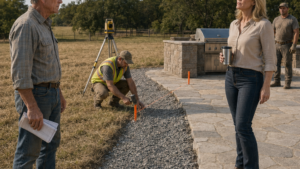
On Monday, the survey crew arrived.
The crew chief carried the recorded plat Anthony had copied from the county, along with newer association maps.
Bright stakes appeared one by one along the gravel edge.
Anthony followed several yards behind as the crew worked toward the curve.
Gregory arrived midway through and watched without speaking.
At the tightest section, the crew chief stopped.
He checked the old plat.
Then checked the newer drawing.
Then measured again.
Gregory finally asked, “Problem?”
The crew chief pointed to the proposed widening line.
“This line isn’t the recorded easement.”
“We know it requires additional frontage.”
“More than your plan notes.”
Gregory stepped closer.
“How much?”
The crew chief walked several feet into Anthony’s pasture and pushed a temporary stake into the ground.
Then he returned toward the gravel and placed another at the recorded boundary.
The space between them was impossible to dismiss.
Anthony stared at it.
Gregory did too.
The plan had not merely assumed extra land.
At the curve, it assumed several feet beyond what the association’s own estimate appeared to describe.
Gregory’s face tightened.
“That can’t be right.”
The crew chief handed him the measuring rod.
“It is according to the recorded plat.”
Anthony looked at the rod in Gregory’s hand.
For weeks Gregory had believed precise measurements would force Anthony into compliance.
Now precision had turned around.
And it was no longer measuring grass.
Chapter 6: The Line They Should Have Measured First
The new survey stakes stopped well before the red line on Gregory’s road plan.
Anthony walked the curve twice before he trusted what he was seeing.
The recorded easement stayed close to the existing gravel. The proposed widening pushed into Anthony’s pasture farther than necessary at the tightest point, especially now that Gregory’s culvert was draining properly.
The survey crew chief knelt beside one stake and compared measurements.
“You’ve got two different problems being treated like one.”
Gregory frowned.
“Meaning?”
“Vehicle clearance and drainage.”
“That’s obvious.”
“No,” the crew chief said. “Your design assumes you solve drainage by creating more shoulder. But if the drainage is restored, you don’t need as much additional road width.”
Anthony looked at Gregory.
Gregory looked irritated, but not surprised.
That concerned Anthony.
“You knew?”
Gregory shook his head.
“I knew drainage was part of it.”
“How big a part?”
“I didn’t know.”
Anthony stepped toward him.
“You were willing to take six feet before finding out?”
“I was willing to build what the preliminary design showed.”
“That’s not better.”
The crew chief rose and brushed soil from one knee.
“There’s another option.”
Both men turned.
He pointed toward the ditch line.
“Keep the road largely where it is. Improve the curve inside the existing easement where possible. Then secure limited access for drainage maintenance here and here.”
Anthony followed his finger.
Both points fell along his frontage.
His stomach tightened.
“What kind of access?”
“Drainage easement. Narrower than a road easement. No general travel rights. No widening authority beyond specified work.”
Gregory looked toward Anthony.
Anthony already knew what he was thinking.
Still an easement.
Still paper.
Still another line on the farm.
“No,” Anthony said.
The word came so quickly that even he heard his father in it.
The crew chief blinked.
Gregory gave a short, bitter laugh.
“There. That’s what I’ve been telling everybody.”
Anthony turned on him.
“Don’t.”
“What? He hasn’t even explained it.”
“I heard enough.”
“You heard the word easement.”
Anthony felt heat rise into his face.
Gregory stepped closer.
“You want proof you’ve been right about me? Fine. I used the complaints as leverage. I shouldn’t have. But you’re doing exactly what I said you would.”
Anthony looked toward the pasture fence.
His father had reset those posts after the old drainage project. The work had left the fence several feet inward from where it had stood before. Nobody had stolen the land. Nobody had forged a deed.
The boundary had simply become inconvenient to restore.
So it never was.
That was the kind of loss his father feared.
Not dramatic theft.
Small changes becoming permanent because reversing them required more effort than accepting them.
Anthony had promised not to repeat it.
The survey crew chief spoke carefully.
“A limited maintenance easement can be written with exact dimensions, purpose, restoration requirements, and expiration or review provisions.”
Anthony did not answer.
Gregory said, “At least listen.”
Anthony almost refused again.
Instead he looked at the measuring rod resting beside the stake.
Exact dimensions.
For the first time, measurement did not feel like something being used against him.
“Show me.”
The crew chief walked them along the drainage line.
The proposal was narrower than Anthony expected. In most places, it did not extend past the existing ditch. At two access points, maintenance equipment would need temporary entry several feet into the frontage.
“No road traffic?” Anthony asked.
“Not under a drainage-only agreement.”
“No parking?”
“No.”
“No widening later because somebody decides drainage access counts as general association access?”
“Not if the language is written correctly.”
Gregory said nothing.
Anthony noticed.
“You okay with that?”
Gregory looked along the curve.
“It doesn’t give us everything.”
“That wasn’t my question.”
Gregory took a long breath.
“If the engineering confirms the trucks can make the turn safely, yes.”
There was no victory in his voice.
Only fatigue.
That changed something.
Anthony had spent weeks believing Gregory wanted control because Gregory liked control.
Perhaps some of that was true.
But the deeper problem was less satisfying.
Gregory had been afraid of losing the grant, afraid of a serious road incident, and convinced Anthony would refuse any proposal attached to his name.
So he had chosen coercion before conversation had truly begun.
And Anthony, by refusing conversation before hearing the details, had helped make that assumption believable.
Not justified.
Believable.
Later that afternoon, Nicole brought revised project numbers to Anthony’s kitchen table.
With the culvert cleared and the road design reduced, the association could still qualify for the cost-share program.
Barely.
“They’ll need signatures fast,” she said.
Anthony looked at the revised map.
“How fast?”
“About ten days if engineering finishes on schedule.”
He laughed once.
“Of course.”
Nicole slid another document across the table.
Draft Drainage Maintenance Agreement.
Anthony did not touch it.
“I told my father I’d never sign another easement.”
Nicole waited.
“He was right about what happened here before,” Anthony continued. “People needed temporary access. The fence moved. Then everybody forgot temporary.”
“Then don’t write this one that way.”
Anthony looked at her.
Nicole tapped the document.
“Specific width. Specific purpose. Restoration requirement. No expansion without a separate recorded agreement.”
“You make it sound simple.”
“It isn’t simple.”
“That’s more honest.”
She smiled faintly.
Anthony opened the old county plat.
The folds were soft from years of handling. His father’s pencil marks were still visible near the pasture frontage.
Anthony laid the revised map beside it.
The old problem had been vagueness.
A little more room.
Temporary access.
We’ll fix it later.
Gregory’s pressure campaign had relied on vagueness too—maintenance issues, cooperation, road concerns—until Anthony forced everything into measurements and dates.
Perhaps the answer was not refusing every line.
Perhaps it was making the line exact enough that nobody could pretend it meant something else later.
That evening Anthony walked to the farm entrance carrying his own measuring stick.
He placed it beside the new survey stake.
The grass was taller now than it had been during Sarah’s inspections.
He had deliberately let it go several extra days.
Nobody had reported it.
Anthony almost smiled.
He measured from the gravel edge to the proposed drainage boundary, then from that point to his fence.
The pasture still belonged to him.
The road stayed largely where it was.
The drainage crew would get only the access it actually needed.
Back at the house, he set the old plat on the kitchen table.
Beside it lay the revised agreement Nicole had left behind.
Anthony read every paragraph.
Then he read them again.
He crossed out one phrase granting “related maintenance access” and replaced it with narrower language limiting entry to drainage work identified on the attached map.
He added restoration requirements.
He added notice before nonemergency entry.
He added a sentence stating that the agreement created no road-widening or general vehicular rights.
When he was finished, the document looked less like surrender and more like a fence built out of words.
Anthony placed his father’s old plat beside it.
For several minutes he sat with both hands flat on the table.
Then he picked up a pen.
Chapter 7: A Boundary Both Men Could Live With
Anthony arrived at the association meeting carrying a signed agreement nobody in the barn expected him to bring.
Gregory Davis saw the folder first.
His eyes dropped to Anthony’s hand, then lifted to his face.
“You signed it?”
“I signed something.”
That distinction quieted the room.
Nicole Lewis had placed the revised road diagram on the folding table. The old version—with its red line cutting several feet into Anthony’s pasture—was gone. In its place, the gravel road stayed almost entirely within the recorded easement. Two narrow shaded areas marked drainage-maintenance access along Anthony’s frontage.
Anthony set his folder beside the map.
Nicole opened it.
She read the first page, then the second.
“You changed the access language.”
“I narrowed it.”
Gregory leaned forward.
“How much?”
“Drainage work only. No road widening. No storage. No routine vehicle access except for maintenance connected to the mapped ditch and culvert.”
“And emergency work?”
“Allowed if delaying it would damage the road or adjoining property. Otherwise I get notice.”
Gregory looked toward Nicole.
She kept reading.
Anthony had expected an argument. He had prepared for one.
Instead Gregory studied the new map for several seconds.
“That still gives the crew enough room at the lower ditch?”
Nicole nodded. “According to the revised engineering notes.”
“And the curve?”
“Fits the cost-share standards if the shoulder is rebuilt and the drainage stays open.”
Gregory sat back.
For weeks, Anthony had imagined this moment as a contest. Gregory would demand more. Anthony would refuse. Somebody would finally admit whose line mattered.
Now the line itself seemed less important than whether both men could stop trying to move it for reasons they would not say aloud.
Anthony pulled another sheet from the folder.
“There’s one more condition.”
Gregory’s expression tightened.
“What?”
“Complaint procedure.”
A board member shifted in his chair.
Anthony placed the county records on the table.
“No association officer uses county complaints as leverage in an association dispute. If there’s a road-maintenance concern involving a member’s property, it gets documented and brought to the member first unless there’s an immediate safety issue.”
Gregory’s jaw moved.
Anthony continued.
“And if somebody files in a private capacity, they don’t represent it afterward as an association action.”
Nicole nodded slowly.
“That probably should have been policy already.”
Gregory looked at Anthony.
“You want my name in the minutes?”
Anthony could have said yes.
Part of him still wanted the clean satisfaction of seeing the four Monday complaints reduced to a formal admission.
But he remembered Sarah’s measuring stick in his grass. He remembered how quickly being correct could become its own appetite.
“I want what happened recorded accurately.”
Gregory’s face remained still.
“That means my name.”
“Yes.”
A long pause followed.
Then Gregory pushed his chair back and stood.
“I filed the complaints.”
Nobody moved.
Gregory looked toward the other board members, not Anthony.
“I believed Anthony was neglecting the roadside maintenance, and I also believed pressure from those complaints would make him engage on the road project.”
His voice was flat, stripped of the certainty Anthony had heard across the gravel road.
“That was improper.”
Anthony felt the words settle more heavily than he expected.
Gregory went on.
“The road problem was real. The way I tried to force the discussion was wrong.”
No applause followed.
No one congratulated Anthony.
Nicole simply wrote the statement into the minutes.
That felt more honest.
One board member cleared his throat.
“And Anthony’s original refusal?”
Anthony answered before Gregory could.
“Also part of the problem.”
Gregory looked at him.
Anthony rested one hand on the old plat.
“He came to my barn and said easement. I said no before I knew what he was proposing.”
“You knew enough,” Gregory said.
“I knew what I was afraid of.”
That ended the challenge in Gregory’s expression.
Anthony unfolded the older county plat and laid it beside the new agreement.
“My father spent years watching temporary arrangements turn permanent because nobody wrote the limits down clearly. I promised him I wouldn’t let that happen again.”
Nicole looked at the added language.
“So you wrote the limits down.”
Anthony nodded.
“That’s different from refusing to let anybody cross the line for any reason.”
Gregory looked at the shaded drainage strip.
“You still don’t trust me.”
“No.”
A faint smile appeared at one corner of Gregory’s mouth.
“Fair.”
Anthony surprised himself by returning it.
The agreement passed without argument.
The association surrendered the broader widening request. Anthony granted only the defined drainage access. Nicole added the new complaint procedure to the minutes, including a requirement that road concerns be addressed directly before outside enforcement was used, except for urgent hazards.
The grant application went forward.
Three weeks later, gravel trucks arrived.
Anthony watched from the pasture as crews rebuilt the damaged shoulder, reshaped the ditch, and replaced the worst section of drainage pipe. They worked within stakes set from the recorded plat and the limited agreement.
Nothing crossed the marked line without purpose.
When they finished, the road did not look dramatically wider.
It looked properly maintained.
That difference mattered.
Early one morning in September, Anthony stood beside the gate with the metal measuring stick in his hand.
The grass along the verge had grown high enough to need cutting.
He pressed the stick into it.
Four and a quarter inches.
Anthony laughed quietly.
A truck engine sounded beyond the bend.
For one absurd second, he expected Sarah’s county pickup.
Instead a feed truck appeared.
It was one of the larger rigs that had struggled through the curve before. The driver slowed, lined up the front wheels, and moved steadily between the rebuilt shoulder and Anthony’s pasture fence.
Gregory stood near his own gate watching.
The truck’s rear wheels followed the bend cleanly.
No tire touched Anthony’s grass.
No mirror crossed the fence line.
No wheel dropped toward Gregory’s ditch.
The truck continued up the road without stopping.
Gregory walked over after the dust settled.
“Looks like it works.”
Anthony looked at the road.
“Looks like.”
Gregory nodded toward the measuring stick.
“You checking the grass?”
Anthony glanced down.
“Old habit.”
“How bad?”
“Terrible.”
Gregory waited.
Anthony said, “Four and a quarter.”
Gregory laughed.
The sound was brief, almost reluctant.
“You planning to turn yourself in?”
“I might mow it.”
“That seems extreme.”
They stood beside the gate, looking at the rebuilt curve.
The new drainage channel followed its marked path. The shoulder stayed inside the road easement. Beyond it, Anthony’s fence remained exactly where it had been.
Gregory rubbed a boot over the gravel.
“I should’ve asked differently.”
Anthony looked at him.
“I should’ve listened longer.”
Neither man apologized again.
They did not need to.
Gregory started back across the road, then stopped.
“For what it’s worth, your father probably would’ve hated that agreement.”
Anthony looked at the worn plat tucked beneath his arm.
“Probably.”
Gregory nodded toward the precise stakes along the drainage line.
“But he might’ve liked the measurements.”
Anthony smiled.
“Those he would’ve checked himself.”
Gregory crossed back to his property.
Anthony remained beside the gate until another truck appeared far down the road.
He placed the measuring stick against the fence post instead of the grass.
For months it had meant accusation—fractions of an inch used to make a man feel watched on his own land.
Now the same idea meant something else.
Measure first.
Write it down.
Know exactly what belongs to whom.
And leave enough room for people to get where they need to go.
The feed truck rounded the repaired curve without touching Anthony’s boundary marker.
He watched it disappear beyond the pasture, then started the mower.
The story has ended.