The Biker’s Basin: The Eyebrow Scar That Reunited Cleveland’s Forgotten Heirs
CHAPTER 1: THE STEAM FROM THE BASIN
The cold November rain falling over West 25th Street in Cleveland was thick with the sulfurous grit of the Cuyahoga steel mills and the damp chill of Lake Erie. Puddles of oily black water mirrored the flickering neon of cheap liquor stores and shuttered machine shops. Outside the cracked glass storefront of a vacant dollar store numbered 2476, the wind whipped through the alleyway with the hollow whistle of a freight train.
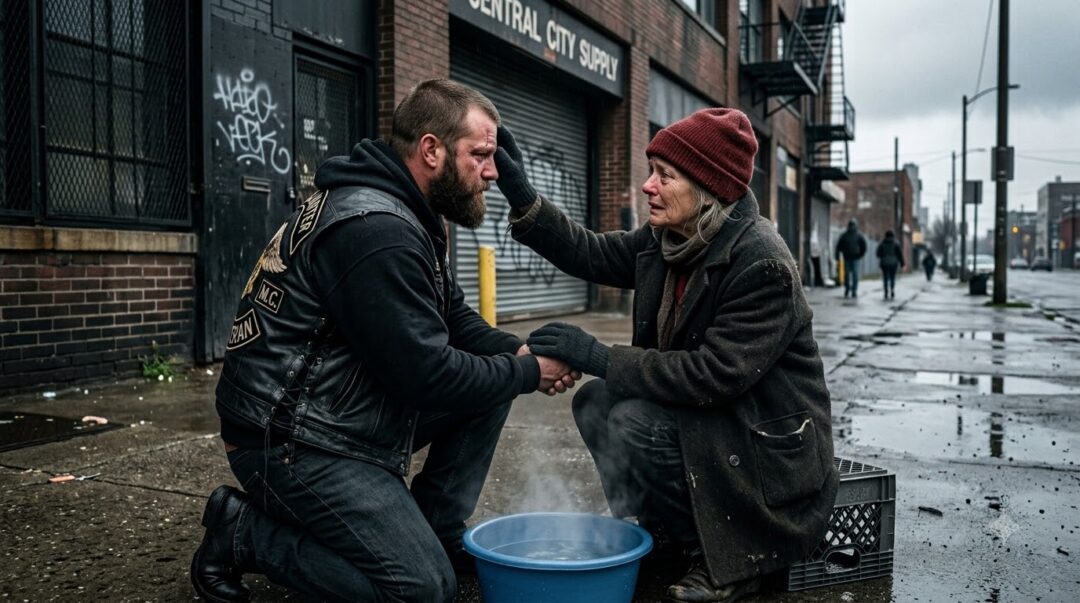
Samuel “Sammy” Cross was kneeling on the freezing concrete pavement.
At thirty-nine, the road captain of the Iron Disciples Motorcycle Club was built like an engine block: six feet two inches of scarred muscle, broad shoulders wrapped in a faded gray thermal sweater beneath a heavy leather cut plastered with road dust and rain. His tattooed hands—scarred from ten years as an Army combat engineer in Kandahar and fifteen years of fabricating custom choppers—were raw and red from the cold air.
Before him on the damp sidewalk, seated on an overturned milk crate, was an elderly homeless woman.
She was shivering violently inside a frayed, salt-stained brown winter overcoat that was three sizes too large, her gray head covered by a stretched knit beanie. Her teeth were chattering with a rhythmic, sickening click, her breath coming in shallow, wheezing puffs of white vapor. Her feet were swollen, purple with frostbite, resting naked on the cold pavement after Sammy had gently untied her duct-taped work boots.
Surrounding them in a loose semicircle on the sidewalk stood five young men and a retail worker wearing a red nylon work jacket with a plastic nametag reading Chloe. Two of the teenagers were holding smartphones at eye level, laughing as they livestreamed the old woman’s trembling feet to social media.
“Look at those toes, bro!” one of the teenagers sneered, stepping closer with his camera. “That’s straight zombie apocalypse right there! Tell the camera what you took, lady!”
Sammy didn’t look up from his work. His deep voice cut through the street noise like a steel cable snapping under tension:
“Stop filming her feet.”
The teenager laughed dismissively, shoving the camera phone within eighteen inches of the old woman’s face. “Relax, man, it’s a public sidewalk. First Amendment rights, you know?”
Sammy stood up.
He didn’t yell. He simply rose to his full height, his massive leather-clad chest blotting out the street lamp, his jaw locked in a line of terrifying, quiet violence. Across his left eyebrow ran a thick, jagged two-inch scar—a childhood souvenir where shattered metal had torn through flesh down to the skull bone. His cold, pale blue eyes locked onto the boy with the absolute, dead focus of a man who had cleared minefields under mortar fire.
The teenager choked on his laugh, his hand trembling as he lowered the smartphone.
Sammy looked at the young woman in the red jacket, who was holding her own phone with the camera app active.
“Film me,” Sammy said, his voice flat, gravelly, and heavy as pig iron. “Not her pain.”
Chloe lowered her phone slowly, her cheeks flushing with sudden, suffocating shame. She backed away toward the entrance of the store, pocketing her device and folding her arms across her chest in silence.
Sammy knelt back down on the wet pavement.
He unzipped a heavy canvas tool roll he had taken from his custom shovelhead motorcycle idling at the curb. From the roll, he pulled a clean white cotton towel, a plastic utility basin, and a three-quart stainless steel thermos filled with boiling water he had filled at the diner down the block.
Sammy poured the steaming water into the basin, diluting it with clean bottled water until it was soothingly warm. Billowing clouds of white steam rose into the freezing night air, carrying the faint, comforting scent of lavender antiseptic soap.
With hands as gentle as a surgeon’s, Sammy lifted the old woman’s left foot, easing the swollen, bruised heel into the warm water.
The old woman let out a long, ragged gasp of sheer, overwhelming relief. Her trembling shoulders relaxed by an inch, her head slowly lifting from her chest as the warmth seeped into her frozen bones.
She looked down at the tattooed man kneeling before her in the mud.
Her watery, faded blue eyes traveled past his heavy leather cut, past the gray beard, past the grease-stained thermal sleeves, and locked onto the jagged scar slicing through his left eyebrow.
The breath died in her throat.
Her wrinkled, papery lips parted, her jaw trembling with an emotion that was terrifying in its sudden, electrifying intensity.
With a hand that shook so violently she could barely control it, the old woman reached out into the steam. Her twisted, calloused fingers, stained with street dirt and swollen with arthritis, reached toward Sammy’s face.
Sammy froze, a white washcloth clutched in his hands, his knuckles resting against the rim of the basin.
The woman’s fingertip gently touched the scar above his eyebrow, tracing the jagged ridge of healed tissue with intimate, unmistakable familiarity.
Her faded blue eyes widened, filling with an ocean of tears that spilled over her wrinkled cheeks, reflecting the neon street lights.
“Sammy?” she whispered.
The single word was cracked, hoarse, barely louder than the falling rain, but it struck Sammy Cross like a lightning bolt driven between his shoulder blades.
Sammy’s entire world collapsed into dead, frozen silence. His breath caught in his windpipe, his heart slamming against his ribs so violently his vision blurred.
He looked up into her weathered, hollow face. Behind the dirt, behind the sunken cheeks, behind the eight years of street grime and suffering, he saw the face that had sung him to sleep on the porch of the family foundry in the Flats.
“Mom…?” Sammy breathed, his voice cracking into a ragged, childlike sob.
Martha Cross didn’t answer with words.
With trembling, frantic fingers, she reached inside the torn flannel lining of her oversized overcoat, tearing at an inner seam that had been stitched closed with black dental floss.
From the frayed cotton, she pulled out a heavy, tarnished brass key stamped with the number 42—the master tool locker of the Cross Iron Foundry that had been shut down and padlocked on the day she was declared dead eight years ago.
CHAPTER 2: THE CLUBHOUSE SANCTUARY
The rumble of six heavy V-twin motorcycles shook the wet pavement of the Industrial Flats as Sammy’s shovelhead roared through the iron gates of the Iron Disciples clubhouse.
The clubhouse was a converted 1920s brick boiler repair shop nestled on the banks of the Cuyahoga River, surrounded by razor-wire fencing, stacks of spare engine blocks, and the towering black silhouettes of deactivated blast furnaces.
Sammy killed his engine under the corrugated metal awning, threw the kickstand down, and vaulted from the saddle.
Wrapped in his heavy fleece road jacket on the pillion seat behind him was Martha. She was trembling, her head resting against his leather cut, her small hands clutching the heavy brass key like a talisman.
The heavy steel entrance door swung open.
Preacher, the sixty-two-year-old president of the Iron Disciples, stood in the doorway. He was a mountain of a man with an iron-gray beard flowing down his denim cut, carrying a scarred 12-gauge shotgun in the crook of his elbow. Flanking him was Doc, the club’s road medic—a former Navy corpsman with tattoo sleeves and reading glasses perched on his scarred nose.
“What do we have, Road Captain?” Preacher asked, his voice low and cautious. “The police scanner on West 25th was lighting up about an altercation outside the commercial strip.”
“It’s my mother, Preacher,” Sammy said. His voice was raw, his eyes bloodshot with tears and road grit. “It’s Martha.”
Preacher’s shotgun lowered by three inches, his jaw dropping beneath his gray beard. “Jesus, Sammy… Martha was buried in Lake View Cemetery eight years ago. You paid for the headstone.”
“She was never in that grave,” Sammy choked out, lifting his mother into his arms like a child and carrying her through the industrial doors into the heated warmth of the clubhouse.
The clubhouse smelled of woodsmoke, motor oil, brewed coffee, and leather. Sammy carried Martha to the leather sofa beside the roaring barrel stove, settling her gently into the cushions.
Doc moved instantly, pulling a pair of heavy shears from his medical kit to cut away the frozen flannel rags wrapped around her legs.
“Her core temp is ninety-four point two,” Doc reported, wrapping heated wool blankets around her shoulders and feeding her small sips of warm, salted bone broth. “Severe hypothermia, grade-two frostbite on her toes, and advanced malnutrition. But she’s stable, Sammy. Her pulse is strong.”
As Doc washed the dirt from Martha’s right forearm with sterile saline, his shears paused against a thick strip of silver industrial duct tape wrapped around her wrist.
Doc peeled the tape back with careful fingers.
Beneath the adhesive was a white plastic hospital barcode bracelet.
Sammy leaned over the sofa, his eyes scanning the thermal-printed text on the plastic band:
PATIENT: MARTHA ELEANOR CROSS
DOB: 04/12/1958
FACILITY: LAKESIDE RESTORATIVE HEALTH — ASHTABULA COUNTY
DISCHARGE STATUS: CONSERVATORSHIP RELEASE — GARRISON REED, ESQ.
TIMESTAMP: NOVEMBER 18, 11:15 PM.
Sammy felt an icy wave of pure, murderous hatred wash through his veins.
The discharge timestamp was less than twenty-four hours old.
Eight years ago, when Sammy was deployed with the 37th Engineer Brigade in eastern Afghanistan, he had received a formal Department of the Army casualty notification stating that his mother had suffered a catastrophic stroke following the bankruptcy of the Cross Iron Foundry, dying in a private hospice in Ashtabula. When he returned to Cleveland on emergency leave, Garrison Reed—the court-appointed probate conservator who had managed the foundry’s debts—had presented him with a sealed urn, a certified death certificate signed by a county coroner, and a bill for thirty thousand dollars in administrative liquidation fees.
“Reed,” Sammy growled, the word tearing from his throat like grinding metal. “Garrison Reed kept her alive in a private warehouse.”
Preacher stepped forward, his weathered hands resting on the iron railing of the woodstove. “Why would a high-priced Chagrin Falls lawyer keep an elderly woman in a private home for eight years while telling the state she was dead?”
“The foundry,” a faint, trembling voice answered from the sofa.
Martha had opened her eyes. The warm broth and wool blankets had brought a faint flush of color back into her hollow cheeks. Her hand reached out, her fingers closing around Sammy’s thumb with surprising strength.
“The ground beneath the furnaces, Sammy,” Martha whispered, her words slow, deliberate, fighting through the haze of vascular exhaustion. “Your grandfather bought the riverfront from the Pennsylvania Railroad in 1964. He didn’t just buy the building. He bought the riparian deepwater rights all the way to the lake.”
She pulled the heavy brass key from beneath the blanket.
“Locker 42 in the machine shop,” Martha said, her blue eyes shining with lucid, unshakeable memory. “The state governor signed the original sovereign land patent on sheepskin. Reed had all the forged corporate papers… but he could never sell the property without the sheepskin deed. He starved me in Ashtabula to make me sign the transfer.”
Doc looked up from his tablet, typing rapidly into the Cuyahoga County judicial land registry.
His face drained of color.
“Sammy,” Doc whispered, turning the screen. “Look at the legal notices filed with the county recorder this morning.”
On the screen was an emergency probate conveyance scheduled for twelve o’clock noon today at the Cuyahoga County Administration Building:
PETITIONER: GARRISON REED, RECEIVER FOR CROSS IRON FOUNDRY ESTATE.
PURCHASER: GREAT LAKES DEEPWATER TERMINALS CORP (TORONTO).
PURCHASE PRICE: $32,500,000 USD.
TRANSFER BASIS: ABANDONED HEIRSHIP / CERTIFIED DEATH OF MARTHA CROSS.
Sammy stared at the screen, his jaw hardening into granite.
Reed hadn’t just stolen his mother’s life. He was forty-eight hours away from cashing a thirty-two-million-dollar check for the family heritage, and he had dumped Martha in the freezing streets of the Flats so hypothermia would erase the only witness before the closing.
Suddenly, the heavy iron gate at the perimeter of the clubhouse compound rattled with violent force.
On the security monitor mounted above the bar, the headlights of an unmarked black Lincoln Navigator were idling in the alleyway, throwing long, predatory shadows across the wet gravel.
CHAPTER 3: THE ASHTABULA FARMHOUSE
The iron gates of the clubhouse did not yield.
Preacher reached beneath the mahogany bar, flipping the toggle switch that engaged the 480-volt industrial perimeter defense circuit running through the razor wire. A sharp blue arc of high-voltage electricity crackled across the steel mesh with a terrifying, snapping hiss.
The black Lincoln Navigator idling in the alleyway threw its transmission into reverse, tires screeching through the gravel puddles as it backed down West 25th Street and disappeared into the rain.
Sammy turned toward Preacher, his heavy leather cut zipped tight against his chest, his combat engineer pack slung over one broad shoulder.
“Doc stays here with Martha,” Sammy said, his voice flat as an anvil. “Keep two brothers on the roof with rifles. If that Lincoln comes back, put steel through the engine block.”
“Where are you going, Road Captain?” Preacher asked, picking up his leather gloves.
“Lakeside Restorative Health,” Sammy replied. “Ashtabula County. Route 11.”
“You aren’t riding north alone,” Preacher said, pulling his own keys from his pocket. “Take four brothers. We ride in diamond formation.”
Twenty minutes later, five heavy custom Harley-Davidsons were tearing north through the freezing rain on Interstate 90, their open exhaust pipes roaring in a thunderous, rolling barrage that scattered the mist off Lake Erie. The highway was empty, the road spray turning to icy sleet that coated their windscreens and leather cuts in a brittle armor of frost.
By four in the morning, they turned off the highway onto a desolate, unpaved gravel road winding through the dormant cornfields of southern Ashtabula County.
Hidden behind a dense stand of dying hemlocks stood Lakeside Restorative Health.
It was not a modern hospital. It was a sprawling, dilapidated two-story Victorian farmhouse surrounded by a ten-foot chain-link fence topped with inward-facing barbed wire. The windows on both floors were covered with heavy decorative wrought-iron bars, and a commercial standby generator hummed like an angry hornet in the rear yard.
Sammy killed his engine at the gate, pulling his tactical bolt cutters from his saddlebag.
With two savage, rhythmic squeezes, the hardened steel jaws sheared through the heavy padlock chains. The iron gate swung open into the mud.
The five bikers walked up the wooden porch steps, their heavy combat boots groaning against the rotted floorboards.
Sammy didn’t knock. He kicked the front door beside the brass lockset with the heel of his steel-toed boot.
The lock shattered, the heavy oak door bursting inward against the foyer wall with an explosive crack that shook the plaster ceiling.
The air inside the house was warm, suffocating, and thick with the chemical stench of bleach, cheap disinfectant, and unwashed bed linen.
From the shadows of the rear hallway, an overweight man in gray medical scrubs rushed forward, holding a heavy three-D-cell aluminum Maglite like a club.
“Who the hell are you?!” the man shouted, his voice cracking with panicked fury. “This is private medical property! Get out before I release the guard dogs!”
Sammy closed the eight feet between them in one lunging stride.
His left hand shot forward, clamping around the man’s throat with the force of a hydraulic clamp, lifting the two-hundred-and-forty-pound orderly off his feet and slamming him violently into the hallway wallpaper.
The heavy flashlight fell, clattering across the linoleum floor.
“Where is the administrator’s office?” Sammy whispered, his pale blue eyes burning with murderous coldness inches from the man’s terrified face.
The orderly gagged, his hands clawing at Sammy’s tattooed wrist, his legs kicking frantically in mid-air. “First… first door on the right… please… don’t kill me…”
Sammy dropped him like a sack of scrap iron.
Preacher kicked open the office door.
The room was furnished with a cheap steel desk, three filing cabinets, and a glowing commercial paper shredder with a plastic tub half-filled with shredded medical charts.
Seated behind the desk, frantically feeding folders into the whirring blades of the shredder, was Dr. Arthur Pendelton—a seventy-year-old former physician whose license had been revoked by the state medical board twelve years ago for writing illegal narcotic prescriptions.
“Step away from the machine, Pendelton,” Preacher growled, leveling his 12-gauge at the man’s forehead.
Pendelton froze, his hands trembling as he pulled his fingers from the feeder chute, his face turning the translucent color of skimmed milk.
Sammy walked to the desk, tore the power cord of the shredder from the wall, and picked up the thick manila folder resting on the blotter.
The folder was labeled: CROSS, MARTHA — PERMANENT CONFINEMENT FILE.
Sammy flipped through the documents under the harsh fluorescent desk lamp.
His knuckles turned white as he read the intake notes.
Martha had been brought to this unlicensed facility eight years ago by Garrison Reed. For ninety-six consecutive months, Reed’s corporate firm had paid the facility twelve thousand dollars a month in cash to keep Martha chemically subdued with high-dose antipsychotics and restricted from any telephone or mail contact.
Attached to the rear of the file was an official document bearing the embossed gold seal of the State of Ohio Department of Health:
CERTIFICATE OF DEATH: SAMUEL ARTHURS CROSS.
CAUSE: COMBAT CASUALTY, HELMAND PROVINCE, AFGHANISTAN.
DATE OF REGISTRATION: OCTOBER 14, 2018.
NOTIFYING PARTY: GARRISON REED, ESQ.
Sammy stared at his own death certificate.
Reed hadn’t just told Sammy that his mother was dead.
Reed had forged Sammy’s military casualty report, showing the fake document to Martha in this very room eight years ago, telling the grieving mother that her only son had died in the desert so she would abandon all hope of rescue.
Sammy looked down at Pendelton, his voice dropping into a register of icy, terrifying finality:
“Where did Reed take the original foundry records, Pendelton?”
Pendelton wept, his hands shaking violently against the desk. “He didn’t take them! He couldn’t find them! Arthur Cross hid the master deed in the machine shop safe before he died! Reed spent eight years trying to drill that safe, but it’s lined with thermite plates! If he drills it wrong, the deed burns!”
The doctor swallowed hard, looking toward the window. “Reed hired an industrial demolition crew from Detroit. They’re staging at the foundry gates right now. They’re going to tear the machine shop down with heavy hydraulic shears at dawn.”
CHAPTER 4: THE CUYAHOGA VAULT
The first violet fingers of dawn were breaking through the smog of the Cuyahoga Valley when Sammy and his brothers crested the hill overlooking the industrial flats.
Below them, spreading across sixty acres of riverfront mud, sat the historic Cross Iron Foundry.
The complex was a colossal rust-colored cathedral of twentieth-century American industrial might: towering corrugated-iron casting sheds, twin decommissioned blast furnaces wrapped in iron catwalks, and a half-mile of deepwater concrete wharves fronting the dark waters of the river.
At the main commercial gate on Columbus Road, three yellow Caterpillar excavators equipped with massive steel hydraulic shearing jaws sat idling, their diesel exhaust puffing into the freezing morning mist.
Parked beside the excavators was the black Lincoln Navigator.
Standing by the driver’s door, drinking coffee from a porcelain travel mug, was Garrison Reed. At fifty-four, the probate attorney was immaculate: bespoke charcoal cashmere overcoat, polished calfskin boots, and platinum-rimmed spectacles that caught the rising sun. Flanking him were four armed private security guards in tactical windbreakers.
Sammy didn’t slow down.
The five Harley-Davidsons roared down the access road, their heavy knobby tires throwing wet gravel fifty feet into the air.
Sammy aimed his shovelhead straight at the construction barricades, smashing through the wooden sawhorses, skidding to a halt thirty feet from Reed’s Lincoln with his front tire smoking against the pavement.
Preacher and the other three brothers fanned out in an iron arc, their shotgun barrels resting across their fuel tanks, their faces hidden behind dark ballistic sunglasses and road bandanas.
Reed didn’t run. He took a slow sip of his coffee, lowered the mug, and smiled with smooth, predatory condescension.
“Samuel,” Reed said, his voice carrying the effortless arrogance of an Ivy League courtroom veteran. “I see you made it through the night. I assume you found that poor, delusional vagrant on West 25th? A tragic situation. The city really needs to clean up the homeless encampments in the Flats.”
Sammy stepped off his motorcycle. He walked forward on heavy boots, stopping six feet from the attorney.
“My mother is alive, Reed,” Sammy said, his voice quiet, steady, and vibrating with an acoustic weight that made the security guards shift their feet. “She’s sitting in our clubhouse right now, drinking warm tea. And she gave me the key to Locker 42.”
Reed’s smile tightened by a fraction of a millimeter. The condescension in his pale gray eyes flickered, replaced for a single instant by a cold, calculating assessment of risk.
“Locker 42 is corporate property of the bankruptcy receiver, Samuel,” Reed replied smoothly. “As court-appointed administrator, I hold exclusive legal title to every bolt, beam, and document on these sixty acres. If you take one step onto this concrete, you are committing a class-two felony trespass.”
Reed gestured toward the construction crew chief sitting in the lead excavator. “The Canadian logistics firm has already wired the down payment. In six hours, this derelict rust-bucket is being flattened for a modern automated container port. You have no legal standing, no capital, and no family left to protect.”
Sammy reached into his pocket, pulled out the heavy brass key stamped with the number 42, and held it up between his thumb and forefinger.
“Let’s see if the safe agrees with you,” Sammy said.
He turned his back on Reed, walking directly toward the towering corrugated doors of the machine shop.
One of Reed’s security guards reached under his windbreaker to draw a concealed Glock.
CLACK-CLACK.
Preacher racked the slide of his 12-gauge shotgun, aiming the heavy muzzle directly at the bridge of the guard’s nose. “Touch that leather, son, and you’ll spend Christmas in a bucket.”
The guard froze, slowly raising his open hands.
Sammy stepped through the pedestrian access door into the cavernous gloom of the historic machine shop.
The air inside was freezing, smelling of ancient machine coolant, iron shavings, and twenty years of undisturbed dust. Massive sixty-foot overhead bridge cranes hung suspended from the steel rafters above hundreds of industrial lathes and milling machines.
At the far end of the shop, mounted into a three-foot-thick reinforced concrete shear wall, was Locker 42.
It was not a sheet-metal locker; it was a custom bank-grade tool vault built by Sammy’s grandfather in 1964, featuring a six-inch solid manganese-steel door secured by four hardened locking bolts and a mechanical dual-key cylinder.
Sammy inserted the brass key into the lower cylinder.
He took the military dog tag from around his neck—his late father’s dog tag from the Korean War—and inserted the stamped notch into the upper keyway.
He turned both keys simultaneously.
With a deep, pneumatic thud of releasing tumbler pins, the heavy steel door swung open on bronze hinges as smooth as velvet.
Inside the vault, illuminated by Sammy’s flashlight beam, lay three items:
A pristine, unencumbered sheepskin land deed bearing the official wax seal of the State of Ohio, dated August 14, 1964, granting perpetual sovereign riparian ownership of the riverfront to Arthur and Martha Cross.
A velvet-lined mahogany box containing his father’s Navy Cross and Purple Heart.
And sitting on the steel shelf beside the box was an active digital audio recording device—its red LED indicator pulsing in the dark, wired directly into a high-gain directional microphone aimed straight at the exterior office where Reed had conducted his private investor meetings for the past two weeks.
Sammy picked up the recorder, hitting the review playback button.
Garrison Reed’s voice came through the tiny speaker, clear and sharp:
“Judge Calloway assured me the probate decree is rubber-stamped. Once the old lady freezes on West 25th, the Canadian group wires thirty-two million. The judge gets four million in Panama bonds, and the demolition crew buries the machine shop vault beneath twelve feet of crushed concrete.”
Sammy smiled—a cold, terrifying grin that reached his pale blue eyes.
He took the sheepskin deed, slipped the recorder into his leather cut, and walked out into the morning light.
CHAPTER 5: THE CHAGRIN FALLS CONFRONTATION
The snow began to fall in heavy, silent flakes as Sammy’s motorcycle convoy roared out of the industrial Flats, heading east toward the wealthy suburban enclave of Chagrin Falls.
The contrast between the two worlds was blinding: behind them lay the rusted iron, stagnant grease puddles, and broken industrial concrete of the working-class riverfront; ahead lay manicured horse estates, cobblestone driveways, and multimillion-dollar brick Georgian mansions nestled securely beneath snow-dusted white oaks. The freezing wind off the river whipped against their leather cuts, but Sammy felt no cold—only the hot, burning fire of thirty years of family honor demanding an accounting.
At the end of a private winding road lined with antique gas lanterns and towering hemlock hedges stood Garrison Reed’s private country estate—a sprawling, twenty-room manor overlooking the frozen, rocky falls of the Chagrin River.
Parked in the heated circular motor court were two black municipal sedans bearing the official seal of the Cuyahoga County Court of Common Pleas, and a gleaming black luxury Mercedes Maybach with diplomatic consulate plates belonging to the Canadian logistics development consortium.
Sammy didn’t cut his engine at the security gate.
He slammed his heavy front tire against the ornamental wrought-iron gate, and with Preacher and the three brothers hooking heavy steel tow-chains from their rear frame mounts to the gate’s pickets, they ripped the ten-foot gates clean off their stone pillars with a deafening shriek of tearing iron and pulverized mortar.
The five Harleys roared up the winding cobblestone drive, their open exhaust pipes shattering the quiet Sunday morning tranquility of the private gated enclave like an artillery bombardment.
Sammy cut his ignition in the dead center of the motor court, stepping off the bike into the fresh, falling snow.
The heavy mahogany front door of the manor flew open with violent haste.
Garrison Reed stood on the stone portico, having changed into a tailored navy wool suit and silk tie, holding a monogrammed leather legal briefcase in one hand and a gold-plated fountain pen in the other.
Standing behind him in the heated marble foyer were Judge Marcus Calloway in formal black judicial robes, and two corporate executives in dark cashmere overcoats holding crystal champagne flutes, their celebratory toast frozen in mid-air.
“This is private residential property, Cross!” Reed snarled, his voice trembling with shrill, panicked rage as he saw the five armed bikers standing in a wall of leather on his pristine white snow. “I have already summoned the Chagrin Falls police tactical unit! You have committed aggravated trespass and property destruction! You are looking at twenty years in the state penitentiary for armed home invasion!”
Sammy didn’t draw a weapon.
He walked slowly up the stone steps, the snow crunching heavily beneath his scuffed combat boots, stopping two paces from the attorney. The cold wind ruffled his graying beard, his pale blue eyes fixed on Reed’s face with the terrifying composure of a man who had already passed through the gates of hell and returned.
From his leather cut, Sammy pulled out the sheepskin deed and the digital audio recorder he had retrieved from Locker 42.
He held the sheepskin up directly before Judge Calloway’s eyes.
“Recognize the seal, Your Honor?” Sammy asked, his voice cutting through the falling snow with the weight of an executioner’s blade. “Governor James Rhodes, August 14, 1964. Perpetual sovereign riparian grant. Not subject to municipal probate forfeiture, not subject to bankruptcy receivership, without the physical in-person signature of Martha Eleanor Cross.”
Judge Calloway’s face turned the translucent gray of wet chalk. He backed away from the threshold into the foyer, his hands shaking so violently his crystal champagne glass slipped from his fingers, shattering across the polished marble floor with a sharp, ringing crash.
“Reed…” Calloway whispered, his voice cracking in terror. “You told me the original patent was destroyed in the 1982 warehouse fire… you swore under oath that the chain of title was broken and the heirs were dead…”
“Shut up, Marcus!” Reed hissed, spinning on the judge with bared teeth and wild eyes. “He’s an uneducated felon biker with an obsolete piece of parchment! The probate decree has already been signed by your clerk, and the corporate transfer is legally binding!”
Sammy calmly reached down and tapped the play button on the digital recorder.
Garrison Reed’s recorded voice boomed across the snow-covered portico through the device’s high-gain speaker, crisp, clear, and damning:
“Once the old lady freezes on West 25th, the Canadian group wires thirty-two million. The judge gets four million in Panama bonds, and the demolition crew buries the machine shop vault beneath twelve feet of crushed concrete…”
The two Canadian corporate executives stopped dead in their tracks. They exchanged horrified, sickened glances, set their glasses down on the console table, looked at Reed with profound, disgusted shock, picked up their leather briefcases, and walked straight out the front door without speaking a single word, stepping past Sammy into the driveway to call their international legal counsel and cancel the wire transfer.
Reed’s face contorted into an expression of unhinged, feral madness.
He dropped his briefcase, lunging his hand inside his tailored suit jacket to draw a small, nickel-plated .380 automatic from his leather shoulder holster.
Before his finger could even touch the trigger shoe, Sammy moved with the blinding speed of a combat engineer.
His scarred right hand clamped down over Reed’s wrist like an industrial hydraulic vise, twisting the joint with brutal, effortless torque.
The sharp, wet crack of dislocating carpal bones echoed through the portico.
Reed shrieked in agony, dropping to his knees on the cold stone, the automatic pistol falling harmlessly into the soft snow.
Sammy didn’t strike him again. He leaned down, his pale blue eyes staring straight into the terrified, weeping eyes of the man who had stolen eight years of his mother’s life, kept her drugged in an attic, and dumped her into the freezing mud.
“You took her dignity, Reed,” Sammy whispered, his voice colder than the winter air. “You left her to die in the mud like an animal so you could buy another house on the river. But you forgot one thing about this city.”
Sammy pulled Reed up by his silk tie until their faces were three inches apart, the attorney sobbing and trembling in helpless agony.
“The steel in the Flats belongs to the people who poured the sweat and bled the iron. Not the thieves in the cashmere suits.”
Sirens began to wail in the distance—not the local Chagrin Falls police, but the heavy, multi-tone sirens of the Federal Bureau of Investigation and the Ohio Attorney General’s Special Crimes Unit, their black SUVs rounding the corner of the drive with blue strobes flashing against the snow, sealing every exit of the estate.
CHAPTER 6: THE THUNDER ON WEST 25TH
The sirens of the federal convoy were still echoing through the snowy valleys of Chagrin Falls when Sammy’s satellite phone buzzed against his chest with urgent violence.
He answered with one hand on the clutch, his thumb pressing the speaker toggle against his ear.
Doc’s voice came through the earpiece, frantic, breathing hard, accompanied by the muffled crack of small-arms gunfire and the roar of a chemical fire:
“Sammy! They hit the clubhouse! Two black Lincoln Navigators breached the south perimeter with industrial oxyacetylene torches! They threw commercial Molotov cocktails into the ground-floor repair bay! Preacher’s holding the second floor with the hunting rifles, but the accelerant is spreading fast toward Martha’s room! You’ve got five minutes before the rafters collapse!”
Sammy’s vision flashed blinding crimson.
He didn’t speak. He kicked his custom shovelhead into gear, spun the heavy rear tire through the snowy lawn, and launched onto the highway at one hundred miles an hour, Preacher and the four brothers falling into a roaring arrowhead formation behind him, their engines screaming against the gale.
The thirty-mile emergency ride back to the Cuyahoga Flats took nineteen minutes of sheer, reckless velocity.
As they crested the Columbus Road bridge over the river, a column of thick, black, oily smoke was rising into the gray winter sky from the historic brick roof of the Iron Disciples clubhouse.
Outside the shattered iron gates, two black Lincoln Navigators were blocking the alleyway, four armed arsonists wearing tactical balaclavas and flame-retardant coveralls spraying commercial accelerant against the brick walls and wooden window frames.
Sammy didn’t even tap his brakes.
He aimed his heavy, steel-framed motorcycle straight at the lead Lincoln, standing up on the foot-pegs, jumping clear at forty miles an hour.
The seven-hundred-pound custom chopper slammed into the driver’s side doors of the Navigator like an anti-tank missile, caving in the reinforced steel panels and flipping the heavy three-ton vehicle onto its roof in a shower of sparks, battery acid, and shattered safety glass.
Sammy hit the wet gravel in a low tactical combat roll, came instantly to his feet with his heavy steel wrecking bar in hand, and charged the remaining three arsonists.
His iron bar swung in a brutal, sweeping arc, striking the first man across the ribs with bone-cracking force, sending him flying ten feet into a pile of scrap engine castings.
Preacher and the brothers slammed their bikes to a halt, jumping down with shotguns leveled, encircling the remaining attackers before they could clear their handguns from their holsters.
Sammy didn’t wait to watch them drop their weapons in surrender.
He sprinted straight through the smoking, shattered entrance of the clubhouse.
The ground-floor repair bay was a raging inferno of burning motor oil, racing fuel, and vulcanized rubber tires, thick black smoke rolling across the heavy century-old timber rafters. Sammy pulled his wet road bandana over his nose and mouth, charging up the burning wooden staircase to the second-floor living quarters.
In the corner of the smoke-filled room, wrapped in soaked wool blankets and coughing into an oxygen mask, sat Martha.
Standing in front of her, wielding a heavy commercial fire extinguisher with fierce, desperate determination, was Chloe Miller—the young retail worker from the commercial dollar store on West 25th Street.
“Get down!” Chloe shouted, spraying a thick cloud of white chemical fire-retardant foam across the burning doorway, beating back the wall of flames as Sammy burst through the blinding smoke.
Sammy scooped his mother into his broad arms, wrapping his heavy leather cut around her head to shield her from the searing heat, while grabbing Chloe’s work jacket with his left hand.
“Out the fire escape!” Sammy roared, his voice cutting through the crackle of burning timbers.
He kicked through the rear sash window, leading them out onto the steel industrial fire escape just as the timber roof of the repair bay collapsed behind them in an explosion of orange sparks and falling brickwork.
They tumbled down the iron stairs onto the wet gravel of the alleyway, coughing up black soot, gasping for the clean winter air off the river.
Doc rushed forward with medical oxygen masks and blankets, wrapping Martha in warm fleece as she breathed the fresh air, her trembling hands immediately reaching out to find Sammy’s soot-streaked face.
“I’m here, Mom,” Sammy wept, holding her tight against his chest, his large tattooed hands trembling with profound relief. “I’m right here. You’re safe now. Nobody will ever hurt you again.”
Chloe stepped forward, wiping soot and sweat from her forehead, pulling her smartphone from her red work jacket.
“I brought this, Sammy,” Chloe said, her voice shaking with adrenaline and pride. “When I saw those men dump your mother on the sidewalk outside my store yesterday, I didn’t just film her feet. I kept the camera rolling when the Lincoln pulled away. I got the license plate, the driver’s face, and the crystal-clear audio of the driver telling her that Garrison Reed sent his regards and to enjoy freezing to death.”
Chloe handed the phone to a federal agent who was stepping through the shattered gates with his badge drawn.
“It’s all backed up to three separate cloud drives,” Chloe said, looking at Sammy with tears of fierce, unshakeable pride in her eyes. “Nobody is going to erase your family or your mother again.”
Sammy looked at the brave young woman, then looked down at his mother resting peacefully in his arms.
The sirens of four Cleveland fire engines turned onto West 25th Street, their high-pressure water monitors blasting streams of river water onto the roof, extinguishing the flames and saving the historic brick clubhouse as the winter sun broke through the storm clouds over Lake Erie.
CHAPTER 7: THE FORGE REKINDLED
Six weeks later, the bitter winter freeze broke across the Cuyahoga Valley, replaced by the pale, gentle warmth of an early Midwestern spring.
The sixty acres of the Cross Iron Foundry were alive with the deep, rhythmic, industrial hum of restoration. The heavy yellow excavators that Garrison Reed had brought to demolish the machine shop had been commandeered by sixty union boilermakers, machinists, and ironworkers, their welding torches throwing bright cascades of blue and orange sparks against the towering steel rafters of the casting sheds.
High above the central casting floor, a fresh coat of gleaming white marine enamel was drying on the historic sixty-foot water tower, visible from three bridges across the river: CROSS INDUSTRIAL WORKS — FOUNDED 1964.
Samuel Cross stood on the newly reinforced concrete wharf overlooking the churning waters of the Cuyahoga River. He wore clean denim work trousers, heavy steel-toed boots, and a black canvas shop apron over his thermal shirt, his tool belt resting at his hips. His beard was trimmed, the jagged scar over his left eyebrow catching the bright morning sunlight, his broad shoulders relaxed with a profound, unshakeable peace that had eluded him for ten long years.
Beside him, seated in a comfortable cedar rocking chair on the wooden observation deck, was Martha Cross.
She wore a warm lavender wool cardigan, dark slacks, and brand-new leather orthopedic walking shoes. Her silver hair was neatly pinned, her face rested, healthy, and radiant, her clear blue eyes watching the river tugboats slowly push their barges toward Lake Erie. In her lap rested the sheepskin deed from 1964, framed in polished native Ohio walnut with glass museum-grade UV protection.
Walking up the wooden ramp carrying a heavy tray of hot coffee and fresh glazed cinnamon rolls was Chloe Miller.
Chloe had left the commercial retail store five weeks ago, hired as the chief administrative director for the revived Cross Foundry Trust. She wore a dark blue shop jacket with the company’s new emblem embroidered over the chest pocket, her smile bright, confident, and infectious.
“Morning, Mrs. Cross,” Chloe said cheerfully, setting a steaming ceramic mug into Martha’s hands. “The first shipment of recycled structural steel from Detroit just cleared the railroad interchange. The union hall dispatched forty structural fabricators for the second shift, and the local suppliers have already paid three months of advance orders.”
Martha smiled—a warm, beautiful smile that completely erased eight years of darkness and confinement from her face. “Thank you, darling. Arthur always said that as long as the coffee is hot and the men are honest, the steel will pour true.”
Preacher and four brothers from the Iron Disciples rode slowly down the wharf lane, their custom Harleys rumbling with a quiet, respectful idle that vibrated the wooden planks.
Preacher cut his engine, stepping off his bike, carrying an official leather portfolio bearing the gold seal of the United States District Court for the Northern District of Ohio.
“Final judgment came down twenty minutes ago, Sammy,” Preacher announced, handing the legal decree to the road captain. “Garrison Reed was sentenced to thirty-two years at the federal maximum-security penitentiary in Terre Haute without possibility of parole for racketeering, attempted murder, elder abuse, and civil rights conspiracy. Judge Marcus Calloway got twenty years in federal custody. And the court awarded the Cross estate eighteen million dollars in treble damages from Reed’s seized personal assets.”
Preacher leaned over Martha’s chair, gently kissing her wrinkled forehead with deep reverence. “The river belongs to you, Mama Martha. From the railway bridge all the way to the open lake. It’s unassailable.”
Martha reached up, taking Preacher’s rough, tattooed hand in hers, her eyes glistening with joyful, triumphant tears. “Thank you, boys. You brought my Sammy home to me when the world forgot I was alive.”
Sammy walked to the polished brass control console mounted beside the main casting floor doors.
Mounted above the console was the historic bronze steam whistle that had signaled the morning shift for three generations before the bankruptcy had silenced its voice.
Sammy looked over his shoulder at his mother. Martha nodded with a bright, tearful, triumphant smile.
Sammy reached up with his tattooed hand, wrapping his calloused fingers around the braided hemp lanyard, and pulled down with all the strength in his body.
A colossal, deafening blast of superheated pressurized steam erupted from the bronze bell atop the foundry roof:
HOOOOOOOOOOOO-NNNNNNNNNNNNNNNN!
The deep, resonant acoustic roar rolled across the Cuyahoga River, echoing off the towering concrete piers of the Detroit-Superior Bridge, reverberating through the brick canyons of the Flats, and carrying all the way to Public Square in downtown Cleveland.
Across the river, longshoremen, bridge operators, and tugboat captains stood on their decks, waving their caps into the morning air, while three massive lake freight barges sounded their own horns in a thunderous, triumphant chorus of blue-collar solidarity.
Sammy let the whistle lanyard go, walking back to the observation deck, dropping gently to both knees beside his mother’s rocking chair.
Martha reached out with her warm hand, her fingers gently stroking the scar above his left eyebrow, resting her palm against his weathered cheek with infinite tenderness.
“You did good, Sammy,” she whispered softly into the warm spring breeze. “Your father is watching from heaven, and he is proud.”
Sammy closed his eyes, resting his forehead against his mother’s knee, feeling the warm morning sunshine wash over them both. The long, freezing winter of separation was over, the stolen heritage was reclaimed, and across the open, sparkling waters of the great river, the fire in the forge had finally been rekindled for generations to come.