The Traitor’s Hound: The Silent Cane Corso That Toppled Savannah’s Feared Dynasty
CHAPTER 1: THE COMMAND ON MARBLE
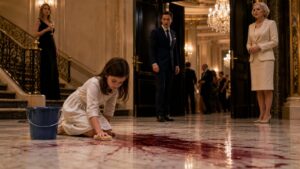
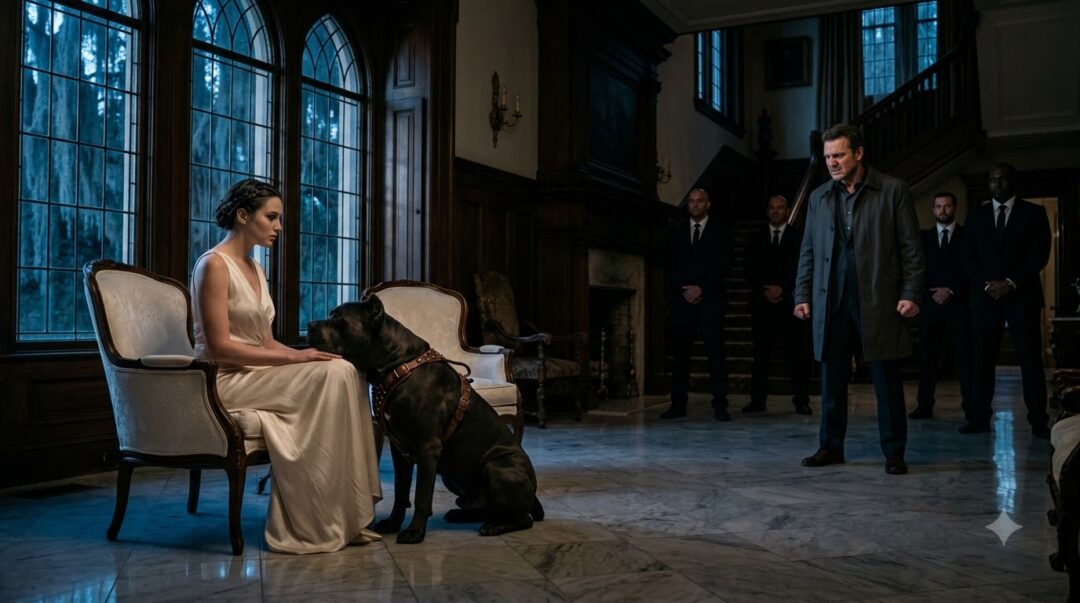
Twilight in Savannah did not fall with the sudden violence of northern winters; it settled like warm, humid velvet over the live oaks of the Montgomery estate, their ancient branches heavy with silver curtains of Spanish moss swaying in the damp breeze off the tidal marsh. Through the twenty-foot arched windows of the grand entrance rotunda, the dying orange light of the Georgia sun cast long, cathedral-like shadows across four thousand square feet of black-and-white checkerboard Carrara marble.
In the center of the rotunda, Camille Montgomery sat composed in a high-backed armchair of tufted white linen.
At thirty-six, the sole surviving daughter of the Montgomery shipping dynasty possessed the porcelain grace of old Southern aristocracy, but beneath the cream sleeveless silk gown that flowed to her satin slippers, her spine was forged of shipyard steel. A delicate gold chain rested against her collarbone, and her dark, wavy hair was swept over one bare shoulder. Beside her chair, a tall marble pedestal supported an urn of fresh white magnolias and Confederate jasmine, their sweet, heavy perfume filling the vast hall.
Standing twenty paces away on the checkerboard marble was Harrison Croft.
At forty-six, Croft was built like an iron piling, his broad chest wrapped in a dark grey wool trench coat over a black silk shirt unbuttoned at the throat. Above his right eyebrow, a fresh, jagged red scratch stood out against his pale skin—a souvenir from a recalcitrant union steward at the port terminal two hours earlier.
Flanking Croft in a semicircle were four private security contractors dressed in tailored black suits, their hands folded at their waists, the discreet bulges of concealed automatic pistols visible beneath their left lapels.
And standing between Croft and the seated woman was Titan.
The Cane Corso was a colossal animal—one hundred and thirty pounds of dense, obsidian muscle, his coat gleaming like polished anthracite under the Bohemian crystal chandeliers. He wore a heavy, double-stitched brown harness studded with brass hardware, his cropped ears alert, his broad, mastiff skull held level as his golden eyes tracked the movement of dust motes in the twilight air.
Croft took a slow step forward, the hard leather soles of his Italian oxfords clicking against the marble with arrogant, measured cadence.
“Move, Camille,” Croft said.
The command was flat, devoid of courtesy, the tone of a man accustomed to foreclosing on coastal towns before lunch. In his gloved left hand, Croft held a leather-bound folio containing the unconditional deed of surrender for Montgomery Deepwater Logistics—the sixty-year-old shipping line that Arthur Montgomery had built with eight cargo freighters and thirty square miles of Savannah waterfront.
Camille didn’t blink. She rested her hands lightly in her silk lap, her hazel eyes looking up into Croft’s face with cool, aristocratic stillness.
“No, Harrison,” Camille replied. Her voice was soft, melodic, carrying the unhurried drawl of the Lowcountry, yet as unyielding as granite beneath sea water. “You entered my home without an invitation, you brought armed hired hands into my father’s foyer, and you have tracking mud across floors laid before your grandfather was born.”
A dark, dangerous smirk pulled at the corner of Croft’s mouth. He reached up, touching the stinging scratch over his eyebrow, his eyes narrowing with venomous amusement.
“Your father’s yacht went to the bottom of the Tybee Roads five weeks ago, Camille,” Croft said, his voice dropping into a razor-edged purr. “The Coast Guard called off the search thirty days ago. The bank called your father’s eight-hundred-million-dollar syndicated loan default at four o’clock this afternoon. You don’t own this house. You don’t own the docks. And unless you sign this deed before the notary arrives at seven, you won’t own the clothes on your back.”
Croft gestured toward the massive dog standing five paces to his right.
“I bought Titan from the top kennel in Milan for ninety thousand dollars,” Croft said, stepping forward until the shadow of his heavy coat touched the hem of Camille’s dress. “I trained him to recognize the sound of fear. He has shattered the collarbones of three trespassers who thought they could breach my private terminal. If I tell him to clear this chair, Camille, you will not walk out of this rotunda.”
Croft raised his chin, his chest expanding as he barked the attack command in guttural German:
“Titan! Come! Voran!”
The silence that followed was suffocating.
The four armed bodyguards shifted their weight, their hands tensing on their weapons, expecting the massive black beast to launch across the marble in a blur of fangs and bone-crushing power.
Titan didn’t move forward.
The Cane Corso slowly turned his heavy head away from Croft. His golden eyes locked onto Camille’s calm, serene face.
Then, with the unhurried, rhythmic majesty of a panther, the one-hundred-and-thirty-pound war dog turned completely around. He took four slow strides across the checkerboard floor, passing Camille’s white silk hem, and gently lowered his massive, square black skull directly onto her lap.
Titan released a long, deep canine sigh of profound contentment, closing his eyes as Camille’s slender, manicured fingers reached out to gently stroke the soft velvet fur behind his ears.
Camille looked up at Croft.
A slow, devastating smile of teasing, radiant triumph parted her dark red lips.
“Well, Harrison…” Camille murmured softly, her fingers scratching the sweet spot behind the dog’s brass-studded collar. “It seems pretty clear who this dog belongs to.”
Croft’s face drained of color, turning an ashen, humiliated gray before an explosion of furious blood rushed into his temples. His fists clenched so violently inside his trench coat pockets that the leather seams groaned. He let out a strangled, furious grunt of disbelief, staring at the beast that had just dismantled his entire intimidation display with a single wag of its tail.
The four bodyguards exchanged panicked, uneasy glances, taking an instinctive step backward toward the heavy mahogany entrance doors.
Camille didn’t look at the guards.
While her left hand continued to stroke Titan’s muscular neck, her right thumb slipped beneath the heavy brass buckle of the dog’s harness.
Her fingers touched a tiny, cold metal cylinder concealed within the double-stitched leather lining—a miniature brass waterproof capsule stamped with her late father’s maritime initials: A.M.
Camille unscrewed the capsule with two silent turns, slipping out a tightly rolled piece of marine vellum covered in her father’s unmistakable pencil script, dated the morning his yacht exploded:
Camille: If Titan comes to you, Croft has already scuttled the ship. The starboard fuel line was cut from Berth 7. Look in the stable floorboards at Isle of Hope.
CHAPTER 2: THE MARSH AT ISLE OF HOPE
The sound of Croft’s heavy leather oxfords stomping across the checkerboard marble echoed through the grand foyer as the four bodyguards backed toward the driveway, their weapons hidden once more beneath their coats.
“You have twenty-four hours, Camille!” Croft snarled, his voice trembling with humiliated rage from the threshold of the mansion. “Keep the damn dog! Tomorrow morning at nine o’clock, the Chatham County Sheriff will execute the writ of possession! You will be thrown onto the street like a common squatter, and everything in this house will be sold at auction!”
The heavy mahogany doors slammed shut with a concussive thud that rattled the crystals of the chandelier and sent a tremor through the antique plaster molding.
The rotunda fell into deep, shadowed quiet, broken only by the distant chorus of tree frogs from the tidal marsh and Titan’s slow, steady breathing against Camille’s knees. Outside, the headlights of Croft’s three black SUVs swept across the arched windows as they turned sharply onto the oak-lined avenue, gravel spitting from their tires as they sped toward downtown Savannah.
Camille stood up from the linen armchair. Titan rose instantly beside her, his massive shoulder brushing against her silk gown, his ears pinned back in protective vigilance, his golden eyes scanning every dark alcove of the cavernous hall.
She walked quickly down the rear gallery toward the private library. The room was lined with floor-to-ceiling shelves of hand-bound maritime law treatises, ship logs, and framed naval architectural sketches dating back to the Civil War. On the wall behind the heavy cypress desk hung an antique brass marine chronometer and a detailed nautical survey of the Georgia coastline.
Camille pulled the rolled vellum from her palm, smoothing the fibrous paper flat under the brass desk lamp.
Her father’s script was hurried, written with the blunt lead of a shipboard pencil in the trembling handwriting of a man who knew his minutes were numbered:
Camille: If Titan comes to you, Croft has already scuttled the ship. The starboard fuel line was cut from Berth 7. Look in the stable floorboards at Isle of Hope. Elias has the keys to the launch.
A soft, rhythmic tap sounded against the glass French doors leading to the rear brick veranda.
Camille moved silently to the heavy velvet curtain, her hand resting on the polished walnut handle of a 19th-century English dueling pistol her father kept mounted above the marble fireplace. Titan stepped in front of her, a low, barely audible vibration rumbling deep in his chest as he sniffed the gap beneath the French door.
“Camille? It’s Elias,” a hoarse, familiar whisper called through the glass.
Camille turned the brass deadbolt, swinging the door open into the warm night air.
Captain Elias Vance stood on the veranda, surrounded by the familiar scent of marsh mud, salt brine, and river diesel. At fifty-eight, the veteran tugboat captain was broad-shouldered and weathered as an iron bollard, his beard silvered by thirty years of Atlantic salt spray, dressed in a faded navy windbreaker and worn denim. In his right hand, he held a heavy-duty marine VHF radio and a heavy brass ring of ignition keys.
“Elias,” Camille breathed, stepping onto the brick terrace. “Did you see Croft’s convoy leave?”
“Three black Suburbans tore down Montgomery Crossroads like hell was chasing them,” Elias said, stepping into the library. His sharp blue eyes dropped to the massive black dog leaning against Camille’s silk gown. A faint, knowing smile broke across the captain’s weathered face. “So Arthur’s boy came home to you after all.”
“Harrison thought he bought him in Milan,” Camille said, locking the French doors behind them. “How did Titan end up in Croft’s compound?”
Elias shook his head, his jaw setting in grim remembrance. “When Arthur’s yacht went down off Tybee, Croft’s private security boat was the first vessel on the scene. They dragged Titan out of the water before the Coast Guard rescue helicopter even cleared Hunter Airfield. Croft knew the dog was Arthur’s pride and joy—he thought if he broke Titan with shock collars and kept him on a short chain, it would be the ultimate symbol of his triumph over the Montgomery name.”
Elias reached down, gently scratching Titan’s broad forehead. The dog gave a soft whine, nuzzling the captain’s rough, salt-calloused palm with deep recognition.
“Titan didn’t break,” Camille said softly, her voice filled with quiet pride. “He was waiting for a chance to come home.”
She pulled the brass capsule from her pocket, showing Elias the vellum note. “Father wrote this before the explosion. He said to check the stable floorboards at Isle of Hope.”
Elias looked at the note, his eyes darkening with grave understanding. “Arthur kept an emergency safe beneath the tack room in the old plantation barn at Bluff Island. But Croft’s men have the causeway under surveillance. Two unmarked sedans have been parked near the marina gate since sunset. We can’t take the road.”
“Then we take the water,” Camille said, her voice leaving no room for argument. “The tide is turning on the Wilmington River. Croft’s radar doesn’t cover the shallow marsh cuts behind Skidaway Island. We take the pilot boat through the back creeks.”
Twenty minutes later, they were skimming across the black waters of the Wilmington River aboard Elias’s forty-foot twin-diesel pilot launch, running without navigation lights beneath the canopy of moss-hung live oaks that arched over the narrow creeks.
Titan sat stationed at the bow like a black stone gargoyle, his nose raised into the salt wind, scenting the damp banks of cordgrass and oyster beds.
As the launch rounded the marsh bend toward the Isle of Hope bluff, Elias throttled back the engines to an idle.
Ahead in the darkness, the private wooden dock of the Montgomery family stables loomed out of the river mist.
Camille picked up her night-vision binoculars, scanning the shoreline through the green phosphor lens.
Her breath caught in her throat.
Tied to the pilings of the stable dock was an unmarked, high-speed military Zodiac boat with twin two-hundred-horsepower outboards. Two men in dark tactical wetsuits were moving through the Spanish moss toward the barn, carrying heavy industrial pry-bars and tactical searchlights.
And parked on the oyster-shell driveway behind the barn, its headlights dark, sat an unmarked black sedan with Georgia state judicial plates—registered to Judge Marcus Calloway, the presiding probate judge handling Arthur Montgomery’s estate.
CHAPTER 3: THE STABLE ON BEAUFORT ISLAND
The tide was running fast along the oyster beds of the Isle of Hope bluff, the river water gurgling against the pilings of the abandoned dock.
Elias kept the pilot launch idling against the thick bank of cordgrass, the low diesel murmur masked by the hum of crickets and night cicadas.
“Calloway’s car is parked by the tack room,” Elias whispered, his hands steady on the helm. “The probate judge isn’t just taking bribes, Camille. He’s personally supervising the destruction of Arthur’s papers.”
Camille knelt on the damp deck beside Titan, her hand resting on the heavy leather harness.
“Elias,” Camille said softly. “Arthur told me when I was a girl: ‘A Montgomery never fights on ground chosen by the enemy.’ We aren’t going to the barn. We’re going north across the sound to Beaufort Island.”
Elias looked at her in surprise. “Beaufort? The old training compound in South Carolina?”
“Arthur’s master ledgers aren’t in the tack room,” Camille said, a cold, calculated smile touching her lips. “Father knew Calloway would search Isle of Hope first. The vellum note had two parts. Look at the watermark.”
She held the vellum slip toward the red dashboard compass light.
Pressed into the fibrous paper was an embossed blind seal: the outline of an anchor crossed with a veterinarian’s caduceus—the private mark of Camille’s equestrian clinic across the state line in Beaufort, South Carolina.
“Father didn’t bury his emergency fund in the floorboards,” Camille explained, her fingers gently moving along the thick fur beneath Titan’s broad jawline. “He buried it in the one place Croft’s lawyers would never dare inspect without a federal subpoena.”
Her fingers parted the dense, glossy black fur at the base of Titan’s muscular neck, just below the brass ring of the leather harness.
Beneath the scar tissue from Croft’s electric training collar, Camille felt a small, hard, rectangular mass the size of a grain of rice embedded beneath the dog’s skin.
It was an encrypted subcutaneous veterinary microchip—implanted by Camille herself when Titan was an eight-week-old pup.
“Titan has carried the private cryptographic keys to the Montgomery Swiss treasury since the day he was born,” Camille whispered.
Elias grinned, a low, rumbling laugh shaking his chest. “Arthur, you sly old sea dog.”
Elias engaged the twin diesels, the pilot launch backing out of the marsh cut with barely a ripple, turning north toward Calibogue Sound and the deepwater channels leading into South Carolina.
By three in the morning, the salt marshes of Georgia had yielded to the pine-lined bluffs of Beaufort Island.
Moored at the end of a private creek was Camille’s veterinary research compound—a hundred acres of coastal pastures, whitewashed stables, and ancient cedar barns where she had rehabilitated injured Thoroughbreds and working police K9s for a decade.
They led Titan into the bright, sterile warmth of the clinic’s operating theater.
The air smelled of surgical scrub, iodine, and clean cedar shavings. Titan hopped onto the stainless-steel examination table without hesitation, settling on his belly with a soft whine, his head resting obediently between his massive forepaws.
Camille put on surgical gloves, picked up a medical RFID scanner, and passed the sensor wand over the dog’s neck.
The scanner beeped with a sharp, high-pitched confirmation tone.
On the digital terminal mounted above the table, a twenty-four-character hexadecimal alphanumeric string appeared, accompanied by an encrypted directory tree:
MONTGOMERY MARITIME TRUST: MASTER EMERGENCY LEDGER.
AUTHORIZATION: BIOMETRIC / CANINE ID #884-CORSO.
STATUS: DECRYPTED.
Camille plugged her ruggedized field laptop into the terminal, downloading the master archive.
Her hazel eyes widened as she scrolled through the financial ledgers.
The records did not merely contain bank account balances; they contained sixteen months of high-resolution digital audio files and scanned wire transfer receipts documenting the systematic infiltration of the Georgia Port Authority by Harrison Croft.
Arthur Montgomery had been conducting a covert federal whistleblower investigation for two years.
He had documented how Croft was utilizing Berth 7 at the Savannah terminal to offload container shipments of unregistered industrial chemicals and synthetic narcotics, paying off Judge Calloway and three state maritime commissioners with bearer bonds issued through offshore banks in Panama.
“Elias,” Camille said, her voice shaking with righteous fury as she opened an audio file stamped with the date of her father’s death. “Listen to this.”
She tapped play.
Through the clinic speakers, her father’s rich, gravelly voice filled the room, accompanied by the background thrum of his yacht’s engines:
“Personal log, October 12th. Arthur Montgomery. Croft is boarding the vessel at Tybee Buoy 4. He claims he wants to settle the wharf leases. Titan is agitated… he senses the contractor on Croft’s boat. If I do not survive this meeting, the port authority records will prove Croft placed an electronic demolition charge on my starboard manifold.”
Suddenly, the clinic’s exterior motion-sensor floodlights clicked on.
Outside on the gravel driveway, the roar of high-performance marine outboards and heavy vehicle engines broke the silence of the marsh.
Through the clinic’s double glass doors, Camille saw two black tactical skiffs idling in the creek, and three unmarked black SUVs blocking the country road.
Stepping through the gate, holding a high-powered tactical shotgun, was Harrison Croft.
Beside him walked Judge Marcus Calloway, dressed in an expensive trench coat, holding a signed South Carolina interstate extradition warrant.
“Camille!” Croft’s voice boomed through an external loudspeaker, echoing through the pine trees. “You violated state bailment laws by stealing personal property from my Savannah estate! Step out of the clinic with the dog and the laptop, or my team will burn this barn to the ground with you inside!”
Titan stood up on the examination table, his lips curling back over massive white fangs, a terrifying, guttural roar rumbling from the depths of his chest that rattled the glass medicine cabinets.
CHAPTER 4: THE RIVER PILOT’S AMBUSH
The low growl vibrating in Titan’s massive chest was louder than the idling diesel engines outside the barn.
Camille stood beside the stainless-steel examination table, her face devoid of panic, her fingers flying across the laptop keyboard as she uploaded the entire decrypted ledger to an encrypted cloud server belonging to the United States Attorney’s Office in Atlanta.
“Elias,” Camille said calmly, clicking the transfer complete button. “Is the backup generator connected to the clinic’s irrigation pumps?”
Elias’s eyes glinted with sudden, savage understanding. “Four five-horsepower submersible pumps pulling directly from the salt creek at eighty pounds per square inch.”
“Turn them on,” Camille ordered. “All of them.”
Elias threw the industrial knife-switch on the wall panel.
Outside, the heavy commercial agricultural irrigation cannons mounted along the roof of the stables roared to life. Four massive, high-velocity streams of brackish tidal marsh water blasted across the gravel driveway with the force of industrial fire monitors, slamming directly into Croft’s armed security team.
The force of the water lifted two mercenaries off their feet, tumbling them into the muddy azalea bushes, their shotguns flying into the gravel.
Judge Calloway shrieked in terror as sixty gallons of marsh mud and saltwater hit his cashmere overcoat, knocking him backward against the hood of his sedan.
“Go! To the launch!” Camille shouted.
She vaulted through the rear stable doors into the dark pasture, with Titan bounding beside her like an obsidian panther.
They sprinted through the damp grass toward the private dock on the creek, where Elias’s pilot launch was still tied to the pilings.
Croft recovered his footing in the driveway, wiping the mud from his eyes, leveling his shotgun toward the dark pasture.
“Kill the dog!” Croft screamed hysterically to his remaining guards. “Shoot the damn dog!”
Three tactical rifles opened fire from the tree line, high-velocity rounds tearing through the wooden siding of the barn, splintering the cedar railings of the pasture fence.
Titan did not flinch. As a muzzle flash flared from behind an ancient live oak thirty yards away, the massive Cane Corso launched across the grass with terrifying speed.
He closed the distance in four seconds, leaping six feet into the air, his one-hundred-and-thirty-pound frame striking the armed contractor square in the chest.
The man hit the ground with a sickening crunch of broken ribs, his rifle clattering into the mud as Titan pinned him to the earth, his massive jaws snapping two inches from the man’s throat.
The contractor wailed in blind terror, throwing his hands up in absolute surrender.
Camille whistled—a sharp, two-tone command that Arthur had used on the docks for twenty years.
Titan broke his hold instantly, wheeling around and sprinting back to Camille’s side, leaping onto the aft deck of the pilot launch just as Elias slammed the throttles forward.
The twin Caterpillar diesels roared, the heavy aluminum launch tearing through the dark creek into the open waters of the Broad River, throwing a four-foot roostertail of white foam into the night.
Behind them, Croft’s two tactical skiffs launched into the river in hot pursuit, their high-intensity searchlights sweeping across the water, twin outboards screaming as they gained on the heavier pilot boat.
“They’re faster than us in open water, Camille!” Elias shouted over the engine roar, fighting the helm against the river chop. “They’ll box us in before we clear the mouth of the Savannah River!”
Camille looked at the pursuing skiffs, then looked down at the tactical crate Elias kept beneath the gunwale for maritime channel marking.
Inside the crate lay six commercial high-intensity phosphorus emergency flares and a spool of heavy steel mooring wire.
“Elias, take us through the Devil’s Elbow,” Camille said, her voice sharp and steady.
The Devil’s Elbow was a notorious hairpin turn in the tidal channel where the Wilmington River met the Savannah shipping channel, flanked by submerged granite ballast stone rip-rap laid by 18th-century sailing ships.
Elias cut the launch hard to port, skimming within three feet of the jagged, half-submerged granite boulders.
The lead tactical skiff attempted to cut the corner to intercept them.
Camille stepped onto the swim platform at the stern of the launch. She cracked the first phosphorus flare, striking the cap to ignite a brilliant, three-thousand-degree blinding crimson fireball.
She hurled the blazing flare directly onto the vinyl bow cover of the pursuing skiff.
The intense phosphorus fire burned through the rubber fabric instantly, igniting the reserve fuel tank mounted in the bow with a deafening WHUMP.
A ball of bright orange fire lit up the marsh, the skiff veering out of control and smashing into the granite rip-rap at thirty knots, ejecting both contractors into the cold tidal mud.
The second skiff throttled back in panic, its searchlight swerving wildly away as the burning wreckage illuminated the river.
Elias steered the pilot launch cleanly through the channel into the deep, commercial waters of the Savannah River shipping channel.
Ahead of them in the pre-dawn mist, the historic waterfront of Savannah rose like a Victorian postcard: the brick warehouses of River Street, the towering gold dome of City Hall, and the colossal yellow container cranes of the Georgia Port Authority standing like sentinels against the violet sky.
Camille looked at her watch. It was 5:45 AM.
At seven o’clock, the Chatham County Board of Maritime Commissioners was holding an emergency public hearing at the historic Pulaski House to ratify the permanent liquidation of the Montgomery Shipping Corporation.
Camille looked at Titan, who was resting his head against her hip, his dark eyes glowing with fierce, unshakeable devotion.
“We have an appointment, Titan,” Camille said softly, her hand tightening around the strap of her laptop bag. “And we aren’t going to be late.”
CHAPTER 5: THE GALA AT THE PULASKI HOUSE
The grand ballroom of the Pulaski House was a monument to nineteenth-century Georgia opulence: sixty-foot ceilings adorned with gilded plaster rosettes, massive Bohemian crystal chandeliers, and polished heart-pine floors that had hosted presidential receptions for two centuries.
At seven o’clock on a Tuesday morning, the room was packed with two hundred of Savannah’s most influential citizens: shipping magnates, cotton brokers, federal maritime attorneys, and television news crews who had gathered for the official liquidation hearing of the Montgomery estate.
At the center of the raised mahogany dais sat Judge Marcus Calloway, dressed in his judicial robes, though his face was pale, his eyes darting nervously around the room, a large bandage covering a deep scratch across his cheek.
Standing at the podium in a tailored three-piece charcoal suit was Harrison Croft.
His hair was immaculate, his leather shoes polished to a mirror shine, completely erasing any trace of the mud and river water from two hours earlier. He radiated the smug, invincible confidence of a predator who had finally cornered his prey.
“Ladies and gentlemen of the Maritime Commission,” Croft began, his deep baritone resonating through the ballroom’s sound system. “This is a sorrowful day for our historic city. For eighty years, the Montgomery family served as custodians of our deepwater terminals. But financial mismanagement and the tragic loss of Arthur Montgomery at sea have left our port vulnerable to commercial collapse.”
Croft raised a thick, leather-bound folder containing the foreclosure petition.
“Under the emergency provisions of the Georgia Maritime Code, my firm—Croft Continental Logistics—is prepared to assume all outstanding liabilities, guaranteeing the jobs of four hundred union longshoremen and securing our port’s future with a two-hundred-million-dollar private capital injection.”
Judge Calloway reached for his heavy rosewood gavel, clearing his throat. “The court finds the petitioner’s standing to be uncontested. In the absence of an objection from the Montgomery heirs, this court is prepared to enter the decree of—”
The colossal, eight-foot carved oak double doors at the rear of the ballroom slammed open with an explosive, ringing crack that shook the chandelier pendants.
The chatter in the ballroom died instantly.
Camille Montgomery walked down the central red carpet aisle.
She was not wearing muddy work clothes. She wore an immaculate, floor-length midnight-blue velvet gown with an off-the-shoulder neckline, her dark hair pinned in an elegant chignon, her hazel eyes blazing with imperial, unyielding fury.
And walking on her left side, matching her strides with terrifying, predatory grace, was Titan.
The one-hundred-and-thirty-pound Cane Corso wore his brown leather harness, his brass hardware gleaming under the chandeliers, his golden eyes scanning the dais with calm, lethal authority.
A collective, terrified gasp rippled through the two hundred guests. Women drew back into their chairs, clutching their pearls; men scrambled backward away from the aisle as the massive war dog walked past within inches of their knees, his tail held level, his step silent as death.
Harrison Croft froze at the podium, his hands clutching the microphone, his knuckles turning chalk-white.
“Camille…” Croft stammered, his voice booming awkwardly through the speakers. “You… you have no standing here! Bailiffs! Remove this animal from the courtroom!”
Two armed Chatham County sheriff’s deputies stepped forward from the side wall, their hands resting on their holsters.
Titan didn’t growl. He simply stopped, lowered his center of gravity by two inches, and turned his massive skull toward the deputies.
The two deputies froze in their tracks, their eyes wide with terror, instinctively raising their hands in a gesture of peaceful retreat.
Camille walked directly to the foot of the raised dais, stopping three paces from Croft.
She pulled a slim aluminum USB drive from her velvet clutch, turning toward the media cameras and the members of the maritime commission.
“My name is Camille Montgomery,” she said, her voice clear, musical, and commanding total, breathless silence throughout the grand hall. “I am the sole surviving heir of Arthur Montgomery. And I object.”
Judge Calloway slammed his gavel against the sound block, his voice rising in panicked desperation. “The objection is untimely! The filing deadline passed at six o’clock—”
“The objection is supported by the United States Department of Justice,” Camille interrupted, her voice ringing out like a silver bell.
She plugged the drive into the podium’s digital media console.
Instantly, the four massive projection screens mounted on the ballroom walls flickered to life.
Across thirty-foot displays, the encrypted telemetry from Titan’s microchip exploded before the eyes of Savannah’s elite:
High-definition digital satellite imagery of Berth 7, showing Croft’s private vessels offloading unmarked shipping containers into warehouse vaults. Scanned banking records from the Bank of Panama showing six million dollars in wire transfers from Croft directly into Judge Marcus Calloway’s private accounts.
And then, the soundboard played Arthur Montgomery’s final recording:
“Croft placed an electronic demolition charge on my starboard manifold… if I do not survive, check the telemetry on Titan’s collar.”
The silence in the Pulaski House ballroom was total.
Judge Calloway dropped his rosewood gavel, the wood bouncing down the steps of the dais, his face turning the color of skimmed milk as he sank back into his high-backed chair, trembling uncontrollably.
Croft lunged across the podium, knocking the microphone to the floor, his face twisted into an expression of raw, feral hatred.
“You think this saves you, Camille?!” Croft hissed, leaning down until his spit hit the marble floor between them. “Those docks are rigged! The container ship Southern Star is docked at Berth 7 with four hundred tons of nitrate cargo! If I don’t punch the clearance code in twenty minutes, that whole terminal goes up in smoke!”
Croft spun on his heel, vaulted over the side railing of the dais, and sprinted through the private judicial service exit into the alleyway behind the hall.
Camille looked at Titan, her eyes flashing with cold, decisive fire.
“Titan,” she commanded, pointing toward the open service exit. “Hunt.”
The Cane Corso let out a deafening, chest-rattling bark that shattered a crystal water glass on the press table, and launched across the ballroom floor like a black missile.
CHAPTER 6: THE DUEL AT BERTH 7
The morning fog over the Savannah River was turning yellow under the first rays of the rising sun as Camille’s launch tore down the waterfront toward Berth 7.
Berth 7 was the deepest commercial shipping berth in the port, an industrial expanse of reinforced concrete wharves, towering yellow gantry cranes, and massive steel bollards that Arthur Montgomery had engineered thirty years ago. Moored to the wharf was the Southern Star—a six-hundred-foot ocean-going container vessel carrying four hundred stacked sea crates, its massive red-and-black hull towering forty feet above the river water.
Parked on the concrete apron beside the ship’s primary boarding gangway was Croft’s black Mercedes SUV, the driver’s door thrown wide open, the engine still idling with hot exhaust fumes drifting into the cool morning air.
Elias slammed the launch against the heavy timber camel fenders of the pier, throwing heavy braided nylon mooring lines around the cast-iron cleats with practiced speed.
“Camille! He’s heading for the cargo control room on the bridge deck!” Elias shouted, racking the slide of his twelve-gauge pump shotgun. “If he accesses the cargo pump manifold, he can dump the entire fuel reserve into the harbor!”
Titan was already off the boat. The massive black dog cleared the four-foot gap between the gunwale and the concrete dock in a single, effortless leap, his heavy paws hitting the pavement in a dead sprint toward the ship’s aluminum gangway.
Camille followed instantly, her midnight-blue velvet dress gathered in her left hand, running up the steep, swaying gangway onto the main deck of the Southern Star.
The steel deck of the container ship was a cavernous labyrinth of towering freight crates stacked four tiers high, secured with heavy steel lashing rods that hummed and vibrated in the river breeze. The air smelled of heavy marine diesel exhaust, hot iron, and the sharp, sulfuric stench of burning road flares.
Through the narrow corridor between two forty-foot containers, a sharp gunshot rang out with an ear-splitting crack.
BANG!
The high-velocity bullet sparked violently off the steel corner-casting two inches above Camille’s head, showering her velvet dress with rust, paint flakes, and hot lead fragments.
“Stay back, Camille!” Croft’s voice echoed wildly from the open steel doorway of the forward cargo control station beneath the bridge superstructure.
Camille flattened her back against a corrugated steel container wall, drawing the 19th-century bronze dueling pistol from her clutch, her breathing steady, controlled, and quiet.
Through the narrow gap between the cargo crates, she saw Croft.
He had shed his expensive suit jacket, his white dress shirt torn and stained with black engine grease and soot. He was holding a nine-millimeter Glock in his right hand, his knuckles white, his arm trembling with exhaustion and manic rage. In his left hand, he held a heavy, commercial phosphorus signaling torch—already ignited, hissing and spitting with blinding, three-thousand-degree white sparks that dripped liquid fire onto the steel deck.
Directly beneath his feet was the open inspection hatch of the ship’s auxiliary fuel bilge—connected directly to sixty thousand gallons of high-grade marine diesel.
“Drop the weapon, Harrison!” Camille called out, her voice cutting clearly through the roar of the river wind and the violent hiss of the flare. “The FBI tactical team has already surrounded the terminal gates! The Coast Guard has blocked the river channel with three patrol cutters! There is nowhere on earth you can run!”
“They won’t take me alive, Camille!” Croft screamed, his eyes bloodshot and wild with manic, cornered desperation. “If I go down, the Montgomery shipping line goes to hell with me! Eighty million dollars in cargo, five hundred feet of deepwater wharf—I’ll burn it all to the waterline! Your father’s legacy dies today!”
Croft raised the hissing phosphorus flare high above his head, preparing to drop the blinding white fireball straight down into the open diesel hatch.
A black shadow exploded from the blind corner of the container stack.
Titan launched himself across twelve feet of open steel deck.
He didn’t bark. He didn’t issue a warning growl.
The one-hundred-and-thirty-pound Cane Corso hit Croft like an artillery shell, his front paws slamming directly into Croft’s chest, the sheer kinetic impact driving the man backward against the heavy cast-iron housing of the anchor windlass with a sickening thud.
Croft’s gun fired into the air, the bullet tearing harmlessly through the green canvas awning of the bridge deck.
Croft shrieked in agony as Titan’s powerful jaws clamped down onto his right forearm, bone crunching audibly beneath the immense pressure of the mastiff’s bite, forcing the pistol from his shattered, useless fingers.
The white-hot phosphorus flare slipped from Croft’s left hand, rolling across the iron plates toward the edge of the open fuel hatch.
Camille lunged forward across the deck.
She didn’t hesitate for a microsecond. She grabbed a heavy, fire-retardant canvas cargo tarp from the nearby lashing rack, threw herself onto her knees on the cold steel, and smothered the burning flare with all her weight, cutting off the oxygen supply until the blinding sparks suffocated into dark, acrid smoke three inches from the fuel vapor.
Croft lay pinned against the anchor winch, sobbing and groaning in utter, broken agony, his eyes staring up in terror into the golden eyes of the massive dog holding his throat pinned against the steel deck.
Titan did not tear. He did not shred.
He held Croft completely immobile, his fangs resting gently against the man’s carotid artery, his hot breath washing over Croft’s cheek, waiting with iron discipline for Camille’s command.
Camille stood up, brushing the black soot from her velvet gown, looking down at the broken corporate raider with cold, unyielding contempt.
“Titan,” Camille said softly, her voice rich with calm authority. “Release.”
Titan unclasped his jaws, stepped back two paces, and sat down on the steel deck, panting softly, his tail thumping once against the iron plating.
Croft curled onto his side on the deck, clutching his shattered arm, weeping in humiliating, total defeat.
Above them on the bridge wing, the sirens of four Coast Guard tactical patrol boats wailed as armed federal boarding teams swarmed over the gangway, their rifles trained on the deck.
Elias walked up the companionway, looking down at Croft, then looking up at Camille, a broad, triumphant grin splitting his weathered face from ear to ear.
“Well, Miss Montgomery,” Elias said, touching the brim of his captain’s cap. “I believe the port is officially open for business.”
CHAPTER 7: THE MAGNOLIA DAWN
One month later, the soft morning light of a Lowcountry spring broke over the salt marshes of the Montgomery estate, painting the Spanish moss in shades of pale amber and liquid gold.
The historic Antebellum mansion had been completely restored, the scars of Croft’s violent intrusion erased by thirty days of meticulous craftsmanship. The tall double doors of the entrance rotunda stood wide open to the river breeze, letting the fragrant scents of blooming tea olives, Confederate jasmine, and salty sea marsh drift freely through the high-ceilinged halls. The checkerboard Carrara marble floors gleamed under the morning sun, scrubbed clean of every trace of mud and violence.
Camille Montgomery stood on the wide brick veranda overlooking the tidal creek, holding a fine porcelain cup of chicory coffee in her hands.
She wore a simple, tailored cream linen dress and flat leather sandals, her dark wavy hair loose around her shoulders, her face glowing with serene, unshakeable peace. The tension that had tightened her jaw for five agonizing weeks had melted away, replaced by the calm, commanding presence of a woman who had fought for her heritage and won.
Lying beside her on the cool Savannah brickwork was Titan.
The massive black Cane Corso was stretched out in a wide patch of warm morning sunlight, his heavy head resting comfortably across his paws, his tail gently thumping against the floor whenever Camille looked down at him. His scarred studded leather harness had been replaced by a soft, oiled English leather collar bearing a solid gold tag engraved with the Montgomery maritime anchor. The scars beneath his neck from Croft’s electric collar were fading, hidden beneath a thick, lustrous coat of black velvet.
Down on the oyster-shell driveway beneath the live oaks, a white postal delivery van crunched to a stop.
Captain Elias Vance walked up the veranda steps, wearing a clean, pressed navy captain’s jacket and a fresh captain’s cap. Under his arm, he carried a thick stack of certified legal documents bearing the red wax seal of the United States District Court for the Southern District of Georgia.
“Morning, CEO Montgomery,” Elias said with a warm, respectful tip of his cap.
Camille laughed—a light, musical sound that carried out over the water, startling a blue heron from the tall spartina grass. “Good morning, Captain. Please tell me that isn’t another deposition from the insurance underwriters.”
“No more depositions, Camille,” Elias said, handing her the court decree with a broad, proud smile. “Judge Marcus Calloway and Harrison Croft were formally sentenced in federal district court in Atlanta yesterday afternoon. Life without possibility of parole at the federal maximum-security penitentiary in Pollock for Croft on eighteen counts of maritime murder, racketeering, and corporate sabotage. Twenty-eight years for Calloway for judicial bribery and treason.”
Elias leaned against the white veranda railing, looking out toward the Wilmington River where the morning sun was glinting like diamonds across the water.
“The federal court has dismissed every creditor claim,” Elias continued, his voice thick with emotion. “Montgomery Deepwater Logistics has been awarded forty-eight million dollars in civil restitution from Croft’s seized commercial real estate trust. All twelve cargo vessels are fully crewed, the longshoreman union contracts are signed for the next ten years, and Berth 7 has been officially renamed the Arthur Montgomery Marine Terminal by unanimous vote of the City Council.”
Camille looked down at the official seal on the judgment, feeling a profound, deep warmth bloom in her chest.
She reached into her dress pocket, pulling out her father’s antique brass pocket watch, which had been recovered from the wreckage of his yacht by Navy salvage divers two weeks ago. The watch was dented and scarred by salt water, but the engraved inscription on the inner lid remained as clear as the day her mother had given it to him:
THE DEEPEST WATER BELONGS TO THOSE WHO CANNOT BE BOUGHT.
Camille walked down the veranda steps onto the green lawn, kneeling in the soft clover beside Titan.
The dog rolled onto his side, letting out a contented groan as Camille buried both hands in his thick, glossy black coat, rubbing his broad chest and scratching behind his cropped ears.
“You brought us home, boy,” Camille whispered, pressing her forehead against the dog’s massive, warm head. “You kept Daddy’s promise when everyone else turned away.”
Titan lifted his heavy head, his golden eyes gazing into hers with an intelligence and devotion that seemed deeper than the river itself, giving her cheek a single, gentle lick before resting his chin on her knee.
Out across the Wilmington River, the deep, resonant horn of a six-hundred-foot container vessel echoed through the morning air—a long, proud salute from the incoming Southern Star, her towering blue bow slicing through the channel as she returned to Berth 7 beneath the warm Georgia sun.
Camille stood up, holding her father’s watch in her hand, Titan standing tall and magnificent at her side.
As the morning breeze carried the sweet scent of tea olives across the water, Camille looked toward the live oaks lining the long driveway. The iron gates that had stood closed in fear for five agonizing weeks were swung wide to the coastal breeze, welcoming the shipyard workers, the family friends, and the honest river captains who had kept faith in the Montgomery name. In her hands, the ticking of her father’s brass pocket watch sounded like a steady, indestructible pulse.
The storm had passed, the empire was restored to its rightful bloodline, and across the endless, sun-drenched waters of Savannah, the tide had finally turned for good.