He Called Her Field Edge Worthless Until the Survey Line Put His Entire Farm Market at Risk
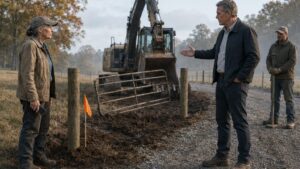
Chapter 1: The Yellow Line Across Her Father’s Field
Rebecca Hall knew the brass pin had not moved.
The yellow paint across it was still tacky.
She crouched at the edge of the gravel entrance with an old putty knife in one hand and scraped until a curved edge of metal appeared beneath the stripe. A pickup rolled through the entrance behind her, tires crunching gravel, then crossed the same invisible line she had been staring at for thirty seconds.
Rebecca wiped the blade on her jeans.
The pin was exactly where she remembered it.
Her father had set it years ago.
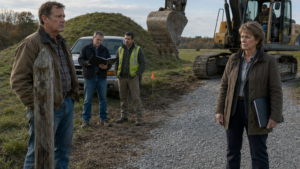
Across the lane, Clark Farm Market was already filling for Saturday morning. Families carried pumpkins toward their cars. A delivery truck waited beside the produce building. New yellow arrows directed traffic toward an automatic gate that had not been there the previous spring.
That gate bothered Rebecca more than the paint.
Paint could be corrected.
The gate had concrete footings.
She stood and looked along the edge of her field. For years, the boundary between the Hall property and the Clark property had been visually loose: grass, gravel, weeds, tire tracks. Nobody needed a fence because both families knew roughly where one farm stopped and the other began.
Or Rebecca had believed they did.
A sedan turned toward the gate.
Its right wheels crossed several yards into what Rebecca understood to be Hall land before straightening.
She counted three more vehicles.
Then five.
“Rebecca.”
Gregory Clark was walking toward her from the market.
He wore work boots and a dark canvas jacket, and his expression suggested he had already decided she was creating a problem.
“What are you doing?”
Rebecca pointed with the putty knife.
“Checking a monument.”
Gregory glanced down.
“A what?”
“The property pin.”
He gave the yellow stripe a quick look.
“That old thing?”
“Yes.”
He looked toward the market as another car entered.
“We had the lot striped Thursday.”
“I noticed.”
Gregory folded his arms.
Rebecca had known him most of her life. He had been the boy loading sweet corn while she helped her father repair fence. Later he became the man who turned a roadside produce shed into a market with refrigerated cases, weekend vendors, a bakery counter and enough autumn traffic to back vehicles onto the county road.
She respected what he had built.
That was part of the problem.
“The line shouldn’t be here,” she said.
Gregory frowned. “Which line?”
“The parking line. And maybe more than the parking line.”
His eyes narrowed.
“Rebecca, we’ve been using this entrance for years.”
“You’ve been crossing here for years. That’s different.”
“Different how?”
She looked toward the automatic gate.
“When did that go in?”
“Three weeks ago.”
“You poured footings?”
“Obviously.”
“Did you have it surveyed?”
Something changed in his face.
Not guilt. Irritation.
“I know where my property is.”
Rebecca looked down at the brass pin.
“So do I.”
A customer drove between them, forcing Gregory to step aside.
The vehicle passed directly over the line Rebecca could already picture from the deed.
Gregory waited until it cleared.
“Don’t start this today.”
Rebecca looked at him.
“I haven’t started anything.”
“Then don’t.”
He walked back toward the market.
Rebecca remained beside the pin.
That sentence should have angered her. Instead, it made her think about how many opportunities she had already had to say something.
First came extra gravel.
Then temporary cones.
Then painted arrows.
She had seen them all.
She had told herself Gregory was busy.
She had told herself harvest season was no time to start a property argument.
She had told herself she could mention it later.
Later had acquired concrete footings.
Rebecca went to her barn and returned with a measuring tape, a survey flag and a copy of the parcel sketch from her work files.
She did not conduct a boundary survey. Not yet.
She measured only enough to test whether her memory was wrong.
It wasn’t.
She established a rough line from the brass pin toward the rear monument, then measured perpendicular offsets toward Gregory’s new improvements.
Twelve feet.
Nineteen.
Twenty-six.
At the gate, she stopped.
Her rough measurement was a little over thirty feet.
Rebecca repeated it.
Then she stood in the middle of the gravel and looked back.
The yellow stripe was no longer the problem.
The entrance itself was.
Gregory had placed the automatic gate, a traffic lane and part of the widened customer entrance on Hall land.
A horn sounded.
Rebecca stepped aside.
Another car passed.
Then another.
She folded the parcel sketch.
Gregory returned before she reached the field.
This time his patience was gone.
“You’re measuring my driveway now?”
“I’m checking mine.”
“That’s not yours.”
“My preliminary numbers say otherwise.”
“Your preliminary numbers?”
“I’m not signing anything based on them. I’ll survey it properly Monday.”
Gregory stared at her.
“Monday?”
“Yes.”
“No. You’re not setting up equipment in the middle of my entrance while I’m trying to run a business.”
“I don’t need your permission to survey my property.”
“You don’t even know that it’s your property.”
Rebecca glanced toward the pin.
Gregory followed her eyes.
Then he laughed once, without humor.
“That strip has always been ours.”
“No.”
“My dad used it.”
“I know.”
“My grandfather used it.”
“For equipment.”
“Exactly.”
“Crossing land doesn’t make it yours.”
Gregory stepped closer.
“Your father gave us that access.”
Rebecca stopped.
The noise of the market seemed to move farther away.
“What?”
“William told my dad we could use it.”
“For what?”
“For access.”
“What kind?”
Gregory shook his head.
“Don’t do that lawyer thing with me.”
“I’m a surveyor, Gregory.”
“Then you should understand what access means.”
“I understand exactly why I’m asking.”
His jaw tightened.
Rebecca suddenly remembered muddy tractor tires.
Not clearly enough.
A wet spring. Her father standing near the field edge. A Clark tractor avoiding a flooded low spot.
The memory disappeared before she could place a year on it.
Gregory pointed toward the gate.
“You watched us gravel this.”
Rebecca said nothing.
“You watched the arrows go down. You watched that gate being installed. You never said one word.”
That landed because it was true.
She had believed silence was patience.
Standing there, she saw how easily it could have looked like consent.
“I should’ve spoken sooner,” she said.
Gregory seemed surprised by the admission.
“But that doesn’t move a boundary.”
His expression hardened again.
“You want to dig through old papers? Fine.”
“I do.”
“Good.”
Gregory started back toward the market, then stopped.
“My father kept everything.”
Rebecca waited.
Gregory looked over his shoulder.
“You come over here Monday telling me I’m thirty feet onto your property, you’d better be ready for what I show you.”
“What are you going to show me?”
“The reason my family has been driving across that strip since before you had a survey license.”
He walked away.
Rebecca looked down at the yellow stripe.
A thin crescent of brass showed through where she had scraped the paint away.
For the first time that morning, the pin no longer felt like an answer.
It felt like the beginning of a question her father had left behind.
Chapter 2: Thirty-One Feet Beyond the Old Pin
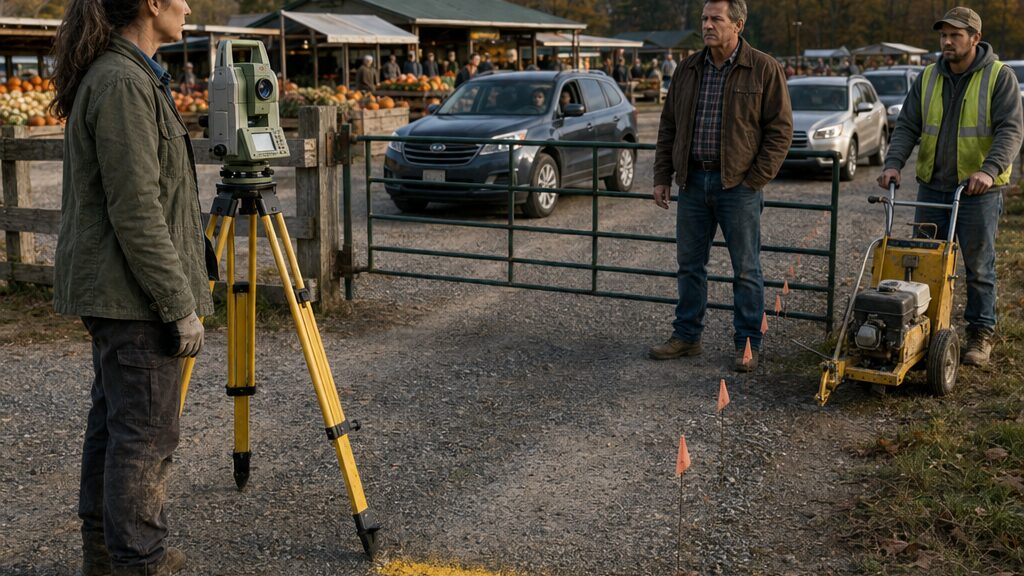
Gregory found Rebecca’s total station aimed straight through his automatic gate at 8:17 Monday morning.
He stopped his pickup in the entrance.
Rebecca watched him through the instrument until the driver’s door opened.
“Move that thing.”
She stepped away from the eyepiece.
Her yellow tripod stood inside the Hall parcel, several feet beyond the gravel. She had arrived before the market opened, tied into two recorded control points and already checked the rear monument twice.
“I don’t need the driveway,” she said.
“You’re pointing through it.”
“Light doesn’t damage gravel.”
“Customers will be here in forty minutes.”
“Then I should be finished with this section in thirty.”
Gregory shut the truck door harder than necessary.
Rebecca returned to the instrument.
She had spent Sunday reviewing deeds and field data instead of calling him.
That had been deliberate.
Gregory could argue with her memory.
He could not argue with coordinates as easily.
She sighted the brass pin near the entrance.
Check.
Then the rear monument.
Check.
Then the gate footing.
Rebecca wrote the offset in her field book.
Gregory hovered ten feet away.
“Well?”
She moved to another point.
“Rebecca.”
“I heard you.”
“How far?”
“I haven’t closed the traverse.”
“You’ve been here an hour.”
“And that’s why people hire surveyors instead of guessing.”
He muttered something and walked toward the market.
Rebecca kept working.
By nine, customer traffic had begun.
She moved herself and the equipment farther from the lane, but the measurements continued to tell the same story.
The boundary did not follow the new yellow stripe.
It cut across the commercial entrance.
Rebecca placed temporary flags along the calculated line.
One near the pin.
One beyond the gate.
Another near the gravel shoulder.
From ground level, the problem looked awkward.
From above, it looked disastrous.
She launched a small survey drone from her field and kept it over her property and the permitted mapping area. When the stitched overhead image appeared on her tablet, she enlarged the entrance.
There it was.
Gregory’s market spread north of the line with orderly rows of parking. But the funnel that fed those rows swung across Rebecca’s parcel before returning toward Clark land.
The gate was not merely over the line.
The traffic pattern depended on being over it.
Gregory came back as she was checking the image.
“You filming customers?”
“Mapping improvements.”
“Same difference.”
“No, it isn’t.”
He leaned toward the screen.
Rebecca almost turned it away, then decided not to.
“That’s the boundary.”
She traced the calculated line with one finger.
Gregory stared.
“No.”
“Yes.”
“Your line cuts through my entrance.”
“That’s what I’ve been trying to tell you.”
“How far?”
Rebecca looked at her field book.
“From the boundary to the outside gate footing, thirty-one feet and four inches.”
He stared at her.
“That’s impossible.”
“Then show me a monument I missed.”
“You’ve got the wrong pin.”
“I checked it against two recorded control points.”
“My dad used this entrance.”
“That doesn’t relocate a monument.”
“You keep saying that like it settles everything.”
“It settles where the land is. It doesn’t settle what rights anyone may have across it.”
Gregory looked toward the market.
Cars were moving steadily through the gate.
His anger seemed to hesitate.
For a moment Rebecca saw calculation instead.
If she closed that strip, the parking rows behind it would still exist.
Getting customers into them would be another matter.
Gregory noticed a flag beside the gravel.
“What are those?”
“Temporary marks.”
“Take them out.”
“No.”
“This is an active business.”
“They’re outside the travel lane.”
He pulled one from the ground.
Rebecca’s voice sharpened.
“Gregory.”
He stopped.
It was the first time she had raised her voice.
“Put it back.”
They looked at each other.
Then an employee approached carrying a bucket of yellow marking paint.
Gregory pointed toward the entrance.
“Finish that edge.”
The employee looked at Rebecca’s flags.
“She says—”
“I know what she says.”
Rebecca stepped between the bucket and the brass pin.
“Don’t paint the monument.”
Gregory gave a tired laugh.
“You’re protecting a piece of metal now?”
“I’m protecting evidence of the boundary.”
“It’s my parking lot.”
“Not here.”
Two customers slowed as they walked toward the produce building.
Rebecca felt their attention and hated it.
She did not want an audience.
She moved back to the tripod instead.
Gregory followed.
“You’re really going to do this?”
Rebecca adjusted the instrument.
“You asked how far.”
She sighted the gate footing again.
“Thirty-one feet.”
“You think I’m moving a gate because you set up a yellow tripod?”
“No.”
She looked at him.
“I think you’re going to stop pretending the tripod is the reason.”
Gregory’s face reddened.
He turned toward the employee.
“Paint it.”
The employee hesitated.
Gregory pointed.
“Finish the line.”
Rebecca said nothing.
The roller moved across the gravel.
Yellow paint passed over one of her temporary marks and continued toward the exposed brass pin.
She could have stepped in front of it.
She didn’t.
Instead, she took out her phone and photographed the pin, the paint and the instrument behind it.
Gregory saw her.
“What now?”
“Documentation.”
“Of what?”
“That I showed you the boundary before you chose to cover the mark.”
For the first time all morning, Gregory had no immediate answer.
The roller crossed the brass.
Rebecca watched the metal disappear beneath yellow.
Her restraint did not feel like patience anymore.
It felt like a decision.
She packed the drone last.
When she folded the tripod, Gregory was standing beside his pickup.
“Wait.”
Rebecca stopped.
He reached behind the driver’s seat and pulled out a battered cardboard envelope.
From it he removed an old photograph.
He held it toward her.
The image had faded at the edges.
A tractor sat in almost the exact place where Gregory’s automatic gate now stood. Mud covered its rear tires. Another tractor waited behind it.
Rebecca recognized the old Hall barn in the background.
And she recognized the man beside the first tractor.
William Hall.
Her father.
Gregory tapped the photograph.
“That’s 2003.”
Rebecca took it.
William was standing with one hand raised toward the driver as if guiding him across the field edge.
Gregory spoke more quietly now.
“My father didn’t sneak onto your land.”
Rebecca looked at the tire tracks in the photograph.
“No.”
“He was invited.”
She handed the picture back.
“That still doesn’t tell me what he was invited to do.”
Gregory slid it into the envelope.
“But now you know I’m not making it up.”
Rebecca looked at the freshly painted stripe covering the brass pin.
He wasn’t.
And that made what came next much harder.
Chapter 3: The Permission Nobody Ever Recorded
Catherine Martin laid an eleven-year-old survey across the county records counter and tapped the certification stamp.
“This is the newest recorded boundary survey I can find for the Hall parcel.”
Rebecca leaned over it.
The line was exactly where she expected.
So was the monument.
A small notation identified the iron-and-brass pin at the northeast corner, the same pin now buried beneath Gregory’s yellow paint.
“And easements?” Rebecca asked.
Catherine adjusted her glasses.
“I searched the Hall parcel and the adjoining Clark parcel.”
“And?”
“I found utility rights, an old drainage agreement and county road documents.”
“Nothing for private access?”
“Nothing recorded.”
Rebecca exhaled.
She had expected relief to feel larger.
Instead it arrived as a technical fact.
No recorded easement.
Catherine must have noticed her expression.
“You know what I’m going to say.”
“That you’re not giving me a legal opinion.”
“Exactly.”
“I wasn’t asking for one.”
“You were thinking loudly.”
Rebecca almost smiled.
Catherine turned the survey around.
“The record tells you what’s recorded. It doesn’t tell you every conversation two farmers had beside a fence twenty years ago.”
“I know.”
That was the problem.
Rebecca photographed the relevant filings and requested certified copies.
Before leaving, she examined the survey again.
Her father had commissioned it eleven years earlier.
William had known where the boundary stood.
If he intended to give the Clarks permanent access, why hadn’t he recorded it then?
The question followed her home.
She spread the documents across the kitchen table beside a cup of coffee that went cold before she touched it.
The old photograph Gregory had shown her stayed in her mind.
William beside the tractor.
His raised hand.
Permission made visible.
Rebecca went to the cabinet where she kept older farm records.
Her father had never believed in throwing paper away. Seed invoices, fence receipts, equipment manuals, handwritten acreage calculations—everything had been folded into labeled envelopes or clipped into notebooks.
She found a folder marked FIELD ACCESS.
Inside were drainage sketches and notes from wet years.
One sheet carried William’s handwriting.
Clark tractor crossing—south edge too soft.
Rebecca sat down.
Below it was a date from twenty-three years earlier.
Another entry appeared several pages later.
Let Clark boys use upper strip until lower lane dries.
Rebecca read it twice.
Until lower lane dries.
Not forever.
Not ownership.
Not a commercial entrance.
But it was permission.
Real permission.
She closed her eyes.
A memory returned with uncomfortable clarity.
She was younger, home for several weeks after a surveying job had ended. Rain had turned the lower Clark lane into mud deep enough to swallow a boot.
Gregory’s father had come over.
William had stood near the barn with Rebecca beside him.
“Use the high edge,” her father had said. “Just don’t tear it up.”
Rebecca remembered the tractor crossing afterward.
She remembered William complaining about ruts.
She remembered him saying, They’ll go back down once it firms.
She had known.
Not every detail, but enough.
When Gregory began spreading extra gravel two years ago, she had remembered the old crossings.
That was why she had not objected immediately.
Part of her had thought: Dad allowed it.
Then temporary gravel became a wider lane.
The wider lane became arrows.
The arrows became a gate.
At each step, Rebecca had told herself the next change would be the moment worth discussing.
Her silence had stretched farther than Gregory’s gravel.
A pickup stopped outside.
Gregory knocked once and entered the enclosed porch when she opened the door.
He carried the cardboard envelope.
“I assume you went downtown.”
“I did.”
“And?”
“No recorded easement.”
His mouth tightened.
“That doesn’t mean we weren’t given access.”
“I know.”
The answer caught him off guard.
Rebecca placed William’s note on the table.
Gregory read it.
His expression changed when he reached the phrase until lower lane dries.
“My father used that strip for years.”
“Seasonally.”
“He used it whenever he needed it.”
“For farm equipment.”
“You’re splitting hairs.”
“No. You put an automatic gate on the difference.”
Gregory looked away.
Rebecca continued.
“My father helped your family because your lower lane flooded. He didn’t give away thirty-one feet of land.”
“He never told us to stop.”
“He died six years ago.”
“And you didn’t tell us to stop either.”
There it was.
Rebecca looked at the papers.
“No. I didn’t.”
Gregory’s anger softened into something almost accusatory.
“You watched me spend money.”
“I watched you make changes I should’ve challenged sooner.”
“That’s convenient to admit now.”
“It isn’t convenient at all.”
She slid the recorded survey toward him.
“The boundary is here. Your history explains how this started. It doesn’t make the gate yours.”
Gregory stared at the survey.
“We’re paving Friday.”
Rebecca looked up.
“What?”
“The entrance.”
“You can’t pave that strip while the boundary is disputed.”
“I’ve got contractors booked. I’ve got deliveries scheduled. I’m not shutting down because you suddenly decided an arrangement we’ve used for twenty years bothers you.”
“Gregory, don’t make it permanent while we’re sorting this out.”
“It already is permanent.”
“No. Concrete makes it harder to undo. That’s not the same thing.”
He collected his photograph.
Rebecca touched William’s handwritten note.
“I am asking you to pause.”
Gregory stood.
“And I’m telling you I can’t run a business based on when you finally decide to speak.”
The words hurt because they contained truth.
But not enough truth.
“You knew I disputed the line Monday.”
“You disputed it.”
“I surveyed it.”
“Same difference to me.”
“It shouldn’t be.”
Gregory moved toward the door.
Rebecca followed him to the porch.
“Friday is two days away.”
“Then you’ve got two days.”
“For what?”
“To decide whether you’re actually going to try to stop me.”
He left.
Rebecca remained at the doorway until his pickup disappeared toward the market.
Her phone buzzed ten minutes later.
An email from Gregory.
The subject contained only three words: PAVING WORK NOTICE.
Rebecca opened it.
The contractor would begin at six Friday morning.
She looked through the kitchen window toward the distant market entrance.
The county record had given her the answer she thought she wanted.
The land was hers.
No permanent easement was recorded.
But the old note on her table had taken away the cleaner story—the one where Gregory was simply a man taking something that had never been offered.
Her father had opened that boundary for a neighbor.
Rebecca had helped turn that temporary kindness into confusion by refusing to close it when the purpose changed.
At six Friday morning, a paving crew would make that confusion harder to reverse.
For the first time, Rebecca could no longer solve the problem by measuring it.
She had to decide where she was willing to draw the line.
Chapter 4: When Courtesy Became Part of the Business
The first orange stake appeared twenty feet inside Rebecca’s field Thursday afternoon.
She stopped her truck so abruptly that the survey case on the passenger seat slid into the dashboard.
A second stake stood closer to the market entrance.
Then a third.
A contractor in a reflective vest was stretching a string line between them.
Rebecca got out with her phone already in her hand.
“What are you laying out?”
The contractor glanced toward the market.
“Paving limits.”
“Who gave you this boundary?”
He pointed toward Gregory’s building.
Rebecca photographed the stake, then the brass pin farther down the entrance, then the yellow stripe connecting the two.
The contractor shifted uneasily.
“You need to talk to the owner.”
“I am one of the owners.”
“Of the market?”
“Of the ground your stake is in.”
That stopped him.
Rebecca crouched and photographed the stake from three angles without touching it.
Gregory came out before she finished.
“You couldn’t wait until tomorrow?”
“You put construction stakes on my land.”
“They’re preliminary.”
“For permanent pavement.”
“For an entrance we’ve been using for twenty years.”
Rebecca straightened.
“You’ve been saying twenty years like nothing changed during those twenty years.”
“Nothing important did.”
She pointed toward the automatic gate.
“That wasn’t there.”
He looked away.
“The traffic volume wasn’t there. The painted parking wasn’t there. The concrete footings weren’t there.”
“The market grew.”
“And your use of my property grew with it.”
Gregory folded his arms.
“You want me to apologize for having customers?”
“No. I want you to stop construction long enough to resolve where those customers are driving.”
He gave a short breath through his nose.
“I can’t.”
“Won’t.”
“Can’t.”
The distinction in his voice made Rebecca look at him more carefully.
Gregory glanced toward the contractor.
“Give us a minute.”
They walked toward the side of the market, away from customers carrying bags of apples and squash.
Gregory lowered his voice.
“You think I put that gate in because I wanted something fancy?”
“I don’t know why you put it in.”
“Because the county told me I had to control the backup onto the road.”
Rebecca waited.
He rubbed the back of his neck.
“The old entrance couldn’t handle fall traffic. The lender wouldn’t fund the cold-storage expansion unless I fixed access and parking.”
“Lender?”
Gregory looked irritated that the word had escaped.
“Yes, lender.”
“How much of this expansion is financed?”
“Enough.”
“That isn’t an answer.”
“It isn’t your business.”
“The portion sitting on my land is.”
Gregory stared at the gravel.
When he finally spoke, the anger had drained from his voice.
“We had two bad growing seasons. Then refrigeration failed in July before last. I borrowed to replace it. When the market started carrying more local producers, we borrowed again.”
Rebecca said nothing.
“Fall weekends are what keep the whole year upright,” he continued. “If customers can’t get in cleanly, they turn around. If they turn around, the vendors leave. If the vendors leave, the loan doesn’t get paid.”
Rebecca had spent days imagining Gregory as a man refusing to move because moving would inconvenience him.
This was different.
Not innocent.
Different.
“You should’ve had the expansion surveyed.”
“I thought I knew the line.”
“I showed you Monday that you didn’t.”
“And by then I had contractors, permits, financing and three months of plans built around that entrance.”
“You also had a choice Monday.”
Gregory’s eyes lifted.
“About the paint.”
He understood.
Rebecca continued.
“You knew the marker might be mine, and you covered it anyway.”
“You’d just put flags through my driveway.”
“I put them on the calculated boundary.”
“You were making a scene in front of customers.”
“I wasn’t the one arguing.”
His jaw tightened.
For a moment she thought the conversation was over.
Then Gregory said, “You don’t understand what happens if that gate has to move right now.”
“Then show me.”
He blinked.
“Show you what?”
“The traffic plan. Your entrance layout. What you’re claiming you can’t change.”
He hesitated, then took her inside the small office behind the market counter.
A site plan covered one wall.
Yellow arrows showed customer circulation.
Rebecca stared at them.
The same yellow path she had seen painted across the brass pin was repeated neatly on paper.
Gregory traced the route.
“Customers enter here, gate meters them, then traffic splits. Delivery trucks stay east.”
Rebecca followed the drawing.
“If the entrance moves north?”
“Too close to the road curve.”
“South?”
“Drainage ditch.”
“What about narrowing it?”
“Two-way conflict.”
She understood why he had chosen the strip.
It was the easiest solution.
It was also not his land.
“How many cars on a Saturday?”
Gregory hesitated.
“Depends.”
“Peak October Saturday.”
“Two hundred fifty. Sometimes three hundred.”
Rebecca looked at him.
Three hundred vehicles crossing a strip he had called practically worthless.
Every weekend.
For months.
For nearly two years.
Gregory saw her expression.
“Don’t.”
“Don’t what?”
“Turn customers into some number you can use against me.”
“You’ve been using the number to explain why you can’t move.”
“That isn’t the same thing.”
“It is when we’re talking about value.”
He pushed the plan flat against the wall.
“This dirt wasn’t doing anything for you.”
Rebecca held his gaze.
“It was doing something for you.”
Neither spoke.
A delivery truck rumbled behind the building.
Gregory finally said, “What do you want?”
“A construction pause.”
“For how long?”
“One week.”
“I can’t give you a week.”
“Three business days.”
“No.”
“Gregory.”
“The crew is booked. Asphalt prices lock tomorrow. If I cancel now, I lose the slot.”
Rebecca looked at the traffic plan again.
Some part of her wanted to keep pressing until he agreed.
Another part understood the trap they had both built.
He had expanded too far.
She had waited too long.
But understanding his pressure did not give him title to her field.
“Forty-eight hours,” she said.
“No.”
He opened the office door.
“Then anything that happens tomorrow is your choice.”
Gregory looked back.
“And anything that happens to the market because you suddenly found your voice is yours.”
Rebecca drove home with that sentence beside her.
At the farmhouse she spread Gregory’s traffic plan, her survey, the old plat and William’s note across the table.
Three hundred cars.
Seasonal vendors.
A financed expansion.
A strip of land that had once carried muddy tractors when a lower lane was unusable.
She began calculating.
Not damages yet.
Use.
Width. Duration. Comparable access. Commercial dependence.
Numbers were cleaner than guilt.
At 5:42 the next morning, the sound of diesel engines woke her.
Rebecca went to the window.
Headlights moved along the road before dawn.
A paving machine turned toward Clark Farm Market.
Two dump trucks followed.
By the time she pulled on her boots, the contractor’s crew was already unloading beside the disputed line.
Chapter 5: The Price of Eighteen Months of Silence
Rebecca wrote $43,200 at the bottom of the valuation sheet and stared at it until the number stopped looking angry.
Then she checked the calculation again.
She had spent most of the previous week building it from comparable rural access agreements, temporary commercial-use rates, actual area occupied and the eighteen months during which Gregory’s expanded traffic pattern had depended on the Hall strip.
Not three hundred cars multiplied by some dramatic fee.
Not punishment.
A defensible value for commercial use.
She removed two assumptions that felt too aggressive.
The figure barely changed.
$43,200.
Rebecca clipped the supporting pages behind it.
Outside her survey office, the yellow tripod leaned against the wall.
For years it had been only equipment.
Now Gregory seemed to regard it as a weapon.
She hated that.
She hated even more that part of her had begun treating paperwork the same way.
The paving crew had not completed the disputed section Friday. Rebecca had delivered written notice to the contractor before asphalt was placed across the boundary, and the contractor—uninterested in becoming part of somebody else’s land fight—had stopped work on that portion.
Gregory blamed her for the delay.
Rebecca blamed herself for waiting until machinery arrived.
Neither position changed where the line was.
She carried the packet to the market Tuesday afternoon.
Gregory was unloading apple crates.
When he saw the folder, he set the crate down.
“What now?”
“A proposal.”
“That word has been getting expensive.”
Rebecca handed it over.
He flipped to the final page.
Then laughed.
It was a genuine laugh at first.
“Forty-three thousand dollars?”
“Two hundred.”
He looked at her.
“You’re billing me forty-three thousand two hundred dollars for driving over grass?”
“For commercial use of approximately thirty-one feet of my parcel over eighteen months.”
“You’re serious.”
“Yes.”
“That ground wasn’t worth forty-three thousand dollars when your father was alive.”
“I didn’t say it was worth forty-three thousand to buy.”
“Then where’d you get this?”
She opened the packet.
“Comparable access licenses. Commercial rather than agricultural use. Duration. Area. The entrance improvements.”
Gregory shook his head.
“You made up a rent number.”
“No.”
“You found somebody charging for a driveway and decided I owe the same thing?”
“I found several agreements.”
“This isn’t town.”
“I adjusted for that.”
“I’m your neighbor.”
Rebecca paused.
“Yes.”
The word landed differently now.
Gregory threw the packet onto a produce table.
“Your father let us through there for nothing.”
“For tractors when the lower lane was wet.”
“Here we go again.”
“You built a gate.”
“You keep saying gate like it committed a crime.”
“The gate isn’t the issue. Permanent commercial use is.”
Gregory picked the packet up again.
His amusement disappeared as he read.
Rebecca watched him reach the traffic estimate.
Then the access comparisons.
Then the calculation.
His eyes slowed.
“You counted market days.”
“I used your operating schedule.”
“How’d you get that?”
“It’s posted publicly.”
His mouth tightened.
“And the car estimate?”
“You told me peak volume yourself. I reduced the annual average from that.”
Gregory looked at her.
“So that conversation in my office was research?”
“No. It was me trying to understand why you wouldn’t pause construction.”
“Same result.”
Rebecca could have defended herself.
Instead she said, “I should’ve told you I was evaluating the commercial use.”
That seemed to irritate him more.
“You always do that.”
“Do what?”
“Admit just enough to make yourself sound reasonable.”
Rebecca went still.
Gregory tapped the papers.
“You watched us expand. You knew we were using the strip. You said nothing. Now you measure it, calculate eighteen months backward, and hand me a bill like you’ve been objecting the whole time.”
“I haven’t claimed that.”
“But you’re charging like you did.”
There was no easy answer.
Rebecca looked toward the entrance.
Cars continued moving through the gate.
“You’re right about one thing.”
Gregory waited.
“My silence matters.”
He gave a bitter nod.
“It should.”
“It doesn’t make the land yours.”
“No, apparently nothing does except your brass pin.”
“That pin is evidence, Gregory. It isn’t the reason.”
He dropped the packet.
“You know what? Fine. If we’re doing boundaries, let’s do boundaries.”
Rebecca heard the change in his voice.
“What does that mean?”
“You use the west farm track.”
“Yes.”
“Part of the approach crosses the corner my family owns.”
Rebecca frowned.
The approach had served both properties for decades.
“You’ve never objected.”
“Neither did you.”
The symmetry was deliberate.
Gregory stepped closer.
“You want to price every tire that crosses your ground? Maybe I’ll start pricing yours.”
Rebecca felt a coldness settle beneath her ribs.
“Is that a threat?”
“It’s a boundary.”
“No. It’s retaliation.”
“Depends which side of the line you’re standing on.”
For several seconds they said nothing.
Rebecca pictured fertilizer deliveries reaching her back field by the west track. Hay equipment. The livestock trailer she sometimes borrowed.
There were alternatives.
All were worse.
Gregory knew that.
And she suddenly understood what would happen if each of them used every possible property right as leverage.
They could make each other’s farms miserable without either one technically taking the other’s land.
The realization did not weaken her claim.
It changed what victory looked like.
Rebecca collected the packet.
“Keep it.”
“I don’t accept it.”
“You don’t have to accept it today.”
“I don’t accept any of it.”
“Then we’ll deal with that.”
She walked away before he could turn the conversation into another argument.
At home, she called the attorney who handled her survey business contracts and occasional land matters.
Rebecca described the recorded boundary, the absence of an easement, William’s temporary notes, her own delay, Gregory’s gate and the halted paving.
The attorney listened without interrupting.
Then came the question Rebecca had been avoiding.
“Do you want the encroachment removed?”
Rebecca looked through her office window.
The yellow tripod stood outside.
Beyond it, across the field, the top of Gregory’s market sign was visible.
“I want my property respected.”
“That isn’t quite what I asked.”
Rebecca rubbed her forehead.
“What are my options?”
“If the facts are what you’ve described, one option is formal action seeking removal of the gate and cessation of unauthorized use.”
“How quickly?”
“That depends on how he responds.”
“And the market?”
“What about it?”
“If that entrance closes during fall season?”
“Rebecca, I’m advising you about your property rights. I’m not running his business.”
She knew that.
That was precisely why the answer felt incomplete.
The attorney continued.
“You could also negotiate compensation and a documented license or easement if continued use benefits both sides.”
“Would that weaken the boundary?”
“Not if drafted correctly. In some ways it clarifies it.”
Rebecca looked down at the $43,200 figure.
For several days she had imagined that number as the moment Gregory would finally understand what the strip was worth.
Now it looked less like an answer than leverage.
“There’s another problem,” she said.
“What?”
“I don’t know yet whether I want him off it.”
The attorney was quiet.
“Then don’t file anything until you know what outcome you’re asking for.”
Rebecca ended the call and remained at her desk.
She could force the gate question.
She could demand money.
She could negotiate.
She could also keep telling herself she was being patient until another decision became concrete.
That was the habit that had brought them here.
Rebecca opened the old Hall records again.
If she was going to decide what came next, she needed to understand something more difficult than a boundary.
She needed to understand what her father had meant when he opened it.
Chapter 6: What Her Father Meant by Neighbor
The notebook fell from the back of William Hall’s old survey case when Rebecca lifted it from the barn-office shelf.
It hit the floor spine-first.
A folded sheet slipped out.
Rebecca almost ignored it.
She had searched the case before.
Then she saw her father’s handwriting across the cover.
FIELD NOTES — NORTH EDGE.
She sat on the wooden step and opened it.
Most of the pages were ordinary: fence distances, drainage elevations, repairs, dates when posts were reset.
Halfway through, one entry stopped her.
Clark crossing — wet season only. Keep upper strip open for equipment. Close again when south lane carries weight.
Rebecca read it a second time.
Then a third.
There was more.
Two years later:
Clark asked to gravel high crossing. Told him no permanent road. Temporary stone okay if removed/spread after harvest.
Rebecca’s thumb rested on the page.
Her father had not been careless about the distinction.
He had simply trusted conversation more than recording.
A later entry contained one sentence:
Being neighborly doesn’t mean forgetting whose job it is to put things back.
Rebecca closed the notebook.
She could hear William saying it.
Not because she remembered that exact sentence, but because it sounded like him—plain, almost impatient with anything that needed unnecessary explanation.
And suddenly another memory surfaced.
Gregory’s father arriving after three days of rain.
Rebecca standing near the barn.
William pointing toward the high strip.
“You can get through there till the bottom dries.”
She had remembered the tractor.
She had remembered the permission.
What she had refused to remember was the end of the sentence.
Till the bottom dries.
Rebecca stared across the barn.
When Gregory first widened the gravel, she had recognized the old route.
She told herself her father would have helped.
When he added the parking arrows, she had felt uneasy.
When concrete forms appeared for the gate, she had known it had gone too far.
She still said nothing.
Not because she was uncertain about the boundary.
Because confronting Gregory felt, somehow, like contradicting William.
Rebecca had wrapped fear in courtesy until even she stopped recognizing it.
By afternoon she was back at the field edge with a wire brush.
The yellow paint over the brass pin had dried hard.
She scraped slowly.
Flakes collected in the gravel.
When the first brass reappeared, footsteps sounded behind her.
Gregory.
“You’re cleaning it again.”
“Yes.”
He stood several feet away.
“Your attorney send something?”
“Not yet.”
Gregory’s shoulders lowered slightly.
Rebecca kept brushing.
“I found more of my father’s notes.”
He said nothing.
“They’re clear.”
“About what?”
“The crossing was temporary.”
Gregory looked toward the market.
“That’s your interpretation.”
Rebecca opened the notebook and held it out.
He read the entries.
His face changed very little, but he read them twice.
“Temporary stone,” he said.
“Yes.”
“This was twenty years ago.”
“Yes.”
“My dad never told me that.”
“I believe you.”
Gregory looked up.
“You believe me?”
“I think your father remembered the part where mine helped him. I think you inherited that version.”
“And you inherited this.”
He tapped the notebook.
“Yes.”
“Convenient.”
Rebecca took it back.
“Not as convenient as you think.”
She crouched and resumed cleaning the pin.
“I remembered some of it.”
Gregory’s expression sharpened.
“What?”
“I remembered my father letting your family cross.”
“You told me that.”
“I remembered more than I admitted to myself.”
She stood.
“When you started widening the gravel, I knew the original permission had been for farm access. When the gate forms went in, I knew this wasn’t the same use.”
Gregory stared at her.
“And you said nothing.”
“No.”
“So all this time—”
“I should’ve stopped you earlier.”
His laugh was short and angry.
“You think?”
“Yes.”
The simplicity took some force out of him.
Rebecca continued.
“My silence helped make this worse. It did not give you ownership.”
Gregory looked down at the brass pin.
“Why didn’t you say anything?”
Rebecca considered inventing a cleaner answer.
“I didn’t want to be the person who took back something my father had given.”
“He gave it.”
“He gave temporary help.”
“He’s not here to explain the difference.”
“No.”
They stood with that for a moment.
Then Rebecca asked, “Did you know this pin might be the Hall corner before Monday?”
Gregory’s eyes moved toward the road.
“Gregory.”
“I knew there was an old marker.”
“That isn’t what I asked.”
He rubbed his jaw.
“My dad said the actual boundary was somewhere around there.”
“And when I exposed it Monday?”
“You said it was yours.”
“I showed you the measurements.”
“You showed me flags in my customer entrance.”
“And then?”
His silence answered first.
Rebecca waited.
Finally he said, “I told them to finish painting.”
“You knew the marker could be valid.”
“Yes.”
“Why cover it?”
Gregory looked at the gate.
“Because if I stopped everything the minute you put that tripod up, every employee and contractor there would’ve assumed the entrance was in trouble.”
“It was in trouble.”
“I couldn’t let it look that way.”
“So you covered the mark.”
“I bought myself time.”
“With my land.”
His face hardened.
“I was trying to keep a business moving.”
“And that’s where this stopped being only a misunderstanding.”
Gregory looked at her.
Rebecca felt the anger she had carried for two weeks shift.
Not disappear.
Settle.
She no longer needed Gregory to be completely wrong for her to be right about what happened next.
She brushed the last yellow fragment from the brass.
The pin was scarred but visible.
“I’ve been thinking about the forty-three thousand.”
Gregory gave a humorless smile.
“I haven’t.”
“You should.”
“Rebecca—”
“I’m not asking you for all of it tomorrow.”
He stopped.
She took two envelopes from her truck.
“I have two options.”
Gregory did not reach for them.
“What options?”
“First: you remove the gate and all permanent improvements from my parcel, restore the strip, and stop commercial traffic across it. We settle past use separately.”
His mouth tightened.
“And second?”
“You move the gate behind the recorded boundary. You restore the portion you paved or graded outside an agreed travel lane. You pay negotiated compensation for the last eighteen months.”
“And then?”
“We record a limited paid access agreement for a narrower lane.”
Gregory stared at her.
“You’d still let customers cross?”
“Under written terms.”
“How wide?”
“Enough for safe one-way controlled access. Not thirty-one feet of assumed ownership.”
“What happens if I expand again?”
“You ask.”
He looked at the envelopes.
“And if I say no to both?”
“Then I stop avoiding the next step.”
Gregory finally took them.
“This your attorney’s idea?”
“No.”
“That worries me more.”
Rebecca almost smiled, but didn’t.
Gregory looked down at the exposed pin.
“You could’ve just filed to shut the gate.”
“Yes.”
“Why didn’t you?”
Rebecca thought of William’s notebook.
“Because my father wasn’t wrong to help your family.”
Gregory looked at her.
“He was wrong to leave the terms in conversation. I was wrong to stay quiet when the use changed. And you were wrong when you decided your need mattered more than the line after I showed it to you.”
Gregory said nothing.
“That is the whole problem,” Rebecca continued. “Not just one part.”
He tucked the envelopes beneath his arm.
“How long do I have?”
“Five business days.”
“That’s not much.”
“It is more time than the paving crew gave me.”
He accepted that without argument.
Then he turned toward the market.
“Gregory.”
He stopped.
Rebecca pointed toward the brass pin.
“Don’t cover it again.”
He looked at the clean metal surrounded by chipped yellow paint.
“I won’t.”
For the first time since the dispute began, Rebecca believed him.
But belief was no longer what she intended to build a boundary on.
Gregory walked back toward the market carrying both written options.
Rebecca stayed beside the pin until he disappeared through the gate.
Five days from now, one of them would have to choose what kind of neighbor came after the line was finally made clear.
Chapter 7: A Gate Moved Back, A Boundary Left Visible
The first bolt came loose at 7:12 on a Tuesday morning.
Rebecca heard the impact wrench from her field and stopped beside the fence.
Across the strip, a contractor knelt at the base of Gregory’s automatic gate—the same gate Gregory had once said she had no right to touch. One worker steadied the steel post while another loosened the anchors from its concrete footing.
Gregory stood nearby with his hands in his jacket pockets.
Three weeks had passed since Rebecca gave him the two envelopes.
He had used nearly all of them.
On the fourth business day, his attorney contacted hers.
On the fifth, Gregory chose the second option.
Not exactly as Rebecca had written it.
There had been arguments over width, seasonal traffic, maintenance, insurance, drainage, delivery vehicles and what counted as an emergency.
The $43,200 demand had changed too.
Gregory agreed to pay a substantial portion immediately and the rest through a structured settlement tied to the market’s seasonal cash flow. Rebecca accepted less than the full calculated figure after the access agreement placed future use on clear paid terms.
She had not forgotten what he owed.
She had decided collecting every possible dollar was not the same as protecting the boundary.
Now the old gate was coming out.
Gregory noticed her and walked over.
“You supervising?”
“No.”
“You’ve been standing there six minutes.”
“I’m appreciating competent work.”
He glanced toward the crew.
“They’re moving it twenty-four feet.”
“Twenty-four feet and eight inches.”
Gregory gave her a look.
“Of course.”
The revised entrance would sit entirely on Clark property except for a narrower one-way approach across the Hall strip. That passage would be licensed, recorded and paid for annually.
No assumption.
No handshake inherited across generations.
No argument about what somebody’s father probably meant.
Gregory looked at the brass pin.
It remained uncovered.
The contractor had marked a protective circle around it instead of painting over it.
“You made them do that?” Rebecca asked.
Gregory shrugged.
“Told them not to bury anything that would bring you over here with a wire brush.”
Rebecca almost smiled.
Beyond him, a worker lifted the gate post free.
For a moment the entrance looked strangely open.
Gregory watched it being carried away.
“That cost me more than the first installation.”
“I figured.”
“And the lender pushed the cold-storage addition to next year.”
Rebecca looked at him.
He had not mentioned that during negotiations.
“Because of the settlement?”
“Settlement, relocation, new electrical work.”
“I’m sorry the expansion got delayed.”
Gregory’s expression was unreadable.
“No, you’re not.”
Rebecca considered it.
“I’m sorry it had consequences.”
“That’s different.”
“Yes.”
He nodded once.
“Fair enough.”
The market continued operating while the work happened. Customers followed temporary cones toward another part of the entrance. Nobody gathered to watch. Nobody applauded when the old footing came out of the ground.
Rebecca was glad.
For months she had imagined the dispute ending with some clean moment when Gregory would finally understand and she would finally feel vindicated.
Instead there were invoices.
Concrete dust.
Revised plans.
A recorded agreement six pages longer than she thought any driveway needed to be.
It felt more honest.
By noon, the new gate posts were standing behind the property line.
Rebecca set her yellow tripod in the grass and checked the installation points before concrete was poured.
This time Gregory did not complain.
He held the prism pole when the contractor needed another measurement.
Rebecca sighted through the instrument.
“Two inches east.”
The worker shifted the form.
“Again?”
Rebecca checked.
“Good.”
Gregory looked at the tripod.
“You know, I hated that thing.”
“The tripod?”
“That tripod aimed at my entrance.”
“It wasn’t aimed at you.”
“Didn’t feel that way.”
Rebecca lowered the instrument.
“You hated what it was showing you.”
“Probably.”
He leaned against the temporary barrier.
After a moment he said, “Why didn’t you shut me down?”
Rebecca looked at him.
“You could’ve.”
“Eventually.”
“You had the boundary. No easement. Those notes from your dad. My genius decision to paint over the marker after you showed it to me.”
“You remember that part clearly now.”
“Unfortunately.”
He watched a customer pickup pass through the temporary route.
“My attorney said if you pushed hard enough, I might lose access while it got sorted out.”
“I know.”
“That would’ve hurt.”
“I know that too.”
“So why offer the license?”
Rebecca looked toward her field.
The old upper strip was still visible if she knew where to look. Grass had reclaimed most of it, but the ground carried a faint change in grade where tractors had once crossed during wet seasons.
“My father opened the strip because your family needed help.”
Gregory was quiet.
“He also expected them to stop using it when they didn’t need it.”
Rebecca tapped the survey case with one hand.
“I spent years treating those two things like they couldn’t both be true.”
“Helping somebody and keeping the land.”
“Yes.”
Gregory looked toward the newly positioned gate.
“You could’ve made me pay the full forty-three.”
“I could’ve tried.”
“Why didn’t you?”
“Because I wanted compensation for what happened. I didn’t want a number big enough to make me feel like I’d won.”
He gave a faint laugh.
“That sounds suspiciously reasonable.”
“It took me a while.”
His expression changed.
Rebecca continued before she could retreat from the admission.
“I should’ve spoken when the gravel widened.”
Gregory looked at her.
“I should’ve spoken when the arrows appeared. Definitely before the gate.”
“You think I would’ve listened?”
“I don’t know.”
“I probably would’ve argued.”
“You did.”
“Fair.”
Rebecca looked at the brass pin.
“My silence didn’t make what you did right.”
“No.”
“But it made the mess bigger.”
Gregory nodded.
“And when you showed me that marker, I knew there was a chance you were right.”
Rebecca waited.
“I painted it anyway.”
“Yes.”
“I thought stopping would make everybody think the market was failing.”
“So you made the line disappear.”
“For a couple hours.”
“Three days.”
“Felt shorter.”
Rebecca shook her head.
They both smiled, but only briefly.
The agreement did not make them friends again.
Not yet.
Perhaps not ever in the way their fathers had been.
But the anger no longer needed to carry every conversation.
Two weeks later, restoration work finished along the Hall side.
Excess gravel was removed. Compacted soil was loosened. The damaged edge was seeded before winter.
The new lane crossed Rebecca’s parcel only where the recorded agreement allowed it.
A small boundary marker stood beside the travel path.
No yellow paint touched it.
On a cold afternoon, Rebecca was closing the barn when Gregory’s pickup approached from the market.
He was alone.
The old habit would have carried him straight across.
Instead he slowed.
Then stopped.
His front tires remained on the Clark side of the brass pin.
Rebecca stood beside the barn door.
Gregory looked through the windshield toward her.
For a second she did not understand.
Then she saw where he had stopped.
Not because a gate forced him.
Not because a contractor had placed cones.
Because the line was there.
Visible.
Known.
He lifted one hand from the steering wheel, asking without words.
Rebecca looked at the narrow licensed lane they had both signed their names to.
Then she waved him through.
Gregory drove across slowly.
His tires passed within several feet of the brass pin but never touched it.
Rebecca watched the truck continue toward the county road.
The pin remained behind him, catching a small piece of afternoon light.
Her father had believed a neighbor could open a boundary when someone needed help.
Rebecca still believed that.
What she no longer believed was that kindness required leaving the boundary invisible.
The story has ended.