The Price of Being Chosen
Part I — The Green Duffel
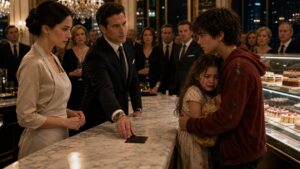
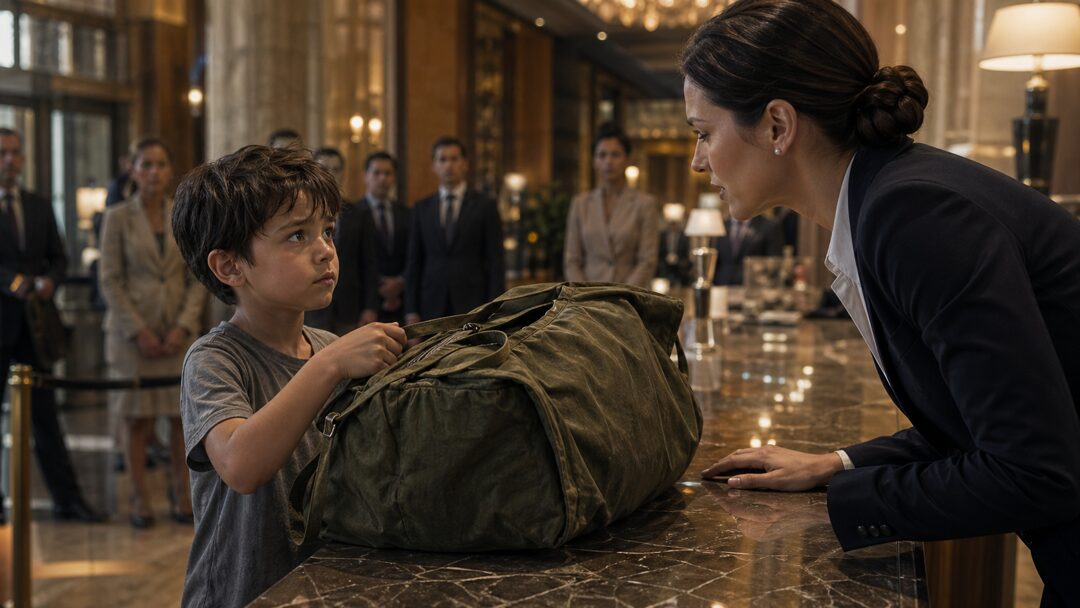
The boy dragged the green duffel bag into Whitcomb Private Bank like it was a body he had promised not to abandon.
It bumped once against the glass door, once against the brass threshold, and then again across the pale marble floor, each sound too loud for a lobby where rich people lowered their voices as if volume were a tax. The boy was small, maybe nine, with a faded gray T-shirt, scuffed sneakers, and both hands clenched around the strap.
Behind the reception counter, Celia Ward looked up with the smile she had practiced for eleven years.
Not too bright. Not too intimate. Warm enough to make powerful people feel harmless.
“Hello,” she said, leaning slightly forward. “Are you lost?”
The boy stopped in front of the dark marble counter. His hair was damp at the edges from sweat. His cheeks were flushed from the effort of pulling the bag across the lobby.
He shook his head.
“I’m here to make a payment.”
Celia’s smile held for one second too long.
A man in a charcoal suit glanced over from the waiting area. A security guard near the door shifted his weight. The lobby’s chandelier glittered above them, expensive and useless.
“A payment?” Celia asked gently.
The boy nodded. “For Lena.”
The name struck something in her, but she kept her face smooth.
Whitcomb Private Bank served families whose names opened doors before they knocked. Celia had learned not to react to names. Reaction gave people power. Still, Lena was not just a name.
Lena Rivera.
Adrian Vale’s fiancée.
Celia looked down at the child again and noticed what she had missed at first: he was not wandering. He was not frightened in the way lost children were frightened. He was frightened like someone who had made a decision and was already paying for it.
“What’s your name?” she asked.
“Milo.”
“And who brought you here, Milo?”
“I came by myself.”
The security guard took one quiet step closer.
Celia lifted one hand behind the counter, a small gesture telling him not yet.
Milo tried to lift the duffel bag. His thin arms strained. The bottom scraped against the side of the counter, then fell back with a dull thud.
Celia came around from behind the counter. “Let me help you with that.”
“No.” He tightened his grip. “I have to do it.”
That was when the lobby began to pay attention.
Not openly. People like that did not stare openly. They turned their bodies a few degrees. They paused over phones. They pretended to examine artwork while listening.
Milo bent his knees, hugged the bag, and heaved it onto the counter. It landed heavily enough to make Celia’s breath catch.
A child’s backpack did not sound like that.
“Milo,” she said, quieter now, “what’s inside?”
He pulled the zipper.
Slowly.
The sound cut through the lobby.
Metal teeth opening. A child breathing hard. A woman somewhere stopping mid-sentence.
The green fabric fell apart.
Inside were bundles of cash.
Neat stacks. Bank-banded. Thick. Too much money to belong in a child’s hands, too much to explain with birthdays or chores or any innocent lie the room wanted to believe.
Celia’s smile disappeared.
For a moment she was not a client-relations director, not a woman in a navy blazer trained to keep scandal soft. She was just a person staring at a nine-year-old boy with a bag full of money.
The security guard moved again.
Milo placed one hand over the cash as if someone might take it before he could say why it mattered.
“It’s for my sister,” he said. “So she doesn’t have to marry him.”
Celia looked from the money to the boy.
“Marry who?”
Milo swallowed.
“Adrian Vale.”
The name did not strike this time.
It opened an old door.
Part II — The Room Without Windows
Celia got Milo away from the lobby before the bank could turn him into an incident.
She closed the duffel. She told the security guard she would handle it. She told the assistant manager to cancel her next appointment. Her voice remained low and clean, the voice that made crisis sound like scheduling.
Then she led Milo into a private consultation room with frosted glass walls and no windows.
The room smelled faintly of coffee, leather, and flowers changed every morning by a florist who knew not to use anything too sweet.
Milo sat in the chair across from her but kept one hand on the green duffel at his feet.
“You need to tell me where this came from,” Celia said.
He shook his head.
“Milo, that is a lot of money.”
“I know.”
“Did someone give it to you?”
“No.”
“Did you take it?”
His mouth tightened. Not guilt. Insult.
“It was in Lena’s closet.”
Celia stilled.
The old door opened wider.
She had met Lena Rivera only twice. Once at a bank luncheon, where Adrian kept a hand lightly at the small of Lena’s back whenever someone important approached. Once in this lobby, where Lena had waited alone while Adrian finished a private meeting with his father’s attorney.
Lena had looked beautiful both times.
Not happy.
Beautiful.
There was a difference, and Celia knew it too well.
“Does Lena know you brought it?” Celia asked.
Milo looked down at the bag.
“No.”
“Does your mother?”
At that, he looked up quickly. “Don’t call my mom.”
“Milo—”
“She’ll give it back to him.”
“To Adrian?”
“To his family.” His fingers curled into the strap. “And then she’ll make Lena smile again.”
The sentence landed harder than the cash.
Celia sat back slowly. She heard, beneath the child’s words, the shape of a room she had never entered: a mother telling a daughter to be grateful, a daughter standing still, a wealthy man offering rescue with a ring in his hand.
“What do you think this money is for?” Celia asked.
Milo frowned as though adults were exhausting. “It’s what they said we owed.”
“Who said?”
“Aunt Rosa said if we gave it back before tonight, Lena didn’t have to do the announcement.” He looked toward the frosted glass, where blurred silhouettes moved beyond them. “But she said Mom never would. She said Mom wants everyone to see Lena chosen.”
Celia closed her eyes for half a second.
Chosen.
The word had once ruined a year of her life.
Adrian Vale had never promised Celia marriage. He had never promised much at all. That had been the elegance of him. He gave attention like a privilege and withdrew it like weather. He called late. He sent cars. He remembered the exact wine she liked and forgot whole weekends when his mother needed him photographed beside someone appropriate.
Celia had told herself she understood the arrangement.
Understanding did not stop humiliation. It only gave it better furniture.
“Tonight is the Vale Foundation reception,” she said.
Milo nodded. “At the hotel. Lena’s supposed to say thank you.”
“For what?”
He hesitated.
Children knew when a truth had been made shameful by adults.
“For saving us,” he said finally.
Celia’s phone sat on the table between them. Calling Marisol Rivera would be correct procedure. Calling Adrian’s office would be political survival. Calling the police would turn Milo into the story before anyone asked what kind of adults had put him inside it.
Instead, Celia searched her contacts.
She had Lena’s number from a guest list.
Her thumb hovered over the name.
“Milo,” she said, “I’m going to call your sister.”
His eyes filled with alarm.
“Not Mom?”
“Not your mother.”
“Not him?”
“Not him.”
He watched her as if deciding whether grown women could still be trusted after everything he had heard them say.
Celia pressed call.
Lena answered on the fourth ring.
“Hello?”
Her voice was soft, controlled, already dressed for a public evening.
“This is Celia Ward from Whitcomb Private Bank,” Celia said. “Your brother is here.”
There was silence.
Then a breath so sharp it almost cut.
“What did he bring?”
Not where is he.
Not is he safe.
What did he bring.
Celia looked at the green duffel.
“You need to come now,” she said.
Part III — Brave Little Man
Lena Rivera arrived twenty-three minutes later wearing a pale silk dress under a beige trench coat, her dark hair pinned at the nape of her neck, her mouth painted the color of restraint.
Milo stood when he saw her.
For one second, his face became a child’s face again.
“Lena.”
She crossed the room fast and grabbed his shoulders. “Are you hurt?”
He shook his head.
Her hands moved over his arms, his face, his hair. Then her eyes dropped to the duffel.
The tenderness vanished so quickly Celia almost missed it.
“What did you do?” Lena whispered.
Milo’s face fell. “I brought it.”
“You shouldn’t have touched it.”
“I was helping.”
“You don’t understand.”
“I heard Aunt Rosa.”
Lena closed her eyes.
The silence that followed was full of things Celia was not supposed to know.
“He said if we pay before tonight, you don’t have to marry him,” Milo said. “I brought all of it.”
Lena crouched in front of him. Even then she looked like someone posing for a photograph under threat.
“Milo, listen to me. That money appearing here doesn’t fix anything. It makes everything public.”
“Good.”
“No.” Her voice cracked, then immediately repaired itself. “Not good. Public is where people like them win.”
The door opened before Celia could answer.
Adrian Vale stepped into the room without asking permission.
Of course he did.
He wore a dark tailored suit, no tie, silver watch at his wrist. His hair was perfect in the careless way expensive men purchased by never appearing to try. He looked first at Lena, then at Milo, then at Celia.
His gaze paused.
“Cece,” he said.
The name was soft. Familiar. Wrong in the room.
Lena heard it. Her face did not change, which somehow made it worse.
Celia stood. “Mr. Vale.”
Adrian smiled. “So formal now.”
“Your presence wasn’t requested.”
“No. But trouble has a way of using my name.”
He looked at the green duffel. Then, with a gentleness that made Celia’s stomach tighten, he knelt in front of Milo.
“You carried all that for her?” Adrian asked.
Milo said nothing.
“Brave little man.”
Milo’s shoulders stiffened.
Adrian rose and turned to Lena. His voice stayed warm. “You should have taught your brother not to embarrass himself in public.”
The line was quiet enough to be deniable.
Lena flinched anyway.
Celia saw it. Adrian saw Celia see it. His smile barely moved.
“There’s no need for drama,” he said. “We can return the funds to safekeeping, get everyone to the reception, and forget this happened.”
Milo stepped in front of the bag. “It’s not yours.”
Adrian looked down at him. “No?”
“It’s for Lena.”
“Everything I have given your family has been for Lena.”
Lena’s fingers tightened around the belt of her coat.
Celia heard the trap. For. Not to. For meant he remained the giver.
Lena said, “Adrian, don’t.”
“I’m not angry.” He moved closer to her. “I’m hurt.”
That was worse. Anger could be opposed. Hurt demanded comfort from the person being harmed.
“You knew?” Lena asked.
For the first time, Adrian’s expression paused.
Celia saw the tiny shift.
So did Lena.
Her voice dropped. “You knew about the money.”
Milo looked between them.
“What money?” he asked.
No one answered him.
Adrian reached for Lena’s hand. She let him take it for half a second before pulling away.
“Your mother was worried,” he said. “She came to me because she didn’t want you making a decision out of panic.”
Lena stared at him.
“My mother told you?”
“She wanted to protect you.”
“No,” Lena said. “She wanted better terms.”
The room went still.
Celia looked at the green duffel again.
Now she understood why Lena had been angry.
Not because Milo had failed.
Because he had found the one thing Lena had hidden well enough to believe it was still hers.
Milo’s voice came small. “Lena?”
She turned to him, and the anger on her face broke into something more painful.
“It was mine,” she said. “The money.”
His mouth opened.
“I was going to use it later. After tonight. After Mom was safe.”
“But you said you didn’t want to marry him.”
“I don’t.”
“Then why wait?”
Lena looked at Adrian, and for one terrible second Celia saw that some part of her still wanted him to answer differently. To say because I love you enough to let you go. To say I never meant to own you. To say anything that would rescue the past from what it had been.
Adrian only said, “Because your sister knows promises matter.”
Lena laughed once. It had no humor in it.
“Promises?” she said. “Is that what we’re calling receipts now?”
Part IV — The Childish Dowry
Marisol Rivera arrived in pearls.
That was the first thing Celia noticed. Not the fear in her eyes. Not the fury in the way she opened the consultation room door. The pearls.
They sat at her throat like a row of small white witnesses.
“Milo.” Her voice was soft enough to bruise. “Step away from that bag.”
Milo moved closer to Lena.
Marisol looked at her daughter. “Tell me this is not happening.”
Lena said nothing.
That was her answer.
Marisol crossed the room and reached for the duffel. Milo slapped his hand down on it.
“No.”
Marisol’s palm struck his fingers away before anyone could stop her.
The sound was small.
Milo did not cry. That made it worse.
Lena moved instantly. “Don’t touch him.”
“Do not make your brother pay for your pride,” Marisol snapped.
“My pride?” Lena’s voice was low. “Is that what you sold?”
Marisol’s face changed. Pain first. Then shame. Then the old armor.
“You think I wanted this?” she asked. “You think I wanted to stand in front of those people and thank them for saving us? I did what I had to do.”
“You told him about my money.”
“I told him you were unstable.”
Celia saw Adrian look away. Not ashamed. Bored by ugliness that no longer served him.
Marisol stepped closer to Lena. “You were going to destroy us because you couldn’t bear one evening of gratitude.”
“One evening?” Lena repeated.
“Tonight gives us time.”
“No. Tonight gives them a photograph.”
The door opened again.
This time the lobby entered with it.
Evelyn Vale stood outside the consultation room in a silver dress, flanked by two foundation staffers and a photographer holding a camera at his hip. Adrian’s mother had the face of a woman who had never been denied service in her life.
Her eyes moved over Celia, dismissed her, landed on Marisol, softened politely, then found the duffel.
“Oh,” Evelyn said.
One syllable. A verdict.
Adrian stepped forward. “Mother, this is being handled.”
“Clearly not.”
Milo reached for Lena’s hand.
Evelyn smiled at him as if he were part of the décor. “And this must be the little brother.”
Nobody spoke.
She moved into the room. The photographer remained just outside, pretending not to look.
Evelyn glanced at the cash, then at Lena’s pale dress beneath the open trench coat.
“My dear,” she said, “wedding nerves can make families do sentimental things.”
Lena went very still.
Evelyn turned toward the open door, where more donors and staff had gathered in the lobby, drawn by money and silence. She raised her voice just enough.
“It seems young Milo has brought a childish dowry,” she said with a light laugh, “to prove how dearly the Riveras value Adrian.”
A few people laughed.
Softly.
Socially.
The kind of laugh that asks permission from power before becoming sound.
Milo’s face burned red.
“It’s not funny,” he said.
Evelyn’s eyes flicked to him. “Of course not, sweetheart.”
Sweetheart sounded like a lid closing.
Adrian placed a hand on Lena’s back.
She did not move away.
That was the humiliation. Not the touch. Not the laughter. The fact that everyone saw the touch and understood what it meant: he could claim her even while her brother stood beside a bag of cash meant to free her.
Celia felt her own hands curl.
Years earlier, Adrian had touched her the same way in private elevators. Not in public. Never in public. Celia had thought secrecy meant tenderness. Later she understood it meant storage.
He had kept her where no one could ask what she cost.
Now Lena was being displayed, and somehow it was the same wound turned outward.
“We should go,” Adrian murmured to Lena. “The reception is waiting.”
Marisol touched Lena’s arm. “Please. One graceful evening.”
Lena looked at her mother.
There are sentences daughters wait their whole lives to hear. I’m sorry. I chose wrong. You are more than our survival.
Marisol gave her none of them.
Only, “Don’t ruin us.”
Lena looked down at Milo.
His eyes were wet now, but he still was not crying.
“I thought it would help,” he whispered.
For the first time all day, Lena stopped performing strength.
She bent and pressed her forehead to his.
“It did,” she said.
He shook his head. “You’re still going.”
“Yes.”
“Why?”
Lena closed her eyes.
When she opened them, they were different.
“Because they’re all there.”
Part V — The Podium
The Vale Foundation reception occupied the ballroom of the Vale Meridian Hotel, three blocks from the bank and a thousand miles from ordinary weather.
Crystal glasses. White flowers. Donors in black. Women in dresses that made silence look expensive.
By the time Lena arrived, the story had already softened itself into something harmless.
A nervous bride.
A devoted little brother.
A family overwhelmed by generosity.
That was how power survived: it translated pain before pain could speak.
Celia stood near the back beside Milo. She was not supposed to be there, not after refusing Adrian’s request to “put the funds back where they belonged” and not after telling her manager she would not file Milo as a security concern.
Her phone buzzed twice in her pocket.
Both messages from the bank.
She did not read them.
Milo held the green duffel by its strap. It looked lighter now. The money had been sealed temporarily in a bank office under Celia’s authorization, but she had brought the bag back to him. Empty things could still accuse.
Across the ballroom, Adrian guided Lena toward the stage.
He did not pull her. He did not need to.
His hand rested lightly at her elbow, just enough for the cameras to understand intimacy, just enough for Lena to feel direction.
Marisol leaned close as they approached the stairs.
“You owe us one graceful evening,” she whispered.
Lena smiled.
It was the smile that had fooled rooms for years.
Adrian stepped to the podium first. The ballroom quieted with immediate obedience.
“My family has always believed,” he began, “that charity is not simply giving. It is commitment. It is loyalty. It is the joining of futures.”
A soft applause moved through the room.
Lena stood beside him.
Milo’s fingers tightened around the strap.
Celia crouched slightly. “Milo.”
He looked at her.
“Whatever happens next,” she said, “stay where she can see you.”
Adrian continued. “Tonight, we celebrate not only the work of the foundation, but the union of two families who understand what it means to stand together through difficulty.”
Lena looked out over the room.
She saw Evelyn Vale near the front, smiling like mercy had a bloodline.
She saw Marisol with her pearls and wet eyes, already preparing forgiveness for herself.
She saw Celia in the back, still as a woman waiting for a verdict she had earned years ago.
She saw Milo.
A small boy in a gray T-shirt holding an empty green bag in a room full of people who had laughed at him.
Adrian turned to her. “Lena and I are grateful to announce—”
“No.”
The word was not loud.
It still ended the room.
Adrian paused, smile intact. “Darling?”
Lena took the microphone from the podium.
For one heartbeat, she looked terrified.
Then Milo started walking.
Celia did not stop him.
He crossed the ballroom with the duffel dragging lightly beside him now. No heavy thump. No cash inside. Just green fabric scraping across polished floor.
People watched him come.
Adrian’s face hardened by one degree.
“Milo,” Marisol hissed from the front row.
The boy climbed the stage steps and handed the bag to Lena.
She took it like he was giving her back her own name.
Then she placed the green duffel on the polished podium.
A murmur moved through the ballroom.
Lena unzipped it.
Empty.
Somehow that made people lean forward more.
“This is not a dowry,” Lena said.
No one laughed this time.
“This morning, my brother brought this bag to Whitcomb Private Bank because he believed what the adults around him had taught him. That if enough money changed hands, a person could be released.”
Adrian moved toward the microphone. “Lena, this is not the time.”
She looked at him.
“You made it the time.”
The room sharpened.
“My family owed the Vales money,” Lena said. “My engagement was presented as love. Then rescue. Then gratitude. Then duty.”
Marisol covered her mouth.
Evelyn’s smile remained, but it had lost its warmth.
Lena continued. “The money in this bag was mine. Every bracelet I sold. Every allowance I accepted from Adrian while pretending not to understand the insult. Every gift I smiled over and returned quietly for cash. I saved it because I thought if I gave back enough, I could leave without destroying my family.”
Adrian’s voice lowered. “I loved you.”
The microphone caught it.
The room heard.
Lena turned toward him slowly.
For a second, the whole story balanced there: the handsome man, the trapped woman, the word love dressed in its best suit.
“You loved having the power to forgive me for needing you,” she said.
No one moved.
Adrian’s jaw tightened.
“Careful,” he said softly.
There he was.
Not the generous fiancé. Not the wounded lover. Just the man beneath the velvet.
Lena nodded once, as if a final private question had been answered.
“My mother knew I was saving to leave,” she said. “She told Adrian. Not to protect me. To negotiate better terms.”
Marisol stood. “Lena—”
“You taught me to be grateful for being bought,” Lena said, looking at her. “I learned it well. That was the problem.”
A sound went through the room.
Not applause. Not yet.
Something less useful and more honest: discomfort.
Lena put one hand on the green duffel.
“Adrian can have the money back,” she said. “Not as payment. As evidence.”
Evelyn rose now. “This is absurd.”
Celia stepped forward from the back of the room.
“I can confirm the funds were presented at Whitcomb this afternoon,” she said, voice clear enough to travel. “I can also confirm Mr. Vale requested that the incident be mischaracterized.”
Her manager would fire her before dessert.
Maybe before coffee.
Celia felt strangely calm.
Adrian looked at her. “Cece.”
That name had once made her feel chosen.
Now it sounded like a leash someone had forgotten was old.
“My name is Celia Ward,” she said.
Milo smiled then, just barely.
Lena saw it.
That was enough.
She closed the empty duffel and lifted it off the podium.
“I’m not announcing a wedding date tonight,” she said. “I’m announcing that I am done mistaking a cage for a rescue.”
Then she stepped away from the microphone.
For a moment, nobody knew what to do without permission.
Then one woman near the back began clapping.
Not loudly. Not theatrically.
Just once. Then again.
Another person joined. Then another.
It did not become triumph. It became cover.
Enough sound for Lena to walk off the stage without hearing only her mother crying.
Enough sound for Milo to run to her.
Enough sound for Adrian Vale to stand alone at the podium, still wealthy, still powerful, but no longer holding the story in his hand.
Part VI — What the Bag Carried Home
The reception continued after they left.
That was the part Milo did not understand.
They walked out through the service hallway, past carts of champagne and trays of untouched desserts, while behind them music rose again. The world did not stop because Lena had told the truth. Wealth did not collapse from embarrassment. It adjusted the lighting and moved on.
Outside, the night was cold.
Lena stood on the curb with the green duffel hanging from one hand, empty except for one paper bank band Milo had slipped inside before the money was taken away.
He had asked if he could keep it.
Lena had said yes.
Not because it was proof of the money.
Because it was proof he had tried.
Marisol did not come after them.
That hurt more than Lena expected, though she had expected it all her life.
Celia came out ten minutes later without her blazer. She had it folded over one arm. Without it, she looked younger and more tired.
“My resignation will probably be accepted before I submit it,” she said.
Lena almost laughed. It came out as a breath.
“I’m sorry.”
“No,” Celia said. “I was overdue.”
They walked to the bus stop because none of them wanted to stand under the Vale Meridian awning waiting for a car Adrian might still believe he had the right to send.
Milo sat between them on the bench, holding the empty duffel on his lap.
Across the street, the hotel glowed gold. Through the tall windows, guests moved like figures inside a jewelry box.
Lena’s phone buzzed.
She looked down.
Adrian.
One message.
I would have protected you.
For a moment her thumb hovered above the screen.
She thought of his hand at her back. His voice calling her darling in front of donors. His gifts wrapped so beautifully that refusing them felt like cruelty. The way he had looked at her sometimes when no one else was watching, as if he truly believed wanting her was the same as loving her.
Maybe some part of him had loved her.
That was the ugliest part.
Love did not become harmless just because it was real.
Lena deleted the message.
Milo watched her do it.
“Are you mad at me?” he asked.
She turned to him sharply. “No.”
“But I ruined it.”
Lena took the paper bank band from the duffel and smoothed it between her fingers. It was creased now from Milo’s pocket, marked faintly with numbers that had seemed powerful that morning.
“You didn’t ruin my life,” she said.
His eyes searched her face.
“You interrupted the lie.”
The bus arrived with a sigh of brakes.
Celia stood first, then hesitated. “You don’t have to let me come.”
Lena looked at her, really looked.
At the woman Adrian had once hidden.
At the woman who had almost hidden the scandal too.
At the woman who had chosen, too late but not never, to step out from behind the counter.
“Come,” Lena said.
They boarded together.
Milo took the window seat. Lena sat beside him. Celia sat across the aisle, still holding her folded blazer like something she had shed but not yet learned to put down.
As the bus pulled away, Milo pressed his forehead to the glass.
The hotel slid backward.
The bank band rested in Lena’s palm.
Her mother did not call.
The future did not open cleanly. It waited, uncertain and unpaid.
But Milo’s hand found hers in the dark, and this time, when Lena held on, no one in the world could make it look like gratitude.