She Locked the Only Farm Road During a Medical Emergency, Then Learned Whose Life She Had Delayed
Chapter 1: The Ambulance Stopped at Barbara’s Gate
The ambulance siren stopped.
Barbara Hill heard that before she understood what it meant.
She was kneeling beside Samuel Wright in the gravel, one hand pressed against his shoulder, the other holding her phone on speaker while the dispatcher counted breaths with her.
The county road was nearly half a mile away.
The ambulance should have been getting louder.
Instead, the siren had gone silent at the gate.
Samuel’s face had turned the color of old fence paint.
“Samuel?”
No answer.
Ten minutes earlier, he had been carrying mineral supplements from his delivery truck toward Barbara’s equipment shed. He had set one sack down, rubbed the center of his chest, and said, “Give me a second.”
Then his knees folded.
Now Barbara could hear an engine idling somewhere beyond the cottonwoods.
She stood.
“Stay with him,” the dispatcher said through the phone.
“The ambulance is here.”
“I need you to stay with the patient.”
“It isn’t coming through.”
Barbara ran.
At sixty-six, she no longer ran gracefully. Her right knee complained before she reached the first bend, and gravel shifted under her boots. She kept going.
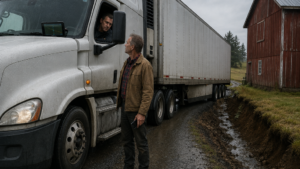
The shared lane crossed four properties before reaching the county road. Spring rain had carved shallow channels along the shoulders, but the center was firm enough for cattle trailers.
It was firm enough for an ambulance.
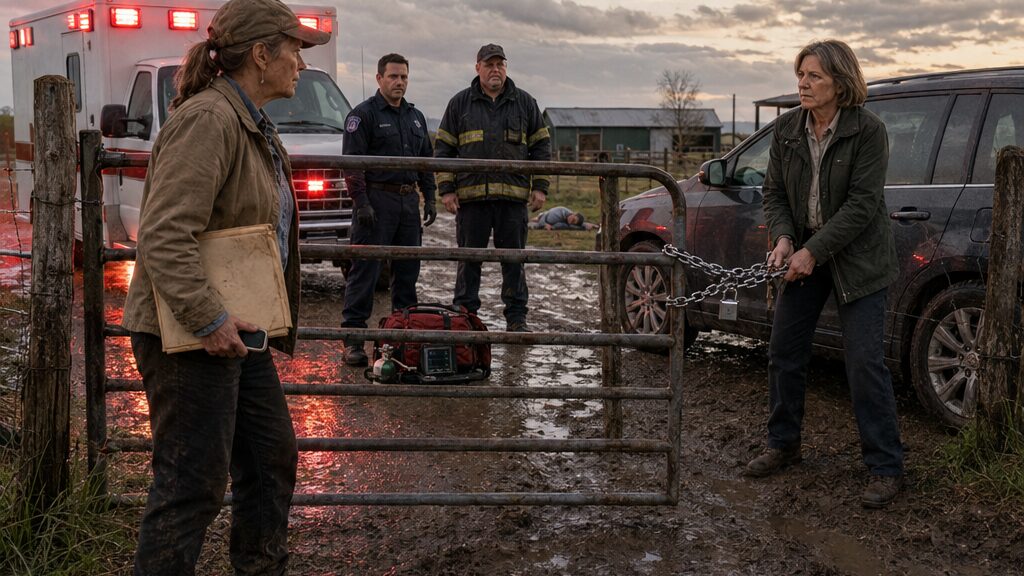
When Barbara cleared the last stand of trees, red emergency lights were flashing against wet fence posts.
Jennifer Moore’s utility SUV stood sideways across the entrance.
Barbara slowed only long enough to understand what she was seeing.
Jennifer was outside the vehicle.
And the gate was shut.
A paramedic leaned from the ambulance window. “Ma’am, we need this vehicle moved.”
Jennifer held up one hand.
Barbara shouted from thirty yards away.
“Jennifer!”
Jennifer turned.
“There’s a man down at my place.”
“I know.”
“Then move your truck.”
Jennifer’s jaw tightened. “Heavy vehicles require authorization now.”
Barbara stared at her.
Behind Jennifer, the ambulance lights washed the steel gate red, then white, then red again.
“That’s an ambulance.”
“I can see that.”
“Samuel Wright is lying in my driveway.”
Jennifer looked past Barbara toward the lane.
“This road was damaged again Tuesday.”
Barbara took another step. “Move the truck.”
“The association adopted restrictions for anything over the posted weight.”
“Jennifer.”
“We made exceptions before. That’s why nobody follows the rules.”
The rear doors of the ambulance opened.
A paramedic came around carrying a medical bag.
“How far is the patient?”
“About four-tenths,” Barbara said.
“Symptoms?”
“He grabbed his chest and collapsed. He’s barely breathing.”
The paramedic’s expression changed.
He turned toward Jennifer. “Open the road. Now.”
Jennifer pointed toward the rut beside the gate.
“That shoulder was repaired three weeks ago.”
“Ma’am, we have a possible cardiac arrest.”
For a second, nobody moved.
Barbara would remember that second more clearly than almost anything that followed.
Jennifer’s face did not look cruel.
It looked exhausted.
Stubborn.
Cornered.
As though the ambulance were one more truck in a long line of people expecting her to solve something at her expense.
Then Jennifer walked to the gate.
Barbara exhaled.
“Thank you.”
Jennifer reached for the chain.
Instead of removing it, she pulled it tight.
Steel scraped against steel.
The padlock clicked shut.
Barbara felt something inside her go perfectly still.
The paramedic swore under his breath.
“You were just told this is a cardiac emergency.”
“And I’m telling you this is private property.”
“No,” Barbara said. “You’re blocking a recorded access road.”
Jennifer faced her.
“You don’t get to quote access rights after refusing every road assessment we’ve sent you.”
“Not now.”
“It’s always not now with you.”
Barbara moved toward the lock.
Jennifer stepped between her and the gate.
“You cut that chain, Barbara, you’re paying for it.”
The paramedic was already pulling equipment from the ambulance.
Barbara looked at him.
“How much can you carry?”
“Enough. Where can we cross?”
She pointed toward the fence beside the gate. “Pasture runs parallel for two hundred yards. There’s an opening after the second post.”
The paramedic called to his partner.
Barbara took out her phone.
Jennifer gave a bitter laugh. “Of course.”
Barbara photographed the SUV first.
Then the gate.
Then Jennifer’s hand resting beside the locked chain.
She checked the time.
She took one final photograph wide enough to show the ambulance directly behind the obstruction.
Then she put the phone away.
“I’m done arguing.”
The paramedics lifted their bags over the fence.
Barbara climbed through after them.
By the time they reached Samuel, his breathing had stopped.
One paramedic dropped beside him while the other tore open equipment.
“Cardiac arrest.”
The words seemed to empty the entire pasture of sound.
Barbara backed away.
The paramedic began compressions.
Another emergency vehicle arrived at the gate several minutes later. The volunteer fire chief came across the pasture carrying additional equipment because the lane was still blocked.
Barbara met him halfway.
“Who controls that gate?” he asked.
“Supposedly the road association.”
“Supposedly?”
Barbara looked back toward Samuel.
The paramedics were working over him on the gravel where he had fallen.
She could hear clipped instructions, the snap of packaging, the electronic voice of the monitor.
Barbara swallowed.
“The easement was recorded before Jennifer chaired anything.”
The fire chief looked toward the distant gate.
“Emergency access?”
Barbara nodded.
“And service access.”
“You have a copy?”
“In my house.”
“Get it later. Stay out of their way now.”
The monitor gave a hard warning tone.
Barbara stood beside Samuel’s abandoned hand truck, staring at the sacks he had been carrying minutes earlier.
She had spent years believing that if she kept every deed, receipt, map, and signed agreement, nobody could tell her what she owned.
Now a man’s life depended on something more immediate than being right.
The paramedic called for another shock.
Barbara looked toward the gate.
Red lights continued pulsing beyond the trees.
The chain was still locked.
And somewhere in the county courthouse was a twelve-year-old document that said it never should have been.
Chapter 2: Twelve Years of Paper in One Envelope
The new padlock was still on the gate after dark.
Barbara stopped her pickup ten feet from it and stared through the windshield.
Samuel had been taken to the regional hospital. The paramedics had restored a heartbeat, lost it once during transport preparations, then gotten it back.
Nobody would tell Barbara more.
Jennifer’s SUV was gone.
The chain remained.
Barbara reversed carefully, used the pasture entrance, and took the longer route home.
Inside her farmhouse, she went directly to the small room where she kept farm records.
The file envelope was exactly where she remembered.
Brown paper. Soft corners. Her handwriting across the front:
ROAD / EASEMENT.
Barbara carried it to the kitchen table.
Twelve years earlier, when the lane had been formally recorded across the properties, her husband had wanted to sign the papers at the attorney’s office without reading every page.
Barbara had taken them home.
“You planning to find a hidden railroad in there?” he had teased.
“I’m planning to know what we’re signing.”
She had read every line twice.
After his death, the habit became something harder.
She signed nothing she did not understand.
Trusted no summary she could verify herself.
Barbara unfolded the recorded easement.
Ingress and egress.
Agricultural service.
Utilities.
Emergency access.
The words were plain.
She placed her phone beside the document and opened the photograph from that afternoon.
Jennifer’s chain.
The ambulance.
The gate.
For several seconds Barbara simply looked at the two things side by side.
Paper and steel.
One said the road must remain available.
The other had stopped it.
Her phone rang.
Jennifer.
Barbara let it ring twice before answering.
“You need to remove that lock.”
Jennifer skipped the greeting too.
“You need to stop presenting this like I woke up and decided to close your road.”
“You locked an ambulance out.”
“I enforced the restrictions everyone agreed were necessary.”
“Not everyone.”
“That’s the problem, Barbara.”
Barbara pressed her thumb against the edge of the easement.
“Emergency access is written into the recorded instrument.”
“Emergency access doesn’t mean a twenty-thousand-pound vehicle gets to destroy a repaired shoulder when there are other ways in.”
“There weren’t other ways in.”
“They got there.”
Barbara closed her eyes.
“They climbed a fence carrying cardiac equipment.”
Silence.
Then Jennifer said, quieter, “You think I wanted that?”
“I don’t know what you wanted.”
“I wanted one rule that applied to everybody.”
Barbara looked again at the photograph.
“You had your chance to make an exception.”
“That’s how we got here. Everybody is an exception.”
The call ended without goodbye.
At eight the next morning Barbara was waiting outside the county records office.
The clerk retrieved the original easement and the later filings attached to the road association.
Barbara read them standing at a counter.
The recorded access language had never been removed.
It could not simply be removed by a road-association vote.
That much was clear.
Then the clerk brought out a thinner file.
“Recent amendments.”
Barbara frowned. “How recent?”
“Last two years.”
There were maintenance schedules, weight recommendations, notices about commercial traffic and an agreement creating a road fund.
Jennifer Moore had signed.
Dennis Allen had signed.
The other property owners had signed.
Barbara turned the page.
Her line was empty.
She remembered the document.
Jennifer had brought it to her porch after a spring washout.
The proposed assessment had been based partly on acreage. Barbara owned the largest parcel, which meant she would pay the largest share.
She had refused.
At the time it had seemed simple.
Jennifer wanted authority over a road Barbara already had a recorded right to use.
Barbara had said no.
What she had not done was offer another formula.
The clerk slid another document toward her.
“This one was submitted later. Heavy-vehicle policy.”
Barbara read it.
Vehicles above a stated weight were supposed to receive prior approval during wet conditions.
“Does this override the easement?”
The clerk shook her head. “I can’t give legal advice.”
“I’m not asking for advice. I’m asking whether anything in the county record extinguishes emergency access.”
The clerk checked the pages.
“Nothing I see.”
Barbara copied everything.
Outside, she sat in her pickup with the files spread across the passenger seat.
For the first time since Samuel collapsed, the satisfaction she had expected did not come.
She had proof.
Jennifer could not erase emergency access with an association rule.
But the county file showed something else too.
For years, the other owners had been trying to create a system for maintaining the road.
Barbara had stayed outside it.
Her phone buzzed.
Dennis Allen.
“You at the courthouse?” he asked.
“Yes.”
“Figured.”
“What do you need?”
“I need you to come by.”
“Why?”
“Because if you’re collecting paperwork, you ought to collect all of it.”
His machine shed sat on the second property off the lane. Barbara drove there before noon.
Dennis was waiting beside the open door.
He did not offer coffee.
He did not ask about Samuel.
Instead, he looked at the envelope under Barbara’s arm.
“You found the easement.”
“Yes.”
“Good.”
Barbara waited.
Dennis wiped his hands on a shop rag.
“Jennifer was wrong yesterday.”
Barbara’s shoulders loosened slightly.
Then he continued.
“But don’t walk in here expecting me to pretend this started yesterday.”
He turned toward a workbench.
A stack of invoices sat on it.
Gravel.
Grading.
Drainage stone.
Culvert work.
Years of them.
Dennis put one hand on the pile.
“You want to know why Jennifer thought she could control that gate?”
Barbara said nothing.
Dennis looked directly at her.
“You left us carrying that road.”
Chapter 3: The Bill Barbara Would Not Sign
Dennis Allen laid twelve years of road bills across the workbench like evidence in a case Barbara had not known she was standing trial for.
Some she recognized.
Others she had never seen.
The oldest invoices were small—grader work, a load of limestone, ditch clearing.
The newer ones were not.
Barbara picked up a bill for culvert replacement.
“This much?”
“Emergency job.”
“When?”
“Two springs ago. After that cattle trailer dropped a wheel through the shoulder.”
Barbara remembered the trailer.
She remembered Jennifer complaining about it too.
What she did not remember was the amount at the bottom of the invoice.
“Who paid this?”
Dennis leaned against the bench.
“Jennifer.”
“All of it?”
“Most.”
“Why?”
“Because the contractor wouldn’t start without a deposit and nobody could agree on shares.”
Barbara set the invoice down.
“I never agreed to acreage-based assessments.”
“I know.”
“It made no sense. I own more ground, but I don’t put the most trucks over that road.”
“I know that too.”
“Then why are you talking like I refused to pay anything?”
“Because you refused the agreement and then stopped coming to meetings.”
Barbara’s mouth tightened.
“I stopped going because every meeting turned into Jennifer telling everybody what they owed.”
“And every time she did, you walked out.”
Dennis’s voice was not angry.
That made it harder.
Barbara glanced toward the shed door.
The lane was visible beyond the yard, pale gravel between fields.
“What was I supposed to do? Sign something I thought was unfair?”
“No. You were supposed to stay at the table and propose something fair.”
Barbara looked back at him.
Dennis pushed another paper across the bench.
A letter.
Insurance company letterhead.
Barbara read the first paragraph, then the second.
The insurer had documented concerns after the trailer accident: uncontrolled commercial traffic, inadequate drainage, unclear maintenance responsibility.
Possible nonrenewal if corrective measures were not implemented.
Barbara read it again.
“So this is where the restrictions came from.”
“Partly.”
“Jennifer told everyone insurance required permits.”
“She told us they wanted controlled access.”
“That’s not the same thing.”
“No.”
Barbara tapped the page.
“It doesn’t say lock the gate.”
“No.”
“It doesn’t say emergency vehicles need approval.”
“No.”
Dennis folded his arms.
“You’re waiting for me to defend her.”
“I’m waiting for you to tell me why you signed.”
“Because I had two thousand dollars in road repairs that year and Jennifer had more. Because trucks kept showing up after rain. Because nobody called ahead. Because if the insurance disappeared, every one of us had a bigger problem.”
Barbara stared at the culvert invoice.
Jennifer had been wrong at the gate.
Nothing Dennis said changed that.
A paramedic had told her Samuel was in cardiac arrest.
Jennifer had heard him.
Then she had locked the chain.
But Barbara could now see the years behind Jennifer’s hand.
Unpaid bills.
Washed shoulders.
A damaged culvert.
Neighbors saying later.
Neighbors saying not my share.
Barbara herself saying no and returning to her farm.
“What did she pay?” Barbara asked.
Dennis named the figure.
Barbara looked up.
“You’re sure?”
“I watched her write the check.”
“Why didn’t she bill me directly?”
“She did.”
“I never got one.”
“She sent you the assessment.”
“That wasn’t a bill. It was a demand based on acreage.”
Dennis gave a tired shrug.
“That right there is the whole problem.”
Neither spoke for a while.
Barbara gathered the invoices into their original order.
“May I copy these?”
“Take pictures.”
She did.
At the last page, she stopped.
The insurance letter had a second sheet.
Near the bottom was a sentence Jennifer had never quoted at any meeting Barbara attended.
Any access-control measures should preserve reasonable ingress for property owners, authorized service providers, and emergency response.
Barbara read it twice.
Then she photographed it.
Dennis noticed.
“What?”
“She left something out.”
He came beside her.
Barbara pointed.
Dennis read the sentence.
His face changed.
“That’s not how she explained it.”
“No.”
“She said the carrier wanted the gate controlled.”
“They did. They didn’t say she could close emergency access.”
Dennis rubbed his jaw.
Barbara could feel the old instinct returning—the clean satisfaction of finding the line that proved somebody else wrong.
This time she did not trust it as much.
“Why didn’t anybody check?” she asked.
Dennis gave her a look.
“You mean besides you?”
Barbara accepted that without answering.
They walked outside.
The gate chain had been loosened, but the new padlock still hung from it.
Someone had positioned the chain so ordinary vehicles could pass while leaving the hardware visible.
Barbara touched the cold steel.
Yesterday it had seemed like nothing but Jennifer’s arrogance made physical.
Now it felt heavier.
Not because Jennifer was less responsible.
Because the chain had been forged from more than one person’s stubbornness.
A pickup approached slowly from the county road and stopped outside the entrance.
The volunteer fire chief got out.
He carried a folder.
“I was looking for both of you.”
Dennis nodded toward Barbara. “You found one.”
The chief looked at the chain before looking at her.
“How’s Samuel?” Barbara asked.
“Still critical. Hospital says stable enough that they’re cautiously hopeful.”
Barbara released a breath she had not realized she was holding.
The chief opened his folder.
“I’m documenting the access delay. Sheriff’s office is doing its own report.”
Dennis glanced toward Barbara.
The chief continued.
“I need the exact policy Jennifer says authorized her to keep us out.”
“I have the county filings,” Barbara said.
“I’ve seen those. I want the association version. Minutes, amendments, notices—whatever she was enforcing.”
Dennis said, “Jennifer keeps those.”
“Then I need them from Jennifer.”
Barbara handed him her photograph of the insurance letter.
“Read the bottom.”
The chief did.
His eyes paused on the emergency-access language.
“That seems pretty plain.”
“It is.”
“But it still doesn’t tell me whether Jennifer misunderstood the warning or made a rule she knew went further.”
Barbara looked down the lane toward Jennifer Moore’s property.
For two days she had wanted a simple answer.
Jennifer was wrong.
Barbara was right.
Samuel had nearly died because Jennifer cared more about authority than people.
The first part remained true.
The rest was no longer simple.
The fire chief closed the folder.
“I’ve asked her to provide the gate-access policy in writing by tomorrow morning.”
Barbara looked at the chain one more time.
Tomorrow, Jennifer would have to show exactly what rule she believed she had been enforcing.
And for the first time, Barbara was no longer sure whether the document would expose only Jennifer.
Chapter 4: The Rule Jennifer Invented From a Warning
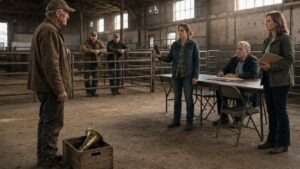
Jennifer Moore arrived at the barn office carrying the original insurance letter in a clear plastic sleeve.
She did not sit.
Barbara noticed that first.
Dennis Allen had pulled four folding chairs around an old desk, but Jennifer stayed beside the door with her coat still on and the gate key hanging from a short brass ring in her hand.
The volunteer fire chief stood near the window. Two other landowners sat against the wall.
Nobody bothered with small talk.
Jennifer placed the letter on the desk.
“There,” she said. “That’s what I was working from.”
Barbara did not touch it.
“I’ve seen it.”
“Not my copy.”
“The wording won’t change.”
Jennifer looked at her. “You’d be surprised what changes when people read the whole thing.”
Dennis shifted in his chair.
Barbara almost laughed.
Three days earlier, she would have taken the opening and driven straight through it.
Instead she said, “Then read the part you think authorized the gate.”
Jennifer’s fingers tightened around the key ring.
“The carrier required controlled access after the trailer accident.”
“Required?”
Jennifer slid the letter toward the fire chief.
“They made it very clear that if we kept allowing uncontrolled commercial traffic, coverage could be reviewed.”
The chief read silently.
Barbara watched his eyes move down the page.
Jennifer continued.
“I had a culvert fail. I had shoulders cut to pieces. I had delivery trucks using that lane after rain because nobody wanted to inconvenience a customer. I paid thousands out of pocket while everyone else debated percentages.”
Her eyes flicked toward Barbara.
“And one owner refused to sign anything at all.”
Barbara let the words stand.
The fire chief tapped the paper.
“This says you needed corrective measures.”
“Yes.”
“It also says emergency ingress has to remain available.”
Jennifer’s face hardened.
“That clause doesn’t mean an ambulance can take any route it wants regardless of conditions.”
“It was the only usable road.”
“There’s a pasture.”
Barbara felt her hands go cold.
“They carried cardiac equipment across that pasture.”
“And they reached him.”
The fire chief looked up.
“That isn’t the standard.”
Jennifer turned toward him. “I didn’t know the man’s condition when I first stopped them.”
Barbara leaned forward.
“But you knew before you locked the chain.”
Silence settled over the office.
One of the landowners looked down at his boots.
Jennifer’s thumb rubbed the edge of the brass key.
“The paramedic said possible cardiac arrest.”
“No,” Barbara said. “He said cardiac arrest.”
Jennifer looked at her.
Barbara could still see the scene with painful clarity: wet fence posts flashing red, the paramedic’s medical bag, Jennifer’s hand pulling the chain tight.
“You heard him,” Barbara said.
Jennifer’s voice dropped.
“I heard a stranger shouting at me while three vehicles were blocking the county entrance.”
“You heard what he said.”
“Yes.”
The word changed the room.
Dennis sat back slowly.
The fire chief closed the plastic sleeve.
“So after you knew it was a cardiac emergency, you secured the gate?”
Jennifer’s eyes moved from him to Barbara and then to the other landowners.
“Yes.”
One of them muttered, “Jennifer.”
She turned on him.
“Don’t.”
“I’m not doing anything.”
“You’re doing exactly what everyone always does. You let me be the bad person until something gets fixed, and then the minute it looks ugly, you step away.”
Dennis said, “Nobody told you to lock out EMS.”
“No. You just told me to keep the road from getting torn apart.”
“That isn’t the same thing.”
Jennifer laughed once, without humor.
“It was when the grader bill came.”
Barbara saw then what she had missed for years.
Jennifer did not love rules.
She loved certainty.
A number on an invoice.
A locked gate.
A key in her own hand.
Things that did not change depending on who was asking.
Barbara understood the impulse more than she wanted to.
The fire chief opened another folder.
“I asked for the policy itself.”
Jennifer pulled two stapled pages from her bag.
“This is what the association adopted.”
Barbara took the copy Dennis passed her.
Heavy commercial vehicles were supposed to obtain approval during saturated road conditions.
Farm owners could authorize necessary agricultural service.
Emergency language was absent.
Barbara read the signature page.
Jennifer.
Dennis.
The other owners.
Not Barbara.
“No unanimous approval,” Barbara said.
Jennifer gave her a hard look. “You weren’t participating.”
“That doesn’t expand your authority.”
“It left us with no workable system.”
“So you wrote one.”
“We adopted one.”
“You wrote the permit requirement.”
“Yes.”
“From an insurance warning that never required permits.”
Jennifer said nothing.
Barbara held the page up.
“You took a warning and turned it into authority you didn’t have.”
Jennifer’s face flushed.
“I took a warning seriously.”
“That still doesn’t let you decide an ambulance needs permission.”
“No.”
The answer came so quickly Barbara almost missed it.
Jennifer looked toward the table rather than at her.
“No, it doesn’t.”
The room went quiet again.
For the first time, Barbara felt the pressure shift away from proving Jennifer wrong.
She had admitted it herself.
But the victory felt smaller than Barbara had imagined.
Jennifer sat at last.
She placed the gate key on the desk.
“I was tired,” she said. “That isn’t an excuse. I know that.”
Nobody interrupted.
“I had the insurer telling me one more claim could cost us. I had a culvert I paid for. I had people calling me whenever a truck got stuck, whenever somebody washed out a shoulder, whenever there was a bill nobody liked.”
Her gaze found Barbara.
“And every time I tried to get you into the same room, you acted like the whole arrangement was an attempt to steal your land.”
Barbara’s instinct rose immediately.
Because some of it was badly written.
Because the acreage formula was unfair.
Because after her husband died, she had learned what happened when people signed things they had not read.
All of that was true.
None of it answered Jennifer.
Barbara said only, “You still locked the gate.”
Jennifer nodded.
“I did.”
The fire chief took the key from the desk.
“Until this is resolved, there will be no locked emergency barrier controlled by one person.”
Jennifer did not object.
That, more than anything, unsettled Barbara.
One of the other landowners stood.
“I backed the weight restrictions. I’m not backing that.”
The second landowner nodded.
Dennis looked at Jennifer.
“We need a different chair.”
Jennifer’s mouth tightened, but she did not fight him.
Barbara should have felt satisfaction.
Instead Jennifer turned toward her.
“You want to talk about road damage? Fine. Let’s talk about where the commercial traffic came from.”
Barbara felt the room narrow.
Jennifer pointed toward the lane outside.
“You told supply companies to use this road every spring the low county route flooded.”
Barbara said, “For necessary deliveries.”
“You told them to come whether the road was wet or not.”
“That isn’t what happened.”
“Ask the drivers.”
Dennis watched Barbara now.
Jennifer continued.
“You want everybody to think I woke up obsessed with trucks? You were sending them through here before I was chair.”
Barbara stood.
The fire chief’s phone rang before she could answer.
He glanced at the screen and stepped aside.
“Chief speaking.”
Everyone waited.
His expression changed.
He listened for several seconds.
Then he looked directly at Barbara.
“All right. Thank you.”
He ended the call.
Barbara’s throat tightened.
“Samuel?”
The chief nodded.
“He woke up this morning.”
Barbara gripped the back of her chair.
Relief hit so sharply she had to sit again.
“He’s talking?”
“A little.”
The chief hesitated.
“He asked if somebody could get Barbara Hill to come see him.”
Jennifer’s accusation was still hanging in the room.
Now Samuel Wright—the one man who had driven that road for years from the other side of the windshield—was awake.
And he had asked specifically for Barbara.
Chapter 5: The Driver Remembered Both Sides
Samuel Wright’s first question was not whether his truck had been recovered.
It was not whether his company knew where he was.
It was not even how long he had been unconscious.
When Barbara entered the hospital room, he looked at her over the oxygen tubing and said, “Gate still locked?”
Barbara stopped beside the bed.
“No.”
Samuel closed his eyes briefly.
“Good.”
He looked older than he had four days earlier.
The hospital gown hung loosely around his shoulders. A monitor clicked and pulsed beside him, steady enough that Barbara found herself watching it anyway.
“You scared everybody,” she said.
Samuel gave a weak smile.
“Didn’t mean to.”
“You rarely do.”
A nurse adjusted his IV and left them alone.
Barbara had imagined this visit several times.
In every version, Samuel thanked her.
Maybe he told her she had saved his life.
Maybe she told him about Jennifer, the easement, the fire report.
Instead she pulled the visitor’s chair closer and said, “How much do you remember?”
“Dropping a bag.”
“After that?”
“Not much.”
He stared toward the window.
“Somebody telling me to stay awake. Your voice, I think.”
Barbara nodded.
“I stayed until they moved you.”
Samuel looked at her.
“Thank you.”
There it was.
The gratitude she had expected.
It gave her less comfort than she thought it would.
He noticed.
“What?”
“Nothing.”
“Barbara.”
She folded her hands.
“Jennifer says I’m part of the reason that road got so bad.”
Samuel’s expression changed.
Not dramatically.
Just enough.
Barbara caught it.
“You remember.”
“I’ve been driving fertilizer and mineral routes out there sixteen years.”
“That isn’t an answer.”
Samuel exhaled carefully.
“You want the hospital answer or the honest one?”
“The honest one.”
He looked at the monitor as if checking whether it would tolerate the conversation.
“Some springs the south county route floods.”
“I know.”
“When it does, dispatch sends us around your road.”
Barbara nodded.
Samuel continued.
“First time I remember, you called the warehouse yourself.”
Barbara frowned.
“When?”
“Years ago. Your husband was still alive.”
She remembered a late planting season. Feed delayed three days. Water over the county bridge.
“You needed mineral blocks before the cattle went to the north pasture,” Samuel said.
“That was necessary.”
“I’m not saying it wasn’t.”
“And the road was passable.”
“It was soft.”
Barbara said nothing.
Samuel shifted against the pillow.
“Then it became normal. South road floods, use Hill’s lane. Delivery behind schedule, use Hill’s lane. Big truck can’t turn at the lower entrance, use Hill’s lane.”
“I didn’t tell every driver that.”
“No.”
He paused.
“But when Jennifer started telling us to call ahead, you told our dispatcher we had an easement for farm service.”
Barbara felt heat rise into her face.
“I do.”
“You do.”
“So I wasn’t lying.”
“I didn’t say you were.”
“That’s what everybody keeps doing. Mixing up what’s legal with what’s convenient.”
Samuel looked at her for a long moment.
“Maybe that’s what both of you were doing.”
Barbara almost stood.
The impulse surprised her with its force.
Samuel saw it.
“Don’t get mad at a man with a heart monitor.”
Against her will, she let out a short breath that was almost a laugh.
Then he grew serious.
“Jennifer complained before she ever chaired that association.”
“About you?”
“About everybody.”
“She called our office after one driver put dual wheels off the shoulder. She was right about that one. We had no business sending that truck through after rain.”
Barbara remembered a torn patch near the culvert.
At the time she had blamed poor grading.
Samuel continued.
“Company was pushing routes. Drivers were pushing schedules. You needed supplies. Jennifer wanted the road protected. Dennis wanted everybody to stop fighting.”
“That sounds about right.”
“Everybody had a reason.”
Barbara looked at the floor.
“And nobody wanted the bill.”
Samuel nodded.
“No.”
For years Barbara had told herself that she refused Jennifer’s compact because the acreage formula was wrong.
That was true.
But there had been something else underneath it.
If she signed, she would be admitting that using the road created an obligation beyond the easement itself.
She had not wanted Jennifer defining that obligation.
So Barbara had chosen none.
No agreement.
No meetings.
No shared formula.
She had kept her right and left the problem behind.
Samuel said, “You still saved me.”
Barbara looked up.
“EMS saved you.”
“You called them. You stayed.”
“I also helped make the mess at that gate possible.”
Samuel was quiet.
Finally he said, “Jennifer locked it.”
“Yes.”
“That part belongs to her.”
Barbara nodded.
“And the rest?”
Samuel gave a tired shrug.
“Probably belongs to more people.”
Barbara sat with that.
Before leaving, she adjusted the water cup closer to his hand.
Samuel said, “Barbara?”
She turned.
“Next time I deliver out there, I’d like a road everybody understands.”
“So would I.”
Outside the hospital, Barbara did not drive home.
She went straight to the county records office.
The same clerk recognized her.
“Back again?”
“I need every version of the shared-road agreement.”
“You already copied the current filings.”
“I want the drafts too, if they were submitted or attached.”
The clerk studied her.
“Looking for something specific?”
Barbara thought of Jennifer’s chain.
Dennis’s invoices.
Samuel remembering trucks waiting at the gate long before the ambulance ever came.
“Yes.”
“What?”
“The one I refused to sign.”
Chapter 6: Barbara Put Her Own Name on the Agreement
“I helped create this problem.”
Barbara said it before anyone in the county meeting room had fully settled into a chair.
Dennis Allen stopped opening his folder.
Jennifer Moore looked up sharply.
The volunteer fire chief remained standing against the wall. The sheriff’s deputy sat near the door with the emergency-response report. An insurance adjuster had joined by request of the road association’s carrier.
Barbara placed three things on the table.
The recorded easement.
The old maintenance agreement she had refused.
And the steel gate chain.
It landed with a dull metallic weight.
“I did not lock that gate,” Barbara continued. “I did not block that ambulance. I won’t take responsibility for either one.”
Jennifer’s face remained unreadable.
“But I refused the maintenance agreement, stopped coming to meetings, kept using the road for deliveries, and decided that because the proposed formula was unfair, I had no obligation to help build a better one.”
Dennis leaned back slowly.
Barbara looked at him.
“You were right about that.”
Nobody applauded.
Barbara was grateful.
This was not a room for winning.
It was a room for fixing something.
The county clerk had helped them obtain a neutral framework used by several shared agricultural lanes in the county: a base contribution from each property, additional cost tied to documented commercial use, and extraordinary repairs allocated according to cause where that could reasonably be established.
Dennis tapped the formula.
“This is closer.”
Jennifer read it without speaking.
Barbara said, “My acreage is larger, but acreage alone shouldn’t decide the bill. I’ll pay the base share and the usage share. If my deliveries increase it, my contribution increases.”
One of the other owners nodded.
Dennis said, “Same for cattle trailers?”
“Same principle.”
The insurance adjuster turned a page.
“That addresses maintenance. It doesn’t fully address liability.”
Jennifer finally spoke.
“There.”
Barbara looked at her.
Jennifer pointed toward the adjuster.
“That’s what I’ve been saying for two years.”
The adjuster held up a hand.
“Concern about liability was reasonable. The response was not.”
Jennifer’s jaw tightened.
The adjuster continued.
“The carrier did not instruct this association to restrict emergency services. We asked for controlled commercial access, documented maintenance, and safe conditions.”
Jennifer stared at the table.
Barbara saw her thumb move as though searching for the gate key that no longer hung from her hand.
The sheriff’s deputy spoke next.
“Our report will document the delay. Whatever happens beyond that is outside this meeting.”
The words stripped away any temptation to turn the room into a trial.
Jennifer would face whatever consequences followed from the emergency.
But Barbara had come for the road.
The clerk slid forward a revised agreement.
“The easement remains unchanged. This agreement governs maintenance and ordinary access procedures. Emergency ingress cannot be conditioned on prior approval.”
Barbara read every line.
Old habits did not disappear simply because pride had been exposed.
She read the definitions.
The payment formula.
The notice requirements.
The dispute procedure.
Then she stopped.
Jennifer noticed.
“What?”
Barbara pointed.
“This leaves physical gate control with the road chair.”
Dennis leaned over.
“Only for wet-weather restrictions.”
“It still leaves one person with the lock.”
Jennifer said, “Somebody has to manage it.”
Barbara shook her head.
“No.”
Jennifer sat straighter.
“No?”
“No one person gets to decide whether everyone else has access.”
“That isn’t what it says.”
“That’s what it becomes when one person has the key.”
Jennifer’s eyes hardened.
“So your solution is no gate?”
“My solution is a gate that cannot trap an emergency vehicle outside.”
The fire chief stepped forward.
“There are breakaway emergency systems. Shared keyed access. Fire-service access boxes. Any of those would be better than what was there.”
Dennis nodded.
“Fine by me.”
Jennifer looked around the room.
One landowner said, “Me too.”
The other agreed.
Jennifer’s cheeks flushed.
Barbara could see the humiliation in it.
Not public disgrace.
Something quieter.
For two years Jennifer had been the person everyone called when the road washed out.
Now the same people were removing the one authority she had convinced herself made that burden manageable.
Jennifer pushed the agreement away.
“I’m not signing that.”
Dennis sighed.
“Jennifer.”
“No. You all want me responsible for keeping the road safe, but nobody wants me to have any authority to do it.”
Barbara slid the chain away from the papers.
It scraped across the table.
“I don’t want you solely responsible either.”
Jennifer looked at her.
Barbara continued.
“That was part of the problem.”
For once Jennifer had no immediate answer.
Barbara pointed to the contribution section.
“The fund gets shared.”
Then to the maintenance schedule.
“Inspection gets shared.”
Then to the emergency clause.
“And access gets shared.”
Jennifer looked at the adjuster.
“What happens if a truck tears out the shoulder after I told them not to enter?”
The adjuster answered.
“If the association follows a documented policy, preserves emergency access, maintains records, and reports incidents properly, the carrier has something it can actually evaluate.”
“That isn’t protection.”
“It’s more protection than an unofficial permit system.”
Jennifer looked exhausted again.
The same look Barbara had seen at the gate before the chain clicked shut.
Only now there was no ambulance behind her.
No dying man.
No excuse to decide in a second.
Barbara said, “Add language that commercial operators using the road against posted wet-weather restrictions can be held responsible for documented damage where the agreement allows.”
Jennifer glanced at her.
Dennis said, “That seems fair.”
The clerk began marking the draft.
Jennifer remained still.
Barbara could have pushed harder.
She could have reminded everyone what Jennifer had done.
Could have used Samuel’s collapse to make resistance look indecent.
Instead she waited.
Jennifer finally said, “And nobody can call a commercial load an emergency just because they need it that day.”
Barbara nodded.
“Agreed.”
“Actual emergency services are unrestricted.”
“Yes.”
“Fire, EMS, law enforcement.”
“Yes.”
“And if there’s a medical emergency requiring another service vehicle?”
The fire chief said, “Necessary emergency access should be broadly defined.”
The clerk revised the language.
They spent another hour on details.
No speeches.
Just arguments over gravel, axle weight, drainage, invoices, keys, notice, and responsibility.
The kind of dull work Barbara had spent years avoiding because dull work required compromise.
When the final copy came around, she read every page again.
Then she signed.
Barbara Hill.
Her handwriting looked unexpectedly small.
Dennis signed after her.
The two other owners followed.
The agreement reached Jennifer last.
She read the emergency clause twice.
Then she uncapped the pen.
“Liability language stays.”
“It stays,” Barbara said.
“And the chair does not keep the only key.”
“No.”
Jennifer looked at Barbara.
“You really trust everybody with one?”
Barbara glanced at the chain.
“No.”
A faint, reluctant change touched Jennifer’s face.
Barbara continued.
“That’s why we write down what happens when somebody misuses it.”
Jennifer lowered her eyes.
Then she signed.
The fire chief collected the old padlock for his documentation, but left the chain on the table.
Later that afternoon, Barbara and Dennis met at the gate with a contractor.
The old chain came down.
For the first time since Samuel’s collapse, Barbara stood in the exact place where Jennifer had pulled it tight.
She remembered the ambulance lights.
The paramedic climbing the fence.
Her own voice becoming useless from shouting.
Dennis held up the new emergency hardware.
“Not much to look at.”
“Good.”
He fitted it into place.
Barbara watched the gate swing freely, then settle back across the lane.
Jennifer’s truck approached from her property.
She stopped on the other side but did not get out.
For several seconds the three of them simply looked at the rebuilt gate.
Then Jennifer lowered her window.
“The south shoulder still needs stone.”
Dennis nodded. “Road fund has enough for the first load.”
Jennifer looked at Barbara.
“You’re paying the usage adjustment?”
Barbara felt the old answer rise automatically.
The defensive one.
The one that began with the easement.
She let it pass.
“Yes.”
Jennifer gave a single nod.
Then she drove through the gate.
No permission requested.
No permission given.
Just a shared road being used by someone who had a right to it—and, now, a written obligation to help carry what that right cost.
Chapter 7: The Gate That Could Open Without Permission
The service truck stopped at the gate in hard rain.
Barbara saw its headlights from the lower pasture and felt her body react before her mind did.
Her shoulders tightened.
Her hand went automatically toward the phone in her jacket pocket.
For one second she was back six weeks earlier, listening to an ambulance siren die at the county road.
Then the gate opened.
Jennifer Moore was standing beside it in a raincoat, one hand on the new latch.
She waved the truck through.
No argument.
No clipboard.
No key held like a warning.
The driver rolled forward slowly, tires staying in the center of the fresh gravel.
Barbara remained where she was beside the fence.
Jennifer saw her across the field.
Neither woman waved.
That was all right.
The road looked different now.
The county contractor had rebuilt the worst shoulder with stone from the new shared fund. The drainage ditch had been cleared. A fresh culvert marker stood near the bend where the trailer wheel had once dropped through.
The changes were not dramatic.
They were practical.
Barbara had come to appreciate that.
The old padlock was gone.
In its place was a breakaway emergency link approved by the fire department, along with shared keyed access for the owners.
The new policy was posted inside the weatherproof box beside the gate.
Commercial restrictions during saturated conditions.
Emergency access unrestricted.
Damage documented.
Costs assigned where possible.
Nobody had to ask one person’s permission to save a life.
Jennifer stepped away as the service truck passed.
She had resigned as road chair three weeks after the meeting.
Dennis had taken the administrative work temporarily, though he complained about it often enough that Barbara suspected he would not keep it long.
Jennifer still lived on her farm.
She still used the lane.
She still attended meetings.
At the first one after her resignation, she had spoken only twice.
Both times about drainage.
Barbara had not known whether to be relieved or disappointed.
Quiet was easier.
It was not necessarily better.
The service truck stopped near Dennis’s property.
Jennifer started back toward her own place.
Barbara climbed through the fence and walked toward the road.
By the time she reached it, Jennifer was fifty yards away.
“Jennifer.”
Jennifer stopped.
Rain drummed on both their jackets.
Barbara nodded toward the shoulder.
“Stone’s holding.”
Jennifer looked at it.
“So far.”
“Drainage helped.”
“Yes.”
Barbara almost smiled.
That was as close to agreement as they had managed in weeks.
Jennifer looked toward the new emergency hardware.
“Fire chief tested it yesterday.”
“I heard.”
“Opened in less than ten seconds.”
“Good.”
Jennifer shifted her weight.
There were things neither of them had said.
Barbara had never told Jennifer she understood now why the old invoices had made her desperate.
Jennifer had never apologized directly for the chain.
There had been statements to investigators.
Insurance interviews.
Formal language about judgment and procedure.
But not the simple words people used when they were only neighbors.
Barbara had thought about asking for them.
Then she decided she did not want an apology she had to extract.
Jennifer said, “I got the carrier’s renewal notice.”
Barbara looked at her.
“And?”
“Coverage stays.”
“That’s good.”
“With conditions.”
“Of course.”
Jennifer gave a tired little breath.
“Of course.”
The rain softened.
For a moment they stood on the road they had spent years fighting over.
Barbara said, “The usage report comes out next week.”
“I know.”
“My share will be higher than Dennis’s.”
Jennifer looked at her carefully.
“Yes.”
Barbara nodded.
“I figured.”
No argument followed.
That surprised them both.
Jennifer glanced down the lane.
“I should go.”
Barbara stepped aside.
Jennifer walked toward home.
Two days later, another truck appeared.
This one Barbara recognized before it reached the barn.
The agricultural supply company logo was faded on the door.
The driver parked near the equipment shed.
Samuel Wright climbed out.
Slowly.
Barbara came off the porch before he had taken three steps.
“You’re supposed to be taking it easy.”
“I am.”
“You call this easy?”
“I’m carrying one box.”
He pointed toward the passenger seat.
Barbara folded her arms.
“You could have sent somebody else.”
“Could have.”
Samuel looked healthier than he had in the hospital, but thinner than before the collapse.
He walked with a deliberate pace that made Barbara notice every step.
He opened the passenger door and lifted a small package.
“I’m not allowed to haul the big stuff yet.”
“Good.”
“My supervisor agrees with you.”
“Smart man.”
Samuel shut the door.
Barbara looked toward the lane.
“You drove through the gate.”
“Sure did.”
“Any trouble?”
He grinned.
“Disappointingly boring.”
Barbara let out a laugh.
Samuel started toward the porch.
“You know, I could carry that.”
“I know.”
“You nearly died on my driveway.”
“Exactly why I’m not wasting the recovery.”
He reached the bottom step and set the package down.
For a moment neither spoke.
Samuel looked back toward the road.
“Different gate.”
“Same gate.”
“You know what I mean.”
Barbara did.
The metal frame was still there.
The posts were still sunk into the same ground.
What had changed was who could close it.
And why.
Samuel said, “Company got the new rules.”
“Good.”
“They’re routing heavy loads around after rain now unless somebody confirms conditions.”
“That’ll help.”
“And your farm still gets deliveries.”
“That was the point.”
Samuel nodded.
He rested one hand on the porch rail.
“Jennifer ever come around?”
Barbara considered the question.
“She’s still there.”
“That isn’t what I asked.”
“No.”
Samuel waited.
Barbara looked across the pasture.
“She opens the gate.”
He smiled slightly.
“Maybe that’s a start.”
After he left, Barbara carried the package inside.
She did not open it immediately.
There was one other thing she had been meaning to do.
The old chain lay on the workbench in the barn.
The fire chief had returned it after the reports were complete.
For weeks Barbara had considered throwing it into the scrap pile.
That morning she took it down.
The steel was still scarred where it had rubbed against the gate.
One link carried a shallow bright mark from the day Jennifer pulled it tight.
Barbara held it for a while.
Not as proof.
Not anymore.
Proof had done its job.
She walked to the inside wall of the barn, near the cabinet where she kept road records.
A hammer hung from one nail.
She drove another nail beside it.
Then she lifted the chain and hung it there.
Heavy.
Visible.
Useless for locking anything.
Outside, a pickup rolled along the shared lane.
The gate opened.
The vehicle passed.
The gate closed again.
Barbara listened to the sound.
Metal settling against metal.
Nothing trapped.
Nothing denied.
Just a boundary that could open when it needed to.
She turned off the barn light and left the chain on the wall.
The story has ended.