The Fogbound Procession: The Silent Honor Guard That Redeemed Maine’s Hero
CHAPTER 1: THE MIST ON THE PORCH
The Atlantic fog hung over the rocky coast of Boothbay Harbor like a shroud of wet wool, dampening the sound of the bell buoys clanging across the black water of Casco Bay. At six in the morning, the pine needles dripping outside the weathered gray cedar-shingle house made a steady, lonely ticking on the wooden porch roof. Inside, the house smelled of woodstove ash, cinnamon tea, and the sterile rubbing alcohol that had become the scent of Evelyn Sterling’s final winter.
Clara Sterling pushed open the heavy storm door with her hip, carrying a chipped ceramic mug of black coffee out onto the front steps. At forty-eight, her brown hair was streaked with gray at the temples, her knuckles swollen from thirty years of teaching middle school English and five years of nursing her mother through congestive heart failure. She pulled her woolen cardigan tight against the raw, salt-chilled air, drawing in a long breath of morning pine.
She took one sip of coffee, lifted her gaze down the quiet suburban street—and froze.
Her hand began to tremble so violently that scalding black coffee sloshed over the rim, burning her fingers. She didn’t feel it. Her jaw dropped, her breath catching in her throat with a soft, strangled gasp.
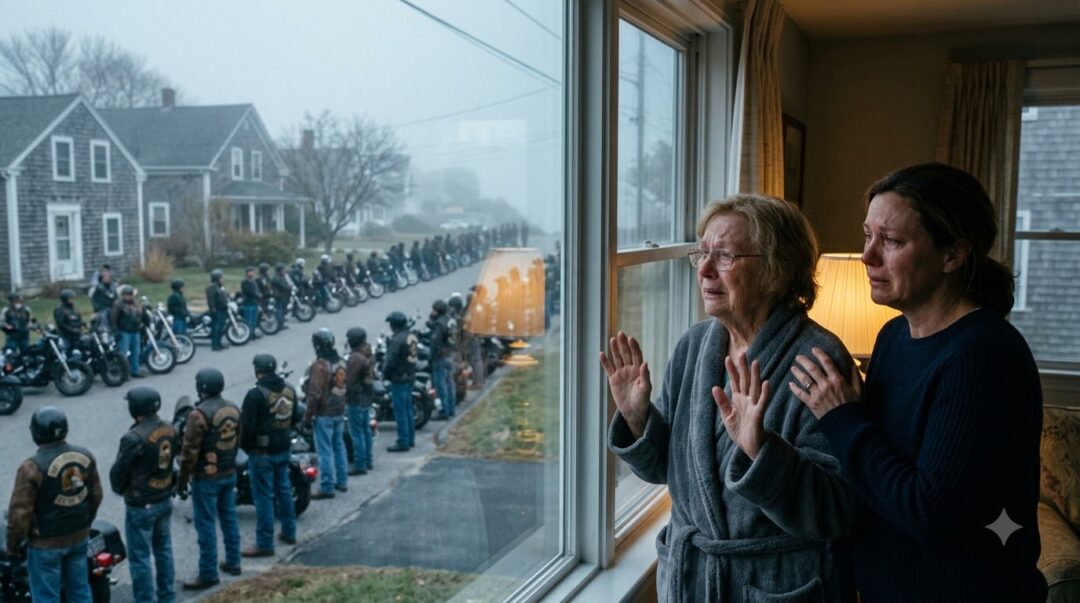
Lining both sides of the narrow asphalt roadway, emerging from the rolling ocean mist like an army of ghosts, was an unbroken, double-flanked column of heavy motorcycles.
There were at least one hundred machines parked along the curb, their massive chrome exhaust pipes and black steel frames glistening with ocean dew. Standing beside each motorcycle, perfectly spaced six feet apart and locked in rigid military parade rest, were men and women in heavy leather cuts and combat jackets. They wore no helmets. Their heads were bare to the freezing mist, their eyes fixed straight ahead in absolute, church-like silence. Not an engine was idling. Not a foot shifted in the gravel. Not a single word was spoken.
Clara spun on her heel, the storm door banging against the siding as she rushed back into the warm living room, her voice cracking with breathless urgency.
“Mom! Mom, you need to get up right now. You need to see this.”
In the corner by the brick hearth, seventy-eight-year-old Evelyn Sterling sat in her high-backed wing chair, an antique wool afghan tucked across her frail knees. Her silver hair was neatly pinned, but her face was translucent as parchment, her blue veins showing beneath delicate skin. Her withered hands rested upon the curved brass handle of her late husband’s mahogany walking stick.
“Clara, dear?” Evelyn asked, her voice a thin, raspy flute of exhaustion. “What is it? Did the heating oil truck finally arrive?”
“No, Mom,” Clara choked, tears suddenly blurring her vision as she reached down and gently helped her mother to her feet. “It isn’t the oil truck. Just come to the window. Please.”
Evelyn frowned, sensing the profound, trembling awe in her daughter’s touch. Leaning heavily on the walking stick, the elderly widow took slow, measured steps across the polished heart-pine floorboards, her knitted slippers scuffing softly against the braided rug. Clara held her mother by the elbow, guiding her to the broad picture window that looked out over the front lawn and the foggy street.
Evelyn looked through the glass.
The old woman stopped dead. Her free hand flew to her mouth, her fingers pressing against her lips as her eyes widened in utter, disbelieving shock.
Down the long suburban lane, through the shifting white coils of Atlantic mist, the line of leather-clad riders seemed to stretch into eternity. Two rows of black iron and silent men, their boots planted firmly in the damp pine needles, their faces carved from stone and sea salt. At the front of the formation, parked directly across from the Sterling driveway, sat a dark olive-drab Harley-Davidson cruiser fitted with an antique military scabbard.
Standing at the front wheel of the lead bike was an imposing man in his mid-fifties. His salt-and-pepper hair was cropped in a high-and-tight combat cut, his weathered jaw clenched with iron resolve. Across the chest of his worn steerhide cut was an embroidered name tape that read: JAX – GHOST WOLVES MC.
As if feeling Evelyn’s gaze through the glass, Jax Cross raised his right hand in a slow, crisp, textbook military salute, his knuckles coming to rest against his temple.
Simultaneously, with the mechanical precision of an elite infantry battalion, every single rider down the quarter-mile line snapped their right hands to their brows, holding the salute in complete, reverent silence.
Tears spilled over Evelyn’s wrinkled cheeks, glistening in the gray morning light. Her knees buckled slightly, but Clara caught her, wrapping both arms around her mother’s frail shoulders.
“Who… who are all these people, Clara?” Evelyn whispered, her voice breaking into a ragged sob. “Why are they here?”
Clara swallowed hard, her heart pounding with a warmth she hadn’t felt since her father died. “I think… I think he kept his word, Mom.”
Evelyn shook her head, tears streaming freely down her face as she looked out at the sea of leather and chrome.
“I only asked for one person,” Evelyn wept. “When Thomas died thirty years ago, I only asked Jax to come stand by the headstone. I only asked for one.”
Outside, Jax Cross lowered his salute, hooked his black helmet over the throttle grip, and turned on his heel. His heavy combat boots began marching up the gravel walkway toward the front door, each step ringing like a drumbeat.
In his left hand, Jax carried a heavy, water-resistant olive-drab tactical courier pouch sealed with red Department of Defense wax. As he reached the bottom step of the porch, Jax pulled a folded piece of paper from inside his vest and held it up against the storm door glass.
It was an official federal grand jury summons addressed to Evelyn Sterling, scheduled for eleven o’clock this morning at the United States District Court in Portland—signed by the Special Inspector General for Naval Procurement.
CHAPTER 2: THE CASCO BAY CONSPIRACY
The latch on the front door clicked, and Clara pulled the heavy wood inward, letting in a swirl of damp morning air and the scent of cold leather. Jax Cross stepped across the threshold, removing his gloves and tucking them under his arm with deliberate, disciplined grace. He stood six-foot-two, his broad frame carrying the quiet, coiled density of a man who had spent his youth clearing bunkers under fire and his middle age defending what remained of his soul.
He stopped three feet from Evelyn’s chair, brought his heels together, and bowed his head with profound deference.
“Mrs. Sterling,” Jax said, his baritone voice rough as coastal granite. “Thirty years ago in the hospital at Portsmouth, I swore to Master Sergeant Thomas Sterling that when the day of accounting came, the squad would assemble to stand as his shield. I apologize for being five minutes early.”
Evelyn reached out with both trembling hands, her frail fingers wrapping around Jax’s scarred, calloused knuckles. “Jax… look at what you’ve brought to my door. The neighbors…”
“The neighbors are watching true honor walk through this town for the first time in three decades,” Jax replied gently, kneeling on one knee so his eyes were level with hers. “We didn’t just come to pay our respects, Evelyn. We came to finish what Thomas started.”
Jax unzipped the olive-drab tactical pouch, sliding a heavy stainless steel container onto the small pine coffee table between them. The container was roughly the size of a shoebox, heavily oxidized with marine salt crust, its corners sealed with vulcanized neoprene rubber and stamped with US NAVY SUBMERSIBLE TELEMETRY UNIT.
Clara stared at the box, her breath catching. “Is that… from the Argus?”
“The USS Argus,” Jax nodded, his gray eyes darkening with the memory of fire and water. “November fourth, 1994. The Bath Iron Works test barge that suffered a catastrophic boiler explosion during sea trials off Casco Bay. Six civilian machinists and four naval technicians were killed instantly. Thomas was the master chief in charge of quality certification for the steam pressure bulkheads.”
Evelyn closed her eyes, a shudder passing through her entire body. “They blamed him. Victor Sterling—his own cousin, the CEO of Sterling Maritime Defense—stood before the congressional inquiry and testified that Thomas had signed off on substandard Chinese titanium valves in exchange for a fifty-thousand-dollar kickback. They stripped Thomas of his pension. They stripped his rank. When he died of a stroke six months later, the military denied him full honors at Arlington.”
“Because Victor Sterling needed a dead man to take the fall for his own corporate treason,” Jax said, his voice dropping into a deadly, vibrating whisper. “Victor didn’t buy Chinese valves; he skimmed twelve million dollars from the Navy hull reinforcement grant to pay off his gambling debts in Atlantic City. He installed thirty-year-old surplus carbon steel that had already rusted through in the warehouse.”
Jax tapped the oxidized steel box on the table.
“Thomas knew the truth,” Jax continued. “Before the sea trial, Thomas took the telemetry black box and a backup pressure transducer, locked them inside this watertight sonar casing, and bolted it inside the auxiliary bilge keel. When the boiler blew, Victor sent commercial divers down to scuttle the wreckage, claiming the telemetry unit was vaporized in the blast.”
Clara leaned forward, her knuckles white on the armrest. “How did you find it?”
“We’ve been diving that wreck every summer for eight years,” Jax said simply. “Twelve brothers from the Ghost Wolves, working seventy feet down in zero visibility, fighting the Atlantic currents with handheld sonar. Last Tuesday at two in the morning, Brother Tank finally burned through the collapsed bilge plate with an underwater torch. We brought this up forty-eight hours ago. We took it to a retired naval cryptographer in Kittery.”
Jax pulled a high-speed encrypted flash drive from his pocket, setting it beside the steel box.
“Every audio transmission, every pressure sensor log, and every voice recording from the bridge is intact on this drive,” Jax said. “It contains Victor Sterling’s direct order to bypass the primary pressure relief valves ten minutes before the explosion. And it contains Thomas’s voice, refusing the order, warning the crew, and manual-tripping the secondary fire suppression system to save eighteen men on the lower deck.”
Evelyn touched the cold steel of the telemetry box, a tear tracing the crease of her smile. “My Thomas… he was a hero to the very end.”
“He was the best commander this country ever produced,” Jax said firmly. “And at eleven o’clock today, the federal grand jury in Portland is convening to consider Victor Sterling’s multi-billion-dollar contract for the next-generation naval frigate fleet. The United States Attorney has issued an emergency subpoena for this evidence and for you, Evelyn, as Thomas’s surviving estate executor.”
Before Clara could speak, the rhythmic clatter of heavy rotor blades beat down from the overcast sky.
The windowpanes rattled in their wooden sashes. Outside, the pine trees bent under a sudden downdraft of turbulent air as an unmarked, matte-black Eurocopter EC135 helicopter descended out of the gray clouds, hovering fifty feet above the salt marsh behind the house.
Jax was on his feet in a fraction of a second, his hand resting on the heavy lockback knife at his belt.
Through the saltbox house’s rear window, Clara saw the helicopter’s sliding door lock back. Four men in dark tactical windbreakers and ballistic helmets rappelled down fast-ropes onto the wet grass of the orchard, carbines leveled at the back door.
Down the front street, a series of sharp, metallic horn blasts sounded from the line of motorcycles—the warning call of the Ghost Wolves.
CHAPTER 3: THE IRON ESCORT
“They’re not waiting for Portland,” Jax said, his voice flat and deadly as he pulled the stainless steel telemetry box and the encrypted drive into his courier pouch, slinging the strap diagonally across his chest. “Victor has private intelligence listening to the federal docket. He knows the grand jury was empaneled this morning.”
Outside the rear kitchen window, the four tactical mercenaries hit the wet sod of the apple orchard, weapons raised in low-ready patrol positions, their boots churning up black coastal mud as they advanced toward the back porch.
“Clara, take your mother’s cane and her wool coat,” Jax ordered without turning around. “We go out the front door. Right now.”
Jax kicked open the heavy front storm door, stepping onto the porch with Evelyn tucked securely beneath his right arm. Clara followed close behind, holding her mother’s leather handbag and the mahogany stick.
At the sight of Jax emerging with the elderly widow, the hundred-man formation on the street transformed with mechanical efficiency.
The dead silence was shattered by an earth-shaking, synchronized roar as one hundred heavy American V-twin engines barked into life at the touch of starter buttons. The sound rolled through the foggy neighborhood like rolling artillery thunder, shaking the shingles off the roofs and setting off car alarms three blocks away.
From the flanks of the formation, two massive riders—Tank, a six-foot-six former Navy Seabee with a braided gray beard, and Dutch, an Army combat medic—vaulted off their machines and sprinted up the walkway, their heavy boots eating the distance in seconds.
“Four shooters in the rear orchard!” Tank bellowed over the engine roar, racking the slide on a twenty-gauge tactical shotgun he kept under his leather cut. “They’re moving to cut the driveway!”
“Form the shield,” Jax commanded. “Get Evelyn into the rig.”
Parked at the foot of the walkway was a custom black trike fitted with an enclosed, steel-reinforced sidecar cab lined with padded aircraft insulation. Dutch lifted Evelyn with gentle reverence, settling her into the bucket seat and securing the heavy five-point safety harness across her lap. Clara climbed into the rear passenger saddle behind the rider, her arms locking around Dutch’s leather waist.
“Go! Go! Go!” Jax roared, swinging his leg over his olive-drab Harley.
Behind the house, the four mercenaries rounded the corner of the garage, their suppressed carbines coughing in rapid, muted bursts: phut-phut-phut.
Rounds chewed into the cedar clapboards of the Sterling porch, sending white wood splinters raining down onto the steps. But before the shooters could establish an aimed crossfire, Tank and three Ghost Wolves veterans formed a solid, unyielding human wall between the mercenaries and the driveway, returning fire with non-lethal beanbag rounds and blinding flash-flares from twelve-gauge launchers.
A magnesium flare struck the mud three feet in front of the lead mercenary, erupting into a four-thousand-degree wall of white chemical flame that completely scorched the man’s night-vision optics and forced the tactical team to dive into the drainage ditch.
“Roll out!” Jax shouted over the club’s open radio frequency.
The motorcycle convoy surged forward in an impenetrable, wedge-shaped phalanx, enveloping the sidecar rig in the center of an iron diamond. Twenty bikes rode point, twenty rode each flank, and forty machines brought up the rear, their high-beam halogen headlights cutting through the dense coastal fog as they banked onto Route 1 heading south toward Portland.
The road was slick with ocean mist, the black asphalt winding between towering walls of dark Maine pines. Jax rode point, his engine screaming at five thousand RPM, his eyes scanning the tree line and the overpasses ahead.
Behind them, Clara looked back over her shoulder through the exhaust haze.
Two heavy black Ford F-350 dually pickup trucks, fitted with reinforced steel pipe bumpers and tinted windows, had blown through the neighborhood stop sign at seventy miles an hour, falling into trailing pursuit three hundred yards behind the motorcycle rear guard.
“Jax!” Clara yelled into the intercom headset wired into Dutch’s helmet. “Two heavy trucks on our tail! They’re accelerating!”
“I see them,” Jax’s gravelly voice crackled back through the headset. “They’re trying to push us into the Sheepscot River bridge. It’s a two-lane drawbridge with zero shoulder and a two-hundred-foot drop into freezing tidal rapids.”
The cold Atlantic rain was now turning into a sleet that coated the asphalt in a slick, transparent glaze. Behind the sidecar, the heavy rumble of one hundred iron engines formed an impenetrable acoustic barrier that muffled the screaming sirens of the local township cruisers trying in vain to merge from secondary side roads. Every rider in the formation knew the history of Bath Iron Works; every man had lost friends to the sea or to the wars, and the chance to escort Thomas Sterling’s widow was not a duty—it was a holy pilgrimage. They held their spacing with geometric perfection, their headlights locked forward like an unbroken laser grid through the gray coastal storm.
Ahead, through the parting fog, the massive green steel trusses of the Sheepscot River bridge loomed against the pewter sky.
Just as the lead motorcycles reached the bridge approach, the warning bells on the crossing gates began to clang frantically. The red alternating lights flashed, and the heavy steel traffic barrier began swinging down across the lanes—manually triggered by someone inside the bridge tender’s control tower.
Simultaneously, a commercial sixty-foot logging truck loaded with thirty tons of raw spruce timber pulled out from an access turnout on the far side of the river, jackknifing deliberately across both lanes of the bridge deck to form an impassable barricade of iron and wood.
CHAPTER 4: THE COASTAL AMBUSH
The air horn of the jackknifed logging truck blared across the Sheepscot River, a deafening blast that reverberated off the steel trusses and echoed into the pine hills. Thirty tons of freshly cut green spruce logs were chained to the trailer bed, blocking every inch of the two-lane bridge deck, while twenty feet behind the barricade, the drawbridge span was already groaning as its hydraulic gears began lifting the road deck into the air.
“Emergency brake!” Dutch shouted through the intercom, his boots hovering over the trike’s dual disc brakes as the smell of burning rubber filled the morning mist.
“Negative! Maintain speed!” Jax’s voice roared through the headsets, absolute and unyielding. “Tank, take six bikes and secure the tender’s tower! Rest of the pack, form wedge left—we’re taking the pedestrian maintenance cat-track!”
To the left of the main roadway, separated by a heavy three-foot concrete curb, was a four-foot-wide service catwalk used by bridge inspectors and utility crews. It was suspended over the open chasm of the river, protected only by a waist-high chain-link railing that trembled in the freezing coastal wind.
Jax dropped two gears, his rear tire kicking out in a momentary skid of blue smoke, and launched his olive-drab Harley directly over the concrete curb onto the narrow steel-mesh walkway.
The metal grating hummed violently under his tires, cold salt spray rising through the mesh from the black tidal whirlpools eighty feet below.
Behind him, Dutch threaded the custom sidecar rig onto the catwalk with less than three inches of clearance on either side. Inside the cab, Evelyn Sterling sat with her chin raised, her hands clasping her husband’s walking stick, her eyes fixed on Jax’s leather back with the unflinching courage of a soldier’s widow.
From the jackknifed logging truck, two men in high-visibility vests pulled short-barreled pump shotguns from behind the cab, leveling them at the approaching motorcycles on the catwalk.
BOOM.
A blast of heavy buckshot shredded the chain-link fencing two feet above Clara’s head, sending rusted wire whipping through the air. Clara gasped, ducking low over Dutch’s back as glass shards from the sidecar’s mirror showered the grating.
Jax didn’t swerve. As his motorcycle closed the twenty-foot gap to the logging truck’s rear overhang, he unclipped a heavy six-pound steel emergency tow clevis from his sissy bar, swung it in a violent horizontal arc, and hurled the iron block through the truck’s driver-side window.
The impact caught the armed driver squarely in the chest, knocking him flat across the bench seat and sending his shotgun discharging uselessly into the cab ceiling.
At the bridge tender’s control tower, Tank and four Ghost Wolves had already kicked in the corrugated steel door. Within ten seconds, the frantic grinding of the bridge machinery reversed: the hydraulic span slammed back down onto its steel abutments with a concussive boom, while the traffic gates snapped upward.
The entire hundred-bike convoy cleared the far side of the Sheepscot River in a roaring wave of leather and chrome, leaving the logging truck stranded and disabled behind them.
“Damage report!” Jax barked as they banked back onto Route 1.
“Sidecar intact! Evelyn is breathing fine!” Dutch yelled back. “Rear guard reports the two black F-350s tried to cross the maintenance curb and sheared their steering tie-rods! They’re dead on the north bank!”
“Don’t celebrate yet,” Jax replied, checking his rearview mirror as the convoy accelerated toward the salt marshes of Yarmouth. “Victor Sterling has three maritime patrol cutters docked in Casco Bay and forty private security contractors on his payroll. We have fifteen miles to the federal courthouse, and the weather is closing in.”
Evelyn leaned her head back against the insulated headrest of the sidecar cab, her fingers tightening on the worn brass handle of Thomas’s stick. She could feel the steady, rhythmic pulse of Dutch’s engine vibrating through the steel chassis, a comforting mechanical heartbeat that drove away the bone-deep chill of the Maine morning. Clara reached over the side rail, resting her gloved hand over her mother’s trembling knuckles. For thirty years, they had lived under the shadow of a corporate slander that had poisoned their family name and driven them into poverty, but out here on the wet blacktop, surrounded by a legion of unyielding veterans, they were no longer victims. They were an advancing army.
As if in answer to his words, the ocean mist thickened into a driving, freezing coastal rain that pelted their face shields like needles of ice. The highway narrowed into a two-lane corridor hemmed in by dense spruce woods and rocky granite cuts.
Ahead, at the intersection of Route 1 and the Yarmouth Parkway, a row of three Maine State Police cruisers sat angled across the road, their blue and red strobes flashing through the driving downpour.
Standing in the center of the asphalt, wearing a heavy yellow storm slicker over his uniform, was Captain Douglas Vance—Victor Sterling’s brother-in-law and the commander of the state police coastal division. Behind him stood eight troopers with shotguns racked and leveled across their cruiser hoods.
A massive electronic message board at the roadside flashed the words: ROAD CLOSED – ARMED TERRORIST ESCORT – PULL OVER IMMEDIATELY.
Jax slowed the convoy to thirty miles an hour, his hand held high to signal a tight echelon formation behind his rear wheel.
“Troopers ahead with weapons drawn,” Dutch warned, his voice tight. “They’ve got a spike strip deployed across both lanes.”
“Nobody fires a shot,” Jax commanded into the radio. “Those troopers are state police, not mercenaries. They think they’re stopping an armed gang. Evelyn, get ready. It’s time for Thomas to speak to the uniform.”
The motorcycles rolled to a halt twenty yards from the barricade, their hundred engines dropping into a low, menacing, synchronized idle that shook the wet pavement beneath the troopers’ boots.
CHAPTER 5: THE TOLLBOOTH STANDOFF
The rain beat down on the hoods of the three state police cruisers with a hollow, metallic roar, streaming in sheets across the windshields and turning the gravel shoulder into yellow mud. Captain Douglas Vance stood before the cruiser grilles with his feet planted wide, his right hand resting on the unsnapped leather holster of his service sidearm, a bullhorn raised to his lips.
“Turn off those engines and dismount!” Vance’s voice boomed through the electronic speaker, distorted by the downpour. “Every rider step away from your machines with your hands on your heads! You are harboring a federal fugitive and transporting stolen classified naval materials! Any sudden movement will be met with lethal force!”
Behind him, the eight young troopers looked visibly unnerved. Facing an unmoving phalanx of one hundred battle-hardened motorcyclists whose leather cuts glistened with rain and whose eyes showed zero fear was not something covered in the state police academy syllabus. Several of the younger troopers’ shotgun barrels wavered slightly in the downpour.
Jax Cross killed his ignition. The silence that fell over Route 1 was broken only by the hiss of rain on hot exhaust pipes and the click of kickstands dropping into the asphalt.
Jax dismounted slowly, keeping both hands in plain sight at chest level, and walked back to the sidecar rig. He reached down, unlatched the fiberglass canopy, and unclipped Evelyn’s five-point harness.
“Easy now, Mother Sterling,” Jax said softly, his voice cutting through the storm. “Let them see who they’re aiming their shotguns at.”
Clara stepped down first, holding the large black golf umbrella over the open sidecar. Then, supported by Jax’s massive tattooed arm, seventy-eight-year-old Evelyn Sterling stood upright on the pavement.
She was shivering slightly in the thirty-five-degree rain, but her back was straight as a naval mast. In her left hand, she gripped Thomas’s brass-headed walking stick; in her right, she held an antique blue velvet presentation case stamped with the Department of the Navy’s gold seal.
Evelyn walked forward into the open space between the motorcycles and the police cruisers, her knitted slippers stepping calmly through the shallow puddles of rainwater. Clara walked beside her, keeping the umbrella steady, while Jax walked a half-step behind as her iron shadow.
Captain Vance frowned, lowering his bullhorn two inches as he recognized the frail widow whose late husband’s name was carved into the memorial wall at the naval shipyard ten miles south.
“Mrs. Sterling?” Vance shouted over the rain, his voice losing some of its aggressive bluster. “What are you doing with these outlaws? Your cousin Victor reported to the governor’s office that you had been abducted from your home by an armed motorcycle gang!”
Evelyn stopped ten feet from the cruisers, looking Vance directly in the eyes with a cold, unyielding dignity that made the captain flinch.
“Douglas Vance,” Evelyn said, her voice carrying through the rain with astonishing clarity. “Your father was a master rigger who worked beside my husband Thomas for twenty-five years at Bath Iron Works. When your father lost two fingers in the drydock crane accident in nineteen-eighty-one, it was Thomas who carried him through the blizzard to the dispensary. Did your father teach you to aim shotguns at eighty-year-old widows?”
The two troopers flanking Vance looked at each other, their shotguns dipping toward the asphalt. One of them, a young corporal with family ties to the shipyard, stepped back half a pace.
“Captain…” the corporal murmured through his teeth. “That’s Master Sergeant Sterling’s widow. My grandfather served under him on the Argus.”
“Quiet, Corporal!” Vance snapped, his face flushing crimson beneath his yellow slicker. He turned back to Evelyn, his voice rising in desperate defensiveness. “Mrs. Sterling, your husband’s record was sealed by a naval board of inquiry thirty years ago. Whatever you think you have in that bag, Victor has a signed federal court injunction from the First Circuit prohibiting the release of any proprietary Bath Iron Works design telemetry. You are violating federal law.”
“The First Circuit injunction was issued by a judge who owns two hundred thousand shares of Victor’s maritime holding company,” Jax Cross intervened, his voice booming over the highway like a thunderclap.
Jax stepped forward, unzipping the courier pouch and withdrawing a laminated document bearing the embossed seal of the United States District Court for the District of Maine.
“This is an emergency Writ of Habeas Subpoena, signed two hours ago by Chief Federal Judge Margaret Caldwell,” Jax said, thrusting the document into Captain Vance’s face. “The grand jury has already initiated proceedings on criminal fraud and maritime manslaughter charges. If you obstruct this witness for another thirty seconds, Captain, the United States Marshals Service will execute an arrest warrant for felony obstruction of justice on you and every officer on this line.”
Captain Vance looked at the federal writ, his eyes darting frantically over Judge Caldwell’s signature and the official judicial gold seal. His jaw worked silently as he realized he had been positioned as the expendable pawn in a multi-million-dollar corporate cover-up.
From the radio inside Vance’s cruiser, a sharp transmission crackled: ALL COASTAL UNITS – BE ADVISED. UNITED STATES MARSHALS ARE IN TRANSIT TO PORTLAND FEDERAL PLAZA. STAND DOWN ON ALL HIGHWAY INTERCEPTIONS OF THE STERLING MOTORCADE. REPEAT: STAND DOWN.
Captain Vance slowly lowered his hand from his sidearm. He looked from the federal writ to Evelyn’s steady, accusing eyes.
“Step aside, Douglas,” Evelyn said softly. “My husband has been waiting thirty years for this trial.”
Vance exhaled a long, defeated breath of steam into the rain. He turned to his men, motioning with his hand. “Clear the cruisers. Pull the spike strips into the ditch.”
The troopers moved with immediate, relieved haste, dragging the steel spike strips off the road and backing the cruisers onto the muddy shoulder.
As Jax guided Evelyn back to the sidecar, the young corporal who had spoken earlier snapped to attention beside his cruiser, raising a crisp salute to Evelyn as she passed.
Evelyn paused, nodding gently to the young man. “Thank you, son. Thomas would have been proud of you.”
Jax strapped Evelyn into the seat, swung his leg over his machine, and clicked the radio. “Ten miles to Portland Federal Plaza, brothers. Rolling thunder all the way.”
As the convoy accelerated through the cleared checkpoint, Jax’s helmet headset crackled with an urgent priority alert from Tank riding the forward scout line:
“Jax! We have visual on the courthouse perimeter! Victor Sterling didn’t just hire local security—he’s got three armed private maritime defense tactical teams barricading the federal steps, and the front entrance has been locked down by order of the county sheriff!
CHAPTER 6: THE PORTLAND BREACH
The industrial skyline of Portland emerged from the freezing rain like a gray silhouette of shipyards, church spires, and brick warehouses rising from the docks of Fore River. It was ten-forty-five in the morning. Inside the sidecar, Evelyn Sterling held Thomas’s walking stick with both hands, her gaze fixed straight ahead as the motorcade roared off the Interstate 295 connector into the heart of the city.
The hundred Ghost Wolves motorcycles rode in tight, thunderous formation down Commercial Street, the roar of their straight-pipe exhausts bouncing off the century-old brick facades of the waterfront. Pedestrians on the sidewalks stopped in their tracks, cell phones raised to film the incredible spectacle of an unbroken iron procession escorting a frail widow through the historic district.
Ahead, at the foot of Pearl Street, loomed the Edward T. Gignoux United States Courthouse—a monumental four-story neoclassical fortress of gray Maine granite, its ceremonial broad stone staircase rising thirty feet from the street to massive bronze double doors.
The plaza was an armed camp.
Parked across the lower steps were three armored transport trucks belonging to Sterling Maritime Security, their high-intensity strobes flashing yellow and amber. Twelve private contractors in black tactical parkas, carrying riot shields and collapsible batons, formed a locked shield wall across the lower landing, backed by two private canine units with German Shepherds straining against their leashes.
Standing at the top of the granite steps, beneath the shelter of the courthouse portico, was Victor Sterling.
At sixty-two, the maritime billionaire wore a charcoal cashmere topcoat with a silk scarf, his silver hair immaculate, his face a mask of arrogant, untouchable corporate power. Beside him stood his chief corporate counsel, holding an emergency injunction from the state superior court.
“Look at him,” Clara whispered through her tears, her hands trembling on Dutch’s leather shoulders. “He looks just like he did at my father’s funeral. Cold. Smiling. Like he owns the earth.”
“He owns a pile of stolen scrap metal, Clara,” Jax Cross said over the radio, his voice dropping into that terrifying, subterranean battle rhythm. “And his lease expires right now.”
Jax didn’t slow the convoy. He raised his left fist, signaling the formation into an aggressive, rolling fan-out maneuver that swept across Pearl Street, boxing in the three private armored trucks against the curb.
With a deafening squeal of rear tires, one hundred motorcycles slid into a double-row perimeter surrounding the courthouse plaza, cutting off every vehicular exit. Two hundred leather-clad boots hit the wet pavement simultaneously as the riders dismounted, their arms crossed over their cuts, forming an impenetrable wall of iron and bone that dwarfed Victor’s twelve private guards.
“Stand your ground!” Victor shouted from the portico, his voice cracking with sudden, shrill panic as he saw the sheer scale of the force surrounding his men. “You are trespassing on private security jurisdiction! That woman is legally incompetent to testify!”
Jax walked to the sidecar, lifted Evelyn effortlessly into his arms, and carried her to the base of the ceremonial staircase. Clara walked beside them, holding the stainless steel telemetry box in both hands like a sacred reliquary.
The twelve private guards with riot shields braced their boots on the granite steps, their knuckles whitening on their batons.
“Back off, biker!” the lead guard shouted, his voice trembling under his tactical visor. “We have orders from Mr. Sterling not to permit unauthorized entry to the courthouse!”
Jax didn’t argue. He didn’t draw a weapon. He took two steps forward until his towering, leather-clad chest was four inches from the lead guard’s polycarbonate shield.
“Son,” Jax whispered, his gray eyes pinning the guard like surgical steel. “Inside that federal grand jury room on the third floor is Chief Judge Caldwell and twenty-three citizens of Maine. Behind me are one hundred combat veterans who fought across three oceans so you could wear that rent-a-cop badge. If you touch this seventy-eight-year-old widow, you won’t need a lawyer—you’ll need an orthopedic surgeon to remove that shield from your throat.”
The lead guard stared into Jax’s dead, unwavering eyes, then looked past him at the hundred Ghost Wolves who were slowly closing the circle, step by step, their boots ringing on the granite.
The guard swallowed hard, lowered his riot shield to the stone steps, and stepped aside.
“Clear the stairs,” the guard ordered his men through his teeth. “We’re not taking a bullet for a maritime contractor.”
The remaining eleven guards lowered their batons and backed away, leaving the broad granite staircase completely open.
Victor Sterling’s face turned the color of damp chalk. He backed toward the bronze double doors, fumbling frantically with his cell phone, his corporate counsel already retreating into the lobby.
Jax set Evelyn gently down on her feet on the bottom step. She took Thomas’s walking stick from Clara, straightened the lapels of her wool coat, and began climbing the thirty granite steps toward her husband’s betrayer.
With every step she took, the hundred Ghost Wolves on the plaza struck the palms of their leather gloves against their thighs in a rhythmic, booming cadence that sounded like the approach of an oncoming storm.
THUD. THUD. THUD.
Evelyn reached the top landing, stopping four feet from Victor Sterling.
Victor tried to muster his boardroom arrogance, his lips twisting into a thin, desperate sneer. “Evelyn… be reasonable. Thomas was a tragic casualty of naval protocol. I set up a trust fund for you. Five million dollars—it’s yours right now if you walk back down those steps.”
Evelyn looked at him with an expression of cold, absolute disgust that silenced the billionaire in mid-sentence.
“Thomas didn’t serve this country for your money, Victor,” Evelyn said, her voice carrying through the portico. “He served it for his honor. And today, you’re going to pay that debt in full.”
Before Victor could speak, the massive bronze doors of the federal courthouse swung open from within.
Stepping out onto the portico was Chief Deputy United States Marshal Marcus Kane, flanked by six armed federal marshals in ballistic vests, their gold star badges gleaming against dark windbreakers.
Kane held a freshly stamped federal arrest warrant in his hand.
“Victor Sterling,” Marshal Kane announced, his voice echoing off the neoclassical pillars. “By order of the United States District Court, you are under arrest for conspiracy to commit maritime manslaughter, corporate fraud, and federal witness intimidation.”
Victor gasped, backing away with his hands raised. “This is an outrage! My attorneys—”
“Your attorneys are currently being questioned in Room 302,” Kane cut him off coldly.
Kane stepped past the trembling billionaire, walked to the edge of the steps, and snapped to attention before Evelyn Sterling, raising a crisp, formal salute.
“Mrs. Sterling,” Marshal Kane said with profound respect. “The grand jury is waiting for your testimony. Master Sergeant Sterling’s case has been called.”
CHAPTER 7: THE FINAL SALVO
The grand jury courtroom on the third floor of the Edward T. Gignoux Federal Courthouse was lined with polished dark walnut paneling and illuminated by tall arched windows overlooking the gray expanse of Portland Harbor.
The federal courtroom was bathed in the warm amber glow of antique brass chandeliers, their light reflecting off the high walnut wainscoting and the solemn faces of the spectators packing the rear benches. Every veteran who had stood on that foggy road this morning now stood silently against the courtroom walls, their hats held across their chests, their eyes wet with silent gratitude. Thomas Sterling had died in a modest cottage with thirty-four dollars in his savings account, but today, his integrity stood taller than the highest skyscraper in New England.
The room was packed to overflowing capacity. In the jury box sat twenty-three men and women of Cumberland County—shipyard workers, lobster fishermen, schoolteachers, and accountants—their faces grave with the solemn weight of the evidence before them.
At the witness table sat Evelyn Sterling, with Clara beside her holding her hand. Resting on the mahogany desk between them was the open, oxidized telemetry black box from the USS Argus, its magnetic tape spools spinning on a specialized forensic playback deck operated by a naval intelligence analyst.
Chief Federal Judge Margaret Caldwell presided from the bench, her silver spectacles reflecting the amber glow of the courtroom chandeliers.
The courtroom speakers hissed with thirty-year-old tape static, then filled with the crackle of a high-pressure naval steam chamber.
A cultured, impatient voice cut through the static—the unmistakable voice of a thirty-two-year-old Victor Sterling, recorded on November 4, 1994:
“…Thomas, I don’t give a damn about the secondary titanium weld. The naval inspection team is boarding at fourteen-hundred. Bypass the primary relief valve and run the test at maximum pressure. That’s an executive directive.”
Then came the voice of Master Sergeant Thomas Sterling—calm, deep, steady as an iron keel:
“Negative, Mr. Sterling. The carbon steel is forty percent below specification. If I bypass the relief valve, the aft bulkhead will rupture within twelve minutes. I have eighteen men down here in the steam tunnel. I will not sign off on this test. I am initiating emergency vent protocol right now.”
The sound of an alarm klaxon blared through the recording, followed by the deafening, catastrophic roar of a ruptured steam boiler and the concussive boom of collapsing steel. Over the chaos, Thomas’s voice could be heard roaring orders to his crew:
“Get through the escape trunk! Miller, grab the hatch! Go, go, go—”
The recording cut into silence.
Inside the federal courtroom, several grand jurors wept openly. In the front row of the gallery, Jax Cross sat with his head bowed, a single tear cutting a clean path through the road dust on his scarred cheek.
Judge Caldwell looked down from the bench at Victor Sterling, who sat at the defense table between two federal marshals, his head buried in his trembling hands, utterly ruined.
“In thirty-five years on the federal bench,” Judge Caldwell said, her voice trembling with righteous indignation, “I have rarely witnessed corporate malfeasance so monstrous, nor courage so pure. The grand jury has returned a true bill on forty-two felony counts, including nine counts of depraved-heart manslaughter.”
Judge Caldwell turned her gaze to Evelyn Sterling, her expression softening into deep, personal reverence.
“Mrs. Sterling, on behalf of the United States District Court and the Department of the Navy, I offer this nation’s deepest, most profound apology for the injustice your family has endured. Today, this court orders that Thomas Sterling’s military rank be posthumously restored to Master Chief Petty Officer, with full military honors, back pay to be distributed to his surviving family, and the official naval record corrected to reflect his heroic sacrifice in saving eighteen lives.”
The courtroom erupted into a standing ovation that shook the walnut rafters, marshals, clerks, and jurors applauding as Clara threw her arms around her mother, sobbing with overwhelming, triumphant joy.
Outside, on the broad granite steps of the federal plaza, the storm clouds were finally breaking apart.
A shaft of pale, golden autumn sunlight pierced through the retreating Atlantic fog, illuminating the two hundred Ghost Wolves motorcycles parked along Pearl Street. As Evelyn emerged through the bronze courthouse doors in her wheelchair, pushed gently by Clara, the riders snapped to attention once more.
Jax Cross walked down the steps to his olive-drab cruiser, reached into his leather saddlebag, and produced an antique, triangular wooden shadow box.
Inside the glass was a freshly minted Congressional Gold Medal and a folded American flag that had flown over the United States Capitol that morning, delivered by a federal courier.
Jax knelt beside Evelyn’s chair, placing the heavy walnut box into her lap.
“The mission is complete, Mrs. Sterling,” Jax murmured, his rough voice thick with emotion. “Thomas’s name is cleared across the entire fleet.”
Evelyn touched the polished glass of the shadow box, looking up into Jax’s eyes with a peace so profound it seemed to erase twenty years of sorrow from her face.
“He was always proud of you, Jax,” she whispered, her frail hand resting gently over his heart. “All of you. You brought him home.”
Jax stood upright, turned toward the street, and raised his right hand high into the air.
Two hundred motorcycle engines roared to life in an earth-shaking, triumphant crescendo of unmuffled American thunder. Jax swung his leg over his machine, lowered his aviator sunglasses against the breaking sun, and led the iron formation out of Portland, their exhaust pipes roaring toward the coastal horizon under a brilliant, cloudless blue Maine sky.
Clara and Evelyn sat together on the sunny courthouse steps, watching the great procession roll away, knowing that as long as free men rode the American road, the name of Thomas Sterling would never be forgotten.