She Stood Between the Bulldozer and Six Generations of Graves, but the Old Deed Wasn’t the Whole Truth
Chapter 1: The Bulldozer Stopped Before the White Cross
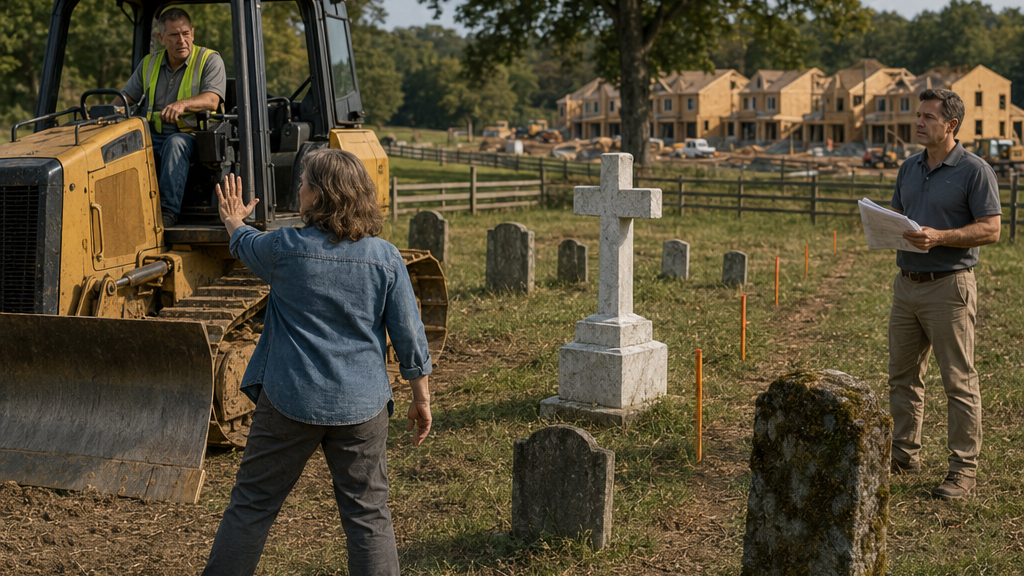
The bulldozer blade was less than twenty feet from the white marble cross when Sharon Hill came through the cemetery gate.
She did not remember dropping the quilt she had been carrying from the shop. One moment it was folded over her arm, the next it lay in the grass behind her while the diesel engine thudded against her ribs.
Fresh orange stakes cut a line across the rear edge of the cemetery.
That was what frightened her almost as much as the machine.
The stakes were wrong.
Sharon knew every crooked fence post and sunken corner of that half-acre. She had mowed around the stones since she was fourteen. The white cross belonged to her great-grandfather, and six paces behind it sat a squat granite marker half buried beneath moss. Her father had always pointed to that stone when he spoke about the burial-ground boundary.
The new stakes ran inside it.
She raised one hand.
“Stop.”
The operator either did not hear her or did not understand she meant him.
The tracks rolled forward another yard.
Sharon moved closer, staying to the side of the machine rather than directly in front of it. The operator finally looked down. He was broad-shouldered, maybe in his fifties, wearing a fluorescent vest over a gray work shirt.
He pulled back on the controls.
The engine dropped to an idle.
“What are you doing?” Sharon called.
The man opened the cab door but stayed seated. “Following the access line.”
“That isn’t the access line.”
His expression tightened with the weary caution of somebody who had been warned there might be trouble.
“You Mrs. Hill?”
“Yes.”
“Gary Roberts.” He pointed toward the orange stakes. “Those are what I was given.”
Sharon looked past him. Beyond the cemetery fence, stripped earth spread across the former cattle pasture the neighboring family had sold two years earlier. Drainage pipe lay in dark rows. Farther uphill, framed walls for the first townhouse buildings stood against the trees.
“You were given a bad line.”
Gary reached beside his seat and produced a plastic-sleeved packet.
“I’ve got a work order.”
Sharon almost laughed, except nothing in her felt amused.
“There are graves here.”
“I can see that.”
“Then why are you driving through them?”
“I’m not driving through them.”
He pointed again.
Sharon followed his finger. According to the bright stakes, the corridor curved between the cemetery fence and the white cross with barely enough width for the bulldozer.
According to Sharon, there had never been a road there.
Gary climbed down and handed her the packet.
At the top was the development company’s name, followed by parcel numbers, an equipment assignment, and a reference to a recorded construction-access easement.
The words caught her harder than she expected.
Recorded easement.
For years she had heard developers speak as though saying something officially made it true. But this looked more substantial than a letter or a phone call.
Gary tapped the page.
“My foreman says we have legal access.”
“Your foreman doesn’t own this ground.”
“No, ma’am.”
“Neither do you.”
“No.”
He was not arguing. That irritated her more.
Sharon pointed toward the moss-covered stone near the cross. “That marks the old cemetery corner.”
Gary glanced at it.
“The stake line says otherwise.”
“The stake line got here Thursday.”
“And that stone?”
“My grandfather showed it to my father. My father showed it to me.”
Gary looked from the stone to the orange flag.
“That doesn’t make it a survey monument.”
Sharon felt heat rise behind her neck.
“You willing to bet a grave on that?”
His face changed slightly.
Not fear. Attention.
She stepped closer to the edge of the flagged corridor. “Tell me something. If that stake is wrong and you go through somebody’s burial plot, whose name goes on it?”
Gary folded the work order.
“I run equipment. I don’t certify surveys.”
“That wasn’t my question.”
“No, ma’am.”
“Whose responsibility?”
Gary looked back toward the construction site.
A pickup was approaching over the temporary gravel road.
Before it arrived, Gary climbed into the cab and shut down the bulldozer completely.
The silence after the engine stopped seemed almost unnatural.
Sharon heard birds in the oak trees. A truck backing alarm sounded somewhere beyond the hill.
The pickup stopped beside the cemetery fence.
David White got out before the dust settled.
He wore clean work boots, khaki pants, and a company polo. He had already pulled his phone from his pocket.
“Gary, why are we shut down?”
Gary nodded toward Sharon. “Boundary dispute.”
David looked at her.
“Mrs. Hill.”
“You know who I am.”
“We sent notice.”
“You sent notice saying you were using an easement. You didn’t say you were putting a bulldozer five feet from my family.”
David glanced toward the cross.
“The survey crew marked the recorded corridor.”
“They marked it wrong.”
“Based on what?”
Sharon pointed to the old stone.
David followed her hand, then back to the stakes.
“Based on a rock?”
“Based on knowing this ground.”
He exhaled through his nose.
“I understand this is personal.”
That sentence made Sharon’s jaw tighten.
“It became personal in 1834.”
David lowered his phone.
“The cemetery isn’t being removed.”
“You don’t get credit for saying that while your machine is sitting inside the boundary.”
“Our title work shows an easement along this edge.”
“My deed shows a burial ground.”
“Those things can both be true.”
The answer stopped her.
Only for a second.
But David saw it.
He stepped closer to Gary’s work packet and opened it to a page Sharon had not noticed. A county recording number had been typed beneath the project description.
“This access right predates your ownership,” David said. “It was granted by the prior owner.”
Sharon stared at the number.
“My father owned this property before me.”
David nodded once.
“Then you may want to ask what he signed.”
Chapter 2: The Deed in the Rolltop Desk
The yellow folder was exactly where Sharon’s father had told her to keep it.
That frightened her.
She had expected, irrationally, that after all these years it might be gone.
The rolltop desk stood in the back room of her quilt shop between shelves of fabric and a window overlooking the lower pasture. Sharon unlocked the bottom drawer and pulled it open.
Tax receipts.
Old insurance policies.
A survey from the seventies.
Then the folder.
Its edges had softened to the color of old straw.
Her father had written HILL LAND in block letters across the front.
When Sharon opened it, the familiar smell of dry paper and cedar drifted up.
She found the deed halfway through.
The document had been copied more than once, but the language remained readable. Sharon sat at the desk and traced the description slowly with one finger.
Road frontage.
Creek boundary.
Oak reference.
Then the words she had been looking for.
A parcel of approximately one-half acre reserved in perpetuity for family burial purposes.
Sharon read the sentence twice.
Then a third time.
Her shoulders loosened for the first time since the bulldozer arrived.
She kept reading.
No structure, road, excavation, or other disturbance was to interfere with the burial ground.
There it was.
Not memory.
Not family tradition.
Not something her father had told her beside a fence when she was twelve.
Recorded language.
Sharon took a photograph and called Kimberly.
Her daughter answered on the fourth ring.
“Mom?”
“I found it.”
“Found what?”
“The deed.”
There was a pause.
“You’re at the shop?”
“Yes.”
“I thought you said they stopped work.”
“They stopped the machine. That’s not the same thing.”
Sharon sent the photograph.
Kimberly had worked around county records long enough to distrust photographs of isolated paragraphs.
“Send me the whole page.”
“It says burial ground.”
“I heard you.”
“And no road.”
“Send me the whole page, Mom.”
Sharon disliked the tone because it sounded too much like professionalism and not enough like a daughter taking her side.
She sent three more photographs.
While Kimberly read them, Sharon carried the folder out to the shop’s cutting table and flattened the deed under clear acrylic rulers.
Through the front window, she could see David’s pickup still parked beyond the cemetery.
No machine moved.
That was something.
Her phone rang again.
“The language is good,” Kimberly said.
“Good?”
“Strong. It means they can’t simply treat the cemetery as ordinary open ground.”
“Exactly.”
“I didn’t say it means there’s no easement.”
Sharon’s hand stopped on the ruler.
“Why are you defending them?”
“I’m not.”
“You sound like you are.”
“I’m trying to keep you from walking out there with one page and assuming the argument is over.”
Sharon stared at the old handwriting.
“My father never gave anybody permission to drive through that cemetery.”
“Maybe not through it.”
“Not beside it either.”
Kimberly was quiet.
That silence irritated Sharon more than disagreement would have.
“What?”
“Do you remember him mentioning a temporary access agreement?”
Sharon looked toward the back window.
“No.”
“Are you sure?”
“Yes.”
Another silence.
Then Kimberly said, “I can check the recording number David gave you.”
“You don’t work in this county.”
“I know people who do.”
Sharon almost told her not to bother.
Instead she gave her the number.
Twenty minutes later, Sharon walked back to the cemetery carrying copies of the deed.
Gary sat on the track of the bulldozer eating something from a paper wrapper. David stood at the hood of his truck with the construction foreman.
Sharon held up the copy.
“This is recorded.”
David took it.
She watched his eyes move over the reservation clause.
His expression did not collapse the way she wanted it to.
But he stopped talking long enough for satisfaction to move through her.
“There,” Sharon said. “No road. No excavation.”
David read further.
“This establishes the cemetery.”
“I told you it did.”
“I didn’t say it didn’t.”
“You acted like I invented the line.”
“I said our survey shows an easement.”
Gary had come closer.
David handed the deed back.
“I’ll pause equipment inside the disputed area until Monday morning.”
Sharon stiffened.
“Monday?”
“We have crews scheduled.”
“You have graves in the way.”
“We have competing recorded interests.”
“No. You have one valid deed and a mistake.”
David looked tired now.
“Mrs. Hill, I’m stopping the work. That’s what you wanted.”
She should have taken the win.
Instead she said, “I want the stakes removed.”
“No.”
“They’re wrong.”
“They’re survey control until someone proves they’re wrong.”
Sharon folded the deed sharply enough to crease the copy.
Gary glanced at her.
“Leave them,” he said. “If somebody’s checking the line, they need to see what we were given.”
It was sensible.
Sharon hated that too.
She walked back toward the shop with the temporary victory she had wanted, but it did not feel like victory anymore.
Inside, her phone was ringing.
Kimberly.
Sharon answered immediately.
“I found the reference,” Kimberly said.
Sharon leaned against the cutting table.
“And?”
“It’s real.”
“What’s real?”
“The later instrument.”
Sharon looked down at the yellow folder.
“What instrument?”
Kimberly spoke more slowly now.
“The recording entry says it was executed by the owner of the Hill property.”
“My father?”
“That’s what I need to confirm.”
“What does it say?”
“I only have the index description.”
“Read it.”
Kimberly hesitated.
Then she did.
“Temporary construction access easement.”
Chapter 3: Her Father’s Signature Changed Everything
Sharon knew her father’s signature before she read a single word above it.
The H leaned forward.
The last two letters of Hill ran together.
He had signed his name that way on checks, permission slips, Christmas cards, and the note he left on the kitchen counter the morning he drove himself to the hospital for the last time.
The signature on the easement was his.
Sharon sat perfectly still at the records-room table.
Kimberly sat opposite her with the copied instrument between them.
Neither spoke.
The clerk had already moved away.
Finally Sharon said, “He wouldn’t have.”
Kimberly did not answer.
“He would not have let somebody use that cemetery.”
“The document doesn’t say they can use the cemetery.”
“He signed an easement.”
“Yes.”
“Beside the graves.”
“Yes.”
Sharon pushed the paper away.
The circuit-court records room was too bright, too clean, too ordinary for the moment. Shelves of deed books lined one wall. A printer hummed behind the counter.
She wanted the document to look fraudulent.
It did not.
The agreement was dated seventeen years earlier.
It granted temporary construction and maintenance access across a narrow strip at the rear of the Hill property. The language was dry, precise, and indifferent to memory.
Then Kimberly tapped a paragraph halfway down the second page.
“Read this.”
Sharon did.
The access corridor was subject to a mandatory setback from all known burial markers and monuments associated with the Hill family cemetery.
Her eyes moved faster.
A survey exhibit had been incorporated by reference.
A fixed point near the cemetery was labeled WHITE MARBLE CROSS.
Sharon read that twice.
Her father had not forgotten the cross.
He had used it as a reference.
Kimberly leaned back.
“So the cemetery restriction is real.”
“I knew that.”
“And the easement is real.”
Sharon said nothing.
“Both things can be true.”
David’s words from Saturday returned to her with irritating clarity.
Sharon studied the attached map.
The access corridor ran closer to the cemetery than she would ever have agreed to.
But it did not cross the rectangle marking the burial area.
At its narrowest point, the permitted lane passed outside the cross with a specified setback.
Not much.
Enough.
Maybe.
Sharon folded her arms.
“They shouldn’t have been that close.”
“I agree.”
“You didn’t see that bulldozer.”
“I know.”
“You didn’t hear it.”
Kimberly’s voice softened. “No.”
Sharon looked away.
The anger had been easier when David was simply wrong.
Now the paper in front of her had turned the dispute into something she hated more: a question requiring precision.
Kimberly turned the survey exhibit toward herself.
“Did you know Dad had signed anything like this?”
“My father.”
“You know what I mean.”
Sharon’s jaw tightened.
Years earlier, her father had mentioned “an agreement about the back lane.”
That was how he had described it.
A temporary thing.
Some drainage work.
Maybe utility access.
Sharon had never asked for the document.
She had not wanted to know.
At the time, the farm had been struggling. Her father had been selling equipment piece by piece. Sharon had assumed any paper he signed involving neighboring land was one more humiliation he preferred not to discuss.
“I knew there was something,” she said.
Kimberly stared at her.
“What?”
“I knew there had been an agreement.”
“You told me yesterday you didn’t.”
“I said I didn’t remember a construction easement.”
“That isn’t the same thing.”
“No.”
Kimberly sat back.
For the first time since Saturday, Sharon felt ashamed.
Not because she had stopped the bulldozer.
She would do that again.
Because she had insisted her memory was complete when she knew there were gaps in it.
“I thought it didn’t matter anymore,” Sharon said.
“You thought it was invalid?”
“I thought if it mattered, Dad would’ve put it in the folder.”
Kimberly looked at the yellow folder on the table.
“Maybe he did.”
They searched it again.
Near the back, tucked behind an insurance survey, Sharon found a photocopy of the easement.
She had handled the folder dozens of times.
She had never read that page.
For several seconds she could not look at Kimberly.
On the drive back to the farm, the paper lay between them on the center console.
Neither mentioned it.
At the cemetery, the bulldozer remained parked exactly where Gary had left it. The white marble cross stood beyond the blade.
Sharon walked past the machine carrying both maps.
The orange stakes still bothered her.
Now, though, she had something better than instinct to compare them against.
She stood beside the white cross and oriented the old survey by the road.
The corridor on paper should have passed farther downhill.
Not dramatically farther.
But farther.
Kimberly came up beside her.
“See it?”
Sharon pointed.
“The old map uses the cross and that fence corner.”
They both looked toward the western fence.
There were two possible corners.
The original fence line had sagged decades earlier, and a replacement section bent inward around an oak.
The contractor’s bright flags appeared to line up with the newer corner.
The recorded map appeared to point toward the older one.
Sharon’s heartbeat changed.
Not relief.
Focus.
She walked the distance twice.
From the new corner, the orange stakes passed close to the marble cross.
From the old corner, the line shifted downhill.
Kimberly crouched beside one of the flags.
“How much difference?”
“I don’t know.”
“Enough?”
Sharon looked from the stake to the cross.
“Enough that I want somebody with equipment to tell me.”
A truck door slammed behind them.
Gary had returned to pick up something from the bulldozer.
He noticed the two maps.
“You find your answer?”
“Part of it.”
Sharon handed him the older survey.
Gary studied it without pretending expertise.
“So they do have access.”
“Yes.”
The word hurt less after she said it.
“But maybe not where you were told.”
Gary looked toward the two fence corners.
“You need a surveyor.”
“I know.”
He handed the paper back.
“If Monday’s stakes change, I’ll follow the new ones.”
“And if they don’t?”
Gary glanced at the cross.
“Then somebody better show me why.”
Sharon stood there after he left.
All weekend she had wanted proof that the developer had no right to be there.
Instead she had found proof that her father had granted one.
But now the two maps lay side by side in her hands, and the orange flags did not seem to follow either history or geometry cleanly.
The question was no longer whether David White had an easement.
He did.
The question was whether his bulldozer had been inside it.
Chapter 4: Three Yards Outside the Recorded Line
The county surveyor pulled the first orange stake out of the ground before saying a word.
Sharon watched the thin wooden marker come free with a soft tear of damp soil.
David White saw it too.
“What are you doing?” he asked.
The surveyor laid the stake beside his equipment case. “Checking what this line was actually tied to.”
Monday morning had brought everyone back to the cemetery edge: Sharon, Kimberly, David, Gary, the construction foreman, and two men from the survey crew. The bulldozer remained where it had sat all weekend, its blade turned toward the white marble cross like an accusation nobody wanted to repeat.
Sharon held copies of both documents against her chest.
The old burial-ground deed.
Her father’s later access easement.
For two days she had wanted one of them to cancel the other.
Now she knew better.
The surveyor set a tripod near the western fence and looked through the instrument toward the cemetery.
“Show me which corner your contractor used.”
David pointed toward the newer fence turn beside the oak tree.
The surveyor glanced at his field notes.
“Why that one?”
“That’s what was picked up during layout.”
“Picked up from what record?”
David looked toward the construction foreman.
The foreman lifted both hands slightly. “Survey file.”
The surveyor said nothing.
He walked to the older fence corner, where two rusted posts leaned behind a tangle of honeysuckle. Then he crouched, scraped leaves aside with his boot, and exposed a weathered iron pin nearly hidden in the soil.
Sharon felt Kimberly touch her arm.
“That was there Saturday?” Kimberly whispered.
“It’s been there longer than I have.”
The surveyor measured from the iron pin.
Then from the white marble cross.
Then back to the recorded easement exhibit.
Nobody spoke while he worked.
Gary stood beside the bulldozer with his hands in his pockets.
At last the surveyor planted a temporary marker farther downhill.
Three long paces from the nearest orange stake.
David stared at it.
“That can’t be right.”
The surveyor checked again.
Then he checked a third time.
“Your current construction line is offset.”
“How much?”
“At this section? Just under nine feet.”
Sharon looked at the two rows of stakes.
Nine feet.
It sounded almost trivial.
Nine feet was less than the width of some rooms in her house.
But at the cemetery, nine feet was the difference between the easement and the graves.
David stepped closer to the instrument.
“You’re saying the whole corridor is wrong?”
“I’m saying this control point was established from the replacement fence corner instead of the monument referenced in the recorded exhibit.”
The construction foreman frowned.
“That fence has been there for years.”
“So has the pin.”
David looked toward Sharon.
For one dangerous second, triumph rose in her so quickly she almost let it show.
She stopped herself.
She had already learned what certainty could cost.
“Does that put the machine outside the easement?” she asked.
The surveyor looked down the flagged route.
“At the cemetery edge, yes.”
Gary breathed out through his nose.
David turned toward him. “We didn’t move anything.”
Gary nodded. “Good thing.”
There was no accusation in his voice.
That made it sharper.
The survey crew reset the next marker, then another. The corrected line curved downhill, away from the white cross.
With each new stake, the shape of the dispute changed.
Sharon had been right about the machine.
But she had been wrong about something larger.
There was an easement.
There would still be an access road.
The development did not disappear just because the first stakes had been misplaced.
The surveyor stopped near a shallow drainage swale.
“This is where you have another problem.”
David stepped over.
“What problem?”
“The corrected route intersects your planned storm line.”
The foreman swore under his breath.
David looked toward the half-installed drainage pipe beyond the fence.
“How much relocation?”
The surveyor shrugged. “That’s engineering, not surveying.”
David’s face tightened.
Sharon saw the moment vindication became expensive.
By late morning, the new line was obvious. Bright stakes now curved around the cemetery rather than squeezing against it.
The white cross stood comfortably inside the protected side.
Sharon should have felt finished.
Instead, David walked to his truck and returned carrying a binder.
He opened it on the tailgate.
“I want you to understand something,” he said.
Sharon stayed where she was.
“I understand your stakes were wrong.”
“Yes.”
He did not argue.
That surprised her.
He flipped to a construction schedule.
“We have road base contracted for Wednesday. Storm inspection Thursday. The lender releases the next construction draw after that inspection.”
“That’s your problem.”
“It is.”
His calmness forced her to listen.
“If we shift the drainage now, I lose the sequence. If I lose the sequence, multiple subcontractors get pushed. Some of them don’t come back next week because they’re booked elsewhere.”
“You still can’t use the wrong land.”
“I know.”
That answer took some of the fight out of her before she was ready to surrender it.
David tapped the schedule.
“I pushed Saturday because every day matters on this project. I thought the title work and staking were right.”
“You saw the graves.”
“I did.”
“And you still told him to keep going.”
David looked toward Gary.
Then back to Sharon.
“Yes.”
No excuse.
Just the word.
For the first time, Sharon saw something besides impatience in him.
Fear, perhaps.
Not of her.
Of the machinery of deadlines behind him.
Banks, crews, penalties, materials, promises.
None of it justified Saturday.
But it explained why he had treated uncertainty like inconvenience.
David closed the binder.
“The corrected line stands unless someone changes it legally. I’m not contesting that.”
Sharon looked toward the new stakes.
“What are you going to do?”
“That depends on whether we can reroute drainage without losing the week.”
“And if you can’t?”
David picked up the binder.
“Then I have a very expensive decision to make.”
He stopped before getting into the truck.
“So do you.”
Sharon frowned.
“What decision?”
“The easement still exists, Mrs. Hill.”
He pointed beyond the cemetery toward the lower pasture.
“If you want the safest route around those graves, there may be another way through your land.”
Chapter 5: The Reason Her Father Gave Them Access
Kimberly found the invoices in a dented metal cabinet in the equipment shed.
She carried them into the farmhouse kitchen just after sunset and laid them beside Sharon’s father’s easement.
“Look at the dates.”
Sharon did not want to.
She was tired of paper changing the shape of people she thought she understood.
But Kimberly slid the first invoice closer.
Drainage trenching.
Road-base delivery.
Culvert replacement.
The work had been done seventeen years earlier.
The dates began eleven days after her father signed the easement.
Sharon picked up another sheet.
A payment receipt was stapled to the back.
The amount was large enough to make her sit down.
“Where did this money come from?”
Kimberly tapped the easement.
Sharon shook her head.
“No.”
“Mom.”
“He wouldn’t have sold access for this.”
“He didn’t sell the cemetery.”
“He took money.”
“To fix the farm.”
Sharon pushed the invoice away.
The old kitchen still had the same pine cabinets her father had built. He had sanded the doors by hand because he refused to pay for replacements.
That was how Sharon remembered him.
Careful.
Stubborn.
Proud enough to make inconvenience look like principle.
She opened another envelope.
A bank notice.
Past-due language.
A loan balance.
Then a letter from an equipment lender.
Kimberly read over her shoulder.
“He was behind.”
“I know what it says.”
“Did you know?”
“No.”
The answer came too fast.
Sharon looked again.
She remembered that year.
The broken tractor.
A washed-out farm lane after weeks of rain.
Her father saying he was “sorting out a few bills.”
She had been working long days at the quilt shop, raising Kimberly, managing her own mortgage. Every time she asked if he needed help, he told her no.
She had believed him because believing him was easier than pressing.
Kimberly found another paper.
“This one is from the contractor who rebuilt the drainage.”
Sharon read the total.
It was almost exactly the amount recorded as consideration for the easement.
She felt something inside her loosen, and she hated the feeling.
Her father had not casually surrendered land.
He had traded a narrow temporary right to keep the rest of it functioning.
The realization did not make the easement pleasant.
It made it comprehensible.
They carried the documents out to the cemetery before dark.
The white cross caught the last weak light.
Sharon stood in front of it and remembered her father leaning on a cane near that same stone during his final year.
Nobody moves them.
That was what he had said.
She had carried the words like law.
But perhaps she had added the rest herself.
Nobody comes near them.
Nobody changes anything.
Nobody negotiates.
Nobody yields.
Kimberly stood several feet away.
“You thought he meant the whole farm.”
“I thought he meant protect it.”
“The graves?”
“The family.”
Kimberly looked across the pasture.
“The farm was part of the family too.”
Sharon said nothing.
A car passed on the county road beyond the trees.
For years, she had judged her father’s secrecy as strength. Now it looked different.
Maybe shame had been part of it.
Maybe he had not wanted his daughter to know how close the farm came to failing.
Kimberly sat on the low cemetery wall.
“I used to think he cared more about this place than he did about people.”
Sharon turned.
Kimberly kept her eyes on the stones.
“When I left, he acted like I was abandoning something. Every conversation came back to the farm.”
“You know how he was.”
“I do.”
There was no anger in her voice now.
Just old fatigue.
“I stopped coming out here because everything felt like a test I’d already failed.”
Sharon had no answer.
That hurt more than accusation would have.
She sat beside her daughter.
After a while, Kimberly pointed toward the cross.
“He protected that.”
“Yes.”
“And he let something change beside it.”
Sharon looked down at the easement map.
The recorded corridor was narrow.
Measured.
Specific.
Her father had negotiated a setback around every known marker.
The cross had been named as a reference point.
That detail mattered now in a different way.
It was not evidence that he had refused compromise.
It was evidence that he had defined what could not be compromised.
Sharon folded the document carefully.
“I’ve been fighting the wrong argument.”
Kimberly looked at her.
“Not completely.”
“No.”
The contractor had still staked outside the legal line.
David had still pushed ahead.
Gary had still been placed in front of a grave with machinery and bad instructions.
But Sharon had spent the weekend trying to prove there should be no access at all.
That was not what her father had arranged.
She stood.
“What if we moved the route farther down?”
Kimberly followed her gaze.
“Across the lower pasture?”
“It’s flatter beyond the drainage cut.”
“You’d have to give them temporary access.”
“I know.”
Kimberly looked surprised.
“So you’re willing to do that?”
Sharon studied the cross.
“I’m willing to hear what it costs me.”
“That’s different from Saturday.”
“Yes.”
They walked the lower edge of the pasture with the old map.
The ground dipped near a line of locust trees, then rose toward the development side.
It would not be free.
A temporary road would tear up grass Sharon still cut for hay.
Fencing would need to move.
But the machinery would stay well away from the cemetery.
At the far end of the field, Sharon stopped.
“David won’t like it.”
“No.”
“It’ll cost them.”
“Yes.”
Sharon looked toward the graves.
The old version of her would have found satisfaction in that.
Now the cost mattered because it might kill the proposal.
She turned to Kimberly.
“Call him.”
“Tonight?”
“Tell him I want to meet in the morning.”
“What are you offering?”
Sharon looked once more at the white cross.
“A way through.”
Chapter 6: The Offer That Cost Both Sides Something
Sharon arrived at the temporary site office carrying both deeds.
David noticed.
His eyes went first to the yellow folder, then to the newer easement copy on top.
“That’s different,” he said.
“What is?”
“Saturday you only wanted me to look at one of those.”
Sharon set them on the folding table.
“Saturday I only wanted one of them to matter.”
Gary stood near the open doorway drinking coffee. The construction foreman had spread drainage plans across another table.
Outside, the corrected survey stakes were visible along the pasture.
David pulled out a chair.
Sharon remained standing.
“I’m offering a temporary alternate route across my lower field.”
David stared at her.
“For what?”
“For construction access while you shift the permanent lane back into the recorded corridor.”
He looked toward Kimberly, who had come with her.
Kimberly said nothing.
David unfolded the sketch Sharon had made.
“This is farther south.”
“By enough.”
“It crosses your pasture fence.”
“I know.”
“We’d have to build temporary stone access.”
“I know.”
“And restore it.”
“Yes.”
David rubbed one hand over his jaw.
“This adds cost.”
“So did your bad stakes.”
His expression sharpened.
Sharon let the sentence sit.
Then she continued.
“I’m not asking you to abandon the easement. I’m asking you not to treat the mistake like my responsibility.”
The construction foreman leaned over the sketch.
“If we come in here, we can reach the storm run from the backside.”
David looked at him.
“And sequencing?”
“Maybe.”
“Maybe isn’t a schedule.”
The foreman traced the plan.
“We’d install the lower section first, then tie uphill after the county inspection.”
David shook his head.
“More stone. More fencing. Restoration.”
“And no equipment beside the cemetery,” Sharon said.
He looked at her.
“That matters to you. I understand.”
“It ought to matter to you too.”
“It matters. I’m also responsible for a project.”
“And I’m responsible for my land.”
Neither raised a voice.
The room became quieter anyway.
David pushed the sketch back.
“No.”
Sharon had prepared herself for argument, not refusal.
“No?”
“Not like this.”
“Why?”
“Because the temporary route you’re offering transfers every restoration obligation to us and gives us a shorter use period than we can guarantee.”
“You want permanent access through my pasture?”
“No. I want terms we can actually meet.”
Sharon folded her arms.
For several minutes they went line by line.
Who paid for temporary fencing.
How wide the stone lane could be.
What happened if rain delayed restoration.
Where trucks could turn.
Whether topsoil would be stockpiled or hauled away.
The more specific the discussion became, the less it resembled Saturday’s confrontation.
That did not make it easier.
It made each concession measurable.
At one point David pushed away from the table.
“This costs me more than staying with the recorded easement.”
“The recorded easement doesn’t let you use the line you staked.”
“I know that.”
“Then don’t say it like I’m charging you for something you already have.”
His jaw tightened.
Gary set down his coffee.
“If you put me back in that machine today, which stakes am I following?”
David looked at him.
“The corrected ones.”
“And if somebody changes them again?”
“They won’t.”
Gary did not move.
David stared at him.
“What?”
Gary spoke carefully.
“I’m not running inside that disputed section until she signs off and you sign off on the same line.”
The foreman looked down at the plans.
David’s face reddened.
“You work for the contractor.”
“I do.”
“I’m telling you where the approved route is.”
“And Saturday I was told the approved route was somewhere else.”
The words landed harder because Gary did not sound defiant.
He sounded tired.
“I’m not doing that twice.”
David looked ready to argue.
Then he stopped.
Sharon saw the calculation happen.
Not surrender.
Recognition.
Gary had been the man in the cab.
If something went wrong, the abstract dispute would become his hands, his machine, his name.
David sat again.
“All right.”
The word changed the room.
They returned to the plans.
By noon, the outline of an agreement existed.
Sharon would grant temporary access across a narrow lower-pasture strip.
The developer would install and later remove the stone surface, restore grading, replace fencing, and shift its drainage sequence.
The corrected permanent easement line would remain where the county surveyor had placed it.
Most importantly, construction equipment would stay outside a newly marked protective setback around the burial ground.
David gathered the papers.
“I’ll have counsel draft it.”
“No.”
He looked up.
“No what?”
“No temporary handshake that disappears when your project ends.”
“These terms will be written.”
“I mean the cemetery protection.”
David frowned.
“The old deed already protects it.”
“And Saturday you had a bulldozer inside the wrong line anyway.”
He could not answer that.
Sharon placed her father’s easement beside the older burial deed.
“I want the corrected boundary and access rights recorded. Permanent setback. Family access to the cemetery. No future owner pretending they couldn’t find the line.”
“That goes beyond solving this construction problem.”
“Yes.”
“It’ll require legal descriptions.”
“Then write them.”
David looked toward the window, where new survey stakes curved safely below the white cross.
“You’re asking me to pay to clean up a title problem that existed before my project.”
Sharon shook her head.
“I’m asking you to help record the solution to the problem your project exposed.”
For a long moment, nobody spoke.
Then David picked up the two deeds.
“I’ll send it to counsel.”
Sharon took them back before he could leave with them.
“Copies.”
For the first time, David almost smiled.
“Copies.”
Outside, Gary walked toward the bulldozer but did not climb in.
He stood beside the machine, looking at the new stakes.
The white cross was framed between them now, no longer in their path.
Sharon followed his gaze.
For the first time since Saturday, the markers in the ground looked less like an invasion.
They looked like a promise that might survive whoever came next.
Chapter 7: What Her Father Actually Asked Her to Protect
The bulldozer came back three weeks later.
Sharon heard it from inside the quilt shop before she saw it.
The low diesel rumble moved across the rear pasture, heavy enough to make the glass in the old display cabinet tremble. For one sharp second, her body remembered Saturday morning before her mind could catch up.
She set down the rotary cutter.
Then she walked outside.
The machine was yellow, tracked, and unmistakable.
Gary Roberts sat in the cab.
But this time the blade was not facing the cemetery.
A line of new survey stakes curved across the lower pasture, far below the white marble cross. The temporary stone lane had already been laid over the grass Sharon had agreed to give up for the season. Fresh fencing ran beside it, keeping equipment away from the cattle field.
Gary saw her and raised one hand.
He did not stop.
Sharon did not ask him to.
That was the difference.
The bulldozer followed the route she had helped negotiate, tracks grinding over stone instead of cemetery soil. It passed the point where the old mistaken stakes had once stood, then continued downhill toward the development.
Sharon stood beside the cemetery gate.
The white marble cross remained untouched behind the fence.
For weeks she had imagined what it would feel like when machinery returned.
She had expected anger.
Instead, she felt herself counting distances.
Cross to fence.
Fence to permanent setback marker.
Setback to corrected easement.
The numbers mattered now because everyone had finally agreed on the same ones.
Kimberly arrived a few minutes later carrying a large envelope.
“You started without me.”
“I didn’t schedule the bulldozer.”
Kimberly watched Gary reach the far turn.
“You okay?”
Sharon considered pretending not to understand the question.
“I’m standing here.”
“That wasn’t what I asked.”
Sharon glanced at her daughter.
“Yes.”
It was nearly true.
The development attorney had sent revised documents twice before Sharon accepted them. The first draft protected the cemetery only for the life of the current construction project.
She rejected it.
The second recorded the corrected boundary but described family access too narrowly.
She rejected that too.
David had called after the second refusal.
“You understand I’m trying to solve this?”
“I do.”
“You keep adding conditions.”
“I keep finding things that somebody after us could misunderstand.”
There had been a long pause.
Then David said, “That sounds familiar.”
She had almost hung up on him.
Instead, she laughed.
Only once.
The final version recorded the corrected legal description, the permanent cemetery setback, and the Hill family’s right to reasonable access regardless of future ownership of the adjoining development land.
It did not erase the easement.
It clarified it.
That mattered to Sharon more than she would have admitted a month earlier.
Kimberly handed her the envelope.
“Recorded copies.”
Sharon opened it carefully.
The first pages were modern, bright white, cleanly printed.
Behind them was a certified copy of the older burial deed.
The old words and the new words now described the same ground without fighting each other.
Sharon looked toward the development.
The view had changed.
Framed townhouses rose where pasture used to stretch toward the ridge. Drainage work had left strips of exposed earth. Trucks moved along the new road.
She did not like all of it.
She suspected she never would.
Preserving the cemetery had not preserved the horizon.
That was not part of the agreement.
David’s pickup rolled down the temporary lane and stopped outside the protected area.
He got out carrying his hard hat.
Sharon waited.
“The lower storm line passed inspection,” he said.
“That good news?”
“For me.”
“Then congratulations.”
He looked toward the cemetery.
“The stone lane should be out within two weeks if the weather holds.”
“And the fence?”
“Rebuilt where it was.”
“Not where your first survey put it.”
David gave her a tired look.
“No, Mrs. Hill.”
“Good.”
Kimberly turned away to hide a smile.
David did not leave immediately.
“I wanted to tell you something.”
Sharon waited.
“We changed our review procedure.”
“For cemeteries?”
“For old easements tied to physical monuments. Survey crews have to verify the referenced monument before construction layout.”
Sharon studied him.
“That because of me?”
“That’s because I told a man to keep working when I should’ve asked one more question.”
There was no apology attached.
She appreciated that.
An apology would have made the moment too neat.
“So Gary was right to stop.”
“Yes.”
“And I was right about the stakes.”
“Yes.”
“And wrong about the easement.”
David looked at her.
“Yes.”
Sharon nodded.
“Fair enough.”
He put on his hard hat and walked back toward his truck.
Gary brought the bulldozer around the lower bend.
This time Sharon watched without measuring every foot.
The machine passed beyond the cemetery, exactly where the new stakes directed it.
She thought about her father.
Not the version she had made from his last years—the man who had become fixed in memory like one of the stones behind her.
The other version.
The man who had looked at overdue bills and a washed-out farm road and made a choice he disliked because the land still had to survive after him.
He had taken money.
He had granted access.
He had also drawn a hard line around the graves.
Sharon had spent years believing his final words meant she was supposed to prevent change.
Nobody moves them.
Standing beside the white cross now, she heard the sentence differently.
Not nobody builds.
Not nobody passes.
Not nobody compromises.
Nobody moves them.
That was what he had asked.
And they had not moved.
Kimberly walked through the cemetery gate and brushed a few leaves from the base of the cross.
“You know what I was thinking?”
“Usually dangerous.”
Kimberly smiled.
“Maybe we should make a proper map of everybody buried here.”
Sharon looked over the rows of stones.
Some names were sharp.
Others were worn almost smooth.
“For who?”
“For whoever has to deal with this after us.”
The answer struck Sharon quietly.
After us.
For years, she had treated inheritance as something moving in only one direction—from the dead toward her.
Kimberly was reminding her that Sharon herself would become the previous generation someday.
“What kind of map?”
“Recorded locations. Photographs. Names where we can confirm them. Nothing fancy.”
“And copies.”
“Several.”
“One in the courthouse.”
“If they’ll take it.”
“One here.”
Kimberly nodded.
“And one somewhere you can’t hide it in a desk for seventeen years.”
Sharon looked at her.
“That was unnecessary.”
“It was accurate.”
They both laughed then.
The sound carried strangely among the stones.
Later that afternoon, after the machinery moved to the far side of the project, Sharon returned to the quilt shop.
The rolltop desk waited in the back room.
She opened the bottom drawer.
The yellow folder still contained her father’s handwriting across the front.
HILL LAND.
For a moment, Sharon held the old burial deed in one hand and the new recorded agreement in the other.
One had protected the dead.
The other explained how the living could pass beside them.
She put both into the folder.
Not one in front and the other hidden behind it.
Side by side.
Then she added the corrected survey.
Before closing the drawer, Sharon looked through the back window.
Beyond the pasture, the new townhouses were visible.
Closer, the temporary lane curved across the lower field.
And above it, under the old oaks, the white marble cross stood exactly where it always had.
The land had changed around it.
That was not the same as losing it.
Sharon closed the folder and lowered the rolltop desk.
The story has ended.