The Orphan Mechanic’s Secret: The Custom Chopper That Unmasked Milwaukee’s Syndicate Murder
CHAPTER 1: THE TWELVE-DEGREE MARK
The afternoon light cutting through the soot-blackened industrial clerestory windows of Mac’s Custom Cycle Works in the Menomonee River Valley of Milwaukee was thick with swirling dust motes, aerosol solvent, and atomized 60-weight gear oil. Outside, a cold October drizzle was whipping off Lake Michigan, drumming against the red-brick walls of the century-old locomotive foundry. Inside, the shop was an echo chamber of clattering pneumatic wrenches, heavy iron tool chests, and the frustrated shouts of four seasoned motorcycle mechanics.
On the central hydraulic lift table sat a mechanical ghost.
It was an unpainted, brutalist custom chopper: a low-slung, rigid steel backbone frame holding a massive, hand-machined 130-cubic-inch V-twin engine with dual downdraft Weber carburetors and hand-beaten aluminum bodywork. The matte-black steel bore the faded, heat-blistered scars of an ancient, catastrophic fire.
Surrounding the lift table were four members of the Black Iron Brotherhood Motorcycle Club, their heavy leather cuts dark with road grime.
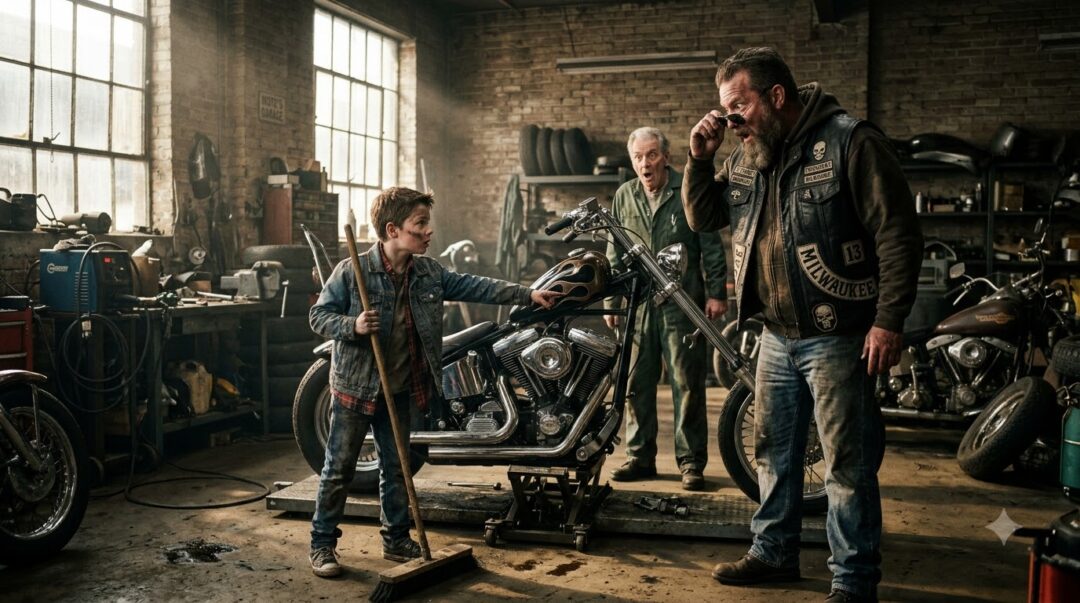
At the head of the lift stood Dutch Morgan. At forty-eight, the club’s president was six feet two inches of scarred muscle, his graying beard trimmed square, his eyes hidden behind dark aviator sunglasses even inside the dim garage. Across his broad chest, his leather cut was decorated with silver skulls and an engraved brass nameplate reading: CHARTER FOUNDER — MILWAUKEE.
Beside him, Old Mac—a sixty-two-year-old master mechanic with grease permanently embedded into the wrinkles of his face—was leaning over the timing cover with a strobe light and a brass degree wheel, swearing profusely under his breath.
“The front cylinder won’t fire, Dutch!” Mac growled, slamming an open-end wrench onto the steel lift table with a concussive clang. “The cam marks are lined up dead on zero top-dead-center! The ignition module is pulling spark, but the intake valve is hanging open on the compression stroke! It’s like the cam lobes were ground backwards by a blind man!”
Five feet away, sweeping a wide broom across the oil-stained concrete floor, was eleven-year-old Toby Hayes.
Toby was small for his age, dressed in oversized denim overalls with holes at the knees, a patched flannel shirt, and scuffed work boots. A smudge of dark molybdenum grease was smeared across his left cheekbone. He had worked at the shop for eight months, sleeping on a cot in the rear parts loft, sweeping metal shavings and cleaning kerosene parts washers in exchange for three dollars a day and leftover deli sandwiches.
Toby stopped his broom. He tilted his head, listening to the dry, wheezing rotation of the engine as Mac spun the flywheel with a breaker bar.
Toby stepped forward, leaning his wooden broom handle against the rear tire of the chopper.
“He’s checking the wrong timing marks,” Toby said.
The boy’s voice was high, clear, and carried an unshakeable, matter-of-fact certainty that sliced straight through the ambient hum of the shop’s air compressor.
Old Mac spun around, his grease-stained face reddening with instant, professional outrage. He lunged forward, grabbing Toby by the shoulder of his flannel shirt, hauling the boy three feet backward away from the lift table.
“Hey!” Mac barked, pointing a thick, calloused finger at the boy’s nose. “Shut your little mouth and go back to sweeping the casting bay! What the hell does an eleven-year-old street orphan know about custom overhead-valve racing cams?!”
Toby didn’t cower. He planted his small boots firmly on the concrete, his hazel eyes flashing with defiant, immovable intelligence.
“That motorcycle isn’t standard, Mr. Mac,” Toby said calmly, pointing his small hand directly toward the custom cylinder head. “The factory timing marks are off by twelve degrees. If you set it to zero, the exhaust valve kisses the piston crown every single revolution.”
Dutch Morgan stopped in mid-stride. He slowly turned his head, his aviator sunglasses reflecting the overhead fluorescent tubes.
The three other bikers stopped their conversation, looking at the dirty boy holding the push broom.
Dutch stepped forward, his heavy engineer boots thudding against the concrete floor. He loomed over Toby, his physical presence blotting out the light from the shop windows.
“Explain,” Dutch commanded. The single word was flat, deep, and heavy as a cast-iron skillet.
Toby didn’t blink. He walked past Old Mac, stepping directly to the right side of the motorcycle frame.
He reached his small, grease-stained fingers beneath the lip of the hand-formed aluminum fuel tank, tracing a hidden contour in the tubular steel frame that was invisible to the naked eye.
Toby’s thumb found a microscopic recessed chrome Allen bolt nestled against the neck gusset. He pressed the bolt inward by three millimeters and turned it ninety degrees clockwise.
A sharp, spring-loaded metallic CLICK echoed from inside the custom oil tank.
“The camshaft wasn’t ground for a standard dual-fire ignition,” Toby explained, his voice taking on the rhythmic, technical cadence of an engineer lecturing a classroom. “It’s an asymmetrical racing grind with a fourteen-to-one compression ratio. There’s a hidden auxiliary advance switch inside the frame that advances the rear cylinder timing by twelve degrees to compensate for the ceramic exhaust port coating.”
Old Mac’s jaw dropped open. His strobe light slipped from his fingers, dangling by its electrical cord. He scrambled to the flywheel, peering through the inspection hole with a magnifying glass.
“Sweet mother of God…” Mac breathed, his voice trembling in sheer, paralyzed shock. “The secondary punch mark… there’s a microscopic compass stamped on the twelfth tooth…”
Dutch Morgan slowly reached up with his scarred right hand.
With deliberate, agonizing slowness, the president of the Black Iron Brotherhood removed his aviator sunglasses.
His pale blue eyes were wide, bloodshot, and burning with an intensity that looked like terror and awe combined. He dropped to both knees on the cold concrete floor, bringing his weathered, bearded face level with the eleven-year-old boy.
Dutch’s hand was shaking—a hand that had held iron bars and shotguns without trembling for twenty years.
“Kid…” Dutch whispered, his voice cracking into a ragged rasp. “What was your father’s name?”
Toby stood tall, his small chest expanding beneath his patched flannel shirt, his eyes meeting Dutch’s with fierce, unbroken pride:
“Arthur Hayes.”
The entire shop froze in suffocating, dead silence.
Old Mac crossed himself with a greasy hand, backing into the tool cabinet. The three bikers took off their leather caps, stepping back from the lift table as if standing before an altar.
Dutch reached into his leather cut, his trembling fingers pulling out an antique silver pocket watch. Inside the watch lid was a faded photograph of two men standing in this very garage twenty years ago: Dutch Morgan, and a brilliant, smiling young engineer named Arthur Hayes.
Dutch looked up at Toby, tears spilling over his weathered cheeks, his voice breaking into a choked, reverent whisper:
“Your father built this bike, son. And we’ve been hunting for his killers for five long years.”
CHAPTER 2: THE MENOMONEE RIVER FOUNDRY
The heavy sliding corrugated-iron doors of Mac’s Custom Cycle Works rolled shut with a concussive thud that shook the brick walls of the foundry, the iron deadbolts sliding into place with three loud, definitive clicks. Outside, freezing autumn sleet pelted the clerestory windows like gravel, sealing five men and the boy inside an industrial sanctuary of heavy iron and whispered secrets.
The bikers stood in a silent, reverent circle around the lift table. Dutch Morgan knelt on the concrete floor, his scarred hands resting on Toby’s small shoulders. The hardened outlaw leader wept openly, tears cutting clean paths through road dust on his gray beard as he searched the boy’s face with breathless awe.
“Arthur’s boy…” Dutch breathed, his deep voice thick with an emotion that twenty years of prison and highway wars had never broken. “You have his chin, Toby. You have the exact same stubborn, fearless fire in your eyes that Arthur had when we rode together through the Black Hills.”
Toby looked down at the massive, blackened chopper resting on the lift, then looked back into Dutch’s pale blue eyes.
“My dad called this machine The Reaper,” Toby said, his young voice steady and quiet. “He spent three years designing and building it in the basement of our house on 16th Street. He let me hold the micrometer while he dialed in the intake runners and hand-filed the ceramic combustion chambers. He taught me that an engine isn’t just metal and gas—it’s a living equation of pressure, heat, and human soul. But five years ago… Dad took the bike to the test track at the state fairgrounds for the Navy demonstration, and he never came home.”
“They told the city it was an accident, Toby,” Dutch said, his voice dropping into a register of icy, murderous fury as he slowly stood up to his full six-foot-two height. “Commissioner Victor Sterling and the Milwaukee Port Authority told the press that Arthur was an erratic, obsessive backyard builder whose experimental ceramic turbine suffered a catastrophic fuel line failure and burned on Turn 3. They had the wreckage towed to a private port warehouse, sealed the coroner’s report in twelve hours, and threatened any reporter who asked questions with commercial ruin.”
“It was never an accident,” Old Mac said, walking to the wooden workbench and pulling a military-grade electronic diagnostic oscilloscope from beneath a grease-stained canvas tarp. “Arthur Hayes was the finest metallurgical and combustion engineer this state ever produced. He held seven proprietary patents on ceramic-matrix composite engine alloys that could withstand three thousand degrees without oil breakdown. He was building this motorcycle to prove to the Department of Defense that a lightweight ceramic turbine could revolutionize military propulsion.”
Dutch turned to Toby, pointing toward the concealed chrome Allen switch the boy had just unlocked beneath the neck gusset of the fuel tank.
“Arthur told me two days before the fairgrounds run that if anything happened to him, the absolute truth was welded inside the machine,” Dutch said. “He said: ‘Dutch, the vultures are circling the docks. If I don’t make it off that track, the Reaper carries my testimony.’ Toby, how do we access the primary diagnostic black box?”
Toby walked to the rear of the chopper with the effortless familiarity of someone walking through his own childhood bedroom.
Beneath the curved, hand-beaten aluminum rear fender, nestled securely inside the hollow tubular steel swingarm, was a sealed black cylindrical housing disguised as a remote nitrogen suspension reservoir.
Toby took an eight-millimeter hex key from Mac’s tool board, inserted it into the threaded cap of the reservoir, and turned it counter-clockwise while pressing down firmly with the heel of his small hand.
The threaded cap popped free with a soft, pressurized pneumatic hiss of inert nitrogen gas.
Inside the hollow swingarm lay a waterproof, fire-resistant titanium flight data recorder—identical to the black box telemetry units installed on experimental military aircraft.
Toby slid the cylinder out and handed it to Old Mac.
Mac plugged the recorder’s multi-pin diagnostic interface directly into the shop oscilloscope with trembling, grease-stained fingers.
The green phosphor monitor screen flickered erratically, drawing a complex harmonic wave pattern of telemetry data stamped with a digital timestamp from five years ago: October 14th, 11:22 PM.
The audio playback initialized with a high-pitched electronic whine through the shop’s commercial soundboard speakers.
At first, there was only the deafening, turbine-like roar of Arthur’s experimental ceramic engine screaming down the straightaway of the Milwaukee Mile speedway at one hundred and sixty miles an hour, the exhaust notes vibrating through the shop with bone-shaking realism.
Then, Arthur Hayes’s voice came through the speaker, calm, technical, and professional, recorded via a Bluetooth microphone inside his racing helmet:
“Telemetry check, Lap 4. The ceramic thermal barrier is holding at twenty-four hundred degrees. The electronic fuel advance is stable at twelve degrees. Approaching Turn 3 at one-sixty-two miles an hour…”
A sharp electronic beep sounded on the recording—an external digital override signal broadcast via an encrypted microwave frequency from the track control tower.
Arthur’s voice spiked in sudden, desperate alarm, his breathing turning ragged:
“What the hell?! The primary hydraulic front brake manifold just locked solid! The drive-by-wire throttle is pinned wide open at one hundred percent! The manual mechanical bypass isn’t responding! The remote port protocol has taken over the ECU… Sterling, you son of a bitch, you cut the lines—”
A sickening acoustic crack of tearing tubular steel and the concussive, deafening roar of an explosive impact tore through the speakers, followed by the terrifying whoosh of burning racing fuel, and then flat, dead static.
The silence in the garage was absolute, suffocating, and terrifying.
Old Mac buried his face in calloused hands, his broad shoulders shaking with grief. The club brothers stared at the glowing green monitor, knuckles white against their tool chests. Dutch Morgan walked slowly to the workbench. He didn’t yell or swear.
He reached into his heavy leather cut, pulled out his customized Colt 1911 .45 automatic, checked the chamber with a slow, deliberate backward pull of the slide, and laid the heavy steel weapon flat on the table beside the titanium flight data recorder.
“Victor Sterling murdered Arthur Hayes,” Dutch said, his voice flat as an iron plate, carrying the finality of an executioner’s decree. “He murdered him to steal the ceramic turbine patents, hid the wreckage in a bonded port warehouse for five years, and then brought it to this shop through a shell corporation to see if we could figure out how to make it run so he could sell it to the Navy.”
Suddenly, the heavy steel security door at the rear alleyway rattled violently under a series of heavy, metallic sledgehammer blows.
On the black-and-white security camera monitor mounted above the parts desk, four black Ford Crown Victorias bearing official Milwaukee Port Authority Police seals had blocked the alleyway.
Six armed tactical officers in dark blue body armor and ballistic helmets were moving toward the shop entrance, carrying an industrial hydraulic door-breaching ram and an emergency warrant issued by the city municipal court.
CHAPTER 3: THE FOSTER HOUSE EXTRACTION
The hydraulic breaching ram struck the heavy iron rear door of the garage with an explosive concussive thud that sent paint flakes flying from the steel jamb and shook the brick lintels above the frame.
“Milwaukee Port Authority Police!” a voice boomed from the alleyway through an electronic megaphone. “Open this door immediately! We have an emergency court order for the seizure of unpermitted hazardous industrial property and the immediate protective custody of an unregistered juvenile!”
Inside the darkened shop, Old Mac had already killed the main electrical circuit breakers, plunging the cavernous workspace into deep shadows, illuminated only by the gray autumn sleet filtering through the high clerestory windows.
“Toby, up into the parts loft behind the tire racks,” Dutch whispered, his voice calm, steady, and devoid of fear.
“No, Dutch!” Toby whispered back fiercely, his small hands grabbing the lapels of Dutch’s heavy leather cut with desperate strength. “They aren’t port police! The man who runs the port security division is Captain Miller—Commissioner Sterling’s brother-in-law! He’s the one who threatened my mother after the crash! If they take me into a squad car, I’ll disappear into an unmarked grave just like my dad did!”
Dutch looked down into the boy’s eyes, reaching out with his scarred, calloused hand to gently cup Toby’s cheek. The hardened outlaw leader’s expression softened into an unshakeable, solemn vow.
“Nobody is taking you, son,” Dutch said softly, his voice cutting through the thudding impacts on the door. “Arthur made me your godfather when you were three days old at the cathedral on 16th Street. I failed your father five years ago because I wasn’t at that racetrack to inspect his machine. I will die on this concrete floor before I let a single one of Sterling’s hired dogs lay a hand on you.”
Dutch turned to the three club brothers standing by their motorcycles in the darkness. “Trigger the emergency distress beacon on the club repeater channel. Code Black Iron. Every brother within fifty miles of the Menomonee Valley rolls right now. Full colors, full iron.”
One of the bikers tapped a red emergency toggle switch on his tactical radio harness.
High above the garage roof, mounted atop the historic locomotive water tower, a high-frequency digital transponder began broadcasting an encrypted tactical alert across southeastern Wisconsin, lighting up emergency pagers from Kenosha to Green Bay.
CLANG-CRACK.
The heavy iron deadbolts on the rear alley door sheared through under eight thousand pounds of hydraulic ram force.
The heavy steel door swung inward with a shriek of tearing metal, and four tactical officers in dark blue body armor, ballistic helmets, and clear polycarbonate visors stepped into the garage, their weapon-mounted tactical flashlights cutting sharp white cones of light through the industrial gloom.
Leading the tactical team was Captain Miller, a heavy-set, florid-faced enforcer with silver captain’s bars pinned to his collar, holding an unholstered Glock automatic with both hands.
“Dutch Morgan,” Miller announced, his heavy boots crunching over metal shavings on the concrete floor. “Step away from the lift table and step away from the child. By executive order of Commissioner Victor Sterling and the Milwaukee Child Welfare Bureau, this unauthorized facility is condemned, and the juvenile Toby Hayes is remanded to state protective custody.”
Dutch didn’t move a single inch. He stood directly in front of Toby, his broad, six-foot-two frame acting as an impenetrable human shield, his heavy arms folded across his leather cut.
“You’re out of your jurisdiction, Miller,” Dutch said, his deep baritone rolling through the room like thunder over Lake Michigan. “This is private commercial property in the Menomonee Valley. You have no municipal search warrant, no county sheriff escort, and no certified child welfare caseworkers. You’re a hired goon carrying out an illegal kidnapping for your brother-in-law.”
“I have eighteen armed tactical officers outside this building, Dutch,” Miller sneered, stepping closer, leveling his pistol directly at Dutch’s chest. “And I have an emergency order signed by the presiding judge of the municipal court. Step aside, or my men will clear this floor with live rounds.”
Before Miller’s finger could tighten on the trigger, the thick brick walls of the foundry began to vibrate with a deep, low-frequency seismic tremor that sounded like an oncoming freight train tearing through the valley.
From the north end of the valley, from the 16th Street viaduct, and from the industrial access ramps along the Menomonee River, a rolling thunderstorm of acoustic power tore through the autumn sleet.
Fifty-five heavy custom Harley-Davidsons of the Black Iron Brotherhood roared down the alleyway in an unbroken iron phalanx, their open exhaust pipes shaking the foundations of the century-old brick buildings.
They didn’t stop in the street.
The lead four motorcycles smashed straight through the temporary police barricades, their massive steel crash bars shoving Miller’s Crown Victorias sideways into the brick walls, boxing the tactical officers inside the narrow alleyway with six tons of roaring steel.
Forty armed club brothers in black leather cuts poured through the breached rear doorway, their faces hardened, their shotguns, tire irons, and heavy wrenches held at low ready, encircling Miller’s four tactical officers in an impenetrable wall of outlaw iron.
Captain Miller’s face turned an ashen, sickly gray. The hand holding his pistol began to shake violently as forty shotguns were racked simultaneously with a sound like a single, colossal metallic execution order that echoed off the high rafters.
“Lower the weapon, Miller,” Dutch said quietly, stepping forward until the muzzle of Miller’s pistol was pressed harmlessly against the center of his heavy leather cut. “Before my brothers turn this alley into an industrial scrap yard.”
Miller slowly, humiliatingly lowered his gun, his breath hitching in his throat.
Old Mac walked over, took the pistol from Miller’s limp fingers, ejected the magazine, cycled the live round onto the floor, and tossed the weapon into a five-gallon bucket of dirty solvent.
Dutch reached down, lifting Toby securely onto his broad shoulder.
“We’re taking Arthur’s bike, Mac,” Dutch announced, looking back at the veteran mechanic. “Load the Reaper onto the heavy trailer. We have an appointment at the Lake Michigan marine terminal.”
CHAPTER 4: THE LAKE MICHIGAN HANGAR
The autumn rain turned into a driving, needle-like sleet as the Black Iron Brotherhood convoy rolled through the commercial security gates of the Port of Milwaukee, forty heavy motorcycles escorting the enclosed heavy-duty equipment trailer down Carferry Drive.
The port was a desolate, freezing expanse of industrial coal piles, towering grain elevators, and massive yellow container cranes jutting like mechanical dinosaurs into the black, churning waters of Lake Michigan. The cold gale howling off the freshwater inland sea carried the bitter scent of freezing brine, industrial diesel exhaust, and raw iron ore pellets stacked in fifty-foot berms along the railroad spurs.
At the far southern tip of the outer harbor, behind a three-tier razor-wire security perimeter fence, stood Hangar 4—a high-security, climate-controlled maritime logistics facility operated under the opaque legal shield of Commissioner Victor Sterling’s private municipal development trust.
Dutch cut his engine fifty yards from the perimeter, stepping off his machine into the slush of freezing mud and crushed limestone.
Beside him, Toby climbed down from the passenger seat of the trailer cab. The boy wore a heavy leather club jacket that Dutch had tailored down for his narrow shoulders with heavy safety pins, Arthur’s brass surveyor’s compass hanging on a raw rawhide lace around his neck. Toby’s hazel eyes were calm and unnervingly analytical, scanning the sweep of the remote security cameras and perimeter motion sensors with the cool diagnostic focus of an experienced systems engineer.
“The security perimeter on Hangar 4 is military-spec, Dutch,” Old Mac warned in a low rumble, pointing toward the high-definition thermal imaging cameras sweeping the chain-link fencing on automated pan-tilt mounts. “They have active infrared tripwires across the concrete apron and biometric palm readers on every exterior access portal. If an unauthorized stray dog brushes against that chain-link, the port tactical security force is on-site in ninety seconds flat.”
“They don’t have a defense against my dad’s master maintenance code,” Toby said quietly, his voice cutting clean through the whistle of the freezing gale.
Toby walked directly toward the perimeter electrical junction box mounted on a concrete pylon beside the rolling security gate. He pulled his father’s pocketknife from his denim overalls, carefully loosening the four tamper-proof Torx screws holding the steel weather-resistant access panel. Inside lay the primary fiber-optic trunk line and the diagnostic telemetry relays that governed the harbor facility’s automated perimeter.
He reached into his pocket and pulled out a small ceramic resistor—a custom component Arthur had hand-soldered and given him on his seventh birthday, telling him it was the universal bypass for every municipal control circuit in Milwaukee County.
Toby bridged the secondary diagnostic circuit with the ceramic resistor, grounding the telemetry feedback loop against the junction box’s galvanized steel frame.
A soft, pneumatic hiss echoed from the gate’s hydraulic motor housing. The heavy steel sliding gates rolled back on silent nylon tracks, the security cameras instantly freezing their telemetry feeds to display a seamless digital loop of empty, rain-swept asphalt to the remote monitoring center downtown.
“Move fast and silent,” Dutch ordered through his headset, waving the convoy forward.
They slid the equipment trailer into the cavernous, heated gloom of Hangar 4, the heavy automated doors sliding shut behind them with a muffled hydraulic click that sealed out the freezing storm.
The interior of the facility was far from an ordinary maritime shipping depot; it was an advanced clandestine manufacturing laboratory and experimental testing facility.
Illuminated by high-output blue LED bay lights were four identical, military-grade ceramic turbine engines mounted on heavy steel test cradles—the exact propulsion system Arthur Hayes had spent his life inventing in the Menomonee Valley. Lined along the corrugated metal walls were twenty wooden shipping crates stenciled with the insignia of an unregistered private maritime defense contractor based in Panama, packed with high-temperature ceramic exhaust cowlings, titanium compressor impellers, and military-grade digital fuel-injection controllers.
On a workbench nearby, Toby stopped dead in his tracks. Resting beside an industrial soldering station was a blue canvas machinist’s notebook, its cover smudged with familiar graphite marks and grease stains. Toby opened it with trembling fingers; every page was filled with his father’s unmistakable, precise drafting handwriting, culminating in a hastily scrawled warning dated three days before his death: Victor is duplicating the turbine blueprints for overseas weapons brokers. If anything happens to me on the test track, protect Toby at all costs.
Across the bay, on a central mahogany executive desk inside an open fireproof steel safe, lay a thick leather-bound folio containing the master patent assignment deeds for the Hayes Ceramic Propulsion System.
Dutch walked to the desk, his jaw hardening into granite as he flipped through the certified state filings. The signature on the primary transfer deed was a clumsy, traced forgery of Arthur Hayes’s signature, notarized three days after the fatal crash at the Milwaukee Mile speedway.
Attached to the rear of the fraudulent deed was an eighty-million-dollar defense procurement contract signed by Commissioner Victor Sterling and a foreign maritime weapons syndicate, detailing the illegal transfer of Arthur’s turbine designs for use in unmanned high-speed strike torpedoes.
“He murdered Arthur for eighty million dollars,” Dutch growled, slamming his heavy fist onto the mahogany desk with enough force to crack the polished wood. “He stole this boy’s future, dragged his family name through the dirt, and sold his father’s genius to foreign arms merchants to build weapons of war.”
“Dutch! Look at the dyno bench!” Toby shouted from the far end of the research bay.
In the center of the bay sat an automated, state-of-the-art chassis dynamometer equipped with high-speed diagnostic telemetry monitors, water-cooled roller drums, and commercial exhaust extraction ducts.
Mounted to the primary computer terminal was an active countdown clock glowing in bright red numerals:
NAVAL DEFENSE DEMONSTRATION: 02 HOURS, 14 MINUTES REMAINING.
STATUS: REAPER PROTOTYPE REQUIRED FOR LIVE BENCH VALIDATION.
Toby ran his fingers over the glowing terminal, his eyes reading the system architecture with effortless mastery.
“Sterling can’t finalize the eighty-million-dollar wire transfer without proving the ceramic turbine can survive a full-throttle ten-thousand-RPM bench run,” Toby said, turning to Dutch with a fierce, brilliant smile. “The foreign syndicate delegates have already arrived at the Milwaukee Mile speedway. They brought twelve armed private security mercenaries to guard the track and execute anyone who interferes.”
Dutch looked at the black chopper sitting on the trailer, then looked at the eleven-year-old boy whose father had built it. A grim, predatory smile spread across the club president’s scarred face.
“Then we’re going to give them a test run they will never forget,” Dutch said.
CHAPTER 5: THE TEST TRACK CONFRONTATION
Midnight over the historic Milwaukee Mile speedway was drowned in an eerie, cinematic silence, broken only by the cold autumn wind whistling through the empty concrete grandstands.
The historic one-mile paved oval—the oldest operating motor speedway in the world—sat illuminated under four towering banks of halogen stadium lights, the black asphalt slick and gleaming from the evening rain. The vast open infield was shadowed in darkness, surrounded by the towering concrete outer barriers where Arthur Hayes had crashed five years ago.
Parked on the pit lane were three black Mercedes Maybach sedans and an armored tactical command van with satellite uplink dishes mounted to the roof.
Standing beside the timing tower, dressed in an expensive custom cashmere overcoat with a velvet collar, was Commissioner Victor Sterling. At fifty-five, the port authority chief radiated the untouchable, predatory arrogance of a man who owned the city’s docks, its judges, and its police force. Beside him stood six armed private tactical contractors carrying suppressed automatic carbines, and four foreign defense buyers in dark bespoke business suits holding leather briefcases.
“The demonstration will take exactly six minutes, gentlemen,” Sterling announced with smooth, polished confidence, checking his gold watch under the pit lights. “My technical team will roll out the prototype, engage the ceramic turbine, and demonstrate a sustained speed of one hundred and seventy miles an hour without thermal degradation. Once the telemetry validates the thermal barrier, the eighty-million-dollar patent assignment is legally executed.”
From the dark tunnel beneath the main grandstand, a single acoustic detonation shattered the night.
It was not the sound of an ordinary motorcycle.
It was the terrifying, apocalyptic roar of Arthur Hayes’s ceramic-turbine V-twin engine—a sound like a jet fighter breaking the sound barrier at ground level, vibrating through the concrete grandstands with enough acoustic energy to rattle the windows of the press box and set off car alarms across the parking lot.
Tearing out of the tunnel onto the front straightaway at one hundred and twenty miles an hour was The Reaper.
Riding the machine was Dutch Morgan, his leather cut zipped tight, his gray beard whipping in the wind, his heavy boots locked onto the forward foot controls.
And sitting directly behind him on the custom stepped pillion seat, wearing Arthur’s vintage leather flight goggles and holding the electronic diagnostic controller in his small hands, was eleven-year-old Toby Hayes.
“What is that?!” Sterling screamed, his face draining of color as the black chopper rocketed down the straightaway in a blur of carbon fiber, glowing red exhaust, and polished aluminum. “Security! Shoot them! Shoot that machine right now!”
The six tactical contractors raised their automatic carbines, opening fire from the pit wall.
High-velocity rounds sparked off the asphalt, tearing through the infield grass, but Toby tapped the nitrous advance switch he had unlocked in the shop.
The Reaper surged forward with a terrifying surge of acceleration, the ceramic turbine screaming at twelve thousand RPM, launching the motorcycle past the pit wall at one hundred and sixty-five miles an hour, completely outrunning the shooters’ traverse.
Dutch cut the wheel hard into Turn 1, sliding the heavy motorcycle through the sixty-degree banked turn with the knee-dragging precision of a grand prix champion.
He roared down the back straightaway, cut across the infield grass, and slammed the brakes in a sliding three-hundred-and-sixty-degree drift that brought the massive machine to a halt ten feet from Sterling’s Maybach sedans, the burning rubber smoke swallowing the pit lane.
Fifty heavy Harley-Davidsons of the Black Iron Brotherhood tore out of the tunnel behind them, forming an impenetrable iron wall across the track exit, their shotguns leveled, their engines idling in a deafening chorus of thunder.
Dutch stepped off the chopper, lifting Toby down to the asphalt.
Sterling backed away against his sedan, his hands shaking violently, pulling a small .380 automatic from his coat pocket.
“Stay back, Morgan!” Sterling shrieked, his voice cracking in panicked terror. “I am a city commissioner! You are armed felons on city-leased property!”
Dutch didn’t draw a weapon. He walked forward on heavy boots, stopping three feet from Sterling’s trembling gun barrel.
Toby walked beside him, holding up the fireproof titanium flight data recorder from the chopper’s swingarm.
“Recognize this, Commissioner?” Toby asked, his young voice ringing clear across the silent speedway. “This is the black box from the night you murdered my father on Turn 3. It recorded your voice cutting his brake lines from the timing tower.”
The four foreign defense buyers stopped dead in their tracks. They looked at Sterling with cold, disgusted contempt, closed their briefcases, and walked toward the track exit without speaking a single word.
Sterling stared at the titanium recorder in the boy’s hands, his mind fracturing as thirty years of corrupt power collapsed around him.
He raised his gun, pointing the barrel straight at Toby’s chest with frantic, murderous malice.
Before his finger could touch the trigger, Dutch’s left hand struck like lightning, knocking the weapon from Sterling’s grip, while his right fist drove forward in a devastating, bone-shattering right cross that lifted the commissioner off his feet, slamming him onto the hood of his own Maybach.
Dutch pinned Sterling to the hood with his forearm across the man’s throat, his eyes blazing with righteous, terrifying vengeance.
“You aren’t dying on a racetrack like Arthur did, Sterling,” Dutch whispered, his voice like iron grinding on stone. “You’re going to stand before the city council in the light of day, and you’re going to answer to Arthur’s boy.”
CHAPTER 6: THE CITY HALL COUNCIL HEARING
The morning sun reflected off the towering stained-glass skylights of the Milwaukee City Hall rotunda, illuminating four hundred spectators, television news reporters, and municipal officials packed into the Common Council chamber on the third floor. The air inside the historic chamber was thick with the scent of aged oak wainscoting, leather-bound legislative binders, and the palpable tension of a city on the verge of a political earthquake.
At the center of the elevated council dais sat Council President Raymond Vance, flanked by eight senior aldermen, presiding over the emergency public hearing regarding the proposed revocation of Commissioner Victor Sterling’s municipal port charter.
At the defense table sat Commissioner Victor Sterling himself.
His face was heavily bandaged, his left eye swollen shut and blackened from the shrapnel of the speedway confrontation, his hands trembling slightly as they rested on the polished walnut table. Flanking him were three high-priced corporate defense attorneys in bespoke charcoal suits who were frantically stacking procedural motions and demands to immediately adjourn the public assembly.
“Mr. President,” Sterling’s lead attorney announced, leaning into the microphone with smooth, practiced condescension. “This entire hearing is an unconstitutional circus. My client was brutally assaulted last night at the state fairgrounds by members of an outlaw motorcycle gang. Any baseless allegations regarding proprietary maritime patents are civil trade matters that belong in confidential arbitration, not in an open municipal tribunal.”
President Vance adjusted his gold-rimmed glasses, clearing his throat as he reached for his rosewood gavel. “The council is inclined to agree. In the absence of authenticated forensic evidence or direct testimony from qualified engineering witnesses, this emergency hearing is hereby adjourned—”
The heavy ten-foot carved oak double doors at the rear of the chamber did not open; they exploded inward.
The deafening, mechanical roar of an experimental ceramic turbine engine echoed through the granite corridors of City Hall, rattling the crystal chandeliers hanging fifty feet above the gallery.
Riding the black-and-silver Reaper directly down the central carpeted aisle, past the rows of gasping council members, stunned aldermen, and frantic television camera operators, was Dutch Morgan.
Sitting on the teardrop fuel tank in front of him, wearing Arthur’s brass surveyor’s compass around his neck and holding the charred titanium flight data recorder in his hands, was eleven-year-old Toby Hayes.
The motorcycle came to a smooth, thunderous halt directly before the council podium. Dutch cut the twin toggle switches on the handlebar console, the cooling ceramic turbine letting out a soft, rhythmic mechanical whine that gradually decayed into an awe-inspiring silence across the vaulted hall.
A collective, electrified gasp rippled through the four hundred spectators in the gallery. News cameras swiveled on their tripods, flashbulbs exploding like continuous lightning across the room.
“What is the meaning of this motorized insanity?!” President Vance roared, rising to his feet and slamming his gavel against the sounding block. “Bailiffs! Arrest these individuals immediately for armed motorized intrusion and contempt of council!”
Four armed Milwaukee County sheriff’s deputies unholstered their tasers and stepped forward, but stopped dead in their tracks as sixty patched brothers of the Black Iron Brotherhood walked through the shattered oak doors in silent, disciplined formation, lining the perimeter walls with their arms folded across their leather cuts, led by Old Mac in his cleanest shop coveralls.
Toby stepped down from the motorcycle’s footpegs, completely fearless before the glaring cameras and the assembly of powerful men.
He walked up the three marble steps to the council podium, placing the titanium flight data recorder, the forged patent deeds, and Arthur’s blue canvas machinist’s notebook flat upon the polished wood surface.
From his pocket, Toby pulled a gold-plated auxiliary audio patch cable. With steady, practiced fingers, he plugged the recorder’s telemetry output directly into the council chamber’s central public address console.
He tapped the play switch.
Across the room’s commercial public address speakers, Arthur Hayes’s final recorded words echoed through the hall with chilling, unmistakable clarity:
“The primary hydraulic front brake manifold just locked! The wireless telemetry circuit is clamping the calipers at twenty-five hundred PSI while the throttle solenoid is pinned wide open… Sterling, you murdered me for the patent, you son of a bitch—”
The silence in City Hall was absolute, heavy as lead.
Council President Vance dropped his rosewood gavel, the polished wood clattering down the marble steps of the dais, his face turning the color of wet parchment as he looked down at Commissioner Sterling.
Toby looked straight into the television cameras broadcasting live across the Midwest, his young, clear voice carrying to every corner of the historic chamber:
“My name is Toby Hayes. My father Arthur Hayes built this engine. He refused to let Commissioner Victor Sterling sell American defense patents to foreign weapons syndicates, so Sterling hacked his brakes and killed him on Turn 3. Here is the uncorrupted telemetry, here is the forged patent transfer, and here is my father’s original engineering registry.”
Two senior special agents from the Federal Bureau of Investigation stepped through the press gallery, accompanied by the United States Attorney for the Eastern District of Wisconsin.
They walked directly to the defense table, ignoring the frantic objections of Sterling’s attorneys. With sharp, metallic clicks, heavy steel handcuffs snapped onto Victor Sterling’s wrists. The federal agents hauled the disgraced commissioner to his feet before the flashing cameras of every major news network in the nation.
Sterling looked at Toby, his lips trembling in pathetic, humiliated defeat, before being led away in chains through the granite rotunda to face federal charges of capital murder, corporate espionage, and treason.
The Common Council chamber erupted into a thunderous, standing ovation. Council members, reporters, and spectators stood cheering, their applause rolling through the building like an ocean wave.
Dutch Morgan walked up the steps, dropping gently to one knee beside Toby, wrapping his massive leather-clad arm around the boy’s shoulders.
“You did it, Toby,” Dutch whispered, tears of unvarnished pride streaming into his gray beard. “You cleared your father’s name. You brought his ghost home.”
Just as the cheers reached their crescendo, Old Mac shoved his way through the press corps, clutching an emergency red-stamped notice from the Milwaukee County Land Division.
“Dutch! We got a massive problem!” Mac shouted, his weathered face pale with alarm. “Sterling’s offshore shell company triggered an automatic liquidation clause at midnight! A private commercial wrecking crew has already pulled up outside the Menomonee Valley foundry with an eight-ton wrecking ball—they have municipal permits to bulldoze the entire shop into dust in less than forty minutes!
CHAPTER 7: THE MASTER’S BENCH
The roar of forty Harley-Davidsons and the screaming ceramic turbine of the Reaper shook the pavement of 16th Street as the Black Iron Brotherhood convoy descended upon the Menomonee River Valley, tires burning rubber against the wet asphalt.
Outside the gates of the historic brick locomotive foundry, two heavy Caterpillar bulldozers and a towering crane fitted with an eight-ton steel wrecking ball stood with diesel engines idling, the private demolition crew preparing to smash through the building’s north wall.
Dutch Morgan slammed his motorcycle to a halt across the demolition entrance, sixty leather-clad brothers fanning out in a solid, unbreakable wall of steel and muscle that completely blocked the heavy machinery.
Toby leaped down from the Reaper, holding the federal emergency injunction and Arthur’s original brass land patent high above his head. Flanked by two federal marshals who stepped out of an escort vehicle with sirens blaring, Toby confronted the demolition foreman.
“Shut down those engines!” the federal marshal commanded through a bullhorn. “By order of the United States District Court, this property is the confirmed, protected estate of Toby Hayes. Anyone stepping across this threshold will be remanded into federal custody immediately.”
The bulldozers cut their engines, the silence settling like a blessing over the red brick walls of Arthur Hayes’s workshop.
Six months later, the sweet, warm breeze of a Wisconsin summer washed over the Menomonee River Valley, carrying the fresh scent of green river willows, blossoming clover, and clean asphalt.
The old locomotive repair foundry on 16th Street had been completely renovated from its stone foundation to its iron roof trusses, its historic red brick masonry scrubbed clean of a half-century of industrial soot, its towering clerestory windows gleaming like crystal under the bright morning sun.
High above the main double iron entrance, beneath the fluttering folds of a brand-new American flag, hung a massive, hand-carved cedar sign: HAYES & MORGAN CUSTOM RACING WORKS — FOUNDED ON HONOR.
The expansive shop floor was alive with the deep, orderly, vibrant hum of American craftsmanship at its finest hour. Twenty master machinists, certified aerospace welders, and apprentice fabricators worked on custom high-performance motorcycles, their TIG torches throwing bright blue cascades of sparks against the polished gray epoxy floor. In the rear bay, ten teenage apprentices from Milwaukee’s inner-city vocational schools were learning the fundamentals of machine tooling under the watchful, encouraging eye of Old Mac.
Standing in the center of the main assembly bay, beside a brand-new hydraulic lift table holding a custom racing chassis, was Toby Hayes.
At twelve, the young master mechanic wore clean denim shop trousers, a heavy black canvas apron with his name embroidered in gold thread over the pocket, and light goatskin work gloves. In his right hand, he held his father’s calibrated Starrett micrometer, carefully measuring the wrist-pin clearance on a newly forged ceramic-composite piston with effortless, surgical precision.
Beside him, holding a calibrated digital torque wrench and a steaming mug of black coffee, was Dutch Morgan.
Dutch wore his leather cut over a clean gray chambray shirt, his aviator sunglasses resting atop a polished chrome toolbox, his weathered, scarred face radiant with peace and deep, fatherly pride.
Walking through the front entrance, carrying an official leather-bound portfolio bearing the blue wax seal of the United States Patent and Trademark Office, was a federal court administrator accompanied by an officer from the Department of the Navy.
“Official delivery for Master Mechanic Toby Hayes,” the administrator announced with profound professional respect.
Toby set his micrometer down on a clean shop rag, wiping his hands as the federal delegation handed him the official patent decree.
“Master Hayes,” the naval officer said, coming to attention. “The United States Patent Office has officially reissued all seven ceramic turbine propulsion patents in your name as sole irrevocable inventor and heir. The Department of Defense has ratified an eighty-million-dollar civilian research partnership with your shop, guaranteeing the independence, prosperity, and legacy of Hayes & Morgan Custom Works for generations to come.”
Toby looked down at the embossed gold seal bearing his father’s name and his own, feeling a warm, golden stillness settle deep into his chest. The bitter years of sleeping in freezing lofts, dodging crooked social workers, and mourning in silence were gone forever, replaced by the unshakeable foundation of family, truth, and brotherhood.
He walked toward the rear of the shop, stopping before an antique oak display bench beneath the north window.
Resting on the velvet-lined bench was The Reaper.
The legendary motorcycle had been restored to immaculate perfection: its hand-beaten aluminum bodywork polished to a mirror shine, its ceramic turbine engine gleaming with clean chrome accents, its frame bearing a small silver brass plate below the steering neck: BUILT BY ARTHUR HAYES — RESTORED BY HIS SON.
Dutch walked over, resting his heavy, calloused hand on Toby’s shoulder.
“Your father is smiling down on us today, Toby,” Dutch said softly, his voice full of warmth and reverence. “The shop is open. The name is clean. And the iron is true.”
Toby looked up at Dutch, smiling—a bright, confident grin that banished every lingering shadow of his years in the cold.
“Come on, Dutch,” Toby said, pulling off his shop apron and picking up his leather jacket. “The sun is up, the fuel tank is full, and the highway is waiting.”
Dutch laughed—a deep, joyful roar that shook the shop rafters.
A moment later, the ceramic turbine engine of the Reaper roared to life with a ferocious, beautiful acoustic purr that echoed like thunder across the valley.
Surrounded by thirty brothers of the Black Iron Brotherhood on their roaring machines, Dutch and Toby rolled out through the massive iron doors of the foundry into the brilliant Wisconsin sunshine, riding out toward the open highway where the legacy of Arthur Hayes would roar forever across the land.