They Tore Down His Farm Fence Over Two Inches—Then He Followed the Bills Nobody Else Had Checked
Chapter 1: The Two Inches Catherine Would Not Recheck
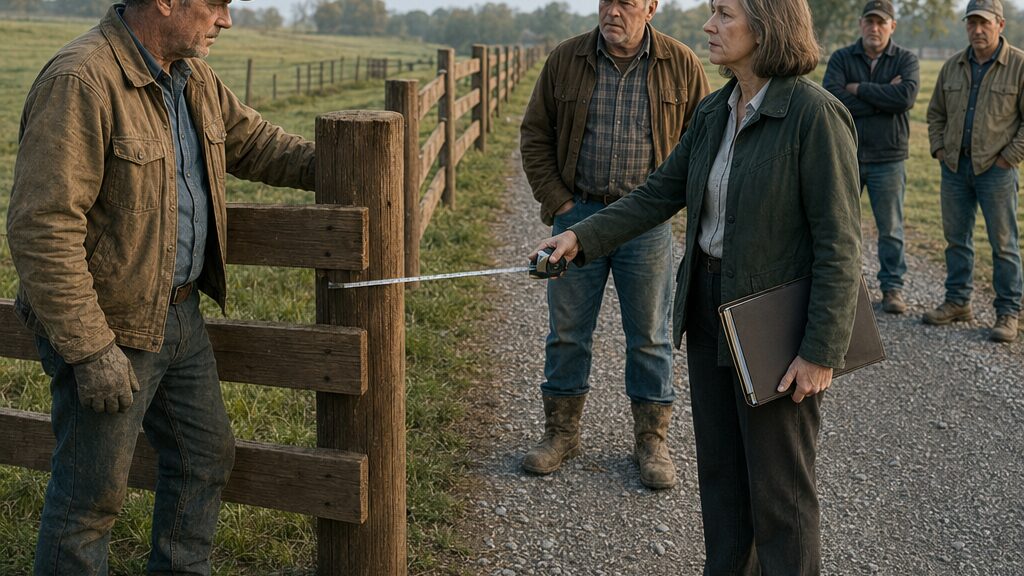
The steel tape snapped tight against Scott Hill’s new cedar post.
“Two inches,” Catherine Roberts said.
Scott stopped halfway through pulling off his work glove.
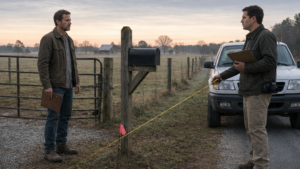
Two neighboring landowners stood near the gravel lane, close enough to hear. Catherine had parked her SUV beside the pasture entrance and walked straight to the corner post with a clipboard and tape measure, as though the matter had already been decided before Scott came down from the hay field.
“Two inches what?” he asked.
“Inside the association access setback.”
Catherine hooked the tape at the edge of the gravel maintenance lane and pointed to the mark against the cedar.
Scott looked from the number to the shallow ditch beyond the lane.
He had replaced that corner of fence three days earlier after winter rot weakened two posts. The new line followed the old one as closely as he could make it.
Catherine released the tape. It hissed back into its case.
“This section has to move.”
Scott rested one hand on the post.
“According to whose line?”
“The association setback.”
“That wasn’t my question.”
Catherine’s mouth tightened.
She wore clean boots that had not collected enough dust to hide their original color. Scott noticed because his own were caked from the south field.
She opened the clipboard and showed him a printed rule.
The association maintained narrow access strips along drainage ditches and shared lanes between farms. Nothing permanent could obstruct them. Scott knew the rule. His father had paid assessments into the association before Scott ever signed his first feed invoice.
“Ten feet from the maintained edge,” Catherine said.
“I can read.”
“Then you understand the problem.”
Scott looked at the lane again.
The maintained edge was not a painted line. Gravel feathered into packed dirt, then weeds, then ditch grass. A grader could change it by inches in a single pass.
“What survey point are you measuring from?”
Catherine tapped the paper.
“This is the standard.”
“That’s a rule. Where’s the point?”
One neighbor shifted his weight.
Catherine glanced toward him, then back at Scott.
“We measured from the established access edge.”
“Established by what?”
“Scott.”
“Survey pin?”
She did not answer.
“County marker?”
“No.”
“Then what?”
“The lane has been maintained in the same location for years.”
Scott gave a short nod.
“So has my fence.”
Catherine folded the rule back onto her clipboard.
“This doesn’t need to become difficult.”
“It wasn’t difficult until you told me two inches was enough to tear down a fence.”
“I said it has to be corrected.”
She turned one sheet around so he could see the penalty schedule.
The daily charge began after notice expired.
Scott read the number twice.
“You’re serious?”
“The purpose of the penalty is compliance.”
“At that rate, in three weeks I could pay nearly what this corner cost me to rebuild.”
“Then moving it now would be cheaper.”
The words landed harder because Catherine said them without anger.
Scott felt both neighbors watching.
He hated that more than the money.
His father had taught him to settle farm problems before they became public entertainment. Broken gates, lost calves, disputed hay deliveries—handle them directly. Do not give people reasons to discuss your business over coffee.
Scott tapped the cedar post.
“Show me the field measurement this is based on, and I’ll look at it.”
“I just showed you.”
“You showed me your tape from a gravel edge you picked this morning.”
Catherine inhaled slowly.
“Fine. We can schedule a joint survey.”
Scott looked at her.
“With who?”
“The association’s survey technician.”
“And I pay half?”
“That’s customary when a landowner disputes a compliance measurement.”
Scott gave a humorless laugh.
“You come onto my ground, tell me my fence is wrong without a survey marker, and then I pay to prove whether you’re right?”
“You’re disputing the measurement.”
“I’m asking you to prove it.”
“Same difference.”
“No, it isn’t.”
For the first time Catherine’s composure slipped.
“You have a habit of treating every association request like somebody is trying to take your farm.”
Scott’s hand tightened around the post.
The remark struck closer than she knew.
His father had spent the last year of his life worrying about easements, taxes, and whether Scott would let outside decisions slowly carve the acreage into pieces. In the hospital, weakened enough that lifting a water cup took both hands, he had still told Scott the same thing.
Don’t let people who don’t work this land decide what it needs.
Scott had treated the words like an inheritance.
Maybe too much like one.
“You want your survey,” Catherine said, “we can do one Thursday.”
“No.”
She stared at him.
“You just asked for one.”
“I asked for the measurement you should’ve had before you threatened penalties. I’m not paying for you to build your case afterward.”
One of the neighbors looked away.
Catherine closed the clipboard.
“That’s your decision.”
“It is.”
“And I’ll record that you declined a joint verification.”
Scott felt the trap only after she said it.
He could have corrected himself.
He could have said he would attend if the association paid. He could have asked for the proposal in writing.
Instead pride kept him silent.
Catherine slid the clipboard beneath her arm.
“You have until tomorrow morning to confirm that you’ll move the fence.”
Scott looked past her toward the cattle clustered in the shade.
“And if I don’t?”
“The association can clear an obstruction from its maintenance access.”
“After a board vote?”
“For routine enforcement, authorization can be issued.”
“By who?”
Catherine met his eyes.
“By the chair.”
She walked toward her SUV.
Scott called after her.
“Catherine.”
She turned.
“If you put a crew on this fence without showing me the actual line, you’re making a bigger problem than two inches.”
For a moment she looked tired rather than angry.
Then the expression disappeared.
“You’re the one choosing not to verify it.”
She got into the vehicle.
Before closing the door, Catherine lifted her phone.
“Yes,” Scott heard her say. “He declined.”
A pause.
Then, still looking through the windshield toward his fence, she added:
“If he doesn’t confirm by morning, prepare the authorization.”
Chapter 2: By Tuesday the Corner Posts Were Gone
The tire tracks were fresh enough that Scott could still see the block pattern from the truck’s rear wheels.
He stopped the tractor in the lane and stared.
The corner posts were gone.
Not leaning. Not cut halfway. Gone.
Twenty feet of cedar rails lay stacked beside the ditch, and the wire had been rolled into a careless coil near the grass. Two dark post holes opened where the fence had stood Monday morning.
One steer had already pushed through the temporary gap.
Scott climbed down before shutting off the tractor.
He caught the steer at the shoulder, turned it back with a feed bucket from the cab, then dragged a steel panel across the opening and wired it to the surviving posts.
Only after the cattle were contained did he allow himself to look closely.
The crew had not damaged much.
That made it worse.
This had not been some reckless mistake. Somebody had arrived with equipment, removed exactly the disputed section, stacked the material, and left.
Scott pulled out his phone.
Catherine answered on the fourth ring.
“You removed it.”
“Yes.”
“You said I had until this morning.”
“You did.”
“It is this morning.”
“It’s nearly eleven.”
“I was in the north field.”
“You didn’t confirm compliance.”
Scott looked at the empty holes.
“Who voted?”
“This was treated as urgent access maintenance.”
“What emergency happened between yesterday and today?”
“The access was obstructed.”
“It was supposedly obstructed by two inches.”
“Scott, we already did this.”
“No. Yesterday we argued over a tape measure. Today somebody came onto my farm.”
“The association has access rights.”
“For maintenance. Not for making up a property line.”
“You declined verification.”
There it was again.
His own decision coming back at him.
Scott stared at the wire in his hand.
“I declined paying half for a survey you should have done first.”
“That isn’t how your refusal was recorded.”
“Then record it correctly.”
“You’ll receive the paperwork.”
Catherine ended the call.
Scott lowered the phone slowly.
By noon he had the temporary panel secured. By one, he had moved the cattle into the west pasture so he would not spend the afternoon wondering whether the improvised barrier would hold.
At two-thirty, a pickup rolled into the drive.
Larry Campbell stepped out carrying a feed-store cap in one hand.
He nodded toward the missing fence.
“So she did it.”
Scott looked at him.
“You knew?”
“I knew she was talking about enforcement.”
“You’re on the board.”
Larry rubbed the back of his neck.
“I didn’t vote on your fence, if that’s what you’re asking.”
Scott stopped.
“No vote at all?”
“Not with me.”
“Were you notified?”
“Not about a meeting.”
Larry walked toward the post holes and looked down.
“Catherine’s been using emergency authority more lately. Culverts, lane clearing, that kind of thing.”
“My fence isn’t a collapsed culvert.”
“I didn’t say it was.”
“Then why is she calling it emergency maintenance?”
Larry gave him a weary look.
“Because you wouldn’t agree to move it.”
Scott nearly answered that this proved his point.
Instead he remembered Monday.
Catherine had offered the survey.
He had refused.
Not the same thing as admitting the fence was wrong, but enough that anyone hearing the story secondhand might believe he had simply planted his feet and dared the association to act.
Larry kicked a clump of dirt back into one hole.
“You should’ve taken the survey.”
Scott’s jaw tightened.
“So she gets to tear it out?”
“No.”
“That sounded like yes.”
“It sounded like you made it easier for her.”
Scott turned away.
Larry did not follow.
That irritated Scott because it meant the man was not there to fight.
“I’m telling you,” Larry said, “if you want to challenge this, challenge what she actually did. Don’t pretend you didn’t give her anything to work with.”
Scott looked back.
“Did you approve the crew?”
“No.”
“Did any board member?”
“I don’t know.”
“That’s a strange answer.”
“It’s an honest one.”
Larry put his cap back on.
“If she classified it under urgent access, she may have signed it herself.”
That evening, Scott found an envelope tucked inside his mailbox.
The association logo sat in the corner.
He carried it to the kitchen table, washed his hands, and opened it with a butter knife.
The first sheet confirmed the removal.
The second was an invoice.
Scott read the total.
Then read it again.
Labor.
Equipment mobilization.
Fence obstruction removal.
Disposal preparation, though nothing had actually been disposed of.
Administrative processing.
He gave a short, disbelieving laugh.
They had torn down his fence and billed him for the privilege.
At the bottom was the contractor:
Bright Field Maintenance.
Scott stared at the name.
Something about it felt familiar.
He went to the drawer beside the refrigerator where he kept association notices, seed receipts that had not yet reached the office, and papers he told himself he would file later.
He found a drainage notice from spring.
Not his drainage work.
The neighbor west of him had asked Scott to look at the ditch afterward because water still pooled near a gate. The neighbor had left a copy of the maintenance sheet on Scott’s kitchen counter.
Scott unfolded it.
Bright Field Maintenance.
Same name.
Same small logo of a fence line under a rising sun.
He laid the two invoices beside each other.
The older one covered ditch clearing and culvert work.
His covered fence removal.
Different jobs.
Different properties.
The layout was nearly identical.
Scott heard Larry’s words again.
Catherine’s been using emergency authority more lately.
He pulled a legal pad from the drawer.
At the top he wrote:
WHO AUTHORIZED REMOVAL?
Underneath:
HOW MANY JOBS?
Then he looked at the two matching contractor names and added a third question.
WHO KEEPS GETTING PAID?
Chapter 3: The Bills Nobody Bothered Comparing
By Thursday night, Scott had three invoices spread across his farm-office desk, and all three described different jobs in almost the same language.
Mobilization.
Equipment service.
Site restoration.
Administrative handling.
The amounts differed by a few hundred dollars.
The descriptions barely differed at all.
Scott pushed his glasses higher and placed colored tabs along the edges.
Blue for drainage.
Yellow for access lanes.
Red for fence or boundary work.
He had started with his own invoice.
Then he asked the western neighbor for the culvert bill.
The third came from another landowner who had paid for gravel work near a shared entrance.
All three carried Bright Field Maintenance at the top.
Scott leaned back.
It was not proof of anything.
Contractors reused invoice templates. A man who spent his day running a skid steer was not expected to write original prose for every drainage ditch.
Still, something bothered him.
Friday morning he drove to the association office.
Rebecca Wilson sat behind a desk crowded with bank envelopes, assessment notices, and a calculator with faded keys.
She looked up when Scott placed his written records request in front of her.
“That’s broad.”
“That’s intentional.”
“You want eighteen months of contractor invoices?”
“And payment records tied to them.”
“Board minutes too?”
“Yes.”
Rebecca studied him.
“This is about your fence.”
“It started with my fence.”
“That isn’t what I asked.”
Scott kept his voice even.
“I want to know who authorized the crew and how that contractor is being used.”
Rebecca leaned back.
“You think something is being stolen?”
“I didn’t say that.”
“You came in asking for eighteen months of records.”
“I came in asking for records.”
She tapped the request with one finger.
“Scott, messy procedure is not the same thing as fraud.”
“I know.”
“Do you?”
He did not like the question.
Mostly because three nights earlier he had imagined Catherine arranging invoices for work that never happened. In that version, everything was simple. His fence was not just an overreach; it was the loose thread that exposed the entire thing.
But a good suspicion was not the same as a fact.
“I know enough not to accuse anybody yet.”
Rebecca held his gaze a moment longer.
Then she nodded.
“I’ll pull what you’re entitled to inspect.”
The records took most of Friday afternoon.
Scott worked at a side table under fluorescent lights while Rebecca handled calls.
He found Bright Field again.
And again.
Drainage clearing.
Emergency grading.
Culvert repair.
Tree removal from an access strip.
Washout stabilization.
His stack grew.
So did the tabs.
At first the repetition made his pulse quicken.
Then he drove home and began checking the jobs.
That slowed him down.
The fallen tree had been real. He remembered it blocking a lane after a windstorm.
The washout had happened too; he had driven around it for a week.
At one property, fresh culvert pipe was visible beneath the road.
Bright Field had not simply invented every job.
Saturday evening, Scott returned to the invoices with dirt still on his jeans.
That was when another pattern emerged.
The amounts.
A drainage excavation involving pipe replacement had cost only slightly more than the gravel-lane grading.
His own fence removal, which could not have required more than a few hours, included a mobilization charge nearly identical to a much larger ditch project.
Scott began writing figures in columns.
Hours.
Equipment.
Materials.
Distance.
He knew enough from renting machinery to know what a skid steer cost per day. He knew what gravel ran per ton. He knew how much diesel a compact excavator could reasonably burn.
The numbers did not scream theft.
They simply refused to make practical sense.
On Monday he went back.
Rebecca watched him add another red tab.
“You planning to wallpaper the room with those?”
“Trying to keep jobs separated.”
“You’ve got more colors than we have categories.”
Scott ignored that.
“Who approves these?”
“Depends.”
“On what?”
“Amount. Type of work. Whether it’s an emergency.”
He slid one invoice toward her.
“This one.”
Rebecca glanced down.
“Chair approval.”
“Catherine?”
“She’s the chair.”
“This one?”
Another glance.
“Same.”
“And this?”
Rebecca’s expression changed slightly.
Not fear.
Annoyance, maybe.
Or recognition.
“Also Catherine.”
Scott sat back.
“How many can she approve alone?”
“There are thresholds.”
“Did these stay under them?”
“Individually.”
The word caught him.
“Individually?”
Rebecca exhaled.
“I’m not giving you a theory, Scott.”
“I didn’t ask for one.”
“You’re looking for something.”
“I’m looking at what’s there.”
She lowered her voice.
“Then keep doing that.”
It was the first thing she had said that sounded less like resistance and more like warning.
Scott returned to the table.
An hour later he found the reserve ledger.
The association kept money aside for major drainage failures, bridge approaches, and expensive access repairs. Scott had paid into that reserve for years without thinking much about it.
He began following transfers.
Most were ordinary.
Then one month stopped him.
Five payments.
Eleven days.
All connected to maintenance work.
Scott added them once on his calculator.
Then again.
Forty-seven thousand six hundred dollars.
He wrote the number at the top of a clean sheet.
$47,600.
The office suddenly felt too quiet.
Rebecca was sorting mail behind him.
Scott turned.
“What happened in May?”
She looked up.
“Which May?”
“This year.”
“What do you mean?”
“Forty-seven thousand six hundred dollars came out of reserves.”
Rebecca did not answer immediately.
Scott placed the ledger in front of her.
She looked at the entries.
“I remember several urgent jobs.”
“Forty-seven thousand dollars’ worth?”
“Apparently.”
“All Bright Field?”
Rebecca’s eyes moved down the page.
Her silence answered before she did.
“Most of them.”
Scott looked back at the colored tabs spread across the table.
He had started with two inches of fence.
Now nearly fifty thousand dollars had moved through the same contractor in less than two weeks.
And for the first time, the question was no longer whether Catherine Roberts had been too aggressive with his property.
It was what, exactly, the association had bought for $47,600.
Chapter 4: Forty-Seven Thousand Six Hundred From the Reserve
The $47,600 had not left the reserve account in one clean payment.
It had gone out in five pieces over eleven days.
Scott copied the entries onto a yellow legal pad and drew a line between each date and the matching Bright Field invoice. The first was for emergency culvert excavation. The second covered grading after heavy runoff. The third listed debris removal, equipment mobilization, and stabilization work. Two more followed before the month ended.
He added the figures again.
Same total.
Forty-seven thousand six hundred dollars.
On paper, the pattern looked worse than it had in Rebecca’s office. Five invoices arriving close together made the reserve withdrawal look deliberate, almost concealed.
Scott caught himself thinking that word.
Concealed.
He crossed it out.
Nothing he had found proved that.
By eight Friday morning, he was at the county records office with copies folded under his arm.
The clerk helped him pull parcel maps and drainage-access records connected to the jobs. None of the files answered the money question, but they gave Scott locations.
That was enough.
He spent the rest of the morning driving.
The first site sat three miles south of his farm where a narrow county road crossed an association ditch. New corrugated pipe was visible beneath the gravel shoulder. The banks had been cut recently enough that clay still showed through the grass.
That job was real.
At the second property, fresh stone had been spread along a washed-out access lane. Tire impressions from heavy equipment were still visible in the compacted surface.
Real again.
By the third stop, Scott was annoyed at himself.
He had wanted the work not to exist.
It would have made everything simple.
Fake invoices. Missing money. Catherine caught.
Instead, he found a repaired culvert, a graded lane, and a drainage ditch that had clearly been cleared.
He parked at the fourth property and unfolded the invoice on the hood of his truck.
Excavator.
Skid steer.
Dump trailer.
Mobilization.
Sixteen equipment hours.
Scott looked across the field.
He knew the place.
A drainage channel ran along the fence before turning beneath a farm lane. He had driven past while the work was happening.
He remembered one machine.
A compact excavator.
No skid steer.
No dump trailer.
Scott walked to the ditch.
The cut was narrow. Spoil had been pushed along the bank instead of hauled away. There was no reason for a dump trailer to have spent hours there.
Maybe it had come and gone before he passed.
Maybe.
He took out his phone and photographed the invoice, then the work area.
At home he pulled his own machinery rental receipts from the previous year.
Daily rate for a compact excavator.
Delivery fee.
Fuel.
Operator costs.
He did the same for a skid steer.
The numbers on Bright Field’s invoices were not impossible.
They were simply high in places where Scott understood exactly what the work should require.
He began marking questionable equipment charges with orange tabs.
By late afternoon, Larry Campbell’s pickup came up the drive.
Scott met him outside the barn.
“You’ve been asking about May,” Larry said.
“Rebecca call you?”
“No. People talk.”
Scott waited.
Larry looked at the papers in his hand.
“You think Catherine took forty-seven thousand dollars?”
“I think forty-seven thousand went through one contractor in eleven days.”
“That’s not the same sentence.”
“I know.”
Larry nodded once.
“That matters.”
Scott leaned against the barn door.
“What happened that month?”
Larry looked toward the lower pasture before answering.
“Three hard rains in ten days. Culvert on the Miller place plugged. Water crossed the access lane near the east parcels. Another ditch blew out behind the old equipment yard.”
“I saw the invoices.”
“You didn’t see what it looked like before.”
“Then tell me.”
Larry rubbed his jaw.
“We called contractors. Two said they couldn’t come for weeks. One gave us a number nobody on the board was going to approve.”
“So Catherine called Bright Field.”
“She got somebody there.”
“Without bids.”
“It was water, Scott. Nobody cared about three estimates when fields were filling.”
“That explains one emergency.”
“There was more than one.”
“Five?”
Larry’s shoulders dropped.
“I’m not defending every invoice.”
“You voted for the reserve withdrawal?”
“I approved emergency spending in general.”
“That isn’t what I asked.”
Larry looked irritated now.
“We weren’t sitting in formal meetings every time a pipe plugged.”
“Exactly.”
“You ever watched beans sit under water for four days?”
Scott said nothing.
Larry stepped closer.
“You’re treating this like Catherine invented every problem. She didn’t. Two of those jobs probably saved crops.”
“Probably?”
“I was there for one of them.”
That stopped Scott.
Larry pointed toward the papers.
“You want the truth, find the truth. But don’t decide what it is before you get there.”
The words sounded uncomfortably familiar.
Scott remembered refusing the joint survey because accepting it had felt like giving Catherine something.
Now he was in danger of doing the same thing with the invoices.
He looked back at the largest charge.
“What about this equipment?”
Larry took the page.
“Don’t know.”
“You remember a skid steer?”
“No.”
“Dump trailer?”
Larry shook his head.
“That doesn’t mean it wasn’t there.”
“No.”
Scott took back the invoice.
“But it means I keep checking.”
Saturday morning, he returned to the county office.
This time he requested the business registration for Bright Field Maintenance.
The clerk found it quickly.
Scott expected a commercial yard somewhere outside town.
Instead the registered mailing address made him stop.
He knew the road.
He knew the mailbox.
He had passed it hundreds of times.
The parcel belonged to Tyler Roberts.
Scott read the name twice.
Then the surname settled into place.
Roberts.
Catherine’s widowed brother.
He carried the registration to the window.
“This address current?”
The clerk checked the screen.
“According to the filing.”
“Business still active?”
“Yes.”
Scott looked down again.
Bright Field Maintenance.
Tyler Roberts.
The room seemed suddenly smaller.
Larry had told him Catherine got somebody there when nobody else would come.
What Larry had not said was that the somebody was Catherine’s own brother.
Scott folded the registration and placed it carefully between two orange tabs.
For the first time since the fence came down, he felt the sharp satisfaction of being right.
Then another thought followed it.
If Tyler had done real work, the family connection did not prove Catherine stole anything.
It proved something narrower.
And perhaps more dangerous because nobody had bothered to disclose it.
Chapter 5: The Contractor at Her Brother’s Equipment Shed
The Bright Field truck was parked beside Tyler Roberts’s equipment shed when Scott drove past Saturday afternoon.
He did not have to stop to recognize it.
White three-quarter-ton pickup.
Small rising-sun logo on the door.
Same logo printed at the top of every invoice in Scott’s binder.
A compact excavator sat on a trailer behind the shed.
Scott slowed.
Then he kept driving.
Ten minutes later, he was at the agricultural supply store buying fence staples he did not urgently need.
The owner rang them up and glanced through the front window.
“You rebuilding that corner?”
“Eventually.”
“Heard there’s a board meeting Monday.”
Scott gave him a look.
The owner shrugged.
“Like I said. People talk.”
Scott put the staples into his jacket pocket.
“You know Bright Field?”
“Tyler’s outfit?”
There it was.
Not hidden.
Not secret.
Not even difficult to discover.
“How long?”
“Few years.”
“Does much association work?”
The owner considered that.
“Enough that I’ve seen him hauling pipe.”
“Catherine sends him?”
“I assume somebody does.”
Scott thanked him and left.
The fact that everyone seemed to know made the registration feel stranger, not less important.
If Tyler’s business relationship was common knowledge, why did none of the invoices or approval records identify the connection?
At the end of the road, Scott turned around.
This time he pulled into Tyler’s drive.
Tyler stepped out from the equipment shed before Scott reached the truck door.
He wiped his hands on a rag.
“You lost?”
“No.”
Tyler looked at Scott’s pickup, then back toward him.
“You here about the fence?”
“Partly.”
A brief silence.
Tyler tossed the rag onto a workbench.
“I figured Catherine would have handled that.”
“She did.”
Scott glanced toward the excavator.
“Your crew remove it?”
“Two guys and me.”
“How long?”
“Couple hours.”
Scott thought of the invoice.
Equipment mobilization. Labor. Administrative handling.
“Why’d you need equipment?”
“Pulled the posts.”
“With?”
“Skid steer.”
Scott looked around.
“I don’t see one.”
“Rental.”
That could be true.
Scott did not push.
Instead he asked, “How much association work do you get?”
Tyler’s expression hardened.
“If you’ve got a question, ask the question.”
“All right. Does Catherine call you directly?”
“Sometimes.”
“Do you bid?”
“For emergencies? No.”
“For non-emergencies?”
“Sometimes there’s a number agreed beforehand.”
“With the board?”
“With Catherine.”
Scott felt the answer settle.
Tyler crossed his arms.
“You think that means something.”
“I think she’s your sister.”
Tyler laughed once, without humor.
“You went all the way to county records to learn that?”
“I went there to learn who owns Bright Field.”
“You could’ve asked.”
“Would Catherine have told me?”
That ended the laughter.
Tyler looked toward the road.
“When that ditch behind the east fields blew out in May, Catherine called three companies.”
Scott waited.
“Nobody would come that night,” Tyler continued. “One said ten days. One wanted more just to mobilize than I charged for half the job.”
“So she called you.”
“She called because water was moving across two properties.”
“Then why not disclose it?”
“Ask her.”
“I’m asking you.”
“I don’t sit on the board.”
“You take their money.”
“And I do the work.”
Tyler pointed toward the excavator.
“You think that thing runs for free? You think diesel is free? Pipe? Labor?”
“No.”
“Then what exactly are you accusing me of?”
Scott almost answered.
The sentence was already there.
Inflated invoices. Family contracting. Reserve money.
But he stopped.
He had seen repaired culverts.
He had seen graded access lanes.
Some equipment charges looked excessive, but he could not prove why.
“I’m not accusing you of stealing.”
Tyler’s arms loosened slightly.
“Good.”
“I’m saying you got association work from your sister without open bids.”
“Sometimes.”
“And she approved invoices.”
“Yes.”
“Did she ever tell the board your business was being used?”
Tyler stared at him.
“I assumed everybody knew.”
Scott looked back at the Bright Field logo.
“That’s not the same as disclosure.”
“No. It isn’t.”
Tyler sounded more tired than defensive now.
“Look, Scott. Catherine called because she knew I’d answer. That’s the truth. She’d get six landowners calling about standing water and three board members telling her to fix it but not spend too much.”
“That still doesn’t give her the right to choose her brother.”
“Maybe not.”
The answer surprised Scott.
Tyler kicked at a loose stone.
“But when nobody else came, I did.”
Scott drove home with less satisfaction than he had expected.
That evening, he spread everything across the barn-office desk.
County registration.
Reserve ledger.
Invoices.
Board minutes.
His own removal bill.
He placed a clean sheet in the center.
At the top he wrote:
WHAT I CAN PROVE.
Under it:
Catherine approved Bright Field invoices.
Bright Field belongs to Tyler Roberts.
Tyler is Catherine’s brother.
Several jobs had no competitive bid.
Some required board approval not shown in minutes.
Then he drew a line.
Below it he wrote:
WHAT I CANNOT PROVE.
Money went directly to Catherine.
Work was fabricated.
Every equipment charge was false.
Scott sat looking at the page.
The line between the two sections bothered him.
Not because it weakened his case.
Because it reminded him of the fence.
A boundary.
On one side were facts.
On the other side was what he wanted those facts to mean.
He pulled out the old survey sketch from his farm file and laid it beside the paper.
The original fence line was hand-marked along the maintenance strip. No measurement on the old copy settled the two-inch dispute.
He traced the line with one finger.
His father had taught him to defend boundaries.
But a boundary was only useful if a man respected it himself.
Scott closed the binder.
At seven-thirty Sunday evening, an email arrived from the association.
He opened it on his phone.
Monday’s agenda had been amended.
First item under member compliance:
Scott Hill — unresolved access-setback violation, removal costs, penalties, and corrective action.
Scott read it twice.
Catherine was not waiting for him to raise questions.
She intended to put his fence in front of the room first.
Scott looked toward the binder on his desk.
If he walked into that meeting angry, Catherine would get exactly what she needed: a stubborn farmer fighting a rule he refused to verify.
He pulled the binder back toward him and removed every page that relied on assumption rather than proof.
Chapter 6: Catherine Put the Fence on the Agenda First
Catherine Roberts held Scott’s violation notice above the folding table before he had been seated five minutes.
The rural fire hall smelled faintly of coffee, dust, and the rubber coats stored along the rear wall.
A dozen association members sat in rows of metal chairs.
Larry Campbell was at the board table.
Rebecca Wilson sat at one end with the minutes.
Scott’s binder rested closed on his lap.
Catherine looked directly at him.
“First item is the unresolved access obstruction on the Hill property.”
No greeting.
No easing into it.
Scott had expected that.
Catherine passed copies down the table.
“The owner declined a joint verification, failed to relocate the fence, and the association cleared the obstruction under emergency access authority.”
Scott heard chairs shift behind him.
Catherine continued.
“Removal costs remain outstanding.”
She spoke calmly, which made the account sound complete.
Scott waited until she finished.
Then he stood.
“I want one correction in the minutes.”
Catherine looked at Rebecca.
“What correction?”
“I did not decline verification. I declined paying half the cost of a survey after I was threatened with penalties based on an unsurveyed gravel edge.”
“That is your characterization.”
“Yes.”
He looked at Rebecca.
“And I want it recorded as mine.”
Rebecca wrote.
Catherine’s jaw moved slightly.
“The physical issue remains.”
Scott opened the binder.
“I agree.”
Several people looked toward him.
Catherine seemed to miss the word at first.
“You agree?”
“I agree the fence may have been misplaced.”
Larry raised his eyebrows.
Scott removed the original measurement sheet and placed it on the table.
“Maybe two inches. Maybe more. Maybe less. We never established it properly.”
Catherine leaned back.
“That is precisely why I offered the joint survey.”
“You did.”
Scott let the admission stand.
“I should have accepted it under protest and argued about the cost afterward.”
The room went quiet.
He could feel Catherine trying to decide what to do with that.
Scott continued before she found a use for it.
“But my mistake doesn’t answer whether you had authority to remove the fence.”
Catherine’s expression hardened again.
“I did.”
“Show the vote.”
“It was emergency maintenance.”
“Show the emergency finding.”
“The access strip was obstructed.”
“By two inches you hadn’t surveyed.”
A board member shifted in his chair.
Catherine put both palms on the table.
“Scott, this association maintains access for drainage equipment. One landowner deciding two inches doesn’t matter becomes another deciding eight inches doesn’t matter.”
“I didn’t say it didn’t matter.”
“You refused correction.”
“I refused your process.”
“And the result was an obstruction.”
Scott reached into the binder.
“I started looking at that process after you billed me for removing my own fence.”
He placed the Bright Field invoice beside the measurement sheet.
Catherine’s eyes flicked down.
Then up.
Scott added three more invoices.
Blue tab.
Yellow.
Orange.
“Same contractor,” he said.
Catherine did not answer.
Scott opened the reserve summary.
“Forty-seven thousand six hundred dollars came out of association reserves in eleven days in May. Most of it went through Bright Field Maintenance.”
The mood in the room changed.
Not dramatically.
No gasps.
Just bodies becoming still.
Catherine looked toward Larry.
He did not look back.
“Those expenses were for emergency drainage work,” she said.
“Some of it was.”
“All of it was legitimate.”
“I didn’t say otherwise.”
Catherine frowned.
Scott placed photographs on the table.
Repaired culvert.
Graded lane.
Cleared ditch.
“I checked.”
That landed differently than an accusation would have.
“These jobs happened,” Scott said. “I’m not standing here telling people they didn’t.”
Larry looked at him now.
Scott turned another page.
“But some equipment charges don’t match what I could verify. Some invoices were approved directly by the chair. Some work went out with no competitive bids.”
Catherine’s voice sharpened.
“Because contractors would not come.”
She opened a folder of her own.
“You want context? Here.”
She pulled out photographs.
Flooded rows.
Water running across a farm lane.
A drainage pipe nearly buried beneath debris.
“That was May eighth,” she said. “The east ditch failed after the second storm. By noon, water was backing into two members’ fields.”
She placed another photograph down.
“This was the next evening. We had twelve hours before more rain.”
Scott studied the images.
They were real.
Catherine looked past him toward the members.
“I called three contractors. One could come the following week. One would not give a firm date. The third quoted nearly double what Bright Field charged.”
“So you called Tyler,” Scott said.
Catherine went still.
A few heads turned.
There it was.
The name entering the room publicly for the first time.
Scott removed the county business registration.
“Bright Field Maintenance is registered to Tyler Roberts.”
Catherine did not reach for the paper.
“He did the work.”
“He’s your brother.”
“I’m aware.”
“Is that relationship disclosed in the minutes where those payments were approved?”
Her face changed.
Not guilt exactly.
Something closer to anger at being forced into a question she had already answered privately for herself.
“You’re implying I stole association money.”
“No.”
Scott’s answer came fast.
Catherine blinked.
“I’m specifically not saying that.”
He opened the binder to the page he had written Sunday night.
“The work happened. Some of it was necessary. Tyler told me you called him because others wouldn’t come.”
Catherine looked toward him sharply.
“You went to my brother?”
“I asked the contractor questions.”
“You had no business—”
“I had an invoice with his company’s name on it.”
She stopped.
Scott continued.
“What I’m asking is why the chair approved work for a close family member without competitive bids and without putting that relationship in the record.”
One of the board members asked, “Was Tyler the only person available?”
Catherine turned toward him.
“For several of those jobs, effectively yes.”
“Was that documented?”
“We were trying to move water, not build a courtroom file.”
Another member said, “That doesn’t answer disclosure.”
Catherine’s hand tightened around the edge of her folder.
“You all called me.”
Nobody spoke.
“You called because the ditches were failing. You called because the lane washed out. You called because nobody could get equipment.”
She looked at Larry.
“You told me to get somebody out there.”
Larry rubbed his forehead.
“I did.”
“So I did.”
Scott watched her.
For the first time, he could see the structure beneath her certainty.
People had expected Catherine to solve problems.
She had solved them.
Fast.
Then faster.
Somewhere along the way, being the person who could act had become permission to act alone.
Scott placed the two-inch notice beside the $47,600 summary.
“This is what I don’t understand.”
Catherine looked at the papers.
“You told me rules exist because if one person ignores two inches, the next person ignores eight.”
“They do.”
“Then why is disclosure different?”
Silence.
Scott tapped the fence notice.
“You expected exact compliance from me.”
Then the reserve summary.
“I’m asking whether the same standard applies here.”
Catherine’s face flushed.
“The difference is that my decisions kept water off people’s crops.”
“And my fence may have been two inches wrong.”
“That is not comparable.”
“Maybe not in consequence.”
Scott closed one hand over the binder.
“But boundaries only work if they apply when they’re inconvenient.”
Rebecca stopped writing.
Catherine looked at her.
“What?”
Rebecca hesitated.
Scott noticed it immediately.
“What is it?” Larry asked.
Rebecca looked down at the minutes binder beside her.
“Some of these approvals weren’t within the chair-only threshold.”
Catherine’s posture stiffened.
“We discussed emergency authorization.”
“For spending generally,” Rebecca said.
“Yes.”
“But several individual invoices exceeded the amount that requires a board vote.”
Larry leaned forward.
“Were they voted?”
Rebecca turned pages.
The sound seemed unnaturally loud in the fire hall.
“No formal votes appear in these minutes.”
Catherine stared at her.
“That doesn’t mean we didn’t approve them.”
Rebecca’s voice stayed quiet.
“It means I don’t have a record that we did.”
Larry reached for one of the invoices.
“How many?”
Rebecca checked another page.
“More than one.”
Scott looked at Catherine.
The contractor relationship had been serious.
The missing bids were serious.
But this was something cleaner.
The association’s own rules required votes that apparently had never happened.
Catherine looked around the table as if expecting someone to remind Rebecca of a forgotten meeting.
Nobody did.
Rebecca turned one final page.
Then she said, “There are at least four approvals here that should have gone before the board, and I cannot find them in the minutes.”