They Marked His Farm Road for Development, Then Learned What Their Water Line Depended On
Chapter 1: The Survey Flags Beside William’s Cattle Gate
The first orange flag stood three feet inside William Harris’s gate.
He saw it before sunrise while carrying a mineral bucket toward the lower pasture. Another flag trembled beside the drainage ditch. A third had been pushed into the gravel shoulder of the farm road his father had laid down with a borrowed dump truck more than forty years earlier.
William stopped walking.
Beyond the pipe gate, two men in reflective vests were stretching a measuring tape along the road.
“Morning,” one called.
William set down the bucket.
“You fellows lose the county line?”
The younger surveyor lowered his clipboard. “We’re marking proposed improvements.”
“To what?”
“The access road.”
William looked behind him as though there might be another road hidden among the hayfields.
“This is my access road.”
The surveyor glanced toward his partner.
“We were given a boundary plan.”
“By who?”
Neither answered immediately.
That delay bothered William more than the flags.
The road ran from the county blacktop through his gate, curved along the cattle pasture, crossed a shallow drainage swale, then climbed toward the barn. William had spread much of the gravel himself. Every spring he filled the ruts left by feed trucks. Every winter he cut ice from the shaded bend near the cedar trees.
Beyond the north fence, however, the land had changed.
Ten years earlier, woods had covered the ridge. Now roofs appeared between the trees. Stone entrance columns stood beside a paved road. The neighboring development had begun as twenty houses and gradually become something large enough to call itself an association.
William pulled the first flag from the ground.
The older surveyor stepped forward. “Sir, we need those left in place.”
“Then put them where you’re authorized to work.”
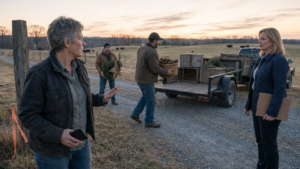
A white SUV turned off the blacktop before the man could answer.
William recognized Cynthia White before she opened the door.
She had visited once the previous month, though he had refused to sit through the meeting she wanted. She stepped out wearing clean boots and a light jacket, carrying a rolled site plan under one arm.
“Mr. Harris.”
“Mrs. White.”
Her eyes moved to the flag in his hand.
“I wish you hadn’t removed that.”
“I wish somebody had asked before sticking it in my pasture.”
Cynthia came to the gate but did not open it.
“We’re beginning the next phase uphill. The county requires improved construction access.”
William nodded toward the paved subdivision entrance.
“You’ve got a road.”
“It isn’t suitable for the equipment schedule.”
“That sounds expensive.”
“It is.”
“Still not my road.”
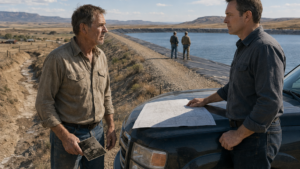
Cynthia unfolded the plan against the hood of her SUV.
A pale line ran from the county road toward the development.
“Our board approved temporary widening here.”
William leaned over the drawing.
The line crossed land he recognized instantly, but the label beside it was wrong.
He tapped the page.
“This map shows your boundary ending east of the drainage ditch.”
“Yes.”
“My road is west of it.”
She hesitated.
“It connects to the same corridor.”
“No, it doesn’t.”
“It does according to the updated county materials.”
William straightened.
“What updated materials?”
“I don’t have the recording numbers with me.”
“Then you don’t have permission either.”
Her expression tightened, though her voice stayed even.
“We’re trying to avoid turning this into something adversarial.”
William almost laughed.
“You sent surveyors through a locked gate before breakfast.”
“The gate wasn’t locked.”
That caught him.
He looked at the chain hanging from the post.
He had left it looped but unsecured after the feed delivery the previous afternoon.
Cynthia continued.
“We requested a meeting. You declined.”
“I declined joining your association meeting. That’s different from declining my own property rights.”
“The project has deadlines, Mr. Harris. Contractors are scheduled. Buyers have commitments. We can’t redesign everything because one landowner refuses to discuss access.”
“One landowner?”
William felt something hard settle behind his ribs.
He picked up the second orange flag.
“This farm was here when that ridge was timber. That road was here before your entrance sign. If you want to discuss something that belongs to me, start by admitting it belongs to me.”
Cynthia rolled the plan more sharply than necessary.
“You may want to check the county records before you make that statement too confidently.”
She motioned to the survey crew.
They withdrew without argument.
William watched the white SUV disappear toward the subdivision.
Only after it was gone did he realize Ruth had been standing near the porch.
She walked down toward him carrying two mugs.
“You pulled the flags.”
“They were on our side.”
“That wasn’t what I said.”
William took the coffee.
Ruth studied the gravel shoulder.
“You could have gone to her meeting.”
“I don’t need a meeting to know where the fence is.”
“No. But you might need one to know what she thinks she has.”
He stared uphill.
The development roofs shone through the trees.
“Nothing.”
Ruth gave him the look she used when she thought he had answered too quickly.
By noon William had replaced the chain with a padlock.
He spent the afternoon cutting hay, but every pass along the north field pulled his attention back toward the road.
His father had built it after a wet spring trapped a cattle truck in the pasture. William had been fourteen, old enough to shovel gravel and too young to understand why his father inspected every load before letting the driver dump it.
A road, his father once told him, became somebody else’s road surprisingly fast if you stopped paying attention.
At four thirty William drove the tractor toward the barn.
Something white moved against the gate.
A large envelope had been stapled to the wooden post beside the chain.
Across the top was the name of Cynthia’s residential association.
Below it were several paragraphs of formal language referring to proposed access improvements, safety requirements, and failure to cooperate.
William read the last section twice.
The association claimed it possessed rights affecting the corridor.
Ruth came down behind him.
“Well?”
William folded the notice carefully.
“They’re saying the road may not be mine to close.”
Ruth looked at the orange pinholes left in the dirt where he had pulled the survey flags.
“Do they say why?”
“No.”
He looked toward town.
“But tomorrow somebody will.”
Chapter 2: The Men in Uniform at the Locked Gate
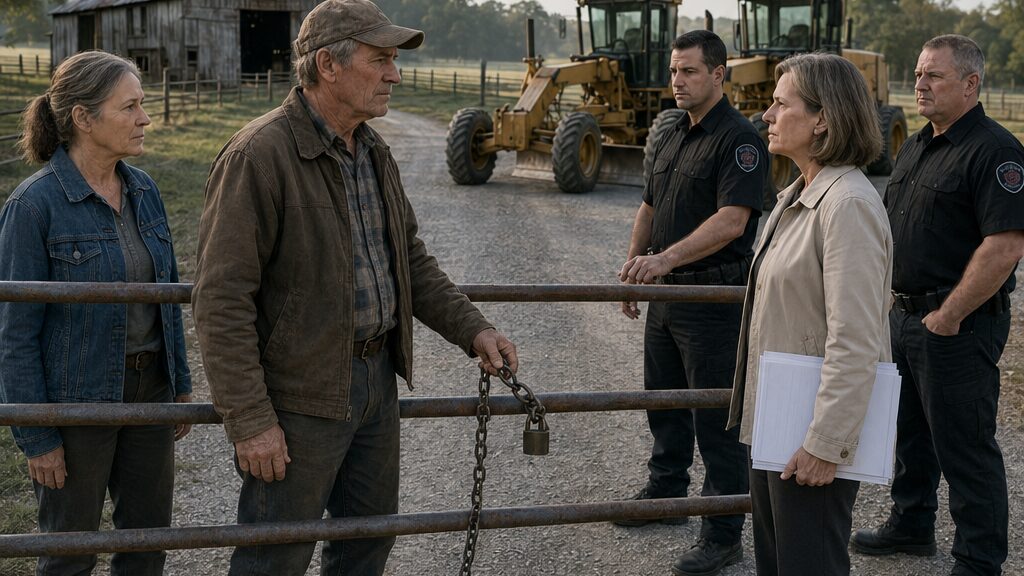
Two men in dark uniforms were pounding on William’s pipe gate when the grader rolled up behind them.
Its diesel engine settled into a heavy idle that vibrated through the gravel.
William came from the barn wiping grease from his hands.
Cynthia White stood beside her SUV with a folder tucked against her ribs.
One of the uniformed men raised his voice.
“Mr. Harris?”
William stopped ten feet inside the gate.
“That depends who’s asking.”
“We need access opened.”
“Who’s we?”
The man glanced toward Cynthia.
She stepped closer.
“These gentlemen are here to secure the work area so the grading crew can begin.”
William looked at the patches on their sleeves.
Dark shields. Small lettering.
Not the sheriff’s department patch he knew.
“What agency?”
The first man shifted.
“We’re contracted for site security.”
“Contracted by who?”
“The association.”
William looked at Cynthia.
“You brought private guards to my farm?”
“They’re licensed security officers.”
“That isn’t what you made it sound like.”
“I said they were here to secure access.”
The grader revved once behind them.
Whether accidental or deliberate, William could not tell.
The noise pushed against him.
He felt suddenly aware of the gate between them, the chain around the post, the equipment waiting on the public road.
Cynthia opened her folder.
“You received the notice.”
“I did.”
“Then you understand continued obstruction may result in penalties and legal costs.”
“Penalties from who?”
“The association.”
“I’m not in your association.”
“This involves access rights, not membership.”
William gripped the top rail of the gate.
One of the security men stepped closer.
“Sir, it would be easier if you unlocked it.”
Something about the sentence irritated William more than a threat would have.
He pulled the key from his pocket.
For one reckless second he imagined unlocking the gate just to step through it and tell the man face-to-face what he thought of easier.
Then Ruth’s voice came from behind him.
“William.”
He stopped.
She walked down the road wearing jeans and an old county emergency-services jacket she used for chores.
Her eyes went directly to the men.
“You with the sheriff?”
Neither answered.
Ruth stopped beside William.
“I asked which unit.”
The second man cleared his throat.
“Ma’am, we’re private security.”
Ruth nodded.
“Then say that first.”
Cynthia exhaled.
“Nobody claimed they were deputies.”
Ruth looked at her.
“You arrived with two uniformed men, a grader, and paperwork telling my husband access was already authorized. You know exactly what impression that creates.”
“They’re here for safety.”
“Then they can stand safely on the public side of the gate.”
The first guard took half a step backward.
William felt the tension in his shoulders loosen.
Not disappear.
Change.
What had looked like authority from the barn now looked like staging.
Cynthia apparently sensed the change too.
“Mr. Harris, the county’s approval requires construction access. If you interfere with an approved project, we will seek reimbursement for delays.”
“Show me the county order that says you can use this road.”
“The relevant documents are already recorded.”
“Recording number.”
“I told you, our attorney has that material.”
“Then have your attorney bring it.”
“We don’t have another week.”
There it was.
William heard the sentence differently from everything else she had said.
Not we have rights.
Not the county requires it.
We don’t have another week.
“Why?”
Cynthia’s mouth tightened.
“For what?”
“Why don’t you have another week?”
“The construction schedule has deadlines.”
“What happens if you miss them?”
“That isn’t relevant.”
“It is if you’re trying to push a grader through my gate.”
The engine behind her went quiet.
A grading contractor had shut it down.
The sudden silence made the scene feel smaller.
Cynthia lowered her folder.
“Several families have already purchased lots in the new phase. Utility work has to stay coordinated. Delays affect everyone.”
“That still doesn’t turn this into your road.”
“You are treating this like a personal insult.”
William stepped closer to the gate.
“You put flags inside my pasture and brought security men before you brought me a recording number.”
Ruth touched his forearm.
Not hard.
Enough.
William released the gate rail.
Cynthia’s expression changed for a moment. The polished certainty slipped, revealing exhaustion beneath it.
Then it was gone.
“Fine,” she said. “We’ll proceed formally.”
“Please do.”
“You may not like what formal looks like.”
Ruth answered before William could.
“Formal has names, jurisdictions, recording numbers, and signatures. Bring those.”
Cynthia stared at her, then turned away.
The security men returned to their vehicle.
The grader backed slowly down the county shoulder.
William remained behind the chained gate until every vehicle was gone.
Ruth walked toward the house.
“You were about thirty seconds from making that worse.”
“I never touched anybody.”
“That isn’t the standard.”
William followed her.
“They came dressed like law.”
“They came dressed like security.”
“They wanted me to see law.”
“Probably.”
He stopped.
“You think I should have let them in?”
Ruth turned.
“No.”
The answer surprised him.
“I think you should find out what Cynthia knows before you decide she knows nothing.”
That afternoon William called the county recorder’s office.
He had to leave a message.
At sunset he checked the north fence and found no new flags.
He almost convinced himself the morning had been Cynthia’s last attempt at intimidation.
Then he saw another envelope pushed through the gap beside the gate.
This one had not been stapled.
It was addressed directly to him and Ruth.
The notice demanded that access be provided within ten calendar days or the association would seek emergency relief for interference with approved infrastructure work.
William read the phrase twice.
Approved infrastructure work.
Ruth took the paper and read the next paragraph.
“There’s something different here.”
“What?”
“They stopped calling it road improvement.”
William looked at the gravel track stretching toward the barn.
“What are they calling it?”
“Infrastructure access.”
The two words sat between them.
William looked toward the dark ridge beyond his pasture.
Ten days suddenly sounded less like a threat than a deadline Cynthia herself was afraid of missing.
Chapter 3: The Plat Book Beneath Twenty Years of Dust
Margaret Jones set a plat book on the records counter so old that dust lifted from its cover.
“This one predates every house on that ridge,” she said.
William leaned closer.
The county records office smelled faintly of paper and copier heat. He had arrived twenty minutes after opening carrying both notices, Cynthia’s site-plan copy, and the stubborn certainty that he would be home before lunch with proof the association had nothing.
Margaret opened the book.
“Your parcel was larger then.”
“My father sold the north timber.”
“I remember.”
She ran one finger along a hand-drawn boundary.
“There’s your farm road.”
William saw it immediately.
A thin ink line entered from the county road, curved through what was now his gate, and continued toward the old barn site.
The date was thirty-seven years before the subdivision.
“Private agricultural access,” Margaret read.
William felt the first real relief he had experienced all week.
“So Cynthia can’t widen it.”
Margaret looked over her glasses.
“I didn’t say that.”
“It says private.”
“It says what the instrument said when it was recorded. I can find records. I don’t interpret them for disputes.”
William pointed at Cynthia’s plan.
“Her map shows a corridor crossing this same section.”
Margaret studied it.
“That looks newer.”
“Obviously.”
“No. I mean it may be referencing another instrument.”
She turned to her computer.
For several minutes only the clicking of keys broke the silence.
William looked again at the old map.
His father’s road was there exactly where memory said it should be.
For the first time since the orange flags appeared, William felt almost foolish for worrying.
Cynthia had dressed a scheduling problem in official language and hoped he would fold.
Margaret printed a list.
“Here.”
“Here what?”
“Three easements recorded against portions of your parcel over the years.”
William’s satisfaction faded.
“One is electric service. One expired. This third one…” She paused. “Water transmission.”
He took the page.
The easement dated back to the early years of the subdivision.
“That’s not the road.”
“No.”
“Where is it?”
Margaret pulled another map.
A dashed line crossed William’s lower pasture, entered near the drainage swale, and ran north toward the ridge.
William stared.
He knew what lay there.
A rusted valve box sat near the fence, half buried in grass. He had driven around it for years.
“That belongs to them?”
“The line probably does. The land doesn’t.”
William followed the dashed route with his finger.
It passed nowhere near most of the farm road.
“So they have a water easement and they’re pretending it gives them road access.”
Margaret closed the book.
“I didn’t say that either.”
He gave her an irritated look.
“You ever get tired of saying that?”
“Less tired than I’d get explaining it to a judge.”
Despite himself, William smiled.
Margaret retrieved the original easement image.
The document granted access for installation, inspection, maintenance, and repair of an underground water line.
It allowed reasonable entry to the utility corridor.
Nothing on the first pages gave the association permanent use of William’s gravel road.
William read the critical paragraph again.
“No widening.”
“Not on that page.”
“No construction traffic.”
“Not on that page.”
“No new subdivision phase.”
Margaret tapped the lower corner.
“You should read all of it.”
He turned the page.
Several handwritten annotations appeared beside the recording stamp.
One referenced a separate maintenance agreement.
Another included a book and page number.
William felt his earlier certainty thinning.
“What’s that?”
Margaret typed the reference into the system.
Her expression changed.
“Separate filing.”
“About what?”
“Looks like obligations tied to the easement.”
The document was old enough that no digital image appeared.
Margaret disappeared into the back records room.
William stood alone at the counter with the plat.
His road was private.
That much was real.
But Cynthia had not invented the association’s presence on his land entirely.
There was a legal line beneath his pasture, one he had barely thought about in years.
When Margaret returned, she carried a thin file jacket.
She opened it carefully.
Inside was a typed agreement bearing the signature of William’s father and representatives of the original development company.
William recognized his father’s handwriting in the margin.
Maintain drainage after all service access.
He read the sentence twice.
Below it, another clause required periodic inspection.
A third section referred to alterations in capacity.
William bent closer.
“Separate landowner consent.”
Margaret nodded.
“That’s what it says.”
“For what?”
“Expansion beyond the original service capacity.”
William looked at the subdivision map Cynthia had brought.
The planned new phase sat uphill beyond the existing homes.
His pulse slowed.
Not because the problem had disappeared.
Because it had finally changed shape.
Cynthia did have a legitimate right across part of his farm.
But perhaps not the right she needed now.
William gathered the papers.
Margaret held back the maintenance agreement.
“I’ll make you a certified copy.”
“Do that.”
She looked at him.
“You came in wanting one answer.”
“I got one.”
“No. You got two.”
William glanced at the old plat and the water easement lying side by side.
The road belonged to the farm.
The water line did not.
Before Margaret carried the agreement to the copier, William noticed another handwritten reference near the bottom of the final page.
A later filing.
Maintenance compliance schedule.
He pointed at it.
“What’s that one?”
Margaret followed his finger.
Then she wrote the book and page number on a yellow slip.
“That,” she said, “is probably what you should look at next.”
William folded the slip into his shirt pocket.
He had come to the courthouse expecting to prove Cynthia White had no claim on his land.
Instead, he walked out knowing she had one.
The question now was whether the association had kept its side of the bargain.
Chapter 4: The Valve Box They Had Stopped Maintaining
The valve box would not open.
William dug his boot into the mud, hooked two fingers beneath the rusted lid, and pulled until the metal edge cut through his glove. The box rose half an inch, then dropped with a hollow clang.
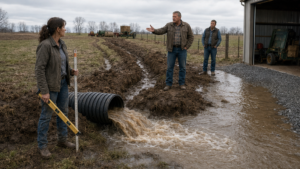
Water had carved a shallow channel around it.
Not much. Enough.
Enough that William suddenly noticed how the gravel shoulder above the pasture had begun washing toward the drainage swale.
He fetched a pry bar from the truck.
Ruth stood at the fence watching him work.
“You haven’t opened that thing since I’ve known you.”
“Never needed to.”
“That may be the problem.”
William wedged the bar beneath the lid.
The metal gave with a groan.
Inside sat an old shutoff assembly, damp with condensation and stained orange around the bolts. A plastic inspection tag hung from one pipe.
The last date written on it was six years earlier.
William crouched.
“Annual inspection,” he said.
Ruth leaned over the fence.
“That what the agreement says?”
“Annual.”
“And this says six years.”
He looked toward the ridge.
The subdivision’s roofs were visible through the trees.
For days he had imagined finding one clean fact that would push Cynthia White back behind her boundary.
Instead he had found a bargain.
His father had granted the original developer a narrow utility easement through the lower pasture. In exchange, whoever controlled the water system was supposed to inspect the line, restore disturbed ground, keep the drainage crossing clear, and repair damage from service access.
William walked the corridor slowly.
Once he knew what to look for, evidence appeared everywhere.
A rut near the fence where a service truck had crossed during wet weather.
A section of flattened grass.
Loose gravel washed into the ditch.
Nothing catastrophic.
Nothing he would have bothered calling anybody about.
That bothered him most.
At the county office that afternoon, Margaret Jones slid a certified copy of the maintenance filing across the counter.
“There are amendments,” she said.
William frowned.
“How many?”
“Two.”
The first updated insurance requirements.
The second added language limiting increased service capacity without written consent from the landowner.
William read it twice.
“How much increase?”
“It doesn’t specify a number.”
“So any expansion?”
Margaret pointed at the wording.
“‘Material increase beyond original residential service area.’”
The new hillside phase was not original.
William felt something close to triumph.
Margaret saw it.
“Don’t get ahead of the paper.”
“It says they need consent.”
“It says what it says.”
“They don’t have mine.”
“That sounds like something you should discuss with whoever is giving you legal advice.”
“I’m talking to the county.”
“You’re talking to the records clerk.”
William folded the document.
“You really enjoy that distinction.”
“I enjoy retirement eligibility.”
Outside, he found Dennis Miller leaning against a pickup.
William recognized him from association meetings held at the county building over the years. Dennis built houses, served as association treasurer, and seemed to know the price of everything before anyone asked.
“You looking for me?” William said.
Dennis pushed away from the truck.
“I figured you’d eventually come here.”
“That sounds confident.”
“Cynthia told us you were digging through records.”
“Cynthia talks a lot about things on my property.”
Dennis looked toward the courthouse doors.
“You find the water agreement?”
William said nothing.
Dennis nodded anyway.
“Then you know why this isn’t just about a road.”
William stepped closer.
“Tell me.”
Dennis rubbed one hand over his jaw.
“The next phase needs the main extended.”
“Across my pasture?”
“The existing corridor.”
“Not without consent.”
Dennis exhaled.
“That depends whose attorney you ask.”
“Does yours say you have it?”
Another pause.
That was becoming a pattern with people from the association.
William noticed it now.
Dennis looked at the traffic moving past the courthouse.
“The original line was sized for more than what’s currently connected.”
“That isn’t what I asked.”
“No.”
William waited.
Finally Dennis said, “We need more capacity than the existing approval covers.”
There it was.
Not a theory.
Not a map.
A need.
William felt Cynthia’s ten-day deadline click into place.
“You’ve sold lots.”
“Some.”
“Promised water?”
Dennis looked back at him.
“Yes.”
William almost smiled.
Dennis saw that too.
“Don’t enjoy this too much.”
“You people tried to push a grader through my gate.”
“I didn’t bring the guards.”
“You sit on the same board.”
“And I told her it was a bad idea.”
William studied him.
“Before or after?”
Dennis did not answer.
William started toward his truck.
“Wait.”
He turned.
Dennis’s face had changed. Less defensive now.
“You ought to know something before you send whatever notice you’re planning to send.”
“What?”
“We sent maintenance letters.”
William frowned.
“To who?”
“To you.”
“No, you didn’t.”
“Three over the last four years.”
William stared at him.
Dennis continued.
“Drainage inspection. Valve access. Request to schedule service. We never got a response.”
“That box hasn’t been touched in six years.”
“I didn’t say we did the work. I said we tried to schedule it.”
William’s certainty slipped.
Mail came to the farmhouse in stacks during hay season. Association envelopes had gone unopened more than once, especially after Cynthia’s board began sending notices about fence appearance near the property line.
He remembered Ruth leaving several envelopes on his desk.
He remembered saying, If it’s from them, it can wait.
Dennis opened his truck door.
“Cynthia overreached. I’m not defending that.”
“Sounds like you are.”
“No. I’m saying this didn’t start this week.”
William drove home in silence.
Ruth was at the kitchen table when he entered.
He went directly to the small desk beside the pantry.
“What are you looking for?”
“Old association mail.”
She watched him open the bottom drawer.
There were farm invoices, seed receipts, county tax notices.
And three unopened envelopes.
William recognized the association logo.
He tore open the oldest.
Request for coordinated inspection of utility corridor.
The second mentioned drainage restoration.
The third requested landowner availability for valve access.
None granted road rights.
None authorized expansion.
But Dennis had been telling the truth.
Ruth read them over his shoulder.
“You never opened these.”
“No.”
“Why?”
William put them down.
“Because every letter they sent was usually something about brush, fencing, or what they thought they could see from their entrance road.”
“That wasn’t an answer.”
He looked at her.
“I got tired of them.”
Ruth nodded.
“And Cynthia got tired of you.”
“That doesn’t give her my road.”
“No.”
She tapped the letters.
“But it does mean you don’t get to pretend every part of this happened because she woke up Tuesday and decided to bother you.”
William walked outside.
At the gate, the gravel road looked different.
He still knew every load beneath it.
He still knew who built it.
But the buried line below the pasture carried water to people who had nothing to do with Cynthia’s behavior.
He returned to the kitchen after dark.
At the table, he wrote a letter.
Not angry.
Not friendly.
He cited the recorded water agreement, the separate-consent clause, the uncompleted maintenance obligations, and the attempted construction access.
Then he wrote the part that mattered.
Until compliance was documented and any expansion received separate written authorization, no access for expansion-related construction would be permitted across the Harris property.
Ruth read it.
“You sure?”
William looked at the unopened letters beside his hand.
“No.”
He signed anyway.
The next morning he sent copies by certified mail to Cynthia, the association attorney, and county planning.
By afternoon, delivery confirmations began arriving.
No one called.
No one came to the gate.
For the first time all week, the farm was quiet.
Then, just before dark, William heard heavy machinery climbing the county road toward his property.
Chapter 5: The Project That Could Not Reach Its Water
Diesel engines woke William before the alarm.
He sat up, listened once, and knew they were too close.
By the time he reached the porch, three trucks were parked beyond the gate. A compact excavator sat on a trailer. Behind it waited a trenching machine and a flatbed stacked with pipe.
Cynthia’s white SUV was already there.
William dressed without hurry.
Ruth stood at the kitchen window.
“You calling the sheriff?”
“Not yet.”
“County?”
“I called planning yesterday.”
“That wasn’t what I asked.”
William put the certified agreement copies into a folder.
“I’m going to make them say what they’re doing first.”
At the gate, Cynthia held a rolled construction plan.
“You received my notice,” William said.
“I did.”
“Then why are they here?”
“We’re performing authorized utility work.”
“Expansion work.”
“Work within an existing easement.”
“You don’t have expansion consent.”
“Our counsel disagrees.”
William looked toward the equipment.
One of the contractors was unfastening chains from the excavator.
“Tell him to stop.”
Cynthia’s expression hardened.
“We have permits.”
“You have my letter.”
“And we have a recorded easement.”
William almost answered with the anger she expected.
Instead, he opened his folder.
“Then we can let the county decide which one controls today.”
A planning vehicle turned onto the shoulder twenty minutes later.
The inspector who stepped out looked irritated before anyone spoke.
He took Cynthia’s permit packet first.
Then William handed him the old easement and maintenance agreement.
The inspector read standing beside the hood of his vehicle.
Traffic passed behind him.
No one talked.
The contractor had stopped unchaining the excavator.
At last the inspector pointed to Cynthia’s plan.
“This approval assumes lawful access through the existing utility corridor.”
“We have that,” Cynthia said.
William tapped the older agreement.
“For maintenance and repair.”
“And installation,” she replied.
“Original installation.”
The inspector lifted one hand.
“I’m not deciding property law on a roadside.”
Cynthia’s jaw tightened.
“The permit is valid.”
“The permit may be valid. The assumption supporting this portion of work may not be.”
She stared at him.
“What does that mean?”
“It means nobody unloads excavation equipment onto disputed private property until planning reviews these instruments.”
William looked at the trucks.
For the first time since the orange flags appeared, the machinery was waiting because of something he had done rather than because Cynthia had ordered it to.
The feeling was satisfying.
Too satisfying.
The inspector placed a temporary work-hold notice on the permit packet.
“Public-side staging can remain. No entry across the Harris boundary.”
Cynthia’s face lost color.
“For how long?”
“Until review.”
“We have utility inspection scheduled Friday.”
“That’s not my problem.”
“It becomes the county’s problem if thirty-two lots lose their construction window.”
The inspector looked at her.
“It becomes the county’s problem if permitted work proceeds without lawful access.”
He drove away.
For several seconds Cynthia said nothing.
Then she turned to William.
“You got what you wanted.”
“No grader crossed my gate.”
“That isn’t what I mean.”
William folded his arms.
“Then say what you mean.”
She pointed toward the ridge.
“Those aren’t just board numbers up there. People paid assessments. Families have construction loans. Contractors scheduled crews months ago.”
“You should have thought about that before you sent security men here.”
“I should have.”
The admission disarmed him more effectively than an argument.
Cynthia continued.
“But you should also understand what happens if you shut the whole thing down.”
“I didn’t sell those lots.”
“No.”
“You didn’t ask me before promising them water.”
Her eyes moved away.
That was answer enough.
William stepped closer to the gate.
“When did you know?”
“Know what?”
“That you needed my signature.”
Cynthia’s face closed again.
“Our attorney’s position is that the easement supports extension.”
“That wasn’t my question.”
A contractor called from behind her.
“Are we clearing out?”
Cynthia did not turn.
“Give me a minute.”
Then she looked at William.
“You think this is clean because there’s an old sentence on a page.”
“I think that sentence was there before you sold anything.”
“And I think your father intended that line to serve the development.”
“The development that existed then.”
“You want me to admit we made a mistake?”
“I want you to stop acting like your mistake became my obligation.”
Her voice lowered.
“If this goes into formal review, the association can be hit with delay charges, redesign costs, and assessment increases. Some of the people paying those aren’t wealthy. Some bought ten years ago and never asked for another phase.”
William thought of the water line beneath his pasture.
He had spent days thinking of it as leverage.
For the first time he imagined it continuing uphill into ordinary kitchens.
Cynthia gathered her papers.
“You can hate how I handled this.”
“I don’t hate you.”
She gave him a tired look.
“That would almost be easier.”
The equipment began turning around.
The excavator never left its trailer.
William watched the trucks descend the road one at a time.
Ruth came down after they were gone.
“That looked different.”
“What did?”
“You won.”
William stared uphill.
“No.”
“You stopped the work.”
“That’s not the same thing.”
By noon, county planning emailed formal confirmation that expansion-related work in the disputed corridor was paused pending documentation of landowner consent or other legal authorization.
William printed the message.
He laid it beside his father’s agreement.
The words should have felt like victory.
Instead, he kept hearing Cynthia say thirty-two lots.
That evening a pickup stopped outside the gate.
Dennis Miller climbed out alone.
No folder.
No security.
No contractor.
William met him without opening the gate.
“If Cynthia sent you—”
“She didn’t.”
Dennis hooked his thumbs in his pockets.
“Actually, she’ll be furious if she finds out I came.”
William waited.
Dennis looked toward the subdivision.
“You asked her when she knew.”
“Yes.”
“She didn’t answer.”
“I noticed.”
Dennis took a breath.
“There are things the homeowners don’t know either.”
William’s hand tightened on the gate.
“What things?”
Dennis glanced toward the farmhouse.
“If you want the truth about why she tried to force that road open, we should probably sit down.”
Chapter 6: The Truth Cynthia Would Not Put in Writing
Dennis put the project budget on William’s kitchen table and did not touch his coffee.
Mud from his boots marked the floor between the back door and the chair.
Ruth noticed.
She said nothing.
William opened the first page.
The numbers meant little individually. Together they made his stomach tighten.
Utility contracts.
Loan obligations.
Roadwork.
Inspection fees.
Deposits.
Assessment revenue already collected.
“What am I looking at?”
Dennis pointed to a column.
“The next phase was supposed to pay for part of the main replacement.”
William looked up.
“Replacement?”
“Upgrade.”
“That isn’t the same word.”
“No.”
Dennis rubbed both hands over his face.
“The original water main works. But it’s near capacity. The association wanted the new phase, and the engineering report said we could extend service if we increased the line through your corridor.”
“You knew that required consent.”
Dennis looked at him.
“Yes.”
Ruth leaned against the counter.
“When?”
Dennis hesitated.
William closed the budget.
“When?”
“Before the construction contracts were signed.”
The kitchen became very quiet.
William had imagined this moment.
Some version of it, anyway.
A confession.
Proof that Cynthia knew.
He had expected anger to arrive with it.
Instead, he felt tired.
“You told her?”
“I told the board the easement language was a problem.”
“Cynthia was there?”
“She chaired the meeting.”
“And you signed contracts anyway.”
Dennis stared at the coffee.
“I voted against the utility authorization.”
“Then?”
“I voted for the overall project budget.”
William laughed once without humor.
“So everybody gets a clean piece of the mistake.”
“I’ve got money tied up in two houses in that phase.”
“There it is.”
Dennis nodded.
“There it is.”
The admission changed something.
Not enough to excuse him.
Enough to make him sound human.
Dennis slid another page across the table.
“We had three options. Redesign from the subdivision side, negotiate with you, or argue the existing easement allowed the work.”
“Redesign cost more.”
“A lot more.”
“So Cynthia chose me.”
“She chose the interpretation that kept the schedule alive.”
“She chose uniforms and a grader.”
Dennis looked toward Ruth.
“I told her not to bring security.”
Ruth folded her arms.
“You stayed on the board after she did.”
“Yes.”
“Why?”
“Because walking away doesn’t get my money back or help the homeowners who already paid.”
William pushed back from the table.
There was the part he disliked.
Not because Dennis was wrong.
Because William understood it.
For days he had divided everyone into two groups: people trying to take his road and people defending it.
The budget refused to cooperate.
“How much have residents paid?”
Dennis showed him the assessment total.
William whistled quietly.
“If the phase stops?”
“Some contracts get canceled. Some don’t. Legal fees grow. The board would probably levy another assessment.”
“How much?”
Dennis gave him a range.
Ruth’s expression changed.
“Per household?”
“Yes.”
William walked to the window.
The ridge was mostly hidden at night, but porch lights glowed between the trees.
He pictured Cynthia sitting in meetings explaining that another payment was needed because an old farmer refused to cooperate.
The thought irritated him.
Then another thought followed.
He had made it easy for her to say.
He had ignored meeting requests.
Ignored letters.
Locked the gate.
None of that gave her authority she did not have.
But his silence had helped turn negotiation into a contest.
“What does Cynthia want now?” he asked.
Dennis shook his head.
“She wants the county to accept the easement interpretation.”
“Will they?”
“I wouldn’t bet on it.”
“Your lawyer?”
“He says litigation could go either way.”
“Meaning expensive.”
“Meaning nobody knows before it gets expensive.”
William returned to the table.
Ruth placed a clean mug beside him.
“What aren’t you telling us?” she asked Dennis.
Dennis looked at her.
“The association took deposits based on the expansion schedule.”
William’s eyes narrowed.
“From buyers?”
“Yes.”
“After Cynthia knew about the consent language?”
Dennis did not answer immediately.
Then he nodded.
That was the deepest cut.
Not illegal certainty.
Not a grand conspiracy.
A decision to keep going because stopping would require admitting the project was not ready.
William understood pride well enough to recognize it in someone else.
The next morning he attended an association meeting for the first time.
He sat in the back of the clubhouse while residents argued about the work hold.
Cynthia stood at the front with the association attorney.
She looked different without a gate between them.
More tired.
More exposed.
One homeowner asked whether the project had proper access.
Cynthia said the association believed it did.
William noticed the wording.
Believed.
Another asked whether additional assessments were possible.
Cynthia said every effort was being made to avoid them.
Nobody cheered when William stood.
Several people turned toward him with expressions ranging from curiosity to resentment.
He did not speak long.
“I own the farm below the ridge. The gravel road is private. The water easement is real. The expansion permission is not settled.”
Cynthia watched him carefully.
William continued.
“I’m not here to shut off anybody’s water. I’m not here to block maintenance. I’m asking that expansion be treated as expansion.”
A man near the aisle said, “So what do you want?”
A week earlier William would have answered: Stay off my land.
He looked at Cynthia.
“Repairs that should have been done. The drainage restored. The road boundary recorded so this doesn’t happen again. And no permanent construction access.”
Cynthia’s expression barely moved.
“That still leaves the new phase without a workable route.”
“Temporary isn’t permanent.”
The room went quiet.
Even William felt the weight of what he had just offered.
After the meeting, Cynthia intercepted him near the door.
“You’re willing to discuss temporary access?”
“I’m willing to discuss terms.”
“You could have said that before.”
“So could you.”
Her eyes hardened.
Then softened again.
“You intend to make the board acknowledge the consent requirement.”
“Yes.”
“That will be in the minutes.”
“Yes.”
She looked away.
William understood.
That was the cost she feared almost as much as money.
Not losing to him.
Having her decision recorded where everyone could see it.
At home that night, William sat at the kitchen table with a yellow legal pad.
Ruth read over his shoulder as he wrote.
Temporary construction license.
Defined dates.
Defined hours.
No permanent widening.
Drainage restoration.
Gravel replacement.
Cattle-gate responsibility.
Association-funded survey and permanent recording of the farm-road boundary.
Annual water-line inspection.
Written landowner approval required for future capacity increases.
He stopped.
Ruth pointed to the page.
“You forgot something.”
“What?”
“What happens if they violate it.”
William added suspension of temporary access upon material breach.
Then he sat back.
The document was not surrender.
It was not revenge either.
It was a gate with hinges instead of a wall.
William signed the bottom of the draft.
The next morning he sent it to Cynthia, Dennis, and the association attorney.
By noon, Dennis replied that the board would review it.
Cynthia did not respond.
By evening, still nothing.
William walked down to the gate.
The chain rested against the steel post.
Beyond it, the gravel road curved toward the county pavement, empty and untouched.
For years, locking that gate had been enough to tell him the farm was protected.
Now protection required something harder.
Opening it only when he chose.
His phone rang.
Cynthia’s name appeared on the screen.
William answered.
“I’ve read your conditions,” she said.
“And?”
A long pause followed.
Then Cynthia said, “We need to talk about which ones I can live with.”
Chapter 7: The Road Stayed His, but It Did Not Stay Closed
Cynthia arrived at William’s kitchen table without her clipboard.
That was the first thing he noticed.
No white SUV idling at the gate. No folders tucked under her arm. No survey crew waiting behind her. She came in Dennis Miller’s pickup with the association attorney and carried only a yellow legal pad.
William had already set out the documents.
The old agricultural plat.
The water easement.
The maintenance agreement.
His proposed temporary-access terms.
Ruth poured coffee and sat at the far end of the table.
Cynthia looked at the papers.
“You’ve built quite a file.”
William pulled out a chair.
“Wouldn’t have needed one if we’d started here.”
Her mouth tightened, but she sat.
The association attorney opened with the water line.
He argued that the easement contained enough language to support necessary improvements. William let him finish.
Then William tapped the amendment requiring separate consent for material expansion.
“You can test that argument in court,” he said. “But nothing crosses my pasture while you’re testing it.”
The attorney glanced at Cynthia.
She rubbed the edge of her legal pad.
“We’re not here to threaten litigation.”
“That’s new.”
Ruth gave William a look.
He leaned back.
Cynthia noticed.
“I deserved that,” she said. “But if we’re going to get anywhere, I need you to stop treating every sentence like a chance to collect interest.”
William stared at her.
A week earlier, he would have answered sharply.
Instead he pushed his proposed agreement across the table.
“Then tell me what you can live with.”
They spent the next hour crossing things out.
Cynthia rejected William’s first restriction on construction hours. He refused her request for unrestricted weekday access.
They settled on scheduled windows.
She wanted the right to widen the narrow bend beside the drainage swale.
William refused.
“The road stays the width it is.”
“Some of our trucks can’t make that turn safely.”
“Then use smaller trucks.”
“That increases cost.”
“That isn’t a property right.”
Cynthia looked toward Dennis.
Dennis said, “We can transfer loads.”
The attorney marked the change.
Then came the larger issue.
Permanent access.
Cynthia placed both hands on the table.
“We need certainty beyond this project.”
“No.”
“William—”
“No permanent construction easement.”
“We cannot come back every time something needs service.”
“You don’t have to. Maintenance rights remain exactly what the old agreement says.”
“I’m talking about future improvements.”
“So am I.”
He pulled the water agreement closer.
“This is how we got here. Somebody forty years ago wrote ‘water line,’ and forty years later you decided it could mean graders, pipe trucks, and another neighborhood.”
“That’s not fair.”
“It’s exactly what happened.”
Cynthia started to respond, then stopped.
For several seconds she looked at the handwritten note from William’s father.
Maintain drainage after all service access.
When she spoke again, her voice had changed.
“Fine. No permanent construction access.”
William said nothing.
It took him a moment to recognize that she had actually agreed.
The attorney wrote it down.
The negotiation moved to repairs.
The association would restore the eroded drainage swale, replace displaced gravel, inspect the valve assembly, and repair the fence crossing where service vehicles had worn the ground.
William added one more condition.
“Survey the road.”
Cynthia frowned.
“It’s already surveyed.”
“Not the way I want it.”
He placed the old plat beside the newer association map.
“I want the farm-road boundary professionally marked and recorded with the county so nobody five years from now can claim the utility corridor and the road are the same thing.”
The attorney studied the maps.
“That is going to require additional filing.”
“Yes.”
“And expense.”
“Yes.”
Cynthia looked at William.
“You want the association to pay.”
“Yes.”
Dennis leaned forward.
“We should.”
Cynthia turned toward him.
He shrugged.
“He’s right. The maps caused part of this.”
For the first time, Cynthia did not argue.
By noon, they had reduced the dispute to one remaining sentence.
Future expansion of utility capacity would require written approval from the landowner.
Cynthia circled it.
“This is too broad.”
“It is exactly the protection my father put in the agreement.”
“It could let you block emergency improvements.”
“Emergency repair is already covered.”
“What about a replacement main?”
“Replacement at existing capacity is maintenance.”
“And increased capacity?”
“You ask.”
She stared at him.
“That simple?”
“That simple.”
Cynthia gave a short, tired laugh.
“You know we did ask you to meet.”
William looked down at the table.
There it was.
The part he could not place entirely on her.
“You did.”
“You never responded.”
“No.”
“Why?”
Ruth remained silent.
Dennis remained silent.
William looked toward the window.
The gravel road ran from the barn to the gate, pale against the pasture.
“Because I decided I knew what you wanted before I listened.”
Cynthia’s expression shifted.
William continued.
“That doesn’t excuse what came after.”
“I know.”
“And it doesn’t give you rights you don’t have.”
“I know that too.”
He nodded toward the circled sentence.
“Then leave it.”
Cynthia uncapped her pen.
She initialed the clause.
Three days later, the county planning inspector accepted the temporary access agreement and modified the work hold.
Construction could resume under the recorded limits.
The first truck arrived the following Monday at eight ten.
William was waiting at the gate.
The driver shut down and walked over.
“Mr. Harris?”
“Yes.”
“I’m scheduled for pipe delivery.”
William checked the printed list Dennis had provided.
The truck number matched.
William unlocked the chain.
The driver hesitated.
“That all?”
“That’s all.”
William swung the gate open.
The truck entered slowly.
Its tires crunched over gravel William had once sworn no development truck would ever touch.
He felt the old instinct rise anyway.
Watch the edge.
Watch the ditch.
Watch what they take for granted.
But the truck stayed within the agreed route.
At the narrow bend, a smaller transfer vehicle was waiting exactly as promised.
No shoulder widening.
No survey flags creeping into the pasture.
No one pretending temporary meant permanent.
Over the next six weeks, the work became almost ordinary.
Trucks came during scheduled hours.
William opened the gate.
Crews signed in.
The association repaired the drainage swale before autumn rain.
Fresh gravel replaced the washed-out shoulder.
A service crew opened the old valve box, replaced the corroded hardware, and attached a new inspection tag where the six-year-old one had hung.
The permanent boundary survey took longer.
When the markers finally arrived, William walked the line with the surveyor.
The farm road remained exactly where he had always known it was.
But this time the distinction between road and utility corridor was recorded clearly enough that nobody needed family memory to understand it.
Cynthia came once during the work.
No entourage.
She stood beside the lower pasture while a drainage crew reshaped the ditch.
“They’re saying another week,” she said.
William nodded.
“They’ve been decent.”
“I told them they needed to be.”
He almost said, Should have started there.
He let it go.
Cynthia watched the crew for a while.
“The board recorded the consent requirement yesterday.”
“I heard.”
“So future presidents get to enjoy this too.”
William looked at her.
“That was the idea.”
She smiled despite herself.
By early winter, the last repair truck was scheduled to leave before sunset.
William met it at the gate.
The driver handed him the final sign-off sheet.
The drainage work was complete.
The gravel had been restored.
The valve inspection was current.
The road boundary had been filed.
William signed the access log and stepped aside.
The truck rolled toward the county pavement.
For a moment he watched its taillights move beyond the gate.
Then he looked back at the road.
Nothing about it appeared dramatically different.
Same curve.
Same fence.
Same barn at the far end.
But the road no longer felt protected merely because William could close it.
It was protected because everyone now knew the terms under which it could open.
Ruth called from the porch.
“You leaving that gate open all night?”
William looked at the chain hanging from the post.
“No.”
He swung the pipe gate shut.
The latch settled into place.
He threaded the chain through slowly and locked it.
Then he put the key in his pocket.
The road was still his.
The water line still served the people uphill.
And for the first time since the orange flags appeared, neither truth threatened the other.
The story has ended.