They Drained the Pond His Grandfather Built, but the Old Water Right Changed Everything
Chapter 1: The Morning the Bottom of the Pond Showed
Benjamin Adams knew something was wrong before he reached the gate.
The cattle were not spread along the north pasture where they usually fed after sunrise. Nearly all of them were crowded around the stock pond, shoulder to shoulder, their heads lowered toward a shrinking patch of brown water.
Benjamin stopped the pickup and stared through the windshield.
The pond had a bottom now.
Cracked gray clay showed in broad plates along the west bank, exposed almost to the center. Water that had stood deep enough the previous week to reach the dark line on the old measuring post was now little more than a shallow pool crowded with hoofprints.
He was out of the truck before the engine stopped ticking.
“Come on,” he muttered, though he did not know whether he meant the cattle or the water.
He walked the bank, looking for a breach. The clay dam was intact. No wet cut showed through the downstream side. No broken pipe. No washout.
He crouched where the inlet entered beneath a fringe of grass.
Dry.
Benjamin put two fingers into the channel and rubbed dust between them.
For sixty-two years, that little run had fed the pond.
He had never seen it empty.
By eight-thirty, he had opened the emergency stock tank near the barn and started moving cattle in groups. The old well could supply drinking water for the house and some livestock, but not eighty head through a hot stretch.
The first tanker company he called could come after lunch.
The second wanted payment before dispatch.
Benjamin wrote the figure on the back of a feed receipt, looked at it, and called the first company again.
Near eleven, one of the heifers stumbled.
He saw her knees buckle near the dry bank. She tried to rise, got one foreleg beneath her, and went down again.
Benjamin moved faster than he had in years.
The veterinary technician who came from town said heat and dehydration had likely worked together. The heifer was not dying, not yet, but she needed fluids and shade.
Benjamin helped drag a panel into position beside the barn and stood there afterward with sweat cooling under his shirt.
The tanker arrived in a cloud of dust.
The driver climbed down and looked toward the pond.
“Lose a pipe?”
“No.”
“Dam leak?”
“No.”
The driver waited.
Benjamin did not explain.
By afternoon, the emergency tank had water in it. The cattle settled enough to stop crowding the fence. Benjamin filled another trough and then walked back to the dry inlet with a shovel over one shoulder.
He followed the channel uphill.
At first it looked the same as it always had—grass pressed flat where spring runoff passed, pale stones polished smooth from years of flow. Farther north, the channel entered the property line through a shallow draw.
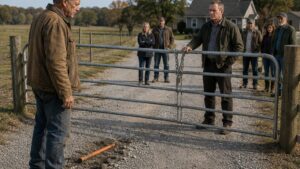
Benjamin stepped over the fence and stopped.
Fresh dirt showed beyond the boundary.
Not a little excavation. A wide cut.
He climbed the rise until he could see over it.
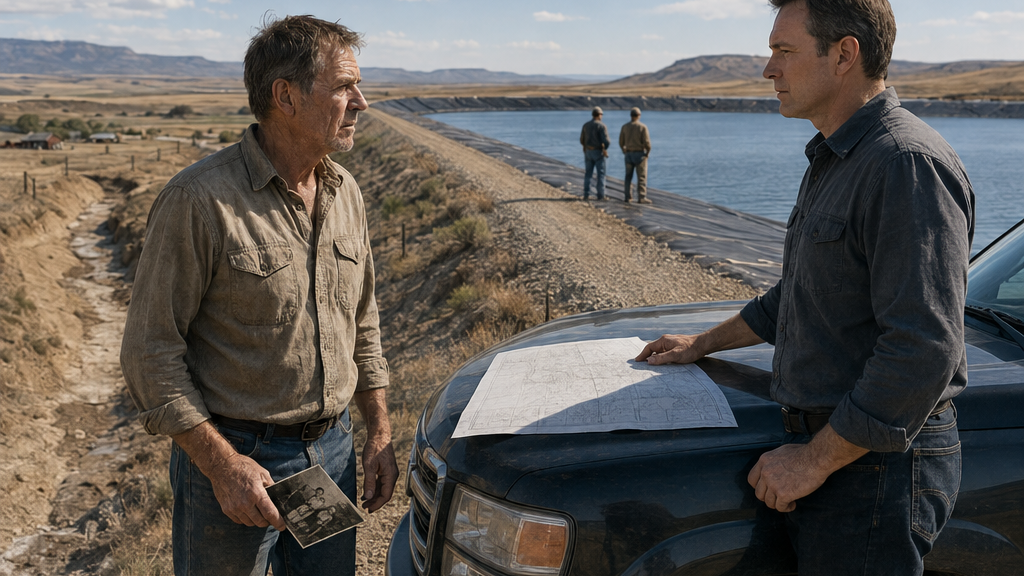
On the upstream parcel, machinery tracks crossed the ground in hard parallel lines. A newly shaped berm curved across the lower end of the field, and above it lay a broad reservoir lined with black material that flashed in the sun.
It was holding water.
Benjamin stood there long enough for his anger to become useful.
The old channel that had carried water toward his ranch had been cut and redirected.
He could see where the excavation intercepted it.
He took out his phone and photographed the reservoir, then the cut, then the dry line leading south toward his place.
Only afterward did he realize his hands were shaking.
That evening, Carolyn found him at the kitchen table.
She had come by with groceries and stopped when she saw the paperwork spread in front of him: tanker receipt, veterinary bill, feed notes, a hand-drawn map of the north pasture.
“What happened?”
“Water quit.”
“That pond?”
He nodded.
Carolyn set the grocery sack down.
Benjamin reached toward the old sideboard, opened the bottom drawer, and pulled out a framed black-and-white photograph.
A young man stood beside raw earth and a shallow pool, one boot on a shovel blade. On the back, in faded pencil, someone had written the year.
Their grandfather, Samuel Green, had dug the first version of the pond before Benjamin was born.
Carolyn touched the edge of the frame.
“You think the new people did it?”
“I know somebody did.”
“You talk to them?”
“Tomorrow.”
She looked at the tanker invoice.
“Maybe you ought to call somebody tonight.”
“I said tomorrow.”
Carolyn gave him the look she had used since they were teenagers—the one that meant she knew stubbornness when she heard it.
Benjamin turned the photograph faceup beside the bills.
His father had taught him to speak to a neighbor before calling an office. His grandfather had settled problems with gates, labor, and plain words whenever possible.
That was how land was kept whole.
At least, that was how Benjamin had always understood it.
Before dark, he drove back to the north fence once more.
The excavator was gone.
The reservoir was quiet.
Benjamin walked down to the intercepted channel and found a fresh set of steel tracks pressed across the exact place where the old flow had once turned toward his ranch.
Someone had not merely improved a field.
Someone had deliberately changed where the water went.
Chapter 2: The Survey Map Beside the Old Photograph
Benjamin left before breakfast with the photograph on the passenger seat.
The heifer was standing again, but weakly, separated from the herd under the barn shade. He looked at her as he passed and kept driving.
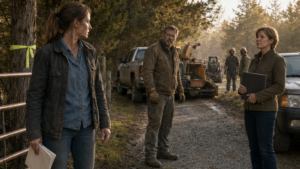
The road onto the upstream parcel was graded smoother than it had been under the previous owner. Fresh gravel ran between new fence posts. Halfway up the slope, Benjamin saw a white pickup parked beside the reservoir.
A man in a clean work shirt stood near the hood with two rolled sheets of paper.
Benjamin pulled over.
The man looked up.
“Benjamin Adams?”
“That’s me.”
“Ryan Clark.”
No handshake came immediately. Ryan seemed to remember one was expected and offered his hand after a moment.
Benjamin took it.
“You managing this place?”
“For the ownership group.”
Benjamin nodded toward the reservoir.
“You cut off the stock flow.”
Ryan did not look surprised.
“We improved a collection feature on our parcel.”
“My pond’s dry.”
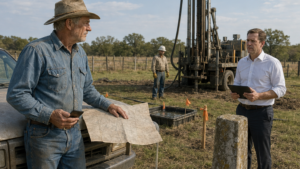
Ryan unrolled one of the sheets across the hood.
It was a survey map, clean and color-coded, showing property lines, contours, and the narrow drainage that crossed the parcel.
“The primary emergence is here,” Ryan said, tapping a point north of the boundary. “Everything we constructed is inside our surveyed line.”
Benjamin looked at the map, then past it toward the reservoir.
“I didn’t ask where your fence was.”
Ryan’s expression tightened slightly.
“The water originates on this parcel.”
“Water’s been running to mine longer than either of us has been alive.”
“That may be true.”
“I’ve got eighty cattle on it.”
Ryan folded his arms.
Benjamin kept his voice level.
“One heifer went down yesterday. I’m hauling water now. Open the cut enough to give me flow while we sort this out.”
Ryan glanced at one of the engineers standing farther up the berm.
“We’re not altering completed work without authorization.”
“Then get authorization.”
“It isn’t that simple.”
Benjamin nearly laughed, but there was nothing funny in it.
“It was simple enough to stop it.”
Ryan rubbed his thumb along the edge of the survey.
“We spent money establishing the hydrology before construction. The collection point is on property we control. I’m not going to reverse a project because a downstream landowner says he has always received the water.”
Benjamin looked at him.
Not angry now.
Just measuring.
Then he returned to his pickup and brought back the photograph.
He set it on the hood beside the survey map.
Ryan glanced down.
Samuel Green stood frozen in black and white, shovel in hand beside the raw pond bank.
“1962,” Benjamin said.
Ryan leaned closer.
“That your father?”
“Grandfather.”
“And?”
“That pond was built for stock water. Family filed on the use that same year.”
Ryan looked up.
“You have documentation?”
“Some.”
“That’s not the same as an adjudicated claim.”
Benjamin did not answer.
Ryan tapped the map again.
“This is what I have. Surveyed source. Surveyed parcel. Engineered storage.”
“And a dry pond downhill.”
“I understand that’s inconvenient.”
Benjamin’s jaw shifted.
“Inconvenient.”
Ryan heard it too. His shoulders lowered a fraction.
“That came out wrong.”
“My cattle don’t care how it came out.”
For the first time, Ryan looked toward the southern ridge as if he could see Benjamin’s ranch through it.
“I’m not trying to put you out of business.”
“Then give me enough water to keep animals standing.”
Ryan hesitated.
Benjamin saw the hesitation and thought he had reached him.
Then Ryan shook his head.
“If I modify this without approval, I own the consequences. The company paid for the parcel in part because of the water potential. I have engineers telling me the collection point is ours. If you believe you have a superior right, talk to counsel.”
There it was.
Not a shouted threat. Not even contempt.
Something harder to argue with: a man hiding inside process because process protected him.
Benjamin picked up the photograph.
“My father used to say a man ought to ask straight before he makes a fight official.”
Ryan’s mouth tightened.
“And now?”
“Now I’m asking straight one last time.”
Neither spoke.
Benjamin slid the photograph back under his arm.
Ryan looked at the old image again.
“Can I see that?”
Benjamin gave it to him.
Ryan studied the back where the faded date had been written. Then, almost casually, he took out his phone.
“What are you doing?”
“Recording what you showed me.”
He photographed the front and back.
Benjamin held out his hand.
Ryan returned it.
“You should find whatever filing you think exists,” Ryan said.
Benjamin stared at him.
The wording had changed.
Not if a filing existed.
Whatever filing you think exists.
Ryan knew enough to be careful.
Benjamin photographed the reservoir, the map on the hood, the berm, and the cut channel while Ryan watched.
When he finished, he put the phone in his pocket.
“I’ll be back when I know what my grandfather filed.”
Ryan did not answer.
Benjamin drove downhill.
Near the boundary, he stopped and looked once more in the mirror.
Ryan was still beside the pickup.
The engineers had walked away.
He was staring at his phone, enlarging the photograph Benjamin had shown him.
Whatever Ryan had seen in that picture, it had been enough to make him stop talking.
Chapter 3: Every Week Without Water Cost More
The first tanker invoice arrived before sunrise the following Thursday.
Benjamin opened the envelope at the kitchen counter, read the amount, and set it facedown.
Then he turned it back over, as though the number might have improved.
It had not.
By the end of the second week, emergency water was costing close to twenty-eight hundred dollars every seven days.
That did not include fuel for moving cattle, the veterinary visit, extra labor, or the lost grazing time from keeping the herd concentrated near temporary tanks.
Benjamin wrote every number in a yellow notebook.
He told nobody the total.
Carolyn saw it anyway.
She came into the kitchen while he was adding receipts and pulled the notebook toward herself.
“Ben.”
He took it back.
“I’ve got it.”
“No, you’re paying it.”
“Same thing.”
“It isn’t.”
He closed the notebook.
Outside, air brakes hissed.
Benjamin looked through the window.
A livestock trailer had backed to the loading alley.
Carolyn turned toward him.
“What’s that?”
“Selling twelve.”
Her face changed.
“These are your fall cattle.”
“I know what they are.”
“You’ll get hurt on price this early.”
“I know.”
“Then why—”
“Because water comes before price.”
He walked out before she could answer.
The cattle loaded reluctantly, hooves striking metal. Benjamin stood at the gate and watched one of his better steers hesitate before entering the trailer.
The animal turned its head toward him.
Benjamin slapped the side panel once.
“Go on.”
When the livestock trailer finally pulled away, another truck appeared at the end of the lane.
The water tanker.
For a moment the two vehicles passed each other beside the mailbox—one carrying value away from the ranch, the other carrying survival in.
Benjamin looked down so the tanker driver would not see his face.
That afternoon Carolyn began opening boxes in the storage room.
Benjamin found her kneeling beside a cedar chest filled with papers that had belonged to their father and grandfather.
“What are you doing?”
“What you should’ve done last week.”
“I told you I’d handle it.”
“You’re handling it by selling cattle.”
She pulled out tax receipts, old grazing records, feed invoices, photographs.
Benjamin leaned against the doorframe.
“Carolyn.”
She ignored him.
“You said Grandpa filed something in 1962.”
“That’s what Dad said.”
“Did you ever see it?”
“No.”
“So we look.”
Benjamin glanced toward the kitchen.
“I don’t need a lawyer waving family scraps around.”
Carolyn stopped.
“This isn’t about a lawyer.”
“It always turns into lawyers once you start digging.”
“What exactly do you think happens if you don’t?”
“I work it out.”
“With Ryan?”
Benjamin said nothing.
Carolyn sat back on her heels.
“He already told you to get counsel.”
“He also knows something.”
“Because he photographed Grandpa?”
“Yes.”
“So find out what.”
Benjamin looked at the boxes.
There were fifty years of paper in that room and none of it arranged the way an office would arrange it. Samuel had saved records in cigar boxes, coffee tins, envelopes, and folded ledgers. Their father had improved the system slightly by writing years on cardboard folders.
Benjamin had always thought knowing the ranch was more important than knowing where every paper lived.
Now the distinction felt expensive.
They searched until evening.
Carolyn found the certificate after dark.
It was folded inside a brown envelope beneath an old livestock tally sheet. The paper was yellowed, its type faint at the creases.
“Ben.”
He came over.
She flattened it carefully.
There was Samuel’s name.
A description of the stock-water use.
A date.
And near the top, a state filing number.
Benjamin read it twice.
His pulse quickened.
“There.”
Carolyn looked at him.
“That’s it?”
“That’s what Dad was talking about.”
“Does it prove the right?”
“It proves Grandpa filed.”
“That isn’t what I asked.”
Benjamin picked up the certificate.
For the first time since the pond went dry, something inside him loosened.
He could already imagine carrying the paper back to Ryan and placing it over that clean survey map.
1962 against last month.
Family use against a development project.
Carolyn watched his face and seemed to know exactly what he was thinking.
“You need somebody who knows what this means.”
“I know what it means.”
“No, you know what you want it to mean.”
Benjamin looked at her sharply.
She held his gaze.
“Call a water lawyer.”
“I’m not spending money I don’t have so somebody in Cheyenne can tell me what my own grandfather did.”
“You’re spending twenty-eight hundred a week because you don’t want to pay someone to tell you whether this paper matters.”
“That’s different.”
“How?”
He could not answer without sounding foolish.
So he turned away.
The photograph of Samuel still sat near the bills on the kitchen table.
Carolyn carried the certificate into the room and laid it beside the frame.
For years, Benjamin had thought of that photograph as proof enough. Samuel with the shovel. The new pond. The date.
A thing seen and remembered.
Now the certificate sat beside it with a number assigned by the state.
Memory beside record.
The tanker receipt lay beneath both.
Carolyn tapped the filing number.
“This is traceable.”
Benjamin looked at the figures on the invoice, then at the number on Samuel’s certificate.
The next tanker delivery was due in three days.
He picked up his phone.
Chapter 4: The Certificate Was Not the Victory
Jessica Rivera read the certificate twice, then slid it back across the desk.
“It matters,” she said.
Benjamin felt his shoulders loosen.
Then she added, “It is not enough.”
The relief vanished so quickly he almost laughed.
He had driven to Cheyenne before daylight with Samuel’s certificate in a plastic folder, the 1962 photograph wrapped in an old feed-store bag, and Carolyn’s filing number copied onto three different pieces of paper in case he misplaced one.
Now Jessica sat across from him in a narrow office lined with binders, telling him the document he had spent two weeks hoping to find did not solve anything.
“What do you mean, not enough?”
“It shows a filing existed. That’s useful. It may establish an early priority date. But a historic filing and a current enforceable right are not the same question.”
Benjamin leaned back.
“My family used that pond every year.”
“I believe you.”
“That sounds like a polite way of saying you can’t prove it.”
Jessica did not soften.
“That is exactly what I’m saying.”
She opened a yellow legal pad.
“How many cattle did your grandfather run?”
“Depends on the year.”
“Your father?”
“Same answer.”
“You?”
Benjamin frowned.
“Usually seventy to ninety.”
“Usually is not a record.”
He looked toward the window.
Jessica continued.
“In Wyoming, prior appropriation can matter a great deal. Earlier beneficial use can outrank later use. But we need to know what was filed, what was recognized, whether the use continued, whether there were changes, whether anything was abandoned, reduced, transferred, or reconfigured.”
Benjamin tapped the plastic folder.
“The pond never moved.”
“That helps.”
“The channel never moved until Clark cut it.”
“That helps too.”
“So why are we sitting here talking like I might not have a right?”
“Because if I walk into an emergency proceeding and say, ‘His grandfather dug a pond in 1962,’ opposing counsel will ask what happened every year between 1962 and now.”
Benjamin looked at the photograph.
Samuel stood there with one hand on the shovel handle, his shirt sleeves rolled, expression flat against the sun.
For most of Benjamin’s life, that picture had represented something uncomplicated.
Now Jessica made it sound like the beginning of a ledger.
She drove with him to the state records office that afternoon.
The clerk retrieved scanned files and microfilmed indexes tied to the number Carolyn had found. There were references to stock watering, a historical priority date, amendments, inspection notes, and later administrative entries written in language Benjamin hated because every sentence seemed designed to contain three possible meanings.
Jessica took notes while he stared at the screen.
At last she touched one line.
“This is good.”
“What?”
“The date.”
Benjamin leaned closer.
The priority period tied to Samuel’s filing was decades older than Ryan’s reservoir project.
“So we’ve got him.”
Jessica looked at him.
“No.”
Benjamin exhaled hard through his nose.
“You enjoy saying that.”
“I enjoy not lying to clients.”
She scrolled.
“The original use is promising. But look here.”
A later record summarized livestock numbers associated with the ranch.
The numbers were high for years.
Then they dropped.
Not slightly.
They fell hard for several seasons.
Benjamin went still.
Jessica noticed.
“What?”
“Nothing.”
She looked at him rather than the screen.
“Benjamin.”
He read the line again.
He knew the years.
Of course he knew them.
Jessica tapped the next entries.
“Then the herd rises again later, but the reporting is inconsistent. There are missing annual details. That gives them room to argue reduced use or discontinuity depending on the exact legal posture.”
“We still used the pond.”
“How much?”
“Enough.”
Her expression hardened.
“That word will hurt you.”
Benjamin pushed away from the desk.
“I didn’t come here to be cross-examined by my own lawyer.”
“You came here because your cattle are drinking hauled water.”
The clerk at the far counter glanced toward them, then away.
Jessica lowered her voice.
“If there is an explanation for these years, I need it before Ryan’s lawyer finds it.”
Benjamin gathered the photograph and slipped it into the folder.
“There was cattle on the place.”
“That was not my question.”
He walked outside.
The afternoon heat off the pavement felt harsher than it should have.
Jessica followed him to the pickup.
“Benjamin.”
He opened the driver’s door.
She stood on the other side of it.
“This case is not going to be won by pretending the ranch has one clean story.”
“My grandfather filed.”
“Yes.”
“My father used it.”
“Yes.”
“I used it.”
“Then help me prove that.”
He looked past her toward traffic moving along the street.
Jessica waited.
Finally she said, “What happened in those years?”
Benjamin’s hand remained on the door handle.
The answer had lived on the ranch for more than a decade without ever needing to be spoken outside the family.
He had convinced himself it belonged to another time.
But the numbers on the state screen had brought it forward.
He looked at Jessica.
“I know exactly why the herd dropped.”
Chapter 5: The Years Benjamin Never Put on Paper
“The cattle numbers fell because I almost lost the ranch.”
Jessica did not write anything at first.
She stood beside Benjamin’s kitchen table the next morning while Carolyn sorted records into piles. The old photograph had been removed from its frame and lay facedown on a dish towel so Carolyn could inspect the cardboard backing.
Benjamin had asked Jessica to come to the ranch because he did not want to tell the story in an office.
Now that she was there, he wished he had chosen the office.
“What happened?” Jessica asked.
“My father got sick.”
Carolyn stopped sorting.
Benjamin kept his eyes on a stack of livestock receipts.
“He was in and out of treatment. Couldn’t work much. We were carrying medical bills, feed costs, a machinery note, and two bad hay years.”
“How far did you reduce the herd?”
“Down into the thirties one year.”
Jessica wrote that.
Benjamin hated the sound of the pen.
“Then lower for part of the next?”
He nodded.
“Did you stop using the pond?”
“No.”
“For how long was the herd reduced?”
“Three years badly. Maybe four before we were back near normal.”
“Any period with no livestock?”
“No.”
“Any year you intentionally abandoned stock-water use?”
“No.”
“Any paperwork showing the reduction was temporary?”
Benjamin looked at her.
“No.”
That was the problem.
He had been too busy surviving to document survival.
When his father was sick, Benjamin had sold cattle whenever bills came due. He had patched equipment instead of replacing it, stretched hay, postponed fencing, and stopped keeping records beyond what taxes demanded.
Every decision had made sense when measured against Friday’s obligations.
None of them had been made for a hearing fifteen years later.
Carolyn folded her arms.
“You never told me how close it got.”
“You knew Dad was sick.”
“That isn’t what I said.”
Benjamin looked at her.
She had left daily ranch work years before, married, moved into town, then later returned to the county after the marriage ended. Benjamin had always treated the ranch crisis as something he and their father had carried because they were the ones physically there.
Carolyn had never forgiven that assumption.
Jessica asked, “Did your father ever discuss selling anything besides cattle?”
Carolyn answered before Benjamin could.
“The water.”
Benjamin turned.
“What?”
Carolyn stared at him.
“He considered selling the water interest.”
“No, he didn’t.”
“Yes, he did.”
“When?”
“The winter before his second surgery.”
Benjamin shook his head.
“You’re mistaken.”
“I’m not.”
“You weren’t even living here.”
“I was the one he called when you were out feeding.”
The room went quiet.
Jessica closed her notebook.
Carolyn walked to the storage-room doorway and returned with a thin folder Benjamin did not recognize.
“He asked me to type a letter because his hands were shaking too badly.”
She opened it.
Inside was an unsigned draft addressed to a neighboring agricultural operator regarding a possible transfer or lease arrangement.
Benjamin read three lines and stopped.
“He never did this.”
“No.”
“Why not?”
Carolyn’s face tightened.
“Because he changed his mind.”
Benjamin looked down again.
The letter had been typed but never mailed.
“He said selling it might keep the bank satisfied,” Carolyn continued. “Then he said it wasn’t only his decision to make.”
Benjamin’s jaw tightened.
“It was his ranch.”
“He said the water had served Grandpa, him, you, me. He said whatever happened next ought to be decided with the family, not because one bad year cornered him.”
Benjamin pushed the folder away.
For years, the sentence his father had given him near the end had controlled more of his life than he admitted.
Keep the place whole.
Benjamin had taken it as a command against change.
No sale.
No outside help.
No dependence.
No surrender.
Now Carolyn was telling him their father had nearly made the largest change imaginable.
Not out of betrayal.
Out of necessity.
Jessica watched Benjamin carefully.
“This does not necessarily hurt the water case.”
“That isn’t what I’m thinking about.”
“I know.”
Benjamin stood and walked outside.
He crossed the yard toward the pond.
The water tanker had filled the stock tank that morning. The pond itself remained low, only a shallow muddy patch beneath the bank.
He stopped at the old measuring post.
Dark marks showed former levels, one above another.
His father had changed herd size.
Samuel had changed grazing rotations.
Benjamin had spent his whole adult life thinking endurance meant refusing to alter the shape of things.
Behind him, Carolyn approached carrying the old photograph.
“I found writing on the back cardboard,” she said.
Benjamin took it.
With the photograph removed from the frame, faint pencil notes showed along the backing board.
Dates.
Water levels.
A drought year.
A notation about rebuilding part of the inlet.
Samuel had been recording change.
Jessica came down from the house and examined the notes.
“He modified the diversion?”
“Looks like it,” Benjamin said.
“You always thought it stayed the same?”
“I thought the pond stayed.”
“That isn’t the same thing.”
No one said anything for a moment.
The realization irritated Benjamin because it sounded too simple.
The family had preserved the use by adjusting the system repeatedly.
The permanence he worshiped had been built from changes he had forgotten.
Carolyn turned the backing board over.
“There’s another note.”
At the bottom, partly hidden beneath an old strip of tape, Samuel had written a name followed by a short notation about a later inspection of the inlet.
Jessica leaned closer.
“What year?”
Benjamin read it.
It was after the worst of his reduced-herd period.
Jessica’s attention sharpened.
“If an inspector came out after those years and documented continued use, that could matter.”
Benjamin looked at the faded pencil line.
For the first time, the old photograph felt less like a portrait of a man who had built something permanent.
It looked like a record left by someone who knew permanence required maintenance.
Jessica took out her phone and photographed the note.
“Tomorrow we trace the inspection.”
Benjamin nodded.
He no longer felt certain the records would save him.
But he was finally willing to let them tell the truth.
Chapter 6: The Records Ryan Thought Did Not Matter
Jessica called at 6:12 the following Monday morning.
“I found something you need to see.”
Benjamin was already dressed.
“What?”
“An engineering memo.”
“Whose?”
“Ryan’s project team.”
He looked through the kitchen window toward the temporary stock tanks.
“What does it say?”
“That their proposed collection could materially reduce downstream seasonal flow.”
Benjamin said nothing.
Jessica continued.
“And the memo predates construction.”
By nine, they were sitting in a small conference room at the state records office with copies spread across the table.
The project correspondence had surfaced through documents tied to the reservoir review and subsequent information requests. Most of it was ordinary technical language—storage calculations, soil stability, estimated capture rates.
Then Jessica placed one page in front of him.
A paragraph had been marked.
The engineers had modeled downstream reduction.
Not total elimination under every condition, but enough to trigger concern about existing uses below the collection point.
“Ryan got this?” Benjamin asked.
“His office was copied.”
“Before he told me the survey settled it?”
“Yes.”
Benjamin stared at the page.
He expected anger.
Instead he felt tired.
“So he knew.”
“He knew there was a risk.”
“That’s knowing.”
“Not legally identical.”
Benjamin gave her a look.
Jessica shrugged.
“You hired me for the difference.”
She pulled another file forward.
The old inspection note from Samuel’s photograph backing had also led somewhere.
A state water official had inspected the ranch after Benjamin’s reduced-herd years. The surviving record was brief, but it described an active stock-water use and the existing inlet system.
It did not erase the reporting gaps.
It did not magically settle priority.
But it filled part of the hole Benjamin had feared most.
Jessica tapped it.
“This is what helps. Not because it makes your history perfect. Because it supports your explanation.”
Benjamin looked at the two records side by side.
One showed his weakness had not been fatal.
The other showed Ryan’s certainty had not been innocent.
His phone rang.
Ryan Clark.
Benjamin almost let it go.
Jessica saw the screen.
“Answer.”
Benjamin did.
“Ryan.”
“I’d like to talk.”
“You’re talking.”
“In person.”
“When?”
“Today.”
They met that afternoon near the upstream access road.
Ryan arrived alone.
He looked different than he had beside the reservoir two weeks earlier. Same clean shirt, same careful posture, but the confidence had narrowed.
He held a folder.
“I know you’ve retained counsel.”
Benjamin leaned against his pickup.
“You told me to.”
Ryan accepted that.
“The company wants to avoid an emergency proceeding if possible.”
“Then release water.”
“I don’t have unilateral authority to restructure the storage system.”
“You had enough authority to build it.”
Ryan looked toward the reservoir.
“I followed the project approvals I had.”
“And ignored your engineers.”
Ryan’s eyes shifted back.
“So you’ve seen the memo.”
“Yes.”
“It was a preliminary model.”
“It said downstream flow could drop.”
“It said could.”
“My pond did.”
Ryan rubbed his jaw.
Benjamin expected denial.
Instead Ryan said, “I should have paused when you came up here.”
The admission caught Benjamin off guard.
Ryan continued before it could become forgiveness.
“But I also had a board asking why we had spent six figures on engineering if I was going to halt a completed project because of an undocumented downstream claim.”
“Mine wasn’t undocumented.”
“I didn’t know that then.”
“You photographed the evidence I brought you.”
“A photograph is not a decree.”
“No. But it was enough to make you check.”
Ryan looked away.
That was answer enough.
He handed Benjamin the folder.
Inside was a proposed payment.
Not enough to cover every projected loss, but enough to pay current tanker bills, veterinary costs, and some of the cattle-sale damage.
Benjamin read until he reached the waiver.
He read that part twice.
“This ends future claims.”
“It resolves the dispute.”
“It pays me for what already happened and leaves your reservoir exactly where it is.”
Ryan did not deny it.
“It gives you cash now.”
Benjamin looked at the amount.
Cash now.
That phrase had governed his worst years.
Cash now had sold cattle early.
Cash now had delayed repairs.
Cash now had nearly convinced his father to transfer the water.
The offer was enough to make the ranch breathe.
That was what made it dangerous.
Ryan watched him.
“You’ve got operating losses. I know that.”
“You know because you calculated them?”
“No.”
“Because you knew I’d get tired?”
Ryan’s expression tightened.
“I know because I manage property for people who look at numbers. At some point everyone has a number.”
Benjamin closed the folder.
“That may be how your board works.”
“It’s how most people work.”
Benjamin thought of the yellow notebook on his kitchen table.
Twenty-eight hundred a week.
Cattle sold below the price he wanted.
His pride had already cost him money.
Now pride could cost him more if he refused an offer simply because Ryan had made it.
That frightened him more than anger did.
He drove back to the ranch with the folder on the seat.
Carolyn and Jessica were waiting.
Jessica read the waiver and set it down.
“It could keep you solvent.”
Carolyn looked at Benjamin.
“But?”
Jessica answered.
“You would be surrendering the future dispute.”
Benjamin walked to the window.
The tanker was due again the next morning.
“What happens if I refuse?”
“We request emergency relief,” Jessica said. “No guarantee. Ryan’s side will challenge continuity, scope, and harm. They’ll argue their project is lawful and that modifying it now creates its own losses.”
“And if I take it?”
“You survive this month.”
Carolyn said quietly, “And maybe fight the same problem next year with no claim left.”
Benjamin looked at the old photograph hanging temporarily without its frame.
Samuel had adjusted channels.
His father had nearly sold water.
None of them had protected the ranch by pretending choices were simple.
Benjamin picked up the settlement offer.
For an instant, he imagined signing it.
The tanker bills disappeared.
The accounts steadied.
He could buy back inventory next season.
Then he pictured the pond staying low permanently while the new reservoir sat full above it.
He turned the last page over.
“Call Ryan.”
Jessica watched him.
“What do you want me to say?”
Benjamin took the pen from her hand but did not sign.
“Tell him I’m not waiving the right.”
Carolyn exhaled.
Benjamin continued.
“Tell him I’m offering something else.”
“What?”
“A temporary shared release. Enough flow to stabilize the herd until the hearing. Measured. Recorded. No admission from either side.”
Jessica studied him.
“That is reasonable.”
“He’ll say no.”
“Maybe.”
Benjamin looked at the tanker invoice beneath Samuel’s photograph.
“If he says no after knowing all this, then I want that refusal in the record too.”
Jessica nodded and reached for her phone.
Benjamin stopped her for one second.
“Make sure the offer says I’ll accept monitoring.”
That surprised both women.
Carolyn smiled faintly.
Benjamin ignored it.
He had spent years believing accepting oversight meant giving up control.
Now he understood the difference between control and proof.
Jessica made the call.
Ryan did not accept immediately.
He said he needed authority.
Benjamin expected that.
What mattered was that this time, before anyone walked into a hearing room, there would be a written choice in front of Ryan:
share enough water to keep the cattle alive,
or refuse while knowing exactly what the downstream damage was.
Chapter 7: He Chose the Water Before the Judgment
The holding company’s lawyer began with the years Benjamin wanted least to discuss.
“You had fewer than forty cattle on the ranch during part of this period, correct?”
Benjamin sat at the narrow witness table and looked at the records projected on the wall.
Jessica had warned him this would happen.
Still, hearing the number spoken aloud in the administrative hearing room made his chest tighten.
“Yes.”
“And substantially fewer than the years immediately before?”
“Yes.”
“And you did not submit complete annual livestock records during that period?”
“No.”
The lawyer stepped closer to his table.
“So when you describe continuous beneficial use, you are asking this office to accept your memory over incomplete records.”
Jessica shifted beside him.
Benjamin saw the movement.
She was ready to object to the framing.
He raised one hand slightly.
Not yet.
The hearing officer looked at him.
“Mr. Adams, you may explain.”
Benjamin glanced toward Ryan.
Ryan sat with his counsel across the room, a binder open in front of him. He did not look triumphant. If anything, he looked exhausted.
Benjamin turned back.
“My father was sick.”
The lawyer’s expression did not change.
Benjamin continued.
“We reduced the herd because I was trying to keep the ranch through his treatment and the debt that came with it. I sold cattle. I postponed repairs. I kept fewer animals because fewer animals were what I could afford.”
“Did you cease using the pond?”
“No.”
“How do we know?”
“There are invoices. Grazing records. The later inspection.”
“The inspection does not count every animal.”
“No.”
“So again, we rely on you.”
Benjamin felt Jessica tense.
He could have stopped there.
Could have given the narrow answer.
Could have let Jessica argue that the question overstated the problem.
Instead he said, “You should also know I did a poor job keeping records.”
The room became very still.
Ryan’s lawyer paused.
Jessica looked at Benjamin sharply.
Benjamin kept going.
“I thought if I knew what happened on the ranch, that was enough. I thought paperwork was something you did for taxes or the bank. That was wrong.”
The lawyer recovered.
“So you admit the records are unreliable.”
“I admit they’re incomplete.”
“That distinction benefits you.”
“It’s still the truth.”
Benjamin pointed toward the historical file.
“My grandfather recorded water levels. My father kept livestock notes. A state official inspected the use after the low-herd years. I brought every invoice I could find, including the ones that make me look careless.”
The hearing officer leaned forward.
“Why?”
Benjamin looked at the table.
Because for most of his life, he had believed protecting the ranch meant never admitting weakness.
Because he had spent weeks doing exactly that.
He raised his eyes.
“Because the water matters more than me looking good.”
No one spoke for a moment.
Ryan finally looked directly at him.
The holding company’s counsel moved to another subject.
They argued the upstream reservoir was a substantial investment. They argued a forced release could affect storage capacity, planned agricultural use, and infrastructure designed around the current capture rate.
One of the engineers described the system carefully.
Then Jessica asked the question Benjamin had been waiting for.
“Before construction, did your team model effects on downstream seasonal flow?”
The engineer hesitated.
“Yes.”
“Did the model identify potential reduction?”
“Yes.”
“Was Mr. Clark’s office copied?”
Ryan’s counsel objected to the implication.
The hearing officer allowed the question but warned Jessica to stay with facts.
The engineer answered.
“Yes.”
Ryan stared down at his binder.
Jessica introduced Benjamin’s written request for temporary shared flow.
Then Ryan’s written response.
He had not accepted.
The company had said operational changes required internal approval and should wait until the legal issue was clarified.
Jessica did not call Ryan cruel.
She did not need to.
The dates sat next to each other.
Engineering warning.
Benjamin’s request.
Ryan’s refusal.
Tanker invoices.
Livestock sale records.
The story was no longer clean enough for either side to simplify.
During a break, Benjamin stood in the hallway beside a vending machine.
Carolyn joined him.
“You all right?”
“No.”
“That’s probably healthier than saying yes.”
He almost smiled.
She held out a cup of coffee.
Benjamin took it.
“I should’ve kept better records.”
“You did what you knew.”
“That’s not the same as doing it right.”
“No.”
He looked at her.
Carolyn had not softened the answer for him.
He appreciated that now.
When the hearing resumed, the holding company made its strongest practical argument.
An immediate release, its counsel said, could reduce reservoir storage at a critical point in the season. The company had expenses, contracts, and its own planned agricultural operations. Benjamin’s historic claim remained disputed. Emergency relief, they argued, would effectively give him part of the final remedy before the merits had been fully decided.
The hearing officer turned to Jessica.
Jessica answered with flow estimates, livestock needs, and the proposed monitored release.
Then she stopped.
“The final decision is yours,” she said. “But Mr. Adams is not asking for exclusive control of the source today. He is asking for enough measured flow to prevent continuing harm while the priority dispute is resolved.”
The hearing officer looked toward Benjamin.
“Mr. Adams, is that accurate?”
Benjamin stood.
“Yes.”
“You understand a monitored interim release may be less than historic flow?”
“Yes.”
“You understand monitoring may require access to your property?”
“Yes.”
“And you accept that?”
Benjamin thought of the man he had been three weeks earlier.
He would have hated the question.
Now he answered without hesitation.
“Yes.”
The hearing officer recessed.
The wait lasted forty-three minutes.
Benjamin counted every one.
Ryan approached him once in the hallway.
“I did ask for authority after your proposal.”
Benjamin looked at him.
“And?”
“They wanted the hearing.”
“Why tell me?”
Ryan glanced toward the closed door.
“Because not every decision with my name on it was only mine.”
Benjamin nodded.
“That doesn’t make the first one disappear.”
“No.”
Ryan walked away.
When the hearing officer returned, everyone stood.
The ruling was limited.
Temporary.
Measured.
Not a final determination of the full water-right dispute.
But effective immediately, the upstream operation was required to allow a controlled release sufficient to restore a defined portion of downstream stock-water flow while monitoring continued.
Benjamin heard the rest in fragments.
Reporting requirements.
Measurement.
Access.
Preservation of claims.
No final finding yet on damages.
Jessica touched his sleeve.
“You got water.”
Benjamin looked across the room.
Ryan had closed his eyes for half a second, then opened them again.
There was no victory in the room.
Only consequence.
That evening, Benjamin stood beside the old inlet.
For several minutes, nothing happened.
Then a thin line of water appeared between the stones.
It moved slowly at first, darkening dust.
Then it reached the first bend.
Benjamin crouched and touched it with two fingers.
Cold.
Real.
Behind him, Carolyn said, “You going to tell Grandpa you won?”
Benjamin looked toward the pond.
“Not yet.”
The water had returned.
The judgment had not.
Chapter 8: The Pond Filled Differently This Time
The first steady stream crossed the old inlet before sunrise several months later.
Benjamin stood beside the measuring post with a notebook in one hand.
He did not cheer.
He wrote down the time.
Then the depth.
Then the flow reading from the monitoring gauge installed upstream.
The pond had recovered gradually under the temporary order. Mud turned dark first, then disappeared beneath widening water. The cattle stopped crowding the emergency tanks. The tanker came twice more, then not again.
But Benjamin had learned not to mistake relief for resolution.
The permanent agreement took months.
Jessica spread the final options across her office table.
One version offered Benjamin more immediate money.
Another offered less money but recognized the senior stock-water use, imposed measurable limits on upstream capture, required ongoing monitoring, preserved maintenance access, and established a procedure for dry-year adjustments.
Benjamin read both.
“How much more?”
Jessica pointed to the first number.
It was enough to replace the cattle he had sold early and leave money in reserve.
Carolyn sat beside him.
She did not speak.
Jessica said, “The larger payment comes with broader releases. You would be giving up part of the future protection we fought for.”
Benjamin leaned back.
Months earlier, he might have stared only at the money.
Now his eyes went first to the operating language.
“What happens in drought?”
Jessica showed him.
“Under the stronger water-protection agreement, both sides reduce according to measured conditions. Under the cash-heavy one, Ryan’s operation gets more flexibility.”
Benjamin read the clause twice.
“And if the monitoring equipment fails?”
“There’s a reporting procedure and manual measurement.”
“Who gets the records?”
“Both parties.”
Benjamin nodded.
Ryan had already agreed in principle to either structure.
The holding company wanted finality.
Benjamin wanted water that did not depend on somebody remembering what had once happened.
He pushed the larger-payment agreement aside.
Carolyn looked at him.
“You’re sure?”
“No.”
Jessica smiled faintly.
“That is usually a better starting place.”
Benjamin chose the stronger water protection.
The settlement compensated documented tanker expenses, veterinary costs, measurable livestock-sale losses, and part of the legal expense. It was enough to repair the damage.
Not enough to transform his life.
That suited him.
Ryan signed two days later.
They met once more near the reservoir for the final operational inspection.
The black liner was no longer new. Dust had collected along the edges. Grass had begun growing around the berm.
Ryan stood beside the monitoring station while a state water official checked the gauge.
“You could’ve taken more cash,” Ryan said.
Benjamin looked at him.
“So could you.”
Ryan gave a short laugh.
“Fair.”
The official moved farther along the channel.
Ryan put his hands in his pockets.
“For what it’s worth, I thought the survey made it simple.”
“I know.”
“I wasn’t trying to dry your place.”
“You kept going after you knew it might.”
Ryan nodded.
“That part’s mine.”
Benjamin studied him.
The apology was incomplete.
So was the harm.
That made it believable.
“You planning to keep the reservoir?” Benjamin asked.
“Yes.”
“Then keep the gauge working.”
“I will.”
Benjamin turned toward his truck.
Ryan called after him.
“Your grandfather’s picture.”
Benjamin stopped.
“What about it?”
“I kept thinking about it after you showed me.”
Benjamin waited.
Ryan looked toward the channel.
“I thought you brought it because you expected me to respect history.”
“I did.”
“I should’ve paid more attention to what the history was documenting.”
Benjamin looked at him for another moment.
Then he left.
At home, Carolyn had covered the kitchen table with papers again.
Benjamin groaned when he saw them.
“What now?”
“Succession.”
“No.”
“Yes.”
He pulled out a chair.
Carolyn slid a folder toward him.
For years, Benjamin had treated the ranch as though keeping it intact meant keeping decisions inside himself.
Now Carolyn’s name appeared beside his on the water-management file.
Not because she was taking over.
Because she belonged in the decisions.
They wrote down where the certificates were stored.
Where the monitoring records went.
Who to call if flow dropped.
Which parts of the system required inspection.
What rights were tied to use rather than family memory.
Benjamin hated every minute of the paperwork.
He completed it anyway.
When they finished, Carolyn picked up Samuel’s photograph.
The frame had been repaired.
“Where do you want this?”
Benjamin looked toward the wall above the sideboard.
There was an empty space.
He hung the photograph there.
Then, instead of putting the new water-management plan in a drawer, he placed a copy in a narrow frame beside it.
Carolyn stepped back.
“Grandpa might hate that.”
“The paperwork?”
“The competition.”
Benjamin smiled.
“Let him.”
The next morning, he walked to the pond before feeding.
The cattle were already there.
Water reached well above the lowest old mark on the measuring post. Ripples moved outward where one cow drank.
Benjamin opened the new logbook.
Date.
Time.
Pond level.
Gauge reading.
He wrote carefully.
For years he had believed Samuel’s photograph showed the moment the family legacy became permanent: a young man with a shovel, a pond behind him, something built once and therefore kept forever.
Now Benjamin understood it differently.
Samuel had dug.
Then repaired.
Then measured.
Then changed the inlet during drought.
Their father had nearly sold the water, then chosen to preserve the decision for the family.
Benjamin had reduced the herd, failed to keep records, resisted help, and nearly allowed pride to become another kind of loss.
None of them had inherited a finished thing.
They had inherited responsibility.
A cow stepped into the shallows and sent muddy water over the bank.
Benjamin watched the water settle.
Then he drew a line beneath the morning entry.
The pond was full enough for cattle.
The water right was documented.
Carolyn knew where the records were.
And if somebody came fifty years from now asking how any of it had been kept, they would not have to rely on an old man saying he remembered.
Benjamin closed the logbook and tucked it beneath his arm.
Behind him, the cattle drank.
The story has ended.