They Put a $42,000 Lien on Her Farm, Then She Opened the Ledger They Thought Nobody Saved
Chapter 1: The Pink Notice Across the Folding Table
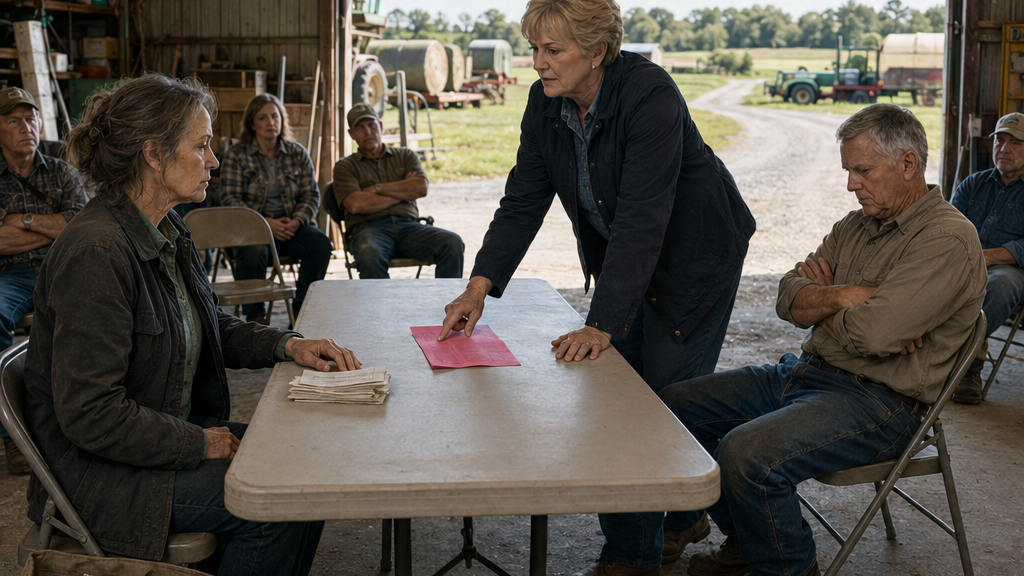
Donna Moore slid the pink paper across the folding table before Amy Hall had finished pulling out her chair.
The number sat in the center of the page in heavy black type.
$42,000.
Amy did not sit.
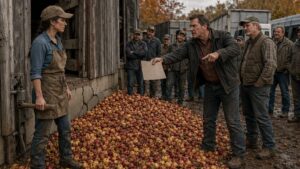
Behind Donna, the equipment shed doors stood open to the cooperative road, where pale gravel ran between pasture fences toward the county highway. A feed truck rattled somewhere beyond the bend. Inside, eight farmers occupied mismatched folding chairs between a parked seed drill and a stack of bagged mineral supplement.
Donna touched one fingernail to the amount.
“You need to take care of that by Friday.”
Amy looked from the paper to Donna.
“What is it?”
“Past-due road and drainage assessments.”
“Forty-two thousand dollars?”
“Accumulated.”
Donna’s tone made the word sound like an explanation.
Amy finally lowered herself into the chair. She was sixty-two, and since her husband died, people had developed a habit of speaking to her as though widowhood had erased her ability to count. Usually she ignored it.
She pulled a narrow envelope from her canvas bag.
“I brought my receipts.”
Donna leaned back.
Paul Young sat two places down, thick arms folded over his work shirt. He had chaired the cooperative for six years and knew exactly how much Amy paid each spring because he had once collected the checks himself.
He avoided her eyes.
Amy laid out the receipts in order.
One for the annual gravel assessment.
One for ditch maintenance.
One for culvert work.
Then the following year.
Then the next.
Donna did not touch them.
“The ledger is what counts.”
Amy looked up.
“These are canceled payment receipts.”
“I understand what they are.”
“Then look at them.”
A chair scraped behind Amy. Somebody gave a quiet cough.
Donna smiled, but there was no warmth in it.
“We’ve already reviewed your account.”
Amy felt heat rising behind her ears. She kept her hands flat on the table.
“How far back are you saying I’m delinquent?”
“Several years.”
“That’s not possible.”
“That’s what everyone says when an account gets this far.”
The words were mild enough to sound reasonable. That made them worse.
Amy glanced at Paul again.
“You remember the 2023 assessment.”
Paul shifted.
“I remember a lot of checks.”
“You deposited mine.”
Donna cut in. “This isn’t helpful.”
Amy turned back to her.
“What happens Friday?”
Donna pushed the pink notice another inch toward her.
“The cooperative attorney starts lien preparation.”
The shed seemed to grow quieter.
Amy’s farm was not large by county standards—eighty-six acres of hay ground, pasture, a machinery shed, and the white farmhouse she and her husband had rebuilt room by room. But the lower twenty acres fronted the shared road. Without them, her cattle operation barely made sense.
She picked up the pink paper.
The notice cited unpaid assessments, interest, administrative charges, emergency-road adjustments and enforcement costs.
Emergency-road adjustments.
Her eyes stopped there.
At the bottom was a printed account date.
Not an invoice date.
A revision date.
Amy read it twice.
Then she looked at Donna.
“When was this ledger revised?”
Donna’s smile held for half a second too long.
“What?”
“The account ledger this notice came from. Which revision?”
“There’s one current ledger.”
“That wasn’t my question.”
Paul uncrossed his arms.
“Amy, we’re not going to turn this into an accounting seminar.”
She looked at him.
“No. You’re going to put a lien on my farm. I’m asking which set of numbers you’re using.”
A younger cattle producer near the open door lowered his gaze to his boots.
Donna reached for Amy’s receipts and gathered them into one stack, not examining any of them.
“You retired from the county, what, five years ago?”
“Six.”
“Then you know records get corrected.”
“They do.”
“Exactly.”
Amy took the receipts back.
“And corrections leave a trail.”
For the first time, Donna did not answer immediately.
Amy had spent thirty-four years working around county accounts. She had never been an auditor, though people often used the word loosely. Her job had been less impressive and more useful: reconciling payments, correcting coding errors, tracking revisions, and finding out why the same dollar appeared in two places.
She knew what legitimate corrections looked like.
She also knew what frightened people did to spreadsheets when they hoped nobody would compare versions.
Paul stood.
“We’ve voted to enforce delinquent accounts. That decision is made.”
“Was my account discussed before today?”
“The board reviewed it.”
“Was I notified?”
Donna answered this time.
“You’re being notified now.”
Amy looked around the shed.
Nobody defended her.
Some looked embarrassed. Others looked irritated that a meeting expected to last twenty minutes was becoming complicated.
That hurt more than Donna’s tone.
For years Amy had brought casseroles when somebody’s wife had surgery, checked cattle during hospital stays, and hauled feed when ice made the county road dangerous.
Yet not one person said, She always pays.
She began gathering her papers.
Donna seemed to take the movement as surrender.
“If you want my advice, don’t make this harder than it needs to be. Call the bank.”
Amy folded the pink notice once.
Then again.
The four neat rectangles fit into the side pocket of her canvas bag.
“I don’t need advice.”
Donna’s face tightened.
Amy stood.
Paul said, “You understand Friday is still the deadline.”
Amy put the strap over her shoulder.
“I understand what you printed.”
She walked toward the open doors.
Behind her, Donna started talking again about drainage maintenance and late accounts, her voice returning to its confident meeting cadence.
Amy reached the gravel road and stopped.
She could hear a truck approaching from the west.
The shared road had been widened after the washout the previous year. New gray stone still showed along the shoulders where the older surface had been cut away.
She turned just enough to look back into the shed.
Donna was watching her.
Amy called across the distance.
“One more thing.”
Donna waited.
“I want the ledger version from before the revision date on that notice.”
The truck rolled between them, tires grinding over gravel.
When it passed, Donna was no longer smiling.
Chapter 2: Forty-Seven Files in an Old County Folder
The debt disappeared when Amy opened the March ledger.
She stared at the screen.
Her farmhouse office was barely large enough for the old oak desk, a filing cabinet, and the printer her daughter kept telling her to replace. The pink notice lay folded beside the keyboard.
Amy unfolded it and compared the account number again.
Same account.
Same parcel.
March: current.
April: current.
May: current.
June—
Amy clicked the next file.
Current.
She sat back.
The cooperative emailed monthly financial packets to members who requested electronic copies. Most people never opened them. Amy did, though not from curiosity. Old habits were harder to retire than county employment.
She had saved the attachments into a folder called FARM ROAD COOP because deleting financial records had always made her uncomfortable.
Melissa called while Amy was opening the next year.
“You ate?”
“Yes.”
“That means no.”
“I had toast.”
“Mom.”
“I’m busy.”
“With what?”
Amy glanced at the pink notice.
“Paperwork.”
There was a pause.
“What happened at the meeting?”
“Nothing I can’t handle.”
Melissa exhaled.
Amy knew that sound. Her daughter had inherited impatience from both parents.
“Did they drop it?”
“No.”
“How much are they claiming?”
Amy hesitated.
“Forty-two.”
“Forty-two hundred?”
“No.”
Silence.
Then, “You need a lawyer.”
“I need the records first.”
“You need both.”
“I’ll call somebody if I need to.”
“You always say that after you’ve decided you don’t.”
Amy closed her eyes.
“This isn’t about your father.”
“I didn’t say it was.”
“You were about to.”
Melissa lowered her voice. “I’m saying you don’t have to do every hard thing alone just because you can.”
Amy looked toward the dark kitchen doorway.
“I’ll call you tomorrow.”
“Mom—”
Amy ended the call.
For several seconds she sat still, annoyed mostly because Melissa had come too close to something true.
Then she returned to the files.
Forty-seven monthly spreadsheets sat in the folder.
Not every month existed. Some had been combined, some skipped. But there were enough.
Amy created a simple list on a legal pad.
Month.
Balance.
Adjustment.
Revision date.
By midnight, a pattern had begun to show.
Her regular payments appeared exactly where they should.
Annual assessment: paid.
Drainage fee: paid.
Special gravel assessment: paid.
Then, in a later version, a new line appeared beneath an already closed quarter.
ROAD ADJ.
$3,850.
The entry date claimed it belonged to February.
But the file itself had not shown it in February.
Nor March.
Nor April.
It first appeared in the July export.
Amy leaned closer to the monitor.
“Backdated.”
She said it aloud because the empty house was beginning to feel too quiet.
The next adjustment was larger.
$6,200.
Then another.
The totals, plus interest and penalties, eventually climbed toward the figure on the pink notice.
Amy retrieved her paper receipts from the canvas bag and began reconciling them against the older versions.
At 1:17 in the morning, the numbers balanced to the cent.
She should have felt relief.
Instead, she felt something colder.
The current ledger was not merely mistaken.
Someone had changed the history.
Tuesday morning brought an envelope from the cooperative attorney.
Amy found it clipped to her mailbox by the carrier because the legal-sized packet would not fit inside.
She opened it standing beside the road.
NOTICE OF INTENT TO PERFECT LIEN.
The language was careful and formal. Unless the outstanding balance was resolved or formally disputed, the cooperative intended to pursue its remedies against the parcel.
Amy read the deadline twice.
She folded the notice and carried it inside.
At ten, she called the cooperative office.
Donna answered.
“I received the attorney letter.”
“Then you understand the timeline.”
“I understand you sent it.”
Donna was silent.
Amy said, “Send me the historical ledger exports.”
“You already have your statement.”
“I asked for the historical exports.”
“I don’t know that we keep every old working file.”
“Your current sheet contains revisions.”
“Amy, we’ve been through this.”
“No. We sat in a shed while you refused to look at receipts.”
Donna’s breath came softly across the line.
“We’re not reopening closed accounting periods because you disagree with them.”
“Who authorized the adjustments?”
“The board.”
“Which meeting?”
Another pause.
“You can make a records request in writing.”
“I will.”
Amy hung up.
Before lunch she compared the revision history again.
One quarterly adjustment bothered her because the amount looked too deliberate—not round, not evenly divided, not like a penalty.
$8,742.16.
She wrote it on the pad.
Something about it felt familiar.
Amy opened another folder: ROAD PROJECTS.
She had kept those packets because the washout the previous year had affected everyone. For nearly a week, loaded trucks had been forced onto a narrower county approach, and cattle trailers had backed up along the road.
There were photographs, contractor summaries, insurance correspondence and one payment schedule.
Amy scrolled.
Then stopped.
Emergency stone and grading.
$8,742.16.
She put one finger against the screen.
The exact amount charged retroactively to her account matched a road-contractor payment down to the penny.
Amy unfolded the pink notice and laid it beside the monitor.
For the first time, the question was no longer whether her account was wrong.
The question was why a road-repair invoice had been turned into her personal debt.
Chapter 3: The Road Bill Nobody Voted On
The neighboring cattle farm carried the same code.
Amy had not meant to look.
She had been searching an old cooperative summary for the total road-repair expense when she noticed a column labeled MEMBER ADJUSTMENTS. The accounts were identified by parcel number rather than names.
She knew one parcel number because its owner’s fence joined hers for nearly half a mile.
ROAD ADJ.
$4,100.
Another parcel showed $5,600.
A third, $3,250.
Amy printed the page.
By Thursday morning, she had found six.
She drove the shared road slowly on her way to the county clerk’s office.
The repaired stretch crossed the lowest ground between the farms. After the washout, trucks had dumped hundreds of tons of stone there. Ditches had been cut deeper. Two culverts had been replaced. The road was better now than it had been before the storm.
Amy remembered the week it failed.
A loaded hay truck had nearly sunk to its axle.
A cattle trailer had been turned around.
Donna had stood in mud directing the contractor while everyone else complained about the cost.
At the time, Amy had been grateful.
That memory irritated her now because it complicated the clean story she had begun telling herself.
Melissa called while Amy parked beside the county building.
“I found a lawyer.”
“I didn’t ask you to.”
“I know.”
“Then why?”
“Because there’s a lien threat against your farm.”
“It’s an intent notice.”
“That distinction does not comfort me.”
Amy gathered her folder.
“I’m checking records.”
“You’ve been checking records for three days.”
“And finding things.”
“What things?”
Amy looked through the windshield.
“Other accounts.”
Melissa went quiet.
“What do you mean, other accounts?”
“I don’t know yet.”
“Mom, that sentence is exactly why you need somebody.”
“I’ll handle it.”
There it was again.
The phrase sounded different after she said it this time.
Less like strength.
More like habit.
At the clerk’s office, Amy pulled cooperative filings, easement documents and recorded meeting notices. The county had no authority over the cooperative’s internal books, but major assessments and liens created paperwork.
Amy found no recorded special assessment corresponding to the emergency road repair.
She checked the cooperative bylaws she had brought with her.
Emergency expenditures could be approved without a full membership vote up to a defined limit.
The washout had cost far more.
She drove home with copies on the passenger seat.
That afternoon she built a new spreadsheet.
Parcel numbers down the left.
Adjustment dates across the top.
She added every amount she could verify from archived cooperative packets.
By six o’clock, eleven accounts showed overlapping road adjustments.
By eight, fourteen.
The numbers were not identical, but they clustered around the same quarters.
Amy totaled them.
Then compared the sum with the contractor’s emergency repair schedule.
She frowned.
The gap was small.
Too small.
She ran it again.
The combined adjustments approximated the entire uncovered portion of the washout repair after the insurance credit.
Amy leaned back.
So that was the mechanism.
At least part of it.
The cooperative had apparently distributed emergency costs through member accounts after the fact.
That could have been sloppy.
It could even have been defensible if properly approved and disclosed.
But Amy’s charges were different.
She had already paid every assessment she had been billed.
These new entries had been inserted backward into closed periods, then allowed to generate penalties.
She opened the cooperative’s current member portal.
The newest ledger looked cleaner than the copies on her hard drive.
No “ROAD ADJ” code.
No separate quarterly adjustment columns.
Instead, balances had been rolled into one line called PRIOR OBLIGATION.
Amy stared at it.
Someone had simplified the record after she asked questions.
She printed the page.
The printer was still running when headlights swept across the kitchen window.
Melissa came through the back door five minutes later carrying a grocery sack.
Amy looked up.
“You drove all this way?”
“It’s forty minutes.”
“You have work tomorrow.”
“I brought soup.”
“I have food.”
Melissa set the bag down.
“Toast is not a food plan.”
Amy almost smiled.
Almost.
Melissa saw the papers spread across the table.
“What did you find?”
Amy hesitated.
Then pushed one page toward her.
“These are other accounts.”
Melissa studied it without understanding.
“They charged them too?”
“Looks that way.”
“How many?”
“Fourteen I can verify.”
Melissa looked at her.
“And you were going to keep this to yourself?”
“I was going to make sure I was right.”
“That’s not what I asked.”
Amy stacked two pages that did not need stacking.
“If I start calling people before I know what happened, all I do is spread accusations.”
“That’s reasonable.”
Amy waited.
Melissa continued, “But not telling anyone at all because you’d rather solve it alone isn’t the same thing.”
Amy’s jaw tightened.
“I don’t need a committee.”
“No. You need a lawyer.”
“Tomorrow.”
Melissa blinked.
“What?”
“I’ll call one tomorrow.”
The answer seemed to surprise both of them.
Later that night, after Melissa had gone, Amy returned to the contractor records.
She wanted the original invoice, not the cooperative summary.
Buried in an attachment from the emergency-repair packet was a scanned copy.
The contractor’s name appeared at the top.
Stone, culvert replacement, grading, machine hours.
At the bottom was the payment line.
Amy expected the cooperative’s name.
Instead, she read:
PAID BY: DONNA MOORE.
She sat completely still.
The invoice had been settled two days after the washout, before any cooperative meeting had taken place.
Donna had not merely allocated the road bill.
She had paid it herself.
Amy looked through the kitchen window toward the dark road.
For three days she had been asking why Donna had changed the books.
Now she had a harder question.
Why had Donna risked her own money to keep that road open in the first place?
Chapter 4: What Donna Paid Before Anyone Asked
The canceled check had Donna Moore’s name on it.
Amy held the copy under the kitchen light and read it again, though there was nothing ambiguous about the signature.
Donna had written the contractor a personal check for the first emergency payment two days after the washout.
Not the cooperative.
Not Paul.
Donna.
By nine the next morning, Amy was standing beside the repaired stretch of gravel road with the invoice folder tucked beneath her arm.
The ditch on the south side was dry now, its banks packed hard beneath summer grass. A year earlier, water had cut through the road badly enough to leave a trench where loaded trucks were supposed to pass.
Amy remembered that week differently now.
She remembered tractors waiting at both ends.
She remembered a cattle trailer backing nearly half a mile because there was nowhere safe to turn.
She remembered Donna in rubber boots, mud up to her calves, arguing with a road contractor while Paul kept saying they needed to wait until the insurance company answered.
At the time, Amy had thought Donna was being overbearing.
Maybe she had been.
But she had also gotten the road opened.
Amy drove to the cooperative office after lunch.
Paul was there alone, sorting envelopes at the counter.
He looked up when she entered.
“If this is about your lien, the attorney has it.”
“It’s about the washout.”
His expression changed slightly.
Amy set a copy of Donna’s check on the counter.
“Why did she pay this?”
Paul did not touch it.
“You’ve been digging.”
“You knew I would.”
He sighed.
“There wasn’t time.”
“For what?”
“For the meeting. For the insurance answer. For everybody to sit around deciding who owed what.”
“That does not explain why Donna paid.”
Paul leaned one hand against the counter.
“We had trucks that couldn’t get through. Hay moving. Cattle moving. Two places on the far end had feed deliveries coming.”
“And?”
“And the contractor wanted money before he committed equipment.”
“So Donna gave it to him.”
“Yes.”
“How much?”
Paul looked toward the window.
“A little over thirty thousand at first.”
Amy had expected a smaller number.
“From her own account?”
“Yes.”
“Why?”
“Because she could.”
The answer irritated Amy.
“That isn’t a reason.”
Paul’s mouth tightened.
“She had money available. The cooperative account didn’t. Donna said we could sort reimbursement out afterward.”
“Did the board approve it?”
“We talked.”
“That wasn’t my question.”
Paul straightened.
“We had an emergency.”
“Did the board approve it?”
“No formal vote.”
Amy let the silence sit between them.
Paul rubbed the side of his jaw.
“I told her I thought she should do it.”
“You told her privately.”
“Yes.”
“And after the road reopened?”
“We were supposed to call a special meeting.”
“Did you?”
“No.”
“Why?”
Paul gave a humorless laugh.
“You know these people.”
“I am one of these people.”
“You know exactly what happens when you ask twenty farmers to agree on an emergency assessment after the emergency is already over.”
Amy said nothing.
Paul continued.
“Half of them would say the county should pay. Three would say the insurance should cover everything. Somebody would complain they didn’t use the road that week. Somebody else would threaten to quit the cooperative.”
“So you avoided the vote.”
“We delayed it.”
“For a year?”
Paul looked away.
There it was.
Not a conspiracy.
Cowardice.
Ordinary, familiar cowardice dressed as practicality.
Amy picked up the copy of the check.
“How was Donna supposed to get her money back?”
“Through assessments.”
“Approved how?”
Paul did not answer.
Amy understood before he spoke again.
“She started applying adjustments.”
“Without a vote.”
“We were going to ratify it.”
“But you didn’t.”
“No.”
“And when members asked questions?”
Paul’s face hardened.
“Most people didn’t.”
Amy thought about the meeting in the equipment shed. Eight people sitting quietly while Donna placed forty-two thousand dollars in front of her.
“No,” Amy said. “They didn’t.”
Paul pushed the envelopes into a stack.
“You’re making Donna sound worse than she was.”
“I haven’t said anything about what she was.”
“You’re thinking it.”
Amy looked at him.
“Right now I’m thinking you let her take all the risk and then left her alone with the bookkeeping.”
His head came up.
That landed.
Paul stared at her, color rising along his neck.
“That’s not fair.”
“Is it wrong?”
He did not answer.
Amy packed the invoice copy away.
At the door, Paul said, “She saved that road.”
Amy turned.
“I know.”
“And people forget that.”
“I won’t.”
Paul seemed almost relieved.
Then Amy added, “But saving the road doesn’t explain my account.”
The relief disappeared.
That evening, Amy rebuilt the reimbursement history.
She began with Donna’s documented advances.
Contractor payments.
Stone deliveries.
Culvert materials.
Equipment charges.
Then she traced every member adjustment she could find.
The math was messy because the cooperative had not used a consistent allocation formula. Some farms were charged by acreage. Others by road frontage. Some entries appeared to be flat assessments.
But by midnight, Amy had a working total.
Donna had advanced a substantial amount.
The cooperative had repaid her in pieces.
Amy checked the deposits twice.
Then a third time.
There was a point, nine months after the washout, when the legitimate reimbursement should have ended.
Amy circled the date.
Everything before it could be argued about.
Poorly authorized.
Improperly allocated.
Badly documented.
But connected to a real expense.
Then she moved down the ledger.
Another adjustment appeared the following quarter.
And another after that.
Amy froze.
Donna had continued creating charges after her documented emergency advance had already been recovered.
The room felt smaller.
Amy pulled the pink notice from beneath her folder and unfolded it.
Part of the $42,000 demand had been built from those later entries.
Not rescue money.
Not emergency reimbursement.
Something else.
Amy stared at the circled date and the charges beneath it.
For the first time since the meeting, she wished the story had remained simple.
Chapter 5: The Accounts That Should Have Stopped
Amy found the exact day Donna’s legitimate reimbursement reached zero.
She marked it with a red line across the spreadsheet.
Everything above the line represented money Donna could at least claim she had been owed.
Everything below it did not.
Amy sat at the farmhouse table with seventeen parcel accounts spread across printed pages.
Seventeen.
She had verified them one by one.
Some showed only a few hundred dollars in unexplained carryovers. Others showed thousands. Amy’s account was the worst because penalties and enforcement charges had been layered over older adjustments until the balance became nearly impossible to recognize.
The pattern was not random.
Members who challenged charges early had cleaner accounts.
Members who paid automatically or rarely attended meetings carried more adjustments.
Widows.
Older landowners.
One farm operated by brothers who were almost never at cooperative meetings because they worked construction jobs during the week.
Amy pushed back from the table.
That part made her angry in a different way.
Not because she knew Donna’s intention.
She did not.
But because somebody had learned which accounts could absorb a questionable charge without immediate resistance.
Melissa arrived carrying coffee and found Amy still in the same clothes she had worn the night before.
“You slept?”
“A little.”
“That means no.”
Amy pointed to the chair across from her.
“Sit.”
Melissa sat.
Amy turned the laptop around.
“The original emergency advance was real.”
Melissa scanned the sheet.
“Donna actually paid?”
“Yes.”
“So she wasn’t stealing.”
“Not at first.”
Melissa looked up.
Amy pointed to the red line.
“This is where she was fully reimbursed.”
Then she scrolled.
“These came after.”
Melissa’s brow furrowed.
“How much?”
“Across the accounts I can verify, enough that it can’t be dismissed as one mistake.”
“Does your lawyer know?”
“I’m meeting the attorney this afternoon.”
Melissa leaned back.
“You called one.”
“Yes.”
“Without me forcing you.”
“Don’t spoil it.”
Melissa smiled briefly, then looked at the pages again.
“What are you going to ask for?”
“My lien stopped.”
“That’s it?”
Amy did not answer.
The attorney’s office occupied the second floor of a brick building near the courthouse. Amy disliked elevators, so she took the stairs and arrived irritated enough to be useful.
Her attorney read quietly for nearly twenty minutes.
The silence reminded Amy of county budget meetings, where the smartest person in the room was usually the one not speaking.
Finally the attorney set down the timeline.
“This is stronger than I expected.”
Amy waited.
“Your cleanest argument is narrow. You paid the assessments you were properly billed. Later entries were added retroactively. We challenge the lien on that basis.”
“What about the other accounts?”
“That is not necessary to stop your lien.”
“It is part of the same ledger.”
“It may be. But once we broaden this, they will broaden their defense.”
“How?”
“They will argue emergency authority, member benefit, equitable contribution, bookkeeping corrections. They may challenge your archived copies. They may say the spreadsheets were working documents rather than final records.”
“They changed the books.”
“That is what we would have to establish.”
Amy tapped the red line.
“And the charges after Donna was repaid?”
“Important.”
“Seventeen accounts.”
“Also important.”
“So why leave them out?”
The attorney folded both hands.
“Because winning your case and proving a cooperative-wide accounting failure are different jobs.”
Amy looked toward the window.
Across the street, a farmer in work boots was feeding coins into a parking meter.
Her first instinct was to take the clean victory.
Stop the lien.
Protect the land.
Go home.
She had not volunteered to become anybody’s investigator.
Those same people had sat silent while Donna humiliated her.
Paul had known enough to speak and chose not to.
Why should Amy risk her farm to correct their accounts?
The thought settled comfortably.
Too comfortably.
Her attorney said, “If you want only the lien stopped, I believe we have a direct path.”
Amy nodded.
She gathered the papers.
On the drive home she passed the cooperative road.
A fertilizer truck was coming toward her, too wide for both vehicles to pass comfortably on the narrow shoulder. Amy pulled into the grass and waited.
The truck rolled by.
Dust rose behind it.
That road connected every farm in the cooperative.
Even the people who never came to meetings.
Even the people who complained.
Even the people who had watched her carry the pink notice out of the shed alone.
Amy drove on.
At home, she opened the seventeen account pages again.
Then she took out the pink notice.
For days, it had represented what Donna had tried to do to her.
Now it looked different.
It was not the beginning.
It was the end of a process that had been running quietly for months.
The last enforcement step.
Amy called the attorney.
“I want to change the filing.”
There was a pause.
“In what way?”
“Include the ledger history.”
“All of it?”
“All the versions I have. The reimbursement timeline. The other affected accounts.”
“Amy, that will make this more complicated.”
“I know.”
“It may make your individual case slower.”
“I know.”
“And if the judge decides the emergency assessments were partly legitimate—”
“Then I pay what I actually owe.”
The attorney went quiet.
Amy looked at the red line on the screen.
“I’m not asking to pay nothing. I’m asking them to prove what belongs there.”
Another pause.
Then the attorney said, “All right.”
Amy exhaled.
“Submit the full history.”
When she hung up, the room did not feel triumphant.
It felt exposed.
She had spent most of her life believing that careful records protected the person who kept them.
Now she was betting her farm on the idea that they could protect people who had never thought to look.
Chapter 6: When the Ledger Reached the Judge
The cooperative’s attorney began by placing a ledger in front of the judge that showed Amy Hall owed $42,000.
Amy almost laughed.
Not because it was funny.
Because after weeks of work, they had returned to the same sheet of paper.
The county civil courtroom was smaller than Amy expected. No polished television drama. No crowd. Just wood benches, fluorescent lights, files, and the low mechanical hum of the ventilation system.
Donna sat at the opposite table.
Paul sat behind her.
Neither looked at Amy.
The cooperative attorney described the ledger as the current official account record.
Amy’s attorney waited.
Then asked, “Current as of when?”
The first crack appeared.
The cooperative attorney answered carefully.
The judge looked down at the document.
Amy’s attorney placed a second ledger beside it.
Then a third.
Then another.
Forty-seven monthly versions had been organized chronologically.
Not all were introduced as separate exhibits at once, but enough were authenticated through email dates and cooperative distributions to establish that the records had changed over time.
Amy watched Donna’s face.
Nothing dramatic happened.
No collapse.
No confession.
Donna simply stopped taking notes.
Amy’s attorney walked through the early versions.
Amy current.
Payment received.
Zero past due.
Then the first road adjustment.
It appeared months later but carried an earlier effective date.
The cooperative attorney objected to characterizing that as backdating.
The judge allowed the records to speak for themselves.
More versions followed.
Additional adjustments.
Rolled balances.
Penalty calculations.
Then the current ledger, where several older categories had been consolidated beneath PRIOR OBLIGATION.
The judge leaned forward.
“Why was the account structure changed?”
Donna’s attorney conferred with her.
Donna answered from the witness chair.
“To simplify reporting.”
“Did the underlying amounts change?”
“No.”
Amy felt her fingers tighten around the edge of the table.
That answer was technically clever.
The amounts had not disappeared.
Their labels had.
Her attorney moved to the reimbursement history.
The contractor invoices came next.
Donna’s personal payments.
For the first time, Amy saw the judge look directly at Donna with something other than procedural attention.
“You personally advanced these funds?”
“Yes.”
“Why?”
“The road was impassable.”
Donna’s voice was steady.
“We had cattle trailers blocked. Feed deliveries. Harvest equipment. Insurance had not paid. The cooperative account could not cover the contractor deposit.”
“Did the board authorize your advance?”
Donna looked toward Paul.
“Not formally.”
Paul shifted behind her.
“Was there informal approval?”
Donna hesitated.
“Yes.”
Amy’s attorney called Paul.
His testimony was less polished.
He admitted telling Donna to get the road opened.
He admitted expecting the cooperative to reimburse her.
He admitted they never held the required special vote.
“Why not?” Amy’s attorney asked.
Paul stared at the witness rail.
“Because I thought we could straighten it out afterward.”
“And did you?”
“No.”
“Did you tell members you had encouraged Ms. Moore to advance the money?”
“No.”
“Why?”
Paul’s face reddened.
“I didn’t want to make things worse.”
Amy lowered her eyes.
There it was again.
The sentence beneath half the damage people caused.
I didn’t want to make things worse.
The hearing moved into the afternoon.
Donna’s attorney argued that the emergency repairs benefited all members and that the cooperative had a duty to recover the expense.
Amy did not disagree with that.
That was the part that surprised Donna.
When Amy testified, her attorney asked whether she believed the cooperative should have paid for the road repair.
“Yes.”
“Do you believe members should have contributed?”
“Yes.”
Donna looked at her then.
Amy continued.
“If the assessment was authorized, allocated fairly and disclosed.”
Her attorney placed the reimbursement timeline on the display.
The red line appeared across the page.
“This date?”
Amy explained it.
Using Donna’s documented advances and cooperative reimbursement entries, the legitimate emergency advance had been recovered by that point.
“What happened after?”
“Adjustments continued.”
“How many accounts did you identify?”
“Seventeen with overlapping entries I could verify.”
“Was yours among them?”
“Yes.”
The attorney displayed the pink notice.
Amy recognized the fold lines.
“What is that?”
“The notice I received at the cooperative meeting.”
“And where does it fall in the sequence?”
“At the end. After the adjustments, after the penalties, after the account categories were consolidated.”
Donna stared at the notice.
Her attorney stood.
When it was Donna’s turn to explain the later entries, her composure finally thinned.
“The cooperative still had obligations.”
“What obligations?” the judge asked.
“Drainage work. Insurance shortfalls. Maintenance. We were behind.”
“So these charges were not reimbursements to you?”
“Not entirely.”
“Were they approved?”
Donna paused.
“Not in the way they should have been.”
The room went still.
Her attorney tried to redirect.
Donna kept talking.
“If I had stopped collecting, the cooperative account would have gone under.”
Amy watched her.
There was no smile now.
Only exhaustion.
Donna looked older than she had in the equipment shed.
“People wanted the road open,” she said. “They wanted the ditches clear. They wanted trucks through. But every time costs came up, nobody wanted the assessment.”
The judge said, “That does not authorize you to create obligations retroactively.”
“I know that now.”
Amy felt no satisfaction.
Donna looked toward Paul.
“He told me to fix it.”
Paul looked down.
“And then when people started asking questions, suddenly nobody remembered anything.”
Amy understood then why Donna had kept going.
Not justification.
Not innocence.
But the path.
One unauthorized decision had solved a real emergency.
Admitting it afterward would have exposed Paul, the board and Donna.
So they postponed.
Then adjusted.
Then disguised.
Then enforced.
Each new choice made the previous one harder to confess.
The judge reviewed the records for several minutes.
Finally, she looked at Amy.
“You are not disputing responsibility for any properly authorized share of the emergency repair?”
“No.”
“You are disputing the retroactive charges and penalties?”
“And the later unsupported adjustments.”
The judge nodded.
Then turned to the cooperative.
“The lien process against Ms. Hall is stayed.”
Amy heard Melissa’s breath leave beside her.
The judge continued.
“The court is not prepared today to declare every emergency expenditure invalid. The road was repaired. Members received a benefit. But the recordkeeping presented here is insufficient to support the claimed delinquency.”
Donna lowered her head.
The judge ordered an independent reconciliation of the affected cooperative accounts, including the emergency advance, reimbursements, subsequent assessments, penalties and allocation methods.
Paul closed his eyes.
Amy’s attorney whispered, “That’s good.”
Amy knew.
But she also knew it was not clean.
The road still existed.
The bills still existed.
Some members still owed legitimate shares.
Donna had done something wrong after doing something necessary.
Paul had helped create the conditions and then stepped aside.
The judge looked toward the cooperative table.
“Until reconciliation is complete, no enforcement action based on these disputed adjustments is to proceed.”
Amy glanced at the pink notice lying among the exhibits.
Weeks earlier, it had felt like a verdict.
Now it was only one piece of paper in a much larger record.
Outside the courthouse, nobody cheered.
Farmers stood in small groups near pickups, speaking quietly.
Donna left with her attorney without looking at Amy.
Paul remained on the steps.
After a moment he said, “This could break the cooperative.”
Amy looked toward the road beyond the square, where trucks moved toward the farms.
“No,” she said. “The books already did that.”
Paul stared at her.
Amy picked up her folder.
“Now we find out whether the truth can put it back together.”
Chapter 7: The Road Still Belonged to Everyone
The corrected assessment arrived in a white envelope, and Amy’s first reaction was irritation.
The amount was not zero.
She stood beside the mailbox with the envelope open in one hand and read the figure again.
$2,184.73.
For weeks, she had imagined the first clean statement as proof that the whole fight had been worth it. Some small part of her had expected a line of zeros.
Instead, the independent reconciliation had assigned every cooperative member a legitimate share of the emergency road repair, recalculated according to the allocation method the bylaws actually permitted.
Amy owed money.
Just not forty-two thousand dollars.
She carried the statement to the kitchen and set it beside the old pink notice.
The difference between the two sheets was almost absurd.
One had threatened her farm with penalties built on altered records.
The other told her what she genuinely owed for a road she had used as much as anyone.
Amy wrote a check that morning.
When Melissa called, Amy told her.
“You already paid it?”
“Yes.”
“You didn’t want to argue over the amount?”
“I checked the calculation.”
Melissa laughed softly.
“Of course you did.”
“It was right.”
“That must have been painful.”
Amy looked toward the pasture through the kitchen window.
“Less painful than being wrong.”
The reconciliation had taken almost four months.
Every cooperative account had been reconstructed.
The results satisfied almost nobody completely, which Amy considered evidence that they were probably close to fair.
Some farmers received credits.
Others owed modest additional amounts.
Penalties tied to unsupported adjustments were removed.
Donna’s documented emergency advance was recognized as legitimate, but reimbursements beyond that amount were separated from authorized cooperative expenses and placed under a repayment agreement.
Nothing about it resembled the dramatic ending people might have imagined after the court hearing.
There were no arrests.
No cheering neighbors.
No single number that explained every bad decision.
There were revised statements, attorney invoices, uncomfortable meetings, and a stack of accounting procedures nobody had cared about until the lack of them nearly cost Amy part of her farm.
Paul resigned as board chair before the reconciliation was finished.
His letter was short.
He accepted responsibility for allowing emergency decisions to proceed without proper documentation and for failing to correct the problem when questions first arose.
Amy read it twice.
He never used the word fear.
He did not need to.
Donna stayed away from the cooperative shed for several weeks.
Then, one Thursday afternoon, Amy found her standing beside the repaired culvert while a road contractor checked erosion along the shoulder.
Donna wore jeans and an old work jacket instead of the blazer she had favored at meetings.
Amy slowed her truck.
For a second she considered driving past.
Donna looked up.
Amy stopped.
Neither woman moved toward the other.
Finally Donna said, “They tell me your corrected statement came out clean.”
“Not clean. Accurate.”
Donna gave a tired half smile.
“That sounds like you.”
Amy rested one arm on the open truck window.
“I paid it.”
“I heard.”
The road contractor walked farther down the ditch, giving them privacy without making a show of it.
Donna looked toward the gravel.
“I should’ve held the special meeting.”
“Yes.”
“I thought if I got everybody through harvest, they’d understand afterward.”
“Some probably would have.”
“Some wouldn’t.”
“No.”
Donna kicked a loose stone away from her boot.
“When the reimbursement started, I kept thinking I’d straighten the records up after the next quarter.”
Amy said nothing.
“Then the next quarter came.”
“And you changed more.”
“Yes.”
Donna’s eyes stayed on the road.
“By the time I knew I’d crossed a line, admitting the first mistake meant admitting all of them.”
Amy remembered the judge’s courtroom.
One decision making the next confession harder.
“You still chose them.”
Donna looked at her.
“I know.”
There was no apology big enough to erase the pink notice.
Amy did not offer forgiveness.
But she did not need Donna to become a monster either.
After a moment Amy said, “You did save the road.”
Donna’s face changed.
Barely.
“I did.”
“And then you used that fact to justify things it didn’t justify.”
Donna nodded.
“That too.”
Amy put the truck in gear.
Before she pulled away, Donna said, “I’m sorry about the way I talked to you that morning.”
Amy looked back at her.
“That was the least expensive mistake you made.”
Donna laughed once despite herself.
Amy drove home.
The next cooperative meeting filled nearly every folding chair in the equipment shed.
People who had ignored financial packets for years arrived carrying corrected statements marked with questions.
The board had already adopted temporary safeguards: dual approval for account changes, recorded votes for special assessments, and outside quarterly reconciliation.
Then a cattle producer stood and said what several others had apparently discussed beforehand.
“We think Amy should take over as treasurer.”
Heads nodded around the room.
Amy felt Melissa, seated beside her, turn to look.
Paul’s old chair at the front table sat empty.
Donna was not there.
The new acting chair said, “You know the books better than anybody.”
That was precisely why the request bothered Amy.
Months earlier, she might have accepted.
She could imagine the satisfaction of controlling every spreadsheet, reconciling every account, catching every mistake before anybody else saw it.
She could also see the trap.
A cooperative that depended on one careful person had learned nothing.
Amy stood.
“I won’t be treasurer.”
Several faces fell.
The cattle producer frowned.
“Why not?”
“Because the problem wasn’t that we had the wrong person with the spreadsheet.”
The shed quieted.
“The problem was that the rest of us stopped looking.”
Amy did not give them a speech.
She proposed something simpler.
Each month, the cooperative would publish the reconciliation.
Two members who were not officers would rotate through review.
Adjustments would show the date, reason, authorization and original entry.
No hidden catch-up work.
No single person allowed to change history without leaving fingerprints.
The acting chair looked around.
“That sounds like more work.”
“It is.”
A few people laughed.
Amy did not.
“So is fixing it afterward.”
The measure passed without applause.
After the meeting, she stayed behind only long enough to help stack the chairs.
On the folding table sat her folder from the court case.
Amy opened it.
The pink notice was still inside.
Its creases had softened from being folded and unfolded so many times.
She opened it flat one last time.
$42,000.
The number no longer frightened her.
It embarrassed her less than she expected.
What remained was the memory of walking out of that shed believing dignity meant needing nobody.
Amy placed the pink notice behind the corrected ledger statement and closed the folder.
Outside, a loaded hay truck came down the shared road.
Its tires pressed into the gravel Donna had once paid to put there.
The truck passed Paul’s farm, Donna’s turnoff, Amy’s lower pasture, and every other property tied to the same strip of stone.
Nobody owned the road alone.
That had always been the difficulty.
It was also the point.
Amy climbed into her truck and headed home.
The story has ended.