They Drilled Beneath His Pasture for Water, and the New Subdivision Went Dry
Chapter 1: The Drill Rig Beyond the South Fence
The first sound Daniel Carter heard was not cattle, wind, or a tractor on the county road.
It was steel grinding against stone.
He stopped halfway across the south pasture with one gloved hand resting on the fence stretcher hooked to his belt. The noise came again—low, mechanical, powerful enough to tremble through the dry ground beneath his boots.
Daniel turned toward the cedar windbreak.
A drilling mast rose above it.
For several seconds he simply stared.
There was no drilling scheduled on his land.
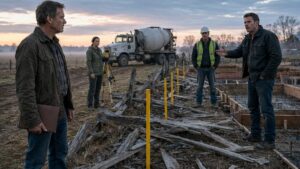
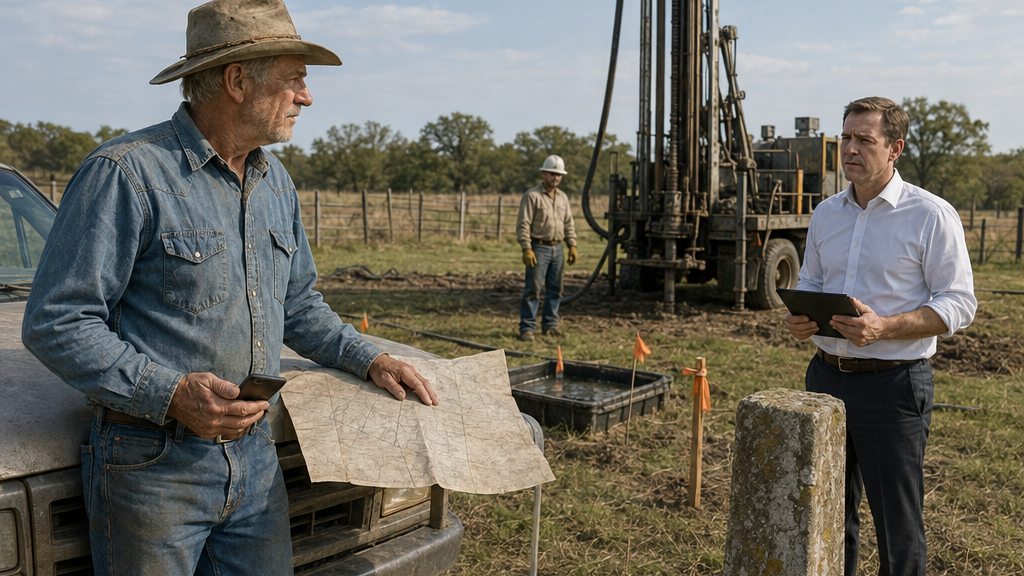
He left the fence wire sagging where he had been tightening it and walked fast toward the trees. By the time he reached the shallow rise, he could see the whole operation below him: a tall rotary rig, two service trucks, a mud tank, orange flags, hoses laid across flattened grass, and six men working as if they had been there all morning.
They were inside his fence.
Not close to it.
Inside it.
A steel bit hung over a freshly cut hole less than fifty yards from the stock pond.
Daniel climbed through the fence instead of using the gate.
The drilling foreman noticed him first. He lifted a hand, then looked toward a man in a white shirt standing beside a pickup with a tablet under one arm.
The white-shirted man came over.
“Can I help you?”
Daniel looked past him at the rig.
“You can shut that down.”
The man glanced toward the crew but did not signal them.
“I’m Mark Lewis. Operations manager for the development.”
“I know what’s being built over there.”
Beyond the north ridge, rooftops from the new subdivision rose in neat lines where pasture had stood three years earlier.
Daniel pointed at the ground beneath Mark’s polished boots.
“This is my side.”
Mark gave him a measured look.
“We’re within the utility corridor.”
“You’re drilling a well.”
“We’re establishing a groundwater connection.”
“On my property.”
Mark’s expression shifted into the patient look people used when they thought explanation and permission were the same thing.
“We have easement rights across this section.”
Daniel turned toward the drilling foreman.
“Kill the rig.”
The foreman looked at Mark.
Mark said, “Hold where you are.”
The machinery slowed, but the engine kept idling.
Daniel heard mud circulating somewhere below.
Mark lowered his voice.
“Mr. Carter, nobody is trying to create a problem here. This project serves the residential development. We’ve got engineering approvals, legal review, and recorded access.”
“You have permission from me to drill?”
“We don’t believe additional permission is required.”
That sentence settled something in Daniel.
Until then, he had allowed for incompetence. A bad survey coordinate. A contractor following the wrong stake. Someone confusing an old pasture road with the recorded corridor.
But Mark had just told him this was deliberate.
Daniel looked at the orange flags. They formed a straight path from the service road toward the rig. Somebody had planned the route, unloaded equipment, leveled part of the pasture, and started drilling before Daniel ever heard the first bit strike rock.
“Who marked this location?”
“Our survey subcontractor.”
“Was I notified?”
“You were contacted regarding access last spring.”
Daniel remembered the letter.
A broad request from the homeowners association and development company asking whether he would consider granting a permanent utility corridor along the edge of the Carter property. The language had been polite. The map attached to it had been vague.
Daniel had written NO across his own copy and mailed back a short refusal.
That should have ended it.
Mark continued, “There was subsequent title review.”
“I didn’t grant anything subsequent.”
“There’s an older easement.”
“For utilities crossing the property.”
“That’s what our counsel is relying on.”
Daniel looked back at the rig.
“A buried line crossing land and a well pulling water out of it aren’t the same thing.”
“I’m not going to argue easement interpretation in a pasture.”
“Then stop drilling until somebody does.”
Mark’s jaw tightened.
“We have crews here, equipment rented by the day, and a schedule we’re already behind on.”
Daniel almost laughed, but there was nothing funny in it.
“That schedule belongs to you.”
“And hundreds of homeowners are depending on us meeting it.”
“Then you should’ve settled what you had a right to do before you brought a drill.”
One of the workers shifted his weight and looked away.
Mark noticed.
His tone hardened.
“We’re not trespassing, Mr. Carter.”
Daniel took out his phone.
Mark watched him unlock it.
“What are you doing?”
“Making sure I remember exactly what’s here.”
He photographed the rig, the trucks, the flags, the mud tank, and the nearest fence post. Then he walked twenty paces toward the shallow ditch and photographed a weathered stone marker half-hidden beneath bunchgrass.
Mark followed.
“You know what that is?”
Daniel brushed dirt from its top with his boot.
“My grandfather paid a surveyor to set monuments across this place in 1978.”
“That doesn’t change the recorded easement.”
“No. But it tells me where I’m standing.”
Daniel photographed the marker.
He could see Mark losing patience now.
“You’ve made your objection. I’ll note it.”
Daniel turned.
“Note this too. I’m telling you not to drill until the right to do it is established.”
Mark said nothing.
Daniel had spent most of his life learning that shouting rarely made a fence stronger, a sick calf stand up, or a bad contract improve. So he walked away.
Halfway back toward the house, he remembered the old folded survey in the fire safe beneath his father’s papers.
He had not opened it in years.
Behind him, the rig engine rose in pitch.
Daniel stopped.
The drilling foreman looked toward Mark one last time.
Mark gave a small downward motion with two fingers.
The rotary table began turning.
A moment later, the steel bit descended into Daniel Carter’s pasture again.
Chapter 2: The Map Mark Did Not Expect
Daniel unfolded the 1978 survey across the hood of Mark Lewis’s pickup and pinned one corner beneath his palm before the morning wind could take it.
The paper was yellowed along its folds and soft at the edges, but the ink remained dark enough to read.
Mark stared down at it.
Behind them, the rig sat temporarily still.
Daniel tapped a hand-drawn square near the lower boundary.
“Stone monument.”
Then he pointed toward the pasture.
“That one.”
He moved his finger north along a measured line.
“Fence is newer. Monument isn’t.”
Mark leaned closer despite himself.
Daniel had returned from the farmhouse with the survey, the deed copy, and an old leather folder containing property filings his father had kept in chronological order. He had also called Amy Adams, the attorney who had handled the last boundary dispute on the farm.
Amy had given him one instruction before he went back outside.
Don’t touch their equipment. Don’t threaten anybody. Get them to tell you what they think gives them the right.
Daniel intended to do exactly that.
He pointed at the orange drilling stake.
“Your well is west of the easement centerline shown here.”
Mark shook his head.
“Our field data says otherwise.”
“Then show me.”
Mark opened his tablet.
He pulled up a parcel image with colored overlays and enlarged a narrow band running across Daniel’s south acreage.
“There.”
Daniel studied it.
“What’s the document number?”
Mark read it aloud.
Daniel opened the photocopied deed packet.
The same easement number appeared on one page.
“So the easement exists,” Mark said.
“I never said it didn’t.”
Daniel read the operative paragraph slowly.
It granted access for installation, inspection, repair, and replacement of buried utility infrastructure through a specified strip of land.
He read it a second time.
Then he looked at Mark.
“Where does it say groundwater?”
Mark folded his arms.
“It says utility infrastructure.”
“A water line is infrastructure.”
“Yes.”
“A well is a hole you drill into my aquifer.”
“That’s your interpretation.”
Daniel nodded.
“Show me yours.”
Mark’s expression changed slightly.
“What?”
“Show me the language that gives you the right to extract water.”
Mark looked back at the tablet.
For the first time that morning, he seemed less annoyed than occupied.
He opened one document, then another.
Daniel waited.
The drilling crew could hear them. No one spoke.
Finally Mark said, “Our counsel reviewed the easement together with state access provisions.”
“That wasn’t my question.”
Mark looked up.
Daniel kept his voice level.
“Which sentence gives you groundwater rights?”
Mark’s mouth tightened.
“There are multiple documents involved.”
“Then pick one.”
A truck engine clicked as it cooled.
Mark glanced toward the foreman, then back at Daniel.
“You understand we’re not building a private well for someone’s swimming pool.”
“I understand you’re drilling on land I own.”
“This is infrastructure for a subdivision with occupied homes.”
“And that changes the words in the easement?”
“No.”
It came out sharper than Mark intended.
Daniel let the silence remain.
That was when he saw the shift. The faint amusement Mark had carried earlier was gone. Now he was calculating.
Daniel refolded part of the survey but left the boundary line exposed.
“I’m asking one more time. Stop until the documents are sorted out.”
Mark rubbed a thumb along the edge of his tablet.
“I made a call while you were at the house.”
“To who?”
“Company counsel.”
“And?”
“They instructed us to proceed.”
Daniel felt the old anger rise.
Not sudden anger. Older than that.
Years of letters offering to buy strips of land Daniel had never offered to sell. Engineers asking if a temporary route could become permanent because construction had already started. Men telling him they only needed twenty feet, ten feet, one season, one exception.
His father had once told him a farm rarely disappeared in one sale.
It went a little at a time.
Daniel folded the survey completely.
“Then proceed knowing I objected before you put that bit any deeper.”
Mark exhaled.
“I’m not trying to take your farm.”
“People keep saying that while asking for pieces of it.”
“That’s not fair.”
“Neither is bringing a drilling rig through my fence.”
Mark looked tired for the first time.
“We sent you correspondence.”
“I answered it.”
“You answered the first letter.”
“That was the question I was asked.”
“There were follow-ups.”
Daniel knew there had been.
Two envelopes had arrived after his refusal. He had recognized the development company logo and put them unopened into the desk drawer with tax notices and seed catalogs.
He said, “If you needed a new agreement, you should’ve gotten one.”
Mark stared at him as if there were something he wanted to say and decided against it.
The crew resumed preparing the rig.
Daniel went back to the farmhouse.
Amy arrived twenty minutes later in an older sedan with dust along the doors. She carried no briefcase, just a laptop and a legal pad.
Daniel placed everything on the kitchen table.
Amy started with the easement.
“This is old.”
“Recorded in eighty-one.”
“Who granted it?”
“My father and grandfather.”
“For what?”
“County water line that never got built through this section.”
Amy read in silence.
Daniel stood by the sink.
“Well?”
“It gives access.”
“I know.”
“It gives installation rights.”
“I know.”
“It does not plainly say extraction.”
Daniel leaned against the counter.
“So they’re done.”
“I didn’t say that.”
He frowned.
Amy looked up.
“Easement interpretation is one issue. Groundwater permitting is another. Boundary location is another. I don’t want you collapsing three questions into the answer you like.”
Daniel disliked that because it sounded like something his father might have said.
Amy asked, “Did they give you a permit number?”
Daniel showed her the photograph he had taken of Mark’s tablet.
She entered the number into the state database.
For several seconds she said nothing.
Then she moved the laptop closer.
The permit was valid.
The applicant was the development company.
The authorized use was groundwater production associated with residential supply.
Daniel felt his jaw tighten.
Then Amy tapped the parcel field.
“This isn’t your parcel.”
Daniel bent toward the screen.
The legal description referenced land east of his fence, inside the development boundary.
Amy checked it twice.
“The permit number Mark gave you authorizes a well on their property.”
Daniel looked toward the south pasture through the kitchen window.
The top of the rig was visible above the trees.
“So either somebody brought the wrong permit to the right well,” Amy said, “or they brought the right permit to the wrong land.”
Daniel reached for his phone.
Chapter 3: The Water Plan Behind the Easement
The county recording clerk confirmed it before Daniel finished his first cup of reheated coffee.
“No extraction easement,” the clerk said over speakerphone. “Not under that grantor, not under that parcel, and not under the development entity you gave me.”
Amy wrote the answer on her legal pad.
Daniel stood at the kitchen table looking at the documents spread beneath his hands.
The old survey lay open beside the easement. Next to it sat the HOA letter he had refused the previous spring.
For the first time all day, the papers seemed to agree with one another.
Daniel said, “So we shut them down.”
Amy raised one finger.
The clerk was still speaking.
“There are utility rights in the south strip. Nothing new recorded for groundwater extraction. I can email certified copies if you need them.”
“We need them,” Amy said.
When the call ended, Daniel reached for his hat.
Amy did not move.
“Where are you going?”
“To tell Lewis his lawyer can explain it to the drill bit.”
“Sit down.”
Daniel stared at her.
“Amy.”
“Sit down for two minutes.”
He remained standing.
She turned her laptop toward him.
“I’ve already filed the complaint with the state groundwater office. They asked for the permit number, location photos, easement, and survey.”
“And?”
“And someone is reviewing it.”
“They’re drilling now.”
“I know.”
“You want me to wait while they punch another hundred feet?”
“I want the state to issue something enforceable instead of you walking into an active site expecting a contractor to take your legal opinion as an order.”
Daniel looked toward the window.
The drilling noise had become a steady pulse through the afternoon.
Amy said, “You were right to object. Don’t ruin that by making yourself part of the problem.”
Daniel sat.
She began sorting the documents into three piles.
Boundary.
Easement.
Permit.
“The permit is the cleanest issue,” she said. “Wrong parcel. The easement question may take more argument. Boundary needs field verification if they dispute the old monument.”
Daniel tapped the permit.
“Wrong land seems pretty simple.”
“It is simple enough to stop work if the state agrees the drilled location is outside the permitted site.”
“If?”
“Government agencies still verify things.”
Daniel disliked procedure most when he already knew the answer.
His phone buzzed.
A message from one of the neighboring farmers appeared.
He had heard there was trouble at the new development’s water plant.
Daniel showed Amy.
She frowned.
“What kind of trouble?”
“He doesn’t say.”
Amy opened another set of records she had pulled while driving out. They were planning documents filed with the county during later phases of the subdivision.
She searched for water supply.
A table appeared.
Then another.
Her eyes slowed.
“What?”
Amy leaned closer to the screen.
“The permanent municipal connection was supposed to be finished months ago.”
Daniel waited.
“It wasn’t.”
“So?”
“They’ve been operating under temporary capacity.”
Daniel sat back.
“How temporary?”
Amy scrolled.
“Combination of an interim supply agreement and on-site storage.”
“Meaning?”
“Meaning the development does not have the permanent water arrangement people buying houses probably assumed was already finished.”
Daniel looked at the rooftops visible beyond the fields.
“How many houses are occupied?”
Amy searched again.
The latest county occupancy count was lower than the total planned number, but still several hundred.
Daniel felt the satisfaction he had carried since the clerk’s call lose some of its shape.
“Does that have anything to do with the well on my land?”
“Probably everything.”
Amy found an engineering attachment.
The proposed groundwater source had been listed as supplemental capacity while the permanent connection was delayed.
Daniel read the line twice.
“So they got behind.”
“Yes.”
“And decided my pasture was the answer.”
“Maybe.”
“Not maybe.”
“You still don’t know who made the decision or what they were told.”
Daniel stood and walked to the sink.
Outside, the stock trough valve clicked. Water hissed softly into galvanized metal.
The sound suddenly seemed louder than the drill.
Amy continued reading.
“The temporary supply agreement expires soon.”
“How soon?”
She looked at him.
“Days.”
Daniel turned around.
That explained Mark’s refusal to stop.
Not the legality. Not the arrogance.
The urgency.
Mark had not been protecting a schedule in the abstract. He had been protecting a water system already close to a deadline.
Daniel said, “He knew.”
Amy closed one window and opened another.
“He knew they were under pressure. That’s not the same as knowing the permit was wrong.”
“He stood in my field and told me counsel said proceed.”
“Yes.”
“With hundreds of houses depending on it.”
“Yes.”
Daniel put both hands on the back of a chair.
“Then he knew exactly how much pressure he could put on everybody if somebody tried to stop him.”
Amy studied him.
“You’re assuming motive again.”
“I’m observing leverage.”
“You’re angry.”
“I have a drilling rig in my pasture.”
“That doesn’t make every conclusion correct.”
Daniel looked at the old HOA letter.
He remembered the two unopened follow-ups still inside the desk drawer.
For a moment he considered mentioning them.
He did not.
Amy’s phone rang.
She answered, identified herself, then listened.
Her expression sharpened.
“Yes. We can send coordinates immediately.”
Daniel watched her write a name across the legal pad.
Virginia Nelson.
When Amy ended the call, she said, “State groundwater inspector.”
“Coming?”
“She’s reviewing the permit discrepancy with a hydrogeologist now.”
“Now?”
“Yes.”
Daniel felt some of the pressure leave his shoulders.
Amy held up a hand.
“There’s more.”
Of course there was.
“The state wants the drilling stopped pending inspection. They’re contacting the operator directly.”
Daniel let out a slow breath.
For the first time since he had seen the mast above the trees, he imagined the pasture quiet again.
Then Amy said, “The inspector asked whether we knew the development’s current supply status.”
Daniel looked at her.
“Why?”
“Because if they’ve already tied this test well into any temporary system, or changed pressure somewhere they shouldn’t have, stopping the operation may not be as simple as turning off an engine.”
“They shouldn’t have touched it in the first place.”
“I agree.”
“Then whatever happens over there is on them.”
Amy did not answer immediately.
She folded the HOA letter and placed it beside the survey.
“Maybe legally.”
Daniel heard the distinction.
He did not like it.
His phone rang before he could respond.
Mark Lewis.
Daniel answered.
“What?”
Mark’s voice had lost the polished patience from the pasture.
“The state called the foreman.”
“Good.”
“They’re ordering a hold.”
“Also good.”
“You made the complaint?”
“Yes.”
A pause.
Then Mark said, “You need to understand something before you celebrate.”
Daniel’s grip tightened around the phone.
“I’m not celebrating.”
“If that well stays offline, we have a supply problem.”
“You already had one.”
Silence.
That silence told Daniel more than Mark intended.
“How bad?” Daniel asked.
Mark exhaled.
“We’re managing it.”
“That isn’t a number.”
“I’m not discussing internal operations with you.”
“You were happy to discuss my groundwater this morning.”
Mark’s voice hardened again.
“This affects people who had nothing to do with our disagreement.”
Daniel looked through the window toward the distant subdivision.
“Then you should’ve thought about them before drilling here.”
He ended the call.
Amy watched him.
“You enjoyed that.”
Daniel set the phone down harder than necessary.
“No.”
She said nothing.
The drilling noise stopped.
The sudden quiet moved across the farm like something physical.
Daniel looked toward the pasture.
For a few seconds all he could hear was the stock trough filling.
Then Amy’s phone rang again.
She listened, asked one question, and looked at Daniel.
“Virginia Nelson is driving here herself.”
“When?”
“This evening.”
Daniel glanced at the map, the wrong permit, and the old easement spread across the table.
The state was coming to shut down a well that should never have been drilled there.
But for the first time, that no longer felt like the end of the problem.
It felt like the point where they were finally going to discover what the drilling had already changed.
Chapter 4: The Seal on the Wellhead
Virginia Nelson arrived after dark with two state vehicles behind her and enough portable lights to turn the south pasture white.
Daniel stood near the fence while the drilling crew waited beside the silent rig.
Virginia did not begin with introductions.
“Who authorized the last drilling interval?”
The foreman raised a hand.
“On instruction from operations.”
Virginia looked at Mark Lewis.
Mark had changed shirts since morning, but not expressions. He appeared more tired than angry now.
“I authorized continuation based on counsel’s interpretation of the easement and the permit information provided to us.”
Virginia held out her hand.
“Permit.”
Mark gave her a printed copy.
She read the first page beneath the floodlights, then turned toward the rig.
“This permit isn’t for this location.”
“Our position is that the well is within the service corridor.”
“I didn’t ask about your easement.”
Virginia handed the paper back.
“I’m talking about the groundwater permit.”
A state hydrogeologist walked the site with a handheld receiver, checking coordinates against the drilling stake. Amy stood several yards away with Daniel’s old survey tucked inside a clear plastic sleeve.
Daniel had expected the moment to feel better.
Instead, the scene looked less like victory than repair after an accident.
Mud had dried across the pasture grass. Tire tracks cut through the ground. A hose lay where cattle normally crossed between fields.
Virginia pointed toward the wellhead.
“No further drilling. No pumping. No development testing. Shut down circulation and secure the casing.”
Mark said, “We need to preserve the bore.”
“You’ll preserve it under seal.”
“We may have active operational consequences if you shut this completely.”
Virginia turned toward him.
“That would have been an excellent issue to resolve before drilling under the wrong permit.”
Daniel almost smiled.
He stopped himself.
Mark noticed anyway.
“This isn’t just a company problem,” he said.
Daniel said, “You keep saying that like it makes the hole legal.”
Virginia stepped between the argument before it grew.
“Neither of you is helping me.”
She took the survey from Amy and asked Daniel to show her the old monument.
He led them through the grass.
The hydrogeologist crouched over the weathered stone, checked coordinates, then walked a measured line back toward the rig.
He returned several minutes later.
“The wellhead is west of the mapped utility centerline and outside the permitted parcel coordinates.”
Virginia nodded once.
That was the first clean answer Daniel had received all day.
He looked at Mark.
Mark did not look back.
Workers began securing the equipment.
The rig’s mast remained against the night sky, but its engine stayed dead.
Daniel heard the stock trough in the distance.
Water running.
A familiar sound.
Virginia asked the foreman for the drilling log.
The man retrieved a clipboard from the cab.
As Virginia read, her expression changed.
“How deep did you go?”
The foreman told her.
The hydrogeologist looked over her shoulder.
“When did circulation change?”
“Late afternoon.”
“Loss volume?”
The foreman hesitated.
“Enough that we adjusted.”
Virginia’s eyes sharpened.
“Adjusted how?”
“We increased make-up.”
Mark stepped closer.
“What does that mean?”
Nobody answered him immediately.
The hydrogeologist took the log and traced a finger down one column.
“You crossed a pressure transition.”
Daniel understood almost none of the terminology.
“What does that mean for my water?”
Virginia said, “We don’t know yet.”
He hated that answer.
“You said the well was wrong.”
“The location and permit are clear issues. The geology is not.”
The hydrogeologist explained that the drilling had passed through more than one water-bearing layer. The changes in circulation suggested the bore may have created a temporary hydraulic connection between zones that had previously behaved differently.
Daniel looked at the steel casing.
“You’re saying they connected water underground.”
“Possibly.”
“Can you undo it?”
“Possibly.”
Another answer he hated.
Mark said, “If there’s connectivity, sealing the well could change pressures again.”
Virginia looked at him.
“That’s why nobody is touching it except under state direction.”
A worker installed a locking cap.
Virginia fixed a numbered seal through the hardware and photographed it.
Daniel watched the small strip of official material tighten around the casing.
That should have been the moment.
The proof.
The boundary had held. The state had arrived. The well was closed.
Then Mark’s phone began ringing.
He checked the screen and declined the call.
It rang again.
A second phone sounded from inside his truck.
The foreman looked toward him.
Mark answered.
“What pressure?”
He listened.
His face changed.
“How many streets?”
Another pause.
“No. Don’t shut the booster down unless the storage level drops below the minimum.”
Daniel glanced at Amy.
Mark turned away, one hand pressed against his forehead.
“Start calling the tanker contractor.”
He listened again.
“Then call another one.”
Daniel felt something cold move through him that had nothing to do with the night air.
Virginia asked, “What happened?”
Mark covered the phone.
“Pressure alarms in the development.”
“Related to this well?”
“It shouldn’t be. This well wasn’t fully commissioned.”
“Was it connected?”
Mark did not answer quickly enough.
Virginia’s voice hardened.
“Was it connected to the temporary system?”
“For testing.”
Daniel stared at him.
“You told me you were establishing a groundwater connection.”
“It was a controlled test connection.”
“Into occupied houses?”
“Not directly.”
Mark’s phone crackled.
He turned away again.
“What do you mean no flow?”
The first subdivision houses were visible from the rise beyond Daniel’s pasture. Porch lights glowed in neat rows.
One by one, more exterior lights came on.
People waking to a problem.
The hydrogeologist asked for system diagrams.
Mark unlocked his truck and pulled out a binder.
Virginia began issuing instructions faster now.
Daniel stood at the edge of the light while the meaning settled into place.
They had not merely drilled a hole on his property.
They had been testing it against a water network already struggling to stay balanced.
Amy came beside him.
“This is what I was worried about.”
Daniel kept his eyes on Mark.
“They connected it before permission.”
“Yes.”
“Then this is theirs.”
Amy did not argue.
That somehow bothered him more.
Twenty minutes later, the well was fully secured.
Virginia signed the field order.
Mark’s phone never stopped.
At a little after nine-thirty, Daniel walked back toward the farmhouse.
The pasture behind him had finally gone quiet.
He was halfway to the gate when his phone rang.
Mark.
Daniel considered letting it go.
He answered.
“What?”
Mark’s voice was stripped of everything polished.
“We have neighborhoods losing service.”
Daniel said nothing.
“The first tanker company can’t get enough trucks here.”
“That sounds like something you need to solve.”
“Daniel.”
It was the first time Mark had used his first name.
“We’re going to have homes without water before midnight.”
Daniel looked back at the sealed wellhead glowing beneath the state floodlights.
“You should call your lawyer.”
“I’m calling you.”
“Why?”
“Because right now every route I have left runs through land you control.”
Chapter 5: Eleven Days of Tanker Trucks
The first tanker truck reached the development before sunrise.
By six-thirty there were seven of them.
Daniel watched from his farm gate as they lined the county road, white tanks shining in the gray morning, diesel engines idling while drivers waited to be directed toward temporary fill points.
A handwritten traffic board pointed residents away from one entrance.
Cars moved slowly past the trucks.
No one looked pleased.
Daniel folded his arms against the gate.
One of his neighboring farmers pulled over in a pickup.
“Quite a mess.”
Daniel nodded.
“Heard half the subdivision’s on bottled water.”
“Temporary pressure zones are down.”
The neighbor whistled.
“They blaming you?”
“Depends who you ask.”
The pickup rolled away.
Daniel remained at the gate.
He had expected satisfaction.
What he felt instead was irritation that the problem had become impossible to keep on the other side of the fence.
By the second day, the tanker line reached past his hay entrance.
By the third, residents were collecting water from temporary distribution points.
The development company had portable storage bladders installed behind the clubhouse and contracted crews around the clock.
Mark called Daniel twice.
Daniel did not answer.
On the third afternoon, Mark came to the farm.
He stopped outside the gate instead of driving through.
That mattered more than Daniel wanted it to.
“I need ten minutes.”
“You’ve had more than ten minutes this week.”
“I’m asking for access.”
“No.”
Mark looked toward the pasture.
“Not for drilling.”
“No.”
“A temporary line.”
“No.”
“You don’t even know the route.”
“I know the word temporary.”
Mark took a breath.
“We can lay above-ground hose from the county-side emergency connection to the development storage system. The shortest safe path crosses the south edge of your property.”
“So find a longer one.”
“The longer route crosses two culverts that won’t carry the loaded equipment we need.”
“Then reinforce them.”
“That takes permitting.”
Daniel almost laughed.
“Now permits matter.”
Mark looked away.
For the first time, Daniel saw exhaustion rather than embarrassment in him. Mark’s collar was open, his face unshaven.
“People are running out of patience.”
“People aren’t the reason you drilled.”
“No. They’re the reason I’m standing here.”
Daniel’s jaw tightened.
“You were standing in that same pasture Monday telling me your schedule mattered more than my objection.”
“I was wrong about the permit location.”
“And the rest?”
Mark did not answer.
Daniel opened the gate just enough to step through, then closed it behind him.
“You knew your water system was failing.”
“I knew we were under capacity pressure.”
“That’s a nice phrase.”
“It’s an accurate one.”
“You had occupied houses tied to temporary supply.”
“Yes.”
“And you kept building.”
“That wasn’t my decision alone.”
“But drilling was?”
Mark looked directly at him.
“Yes.”
The answer stopped Daniel for half a second.
Mark continued.
“I authorized the crew to continue after you objected.”
“Why?”
“Because counsel told me we had a defensible easement interpretation, the permit package had been represented to me as complete, and if we lost another week we were going to trigger supply penalties and delayed occupancy.”
“You mean lose money.”
“Yes.”
The bluntness surprised Daniel.
Mark added, “And I thought stopping would create a worse problem than proceeding.”
“It did anyway.”
“Yes.”
Neither man spoke.
A tanker shifted gears on the road.
Water moved inside the steel tank with a heavy rolling sound.
Mark glanced toward it.
“We’re burning through emergency capacity faster than we can contract trucks.”
Daniel said, “Still no.”
Mark nodded once.
“I figured.”
He turned to leave.
Daniel should have felt better watching him walk back to his truck.
He did not.
That evening Amy arrived with a folder.
She found Daniel at the kitchen table repairing a broken leather halter strap.
“You ignored my calls.”
“I was working.”
“You were avoiding me.”
“That too.”
She put the folder in front of him.
“What is it?”
“Something Mark’s company produced to the state.”
Daniel did not touch it.
Amy opened the first page.
It was an internal project email printed with attachments.
Mark’s name appeared beneath a short message.
Daniel read it once.
Then again.
The email was dated nearly three weeks before the drilling.
Mark had written that the proposed groundwater site should not proceed until a current boundary survey and parcel-specific permit confirmation were completed.
Daniel looked up.
“He objected.”
“Yes.”
“Then why did he do it?”
Amy turned the page.
A later chain showed project executives discussing delayed municipal infrastructure, closing deadlines, mounting penalties, and the temporary water agreement nearing expiration.
Another message requested legal review of the older easement.
Then came the answer Mark had mentioned: counsel believed the utility language could support temporary access for water infrastructure, subject to regulatory compliance.
Daniel tapped the last phrase.
“Subject to regulatory compliance.”
“Yes.”
“So that wasn’t permission to use the wrong permit.”
“No.”
The next page carried Mark’s authorization for field work.
Daniel sat back.
“He knew enough to ask the question.”
“And then chose the answer that let the schedule continue.”
Daniel stared at Mark’s earlier warning.
It would have been easier if the man had never cared.
Amy said, “That doesn’t excuse him.”
“I didn’t say it did.”
“But it changes something.”
Daniel disliked that too.
“Does it?”
“You tell me.”
He closed the folder.
For four days Daniel watched tankers cross the county road.
He saw homeowners carrying cases of bottled water from cars. He saw maintenance crews dragging hoses between temporary tanks. Once he saw a woman standing beside a stalled line of vehicles with two plastic containers at her feet while a child waited inside the car.
Daniel drove past without stopping.
A mile later, he turned his truck around.
By the time he returned, a tanker worker had helped her.
Daniel continued home without speaking to anyone.
That night he opened the desk drawer.
The two letters he had ignored were still there.
He slit the envelopes.
The first was another request for a permanent corridor.
The second was different.
It asked for a meeting to discuss temporary emergency access if the permanent municipal connection was delayed.
Daniel read that sentence three times.
No agreement existed. No permission had been granted. Nothing in the letter justified what Mark had done.
But Daniel had not known about the request because he had chosen not to know.
The next morning Virginia Nelson arrived while tanker number forty-something rolled past the farm.
She stood with Daniel near the old monument.
“The well stays sealed,” she said.
“Good.”
“We’ve got a remediation plan for that bore.”
“Good.”
Virginia watched a tanker disappear toward the subdivision.
“There may be another option for their temporary supply.”
Daniel already knew what was coming.
“Across my land.”
“A narrow section.”
“No.”
Virginia did not react.
“It could be above ground, monitored, time-limited, and removed when the permanent connection is finished.”
“I said no.”
“I heard you.”
“Then why are we discussing it?”
“Because legally, you can say no.”
Daniel waited.
“And?”
“And technically, it’s the fastest workable option we’ve seen that doesn’t involve using the sealed well.”
Daniel looked toward the pasture.
“How long?”
“Days to install. Temporary duration would depend on the agreement.”
“No permanent right?”
“Not if your attorney structures it properly.”
Daniel felt the folded survey map inside his coat pocket. He had started carrying it after Monday.
It had felt like armor.
Now it felt heavier.
Virginia said, “The state cannot make you grant access.”
“Good.”
“But nobody can grant it except you.”
A tanker horn sounded at the road where traffic had backed up again.
Daniel put his hand over the folded map.
For the first time since the rig had appeared beyond his fence, the most important decision was no longer about stopping someone else.
It was his.
Chapter 6: The Boundary He Could Choose to Open
Daniel placed a blank temporary-access agreement beside the 1978 survey and waited for Mark Lewis to sit down.
The kitchen table had become crowded territory over the past week.
Maps. Easements. State orders. Engineering drawings. Tanker invoices Amy had obtained during negotiations.
This morning there were only two documents that mattered.
What Daniel’s family had protected.
And what Daniel might choose to permit.
Amy sat at one end of the table.
Mark remained standing until Daniel pointed at the chair.
“Sit.”
Mark sat.
Amy slid a draft agreement toward him.
“This is not an easement.”
Mark nodded.
“It is not transferable.”
“I understand.”
“It creates no groundwater extraction right, utility ownership interest, permanent corridor, prescriptive claim, or future-access presumption.”
“I understand.”
Daniel watched him.
Mark looked different from the man in the pasture six days earlier.
Not humbled in some satisfying theatrical way.
Just tired enough to stop pretending certainty.
Daniel unfolded the old survey.
He ran his finger along the southern edge.
“You come in here.”
Mark leaned forward.
“Along the existing farm lane?”
“No. Your trucks stay off the lane except installation and removal.”
Daniel moved his finger.
“Temporary line follows this edge. Above ground where possible. Protective crossing where cattle move.”
Mark studied the route.
“That adds distance.”
“Yes.”
“We could shorten it if we cut across this corner.”
“No.”
“Daniel—”
“No.”
Mark stopped.
Amy said, “The route is the route.”
Mark nodded.
Daniel continued.
“You restore every rut. Reseed disturbed pasture. Replace fencing if anything is damaged. Independent monitoring at both ends.”
“Agreed.”
“And you pay for it.”
“Agreed.”
“And the sealed well gets abandoned under the state plan.”
Mark looked at Amy.
“We already accepted that.”
“I want it here.”
Amy marked the draft.
Mark rubbed his forehead.
“There’s one issue.”
Daniel waited.
“Our counsel wants broader indemnity if the temporary connection fails.”
Amy gave a humorless smile.
“Of course they do.”
Mark slid his proposed language across the table.
Daniel read it slowly.
The clause would have required him to indemnify the development for losses associated with interruption of access under several circumstances.
He pushed the page back.
“No.”
“It’s standard.”
“Then use it somewhere standard.”
“Daniel, if you close the route without cause—”
“The agreement already says I can’t interfere during the authorized period except for safety or breach.”
“Our counsel wants protection.”
“So do I.”
Mark looked at Amy.
She said, “He’s right. This language shifts operational risk to the landowner.”
“We’re spending a substantial amount installing this.”
“You’re also avoiding another week of tankers.”
Mark exhaled.
Daniel refolded one corner of the survey.
“Monday you told me your schedule wasn’t my problem.”
Mark stared at him.
Daniel continued.
“You were right about that.”
Amy glanced at Daniel, surprised.
“But the people over there aren’t your schedule either,” Daniel said. “They’re people who bought houses where you told them water would work.”
Mark looked down at the draft.
“Yes.”
“That’s why I’m considering this. Not because your company needs a favor.”
“I know.”
“No, you didn’t know Monday.”
Mark took that without argument.
Daniel felt the old instinct telling him to stop there.
Make the point.
Close the map.
Say no.
His father’s voice existed somewhere behind that instinct: Don’t let them take one strip at a time.
For years Daniel had understood the promise as a wall.
Now he wondered whether his father had meant something narrower and harder.
Know what is yours before you decide what to do with it.
Daniel flattened the survey again.
“The indemnity clause comes out.”
Mark said, “I’ll have to call counsel.”
“Call.”
Mark stepped onto the porch.
Daniel heard fragments through the closed door.
No, he won’t accept it.
Because it’s his property.
No, we don’t have another route ready.
Amy looked at Daniel.
“You’ve changed your mind.”
“I haven’t signed anything.”
“That wasn’t what I said.”
Daniel folded his arms.
“I found the letters.”
Amy waited.
“The follow-ups.”
“The ones you didn’t open?”
“Yes.”
“And?”
“One asked for temporary access if the permanent line fell behind.”
Amy said nothing.
“I still would’ve said no.”
“Probably.”
Daniel looked through the window toward the pasture.
“But I would’ve known what I was saying no to.”
“That matters.”
“I don’t need a lesson.”
“I wasn’t giving you one.”
Mark returned.
“Counsel will remove the clause if we add a defined cure period for non-safety breaches.”
Amy considered it.
“That’s reasonable.”
Daniel asked, “How long?”
“Forty-eight hours.”
“Twenty-four.”
Mark hesitated.
“Thirty-six.”
Daniel looked at Amy.
She nodded.
“Thirty-six.”
The negotiation continued for nearly two hours.
No permanent fixtures.
No buried infrastructure except protective sleeves approved by Daniel and removed later.
No expansion without a new written agreement.
Independent meter readings.
Insurance certificates.
Restoration bond.
Defined end date with an extension possible only by Daniel’s written consent.
The development would pay for pasture restoration and the state-approved closure of the unauthorized well.
By noon, the blank spaces were full.
They walked the route together.
At the old monument, Mark stopped.
“This is where you knew we were wrong?”
Daniel looked at the stone.
“I knew where my boundary was.”
“That’s not quite the same thing.”
“No.”
Daniel appreciated the correction more than he showed.
Virginia met them near the proposed crossing.
She reviewed the route and pointed toward a shallow drainage swale.
“Raise the line there. If we get heavy rain, I don’t want it acting like a dam.”
Mark made a note.
Daniel said, “And no anchoring into that fence.”
“Understood.”
A tanker passed on the road.
Then another.
The drivers no longer even drew Daniel’s attention the way they had earlier in the week. They had become part of the landscape, which was exactly what bothered him.
Back at the farmhouse, Amy placed the final agreement on the table.
Mark signed first.
His hand paused before he pushed the pen toward Daniel.
“I’m not asking you to trust me.”
Daniel looked at him.
“Good.”
“I’m asking you to trust what’s written.”
Daniel glanced at the survey.
That was different.
The old map had been created because memory was not enough. Because fences moved. Owners died. Roads shifted. People disagreed.
Paper did not eliminate conflict.
It made the boundary visible.
Daniel signed.
Amy notarized the agreement.
Mark stood.
“We’ll mobilize this afternoon.”
“Not until Virginia approves the installation plan.”
“She said she can review it today.”
“Then today.”
Mark nodded.
At the door he stopped.
“For what it’s worth, I should’ve halted the rig when you asked.”
Daniel did not rescue him from the silence.
Mark opened the door.
“I knew we had a problem,” he said. “I convinced myself urgency made the uncertainty acceptable.”
“That’s a long way of saying you gambled with my land.”
“Yes.”
Mark left.
Daniel returned to the table.
The survey remained unfolded beside the signed temporary agreement.
For the first time, the two documents did not look like opposites.
One established the line.
The other described the conditions under which Daniel had chosen to let someone cross it.
He refolded the survey carefully.
Outside, crews began staging equipment beyond the gate, waiting for authorization rather than entering first.
Daniel slipped the map back into its sleeve.
He had not given away the boundary.
He had chosen what could happen inside it.
And this time, before a single wheel crossed his pasture, Mark Lewis had signed his name to exactly where permission ended.
Chapter 7: When the Water Came Back Differently
The temporary line began carrying water at 8:17 on the eleventh morning.
Daniel knew the exact time because Virginia Nelson was standing beside him with a clipboard when the meter wheel started turning.
For several seconds, nobody said anything.
The line ran above ground along the southern edge of Daniel’s pasture, raised across the drainage swale exactly where Virginia had required. Protective ramps covered the places where farm equipment and cattle might cross. Every connection had been inspected twice.
On the development side of the fence, a technician opened the receiving valve slowly.
The meter clicked.
Then water rushed through the pipe with a deep, steady vibration.
Daniel felt it through the soles of his boots.
Mark Lewis stood ten yards away beside the temporary control station, watching pressure readings climb on a portable monitor.
“Storage tank is taking flow,” one of the workers said.
Mark nodded.
“Keep it gradual.”
Daniel glanced toward the county road.
Three tanker trucks still waited near the subdivision entrance, but there were fewer than yesterday.
That was the first visible difference.
The second came twenty minutes later when a maintenance worker received a radio call and lifted his thumb.
“North pressure zone is stabilizing.”
Mark closed his eyes briefly.
Not relief exactly.
More like permission to stop holding his breath.
Virginia checked the meter again.
“The temporary connection is functioning inside the approved parameters.”
Daniel asked the question he had asked twice already that morning.
“And this creates no permanent right?”
Virginia looked directly at him.
“No permanent easement. No groundwater extraction right. No prescriptive claim created by this temporary access. The agreement has a defined term, defined purpose, removal requirement, and written termination procedure.”
Amy Adams, standing nearby, added, “And if anyone tries to argue otherwise later, they’ll be arguing against language they signed themselves.”
Daniel looked at Mark.
Mark lifted both hands slightly.
“I’m not arguing.”
“That’ll be a change.”
Mark almost smiled.
Almost.
The line continued filling the development’s storage system.
By noon, the first emergency distribution point closed.
By late afternoon, residents in the nearest pressure zone had normal service again. The remaining tanker deliveries continued as backup while the system stabilized, but the line of trucks along the road shortened.
Daniel watched one tanker pull away empty.
For eleven days, those trucks had been the loudest reminder that a private boundary dispute had become something much larger.
Now their engines faded toward the highway.
The farm sounded like itself again.
Almost.
The drilling rig was gone.
The well casing remained behind a temporary state barrier, sealed and tagged while the abandonment plan moved through final approval.
A week later, crews returned under Virginia’s supervision.
This time, every truck stopped at Daniel’s gate.
Every driver waited.
Daniel noticed that more than he expected.
The unauthorized bore was filled and sealed according to the remediation plan. The damaged section of pasture was graded. Ruts were repaired. Disturbed ground was reseeded.
The development paid for all of it.
Daniel made sure of that.
He also made sure the temporary line stayed exactly where the agreement placed it.
No shortcuts appeared.
No extra equipment was stored beyond the allowed area.
No one asked for “just a little more room.”
Three months later, Daniel met Virginia and the state hydrogeologist beside the old stone monument.
Fresh survey markers had been installed after an independent resurvey.
The new coordinates differed from Daniel’s 1978 map by less than he had expected.
The monument had been right all along.
Virginia signed the final field report.
“The abandoned well no longer poses an active connection risk,” she said.
“And the temporary line?”
“Still temporary.”
Daniel nodded toward the development.
“What happens when they finish the permanent supply?”
“They remove everything from your property.”
Mark had joined them near the fence.
He said, “Construction on the permanent off-site connection is already underway.”
Daniel glanced at him.
“On land you actually have permission to use?”
“Yes.”
“That must feel strange.”
Mark gave a tired laugh.
“It’s growing on me.”
They walked toward the restored drill site.
Grass had begun returning where the rig had stood. The patch was lighter than the surrounding pasture, but from the county road most people would never know what had happened there.
Mark stopped near the former well location.
“I owe you an answer.”
Daniel looked at him.
“For what?”
“For why I kept drilling.”
“I know why.”
“You know the paperwork.”
Daniel waited.
Mark looked toward the subdivision roofs beyond the ridge.
“When I sent that first warning, I meant it. I thought we needed the new survey and the correct permit before anyone mobilized.”
“Then somebody above you said no.”
“They said delay wasn’t acceptable.”
“And you listened.”
“Yes.”
Mark kicked lightly at the new grass.
“I had closings stacked up. Penalty notices coming in. The HOA board wanted dates. Families were already moving into houses. Every meeting became the same question: when will the permanent water connection be ready?”
Daniel said nothing.
“I started telling myself that counsel’s easement opinion was enough. Then the permit package showed up and I didn’t verify the parcel because I wanted it to be complete.”
“You knew it might not be.”
“I knew enough to check.”
Mark met his eyes.
“I didn’t.”
That was the closest thing to an apology Daniel had expected from him.
Maybe the closest thing worth having.
Daniel looked at the restored pasture.
“You thought urgency made uncertainty acceptable.”
Mark nodded.
“I did.”
Daniel remembered the unopened letters in his desk.
“So did I, in a different way.”
Mark frowned.
Daniel did not explain.
He did not need to.
When the permanent municipal connection was finished several months later, the temporary pipe came out in sections.
The protective ramps disappeared.
The anchors were removed.
The disturbed strip was reseeded again.
Virginia inspected the removal and signed the final release.
No permanent access remained.
No extraction right had been created.
No part of Daniel’s farm had quietly become someone else’s corridor.
That evening, Daniel carried the 1978 survey back into the farmhouse.
He unfolded it one last time across the kitchen table.
The creases had grown softer during the months he had carried it in and out of folders, trucks, meetings, and pasture fields.
His grandfather’s surveyor had drawn the boundaries with hard black lines.
Daniel ran one finger along the southern edge.
For years he had treated those lines as a warning.
This far.
No farther.
He still believed that.
But now another document lay beside the map.
The temporary-access agreement.
Signed.
Expired.
Completed exactly as written.
Daniel folded the survey carefully and returned it to the fire safe with the deed and the old water-rights papers.
Then he picked up the temporary agreement.
He did not put it in the safe.
He placed it in the working farm file beside current leases, repair contracts, grazing notes, and things that belonged to decisions still connected to the living place.
Outside, the stock trough valve opened.
Water struck galvanized metal in a clean, steady stream.
Daniel stood in the kitchen and listened.
The boundary had held.
But this time, holding it had not required keeping everyone outside forever.
The story has ended.