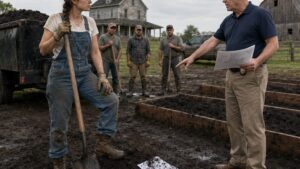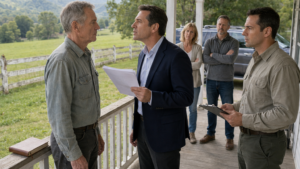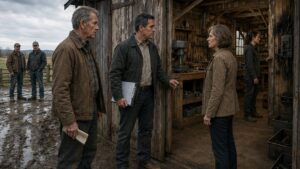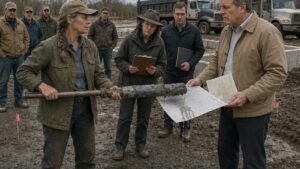
They Said the Old Farmer Misread the Land Rules—Then He Opened the Map He Helped Write
Chapter 1: The County Rejected the Barn Before Reading the Survey
Michael Wright slid the application across the table before Richard Davis had finished unrolling the survey.
A red rejection stamp sat crooked across the top page. Beneath it was a second sheet Richard had not seen before.
“Additional review fee,” Michael said. “Four hundred dollars.”
Richard kept one hand on the rolled survey so it would not spring shut.
“You haven’t looked at this.”
“I looked at your application.”
“I said the survey.”
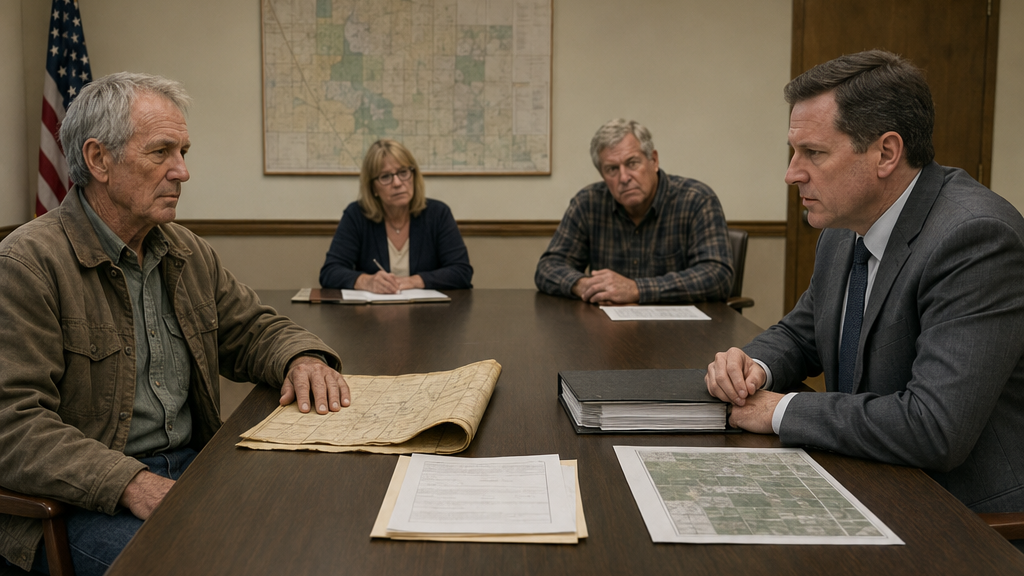
Michael leaned back in his chair. The county hearing room smelled faintly of old coffee and copier heat. Three board members sat farther down the long table. A clerk typed without looking up. Behind Michael, a framed county map covered most of the wall.
“We have enough information to make a determination,” Michael said.
Richard looked at the rejection again.
The barn was supposed to replace the equipment shed whose roof had started sagging the previous winter. The new structure would also move machinery away from the cattle lane, where a tractor and livestock trailer could barely pass each other in wet weather. The agricultural contractor had given Richard a narrow construction window. Miss it, and the project would likely slide into winter.
Jennifer had already reminded him twice that morning.
Richard pushed the rejected application aside.
“Which rule?”
Michael frowned. “Excuse me?”
“Which provision did I violate?”
“The setback and drainage standards.”
“That isn’t a provision.”
One of the board members shifted in his chair.
Michael opened a thick binder already marked with colored tabs.
“Your proposed structure falls within an area subject to enhanced review.”
Richard waited.
Michael flipped three pages.
“Section Nine.”
“Which subsection?”
Michael’s expression tightened.
Richard knew the look. He had seen it years ago on contractors who thought a man carrying a transit and field book was delaying them for entertainment.
Michael tapped the page.
“Nine-C.”
Richard did not immediately answer.
That was enough for Michael to mistake silence for uncertainty.
“This is exactly why applicants are encouraged to let staff handle the technical interpretation.”
Richard looked at the binder.
“Nine-C.”
“Yes.”
“For what parcel classification?”
Michael’s finger remained on the page.
“For regulated land use adjacent to a drainage feature.”
“That’s not what I asked.”
Jennifer, seated behind Richard near the wall, stopped scrolling through something on her phone.
Michael closed the binder halfway.
“Mr. Davis, your proposed barn sits too close to the mapped drainage area. Your access improvement expands the disturbed footprint. Those are the facts before us.”
Richard glanced at the still-rolled survey.
“The drainage feature shown in your system isn’t where your denial places it.”
“We have the county map.”
“So do I.”
Michael gave a short sigh.
“Then you should understand why this application can’t be approved as submitted.”
The words drew a faint smile from one of the men seated along the side wall waiting for a later case.
Richard felt heat climb the back of his neck, but he kept his voice level.
“I’m asking you to tell me what parcel classification makes Nine-C apply.”
Michael opened the binder again.
“A higher-intensity use designation.”
Richard’s eyes settled on him.
“Our farm is agricultural ground.”
“Your project includes equipment storage, an improved access lane, and increased structural footprint.”
“That doesn’t change the parcel classification.”
Michael’s voice sharpened.
“That is a technical determination made by this office.”
The room went still in the peculiar way public rooms did when disagreement stopped being procedural and became personal.
Richard turned the rejection sheet ninety degrees and studied the citation.
Nine-C.
He knew the numbering system.
Not every word. Not every amendment. He had been out of county work too long to pretend otherwise. But he knew why certain subsections had been separated. He knew what category Nine-C had originally been written to address.
And it had not been cattle farms.
Richard tapped the citation once.
“Was my survey reviewed by anyone before this denial?”
“The application was reviewed.”
“That’s the third time you’ve answered a different question.”
Michael’s jaw set.
Jennifer spoke quietly behind him. “Dad.”
Richard knew what she meant.
Don’t make this worse.
The contractor needed an answer. Materials had already been priced. The old shed roof would not care who was right when the first heavy snow came.
Richard gathered the rejected pages.
Michael pushed the fee notice toward him.
“You can revise and resubmit, or you can appeal.”
“How long for resubmittal?”
“Depends on staff workload.”
“And an appeal?”
“Several weeks.”
Jennifer exhaled behind him.
Richard finally unrolled enough of the survey to expose the parcel boundary, but Michael had already reached for the next folder.
“We’re done for today, Mr. Davis.”
Richard held the map open another second.
Then he rolled it shut.
Outside, Jennifer followed him across the county building’s concrete steps.
“You could just move the barn twenty feet,” she said.
“That wouldn’t fix the lane.”
“It might get us a permit.”
“He cited the wrong section.”
She stopped beside the pickup.
“You know that for sure?”
Richard placed the rolled map across the truck’s hood.
“Yes.”
Jennifer looked toward the county building and then back at him.
“How?”
Richard rested both hands on the hood.
Because he remembered the old classification tables.
Because he remembered sitting in a county office thirty years earlier with maps spread across drafting tables.
Because some of the lines Michael was treating as unquestionable had once been pencil marks under Richard’s own hand.
But he was not ready to explain that in a parking lot.
He looked down at the rejection.
“Nine-C doesn’t describe our parcel,” he said.
Jennifer’s face changed.
Not agreement.
Suspicion.
Chapter 2: The Map on the Table Changed Who Looked Unprepared
Richard returned to the hearing room before lunch with a photocopy folded under one arm and a blue circle drawn around a single line.
Michael Wright looked up from the clerk’s desk.
“I thought we were finished.”
“So did I.”
Richard laid the county’s current parcel printout on the table.
Then he placed his older map beside it.
The newer sheet was clean, computer-generated, and pale enough that the parcel lines nearly disappeared under fluorescent light.
Richard’s map was heavier paper, yellowed along the edges, with handwritten reference numbers and revision marks in the margins.
Michael looked at it as if Richard had brought in a newspaper clipping.
“What is this supposed to establish?”
Richard pointed to the blue circle on the county printout.
“Read the classification.”
Michael did not.
Richard waited.
A board member who had remained in the room leaned forward.
Michael finally looked down.
“Agricultural.”
“And Nine-C?”
Michael’s mouth tightened.
“It governs higher-intensity development near mapped drainage corridors.”
“Read the heading.”
Michael glanced at Richard.
“Mr. Davis—”
“Just the heading.”
The clerk had stopped typing.
Michael turned the binder around.
“Commercial and intensive-use parcels.”
Richard nodded.
“Exactly.”
Michael pushed back from the table.
“That does not mean the drainage protections disappear because you call the property agricultural.”
“I didn’t say they did.”
“You’re trying to reduce this to one label.”
“No. You reduced it to one subsection.”
Michael drew the newer map closer.
“The county mapping system has been updated repeatedly. Old paper records are not controlling.”
Richard unfolded the older map another foot.
“I know.”
“Then I’m not sure why we’re wasting time on it.”
Richard’s finger moved to a reference block printed near the lower corner.
“Because the parcel classification was carried forward from this series.”
Michael gave a restrained laugh.
“This is exactly what I was talking about earlier. Technical mapping should be left to people who work with the system every day.”
Richard looked at him.
For several seconds he said nothing.
Then he turned the map so Michael could read the revision initials.
“You see that?”
Michael glanced down.
“Yes.”
“That series was built before the county digitized the agricultural layer.”
“I’m aware of the history.”
“Are you?”
Michael’s eyes lifted.
Richard placed one finger beside a small set of initials.
“I surveyed half the western agricultural parcels that went into the first revision.”
The room became noticeably quieter.
Richard moved his finger to another notation.
“I helped prepare these sheets when the county reorganized the rural classifications.”
Michael stared at the map.
One of the board members leaned closer.
“You worked for the county?”
“Survey technician,” Richard said. “Years ago.”
Jennifer stood near the doorway. She had followed him back but had not interrupted. Her expression now held the same question Richard had avoided in the parking lot.
Why didn’t you tell me?
Michael recovered first.
“That still does not make an old map controlling law.”
“No.”
Richard folded his arms.
“It makes me wonder why you used a commercial subsection on an agricultural parcel.”
Michael closed the binder.
“The denial stands unless you file a formal appeal.”
“So you’re not going to correct the citation.”
“I am saying the project raises legitimate drainage concerns.”
Richard nodded once.
“That’s a different sentence.”
Michael’s face hardened.
“It gets you to the same result.”
“No. It doesn’t.”
Richard began rolling the old map.
“If there’s a valid drainage restriction, show me the valid restriction. Don’t use the wrong one because it’s convenient.”
Michael lowered his voice.
“You think working here thirty years ago means you know the current code better than this office?”
Richard stopped rolling.
“No.”
He looked at the rejection sheet.
“I think the current code should say what you claim it says.”
That ended the exchange.
Michael told the clerk to give Richard an appeal packet.
On the drive home, Jennifer sat with the packet in her lap.
“You helped build those maps?”
“Some of them.”
“You never mentioned that.”
“It was a job.”
“For twelve years?”
Richard glanced at her.
“Eleven.”
Jennifer gave him a look.
“That somehow makes it less strange?”
Richard kept his eyes on the road.
The farm came into view beyond the bend: pasture fencing, the low machinery shed, cattle gathered along the shaded side of a loafing area. The proposed barn site sat beyond the equipment yard, where the ground fell gently toward the lower pasture.
Back in the farm office, Richard spread the old map across the desk.
He intended to prove one thing.
That Michael’s citation was wrong.
He found the old classification notes quickly enough. Agricultural parcel. No conversion. No commercial designation.
He should have felt satisfied.
Instead, his eye caught a thin faded line running diagonally across the lower portion of the property.
It was not a parcel boundary.
It was lighter than the drainage markings on the current county printout, almost rubbed away.
Richard leaned closer.
Beside it was a handwritten reference number.
For a moment he simply stared.
Then he opened the bottom drawer of the filing cabinet.
Jennifer stood in the doorway.
“What did you find?”
“Nothing yet.”
The answer came too quickly.
She heard it.
Richard knew she heard it.
He pulled out an old folder anyway.
Inside were folded field notes from a year he remembered much better than he wanted to.
The faded line on the map crossed directly beneath the western edge of the barn footprint.
Chapter 3: Winning the Rule Argument Did Not Clear the Land
The agreement number was still legible after thirty-two years.
Richard found it written in pencil beside the faded drainage line: 87-14-D.
He sat alone in the farm office before sunrise with the old folder open and the appeal packet untouched beside it.
The document he wanted was not in the folder.
That bothered him more than if it had been.
He remembered enough to know what the number meant. Agreements involving drainage routes had been filed separately because they often crossed parcel boundaries. Some became formal easements. Others were maintenance understandings. Some expired when projects were completed.
He could not remember which kind this had been.
By seven, Jennifer was knocking mud from her boots outside.
Richard closed the folder.
She entered carrying two mugs.
“You’re up early.”
“Cattle don’t care about county hearings.”
“Neither do daughters, apparently.”
She set a mug beside him and looked at the papers.
“You staying on this today?”
“I need to check something in the lower pasture.”
Her gaze moved to the old map.
“What?”
“A drainage mark.”
“That the county missed?”
“Maybe.”
Jennifer crossed her arms.
“Or one you missed?”
Richard stood.
“I haven’t missed anything yet.”
She gave him a tired look.
“There’s the father I know.”
He took his coat from the hook.
The shallow swale began above the lower pasture fence and ran toward the neighboring ground. In dry months, it barely looked intentional. Grass covered most of the depression, and cattle had softened its edges.
Richard walked it slowly.
He remembered standing there much younger with survey stakes tucked under one arm.
That summer had brought three storms in less than two weeks. Water had crossed the upper field, pooled behind an old fence berm, then broken through toward the neighboring parcel. Topsoil had washed into a low hay field.
Richard stopped where the proposed barn corner would stand.
A shallow groove continued beneath his boots.
It was still carrying water.
Not much.
Enough.
Jennifer came through the gate behind him.
“You found your mystery.”
Richard looked uphill.
“If this is what I think it is.”
“What do you think it is?”
“Old controlled drainage.”
“Controlled by what?”
“Grade.”
She frowned.
“You mean somebody designed this?”
“Possibly.”
“You?”
Richard looked at the swale instead of her.
“We need the record.”
That afternoon he drove to the county clerk’s office.
The clerk brought him a scanned copy on a computer screen.
Drainage Cooperation Agreement.
Richard read the title once.
Then again.
The county was not a party. The agreement had been between the Davis parcel and the neighboring property, with the county survey office providing technical description.
It did not prohibit construction outright.
But it required both landowners to preserve an unobstructed flow path along the mapped swale unless both parties approved an alternate design.
Richard leaned closer.
At the bottom was his signature.
Not as survey technician.
As landowner.
He remembered now.
His father had still been alive. Richard had been working for the county and running cattle evenings and weekends. The neighboring farm had lost part of a hay crop after the flood. The two families had spent weeks arguing over whose ditch or fence had caused the damage.
Richard had suggested the swale.
He had laid out the grade himself.
He drove home with a copy folded on the passenger seat.
The contractor met him near the equipment yard to look at the site again.
“If we shift the barn east,” the contractor said, “we can clear that drainage path.”
“How far?”
“Thirty feet, maybe thirty-five.”
“That narrows the turn from the cattle lane.”
“We can widen the approach.”
“Into the winter feed area.”
The contractor nodded.
Richard looked across the yard.
Every fix took something from somewhere else.
That evening Jennifer spread the plans across the kitchen table.
“So Michael was wrong.”
“About Nine-C.”
“But the drainage issue is real.”
Richard said nothing.
Jennifer looked up.
“You knew about this agreement?”
“I remembered the drainage. Not the details.”
“That isn’t what I asked.”
Richard stared at the copy.
“I signed it.”
Jennifer leaned back.
“You signed a restriction across the lower pasture and never told me?”
“It’s not a restriction on the whole pasture.”
“Dad.”
“It preserves drainage.”
“And the barn sits on it.”
“The edge does.”
She pressed both palms against the table.
“We’ve spent three months planning this building.”
“I know.”
“We gave the contractor a deposit.”
“I know.”
“You argued with the county in public like they were inventing a problem.”
“They used the wrong rule.”
“But there is a problem.”
Richard’s voice sharpened.
“Those are two separate things.”
Jennifer stood.
“That may matter to an appeal board. It doesn’t change what it costs us.”
He almost answered immediately.
Then stopped.
Because she was right about that.
Moving the barn would mean redesigning the lane. Redesigning the lane would cut into the winter feed space. The contractor would charge for revised grading. The schedule would slip.
Michael had been wrong.
Richard had not been entirely right.
Jennifer picked up the agreement.
Her expression changed.
She had reached the signature block.
Richard watched her thumb move over the copied line.
She looked at him slowly.
“This wasn’t something the county forced on you.”
Richard did not answer.
“You recommended it.”
He looked toward the dark window over the sink.
“After a flood.”
Jennifer waited.
Richard could feel the next question coming before she asked it.
“Why have I never heard any of this?”
He had no answer that would not open more than the agreement itself.
Chapter 4: The Agreement Richard Never Explained Became the Real Dispute
Jennifer put the drainage agreement on the kitchen table before Richard had taken off his work coat.
His signature faced him from the bottom of the page.
The rejected application lay beside it.
“You told me you remembered the drainage,” she said. “You didn’t tell me you designed it.”
Richard pulled out a chair but did not sit.
“I helped lay it out.”
“That’s not what this says.”
She tapped the paragraph above his signature.
The language was dry and compact: preserve unobstructed drainage, maintain the established grade, obtain written agreement before relocating the route.
Richard had once liked language like that. It prevented argument because the paper did not care what anyone remembered.
Now it felt different.
“I recommended the route,” he said.
Jennifer stared at him.
“Why?”
“Because the old one wasn’t working.”
“That’s still not an answer.”
Richard looked toward the window. Beyond the glass, the equipment-yard light cast a weak yellow patch across the gravel.
“There was a flood.”
“When?”
“Long time ago.”
“How long?”
“Before you were running the place with me.”
“That covers most of my life.”
He finally sat.
Jennifer remained standing.
Richard rubbed his thumb along the edge of the agreement.
“There were three storms close together. Water came off the upper ground faster than anybody expected. The old fence berm backed it up, then part of it let go.”
“Into the neighbor’s field?”
He nodded.
“They lost hay.”
“How much?”
“Enough.”
“And you were working for the county then.”
“Yes.”
Jennifer pulled out the chair opposite him.
“So what happened?”
Richard could still remember the neighbor standing ankle-deep in mud, furious enough to point at every ditch, fence post, and tire track as though each had personally betrayed him.
“My father said it wasn’t our fault. Their side said it was. Everybody had a different story about where the water used to run.”
“And you?”
“I surveyed it.”
Jennifer waited.
“The natural low point crossed our lower pasture,” Richard said. “The fence and years of grading had interrupted it. I proposed opening a shallow swale and keeping it clear.”
“The line on the map.”
“Yes.”
“And the agreement?”
“The neighbor wanted something permanent before they accepted it.”
Jennifer looked down.
“That sounds reasonable.”
Richard’s jaw tightened.
“It was.”
Her eyes returned to him.
The simple admission landed harder than an argument.
“So this thing Michael stumbled into,” she said, “isn’t just some bureaucratic mistake.”
“Michael’s denial is still wrong.”
“I know.”
“He used the wrong classification.”
“I know.”
“He can’t make Nine-C apply because he feels like it.”
“I know, Dad.”
Her voice was quiet now.
“That isn’t what I’m angry about.”
Richard leaned back.
He knew.
He also knew the next part would be harder.
Jennifer turned the agreement toward him.
“We’ve talked about the barn for months. We talked about the lane. We walked that site together. You never once said there was an agreement under it.”
“I didn’t remember the exact line.”
“But you remembered enough to go looking the second you saw it on that map.”
Richard said nothing.
Jennifer’s mouth tightened.
“You do this all the time.”
“Do what?”
“Decide what I need to know.”
“That’s not fair.”
“Isn’t it?”
She pointed toward the farm office.
“The lease papers. The old well records. The fence arrangement on the north forty. Every time something comes up, there’s another file somewhere that you know about and I don’t.”
“I handle the records.”
“And someday I’m supposed to handle this place.”
“That’s the plan.”
“Then when does it become my business?”
Richard felt the answer rising in him—when you’re ready—but stopped before saying it.
Jennifer would have heard what was wrong with it before he did.
She stood and took her coffee to the sink.
“I can deal with bad news,” she said. “What I can’t deal with is finding out there was bad news you decided to keep in a drawer.”
Richard looked at his signature again.
He had always thought silence was part of doing the work.
You fixed what needed fixing. You carried what belonged to you. You did not bring every old problem into the kitchen and ask other people to help hold it.
His father had lived that way.
Richard had admired him for it.
Until now, he had never considered what it felt like from the other side.
The next morning, he and Jennifer walked the lower pasture with stakes and a measuring tape.
The grass inside the swale was flattened from the previous rain.
Richard paced the grade while Jennifer held the old map.
“If the barn moves east,” she said, “we lose the wide approach.”
“We can rebuild it from the south.”
“That cuts into the feed area.”
“I know.”
“And costs more.”
“I know.”
Jennifer folded the map against the wind.
“So we appeal the county and then redesign anyway?”
Richard looked toward the proposed barn site.
“Yes.”
She studied him.
“You’re willing to tell them about the agreement?”
He hesitated.
The easier path was obvious: appeal only the citation. Force Michael to withdraw the denial. Get the application reopened. Deal with the drainage issue later if anyone noticed.
Thirty years earlier, Richard would have despised anyone who worked that way.
He took the copy of the agreement from his coat pocket.
“It goes in the appeal.”
Jennifer raised an eyebrow.
“Voluntarily?”
“Yes.”
“That might give them another reason to stop the project.”
“It might.”
“And you’re doing it anyway.”
Richard looked down the shallow green line he had once helped cut into the land.
“If I’m asking them to read the whole record,” he said, “I don’t get to hand them half of it.”
Jennifer said nothing for several seconds.
Then she handed the map back.
It was not forgiveness.
But it was the first time since the kitchen argument that she stood beside him instead of across from him.
That afternoon Richard completed the appeal.
He attached Michael’s denial, the current parcel classification, the historical map, the drainage agreement, and a short statement requesting review of the specific legal basis for the rejection.
Before sealing the envelope, he read the final paragraph twice.
He could remove the drainage agreement.
Nobody would know yet.
His hand stayed on the page.
Then he stapled it to the rest.
Chapter 5: The Appeal Proved the County Wrong and Richard Incomplete
Susan Ramirez did not begin with a greeting.
She opened Richard’s file, set Michael Wright’s denial in front of her, and said, “This cannot stand as written.”
Richard had prepared himself for an hour of argument.
For a moment he did not know what to do with the sentence.
Susan turned the denial toward him.
“The parcel is classified agricultural. The subsection cited here applies to commercial and intensive-use parcels.”
“So the denial is withdrawn?”
“The legal basis for this denial is defective.”
Richard almost smiled.
Susan held up one finger.
“However.”
There it was.
Richard settled back into the chair.
Susan pulled his old parcel map from the appeal file. She had placed it inside a clear protective sleeve.
“You also submitted this.”
“Yes.”
“And the drainage cooperation agreement.”
“Yes.”
She examined him.
“You did not have to make my job harder.”
“I thought you wanted the record.”
“I do. Most appellants want the useful parts of the record.”
Richard looked down at his hands.
“Wouldn’t make much sense complaining that somebody didn’t read everything if I left something out.”
A faint expression passed over Susan’s face. Not quite amusement.
She placed the historical map beside the current code.
“The good news is that the county’s mapping history supports your argument about classification. I checked the revision logs. This parcel has remained agricultural through every relevant update.”
Richard nodded.
“That’s what I found.”
“The less convenient news is that nothing in those revisions cancels your private drainage agreement.”
Richard had expected the words.
Hearing them still tightened something in his chest.
“Does the county enforce it?”
“Not directly as a zoning provision. But the application asks us to approve grading and a permanent structure. Once you disclosed an existing drainage obligation, staff cannot pretend it is irrelevant.”
“So Michael gets to call himself right after using the wrong rule?”
“No.”
Susan’s answer was immediate.
“He does not.”
She turned to another page.
“This is important, Mr. Davis. An official cannot reach for the wrong authority merely because a different concern might exist somewhere in the facts.”
Richard looked at her.
“That’s what I’ve been saying.”
“Yes. And now I’m saying something you may like less.”
She pointed to the faded drainage route.
“Being right about the denial does not make this line disappear.”
Richard followed her finger.
Susan continued.
“Your proposed western foundation edge overlaps the preserved flow path. Your access-lane grading also changes the approach to it.”
“Not enough to block it.”
“Maybe not.”
“Then what’s the problem?”
“You’re doing what Michael did.”
Richard’s eyes lifted.
Susan did not soften the statement.
“You’re jumping from ‘probably not a problem’ to ‘therefore it isn’t one.’”
He sat very still.
She pulled a blank review form from the file.
“What I need is a drainage-safe design. Something that preserves the function of the agreement or relocates it with proper consent.”
Richard looked out through the office window toward the parking lot.
For a week he had imagined this meeting differently.
He had imagined the county confirming the citation error, the application reopening, Michael forced to admit he had been wrong.
That part had happened.
It simply had not produced the relief Richard expected.
“What happens to the four-hundred-dollar fee?”
“The additional review fee tied to the defective denial should be credited.”
“Should?”
“I’m recommending it.”
“And the appeal?”
“Granted on the cited basis.”
Richard looked back at her.
“So I won.”
Susan capped her pen.
“You won the argument you appealed.”
He gave a short breath that might have been a laugh.
“That’s a government answer.”
“It’s also an accurate one.”
Richard could not argue with that.
Outside, he called Jennifer from the truck.
“She granted it.”
There was a pause.
“The whole thing?”
“The denial can’t stand.”
“And the drainage?”
“Still ours.”
Jennifer was quiet.
Richard looked at the old map lying on the passenger seat.
“We have to redesign.”
“How much?”
“Don’t know yet.”
“Contractor called this morning. Steel price is only held through Friday.”
Richard closed his eyes.
“Of course it is.”
“What are you going to do?”
He looked toward the county building.
“Get a plan that works.”
“That sounded almost reasonable.”
“Don’t get used to it.”
Jennifer laughed once.
It was the first easy sound between them in days.
Back at the farm, Richard and the contractor marked possible new corners with yellow stakes.
Thirty feet east preserved the swale but tightened the cattle turn.
Twenty-four feet helped the lane but left almost no margin around the drainage route.
They walked it twice.
Jennifer stood at the gate, watching.
“What about shifting the whole approach south?” she asked.
Richard opened his mouth to dismiss it.
Then stopped.
He looked.
The grade would be more expensive, but the turn would remain broad enough for the livestock trailer.
“We’d lose part of the winter feed area,” he said.
“We can stack north of the shed.”
“That’s farther from the loader.”
“Six hundred feet.”
“In January that’s six hundred unnecessary feet.”
Jennifer shrugged.
“It’s still less expensive than building a barn we have to fight about for another year.”
Richard stared across the yard.
Her idea was not how he would have laid it out.
That did not make it wrong.
His phone rang.
Michael Wright.
Richard let it ring twice before answering.
“Davis.”
“Richard, this is Michael.”
“I know.”
A pause.
“I understand the review decision came through.”
“It did.”
“I think we should talk.”
Richard watched Jennifer move one of the yellow stakes with her boot.
“About what?”
“About resolving this efficiently.”
“We’re redesigning.”
“That may help.”
Michael’s voice had none of the sharpness from the hearing room.
Then he added, “There’s no reason this needs to become another public hearing.”
Richard looked at the county denial lying on his dashboard.
The sentence was polite.
Almost helpful.
That made him trust it less.
Chapter 6: When Michael Asked for Quiet, Richard Chose the Public Record
“There’s no reason to make this bigger than it needs to be,” Michael said.
Richard stood beside the pickup with the phone pressed to his ear.
Twenty yards away, Jennifer and the contractor were measuring the southern approach.
“What exactly are you offering?” Richard asked.
“A corrected staff decision. We withdraw the citation, you submit the revised plan, and we move forward.”
“Quietly.”
“Efficiently.”
“Those aren’t always the same thing.”
Michael exhaled.
“Richard, your appeal was granted. I’m not disputing that.”
“Then why not correct it at the meeting?”
“Because an administrative error does not require a public spectacle.”
Richard looked toward the barn site.
He remembered Michael telling the room that technical interpretation belonged to county staff.
He remembered the half-smile from the man waiting along the wall.
A part of him wanted Michael sitting in the same chair when the correction was read.
That part bothered him.
“I don’t want a spectacle,” Richard said.
“Good.”
“I want the record accurate.”
Silence.
Michael spoke more carefully.
“The record can be corrected administratively.”
“And the drainage agreement?”
“What about it?”
“It should be in the revised findings.”
“You want us to include a private agreement that complicates your own permit?”
“Yes.”
Another pause.
“Why?”
Richard watched Jennifer drive a stake into the ground.
“Because it exists.”
The revised hearing took place four days later.
This time Richard entered with the old parcel map in a flat protective sleeve instead of rolled under his arm. Over it lay the contractor’s revised site plan.
A new barn footprint had been traced east of the drainage swale. The access lane curved farther south, preserving the cattle turn but cutting through a piece of the winter feed-storage area.
Jennifer sat beside him.
Michael was already at the table.
He looked tired rather than hostile.
The clerk called the matter.
Michael began.
“The prior denial cited an incorrect subsection for the parcel classification.”
No qualification.
No explanation.
Richard looked at Jennifer.
She kept her eyes on Michael.
“The Davis parcel is agricultural,” Michael continued. “Section Nine-C was therefore not the appropriate authority for denial.”
One board member asked, “Why was it cited?”
Michael glanced at his notes.
“Because the application involved equipment storage, grading, and a mapped drainage feature, staff treated it under the higher-intensity review framework.”
“That’s not what I asked,” Richard said.
Michael looked at him.
The words hung between them because they belonged to their first hearing.
Richard regretted them almost immediately.
Not because they were inaccurate.
Because he had enjoyed saying them.
He lowered his voice.
“The question was why the classification wasn’t verified.”
Michael’s hands flattened on the table.
For a moment Richard expected the old defensiveness.
Instead Michael said, “It should have been.”
The room stayed quiet.
Then Michael looked toward the board.
“We had a drainage complaint last year involving a rural construction approval. Staff treated the parcel too casually. The county incurred substantial remediation costs.”
Richard had heard pieces of the story at the cooperative but never details.
Michael continued.
“After that, I directed staff to flag projects with drainage features for stricter review. In this case I applied that caution beyond what the adopted classification allowed.”
There it was.
Not an excuse.
Not exactly.
But an explanation.
Richard looked at Michael differently.
Fear could make a man careless in both directions.
Richard had spent years believing caution meant remembering old obligations.
Michael had responded to a costly mistake by treating uncertainty as danger.
Neither was quite the same as reading the record.
The clerk asked Richard to present the revision.
He slid the old map onto the table first.
Then the new site plan over it.
The faded drainage line remained visible beneath the transparent edge.
“We moved the barn footprint east,” Richard said. “The swale stays open.”
He traced the revised lane.
“The approach shifts south. We lose part of the feed-storage area, but the drainage grade remains untouched.”
Michael leaned forward.
“You’re voluntarily keeping the existing route?”
“The agreement says preserve it unless both landowners approve an alternative.”
“You could seek relocation.”
“I could.”
“Why not?”
Richard looked at the faded line.
“Because it works.”
Jennifer glanced at him.
Richard continued.
“The first application was wrong at the edge. Not for the reason you denied it. But wrong enough that I wouldn’t build it now.”
Michael sat back.
One board member asked about turning clearance for farm equipment.
Jennifer answered before Richard could.
“We laid it out for the livestock trailer and the largest tractor. The southern approach keeps the turning radius.”
Richard looked at her.
She did not look back.
She simply continued explaining the measurements.
For once, he let her.
The board approved the revised review path subject to final drainage confirmation.
Michael closed his folder.
The four-hundred-dollar additional fee would be credited.
The incorrect citation would be removed from the file.
No applause followed.
No one apologized theatrically.
The clerk called the next matter.
Outside, Richard and Jennifer walked toward the pickup.
“That went better than the first one,” she said.
“Lower standard.”
She smiled.
Then her expression changed.
“The southern approach adds grading.”
“I know.”
“And we lose feed space.”
“I know.”
“And you could still push for relocating the drainage line.”
“I’m not going to.”
Jennifer stopped beside the truck.
Richard reached for the door.
She did not move.
“Is that because you think it’s the right plan?”
He turned.
“What else would it be?”
“Because I can’t tell anymore.”
Richard frowned.
Jennifer nodded toward the county building.
“You gave up ground in there. Real ground. You admitted the first layout had a problem. You let me answer a question you normally would’ve answered yourself.”
“That bothers you?”
“No.”
She studied him.
“It scares me a little.”
Richard almost laughed, but she was serious.
Jennifer stepped closer.
“I need to know whether this redesign is actually your choice, or whether you’re going to spend the next ten years looking at that barn and remembering everything you gave up because I pushed you.”
Richard looked across the parking lot.
For the first time, the question was not about what the map required.
It was about whether he could live with a future he had not designed alone.
Chapter 7: The New Barn Left One Old Line Exactly Where It Belonged
The first hard rain after the barn was finished came sideways across the lower pasture.
Richard stood beneath the new overhang with his hands in his coat pockets and watched brown water gather above the fence line.
For ten minutes, nothing happened.
Then the water found the swale.
It moved through the grass in a shallow, steady sheet, bending the blades flat as it passed the western edge of the barn. It crossed the pasture exactly where the faded line on the old county map said it should.
Jennifer came around the corner carrying a flashlight even though it was still afternoon.
“You planning to stand here until dark?”
“I’m checking the drainage.”
“You’ve checked it three times.”
“Rain changes.”
“So does water?”
“Yes.”
She pointed the flashlight down the swale.
“It’s moving.”
“I can see that.”
“It isn’t backing up.”
“I can see that too.”
Jennifer smiled.
Richard did not.
Not yet.
He stepped out into the rain and walked toward the lower end of the swale.
The redesigned barn sat farther east than he had first wanted. The southern approach curved more broadly than his original plan. The feed-storage area was smaller, and every trip with the loader now required a longer turn.
For weeks after construction began, Richard noticed every inconvenience.
He noticed the extra fuel.
The lost square footage.
The distance between the loader and the stacked feed.
He noticed each one because part of him was still keeping score.
Then the first livestock trailer came through the new approach without stopping to reverse.
Jennifer had been driving.
She had leaned out the window afterward and said, “Almost like somebody planned it.”
Richard had pretended not to hear.
Now the rainwater crossed beneath the fence opening and continued toward the neighboring ground without pooling against the barn pad.
Richard followed it until his boots sank into soft earth.
Behind him, Jennifer called, “You satisfied?”
He looked uphill.
The barn lights glowed through the rain. The roofline was new and clean, but the drainage swale looked almost unchanged.
That surprised him.
He had spent months thinking the choice was between preserving the old farm and surrendering part of it.
Standing there, he saw something different.
The farm had changed.
The line had stayed.
Both could be true.
“I’m satisfied,” he said.
Jennifer cupped a hand around her ear.
“What?”
Richard raised his voice.
“I said it works.”
“That’s not the same thing.”
He turned back toward the barn.
“It’s close enough.”
Inside, the new concrete floor smelled faintly of damp dust and machinery oil. The tractor sat under cover for the first time in years. Tools that had been scattered between two sheds now hung along one wall.
Jennifer had organized the workbench differently than Richard would have.
He had noticed that too.
He had not moved anything.
Two days later, he carried three file boxes from the farmhouse office to the smaller room Jennifer used for farm records.
She looked up from the desk.
“What’s all that?”
“Land files.”
She stared at the boxes.
“All of them?”
“Most.”
Richard set the first one down.
Old leases.
Fence agreements.
Well records.
Tax maps.
Survey notes.
The drainage cooperation agreement.
Jennifer pulled the lid from one box.
“You’re moving these in here?”
“Yes.”
“Why?”
Richard set down the second box.
“Because you need them.”
“I’ve needed them for years.”
He nodded.
“I know.”
Jennifer went still.
Richard did not try to explain the sentence away.
He had spent most of his life believing that admitting a mistake meant losing standing.
The county dispute had taught him otherwise.
Michael’s problem had not been ignorance.
It had been certainty.
Richard understood that better than he liked.
He had carried the same habit in a different form.
Michael had assumed the office should know more than the farmer.
Richard had assumed the father should know more than the daughter.
Both assumptions had made it easier not to listen.
Jennifer opened another box.
“What’s this?”
“North boundary notes.”
“You told me those were settled.”
“They are.”
“Then why are there four folders?”
Richard pulled out a chair.
“Because settled and simple aren’t the same thing.”
She looked at him.
“That might be the most useful thing you’ve said all year.”
“Don’t get ambitious.”
She smiled.
For the next hour, he showed her where the older documents were grouped and which records had duplicates in the county office. He explained the hand marks on surveys that no digital file would preserve.
Once, Jennifer interrupted him.
“You know you don’t have to teach me all of this today.”
“I know.”
“You’re talking like you’re leaving.”
“I’m talking like you’re staying.”
That ended the joking.
Jennifer lowered her eyes to the file in front of her.
Richard stood and walked to the last box.
The old county parcel map lay at the bottom.
He lifted it carefully.
Its folds had softened with age. Pencil marks still crossed the lower pasture. The old drainage line was faint but visible.
Jennifer cleared space on the desk.
Richard spread the map flat.
For years he had rolled it tightly after every use and returned it to his cabinet.
This time he did not.
Jennifer traced the agricultural parcel boundary with one finger.
“Still strange seeing your initials on this.”
“They’re not important.”
“They were important enough to make Michael uncomfortable.”
Richard gave her a look.
“That wasn’t the point.”
“I know.”
She moved her finger to the drainage line.
“This was.”
Richard looked at it.
The line had once been an argument between two landowners.
Then a solution.
Then a forgotten obligation.
Then evidence against the county.
Then evidence against Richard’s own certainty.
Now it was simply part of the land.
Jennifer asked, “If I ever move the barn again?”
“You probably won’t.”
“If I do.”
Richard almost answered with instructions.
Check the grade. Review the agreement. Talk to the neighbor. Get it in writing.
Instead he said, “You’ll decide what makes sense.”
Jennifer looked up.
“You sure?”
“No.”
She laughed.
Richard smiled.
“That’s different from saying you’re wrong.”
Outside, runoff still moved through the swale.
The barn stood clear of it.
The cattle lane curved around the new approach.
Nothing looked exactly as Richard had first imagined it.
He found that he could live with that.
He gathered the empty file box and started toward the door.
Jennifer called after him.
“You forgot the map.”
Richard stopped.
He looked back at the yellowed sheet spread across her desk.
“No,” he said. “I didn’t.”
Then he left it there, unfolded.
The story has ended.