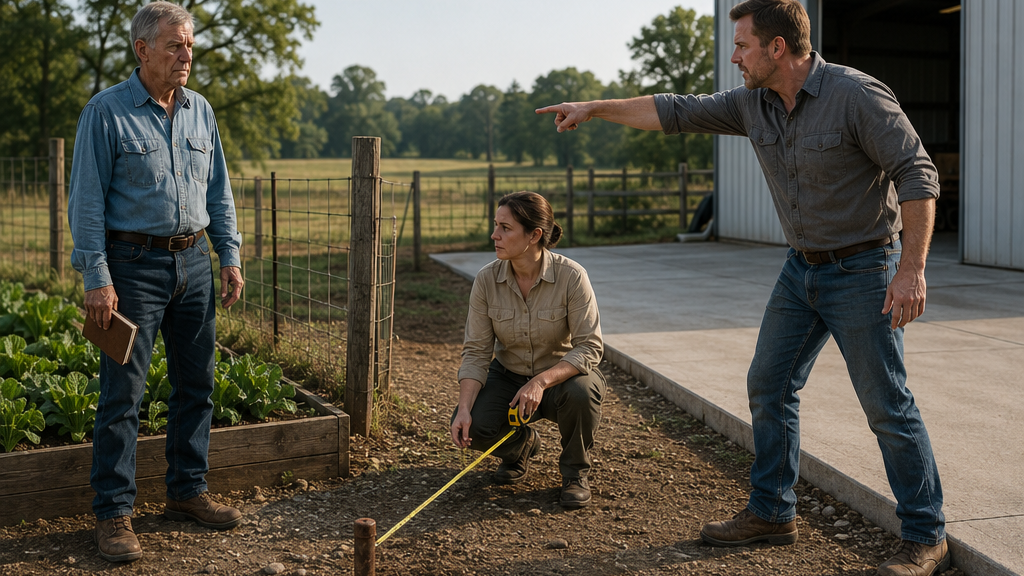
He Challenged the Boundary of a Twenty-Two-Year Farm—Then the Survey Line Reached His New Barn
Chapter 1: The Morning Jason Put a Stake Beside the Fig Row
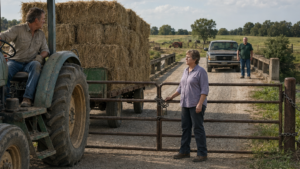
The orange stake had not been there when Raymond Carter shut the pasture gate the night before.
It stood bright and clean beside the fig row, driven deep enough that the ribbon at its top barely moved in the morning air. One side of it faced Raymond’s vegetable beds. The other faced the old woven-wire fence that had divided the farms longer than Jason Wright had owned the property next door.
Raymond stopped with one hand still on the gate chain.
Beyond the fence, Jason’s new equipment barn caught the low sun on fresh metal roofing. The concrete apron in front of it was less than a month old. Tire marks from a skid steer curved through the pale dust. Everything about the building still looked temporary except the concrete.
Raymond crossed the grass and crouched beside the stake.
There were no numbers on it he recognized. No county tag. Just orange ribbon and a sharpened wooden shaft placed four feet inside the strip Raymond had treated as his for twenty-two years.
Behind him, cattle shifted near the water trough.
A pickup door slammed next door.
Jason came across the gap in the fence wearing work boots and a gray shirt with the sleeves pushed to his elbows.
“You saw it,” he said.
Raymond stood. “Hard not to.”
“That’s about where the line runs.”
Raymond looked from the stake to the old fence.
“No,” he said. “It isn’t.”
Jason gave a short laugh. “That’s exactly the problem.”
Raymond had known Jason for three years. They had shared a tractor pull once when Jason’s machine bogged down after a storm. Raymond had let his feed truck turn around in Jason’s empty field before the barn went up. Jason had brought over a socket set when Raymond broke a hitch pin.
They had never been friends, exactly, but they had been agreeable enough.
That seemed farther away now than the county road.
Jason pointed toward the raised cedar bed nearest the fence. Tomato vines had fallen over one end of it, heavy with late fruit.
“That bed’s on my side. So’s the corner of your gate approach.”
Raymond followed his finger.
“My father set that garden before you bought this place.”
“That doesn’t make it yours.”
Raymond felt the answer rise into his throat and stopped it there.
That was how these arguments became permanent. One sentence too many, then another, until every future conversation started from the worst thing either man had said.
“Where’d you get the stake?” Raymond asked.
“I put it there.”
“Based on what?”
Jason took out his phone.
He opened a county parcel map and enlarged the screen until the colored boundary line filled it.
“There.”
Raymond stared at the blue line running between two aerial photographs.
The line did not follow the fence.
It ran through the edge of his garden strip, clipped the approach to the pasture gate, then continued toward Jason’s barn.
Raymond looked up.
“You know those maps aren’t surveys.”
“I know they’re county records.”
“They’re tax maps.”
“They’re close enough to show what’s been happening.”
“What’s been happening?”
Jason’s jaw tightened.
“You’ve been using my side because nobody stopped you.”
That landed harder than Raymond expected.
Not because it was loud. Because Jason said it as if Raymond had known.
Raymond stepped toward the old fence and rested two fingers on the top wire. Half the posts leaned. One cedar brace had gone silver with age.
“There’s an iron pin somewhere along here.”
Jason folded his arms. “Then find it.”
Raymond remembered hearing about the pin from his father. A buried corner marker, driven near a cedar that had died after lightning split it. Raymond had never needed to see it. The fence had been there. The garden had been there. The cattle gate had been there.
Until now, that had seemed like enough.
Jason tapped the phone.
“I called the county yesterday.”
Raymond turned.
“For what?”
“Land use. Building inspection. Whoever handles encroachments.”
“You called them on my garden?”
“I called them because you told me last week you weren’t moving anything.”
Raymond remembered the conversation differently. Jason had asked whether Raymond planned to shift the fence. Raymond had said he had no reason to.
“You could’ve told me you were filing a complaint.”
“I just did.”
Raymond looked past him toward the barn.
From this angle, the nearest corner seemed almost lined up with the orange stake.
He had watched that barn go up through August—posts, trusses, roofing, then concrete. Jason had built quickly, trying to have the place ready before his winter contracting work picked up. Raymond had thought the structure was close to the fence, but rural properties were full of old arrangements that did not make sense on paper.
He had never questioned it.
Now he measured the distance with his eyes.
If Jason’s blue phone line was right, Raymond’s garden was wrong.
But if the old fence was even roughly right, Jason’s barn was awfully close.
“When are they coming?” Raymond asked.
“Tomorrow, supposedly.”
Raymond nodded once.
Jason seemed almost disappointed that he had not argued.
“You ought to move that bed before then.”
“No.”
Jason’s expression hardened.
Raymond pointed toward the orange stake.
“And don’t move that either.”
“It’s on my property.”
“You don’t know that yet.”
Jason stepped closer. “I know enough.”
Raymond looked at him for a long moment.
Then he walked back toward the house.
Inside the mudroom, he pulled an old notebook from a drawer beneath receipts, twine, and veterinary records. The cover had softened at the corners from years in his shirt pocket.
He flipped through pages of hay yields, fence repairs, seed dates and equipment notes.
Nothing about the iron pin.
Nothing he could use.
For the first time that morning, Raymond felt something colder than irritation.
He had always believed he knew where his farm ended.
He could point to trees his father had planted, a ditch they had cleared by hand, a rock where his mother once left jars of water while they worked. But memory had no coordinates.
By late afternoon, Donna Adams arrived after Raymond called her.
She stood at the fence and looked at the orange stake.
“You ever had this side surveyed?” she asked.
Raymond did not answer immediately.
Donna turned toward him.
“Raymond.”
“No.”
She sighed.
“I told you fifteen years ago.”
“And fifteen years ago there wasn’t a barn sitting there.”
“That isn’t an answer.”
He looked toward the concrete.
“No,” he said. “It isn’t.”
The next morning Raymond walked out before seven expecting to wait.
A county SUV was already parked beside the lane.
A woman in a tan work shirt stood near the gate with a tablet under one arm and measuring equipment in the other hand.
Jason was coming down from the barn.
The woman looked at both men.
“I’m Christine Davis with county land use,” she said. “Before either of you tells me where you think the boundary is, I need one thing clear.”
She pointed first at the orange stake, then at the fence.
“From this moment on, nobody moves another marker.”
Chapter 2: The Old Fence Was Never the Line
“The fence doesn’t establish ownership,” Christine Davis said.
Raymond had been standing beside that fence for less than five minutes, and already the one thing he had relied on most had been removed from the argument.
Jason glanced at him as if the statement settled everything.
Christine noticed.
“It doesn’t establish ownership for either one of you,” she added.
That erased the satisfaction from Jason’s face.
She set her tablet on the hood of the county SUV and opened a parcel map. The aerial image resembled the one Jason had shown Raymond, but this version carried measurements, recorded bearings and deed references.
Christine zoomed in.
“This line is approximate. It helps me identify the parcels. It does not replace a boundary survey.”
Jason pointed toward Raymond’s raised beds.
“But you can see they’re over.”
“I can see vegetation and lumber on an aerial photograph.”
“They’re clearly—”
“I’m not making a boundary determination from satellite imagery.”
Jason stopped.
Raymond kept quiet.
Christine looked at the old wire fence.
“Do either of you know when this was installed?”
“Before I bought,” Jason said.
Raymond rubbed his thumb against a rusty staple.
“Parts of it have been here longer than me. Parts haven’t.”
Christine looked at him. “Explain that.”
Raymond hesitated.
The truthful answer weakened the story he had been telling himself since yesterday.
“There was a washout,” he said. “Years back. Heavy rain opened the ditch on this side. We reset several posts.”
“Did you have the boundary located first?”
“No.”
Jason let out a breath through his nose.
Raymond ignored him.
Christine asked, “Did you move the fence?”
“A little, maybe.”
“How much?”
“I don’t remember.”
Jason gave a humorless laugh. “Convenient.”
Raymond turned toward him.
“I said I don’t remember. I didn’t say I didn’t do it.”
For once Jason had no immediate reply.
Christine made a note.
“Any survey monuments you know about?”
Raymond nodded toward the far end of the strip.
“My father talked about an iron pin near an old cedar.”
“Still there?”
“Cedar isn’t.”
“The pin?”
“I’ve never seen it.”
Jason shook his head. “So we’re looking for something he heard about decades ago.”
Raymond felt his temper move, but Donna’s truck rolled into the lane before he answered.
She got out holding a manila folder.
“I found the old papers.”
Raymond frowned. “What papers?”
“The things you said weren’t worth keeping organized.”
Christine almost smiled.
Donna joined them and opened the folder across the SUV hood. Inside were copies of an old deed, a farm sketch, several tax notices and a faded page containing measurements written in their father’s blocky hand.
“That isn’t a survey,” Raymond said.
“I know.”
Donna tapped one corner of the sketch.
“But look.”
Beside a rough line representing the east boundary were three words:
CEDAR — PIN SOUTH.
Raymond stared at them.
He remembered the cedar then—not the tree itself so much as what surrounded it. A rusted mineral tub. His father sharpening a chainsaw. A storm that tore the top out of the tree. Raymond dragging the broken trunk away with a tractor.
“When did that tree come down?” Donna asked.
“Long time ago.”
“Before the washout?”
He thought.
“After.”
Donna looked toward the fence.
“So Dad still knew where the pin was after you moved those posts.”
Raymond reached for his notebook.
He had brought it outside almost as an afterthought. He flipped backward through the pages until the dates moved beyond Jason’s purchase, beyond the new barn, beyond several dry summers.
Then he found an entry.
Fence east side reset after washout. Four posts. Gate approach widened.
The date was twelve years earlier.
Below it, in smaller writing:
Stay west of old cedar mark.
Raymond read the line twice.
He had written it himself.
He could not remember doing so.
Jason leaned over.
“What’s that prove?”
“Nothing by itself,” Christine said. “But it gives us a search area.”
She contacted the survey crew attached to the county’s field review. They arrived later that morning with a locator, probe, tripod and enough caution to irritate both landowners.
The search moved slowly.
They began near the place Raymond thought the cedar had stood.
Nothing.
A foot farther south, nothing.
The crew leader studied the deed bearings, then walked toward the new barn.
Jason followed.
“You’re getting too far over.”
“From what?”
“The corner.”
“What corner?”
Jason pointed at the orange stake.
The surveyor looked at it, then at Jason.
“That’s your stake?”
“Yes.”
The surveyor moved past it.
Raymond watched Jason’s shoulders tighten.
They crossed the gravel edge beside the barn apron. The concrete there was sharply finished, with a shallow groove cut along the side. Raymond noticed how close the crew was working to it.
Closer than he liked.
Jason noticed too.
“You’re not saying the line is under the slab.”
“Nobody said that.”
“But that’s what you’re looking at.”
“We’re looking for a monument.”
Christine stepped closer to the apron.
“Was this concrete poured with the barn?”
“Week after.”
“Surveyed first?”
Jason looked at her.
“The building location was staked.”
“That’s not what I asked.”
Jason’s silence lasted only a second, but Raymond heard it.
“The contractor laid it out from the site plan.”
Christine made another note.
Raymond felt no satisfaction this time.
His own notebook was still open in his hand. The sentence about the old cedar looked different now.
He had not forgotten everything.
But he had forgotten enough.
Donna stood beside him.
“You see why I wanted a survey?” she asked quietly.
Raymond closed the notebook.
“Yeah.”
“You didn’t want to know.”
He looked at her.
“That’s not fair.”
“Isn’t it?”
He wanted to say the fence had worked for decades. He wanted to say their father had trusted neighboring landowners to know what belonged to whom.
But Jason had bought from somebody else. Then somebody else had graded the barn site. Then contractors had arrived with measurements of their own.
A boundary remembered by three people could disappear when two of them were gone.
Raymond looked at the old wire and understood, with an embarrassment he did not want Donna to see, that he had treated avoiding a dispute as if it were the same thing as preventing one.
A metallic sound cut through the lane.
Clink.
The surveyor stopped.
He pressed the probe down again.
Clink.
Jason stepped off the concrete.
“What is it?”
The surveyor knelt at the gravel edge and scraped away loose stone with a hand tool.
Christine came over.
Raymond moved close enough to see dark soil beneath the gravel.
The probe struck something a third time.
Metal.
The surveyor looked up at Christine.
“We’ve got something.”
Jason stared at the place they were digging.
It was less than two feet from the edge of his freshly poured apron.
Chapter 3: The Tape Measure Crossed the Barn Corner
By eight the next morning, the survey crew had uncovered three inches of rusted iron.
It was not much to look at.
A narrow pin, dark with age, driven into packed earth beneath the edge of Jason’s gravel. No flag. No cap. No bright paint.
Yet everyone standing there had gone quiet.
The surveyor brushed away the final layer of dirt and checked the location against the deed bearings.
Then he checked it again.
Christine stood over his shoulder.
Jason stayed near the apron with his arms folded tightly.
Raymond opened his worn notebook but did not read from it yet.
He simply looked at the pin.
His father had known it was there.
Raymond had written himself a reminder to stay west of it.
Then twelve years of cattle, repairs, weeds, gravel and ordinary life had buried the fact beneath everything else.
Jason broke the silence.
“So where’s the line?”
The surveyor stood.
“We need the second monument confirmed before I give you a final boundary.”
“But this is the corner?”
“This appears consistent with the recorded corner.”
Jason pointed immediately toward Raymond’s raised bed.
“Then measure that.”
Christine looked at him.
“We will.”
Jason’s voice sharpened. “He’s been using my side for years. That garden’s been sitting over there the whole time.”
Raymond felt Donna watching him from near the gate.
He could have answered.
He could have said Jason’s barn had been there a month while the garden had been there nearly two decades. He could have said intention mattered.
But the iron pin had already taught him something about relying on stories.
So Raymond opened the notebook.
“Fence got reset twelve years ago,” he said. “After the washout. I wrote down that we were supposed to stay west of the old cedar mark.”
Jason turned. “And did you?”
“I don’t know.”
Jason seemed startled.
Raymond handed the notebook to Christine.
“That’s why we’re measuring.”
Christine read the entry, then gave it back.
“All right.”
The surveyor established the bearing from the recovered pin to the confirmed marker farther north. A bright tape was stretched temporarily while the electronic equipment verified the line.
The visual was brutally simple.
The legal boundary did not follow the fence.
It cut across the strip at an angle.
At the garden end, the tape passed through the corner of Raymond’s nearest cedar-framed bed.
Jason gave a short, triumphant laugh.
“There.”
Raymond stared at it.
Six or seven inches of the bed appeared to sit on the wrong side.
The gate approach farther down also narrowed across the line before returning onto Raymond’s parcel.
Jason stepped closer.
“That’s what I’ve been saying.”
Raymond crouched beside the bed and looked at the tape crossing beneath tomato leaves.
His first feeling was embarrassment.
His second was anger at himself for being embarrassed, as if facts had insulted him.
Christine said, “We’re not done.”
Jason looked toward her.
“What else is there?”
The surveyor continued the line south.
Toward the barn.
The tape passed the orange stake Jason had installed.
Not through it.
Past it.
Jason noticed first.
“That can’t be right.”
Nobody answered.
He moved toward the surveyor.
“My map put the line back there.”
“The parcel map wasn’t a survey,” Christine reminded him.
Jason pointed at the tape.
“You’re saying I was off by that much?”
The surveyor checked his instrument.
“I’m saying this is the line established from the monuments and recorded bearing.”
The tape continued toward the concrete apron.
Raymond straightened slowly.
It reached the gravel shoulder, crossed the finished edge of the concrete, and kept going.
Under the apron.
Jason’s arms dropped to his sides.
For several seconds all anyone heard was a compressor cycling inside the barn.
The surveyor marked a point near the concrete edge.
Then another.
Raymond looked from those marks toward the nearest barn post.
The line did not merely touch the apron.
It continued toward the corner of the building.
Jason stepped onto the slab.
“No.”
Christine walked closer.
“Jason.”
“The contractor laid this out from the plan.”
“That may be.”
“They measured.”
“I’m sure they did.”
“Then this is wrong.”
Raymond expected Christine to argue.
She did not.
She turned to the surveyor.
“Run it again.”
They did.
That made the moment worse.
The second measurement matched the first.
One of the crew members held the tape while the surveyor called out distances. Christine wrote them down.
Raymond’s garden bed crossed the line by less than a foot at its widest point.
The gate approach crossed briefly as well.
Jason’s concrete apron extended several feet across Raymond’s side before the boundary reached the barn corner.
The precise building encroachment still needed the completed survey, but nobody standing there could pretend the problem belonged only to Raymond anymore.
Jason looked at him.
“You happy?”
Raymond’s answer came faster than he expected.
“No.”
Jason scoffed.
“You expect me to believe that?”
Raymond pointed toward the garden.
“My bed’s wrong.”
Jason opened his mouth, but Raymond continued.
“If the survey says it’s yours, I’ll move it.”
That stopped him.
Raymond looked toward the barn.
“And if that’s mine, you’ll have to deal with yours.”
Jason’s face hardened again.
“It isn’t that simple.”
“No,” Raymond said. “Seems like that’s what we’re learning.”
Christine stepped between the line and the slab.
“I need to see the permit documents for this structure.”
Jason frowned.
“It’s an agricultural building.”
“That doesn’t answer my question.”
“It was permitted.”
“I’m asking for the approved site plan.”
Jason gestured toward the barn.
“You can see it passed inspection.”
“I can see a building.”
Raymond watched Jason’s expression change.
Only slightly.
But enough.
Christine noticed too.
“What did you submit for the setback?” she asked.
Jason looked toward the crew.
“The contractor handled most of that.”
“Your name is on the application?”
“Yes.”
“Then I’m going to pull the file.”
Jason rubbed the back of his neck.
“You’re turning a fence complaint into a building inspection.”
Christine looked directly at him.
“You requested a boundary-related enforcement review. We now have a permanent structure potentially crossing that boundary. I can’t ignore that.”
Jason looked at Raymond as if Raymond had arranged the entire thing.
Raymond felt the old instinct to smooth the situation.
He could say they should work it out privately.
He could tell Christine they did not need to make trouble over a few feet.
That was what he had done for years whenever uncertainty appeared along the edge of the farm.
Leave it alone.
Keep the peace.
Assume decent people would remember.
But a concrete slab did not remember anything.
Neither did a deed.
Raymond said nothing.
Christine photographed the recovered pin, the tape alignment, Raymond’s garden corner and Jason’s apron. She instructed the survey crew to finish the formal boundary work and told both men not to alter anything until the measurements were recorded.
Jason followed her toward the SUV.
“What happens if the building crosses?”
“We determine how much.”
“And then?”
“That depends on the permit, setback requirements and whether what was built matches what was approved.”
“It does.”
Christine stopped at the driver’s door.
“You’ve said that twice.”
“Because it’s true.”
“Then the file will make this easy.”
Jason did not answer.
The county SUV left first.
The survey crew packed slowly.
Donna walked to Raymond’s garden bed and touched the cedar corner that sat beyond the tape.
“You meant what you said?” she asked.
“About moving it?”
“Yes.”
Raymond looked at the tomato plants spilling over the boards.
His father had helped build the first version of that bed.
Raymond had replaced the lumber twice since then.
He had always thought of it as unquestionably theirs.
Now a strip of it was not.
“If that’s the line,” he said, “that’s the line.”
Across the fence, Jason stood alone at the barn corner.
His boot rested on the concrete that crossed the tape.
He no longer looked angry.
He looked like a man calculating something.
Late that afternoon Christine called Raymond.
“I pulled the permit file,” she said.
Raymond sat at his kitchen table with the notebook open beside him.
“What does it say?”
There was a pause.
“The approved drawing shows the barn in a different position.”
“How different?”
“I’m not giving you a conclusion until I compare it to the completed survey.”
Raymond looked out the window toward the metal roof beyond the pasture.
“But?”
Christine exhaled.
“But the permit file does not match what is standing on the ground.”
Chapter 4: Raymond Learned He Was Wrong Too
Raymond saw his own name before he saw Jason’s.
The final survey lay flat on the county conference table, a clean white sheet crowded with bearings, distances, corner references and thin black lines. Near the eastern edge of Raymond’s parcel, beside the cedar-framed garden bed, an arrow pointed to a narrow shaded wedge.
ENCROACHMENT.
Raymond leaned closer.
His name was printed beside it.
Across the table, Jason said nothing.
Christine Davis sat between them with the survey copy turned so both men could read it. She tapped the marked corner with the end of a pen.
“This portion of the raised bed crosses approximately eight inches at the widest point.”
Raymond stared at the number.
Eight inches.
It was less than the width of his boot.
The gate approach farther south had another mark where the gravel flared briefly across the line.
Jason finally spoke.
“So I was right.”
Christine moved her pen several inches down the page.
“You were right that Raymond has encroachments.”
Jason’s expression shifted.
She tapped a larger shaded area.
“And Raymond was right that your improvements cross the same boundary.”
The barn apron extended well beyond the line. The completed survey also showed the nearest corner of the barn itself inside Raymond’s parcel.
Jason leaned back.
“That building was laid out by a contractor.”
“The survey doesn’t identify who made the mistake,” Christine said. “It identifies where the property line is.”
Raymond kept looking at the small wedge beside his garden.
He had expected relief when the survey was finished. Instead he felt exposed.
His father’s land.
His notebook.
His memory.
And still, eight inches of cedar board sat where it did not belong.
Christine slid a copy toward him.
“The county isn’t treating an old garden frame the same as a recently permitted structure. But the boundary itself applies to both of you.”
Jason gave Raymond a hard look.
Raymond understood what the look meant.
You wanted facts. There they are.
Outside the county office, Donna waited beside his truck.
She read his face before he handed her the survey.
“How bad?”
“Barn’s worse.”
“That wasn’t what I asked.”
Raymond gave her the paper.
She found the garden notation.
“Well.”
“It’s eight inches.”
Donna looked at him.
He regretted the sentence immediately.
“Eight inches on somebody else’s land is still somebody else’s land.”
“I know that.”
“Do you?”
Raymond folded the survey once.
“Don’t start.”
“I’m not starting anything. Jason did enough of that.”
She stepped closer.
“But if you stand there demanding he cut concrete while you explain why your eight inches don’t count, what exactly are you proving?”
Raymond looked across the parking lot.
“You think I should tear out a whole bed over eight inches?”
“I think you should do what you said you’d do.”
He remembered saying it beside the tape.
If that’s the line, that’s the line.
At the time, it had sounded honorable because he had still expected Jason to be the one with the bigger problem.
It sounded more expensive now.
That afternoon Raymond carried a pry bar, drill and circular saw to the garden.
The tomato vines had grown through the cedar frame in places. He tied them back carefully before removing the first screws.
Donna stood by the gate.
“You want help?”
“No.”
“That pride talking?”
“Mostly.”
She stayed anyway.
Raymond removed the top board first.
The cedar had darkened where soil pressed against it. He remembered replacing that board seven summers ago, sweating through his shirt while his father’s old radio played from the shed.
He had never measured from the iron pin because he had not known where it was.
More truthfully, he had never bothered to know.
He pulled the next board loose.
A pickup slowed on the lane. The neighboring farmer glanced toward him, then continued without stopping.
Good, Raymond thought.
He did not want an audience.
By midafternoon, the disputed corner of the bed was gone.
Raymond shoveled the soil back, reset the short end farther inside his property and checked the new position against the survey coordinates Christine had given him.
Then he walked to the gate approach.
That correction was easier. He raked gravel away from the narrow wedge across the line, loaded it into the tractor bucket and spread it farther inside the lane.
Jason appeared near the barn just as Raymond finished.
For several minutes he watched without speaking.
Raymond shut off the tractor.
Jason walked toward the fence.
“You actually moved it.”
Raymond climbed down.
“Told you I would.”
Jason looked at the shortened garden bed.
“You didn’t have to do it today.”
“No.”
“County didn’t give you a deadline.”
“No.”
Jason studied him as if there were a trick he could not identify.
Raymond wiped dust from his hands.
“Survey says it’s yours.”
Jason’s gaze shifted toward the barn.
Raymond followed it.
The concrete apron looked different now that he knew exactly where the legal line crossed it.
The mistake had become visible even without the tape.
Jason said, “My situation isn’t the same.”
Raymond waited.
“That barn cost me real money.”
“So did twenty-two years of taking care of this place.”
“I’m not talking about sentimental value.”
Neither man moved.
Raymond felt the old anger return, but underneath it was something steadier.
He pointed toward the corrected bed.
“That board was on your land this morning. It isn’t now.”
Jason’s jaw tightened.
“I’m appealing whatever they decide.”
“That’s your right.”
“And I’m not cutting up a building because of some old pin nobody could even find until yesterday.”
Raymond looked at him.
“The pin didn’t move.”
Jason stepped back.
For an instant Raymond thought he might say something else.
Instead Jason looked toward the barn and spoke more quietly.
“That barn is staying.”
Then he turned and walked away.
Chapter 5: The Warning Came Before the Concrete
Christine placed two drawings side by side.
“Approved,” she said, touching the first.
Then she moved her finger to the second.
“Built.”
Raymond and Jason stood opposite her at the county records counter.
At first the drawings looked nearly identical: rectangular barn, access apron, property line, setback dimensions.
Then Raymond noticed the difference.
On the approved plan, the barn sat farther west.
On the field drawing made after the survey, the entire east side had shifted toward Raymond’s farm.
Jason leaned over both sheets.
“How far?”
Christine gave him the measurements.
His mouth tightened.
“That doesn’t make sense.”
“The footprint on the permit application is not the footprint on the ground.”
“My contractor staked it.”
Christine nodded.
“Which is why I asked for the layout records.”
Jason looked at her sharply.
“What records?”
“The pre-construction site notes.”
The county records clerk placed a thin file on the counter.
Jason’s hand moved toward it, then stopped.
Raymond noticed.
Christine opened the file.
There was no dramatic letter inside. No confession. Just a photocopied site sketch, a permit checklist and an email printout attached to a preliminary survey note.
Christine read from the note without performing it.
“East boundary monument not verified in field. Building location subject to confirmation before foundation placement.”
Silence settled over the counter.
Raymond looked at Jason.
Jason was staring at the page.
Christine said, “This was dated before the slab was poured.”
Jason rubbed one hand across his mouth.
“The surveyor never gave me a final line.”
“That appears to be exactly what the note says.”
“So why are you acting like I ignored one?”
“I’m not. I’m saying the note warned that the corner had not been verified.”
Jason looked toward Raymond.
“You think I knew I was building over?”
Raymond said, “I didn’t say anything.”
“You’re standing there like you won something.”
Raymond almost answered sharply.
Then he remembered the cedar boards lying beside his garden.
“I was wrong too,” he said. “Mine was easier to fix.”
Jason’s face changed—not softened, exactly, but lost some of its fight.
Christine closed the file.
“What happened after you got the warning?”
Jason stared at the papers for a moment.
Then he pulled out a chair and sat down.
“If we delayed the pour, I lost the concrete crew.”
Christine waited.
“And?”
Jason looked irritated that she would make him continue.
“And the bank release was tied to the construction schedule.”
Raymond frowned.
Jason glanced at him.
“I borrowed against the place to expand the contracting business. Winter work is when I make half my year. I needed the barn enclosed before then.”
“What was it for?” Raymond asked.
“Equipment. Materials. Two trucks if the weather gets bad.”
Raymond looked again at the drawings.
“You knew the line wasn’t confirmed.”
“I knew a corner wasn’t confirmed.”
“That’s the line.”
Jason pushed back from the counter.
“You had a fence sitting wrong for twelve years and didn’t even know it.”
“That’s true.”
The answer took some force out of Jason.
Raymond continued.
“That’s why I moved mine.”
Christine intervened before the exchange sharpened.
“The county isn’t deciding whether either of you had good intentions. We’re deciding what can remain where.”
She pulled another sheet from the file.
“The agricultural classification simplified part of the permitting process, but it did not authorize construction across a property line. It also didn’t eliminate the applicable setback shown on the submitted plan.”
Jason stared at her.
“What are you ordering?”
“The apron has to be corrected. The building portion inside Raymond’s parcel has to be removed or redesigned to comply. A revised plan must be submitted.”
“How long?”
Christine gave him the deadline.
Jason laughed once, without humor.
“That’s impossible.”
“You can request the administrative review available to you.”
“And while that happens?”
“The correction timeline remains unless it’s formally stayed.”
Jason looked down at the plan again.
Raymond could see numbers moving behind his eyes.
Labor.
Lumber.
Concrete.
Lost work.
Interest.
Christine added, “You should also contact your insurer.”
Jason looked up.
“Why?”
“Because if the completed structure differs materially from the permitted plan, you need to understand what that means for coverage.”
Jason’s face went still.
For the first time since the orange stake appeared, Raymond saw something beneath Jason’s anger that looked like fear.
Not fear of losing an argument.
Fear of losing control of everything attached to it.
They left the county office separately.
Raymond stopped at the feed store on the way home. By the time he returned, Jason’s truck was parked beside the lane.
Jason stood near the corrected garden bed.
Raymond set down the feed sack in the barn doorway.
“You waiting on me?”
“Yeah.”
Jason looked tired.
No phone map in his hand. No folded survey. No pointing.
“I called my insurance company.”
Raymond said nothing.
“They’re reviewing it.”
“That good or bad?”
“I don’t know yet.”
Jason kicked at a piece of gravel.
“Contractor says he can cut the apron. Barn corner’s the expensive part.”
Raymond leaned against the post.
“You filed the complaint because you thought I’d move.”
Jason looked up.
“I filed it because I thought you knew the fence was wrong.”
“I didn’t.”
“I know that now.”
The admission surprised Raymond more than an apology would have.
Jason looked toward the pasture.
“You’ve been here forever. People around here treat every old fence and tractor path like scripture. I figured if I didn’t push, you’d just keep saying that’s how it’s always been.”
Raymond almost told him that was unfair.
Then he remembered how long he had avoided the survey.
“It might’ve taken me longer than it should have,” he said.
Jason nodded.
“That’s what I thought.”
Neither man apologized.
The space between them felt less hostile because neither was pretending innocence.
Jason reached into his truck and brought out a folded sheet.
“I might have another way.”
He handed it to Raymond.
It was not a county form.
It was an offer.
Raymond read the figure once, then again.
Jason was offering to purchase the narrow disputed strip along the barn.
The amount was far more than Raymond expected anyone to offer for so little ground.
“If you sell me that section,” Jason said, “the barn stays. I fix the paperwork. You keep the rest. We’re done.”
Raymond looked from the number to the strip itself.
A few feet of grass.
An old fence.
Part of a farm that looked, from where he stood, almost too small to matter.
Chapter 6: He Would Not Sell the Line Away
The number on Jason’s offer was large enough to make Raymond sit down.
He spread the paper across his kitchen table the next morning and placed the final survey beside it.
Donna stood at the counter with a mug in both hands.
“That much for that little strip?” she asked.
Raymond nodded.
“Jason really needs that barn.”
“He needs the problem gone.”
Donna came to the table.
The proposed purchase ran in a narrow band along the east edge of Raymond’s parcel, wider near the barn, tapering toward the lower field.
On paper it looked harmless.
A thin shape.
No house.
No pond.
No valuable timber.
Raymond tapped the figure.
“That’d buy the used baler I’ve been putting off.”
“And then some.”
“Could redo the south fence.”
Donna did not answer.
Raymond looked at her.
“What?”
“You’re trying to make yourself want it.”
“I’m looking at what it’s worth.”
“No. You’re looking at what the money could excuse.”
Raymond leaned back.
“Here we go.”
“You asked me to come.”
“I asked you because you’re part owner.”
“Then let me act like it.”
She pulled the survey closer.
“What happens here?”
Her finger rested on the narrowest part of the strip.
“Nothing.”
“That’s not true.”
Raymond looked again.
The lower field access.
The lane between the old fence and the drainage dip was just wide enough for a tractor towing a hay wagon. If the property line shifted west by the amount Jason proposed, Raymond could still walk through it.
A tractor was another matter.
A wider baler would be worse.
He got up and fetched his notebook.
On a blank page he copied the pin position, then sketched the access width from the survey.
Donna watched.
“You see it now?”
Raymond measured with a ruler.
“If he owns that strip, I’d need permission to swing equipment through here.”
“Every time?”
“Depends what I’m pulling.”
“So this isn’t about a few feet beside a barn.”
Raymond sat back down.
The number on Jason’s offer seemed smaller.
Donna turned the notebook toward herself.
“Dad knew.”
Raymond looked up.
“What?”
“He had an offer once.”
Raymond frowned.
“When?”
“Before you took over full-time.”
“I never heard that.”
“I did because I was helping with his taxes then.”
Donna rested one finger on the sketch.
“The owner before the last owner wanted to straighten this side. Offered to trade some acreage farther up for this access strip.”
“What did Dad say?”
“No.”
“Why?”
“The same reason you just drew.”
Raymond stared at the page.
Donna continued.
“He said if you give away the throat of a field, you can still own the field and not be able to work it.”
Raymond looked toward the kitchen window.
The lower pasture lay beyond the barn, mostly hidden from there.
For years he had remembered his father’s request in simpler terms.
Keep the acreage together.
Raymond had heard stubbornness in it. Sentiment. A man who disliked selling land because his own father had told him not to.
Now the promise looked different.
It was not about refusing every change.
It was about understanding what a piece of ground did before deciding what it was worth.
Raymond closed the notebook.
Jason arrived after lunch.
They met in the boundary lane rather than the kitchen.
Raymond thought that mattered.
The iron pin remained exposed inside a small protective circle the survey crew had marked. Beyond it, Jason’s barn stood quiet.
Jason looked at Raymond.
“Well?”
“I’m not selling.”
Jason’s expression closed immediately.
“You didn’t even counter.”
“It’s a fair offer.”
“Then what’s the problem?”
“The strip is my lower-field access.”
“You’ve got another gate.”
“For cattle. Not equipment.”
“I can give you access.”
Raymond shook his head.
“That’s what I have now. Access because I own it.”
Jason looked frustrated.
“I’m not going to block you.”
“I believe you.”
“Then what are we arguing about?”
“We’re not.”
Raymond pulled the notebook from his pocket.
He showed Jason the sketch.
“If I sell this, every future tractor, baler or trailer that needs that swing depends on whoever owns your place.”
“I’m not selling.”
“Neither was the man before you, until he did.”
Jason looked away.
That landed because both men knew it was true.
Raymond continued.
“I spent too long treating this line like something we could leave vague. I’m not fixing that by creating a new vague arrangement.”
Jason’s face tightened.
“So I cut the barn.”
“Yes.”
“You know what that costs me.”
“I know.”
“You don’t seem too bothered.”
Raymond let the accusation sit.
Then he said, “I tore out my own bed the day I found out it was wrong.”
“Eight inches of lumber isn’t a building.”
“No. It isn’t.”
Raymond looked at the barn.
“That’s why your mistake costs more.”
Jason gave a bitter laugh.
“You always this calm when somebody else is writing the checks?”
Raymond almost answered in kind.
Instead he looked down at the iron pin.
“I should’ve surveyed years ago.”
Jason went silent.
“If I had,” Raymond continued, “maybe you don’t pour there. Maybe we never get this far.”
Jason frowned.
“You’re saying this is partly your fault?”
“I’m saying my silence helped leave room for it.”
“That doesn’t pay the contractor.”
“No.”
Raymond folded the notebook.
“But I can help with something else.”
Jason looked suspicious.
Raymond pointed toward the old gate opening.
“You need to keep getting trucks and equipment in while they cut that corner back.”
“Yes.”
“I’ll give you temporary access through my lane during the correction.”
Jason stared at him.
“For free?”
“For the work period. In writing. Ends when the county signs off.”
Jason looked toward Raymond’s wider farm lane.
It would allow his trucks to bypass the section that needed demolition and keep his contracting operation moving.
“You’d do that after all this?”
Raymond shrugged slightly.
“I want my land back. I don’t need your business ruined.”
The anger in Jason’s face changed into something more difficult.
Embarrassment, perhaps.
Or relief he did not want to show.
“What conditions?”
“You repair any rutting. No storage on my side. Work hours stay reasonable. When the county closes the correction, the easement ends.”
Jason considered it.
“And you won’t change your mind halfway through?”
Raymond held out his hand.
“We put it on paper this time.”
Jason looked at the hand.
For a second Raymond remembered the earlier version of them—before stakes, maps and inspectors—when a handshake had seemed like enough.
Jason finally took it.
“Paper,” he said.
“Paper.”
Two days later Christine received the temporary easement with both signatures. The county accepted Jason’s correction proposal and set the work deadline.
The barn crew was scheduled to return the following week.
Raymond stood beside the exposed iron pin after Jason left, looking at the narrow line of ground that had nearly become somebody else’s.
This time he did not trust himself simply to remember it.
He opened the notebook and wrote down the coordinates, the access width and the date.
Across the boundary, Jason rolled up the barn door and began moving equipment away from the corner that would have to come down.
Chapter 7: The Saw Stopped at the Iron Pin
The same two carpenters who had built Jason’s barn came back carrying saws.
Raymond recognized the older one by the way he walked the concrete first, studying it before unloading anything. The younger carpenter carried a chalk reel and a long level. Neither man looked toward Raymond’s house.
They had come to remove part of their own work.
Jason stood at the barn corner with the corrected survey in one hand.
Raymond watched from beside the gate.
The temporary easement had already been put to use. Two of Jason’s work trucks had crossed Raymond’s lane that morning, their tires leaving shallow impressions in the dry gravel before turning toward the western side of the barn. Raymond had written down the time out of habit.
Not because he distrusted Jason.
Because he had learned what habits could cost when they were never written down.
Christine arrived shortly after eight.
She carried the revised site plan in a clear folder and walked straight to the exposed iron pin.
The survey crew had placed a protective marker beside it, but the pin itself remained visible beneath the soil.
Christine checked the coordinates, then looked at Jason.
“Your contractor has the approved correction dimensions?”
Jason nodded.
The older carpenter lifted a folded drawing.
“Got them.”
Christine pointed toward Raymond.
“And his property line is not your work line. Your correction stays entirely inside the approved setback.”
“I understand.”
Jason looked toward Raymond.
“Everybody understands.”
There was irritation in his voice, but not the kind Raymond had heard beside the orange stake weeks earlier.
It sounded tired.
The carpenter snapped a chalk line across the concrete apron.
Blue powder marked the section to be cut.
The line stopped several inches short of the iron pin.
Raymond noticed that immediately.
So did Jason.
The carpenter carried the chalk line toward the barn corner and began laying out the structural cut.
Jason moved after him.
“Hold up.”
The crew stopped.
Jason unfolded the survey and walked back to the iron pin.
He crouched beside it, found the boundary bearing, then compared it to Raymond’s copy, which Raymond had brought outside in his notebook.
“Let me see yours.”
Raymond handed it over.
Three weeks earlier, that request would have sounded like a challenge.
Now it sounded like verification.
Jason placed the two sheets side by side on the hood of his truck.
His finger moved from the pin coordinates to the barn measurement.
Raymond leaned over the other side.
For the first time since the dispute began, neither man argued about where the line ought to be.
They were reading the same one.
Jason looked toward the carpenter.
“You’re good.”
The saw started.
Its sound carried across the pasture.
The blade entered the concrete along the chalk line, throwing pale dust against the carpenter’s boots. Raymond stepped back as the cut advanced toward the corner.
It stopped exactly where the correction plan required.
Short of the iron pin.
The physical difference was only a few feet.
The cost of those few feet was not.
Jason had shown Raymond the contractor estimate while they drafted the easement. Concrete removal, framing alteration, siding, roofing, labor, engineering review, permit correction and equipment relocation added up to an amount large enough that Raymond had stopped reading individual numbers halfway down the page.
Jason’s insurance company had not denied everything, but it had refused to treat the boundary correction as an ordinary covered repair.
The rest belonged to Jason.
Raymond had expected to feel satisfaction when the first piece of concrete came free.
Instead he felt the vibration through his boots.
He thought of his own cedar garden board in the dirt.
A mistake did not become smaller because it belonged to somebody you disliked.
The crew spent most of the morning removing the apron section. By noon they had opened the barn corner.
Jason kept working around them.
A truck arrived through Raymond’s lane, picked up equipment and left again. Another came an hour later.
Without the temporary easement, Jason would have lost practical access to part of his operation during the reconstruction.
Raymond knew that.
Jason knew it too.
Near midafternoon, while the crew adjusted temporary framing, Jason crossed the boundary on foot.
He stopped before reaching Raymond.
“Can I ask you something?”
Raymond set down the fence pliers he had been using.
“Go ahead.”
“When I first put that stake in, why didn’t you get the survey then?”
Raymond looked toward the iron pin.
“You mean before you called the county?”
“Yeah.”
“Same reason I didn’t get one twelve years ago.”
Jason waited.
Raymond wiped his hands on his jeans.
“I thought if I made it official, I’d create a problem.”
Jason gave a dry laugh.
“That worked out.”
“About as well as your plan.”
Jason looked down.
There was no anger in the silence that followed.
Only accuracy.
After a moment Jason said, “I thought you knew.”
“Knew what?”
“That fence favored you.”
Raymond shook his head.
“I didn’t.”
“I didn’t believe that.”
“I know.”
Jason looked back at the barn.
“My first year here, every time I asked somebody about a road or a ditch or a fence, I got the same answer. ‘That’s how it’s always been.’”
Raymond could hear the frustration beneath the words.
Jason continued.
“I figured that was how things worked around here. New guy asks a question, old guy tells him history, and that’s supposed to settle it.”
Raymond thought of the phone map in Jason’s hand.
“So you pushed.”
“I thought you’d never agree to a real survey unless somebody forced it.”
The admission sat between them.
It did not excuse the orange stake.
It did not excuse pouring concrete after a warning.
But Raymond understood it.
Worse, he understood why Jason had believed it.
Raymond had resisted the survey for years because he feared what making the boundary official might start.
Jason had seen only the resistance.
“Turns out you were partly right,” Raymond said.
Jason looked at him.
“About what?”
“I probably wouldn’t have ordered one.”
Jason almost smiled.
“Could’ve saved me some money.”
“Could’ve saved both of us some trouble.”
The saw started again behind them.
Jason glanced toward it.
“I’m still not thanking you for this.”
“I didn’t ask.”
“But the lane…”
Raymond waited.
“That kept me working.”
“That was the point.”
Jason nodded once.
It was the closest either man came to an apology.
Two days later Christine returned for the final inspection.
The barn corner had been reconstructed inside the approved line. The apron had been cut back and refinished. The revised plan matched the survey.
Christine walked the boundary with both men.
At the old iron pin, the survey crew installed a permanent protective marker just inside Raymond’s side so farm equipment would not disturb the monument again.
Christine looked at Raymond.
“Happy with that?”
Raymond crouched and checked it.
“I can find it.”
“That’s the idea.”
She turned to Jason.
“Correction is complete pending final filing.”
Jason exhaled slowly.
“When does that happen?”
“I’ll submit it this afternoon.”
She closed the folder.
“You two should both keep copies of everything.”
Raymond tapped the notebook in his pocket.
“I plan to.”
After she left, Jason removed the last of his equipment from Raymond’s temporary access lane.
He stopped his pickup beside the gate.
“Easement ends today, right?”
“That’s what we wrote.”
Jason nodded.
Then he looked at the opening in the old fence.
“You closing that?”
Raymond considered it.
“Not yet.”
Jason frowned.
“Why not?”
“I still need to rebuild the garden bed.”
“That’s not over here.”
“No.”
Raymond rested his hand on the gatepost.
“And if you need the lane while the filing finishes, ask.”
Jason looked surprised.
“Ask?”
“Works better than stakes.”
This time Jason did smile, though only briefly.
“Yeah.”
The following Saturday, Raymond carried the old cedar boards back to the garden.
Donna arrived while he was measuring.
She found him kneeling beside the rebuilt frame with a tape stretched from the permanent boundary marker.
“You measuring vegetables now?”
“Learning.”
She looked at the new bed.
It sat fully inside Raymond’s parcel, with a deliberate gap between its edge and the legal boundary.
“You lost some growing room.”
“About eight inches.”
Donna laughed.
Raymond drove the final screw into the cedar.
The tomato vines would not care.
Neither would the fig tree.
He stood and looked down the boundary.
The old fence still wandered slightly because a fence was a tool, not a deed. The new permanent marker remained beside the recovered iron pin. Beyond it stood Jason’s shortened barn corner, repaired and painted so neatly that a stranger might never notice anything had happened.
But Raymond noticed.
Not because the barn had lost something.
Because the line had gained something.
Meaning.
For years he had thought protecting the farm meant keeping everything exactly as his father left it.
Now the garden bed was smaller.
The gate approach was narrower.
Jason’s barn had been changed.
And Raymond had never felt more certain about what he was keeping.
He opened the worn notebook.
Below the coordinates he had written earlier, he added one final entry.
Boundary surveyed. Garden corrected. East access preserved.
Then he closed the notebook and put it back in his pocket.
Across the way, Jason raised one hand from beside the barn.
Raymond raised his in return.
Nothing more.
No celebration.
No friendship restored by a single gesture.
Just two men standing on different sides of a line they could finally both see.
Raymond left the gap in the old fence open.
The iron pin remained exactly where it had always been.
The story has ended.