My Neighbor Put His Equipment Shed Seven Feet Into My Pasture—So I Let the Old Boundary Speak
Chapter 1: The Green Shed Beyond the Old Fence
Frank Campbell stopped the tractor so hard that the hay rake behind him snapped against its hitch.
There was a building in his pasture.
Not near the pasture. Not beside it.
In it.
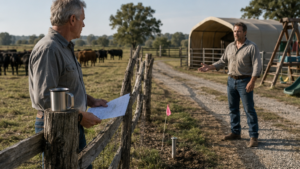
A dark-green steel equipment shed stood beyond the weathered livestock fence that separated his cattle ground from Anthony King’s adjoining horse property. The building had not been there when Frank checked the south pasture Saturday afternoon. Now, on Tuesday morning, it sat on a fresh bed of packed gravel, its metal siding catching the sun between two old cedars.
Frank left the tractor idling and walked toward it.
The cattle had already given the new structure a wide berth. Their tracks curved around the disturbed ground, and several clumps of grass had been scraped away by equipment tires. Beyond the fence, Anthony’s pickup was parked beside a flatbed trailer.
Frank did not call out.
He crouched instead.
Thirty years earlier, his father had shown him an iron survey pin somewhere along this stretch. Frank remembered the old man’s boot pushing grass aside and the dull tap of steel against steel.
“Fence ain’t always the line,” his father had said.
Frank had been in his thirties then and too busy fixing a broken baler to care why.
Now he cared.
He walked the fence slowly, studying the ground. The wire wandered slightly between cedar posts, bowed from decades of cattle pressing against it. The shed looked wrong even without a tape measure. Its nearest corner sat well past where Frank remembered the property line running.
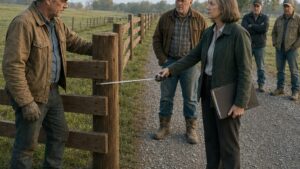
He returned to the tractor toolbox, found a fifty-foot tape, and hooked it against a fence post he knew had stood since before Anthony bought the neighboring parcel.
Seven feet.
Frank measured again.
A little more than seven at the shed’s rear corner. Slightly less toward the front.
He stood with the tape stretched across the grass and stared at the green wall.
“Morning.”
Anthony’s voice came from the other side of the shed.
He was broad through the shoulders, wearing work boots and a faded gray shirt, with his arms folded as though he had been watching Frank measure for some time.
“New building?” Frank asked.
“Finally.”
Anthony walked around the corner. “Feed, tack, small equipment. Been needing it two years.”
Frank nodded toward the tape.
“Looks like it may be over.”
Anthony followed his gaze, then looked toward the livestock fence.
“Over what?”
“My line.”
Anthony gave a short laugh, not quite mocking but close enough to tighten something in Frank’s chest.
“The fence is right there.”
“The fence isn’t necessarily the boundary.”
“It’s been the boundary since before I bought the place.”
“It has been a fence.”
Anthony’s expression changed.
“You saying I built on your land?”
“I’m saying I want to check before I say anything.”
“You’ve already got a tape out.”
Frank reeled it in slowly.
“That’s what checking looks like.”
Anthony glanced at the shed, then toward the old fence.
“My closing survey showed the fence.”
“Showed it as what?”
Anthony hesitated.
Frank noticed.
“A fence,” Anthony said finally. “Right along that side.”
Frank could have pressed him. Instead he put the tape back in his toolbox.
That was the habit that had carried him through forty years of cattle, machinery breakdowns, drought years, and dealings with men who became louder when uncertain: gather facts first. Speak after.
It had saved him money more than once.
It had also allowed arguments to grow in silence.
By midmorning Frank was in the farmhouse office with three cardboard boxes spread across the floor. Tax maps. Closing papers. Receipts. Old photographs his mother had kept in envelopes without dates.
He found a survey from twenty-six years earlier folded inside a plastic sleeve.
The drawing showed the south boundary as a straight line between two iron markers.
The livestock fence was not marked directly on it.
Frank leaned closer.
The shed, if his memory of the pin was right, could not possibly fit entirely on Anthony’s side.
He carried the survey back outside.
This time he brought a narrow steel rod and worked through the grass near the place his father had once pointed out. The soil was hard from late summer. He scraped away dead stems, pushed the rod down, moved six inches, tried again.
Metal clicked.
Frank froze.
He scraped with his boot.
A round, rust-darkened cap emerged barely above the dirt.
The old iron pin.
He stood over it and sighted toward the next recorded corner. The livestock fence bowed several feet inside that imaginary line before wandering back again farther down the pasture.
And Anthony’s green shed stood across it.
Frank took out his phone.
He photographed the pin. The fence. The shed. Then a wider frame containing all three.
He found an old orange survey flag in the barn and pressed it into the ground beside the rusted iron.
The bright plastic looked almost absurd against the brown grass.
But for the first time that morning, the invisible line had something visible standing on it.
Anthony came down the drive twenty minutes later.
He stopped when he saw the flag.
“You marking something?”
“Found the old corner.”
Anthony walked to the fence but did not cross.
“That rusty thing?”
“Survey pin.”
“You sure?”
“No. That’s why I’m getting it checked.”
Anthony looked from the pin to the shed.
His jaw tightened.
“Frank, people have been using that strip forever.”
“Using isn’t owning.”
“And that fence didn’t move itself.”
“I didn’t say it did.”
Anthony exhaled through his nose. “You want to turn this into a property dispute over a few feet?”
Frank looked at him.
Seven feet was not much when viewed from the cab of a tractor crossing eighty acres.
Seven feet was a great deal when somebody poured gravel over it and put up a building.
“I want to know where the line is.”
Anthony shook his head.
“Fine.”
He walked back toward his truck.
Frank remained beside the orange flag until the pickup disappeared.
That afternoon he pulled more photographs from the boxes. One showed his father standing beside a calf in almost the exact location where the shed now stood. Another, taken years later, showed a hay wagon parked on the strip. In both, the land beyond the fence was plainly being used as part of the Campbell pasture.
The photographs did not prove ownership.
But they proved one thing that mattered to Frank.
His memory was not inventing the strip after the shed appeared.
At four thirty, he heard a diesel engine near the south field.
Frank stepped out of the barn.
The installation truck was coming back down Anthony’s drive.
On its trailer were steel anchors, concrete blocks, and the equipment needed to make the green shed permanent.
Chapter 2: Frank Asked Them to Stop Once
By the time Frank reached the boundary, one of the installers was already guiding a steel anchor toward the ground.
“Hold up.”
The worker stopped and looked toward Anthony.
Frank climbed through his own gate rather than stepping across the low place in the fence. It took him farther around, which annoyed him more than it should have.
Anthony stood beside the shed with a clipboard.
Frank held up the folded survey.
“I need you to pause this.”
Anthony’s face hardened almost immediately.
“For what?”
“Until I get the boundary verified.”
“We already talked.”
“We talked before I found the pin.”
Anthony looked toward the orange flag.
“You found some old iron in a cow pasture.”
“I found the marker shown on my survey.”
“You don’t know that.”
“Exactly. That’s why I’m asking you to wait.”
The installer shifted his weight.
“How long are we talking?” he asked.
Frank looked at Anthony, not the worker.
“A day or two if I can get somebody out.”
Anthony lowered the clipboard.
“That’s not how this works. They’ve already been here twice. I paid for installation.”
“And if it’s on my property?”
“It isn’t.”
“You don’t know that either.”
Silence settled between them.
A horse struck a stall wall somewhere beyond Anthony’s barn. Frank heard the hollow thump clearly.
Anthony rubbed the back of his neck.
“When I bought this place, everybody treated that fence as the line.”
“Everybody who?”
“The people before me. Your dad. You.”
Frank felt the accusation land harder than he expected.
He had allowed Anthony’s mower to turn through the strip. He had watched trucks pass near the fence during hay deliveries. Once, years ago, he had even waved Anthony through after a gate chain broke farther uphill.
None of those moments had felt like transferring land.
They had felt like being neighbors.
“Using a strip doesn’t change a deed,” Frank said.
Anthony’s mouth tightened.
“You didn’t care until there was a building.”
That was not entirely true.
But it was true enough to bother Frank.
“I care because a building doesn’t drive away when it’s finished.”
The installer cleared his throat.
“I need a call one way or another.”
Frank looked at Anthony.
“This is me telling you there is a dispute. Don’t make it permanent until we check.”
Anthony stared at the orange flag.
Then he turned to the installer.
“Finish it.”
The words were quiet.
Frank felt something hot rise behind his ribs.
He could have stepped forward. He could have called the sheriff, though he doubted anyone would treat a disputed rural boundary as an emergency. He could have parked his tractor across the access path. He could have stood in front of the anchor point and forced the issue into something louder.
Instead, he took out his phone.
Anthony noticed.
“You filming me?”
“Photographing the work.”
“Of course you are.”
Frank took three pictures: the anchor equipment, the shed corner, and the orange flag in the same frame.
“Frank.”
He lowered the phone.
Anthony’s irritation had shifted into something closer to disbelief.
“You really want to do this?”
“I asked you to wait.”
“You asked after the building was already delivered.”
“I’m asking before it’s finished.”
Anthony glanced toward the workers.
“I’ve got horses coming in for winter boarding. Feed has to stay dry. Equipment has to get under cover. If I cancel them now, I pay another setup charge, another delivery charge, and probably lose my slot.”
That was the first thing Anthony had said that sounded less like territorial confidence and more like pressure.
Frank understood deadlines.
A broken baler did not care whether the farmer had cash. A feed bill did not wait because rain ruined a cutting.
But understanding the pressure did not change the location of the shed.
“You should’ve checked before you set it.”
“I did.”
“You checked a fence.”
“A fence that’s been there longer than either one of us has owned these places.”
Frank folded the survey again.
He could hear his father’s voice telling him that arguing in front of hired men never improved a man’s judgment.
So Frank did what felt disciplined.
He left.
Halfway to his barn, it stopped feeling disciplined.
It felt like retreat.
He spent the next hour calling surveyors.
The first could not come for three weeks.
The second said ten days.
The third had a cancellation Thursday morning.
Frank took it.
Then he called the county records office and was told he could inspect historical parcel maps in person.
He wrote everything down in a yellow legal pad.
At the top he printed:
SOUTH LINE — KING SHED.
Underneath, he listed dates, photographs, measurements, names.
Facts calmed him.
Facts had edges.
Conversations did not.
Near sunset he returned to the pasture.
The installation truck was gone.
The shed had been leveled. The anchors were seated. Gravel had been packed tight around the base. Anthony had already moved several feed bins inside.
Frank walked to the orange flag.
It leaned slightly now, probably from somebody brushing against it.
He straightened it.
The rusted survey pin remained beneath, mostly invisible.
On Anthony’s side of the fence, the green shed threw a long shadow across the disputed strip.
Frank looked at the permanent anchors disappearing into the ground and understood, with an unpleasant clarity, what his silence had purchased.
Time for Anthony.
And a harder problem for himself.
Chapter 3: The Iron Pin Was Still There
The surveyor’s string passed beneath the green shed.
Frank watched the bright line disappear under one side wall and emerge beyond the rear corner.
Neither man spoke for several seconds.
The licensed surveyor checked the instrument again, walked back to the exposed iron pin, and sighted toward the northern monument.
Then he returned.
“Your old pin is consistent with the recorded corner.”
“Consistent how close?”
“Close enough that I’m comfortable using it with the other monument and the deed calls. I’ll put everything in the field notes.”
Frank pointed toward the shed.
“And that?”
The surveyor did not dramatize it.
“Based on what I’m seeing right now, part of the structure is across the line.”
“How far?”
They measured.
Six feet nine inches at one corner.
Seven feet two inches at the other.
Frank had expected satisfaction.
Instead, he felt strangely tired.
He had been right.
The problem was still there.
The surveyor drove two fresh stakes outside the work area and tied orange flags to them. Then he cleared more soil around the old iron pin so its cap was plainly visible.
For decades it had been almost swallowed by grass.
Now it looked stubborn.
Anthony appeared before the surveyor finished packing his tripod.
He stayed on the opposite side of the fence.
“So?”
Frank handed him nothing.
“The measurement puts the shed across.”
Anthony looked at the surveyor.
“That what you’re saying?”
“I’m saying the field evidence is consistent with the deed line I’m retracing. You’ll want the completed survey.”
“That fence has been there thirty years.”
The surveyor glanced at it.
“Fences and boundary lines aren’t always the same thing.”
Anthony gave Frank a look as if the sentence had been rehearsed between them.
Frank almost said, I told you.
He stopped himself.
Anthony pointed toward the orange stakes.
“So now what?”
“I get the paperwork,” Frank said. “Then we figure out how to move it.”
Anthony’s face changed.
“You mean move the whole shed.”
“It’s on my land.”
“Part of it.”
“Part is enough.”
Anthony looked toward the building, where the sliding door stood open and stacked feed bags were visible inside.
“We’re not moving anything today.”
“I didn’t ask you to.”
“Sounds like you’ve already decided how this ends.”
Frank folded his arms.
For once, he noticed how much the gesture resembled Anthony’s.
“I decided where my land ends.”
Anthony walked away.
At the county office that afternoon, Frank expected the records to make things simpler.
They did the opposite.
Carolyn Walker sat behind a counter crowded with rolled plats and scanning equipment. She studied the parcel number Frank gave her, then brought up several older records.
“You have a retracement survey coming?”
“Yes.”
“Good. These maps aren’t a substitute.”
“I understand.”
She zoomed in on an older plat.
Frank leaned closer.
A straight boundary line ran between monument symbols.
Beside it, in faint notation, was a fence line that wandered several feet inward on the Campbell side.
Frank frowned.
“That’s the same fence.”
“Appears to be.”
“So the records always showed it off the line?”
“This plat did.”
“What year?”
Carolyn gave him the date.
Frank did the arithmetic.
His father had still been running the farm then.
“Why would somebody build a fence seven feet inside their own property?”
Carolyn leaned back.
“Lots of reasons. Terrain. Equipment access. Water. Agreement between owners. Sometimes people fence where it’s convenient instead of where the deed line sits.”
“Would that give the other owner the land?”
“I’m not going to give you a legal conclusion.”
“I’m asking generally.”
“And generally, that’s still a question for an attorney because use history matters.”
Frank stared at the screen.
“What use history?”
Carolyn pulled another file.
Aerial imagery.
Older photographs showed tire tracks along the strip between the deed line and the fence. In one image a wagon sat there. In another, what looked like a tractor had traveled the length of it.
From both properties.
Frank felt his certainty loosen.
“This doesn’t mean ownership changed,” Carolyn said. “It means you shouldn’t assume the story started with that shed.”
Frank nodded.
That sentence followed him home.
He drove the farm lane slowly, looking at gates and tracks he had passed thousands of times without seeing them as evidence of anything.
The strip had always been awkward.
Too narrow to graze efficiently. Wide enough for a truck or tractor. His father had sometimes run equipment there when repairing fence. The previous owners of Anthony’s parcel had used it to reach a back paddock.
Frank remembered all that now.
He had simply never attached legal meaning to it.
At the barn office, he spread the new copies beside his survey.
The seven-foot encroachment was real.
So was the history that made Anthony’s assumption less ridiculous than Frank wanted it to be.
That irritated him almost as much as the shed.
He spent an hour searching through farm records for anything that mentioned the fence.
Invoices first.
Then old feed books.
Then his father’s notebooks—small, grease-stained books filled with vaccination dates, hay yields, broken equipment, cattle numbers, and reminders written in block letters.
Most were useless.
In the fourth notebook, Frank found an entry from more than three decades earlier.
It was only two lines.
Moved south fence inward for access.
Keep service strip shared with neighbors.
Frank read it twice.
Then a third time.
The word shared seemed to darken on the page.
He sat alone at the old desk, the notebook beneath his hand and the survey pin visible through the barn window as a tiny orange flag in the distance.
The land had not suddenly become uncertain.
The people had.
And for the first time since the green shed appeared, Frank had to ask a question he could not answer with a tape measure.
What, exactly, had his father meant by shared?
Chapter 4: The Favor Everyone Mistook for Ownership
Frank carried his father’s notebook to the kitchen table before sunrise and read the same two lines until the words stopped looking like handwriting.
Moved south fence inward for access.
Keep service strip shared with neighbors.
Shared.
Not sold. Not transferred. Not theirs.
But not exactly private, either.
He found three more notebooks from the same period and searched every page that mentioned the south pasture. His father’s entries were spare and practical: replaced cedar posts, moved cattle before rain, neighbor borrowed wagon lane, repaired wire after tractor access.
No deed. No agreement. No sentence saying the adjoining owners could claim the strip.
But there were years of favors.
Frank remembered some of them now that the notebooks forced him to.
The former neighbor had hauled hay through that strip when the main lane washed out. Frank’s father had taken a tractor through the same opening to repair the far side of the fence. Nobody had stopped to ask who owned each wheel track because everybody knew where they were going and why.
The fence had been moved inward because there was more room to work equipment without catching axles on wire.
That was all.
At least, Frank believed that was all.
He took the notebook outside.
The orange flags stood in a straight line that made the old fence look almost careless. Beside them, the green shed looked more intrusive than ever.
Anthony was filling water troughs near his barn when Frank called over.
“You got a minute?”
Anthony shut off the hose.
Frank held up the notebook.
“My dad wrote about this strip.”
Anthony approached slowly.
“And?”
“He moved the fence inward for equipment access.”
Anthony looked at the fence.
“That’s what I’ve been telling you. That strip was shared.”
“Shared for access.”
“Same thing we’ve been doing.”
“No. It isn’t.”
Anthony’s expression tightened.
Frank opened the notebook and showed him the entry.
Anthony read it.
“You think this helps you?”
“I think it explains the fence.”
“It explains that both sides used the ground.”
“It doesn’t say anybody gave it away.”
Anthony handed the notebook back.
“For thirty years nobody objected.”
“To driving over it.”
“To using it.”
“You’re trying to turn a favor into ownership.”
Anthony looked toward the shed.
“And you’re trying to pretend thirty years means nothing.”
Frank almost answered quickly.
Then he looked at the tire marks running beside the fence.
Anthony had a point, even if not the one he wanted.
The strip had functioned as shared space for longer than Anthony had owned his farm. Frank had never posted it. Never marked it. Never told Anthony not to mow a corner or turn a trailer there.
Frank had treated the difference between permission and ownership as obvious because it had been obvious to him.
That did not mean it had been obvious to Anthony.
“I understand why you thought the fence mattered,” Frank said.
Anthony blinked, apparently not expecting the concession.
“But I told you Tuesday to stop.”
The softness vanished from Anthony’s face.
“We’re back to that?”
“We never left it.”
“I couldn’t stop.”
“You could.”
“You don’t know what it costs.”
“Then tell me.”
Anthony stared at him for a moment.
“I’ve got six winter boarding spots committed. Two more horses coming next month. Feed prices went up. My old storage roof leaks. I booked that shed install before summer and put half down.”
Frank said nothing.
Anthony continued.
“If I’d canceled after delivery, I’d have paid another setup fee. Then another transport fee. Maybe waited six weeks for another opening.”
“So you gambled the line was where you wanted it.”
“I believed the fence.”
“Before I asked you to wait, maybe.”
Anthony’s jaw moved.
“After that, I believed you were making something out of nothing.”
There it was.
Not ignorance.
A choice.
But Frank also heard the fear underneath it.
Anthony’s operation was smaller than Frank’s cattle farm. A handful of lost boarding customers might matter more to him than Frank had assumed.
Frank looked at the green shed.
“Move it.”
Anthony laughed once.
“No.”
“The survey says it’s over.”
“The survey doesn’t erase history.”
“It establishes the boundary.”
“We’ll let somebody else decide that.”
Frank felt his shoulders stiffen.
“You want lawyers?”
“I want you to quit acting like I stole something in the night.”
“You installed it after I asked you not to.”
“And you stood there taking pictures instead of doing anything.”
The words landed cleanly.
Frank stared at him.
Anthony shook his head.
“If you thought it was yours, Frank, you should’ve said so before the last anchor went in.”
“I did.”
“You asked me to wait. Then you walked away.”
Frank had no answer that did not sound weaker when spoken aloud.
Anthony turned toward his barn.
“We’re done.”
Frank returned to the farmhouse carrying the notebook under one arm.
For most of the morning, he considered calling the attorney whose number Carolyn Walker had given him. He even wrote the number on his legal pad.
Instead, he opened the county land-use pages and began reading.
He wasn’t looking for revenge.
That was what he told himself.
He was looking for something physical that would make the boundary impossible to ignore.
Fencing required permits in one portion of the agricultural setback. Permanent structures brought more questions. Vegetative barriers were different.
He called the agricultural extension office and asked about hardy boundary plantings that could survive cattle-country weather without spreading uncontrollably into pasture.
The employee gave him several options and warned him away from invasive varieties.
Frank chose a dense thorn-bearing hedge suitable for the soil.
He measured the available strip again.
Fourteen plants would establish the first section. More later if needed.
He filled out the nursery order online.
His finger rested over the final button.
A formal demand letter would have been cleaner.
A direct conversation might have been cleaner still.
Instead, Frank pressed Submit.
The confirmation appeared on the screen.
Fourteen hedge plants.
Delivery Friday.
Chapter 5: The Hedge Stayed on Frank’s Side
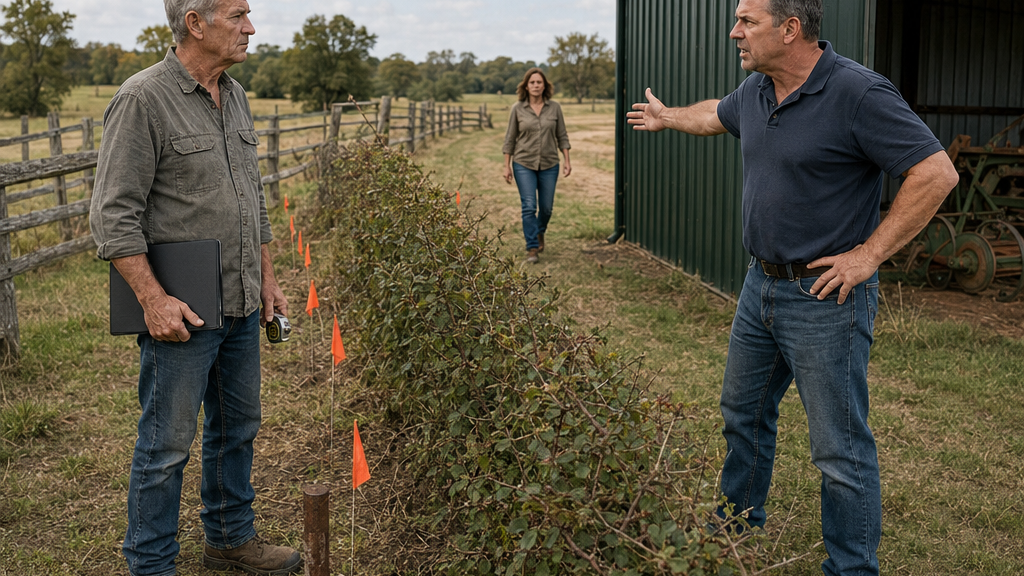
The nursery truck arrived with fourteen thorny plants lined in black containers along the bed.
Anthony saw them before Frank unloaded the third one.
He stood beside the green shed, one hand resting on its sliding door, saying nothing.
Frank preferred that.
He placed the first container beside an orange survey flag.
Not on the fence.
Not near the place people had assumed the line to be.
On the surveyed side of the iron pin.
Frank ran a string between the flagged points and measured every planting hole from it. He left enough clearance for the plants to mature without crossing the recorded boundary. He photographed the tape at each end.
By noon, six holes were dug.
Anthony finally walked over.
“What are those?”
“Hedge plants.”
“I can see that.”
Frank set the shovel down.
Anthony looked along the line of black pots.
“You’re putting them there?”
“That’s where my ground starts.”
“Your survey says the line is there. Doesn’t mean you need to build a wall on it.”
“They’re plants.”
“Don’t play games.”
Frank wiped dirt from his palms.
“I checked the setback. I checked the species. They’re on my side.”
Anthony stared at him.
“You’ve been waiting to do this.”
Frank almost denied it.
The answer came too slowly.
Anthony noticed.
“That’s what I thought.”
He walked away.
Frank resumed digging.
The first row took the rest of Friday.
He drove stakes beside each plant, watered the roots deeply, and laid mulch around the bases. When he finished, the hedge looked unimpressive—fourteen young shrubs with more empty space than growth between them.
But the line was visible.
For the first time in decades, anyone standing near the shed could see exactly where Frank believed his pasture began.
On Saturday morning, he added a second staggered row along the section nearest the shed.
He photographed that too.
Anthony watched from his barn door.
He did not challenge the string.
He did not bring out his own tape.
He did not claim the orange flags had been moved.
That silence gave Frank more satisfaction than it should have.
Over the next three weeks, the plants settled into the ground.
Frank watered them when the soil dried and trimmed nothing.
New growth filled the gaps. Thin thorn-covered branches reached outward, catching dead grass and each other. The hedge was not yet high, but it became dense enough that a person could no longer casually step through the strip.
The cattle learned the line before either man admitted its effect.
They stopped nosing toward the shed.
Frank began walking the boundary each morning.
At first he told himself he was checking moisture.
Then growth.
Then whether any branch crossed the surveyed line.
By the third week, he knew the truth.
He liked seeing the hedge there.
He liked the green shed appearing boxed in by something Anthony had not chosen.
That realization embarrassed him.
One afternoon Frank found a branch extending toward the shed’s access side. It remained on his property, but barely.
He stood looking at it with pruning shears in his hand.
He could have clipped it.
Instead, he lowered the shears.
A horse trailer arrived at Anthony’s place later that day.
Frank watched from the pasture as Anthony tried to maneuver a feed cart between the shed and the hedge. There was still room, but not as much as before. Anthony had to turn the cart sideways and pull it by hand.
He looked straight across at Frank.
Frank pretended to check a water trough.
That evening, he placed the survey copies, dated photographs, and county notes in a folder.
He told himself it was preparation.
The next morning proved him right.
Frank was repairing a mineral feeder when he heard the gate slam.
Anthony came across the pasture fast.
Not running.
Close.
His shoulders were forward, his face red from either anger or the walk.
He stopped on the far side of the hedge.
“You’re moving these.”
Frank straightened.
“No.”
“They’re blocking my building.”
“They’re on my land.”
“They’re growing into my access.”
Frank set down the wrench.
“I’ve checked them every morning.”
Anthony pointed at a thorny branch.
“Look at that.”
“Still this side of the line.”
“The line according to you.”
“The line according to the survey.”
Anthony stepped closer.
His boot came down inches from the exposed iron pin.
Frank noticed it immediately.
So did Anthony.
For a moment neither man moved.
Then Frank walked to the barn gate and returned with the folder and a measuring tape.
Anthony gave a humorless laugh.
“Here we go.”
Frank hooked the tape at the surveyed reference point and stretched it toward the nearest plant.
“Don’t take my word for it.”
Anthony watched the numbers.
Frank moved to the second plant.
Then the third.
Every trunk was inside Frank’s boundary.
Every orange flag aligned with the survey stakes.
Every dated photograph showed the planting position before new growth filled in.
Frank opened the folder.
“Here’s the retracement. Here’s where they measured the shed. Here’s every planting point.”
Anthony did not take the papers.
“You think because you made a file, that makes this neighborly?”
“No.”
Frank heard the answer leave his mouth before he had decided to give it.
Anthony’s expression shifted slightly.
“No,” Frank repeated. “It makes it documented.”
“You planted those because of me.”
“Yes.”
“You wanted them against my shed.”
Frank looked at the branches.
He could have said he only wanted a boundary.
That would have been partly true.
Not completely.
“I wanted you to see the line.”
Anthony shook his head.
“That’s not the same thing.”
“No.”
The admission tasted worse than an argument.
Frank looked at the hedge.
“I wanted you to feel what it was like having something pushed where you didn’t want it.”
Anthony stared at him.
There was no satisfaction left in saying it aloud.
Only recognition.
Frank had spent three weeks proving Anthony crossed a physical boundary.
He had not noticed how close he was getting to crossing another one himself.
Anthony opened his mouth.
A woman’s voice called from the direction of his house.
“Anthony.”
Susan Taylor stood beside the farm lane.
She had apparently heard enough.
Anthony turned.
Susan did not look at Frank.
She looked at her husband.
“You need to tell him the rest.”
Anthony’s face went still.
Frank closed the survey folder.
“What rest?”
Susan started walking toward them.
Chapter 6: He Knew Frank Had Asked Him to Wait
Anthony stepped directly over the exposed survey pin before Susan reached them.
Frank pointed down.
“Watch your boot.”
Anthony looked at the rusted metal under his heel and moved aside.
For a second, the gesture was almost absurdly precise: two men arguing over acres and livelihoods, both instinctively careful not to disturb a piece of iron scarcely wider than a coin.
Susan stopped beside the hedge.
“What did you tell him?” Anthony asked.
“Nothing yet.”
“Then don’t.”
Frank looked between them.
Susan folded her arms.
“You told me Tuesday he wanted the installation stopped.”
Anthony’s face hardened.
“I said he had questions.”
“You said he found a marker and wanted time for a survey.”
Frank did not speak.
Anthony looked at him instead.
“I already told you I thought the fence was right.”
“Tuesday morning,” Frank said.
Anthony said nothing.
Susan continued.
“You called the installer after Frank left.”
Anthony turned sharply toward her.
“This is between me and him.”
“It stopped being between you two when the boarding money started paying for it.”
That silenced him.
Susan looked at Frank.
“The installer offered to leave it unanchored until Thursday. Anthony would’ve lost the labor charge for that day, but they would’ve come back.”
Frank felt the folder become heavier in his hand.
“How much?”
Anthony answered before Susan could.
“Enough.”
“How much?”
“Eight hundred for the return setup. More if we had to reschedule beyond that week.”
Frank stared at him.
“Eight hundred dollars.”
“And maybe the delivery slot. Maybe storage. Maybe two clients.”
“So you knew.”
“I knew you disputed it.”
“You knew I asked for forty-eight hours.”
Anthony’s voice rose.
“And I thought you were wrong.”
“That’s different from not knowing.”
Anthony looked toward the shed.
For weeks Frank had imagined this moment in simpler terms. Proof on one side. Excuse on the other.
Now he could see exactly where Anthony’s mistake had become a choice.
And exactly why Anthony had made it.
That did not make it acceptable.
It made it human.
Anthony pointed toward the hedge.
“And this was your choice.”
Frank looked at the plants.
“Yes.”
“Don’t stand there with survey papers and act like this was only about protecting property. You wanted to make the shed unusable.”
“I wanted you to respond.”
“You knew I’d respond once it got in the way.”
Frank tightened his grip on the folder.
“Yes.”
Susan looked from one man to the other.
“So both of you knew what you were doing.”
Neither answered.
A horse whinnied near the barn.
Anthony rubbed his face.
“I’ve got commitments.”
Frank said nothing.
“Six winter boarders,” Anthony continued. “Two are already paying deposits. Feed has to be dry. Saddles, blankets, tools—there’s nowhere else on the property big enough without clearing another pad.”
Frank glanced toward Anthony’s older barn.
“The loft?”
“Roof leaks on the north side.”
“The equipment bay?”
“Tractor’s in it.”
“Move the tractor.”
“And put twelve thousand dollars of equipment outside all winter?”
Frank understood the arithmetic because farmers always did.
Everything had somewhere to go until one thing moved. Then three other things had nowhere to go.
Anthony kicked lightly at the grass.
“I should’ve waited.”
The words were barely audible.
Frank looked at him.
Anthony’s eyes stayed on the ground.
“I said I should’ve waited. Don’t make me say it like I’m signing a confession.”
Frank almost smiled.
He didn’t.
“I should’ve spoken sooner,” Frank said.
Anthony looked up.
Susan’s expression changed.
Frank continued before pride could stop him.
“I saw the work Tuesday morning. I measured. I took pictures. I spent half the day telling myself I needed facts.”
“You did.”
“I also didn’t want the confrontation.”
Anthony glanced at the hedge.
“Found a different way to have one.”
“Apparently.”
For the first time since the shed appeared, the anger between them lost enough pressure to leave room for embarrassment.
Frank opened the survey folder and laid several sheets on the grass beside the iron pin.
The retracement showed the boundary.
His photographs showed the installation.
The old county plat showed the offset fence.
His father’s notebook sat on top.
Anthony crouched.
“So that’s why the fence is in.”
“Equipment access.”
“Shared access.”
“Yes.”
Anthony tapped the notebook.
“Your dad wrote shared.”
“He did.”
“That has to matter.”
“It matters to me.”
Anthony looked up.
“But?”
“But shared isn’t given.”
Anthony straightened.
Susan stepped closer and read the notebook entry.
“Did your father ever tell you the neighbors owned it?” she asked.
“No.”
“Ever tell you they could build there?”
“No.”
Anthony stared at the shed.
Frank could almost see the argument changing shape in his mind.
Not disappearing.
Changing.
“If I move it,” Anthony said, “I lose the gravel pad. I pay the lifting crew. New anchors. Maybe grading.”
Frank nodded.
“Yes.”
“You say that pretty easy.”
“It’s still your building.”
Anthony laughed without humor.
“And it’s still your strip.”
Frank looked at the hedge.
Several branches trembled in a light breeze.
Three weeks earlier he would have enjoyed hearing Anthony say those words.
Now they sounded expensive.
“What if we move it straight back?” Frank asked.
Anthony turned.
“Where?”
“Far enough onto your side to clear the surveyed setback and leave access.”
“The ground slopes.”
“We grade the minimum.”
“That’s not cheap.”
“No.”
Anthony’s eyes narrowed.
“What are you offering?”
Frank had not known until the question was asked.
“I’ll split the access work.”
Susan frowned.
“The move?”
“No. The shed is Anthony’s responsibility. So are the new anchors.”
Anthony’s face began to close again.
Frank kept going.
“I’ll split the grading needed to reopen the old service route, because my family used that route too. And I’ll remove the section of hedge necessary for the crew to get through.”
Anthony looked surprised.
“In exchange?”
“We record the surveyed line. Permanent markers. Written acknowledgment that shared access never means permission to build.”
“And the rest of the hedge?”
“Stays.”
Anthony looked at it.
Frank added, “Trimmed so it stays on my side.”
Susan let out a breath.
Anthony remained silent.
Frank picked up his father’s notebook.
“This happened because everybody before us knew what they meant and nobody wrote it clearly enough for the next people.”
Anthony looked toward the old fence.
“What if I say no?”
Frank closed the folder.
“Then the attorney sends the letter, and we spend money arguing about a building that still has to sit somewhere.”
Anthony’s expression sharpened.
“So that’s the threat.”
“No.”
Frank met his eyes.
“That’s the option I should’ve stated plainly the first day.”
Anthony looked at Susan.
She did not answer for him.
Good, Frank thought.
This had to be his choice.
At last Anthony bent, picked up one of the survey copies, and studied the heavy boundary line running beneath his shed.
“I need to run the numbers.”
“Do that.”
“Don’t plant anything else.”
Frank considered the request.
“Not while we’re talking.”
Anthony nodded once.
It was not agreement.
But it was the first thing that resembled one.
Frank gathered the papers, leaving Anthony with a copy of the retracement and the proposed dimensions for relocation.
Before turning away, he pointed toward the rusted pin.
“Whatever we decide, that stays visible.”
Anthony looked down at it.
Then at the orange flags stretching across the pasture.
“This time,” Frank said, “we write down what the line means.”
Anthony did not promise anything.
He carried the survey toward his farmhouse with Susan walking beside him.
Frank remained at the hedge, waiting to see whether the next thing that crossed the boundary would be another piece of equipment—or an answer.
Chapter 7: This Time the Boundary Was Written Down
The lifting crew arrived two weeks later.
Frank heard the diesel engine before he saw the truck turning down Anthony’s lane. For one brief second, he wondered whether Anthony had changed his mind and hired somebody to do something else with the shed.
Then the hydraulic trailer came into view behind it.
Anthony was already standing by the green building.
Susan stood near the barn with a clipboard and a stack of papers tucked beneath one arm.
Frank walked out through his pasture gate carrying pruning shears.
The hedge had filled in more during the two weeks of waiting. Several branches now reached into the narrow space the lifting crew would need to work.
The foreman looked at the plants, then at Frank.
“We need another three feet along this side.”
Anthony glanced toward him.
Frank could feel the question in that glance.
Three weeks earlier, he might have argued over every inch.
Instead, he stepped to the first shrub and cut it low.
The thorny branches dropped into the grass.
Anthony said nothing.
Frank moved to the next.
By the fourth plant, the crew had enough room to bring in their equipment. Frank dragged the cut branches aside and stacked them near the fence.
The foreman checked the new site Anthony had prepared farther inside his property. The ground had been graded just enough to create a level pad without disturbing more soil than necessary. A fresh line of compacted stone waited beyond the surveyed boundary.
Anthony had done what he said he would do.
Not happily.
But he had done it.
Susan had worked out temporary feed storage in half of the older equipment bay. The tractor would spend part of the winter under a covered lean-to, protected with a tarp along the exposed side. It was inconvenient and imperfect.
It also meant the boarding contracts would survive.
Frank paid his agreed share of the grading for reopening the service route. Anthony paid the lifting crew, the new anchors, and the replacement gravel.
Neither man called the arrangement fair.
That was part of why it worked.
The crew began disconnecting the anchors.
Metal rang against metal.
Frank stood near the rusted survey pin and watched the green shed rise a few inches from the ground.
It looked smaller off its foundation.
For weeks, it had seemed almost permanent enough to change the landscape simply by existing.
Now four hydraulic jacks lifted it as easily as a hay wagon.
Anthony came over.
“You didn’t have to cut that many.”
Frank looked at the severed hedge.
“They needed room.”
“You planted them.”
“I know.”
Anthony rubbed his chin.
“Thought you’d make them work around every branch.”
“So did I.”
Anthony gave him a sideways look.
Frank let the admission sit.
The shed moved slowly across the strip.
The old gravel pad appeared underneath it, pale and rectangular against the pasture soil. Tire ruts and anchor holes marked the place where the dispute had spent more than a month growing larger than the building itself.
When the shed finally cleared the surveyed line, the foreman stopped.
“Check us.”
Anthony looked toward Frank.
Frank almost told the crew to continue.
Instead, he took out his tape.
Not because he distrusted them.
Because this time everyone was measuring before anything became permanent.
He hooked the tape at the iron pin and checked the nearest corner. Then he checked the rear.
Anthony followed with his own tape.
Their measurements matched within an inch.
“Enough clearance?” Anthony asked.
“Enough.”
“Say it like you mean it.”
Frank looked at him.
“Yes. Enough.”
The crew continued.
By early afternoon, the shed rested entirely on Anthony’s side, properly aligned on the new pad. The anchors went in only after both men checked the placement again.
Frank found himself watching Anthony’s face as the final anchor was driven.
There was no triumph there.
Mostly fatigue.
Frank understood that too.
Susan came across the lane carrying the paperwork.
Carolyn Walker had confirmed that the completed retracement matched the county’s recorded monuments. The attorney had turned Frank’s proposal into a short boundary acknowledgment and shared-access agreement.
Nothing grand.
No courtroom language meant to frighten anybody.
The document identified the surveyed line, confirmed that the historic service strip remained Campbell property, and granted limited agricultural access only where both owners agreed. It also stated plainly that access did not authorize structures, storage, permanent improvements, or changes in ownership.
Anthony read it again even though Frank knew he had already reviewed it.
Susan pointed at the signature line.
“You’ve had two weeks.”
“I know where the line is.”
“Then sign where the line is.”
Anthony looked at her.
“You practicing that?”
“For two weeks.”
Frank looked away before either of them saw him smile.
Anthony signed.
He pushed the papers toward Frank.
Frank signed next.
There was no handshake.
For some reason, that felt more honest than forcing one.
Susan took one copy for their records.
Frank folded his own and slipped it into the same folder that had held the first photographs of the shed.
Anthony nodded toward the old livestock fence.
“You replacing that too?”
“Not today.”
“Seems strange now.”
“It was always strange. We just stopped seeing it.”
Anthony looked down the fence line.
“My closing survey should’ve made me ask more questions.”
Frank rested one boot beside the old iron pin.
“I should’ve marked the line years ago.”
Anthony glanced at him.
“Your dad didn’t.”
“No.”
“Mine wouldn’t have either.”
Frank considered that.
Men of their fathers’ generation had sometimes treated spoken understandings as if they would survive forever simply because the people who made them remembered what they meant.
Maybe that worked until the people changed.
Or the pressure changed.
Or somebody put a building where only tire tracks had been before.
Frank walked to his truck and returned carrying a treated wooden marker post.
Anthony raised an eyebrow.
“Thought we had enough markers.”
“We’ve had enough invisible ones.”
Frank drove the post several inches inside his property, close enough to the rusted survey pin that nobody could mistake what it referred to. He left the iron untouched in the ground.
The permanent marker did not replace it.
It made it easier to find.
Then Frank pulled up the nearest orange flag.
He had been looking at those bright flags for weeks.
At first they had meant suspicion.
Then proof.
Then defiance.
Now they were unnecessary.
He removed the next flag and the next.
Anthony helped with the last one without asking.
He pulled it from the soil and held it out.
Frank took it.
For a moment they stood beside the old iron pin with the shed now several yards away on Anthony’s side.
“You keeping the hedge?” Anthony asked.
“Most of it.”
Anthony nodded toward the cut section.
“It’ll grow back.”
“Probably.”
“You going to let it get against my shed again?”
Frank looked toward the relocated building.
“Not unless your shed learns to walk.”
Anthony laughed once.
It was not reconciliation.
But it was the first sound between them in weeks that did not carry an argument inside it.
Frank gathered the flags and headed back toward his pasture.
Behind him, the lifting crew packed equipment. Anthony and Susan began moving feed into the relocated shed.
The old service strip remained exactly where it had always been.
Same grass.
Same fence.
Same land.
What had changed was that nobody had to guess anymore.
At the marker post, Frank stopped and looked down at the rusted iron pin his father had once uncovered with the toe of a boot.
For thirty years, the metal had stayed in the ground while people drove across it, fenced around it, remembered it badly, and trusted one another to understand what was never written clearly enough.
Frank pressed the soil firm around the new post.
Then he carried the last orange flag back to the barn.
The story has ended.