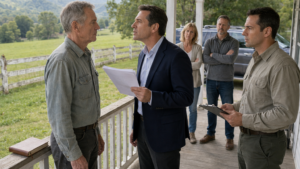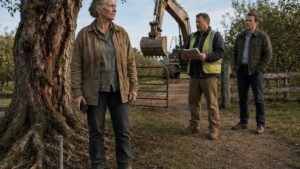
They Ordered Laura to Remove Her Farm Gate—Then She Checked the 1994 Easement Beneath Their Road
Chapter 1: The Morning They Came for Laura’s Gate
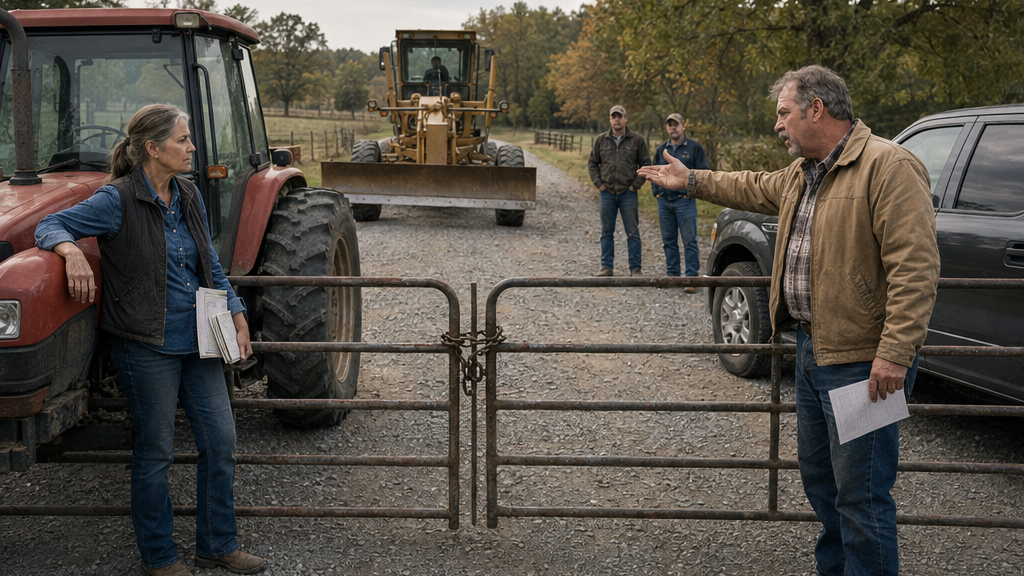
The road grader was already running when Laura Campbell reached the end of her driveway.
Its diesel engine shook the cool morning air, low and steady, while the operator sat behind the glass with both hands off the controls. He was waiting.
So was Robert Davis.
He stood outside his pickup on the far side of Laura’s chained cattle gate, one boot on the gravel shoulder and a yellow sheet of paper folded against his thigh.
Laura stopped twenty feet short of him.
Beyond the gate, the gravel lane cut between two fenced pastures before bending through the trees toward the properties behind hers. A pair of yearling calves had wandered closer to the fence, ears forward, disturbed by the engine.
“What’s the grader doing here?”
Robert unfolded the paper.
“You got the notice.”
“I got a piece of paper in my mailbox.”
“That was the notice.”
Laura looked past him at the grader. “That doesn’t answer my question.”
Robert exhaled through his nose. He was sixty or close to it, broad through the shoulders, with the patient expression of a man accustomed to chairing meetings where other people eventually stopped arguing.
“The road association voted to clear obstructions from the access lane.”
Laura looked at the gate.
The gate had been there for eighteen years.
Her father had hung the original one. Laura had replaced it with heavier galvanized tubing after taking over the farm, but the posts still stood where he had set them. The gate crossed the lane because cattle moved between the lower pasture and the hay field twice a year. Anyone using the road opened it, drove through, and closed it again.
At least they used to.
“You’re calling my gate an obstruction now?”
“I’m calling it what the easement calls it.”
Robert held out the yellow sheet.
Laura took it.
The notice said the road association required “unrestricted and continuous vehicular passage over the association access corridor.” It ordered removal of gates, chains, parked equipment, or other impediments by Friday.
It was Tuesday.
At the bottom, Robert had signed as chairman.
Laura read the central sentence again.
“Association access corridor,” she said.
“That’s right.”
“No.”
Robert’s brow tightened. “No what?”
“That isn’t the language.”
“What language?”
“The deed language.”
A pickup rolled slowly around the bend behind Robert and stopped. One of the neighboring farmers leaned an elbow out his window.
Robert glanced back, then toward Laura again.
“Laura, we’re not doing this all morning. The easement was recorded in 1994. It grants access to every parcel behind you. Everybody knows that.”
“Everybody knowing something isn’t the same as the instrument saying it.”
“You worked in records. You know how this works.”
“Yes.”
The single word landed harder than she intended.
Robert shifted the paper under his arm.
Laura had spent twenty-nine years in the county land-records office before retiring. She had indexed deeds written in ink that had browned to the color of tobacco. She had handled plats drawn before paved county roads reached half the farms in the district. She had watched people arrive furious over fence lines and leave quieter after discovering that memory, custom, and title were three different things.
She also knew the danger of arguing from memory.
Her own memory included the deed she had examined before buying the Campbell place from her father’s estate. There was an access easement. She had never disputed that.
But she did not remember the words Robert had just used.
The road grader’s engine climbed briefly, then settled.
“Move the chain,” Robert said.
Laura looked at him.
“We’re grading this morning. While the operator’s here, we’re taking the gate out.”
“No.”
This time there was no edge in her voice.
Robert seemed more bothered by that than he would have been by shouting.
“Laura, you can’t block legal access.”
“I’m not blocking anybody. The gate opens.”
“Emergency vehicles shouldn’t have to stop for a gate.”
“Then we can discuss emergency access.”
“We already discussed it.”
“You did.”
Two more vehicles had come down the lane behind Robert. Cynthia Ramirez’s small SUV stopped behind the farmer’s truck. Another neighbor stood beside his mailbox farther back, watching.
Laura felt the situation changing around her.
What had begun as Robert, a grader, and a piece of paper was becoming a public test.
Robert apparently felt it too.
He raised his voice just enough to carry.
“The association has maintained this road for years. Everybody back here pays assessments. We cannot have individual owners deciding what goes across the easement.”
Laura folded the notice once.
“Show me the easement.”
Robert stared at her.
“You know there’s an easement.”
“I know there’s an instrument recorded in 1994. That’s not the same thing as agreeing with your description of it.”
Cynthia lowered her window.
“Laura, I have a feed delivery coming Thursday.”
“You’ll get your feed delivery.”
Robert turned toward Cynthia. “This is exactly the problem.”
Laura felt something small and unpleasant settle behind her ribs.
He was turning a title question into a choice between Laura and her neighbors.
She hated that he was doing it.
She hated more that it was working.
Cynthia looked from Robert to the gate. “Are you planning to lock it?”
“It’s chained because my cattle were in the lower field last night. The chain isn’t locked.”
Robert shook his head. “People shouldn’t have to wonder.”
Laura looked down at the yellow notice again.
Unrestricted and continuous vehicular passage over the association access corridor.
Her father had disliked loose language. He had been a patient man about broken equipment and bad weather, but a phrase used carelessly could bother him for days.
Don’t surrender an inch because somebody got comfortable using two, he had once told her during a fence dispute with a timber company. Make them show you where the inch came from.
Laura had inherited that habit.
Perhaps too completely.
Robert stepped toward the gate.
“If you won’t remove it voluntarily, the association will remove it and bill you for the labor and equipment.”
The grader operator looked away.
“How much?”
“That depends on time.”
“So you intend to cut down posts on my property and send me the invoice.”
“I intend to keep a legal access road open.”
“There’s that word again.”
“What word?”
“Legal.”
Robert’s face changed slightly.
Not fear. Not yet.
Annoyance sharpened by uncertainty.
Laura looked toward her barn. Her tractor was parked near the equipment shed, forks still mounted from moving hay pallets the previous afternoon.
Ten minutes later, she backed it across the gravel entrance on her side of the gate.
Robert watched her set the brake.
“You’re making this worse.”
“No. I’m keeping you from doing something neither of us can undo before we know what your paper actually says.”
The other vehicles remained where they were.
Cynthia got out.
“Laura, what are you saying?”
Laura almost told her.
She almost said that the terminology bothered her, that the notice sounded like language lifted from an association policy rather than the recorded grant she remembered, that the present lane might not even follow the original description.
Instead she said, “I’m saying Robert needs to show me the document.”
It was precise.
It was also insufficient.
Cynthia’s mouth tightened.
Robert reached into his truck and pulled out a photocopied packet.
“I have it.”
Laura’s attention went straight to the first page.
The reproduction was poor. Gray shadows ran along the fold lines. A rectangular recording stamp showed 1994, and beneath it several paragraphs were barely legible.
“Give me a copy.”
“This is my copy.”
“Then bring another.”
Robert laughed once, without humor.
“You think because you worked in that courthouse you can turn this into some technicality?”
Laura met his eyes.
“No. I think technicalities are what people call details after they discover the details matter.”
For a few seconds, no one spoke.
Then the grader operator shut off the engine.
The sudden silence made the cattle’s movements audible in the grass.
Robert looked toward the machine, then at the neighbors waiting behind him.
“You’ve got until tomorrow morning,” he said. “After that, I’m rescheduling the grader.”
Laura stepped closer to the gate.
“Bring me the recorded legal description.”
“You’ve seen it.”
“Bring it anyway.”
“And then?”
Laura looked at the lane bending toward the trees, at the road everybody had used so long that use itself had become proof in their minds.
“Then we find out whether the road you’re enforcing is the road they actually granted.”
Chapter 2: The Line on the Map Did Not Match the Road
The copy in Laura’s farm office did not match Robert’s.
She knew that before she finished the first page.
Robert’s packet, which he had finally slid through the gate before leaving, contained language referring to a thirty-foot access corridor “following the existing gravel road.” The copy Laura kept with her closing documents described a thirty-foot strip by bearings and distances.
No phrase about an existing gravel road appeared anywhere.
Laura laid both versions beneath the brass desk lamp.
The room smelled faintly of dust, cattle medicine, and the coffee she had forgotten to drink.
She traced the boundary calls with one finger.
North eighty-one degrees east.
Then a distance.
Then another bearing.
Her old copy was not certified. It could have been incomplete. A missing page or later amendment could explain everything.
That possibility irritated her because it was reasonable.
By nine-thirty she was driving toward the county seat.
The deed room had changed since her retirement. Two public terminals stood where an old microfilm reader once sat, and the counter had been lowered to meet accessibility standards.
The clerk recognized her.
“You coming back to work?”
“Not voluntarily.”
“That bad?”
“Potentially.”
Laura gave her the book and page reference from Robert’s packet.
The clerk found the image, but Laura asked for the physical deed book too.
Some habits did not improve with screens.
The volume arrived on a cart. Laura opened it carefully, feeling the familiar resistance of a binding made stiff by age and handling.
The 1994 instrument began three pages before Robert’s copy suggested.
She read it once.
Then again.
The first recorded easement described a strip beginning at the county road and continuing along what had then been the eastern edge of the Campbell tract.
Laura pulled a contemporary parcel map onto the computer.
Her pulse changed.
The eastern edge described in 1994 did not follow the current gravel lane past her gate.
It ran farther downslope.
Not dramatically. Forty feet in some places, nearly seventy in others.
But enough.
Laura printed the original description and carried it to a side table.
The present lane had apparently migrated uphill sometime after the easement was created.
That by itself did not prove Robert wrong. Rural roads moved. Creek erosion, mud, equipment traffic, and convenience could shift a lane over decades. A later easement might have corrected it.
Laura searched.
A second instrument appeared eleven months after the first.
It referenced the same parties and the same access purpose, but its language was different.
This one included five signatures.
Laura leaned closer.
There was no attached survey.
No clean metes-and-bounds description.
Instead, it referred generally to “the private access presently used by the benefited tracts.”
Laura sat back.
That might explain Robert’s phrase.
But not enough.
The instrument appeared to recognize use of the newer route without clearly abandoning the original one. Worse, it was unclear from the scanned record whether all the affected owners had executed the same version.
The clerk passed behind her.
“You find what you wanted?”
“I found what I didn’t want.”
“That sounds more like records.”
Laura smiled despite herself.
By noon she had copies of three versions spread across the table: the original easement, the later access acknowledgment, and a road-maintenance agreement recorded several years afterward.
They overlapped.
They did not align.
She drove home with the folder beside her on the passenger seat.
Robert was waiting at the gate.
His pickup hood was warm in the afternoon sun.
“You went downtown.”
“I did.”
“And?”
Laura placed his photocopy on the hood.
Then her certified copy.
Then the current parcel map.
Robert folded his arms.
A neighboring farmer had stopped nearby again. Cynthia stood several yards away with one hand on her SUV door.
Laura placed her finger on the original legal description.
“This is the granted strip.”
Robert looked.
“This is the old road.”
“Yes.”
“And the road moved.”
“That appears to be what happened.”
“So what are we arguing about?”
Laura moved her finger to the present road on the current map.
“Show me where the recorded document moves the easement with it.”
Robert stared at the papers.
“The 1995 agreement.”
“It recognizes access being used. It does not give your association the language in that notice.”
“It gives access.”
“Possibly. That’s not the same as giving you authority to remove improvements from land outside the described strip.”
Robert’s jaw tightened.
Cynthia stepped nearer.
“Are you saying we don’t have a road?”
“I’m saying the paperwork is not as clean as Robert told us.”
“That sounds like the same thing.”
“It isn’t.”
But Laura heard how little comfort there was in the distinction.
Robert tapped the later agreement.
“People have driven this road thirty years.”
“I know.”
“We maintain it.”
“I know.”
“We’ve collected money for gravel, ditch work, grading, culverts—”
“I know that too.”
“Then what exactly are you trying to prove?”
Laura looked at him.
The answer that rose first was: that you cannot order me around with a document you haven’t read carefully.
She did not say it.
Because beneath that answer was another, less flattering one.
She wanted him to admit she had caught something he had missed.
Her years in the deed room had taught her how expensive pride could become when attached to land.
She forced herself back to the papers.
“I’m trying to prove what belongs to whom before anybody cuts down anything.”
Robert looked again at the map.
For the first time, his confidence did not immediately return.
“The gate’s been there forever,” Cynthia said.
Laura nodded.
“And the road’s been there forever,” Robert replied.
That was the problem.
The gate was old.
The road was old.
The paperwork was older than some of the assumptions but newer than others.
And every year of uneventful use had made everyone less interested in asking whether the legal structure underneath it still matched the ground.
Robert tapped the map.
“That line could be off.”
“It could.”
“The county GIS is approximate.”
“Yes.”
“The old survey could be wrong.”
“Yes.”
He looked irritated by her agreement.
Laura continued. “Which is why you don’t send a grader to remove a gate until you know.”
Robert gathered his photocopies.
“I’ll get a surveyor.”
“Good.”
“You keeping the tractor there?”
“Until nobody’s threatening the posts.”
A delivery truck appeared at the county road and slowed, its driver uncertain about the cluster of vehicles.
Laura moved the tractor herself and unhooked the chain.
She swung the gate wide.
The truck passed.
Robert watched her.
“You know that makes my point.”
“No,” Laura said. “It makes Cynthia’s feed delivery.”
She kept the gate open until the truck disappeared around the bend.
Then she turned back to the papers.
There was something else bothering her.
The five signatures on the 1995 acknowledgment were executed across what appeared to be two different dates. Three had been notarized together. Two were added later.
She had seen thousands of ordinary explanations for such things.
Spouses signed later. Owners traveled. Clerks corrected omissions. Documents circulated from kitchen table to kitchen table for weeks.
Nothing about that was inherently suspicious.
Still, one name caught at her memory.
Not the handwriting.
The date.
Laura gathered the copies and went inside.
She searched the county index for the signer’s name.
A probate reference appeared.
Then an estate file.
Laura stared at the screen.
The access acknowledgment bearing that person’s signature had been notarized in September 1995.
The estate file had opened the previous spring.
She wrote both dates on a legal pad.
For the first time that day, the argument at the gate felt small.
Chapter 3: One Signature Came After a Death
The death certificate said April 18, 1995.
The signature was notarized September 7.
Laura checked both dates three times.
Then she checked the name.
Same middle initial.
Same parcel reference in the old tax index.
Same spouse.
She sat alone at her kitchen table with the documents spread beneath the hanging light, listening to the refrigerator cycle on and off.
Five months.
A dead man had apparently signed a road-access acknowledgment five months after he died.
The first emotion Laura felt was satisfaction.
It came fast and clean.
Robert had arrived with a grader, an ultimatum, and the confidence of a man who believed the argument had already been settled. Now one of the documents supporting that certainty contained something impossible.
Then training replaced satisfaction.
Impossible facts often meant incomplete research.
Laura took out a yellow pad.
Possibilities:
Wrong person.
Wrong recording reference.
Signature executed earlier, notarized later.
Clerical copying error.
Estate representative signing improperly.
Replacement page inserted.
She refused to circle the word forgery.
Not yet.
The next morning she returned to the county archive.
The clerk brought out the probate packet.
Laura compared the deceased owner’s authenticated signatures from earlier deeds with the road acknowledgment.
They were similar.
Too similar to dismiss.
But handwriting comparison was not her expertise, and she knew enough about records to distrust the seduction of a dramatic answer.
She shifted to the property itself.
The deceased man had owned one of the rear parcels served by the lane. His inclusion made sense.
The next signer did not.
Laura stared at the tax map.
The second person’s property lay north of the benefited tract and had its own frontage on a county-maintained road.
She retrieved the deed.
No mention of the Campbell access.
No dependency on it.
Yet that signature appeared on the same document Robert’s association had used for years as proof that all affected owners had agreed to the relocated lane.
Laura sat very still.
One anomalous signature could be a clerical problem.
Two different kinds of anomalies suggested the document had a history nobody had bothered to reconstruct.
She copied everything.
At home that afternoon she did something that would have surprised Robert.
She padlocked the disputed gate open.
The chain hung loose around the post, the lock securing it where nobody could swing the gate shut.
It irritated her every time she passed it.
But she no longer wanted a neighbor’s inconvenience confused with her legal objection.
She called Samuel King.
He had handled rural title work in the county for more than twenty years and had once joked that half his practice consisted of people discovering their grandfather’s handshake had not been recorded.
“Tell me you’re not calling because somebody moved a fence,” he said when he answered.
“Worse.”
“A creek?”
“Paper.”
There was a pause.
“That is worse.”
Laura explained the original 1994 easement, the apparent route change, the later acknowledgment, and the signature dated after the owner’s death.
Samuel stopped her there.
“Do not say forged.”
“I didn’t.”
“You were thinking it.”
“I was thinking impossible.”
“Those are different words for a reason.”
“I know.”
“Good. What do you want?”
“The gate left alone.”
“That’s not what I asked.”
Laura looked through the kitchen window toward the lane.
“I want Robert to stop claiming authority he may not have.”
“And the neighbors?”
“They have access.”
“Today.”
“They’ve had it for decades.”
“Exactly.”
Laura frowned.
Samuel continued. “Even if the recorded instrument is defective, that doesn’t make thirty years of open, continuous use vanish. There may be prescription issues. Estoppel arguments. Reliance. Depending on the facts, implied rights. I’m not telling you they win any of those. I’m telling you not to confuse a bad document with an empty road.”
Laura leaned back in her chair.
“I haven’t closed it.”
“I know you haven’t. I’m asking whether you’re prepared for everybody behind you to think you might.”
That annoyed her.
Perhaps because she had already seen it happening.
“They shouldn’t assume.”
Samuel was silent for a moment.
“People living at the end of a private road tend to assume things when somebody at the entrance starts challenging the access document.”
“I didn’t start this.”
“No. Robert did. But you’re the one who knows enough to understand what this could become.”
Laura looked at the yellow notice lying near the edge of the table.
Robert’s language now seemed almost reckless.
Unrestricted and continuous vehicular passage.
The association access corridor.
Words laid over uncertain ground until they sounded permanent.
“What would you do?” she asked.
“I’d keep researching before I decided what problem I was trying to solve.”
“That sounds like a lawyer.”
“It’s why you called one.”
By evening Laura had arranged the documents chronologically.
The 1994 easement.
A rough plat.
The 1995 acknowledgment.
Later maintenance agreements.
Assessment records.
Nothing in the chain neatly explained why the traveled lane had shifted uphill.
Nothing clearly authorized the road association to remove a cattle gate from whatever land it considered inconvenient.
That was the small victory.
Robert had overstated his authority.
She was nearly certain of it.
But Samuel had spoiled the satisfying version of what came next.
Laura could not simply expose the weak instrument, close the folder, and declare the road hers.
People had built routines around it.
Feed deliveries.
Propane trucks.
Farm trailers.
Family vehicles.
Possibly emergency services.
She disliked possibilities that required human judgment more than facts that required indexing.
Facts stayed where you put them.
People did not.
Late the next morning, a pickup came through the open gate and stopped beside her barn.
Cynthia Ramirez got out.
Laura was repairing a latch on a mineral feeder.
“You left the gate open,” Cynthia said.
“For now.”
Cynthia glanced toward the road.
“Robert says you found something wrong with the deed.”
“With one of the documents.”
“He says you’re trying to void the easement.”
“I didn’t say that.”
“He says if you do, every place behind you could lose legal access.”
Laura set down the wrench.
“That’s not a conclusion anybody can make yet.”
“But it’s possible.”
Laura hesitated.
That was enough.
Cynthia’s expression hardened.
“My husband and I bought our place because that road was recorded as access.”
“I understand.”
“No, I don’t think you do.”
Laura straightened.
Cynthia was usually careful with her words. The sharpness caught Laura off guard.
“When he was sick, the ambulance came that way twice. The other track washes out when we get heavy rain.”
Laura knew the track she meant, a rutted route crossing higher ground before joining another county road. She had always considered it inconvenient.
She had never considered it from the back of an ambulance.
“I’m not closing the road.”
“Then say that.”
“I just did.”
“To everybody.”
Laura looked toward the open gate.
Cynthia followed her gaze.
“You’ve been down at the courthouse. Robert’s telling people you’re trying to kill the association. Nobody knows what you’re doing because you don’t tell anybody anything.”
The criticism struck more accurately than Laura wanted to admit.
“I’m trying not to make claims before I have facts.”
“That’s fine when you’re sitting with documents. The rest of us are sitting behind your gate.”
Laura picked up the wrench, then put it down again.
“I found a signature dated months after the man died.”
Cynthia’s anger disappeared.
“What?”
“And another signer may not have owned property served by the road.”
Cynthia stared at her.
“So Robert really doesn’t know what the paperwork says.”
“I didn’t say that.”
“You didn’t have to.”
Laura regretted the sentence as soon as it left her.
Not because it was false.
Because she had allowed herself to enjoy saying it.
Cynthia looked down the gravel lane.
After a moment she said, “Then you need to ask him what he did know.”
Laura watched her.
Cynthia rubbed one hand over the other, suddenly less confrontational.
“What does that mean?”
Cynthia hesitated.
“I thought you knew.”
“Knew what?”
“Robert had somebody look at the easement before.”
“When?”
“A few years ago. Maybe four.”
Laura felt the kitchen-table papers rearrange themselves in her mind.
“Who?”
“A surveyor, I think.”
“Why?”
“There was an argument about grading the ditch near the lower bend. Robert told us afterward it was handled.”
“Did you see anything in writing?”
“No.”
“Did he?”
Cynthia met her eyes.
“He said the old road description was messy, but it wasn’t worth reopening as long as everybody kept using the same lane.”
The wrench lay untouched on the feeder.
Laura thought of Robert standing beside the grader.
The certainty in his voice.
The notice giving her until Friday.
The threat to remove the gate and charge her for it.
He had not merely inherited a document and trusted it.
At some point, somebody had already warned him there was a problem.
And he had chosen not to tell her.
Chapter 4: The Road Was Wrong, but the Need Was Real
Cynthia did not wait for Laura to come to her.
The next morning, she stood beside the open farm gate with both hands tucked into the pockets of a faded jacket while a propane truck idled behind her.
“You need to see something,” she said.
Laura had been carrying a bucket of mineral blocks toward the lower pasture. She set it beside the fence.
“Right now?”
“Yes.”
Cynthia pointed toward the lane.
The propane driver leaned out his window. “I can wait.”
Laura unhooked the chain even though the gate was already secured open and climbed into Cynthia’s SUV.
They drove past the bend where the newer gravel road diverged from the 1994 description. From inside a vehicle, the difference was almost invisible. The present lane looked inevitable, worn into the land by thousands of tires.
Cynthia drove slowly.
“You know the old track Robert keeps talking about?”
“Yes.”
“The one downhill?”
“Yes.”
“It washes out.”
“I know it gets muddy.”
“No. You know it gets muddy when you walk past it.”
Cynthia turned onto a faint pair of ruts disappearing toward a low swale.
The ground dropped sharply.
At the bottom, standing water filled two deep depressions. One rut had collapsed along the edge, leaving a narrow shelf of red clay beside the ditch.
Laura stared through the windshield.
“A pickup can make it in summer,” Cynthia said. “Maybe. Not an ambulance after three days of rain.”
Laura said nothing.
Cynthia backed out carefully.
They returned to the maintained gravel lane.
“My husband had his first bad spell four years ago,” Cynthia said. “The ambulance came down this road. Second one too. They never had to use that track.”
Laura looked at her.
Cynthia kept her eyes ahead.
“I’m not asking you to give Robert whatever he wants.”
“I know.”
“I’m asking you not to treat the road like a paperwork mistake.”
The words struck harder than Robert’s threats had.
Because Cynthia was not wrong.
At the next property, a feed truck sat with its rear axle near the edge of the gravel. The driver maneuvered around a culvert before disappearing behind a barn.
“Feed comes this way,” Cynthia said. “Propane. Hay. Vet. Everybody.”
Laura watched the truck.
For three days, she had been thinking about the road as a legal problem.
A strip.
A description.
A defective acknowledgment.
A chain of title.
Now she saw wheels.
Weight.
Time.
Rain.
She thought about the padlocked-open gate and felt less satisfaction in the gesture than she had the night before.
Cynthia turned into her own driveway.
The house was modest, set back behind pecan trees. A ramp ran from the porch to the gravel.
Laura had seen it countless times.
She had never asked why it was there.
Cynthia noticed her looking.
“My husband needed it near the end.”
Laura nodded.
Cynthia shut off the engine.
“When we bought this place, the closing attorney told us the road was recorded access. I never thought about it again.”
“Most people wouldn’t.”
“Should we have?”
“No.”
The answer came too quickly.
Cynthia turned toward her.
“Then that’s part of your problem too.”
Laura frowned.
“You know enough to distrust a document. The rest of us were told the document was the reason we were safe.”
Laura looked down at her hands.
That distinction had been obvious to her.
She had not considered how invisible it was to everyone else.
By noon, two neighboring farmers had stopped at the gate separately.
Both asked versions of the same question.
Are you shutting the road?
Laura gave the same answer.
“No.”
Then came the harder question.
Can you promise we still have legal access?
Laura could not.
Each time she said, “I’m still checking,” she watched the listener become less reassured.
The problem was no longer Robert’s notice.
Her silence had become its own kind of pressure.
That afternoon, she called Samuel again.
“You were right,” she said.
“That narrows nothing down.”
“About the road.”
“Ah.”
“People relied on it.”
“Yes.”
“I knew that.”
“Knowing a fact isn’t always the same as seeing the cost.”
Laura disliked the accuracy of that too.
“Can use create rights even if the paperwork is bad?”
“It can create arguments. Strong ones, sometimes. Depends on how, how long, under what claim, whether use was permissive, who maintained it, what owners knew.”
“So nobody gets an easy answer.”
“Land rarely gives easy answers after thirty years.”
Laura walked to the kitchen window.
A farm truck moved along the lane.
The gate stood open.
“What if the original easement never moved?”
“Then the current road may still have some other legal basis. Or it may not. That’s why we don’t confuse document defects with the whole universe of possible rights.”
“Robert did.”
“Robert oversold certainty.”
Laura watched the truck disappear.
“And I did the opposite.”
Samuel paused.
“How?”
“I acted like uncertainty belonged only to him.”
That evening Laura went through her closing file.
Near the back was a title summary she had hardly looked at since buying the farm.
The access road was listed simply as “subject to recorded easements and rights-of-way.”
No warning.
No dispute.
Nothing suggesting the present lane might sit partly outside the original strip.
If Laura, with nearly three decades in the deed room, had accepted that shorthand during her own closing, she could hardly condemn Cynthia for doing the same.
The realization sat badly with her.
Near dusk, Cynthia returned on foot.
Laura met her beside the gate.
“I’m leaving it open while this is being sorted,” Laura said.
Cynthia nodded.
“That’ll help.”
“But I’m not agreeing that Robert can remove it.”
“I didn’t ask you to.”
“I know.”
For a moment they stood looking down the road.
Laura finally asked, “You said Robert had someone look at the easement four years ago.”
Cynthia’s expression changed.
“Yes.”
“What exactly did he say afterward?”
“I don’t remember exact words.”
“Try.”
Cynthia rubbed her thumb along the seam of her jacket pocket.
“There’d been a fight over ditch grading near the lower bend. Somebody said the association was working outside the easement. Robert hired a surveyor to look at the records.”
“And?”
“He came to the next meeting and said the road had shifted over time, but everything was fine because the owners had used it so long.”
Laura waited.
“That was all?”
“No.”
Cynthia looked toward Robert’s property beyond the trees.
“He said the surveyor wanted them to clean up the paperwork.”
Laura went still.
“Clean it up how?”
“I don’t know.”
“Did Robert show the letter?”
“No.”
“Did he say why he wasn’t doing it?”
Cynthia hesitated.
“He said opening old deeds would cause more trouble than it fixed.”
Laura thought about the yellow notice.
About the phrase association access corridor.
About Robert threatening to bring back the grader.
The issue was no longer whether he had overlooked a problem.
He had been warned.
The next question was what, exactly, the warning had said.
Chapter 5: Robert Had Seen the Problem Before Laura Did
Robert brought the survey letter himself.
He arrived at Laura’s equipment shed just after lunch, carrying a thin manila folder in one hand.
“I heard Cynthia talked to you.”
Laura set down the grease gun she had been using on the baler.
“She answered a question.”
Robert held out the folder.
“You want records. Here.”
Laura wiped her hands on a rag before taking it.
The letter was four years old.
Three pages.
Signed by a licensed surveyor.
The first paragraph summarized the road dispute that had prompted the review. The second identified a problem with the 1994 easement description.
Laura read more slowly.
The current traveled road deviated from the recorded strip.
The 1995 acknowledgment did not contain a sufficient legal description to clearly relocate the original easement.
The surveyor recommended that affected owners execute a corrective easement defining the present road and maintenance obligations.
Laura read that paragraph twice.
Then she looked at Robert.
“You had this.”
“Yes.”
“For four years.”
“Yes.”
“And you sent me a notice claiming the association had unrestricted authority over the current corridor.”
Robert’s mouth tightened.
“It wasn’t that simple.”
“It’s written in plain English.”
“So is the part about thirty years of use.”
Laura turned the page.
The surveyor had indeed noted longstanding use, maintenance, and possible rights that might exist independent of the defective description.
But the final recommendation was unmistakable.
Correct the instrument.
Do not assume the recorded easement accurately describes the traveled road.
Laura closed the folder.
“Why didn’t you?”
Robert looked past her toward the lane.
“Because I had twelve households asking whether their access was about to disappear.”
“That’s not an answer.”
“It is if you’re the one they call.”
Laura waited.
Robert walked toward the open shed door.
“When that ditch argument happened, one owner threatened to sue everybody. Another said if we redrew the easement he’d demand money. One of the older couples had a mortgage refinance pending. Their lender started asking questions.”
He turned back.
“You think people hear ‘corrective easement’ and calmly sign?”
“Sometimes.”
Robert almost smiled.
“You worked with paper. I worked with people.”
There was enough truth in the sentence to irritate her.
“That doesn’t excuse lying about the paper.”
“I didn’t lie.”
“You claimed certainty you knew you didn’t have.”
“I made a decision.”
“To do nothing.”
“To keep the road functioning.”
Laura handed the folder back.
Robert did not take it.
“You know what happens if somebody files a title action?” he asked. “Every owner back there gets dragged into it. Lawyers. Survey costs. Lenders asking questions. Buyers walking away. Maybe somebody wins. Maybe somebody doesn’t. Meanwhile everybody wonders if they can get to their house.”
“So you buried the problem.”
“I contained it.”
Laura stared at him.
There it was.
Not corruption.
Not greed.
Fear dressed as management.
She understood it more than she wanted to.
“You could have told people.”
“And caused a panic over something that hadn’t caused a practical problem in decades?”
“It caused one when you threatened my gate.”
Robert’s eyes hardened.
“The gate became a problem because emergency access has become a concern.”
“Then address emergency access.”
“We did.”
“No. You ordered removal.”
Robert took a slow breath.
“A few years ago an ambulance driver complained about gates on private roads. Not yours specifically. I started looking at what we could control. Gates are a liability.”
“Then why didn’t you say that?”
“Because the association doesn’t need permission to enforce an easement.”
Laura lifted the folder.
“According to this, you don’t know where that easement is.”
Robert finally took it from her.
For a few seconds neither spoke.
The machinery around them ticked softly as metal cooled.
Laura found herself thinking about all the years Robert had collected road assessments, scheduled grading, called culvert contractors, taken complaints after storms.
Work that mattered.
Work few people wanted.
It would have been easier if he were simply a bully.
But understanding his pressure did not erase his choice.
“You were scared to reopen it,” Laura said.
Robert looked at her.
“Yes.”
The honesty surprised her.
“People think a recorded road means they’re safe. You start telling them maybe the description’s wrong, suddenly everybody wants guarantees nobody can give.”
“And that scared you enough to pretend the guarantee existed.”
Robert’s jaw shifted.
“I kept the road open.”
“You also signed a notice saying you could remove my property.”
“I thought the association had enough authority to do it.”
“No. You hoped nobody would make you prove it.”
That landed.
Robert looked down at the gravel floor.
When he spoke again, his voice was quieter.
“You know why I pushed the gate?”
Laura waited.
“Because if one gate stays, the next owner puts up another. Then somebody adds a lock. Then an argument starts over who has keys. I’ve seen it happen on other roads.”
“My gate has been there eighteen years.”
“I know.”
“And nobody was locked out.”
“I know that too.”
“Then this wasn’t about my gate.”
Robert looked toward the lane.
“It was about not letting the road become negotiable.”
Laura understood.
He had made the same mistake she had.
He believed one clear line could eliminate every uncertainty.
His line happened to be authority.
Hers happened to be title.
Later that afternoon, three affected owners gathered in the equipment shed with Robert and Laura.
No one called it a meeting.
That would have required notice and procedure.
They stood around a folding table while Laura placed copies of the old easement, the later acknowledgment, and the survey letter side by side.
One farmer tapped the survey letter.
“So what does this mean?”
“It means the old description and the current road don’t line up cleanly,” Laura said.
“Does that mean we don’t have access?”
“I don’t know.”
Robert looked at her sharply, perhaps surprised she had not used the opportunity against him.
Laura continued. “It means nobody should promise more than the documents prove.”
Cynthia stood near the door.
“What are the choices?”
Robert answered first.
“We can leave things alone.”
Laura looked at him.
He raised a hand.
“I withdraw the gate notice. We go back to how things were.”
There was immediate relief around the table.
Laura felt it.
For one second, she understood exactly why Robert had avoided the issue four years earlier.
Doing nothing was easy.
Nobody had to hire a surveyor.
Nobody had to sign anything.
Nobody had to admit that the structure beneath their routines was uncertain.
Robert looked at Laura.
“You keep the gate. We keep maintaining the road. Done.”
It was the first thing he had offered that sounded like peace.
Laura wanted it.
Then she looked at the survey letter.
If she accepted, the next disagreement would begin in exactly the same place.
A future owner might lock the gate.
A future chairman might claim broader authority.
A lender might find the defect during a sale.
Someone would inherit their silence as if it were certainty.
“No,” she said.
One of the farmers sighed.
Robert stared at her.
“You got what you wanted.”
“No. I got the notice withdrawn.”
“What else is there?”
“The problem.”
“We’ve lived with the problem thirty years.”
“That doesn’t make it solved.”
Robert’s face flushed.
“So now you want to blow up everybody’s deeds because you found a bad date on an old paper?”
Laura felt the familiar urge to retreat into precision.
To tell him exactly what was defective.
To win the sentence.
Instead she said, “No. I want us to stop handing the same uncertainty to the next person.”
The room went quiet.
Cynthia looked between them.
Robert folded the survey letter and placed it back in the folder.
“You want a corrective easement.”
“I want to find out whether one can work.”
“And if people won’t sign?”
Laura looked toward the open gate at the end of the lane.
“Then we decide what the facts require.”
It was not the answer Robert wanted.
It was not even the answer Laura wanted.
But the easy solution had just disappeared.
Chapter 6: Laura Could Win the Paper and Still Lose the Neighbors
Samuel King slid the yellow notice across Laura’s kitchen table and asked, “What do you actually want?”
Laura frowned.
“I told you.”
“No. You told Robert.”
“He had no authority to threaten removal.”
“Probably not the authority he claimed.”
“Then that.”
Samuel leaned back.
“That’s what you don’t want. What do you want?”
Laura looked at the stack between them.
The 1994 easement.
The 1995 acknowledgment.
The survey letter.
The death record.
Years of maintenance assessments.
She had spent nearly two weeks proving that Robert’s certainty was defective.
Now Samuel was asking her to define something harder.
“I want my gate.”
“Why?”
“It’s my farm.”
“That’s not why.”
Laura’s eyes narrowed.
Samuel waited.
She finally said, “Because cattle cross there.”
“Good. What else?”
“I want the road association out of acreage it doesn’t have a right to control.”
“Better.”
“And I don’t want Cynthia wondering whether an ambulance can reach her.”
Samuel nodded once.
“There.”
Laura disliked how relieved he looked.
A surveyor arrived later that morning.
For three hours, Laura walked with him along the present lane while he compared monuments, deed calls, old plats, and physical occupation.
They measured the gate.
They measured the ditch.
They marked where the 1994 strip likely ran.
At one bend, the difference between old easement and current road exceeded sixty feet.
The surveyor planted a temporary flag in the grass.
“This is roughly the old centerline.”
Laura looked from the flag to the gravel road uphill.
The original strip crossed ground now too wet for dependable year-round travel.
“So moving back isn’t realistic.”
“Not if you want normal farm traffic.”
They continued.
Near Laura’s entrance, the present road could be defined within a narrower corridor than Robert had been claiming. The gate itself could remain if relocated slightly inward and equipped so emergency access did not depend on someone finding Laura.
Laura stood between the gateposts while the surveyor stretched a tape across the gravel.
For days, the gate had been an argument.
Now it was measurements.
Feet.
Setback.
Clear width.
Turning radius.
The change calmed her.
Numbers could not solve the human part, but they could strip away some of the theater.
That afternoon Samuel spread a proposed sketch on the table.
“This is the concept,” he said. “Not final language.”
A defined access strip followed the current road only where necessary.
Maintenance rights stayed within it.
Laura retained the surrounding acreage.
The road association could grade, drain, and repair the corridor but could not remove unrelated farm improvements outside it.
The gate would sit behind the defined entrance line, with a coded emergency-access mechanism and rules preventing permanent locking against benefited owners.
Laura traced the road with her finger.
“And the old easement?”
“Corrected or superseded, depending on what everyone signs and what the title work supports.”
“And the bad signatures?”
“They stay part of the historical problem. They don’t need to become the whole future.”
Laura looked up.
She had expected to feel victorious when the old paperwork weakened.
Instead, this map gave her something more useful.
A boundary nobody had to pretend about.
Samuel watched her.
“You could file now.”
“I know.”
“You might get a declaration limiting what Robert can claim.”
“I know.”
“You might also spend a year making every neighbor behind you hire counsel.”
Laura looked at him.
“You enjoy saying that.”
“No.”
“You sound like you do.”
“I enjoy clients deciding what they’re solving before they pay me to fight.”
Laura smiled despite herself.
By the end of the week, copies of the proposed corridor had gone to every affected owner.
The response was not immediate agreement.
One farmer wanted the maintenance language broader.
Another wanted assurance that heavy equipment could pass during harvest.
Cynthia wanted emergency access stated plainly.
Robert wanted the association to retain authority to remove “obstructions.”
Laura crossed the word out.
He put it back in.
They met at the equipment shed.
Robert tapped the draft.
“If a vehicle can’t pass, somebody has to have authority.”
“Then define interference with passage.”
“That’s what obstruction means.”
“No. Obstruction can mean my gate because you decide you don’t like it.”
“We’re back to that?”
“We never left it.”
Cynthia interrupted.
“What if the gate has to meet a width requirement?”
Laura looked at her.
“And emergency access,” Cynthia added. “Then nobody gets to remove it just because they want it gone, but Laura can’t put a lock on it that leaves us stuck.”
Robert leaned against the table.
“That’s cumbersome.”
“It’s specific,” Laura said.
He gave her a dry look.
“Of course you like it.”
She nearly snapped back.
Instead she looked at Cynthia.
There was no hostility in her face now.
Only caution.
Laura realized how easily the whole discussion could become a contest between herself and Robert again, forcing everybody else to choose sides.
That was the pattern she had helped create by staying silent.
She turned to the farmers.
“What do you need from the road?”
The answers came practically.
Clear passage for hay trailers.
Drainage maintenance.
No surprise assessments.
No locked gate.
Notice before major excavation.
Rights that survived property sales.
Laura wrote each one down.
Then she added her own.
No expansion of the road corridor without consent or lawful process.
No removal of farm improvements outside the defined strip.
No claim over adjacent pasture merely because equipment had crossed it during repairs.
By the time they finished, Robert had stopped interrupting.
He stared at the list.
“You’re building a new association.”
“No.”
“What would you call it?”
“A road agreement.”
“That’s semantics.”
Laura shook her head.
“No. That’s the point. The road needs rules. The rules don’t need to own more than the road.”
Robert looked at the survey sketch.
Accepting it would require more than agreeing with measurements.
He would have to acknowledge that the authority he had exercised for years was narrower than he had claimed.
Laura understood why he resisted.
She no longer excused it.
Two days later, Robert called.
“People are nervous about signing.”
“They should read it first.”
“They’re asking whether you’ll sue if they don’t.”
“I haven’t decided.”
“That answer isn’t helping.”
Laura looked out toward the gate.
A cattle trailer had just passed through.
The driver swung the gate closed behind him but left the chain loose, exactly as people had done for years.
“You had four years to fix this,” Laura said.
“I know.”
“I had two weeks to find out you already knew.”
Silence.
Robert finally said, “What do you want me to do?”
“Put the corrected agreement in front of every affected owner.”
“And if somebody refuses?”
“Then we deal with that honestly.”
“You’ll file?”
“If we have to.”
Robert exhaled.
“You know what that does to me.”
Laura understood the question beneath the words.
If he presented the correction, he would effectively announce that the old structure had not been as secure as he had told everyone.
His reputation would take the first hit.
Maybe deservedly.
Maybe not entirely.
“Yes,” she said.
“You could just keep the gate and let this go.”
Laura looked at the old yellow notice still lying on her desk.
For a moment she remembered how easy it would have been to accept that offer.
Keep the gate.
Withdraw the threat.
Leave the deeper problem buried.
That was how Robert had handled it.
She would not repeat him.
“If we leave it alone,” she said, “the next person gets the same bad choice we got.”
Robert did not answer.
Laura continued.
“Put it before them. All of them. If you won’t, Samuel files the title action.”
There was a long silence on the line.
Then Robert said, “You’re really going to make me do this.”
“No.”
Laura looked down the gravel lane toward the properties beyond her farm.
“The paperwork did.”