The Fence Went Up After His Neighbor Mistook Two Years of Kindness for Permission
Chapter 1: The Shelter Was Three Feet Past the Line
Frank Harris knew the steel anchor was on his side before he ever unfolded the survey.
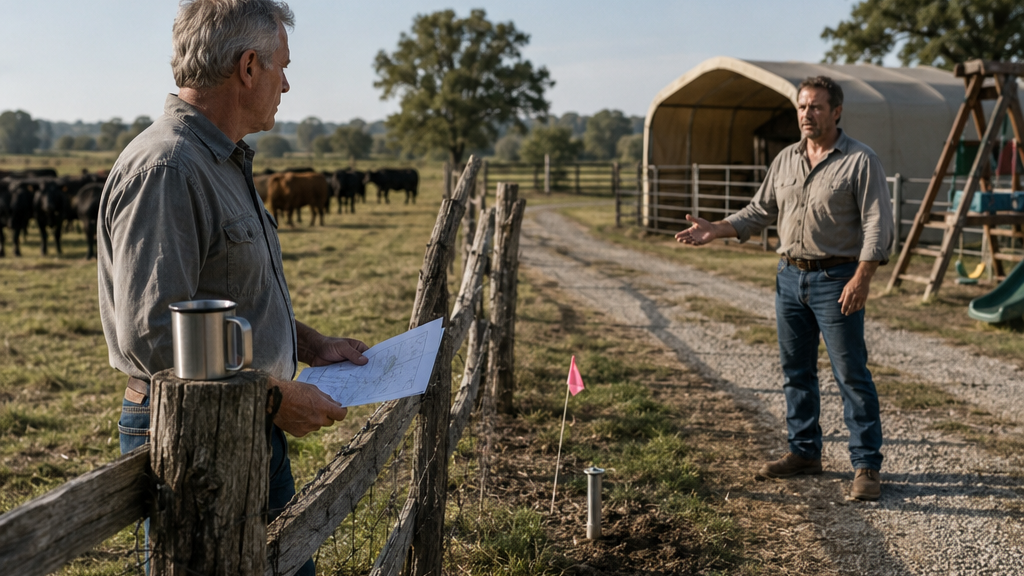
It sat in a patch of pasture grass just beyond the old leaning fence, driven deep enough that fresh clay had curled up around the galvanized shaft. Ten feet behind it stood a portable horse shelter Frank had not seen the evening before. Beside the shelter, a green plastic climbing frame faced Brian Moore’s house as if the ground beneath it had always belonged there.
Frank stopped with his stainless-steel coffee mug halfway to his mouth.
A cow bawled from the lower pasture. Somewhere beyond Brian’s barn, a gate slammed.
Frank set the mug on the nearest cedar post.
For years, that fence had been more suggestion than barrier. Several strands had sagged. One corner post leaned toward Brian’s property. Frank’s father had put it there decades ago to keep cattle separated, not to mark the deed line with surveyor’s precision.
Frank knew that.
Brian knew it too—or Frank had always assumed he did.
A bright orange survey flag still stood near the ditch from work done when Frank refinanced the farm six years earlier. It was several feet beyond the old fence.
So was the anchor.
Frank crouched, pressed his thumb into the loose dirt around it, and felt anger rise faster than he liked.
He did not pull it out.
Instead, he walked back to the farmhouse.
The survey was in a metal filing cabinet in the office, folded inside the closing papers from when his father had transferred the property. Frank spread it across the kitchen table and followed the west boundary with one finger.
The measurements had not changed.
He took the survey outside.
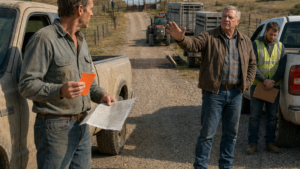
Brian came across the gravel lane ten minutes later wearing work boots and a faded shirt, carrying a length of rope. He glanced at the paper under Frank’s arm, then at the shelter.
“Morning,” Brian said.
“That yours?”
Brian looked at the structure as though the answer were obvious. “Moved it yesterday evening. Kids wanted the climbing thing closer to the barn.”
Frank pointed toward the anchor.
“That’s on me.”
Brian smiled slightly. “The shelter?”
“The ground.”
Brian gave a short laugh.
Frank waited.
“Come on, Frank. We’ve used this strip for years.”
“You’ve crossed it.”
“Same difference.”
“No.”
Brian’s smile thinned.
Frank opened the survey against the flat top of the cedar post. Wind caught one corner, and he pinned it with his hand.
“The deed line starts there.” He pointed toward the orange flag. “Runs straight down past that walnut.”
Brian barely looked.
“You really pulling out paperwork over three feet?”
“It isn’t three feet everywhere.”
“You’ve never cared before.”
That landed harder than Frank wanted it to.
Children had crossed there for years. First on foot, then with bicycles. Brian had occasionally driven a utility cart down the edge. Frank had seen it and said nothing. He had told himself there was no sense souring a neighbor relationship over a strip of grass.
But a shelter anchored into the soil was different.
At least, that was what Frank had told himself since the moment he saw it.
Brian tapped the survey with one finger.
“Your cows don’t use this corner.”
“Still mine.”
“It’s just a shelter.”
“And that?”
Frank nodded toward the climbing frame.
Brian glanced back. “The kids play there.”
“They can play on your side.”
Brian laughed again, louder this time.
Frank felt the temptation to answer in the same tone. Instead, he reached for his coffee mug and took a drink. It had gone lukewarm.
Brian shook his head.
“You’re making this into something it doesn’t need to be.”
Frank folded the survey once.
“I called Tyler Wright this morning.”
That wiped most of the amusement from Brian’s face.
“The fence guy?”
“His crew comes Monday.”
Brian stared at him.
Frank continued. “I’m putting the boundary fence where the boundary actually is.”
For several seconds, neither man spoke.
Brian looked toward the old fence, then toward the gravel lane that curved along Frank’s pasture before turning toward his own horse barn.
“You can’t fence that whole stretch.”
“I can fence my land.”
“We’ve always come through here.”
“You’ve always come through because I didn’t stop you.”
Brian’s jaw tightened.
“There you go,” he said. “So you did give permission.”
“No. I didn’t object.”
“That’s permission where I come from.”
Frank looked at him.
“No, Brian. That’s me avoiding an argument.”
The words surprised both of them.
Brian glanced toward his house. One of his children had appeared near the porch, watching from a distance.
Frank lowered his voice.
“I’m not asking you to agree with me. I’m asking you to move your things.”
“By when?”
“Before Tyler gets here Monday morning.”
Brian scoffed. “You’re serious.”
“Yes.”
“You’re going to put up a fence because my kids have a playset three feet over some line nobody’s cared about for twenty years?”
Frank looked at the new steel anchor, then at the bent old post beside it.
“My father cared about the farm,” he said. “So do I.”
Brian stepped closer.
“Don’t drag your dad into this.”
Frank’s grip tightened around the mug.
He could have listed every wrapper he’d picked up, every bicycle track, every time Brian’s horses had been led through the opening without a call. Instead, he said nothing.
That silence had been his habit for too long.
Brian finally looked down at the survey properly.
For the first time, his expression changed—not to surprise, exactly, but calculation.
Frank noticed.
Brian folded his arms.
“Monday?”
“Monday.”
“And if I don’t move it?”
“Tyler still builds the fence.”
Brian stared at him for a long moment, then picked up the rope he had dropped in the grass.
“You know what people around here are going to think.”
Frank put the survey under his arm.
“Probably whatever they were already going to think.”
Brian turned away.
Frank watched him cross the gravel toward his barn. At the edge of the lane, Brian stopped.
“You close that strip,” he said without turning, “you’re closing more than you think.”
Then he kept walking.
Frank looked down the lane.
For the first time in years, he tried to remember exactly how many people besides Brian had been using it.
Chapter 2: The Shortcut Had Become a Farm Road
The first pair of tire ruts began inside Frank’s pasture and crossed the old fence line without hesitation.
By Thursday afternoon, the morning dew had dried, leaving the tracks sharp in the packed earth. They were too wide for Brian’s utility cart. Dual rear tires.
Frank followed them from the gravel lane toward the gap between the old posts.
They curved through his strip of ground, climbed the shallow rise, then disappeared onto Brian’s side near the horse barn.
Frank stood over them with his phone.
He took one photograph.
Then another from farther back.
Then one with the orange survey flag visible in the same frame.
He had spent the morning thinking about the shelter.
Now the shelter seemed smaller.
Near the machine shed, Frank found older tracks hardened into the dirt. Some had grass growing in their centers. A gate hinge on the pasture corner had been bent outward, and the latch no longer lined up cleanly unless Frank lifted the gate before closing it.
He had fixed that problem with his boot so many times that he had stopped asking what had caused it.
That bothered him more than the bent hinge itself.
Around four that afternoon, an engine growled up the county road.
A feed truck turned onto Frank’s gravel entrance.
Frank stepped out from the machine shed.
The driver slowed and leaned out the window.
“Moore place?”
Frank pointed toward Brian’s driveway.
“You passed it.”
The driver frowned.
“Brian always has us take this lane.”
Frank looked at the truck. Loaded, it was heavy enough to explain the ruts.
“This lane’s mine.”
The driver glanced in his mirror as if checking whether he had somehow missed a sign.
“Sorry. He said come through the cattle side because it’s easier to swing into his barn.”
“How long have you been doing that?”
The driver thought.
“Year? Maybe longer. I’m not always on this route.”
Frank felt heat move up the back of his neck.
“Turn around here.”
“I can back out.”
“Turn around. Easier.”
The driver did.
Frank watched the dual tires press fresh lines into the gravel.
When the truck was gone, he stood in the quiet lane with his phone still in his hand.
A year.
Maybe longer.
Brian had not merely allowed his children to cut across the pasture. He had been directing business traffic through it.
Frank called Brian.
No answer.
He did not leave a message.
That impulse—to call once, accept silence, and wait—was exactly how the last two years had been built.
He opened the camera again.
By sunset, he had photographed the damaged gate hinge, the deepest ruts, the flattened grass beside the lane, the shelter anchors, the climbing frame, and the old fence from both directions.
He created a folder on his phone and labeled it with the date.
The next morning, Friday, the shelter was still there.
So was the climbing frame.
Frank carried coffee to the machine shed and pulled down an old plastic storage box filled with farm photographs, receipts, equipment manuals, and things he had never sorted because sorting them seemed less urgent than actual work.
He wanted older photographs of the west pasture.
At first he found nothing useful.
Then he found his father.
The picture had been taken seven years earlier. His father stood beside an old red baler, one hand on the fender, squinting into the sun. Behind him, the west fence ran in a crooked line through knee-high grass.
Frank sat on an overturned bucket.
His father had always been precise about fences.
Not because every fence was perfectly placed. Most were not. But because he believed a man ought to know whether he was lending something or losing track of it.
“If somebody uses your gate,” his father had once told him, “make sure both of you know whose gate it is.”
Frank had considered that old-fashioned.
Now he looked at the photograph and felt irritated with himself.
He found another image from four years earlier showing Brian’s children with bicycles near the gap. Frank remembered that afternoon. One of them had asked whether they could cut through.
Frank had waved them on.
No rule. No limit. No “ask next time.”
Just a wave.
There it was.
Permission for one afternoon, offered so casually that no one had bothered defining where it ended.
Frank set the photo aside.
He searched deeper.
A later picture showed the same lane during hay season. A horse trailer sat partly visible in the background on Brian’s side.
Then another photograph appeared.
Frank stopped.
The picture had been taken two summers earlier after a storm damaged several sections of the old fence. Frank had photographed the fallen branches for insurance purposes.
Near the far corner, Brian stood beside the fence.
He was holding a tape measure.
One end appeared to run toward the orange survey stake.
Frank enlarged the image on his phone after photographing the print.
The details were grainy but unmistakable.
Brian was not merely standing near the line.
He was measuring from it.
Frank leaned back against the workbench.
A memory returned with uncomfortable clarity.
He had seen Brian there that afternoon.
Frank had been driving the tractor toward the lower field. He remembered slowing when he noticed the tape. He remembered wondering what Brian was doing.
And then he had kept driving.
He had told himself that if it mattered, Brian would come talk to him.
Brian apparently told himself something similar.
Frank put the photograph into the new folder.
His anger was still there, but something else had joined it.
He had spent one day collecting proof of what Brian had done.
Now he had found proof of what Frank himself had failed to do.
At noon, Brian drove past on his utility cart without stopping.
The shelter remained.
Frank called Amanda Lewis, the surveyor whose company had marked the property during the refinance.
“I need the west boundary located again,” he said.
“Dispute?”
Frank looked through the machine shed door toward Brian’s property.
“Looks like one.”
Amanda paused.
“Do both sides know I’m coming?”
“They will.”
“Good. Because I locate lines, Frank. I don’t referee neighbors.”
“That’s all I need.”
He hung up.
Then he looked once more at the old photograph of Brian with the tape measure.
If Brian had known enough to measure the line two years ago, Frank wanted to know what he had discovered—and why he had never said a word.
Chapter 3: The Survey Pins Settled Only Half the Argument
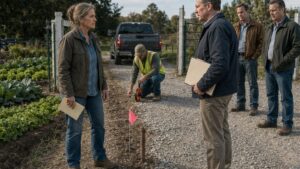
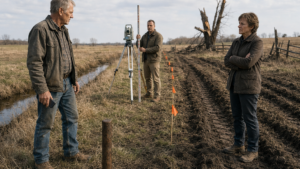
Amanda Lewis found the first iron pin eleven minutes after stepping out of her truck.
It lay beneath four inches of soil and roots near the ditch, several feet farther toward Brian’s property than the old fence.
She cleared the dirt around it with a narrow shovel, checked her equipment, then placed a bright flag beside the pin.
Frank looked from the flag to the horse shelter.
The nearest steel anchor stood unmistakably on his side.
Amanda did not celebrate the discovery.
“One point isn’t a boundary,” she said.
“I know.”
“Good.”
She moved on.
Brian had come outside when her truck arrived but stayed near his barn, watching with his arms folded.
Frank resisted the urge to call him over.
Amanda worked steadily down the line, checking recorded measurements against what she recovered in the ground. The second corner took longer because the original marker had been buried beneath weeds and washed soil near the walnut tree.
When she finally located it, the result was the same.
The old livestock fence wandered.
The deed line did not.
Amanda stretched temporary marking between the recovered points.
The horse shelter crossed it.
So did part of the children’s climbing structure.
More important, so did the worn traffic path leading from Frank’s gravel lane toward Brian’s barn.
Frank felt the satisfaction of being right.
It lasted less than a minute.
Amanda walked the strip slowly, looking down.
“Lot of traffic through here.”
“His.”
“All of it?”
Frank hesitated.
“Mostly.”
She pointed toward several narrow tracks.
“Those look like cattle.”
“They are.”
“And these deeper ones?”
“Feed trucks. Horse trailers. His utility cart.”
“How long?”
“I don’t know.”
Amanda looked at him.
“That’s usually the first thing people know in a boundary dispute.”
“I didn’t keep track.”
“Why not?”
Frank did not answer immediately.
Because he’d wanted to be easy to live beside.
Because complaining over every tire mark felt petty.
Because his father had argued with one neighbor for twelve years over a drainage ditch, and Frank had promised himself he would never become that kind of man.
“Didn’t think I needed to,” he said.
Amanda nodded, but not as though she accepted the whole answer.
She packed one tool away.
“The line’s straightforward. The history isn’t.”
“Meaning?”
“Meaning I can tell you where your deed says the property ends. I can’t tell you what understandings the two of you created by using it differently for years.”
“I never gave him the land.”
“I didn’t say you did.”
“He acts like I did.”
Amanda met his eyes.
“Then that’s the conversation you should’ve had before I got here.”
Frank disliked the sentence because it sounded too much like something he already knew.
Brian finally approached.
He stopped several feet from the new flag.
“So?”
Amanda answered before Frank could.
“The recovered corners match the recorded survey within expected tolerance. I’m marking the deed line.”
Brian looked along the temporary marks.
His face remained controlled.
Frank watched carefully.
There was no shock.
No double take.
No argument that the equipment must be wrong.
Brian simply said, “Old fence has never been there.”
“No,” Amanda replied. “It hasn’t.”
Brian nodded once.
Frank felt the old photograph in his shirt pocket.
“You knew that.”
Brian looked at him.
Amanda began gathering equipment.
“This is where I stop being useful.”
Frank took the photograph out.
He held it so Brian could see.
“You were measuring from the marker two years ago.”
Brian’s eyes dropped to the picture.
For a second, something like embarrassment crossed his face.
Then it disappeared.
“I was fixing storm damage.”
“With a tape running to the survey point?”
“I wanted to know how far off the fence was.”
Frank waited.
Brian looked toward Amanda, but she had deliberately turned her attention to her equipment case.
“So you knew,” Frank said.
Brian exhaled.
“I knew the fence wasn’t exact.”
“How far?”
“I don’t remember.”
“Three feet?”
“In places.”
“Five?”
Brian rubbed the back of his neck.
“Maybe.”
Frank felt his voice becoming sharper.
“And after that you started sending feed trucks through here?”
“I didn’t start anything. We’d already been using the opening.”
“You put a shelter on it.”
“Because the old fence is over there.”
Brian pointed.
Frank almost laughed.
“The old fence isn’t the property line. You just admitted you knew that.”
Brian’s expression hardened.
“And you knew we used it.”
“For crossing.”
“For years.”
“Crossing isn’t ownership.”
“I never said it was.”
“You anchored a building in my pasture.”
“It’s a portable shelter.”
“Anchored into the ground.”
Brian stepped closer.
“Frank, every time my kids came through here, you waved. Every time I brought a trailer across, you never said a word. Feed truck came through last month while you were standing by the shed.”
Frank remembered it.
He had noticed the truck but assumed it was turning around.
Or maybe he had chosen not to look closely.
Brian continued.
“You want to act like I snuck onto your farm in the dark. I didn’t. I did everything right in front of you.”
The words struck because they were partly true.
Frank folded the photograph.
“That doesn’t make the shelter yours to put there.”
“No.”
The answer came so quickly that Frank stopped.
Brian looked toward the marked boundary.
“No,” he repeated. “It doesn’t.”
For the first time since Thursday morning, they stood without arguing.
Amanda closed the tailgate of her truck.
“I’ll send the updated location sketch this afternoon,” she said. “If you’re building a fence, have the contractor stay on the appropriate side of the marked line.”
Frank nodded.
Brian stared at the orange flag.
Amanda drove away.
The sound of her truck faded along the county road.
Frank and Brian remained near the shelter.
Finally Brian said, “I’ll move it.”
Frank had expected resistance, maybe another argument.
“When?”
“Before Monday.”
“And the climbing frame.”
“That too.”
Frank nodded.
It should have felt like victory.
Instead, the easy surrender bothered him.
Brian looked toward the gravel lane.
“You really closing the whole thing?”
“That’s the plan.”
Brian kicked lightly at the dirt.
“My trailers won’t make the turn from the north entrance without backing twice.”
“Then back twice.”
“Feed trucks can’t always get around the barn if the ground’s wet.”
“Use your drive.”
“You know how narrow it is.”
Frank said nothing.
Brian’s frustration rose.
“This is what I meant yesterday. You’re not just fencing grass.”
“I’m fencing my property.”
“Sure.”
Brian turned to leave.
Frank called after him.
“Why put the shelter there if you knew?”
Brian stopped.
For several seconds, he did not turn around.
When he finally did, the defensiveness had drained out of his face.
“I knew the old fence was a little inside your deed line,” he said quietly.
Frank waited.
Brian looked at the temporary markers Amanda had placed, then back at Frank.
“I also knew you’d known for years.”
He walked toward his barn before Frank could ask what, exactly, Brian believed that meant.
Chapter 4: Monday Morning Closed More Than a Shortcut
The post driver arrived while Frank’s cattle were still clustered near the water trough.
Its diesel engine broke the morning quiet before sunrise, and its work lights swept across the west pasture as Tyler Wright backed the truck beside the old fence.
Frank stood at the lane entrance with his coffee.
The horse shelter was gone.
So was the climbing frame.
Only four dark circles in the grass showed where the steel anchors had been.
Tyler climbed from the cab, pulled on his gloves, and studied the line of survey flags.
“Looks cleaner already.”
Frank nodded.
“Start at the south corner.”
Tyler glanced toward Brian’s place.
“You two settle anything?”
“We settled where the line is.”
“Didn’t ask that.”
Frank took a drink.
Tyler gave him a look, then turned toward his crew.
Within twenty minutes, the first old post came out.
Frank had expected satisfaction.
Instead, watching the cedar post rise from the earth left him with an odd sensation, as though something older than the dispute was being pulled loose.
His father had set some of those posts.
Not on the legal boundary, apparently. Not with a surveyor’s precision. But they had stood there for decades.
One by one, Tyler’s crew replaced that crooked history with a straighter one.
New treated posts followed Amanda’s marks exactly.
At seven-thirty, Brian appeared.
He walked down from his barn alone.
Frank set his coffee mug on a fence post.
Brian stopped beside a stack of wire.
“You didn’t waste time.”
“Tyler had Monday open.”
“I see that.”
They watched the post driver strike another hole into the soil.
Brian nodded toward the northern end.
“You planning to close the whole gap?”
“Yes.”
Brian rubbed his jaw.
“Leave enough for a trailer.”
“No.”
“Frank.”
“You moved the shelter. I appreciate that.”
“That’s not what I’m asking.”
“I know.”
Brian looked toward his barn.
“The north driveway isn’t wide enough for my long stock trailer to swing clean when the ground’s soft. You know that.”
Frank did know.
Brian had built the barn before expanding the boarding operation. The original driveway had been enough for a pickup and a small two-horse trailer. The larger equipment came later.
“Then you’ll have to make two turns.”
“That’s easy to say when you’re not backing twenty-four feet of trailer between a barn corner and a drainage ditch.”
“Still isn’t my problem.”
Brian’s face tightened.
“No. Apparently none of it ever was.”
Frank looked at him.
Brian continued before Frank could answer.
“Leave one opening. Same place it’s always been. You can put a gate there if you want.”
“No.”
“Why?”
“Because ‘same as always’ is how we got here.”
Brian looked away.
Tyler approached carrying a roll of marking string.
“You want me to keep going?”
Frank nodded.
Brian gave a humorless laugh.
“Guess that answers it.”
He walked back toward his property.
By late morning, the boundary looked nothing like it had on Thursday.
Fresh posts marched across the pasture in a straight line. The old gap through which bicycles, feed trucks, utility carts, and trailers had passed for years had narrowed to thirty feet.
Then twenty.
Then twelve.
Frank stood beside Tyler as the crew prepared the final northern corner.
“It’ll hold cattle?” Frank asked.
Tyler looked offended.
“It’ll hold cattle that know they’re cattle.”
Frank almost smiled.
A sharp metallic bang came from Brian’s side.
Both men turned.
Then came shouting.
Not angry shouting.
Urgent.
Brian ran from behind the barn.
“Frank!”
Frank was already moving.
A horse had slipped near the rear paddock where the ground fell toward the drainage ditch. By the time Frank reached the boundary, Brian had a halter on the animal, but the horse was favoring its left rear leg and refusing to put weight on it.
“What happened?”
“Gate swung back. She spooked.”
Brian’s breathing was hard.
“I need to get the trailer around back.”
Frank looked toward Brian’s main drive.
A pickup was already attached to the long stock trailer. The angle was bad. To reach the rear paddock from Brian’s side, Brian would have to back the trailer around the barn, then make a second turn beside the ditch.
The route through Frank’s lane would be nearly straight.
Brian looked at the unfinished section of fence.
Neither man said anything.
Frank saw the whole argument reduced to twelve feet of open ground.
“Bring it through,” he said.
Brian hesitated.
Frank stepped aside.
“Now, Brian.”
Brian ran for the truck.
Tyler’s crew stopped work.
Minutes later, the trailer rolled slowly down Frank’s gravel lane and through the remaining opening.
No one argued about ownership.
No one talked about permission.
They loaded the injured horse carefully and Brian left for the veterinary clinic.
When the truck disappeared, Tyler looked at Frank.
“You still want that last corner closed?”
Frank stared at the opening.
The new posts on either side made it look deliberate now rather than neglected.
“Yes.”
Tyler nodded and raised a hand toward the crew.
Frank heard himself say, “Wait.”
Tyler lowered his hand.
Frank walked to the survey flag beside the gap.
The orange fabric fluttered against his boot.
He thought about Brian’s shelter.
The feed truck.
The trailer ruts.
His father’s warning about knowing whose gate it was.
Then he thought about the injured horse and how quickly every principle in the dispute had become secondary to getting an animal safely out.
Tyler waited.
“Don’t set the final post yet,” Frank said.
“You changing the line?”
“No.”
“The plan?”
Frank looked toward Brian’s empty driveway.
“Maybe.”
Tyler rested both hands on the post driver controls.
“You need to tell me before I leave today.”
Frank picked up his coffee mug.
For the first time since Thursday, the boundary was perfectly clear.
What Frank intended to do with it was not.
Chapter 5: Brian Finally Said What He Had Been Afraid to Ask
Brian came to the unfinished fence just before dusk without a clipboard, survey, complaint, or demand.
Frank noticed that first.
He was tightening a temporary strand of wire across the opening when Brian stopped on the other side.
“She’s okay,” Brian said.
Frank straightened.
“The horse?”
“Bad sprain. Nothing broken.”
“Good.”
Brian nodded.
For a while, the wire between them was the only thing either man looked at.
Finally Brian said, “Thanks for letting me through.”
Frank set the fencing pliers on a post.
“You needed through.”
“That simple?”
“It was this morning.”
Brian glanced at the straight line of new posts stretching toward the walnut tree.
“And tomorrow?”
“Depends.”
“On what?”
“Whether we’re talking about an emergency or whether you’re deciding my farm road belongs to you again.”
Brian let out a breath through his nose.
“Fair.”
It was the first time Frank had heard him use that word since the dispute began.
Brian rested his forearms against the top wire, then seemed to remember it was new and stepped back.
“I should’ve asked.”
Frank waited.
“The shelter,” Brian said. “The feed trucks. All of it.”
“Yes.”
“I still think you let it go long enough that I had reason to think it was okay.”
“Thinking isn’t asking.”
“I know that now.”
“No. You knew it then.”
Brian’s eyes lifted.
Frank took the old photograph from his shirt pocket. He had carried it around all day without intending to.
He held it up.
“Two years ago.”
Brian didn’t ask what it was.
“I remember.”
“Then tell me.”
Brian stared across the pasture.
The cattle were feeding near the far fence, barely visible in the fading light.
“I measured because I was getting bids on widening the horse operation.”
Frank said nothing.
“Four more stalls,” Brian continued. “Two more boarding clients at first. Maybe three.”
“You didn’t tell me that.”
“Didn’t tell many people.”
“Why?”
“Because I didn’t know if I could afford it.”
Brian rubbed his hands together.
“The bank wasn’t interested in another loan unless I could show steady boarding income. I already had deposits from people who needed stalls. I needed the bigger trailer. More feed deliveries. More hay coming in.”
“And you needed my lane.”
Brian looked at him.
“Yes.”
The answer carried no argument now.
Frank felt anger rise again, but it had lost some of its heat.
“So you measured.”
“I measured.”
“And found out the old fence was inside my deed.”
“A few feet.”
“In places five.”
Brian nodded.
“Then why didn’t you come to me?”
Brian gave a dry laugh.
“You really want that answer?”
“Yes.”
“Because I thought you’d say no.”
Frank stared at him.
Brian continued.
“You keep your place the way your dad did. Gates shut. Equipment where it belongs. You don’t like people making assumptions.”
“Apparently I allow plenty of them.”
“You didn’t used to say anything.”
“That’s different.”
“It was convenient.”
“For you.”
“For both of us, I thought.”
Frank almost objected, then stopped.
Brian was watching him carefully.
“I’d help you when cattle got loose,” Brian said. “Your hay wagon broke down two summers ago, I brought the tractor. My kids crossed your field, you waved. I used the lane, you waved. I thought that’s how we did things.”
“Helping a neighbor doesn’t transfer land.”
“I didn’t think it transferred.”
“You put a building on it.”
“A portable shelter.”
Frank’s expression stopped him.
Brian looked down.
“Yeah.”
Silence settled again.
Then Frank said, “I saw you measuring.”
Brian looked up sharply.
“That day in the picture. I was on the tractor. I saw the tape.”
“You never said anything.”
“No.”
“Why?”
The question came without accusation, which made it harder.
Frank picked up the fencing pliers, then set them down again.
“I figured if you needed something, you’d come ask.”
Brian shook his head.
“You saw me measuring your property line and just drove away?”
“Yes.”
“Why?”
Frank looked toward the farmhouse.
“My father could fight with a man until neither of them remembered what started it. He had a neighbor once he barely spoke to for twelve years over runoff from a field tile. I decided I wasn’t doing that.”
Brian’s mouth tightened slightly.
“So you just didn’t talk.”
“Looks that way.”
“And every time I came through here?”
“I told myself it wasn’t worth making an issue.”
Brian nodded slowly.
“Until it was.”
“Until you anchored something into it.”
Brian rubbed the toe of his boot against the dirt.
“I kept waiting for you to say something.”
Frank looked at him.
Brian shrugged once.
“At first. Then after a while, I figured you weren’t going to.”
That was the piece Frank had not wanted.
Brian had been wrong.
But not entirely confused.
He had tested silence until it became useful.
And Frank had watched the testing because confrontation felt worse than inconvenience.
Neither man had invented the misunderstanding alone.
Frank pulled the temporary wire tighter.
“None of that makes what you did right.”
“I know.”
“You directed trucks through here without asking.”
“I know.”
“You damaged the gate.”
“Probably.”
“You used the strip for your business.”
“Yes.”
Frank nodded.
Brian looked toward the gap.
“So what happens now?”
“The fence gets finished.”
Brian’s face closed again.
Frank continued.
“But I’m not saying there can never be a gate.”
Brian’s expression changed.
“Then leave it.”
“No.”
“What?”
“Not like before.”
Frank stepped closer to the unfinished opening.
“If there’s ever access through here again, it’ll have a purpose. It’ll have rules. It’ll be written down.”
Brian looked almost offended.
“We need a contract to be neighbors now?”
“We needed clarity two years ago.”
Brian didn’t answer.
Frank picked up his tools.
“I’m filing for the damage I can document. Ruts. Gate repair. Restoration where the trucks cut the shoulder.”
“The whole fence?”
“No.”
Brian looked surprised.
Frank met his eyes.
“I’m not charging you for a fence I chose to build.”
Brian absorbed that.
“But the damage, yes.”
“How much?”
“I don’t know yet.”
“You taking me to court?”
“If we can’t settle it.”
Brian looked along the new posts.
The line between them had never been straighter.
Frank lifted the temporary wire and hooked it securely to the post.
“No one crosses this boundary again because they assume they can.”
Brian’s jaw shifted.
“And if they ask?”
Frank picked up his pliers.
“Then they’ll get an answer.”
Chapter 6: The Claim Was About Damage, Not Revenge
Frank crossed out three items before he ever showed Brian the claim.
The first was reseeding along the lower pasture edge.
The second was a portion of the damaged gate.
The third was labor he had originally estimated for grading the lane shoulder.
He sat at the kitchen table with photographs spread beside Amanda’s survey sketch and a yellow legal pad in front of him.
The more carefully he looked, the less certain those charges became.
The grass damage at the lower edge existed in photographs from before Brian’s feed trucks began using the lane.
The gate hinge had already been worn.
And Frank had done part of the grading himself after a storm two years earlier.
He drew lines through all three.
It annoyed him.
Then it relieved him.
If he was going to make Brian answer for crossing a boundary, Frank could not move his own boundary whenever it benefited him.
Three days later, he slid a narrower packet across Brian’s kitchen table.
Brian picked it up cautiously.
“This it?”
“This is what I can prove.”
Brian read the first page.
His eyes moved down the numbers.
Then back up.
“What happened to the fence cost?”
“I built the fence.”
“Because of me.”
“Because I decided I needed one.”
Brian looked at him for several seconds.
“I figured you’d put the whole thing in.”
“I thought about it.”
“Why didn’t you?”
“Wouldn’t be accurate.”
Brian returned to the packet.
Frank had included dated photographs of the deepest dual-tire ruts, an invoice for repairing the gate assembly, an estimate for restoring the lane shoulder, and photographs showing how the traffic had widened the crossing.
Brian tapped one figure.
“This grading is high.”
“It’s an estimate.”
“I can get it done cheaper.”
“Then get me an estimate.”
Brian leaned back.
“You already filed?”
“Not yet.”
That seemed to surprise him more than the amount.
“You came here first?”
“That’s what I should’ve done two years ago.”
Brian looked at the papers again.
For one brief moment, Frank thought they might settle it there.
Then Brian shook his head.
“I’m not paying for all these ruts. Some of them are yours.”
“The cattle tracks aren’t included.”
“Some trailer tracks were already there.”
“Show me.”
Brian’s face tightened.
“You’ve got pictures for everything now.”
“I’ve got pictures for what I’m asking you to pay.”
“And I’m supposed to remember every tire mark from last year?”
“No.”
Brian pushed the packet back.
“Then file it.”
Frank did.
The county clerk gave him procedural instructions without interest in the neighbor dispute behind them. The hearing date came faster than either man expected.
During the following weeks, they spoke only when necessary.
The unfinished opening remained blocked with temporary wire.
Tyler had offered twice to return and close it permanently.
Frank told him to wait.
At the hearing, Brian arrived carrying Frank’s packet and several photographs of his own.
The small-claims courtroom was plain enough to make the months of tension feel almost embarrassing.
The judge asked questions neither man had asked properly when the conflict began.
Who owned the strip?
Frank did.
Was the boundary disputed?
Not after Amanda’s survey.
Had Brian used the lane?
Yes.
Had Frank previously allowed that use?
Frank paused.
“I didn’t stop it.”
The judge looked at him.
“That’s not quite the same answer.”
“No, Your Honor.”
“Did you give explicit permission?”
“Once to his children. Not to commercial deliveries.”
Brian shifted at the other table.
The judge turned to him.
“Did you believe you had permission?”
Brian hesitated.
“For access, yes.”
“For placing the shelter?”
Brian looked down.
“No.”
Frank felt something in his chest loosen.
That admission mattered more than he expected.
The judge examined the photographs.
Brian disputed the grading estimate and produced a cheaper one.
Frank did not object when the judge used the lower figure.
The gate damage was reduced because photographs showed earlier wear.
Several minor claims were denied entirely.
Frank watched the total shrink.
Strangely, he did not feel cheated.
The final award covered documented portions of the lane repair, the increased gate damage attributable to repeated vehicle use, filing fees, and part of the restoration work.
It was enough to establish responsibility.
Not enough to turn the case into punishment.
When the judge finished, Brian looked at Frank across the room.
There was no triumph on either side.
The judge gathered the papers.
“Now,” she said, “there’s something this court isn’t going to decide for you.”
Both men looked up.
“You live next to each other.”
Neither answered.
“You’ve established who owns the property. I’ve addressed the damages supported by the evidence. But this access problem appears to remain.”
Brian folded his hands.
Frank said, “Yes.”
The judge looked from one man to the other.
“Then you can continue spending money proving where the line is every time one of you gets angry, or you can decide what happens at that line.”
Her tone was not warm.
It was practical.
Frank understood it.
Outside the courthouse, Brian stopped near the steps.
“Didn’t expect you to cut your own claim down.”
Frank looked at him.
“Didn’t expect you to admit the shelter wasn’t permitted.”
Brian gave a small shrug.
“Would’ve been stupid to lie about it.”
“Would’ve been easier three weeks ago.”
“Probably.”
They stood there with traffic moving on the street beyond the parking lot.
Brian tapped the packet against his leg.
“So we’re done?”
“With the damages.”
“And the lane?”
Frank thought about the twelve-foot opening still waiting between Tyler’s new posts.
“No,” he said.
Brian’s face tightened.
Frank continued.
“But I think I know what I want to do with it.”
Brian waited.
Frank did not explain.
This time, however, the silence was not avoidance.
It was a decision he intended to put into words before anyone crossed the line again.
Chapter 7: The New Gate Opened Only When Someone Asked
Tyler Wright returned carrying a gate instead of another bundle of fence boards.
Frank saw it before the truck stopped: twelve feet of galvanized steel strapped upright behind the cab, wide enough for Brian’s stock trailer but narrow enough that no one could mistake it for an open road.
Tyler climbed down and looked toward the unfinished section.
“So this is the decision?”
Frank held a folded sheet of paper in one hand.
“This is part of it.”
Tyler studied him.
“You sure? Last time we talked, you were one post away from closing the whole thing.”
“I know.”
“And now you want a gate.”
“I want a boundary.”
Tyler glanced at the straight fence line, then at the gap.
“That usually means fewer gates.”
“Not this one.”
Tyler shrugged.
“Your farm.”
The words had once sounded like the entire argument.
Now Frank heard something different in them.
Ownership settled where the gate could go. It did not settle how a man ought to use what he owned.
He walked to the orange survey flag Amanda had left beside the recovered pin. The fabric had faded from weeks of sun and dust, but the pin beneath it had not moved.
“Center the hinge post two feet inside this,” Frank said.
Tyler looked at him.
“Inside your side?”
“Yes.”
“You don’t need to give up two feet.”
“I’m not giving up anything.”
Frank tapped the folded paper against his palm.
“I want the gate entirely on me. Posts, hinges, latch. No argument later about who owns what.”
Tyler gave a short nod.
“That I understand.”
By midmorning, the final posts were set.
The gate hung square between them.
Closed, it completed the fence.
Open, it restored the straight route from Frank’s gravel lane to the rear of Brian’s property.
Tyler installed a chain and weatherproof lock.
When he finished, he handed Frank two keys.
Frank turned them over in his palm.
One stayed with him.
The other went into his shirt pocket beside the folded agreement.
Brian arrived twenty minutes later.
He slowed when he saw the gate.
Frank watched his eyes move from the new hinges to the lock, then to the survey flag at the base of the post.
“You put one in.”
“I did.”
Brian came closer.
“So we’re back to using it?”
“No.”
The answer stopped him.
Frank took out the folded sheet and handed it across the fence.
Brian unfolded it.
He read silently.
The language was plain. Frank had insisted on that.
The gate could be used for an actual livestock emergency when the normal entrance was unsafe or impractical. It could not be used for routine feed deliveries, boarding clients, children’s shortcuts, equipment convenience, or ordinary trailer traffic. Brian would be responsible for any damage caused during permitted use. The gate remained Frank’s property. Permission could be withdrawn if the terms were ignored.
And before using it, unless circumstances made that impossible, Brian had to ask.
Brian reached the bottom.
“You wrote all this?”
“With some help making it clear.”
Brian looked back at the first paragraph.
“Emergency use only.”
“Yes.”
“No feed trucks.”
“No.”
“No trailers unless there’s an actual need.”
“Correct.”
Brian held the page up slightly.
“And if I need through?”
“You call.”
“What if you don’t answer?”
“If there’s a horse hurt, fire, broken fence, something that can’t wait, use it. Then call me as soon as you can.”
Brian’s mouth shifted.
“So there’s still judgment involved.”
“There always was.”
“That’s what caused the problem.”
Frank shook his head.
“No. Assuming you knew my answer caused the problem. Me refusing to give one caused the other half.”
Brian went quiet.
That sentence had taken Frank weeks to say without wanting to defend himself afterward.
He reached into his pocket and removed the second key.
But he did not hand it over.
Brian noticed.
“You want me to sign first.”
“Yes.”
Brian looked at the paper again.
“What if I don’t?”
“Then Tyler takes the gate back out and finishes the fence.”
Brian gave him a long look.
“You planned that?”
“I planned to stop leaving things undefined.”
A reluctant smile touched Brian’s face and disappeared.
“You know, for a man who hates arguing, you got pretty organized.”
Frank almost smiled back.
“I’m learning.”
Brian borrowed a pen from Tyler’s truck and signed against the flat top of the gate.
Frank signed beneath him.
Then he handed over the key.
There was no handshake.
Frank was glad of that.
A handshake would have made the moment cleaner than it was.
They were not old friends restored by one page of rules. Brian still owed the court judgment. Frank still remembered every truck that had crossed without permission. Brian still thought Frank could have spoken sooner.
All of those things could remain true.
A boundary did not require pretending nothing had happened.
During the following weeks, the difference became visible in small ways.
The feed truck stopped using Frank’s entrance.
Brian widened part of his own turnaround with gravel instead.
His children no longer rode bicycles through the cattle pasture. The first time Frank saw them near the new fence, one of them pointed toward the gate. Brian said something Frank could not hear, and both children turned back toward their own yard.
Brian did not blame him within earshot.
That mattered.
The old tracks across the disputed strip began to fade.
Grass returned where tires had packed the earth.
Frank repaired the gate hinge near the lane and reseeded the shoulder after the settlement check arrived. He did not use the money for anything symbolic. It went into the repairs it was meant to cover.
The old fence posts he had saved lay stacked behind the machine shed.
One afternoon, Frank picked up the cedar post that had once held his coffee on the morning of the argument.
The bottom was rotted.
He considered cutting it into firewood.
Instead, he leaned it against the shed wall.
Not because it had marked the boundary correctly.
Because it reminded him how long something could stand in the wrong place simply because no one bothered to move it.
A month after Tyler installed the gate, Frank was checking cattle near the lower pasture when his phone rang.
Brian.
Frank answered.
“What’s wrong?”
“Nothing wrong.”
Brian paused.
“I need to move the big trailer behind the barn tomorrow. North side’s still soft from the rain.”
Frank looked toward the new fence.
The galvanized gate caught the afternoon light.
“You asking to use the lane?”
“Yes.”
It was not an emergency.
Frank could hear Brian waiting for the answer instead of supplying one himself.
Frank considered it.
“How long?”
“Ten minutes. In and out once.”
“No feed delivery?”
“No.”
“No clients?”
“Just me and the trailer.”
Frank looked at the ground. The lane was firm. No cattle were in the west section.
“All right.”
Another pause.
“All right meaning yes?”
Frank smiled despite himself.
“Yes, Brian. Tomorrow morning is fine.”
“Eight?”
“Eight.”
The next morning, Frank was already by the fence when Brian arrived.
He had his stainless-steel mug in one hand.
Brian stopped the truck on his side and got out instead of unlocking the gate from the cab.
He walked over with the key.
For a moment, the two men stood beside the recovered survey pin, the orange flag now frayed almost white at one edge.
Brian lifted the key.
“Still okay?”
Frank looked at him.
A month earlier, he might have found the question unnecessary.
Two years earlier, he might have waved vaguely and expected Brian to understand everything that wave did and did not mean.
Now he understood the value of answering plainly.
“Yes,” Frank said. “Open it.”
Brian unlocked the chain.
The gate swung inward across Frank’s land because Frank had deliberately hung it that way.
Brian drove through slowly.
When the trailer cleared, he stopped, got out, and closed the gate behind him before continuing toward the barn.
Frank watched him go.
The fence was still there.
The deed line had not softened.
Nothing had been surrendered simply because permission had been given.
Frank rested his coffee mug on the new post beside the survey pin.
For years, he had thought being a good neighbor meant making as little trouble as possible.
Now he knew better.
Sometimes being a good neighbor meant saying no before resentment made the answer cruel.
Sometimes it meant saying yes without pretending yes meant forever.
And sometimes the difference between kindness and surrender was no more complicated than one person asking and the other finally answering.
The story has ended.