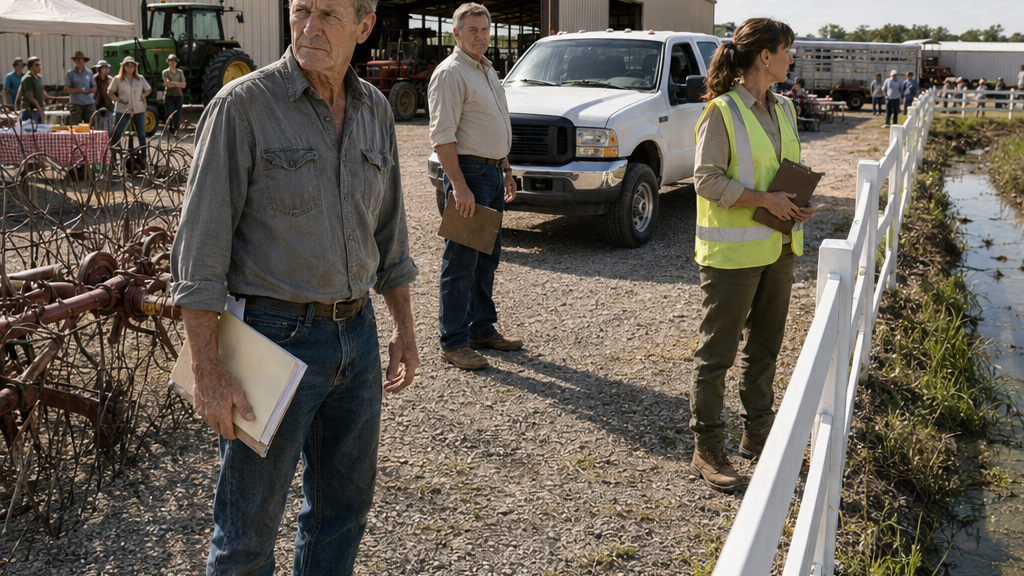
The Farm Association Ignored the Mosquito Ditch for Weeks—Then Inspection Day Arrived at the Worst Possible Time
Chapter 1: The Ditch Behind the East Pasture Would Not Drain
The mosquito landed on Daniel Harris’s forearm while he was still reading the violation notice.
He slapped it hard enough to leave a gray smear against his skin, then looked from the paper in his hand to the green-brown water lying twenty yards beyond his fence.
The notice concerned his gate.
More precisely, it concerned the grass growing around the right-hand post of his gate, where a strip roughly two feet wide had gone to seed after his mower belt broke.
Daniel read the sentence again.
“Roadside appearance standards.”
He looked back at the ditch.
The drainage swale ran along the association strip between his east pasture and the gravel access road. It was supposed to collect stormwater from three adjoining farms, carry it through a shallow culvert, then empty toward the creek bottom. Most years, Daniel hardly noticed it.
Now it looked like somebody had poured old soup into a trench and forgotten it.
A film had formed across the surface. Grass leaned into the water from both banks. Small bubbles gathered under mats of floating debris. The water had been there since the storms near the end of June, and in the last week it had changed from muddy to green.
Another mosquito settled against his neck.
Daniel brushed it away.
His cattle stood under the far hedge, tails flicking.
The absurdity of the paper in his hand bothered him more than the paper itself.
The association had found time to drive past his place, notice six inches of untidy grass, photograph it, type a notice, print it, and get it into his mailbox.
Yet the ditch beside the same road had not moved in days.
Daniel folded the notice once and slid it into his shirt pocket.
He walked toward the fence.
The smell reached him first. Not sewage. Not exactly. It was the warm, sour smell of trapped vegetation beginning to rot.
He leaned over the wire.
At first the surface seemed still.
Then he saw movement.
Tiny dark shapes hung just below the waterline. They jerked downward when his shadow crossed them, then floated back toward the surface.
Daniel narrowed his eyes.
He pulled out his phone and zoomed in.
There were dozens.
No—hundreds.
He moved farther along the fence and found another patch, then another.
The ditch was alive.
Daniel had spent enough years around ponds, troughs, calves, irrigation lines, and standing rainwater to know mosquito larvae when he saw them.
He stared at them for several seconds.
The violation notice in his pocket suddenly felt different.
Until then, the ditch had been irritating.
Now it was a maintenance problem.
Maybe more than that.
A pickup rolled slowly along the gravel lane. Daniel recognized the association decal on the door before he recognized Stephen Nelson behind the wheel.
Stephen lifted two fingers from the steering wheel.
Daniel did not wave back.
The truck stopped.
Stephen lowered the window.
“You get the notice?”
Daniel touched his pocket.
“I got it.”
Stephen nodded toward the gatepost.
“Shouldn’t take much.”
“No.”
Stephen waited.
Daniel pointed toward the ditch.
“What about that?”
Stephen glanced in the direction of the swale.
“What about it?”
“It’s been holding water since the storm.”
“We know.”
“You looked at it?”
Stephen’s mouth tightened almost imperceptibly.
“We’ve looked at everything along this road.”
Daniel almost laughed.
Instead he said, “There are mosquito larvae in it.”
Stephen rested his forearm against the window frame.
“We’ve had standing water before.”
“Not like that.”
“We’re monitoring it.”
Daniel looked at him.
Stephen had the calm tone of a man who believed the sentence itself completed the work.
“Monitoring what?”
“The drainage condition.”
Daniel nodded once.
Then he looked down at the paper in his pocket.
Stephen followed his gaze.
“The grass notice isn’t personal, Daniel.”
“I didn’t say it was.”
“We send the same thing to everybody.”
Daniel looked toward the ditch again.
“That’s kind of my point.”
Stephen’s expression cooled.
“If you’ve got a maintenance concern, file it.”
“I will.”
Stephen rolled up his window.
The truck pulled away, leaving a faint cloud of pale dust behind it.
Daniel stood beside the gate until the dust settled.
Then he crossed through the pasture entrance and walked along the inside of his fence.
At the lowest section of the swale, the stagnant water had spread wider than he realized. It reached almost to the base of the temporary farm-tour signboard the association had placed there the previous week.
The board was new plywood with clean painted trim.
The ditch beneath it looked abandoned.
Daniel crouched.
He held his phone close to the water and recorded ten seconds.
Larvae flexed beneath the surface.
He took photographs from three angles.
Then he stepped back and took a wider picture showing the fence, the ditch, the access road, and the association signboard in the same frame.
He checked the timestamp.
June 28.
At the house, he washed his hands and opened the drawer beside the refrigerator where he kept association papers.
Daniel saved almost everything.
Not because he enjoyed paperwork.
Because farming had taught him what memory cost.
A feed invoice remembered wrong could lose fifty dollars. A fertilizer application date remembered wrong could lose a field. A handshake agreement remembered differently by two men could ruin a relationship that had lasted twenty years.
Paper did not remember differently.
He placed the roadside violation on the counter.
Then he opened his laptop.
The association’s maintenance form was one page.
Location.
Nature of issue.
Date first observed.
Daniel typed carefully.
He did not write “disgusting swamp.”
He did not write “hypocrisy.”
He wrote:
Standing water in east drainage swale adjacent to Harris pasture. Water has remained stagnant since recent storms. Visible mosquito larvae present. Drainage appears obstructed.
He attached four photographs.
He read the form twice before submitting it.
Then he printed a copy.
At the bottom, he wrote the date by hand.
The next morning he cut the grass around the gatepost.
It took eleven minutes.
The ditch remained.
Two days later, it remained.
Three days later, mosquitoes rose from the grass when Daniel walked the fence after feeding.
He checked his email.
No reply.
On the fourth afternoon, an association message finally appeared.
It contained no work date.
No inspection report.
No maintenance schedule.
Only a short acknowledgment that his concern had been received and that the drainage area remained under observation.
Daniel printed that too.
He placed it behind his maintenance request.
That evening he walked back to the ditch with his phone.
The larvae were still there.
More of them now.
He photographed the surface again, making sure the date appeared in the file information.
Then he stood beside the fence and watched the water for another minute.
The surface twitched in dozens of places at once.
Daniel had no idea yet what the association intended to do.
But he knew what he intended to do next.
He went inside, clipped the photographs to his dated request, and set the packet beside the door for the association office.
Chapter 2: Two Maintenance Requests and Five Empty Words
Mosquitoes were collecting against the association office screen door when Daniel handed over his second maintenance request.
The secretary stamped the top right corner.
RECEIVED.
Daniel watched the ink dry.
“You want a copy?”
“I brought one.”
She looked at the paper, then at him.
“You already filed this.”
“This is an update.”
“Same ditch?”
“Same ditch. More water. More larvae.”
The secretary glanced toward the back room.
Stephen was there. Daniel could hear his voice.
“We’ll put it with the first one.”
Daniel did not move.
“I’d like the date entered.”
She tapped the stamp with one finger.
“It is.”
Daniel nodded.
“Thank you.”
Outside, he stopped beneath the office awning and looked toward the equipment yard.
Two workers were pressure-washing folding tables.
Fresh banners lay rolled across the bed of a utility trailer.
The annual farm tour was ten days away.
Every summer, neighboring producers, equipment dealers, lenders, extension staff, and families came through the association grounds to watch machinery demonstrations and inspect pasture-management projects. The tour was not glamorous, but people remembered whether the roads were smooth, whether the equipment barn looked organized, whether the association seemed competent.
This year Stephen had been talking about it since April.
Daniel drove home by the east lane.
The ditch had grown after another rain.
Water had spread into grass that had been dry a week earlier. The temporary signboard stood above it announcing the demonstration area in neat painted lettering.
Daniel slowed.
A worker was trimming weeds around the signboard.
Not the ditch.
The signboard.
Daniel continued home.
He waited until after lunch before calling Stephen.
Stephen answered on the fourth ring.
“Nelson.”
“It’s Daniel.”
A pause.
“I figured.”
“I filed the second request.”
“I heard.”
“The water’s spreading.”
“We know.”
“Have you sent anybody to check the outlet?”
“Daniel, we are monitoring the situation.”
There it was again.
Daniel stared through the kitchen window.
Five words.
Perfectly shaped.
Completely empty.
“Monitoring it how?”
“We’ve discussed it.”
“That isn’t what I asked.”
Stephen exhaled.
“We have priorities across the whole association.”
“So do I.”
“I understand.”
“No, you don’t. If you did, somebody would’ve put a shovel in that outlet by now.”
“You don’t know what the outlet needs.”
“That’s why I asked whether anyone checked it.”
Another pause.
When Stephen spoke again, his voice was flatter.
“We’re not going to manage association maintenance by whoever calls the most.”
Daniel felt the old instinct rise in him: answer sharply, correct the implication, make Stephen regret the wording.
Instead he said, “I filed twice.”
“And both were received.”
“So when does someone inspect it?”
“I don’t have a date for you.”
Daniel looked at the folder on the table.
The violation notice about his gate grass sat on top.
It had been issued three days after the photograph printed on it.
He said, “You had a date for my gate.”
Stephen said nothing.
Daniel continued.
“You had somebody inspect that. Photograph it. Process the notice.”
“That’s routine compliance.”
“Standing water beside livestock isn’t?”
“That’s not what I said.”
“No. You said you were monitoring it.”
Stephen’s patience finally cracked.
“The farm tour is next week. We have road grading, barn electrical work, vendor access, fencing, parking, and about twenty other things moving at once. The ditch is on the list.”
Daniel leaned back in his chair.
“At what number?”
“Goodbye, Daniel.”
The call ended.
Daniel set the phone down gently.
That part surprised him.
He was not angry enough to throw anything.
He was angry enough to start paying closer attention.
Over the next two days he noticed things he might otherwise have ignored.
A neighboring cattle producer received a notice for leaving a stock trailer overnight near the shared lane.
Another member was told to remove empty mineral tubs visible from the road before the tour.
The association sent a reminder about parking equipment only in approved demonstration areas.
Every message used some variation of the same reasoning: safety, appearance, consistency, shared responsibility.
Daniel read each one.
Then he walked to the ditch.
Mosquitoes came up from the grass around his boots.
The contradiction had become almost too obvious to describe.
At dusk, he stood beside the fence with a flashlight angled toward the water.
Larvae hung beneath the surface.
He filmed them.
Then he heard machinery from the association yard.
A skid-steer was moving gravel near the barn entrance.
They were working.
Just not here.
The following morning Virginia Roberts stopped at Daniel’s gate.
She was the association treasurer and had farmed less than two miles away for most of her adult life.
Daniel expected an argument.
Instead she held up one hand.
“I’m not here about your grass.”
“That’s been cut.”
“I know.”
Virginia looked toward the ditch.
“Stephen says you’re upset.”
“I filed maintenance requests.”
“That isn’t what I said.”
Daniel rested his arms on the gate.
“What did he say?”
“That you think the board’s ignoring you.”
“Are you?”
Virginia hesitated.
“We have more work than money right now.”
That was the first sentence anyone had given him that sounded remotely like an answer.
“What does that mean?”
“It means exactly what it sounds like.”
“Then why didn’t somebody say that?”
She gave him a tired look.
“Because not every maintenance decision needs a membership meeting.”
“I didn’t ask for a meeting.”
“You asked twice in four days.”
“Because nothing happened.”
Virginia’s jaw tightened.
“You’re not the only member with a problem.”
Daniel nodded.
“I know.”
That seemed to take some fight out of her.
She looked at the ditch again.
“Stephen believes it can wait.”
“Do you?”
“I think the board has to choose.”
“That wasn’t my question.”
Virginia looked back at him.
“No,” she said. “It wasn’t.”
She did not answer it.
Before leaving, she said, “The farm tour is still happening Saturday after next.”
Daniel glanced toward the signboard.
“With that sitting there?”
Virginia’s eyes followed his.
“The grounds will be ready.”
She drove away.
Daniel stood at the gate after her truck disappeared.
The phrase bothered him.
Not because he knew what it meant.
Because he did not.
That night, he placed both stamped requests on the kitchen table beside the association notices.
He made coffee.
Then, instead of drafting a third complaint, he opened his laptop and searched the county environmental-health department.
He started with mosquitoes.
Then standing water.
Then nuisance conditions.
The results led him through pages he had never had reason to read before.
Animal control.
Septic systems.
Waste disposal.
Vector management.
He clicked the last one.
A county code page opened.
Daniel leaned toward the screen.
He began reading slowly.
Chapter 3: The Rule Applied to the Association Too
Daniel found the sentence at 11:17 that night.
He had read the paragraph three times before he understood what had changed.
The section did not say homeowners.
It did not say tenants.
It did not say private individuals.
It said any owner, operator, occupant, organization, or responsible entity controlling property on which a vector-breeding nuisance existed could be required to correct it.
Daniel sat back.
The kitchen was quiet except for the refrigerator motor.
He looked at the two stamped maintenance requests lying beside the laptop.
For the first time since the ditch had filled, Stephen’s five words sounded almost useful.
We are monitoring the situation.
Fine.
Then the situation had a record.
Daniel printed the page.
He did not feel triumphant.
Not exactly.
He felt the careful click of something moving into place.
The next morning he called the county.
A clerk transferred him twice before a woman in environmental health answered.
Daniel explained the drainage swale.
“How long has the water been standing?”
“About two weeks.”
“Any visible larvae?”
“Yes.”
“Do you have photographs?”
“Yes.”
“Who controls the property?”
“The drainage strip belongs to our agricultural access and drainage association.”
There was a short pause.
“That’s fine.”
Daniel looked down at the printed code.
“Fine?”
“For jurisdiction. If the association controls maintenance, they can be listed as the responsible entity.”
Daniel picked up a pen.
“So I can file?”
“If you’re reporting a condition, yes.”
“I’m a member.”
“That isn’t required for the complaint.”
He stopped writing.
The simplicity of the answer unsettled him.
He had spent days thinking the association structure might shield Stephen from the same type of rule Stephen expected members to follow.
It did not.
The clerk gave him the online complaint address.
“Include dates if you have them.”
“I do.”
“Photographs help.”
“I have those too.”
“And don’t enter the ditch if you don’t need to.”
“I won’t.”
Daniel thanked her and hung up.
The complaint form took twenty minutes.
He attached a wide photograph of the swale.
A close photograph of the larvae.
The first maintenance request.
The second maintenance request.
The association acknowledgment.
He entered the dates carefully.
Under description, he wrote:
Persistent standing water in association-maintained drainage swale adjacent to active cattle pasture and shared access road. Visible mosquito larvae documented on multiple dates. Two internal maintenance requests submitted without corrective work.
He stared at the final button.
Submit complaint.
His finger rested on the mouse.
This was the point where he could still call Stephen.
Tell him what he had found.
Give him one more chance.
Daniel imagined the conversation.
Stephen would say it was being handled.
Daniel would ask when.
Stephen would say priorities.
Daniel would mention the county rule.
Stephen would hear a threat.
Maybe it would get fixed.
Maybe it would become another argument about tone.
Daniel looked at the maintenance requests.
He had asked already.
Twice.
He clicked Submit.
The confirmation page appeared.
A case number followed.
Daniel wrote it on the printed complaint.
For a few seconds, satisfaction warmed him.
Then something colder followed it.
He knew the farm tour was coming.
He also knew he had not told Stephen.
That choice had been deliberate.
He did not examine it too closely.
At noon the county called back.
“Mr. Harris?”
“Yes.”
“This is Cynthia Green with environmental health.”
Daniel straightened.
She spoke plainly, without urgency.
“I’ve reviewed the complaint. Your photographs are enough for us to open the case, but I need to verify the site.”
“When?”
“I’m in that part of the county Thursday.”
Daniel looked at the calendar.
Thursday.
The farm tour was Saturday.
“Morning or afternoon?”
“Probably late morning.”
He wrote it down.
“Do I need to meet you?”
“Only if access is restricted.”
“It’s visible from the association lane.”
“Then I can start there.”
Daniel hesitated.
“Will you contact the association?”
“If we confirm a condition requiring action, yes.”
“Before the inspection?”
“Not necessarily.”
Daniel looked toward the east pasture through the window.
That answer mattered more than it should have.
Cynthia continued.
“We’re not mediating a dispute, Mr. Harris.”
“I understand.”
“We’ll look at the condition. If it meets criteria, we address the condition. If it doesn’t, we close the complaint.”
“That’s all I’m asking.”
After they hung up, Daniel remained at the table.
Was it?
He asked himself the question plainly.
Was correction all he wanted?
The honest answer was uncomfortable.
He wanted the ditch fixed.
He also wanted Stephen to experience, once, what it felt like to receive a rule instead of issue one.
Daniel folded the county code and clipped it beneath the two maintenance requests.
The packet looked neat.
Too neat.
He drove to the association office that afternoon to pay a fuel-storage assessment that had nothing to do with the ditch.
Stephen was outside near the equipment barn, directing an operator who was leveling gravel.
He saw Daniel and walked over.
“Getting ready,” he said.
Daniel looked toward the new gravel.
“Looks like it.”
“We’ve got more vendors this year.”
Daniel nodded.
Stephen studied him.
“You still worried about the ditch?”
“Yes.”
“It’s on the list.”
Daniel could have told him then.
The county is coming Thursday.
The words were easy.
They sat behind his teeth.
Instead he asked, “Has anyone checked the outlet?”
Stephen’s face closed slightly.
“I told you, we’re handling it.”
Daniel nodded.
“All right.”
Stephen turned back toward the operator.
Daniel walked to his truck.
He stopped with one hand on the door.
For a moment he almost went back.
Then he saw a fresh stack of white-painted barricades beside the barn, ready for the farm tour.
He got in.
On Wednesday afternoon, Cynthia emailed him a short confirmation.
Site inspection scheduled Thursday, 10:30 a.m.
Daniel printed it.
He added it to the packet.
Outside, mosquitoes hovered above the ditch in the late light.
The association grounds beyond it looked cleaner every day.
Fresh gravel.
Washed tables.
Trimmed fence lines.
Painted signs.
Everything people would see on Saturday was being put in order.
Everything except the water.
Daniel stood beside the fence until the mosquitoes drove him back toward the house.
Thursday morning, he carried the packet with him while feeding cattle.
At 10:22, a white county truck turned onto the association lane.
Daniel watched it slow beside the ditch.
The driver’s door opened.
A woman in work boots and a high-visibility vest stepped out carrying a measuring pole and clipboard.
She took three steps toward the water, stopped, and looked toward the culvert.
Then she said, to no one Daniel could hear from that distance,
“Why hasn’t that outlet been cleared?”
Chapter 4: The Inspector Found More Than Mosquitoes
Cynthia Green stepped off the gravel lane, pushed the tip of her measuring pole into the edge of the swale, and looked toward the culvert.
“Why hasn’t that outlet been cleared?”
Daniel was still twenty yards away.
He came through the pasture gate carrying the folder he had assembled over the last two weeks. Cynthia glanced at him, then back at the water.
“You Mr. Harris?”
“Yes.”
She pointed with the pole.
“Is that the usual flow direction?”
“Toward the creek.”
“And this normally drains?”
“Within a day or two after rain.”
Cynthia studied the waterline along the grass. A dark stain marked where the ditch had recently stood higher.
“This has been here longer than that.”
“Yes.”
She crouched near the bank but did not touch the water.
Mosquito larvae moved beneath the surface.
Daniel watched her expression.
It did not change.
That disappointed some small, unreasonable part of him. He had expected confirmation to feel more dramatic.
Instead Cynthia took a photograph, entered something on her clipboard, and walked toward the culvert.
Professional certainty turned out to look a lot like ordinary work.
The outlet sat beneath the association road where the swale narrowed. Daniel had looked at it from his side of the fence, but dense weeds and mud had hidden most of the pipe.
Cynthia used the pole to push aside the growth.
Something metallic scraped.
She tried again.
“This isn’t just vegetation.”
Daniel moved closer.
At the mouth of the culvert, one side of the corrugated pipe had collapsed inward. Mud, roots, and gravel had packed against the damaged section until only a narrow opening remained.
Daniel stared.
“That wasn’t visible from my fence.”
“No.”
Cynthia measured the opening.
“Has heavy equipment been through here recently?”
“After the spring storms.”
She looked up.
“What kind?”
“Excavator. Dump truck. Maybe a loader.”
The association had repaired the west-road crossing in May after floodwater tore apart the approach. Daniel remembered the line of trucks and the emergency notice telling members the road would be closed for half a day.
Cynthia stood.
“This needs more than mosquito treatment.”
That changed the shape of the problem immediately.
Daniel had imagined someone clearing weeds, treating the water, maybe cutting a shallow channel.
A crushed culvert meant excavation.
Equipment.
Material.
Money.
Cynthia walked back along the swale and marked several points on a printed site sheet.
“How much standing water do you estimate?” Daniel asked.
“I don’t estimate when I can measure.”
She worked in silence for several minutes.
Daniel let her.
When she finished, she said, “There’s enough active breeding to require corrective action.”
The words landed more quietly than he had expected.
“So the complaint was valid.”
“The condition is valid.”
Daniel understood the distinction.
She looked toward him.
“I’m not deciding whether anybody ignored anybody.”
“I didn’t ask you to.”
“No. But people sometimes hear an inspection as a judgment on the argument.”
Daniel said nothing.
Cynthia returned to the truck and retrieved a second form.
“The association will receive notice today. Immediate vector control, restriction of the affected edge, and a plan to restore drainage.”
“How long do they get?”
“For the breeding condition, action starts within twenty-four hours.”
Daniel glanced toward the association grounds.
Workers were hanging banners from the equipment barn.
“And the drainage?”
“That depends on what repair is required. But they can’t leave active breeding while they decide.”
The farm tour was Saturday.
Today was Thursday.
Daniel did the arithmetic before Cynthia said anything else.
“So the deadline runs into the tour.”
“It runs from service.”
She said it without emphasis.
Daniel looked down at the stagnant water.
For two weeks he had wanted an official answer.
Now he had one.
It did not feel clean.
A pickup approached from the direction of the office.
Virginia Roberts stopped beside the county truck and climbed out.
She took in Cynthia’s vest, the measuring pole, Daniel’s folder, and the swale.
Her eyes settled on Daniel.
“You called the county.”
Daniel kept his voice even.
“I filed a complaint.”
Virginia looked toward Cynthia.
“Is there a problem?”
Cynthia answered before Daniel could.
“Yes.”
Virginia’s face tightened.
“How serious?”
Cynthia explained the breeding condition, the damaged outlet, and the immediate requirements.
Virginia listened without interrupting.
When Cynthia mentioned the culvert, Virginia closed her eyes for half a second.
Daniel noticed.
“You knew?”
Virginia looked at him.
“We knew the drainage had slowed.”
“That’s not what I asked.”
Cynthia stepped away toward her truck, giving them space without pretending not to hear.
Virginia folded her arms.
“The spring repair cost more than expected.”
Daniel waited.
“The west crossing?”
“Yes.”
“What does that have to do with this ditch?”
“Everything has to do with everything when the same reserve account pays for it.”
Daniel looked toward the damaged pipe.
“How empty is it?”
Virginia’s jaw moved before she answered.
“Low.”
“How low?”
“Low enough that Stephen didn’t want another contractor invoice before the tour.”
Daniel felt the satisfaction drain out of him.
Not disappear.
Change.
“So he knew this needed work.”
“He knew it needed attention.”
“That’s a careful phrase.”
Virginia’s expression sharpened.
“You think I’m protecting him?”
“Aren’t you?”
“I’m protecting the association.”
“From what?”
“From members who think every account has unlimited money.”
Daniel opened his folder.
He pulled out his two stamped requests.
“I asked for somebody to check the ditch.”
“I know.”
“I didn’t demand a new culvert.”
“We didn’t know it was crushed.”
“Because nobody checked.”
Virginia looked away.
That silence answered him more clearly than Stephen’s messages had.
Cynthia returned with the notice.
“I need a responsible association contact.”
Virginia gave her Stephen’s number.
Cynthia made the call from beside the truck.
Daniel could hear only her side.
“Yes, sir.”
“No, sir, I’m at the site now.”
“Yes, there are visible larvae.”
Pause.
“No, this is not a recommendation.”
Another pause.
“The formal notice will explain the requirements.”
Virginia stared at the gravel.
Daniel stared at the water.
Cynthia ended the call.
“He’ll meet me at the office.”
She handed Virginia a copy.
“Until treatment begins, keep people away from the swale edge. Especially children.”
Virginia read the first page.
“When do we have to respond?”
“Initial corrective action by tomorrow. Full drainage repair can be scheduled, but I need a documented plan.”
Virginia looked toward the barn.
The tour setup continued as if nothing had changed.
An equipment operator drove past carrying folded barricades.
Cynthia packed the measuring pole into her truck.
Daniel should have felt vindicated.
He had photographs, written requests, the county code, and now an inspector standing on the same ground confirming everything he had said.
Instead he kept looking at the damaged culvert.
It was easier to be angry when the problem had seemed cheap.
Virginia folded the notice.
“The west crossing took nearly the whole emergency reserve.”
Daniel turned.
“How nearly?”
She hesitated.
“Enough that Stephen didn’t want the number circulated until we knew what came in from dues.”
“You mean until after the tour.”
Virginia did not answer.
Daniel studied her.
“You agreed with him?”
“At first.”
The honesty surprised him.
Virginia rubbed her thumb across the edge of the county notice.
“I thought we could get through July, collect the second-half road assessments, then catch up.”
“And when the ditch started breeding mosquitoes?”
“I told him we needed to tell the members the reserve was thin.”
Daniel waited.
Virginia looked directly at him.
“I told him three weeks ago.”
That was before Daniel’s first complaint.
“What did he say?”
“He said announcing financial trouble right before the tour would make a temporary problem look permanent.”
Daniel glanced toward the freshly washed equipment barn.
“So he chose not to tell anybody.”
Virginia’s face hardened, but not at Daniel.
“He chose to wait.”
“And you let him.”
“Yes.”
There was no defense in the word.
That made it harder to attack.
Cynthia started her truck.
Before leaving, she lowered the window.
“Mr. Harris, Ms. Roberts, I’ll return for compliance follow-up.”
“When?” Virginia asked.
“Based on the notice, no later than Saturday afternoon unless the condition is corrected sooner.”
The engine idled.
Saturday afternoon.
Farm-tour day.
Cynthia drove away.
Virginia remained beside the ditch.
Daniel looked at her.
“Does Stephen know you told me about the reserve?”
“No.”
“Will you tell him?”
“Yes.”
“When?”
She folded the notice again.
“Right after I tell him I warned him weeks ago that the members needed the truth.”
Chapter 5: The Farm Tour Was Already Too Important
The workers arrived Friday morning with decorative fencing.
Daniel watched them unload white temporary panels beside the east field and knew immediately what they were for.
Not repair.
Cover.
By nine o’clock, the panels formed a clean visual boundary between the farm-tour grounds and the ditch.
The stagnant water remained exactly where it had been.
Daniel drove to the equipment barn.
Stephen stood near a trailer full of folding chairs, checking items off a clipboard.
He saw Daniel coming and did not pretend to be pleased.
“You happy now?”
Daniel stopped several feet away.
“No.”
Stephen gave a short laugh.
“County inspector. Formal notice. Twenty-four-hour action. Seems like you got what you wanted.”
“I wanted the ditch fixed.”
“It will be.”
“When?”
“We’ve got treatment coming.”
“That’s not the same as drainage.”
“I’m aware.”
Daniel looked toward the temporary panels.
“You’re hiding it.”
“We’re restricting access.”
“With decorative fence?”
“It’s what we had available.”
Daniel almost answered sharply.
Then he noticed Stephen’s face.
There were dark shadows beneath his eyes.
His shirt was wrinkled at the waist, unusual for a man who normally looked ready for a board photo even while standing in mud.
Daniel lowered his voice.
“Virginia told me about the reserve.”
Stephen stopped writing.
For a moment neither man moved.
Then Stephen set the clipboard on a chair.
“She shouldn’t have.”
“Was she wrong?”
“No.”
“How bad is it?”
Stephen looked toward the barn, where two workers were arranging extension cords.
“Bad enough.”
“That’s not a number.”
“You’re not the treasurer.”
“I’m a member.”
“So are thirty-seven other people.”
Daniel waited.
Stephen rubbed his forehead.
“The west crossing repair was thirty-one thousand more than the first estimate.”
Daniel had not expected that.
Stephen continued.
“The lower road washed out twice. We had milk pickups rerouting. Feed trucks couldn’t get through. Two members were moving cattle that week. We either fixed it immediately or shut heavy access for half the association.”
“I remember.”
“We fixed it.”
Daniel nodded.
“You did.”
“And now everybody acts like money regenerates because the road looks normal again.”
Daniel looked toward the gravel lane.
Stephen’s voice had lost its edge.
“We could call a special assessment.”
“Why didn’t you?”
Stephen laughed once, without humor.
“You know what hay brought last season?”
“Yes.”
“You know what fertilizer cost?”
“Yes.”
“Then you know exactly why.”
Daniel did.
Several farms in the association were still recovering from a dry year followed by a wet spring. Another bill would not bankrupt most members, but it would hurt.
Stephen picked up the clipboard.
“The tour matters.”
“To the ditch?”
“To everything.”
Daniel said nothing.
Stephen pointed toward the grounds.
“Dealers come. Extension people come. The bank sends somebody every year. Neighboring associations send officers. People see whether we’re functioning.”
“And you thought telling members the reserve was low meant we weren’t.”
“I thought people panic faster than they listen.”
“That’s not the same thing.”
“No.”
Stephen looked directly at him.
“But I’ve sat in those meetings. You have too.”
Daniel had.
He knew the complaints.
Why did road dues rise?
Why did the culvert cost that much?
Why was one farm’s entrance repaired first?
Why should everybody pay for damage near somebody else’s land?
Small associations ran on cooperation until money entered the room.
Then every ditch had an owner and every bill belonged to somebody else.
Stephen said, “I thought we could get through the tour, collect the scheduled assessments, then do the drainage work without sending everybody another bill.”
“You knew about the mosquitoes.”
“I knew about standing water.”
“You got my photographs.”
Stephen looked away.
That mattered.
“You saw them.”
“Yes.”
“And still waited.”
“Yes.”
The word sat between them.
No excuse followed it.
Daniel felt something inside him shift.
Understanding Stephen’s reasoning did not make the decision better.
It made the failure more human.
That was less satisfying.
A worker called Stephen’s name from the barn.
Stephen raised a hand.
Then he turned back to Daniel.
“You could’ve called me before calling the county.”
“I called you before I called the county.”
“You know what I mean.”
“Yes.”
“You could’ve told me you filed.”
Daniel did not answer.
Stephen watched him.
“You knew the tour was coming.”
“Yes.”
“You knew an inspection could land on it.”
“Yes.”
There it was.
Daniel could have explained that he had filed before knowing Cynthia’s schedule.
He could have said county timing was not his responsibility.
Both statements were true.
Neither addressed the thing Stephen was actually asking.
Why didn’t you warn me?
Daniel looked toward the white panels hiding the ditch.
“I asked twice.”
Stephen’s mouth tightened.
“That isn’t an answer either.”
“No.”
For the first time, Daniel heard his own silence the way somebody else might.
Not restraint.
Punishment.
A tractor engine started near the demonstration field.
Stephen picked up his clipboard.
“The county contractor is treating the water this afternoon. We’ve scheduled an excavator for Monday.”
“After the tour.”
“It was the earliest slot.”
Daniel could not tell whether that was true.
He was tired of not knowing.
“Are you postponing tomorrow?”
Stephen looked almost offended.
“No.”
“You have a compliance order.”
“We’re complying.”
“The follow-up could be tomorrow.”
“We’ll have treatment complete.”
“And the drainage won’t be fixed.”
“The notice gives us time for permanent repair.”
Daniel looked at him.
Stephen added, “Cynthia told me that herself.”
So the event would continue.
The county would return.
And Stephen, fully informed now, had chosen to accept the risk.
That mattered too.
Daniel left without another argument.
That afternoon the county abatement contractor treated the standing water from the ditch side, away from the event grounds. The edge was marked off, and a notice was attached to a temporary post.
By evening, the larvae were harder to see.
But the water remained.
Daniel stood at his fence and watched workers finish preparations across the lane.
Tables went under the barn roof.
Demonstration equipment was lined in rows.
A portable handwashing station arrived.
Someone swept gravel from the concrete apron.
The association looked ready.
Only the white panels seemed wrong.
They were too clean.
Too deliberate.
A neighboring cattle producer pulled up beside Daniel.
“Heard you had county people out here.”
Daniel nodded.
“Mosquito issue.”
The man looked toward the panels.
“That what’s behind there?”
“Yes.”
“Heard Stephen’s pretty mad.”
“I expect he is.”
The man grinned slightly.
“You timed that well.”
Daniel looked at him.
“I didn’t time it.”
The grin faded.
“All right.”
Daniel did not explain further.
After the pickup left, he remained by the gate.
That exchange bothered him more than Stephen’s accusation.
The story had already begun changing shape as it passed from person to person.
Daniel had filed.
County came.
Farm tour threatened.
Therefore Daniel must have designed the whole thing.
He had not.
But he had chosen silence when warning Stephen might have changed what happened next.
That distinction was getting thinner.
Near dusk, Virginia drove over.
She handed Daniel a copy of the formal compliance notice.
“You should have this since you’re the complainant.”
Daniel took it.
“Stephen know you’re giving it to me?”
“He knows I’m done keeping paperwork inside the office.”
Daniel looked at her.
“How’d that conversation go?”
“Poorly.”
She seemed almost amused.
Then the expression vanished.
“He thinks disclosure makes people lose confidence.”
“And you?”
“I think discovering you were kept in the dark does more damage.”
Daniel unfolded the notice.
Cynthia’s follow-up window was printed near the bottom.
Saturday, between noon and four.
Daniel read it twice.
Virginia watched him.
“You didn’t know?”
“Not the time window.”
“Stephen does.”
Daniel looked up.
“He saw this?”
“This morning.”
“And he’s still holding the tour.”
“Yes.”
For a moment Daniel felt relief.
The decision no longer belonged only to his silence.
Stephen had been given the same clock and chosen to proceed.
Yet that did not erase Daniel’s part.
Virginia headed back to her truck.
Before opening the door, she said, “If you’re wondering whether you should warn him again, don’t bother.”
Daniel looked at the paper.
“He already knows.”
“Yes.”
She drove away.
Daniel remained beside the gate as the last workers left the barn.
The event grounds were quiet now.
White fencing concealed the stagnant swale.
Fresh gravel covered the parking area.
Tomorrow people would arrive in clean trucks and boots, drink coffee under the barn roof, inspect equipment, talk feed prices, watch demonstrations, and assume the association had everything under control.
Daniel folded the compliance notice and put it in his shirt pocket.
Near the bottom of the page, one line remained visible before the fold closed.
Follow-up inspection: Saturday afternoon.
Chapter 6: The County Truck Came Through the Farm Gate
The county truck came through the decorated farm gate while an equipment operator was demonstrating a new hay rake.
Daniel saw it before Stephen did.
The white truck moved slowly between parked pickups, county seal plain on the door, amber light flashing once as the driver eased around a livestock trailer.
People turned to look.
Daniel felt a hard pulse of satisfaction.
It lasted perhaps two seconds.
Then he saw a child standing beside the white temporary fence, watching the demonstration from ten feet away from the hidden swale.
The satisfaction disappeared.
Cynthia Green parked beside the equipment barn.
The hay rake stopped moving.
Conversation thinned.
Stephen came out from beneath the barn roof carrying the same clipboard he had held the day before.
His face changed when he recognized her.
Not surprise.
Recognition.
That told Daniel everything he needed to know.
Stephen had known she might come.
Cynthia stepped out.
She wore the same high-visibility vest. No dramatic protective gear. No siren. No theatrical entrance.
Just a clipboard and the authority of a deadline.
“Mr. Nelson.”
Stephen walked toward her.
“Ms. Green.”
“I’m here for follow-up.”
“We treated yesterday.”
“I received the contractor report.”
Stephen visibly relaxed.
Then Cynthia looked toward the white fencing.
“I still need to inspect the area.”
People nearby had begun listening.
Stephen glanced around.
“Could we do that from the road side?”
“No.”
“The event’s active.”
“I can see that.”
Daniel stood near a line of demonstration tractors.
A neighboring member recognized him.
“This your county complaint?”
The question was louder than necessary.
Several heads turned.
Daniel said, “I filed the drainage complaint.”
The man gave a short whistle.
Stephen heard.
His jaw tightened.
Cynthia did not react.
“Mr. Nelson, I need the affected edge cleared while I inspect.”
Stephen lowered his voice.
“We’ve got families here.”
“That’s why I need the edge cleared.”
The sentence moved through the nearby crowd more effectively than a raised voice would have.
Stephen motioned to two board members.
“Move people back from the east fence.”
The equipment operator shut down the tractor.
The sudden silence made everything feel larger.
Cynthia walked toward the temporary panels.
Daniel followed at a distance.
So did half a dozen members until she turned and said, “Please remain behind the gravel boundary.”
People stopped.
She opened the temporary access section and stepped through.
The ditch lay exposed.
The treatment had reduced the visible insect activity, but the water still sat green and motionless beneath the grass.
From the event side, it looked worse than Daniel expected.
The decorative fencing had not merely concealed it.
It had created contrast.
Clean white panels.
Trimmed demonstration field.
Then stagnant water.
Cynthia inspected the culvert.
She photographed the damaged outlet again.
When she returned, Stephen was waiting.
“The larval treatment requirement has been met,” she said.
A visible release moved through his shoulders.
Then she continued.
“The access restriction remains in place. The drainage failure still requires corrective work, and this event cannot use the east field edge until the hazard boundary is secured.”
Stephen frowned.
“We secured it.”
“These panels are visual barriers. They aren’t an adequate exclusion boundary where the ground drops into standing water.”
“We’ve had nobody inside it.”
“That isn’t the standard.”
The irony was so exact Daniel almost hated it.
That isn’t the standard.
Stephen had used variations of that sentence for years.
Not maliciously.
Not even unfairly most of the time.
Gate clearance.
Trailer parking.
Shared road width.
Drainage setbacks.
Standards made cooperative land use possible.
But now the same logic had reached him from the other direction.
Cynthia pointed toward the demonstration field.
“I need this section closed and the eastern equipment route shifted until permanent drainage work begins.”
Stephen stared at her.
“That cuts off half the demonstration loop.”
“I understand.”
“We have vendors set up there.”
“I understand.”
“This event has been scheduled for months.”
Cynthia’s voice stayed calm.
“The notice was served Thursday.”
Stephen said nothing.
Daniel felt eyes turning toward him.
The neighboring cattle producer spoke first.
“So Harris called the county knowing the tour was today?”
Daniel looked at him.
“I filed before the inspection was scheduled.”
“But you knew after.”
“Yes.”
“And you didn’t tell anybody?”
“I told the association about the ditch twice.”
“That’s not what I asked.”
The same accusation Stephen had made.
Daniel felt heat rise into his face.
He could have defended himself.
He had documents.
Dates.
Emails.
He could have pulled them from the folder in his truck and laid out the chronology while everybody stood there.
Instead he said, “No. I didn’t tell Stephen the county had accepted the complaint.”
A murmur moved through the group.
Stephen looked at him.
For the first time all day, Daniel saw something other than anger in his face.
Disappointment.
That was harder to face.
Cynthia interrupted.
“This is not relevant to the compliance order.”
Daniel almost wished she had not.
The legal distinction protected him.
It did not resolve the moral one.
Workers began moving tables away from the eastern edge.
A vendor reversed a utility vehicle.
Families were directed back toward the barn.
No one panicked.
No one screamed.
The event simply began shrinking in real time.
That was worse in its own way.
Every moved chair represented a decision that should have been made earlier.
Virginia appeared beside Daniel.
“You all right?”
“Yes.”
“That looked painful.”
“It was supposed to.”
Virginia studied him.
“You mean the inspection?”
Daniel did not answer.
Across the field, Stephen and Cynthia stood over the notice.
Daniel saw Stephen point toward a line near the bottom.
Cynthia shook her head.
Then Stephen’s voice carried.
“We scheduled excavation for Monday.”
“That’s documented,” Cynthia said.
“Then what exactly do you want today?”
“Immediate restriction of the affected route and confirmation that work begins Monday.”
“We can do that.”
“Then do that.”
Stephen lowered the paper.
For several seconds he looked like a man who had run out of arguments before he ran out of pride.
Then he turned to the board members.
“Close the east loop.”
No protest.
No speech.
Just the order.
Within fifteen minutes, the machinery demonstration was moved to the western field.
The farm tour continued.
Smaller.
Awkward.
But functioning.
That surprised Daniel.
He had imagined the county arrival as a final scene.
Instead it was an interruption.
Real life did not end when somebody was proven wrong.
People still needed lunch.
Vendors still had equipment to load.
Cattle still needed water.
Roads still had to remain open.
Near three o’clock, Cynthia completed her follow-up.
Before leaving, she spoke to Daniel privately.
“The complaint is moving into compliance monitoring.”
“So that’s it?”
“For today.”
Daniel glanced toward Stephen.
“What happens to him?”
Cynthia followed his gaze.
“That isn’t my department.”
Daniel almost smiled.
Of course it wasn’t.
She continued.
“Your report did what reports are supposed to do. It identified a condition.”
Daniel looked at the relocated crowd.
“And the rest?”
“That’s yours.”
The words stayed with him after the county truck left.
By late afternoon, people had begun discussing the reserve shortage.
Daniel did not know who had said it first.
Maybe Virginia.
Maybe Stephen.
Maybe one of the board members had overheard enough.
What mattered was that the hidden financial problem was no longer hidden.
Several members gathered near the barn office.
Questions sharpened quickly.
“How low are the reserves?”
“Why weren’t we told?”
“Who approved waiting?”
“Did the board vote?”
Stephen answered some.
Virginia answered others.
Daniel remained outside the circle.
Then someone said, “He ought to resign.”
Another voice agreed.
“Tonight.”
A third person looked toward Daniel.
“You filed the complaint. What do you think?”
The group opened slightly, creating space for him.
Daniel looked at Stephen.
This was the moment he had imagined without admitting he imagined it.
Stephen publicly cornered.
The rules finally turned back on him.
Daniel could say one sentence and push the whole thing over.
Instead his attention went to the ditch beyond the white fence.
Still full.
Still blocked.
Still waiting for Monday.
He thought of the reserve account.
The west crossing.
The farms that depended on it.
His own two stamped requests.
His silence.
Stephen’s concealment.
Different failures.
Not equal.
But connected by the same instinct: hold information until it becomes leverage.
Daniel stepped into the circle.
“If Stephen resigns tonight,” he said, “does the ditch drain?”
Nobody answered.
“Does the reserve come back?”
Silence again.
The neighboring cattle producer frowned.
“So you’re defending him now?”
“No.”
Daniel looked at Stephen.
“I’m saying a resignation is easier than fixing what let this happen.”
Stephen’s expression changed.
Not relief.
Something closer to surprise.
Daniel continued.
“We need to know where the reserve money went. We need to know who knew what and when. We need maintenance requests tracked where members can see them. We need deadlines. And if emergency spending empties an account, members need to be told before somebody decides appearances matter more than the problem.”
Virginia nodded once.
One of the board members said, “That sounds like a meeting.”
“It is.”
“When?”
Daniel looked at Stephen.
Stephen had gone very still.
Finally he said, “Monday night.”
The neighboring cattle producer folded his arms.
“And resignation?”
Stephen opened his mouth.
Daniel spoke first.
“Monday.”
Several people looked annoyed by the delay.
Daniel understood.
Immediate punishment was simple.
He had wanted simple himself.
But he no longer trusted simple answers.
The meeting was set for seven.
As people dispersed, Stephen approached Daniel.
“You could’ve buried me just then.”
Daniel looked toward the ditch.
“I nearly did.”
Stephen absorbed that.
Neither man apologized.
There was too much unfinished work for apologies to mean much yet.
Stephen picked up his clipboard from a folding chair.
“Monday, then.”
“Monday.”
He walked away.
Behind the white panels, the treated water remained trapped against the crushed culvert.
Daniel watched it for a moment.
Then he turned back toward the barn, where members were already arguing about what the association should become after everyone finally knew what had been hidden.
Chapter 7: The Water Finally Had Somewhere to Go
Stephen Nelson offered to resign before Daniel had even opened his folder.
The association meeting had been called for seven, but by 6:55 nearly every folding chair in the equipment barn was occupied. Mud still clung to boots from the afternoon rain. A box fan pushed warm air across the room. On the table in front, Virginia Roberts had arranged the reserve statements, contractor invoices, inspection notices, and three years of maintenance records into careful stacks.
Stephen stood beside her.
He did not sit.
“I’ll make this simple,” he said. “If the membership believes the association is better served by my resignation, I’ll turn over the chairmanship tonight.”
Several people shifted.
A voice near the back said, “That’d be a start.”
Daniel remained standing beside the aisle with his folder under one arm.
For days he had imagined what Stephen might look like once the authority was gone from his voice.
He had expected satisfaction.
Instead Stephen looked older.
Not defeated exactly. Just stripped of the certainty that had carried him through every gate notice, road dispute, and maintenance decision.
Virginia raised one hand.
“Before anybody votes on anything, the financial records need to be clear.”
She turned the top statement around.
“The emergency culvert repair was legitimate.”
The room quieted.
Virginia walked them through it without drama.
Spring storms had undermined the western crossing. The first contractor estimate had been manageable. Then excavation exposed deeper washout beneath the roadbed. Additional stone, pipe reinforcement, trucking, and labor pushed the final cost more than thirty thousand dollars above the original estimate.
A board member asked, “Was the work approved?”
“Yes.”
“Properly?”
“Yes.”
Virginia tapped the minutes.
“Emergency authority was used correctly. The invoices match the work. There is no missing money.”
Someone near Daniel exhaled.
The tension in the room changed.
Not gone.
Redirected.
“So what’s the problem?” another member asked.
Virginia looked at Stephen.
“The problem is what happened afterward.”
Stephen did not look away.
Virginia continued.
“The reserve fell below the level we normally maintain. I recommended written disclosure to the membership and a revised maintenance schedule.”
“When?”
“Three weeks before Daniel’s first complaint.”
A low murmur moved through the barn.
Daniel watched Stephen.
There it was.
Not theft.
Not fraud.
Not some hidden scheme.
A decision.
Stephen finally spoke.
“I believed disclosure at that point would trigger demands for a special assessment before we knew whether one was necessary.”
The neighboring cattle producer shook his head.
“So you just didn’t tell us?”
“I delayed telling you.”
“That’s the same thing when it’s our money.”
Stephen accepted the blow without answering.
Virginia said, “The reserve shortage explains why work was delayed. It does not justify failing to inspect Daniel’s ditch after he reported visible larvae.”
Daniel looked down at the folder in his hands.
Two stamped requests sat inside.
For weeks they had felt like evidence against Stephen.
Now they looked more like evidence of a system that had depended too much on one person deciding what others needed to know.
Stephen rested both hands on the table.
“I made that decision.”
No one interrupted.
“I thought the drainage could wait until after the scheduled assessment receipts came in. I thought the tour mattered more than making the reserve problem public. And when Daniel filed the second request, I should have sent somebody to inspect the outlet.”
His eyes found Daniel.
“I didn’t.”
Daniel gave no answer.
Stephen continued.
“When the county notice came, I still believed we could treat the water, hold the tour, and start permanent work Monday.”
“That was a mistake,” Virginia said.
“Yes.”
The word landed cleanly.
One of the board members asked, “So are we voting on resignation or not?”
Several people spoke at once.
Daniel finally stepped forward.
“No.”
The room turned toward him.
The neighboring cattle producer frowned.
“You said Monday we’d deal with accountability.”
“We are.”
Daniel placed his folder on the table.
He removed the two maintenance requests and laid them side by side.
“These are both stamped received.”
Then he placed the association replies beneath them.
“What happened to these after they were received?”
Stephen said, “They came to me.”
“Only you?”
“Yes.”
Daniel looked around the room.
“That’s the first problem.”
A member near the wall asked, “Meaning what?”
“Meaning a maintenance request shouldn’t disappear into one person’s judgment.”
He tapped the papers.
“If it’s reported, it gets logged. Date received. Who inspected it. What they found. What action is planned. If it’s delayed, why.”
Someone said, “That sounds like more paperwork.”
“It is.”
A few people laughed, though not warmly.
Daniel nodded.
“So is a county order.”
That quieted them.
He pulled another sheet from the folder.
“I’m not asking for a complicated system.”
He had written the proposal that afternoon, then cut it in half after realizing half of it was anger disguised as policy.
“Maintenance requests visible to members. Monthly reserve balance reported to the board and summarized to the association. Any emergency spending that drops reserves below the agreed threshold triggers written notice. And anything involving health, drainage failure, road safety, or livestock access gets an inspection deadline.”
Virginia asked, “How long?”
“Forty-eight hours for initial inspection unless there’s an immediate emergency.”
Stephen studied the paper.
“And if there’s no money for the repair?”
“Then members are told there’s no money.”
A silence followed.
Daniel looked directly at him.
“That’s the part we keep trying to avoid.”
Stephen’s face tightened.
Daniel continued.
“Maybe the answer is delay. Maybe it’s assessment. Maybe it’s temporary work. Maybe everybody gets mad. But they get mad knowing the truth.”
Virginia leaned forward.
“And the chairmanship?”
Daniel looked at the room.
“That’s your vote.”
The neighboring cattle producer said, “You don’t think he should resign?”
Daniel took a moment before answering.
“I think Stephen should lose the authority to make reserve-disclosure and maintenance-delay decisions by himself.”
Stephen’s eyebrows lifted slightly.
Daniel went on.
“I think the board should require a second officer on those decisions. I think Virginia’s financial reports should go to every member. And I think the chair should be reviewed at the next scheduled election like normal.”
Someone near the back said, “That’s letting him off easy.”
Daniel felt the sentence strike exactly where it was meant to.
A week earlier, he might have agreed.
He looked toward the open barn door.
Beyond the parking area, the temporary fencing still marked the ditch.
“Easy would be making Stephen the whole problem.”
The room went still.
Daniel touched the maintenance requests.
“He ignored these.”
Then he touched the county notice.
“I didn’t warn him after I filed this.”
Stephen looked at him.
Daniel had not intended to say it in front of everyone.
But once spoken, it felt necessary.
“I had my reasons. I’d already asked twice. I didn’t owe him another warning.”
The neighboring cattle producer said, “That’s true.”
“Maybe.”
Daniel looked at him.
“But I also liked knowing he didn’t know.”
No one spoke.
Daniel continued.
“That’s not how I want this association run either.”
Stephen lowered his gaze.
Virginia was the first to move.
She slid Daniel’s proposal toward the center of the table.
“Then let’s vote on the rules before we vote on the man.”
The motion passed after amendments.
Maintenance requests would be logged and reviewable.
Reserve summaries would be distributed quarterly, with immediate notice if emergency spending dropped funds below the board-approved threshold.
Health, drainage, road-safety, and livestock-access complaints would receive a documented inspection within forty-eight hours.
Major maintenance delays required two board officers to sign off.
Stephen retained the chairmanship, but only until the scheduled election, and with reduced discretion over emergency reserves and deferred work.
The vote was not unanimous.
That made Daniel trust it more.
Three members wanted Stephen gone immediately.
Two thought the new procedures were unnecessary.
One complained that the association was becoming “a county office with tractors.”
But the changes passed.
Two mornings later, the excavator arrived at the east swale.
Daniel watched from his pasture as the operator exposed the crushed culvert.
The damage was worse than it had looked.
One section had folded inward under the road edge, trapping gravel and roots behind it. The crew replaced the damaged pipe, reshaped the ditch, and cleared the outlet toward the creek.
By late afternoon, the stagnant pool had shrunk to mud.
Stephen came by while Daniel was checking the fence.
He stopped at the gate.
For a moment, both men looked at the ditch instead of each other.
“Should’ve checked it the first time,” Stephen said.
“Yes.”
Stephen nodded.
Then he noticed the grass around Daniel’s gatepost.
Trimmed short.
“You keeping that up now?”
Daniel looked at him.
Stephen’s mouth moved slightly.
Not quite a smile.
Daniel said, “Wouldn’t want a notice.”
This time Stephen did smile, briefly.
Then he drove on.
The real test came the following week.
A hard summer storm crossed the county shortly after dark, dropping enough rain to drum against Daniel’s roof for nearly an hour.
At first light, Daniel walked to the east pasture.
Water ran down the association swale.
Not pooled.
Ran.
Brown stormwater moved through the newly shaped channel, slipped beneath the road through the repaired culvert, and continued toward the creek bottom.
Daniel stood beside the fence.
For weeks, that ditch had represented everything he resented: selective rules, ignored warnings, polished appearances, people deciding silence was easier than honesty.
Now it was only drainage again.
Water moving where it was supposed to move.
He pulled out his phone.
For habit more than necessity, he took one photograph.
Then he stopped.
Daniel looked at the image on the screen.
There was nothing to prove anymore.
He put the phone back in his pocket and watched the water disappear beneath the road.
The story has ended.