They Ordered Him to Move His Farm Fence by Friday—Then the Survey Exposed What Their New Access Road Crossed
Chapter 1: The Fence Had Five Days Left
The county notice was clipped to Benjamin Clark’s cattle gate with a black binder clip, fluttering every time the idling feed truck behind Gregory Young coughed through its exhaust.
Benjamin stopped ten feet from it.
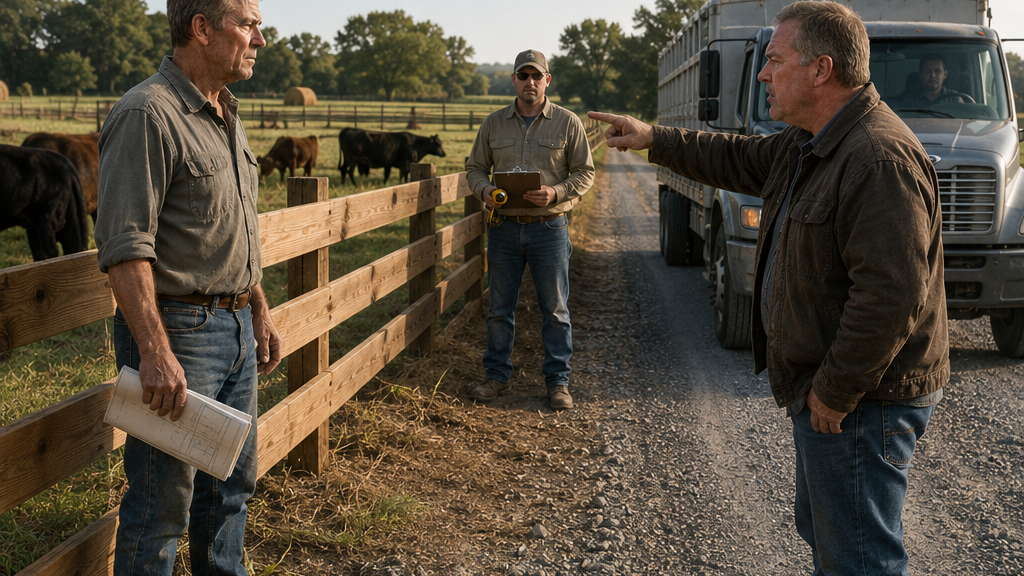
He had come down from the barn expecting to open the gate, wave the truck through, and get back to moving hay before the heat settled in. Instead, Gregory stood beside the new cedar fence with one hand resting on a post as if he had been waiting for an audience.
A county inspector held a clipboard near the gravel shoulder.
“Morning, Benjamin,” Gregory said.
Benjamin looked past him at the truck. The driver had shut off the engine now. Silence settled over the lane except for cattle shifting behind the wire farther down the pasture.
“What’s this?”
The inspector unclipped the notice and handed it over.
Benjamin read the first paragraph once, then again.
Complaint regarding obstruction and possible encroachment into an association-maintained agricultural access lane.
His eyes moved lower.
Five days to correct the condition.
Daily penalties beginning Saturday if the obstruction remained.
He looked up. “You filed this?”
Gregory did not answer immediately.
“I asked the county to look at the lane.”
“That wasn’t my question.”
Gregory’s jaw tightened. “Yes.”
Benjamin folded the notice along its existing crease.
The rebuilt fence ran straight behind him, pale cedar posts and rails replacing the sagging line that had stood there for almost thirty years. He had hired a contractor the previous fall because cattle had begun leaning through the old boards near the gate.
The new line followed the old one.
At least Benjamin had believed it did.
The inspector stepped toward the nearest post. “The complaint is that this fence is inside the traveled access width.”
“The fence is on my land.”
“That may be,” the inspector said. “I’m here because the lane has been maintained through the association for years, and there’s a question about where the legal boundary sits.”
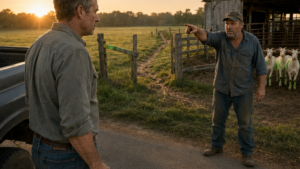
Gregory pointed down the gravel. “You can see the problem.”
Benjamin followed his hand.
The lane curved past his pasture before continuing toward three other farms. Fresh gravel covered the shoulder where spring rains had washed out a shallow ditch. Tire marks widened near the bend.
The feed truck was broad, but it had room.
“Truck got through,” Benjamin said.
“Barely.”
The driver stared ahead, clearly wishing to become invisible.
Gregory walked to the fence and spread his hands between the cedar rail and the opposite gravel edge.
“It wasn’t this tight before.”
Benjamin felt the first hot rise of anger and pressed it down.
“What are you saying?”
“I’m saying the lane was usable before you rebuilt this.”
“That fence replaced a fence that was already there.”
Gregory shook his head. “Old fence leaned back. These posts don’t.”
“So now I’m responsible because my fence stands straight?”
“I’m responsible for keeping this road open.”
The inspector lifted a hand. “Nobody’s deciding fault standing here. The notice gives Mr. Clark time to correct it or provide documentation showing the fence doesn’t encroach.”
Benjamin looked at the paper again.
Five days.
The number offended him more than the accusation.
His father had farmed this ground before him. Benjamin knew where the water pooled after a January rain, where the soil changed color near the ridge, where a tractor wheel would sink if you cut too close to the lower pasture. He had replaced broken posts along this line with his own hands before Gregory ever chaired a road association.
Yet the paper in his hand made him feel like a careless tenant.
Gregory lowered his voice.
“We don’t have to make this bigger than it is.”
Benjamin looked at him.
“What does that mean?”
“Move the first section back a couple feet. We settle it between us. County closes the complaint. Everybody keeps moving.”
“A couple feet?”
“Enough to take pressure off the bend.”
Benjamin laughed once, without humor.
“So you filed a county complaint, and now you want to settle it informally.”
“I filed because you wouldn’t listen.”
“You never asked me to survey it.”
“I asked you last week if we could stand out here and work it out.”
Benjamin remembered.
Gregory had called while Benjamin was loading mineral tubs. He had said there was an issue with the lane and asked if they could meet at the gate.
Benjamin had told him the fence was on his property and there was nothing to discuss.
At the time, that had felt like refusing nonsense.
Now it sounded different.
The inspector checked his watch. “I need to photograph the condition.”
He paced off the shoulder, took several pictures, and measured from the edge of the gravel toward the cedar posts. None of it was a legal survey, he explained. It was only documentation.
But Benjamin hated the sight of the tape measure near his fence.
Gregory stood beside him.
“You could save yourself trouble.”
Benjamin turned.
“By giving you land because a truck feels crowded?”
“By keeping a farm road functional.”
“That road being useful doesn’t make everything beside it yours.”
Something changed in Gregory’s expression.
Not guilt.
Not quite.
Pressure.
“I’ve got four properties depending on this lane,” he said. “Last winter, one feed delivery backed halfway to the county road because the trailer couldn’t make the turn. Everybody called me. When the ditch washed out in March, everybody called me. When somebody has to pay for gravel, they call me. You rebuild a fence and suddenly the lane loses space, and somehow I’m supposed to ignore it.”
Benjamin glanced toward the truck.
For the first time, he heard something beneath Gregory’s accusation besides irritation.
Still, the notice remained in his hand.
“You should have checked before filing.”
Gregory’s mouth hardened. “Maybe you should have checked before building.”
The inspector finished his photographs and left.
The feed truck rolled through next, slow enough that the driver’s mirror passed several feet from the fence. Gregory watched it carefully.
Benjamin watched Gregory.
By noon, the gate was quiet again.
Benjamin carried the notice to the farm office, laid it beside his coffee mug, and stared at it longer than he meant to.
Then he opened the bottom drawer of an old metal filing cabinet.
Receipts. Seed invoices. Cattle records. Equipment warranties.
At the back was a thick manila envelope with the fence contractor’s name written across it.
Benjamin sat down.
Inside were photographs of the old fence, the estimate, material receipts, and a copy of the sketch used when the replacement line had been marked.
He nearly stopped there.
A sketch was not a survey.
Then another sheet slid loose.
It was a copy of the property diagram Benjamin had given the contractor.
A handwritten note ran beside the western line.
SET POSTS 6″ INSIDE RECORDED BOUNDARY.
Benjamin leaned closer.
He remembered telling the contractor exactly why.
Leave room. No arguments later.
Six inches of his own land sacrificed to avoid the very dispute now sitting on his desk.
He placed the county notice beside the drawing.
For the first time that morning, the anger drained away.
In its place came a harder question.
If the fence was six inches inside his boundary, why did Gregory believe the lane had lost space?
Chapter 2: The Iron Pin Under the Gravel
The iron pin was almost gone.
Benjamin saw only the dark crescent of its top where fresh gray gravel had been pushed into the grass beside the lane.
He crouched and scraped dirt away with the heel of his glove.
Rust appeared.
Then metal.
He stopped.
The pin stood several inches outside the cedar fence line, exactly where he vaguely remembered it from years earlier.
But the gravel shoulder now reached over it.
Benjamin straightened slowly.
By eight o’clock, Gregory’s pickup appeared at the bend.
He got out and looked from Benjamin to the exposed pin.
“What are you doing?”
“Finding something.”
Gregory walked closer.
His face changed when he recognized the metal.
“That could be anything.”
Benjamin wiped dirt from the top.
“It’s the old survey monument.”
“You don’t know that.”
“No. That’s why I’m not filing anything yet.”
The answer irritated Gregory more than an accusation might have.
Benjamin brought out the contractor drawing and a tape measure.
The county inspector had agreed to return after Benjamin called that morning and said he had old documentation. He arrived ten minutes later.
Benjamin handed him the plan.
“This says the posts were set six inches inside the recorded line.”
The inspector studied it.
“It says that. Doesn’t prove they were.”
“Agreed.”
Benjamin hooked the tape at the cedar post and stretched it toward the exposed pin.
The distance was close.
Not exact enough to settle anything, but close enough that the inspector stopped writing for a moment.
Gregory folded his arms.
“The old fence wasn’t here.”
Benjamin looked at him.
“It was.”
“It leaned.”
“So?”
“So usable space matters.”
“Legal space matters too.”
The inspector crouched beside the pin.
“If this monument corresponds to the deed call, then the fence may actually be inside Mr. Clark’s boundary.”
Gregory frowned. “May.”
“May,” the inspector repeated. “This isn’t a boundary survey.”
Benjamin let the tape retract.
The sharp metallic snap broke the silence.
Two road-association members had stopped farther up the lane. Neither spoke, but Benjamin felt their attention.
He disliked the audience.
He disliked even more how much part of him wanted Gregory embarrassed in front of them.
That realization unsettled him.
He rolled up the drawing.
“I’m going to the county office.”
Gregory stepped closer. “Benjamin, we can still handle this without turning it into a case.”
“You already turned it into one.”
“I’m telling you the road needs width.”
“And I’m telling you I want to know where my land ends.”
Gregory lowered his voice.
“You always do this.”
Benjamin stared at him.
“Do what?”
“Once you think somebody’s pushed you, you stop hearing anything except the push.”
Benjamin felt the words hit harder than he wanted them to.
“Maybe don’t push.”
He walked away before Gregory could answer.
The county records office occupied the first floor of a low brick building beside the courthouse. Benjamin spent nearly two hours with a clerk comparing his deed, an older subdivision plat, and maintenance records relating to the farm lane.
Most of it was dry language.
Bearings.
Distances.
References to an iron rod.
But one number kept returning.
The recorded access width was narrower than the gravel footprint he saw outside his pasture that morning.
Benjamin traced the line with one finger.
“Is this the full road?”
The clerk leaned over.
“This is the described easement width in the recorded document.”
“And the county maintains it?”
“No. Looks like private maintenance through the association.”
“So if they widened it—”
“I can’t tell you where it sits on the ground.” The clerk tapped the plat. “That takes a surveyor.”
Benjamin knew one.
He called Anna Roberts from the parking lot.
She answered on the fourth ring.
“If this is about cattle getting out again, I’m billing you family rates.”
“They’re still in.”
“Then what happened?”
Benjamin explained.
Not dramatically.
He gave her the complaint, the six-inch setback note, the buried pin, and the road-width discrepancy.
Anna was quiet long enough that Benjamin checked the phone.
“You there?”
“Yes.”
“Well?”
“You want me to tell you you’re right.”
“I want you to tell me where the line is.”
“No, you want both.”
Benjamin leaned against his truck.
She knew him too well.
“I found the pin.”
“You found metal in dirt.”
“Inspector thinks it may be the monument.”
“Inspector isn’t a surveyor.”
“You are.”
“Yes, which is why I’m not declaring victory from a phone call.”
Benjamin looked back toward the courthouse.
“When can you come?”
“Tomorrow morning.”
“That fast?”
“You said penalties start Saturday.”
“They do.”
Anna sighed.
“I’ll pull the recorded documents tonight. But I’m bringing an independent field technician.”
“You don’t need to.”
“I do if this turns ugly. You’re family. Gregory will say I drew the line for you.”
Benjamin hated that she was right.
“Fine.”
“And Benjamin?”
“What?”
“If the survey says your fence is wrong, you move it.”
His grip tightened on the phone.
“That’s not what it’s going to say.”
“That wasn’t the question.”
Benjamin stared through the windshield.
His father’s voice came back unexpectedly from years earlier, when they had argued over an old gate opening farther down the property.
A man who only respects a survey when it agrees with him doesn’t respect a survey.
Benjamin had been thirty-three and furious at the time.
Now he said, “If I’m wrong, I move it.”
“Good.”
He ended the call and drove back to the farm.
Gregory was waiting near the gate.
Benjamin almost kept going.
Instead, he stopped.
“I hired a surveyor.”
Gregory looked toward the exposed pin.
“Your cousin?”
“She’s bringing an independent technician.”
Gregory gave a small nod.
“Good.”
Benjamin had expected resistance.
The absence of it made him uneasy.
“You sound confident.”
“I’m confident the road worked before.”
“That isn’t the same thing.”
“No.”
Gregory looked down the lane.
Fresh gravel lay smooth over the shoulder, brighter than the older crushed stone in the center.
“When they come tomorrow, have them shoot the whole bend.”
Benjamin studied him.
“Why?”
“Because if we’re doing this, do it once.”
Gregory got back in his truck and left.
Benjamin stood at the gate.
The answer should have reassured him.
Instead, he walked to the iron pin again.
Fresh gravel surrounded it on three sides.
He kicked lightly at the shoulder and watched small stones slide away.
The fence had not moved.
The pin probably had not moved.
But something had.
Chapter 3: The Road Was Wider Than the Deed
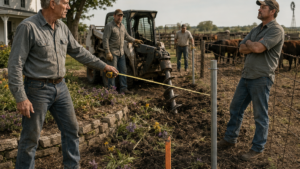
Anna Roberts drove the first orange survey stake into what everyone had been calling the road.
Not beside it.
Into it.
Benjamin watched the mallet rise and fall twice.
The stake stood almost three feet inside the fresh gravel shoulder.
Gregory said nothing.
Behind them, the independent technician adjusted the instrument and called out another number.
Anna checked her field book.
“Again.”
The technician repeated it.
Anna looked toward the cedar fence, then toward the road.
Benjamin felt something cold and satisfying settle in his chest.
“So?”
Anna ignored him.
She walked forty feet down the lane, set another point, and had the technician shoot it again.
Another orange stake went into gravel.
Then another.
Gregory finally spoke.
“That can’t be right.”
Anna gave him the same expression she had given Benjamin when he called her.
“It can be wrong. That’s why we check.”
For the next hour, she checked.
The old iron pin matched the recorded monument closely enough to establish the starting reference. A second monument farther down the boundary confirmed the line.
The cedar fence sat inside Benjamin’s property.
Not by exactly six inches everywhere—the contractor’s work varied slightly—but nowhere did it cross the deed line.
The county inspector arrived before ten.
Anna showed him the preliminary measurements.
“So the fence complaint?” Benjamin asked.
The inspector looked over the stakes.
“I can pause enforcement pending the final survey.”
“Pause?”
“I don’t close boundary matters based on preliminary field work.”
Benjamin wanted to argue.
He stopped himself.
“Fair enough.”
Gregory stood near his truck with both hands on his hips.
The inspector turned toward him.
“The fence does not appear to be the encroachment here.”
No one said anything for several seconds.
One of the road-association members had arrived and parked farther up the lane. A livestock trailer approached from the county-road side, slowed, and carefully passed through the bend.
Benjamin watched its tires.
The inside wheels stayed near the center of the gravel.
The outside wheels rolled directly beside one of Anna’s new stakes.
Something about that erased part of his satisfaction.
Anna continued down the boundary.
The orange markers kept appearing.
Some stood only inches inside the shoulder.
Others were farther.
At the bend, the current gravel surface crossed significantly beyond the recorded line.
Worse, the shallow drainage swale that had been cut beside the road ran through Benjamin’s side too.
He followed Anna down the lane.
“How long?”
“I’m not giving you a number until I finish.”
“Roughly.”
She looked at him.
“Longer than your fence problem.”
Gregory heard.
His face tightened.
Benjamin nearly smiled.
Then the livestock trailer stopped farther ahead.
The driver leaned out the window.
“Can I get through or not?”
Anna motioned him forward.
“Stay on the traveled surface. Don’t hit the stakes.”
The trailer crawled through.
Its rear axle swung wide near the bend.
Benjamin suddenly understood Gregory’s obsession with width.
There was clearance, but not much.
The lane had been built up for machines larger than those his father had used.
Hay wagons were wider.
Feed trailers longer.
Cattle haulers heavier.
The road had changed because the farms using it had changed.
That did not make the land Gregory’s.
But it made the problem real.
By noon, Anna had enough data to show Benjamin the shape of it.
She spread a printed plat across his truck hood and marked the surveyed boundary with a pencil.
Then she traced the present gravel edge.
The two lines separated gradually.
“How far at the worst point?” Benjamin asked.
“About eleven feet from the deed line to the outer edge of the disturbed shoulder and swale.”
Benjamin looked at her.
“Eleven feet?”
“At the widest area. The regularly traveled gravel is less than that.”
Gregory stepped closer.
“That ditch was necessary.”
Anna tapped the map.
“Necessary isn’t the same as recorded.”
Gregory looked at Benjamin.
“You know what happens here after hard rain.”
“I know.”
“The old ditch filled. Water started cutting across the crown. We had trucks sliding toward the fence.”
“My fence.”
“Yes, your fence.”
Benjamin folded his arms.
“And your solution was to dig into my property?”
“We rebuilt the shoulder.”
“On my property.”
Gregory’s expression sharpened.
“You’re enjoying this.”
Benjamin opened his mouth.
Then closed it.
Because he had been.
Not the land problem itself.
The reversal.
The same man who had stood beside a county notice Monday morning was now being shown a line of orange stakes running through the work he had defended.
Benjamin hated Gregory’s accusation because there was truth in it.
Anna rolled the plat halfway closed.
“This isn’t the place to settle motives.”
The inspector returned from making a phone call.
“Mr. Clark, I’m placing the fence complaint on hold. Once I receive the final survey, if it confirms these measurements, the fence portion should be resolved.”
Benjamin nodded.
There it was.
The thing he had wanted since Monday.
His fence could stay.
He looked at the cedar posts.
Nothing about them had changed.
Yet the victory felt smaller than he had imagined.
The inspector pointed toward the disturbed shoulder.
“This other issue is separate.”
Gregory looked away.
Benjamin said, “Separate how?”
“If the road and drainage work cross private property outside an existing easement, that becomes a land-use matter between the owners and possibly the association. I’m not making that determination today.”
Gregory rubbed a hand across the back of his neck.
One of the association members approached.
“What does that mean for the road?”
Nobody answered immediately.
The man looked at Benjamin.
“We’re hauling cattle next week.”
Benjamin felt every eye turn toward him.
“That road’s been there a long time,” the man added.
“So has my property line.”
“I’m not arguing with you. I’m asking if we’re going to lose access.”
Benjamin looked down the road.
Another farm entrance lay beyond the bend. Beyond that, pastureland disappeared behind a row of trees.
Monday morning, the dispute had seemed simple.
Move the fence or prove it belonged where it stood.
Now proving himself right had opened a problem affecting people who had never filed anything against him.
Anna packed her equipment.
“I’ll have a preliminary drawing tonight.”
Gregory remained by the truck.
Benjamin approached him after the others had started leaving.
“When was this shoulder widened?”
Gregory stared toward the ditch.
“Last spring.”
“During the drainage repair?”
“Yes.”
“You chaired that project.”
“Yes.”
“Who approved taking my land?”
Gregory looked at him then.
“No one said we were taking your land.”
“That wasn’t my question.”
Gregory’s face showed exhaustion rather than defiance now.
“The ditch kept washing out. We brought in stone. The operator cut it wider so the water would stay off the road.”
“And nobody checked the boundary?”
Gregory hesitated.
It was brief.
But Benjamin saw it.
“Gregory.”
“I knew the old road edge wasn’t exact.”
Benjamin went still.
“How much did you know?”
“I knew there had always been some question about where the maintained shoulder ended.”
“That’s not the same as what I asked.”
Gregory looked past him at the line of orange stakes.
“No,” he said quietly. “It isn’t.”
He opened his truck door.
Benjamin stepped closer.
“Did you know you might be over my line when you filed against my fence?”
Gregory’s hand stayed on the door.
For a moment Benjamin thought he would answer.
Instead Gregory said, “The drainage project was last spring. Your fence was rebuilt in the fall. Those are two different things.”
Then he got in and drove away.
Benjamin stood beside the unchanged cedar fence while orange stakes cut through the gravel beyond it.
For the first time, he no longer wondered whether Gregory had made a mistake.
He wondered how much of the mistake Gregory had already known.
Chapter 4: What Gregory Never Put to a Vote
The meeting minutes contained nothing about Benjamin’s land.
Not a purchase.
Not an easement.
Not even a motion authorizing Gregory to negotiate for more width.
Benjamin read the packet twice at the long folding table in the agricultural-road association’s meeting room, then slid the pages toward Gregory.
“Show me where I missed it.”
Gregory did not touch them.
Two association members sat several chairs away. Anna had supplied a preliminary survey drawing that morning, and its orange boundary line was visible beneath Benjamin’s hand.
Gregory looked tired.
“It wasn’t handled as a land acquisition.”
“That’s the problem.”
“It was road maintenance.”
“You cut a ditch onto my property.”
“We rebuilt an existing drainage shoulder.”
“Beyond the recorded easement.”
Gregory glanced at the others.
One of the members shifted in his chair.
Benjamin noticed it.
Until that moment, he had thought of the association as Gregory’s machine. Gregory chaired the meetings, called contractors, dealt with washouts, and collected everyone’s share of gravel expenses.
But the other men did not look loyal.
They looked worried.
The older member cleared his throat.
“We approved drainage work.”
Benjamin turned to him.
“Did you approve taking eleven feet of my land?”
“No.”
“Did anybody tell you that might happen?”
The man looked at Gregory.
“No.”
Gregory leaned forward.
“Because we didn’t know it was eleven feet.”
Benjamin heard the word immediately.
“We?”
Gregory’s jaw tightened.
“I knew the old shoulder was not a surveyed boundary. Everybody knew that.”
“That’s different from what you said yesterday.”
“I said there had always been uncertainty.”
“You also filed against my fence as if the road edge was certain.”
Gregory slapped one palm lightly against the table.
“The road was failing.”
The room went quiet.
For the first time since Monday, Benjamin heard anger in Gregory that did not seem aimed at him personally.
Gregory stood.
“You want to know why I did it? Fine. January before last, a feed trailer slid sideways at the bend. Didn’t go over, but it came close. Last winter, a cattle hauler had to back nearly a quarter mile because the shoulder collapsed under the rear wheels. Then March rains cut through the ditch and washed gravel into Benjamin’s pasture.”
He pointed toward the survey drawing.
“I had four people calling me every week. One wanted more stone. One wanted the ditch deeper. One said assessments were already too high. We priced a full engineered rebuild and everybody complained.”
Benjamin said, “None of that gave you my land.”
“I know that.”
The answer came too quickly.
Benjamin studied him.
“You know it now.”
Gregory looked away.
One of the members spoke quietly.
“What did you know then?”
Gregory remained standing.
He pressed both hands to the back of a chair.
“The operator told me the old ditch line was too narrow to hold the water.”
“That isn’t what he asked,” Benjamin said.
Gregory gave him a hard look.
Benjamin did not move.
Finally Gregory said, “There was an old marker near the bend.”
The room seemed to contract.
Benjamin’s mind went immediately to the rusted pin.
“What marker?”
“I didn’t know if it was current.”
“Did you ask?”
“No.”
“Did you stop the work?”
“No.”
Gregory stared down at the table.
“The operator said if we kept the ditch where it was, we’d be repairing the road again after the next heavy rain.”
“So you told him to widen it.”
“I told him to make the drainage work.”
“Across wherever he needed.”
Gregory’s silence answered.
One association member muttered something under his breath.
Gregory turned on him.
“You were the one calling me because your feed truck couldn’t get through.”
“I didn’t tell you to use Benjamin’s ground.”
“No. You told me to fix the road.”
Benjamin felt the shape of the problem become clearer.
Gregory had not secretly plotted to steal a strip of land.
He had done something more ordinary.
He had treated uncertainty as permission because stopping the project would have made him answer to everyone.
Benjamin disliked him for it almost more.
There was no dramatic scheme to expose.
Just a man under pressure deciding that another man’s boundary could be dealt with later.
Benjamin tapped the meeting packet.
“Why wasn’t there a vote?”
Gregory sat again.
“Because if I came back asking for survey fees, engineering, and possibly an easement payment, the project would have died.”
One member frowned. “You don’t know that.”
Gregory looked at him.
“You argued over a twelve-hundred-dollar gravel increase for forty minutes.”
The member said nothing.
Gregory turned back to Benjamin.
“I thought we were improving an existing road everybody had used for decades. I thought if we were a foot or two off somewhere, we could clean it up later.”
“Eleven feet.”
“At the outer edge of the swale. Not the traveled lane.”
“Still mine.”
“Yes.”
The word landed differently from every argument before it.
Gregory did not qualify it.
Benjamin should have felt satisfied.
Instead, he thought of Monday morning, when Gregory had offered to meet at the gate before filing anything and Benjamin had dismissed him.
It did not excuse what Gregory had done.
But Benjamin could see the mirror now.
Both of them had decided there was nothing worth discussing because each believed the ground beneath his feet already settled the matter.
The association member beside Gregory leaned toward the drawing.
“What happens now?”
Benjamin answered before Gregory could.
“I don’t know yet.”
That surprised all of them.
Gregory looked up.
“You could shut the shoulder down.”
“I know.”
“You could ask for the whole thing restored.”
“I know that too.”
The older member rubbed his forehead.
“If we move the ditch back, we lose turning room.”
Gregory nodded. “And water goes back toward the crown unless we redesign it.”
Benjamin looked at the preliminary survey.
The orange line seemed less like a weapon in this room than it had beside the road.
After the meeting, he and Gregory walked the lane in silence.
At the bend, tire tracks crossed close to the survey stakes.
Gregory stopped near the exposed iron pin.
“I should have called you before we dug.”
“Yes.”
“I should have surveyed it.”
“Yes.”
Gregory exhaled through his nose.
“You going to make me say every part?”
“No.”
“You look like you might enjoy it.”
Benjamin almost answered sharply.
Then he remembered how much he had enjoyed those orange stakes going into the gravel.
“A little,” he admitted.
Gregory looked at him, surprised.
Benjamin stepped over the drainage swale.
“That doesn’t mean I’m wrong.”
“No.”
“And being under pressure doesn’t make what you did right.”
“No.”
They stood several feet apart.
Gregory looked down the lane toward the farms beyond Benjamin’s property.
“You know why I filed the fence complaint?”
“You thought I narrowed your road.”
“I thought you rebuilt it to make a point.”
Benjamin frowned.
“What point?”
“That you were done giving anybody room.”
Benjamin said nothing.
Gregory continued.
“After the drainage project, you wouldn’t even meet me out here. I figured you knew we’d widened the shoulder and set the fence tight because you wanted it back.”
Benjamin felt an unexpected flash of embarrassment.
“I didn’t know about the widening.”
“I know that now.”
A truck engine sounded in the distance.
Both men stepped off the traveled surface as a pickup came through.
Gregory watched its tires.
“So what are you going to do?”
Benjamin looked at the fence line.
“I’m going to find out what I’m entitled to do before I decide what I should do.”
That afternoon, Kathleen Wright called after reviewing Anna’s preliminary survey, the recorded easement, and the association documents.
Her voice was matter-of-fact.
“If the final survey confirms this, you have a credible basis to demand restoration of the area outside the easement.”
“How fast?”
“You could make the demand immediately.”
Benjamin stared through his office window at the lane.
“Meaning dig it back.”
“Potentially. Gravel, ditch, grading—whatever constitutes the encroachment. There are procedural details, but yes.”
He thought of Gregory’s face at the meeting.
Then of the trailers using the bend.
Kathleen continued.
“You also have settlement options.”
Benjamin did not answer.
“You still there?”
“Yes.”
“You sound disappointed.”
“I thought being right would make this simpler.”
Kathleen gave a quiet laugh.
“It usually makes the choices clearer. Not easier.”
Benjamin looked at the cedar fence that had started all of it.
By Friday morning, he could stop defending that line and begin enforcing it.
For the first time, he was not sure those were the same thing.
Chapter 5: The Victory That Would Hurt Everyone
Kathleen placed the survey drawing on her desk and tapped the area shaded beyond the recorded easement.
“If you want restoration, you have enough to demand it.”
Benjamin sat across from her.
The final survey had arrived that morning.
His fence was clear.
The road was not.
The widened shoulder and drainage work crossed onto his property for a substantial stretch, widening most severely near the bend.
“What happens if they refuse?”
“Negotiation first. Then potentially litigation.”
“And if I win?”
“They restore the land or compensate you under whatever order or settlement applies.”
Benjamin looked at the drawing.
“That simple?”
“No.”
He looked up.
Kathleen leaned back.
“Nothing involving access is simple. Especially when people have relied on it for years.”
“The recorded easement stays.”
“Yes.”
“So they still have a road.”
“They have the recorded road.”
Benjamin heard the distinction.
Kathleen continued.
“The practical question is whether the recorded width accommodates current use.”
He already knew the answer.
On the way home, he stopped where the lane branched toward the neighboring farms.
A large cattle trailer stood at one entrance while its owner adjusted a gate chain.
Benjamin pulled over.
The farmer approached his truck.
“I heard your survey came back.”
“It did.”
“How bad?”
“Depends who you ask.”
The farmer looked toward the lane.
“They taking the ditch out?”
“I haven’t decided anything.”
“I’m not asking you to give away land.”
Benjamin waited.
The farmer put both hands into his jacket pockets.
“But that bend was rough before they widened it. My big trailer can make it now. Barely. If it goes back exactly where it was…”
He let the sentence hang.
“You knew it crossed my property?”
“No.”
“You vote on the work?”
“I voted for fixing drainage.”
“That’s not what I asked.”
The farmer gave him a tired look.
“No. I didn’t vote on taking your property because nobody told me we were.”
Benjamin nodded.
The man looked almost relieved not to be accused further.
“I’m asking for time, that’s all. If you make them move it, give us time to figure out another way.”
Benjamin glanced toward the trailer.
His first instinct was resentment.
Why was everyone’s inconvenience somehow finding its way onto his land?
Then he pictured an ambulance trying to negotiate the old washed-out shoulder. A livestock trailer backing toward the county road in darkness. A feed delivery delayed while cattle waited.
Those problems were not imaginary just because Gregory had handled them badly.
Benjamin drove home and walked the fence line before going inside.
The cedar rails were dry and straight beneath his hand.
His father had believed in boundaries with almost religious seriousness.
Once, years ago, Benjamin had asked why he kept old deed copies, survey notes, handwritten agreements, and photographs of gate locations.
His father had told him, “Because memory makes permission grow.”
Benjamin had carried that sentence for decades.
He had taken it to mean never yield.
Now he wondered whether his father had meant something narrower.
Make permission clear.
Make it deliberate.
Do not let kindness become confusion.
By afternoon, Gregory arrived at the farm without calling.
Benjamin met him at the gate.
“I heard you talked to Kathleen Wright,” Gregory said.
“I did.”
“She tell you that you can make us move it?”
“Yes.”
Gregory’s mouth tightened.
“So that’s it.”
“I didn’t say that.”
“What else is there?”
“An easement.”
Gregory stared at him.
“We already have one.”
“Not for the land you’re using.”
“That road has been used longer than either of us has been farming.”
“The recorded road has.”
Gregory shook his head.
“You’re going to charge us for something everybody has treated as access for decades.”
Benjamin felt his patience thinning.
“Everybody treating something as theirs doesn’t make it theirs.”
“Historic access matters.”
“So do recorded boundaries.”
Gregory stepped toward the fence.
“You know what this is really about?”
Benjamin’s voice went flat.
“Careful.”
“You want me to admit you won.”
There it was.
The accusation Benjamin had been trying not to make true.
His first impulse was to answer with the survey.
Instead, he looked at Gregory.
“Part of me does.”
Gregory stopped.
Benjamin continued.
“Part of me wants you to move every stone back to the line because you stood here Monday with a county notice and told me my fence was the problem.”
Gregory said nothing.
“But if I do that tomorrow, I don’t just hurt you.”
Gregory’s expression shifted slightly.
Benjamin pointed down the road.
“Those farms still need access. That ditch still needs to carry water. The fact you handled it wrong doesn’t erase the need.”
“You offering to let it stay?”
“Under terms.”
Gregory gave a short, humorless laugh.
“Meaning money.”
“Meaning recognition that it is my land.”
Gregory looked away.
“That’s what this is.”
“Yes.”
“And money.”
“Yes.”
Benjamin did not soften it.
“If you want permanent use of the strip, the association pays for an easement. It fixes the drainage where it’s cutting into the pasture. It pays for permanent boundary monuments. Future widening requires written consent and a survey first.”
Gregory turned back.
“You already have an easement payment in mind?”
“Kathleen is working on terms.”
“You don’t waste time.”
“You gave me five days.”
The words stopped both men.
Benjamin regretted the satisfaction he heard in his own voice.
Gregory caught it too.
“There it is.”
Benjamin took a breath.
“No. Listen to me.”
Gregory waited.
“I’m not giving the land away. I’m also not tearing the road apart just to make you watch.”
“That supposed to make me grateful?”
“No.”
“Then what?”
“It means I finally understand compromise isn’t the same as pretending the line doesn’t exist.”
Gregory looked toward the fence.
For several seconds neither spoke.
Then Gregory said, “I’m not paying rent forever on a road we’ve used my whole life.”
“Then restore the land outside the recorded easement.”
“You know what that does to access.”
“Yes.”
“You’d really make us do it?”
Benjamin held his gaze.
“If the alternative is you telling me long use gives you ownership, yes.”
Gregory’s face hardened again.
“There’s no way the association votes for that.”
“Then the association can vote to restore it.”
Gregory stepped back.
“You always need things written down.”
Benjamin thought of his father’s filing cabinet.
“Yes.”
“Some people still know how to shake hands.”
“And some people shake hands until the ditch gets eleven feet wider.”
Gregory flinched.
Benjamin wished immediately that he had not said it that way.
But he did not retract it.
Gregory walked back to his truck.
Before getting in, he said, “Send whatever you’re proposing.”
“I will.”
That evening, Kathleen emailed a draft.
Benjamin printed it and read every page at the same desk where the county notice had sat Monday.
Permanent easement over the surveyed strip.
Annual payment.
Association responsibility for drainage correction.
Permanent monuments.
Written approval required before future widening.
Restoration alternative if the agreement was rejected.
Benjamin changed one sentence.
Kathleen had written that the association acknowledged “uncertainty concerning the historical boundary.”
Benjamin replaced it with:
The association acknowledges that the 2025 widening and drainage work extended beyond the recorded easement without prior written consent of the property owner.
He stared at the sentence.
It was not an insult.
It was not revenge.
It was also not comfortable.
He sent the revision.
The next morning, Gregory would receive two choices.
Pay for the right to keep using Benjamin’s land under rules everyone could see, or put the land back the way it had been.
Chapter 6: The Price of Eleven Feet of Habit
Gregory entered Kathleen Wright’s office expecting Benjamin to demand a removal crew.
Benjamin could see it in the way he carried himself—shoulders squared, folder tucked under one arm, expression already prepared for an argument.
Kathleen motioned toward the chair opposite Benjamin.
“Sit down.”
Gregory remained standing long enough to look at Benjamin.
“You really called a lawyer before talking to me again.”
Benjamin said, “We talked.”
“Not about this.”
“We’re talking now.”
Gregory sat.
Kathleen placed three copies of the proposed agreement on the table.
“I want to be clear before we begin. Nobody here is required to settle today.”
Gregory opened the document.
His eyes moved down the first page.
Then stopped.
“Annual payment.”
“Yes,” Kathleen said.
“For a ditch.”
“For a defined easement area that includes portions of the widened shoulder and drainage system.”
Gregory looked at Benjamin.
“How much land do you think you’re leasing us?”
Benjamin did not answer.
Kathleen did.
“The payment is not based solely on acreage. It reflects continuing use, maintenance obligations, and the value of avoiding restoration.”
Gregory flipped several pages.
“You priced restoration?”
“I asked for estimates.”
Kathleen slid another sheet across.
Gregory read it.
His face changed.
The cost to remove gravel, reshape the shoulder, redesign drainage within the recorded corridor, reseed disturbed ground, and rebuild the bend was far higher than the first-year easement payment.
He leaned back.
“That’s inflated.”
“Get your own estimate,” Kathleen said. “I encourage it.”
Gregory looked at Benjamin.
“You knew it would cost this much.”
“No.”
“You knew enough.”
“I knew tearing it out would cost more than leaving it.”
Gregory closed the estimate.
“So you found the number that hurts without hurting enough to make us walk away.”
Benjamin felt irritation rise.
Kathleen spoke before he could.
“That is usually how settlements work.”
Gregory looked at her.
“You represent him?”
“I drafted the proposal for him. I am not your attorney.”
“Then don’t tell me what settlement means.”
Kathleen nodded once.
“Fair.”
The answer robbed Gregory of momentum.
Benjamin watched him reopen the document.
There was no audience here.
No feed truck.
No county inspector.
No association members.
Just three people and a stack of paper defining what everyone had spent years leaving undefined.
Gregory reached the drainage clause.
“This says we pay to reshape the swale.”
“It’s cutting water toward Benjamin’s lower pasture,” Kathleen said.
“We fixed the water problem.”
“You moved part of it.”
Gregory looked at Benjamin.
“You had flooding before.”
“Not there.”
“You sure?”
Benjamin nearly snapped back.
Instead, he said, “Anna marked the grade. Look at it with the engineer.”
Gregory studied him for a moment.
“You’re not asking us to close the road.”
“No.”
“Not even during the work?”
“Only as needed for repairs.”
Gregory turned another page.
“Permanent monuments?”
“Yes.”
“Survey markers every time somebody drives past?”
“Monuments at defined points. So this never becomes an argument about where somebody remembers a ditch being.”
Gregory’s mouth twisted.
“My father drove that road.”
“So did mine.”
“He never charged anybody.”
Benjamin leaned forward.
“My father also wrote down every access agreement he cared about.”
Gregory looked at him.
“That why you’re doing this?”
“Partly.”
Benjamin paused.
“He used to say memory makes permission grow.”
For the first time that morning, Gregory’s expression softened.
“My father would have said the opposite.”
“What?”
“That if you made neighbors sign papers for every favor, you’d end up with papers instead of neighbors.”
Benjamin almost smiled.
“Maybe both of them were half right.”
Gregory looked down.
The room went quiet.
Then he reached the clause Benjamin had revised.
His finger stopped.
“This stays?”
Benjamin knew exactly which sentence.
“Yes.”
Gregory read it aloud, slowly.
“The association acknowledges that the widening and drainage work extended beyond the recorded easement without prior written consent of the property owner.”
He dropped the page.
“No.”
Kathleen folded her hands.
“Which part is inaccurate?”
“That goes into the association record.”
“Yes.”
“It makes it look like I knowingly took his land.”
Benjamin said, “Did you knowingly survey it first?”
“No.”
“Did you know there might be a boundary problem?”
Gregory’s jaw worked.
“Yes.”
“Did you widen it anyway?”
“Yes, because the road was failing.”
“The reason can go in the minutes too.”
Gregory stared at him.
Benjamin continued.
“I’m not asking you to write that you stole anything. I’m asking you to acknowledge what happened.”
“You want my name attached to it.”
“You were chair.”
“There were other people involved.”
“And they can explain their part.”
Gregory pushed the agreement away.
“This is humiliation dressed up as paperwork.”
Benjamin felt the old temptation immediately.
He could have said: You humiliated me first.
He could picture the county notice clipped to his gate.
Five days.
Daily penalties.
Gregory standing beside the fence while the feed truck waited.
Instead Benjamin looked at the agreement.
“If I wanted to humiliate you, I’d demand restoration and let everybody watch equipment tear the shoulder out.”
Gregory’s eyes narrowed.
Benjamin went on.
“I’m offering a way to keep the road.”
“For a price.”
“Yes.”
“And an admission.”
“Yes.”
“Why do you need that sentence?”
Benjamin did not answer immediately.
Because his father would have.
Because Monday morning still burned.
Because he wanted Gregory to say out loud that Benjamin had not caused this.
All of those reasons were true.
He chose the one that mattered.
“Because ten years from now, I don’t want somebody pointing at that ditch and telling me it has always been theirs.”
Gregory’s expression changed.
Not surrender.
Recognition.
Benjamin tapped the survey.
“The payment matters less than that.”
Gregory looked down the table toward the documents.
Kathleen said, “There is another option.”
Gregory gave a dry laugh.
“Restoration.”
“Yes.”
She slid the estimate back toward him.
“The land returns to the recorded boundary. No annual payment. No permanent additional easement.”
Gregory stared at the number.
Then he looked at Benjamin.
“You’d let me choose that?”
“It’s your choice.”
“And if the association wants to fight?”
“Then we fight.”
Benjamin said it without satisfaction.
Gregory seemed to notice.
They spent another hour changing smaller terms.
Maintenance access limited to the easement area.
Advance notice for major work.
Drainage inspected after the next heavy season.
Payment adjusted periodically rather than rising automatically every year.
Benjamin gave ground on several provisions.
Gregory did too.
By the time they stood, the argument had become strangely technical.
That was a relief.
Outside, they drove separately to the lane.
Anna’s temporary stakes still marked the disputed strip.
The old iron pin stood exposed beside the gravel.
Gregory walked to it.
“So this becomes one corner?”
“One reference point,” Benjamin said.
Gregory nudged gravel away from its base with his boot.
“All these years, that thing was sitting there.”
“Yes.”
“And nobody cared until we needed it.”
Benjamin thought about that.
“No. We cared when we stopped agreeing.”
Gregory looked down the road.
“I need the board.”
“I know.”
“They’re going to hate the payment.”
“Probably.”
“They’re going to hate the sentence more.”
“Probably.”
Gregory turned.
“You really won’t take it out?”
“No.”
“Not the admission. The road.”
“If the agreement is signed, the road stays.”
Gregory looked back toward the farms beyond the bend.
For the first time since the dispute began, Benjamin saw relief plainly on his face.
It lasted only a second.
Then Gregory picked up his folder.
“I need one night.”
Benjamin nodded.
Gregory walked toward his truck.
At the door, he stopped.
“If I sign this, you don’t get to act like I did it because you beat me.”
Benjamin almost answered with something sharp.
Instead he said, “If you sign it, I’ll act like we finally put the line where everybody can see it.”
Gregory studied him.
Then he got into the truck and drove away.
Benjamin remained beside the iron pin until the dust settled.
The terms were almost finished.
The money was manageable.
The road could stay.
Everything now depended on whether Gregory could accept one sentence saying that the land had never been his to take.
Chapter 7: The Line They Finally Agreed to Keep
Gregory came down the farm lane carrying a signed agreement instead of a restoration estimate.
Benjamin saw the folder in his hand before he saw Gregory’s expression.
For one brief second, he assumed there would be another condition.
Another revision.
Another argument over the sentence Gregory had refused to sign the day before.
But Gregory stopped beside the cedar fence, held out the folder, and said, “The board approved it.”
Benjamin did not take it immediately.
“All of it?”
“All of it.”
“The drainage work?”
“Yes.”
“The annual payment?”
Gregory nodded.
“The monuments?”
“Yes.”
Benjamin finally accepted the folder.
He opened it on the hood of his truck.
There were signatures from the association officers, Kathleen’s final legal description, Anna’s survey exhibit, and the sentence that had almost broken the settlement apart.
The association acknowledges that the widening and drainage work extended beyond the recorded easement without prior written consent of the property owner.
Gregory watched him read it.
“You happy?”
Benjamin looked up.
“No.”
Gregory gave a short laugh.
“Good.”
Benjamin closed the folder.
“I’m relieved.”
“That sounds worse.”
“It’s more accurate.”
A pickup approached from beyond the bend.
Both men stepped aside while it passed.
Its tires stayed on the traveled surface, several feet from the cedar rails.
For days, Benjamin had seen every vehicle as evidence.
Too close.
Too wide.
On his land.
Not on his land.
This morning, it looked like what it had been before the argument began.
A farm truck going somewhere.
Gregory nodded toward the folder.
“Recorder’s office opens at nine.”
Benjamin checked his watch.
“Then we should go.”
They drove separately into town.
Kathleen met them at the county recorder’s office with the final originals. Anna had already attached the surveyed legal description of the additional easement corridor, defined from the old iron pin and the new permanent reference points.
The clerk reviewed everything, stamped the filing pages, and slid copies back across the counter.
It was over in less than fifteen minutes.
Benjamin found that almost insulting.
More than a week of anger, measurements, meetings, contractors, old records, and sleepless calculations had become a few inked stamps and a receipt.
Outside, Gregory looked at his copy.
“That’s it?”
Kathleen said, “That’s the part people forget. A recorded agreement is usually less dramatic than the fight that makes it necessary.”
Gregory folded his copy into the folder.
“I hope I never see your office again.”
Kathleen smiled.
“I hear that from satisfied clients too.”
By noon, an equipment operator was at the farm lane.
Not to tear the road out.
To correct it.
Benjamin stood beside the fence while the county road engineer and Anna walked the drainage line with the operator. The work was limited and precise: reshape the swale where water had been directed toward Benjamin’s lower pasture, pull loose gravel away from the new monument locations, preserve the usable turning width, and keep all future disturbance within the recorded corridor unless Benjamin gave written approval.
The first bucket of dirt lifted from the ditch.
Gregory stood several yards away.
Benjamin glanced at him.
“You all right?”
“No.”
Benjamin waited.
Gregory watched the machine.
“I spent a year getting people to stop complaining about that ditch.”
“And now?”
“Now they’re complaining about the bill.”
Benjamin almost laughed.
Gregory looked at him.
“You think that’s funny?”
“A little.”
This time Gregory smiled too.
Only briefly.
The engineer called them over.
He pointed to two permanent monument locations.
“These stay visible. Don’t bury them with gravel again.”
Gregory looked at Benjamin.
“I suppose that one’s directed at me.”
“It’s directed at whoever runs the grader.”
Benjamin said, “Put it in writing.”
Gregory rolled his eyes.
The moment was small, but something in the old stiffness between them loosened.
A week later, the road association held another meeting.
Benjamin attended because the easement required one final procedural change.
The new rule was simple.
No future widening, ditch relocation, shoulder expansion, or similar work could cross a recorded property boundary without a survey or written landowner consent.
One of the members complained that it would slow emergency repairs.
Another asked who would pay for surveys.
Gregory answered both questions himself.
“We’ll budget for it when the work could affect private ground.”
The older member frowned.
“We never had to do that before.”
Gregory looked down at the minutes.
“We should have.”
Benjamin heard no resentment in it.
That surprised him more than the vote.
The rule passed.
Afterward, Gregory remained behind while the others left.
Benjamin was gathering his papers when Gregory said, “There’s one thing I didn’t tell you.”
Benjamin looked up.
Gregory leaned against the table.
“When I filed the fence complaint, I wasn’t only worried about the truck clearance.”
Benjamin waited.
Gregory stared toward the empty chairs.
“I knew the drainage job had gotten wider than planned. I didn’t know how far. When you rebuilt that fence and wouldn’t meet me, I thought you knew too.”
“You thought I was trying to take the shoulder back.”
“Yes.”
“So you filed first.”
Gregory nodded.
“I thought if the county treated the road edge like the accepted line, it would settle the issue before anyone opened up the old plats.”
Benjamin felt the last missing piece slide into place.
Not theft.
Not ignorance either.
Fear.
Gregory had used the complaint partly because he was afraid the road project would come apart under scrutiny.
Benjamin said, “You could have told me.”
“I could have.”
“You could have surveyed it.”
“Yes.”
Gregory looked at him.
“And you could have met me at the gate before any of this.”
Benjamin felt the old instinct to defend himself.
Instead he nodded.
“I could have.”
Neither man apologized.
Benjamin realized he did not need them to.
Three weeks after Gregory had first clipped the county notice to the gate, the cedar fence still stood exactly where it had stood that Monday morning.
The lane still carried feed trucks.
The drainage swale still worked.
But now the line between use and ownership was written down.
The old iron pin had been cleaned, flagged, and left visible beside one of the new monuments.
Benjamin stopped there one afternoon after checking cattle.
He rested his boot beside the metal and looked along the cedar rails.
His father had been right that memory made permission grow.
But Gregory’s father had not been entirely wrong either.
Paper could protect a relationship only if the people signing it still intended to behave like neighbors afterward.
A few days later, Benjamin opened his mail at the farm office.
Inside one envelope was the association’s first annual easement payment.
He set the check beside the original county notice.
For a moment he considered keeping both.
Then he took the notice to the trash.
The check stayed.
Not as a trophy.
As proof that permission had finally been named.
Benjamin used part of the payment to replace two damaged boundary markers farther down the pasture, where years of mowing had nearly erased them.
When the contractor finished, the new markers were plain and permanent.
No bright warning paint.
No sign.
No accusation.
Just fixed points in the ground.
That evening, Gregory drove past slowly.
He stopped near the gate and lowered his window.
“Those the new markers?”
“Yes.”
Gregory looked at the nearest one.
“Hard to miss.”
“That’s the idea.”
Gregory nodded.
Then he glanced toward the cedar fence.
“Still think you should’ve moved it back a couple feet.”
Benjamin stared at him.
Gregory held the expression for two seconds before smiling.
Benjamin shook his head.
“Drive your truck.”
Gregory did.
Benjamin watched him disappear around the bend.
The fence remained.
The road remained.
And between them, where habit had once been mistaken for ownership, the line was finally clear enough for both men to live with.
The story has ended.