They Fined Him for Leaving Hay Bales Beside the Farm Lane—Then He Checked Where the Maintenance Money Went
Chapter 1: The Hay Bales Had Not Moved in Four Years
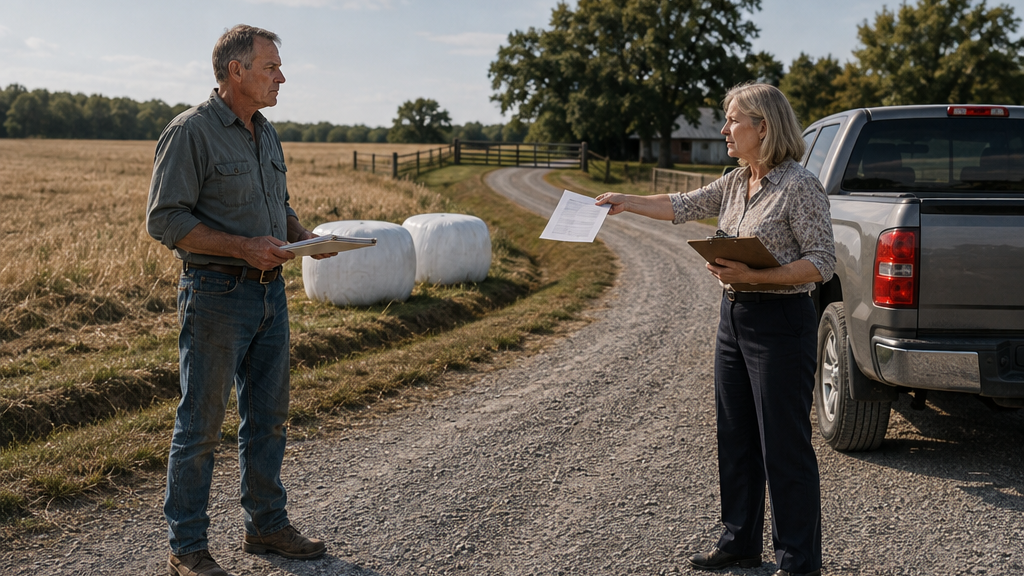
Catherine Hall took the photograph before Gary Williams had even climbed down from the tractor.
He saw her through the dusty rear glass of the cab, standing at the bend in the gravel lane with one hand on her hip and her phone raised toward the two wrapped hay bales he had just set beside the drainage strip. The tractor was still idling. One bale had a faint smear of mud across its white plastic, and the other sat exactly where Gary had placed the same kind of bale every September for years.
He killed the engine.
Catherine lowered the phone.
“You planning to leave those there?”
Gary opened the cab door and stepped down carefully. His knees reminded him he was sixty-two before his mind did.
“Until I feed them or move them to the lower shed.”
“That’s not a storage area.”
Gary looked at the bales, then at the gravel lane. There was still more than enough room for a loaded feed truck to pass. The shallow ditch behind the bales was mowed clean. Nothing touched the travel surface.
“They’ve been there every harvest since before you were treasurer.”
“That doesn’t make it allowed.”
She said it without heat. That was Catherine’s way. She rarely raised her voice. She spoke as though the rule already existed somewhere, stamped and filed, whether anybody had seen it or not.
Gary brushed chaff from his sleeve.
“I’ve got another wagon coming in.”
“Then you may want to make room.”
“For what?”
“For avoiding a notice.”
He watched her walk back toward her pickup.
Gary’s first instinct was to call after her and ask what notice she was talking about. His second was stronger. He had three more loads to bring in before dark, one field still to rake, and a weather forecast that had shifted rain twelve hours earlier than it had that morning.
He climbed back into the tractor.
By supper, he had nearly forgotten the conversation.
The envelope arrived two days later.
It was folded once and tucked into the metal mailbox at the end of his drive. Gary opened it standing beside the post, expecting an association assessment reminder.
Instead, it listed a violation for roadside obstruction and unauthorized storage.
Fine due: seventy-five dollars.
Gary read the page twice.
Then a third time.
The notice said the bales interfered with the appearance and maintenance of the shared lane.
He looked over his shoulder.
From the mailbox, he could see both bales forty yards away, sitting beyond the gravel edge, parallel to the ditch. A mowing tractor had passed them the previous week without difficulty. The association’s gravel truck had driven past the same place that morning.
Gary folded the paper back along its crease.
For four years, he had used that strip during hay season. Before that, his father had stacked square bales farther back near the fence, when the lane was narrower and nobody called anything a common area.
Gary carried the notice into the house and left it under the salt shaker on the kitchen table.
He did not call Catherine.
He told himself the amount was too small to turn into a neighborhood argument.
That was how his father had handled things.
Don’t make a public fight out of something you can settle quietly.
The sentence had followed Gary through most of his adult life. It had been useful when a neighbor’s cattle pushed through a fence, when a tractor clipped a mailbox, when somebody forgot to close a gate.
It had also taught Gary to absorb more than he sometimes should have.
The next morning, he mailed the seventy-five dollars.
Six days later, another envelope appeared.
Same association letterhead.
Same description.
Same seventy-five-dollar fine.
Gary stood at the kitchen counter holding both notices side by side.
The wording was nearly identical, down to a misspelled word in the second paragraph.
He picked up the phone, then set it down.
He could already hear how the conversation would go.
Catherine would say the board had rules.
Gary would ask which one.
She would tell him everybody else managed to follow them.
He would get irritated.
She would get formal.
Then the whole thing would live in the lane between them for the next ten years.
His daughter called that evening about bringing the grandchildren by on Sunday. Gary did not mention the fines. He talked about the hay instead, and the dry spell, and the calf that had learned to get its head through the wrong side of the feed rack.
After the call, he sat at the table with the second notice.
He had spent twenty-eight years reviewing municipal purchasing files before returning full time to the farm. He knew what a real citation looked like. He knew what a contract reference looked like. He knew the difference between a rule somebody could produce and a practice people had repeated long enough to stop questioning.
Still, he wrote another check.
That bothered him more than the money.
Not because he believed Catherine was right.
Because paying was easier.
Three days later, Ryan Baker pulled his pickup alongside Gary’s tractor near the north pasture.
“Heard you and Catherine are fussing about those bales.”
Gary kept one hand on the steering wheel.
“I’m not fussing.”
Ryan smiled.
“That’s usually when I know you’re mad.”
Gary looked toward the bend. The two white bales sat exactly where they had been from the beginning.
“You on the board now or just collecting gossip?”
“Still on the board. Unfortunately.”
“Then tell me what rule I broke.”
Ryan’s smile weakened.
“I don’t know the section.”
“Catherine does?”
“She says roadside storage isn’t allowed.”
“That isn’t a section.”
Ryan rubbed the edge of the open window.
“You know how this goes. If one person starts leaving stuff along the lane, next thing somebody parks a trailer there.”
Gary almost laughed.
“So two hay bales become a trailer?”
“I’m saying they try to keep it consistent.”
Gary glanced toward the road again.
“Consistent with what?”
Ryan did not answer directly.
Instead he said, “You ought to just move them.”
That sentence stayed with Gary after the pickup disappeared down the lane.
Not because it was hostile.
Because it was ordinary.
Move them.
Pay it.
Don’t turn it into something.
Gary finished his work that afternoon with more force than necessary. He slammed the tractor door. He bent a gate latch by yanking it when the chain caught. Twice he told himself he was being ridiculous.
The bales were worth more than the fines, but that was not the point.
The point was that nobody could tell him what rule he had violated.
The third envelope came before the end of the month.
Gary opened it at the mailbox.
This one did not repeat the same amount.
Repeat violation.
Fine due: one hundred twenty-five dollars.
The words underneath were what changed something in him.
Continued noncompliance after prior notice.
Gary looked down the lane.
The bales had not moved.
Neither had the rule, apparently.
But according to the association, he had now become somebody who repeatedly refused to obey it.
He folded the notice slowly and slid it into his shirt pocket.
Then he walked toward the house, not to write another check, but to find the association binder he had not opened in years.
Chapter 2: The Rule Catherine Could Not Point To
The rule number printed on Catherine’s third notice did not exist in Gary’s copy of the association agreement.
He discovered that before breakfast.
The old binder lay open across the kitchen table, its clear plastic sleeves cloudy at the corners. Gary had gone through the index twice, then the amendments, then the pages dealing with road access, drainage, obstruction, storage, and maintenance.
Nothing matched.
He carried the binder to the window where the light was better and checked the notice again.
Section 8.3.
There was a Section 8.2.
Then Section 8.4.
No 8.3.
Gary stared at the gap for a few seconds.
By nine, he was at the small association records office, which occupied a converted room beside a local equipment shed. Patricia Brown sat behind a metal desk with a ledger open in front of her.
“I need the current road agreement.”
She looked up.
“You have one.”
“I have an old one.”
“How old?”
“Apparently old enough to be missing rules I’m getting fined under.”
Patricia’s expression changed only slightly.
She rose, unlocked a gray cabinet, and pulled out a newer binder.
Gary laid the fine beside it.
“I’m looking for Section 8.3.”
Patricia flipped several pages, stopped, then went backward.
“That numbering changed after the drainage amendment.”
“So what replaced it?”
She ran one finger down the contents page.
“I’d have to see what Catherine meant.”
Gary waited.
Patricia closed the binder halfway.
“You should ask her.”
“I did. She told me roadside storage isn’t allowed.”
“That sounds like the policy.”
“Policy where?”
Patricia did not answer.
Gary asked for copies of the current agreement and amendments and paid the small copying charge without comment.
At home, he spread everything across the kitchen table.
He found the first useful language in the maintenance section.
The association had responsibility for grading, mowing, culvert clearance, and drainage maintenance within a defined strip along both sides of the shared lane.
Gary read the description twice.
Then he took the agreement outside.
The two wrapped bales sat beyond the gravel edge, inside the mowed strip but clear of the ditch itself.
He paced the distance from the lane.
He checked the culvert.
He checked the width.
Then he went back to the agreement.
The document gave the association maintenance responsibility.
It also restricted permanent structures, abandoned equipment, and anything that blocked drainage or vehicle access.
Hay bales were not mentioned.
Temporary agricultural storage was not mentioned.
Gary did not mistake that for a victory. Documents were rarely that generous. If language was broad enough, people could argue about what it covered for years.
But Catherine’s certainty now irritated him more than the fines.
She had written three notices as though there were no ambiguity at all.
That afternoon, Gary saw her pickup turn onto the lane.
He was already waiting near the bales.
Catherine stepped out carrying a clipboard.
“Those still need to go.”
Gary held the agreement folded in one hand.
“I looked up the section on my notice.”
“And?”
“It isn’t in the current document.”
“It was renumbered.”
“What is the current number?”
Catherine shifted the clipboard against her hip.
“The board’s position is that the maintenance strip is not for private storage.”
Gary opened the agreement.
“I’m not asking the board’s position.”
She looked at him.
“I’m asking you to show me the rule.”
The sound of a diesel engine came from farther up the lane. A feed truck rounded the bend, slowed, and passed both of them with several feet to spare.
Gary waited until the dust settled.
Catherine glanced at the truck, then back at him.
“The association maintains this strip.”
“I know.”
“That doesn’t make it yours to use.”
“I didn’t say it did.”
“Then move the bales.”
Gary tapped the page.
“This says no permanent structures, no abandoned equipment, nothing blocking drainage or travel. Which one are these?”
Catherine’s jaw tightened.
“You’re reading it like a contract.”
“It is a contract.”
“It’s an association agreement.”
“That doesn’t make the words decorative.”
For the first time, Catherine’s expression lost some of its certainty.
Not much.
Just enough for Gary to notice.
She looked down at the open page.
“The board has always interpreted the strip as common maintenance space.”
“Always?”
“Yes.”
“I’ve put hay here four seasons.”
“That doesn’t mean it was approved.”
“Was it prohibited?”
Catherine closed her lips for a moment.
“The board doesn’t have to list every possible misuse.”
Gary nodded once.
“That’s true.”
She seemed surprised by the agreement.
Then he added, “But if you’re fining me, somebody ought to be able to tell me what I violated.”
Catherine’s face hardened again.
“You were notified.”
“That isn’t the same thing.”
She slid a paper from behind the clipboard.
Gary looked at it.
Another violation notice.
Two hundred dollars.
Unauthorized use of common maintenance area.
He almost smiled.
Not because it was funny.
Because the phrase proved the contradiction better than anything he had said.
Catherine had spent three weeks insisting the bales were improperly stored along the lane.
Now the notice specifically called the place a common maintenance area.
Gary held the paper beside the open agreement.
“So now we agree this is the maintenance strip.”
“You’re twisting language.”
“No. I’m reading yours.”
Catherine stepped closer.
“You know what the intent is.”
“Then write the intent into the rules.”
“That isn’t how this works.”
Gary looked past her at the two hay bales.
They sat cleanly aligned with their flat ends facing the lane. He had straightened them that morning on purpose.
It occurred to him that, until now, he had still been trying to make Catherine admit he was right.
That was the wrong goal.
He folded the notice and slipped it into the binder.
“All right.”
Catherine frowned.
“All right what?”
“I’ve got what I need.”
He carried the binder back toward the house.
Behind him, Catherine said, “The fine still stands.”
Gary did not turn around.
Inside, he put the new notice beside the previous three.
Then he opened the association’s most recent annual statement.
He had ignored most of those numbers for years. Gravel. Mowing. Culvert work. Equipment. Emergency repairs. Contractor services.
He had paid the annual assessment, scanned the total, and moved on.
Exactly the way Ryan probably did.
Exactly the way most people did.
Gary pulled a yellow legal pad from the desk drawer.
For the first time, the hay bales no longer felt like the real problem.
He copied every maintenance line item from the statement, one by one.
Chapter 3: The Gravel Bills Were Bigger Than the Road
The invoice said three hundred tons of gravel had been spread on the south section of the lane in May.
Gary knew that section of road.
He drove it every day.
Three hundred tons would not have disappeared without leaving a trace.
He sat at the desk in the small farm office with the invoice under his left hand and a county supplier record under his right. Outside, a grain truck rattled past the two wrapped hay bales and never slowed.
Gary read the invoice again.
Road resurfacing and shoulder restoration.
South access section.
He pictured the ruts that had remained through most of June.
There had been grading. He remembered that.
There had been some gravel.
But not what the invoice described.
The county records clerk had helped him identify publicly filed business names and equipment registrations, nothing more. The association’s own records had supplied the real puzzle.
Gary had requested copies of three years of maintenance expenses because one year could always be strange.
Storms happened.
Culverts collapsed.
Diesel prices changed.
A machine broke in the wrong week and doubled the cost of a repair.
Three years showed patterns.
He built a simple worksheet.
Association-reported road and drainage spending.
Contractor invoices.
Equipment rentals.
Mowing.
Gravel deliveries.
He did not call anything missing until he could not match it somewhere else.
The first year showed a difference large enough to bother him.
The second showed another.
The third showed nearly the same shape.
Gary leaned back.
For a few seconds he felt the clean satisfaction he remembered from his old procurement work: the moment when a messy pile of paperwork stopped looking random and started forming a pattern.
Then the satisfaction faded.
Patterns could mislead people too.
He had seen auditors become convinced they had found wrongdoing because two columns did not reconcile. Later, somebody produced a fuel receipt, a subcontract, or an emergency purchase authorization, and the scandal became sloppy paperwork instead.
Gary wrote at the top of the page:
DO NOT ASSUME.
Then he underlined it.
The totals were still difficult to ignore.
The association had reported annual road, mowing, and drainage costs much higher than the vendor invoices Gary could trace.
Not a few hundred dollars.
Thousands.
Some of the gaps were explained by grouped payments.
One contractor invoice combined brush cutting, culvert clearing, and hauling under a single amount. Another listed “road service” without separating labor from equipment.
Gary hated invoices like that.
They were not necessarily dishonest.
They were simply hard to test.
He drove the lane that afternoon with copies on the passenger seat.
At the first culvert, he stopped and got out.
Fresh rock had been placed there in spring. That matched the records.
Farther down, a ditch line had clearly been reshaped. That probably matched another charge.
Then he reached the south section.
The invoice description still did not fit what he saw.
He walked the shoulder slowly, boot heels sinking into soft edges.
A grader had been through.
A load or two of gravel, perhaps more.
But the scope described on paper felt larger than the work under his feet.
Ryan Baker’s pickup approached from behind and stopped.
“You inspecting the road now?”
Gary held up the paper.
“Trying to understand it.”
Ryan climbed out.
“You still on those fines?”
“No.”
Ryan looked toward the bales in the distance.
“That was quick.”
Gary handed him the invoice.
“You remember three hundred tons of gravel going on this section in May?”
Ryan scanned it.
“Could’ve been.”
“You would’ve noticed.”
Ryan shrugged.
“They hauled a lot.”
“How much is a lot?”
“I don’t know.”
Gary watched him.
Ryan handed the invoice back.
“You think somebody padded it?”
“I think the description doesn’t match what I remember.”
“That’s not the same thing.”
“I know.”
Ryan seemed relieved by the answer.
“Catherine handles that stuff.”
“That’s becoming a common sentence.”
Ryan frowned.
“What’s that supposed to mean?”
“It means everybody keeps telling me Catherine handles it.”
“She’s treasurer.”
“You’re on the board.”
Ryan looked away toward the ditch.
“I vote on budgets.”
“Do you see the backup?”
“Sometimes.”
“Before you vote?”
Ryan gave Gary a tired look.
“You spent years doing this for a living. Most of us didn’t.”
“That isn’t an answer.”
“It’s the answer you’ve got.”
He climbed back into the pickup.
Before leaving, Ryan rolled down the window.
“Gary, be careful about turning bad bookkeeping into an accusation.”
Gary held up the invoice.
“I haven’t accused anybody.”
“Not yet.”
The pickup drove away.
That evening Gary reviewed the three years again.
He removed every amount he could reasonably explain.
He created a separate column for expenses that might have been legitimate but lacked enough detail.
Even after doing that, the pattern remained.
Year after year, the association’s reported maintenance costs exceeded the clearly supported invoices by a substantial margin.
The number was not identical each year.
That almost made it worse.
It looked less like a simple duplicate and more like a system nobody had ever forced to reconcile.
Gary printed the spreadsheet.
Then he stared at it for several minutes.
A month ago, he had paid seventy-five dollars because he did not want to irritate his neighbors.
Now he was sitting alone in a farm office wondering whether those same neighbors had been approving thousands of dollars without knowing where the documentation was.
He thought about his father again.
Settle things quietly.
Gary had always heard wisdom in that sentence.
For the first time, he heard the danger too.
Quiet could mean respectful.
Quiet could also mean nobody asked.
The next morning he returned to the association office.
Patricia Brown was working with the old ledger, colored paper tabs protruding from three sides.
Gary placed his spreadsheet on the desk.
“I’m trying to match these totals.”
Patricia looked at the first page.
Her shoulders changed before her face did.
“You pulled three years?”
“Yes.”
“That’s a lot of paper.”
“It’s supposed to be.”
She scanned the columns.
Gary pointed to the highlighted difference.
“These are the invoices I can trace. These are the expenses reported to members.”
Patricia kept reading.
“I’m not saying the difference is missing money.”
“That’s good.”
“I’m saying I can’t support it.”
Patricia closed the ledger.
For a moment, neither of them spoke.
Then she looked toward the cabinet behind her.
“You don’t have everything.”
Gary felt his attention sharpen.
“What am I missing?”
Patricia rested both hands on the closed ledger.
“Those invoices aren’t all the payments.”
Chapter 4: The Missing Money Was Not One Simple Thing
Patricia Brown set a cardboard file box on the desk between them and lifted the lid.
Inside were folded receipts, handwritten slips, equipment-rental tickets, fuel stubs, and photocopies held together with fading rubber bands. Several had no invoice numbers. Some had dates written in different ink. A few carried only a dollar amount and initials.
Gary stared at the box.
“What is all this?”
“The other payments.”
Patricia sat down again.
“Reimbursements. Emergency work. Rentals. Things people paid out of pocket and got paid back for.”
“Where are they in the annual statements?”
“They’re in the totals.”
“That isn’t what I asked.”
Patricia’s mouth tightened.
Gary regretted the tone immediately, but he did not take the question back.
She pulled out a yellow slip.
“This was for a rented excavator when the east ditch washed out.”
Gary read it.
The amount matched part of one unexplained gap.
Another receipt covered a culvert pipe. Another was for diesel. A third showed two days of equipment rental after a storm.
The pile began giving names to numbers that had looked empty on his spreadsheet.
For nearly an hour, Gary worked through the box while Patricia opened the worn maintenance ledger and marked entries with colored tabs.
Green for matched.
Yellow for plausible but incomplete.
Red for unsupported.
By noon, the frightening gap on Gary’s worksheet had shrunk.
It had not disappeared.
That mattered.
But so did the shrinking.
He sat back and rubbed his eyes.
“So some of it was real.”
Patricia gave him a guarded look.
“I told you the invoices weren’t everything.”
“You could’ve told members that in the statements.”
“I don’t write the statements.”
“You keep the books.”
“I record what I’m given.”
Gary looked down at the handwritten slips.
“That’s part of keeping books.”
Her face hardened.
“You think I don’t know that?”
The room went quiet.
Gary lowered his voice.
“No.”
Patricia pushed one of the red-tabbed entries toward him.
“This one I never got backup for.”
It was large enough to make him stop.
“What was it supposed to be?”
“Shoulder repair and hauling.”
“Who approved it?”
“Catherine.”
“Board vote?”
Patricia shook her head.
“I don’t have one attached.”
Gary looked at the ledger.
There were several more red tabs.
Not enough to support the conclusion he had feared two days earlier.
More than enough to demand an explanation.
That afternoon he called Ryan Baker and asked him to meet near the equipment shed.
Ryan arrived already looking tired.
Gary showed him the box, the matched receipts, and the remaining red entries.
Ryan read without speaking.
Finally he said, “So it’s not twenty-some thousand disappearing every year.”
“No.”
Ryan exhaled.
Gary added, “It’s still bad.”
“How bad?”
“I don’t know yet.”
Ryan handed the page back.
“That’s different from what you were thinking.”
“I was thinking I couldn’t support the totals. I still can’t support all of them.”
Ryan looked toward Patricia’s office.
“You really went through every slip?”
“Yes.”
“Why?”
Gary almost answered because somebody had to.
Instead he said, “Because I was wrong about part of it.”
Ryan blinked.
Gary pointed at the spreadsheet.
“If I’m going to ask questions in public, I need to know which questions survive an answer.”
That seemed to unsettle Ryan more than an accusation would have.
He rubbed the back of his neck.
“I voted for those budgets.”
“I know.”
“I never read all that.”
Gary waited.
Ryan stared at the ledger through the office window.
“I’d look at the total. Catherine would say we had the money. Somebody would complain the meeting was running long.”
He gave a short, humorless laugh.
“So I voted.”
Gary said nothing.
Ryan looked at him.
“You want me to say she fooled us?”
“No.”
“Good, because she didn’t.”
That was the surprise.
Ryan had not been deceived.
He had simply chosen not to know.
“I trusted her,” he said. “And I wanted to get home.”
Gary thought about the first two fines he had paid for exactly the same reason.
Different amount.
Same habit.
Avoid the argument. Let somebody else carry the detail.
Ryan folded the worksheet.
“What do you do now?”
“Find out what the red entries were.”
The road-maintenance contractor kept equipment in a gravel yard six miles away. Gary drove there the next morning with copies of several questionable charges.
The contractor recognized the first one immediately.
“That was after the spring washout.”
“Was this the full amount?”
“Looks right. We had a rented loader in there too.”
Gary marked it yellow.
The second entry took longer.
The contractor frowned.
“I did work that week. Not all of this.”
“What did you do?”
“Graded the bend, pulled silt out of two culverts, hauled some rock.”
“Shoulder restoration?”
“Not that I remember.”
Gary showed him another charge from the following year with nearly identical wording.
The contractor scratched his cheek.
“Catherine liked broad descriptions.”
“She wrote the descriptions?”
“Sometimes she told me how the association needed it listed.”
Gary felt a familiar tightening in his chest.
“Why?”
The contractor shrugged.
“Made it easier for them to code, I guess.”
“Did the board approve the jobs first?”
“Depends which job.”
Gary waited.
The contractor glanced toward the shop.
“If the road was washing, Catherine didn’t wait for meetings.”
“How often?”
“Enough.”
“Did you know whether she had authority?”
“I knew she was the one calling me.”
Gary gathered the papers.
At the truck door, the contractor added, “She wasn’t calling me to build herself a swimming pool, if that’s what you’re thinking.”
“I’m not.”
“She was trying to keep that road open.”
Gary looked back.
“That doesn’t answer who approved the money.”
“No.”
The contractor wiped his hands on his jeans.
“It doesn’t.”
Gary drove home with fewer suspicions and more problems.
The money had not vanished into one neat scheme.
Some of it had bought real work.
Some had been approved late.
Some had been described badly.
Some still had no support he could find.
And Catherine had repeatedly committed the association to spending before the board voted.
The question was no longer whether the books hid one simple wrongdoing.
It was why Catherine had been willing to run the association that way for years.
Chapter 5: Why Catherine Kept Saying Everything Was Fine
Catherine came to Gary’s farm without her clipboard.
He noticed that before he noticed anything else.
Her pickup stopped near the equipment shed instead of at the lane, and she walked toward him carrying nothing but her keys.
Gary set down the grease gun he had been using on the baler.
“You here about the bales?”
Catherine looked toward the bend.
The two white-wrapped cylinders were still there.
“No.”
That was new too.
She stood a few feet away, hands tucked into the pockets of her jacket.
“I heard you’ve been talking to the contractor.”
“I’ve been matching records.”
“You’ve been asking people whether I had authority to spend money.”
“Sometimes you didn’t.”
Her eyes sharpened.
“That’s not the same as stealing it.”
“I never said you stole anything.”
“People don’t need the word.”
Gary wiped his hands on a rag.
“What do you want, Catherine?”
She looked toward the pasture before answering.
“I want you not to turn bookkeeping into an accusation.”
“I’m trying not to.”
“You don’t know what it was like when I took over.”
Gary said nothing.
Catherine seemed to take his silence as permission.
“The reserve account was nearly empty. The east culvert was failing. Half the members were behind on assessments, and every time we talked about raising dues, everybody suddenly had somewhere else to be.”
Her voice remained controlled, but the edges had changed.
“We had one spring where the ditch overtopped twice. Another hard rain and that lower section would’ve gone.”
“So you hired work.”
“I called people who would answer.”
“Before votes.”
“Sometimes.”
“And then had the board approve the total later.”
“Yes.”
Gary folded the rag once.
“You see the problem.”
“I saw a road people still expected to use Monday morning.”
“That isn’t an answer.”
“It was the answer then.”
For a moment, neither of them moved.
Gary had spent days imagining what Catherine might say if confronted directly.
He had expected denial.
Maybe anger.
He had not expected fatigue.
She looked older standing beside the baler than she ever did behind a meeting table.
“Why the broad invoices?” he asked.
“Because we were paying several things out of one line. Because Patricia needed categories. Because I was trying to make a bad system work.”
“You made it harder to see what happened.”
“I know that now.”
“You knew enough to keep doing it.”
Her expression closed.
“There it is.”
“What?”
“The accusation.”
“No. The responsibility.”
Catherine turned toward the lane.
Her gaze settled on the hay bales.
“You know why those bothered me?”
Gary waited.
“Because everybody wants an exception until the road belongs to nobody.”
“They weren’t in the road.”
“That’s not the point.”
“It became the point when you fined me.”
She faced him again.
“A trailer stays one night. Then a mower. Then somebody dumps fencing. Then when we need the ditch, everybody says theirs was different.”
Gary could understand the fear.
That was the uncomfortable part.
He had seen shared places deteriorate exactly that way.
But understanding why Catherine wanted a boundary did not create a rule that was not there.
“You could’ve asked the board to write a clear policy.”
“And spent three meetings arguing over where somebody can set a hay bale?”
“Yes.”
She gave him a tired look.
“That’s easy for you to say.”
Gary nearly laughed.
“I paid three fines because I didn’t want an argument.”
“And then you started auditing us.”
“After the fourth.”
The corner of Catherine’s mouth moved, though it was not quite a smile.
Then she grew serious.
“I can refund them.”
Gary looked at her.
“All of them?”
“Yes.”
“And the records?”
“We clean them up.”
“We?”
“The board. Patricia. Me.”
“Privately.”
Catherine hesitated.
“We don’t need to turn the annual meeting into a trial.”
There it was.
Not a bribe exactly.
Not even a threat.
Something more familiar.
Keep it quiet.
Gary thought about his father’s voice.
Settle things quietly.
For years he had treated that as the opposite of conflict.
Now he understood that quiet could protect peace, or it could protect the very thing that needed correction.
“What happens next year?” he asked.
“We change procedures.”
“Who tells the members why?”
“They don’t need every detail.”
“They paid every dollar.”
Catherine’s jaw tightened.
“You want to humiliate me.”
“No.”
“You expect me to believe that?”
Gary looked toward the bales.
A month earlier, he had wanted nothing more than to prove Catherine wrong about them.
Now that seemed too small.
“I’m going to the meeting,” he said.
Her face went still.
“I figured.”
“I’m not going to call anything theft. I’m not going to say money disappeared if I can show where it went.”
Catherine studied him.
“And the rest?”
“I’ll say what I can prove.”
“That could still do damage.”
“So did what happened.”
She looked away.
Gary added, “I paid those first fines because I didn’t want trouble. That was my choice. It also made you think I accepted what you were doing.”
Catherine said nothing.
“I’m not doing that again.”
She walked back toward her pickup.
At the door, she stopped.
“You really think a room full of angry landowners is going to care about the difference between bad controls and theft?”
“I’m going to make them care.”
She shook her head.
“You always did like paperwork.”
Gary closed the baler panel.
“No. I like knowing what I’m accusing somebody of.”
Catherine climbed into the truck.
Gary watched her leave.
Then he went inside, opened the four pages he had prepared, and removed three sentences that sounded more certain than his evidence was.
He would not give Catherine the silence she wanted.
He would not give the room a scandal he could not prove either.
Chapter 6: Four Pages Changed the Annual Meeting
Catherine tried to move financial questions to the end of the agenda before Gary had even taken his coat off.
The annual association meeting was held in the volunteer fire hall, where folding chairs faced three plastic tables pushed together beneath fluorescent lights. About two dozen landowners sat scattered across the room.
Catherine stood at the front with a printed agenda.
“We have several routine items to get through first. Financial questions can be handled after new business.”
Gary stopped beside an empty chair.
“Financials are already on the agenda.”
Catherine looked at him.
“They are.”
“Then they ought to stay where they are.”
A few people turned.
Gary disliked that immediately.
He had spent most of his life avoiding rooms where everybody looked at him at once.
Ryan Baker sat at the board table and studied his hands.
Patricia had the ledger beside her, colored tabs protruding from the pages.
Catherine finally said, “We’ll follow the agenda.”
The meeting began.
Minutes.
Culvert maintenance.
Winter grading.
A proposed assessment increase.
Gary listened, but the four-page summary in his folder seemed to become heavier with every item.
When Catherine reached the financial report, she read totals quickly.
Gary raised his hand.
She saw it.
For half a second, he thought she might pretend she had not.
“Gary.”
He stood and walked to the small microphone near the aisle.
“I’ve got four pages.”
Someone behind him muttered something about this taking all night.
Gary almost sat back down.
That reflex was still there.
Don’t make people uncomfortable.
Don’t drag it out.
Then he placed the first page on the lectern.
“This started with my hay bales.”
Several people looked toward Catherine.
Gary held up a photograph taken from the lane. Two white-wrapped bales sat well beyond the gravel.
“I was fined repeatedly for storing these in the maintenance strip. The first notices cited a section that isn’t in the current agreement.”
Catherine interrupted.
“The section was renumbered.”
Gary nodded.
“That’s true. The current language restricts permanent structures, abandoned equipment, drainage obstructions, and interference with travel. It does not specifically address temporary agricultural storage.”
“The board has authority to interpret use.”
“Yes.”
Gary looked around the room.
“That’s why I’m not asking anybody here to decide tonight that my interpretation is automatically right. I’m asking why we issue escalating fines under language we haven’t clarified.”
The room stayed quiet.
That was his first small victory.
Not agreement.
Attention.
He moved to page two.
“When I started reading the agreement, I also looked at what we spend maintaining that strip and the road.”
Catherine leaned back.
Gary continued.
“The annual totals did not initially match the contractor invoices I could locate.”
A neighbor near the wall asked, “How much are we talking?”
Gary gave the figures.
A murmur moved through the chairs.
Catherine said, “Those numbers exclude reimbursements and equipment rentals.”
“They did at first.”
The room quieted again.
Gary saw surprise on her face.
He turned to Patricia.
“Patricia provided additional records.”
Patricia nodded once.
Gary held up the third page.
“After adding documented rentals, culvert materials, fuel reimbursements, and emergency work, a substantial part of the difference is explained.”
Someone behind him said, “So there’s no problem?”
“There is.”
Gary pointed to the bottom section.
“There are expenses with no complete supporting record. There are contractor descriptions too broad to tell what work was paid for. There are payments approved after work was ordered. And there are several charges I still cannot match to enough documentation to say what they covered.”
A man near the back said, “Are you saying somebody stole money?”
That was the moment Gary had prepared for.
“No.”
The answer came quickly enough to stop the room.
“I am specifically not saying that.”
Catherine looked at him.
Gary continued.
“If I say money was stolen, I should be able to prove money was stolen. I can’t.”
A few shoulders relaxed.
He could feel the mood change.
The room had been waiting for a fight.
He was giving them a ledger.
“What I can prove,” Gary said, “is that our controls are poor enough that none of us can easily tell which spending was authorized before the fact, which was emergency work, which was reimbursed informally, and which entries still need support.”
Ryan finally looked up.
Gary moved to page four.
“This is not one person’s problem.”
Catherine’s expression shifted.
Gary almost stopped there.
It would have been easy to let that sentence sound generous and move on.
Instead he said, “I paid my first two fines without asking the board to review them. I did that because seventy-five dollars seemed easier than an argument. That was a mistake.”
A few people glanced at him.
“I treated avoiding conflict like the same thing as solving it.”
He looked toward Ryan.
Ryan stared at the tabletop for a moment, then pushed his chair back.
“I need to say something.”
Catherine turned.
Ryan stood.
“I voted for those budgets.”
Nobody spoke.
“I didn’t read all the backup.”
Catherine said quietly, “Ryan.”
He shook his head.
“No. He’s right about that part.”
Ryan faced the room.
“Catherine would tell us what needed done. I trusted her. Meetings ran long. I wanted to go home. I voted.”
A neighbor asked, “You never checked?”
“Not enough.”
The admission landed harder than accusation would have.
Catherine’s hands tightened around the agenda.
“You’re making it sound like I hid things from the board.”
Ryan looked at her.
“I’m saying I didn’t make you show me.”
Patricia stared down at the ledger.
Gary understood then that the association’s weakness had never belonged to one personality.
Catherine had taken too much authority.
Ryan had surrendered too much responsibility.
Patricia had accepted paperwork she knew was insufficient.
Gary had paid fines he believed were unsupported because challenging them felt inconvenient.
Different choices had built the same system.
Catherine leaned toward her microphone.
“Emergency work cannot always wait for a formal meeting. Everyone here knows that. When the east ditch failed, we had hours, not weeks.”
Gary nodded.
“I agree.”
Her eyes narrowed, perhaps because she had expected resistance.
He continued.
“That’s why an emergency-spending rule should exist. A dollar limit. Written notice afterward. Receipts. Board ratification at the next meeting.”
A neighbor near the front said, “Why didn’t we have that already?”
Nobody answered.
Catherine looked at the hay-bale photograph.
“And your storage issue?”
Gary placed the photograph beside the four-page summary.
“Write a clear rule. Mark the usable strip. Apply it to everybody.”
“You still think those bales belong there.”
“I think nobody should get fined based on a rule that changes depending on who’s explaining it.”
Catherine held his gaze.
Then, slowly, she said, “The roadside policy needs clarification.”
It was not an apology.
It was more than he had expected.
The board discussion lasted another forty minutes.
Some members wanted Catherine removed immediately.
Others argued that she had kept the lane functioning when nobody else wanted the work.
One man insisted the entire association was corrupt until Gary corrected him twice about what the records actually showed.
By the second correction, the room stopped looking at Gary as Catherine’s opponent.
They began looking at him as the person trying to keep the argument inside the evidence.
Ryan proposed an independent review of three years of maintenance spending.
Catherine objected to the cost.
Patricia said quietly, “It’ll cost less than doing this again next year.”
The motion was seconded.
Before the vote, Gary returned to his chair.
His hands were shaking slightly now that he no longer needed them not to.
Catherine counted the raised hands herself.
The review passed.
A second motion froze discretionary maintenance spending above an emergency threshold until the records were reconciled.
That passed too.
No one applauded.
Chairs scraped.
People whispered.
Someone asked who would arrange winter grading if the freeze lasted too long.
Practical problems rushed in immediately behind accountability.
Gary preferred that.
It made the night feel real.
As people began putting on coats, Catherine remained seated behind the table.
Gary collected his photograph and four pages.
When he passed her, she said without looking up, “You got your review.”
Gary stopped.
“We got one.”
She gave him a tired glance.
“That sounds nicer.”
“It’s also true.”
Outside, Ryan caught up with him near the parking lot.
“You know this could come back messy.”
“I know.”
“If half the records are as bad as those slips—”
“Then we fix them.”
“And if they find something worse?”
Gary looked back at the fire hall.
Through the open doorway, he could see Catherine and Patricia still sitting beside the worn ledger.
“Then we name what we can prove.”
Ryan nodded slowly.
For the first time since the fines began, Gary did not feel vindicated.
He felt responsible.
The association had voted to look.
Now they would have to live with whatever looking found.
Chapter 7: The Road Stayed Open After the Rules Changed
The envelope from the association contained four checks.
Gary stood beside the mailbox and counted them twice.
Seventy-five dollars.
Seventy-five dollars.
One hundred twenty-five dollars.
Two hundred dollars.
Every fine Catherine Hall had issued over the hay bales had been returned.
A short letter was folded behind the checks. The board had suspended the citations after reviewing the current roadside-use language and determining that the agreement did not clearly support the escalating penalties as they had been issued.
Gary read the paragraph again.
There was no apology.
He had not expected one.
He slipped the checks into his shirt pocket and looked down the lane.
Six weeks had passed since the annual meeting. The two wrapped hay bales were still beside the drainage strip, though one had begun to sag slightly at the bottom where the plastic stretched over the flattened hay.
He had left them there longer than necessary.
That bothered him now.
At first, keeping them in place had felt like refusing to surrender an argument.
After the independent review began, they started feeling different.
Less like proof.
More like a question he had not finished answering.
A pickup approached slowly from the main road. Ryan Baker stopped beside the mailbox and lowered his window.
“You get yours?”
“Get what?”
“The review packet.”
Gary shook his head.
Ryan reached across the seat and held up a thick envelope.
“Came this morning.”
Gary looked at the association return address.
“What does it say?”
Ryan gave him a tired smile.
“More than I wanted it to.”
Gary received his copy before noon.
He read it at the same kitchen table where he had opened the first fine.
The review did not contain the clean scandal some neighbors had expected.
There was no finding that Catherine had been taking association money for herself.
No secret account.
No neat total stamped MISAPPROPRIATED.
Instead, the report described something less dramatic and more believable.
Weak controls.
Incomplete receipts.
Retroactive approvals.
Poorly documented emergency purchases.
Invoices with descriptions too broad to verify precisely.
Several expenses that the reviewer considered legitimate after reconstructing them through equipment records and supplier statements.
And several others that remained unsupported because no sufficient documentation existed.
Gary paused over that section.
The unexplained amounts were real.
Smaller than his earliest worksheet had suggested.
Still large enough that nobody should have been comfortable with them.
The report also criticized the repeated use of the same road contractor without competitive bids.
It did not say the contractor had charged fraudulent prices. It said the association had created no reliable way to know whether the prices were competitive.
Gary set the report down.
That distinction mattered.
For a month, people along the lane had quietly divided into camps.
Some believed Catherine had stolen money.
Others believed Gary had invented a crisis because he was angry about the bales.
The review satisfied neither version.
Reality rarely did.
His phone rang.
Ryan.
“You finish it?”
“Just did.”
“So?”
“So we were careless.”
Ryan was silent.
Gary added, “And Catherine had too much authority.”
“Yeah.”
“And some expenses still aren’t supported.”
“Yeah.”
Neither man said theft.
There was no need to say what the report did not prove.
Ryan finally said, “Meeting’s Thursday.”
“I know.”
“You coming?”
Gary looked at the four refund checks on the table.
His first instinct was to say no.
The fines were returned.
The records had been reviewed.
He had harvest work to finish.
His part could be over.
That instinct was so familiar that he recognized it before it finished forming.
“I’ll be there.”
The follow-up meeting was smaller than the annual one but more serious.
Nobody had come expecting entertainment anymore.
Copies of the review sat on each chair.
Catherine was already seated when Gary entered the fire hall.
For the first time since he had known her as treasurer, she was not behind the financial ledger.
Patricia Brown was.
Catherine looked at Gary and gave a small nod.
He returned it.
Ryan called the meeting to order.
He began with the review findings, then stopped halfway through the first page.
“I’m not going to read all this aloud. Everybody has it.”
A few people smiled.
Ryan did not.
“What matters is what we do because of it.”
The first proposal required receipts or formal supporting documents for every reimbursement.
It passed.
The second created an emergency-spending limit. Catherine’s old practice of calling work into motion without a prior vote would still be possible when the road or drainage system faced immediate damage, but the amount would be capped and the full board would have to receive written notice within a fixed period.
That passed too.
The third required competitive bids above a defined threshold.
One board member objected.
“You can’t always get three contractors out here.”
“Then document that,” Gary said from his chair.
Heads turned.
He had not planned to speak.
He continued anyway.
“If only one contractor will quote the work, write that down. The point isn’t paperwork for its own sake. The point is that two years later somebody ought to understand why the decision was made.”
The board member considered that.
Then nodded.
The bidding rule passed with language allowing documented exceptions.
Patricia proposed standardized expense categories.
Ryan proposed quarterly financial summaries with supporting documents available to members.
Then came roadside use.
Gary could feel Catherine looking at him before Ryan read the draft.
The new policy distinguished the travel surface, drainage ditch, maintenance clearance, and temporary-use strip.
Nothing could block traffic or drainage.
Abandoned equipment and permanent storage remained prohibited.
Temporary agricultural materials could remain within marked portions of the strip for limited periods when they did not interfere with maintenance access.
Simple.
Clear.
Almost embarrassingly so.
Gary read the page.
Weeks of fines, arguments, invoices, and suspicion had finally produced three paragraphs somebody could have written at the beginning.
A neighbor across the aisle looked at him.
“So the bales get to stay?”
“For now,” Ryan said. “Inside the marked area.”
Someone chuckled quietly.
Gary did not.
He was thinking about how much effort it had taken to make an obvious disagreement specific.
Then Ryan cleared his throat.
“There’s one more item.”
Catherine moved her hands together on the table.
Ryan looked toward her.
“She submitted her resignation as treasurer this morning.”
The room changed.
Nobody spoke.
Catherine kept her eyes on the packet in front of her.
Gary felt no satisfaction.
He had imagined this possibility after the annual meeting, but imagination had made it cleaner.
Catherine finally looked up.
“I’m staying in the association.”
Her voice was steady.
“I still own property on the lane. I still pay assessments. I still intend to show up.”
A landowner near the wall asked, “Why resign if you don’t think you stole anything?”
Catherine’s expression tightened.
Gary saw the old reflex return—the certainty, the armor.
Then it eased.
“Because I handled things I should’ve made the board handle.”
The room remained still.
“I thought getting something done was more important than making everybody stop and approve it correctly.”
She looked toward Ryan.
“Sometimes it probably was.”
Then toward Patricia.
“But I stopped seeing the difference between an emergency and the way we always did business.”
Her eyes found Gary last.
“And I enforced a roadside rule more confidently than the rule was written.”
It was not an apology.
It was close enough that Gary did not need to force one out of her.
Ryan moved to the next item.
“We need a temporary committee to help put the new controls in place.”
Gary knew what was coming.
He looked down at the review packet.
Ryan said, “I’d like Gary on it.”
Gary almost laughed.
“No.”
A few people smiled.
Ryan did too.
“I figured.”
“I’ve already got a job.”
“It’s temporary.”
“I’ve already had one government job.”
“That’s why we need you.”
Gary shook his head.
Then Patricia spoke.
“Three meetings.”
Gary looked at her.
“Three?”
“Set up the forms. Review the bid procedure. Help us make sure the categories mean something. Then you’re done.”
Catherine said nothing.
That somehow made it harder to refuse.
Gary thought about the two checks he had mailed without asking questions.
He had complained privately that the board did not pay attention.
Ryan had admitted he voted without reading.
Patricia had admitted she accepted verbal approvals.
Catherine had admitted that getting things done had become permission to skip the process.
Gary could walk away now and be correct about all of them.
Or he could accept that correctness created its own obligation.
“Three meetings,” he said.
Ryan nodded.
“Three.”
“No permanent committee.”
“Agreed.”
“And if you hand me a fifty-page policy manual, I’m quitting at page two.”
That earned the closest thing to laughter the meeting had produced.
Even Catherine smiled briefly.
Two days later, Gary moved the hay bales.
Not far.
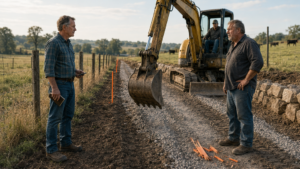
The association had marked the temporary-use strip with short stakes set beyond the drainage clearance. Gary eased the tractor forward, lifted the first bale, and placed it inside the new boundary.
Then the second.
He climbed down and checked the spacing.
The road was clear.
The ditch was clear.
A maintenance tractor could pass without touching them.
Ryan pulled up as Gary was finishing.
“You measured that, didn’t you?”
Gary looked at the stakes.
“Twice.”
“Of course you did.”
Ryan drove on.
Gary remained beside the lane.
The hay bales looked almost exactly as they had on the day Catherine photographed them.
Same white plastic.
Same gravel road.
Same pasture behind them.
But the meaning had changed.
Before, Gary had treated their position as something too small to argue about.
Then he had treated them as proof that Catherine was wrong.
Now they sat inside a boundary everybody could see and everybody had agreed to.
A pickup approached from the opposite direction.
Catherine was driving.
She slowed beside him.
Her window came down.
Gary expected a comment about the markers.
Instead she looked at the bales.
“You left enough room for the mower.”
“Three feet more than the policy requires.”
“I figured.”
There was a pause.
Then Catherine said, “The east culvert held through that rain Tuesday.”
Gary nodded.
“Good.”
She looked down the road.
“We did some things badly.”
Gary waited.
“So did I,” he said.
Catherine looked at him again.
“You paid those fines awfully fast for somebody who knew contracts.”
“I know.”
“Why?”
Gary glanced toward the farm entrance.
“My father used to say neighbors ought to settle things quietly.”
“Sounds reasonable.”
“It is.”
He rested one hand on the tractor fender.
“I just forgot that quiet and settled aren’t always the same thing.”
Catherine considered that.
Then she nodded once and drove away.
Gary watched the pickup disappear around the bend.
He did not feel that he had defeated her.
The road association still had bills.
The ditch would wash again.
Somebody would complain about assessments.
Somebody else would forget a receipt.
Catherine would still live down the lane.
Ryan would still get impatient in meetings.
Gary would still rather be on a tractor than in a room discussing purchasing procedures.
None of that had been fixed forever.
What had changed was smaller and more useful.
The next person who received a fine could point to an actual rule.
The next emergency purchase would leave a record.
The next large contract would require somebody besides one confident person to look at it.
And the next time Gary believed something was wrong, he knew he could no longer pretend that silence was the generous choice simply because it was easier.
He pulled the temporary boundary stake upright where the tractor tire had leaned it.
Then he stepped back.
The two hay bales rested inside the marked strip, the gravel lane open beside them.
Gary climbed into the tractor and went back to work.
The story has ended.