They Called His Irrigation Design Worthless Until the County Opened the Farm Records He Had Kept for Twenty-Five Years
Chapter 1: The Excavator Was Waiting Beside His Headgate
The excavator bucket hung six feet above William Wright’s irrigation ditch when he stepped out of his pickup.
It was not digging yet.
That was the only reason he kept walking instead of shouting.
The machine sat on the narrow strip between his hayfield and the drainage line, its tracks pressed into grass William had mowed three days earlier. Beside it, two workers in reflective vests studied orange stakes driven along the ditch. A white contractor truck blocked half the farm lane.
William looked past all of them to the steel headgate.
Rust showed through its old gray paint. The threaded stem leaned slightly west, just as it had for twenty-five years. Water slid beneath the gate into the shallow channel he had cut, measured, corrected, and cut again long before anyone had started calling it infrastructure.
One worker raised a hand.
“Mr. Wright?”
William stopped at the edge of the gravel.
“That’s my ditch.”
The worker lowered a rolled plan. “We’re aware.”
“Then you’re aware your machine’s on the wrong side of the fence.”
The excavator operator killed the engine.
The sudden quiet made the running water sound louder.
The man with the plan introduced himself only as the site supervisor. William did not offer his hand.
“We’re scheduled to widen the existing irrigation corridor,” the supervisor said. “There’s supposed to be a twelve-foot construction access.”
“There isn’t.”
“It’s on the approved plan.”
William glanced at the orange stakes. They ran beside the ditch, crossed the old headgate, then continued toward the lower pasture where the channel split toward two neighboring farms.
He had seen survey flags farther north the previous week. He had assumed they belonged to the new development beyond Dennis Baker’s place.
He had not assumed anyone would follow them onto his land.
“Show me.”
The supervisor hesitated.
William waited.
He was sixty-five and had spent enough years around cattle, equipment dealers, county inspectors, and men selling things they did not own to know what silence did to people who expected an argument.
The supervisor unrolled the plan across the hood of the contractor truck.
A heavy blue line followed the irrigation channel.
Beside it was a shaded strip labeled as an access corridor.
William leaned closer.
The plan showed the headgate. The lower branch. The bend beside his sycamore. Even the stone spillway he had rebuilt after a flood twelve years earlier.
What it did not show clearly was the boundary between his parcel and the cooperative users downstream.
At the bottom sat a county reference number.
William tapped it.
“What is that?”
“Supporting access record.”
“Whose?”
“The irrigation cooperative’s.”
William looked at him.
The supervisor added, “That’s what we were provided.”
William straightened.
The development company had bought acreage east of the old Baker property the previous winter. Its brochures showed clustered homes, a small commercial greenhouse operation, and enough landscaping to make William wonder where all the water was supposed to come from.
Now he knew.
“You’re not widening this ditch.”
“I’m under contract.”
“And you’re standing on my land.”
The supervisor’s jaw tightened, but he did not become hostile. “Mr. Wright, I don’t decide easements. If there’s a dispute, that needs to happen above me.”
William almost told him exactly where above him the dispute could happen.
Instead he looked at the excavator bucket.
One careless pass could break the old headgate collar. Dig too deep near the turn and the grade would change. Water that had run by gravity for decades would pool where it should move and race where it should slow.
“Lower the bucket onto your side of the fence,” William said. “Then call whoever sent you.”
The supervisor studied him.
“You’re ordering us off?”
“I’m telling you there’s a property dispute before you alter a working water system.”
That wording did it.
The man took out his phone.
William walked back to his pickup while the call was made.
Behind the passenger seat lay his old canvas field bag. The olive fabric had faded almost brown at the seams. One strap had been stitched twice. Inside were notebooks, folded surveys, pencil sketches, rainfall totals, receipts, and measurements he had once meant to organize properly.
He did not reach for it.
He disliked producing papers for people who had already decided what he knew.
For years, cooperative board members had asked him to update diagrams of the system.
William’s answer had always been some version of the same thing.
The ditch is where the ditch is.
The gate is where the gate is.
Anybody who wants to know can come walk it with me.
Nobody had come often enough.
The site supervisor approached.
“We’ve been told to pause physical work pending clarification.”
William nodded once.
“But I need you to understand something. This isn’t going away. The access plan references a county-recognized cooperative system.”
“County-recognized doesn’t make my ground theirs.”
“I’m not saying it does.”
“You brought an excavator.”
The supervisor looked toward the machine.
“Because somebody told us it did.”
That answer stayed with William after the trucks backed out.
By late morning, he had checked the headgate twice and walked the entire upper channel. No dirt had been moved. A few track marks scarred the grass, nothing more.
He should have felt relieved.
Instead, he kept seeing that blue line on the plan.
At twelve seventeen, a county vehicle turned into his lane.
The driver was a records courier, not an inspector. He handed William a large envelope and asked him to sign for delivery.
William read the first page beside his mailbox.
NOTICE OF EMERGENCY ADMINISTRATIVE HEARING.
Two days.
County water-and-land-use office.
The matter concerned proposed modernization of what the notice called the North Branch cooperative irrigation system.
William read the phrase twice.
Then a third time.
The North Branch had never been its name when he built it.
There had been no cooperative then.
There had been a drought, three failing wells, a creek that still carried enough flow if you knew how to move it, and neighbors who needed water.
William turned the page.
The disputed structure was described as “existing cooperative diversion infrastructure.”
He stopped reading.
For twenty-five years, the steel headgate had stood on his parcel.
For twenty-five years, he had repaired it.
For twenty-five years, everyone who used water below it had known where the water came from.
Somewhere along the way, knowing had become assuming.
Assuming had become paperwork.
And paperwork had just arrived with an excavator.
William folded the notice and put it inside the weathered canvas bag.
Chapter 2: The Man Without an Engineer’s Stamp
“Mr. Wright should not be permitted to offer technical conclusions about the design of this system.”
Brandon Martin said it before William had been seated five minutes.
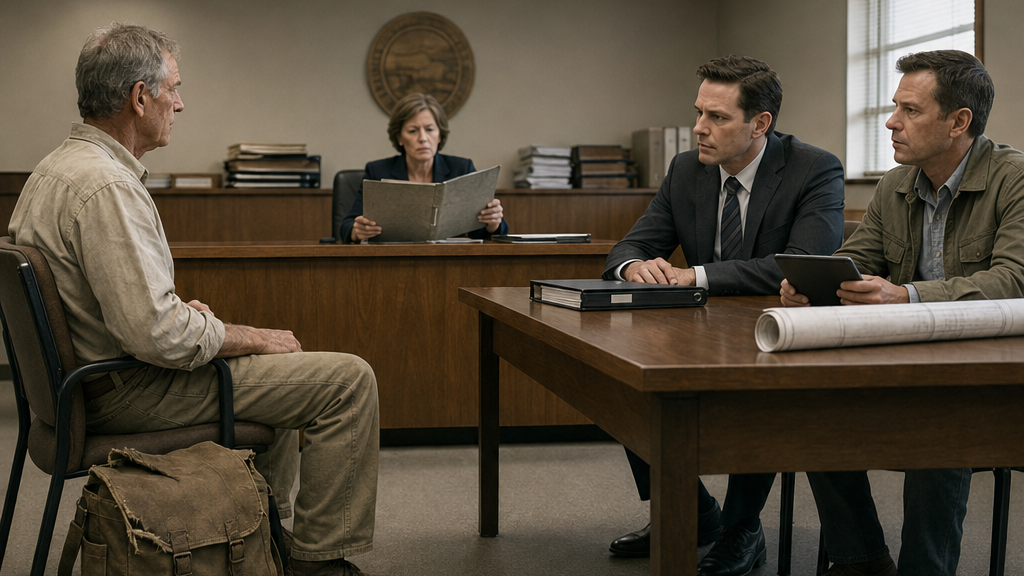
The county hearing room was smaller than William expected. No jury box, no high judge’s bench, no marble. Just fluorescent lights, wood tables, a county seal, and enough binders to make the place feel more official than it looked.
Brandon sat at the opposite table in a charcoal suit with the development-company engineer beside him.
William sat alone.
His canvas bag rested near his right boot.
Rebecca Adams, the hearing chair, looked over her glasses.
“On what basis?”
“Mr. Wright is the landowner of record for the parcel containing part of the existing corridor. That is relevant. But the applicant’s proposed improvements were designed and reviewed by licensed professionals. Mr. Wright is not an engineer.”
William watched Brandon without moving.
Brandon continued.
“We have no indexed county record identifying him as designer of the cooperative system. If he wishes to testify to what he observed on his property, we have no objection. But unsupported technical claims about system authorship, hydraulic design, or historical configuration should be given appropriate limits.”
Rebecca turned toward William.
“Mr. Wright?”
He had prepared several answers in the truck.
None sounded useful now.
“I know where I dug it.”
Brandon’s engineer shifted in his chair.
Rebecca’s expression did not change.
“You designed portions of the system yourself?”
“The part they want to widen.”
“Do you have professional plans?”
“No.”
“Stamped drawings?”
“No.”
“Surveyed construction records?”
William considered the question.
“Depends what you mean by construction records.”
Brandon leaned back slightly.
There it was: the first small sign of satisfaction.
William recognized it.
People often heard his short answers and mistook them for the limits of what he knew.
Rebecca asked, “Do you have records with you?”
William glanced down at the canvas bag.
“Yes.”
“Would you like them marked for review?”
“Not yet.”
That changed the room more than if he had opened the bag.
Brandon’s eyebrows rose.
Rebecca studied William for a moment. “Why not?”
“Because the county says this is cooperative infrastructure. I’d like to see what the county relied on before I explain what’s in my bag.”
For the first time, Brandon stopped arranging the papers in front of him.
Rebecca nodded slowly.
“That is a reasonable request.”
Brandon objected that the emergency hearing concerned construction access, not historical authorship. Rebecca allowed him to proceed.
He did.
For nearly twenty minutes he built a tidy version of the world.
The development company had acquired land east of the existing agricultural parcels. The planned project required a reliable irrigation and stormwater-management connection. Cooperative records showed longstanding shared use of the North Branch system. Engineers had surveyed the current channel and proposed improvements rather than replacement. The county map database depicted the corridor as serving multiple parcels.
Nothing Brandon said sounded absurd.
That bothered William more than a lie would have.
The engineer displayed a current map.
The blue line was there again.
A wider shaded corridor surrounded it.
“The proposed work does not eliminate Mr. Wright’s agricultural use,” Brandon said. “It improves conveyance capacity for all lawful users.”
William finally spoke.
“Who told you where the old diversion started?”
Brandon looked toward him.
“Mr. Wright, questions can be directed through the chair.”
Rebecca said, “Answer if you can.”
The engineer leaned toward his microphone. “Current field survey and cooperative mapping.”
“Current,” William said.
“Yes.”
“What year is the oldest map you used?”
The engineer glanced at Brandon.
Brandon checked a binder.
“Two thousand nine.”
William nodded.
Nothing else.
Rebecca noticed.
“You believe there are earlier records.”
“I know there are.”
Brandon said, “If Mr. Wright has them in his possession—”
“I asked about the county’s.”
Silence.
Rebecca turned toward the records clerk seated against the wall.
“Do we have historical irrigation files associated with Mr. Wright’s parcel?”
The clerk typed.
A minute passed.
Then another.
William could hear the soft mechanical hum from the overhead vent.
The clerk frowned at the screen.
“There’s an archived reference under the parcel number. Pre-digital conversion.”
“Can it be retrieved?”
“Physical file.”
Rebecca looked at the clock.
“Retrieve it.”
Brandon exhaled through his nose.
“This may be outside the scope of today’s emergency review.”
“If the applicant is relying on historical shared infrastructure,” Rebecca said, “then the historical record is within scope.”
No one spoke after that.
The clerk disappeared through a side door.
William kept his hands on the table.
He did not touch the bag.
Twenty-five minutes later, the clerk returned carrying a thin gray folder whose corners had gone soft.
Rebecca opened it.
The first pages were old inspection forms.
Then she stopped.
Her eyes moved from one page to another.
Brandon leaned slightly forward.
William knew that expression too.
Not fear.
Calculation.
Rebecca pulled out a faded photocopy of a hand-drawn channel.
“What is the date on this?”
The clerk came closer.
“September, nineteen ninety-nine.”
Rebecca looked at William.
“Mr. Wright, was this system in place then?”
“Most of it.”
She traced the drawing with one finger.
The diversion point was marked on William’s parcel. The headgate dimensions were written beside it. A narrow branch ran east toward the neighboring farms.
William could see the crooked notation even from across the table.
Twenty-four inch gate.
Thirty-inch throat.
He had written those numbers so many times he could feel the pencil in his hand.
Rebecca asked, “Do you recognize this configuration?”
“Yes.”
“Why?”
“I built it.”
Brandon spoke immediately.
“With respect, recognition of an old sketch does not establish authorship.”
William looked at him.
“No.”
That seemed to surprise Brandon.
William continued.
“But the steel gate outside is twenty-four inches wide. The throat is thirty. The first bend is one hundred sixty-three feet below it. You can measure all three.”
The development engineer looked down at his own survey.
William saw him find the numbers.
The engineer’s face changed first.
Only a little.
But enough.
Rebecca asked, “Do the current measurements correspond?”
The engineer cleared his throat.
“Approximately, yes.”
“Approximately?”
“Within normal field variation.”
Rebecca placed the old drawing flat on the table.
The room no longer felt arranged around Brandon.
It felt arranged around the sheet of paper.
William still had not opened his bag.
Rebecca turned to the clerk.
“Is there anything identifying the preparer?”
The clerk checked the reverse side.
“No formal engineering block.”
Brandon’s posture eased.
Then Rebecca lifted the next page.
It was a county inspection note.
Her eyes moved down the page.
“Site contact,” she read quietly. “William Wright.”
Brandon said nothing.
Rebecca continued reading.
“Owner-installed diversion and agricultural distribution channel.”
William looked toward the blank wall behind her instead of at Brandon.
The words did not prove everything.
He knew that.
They did prove one thing.
He had not walked into the hearing as a confused old farmer objecting to infrastructure designed by somebody else.
Rebecca seemed to understand the same distinction.
“Mr. Martin, I am not excluding Mr. Wright’s technical testimony.”
Brandon adjusted his cuff.
“Understood.”
“We will determine weight as the record develops.”
“Of course.”
Rebecca returned to the gray folder.
Several minutes passed while the clerk helped her sort the contents by date.
Then Rebecca pulled out a document from a much later year.
Unlike the faded inspection page, this one carried a cooperative letterhead.
William saw his name before she said it.
He also saw his signature at the bottom.
Rebecca looked up.
“Mr. Wright, we have a subsequent maintenance agreement here describing shared irrigation access.”
Brandon turned the page toward himself.
The satisfaction returned, more carefully this time.
William stared at his own handwriting.
He remembered signing something.
He did not remember that wording.
Chapter 3: His Own Signature Changed the Room
“Yes,” William said. “That’s my signature.”
No one had asked him yet.
Rebecca had only set the document between them.
But denying the obvious would have been worse than whatever was written above his name.
Brandon slid a copy from his binder.
“You signed this in August of 2002?”
William looked at the date.
“That appears right.”
“And the agreement refers to shared access to the North Branch irrigation system.”
“I can read.”
Rebecca gave William a warning look that was mild but unmistakable.
He leaned back.
Brandon continued.
“The cooperative relied on this agreement for maintenance, access, and distribution for more than two decades. Correct?”
“I don’t know what the cooperative relied on.”
“You were a participant.”
“For a while.”
“You signed the agreement.”
“I already said that.”
Brandon turned the page so the relevant paragraph faced Rebecca.
The language was broad.
Shared access for maintenance and continued irrigation service.
Reasonable entry to preserve conveyance.
Cooperative coordination of repairs.
William read it twice.
A pressure started behind his ribs that had nothing to do with Brandon.
He remembered the summer.
He remembered the dry creekbanks, cattle standing under shade with their ribs too visible, and Dennis Baker’s father driving over after dark because the lower well had stopped recovering.
He remembered paperwork.
But not like this.
Rebecca asked, “Did you understand this to authorize shared maintenance?”
“Yes.”
“Entry onto your property?”
“For the ditch, when something needed fixing.”
“Continued water delivery?”
“To the farms already using it.”
Brandon caught the qualifier.
“The document does not appear to say ‘farms already using it’ in this paragraph.”
William read the page again.
“No.”
“Nor does it say the access terminates if ownership downstream changes.”
“No.”
Brandon sat back.
The development engineer stopped looking uncomfortable.
The room had tilted again.
This time away from William.
Rebecca called for a short recess.
William carried his bag into the hallway but did not open it.
Dennis Baker was waiting near a vending machine.
He wore work boots and a denim shirt, and he looked as if he would rather be repairing fence than standing inside a county building.
“You all right?” Dennis asked.
“Fine.”
Dennis glanced toward the hearing room.
“That agreement’s real.”
“I noticed.”
“My dad relied on it.”
William looked at him.
Dennis did not retreat.
“So did the farm south of us. When you changed that branch after the flood, we all chipped in.”
“You chipped in for gravel and pipe.”
“And labor.”
“Doesn’t make it yours.”
“I didn’t say it did.”
William turned toward the window.
Outside, county employees crossed a parking lot carrying coffee and folders, unaware that a sentence written twenty-four years earlier had just shifted the control of several acres.
Dennis lowered his voice.
“William, people have treated that ditch as shared for a long time.”
“People using something isn’t the same as owning it.”
“I know.”
“Do you?”
Dennis’s expression hardened.
“My cattle drank that water in 2002 because you opened it to us.”
William looked back at him.
“I didn’t open it to a subdivision.”
“No. You didn’t.”
That distinction should have helped.
Instead Dennis added, “But you never wrote down half the things you told people.”
William said nothing.
“You remember when the cooperative asked for updated maps?”
“They had maps.”
“They had old maps.”
“The water didn’t care.”
Dennis gave a tired laugh without humor.
“That’s exactly what you said then.”
The hearing resumed.
Dennis was asked to describe how the system had been used.
He did not betray William.
That would have been easier.
He told the truth.
The diversion originated on William’s land.
William had done most of the early design and construction.
Neighboring farms had helped with later repairs.
For years, cooperative members entered the corridor when pipes clogged or banks washed out.
Nobody asked William for fresh written permission every time.
“Because you believed the agreement provided ongoing access?” Brandon asked.
Dennis paused.
“For the farms using it, yes.”
“Did Mr. Wright ever tell the cooperative, in writing, that access was temporary?”
“Not that I saw.”
“Did he provide revised written restrictions?”
“No.”
William kept his eyes on the tabletop.
There it was.
Not theft.
Not conspiracy.
Not even necessarily deception.
A gap.
And he had helped leave it open.
Rebecca ended the hearing for the day with a temporary order: no excavation until the record could be clarified, but no determination of ownership or access had been made.
It was not a loss.
It did not feel like a win.
William drove home with the canvas bag on the passenger seat.
At the farm he did not go to the house.
He went to the equipment shed.
Dust lay along the upper shelves. A broken grease gun hung from a nail. Old fencing tools shared space with coffee cans full of bolts.
William put the county copy of the agreement on his workbench.
Then he opened the canvas bag.
Inside were notebooks in no sensible order.
Green cover. Black cover. Spiral-bound pad with half the cardboard backing gone.
He found 2004 first.
Then 2001.
Then a folder of receipts.
Nothing from the drought year.
He emptied the bag completely.
Pencils.
An old pocket level.
Two folded aerial photographs.
A gasket invoice.
Rainfall totals written on feed-store calendars.
No agreement.
William sat on an overturned bucket.
He tried to remember signing it.
Not the hearing-room version of remembering, where a date and signature told him something had happened.
The actual day.
Heat.
Dust.
Someone had brought a portable fan into the cooperative office.
Dennis’s father had been there.
Two other farmers.
They had needed a way to share maintenance because nobody could afford for the ditch to fail.
William remembered disagreeing with one sentence.
He remembered insisting that something be added.
Then he remembered a second page.
Not a full page.
An attachment.
Parcel numbers.
Existing users.
He stood so quickly the bucket tipped over.
The old agreement would not have stayed in the bag. Not then. He had kept signed originals in a metal file box on the shelf above the welding table.
He dragged the box down.
Tax receipts.
Equipment titles.
Old cooperative notices.
At the bottom, folded beneath an envelope of soil-test reports, was his copy.
William laid it beside the county version.
Same first page.
Same wording.
Same signature.
He turned his copy over.
Nothing.
He felt the first drop of certainty leave him.
Then he noticed two small rust marks near the upper left corner.
Staples.
Not one.
Two.
The county copy had the same holes, faint but visible.
Something had once been attached to both.
William held his page beneath the shop light.
Along the back was a pale rectangular shadow where another sheet had rested against it for years.
He could not remember the exact language.
But he remembered insisting on it.
Existing agricultural parcels.
Drought use.
No expansion without owner approval.
Or words close enough to those that his chest tightened.
The missing page did not prove his memory.
It proved only that the agreement in front of the county was incomplete.
William looked at the pile of old notebooks spread across the bench.
Somewhere among twenty-five years of things he had considered too obvious to explain, there might be another reference.
For the first time since the excavator arrived, he understood that being right would not be enough.
He would have to prove what he had once been too stubborn to keep organized.
He picked up the agreement again.
The empty staple holes were small.
But now they were the most important marks on the page.
Chapter 4: The Drought Agreement Was Never the Whole Deal
The notebook William wanted was not in the canvas bag.
He found it at seven the next morning behind a stack of seed catalogs in the equipment shed, its green cover curled from years of damp air and one corner darkened by grease.
Across the front, in his own block handwriting, were two words:
DRY YEAR.
William stood beneath the bare shop light and opened it.
The first pages were rainfall totals.
April: 1.7.
May: .9.
June: .3.
After that, he had stopped bothering with decimals on some days and written things like NOTHING AGAIN and CREEK DOWN 4 INCHES.
Farther in were measurements.
Gate opening.
Channel width.
Elevation drops calculated with a borrowed builder’s level.
Then came parcel sketches.
William pulled his stool closer.
He had forgotten how crude the drawings looked.
Not wrong. Crude.
Lines angled across pages crowded with numbers. Arrows marked flow direction. Circles identified culverts. Beside one branch he had written BAKER LOWER FIELD. Beside another, SOUTH PASTURE ONLY.
The farther he read, the more that summer came back.
The creek had been low enough to cross in work boots without wetting the tops. Two shallow wells downstream had nearly failed. William had spent evenings walking the channel with a flashlight, looking for places where a half inch of unnecessary rise could steal water from somebody farther down.
He had not thought of it as designing an irrigation system.
He had thought of it as keeping water moving.
Near the middle of the notebook, a folded feed receipt marked a page.
William opened it.
There, beneath a list of gate settings, was a sentence he had written in pencil:
SHARED DROUGHT MAINT.—EXISTING FARMS ONLY. NO NEW TAKEOFF WITHOUT W.W. APPROVAL.
He read it again.
Not the missing attachment.
But close enough to prove his memory had not invented the limitation overnight.
William tore nothing out. He slid a piece of scrap paper between the pages and closed the notebook.
By nine, he was walking the ditch.
The water was lower than it had been earlier in the week, but steady. At the first branch he stopped beside an old galvanized pipe collar half hidden in grass.
That branch had been added during the drought.
Dennis’s father had helped dig it.
The south branch had come two weeks later.
There had been no development company, no engineered corridor, no promise that any future owner could enlarge the system for any future use.
Just farms trying not to lose livestock and hay.
A truck door slammed near the lane.
Dennis Baker came down the slope carrying two coffees.
William looked at them.
“You planning to stay awhile?”
“Depends whether you start yelling.”
“I don’t yell.”
Dennis handed him one cup.
“That’s worse sometimes.”
William took it.
They stood beside the ditch without drinking.
Finally William said, “I found my drought notebook.”
Dennis looked at him.
“It says existing farms.”
“Your notes say that?”
“Yes.”
“Agreement?”
“Not the page I need.”
Dennis rubbed his jaw.
William watched him.
“You remember it?”
Dennis stared at the water.
“I remember there was an attachment.”
“That’s not what I asked.”
Dennis sighed.
“My dad talked about it. Said you were worried somebody would buy acreage and turn one farm connection into ten.”
William’s grip tightened around the paper cup.
“That sounds like me.”
“It does.”
“Then why didn’t you say that yesterday?”
“Because I don’t remember the language. I remember what my dad said. That’s different.”
William looked away.
He did not like the answer.
Which was probably why it was the right one.
Dennis crouched beside the headgate branch and pulled a stem of grass loose.
“You want another thing you’re not going to like?”
“No.”
“I’m telling you anyway.”
William waited.
“The cooperative asked you to update the maps after the flood.”
“I remember.”
“And again when the south farm changed hands.”
“They knew where the pipes were.”
“That wasn’t the question.”
William drank the coffee. It had already gone lukewarm.
Dennis continued.
“You kept telling everybody the same thing. Walk the ditch. Look at the gate. Ask me if you don’t understand.”
“Worked for twenty years.”
“Until you weren’t the only person who needed to understand it.”
William’s jaw set.
Dennis stood.
“I’m not saying Brandon’s right. I’m saying the paperwork got sloppy because we all let it get sloppy. You more than most, because everybody figured you knew it.”
“I did know it.”
“That’s the problem.”
William turned on him.
Dennis did not step back.
“If you’re the only man who knows what something means,” Dennis said, “then everybody else is left guessing when you won’t write it down.”
For a few seconds, the only sound was water brushing the channel grass.
William wanted to answer.
He had several answers.
The cooperative could have kept better records.
The county could have asked him.
New owners could have walked the ground instead of trusting maps.
Brandon could have called before bringing an excavator.
All of those things were true.
None erased what Dennis had said.
William looked down at the ditch.
“I wasn’t trying to hide anything.”
“I know.”
“I got tired of explaining things to people who acted like I needed permission to understand my own farm.”
“I know that too.”
Dennis’s voice softened.
“But being tired doesn’t make the paper clearer.”
Later that morning, they drove to the cooperative office.
Two board members met them at a metal table beneath a wall map that had been revised so many times the parcel lines looked darker than the roads.
William spread out the drought notebook.
Nobody laughed at it.
Nobody called it worthless.
One board member pointed to the pencil notation about existing farms.
“That helps.”
“Helps isn’t proves,” William said.
“No.”
William almost snapped back.
Then stopped himself.
The board member was right.
His notebook showed what William believed the arrangement meant. It did not establish what everyone had signed.
They opened storage boxes.
Old invoices.
Pump-repair receipts.
Meeting minutes.
Insurance documents.
Nothing contained the missing attachment.
One set of minutes from 2008 referred to “continued shared irrigation maintenance under existing agreement,” but no limitations were restated.
William stared at the sentence.
That was how meaning disappeared.
Not all at once.
One shorthand reference at a time.
By afternoon, the canvas bag lay open on the cooperative table.
For years William had treated its contents as enough.
Now, with other people turning the pages, he could see what it really was: a record made for one man’s memory.
Dates without explanations.
Measurements without titles.
Initials everybody once knew.
Practical truth, but not always durable truth.
He found another drought-year notebook near the bottom.
On a page listing repairs, one line was written darker than the others.
COPY OF ACCESS LIMITS LEFT WITH COUNTY INSPECTOR—8/19.
William froze.
Dennis leaned closer.
“What?”
William tapped the line.
The cooperative board member read it aloud.
“County inspector.”
William felt something shift.
They had been searching for the missing page as though the only surviving copy had to be in his shed or the cooperative files.
But during the drought, the county had inspected the diversion after complaints about reduced downstream flow.
William remembered the inspector now.
A white pickup.
Clipboard.
A long argument about whether temporary branches required additional approval.
He remembered handing over copies.
Not the originals.
Copies.
Dennis looked at him.
“You think they kept it?”
William closed the notebook carefully.
“I think Friday we find out.”
Chapter 5: The County Copy Had One Extra Page
The records clerk placed the missing page beside William’s signed agreement without saying a word.
It was thinner than he remembered.
One sheet.
No dramatic seal.
No bold title.
Just typed parcel references, a date, and three numbered limitations.
William sat forward.
Across the table, Brandon Martin stopped whispering to the development engineer.
Rebecca Adams read the attachment once.
Then again.
The county archive room had opened early at Rebecca’s request. By nine, the document had been copied into the hearing record and everyone was back in the same fluorescent-lit room where William’s signature had nearly settled the matter two days earlier.
Rebecca adjusted the page.
“Mr. Wright, is this the attachment you remembered?”
William looked at the third paragraph.
Any expansion of irrigation service beyond the agricultural parcels identified herein requires separate written consent of the diversion-property owner and applicable county approval.
“Yes.”
Brandon said, “We should establish chain of custody before characterizing it.”
Rebecca nodded.
“We will.”
The clerk explained that the attachment had been filed with an inspection report, not with the cooperative agreement itself. During later digitization, the inspection file had been indexed under William’s parcel while the agreement had been indexed under the cooperative.
Two records.
Two systems.
One agreement split between them.
No one had removed anything.
No one had hidden anything.
The county had simply stored related pages in different places.
William found that almost more troubling than sabotage would have been.
Rebecca asked the clerk to read the first limitation.
“Shared maintenance access applies to the agricultural parcels listed below.”
The second limited work to maintaining existing conveyance unless otherwise approved.
The third required William’s written consent for expansion to additional parcels.
Brandon rubbed one thumb along the edge of his legal pad.
When Rebecca finished, he said, “This changes our position regarding automatic expansion rights.”
William looked at him.
Brandon did not look embarrassed.
He looked busy.
“But it does not resolve ownership of the current system.”
Rebecca turned toward him.
“Explain.”
Brandon nodded toward the development engineer.
“The attachment concerns the 2002 configuration. The system in the field today is not the 2002 configuration.”
William knew what was coming before the engineer stood.
The flood.
The replacement branch.
The larger culvert.
The reinforced spillway.
Twenty-four years of repairs.
The engineer displayed two aerial images on a screen.
One from the early 2000s.
One recent.
“The present channel has been modified repeatedly,” he said. “Its width has changed. Several connections have been replaced. The lower distribution geometry is different. Cooperative funds and labor contributed to some of those improvements.”
William said, “Repairs.”
“Some appear to be more substantial than repairs.”
“Such as?”
The engineer pointed.
“This branch alignment.”
“Flood took the old one.”
“And this widened section?”
“Bank collapsed.”
“This culvert?”
“Old one rusted through.”
The engineer nodded.
“I’m not disputing your reasons. I’m saying the physical system evolved through shared work.”
Brandon took over.
“Our position is narrower now. We are not claiming this attachment grants the development unrestricted expansion rights.”
William heard the word now.
It was a retreat.
Just not a surrender.
Brandon continued.
“But if the present irrigation network became, through decades of cooperative modification and joint maintenance, functionally distinct from Mr. Wright’s original installation, then an ownership determination cannot rest solely on the 1999 drawing or this 2002 limitation.”
William stared at him.
“That gate’s still mine.”
Brandon looked back.
“Perhaps. But the applicant is not asking to remove the gate. It is asking to improve a system that multiple properties have maintained and relied upon.”
“That system starts at my gate.”
“Which is exactly what needs to be established.”
William nearly laughed.
They had a county record saying he installed the diversion.
They had the missing agreement saying new parcels needed his consent.
Yet the argument had not disappeared.
It had changed shape.
Rebecca seemed to see his frustration.
“Mr. Wright, the attachment is significant.”
“Doesn’t sound significant.”
“It is.”
“Then why is his excavator still waiting?”
“Because a document can establish a restriction without answering every physical question about what exists today.”
William leaned back.
There was the institutional language he hated.
Accurate enough to resist.
Slow enough to make a man feel as if truth had to stand in line.
Rebecca turned to Brandon.
“The development may not proceed under an assumption of automatic cooperative expansion authority.”
Brandon nodded.
“That is understood.”
“Construction remains stayed.”
Another small victory.
William felt almost nothing.
Rebecca continued.
“We now need to determine whether the proposed work affects infrastructure belonging to Mr. Wright, cooperative infrastructure, or some combination.”
The engineer offered to submit a technical history.
William shook his head.
Rebecca noticed.
“You disagree?”
“He’ll compare pictures.”
“He’ll compare surveys.”
“Pictures and surveys of what’s there now.”
Rebecca waited.
William thought of the measurements in the old gray folder.
Twenty-four-inch gate.
Thirty-inch throat.
One hundred sixty-three feet to the bend.
He thought of the drought notebook.
The slope notes.
The branch locations.
He finally opened the canvas bag.
Not dramatically.
He simply lifted it onto the table and removed three notebooks.
The room watched anyway.
William opened the oldest one.
“I can show where it started.”
Brandon glanced at the development engineer.
William continued.
“Not because I remember every shovel of dirt. Because I measured it while I was building it.”
Rebecca leaned forward.
“What measurements?”
“Gate width. Channel fall. Branch distances. Culvert locations. Every change I made for the first four years.”
The engineer said, “Those are contemporaneous field notes?”
“That what you call them?”
“If they were created at the time.”
William slid one notebook across.
“They were.”
The engineer turned pages.
His expression tightened.
Not disbelief.
Interest.
He found a hand-drawn profile showing elevation drop along the upper channel.
“Did you establish these elevations yourself?”
“With a builder’s level.”
“Bench point?”
“North fence-post footing. Concrete corner.”
The engineer looked at him sharply.
“That still exists?”
“Yes.”
Brandon asked, “How do you know?”
“Because I poured it.”
That earned no laughter.
William did not want laughter.
Rebecca asked the survey technician seated behind the clerk whether the original benchmarks and dimensions could be compared with the current field condition.
The technician said they could, if access were provided across all affected parcels.
William answered before anyone asked.
“You have mine.”
Dennis, seated behind him, said, “You have ours too.”
One of the cooperative board members agreed for the lower corridor.
Brandon consulted quietly with his engineer.
Then he said, “The applicant has no objection to a joint site inspection.”
Rebecca set a date for Monday.
Survey technician.
Development engineer.
Cooperative representative.
William.
County staff.
No excavation.
No alterations.
The old and new systems would be measured against the historical records.
As the hearing ended, Brandon gathered his papers.
William put the county copy of the missing attachment into his canvas bag.
Brandon paused beside his table.
“You understand this could still show substantial cooperative modification.”
William looked up.
“Yes.”
“And if it does?”
“Then we deal with what it shows.”
Brandon studied him for a second, perhaps expecting more.
William gave him nothing.
Outside, Dennis caught up near the stairs.
“You feeling better?”
“No.”
“You got the page.”
“We got a page.”
Dennis smiled faintly.
“That sounds like you.”
William looked back toward the county building.
For two days he had wanted paper to settle what everybody should have known.
Now the paper had done something else.
It had forced them back onto the land.
On Monday morning, the county would measure the old headgate, the branch distances, the slope, and the concrete benchmark William had poured before the cooperative even had a name.
If those measurements matched, his notebooks would stop being one man’s memory.
If they did not, William would have to face the possibility that the system beneath his feet had become something different while he was busy insisting it had never changed.
Chapter 6: The Old Headgate Answered What Paper Could Not
The survey technician planted his rod beside the steel headgate, checked the instrument, and frowned.
“Run that property line again.”
The assistant moved twenty feet uphill.
William stood beside his canvas bag and said nothing.
Brandon Martin was there in work shoes instead of polished office leather. The development engineer carried a tablet. Dennis Baker stood near the fence with two cooperative board members.
Rebecca had sent a county field officer to observe, but no one was conducting a hearing.
The ground was doing that.
The technician checked the reading again.
Then he walked toward the orange stakes left by the construction crew.
“This assumed corridor is off.”
Brandon looked up.
“How far?”
“Depends which feature you’re calling the corridor centerline.”
“The existing diversion.”
The technician pointed toward the headgate.
“The oldest control structure is almost seven feet west of the mapped cooperative centerline.”
The development engineer crouched beside the gate.
“Could it have been moved?”
William answered.
“No.”
The engineer looked at him.
“You’re certain?”
William pointed to two concrete shoulders buried beneath grass.
“Poured around the original frame. Move the gate, you break those.”
The technician scraped soil from one edge.
Old aggregate appeared.
He measured.
Twenty-four inches.
Then the throat.
Thirty.
The engineer opened William’s 1999 field notebook.
“Same dimensions.”
Nobody said anything for a moment.
William had imagined this scene several ways since Friday.
In none of them did victory feel so quiet.
The technician moved downstream.
At the concrete fence-post footing William had used as his benchmark, they established elevation.
Then they measured the first bend.
One hundred sixty-two feet, ten inches.
William’s notebook said one hundred sixty-three.
Dennis let out a low breath.
The engineer looked at William.
“What did you use for distance?”
“Hundred-foot tape.”
“By yourself?”
“Mostly.”
The engineer nodded as though that answer made sense now.
They continued.
Not everything matched.
The flood-rebuilt section was wider.
One branch had shifted.
A later culvert sat four feet south of William’s original note.
Cooperative work had changed the system.
Brandon pointed that out without triumph.
“So we agree the current network is not entirely original.”
William wiped mud from his boot.
“Never said every pipe was.”
“The question is where original ownership ends and cooperative infrastructure begins.”
“The question you came here with was whether you could widen my diversion.”
Brandon looked toward the old headgate.
“That question is becoming easier.”
It was the closest thing to a concession William had heard from him.
Near noon, the group reached the lower split where water divided toward Dennis’s land and the south farm.
The development engineer compared current flow with William’s old routing sketch.
“This geometry matters,” he said.
Brandon asked why.
“Because the upper channel establishes the available head. If you widen upstream without adjusting the throat and lower branch grades, you could reduce effective delivery here.”
William looked at the excavator parked far up the field.
That was what he had been trying to tell them on Monday.
Not in those words.
But exactly that.
The engineer continued.
“The proposed plan assumed the upper corridor was simply undersized shared conveyance. That assumption is not supported by these measurements.”
Brandon’s mouth tightened.
“Meaning?”
“Meaning the old diversion is not an arbitrary bottleneck. It appears intentionally proportioned.”
William bent, picked up a small stick, and traced the channel section in damp soil.
“Too much water here,” he said, “and it piles at the bend. Cut this side deeper, Baker gets more and south loses pressure when the creek drops.”
The engineer watched.
William drew the throat.
“Gate controls volume. Throat controls speed. Slope controls whether either of them matters.”
Brandon said, “You calculated that?”
“No.”
The engineer looked surprised.
William tapped the dirt.
“I adjusted it until it worked. Then measured what worked.”
Something in the engineer’s expression changed.
Not admiration.
Recognition.
The difference mattered to William.
They moved back toward the headgate for the final measurement.
Dennis walked beside him.
“You were right,” Dennis said.
William kept walking.
“That sounded painful.”
“It was.”
Dennis kicked a stone from the path.
“Don’t enjoy it yet.”
William glanced over.
Dennis stopped.
“You were right about building it. Right about the expansion. Right that nobody had permission to treat this place like a public trench.”
William waited.
“But I was right too.”
There it was.
William looked toward the others.
They were close enough to hear.
Dennis did not lower his voice.
“You left everybody guessing.”
William’s face hardened.
Dennis continued.
“My dad knew what you meant. I mostly knew. The old board knew. Then people retired. Land changed hands. New board members got one page instead of two. You kept saying anybody confused could come ask you.”
“They could have.”
“And what happens when you’re not here?”
William said nothing.
Dennis pointed toward the canvas bag.
“All that was in there.”
“Yes.”
“For twenty-five years.”
“Yes.”
“And half of us didn’t know it existed.”
William looked at the bag.
He wanted to tell Dennis that people should keep their own records.
That nobody was entitled to his notebooks.
That he had already done enough when he kept water flowing through the drought.
Then he looked downstream.
Two farms still depended on the branches.
Not the development.
Farms.
Families who had maintained their side of the system for years under an arrangement William himself had allowed to become ordinary.
The county field officer approached with the preliminary measurement sheet.
“The old diversion and upper channel substantially correspond to Mr. Wright’s historical notes,” she said. “Later shared modifications begin farther downstream than the proposed construction plan assumed.”
Brandon read the sheet.
“So the development’s planned access corridor crosses infrastructure the county currently has no basis to classify as cooperative property.”
“That would be my preliminary reading.”
William should have felt the argument end.
Instead Brandon asked the question that mattered next.
“If Mr. Wright withdraws consent for the upper diversion entirely, what happens to existing downstream users?”
The engineer looked toward the ditch.
“They lose supply.”
Dennis said nothing.
William did.
“I’m not shutting their water off.”
Everyone turned toward him.
Brandon folded the measurement sheet.
“Then some form of access still has to exist.”
“For maintenance.”
“And conveyance.”
“For the farms that already have it.”
“The development needs a solution too.”
William looked across the pasture toward the distant graded acreage.
“That one isn’t this ditch.”
Brandon’s jaw shifted.
“A separate route will cost money.”
“So would rebuilding this after you ruin the grade.”
“I’m not disputing the technical issue anymore.”
That stopped William.
Brandon glanced at the development engineer, then back at him.
“But the project has financing deadlines, contracted water assumptions, and permits built around this connection. I was given cooperative records that appeared to support it.”
“You were also given my property line.”
“Yes.”
“And you sent an excavator anyway.”
Brandon held his gaze.
“Yes.”
No excuse.
No speech.
Just responsibility.
William respected that more than he wanted to.
The field officer asked what position each party intended to take before the final county session.
Brandon said the development would withdraw its claim to automatic expansion rights but wanted negotiations for either a separate engineered connection or a compensated agreement.
Dennis said the cooperative wanted continued access for historic agricultural users.
Then everyone looked at William.
For most of the week, he had carried one answer.
No.
No widening.
No new users.
No assumptions.
No one crossing his land because a map said they could.
Now he could see what that answer would do if he stretched it far enough.
Protecting his ownership did not require pretending Dennis’s farm had never relied on the ditch.
Being right about Brandon did not make William right about everything.
He bent beside the headgate and turned the steel wheel a quarter turn.
Water changed pitch beneath it.
A little louder.
A little faster.
The same movement he had made thousands of times.
“I won’t give the development an easement through this corridor,” he said.
Brandon’s expression closed.
William continued.
“And I’m not closing the historic farm branches.”
Dennis looked at him.
The field officer asked, “Then what are you proposing?”
“I don’t know yet.”
Brandon exhaled.
“The final session is next week.”
“I know.”
William picked up the canvas bag.
For once, it felt heavier because of what was missing from it rather than what it held.
“I spent twenty-five years thinking everybody should know what I meant because I knew what I meant.”
Dennis said nothing.
William looked downstream.
“I’m not doing that again.”
He walked back toward the pickup carrying the notebooks, the missing county attachment, and one question he could no longer avoid.
If he refused the development and refused to abandon the neighbors, then the next set of rules could not live in his head or in an old canvas bag.
He would have to write them himself.
Chapter 7: He Finally Put the Rules in Writing
William arrived at the final county session carrying a folder instead of an objection.
The canvas bag was with him too, but for the first time since the excavator had appeared beside his headgate, it was not the thing he intended to rely on.
He laid three typed copies on the table.
Brandon Martin looked at them, then at William.
“You drafted something?”
“With help checking the wording.”
Rebecca Adams took the first copy.
The room settled.
Dennis Baker sat behind William with the two cooperative board members. The development engineer had returned. The county records clerk had already placed the old agreement, the missing attachment, the field inspection measurements, and William’s historical notebooks into the administrative file.
A week earlier, William had walked into this room expecting to defend something he believed everybody should already understand.
Now he had written it down.
Rebecca read silently for several minutes.
William kept his hands flat on the table.
Brandon finished first.
“This rejects the proposed development easement.”
“Yes.”
“It also grants continued access to existing agricultural users.”
“Yes.”
Brandon turned a page.
“And requires the development to establish a separate engineered route unless Mr. Wright later agrees in writing to another connection.”
“That’s what it says.”
Brandon leaned back.
The old William would have added something sharp.
Something about reading.
Something about excavators.
Instead William waited.
Rebecca looked up.
“Mr. Wright, explain the distinction you’re proposing.”
William glanced at Dennis.
Then toward the development engineer.
“The farms that were using the branches when the drought agreement was signed keep using them. They get reasonable maintenance access. Same general purpose. Same parcels unless we all agree otherwise.”
“And the development?”
“Is new.”
Brandon said, “The development parcel includes acreage formerly associated with an agricultural tract.”
William nodded.
“I know.”
“So your line is not simply parcel history.”
“No.”
“What is it?”
William looked at the copy in front of him.
“Use.”
Brandon waited.
William continued.
“The old agreement helped working farms that already depended on the system. It didn’t promise unlimited capacity to whoever bought land later.”
Rebecca tapped the proposal.
“And maintenance responsibility?”
“Shared by the agricultural users according to the parts they benefit from. Major work at the diversion needs my written approval. Emergency work can happen without waiting if the water is threatening property, but I get notified.”
One cooperative board member raised a hand slightly.
“What about routine clearing?”
“Covered.”
“Gate replacement?”
William hesitated.
The question was small.
That was what made it important.
Twenty-five years earlier, he would have answered from memory and expected everyone else to remember.
He found the section.
“Replacement in kind is maintenance. Changing dimensions or flow capacity is an alteration.”
Dennis smiled faintly behind him.
William did not turn around.
Rebecca continued through the proposal.
The county’s preliminary findings had already separated the old diversion from the later cooperative modifications. William’s historical measurements, the original inspection file, and the field reconstruction established that he had designed and installed the upper diversion on his parcel. Cooperative work had later modified downstream sections, but those changes had not converted the original headgate or upper channel into unrestricted cooperative property.
The missing attachment established something equally important.
Shared use had been real.
So had its limits.
Rebecca looked toward Brandon.
“Does the applicant continue to assert an existing right to expand service through Mr. Wright’s diversion?”
“No.”
The answer came without hesitation.
William looked at him.
Brandon folded his hands.
“Based on the complete historical record and field findings, no.”
There was no apology.
William discovered he did not need one.
Rebecca asked, “Then what remains disputed?”
“Feasibility and timing.”
Brandon turned toward William.
“A separate route will require redesign, additional permitting, and likely a revised construction schedule. The applicant is willing to proceed with that work. We would also like the option to negotiate a future connection if circumstances change.”
William said, “You can ask.”
Brandon almost smiled.
“And you can say no?”
“Yes.”
“At least that part is clear.”
Dennis laughed once under his breath.
Rebecca gave him a look and the room went quiet again.
The development engineer opened a revised concept plan.
Instead of following William’s ditch, the new route curved along the eastern edge of the development parcel toward a lower drainage structure. It would cost more. It would require additional grading. But it would not depend on widening William’s diversion.
“There are engineering issues,” the engineer said. “Nothing impossible.”
William studied the plan.
A week earlier, he might have taken satisfaction in the added expense.
Now he only cared that the blue line stopped before it crossed his headgate.
Brandon said, “If we agree to pursue this route, the applicant would request certainty that the existing agricultural system will not later be expanded in a way that interferes with our permits.”
William looked at Rebecca.
“That fair?”
“It is reasonable to document existing capacity and future modification procedures,” she said.
William nodded.
“Put it in.”
Brandon looked surprised.
Not because William had surrendered anything.
Because he had agreed to make the rules apply both ways.
The final discussion took nearly two hours.
They changed notification periods.
Clarified emergency access.
Added language for successor owners.
Defined which parcels qualified as historic agricultural users.
Required future cooperative maps to distinguish William’s privately owned diversion from jointly maintained downstream sections.
Every time someone said, “We’ll know what that means,” William stopped them.
“No. Write what it means.”
By the third time, Dennis stopped smiling.
By the fifth, Rebecca did.
It was tedious work.
More tedious than digging the original ditch.
More tedious than repairing the flood damage.
William understood, finally, why he had avoided it.
A ditch gave an answer immediately. Water either moved or it did not.
Words could look precise while leaving room big enough for an excavator.
When they reached the final page, Rebecca read the county findings into the record.
The unauthorized construction stay would remain until the development submitted revised plans.
The upper diversion and original headgate would be recorded as private infrastructure on William Wright’s parcel.
Historic agricultural users retained limited access under the clarified agreement.
No new parcel or materially expanded use could connect without written authorization and applicable county approval.
The county mapping database would be corrected.
William’s notebooks and field sketches would be scanned as supporting historical records, not as engineering certifications but as contemporaneous documentation of the system’s development.
Rebecca looked at him.
“Mr. Wright, are you willing to leave these for copying?”
The canvas bag sat beside his chair.
William rested a hand on it.
For years, the answer would have been no.
Those notebooks had grease on them from his hands. Rain spots. Feed calculations in the margins. Pages only he knew how to interpret.
They felt private because they were imperfect.
He opened the bag.
One by one, he removed the notebooks.
“Yes.”
The clerk brought an archival box.
William placed the drought-year notebook inside last.
Dennis watched from the second row.
When the session ended, Brandon stopped beside William’s table.
“We should have verified the historical file before staging equipment.”
William looked at him.
“Yes.”
Brandon accepted that.
“I was working from what looked like a complete record.”
“It wasn’t.”
“No.”
A moment passed.
Then Brandon held out his hand.
William considered it before taking it.
Not forgiveness.
Not friendship.
Just the acknowledgment that both men would have to live with what had actually happened instead of the cleaner version either might have preferred.
Outside, Dennis joined William near the pickup.
“You realize you just voluntarily put paperwork in a county office.”
“Don’t spread it around.”
Dennis grinned.
Then his face became more serious.
“My dad would’ve liked seeing this fixed.”
William looked toward the road.
“He would’ve asked why it took us twenty-four years.”
“He’d have blamed both of us.”
“Probably.”
The following afternoon, William carried the returned originals down to the headgate.
The excavator was gone.
Only flattened grass showed where it had stood.
Water slipped beneath the old steel gate and divided farther down toward the farms that had depended on it since the drought.
William opened the canvas bag.
It felt different.
Not empty, exactly.
Lighter.
The county had copies now. So did the cooperative. Dennis had one set. The maintenance rules were signed. The parcel maps were being corrected.
The knowledge no longer existed only where William could carry it.
He hung the bag from an old nail inside the small weather shelter beside the headgate.
For years it had been proof that he did not need anybody else to understand what he had built.
Now it meant something else.
He turned the steel wheel slightly and watched the water settle into its familiar level.
Nothing about the ditch looked changed.
That was the point.
The water still ran where William had taught it to run twenty-five years earlier.
Only now, if somebody came after him and asked why, the answer would not depend on finding the one man who remembered.
The story has ended.