The Small Hands That Bought Peace In The Hill Country
CHAPTER 1: THIRTY-SEVEN DOLLARS IN THE PEACH SHADOWS
The dry, blinding heat of late afternoon baked the caliche limestone bluffs of Fredericksburg, Texas, shimmering in wavy mirages above Highway 290. The air smelled of sweet smoked brisket, cedar pollen, and sun-baked asphalt. Outside The Peach Tree Grill, giant live oaks cast long, dappled shadows across rows of dusty pickup trucks and tourists’ convertibles.
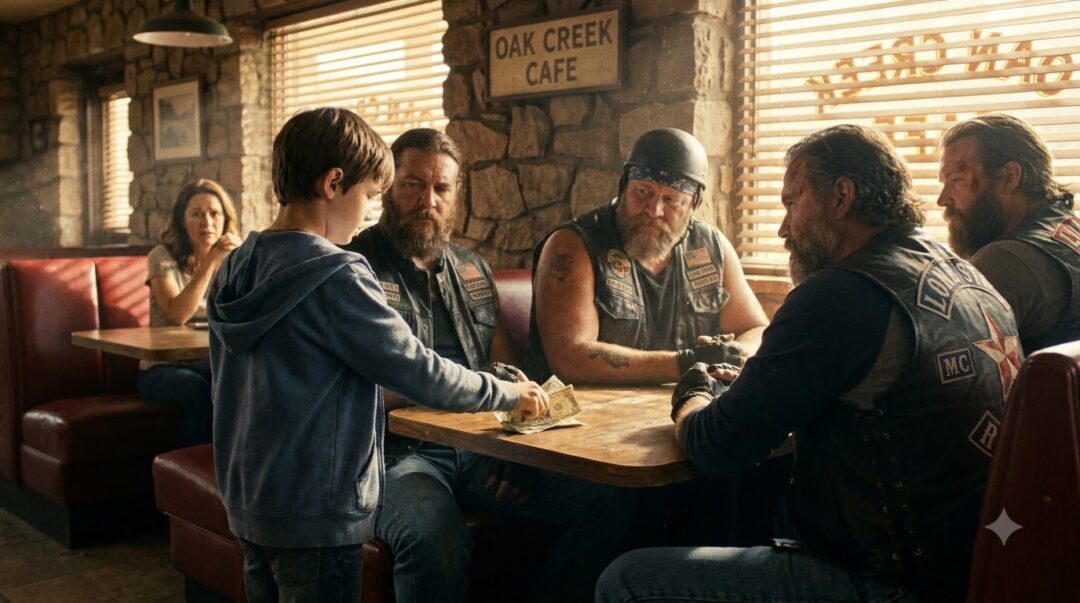
In the back corner booth beneath a pair of mounted longhorns sat four members of the Hill Country Iron Motorcycle Club. At their head was Colton “Tex” Boone.
At forty-nine, Colton looked as weathered and enduring as an ancient limestone canyon. He was six-foot-two, with broad, muscular shoulders honed by twenty years as a master ranch farrier and eight years as a combat investigator with the U.S. Army Criminal Investigation Division at Fort Hood. His steel-gray beard was trimmed neat along a square, granite jaw, and his hazel eyes held the quiet, lethal watchfulness of a seasoned frontier lawman. He wore a faded denim work shirt beneath a heavy black leather vest bearing the silver horseshoe-and-spur patch of Hill Country Iron. Beside him sat Red, a wiry former helicopter mechanic, and Travis, a six-foot-four heavy-rig operator whose knuckles bore the silver scars of thirty years on drilling platforms.
A timid shadow fell across the yellow formica tabletop.
Standing at the edge of the booth was a ten-year-old boy. He wore faded denim jeans with iron-on knee patches, scuffed brown roper boots, and a dusty red t-shirt depicting the Texas flag. His light brown hair was damp with sweat, clinging to his forehead, and his knuckles were scraped raw. But what caught Colton’s eye was the boy’s expression: his jaw was set with fierce, stubborn determination, his brown eyes clear and unbroken despite the fear vibrating through his small body.
The boy reached into his front pocket and placed a small stack of bills onto the table.
It was a five-dollar bill, three two-dollar bills, and twenty-six tightly folded, creased one-dollar bills, topped with four silver quarters.
“Mister,” the boy spoke. His voice cracked with a ten-year-old’s nervous tremor, but he didn’t look down. “Are you the man who doesn’t back down from anybody in Gillespie County?”
Colton did not touch the money. He set his iced tea glass down with a soft thud, leaning forward slightly, his deep baritone voice rumbling low and gentle. “Folks around here say I stand my ground, son. My name is Colton. Who are you?”
“My name is Wesley McCall,” the boy said, taking a steadying breath. “And I have thirty-seven dollars here. It’s my birthday money from my grandma in Abilene, and what I earned mowing grass behind the motel. I want to hire you.”
Red raised an eyebrow, trading a quiet glance with Travis, but Colton held up a single hand, keeping his focus locked entirely on the boy.
“Thirty-seven dollars is a serious sum of money, Wesley,” Colton said with quiet respect. “What kind of contract are you looking to buy?”
Wesley took a half-step closer, his eyes welling with fierce, protective tears that he refused to let fall. “I need you to protect my momma.”
Wesley pointed toward the pass-through window of the restaurant kitchen.
Working behind the counter, carrying a heavy tray laden with cast-iron skillets of chicken-fried steak, was Sarah McCall. At thirty-four, she was slender and pale, her chestnut hair pulled back in a simple ponytail. She was a beautiful woman, but chronic, suffocating terror had hollowed her cheeks and carved dark lavender shadows beneath her hazel eyes. Every time the restaurant’s front screen door creaked open, she flinched, her hands trembling so violently that the silverware rattled against the plates.
“Her name is Sarah,” Wesley whispered, his voice trembling with unspeakable pain. “A man followed us from Dallas three weeks ago. He sits in a blacked-out car across the street from our cabin on Willow Pass every night from midnight until four in the morning. He calls her phone and just breathes. Yesterday, he left a dead copperhead on the hood of our station wagon with a note pinned to its head.”
Wesley reached up, pulling open the collar of his shirt to reveal a jagged, purplish bruise shaped like the heel of a heavy combat boot along his left shoulder blade.
“Momma thinks I’m asleep,” Wesley choked out, his small hands clenching into fists on the formica table. “She cries in the bathroom every night with a kitchen knife in her lap. She told me we have to pack our bags and run again tonight. But we don’t have anywhere left to run, mister. Our car has a cracked radiator. If we hit the desert road, we’ll die in the heat.”
Wesley pushed the thirty-seven dollars closer to Colton’s hand. “Can thirty-seven dollars buy enough courage to make that man go away?”
Colton looked down at the crumpled bills. Then he looked across the dining room at Sarah McCall, watching her lean against the food prep counter as if her knees were about to give out from pure exhaustion.
Colton reached out, took the five-dollar bill, and slid the remaining thirty-two dollars back toward the boy. He placed the five-dollar bill in his front pocket.
“The contract is five dollars, Wesley,” Colton said, his voice steady as bedrock. “Keep the change for gas and sweet tea. Your contract is accepted.”
Colton looked down into Wesley’s eyes. In his eight years conducting felony investigations for Army CID, Colton had interviewed hundreds of victims of domestic terror. He had seen the unmistakable hallmarks of trauma: the guarded flinch at sudden movements, the unnatural stillness of a child trying to make himself invisible to avoid an abuser’s wrath, and the premature aging that settled into young eyes forced to witness brutality. Wesley wasn’t asking for pity; he was offering everything he had in the world to buy peace for his mother. That kind of devotion was rarer than gold in these hills.
Colton stood up. His six-foot-two frame towered over the diner booth, his broad shoulders casting an immense shadow. Red and Travis stood beside him like iron pillars.
“Let’s walk outside, Wesley,” Colton said quietly. “Show me this car.”
They walked out the front doors of the grill into the blinding Texas sunlight. Wesley pointed a trembling finger toward the gravel apron across the highway, beneath the shade of a cluster of post oaks.
Parked in the shadows was a late-model black Ford Police Interceptor sedan, bearing municipal exempt plates and dark tinted windows.
As Colton watched, the driver’s window rolled down three inches.
Sitting in the air-conditioned cab was a man in his late thirties, wearing the tan uniform and gold star badge of a Gillespie County Chief Deputy. He had closely cropped blond hair, cold blue eyes behind mirrored aviator sunglasses, and a smirk of pure, sociopathic arrogance. It was Clint Rooker—Sarah’s ex-husband.
Rooker leaned his forearm out the window, his hand casually resting on the holster of his Glock .45 caliber service sidearm.
He looked at Colton, tapped the grip of his pistol twice with his index finger, and mouthed three silent words through the heat waves:
Midnight. She dies.
Then Rooker dropped the transmission into gear, sprayed caliche gravel across the highway, and roared away toward the limestone hills.
CHAPTER 2: THE TRACKER ON THE CALICHE TRAIL
Colton stood by the highway shoulder, watching the dust cloud settle over Highway 290. His former Army CID training kicked into gear with cold, analytical precision.
“Red,” Colton said, his voice dropping to a low, commanding rasp. “Get Wesley and his mother out of the restaurant through the rear kitchen door. Load their station wagon onto Travis’s flatbed trailer. We’re moving them to the ranch right now.”
Fifteen minutes later, Sarah McCall sat in the passenger seat of Colton’s heavy Ford F-350 dually, her son Wesley squeezed tight against her side. Her hands shook uncontrollably as Colton navigated the winding, cedar-choked caliche roads of Willow Pass, climbing high into the rugged limestone hill country.
“Mr. Boone… you don’t understand what Clint is,” Sarah whispered, her voice breathless with terror as she stared in the rearview mirror. “He isn’t just a deputy. Clint is the enforcer for a contraband corridor running through the border counties. He took Wesley away from me three years ago, kept him locked on his father’s compound, until I took my boy in the middle of a thunderstorm and ran. Clint told me he would hunt me to the ends of the earth. He said a badge makes him God in this county.”
“A badge is a piece of tin, Sarah,” Colton replied calmly, his hands relaxed on the steering wheel. “It doesn’t stop lead, and it doesn’t make a coward into a man. On my ranch, no man plays God.”
They crested a rugged limestone ridge and turned through a massive wrought-iron gate bearing the brand of the Boone Homestead.
The ranch was a fortress carved from Hill Country history: a two-story homestead constructed from eighteen-inch-thick dressed limestone blocks quarried in 1865, flanked by a massive stone blacksmith forge, heavy pipe-fencing corrals, and a hundred-foot steel windmill spinning lazily in the dry breeze. In the center of the yard, six custom Harley-Davidsons were parked beneath the shade of towering pecan trees, guarded by four massive blue lacy cow-dogs who rose to greet Colton’s truck with low, friendly wuffs.
The Boone homestead sat on a Spanish land grant dating back to 1845, when German immigrants had first broken the stony Hill Country soil. The main ranch house had walls two feet thick, constructed from native honey-colored limestone blocks hand-chiseled by Colton’s great-grandfather. In the nineteenth century, it had served as a fortified frontier waystation against Comanche raiding parties; its narrow gun-slits still flanked the heavy cedar front doors.
Colton guided Sarah into the cool, shadowed parlor. The interior was furnished with heavy mission-oak tables, hand-woven Navajo rugs, and leather armchairs worn to the softness of velvet. He brought her a tall pitcher of cold spring water infused with mint from the kitchen garden. ‘Drink this, Sarah,’ Colton said softly, his deep voice carrying the calm stability of an anchor in a gale. ‘You’re forty miles from the nearest interstate, behind three locked gates and thirty thousand acres of rough cedar breaks. Take a breath and let your shoulders down.’
Sarah held the heavy glass with both hands, the cold condensation soothing her blistered fingers. For three long months, she had slept in rat-infested motels with a chair propped beneath the doorknob, waking in terror at every tire crunch on the gravel. Feeling the thick stone walls around her, smelling the comforting scents of old leather, cedarwood, and beeswax, a deep, shuddering sigh broke from her chest, the tears she had held back for a hundred days finally spilling down her cheeks.
Travis backed the flatbed trailer into the open bay of the stone forge.
Colton stepped down from the truck. “Wesley, grab your bicycle from the back of your wagon. Let me take a look at it.”
Wesley wheeled out his battered red Huffy bicycle.
Colton pulled a high-intensity inspection light and a handheld radio-frequency detector from his saddlebag. He ran the probe along the bicycle’s frame.
Beneath the rusted metal seat bracket, the detector suddenly shrilled with a sharp, continuous electronic beep.
Colton reached under the springs, his fingers prying loose a small, black magnetic puck wrapped in clear evidence tape. Stamped in white lettering across the plastic was: GILLESPIE CO. SHERIFF – EVIDENCE CASE 408.
Sarah gasped, clapping her hands over her mouth. “A GPS bug… Clint planted a tracker on Wesley’s bike!”
“That’s how he stayed on your bumper from Dallas to Kerrville,” Colton said, holding the puck under the workshop light.
He connected the device to his field tablet, downloading the internal flash memory log.
Colton’s jaw hardened into stone as he read the time-stamped telemetry. “Rooker didn’t just track you, Sarah. The log shows his cruiser was parked within fifty yards of your motel in Fredericksburg every night for five consecutive days. He wasn’t just watching you. He was waiting for his shift rotation to clear so he could strike without the sheriff knowing.”
Red walked over, wiping sweat from his forehead with a bandana. “Colton, if that bug is active, Rooker already knows Wesley’s bike is sitting in the center of our forge.”
Colton looked up at the sun setting behind the cedar hills, bathing the limestone bluffs in blood-red light.
“Good,” Colton said, his eyes blazing with icy resolve. “Let him come up the mountain. In these hills, we write our own law.”
CHAPTER 3: THE AMBUSH AT WILLOW PASS
Night fell over Gillespie County like an ink-stained canvas, punctuated by the cold, brilliant glitter of ten thousand stars. The dry night air cooled rapidly, the smell of night-blooming cactus mingling with the sharp, resinous aroma of mountain cedar.
At 11:30 PM, the sound of heavy V8 engines echoed from the winding switchbacks of Willow Pass—the only access road leading up to the Boone ranch.
Colton, Red, and Travis sat in the dark behind a natural parapet of limestone boulders overlooking the narrow canyon road. Parked across the road, completely blocking the trail, was an old John Deere tractor with its rear tires chained to an ancient live oak tree.
Two blacked-out Dodge Ram pickups and Rooker’s unmarked Police Interceptor rounded the blind hairpin curve, their headlights cutting through the swirling dust.
The lead pickup slammed on its brakes, skidding to a halt barely ten feet from the tractor blade.
Four men stepped out into the dust, wearing tactical black cargo pants, body armor, and carrying military-grade Colt M4 carbines. Leading them was Chief Deputy Clint Rooker, his mirrored sunglasses replaced by green-glowing night-vision monoculars.
“Boone!” Rooker’s voice echoed off the sheer canyon walls. “Move that farm equipment off the road! You’re obstructing a certified law enforcement felony pursuit! Sarah McCall is wanted for interstate parental kidnapping!”
Willow Pass was an ancient Comanche war trail carved through the sheer Cretaceous limestone bluffs of the Edwards Plateau. On either side of the narrow dirt track, vertical walls of honey-colored rock rose eighty feet into the night sky, crowned with dense stands of twisted Ashe juniper and Spanish oak. For a century, local ranchers had used the pass to move cattle down to the railheads, knowing that two determined men on the high cliffs could hold the canyon against an entire cavalry regiment.
Red knelt in the gravel, his hands steady as he adjusted the mechanical trip-wire. ‘Tex,’ Red murmured, peering through the darkness, ‘we got four miles of open switchbacks below us. Once Rooker enters the gorge, there’s no cell service, no radio relay, and no way to turn a three-ton pickup around without backing off a cliff. He thinks he’s hunting a defenseless woman. He has no idea he’s driving straight into an artillery funnel.’
Colton stepped out from behind the limestone boulder into the glare of the headlights. He carried no rifle—only a heavy, twenty-four-ounce farrier’s forging hammer in his right hand.
“There’s no felony warrant, Rooker,” Colton said, his baritone voice echoing like thunder across the canyon. “I spent twenty minutes on the satellite phone with the Texas Rangers in San Antonio. The Dallas family court granted Sarah full, sole legal conservatorship six months ago. Your visitation rights were terminated due to aggravated domestic violence.”
Rooker sneered, raising his carbine until the laser sight painted a bright crimson dot directly over Colton’s heart. “You think a judge in Austin matters out here in the brush, biker? Out here, my word is the law! Now step aside before I leave your carcass for the coyotes!”
“Red. Now,” Colton whispered into his tactical collar mic.
High on the cliff ledge thirty feet above the road, Red tripped a mechanical release lever.
Two massive thousand-pound round bales of coastal bermuda grass tumbled off the bluff, crashing directly onto the hood and cab of Rooker’s lead pickup truck with a deafening, crushing crunch.
The pickup’s suspension collapsed under the massive weight, the windshield shattering into a million pieces.
In the ensuing cloud of dust and flying hay, Travis leaped from the rocks like an enraged grizzly. He slammed his heavy steel tire iron across the weapon of the second gunman, disarming him and driving him into the caliche dirt with a bone-jarring tackle.
Colton closed the distance on Rooker in three explosive strides.
Rooker fired a panicked burst from his M4, the 5.56mm rounds sparking wildly off the limestone boulders. Colton deflected the barrel with his left forearm, stepping inside Rooker’s guard. Colton’s farrier hammer struck the carbine’s receiver, shattering the aluminum housing and ripping the weapon from Rooker’s grip.
Colton drove his right palm into Rooker’s nose.
The sickening sound of cartilage crunching was followed by Rooker’s shrill scream of agony as blood erupted from his nostrils. Rooker stumbled backward into the door of his cruiser, his hands clawing at his holster for his sidearm.
Colton pinned Rooker against the doorframe, his massive left hand clamping around Rooker’s throat like a hydraulic vice, lifting the deputy onto his tiptoes.
“You like hitting women and terrified little boys, Clint?” Colton growled, his face inches from Rooker’s terrified eyes. “How does it feel when a real man takes you by the neck?”
Before Colton could strike again, the driver of the second pickup slammed his transmission into reverse, spun the truck in a violent J-turn, and fired a barrage of buckshot toward the rocks.
The pellets peppered the side of Colton’s truck.
In the chaos of the gunfire, Rooker slipped from Colton’s grip, scrambled into the passenger side of the reversing pickup, and roared back down the canyon road in a blinding cloud of dust and flying gravel.
Travis walked over, breathing heavily, holding a heavy black leather binder he had snatched from the front seat of Rooker’s abandoned cruiser.
“Look what the deputy left behind, Tex,” Travis said, handing the binder to Colton.
Colton snapped his flashlight on.
Inside was not a police log. It was a private contraband ledger labeled: OPERATION COLD CEDAR.
The pages detailed six million dollars in cash kickbacks paid by Mexican cartel methamphetamine smugglers using the low-water limestone crossings on the Pedernales River—with monthly protection payments wired directly to Clint Rooker’s personal offshore accounts in Belize.
And on the final page was a handwritten note in Rooker’s handwriting: Sarah knows about the Pedernales accounts. If she speaks to the Rangers, the entire county falls.
CHAPTER 4: THE SIEGE OF BOONE FORGE
“It was never just about custody,” Colton said, standing in the center of the stone ranch living room.
The ranch house was blacked out, its heavy oak shutters bolted from the inside with forged iron bars. Sarah sat on the leather sofa, clutching Wesley against her side, her face pale as parchment in the glow of the kerosene lantern.
“Clint made me handle his private bookkeeping three years ago,” Sarah wept, her voice trembling. “I found the wire transfer receipts from the shell companies in McAllen. When I told him I was going to the federal prosecutor, he locked me in the cellar for a week until I swore on Wesley’s life I would never tell. He doesn’t just want Wesley, Colton… He wants me dead so the records stay buried forever.”
“Those records are sitting in an encrypted file at the Texas Ranger detachment in Kerrville right now,” Colton said, checking the action of his Winchester Model 70 bolt-action rifle. “Rooker knows his badge is burned. He’s cornered, and a cornered rattlesnake strikes with everything he has.”
The night was black and silent, save for the dry wind rattling the seedpods of the mesquite trees along the fence line. In the stone forge, the heavy cast-iron anvil stood cold, smelling of coal dust and quenched steel. Colton walked the perimeter of the outer barn, inspecting every deadbolt, checking the tension on the heavy perimeter trip-wires that connected to the ranch’s high-gain acoustic alarms.
During his years in the military police, Colton had investigated dozens of domestic stalkers who carried badges. He knew the terrifying psychological pattern: men who weaponized official authority to hunt their spouses, believing that legal immunity made them invincible. Clint Rooker wasn’t just an abusive ex-husband; he was a sociopath who viewed his wife and child as chattel property, willing to burn down half a county rather than admit he had lost control. But Rooker had made a fatal miscalculation. He had followed Sarah out of the corrupt city alleys and into the rugged Hill Country, where men were judged not by gold stars or municipal titles, but by blood, honor, and iron resolve.
Suddenly, the overhead kerosene lantern vibrated.
The low hum of the ranch’s solar inverter in the basement died. The entire compound plunged into total, inky blackness.
Through the heavy oak shutters, the unmistakable, muffled thump-thump of tear gas canisters being launched through the air echoed from the front yard.
Two canisters of military-grade CS tear gas crashed through the dining room windows, spewing dense, choking clouds of white chemical smoke into the hallway.
“Gas masks! On the children now!” Colton roared.
Red immediately pulled two civilian respiratory masks from the wall cabinet, slipping them over Wesley’s and Sarah’s faces.
Outside, high-powered infrared rifle sights danced across the exterior limestone walls.
Four mercenary snipers hired from the border cartels had surrounded the homestead, firing high-velocity rounds through the cedar trim, splintering the antique oak furniture.
“They’re trying to flush us out the back into the open fields!” Travis yelled, returning fire through a reinforced firing port with his twelve-gauge shotgun.
Colton knelt beside Sarah. “Sarah, you take Wesley down to the storm cellar beneath the kitchen. The trapdoor is four inches of solid iron plate covered in flagstone. Bolt it from the inside and do not open it for anyone except me.”
Sarah looked into Colton’s eyes. The terrified, shivering waitress had vanished; in her eyes burned the fierce, unyielding fire of a frontier mother.
“I’m not hiding in the dark while you bleed for my boy, Colton,” Sarah said, her voice steady and resolute. She reached down, picking up a heavy Marlin .30-30 lever-action rifle from the gun rack. “My father was a rancher in West Texas. He taught me to shoot before I could ride. Give me a window.”
Colton looked at her with profound respect. “Take the east gable, Sarah. Watch the corral fence.”
Sarah moved to the window like a seasoned marksman.
Through the tear gas smoke, Colton sprinted to the master electrical disconnect in the forge. He threw the heavy manual knife-switch, diverting the ranch’s three emergency diesel generators directly into four ten-thousand-lumen stadium floodlights mounted on the four corners of the stone roof.
A blinding, sun-bright explosion of white halogen light turned the midnight ranch yard into midday.
The mercenary snipers, caught out in the open pastures with night-vision goggles over their eyes, shrieked in agony as ten thousand lumens overloaded their optics.
From the east gable, Sarah levered the Marlin .30-30. CRACK! A single shot tore through the shoulder of the lead sniper by the corral, dropping him instantly into the dust.
Travis and Red poured suppressing fire into the tree line, forcing the remaining gunmen to abandon their positions and scatter into the dark cedar canyons.
“Clear! The perimeter is clear!” Red shouted through the ringing smoke.
Colton rushed toward the back breezeway.
Suddenly, from the kitchen below, a child’s terrified scream tore through the house.
“Momma! Help me!”
Colton charged into the kitchen.
The iron storm cellar door had been breached with a hydraulic jaws-of-life tool.
Standing in the dust and smoke was Clint Rooker, his face covered in a tactical respirator, holding ten-year-old Wesley under his left arm like a ragdoll. In his right hand, Rooker held a cocked semi-automatic pistol pressed directly to the boy’s temple.
“Back up, Boone!” Rooker shrieked, backing toward the kitchen patio door. “Take one step and the boy’s brains paint this limestone floor!”
Sarah screamed from the stairs, dropping to her knees. “Wesley! Clint, please! Take me! Leave my baby alone!”
Rooker kicked the back door open, sprinting backward into the darkness toward his idling pickup truck. He threw Wesley into the passenger seat, slammed the door, and stomped the gas pedal, tearing across the open pasture toward the Pedernales River at ninety miles an hour.
CHAPTER 5: PURSUIT TO THE PEDERNALES
Colton did not hesitate for a heartbeat.
He sprinted to the forge, throwing his leg over his custom Harley-Davidson Road King—a massive, reinforced touring cruiser built with heavy off-road tires, a modified 120-cubic-inch engine, and high-intensity desert floodlights.
He hit the starter. The V-twin engine erupted with an earth-shattering, straight-pipe roar that shook the stone walls of the forge.
Colton slammed the transmission into gear, dumping the clutch. The rear tire tore a trench through the caliche turf, launching the heavy motorcycle across the pasture in hot pursuit.
The chase tore through the rugged limestone canyons of the Hill Country.
Rooker’s pickup truck bounced violently over rock ledges and crushed cedar brush, sending showers of sparks into the dark night. Colton rode the heavy Harley like a cavalry scout on a warhorse, skimming across rock gardens and drainage ditches at eighty miles an hour, closing the distance second by second.
Up ahead lay the Pedernales River: a wide, rushing waterway swollen by recent summer flash floods, running fast and turbulent over slick limestone shelves.
The crossing was an unpaved, historic low-water crossing—a six-inch-deep slab of natural limestone flanked by deep, swirling twenty-foot pools of churning brown water.
Rooker didn’t slow down. He plunged the pickup directly onto the flooded limestone slab.
The torrential current caught the truck’s tires. The rear end broke loose on the slick algae-coated rock. The pickup spun sideways, slammed against a giant boulder in mid-river, and stalled, water rushing up past the door sills.
Inside the cab, Wesley fought like a trapped badger, biting Rooker’s forearm with all his strength.
Rooker screamed in pain, backhanding the boy across the face, but Wesley’s resistance bought Colton the three seconds he needed.
Colton launched the Harley into the shallow water, killing the ignition and leaping from the saddle into the freezing, rushing current.
The water reached Colton’s waist as he waded through the torrent with the crushing power of an angry grizzly.
He reached the driver’s side of the stalled truck, slammed his elbow through the side window, and ripped the door open with raw, adrenaline-fueled power.
Rooker pulled his pistol, firing wildly through the shattered glass. The bullet grazed Colton’s left bicep, tearing through leather and flesh, but Colton didn’t even blink.
Colton’s massive right hand clamped onto Rooker’s tactical collar, hauling the deputy bodily out of the cab and slamming him flat onto the submerged limestone bed.
The two men crashed into the roaring river, fighting in three feet of churning, white-capped water.
Rooker pulled a combat dagger from his belt, slashing desperately at Colton’s throat. Colton blocked the strike with his forearm, his knuckles driving squarely into Rooker’s solar plexus, forcing all the air from the deputy’s lungs.
Colton twisted Rooker’s wrist with a sickening crack, sending the knife spinning away into the dark river current.
Colton pinned Rooker against the submerged limestone shelf, his knee driving into the deputy’s chest, his left hand holding Rooker’s head inches above the rushing water.
“It’s over, Clint,” Colton roared over the thunder of the rapids. “Give it up!”
Rooker coughed up river water, laughing like a madman through blood-stained teeth. “You kill me, Boone, and my cartel partners will burn this valley to ash! You don’t have the guts to pull the trigger!”
Before Colton could answer, a small figure splashed through the shallow water.
Wesley had scrambled out of the truck cab. The ten-year-old boy stood on the limestone shelf, shivering in the freezing current, his face bruised and bloody, but his eyes burning with absolute clarity.
“Mr. Colton!” Wesley cried out over the roar of the water.
Colton paused, looking back at the boy.
Wesley held up his right hand, showing his small, empty palm.
“Don’t kill him, Mr. Colton,” Wesley said, his young voice ringing with heartbreaking dignity and courage. “I hired you to protect us… not to become a monster like him. Don’t let him turn you into what he is.”
Colton stared at the boy.
The murderous fury that had gripped Colton’s heart slowly receded, replaced by the profound, awe-inspiring realization of what this child had just done.
Colton looked down at the disgraced, shivering lawman pinned beneath his knee.
Colton did not strike him again. He reached to his belt, pulled heavy stainless-steel military handcuffs, and ratcheted them with brutal finality around Rooker’s wrists behind his back.
“You’re not dying tonight, Clint,” Colton whispered into Rooker’s ear. “You’re going to spend the next forty years in a federal penitentiary, listening to the men you betrayed laugh while you rot in a six-by-eight cell.”
Suddenly, the canyon bluffs above the river crossing erupted in a dazzling kaleidoscope of brilliant red and blue emergency strobe lights.
CHAPTER 6: THE VERDICT ON THE PEDERNALES
Six unmarked black Chevrolet Suburbans and four tactical patrol cruisers lined the rim of the limestone bluffs, their high-intensity searchlights illuminating the riverbed in brilliant, daylight-intensity white.
Descending the rocky path to the river were twelve men wearing crisp khaki uniforms, Stetson hats, and polished silver star badges: Texas Rangers, Company F.
Leading them was Captain Jack Sterling—a legendary senior Ranger with thirty years on the frontier.
“Colton Boone!” Captain Sterling announced over a megaphone. “Stand down! The Texas Rangers have the scene!”
Colton hauled Rooker to his feet, marching the dripping, handcuffed deputy out of the river onto the caliche bank. He pushed Rooker down onto his knees in front of the Rangers.
“He’s all yours, Jack,” Colton said, breathing hard as river water dripped from his beard. “You’ll find six million dollars in cartel wire transfers, five tons of contraband routing logs, and thirty counts of aggravated kidnapping in that black binder on my saddle.”
Captain Sterling looked down at Chief Deputy Clint Rooker, disgust written across his weathered face. He looked back at Colton, nodding with deep, professional respect.
“We’ve been investigating this corrupt bastard for eight months, Tex,” Captain Sterling said. “Your data packet to Kerrville tonight gave us the federal warrant we needed to arrest his entire network. The sheriff has been suspended, and federal marshals are raiding Rooker’s stash houses across three counties right now.”
A second truck pulled onto the riverbank.
The Pedernales River was famous for its deceptive, deadly beauty. Beneath its shallow, crystalline waters lay deep underwater limestone caverns, treacherous whirlpools, and submerged cypress snags that had claimed the lives of careless cattlemen for two centuries. As the river rose with the sudden mountain runoff, the water turned into a frothing, copper-colored torrent, churning up river silt and slamming fallen logs against the bridge abutments with the force of battering rams.
Standing on the slick limestone shelf, his clothes dripping with river water, Colton watched the convoy of Texas Ranger vehicles encircle the bluffs. Captain Jack Sterling had served alongside Colton’s father in the National Guard thirty years ago. In Texas, the Rangers were more than state police; they were the living embodiment of frontier justice, carrying an unyielding tradition of relentless pursuit that no corrupt county boss could ever buy or intimidate. As Rooker was hauled into the back of the armored transport, his uniform stripped of his badge and his arrogance completely crushed, the silence of the river valley felt sacred and clean once more.
Sarah McCall leaped from the passenger seat, sprinting through the mud with tears streaming down her face.
“Wesley! My baby!”
“Momma!” Wesley ran to her, throwing his small arms around his mother’s neck.
Sarah fell to her knees in the dirt, clutching her son against her chest, weeping with overwhelming, hysterical relief, kissing his face, his hair, his bruised cheeks. “You’re safe… Oh God, Wesley, you’re safe…”
Wesley looked over his mother’s shoulder, his brown eyes locking onto Colton standing beside his motorcycle in the river mist.
Wesley gave Colton a slow, solemn nod of infinite gratitude.
Captain Sterling walked over to Sarah, kneeling beside her with his Stetson in his hands. “Mrs. McCall, on the authority of the Attorney General of Texas, you and your son are under permanent federal witness protection until all indictments are concluded. And as for your civil custody decree… the judge signed the final termination of Clint Rooker’s parental rights twenty minutes ago. You are free, ma’am. You never have to look over your shoulder again.”
Sarah buried her face in Wesley’s neck, her sobs turning from terror into the pure, joyous music of liberation.
CHAPTER 7: THE PERMANENT RANCH CONTRACT
One month later, the Texas Hill Country was alive with the radiant colors of autumn. The peach orchards had turned a brilliant, fiery orange, and the cool November breeze smelled of sweet post-oak smoke and roasted pecans.
At the Boone Family Ranch, the great stone homestead was filled with the sounds of laughter, clattering silverware, and acoustic guitar music.
Parked along the crushed-limestone driveway were twenty-five gleaming motorcycles of Hill Country Iron, their chrome exhausts polished until they shone like mirrors in the warm Texas sun.
In the front yard beneath the shade of the live oaks, a massive pit barbecue was in full swing. Giant slabs of peppered brisket, smoked sausage links, and racks of beef ribs sizzled over glowing hickory coals.
Sitting at the head of a long, rough-sawn cedar banquet table was Sarah McCall.
She looked radiant, her cheeks flushed with healthy color, wearing a beautiful embroidered white peasant blouse and dark denim jeans. The dark circles under her eyes had completely vanished, replaced by a radiant, peaceful light that made her look ten years younger. She was laughing heartily as Red and Travis debated the best recipe for Hill Country chili.
Beside her, wearing a brand-new pair of hand-tooled leather cowboy boots and a miniature Hill Country Iron denim vest, was Wesley. He was grinning from ear to ear as he fed pieces of smoked brisket to the four blue lacy cow-dogs resting beneath the table.
Colton walked out from the stone forge, carrying a polished walnut picture frame.
The table went quiet as the president of the club walked to the head of the table and stopped beside Wesley.
Colton laid the frame on the table in front of the boy.
Inside the frame, mounted against dark green velvet, was the wrinkled five-dollar bill Wesley had handed Colton at the diner booth.
Beneath the bill, engraved on a small brass plaque, were the words:
THE CONTRACT OF WESLEY MCCALL – PAID IN FULL – NOVEMBER 2026
“Wesley,” Colton said, his deep baritone warm and thick with emotion. “You gave me five dollars to protect your momma for one night. That contract is fulfilled.”
Wesley looked down at the frame, his small face growing serious. “Does that mean… we have to move away now, Mr. Colton?”
Colton laughed—a rich, hearty sound that filled the oak grove. He placed his massive, calloused hand on Wesley’s shoulder, then reached out and took Sarah’s hand in his own.
“Not on your life, son,” Colton smiled. “Sarah just signed a lease to manage the new bakery and restaurant at the Fredericksburg cooperative. And as for you… I’m looking for an apprentice at the forge. Someone who knows how to keep his head in a storm, someone who isn’t afraid to stand between the people he loves and the wolves.”
Colton pulled a small, hand-forged silver horseshoe amulet from his pocket, hanging it around Wesley’s neck.
“From this day on, Wesley, you’re not just a client. You and your momma are family. And around here, nobody messes with family.”
Wesley looked up at his mother, then at Colton. A tear of pure, unadulterated happiness slipped down his cheek as he threw his arms around Colton’s waist in a tight, fierce embrace.
Sarah leaned forward, resting her head against Colton’s broad chest, whispering words of gratitude that were lost in the warm Texas breeze.
The twenty-five riders of Hill Country Iron raised their sweet tea glasses in a thunderous, table-shaking toast that echoed off the limestone bluffs of the Pedernales River.
High above the ranch, a red-tailed hawk circled peacefully in the endless blue Texas sky, watching over a home where fear had finally been conquered by honor.