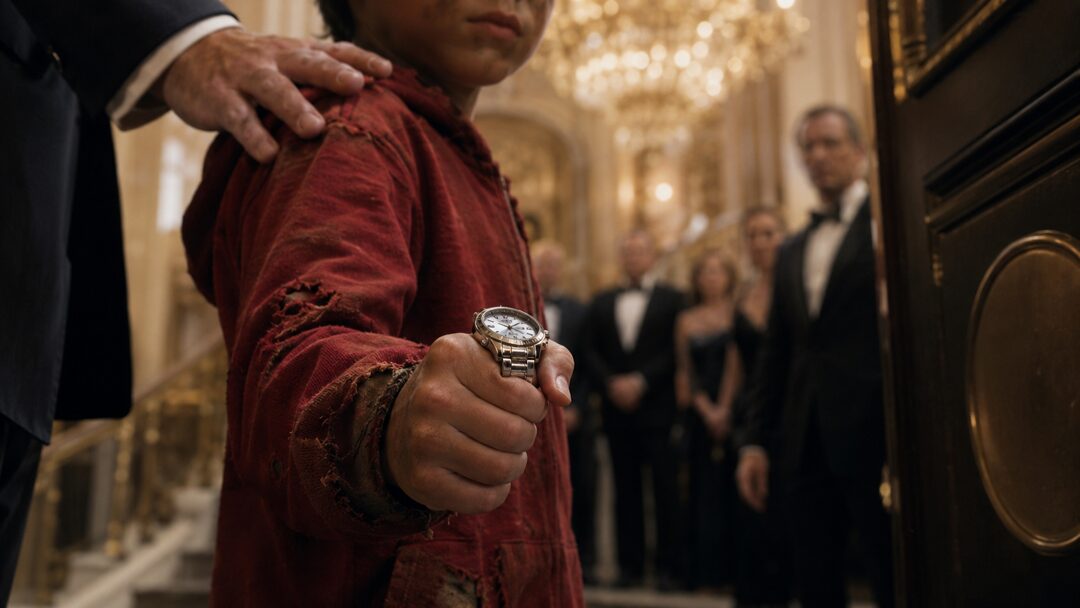
The Watch He Was Asked To Remember Beneath The Chandeliers
Part I — The Boy at the Edge of the Room
Robert Mason was about to announce his engagement when a barefoot boy in a torn red hoodie slipped past security, crossed the marble ballroom, and grabbed his sleeve in front of four hundred people.
The orchestra faltered.
Champagne glasses paused halfway to mouths.
Emily Carter’s smile stayed perfect, but only because she had been raised by people who believed panic was something servants did.
Robert looked down.
The boy was small, maybe twelve, with dark hair stuck to his forehead and dirt along one cheek. His lower lip was split. His hoodie hung from one shoulder, the red cloth thin and frayed, violently out of place beneath the chandeliers and gold-trimmed ceiling of the Mason Grand Hotel.
Security moved in.
Robert almost let them.
Then the boy tightened his hand on Robert’s sleeve and said, loud enough for the nearest tables to hear, “You said if I ever got lost, I should find the man with the watch.”
Robert stopped breathing.
His own hand, by habit or warning, shifted toward the silver watch under his cuff. He had not meant to wear it tonight. He had told himself he picked it up by accident from the drawer where old things went to become harmless.
But there it was, cold against his skin.
Emily leaned close, her pearl earrings brushing the side of her neck. “Robert,” she said softly, “let staff handle this.”
The words were gentle.
That made them worse.
The boy looked at her, then back at Robert. He did not cry. That was the first thing Robert noticed. The second was that he looked ready for Robert to deny him.
“I don’t know you,” Robert said.
The boy swallowed.
People were watching now with the quiet hunger of the well-fed. Donors. Board members. city officials. Hotel investors. Friends of Robert’s late father. Women in black gowns. Men in tuxedos. All of them pretending not to stare at the dirty child touching the clean man.
“You do,” the boy said.
His voice shook only once.
Security reached them.
“Sir?” one guard asked.
Robert looked at the boy’s hand on his sleeve. The fingers were thin and raw at the knuckles.
“What’s your name?” Robert asked.
The boy hesitated, as if even his name could be taken from him.
“Ryan.”
Emily’s smile tightened by one invisible thread. “Ryan, sweetheart, this is a private event.”
“I know.”
“Then you understand this isn’t the place.”
Ryan reached into the front pocket of his hoodie.
The nearest security guard stepped forward.
Robert lifted one hand. “Wait.”
Ryan pulled out a photograph folded into quarters. One edge was darkened and curled, as if it had survived something that had not wanted it to. He opened it with careful fingers and held it up.
Robert saw himself at twenty-eight.
Younger. Careless. Alive in a way he barely remembered.
Beside him stood Lisa.
Her hair was loose around her shoulders. Her head leaned toward his. Her hand rested over his wrist, where the same silver watch caught a white flash of light.
The ballroom disappeared badly, in pieces.
The chandelier became heat.
The orchestra became crackling.
The voices became someone shouting his name through smoke.
Robert’s body remembered before his mind allowed it.
Emily saw the photograph. Her hand closed around Robert’s arm, not affectionately this time, but as a warning.
“Robert,” she said.
Ryan did not look at her. His eyes stayed fixed on Robert’s face.
“My mom said you’d know,” he whispered.
The room seemed to lean closer.
Robert folded his fingers around the photograph before anyone else could see it. He did not take it roughly. Still, Ryan flinched.
That small movement did something to him.
“Come with me,” Robert said.
Emily’s hand tightened. “Not through the ballroom.”
Robert looked at her.
She was still beautiful. Still composed. Sleek black gown, pearl earrings, dark hair pinned back with a precision that made disorder look like a personal insult. She had stood beside him for two years while he learned how to become the man his family needed after his father’s death.
Tonight, he was supposed to announce that she would stand there forever.
Instead, a boy with Lisa’s photograph was holding his breath in front of them.
Robert turned away from the stage.
The crowd parted.
Not generously. Not kindly.
They parted the way people step away from a spill.
Ryan followed Robert through the ballroom with his head low and the photograph no longer in his hands. Robert felt the room calculating. Emily walked beside him, close enough to suggest unity, far enough to avoid touching the boy.
At the corridor doors, Ryan looked back once at the chandeliers.
Robert saw it then: not envy.
Recognition.
As if his mother had described this place to him.
As if he had imagined arriving here differently.
The corridor door shut behind them, cutting the orchestra into a muffled pulse.
Emily exhaled.
“Robert,” she said, and now there was steel under the silk, “whatever this is, it has to be handled quietly.”
Ryan looked at the floor.
Robert looked at the photograph in his hand.
Lisa smiled up from the past with his watch under her fingers, asking a question he had spent ten years not answering.
Part II — The Photograph
The corridor behind the ballroom was narrow, lined with framed photographs of Mason family events: ribbon cuttings, foundation dinners, hotel openings, handshakes with governors and bishops and men who had made fortunes look like virtues.
Ryan stood beneath them in his torn hoodie.
The contrast made Robert feel ill.
“Where did you get this?” Robert asked.
Ryan’s eyes flicked toward the photograph. “My mom.”
“Your mother’s name.”
The boy’s throat moved. “Lisa.”
Robert looked away.
He had said her name only in locked rooms for ten years.
Lisa had worked in the Mason Grand lobby flower shop when Robert first met her. She could make a lobby arrangement look less like a corporate apology and more like spring. She laughed at his expensive watch the first time he asked her to dinner.
“Do all rich men check the time this much,” she had said, “or are you just trying to escape me?”
He had taken the watch off and put it on the table between them.
“Then keep me here,” he had said.
That was how it began. Not with scandal. Not with defiance. Just a woman smiling at him like he was a person, not a surname.
Robert forced himself back to the corridor.
“Lisa died ten years ago,” he said.
Ryan’s face closed.
“She died last month.”
Emily made a small sound, almost too polished to be surprise. “Ryan, maybe someone told you a story that wasn’t true.”
He looked at her then.
It was not rude. It was worse. It was tired.
“My mom didn’t lie.”
Emily stepped closer, lowering her voice into something tender enough for witnesses and sharp enough for Robert. “No one is saying she lied. But grief makes people confuse things. You’re cold, and you’re hurt. We can get you food. We can call someone.”
“I don’t want food.”
“Then what do you want?”
Ryan looked at Robert.
“To know if she was stupid for waiting.”
The sentence went through Robert cleanly.
Emily’s expression shifted, just for a second. Not guilt. Recognition of danger.
Robert crouched slightly, not enough to kneel, not yet. “Waiting for what?”
“For you.”
Behind them, the corridor door opened.
Karen Mason entered without hurrying.
Robert’s mother had never needed speed. Rooms adjusted themselves around her. She wore an ivory evening suit and a diamond brooch shaped like a small branch. Her silver hair was swept back from a face that age had not softened so much as refined.
She took in the scene: Robert’s pale face, Emily’s controlled posture, the boy’s hoodie, the photograph.
Her gaze did not pause on Ryan’s split lip.
It paused on his eyes.
Then on the watch under Robert’s cuff.
“How did you get in?” Karen asked.
Not Who are you.
Not Are you all right.
How did you get in?
Ryan heard the difference. So did Robert.
Emily’s shoulders tightened.
Robert turned slowly toward his mother. “You know him?”
Karen looked at him as if he had asked the wrong question in the wrong hallway. “I know an intrusion when I see one.”
Ryan’s hand curled into a fist.
“He says Lisa was his mother,” Robert said.
Karen did not blink.
“She had many difficulties,” Karen said. “I’m sorry if one of them has found its way here tonight.”
Robert stared at her.
The hallway seemed too narrow now, too full of old frames and polished lies.
“Mother.”
Karen’s eyes went to the photograph. “Give that to me.”
Ryan stepped back.
Robert felt the movement before he saw it. He closed his fingers around the photograph.
“No.”
Karen’s face remained calm. That was how Robert knew she was furious.
Emily slid between them with practiced grace. “This is not the place. Robert, we need a private room. Your speech is in twenty minutes.”
“My speech can wait.”
“No,” Karen said. “It cannot.”
Ryan looked between them. He was starting to understand the room, not the facts, but the shape of it. Who spoke and who obeyed. Who could make a child disappear by using words like unfortunate and confused.
Robert saw shame rise into the boy’s face.
Not fear.
Shame.
That was what broke the first lock in him.
He turned to the guard lingering at the corridor entrance. “No one touches him. Do you understand?”
The guard nodded.
Karen’s eyes sharpened. “Robert.”
He ignored her.
“To the north dressing room,” he said. “Now.”
Emily followed him.
Karen followed last.
Ryan walked beside Robert without touching him this time.
Robert wished he had not noticed.
Part III — The Room Upstairs
The north dressing room had been prepared for Emily.
There were white roses on the side table, a full-length mirror, a garment rack with an after-party dress sealed in plastic, and a silver tray of untouched sparkling water. Ryan stood near the door as if afraid the carpet might accuse him.
Robert handed the photograph back.
Ryan took it fast and folded it into his hoodie pocket.
“Sit down,” Robert said.
“I’m okay.”
“You’re not.”
Ryan’s chin lifted. “I didn’t come here for you to feel bad.”
The words were small, but they had teeth.
Emily closed the door. “Then why did you come?”
Ryan reached into his pocket again.
Robert tensed.
This time, the boy pulled out a watch.
Not Robert’s. Older. Smaller. A women’s silver watch, scratched across the face, its leather strap replaced with a cheap black band.
Robert knew it immediately.
He had bought it for Lisa at a jewelry store he had entered like a criminal, afraid someone would see him buying something personal for a woman his mother called temporary. Lisa had laughed when he gave it to her.
“I don’t need a rich watch,” she’d said.
“No,” he told her. “You deserve one.”
Now the watch looked like it had survived years in drawers, pockets, shelters, hands.
Ryan held it carefully. “She sold this once.”
Robert’s voice came out wrong. “Sold it?”
“When I got sick. I don’t remember. She told me later she bought it back, but the real strap was gone. She said she should’ve sold yours too, but she couldn’t.”
Robert looked at his own wrist.
The expensive silver face gleamed under his cuff, useless and clean.
“Why not?” he asked, though he already feared the answer.
Ryan shrugged with one shoulder. “She said it proved you loved her once.”
Emily turned away.
Karen remained near the mirror, watching the scene with the stillness of someone refusing to be drawn into another person’s weather.
Robert took out his phone.
Karen’s voice cut through the room. “Who are you calling?”
“Dr. Harris.”
For the first time, something like alarm moved across her face.
Emily said, “Robert, think carefully.”
“I am.”
“You’re reacting.”
“No,” he said. “I think I’m reacting ten years late.”
Dr. Harris answered on the fourth ring.
He sounded older than Robert remembered. Cautious too. Men who had kept secrets for rich families often aged into caution.
“Mr. Mason,” he said. “Is everything all right?”
“No,” Robert said. “Tell me about Lisa.”
Silence.
Karen stepped forward. “End that call.”
Robert put the phone on speaker.
Dr. Harris breathed once, unevenly. “I’m not sure what you mean.”
“She survived the night of the accident, didn’t she?”
Ryan stared at the phone.
Emily closed her eyes.
Karen said, “Robert, you have no idea what you are doing.”
He looked at his mother. “Then it runs in the family.”
Dr. Harris spoke quietly. “She survived the first night.”
Robert’s body went cold.
Ryan’s hand tightened around the women’s watch.
“She was moved,” Dr. Harris continued. “At your mother’s request. There were concerns about media attention.”
“Moved where?”
“A private facility first. Then later a charity clinic outside Evanston.”
Robert laughed once. It was not laughter. It was the sound of something breaking without permission.
“Was she pregnant?”
Another silence.
Ryan looked at Robert now. Not pleading. Bracing.
“Yes,” Dr. Harris said.
Emily whispered, “Robert.”
He did not look at her.
“Did she try to contact me?” he asked.
Dr. Harris did not answer quickly enough.
That was answer enough.
“Did she?”
“Yes.”
Karen’s voice was flat. “She was unstable.”
Ryan flinched.
Robert turned on her. “Do not use that word about her in front of him.”
Karen’s mouth hardened.
Dr. Harris said, “Letters came through the clinic. I was told they were being forwarded.”
“To whom?”
No one spoke.
Robert looked at Karen.
She looked back with the terrible dignity of a woman who believed her sins had been administrative.
“To whom?” Robert repeated.
Karen said, “You were grieving. Your father was dying. The company was under threat. That woman had already cost you enough.”
Ryan’s face changed.
A boy can hear many things and survive them. Hunger. Doors closing. Adults saying not now. But there is a particular cruelty in learning that your mother’s whole life had been reduced to that woman.
Emily stepped toward him. “Ryan—”
“Don’t,” he said.
It was not loud.
Emily stopped anyway.
Robert ended the call without saying goodbye.
The room felt too full of objects meant for celebration: roses, mirrors, clean glasses, a second dress. All of them belonged to a life that had been allowed to prepare itself while Ryan’s had been improvised from shelters and stations and whatever Lisa could keep.
Robert looked at Emily.
“You knew.”
Her face changed slowly.
Not into guilt. Into grief resisting guilt.
“I knew there were letters,” she said.
Ryan stared at her.
Robert’s voice dropped. “What else?”
“I didn’t know about him.”
“But you knew about Lisa.”
Emily’s eyes shone, but she did not cry. “I knew enough to know your mother had made it disappear.”
“Why didn’t you tell me?”
“Because your father had just died. Because you were drinking at noon. Because the board wanted you gone. Because every man in this city was waiting for you to prove you were too weak to carry the Mason name.”
Robert stepped back from her.
Emily followed the movement with her eyes like it hurt.
“I saved you,” she said.
“Saved me from what?”
Her answer came too fast, which meant she had said it to herself before.
“From becoming the kind of man who throws away everything for a woman your mother called a liability.”
The word sat in the room like poison in a crystal glass.
Ryan looked down at the watch in his hand.
Robert did not know if the boy understood every adult cruelty in that sentence.
He understood enough.
Part IV — What Was Kept Quiet
Karen opened the dressing-room door.
“We are finished,” she said.
Robert turned. “No.”
“Yes,” Karen said. “The gala is waiting, and whatever obligations exist here will be handled tomorrow with attorneys and doctors.”
Ryan’s face went pale at the word attorneys.
Robert saw it. Emily saw it too.
She took a softer approach, which was always more dangerous.
“Robert,” Emily said, “listen to me. We can do this carefully. We can get a DNA test. We can put Ryan somewhere safe tonight. Somewhere clean. We can make sure he has everything.”
Ryan said, “Somewhere not here.”
Emily’s mouth tightened.
Robert looked at her.
She did not deny it.
“Not in the ballroom,” she said. “Not like this.”
“Like what?”
“Like a public collapse.”
Karen’s voice was colder. “Like a spectacle.”
Ryan’s head lowered again.
Robert hated himself for every second he had allowed the word to apply to a child.
He moved toward Ryan. “You’re not a spectacle.”
Ryan looked up at him. “Then why does everyone keep trying to move me?”
No one answered.
A knock came at the door.
One of Karen’s assistants leaned in, pale and breathless. “Mrs. Mason, they’re asking for Mr. Mason downstairs. The announcement—”
“Tell them five minutes,” Karen said.
The assistant glanced at Ryan and vanished.
Karen turned to Robert. “You will go downstairs. You will make your announcement. You will not dismantle your father’s life work because a runaway appeared with a photograph.”
“My father’s life work?”
“Yes.”
Robert’s voice sharpened. “Is that what we call it when the walls are expensive enough?”
Karen’s eyes flashed.
Emily touched his arm. “You’re not thinking clearly.”
He pulled away.
Ryan saw that too.
Every movement in that room taught him what he was worth.
Karen stepped close to Robert. Her voice lowered. “Do not confuse guilt with duty.”
Robert stared at her.
She continued, almost tenderly. “You always wanted to be loved by wounded things. Strays. Lost causes. Women who looked at you as if your name was a crime they could forgive. Lisa knew exactly what she was doing.”
Ryan moved before Robert did.
“You don’t get to talk about her.”
Karen looked down at him as though he had broken a glass.
“I have shown more restraint tonight than you can understand.”
Ryan’s face burned red.
Robert said, “Mother.”
But Ryan was already backing toward the door.
“I should go.”
“No,” Robert said.
Ryan swallowed hard. “She was right. I shouldn’t have come.”
He slipped out before Robert could reach him.
Emily moved after him, but Karen caught her wrist with two fingers.
Robert saw it.
The gesture was tiny. Possessive. Practiced.
“Let him breathe,” Emily said.
“Let him leave,” Karen answered.
Robert stepped toward the door.
Karen blocked him with her body. She had done it when he was ten and wanted to visit the kitchen staff instead of greeting donors. When he was twenty-eight and told her he loved Lisa. When he was thirty and drunk and asking why no one would say Lisa’s name.
Always the same move.
A mother placing herself between him and consequence, then calling it love.
“Move,” Robert said.
Karen did not.
Emily’s phone buzzed. She glanced down, then away too quickly.
Robert saw the name on the screen: Mason Security.
He looked at her.
Emily looked back.
Something passed between them then, not surprise but recognition. The kind that ends things before anyone speaks.
“What did you do?” he asked.
Emily’s lips parted.
Karen answered instead. “What had to be done.”
Robert opened the door and ran.
He reached the service stairs in time to hear voices below.
Ryan’s voice first. “I can walk.”
A guard answered, “Mrs. Mason said—”
“I said I can walk.”
Robert started down.
Then he heard Karen behind him, speaking to Emily in the hallway above.
“Make sure he gets through the east exit before Robert reaches the ballroom.”
Emily’s voice was low. “Karen, this has gone too far.”
“It went too far when Lisa kept records.”
Robert froze on the stairs.
So did Ryan below.
Karen did not know the sound carried.
“She should have taken the money,” Karen said. “She should have understood what happens when a woman like that keeps letters from a man like my son.”
Emily’s voice shook. “The fire was an accident.”
Robert’s hand tightened on the railing.
Ryan made no sound at all.
Karen said, “Of course it was. Men sent to retrieve property are not supposed to start one. But accidents become scandals when foolish women survive long enough to speak.”
The silence that followed was enormous.
Robert looked down.
Ryan was standing at the bottom of the stairs, held lightly by one guard, his face turned upward. He had heard every word.
Not every legal detail.
Enough.
His mother had not simply waited.
She had been pushed, priced, followed, hidden, and renamed inconvenient until even her son was treated like a problem to escort out through the service exit.
Robert took one step down.
Ryan pulled free of the guard.
He did not run toward Robert.
He ran toward the ballroom.
Part V — The Room That Had to See
The foundation speech had already begun by the time Ryan reached the ballroom doors.
Inside, the chandeliers were bright again. The orchestra had stopped. Four hundred faces turned toward the stage, where the Mason crest glowed in gold behind a podium.
A board member was speaking too cheerfully into the microphone.
Robert entered from the side just as a security guard caught Ryan near the doors.
The boy’s hoodie twisted in the guard’s grip. His bare feet slid once on the polished floor. The movement was small, but the room saw it.
That was the cruelest part.
The room saw.
They saw the dirty boy being held at the edge of their charity gala.
They saw his split lip.
They saw his fist closed around something silver.
They saw Robert Mason standing halfway between the stage and the service door, and they waited to learn which direction power would walk.
Emily appeared behind him.
“Robert,” she whispered.
He turned.
Her face had lost its public softness. What remained was fear, and love, and the old belief that love meant preventing disaster from reaching the room.
“Please,” she said. “Not like this.”
He looked at her hand.
The engagement ring caught the light.
For two years, Emily had stood beside him at hospital openings, donor breakfasts, hotel launches. She had remembered names he forgot. She had kept reporters away when grief made him stupid. She had loved him in the language of schedules, statements, and closed doors.
But now a boy was being held in front of people who paid money once a year to feel generous.
And Emily still wanted a closed door.
“We can help him,” she said. “We can protect him.”
Robert looked at Ryan.
The boy was trying not to cry. Not because he was unafraid. Because there were people watching.
Robert had seen grown men weep into linen napkins over wine pairings and be treated with tenderness.
Ryan was twelve and swallowing his pain like bad manners.
“Protect him from what?” Robert asked.
Emily did not answer.
Karen appeared near the front row. She did not hurry. She never did. Her gaze found Robert’s and held.
It was an order.
It had worked all his life.
The board member at the podium smiled with desperate confusion. “And now, of course, the man we all came to celebrate tonight—Robert Mason.”
Applause started.
Thin at first.
Then automatic.
Robert walked to the stage.
Emily closed her eyes for half a second in relief.
Karen’s posture eased.
Ryan’s face went blank.
Robert took the microphone.
The applause died.
He looked out at the ballroom: donors, investors, friends, cameras, servers standing along the wall with trays they were not allowed to lower. He saw every life his family had taught him to value. He saw every person whose approval had been mistaken for proof of character.
Then he looked at Ryan.
“I was supposed to make an announcement tonight,” Robert said.
Emily stood very still.
Karen’s face sharpened.
Robert continued. “I was supposed to tell you about the future of this family.”
He stepped away from the podium.
A murmur moved through the room.
He walked down the stage steps.
Karen said, softly but clearly, “Robert, stop.”
He did not.
Emily said his name once.
Not loudly.
But with the ache of someone who already knew she had lost to something older than herself.
Robert crossed the ballroom.
No one applauded now.
The guard let go of Ryan before Robert reached him.
Ryan stood alone beneath the chandelier, shoulders stiff, fist still clenched around the watch.
Robert stopped in front of him.
For a second, he could not speak.
He saw Lisa in the boy’s eyes. Not exactly. Not neatly. But enough to ruin him.
“Can I see it?” Robert asked.
Ryan looked at his fist.
His face changed.
He thought Robert wanted to take it.
That was the final shame.
Robert saw it land in him: another adult asking for the last thing he had.
Ryan opened his hand anyway.
The silver watch lay across his palm. Scratched. Too fine for his dirty fingers. Too heavy for what it had carried.
Robert took it carefully.
Then he knelt.
Gasps moved through the room like a dropped tray.
Robert Mason, heir to the hotel, chairman of the foundation, son of Karen Mason, knelt on the ballroom floor in front of a boy everyone had been trying to remove.
He opened the clasp.
Ryan stared at him.
Robert fastened the watch around Ryan’s thin wrist. It hung loose, sliding toward his hand.
Robert held it there a moment.
“I’m sorry,” he said, and his voice broke in front of everyone. “I’m sorry I made you prove you belonged to me.”
The room heard it.
Emily heard it.
Karen heard it.
Ryan’s mouth trembled.
Robert did not touch him yet. He had no right to decide when the boy should be ready.
Ryan looked at the watch, then at Robert.
“She said you’d come,” he whispered. “Did she lie?”
Robert felt every easy answer burn away.
He could have said no.
He could have said he never knew.
He could have said people kept them apart.
All of that would have been partly true.
Partly true had already cost Lisa her life.
“No,” he said. “I did worse.”
Ryan blinked.
Robert looked at him through tears he no longer cared to hide.
“I stayed where they told me to stay.”
Ryan’s face folded, not into forgiveness, but into exhaustion.
Robert opened his arms slightly.
Not demanding.
Asking.
Ryan looked at the room first.
At the people staring.
At Emily, whose ring hand hung at her side.
At Karen, whose face had gone white with a rage too polished to shout.
Then at Robert.
He stepped forward.
The hug was not graceful.
Ryan hit Robert’s chest like someone who had been holding himself upright for too long. Robert wrapped both arms around him and bowed his head over the torn red hood. His shoulders shook once, then again.
For ten years, he had mourned a woman whose letters had been hidden from him.
For twelve years, his son had carried proof like a burden.
Around them, the gala did not know what to become.
No one clapped.
No one moved.
That was good.
Some moments did not deserve applause.
They deserved witnesses.
Part VI — What She Kept
Karen’s fall was not loud.
It happened in the way people stepped back from her after Robert spoke into the microphone again, Ryan still beside him. It happened in the way donors stopped meeting her eyes. It happened when Dr. Harris arrived an hour later, pale and shaking, and Karen no longer had enough room to turn silence into command.
Emily removed her engagement ring before midnight.
She did it in the side corridor, away from the ballroom but not hidden enough to pretend it meant nothing.
Robert stood with Ryan asleep against his shoulder, the boy’s face turned into his jacket, one hand still closed around the edge of Robert’s lapel.
Emily looked at them for a long moment.
“You chose him,” she said.
Robert’s answer was quiet. “I should have chosen truth before I knew his name.”
Her mouth trembled.
For the first time all night, she looked younger than her control.
“I did love you,” she said.
“I know.”
“That doesn’t make it clean.”
“No.”
She nodded once, as if she had expected him to be crueler and would have preferred it.
Then she set the ring on the small table between them.
It made almost no sound.
That was how two years ended.
Karen did not apologize.
When Robert passed her near the lobby, she looked at Ryan sleeping in his arms and said, “You have no idea what this will cost.”
Robert adjusted Ryan’s weight.
“Yes,” he said. “I do.”
That was the first honest thing he had said to her in years.
Three weeks later, the city had moved on enough to pretend it had always known.
The newspapers chose careful words. The board announced reviews. The foundation used phrases like leadership transition and renewed commitment. Karen retreated behind attorneys and curtains and old friends who no longer returned calls quickly.
Robert did not care about the phrasing.
He cared about the boy walking beside him through a quiet cemetery outside Evanston, wearing Robert’s overcoat over a clean sweatshirt and the silver watch too loose on his wrist.
Ryan had refused to let Robert tighten the strap.
“It’s fine,” he said whenever Robert offered.
So it slid down his hand and clicked softly when he moved.
Lisa’s marker was simple.
Too simple.
Robert stood in front of it with flowers he had bought himself because asking an assistant felt obscene.
Ryan crouched and brushed a leaf from the base of the stone.
For a while, neither of them spoke.
The morning was gray. Cars moved beyond the cemetery wall. Somewhere far away, someone laughed, and the sound felt almost rude.
Robert placed the flowers down.
“I’m going to tell the truth,” he said. “Every time it costs me.”
Ryan kept looking at the stone.
“That’s not the same as coming.”
Robert closed his eyes.
“No,” he said. “It isn’t.”
Ryan touched the watch face with his thumb.
“Was it expensive?”
Robert looked at him. “Yes.”
Ryan nodded, as if that confirmed something sad and private.
“She kept it like it was food.”
Robert could not answer.
Ryan stood. The watch slid again, nearly past his wrist. This time, he let Robert catch it before it fell.
Neither of them mentioned what that meant.
Robert adjusted the strap one hole tighter. Not enough to claim. Just enough to keep it from slipping away.
Ryan watched his hands.
Then he looked back at Lisa’s name.
“I’m not calling you Dad today,” he said.
Robert swallowed. “You don’t have to.”
“Maybe not tomorrow either.”
“I know.”
Ryan nodded once.
Then, after a long moment, he stepped closer—not into Robert’s arms, not exactly, but near enough that their shoulders almost touched.
Robert did not move.
He had learned something beneath the chandeliers.
Some love had to wait without reaching.
Some forgiveness could not be asked for.
Some names had to be earned in silence, one costly truth at a time.
The watch caught the gray light on Ryan’s wrist.
This time, he did not hide it.