The Letter at the Desk That Made the Room Go Quiet
Part I — The Boy With the Green Bag
The boy came into the Harrington Hotel alone, dragging a green duffel bag across the marble floor while three men in black suits watched him pretend it was not heavy.
Sarah Carter saw him before anyone else did.
That was her job.
She noticed the bride who was about to cry before the groom did. She noticed donors who wanted corner tables, guests who wanted their names remembered, men who arrived with wives and checked in under different rooms. The Harrington taught her to see everything and react to almost nothing.
But the boy made her hand stop over the keyboard.
He was small for twelve, or maybe he only looked small because the lobby was built to make everyone feel measured and approved. The ceiling rose three stories above him. White orchids stood in glass vases taller than his shoulder. A string quartet tuned somewhere near the ballroom stairs for the Harrington Legacy Foundation gala upstairs.
The boy wore a gray T-shirt under an open hoodie. His sneakers squeaked. His hair was flattened on one side as if he had slept in a car.
The green duffel bumped his knee with each step.
He walked straight to Sarah’s desk.
“Are you Sarah Carter?” he asked.
Her smile came automatically. “I am.”
He did not smile back. “My dad said if I couldn’t reach him, I had to come here.”
The lobby noise thinned around her.
Not stopped. Never stopped. The Harrington Hotel did not allow scenes. The doors whispered open and closed. Champagne glasses chimed in the upstairs reception hall. Guests murmured over gold invitations and winter coats.
Sarah kept her voice soft. “Who’s your dad?”
The boy tightened his fingers around the duffel strap.
“Daniel Harrington.”
For one second, Sarah forgot she was standing behind a front desk in a dark blazer with a nameplate pinned over her heart.
She was twenty-nine again, standing near this same lobby while Daniel Harrington crossed the room toward another woman under his mother’s watchful smile. She remembered the flash of cameras. Patricia’s pearl earrings. Daniel’s hand slipping from Sarah’s waist the moment he saw who was looking.
She remembered him saying, “Not here.”
Then never fixing it.
Sarah’s face did not change. It had taken five years to learn that skill, and the Harrington had paid her hourly for every lesson.
“Joshua?” she said.
The boy looked surprised. “You know me?”
“I know who you are.”
He glanced behind him.
That was when Sarah understood he was not lost.
He was hiding.
“What’s in the bag?” she asked.
Joshua swallowed. “He said not to show anybody.”
“Did he tell you to show me?”
After a long second, Joshua pulled the duffel onto the brass luggage stand beside the desk. He struggled with the zipper. Sarah almost reached to help, then stopped. The boy needed to be the one to open it.
The zipper rasped loud enough that a woman near the orchids turned her head.
Inside were stacks of hundred-dollar bills, wrapped in white paper bands.
Sarah did not gasp. She did not step back. She only placed one hand flat on the counter, because the floor had shifted and she did not trust her knees.
Joshua pulled a sealed envelope from the side pocket and slid it toward her.
Sarah knew the handwriting before she read the words.
Daniel had always written like he was apologizing to the page.
On the envelope was her name.
Below it:
Only open this if I disappear.
Sarah looked at the boy. His eyes were dry, but too still.
“When did you last see your father?”
“Last night.”
“Where?”
“He put me in a rideshare outside our building. He gave me the bag and said to come here if he didn’t call by morning.” Joshua’s voice went thinner. “He didn’t call.”
Behind him, the elevator doors opened.
Patricia Harrington stepped into the lobby in a cream suit, surrounded by donors and photographers.
She saw Joshua.
Then she saw the bag.
Her smile did not break.
That was the first thing Sarah hated her for all over again.
“Joshua, sweetheart,” Patricia called, warm enough for the room to hear. “Your grandfather’s people have been looking everywhere for you.”
Joshua went rigid.
He did not move toward her.
Patricia crossed the lobby with the smooth confidence of a woman who had never had to hurry. Cameras lifted behind her. Donors paused. The hotel staff became suddenly busy with nothing.
Patricia rested one hand lightly on Joshua’s shoulder.
He flinched.
Only Sarah seemed to notice.
Then Patricia looked at her.
“Miss Carter,” she said, with the same polite tone she had used five years ago when Sarah was asked to leave a private engagement dinner through the service hallway. “This is a family matter. You may return to the desk.”
The words were soft.
The room still heard them.
Sarah felt the old burn rise in her throat. Not anger first. Shame first. Shame always arrived early, well-dressed, and familiar.
Joshua looked at her.
Not begging.
Worse.
Trusting.
Sarah picked up the envelope and slipped it beneath the reservation ledger.
“Of course, Mrs. Harrington,” she said.
Patricia’s smile sharpened.
Sarah touched the phone at her desk. “I’ll just log the young guest’s misplaced property before security takes possession of the item. Hotel policy.”
For the first time, Patricia’s hand tightened on Joshua’s shoulder.
Sarah smiled back.
The Harrington Hotel had taught her to see everything.
It had forgotten she could also remember.
Part II — The Family Matter
The staff office behind the lobby smelled of printer toner, lemon cleaner, and old coffee.
Joshua sat in the chair nearest the door, both hands gripping the duffel strap as if someone might pull it from him by force. Sarah locked the office from the inside and lowered the blinds.
Only then did she let herself breathe.
“Did anyone follow you here?”
Joshua shook his head. “I don’t think so.”
“That means maybe.”
He looked down. “Maybe.”
Sarah took out her phone and called Daniel.
Straight to voicemail.
She hung up before his recorded voice could finish saying her name. Even the voicemail was old enough to hurt.
She tried again.
Nothing.
Joshua watched her with that terrible adult stillness some children learned when the grown-ups around them were unpredictable.
“Did your father say why he was sending you to me?”
“He said you’d be mad.”
Sarah almost laughed. It would have come out wrong.
“He said you would still help.”
That landed harder.
Of course Daniel would believe that. Daniel believed in her goodness the way rich people believed in emergency exits. Something quiet and functional, available when the room filled with smoke.
Sarah folded her arms. “What else did he say?”
Joshua hesitated.
“Joshua.”
“He said not to go home if Aunt Linda came for me.”
Sarah knew Linda from newspapers before she ever saw her in person: Linda Whitman, museum board member, Harrington family darling, Daniel’s fiancée whenever the family needed a headline about stability.
“Is Linda upstairs?”
“I don’t know.” Joshua’s voice dropped. “Grandma told me Dad was tired and needed rest. But Dad told me not to believe her if she said that.”
A knock came at the office door.
Sarah and Joshua froze.
“Miss Carter?” a man called. “Mrs. Harrington asked us to escort the boy upstairs.”
Hotel security.
Of course Patricia had sent security instead of raising her voice. At the Harrington, control wore an earpiece and said please.
Sarah opened the door three inches.
Two guards stood in the hallway. Behind them, Patricia’s assistant waited with a tablet pressed to her chest.
Sarah gave them her front-desk smile. “I’m filing an incident report. The item contains a large sum of cash. I need ten minutes.”
The assistant’s expression tightened. “Mrs. Harrington requested immediate discretion.”
“Then she’ll appreciate the documentation.”
“Miss Carter.”
Sarah let her smile fade just enough. “If this bag leaves my custody undocumented and a guest later claims property went missing, that becomes a legal issue for the hotel. Would you like your name on that?”
The assistant blinked.
People like Patricia had power. People like Sarah had procedure. Procedure was smaller, but sometimes it bought minutes.
“Five,” the assistant said.
Sarah closed the door.
Joshua stared at her. “They’re going to take me.”
“Not yet.”
“You don’t know them.”
Sarah looked at the envelope on the desk.
“I know them.”
The words surprised them both.
Joshua’s eyes narrowed slightly, not suspicious, just bright with painful understanding. “Were you and my dad…”
“No.”
It came too fast.
Sarah corrected herself. “Not in a way your family would admit.”
Joshua looked down at his hands. “He said that too.”
“What exactly did he say?”
The boy swallowed. “He said, ‘She knows what it feels like when my family smiles before they ruin you.’”
Sarah turned away so he would not see what that did to her.
Five years collapsed into one sentence.
Daniel in a black tux, whispering near the service stairs, “Just wait until after tonight.” Patricia appearing behind him, soft as snowfall. Linda across the room in diamonds, already chosen. Daniel releasing Sarah’s hand like it was evidence.
Then Patricia’s voice: “A hotel employee should understand entrances and exits.”
Sarah had left through the kitchen.
Daniel had not followed.
The desk phone rang.
Sarah picked it up.
Patricia’s voice came through calm and close. “Miss Carter, I have indulged this awkwardness long enough.”
Sarah looked at Joshua. “The boy is frightened.”
“He is embarrassed. Children confuse the two.”
There it was. Cruelty in a linen napkin.
“The bag contains cash,” Sarah said. “That makes this more than a family matter.”
A pause.
Then Patricia laughed softly. “You always did overestimate your importance.”
Sarah closed her eyes.
Joshua was watching.
So Sarah opened them.
“Mrs. Harrington, if you want the bag, come sign for it.”
The line went quiet.
When Patricia spoke again, her voice had lost its warmth. “You should be careful, Sarah. Daniel’s attention has cost you enough already.”
The call ended.
Joshua whispered, “Is my dad bad?”
Sarah did not answer right away.
There were easy answers for children in books. Good people, bad people, clean lines. But Daniel had not been clean. He had been tender in private and weak in public. He had known where Sarah’s mother received treatment and which bills kept Sarah awake at night. He had kissed her forehead in his penthouse kitchen and let his mother call her temporary.
Finally Sarah said, “Your father knew how to love someone.”
Joshua waited.
“He just didn’t always know how to choose them when people were watching.”
Joshua looked older when he heard that.
Outside, the gala music began upstairs.
Sarah stared at the envelope.
Only open this if I disappear.
But what counted as disappearing?
A missing phone call?
A frightened son?
A family pretending panic was embarrassment?
Sarah picked up the envelope, then set it down.
Her hands were steady.
That scared her.
Part III — The Woman Upstairs
Patricia did not come to the office.
She sent an invitation.
A cream card embossed with the Harrington crest arrived beneath the door, carried by the assistant who would not meet Sarah’s eyes.
Mrs. Harrington requests Miss Carter’s assistance in the ballroom.
Sarah read it twice.
Joshua stood. “Don’t go.”
“If I don’t, they’ll come down here.”
“They’ll take the bag.”
Sarah handed him her spare keycard. “If anyone opens this door except me, you go through the staff corridor, left at the laundry room, then down the back stairs. There’s a delivery entrance to the alley.”
“What about the bag?”
“Leave it.”
“But Dad said—”
“Your father gave you something too heavy.” Sarah softened her voice. “That doesn’t mean you have to carry it forever.”
Joshua’s grip loosened slightly.
She hated Daniel for that most of all. Not the money. Not the envelope. The weight he had placed into a child’s hands because he had waited too long to become brave.
Upstairs, the ballroom glowed gold.
The Harringtons knew how to make money look like virtue. White flowers, crystal lights, champagne towers, a pianist near the stage, glossy programs with words like legacy and stewardship printed beside black-and-white photographs of old men who had built things and younger men who had inherited them.
Sarah entered through the side doors and instantly felt the room classify her.
Staff.
Useful.
Invisible unless inconvenient.
Patricia stood near the stage with a microphone in one hand and Linda Whitman beside her.
Linda was beautiful in a restrained way, the kind wealth preferred: smooth hair, pale dress, no visible need. She looked at Sarah with recognition but no surprise.
That meant she had been expecting her.
“Sarah,” Patricia said, as if greeting an old friend. “Thank you for joining us.”
Several guests turned.
Sarah stopped at the edge of the stage. “You requested assistance.”
“Yes. With Joshua’s little episode.” Patricia smiled toward the room. “He has always been sensitive.”
Sensitive.
Not frightened. Not endangered. Not carrying a bag full of cash.
Sensitive.
Linda stepped closer to Sarah while Patricia returned to the donors.
“I’m sorry you got pulled into this,” Linda said quietly.
Sarah looked at her. “Are you?”
Linda’s mouth curved. “Daniel always did leave women cleaning up after his conscience.”
There was hurt under the sentence, but it did not make the cruelty softer.
“Where is he?” Sarah asked.
“Resting, according to Patricia.”
“According to you?”
Linda glanced toward the stage. “According to me, Daniel never learned the difference between rebellion and performance.”
Sarah said nothing.
Linda leaned in, lowering her voice so only Sarah could hear. “You should know something. He was never going to marry me because he loved me. It was an arrangement. A public correction.”
“A correction for what?”
Linda’s eyes moved over Sarah’s blazer, her nameplate, her sensible black shoes.
“For his embarrassing attachment.”
Sarah absorbed the hit without moving.
Linda seemed almost disappointed.
Then she delivered the second one.
“You weren’t a mistake, Sarah. You were a liability.”
The sentence entered cleanly.
No shouting. No scene. Just a blade wrapped in sympathy.
Sarah felt the ballroom around her: donors laughing, glasses lifting, Patricia smiling at a photographer, staff circulating with trays they were trained to hold level no matter what they heard.
Five years ago, Sarah had thought the worst part was being left.
It was not.
The worst part was learning how many people could watch you be lowered and call it manners.
Patricia tapped the microphone.
“Friends,” she said. “Tonight, family means more than blood. It means stewardship. Continuity. The courage to preserve what has been entrusted to us.”
Sarah looked at Linda.
Linda was watching Patricia now, her face blank.
“Daniel,” Patricia continued, “has chosen a period of private rest after a demanding season. In his absence, I will be assuming temporary oversight of the Harrington trust.”
Applause began before the sentence finished.
Sarah’s phone buzzed in her hand.
A text from an unknown number.
They’re outside the office.
Another buzz.
I’m in the laundry hallway. I left the bag.
Joshua.
Sarah’s pulse climbed.
Patricia was not announcing a rest.
She was taking control.
Sarah slipped out through the side door before anyone could stop her.
In the service corridor, the music became muffled and ugly. Sarah ran past racks of linens, past a cook smoking near the emergency exit, past a housekeeper who started to ask something and then saw her face.
The staff office door was open.
The duffel was gone.
For one second, the room tilted.
Then Sarah saw the envelope.
Joshua had hidden it under the keyboard.
Her name was still on the front.
Daniel’s handwriting.
Only open this if I disappear.
Sarah stood alone in the office with the locked door swinging behind her.
Then she opened it.
Part IV — The Letter
The first thing inside was a black keycard.
Not a guest key.
Executive level. Private safe access.
The second thing was a folded letter, four pages, written in Daniel’s hand.
Sarah did not sit down.
She read standing.
Sarah, if Joshua is with you, I have already failed him once. I am asking you not to let me fail him completely.
Her throat tightened. She kept reading.
The letter did not begin with romance. That was one mercy.
It began with numbers.
Foundation donations routed through hotel accounts. Political committees disguised as civic projects. Cash withdrawals made to prove where the money had moved before records disappeared. Names of donors. Dates of galas. Safe number 811.
Daniel had written like a man trying to leave a map before the house burned around him.
Sarah’s eyes moved faster.
The cash is not for you. It is not for ransom. It is the piece they cannot explain away quickly. The rest is in the safe.
Her phone buzzed.
Unknown number again.
They found me.
Sarah stopped breathing.
Another message appeared.
Grandma says Dad is sick. Is he?
Sarah pressed her palm to her mouth.
Then she forced herself back to the letter.
The last page was different.
Slower.
Personal.
You deserved the truth years ago. My mother threatened to cut off the policy that covered your mother’s treatments if I stayed with you. She threatened to challenge Joshua’s trust and send him to my father’s people until I came back into line. I told myself silence was protection. It was cowardice wearing a better suit.
Sarah’s vision blurred.
She read the sentence again, hating him for writing it too late.
I let you believe I was ashamed of you because it was easier than admitting I was afraid of them.
The old wound shifted.
It did not heal.
It became deeper because now it had a shape.
Sarah remembered the weeks after the engagement gala. Her mother asking why Daniel stopped calling. The hospital envelope on the kitchen table. The anonymous continuation of coverage she had never questioned because she had been too exhausted to question anything that kept her mother alive.
Daniel had paid for silence with care.
Patricia had made care feel like a leash.
Sarah folded the letter with shaking hands.
A noise came from the hallway.
She tucked the keycard into her sleeve and stepped out.
Patricia was waiting near the service elevators.
Alone.
No donors. No photographers. No smile for witnesses.
Just cream silk, pearls, and eyes that had made grown men apologize for being inconvenient.
“Give me the envelope,” Patricia said.
Sarah held it at her side. “Where is Joshua?”
“Safe.”
“That isn’t an answer.”
“It is the only one you are entitled to.”
Sarah laughed once. It had no humor in it.
Patricia looked her over. “Daniel always had a weakness for women who confused rescue with love.”
Sarah felt the sentence reach for the old bruise.
This time, she did not give it room.
“You used my mother.”
“I protected the hotel from Daniel’s instability. Your mother happened to benefit from my discretion.”
“My mother was sick.”
“And you were poor,” Patricia said. Not cruelly. Worse. Factually. “Which meant you understood gratitude until Daniel taught you to confuse it with dignity.”
Sarah stepped closer.
Patricia lowered her voice. “There is still a way for you to leave this with something. Hand over Joshua, the bag, and whatever Daniel gave you. I will make sure your mother has permanent care. I will make sure you never have to stand behind a desk again.”
The offer struck exactly where Patricia meant it to.
Sarah saw her mother’s apartment. The pill organizer. The bills tucked beneath a magnet on the refrigerator. The way poverty made every moral decision stand next to a price tag.
Patricia knew.
Of course she knew.
She had built a life studying what people could afford to refuse.
“Where is Daniel?” Sarah asked.
Patricia’s expression did not move. “Resting.”
“Still?”
“He needed help.”
The word help turned Sarah cold.
Behind Patricia, through the glass panel of the service corridor, Sarah saw two security guards guiding Joshua toward the private elevator.
He was not crying.
He was not fighting.
He walked between them with his shoulders pulled in, one hand clutching the strap of the green duffel.
The bag was back with him.
Too heavy again.
Joshua saw Sarah.
His face did not change.
Only his eyes did.
Patricia followed Sarah’s gaze. “Children recover from confusion if adults do not dramatize it.”
Sarah looked at the boy.
Then at the letter in her hand.
Then at the ballroom doors beyond the service hall, where Patricia’s donors were applauding a speech about legacy.
Sarah’s choice arrived quietly.
Not like courage.
Like exhaustion reaching its limit.
She took out her phone and photographed the first page of Daniel’s letter. Then the cash in the open duffel, visible through the glass as Joshua struggled with its strap. Then Patricia standing between them, beautiful and composed.
She sent the images to Michael Reyes, a local reporter who had once tipped her off before the Harrington quietly blamed a kitchen worker for a donor’s missing jewelry.
Then Sarah walked past Patricia.
Patricia caught her arm.
Sarah looked down at the hand.
“Let go,” she said.
For once, Patricia did.
Part V — The Room That Listened
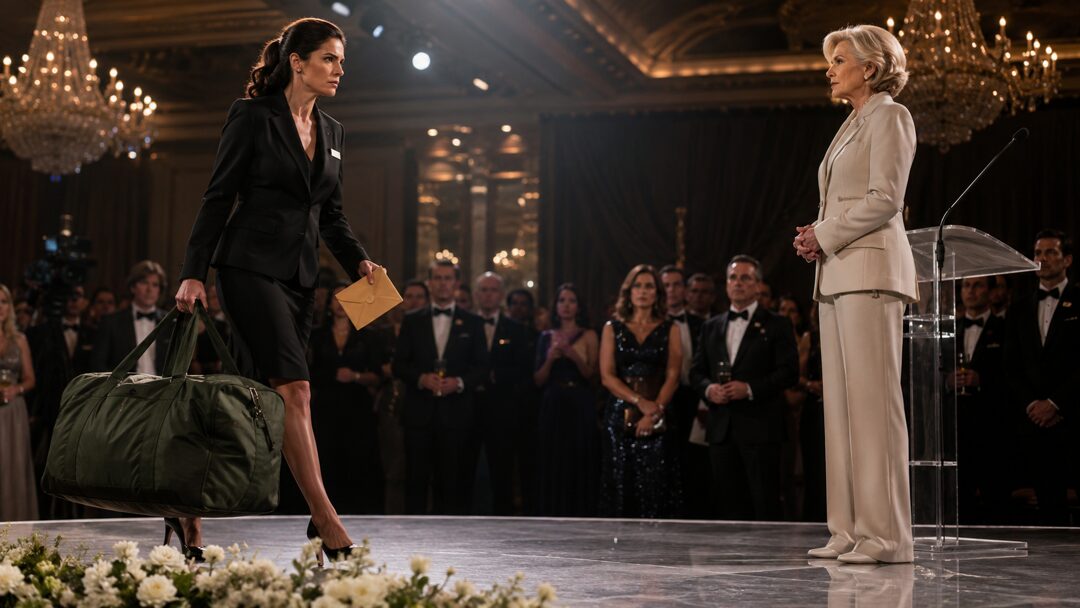
The ballroom was mid-applause when Sarah walked in carrying the green duffel bag.
She had taken it from Joshua in the corridor with one sentence.
“Let me carry it now.”
He had released it instantly.
That almost broke her.
Now the bag dragged beside her across the polished ballroom floor, ugly and ordinary against all that gold. Conversations faltered. A waiter froze with a tray of champagne. Linda turned first. Then Patricia, entering behind Sarah with a face so calm it frightened people who knew how to read calm.
Patricia reached the stage before Sarah did.
“Ladies and gentlemen,” Patricia said into the microphone, smiling with her whole public life. “A brief staffing interruption.”
A few guests chuckled politely.
Sarah climbed the stage steps.
Patricia’s smile tightened. “Miss Carter, this is not appropriate.”
Sarah looked at the room.
Donors. Journalists. Board members. Hotel staff lining the walls. People who would not have remembered her name an hour ago unless they needed towels.
She had spent years being careful in rooms like this.
Careful women were easy to erase.
She set the duffel at Patricia’s feet.
Linda stepped forward. “Sarah, whatever Daniel promised you, this isn’t the way.”
There it was.
A whisper dressed for a crowd.
Several faces changed. Curiosity sharpened into judgment.
Linda’s voice softened, perfectly pitched. “I understand old feelings can make people act against their own interests.”
Sarah looked at her.
“No,” Sarah said. “You understand exactly how to make old feelings sound cheap.”
The room went still.
Patricia reached for the microphone. “This woman has a personal history with my son and appears to be under some distress.”
Sarah took the microphone first.
Her hand was steady now.
“I am under distress,” she said. “There’s a twelve-year-old boy being taken through your private elevator while his grandmother tells this room his father is resting.”
A murmur moved across the ballroom.
Patricia’s eyes hardened. “Be careful.”
Sarah unzipped the duffel.
The sound carried.
Then she tipped the bag.
Bundles of hundred-dollar bills spilled across the stage in heavy, ugly blocks. One broke open and scattered bills against Patricia’s cream shoes.
The room gasped as one body.
Sarah did not look at the money.
She unfolded Daniel’s letter.
“I’m going to read one line,” she said.
Patricia moved toward her.
Linda caught Patricia’s sleeve. Not to stop her. To warn her that everyone was watching.
Sarah read.
“If Joshua is missing, my family has chosen the hotel over my son.”
The ballroom changed.
Not into outrage yet. Wealth rarely moved that fast.
It changed into uncertainty.
That was enough.
At the far entrance, the private elevator doors opened.
Joshua stood between two guards, pale and silent, one hand still curved as if the duffel strap had left a mark in his palm.
Sarah pointed toward him.
Not dramatically.
Simply.
“Look at him,” she said. “This is what your legacy is protecting itself from.”
No one applauded.
No one moved.
That silence did more than applause could have.
Patricia stepped to the microphone again, but her voice no longer filled the room the same way.
“Joshua is my grandson. This is a private family issue.”
Sarah looked at the cameras near the back wall. Some were already raised.
“You made it public when you built a gala around hiding it.”
A man near the front stood. “Mrs. Harrington, what is this money?”
Patricia ignored him.
Another voice, a journalist this time: “Where is Daniel Harrington?”
Patricia’s face flickered.
Small.
Fatal.
Sarah saw it and knew the letter was true.
Hotel security began moving, but not toward Sarah now. Toward the stage. Toward the money. Toward Joshua. Too many directions at once.
Then the ballroom doors opened again.
Two men in dark coats entered with badges held low at their sides, followed by Michael Reyes with his phone already recording.
Sarah stepped back from the microphone.
She had expected to feel triumphant.
She felt tired.
Joshua crossed the room before anyone stopped him. He climbed the stage steps and stood beside Sarah, close enough that his sleeve touched hers.
He did not take her hand.
That would have made him look younger than he wanted to be.
But he leaned against her, just once.
That was enough.
Patricia stared at them from three feet away, surrounded by cash, flowers, cameras, and all the people she had trained to admire her.
For the first time since Sarah had known her, Patricia had no graceful sentence ready.
Part VI — What Was Left Inside
Daniel was found two days later in a private recovery facility outside Lake Forest, registered under a shortened version of his middle name.
He was not dying. He was not fine.
The official language came slowly and carefully: exhaustion, medication concerns, family miscommunication, ongoing review. The unofficial truth came faster. Patricia had arranged for him to be kept quiet long enough to transfer control of the trust.
Sarah did not follow every update.
She had spent enough of her life waiting for Daniel Harrington to become clear.
When he asked to see her, she almost said no.
Then Joshua called.
Not crying. Not pleading.
Just asking, “Could you come? He keeps asking if I’m safe, and I don’t know how to answer that so he believes me.”
So Sarah went.
Daniel looked smaller in the facility’s white room. Not physically. The Harrington polish was simply gone. No tailored jacket, no watch, no practiced ease. His hair was uncombed. His face had the hollowed look of a man finally meeting consequences without staff to soften the appointment.
When Sarah entered, he tried to sit up.
“Don’t,” she said.
He stopped.
That alone told her how much had changed.
For a moment they looked at each other across all the years he had allowed her to misunderstand.
“I’m sorry,” Daniel said.
Sarah nodded once. “I know.”
His eyes reddened. “I loved you.”
The sentence landed, but not where it used to.
Once, those words would have undone her.
Now they only opened a door to a room she no longer lived in.
“You loved me best when no one could see it,” Sarah said. “I can’t live there anymore.”
Daniel closed his eyes.
He did not argue.
That was his first decent gift.
Joshua sat in the chair by the window, listening without pretending not to. Sarah wished he did not have to hear adults being honest too late.
Daniel looked at his son. “I should never have given you that bag.”
Joshua’s mouth trembled once. He controlled it quickly.
“No,” he said. “You shouldn’t have.”
Daniel nodded as if the words hurt and deserved to.
Sarah left before apology could become need.
Three weeks later, she resigned from the Harrington Hotel.
Human resources asked if she wanted to make a statement. Sarah almost laughed. The hotel had finally asked for her version after the whole city had heard everyone else’s.
“No,” she said. “I’m done explaining myself in rooms that already decided.”
She took a position at a small independent inn near Lincoln Park. It had no ballroom, no family crest, no orchids tall enough to intimidate anyone. The lobby smelled of coffee and raincoats. Guests learned her name because she told it to them, not because it was pinned to her chest.
On her fourth Friday there, Joshua came in carrying the green duffel.
For one terrible second, Sarah’s body remembered fear before her mind could read his face.
Then he lifted it easily.
Empty.
“Hi,” he said.
Sarah came around the counter. “Hi.”
He looked taller, though he probably was not. His hoodie was zipped. His hair was still messy, but in an ordinary way now.
A woman from the temporary guardianship office waited outside by the curb, giving him space.
Joshua set the duffel on the floor between them.
“I thought you might want it.”
Sarah looked at the bag.
It seemed smaller without the money.
“No,” she said gently. “I don’t.”
He nodded as if he had expected that.
Then he unzipped the side pocket and took out the envelope. Daniel’s handwriting was still there, creased now at the corner.
Only open this if I disappear.
Joshua held it for a long time.
“I was going to throw it away,” he said.
“You can.”
He walked to the trash can near the coffee station, dropped the empty duffel in first, then held the envelope over it.
His fingers opened.
The envelope fell.
Sarah did not move.
Joshua stared down into the trash.
Then he reached in and pulled the envelope back out.
“I think I want to keep this part,” he said.
Sarah understood.
Not because it was sentimental.
Because proof mattered when powerful people spent whole lives making pain sound like confusion.
She nodded. “Then keep it.”
Joshua folded the envelope carefully and slid it into his hoodie pocket.
At the door, he turned back. “Do you think my dad will be okay?”
Sarah thought of Daniel in the white room. Daniel without the suit. Daniel apologizing without asking to be forgiven. Daniel alive, guilty, trying.
“I think he has a chance,” she said.
Joshua considered that.
“Is that the same as okay?”
Sarah smiled, but only a little. “Not always.”
He accepted this better than most adults would have.
Outside, the woman from the guardianship office opened the car door. Joshua stepped toward it, then paused.
“Sarah?”
“Yes?”
“Thank you for opening it early.”
He touched the envelope in his pocket once, as if making sure it was still there.
Then he left.
Sarah watched the car pull away from the curb and disappear into the afternoon traffic.
Behind her, the inn bell chimed as a new guest entered.
For a moment, Sarah stayed where she was, looking at the empty space where the green duffel had been.
The bag was gone.
The money was gone.
The room was quiet.
And for the first time in years, silence did not feel like something she had been forced to carry.