The Day They Chained His Farm Road, He Went Looking for the Record Everyone Ignored
Chapter 1: The Morning a Chain Appeared Across His Farm Road
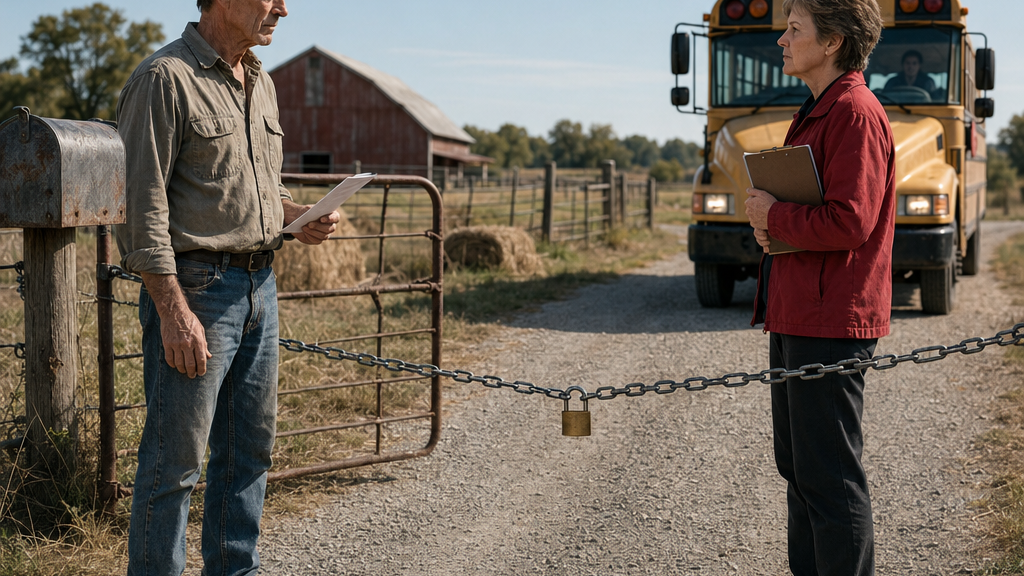
Gregory Hill saw the chain before he saw the woman.
It stretched from the cedar post beside his mailbox to the steel cattle gate on the other side of the gravel lane, waist-high and new enough that the links still carried an oily gray shine. A brass-colored padlock hung near the middle.
His feed wagon was already hitched to the tractor behind him.
For several seconds, Gregory simply sat in the seat with the engine idling.
Nobody had chained that road in the forty-two years he had been driving it.
He killed the engine, climbed down, and walked toward the barrier.
A white sheet of paper had been slipped through one of the links.
TRESPASS ASSESSMENT was printed across the top.
Below it was a number.
$400.
Gregory read it twice.
Then a car door shut behind him.
Christine Roberts came up the lane from the subdivision side carrying a clipboard under one arm. Her clothes were too neat for the dust already lifting off the road—dark slacks, clean boots, a red jacket that made her visible from halfway across the pasture.
“Morning, Gregory.”
He held up the paper.
“What is this?”
“It explains itself.”
“It says I’m trespassing.”
“Yes.”
“On what?”
Christine stopped several feet from him.
“The association road.”
Gregory looked past her.
The road ran north between his hay ground and the fence line, bent around a cottonwood, and continued toward six newer homes built on former pasture. Behind him, the same gravel ran past his barn and equipment shed before reaching the county road.
He had hauled hay over it before any of those houses existed.
“My barn is back there,” he said.
“I know where your barn is.”
“My south field is back there.”
“I know that too.”
“And you’re telling me I’m trespassing if I drive from one part of my farm to another?”
Christine’s jaw tightened.
“I’m telling you that the road is maintained and controlled by the Cedar Ridge Road Association. You’ve ignored the notices, you haven’t followed the access rules, and you haven’t paid the current assessment.”
Gregory looked again at the chain.
“You put this up?”
“The board authorized it.”
“Which board?”
“The association board.”
“That wasn’t my question.”
Christine opened the clipboard.
Gregory knew that gesture. She had done it twice the previous summer when neighbors complained about gravel washing into a drainage swale. Paper first. Conversation second.
“The association rules are clear,” she said.
“I didn’t ask about your rules.”
He held out the invoice.
“I asked what recorded document gives your association the right to block this road.”
Christine’s eyes flicked to the paper and back to him.
“The road-maintenance agreement.”
“What book and page?”
A pause.
Not long.
But long enough.
Christine shifted the clipboard against her hip.
“You’ve been provided copies.”
“Of association rules.”
“And the agreement.”
“Then tell me where it’s recorded.”
Her mouth flattened.
“You can bring your concerns to the meeting.”
Gregory almost laughed.
For years he had thrown association envelopes into a drawer unopened. He had no patience for committees debating potholes, mailbox placement, speed limits, or who owed twenty dollars for another load of gravel. The road had worked before there was a committee.
That fact had always seemed sufficient.
Now Christine reached toward the padlock.
“If you need access for farm operations, you can request temporary entry after the outstanding amount is handled.”
Gregory stared at her hand.
“You’re charging me four hundred dollars to drive to my own field.”
“I’m enforcing the same rules for everyone.”
A diesel engine sounded behind Christine.
Both of them turned.
The yellow school bus rounded the curve and slowed when the driver saw the chain. Its brakes sighed. Through the windshield, the driver lifted one hand in confusion.
Gregory stepped toward the road.
Christine raised her palm.
“Don’t.”
The bus stopped twenty yards away.
The driver opened the door.
“What’s going on?”
Christine walked toward the bus.
“This route is restricted.”
“It wasn’t Friday.”
“It is now.”
The driver looked at Gregory.
Gregory said, “I didn’t put it there.”
Christine’s shoulders stiffened.
“There’s another entrance off Miller Road.”
The driver frowned.
“That’s not an approved turnaround.”
“It connects.”
“After rain, it barely connects.”
Christine glanced toward the sky as if the dry Monday morning settled the matter.
“You’ll have to use it.”
Gregory could see silhouettes at the bus windows.
Children shifting in their seats.
Watching.
That was when the embarrassment reached him.
Not when he saw the invoice.
Not when Christine called him a trespasser.
It was standing beside his own mailbox while a school bus waited for someone else’s permission to cross the road he had graded with his father when he was twenty-three.
He could have unhooked the chain.
A pair of bolt cutters hung in his shop fifty yards away.
He could have broken the lock in less than a minute.
Instead, he folded the invoice once and put it in his shirt pocket.
“Christine.”
She turned.
“Before you fine me again, send me the recorded instrument that says you own the access.”
“We’ve already sent you what applies.”
“No. You sent rules your board wrote.”
Her face hardened.
“You always do this.”
“Do what?”
“Act like nothing applies to you because your family was here first.”
The words struck closer than he expected.
Gregory said nothing.
Christine pointed toward the alternate road.
The bus backed slowly, then turned.
Gregory watched it disappear beyond the cottonwoods.
He stood beside the chain for another minute, listening to the tractor ticking as its engine cooled.
By noon he had moved the feed wagon through a pasture gate instead, crossing ground he normally kept closed to equipment. A rear tire sank into a soft patch near the swale. It took him forty minutes and a second tractor to pull it free.
At two-thirty, he heard from the school transportation supervisor.
The alternate route had turned muddy in the low section. The bus had made it through, but barely. They would not use it again until the ground dried.
“You and the association need to settle this,” the supervisor said.
Gregory almost answered that he had never joined the fight.
Then he looked toward the chain.
Maybe that was exactly the problem.
Just before sunset, he walked down to the mailbox.
Another sheet had been fastened to the post with a yellow plastic tag.
He tore it loose.
UNAUTHORIZED GRAVEL DISTURBANCE.
Additional assessment: $200.
At the bottom, beneath Christine Roberts’s signature, was a line Gregory had not noticed on the first notice.
Continued violations may result in further restrictions of access.
Gregory folded the second invoice and placed it beside the first.
For the first time that day, he stopped wondering how angry Christine intended to make him.
He began wondering what she believed gave her the right.
Chapter 2: Every New Invoice Made the Road Feel Smaller
The feed truck stopped on the county shoulder Tuesday morning and would not come any farther.
Gregory walked down from the barn while the driver leaned out the window.
“You got a chain across your entrance.”
“I can see it.”
“Company says I don’t cross private barriers.”
“It isn’t private.”
The driver looked at the padlock, then at Gregory.
“I’m not getting in the middle of that.”
The load was eight tons.
Gregory had enough feed in the bins for another two days.
Maybe three if he stretched it.
“Can you back into the south field entrance?”
“With this rig?”
The driver shook his head.
“Too narrow.”
Gregory stood beside the truck while dust settled around his boots.
Christine’s chain had turned a thirty-foot stretch of gravel into something larger than the road itself. Every ordinary task now required explanation. Deliveries. School traffic. Hay equipment. Even getting his pickup from the barn to the north pasture meant deciding whether to call Christine for permission or take the long route through his own fields.
He chose the fields.
By Tuesday afternoon, there was another notice on the gate.
GATE MAINTENANCE VIOLATION.
By Wednesday morning, one appeared under his windshield wiper.
UNAUTHORIZED HEAVY VEHICLE ACCESS.
Gregory carried all four papers into the farmhouse and dropped them on the kitchen table.
They made an absurd little stack.
Four hundred.
Two hundred.
One hundred fifty.
Another two hundred.
He added the figures on the back of an envelope and stopped when he reached nine hundred fifty dollars.
The telephone rang.
Christine.
He let it ring.
That had been his habit for years.
Association letter? Drawer.
Meeting notice? Drawer.
Reminder? Drawer.
If they needed gravel money, he paid what seemed reasonable when somebody came by. If they wanted him to attend a meeting about reflective mailbox numbers or landscaping near a sight line, they could talk without him.
His father had been the same way.
Roads were maintained by the people who used them. Fences were fixed by the people whose cattle leaned on them. Agreements were settled over truck hoods and coffee.
Paper was what outsiders needed when trust had already failed.
Gregory opened the kitchen drawer beside the refrigerator.
It was nearly full.
Envelopes bent at the corners. Notices. Meeting minutes. Photocopied budgets. Some unopened.
He began sorting.
Most were recent.
Two years.
Three.
Then he reached the older folder beneath them.
His mother had written ROAD in blue ink across the tab sometime before she died.
Inside were tax receipts, survey copies, handwritten gravel calculations, and a yellowed sheet bearing his father’s name.
Gregory stopped moving.
The signature was unmistakable.
Arthur Hill.
Below it was a date from more than twenty years earlier.
The document was titled ROAD MAINTENANCE PARTICIPATION AGREEMENT.
Gregory sat down.
He read slowly.
Each benefited parcel was expected to contribute to grading, gravel, drainage repair, and snow removal. Costs would be divided according to frontage and use. Heavy agricultural traffic could be assessed an additional share if documented road damage resulted.
That much irritated him, but it did not surprise him.
Then he reached the final page.
By signing, participating landowners acknowledge the Cedar Ridge Road Association as the coordinating body responsible for administration and regulation of the maintained roadway.
Gregory read that sentence again.
Regulation.
Not ownership.
Not exclusive access.
But more than nothing.
His father had signed it.
There was even a canceled check stapled behind the agreement for six hundred dollars marked ROAD GRAVEL.
Gregory leaned back.
For twenty-four hours, he had treated Christine’s claim as something fabricated from committee arrogance. Now there was his father’s name beneath the association title.
He heard the old man’s voice as clearly as if he were standing in the kitchen.
Pay your share. Don’t let anybody carry you.
Gregory rubbed one thumb across the signature.
Had Arthur understood the wording?
Probably.
Had Gregory?
He could no longer say, because he had never bothered to read the later versions.
The telephone rang again.
This time he answered.
“Gregory,” Christine said, “we need to resolve the outstanding assessments.”
“I found my father’s road agreement.”
Silence.
Then: “Good.”
“You knew he signed one?”
“Of course.”
“That agreement says maintenance.”
“It says administration and regulation.”
“It doesn’t say ownership.”
“It gives the association authority.”
“To collect gravel money. Maybe. It doesn’t say you can lock me out.”
Christine exhaled.
“This is exactly why we asked you to attend meetings. The road has been deteriorating for years. Heavy trucks use it. Several owners stopped paying. Everybody wants it plowed and graded, but nobody wants responsibility.”
“That still doesn’t answer who owns access.”
“You keep separating things that aren’t separate.”
“Because they might be.”
Her voice cooled.
“Your outstanding invoices remain valid.”
Gregory looked at his father’s signature.
For the first time, he felt something worse than anger.
Uncertainty.
“What document did this agreement come from?” he asked.
“What?”
“What’s underneath it? Easement, deed, plat—whatever created the road in the first place.”
“The association has its files.”
“Recorded where?”
“We’ve gone over this.”
“No. We haven’t.”
He heard paper moving on her end.
“You want to challenge it formally, do that.”
“I think I will.”
After the call, Gregory carried the old folder to the window.
Outside, the chain crossed the lane exactly where it had on Monday.
But it looked different now.
Not stronger.
More complicated.
At dusk, he drove to the south pasture and checked the cattle. On the way back, he stopped near the old cottonwood where the gravel bent north. He remembered his father standing there beside a grader decades ago, telling him to crown the road so rain would run off instead of cutting ruts.
His father had never called it the association road.
He had called it the lane.
Gregory realized that memory had been doing too much work for him.
Wednesday night, he laid the maintenance agreement, every invoice, and the unopened association notices across the kitchen table.
At the bottom of one recent letter was a reference number for county recording.
That was enough.
He set his alarm for earlier than usual.
On Thursday morning, instead of turning toward the barn after feeding the cattle, Gregory put the folder on the passenger seat of his pickup.
Then he drove to the county records office to find out exactly what his father had signed—and what he had not.
Chapter 3: The County File Contained Two Different Stories
Kathleen Brown placed the brittle sheet beside Gregory’s father’s maintenance agreement and said, “Don’t fold this one.”
Gregory barely heard her.
The plat was large enough to cover most of the records counter.
Faded black lines divided pasture, timber, and narrow parcels that no longer existed in the same shape. In the lower corner, beneath the surveyor’s seal, was the year.
A thin double line ran from the county road through what was now Gregory’s property, bent near the cottonwood, and continued north across the ground later divided for the Cedar Ridge homes.
Beside the line were four words.
INGRESS-EGRESS EASEMENT, 30 FEET.
Gregory leaned closer.
“That’s the road.”
Kathleen looked at the map but did not answer.
“That’s exactly where it runs.”
“I believe you.”
“And that says easement.”
“Yes.”
“So the association can’t block it.”
Kathleen gave him a patient look.
“I can tell you what’s recorded. I can’t give you a legal interpretation.”
Gregory almost argued.
Then he stopped himself.
That was what he had been doing since Monday—asking people to confirm what he already believed.
He looked back at the plat.
“Who was the easement for?”
Kathleen pointed toward the legal description.
“Let’s pull the instrument it references.”
Ten minutes later she returned with another scanned record.
The original grant allowed access for several parcels then owned by members of the same farming family. The language survived subsequent transfers unless formally released or modified.
Gregory followed the parcel numbers.
One led to his north field.
Two became the present subdivision.
Another had been absorbed into a neighboring farm.
“So this existed before Cedar Ridge Road Association.”
“By several decades,” Kathleen said.
Gregory felt a small, fierce satisfaction.
There it was.
The thing Christine had not produced.
He could already picture himself laying the 1962 plat on the association table.
Then Kathleen slid his father’s agreement closer.
“You asked about this too.”
The satisfaction cooled.
“Yes.”
She tapped a recording stamp.
“This one was filed later.”
Gregory looked at the date.
His father had signed the maintenance agreement twenty-three years ago. Two neighboring landowners had signed as well. A later amendment added the subdivision parcels after the original farm was split.
“Does it replace the easement?”
Kathleen shook her head.
“I can’t answer that.”
“Does it say it replaces it?”
“That I can help with.”
She searched the document.
They read every page.
There was no release of the 1962 easement.
No termination.
No transfer of exclusive ownership.
But the language became broader as the years passed.
The earliest agreement said coordinate maintenance.
A later amendment said administer the roadway.
Another revision used control and regulate access for the purposes of maintenance, safety, and preservation.
Gregory frowned.
“There.”
He pointed.
“That’s what Christine is using.”
“Possibly.”
“But it still doesn’t say they own it.”
“No.”
The word gave him less satisfaction than he expected.
Because the next paragraph allowed additional assessments for extraordinary use, including heavy agricultural vehicles.
His farm equipment.
His feed deliveries.
His hay trucks.
Christine had not invented that either.
He sat back.
“So my father agreed they could charge us more if we damaged the road.”
“That appears to be what he signed.”
“And they could regulate access.”
“For the listed purposes,” Kathleen said carefully.
“But the original easement still exists.”
“It’s still in the chain of title.”
Gregory stared at both documents.
Two stories.
The plat said the road existed to provide access.
The maintenance agreement said somebody had to protect and pay for the road carrying that access.
Neither document, at least not in front of him, said exactly what Christine had told him Monday morning: that the association owned the road and he was trespassing.
But neither allowed Gregory to pretend the association was meaningless.
His father had signed its authority into existence because the road needed gravel, grading, drainage, and snow removal.
Gregory felt a flash of irritation at the dead man.
Then shame for feeling it.
“Why didn’t you tell me about this?” he muttered.
Kathleen looked up.
“Sorry?”
“Nothing.”
She began returning loose pages to order.
Gregory stopped her.
“There are annual assessments mentioned here.”
“Yes.”
“Are those recorded?”
“Association accounting usually wouldn’t be in land records.”
“Then where would I find what they were charging for?”
“Association records. Possibly tax filings, depending on structure. Bank records if you have lawful access to them. Meeting minutes.”
Gregory thought of the drawer in his kitchen.
Years of envelopes he had ignored.
For all he knew, the answer had been arriving at his house one sheet at a time.
Kathleen pulled another index entry onto the screen.
“There are a few later memoranda.”
One was filed eleven years earlier after a dispute over grading costs.
Gregory read the language.
Annual road assessments may be levied upon participating parcels to ensure continued maintenance and regulated use.
Then came a phrase that bothered him.
Nonparticipating or delinquent users may be subject to access enforcement measures as adopted by the association.
“Who wrote this?”
Kathleen checked.
“Association filing. Signed by the chair at the time.”
“Was my father still alive?”
“Yes.”
“Did he sign it?”
“No.”
Gregory leaned closer.
Neither had several other original easement holders.
Yet later documents referenced that memorandum as though it applied to everyone.
He took out his phone and photographed the recording information.
“What happened between the first agreement and this?”
Kathleen glanced toward the clock, then back at him.
“That’s probably not a land-record question.”
“No.”
Gregory looked at the four invoices in his folder.
“It’s a money question.”
Before leaving, he paid for certified copies of the 1962 plat, the original easement instrument, his father’s maintenance agreement, and the later amendments.
Kathleen slid them across the counter in a large envelope.
“You may want someone qualified to review these.”
Gregory nodded.
A week earlier he would have resented the suggestion.
Now he understood what she meant.
Documents did not speak as plainly as people claimed they did.
In the parking lot, he sat in his pickup with the certified envelope on the passenger seat.
He could prove Christine had overstated one thing.
The association did not appear to own the road outright.
But she could prove something too.
His family had accepted responsibility for maintenance and some regulation.
The dispute was no longer Gregory versus a woman who had invented a road association out of thin air.
It was about where maintenance authority had turned into claimed ownership.
He drove home and spent the afternoon opening every association envelope he had ignored.
Near the bottom of the stack, he found three annual statements from different years.
One described a charge as road maintenance.
The next called nearly the same amount an access assessment.
The third divided the same category between maintenance and enforcement.
Gregory placed the papers side by side.
The numbers were close enough to make him uneasy.
At the bottom of the newest statement was a handwritten notation directing questions to the association treasurer.
Matthew Nelson.
Gregory took out a clean sheet of paper.
For the first time since the chain appeared, he was no longer trying to prove that Christine was wrong.
He was trying to find the moment when everybody had stopped distinguishing the right to maintain the road from the right to control who could use it.
And now he knew exactly which records he needed next.
Chapter 4: The Money Trail Changed What Gregory Thought He Was Fighting
The same gravel charge appeared twice.
Gregory noticed it Friday morning because the figure—eight hundred forty dollars—was too large to forget.
On one annual statement it sat beneath ROAD MAINTENANCE. On another association summary from the same year, eight hundred forty dollars appeared under ACCESS ADMINISTRATION.
He placed both sheets side by side on the kitchen table.
Same amount.
Different description.
He found another.
Three hundred twenty dollars for drainage work appeared once under MAINTENANCE and again in a year-end category labeled ENFORCEMENT AND ROAD PRESERVATION.
Gregory took out a pencil.
He had spent enough years calculating seed, fertilizer, fuel, cattle weights, and hay yields to know that numbers did not become suspicious simply because they were confusing. Sometimes the explanation was boring.
But boring explanations usually became clearer when you followed them.
These became worse.
He pulled every annual statement from the drawer and arranged them by year. His breakfast went cold beside him.
In the earlier records, charges were straightforward: gravel, grading, snow removal, culvert repair.
Later, the language changed.
Road assessment.
Access assessment.
Administrative enforcement.
Gate compliance.
Heavy-use fee.
The underlying expenses, however, looked remarkably similar.
By ten o’clock he had filled three pages with dates and amounts.
Then his phone rang.
The number belonged to Matthew Nelson.
Gregory stared at it before answering.
“Matthew.”
“Christine said you’ve been asking about the accounts.”
“I’ve been reading what you sent everybody.”
“That’s not really the same thing.”
“No?”
Matthew hesitated.
“I’m treasurer. If you have a question, ask me.”
Gregory looked at the two eight-hundred-forty-dollar entries.
“Was this gravel or access enforcement?”
Silence.
“What year?”
Gregory told him.
More silence.
“Probably gravel.”
“Then why does another statement call it access administration?”
“I’d have to look.”
“I am looking.”
Matthew exhaled into the phone.
“Don’t assume there’s missing money.”
“I didn’t say there was.”
“You’re thinking it.”
“I’m thinking the words changed.”
“That’s not the same as money disappearing.”
“I know.”
The answer seemed to unsettle Matthew more than an accusation would have.
After a moment he said, “I’ll meet you at the association office.”
The office was a converted room beside the equipment storage shed used by the subdivision. One metal desk, two file cabinets, folding chairs, a printer, and a wall calendar from a local farm-supply company.
Matthew was already there when Gregory arrived.
He was younger than Gregory by perhaps fifteen years, broad through the shoulders, with the permanently tired look of a man who had agreed to volunteer for something that slowly became a second job.
He opened a ledger.
“Here. Eight-forty. Crushed limestone.”
Gregory pointed to his photocopy.
“Then why call it access administration?”
Matthew rubbed the bridge of his nose.
“Because we changed categories.”
“Why?”
“Because Christine wanted expenses tied to the rules they supported.”
Gregory waited.
Matthew turned several ledger pages.
“Look, the road started costing more. Everybody complained. The people at the far end said farm trucks did most of the damage. Farmers said the subdivision caused the traffic. Two households stopped paying completely. Every meeting turned into the same argument.”
“So you renamed gravel?”
“We reorganized accounting.”
“You called maintenance enforcement.”
“Sometimes enforcement money paid maintenance costs.”
Gregory looked up.
“That sentence doesn’t help.”
“I know.”
Matthew shut the ledger.
For the first time, he seemed embarrassed rather than defensive.
“I told Christine the wording was getting ahead of us.”
“When?”
“Last winter.”
“And?”
“She said nobody took the association seriously because everything had always been informal.”
Gregory almost smiled.
That sounded uncomfortably familiar.
“What did you say?”
“That we ought to get the easement reviewed before changing access rules.”
“And did you?”
“No.”
“Why?”
Matthew looked toward the closed office door.
“Because we were six thousand dollars short on projected road work. Because three residents were threatening to vote Christine out if she didn’t make delinquent users pay. Because I didn’t want to be the man standing in front of everybody saying our rules might not mean what we’d been telling them they meant.”
Gregory sat back.
There it was.
Not theft.
Not some grand plan.
Fear, pride, and bookkeeping layered over old language until nobody wanted to pull at the thread.
“Christine knew there was a question.”
“She knew I had one.”
“That’s different.”
“Yes.”
“But she chained the road anyway.”
Matthew did not answer.
Gregory looked down at the ledger.
That silence mattered more than the duplicate categories.
“What happened with my invoices?”
Matthew opened another folder.
The four charges were listed.
Beside them were projected uses: grading reserve, administrative costs, gate installation, road repair.
Gregory tapped the page.
“My trespass fine is paying for gravel?”
“Part of it would.”
“Then it isn’t a trespass fine.”
“It’s an assessment.”
“It says trespass.”
Matthew looked tired again.
“Christine wanted consequences people couldn’t shrug off.”
Gregory closed the folder.
He had arrived hoping to discover a clean line between right and wrong.
Instead he had found people trying to keep a road functioning, then letting the need for money justify language they had never bothered to prove.
He thought of his own unopened envelopes.
He had made the same mistake in reverse.
They assumed written rules could replace old understanding.
He assumed old understanding could survive without anything written.
“Matthew,” he said, “how many people have paid access penalties?”
“I’d have to count.”
“More than five?”
“Yes.”
“More than ten?”
Matthew looked away.
“Yes.”
Gregory stood.
“What are you going to do?”
“About what?”
“You know what.”
Before Matthew could answer, his phone buzzed.
He looked at the screen.
His expression changed.
“Christine scheduled a meeting.”
“When?”
“Tonight.”
Gregory held out his hand.
Matthew gave him the phone.
The message called it an emergency meeting to confirm enforcement authority and approve revised access penalties.
A vote was scheduled.
Seven o’clock.
Gregory handed the phone back.
“She’s trying to settle the question before anyone asks what the question is.”
Matthew said nothing.
Gregory gathered his copies.
At the doorway, Matthew spoke.
“For what it’s worth, she didn’t invent all this.”
Gregory turned.
“The language was messy before Christine became chair. People have treated that road like association property for years.”
“Then somebody should’ve checked.”
“Yes.”
“Did you?”
Matthew lowered his eyes.
“No.”
Gregory drove home with the certified plat on the passenger seat and Matthew’s admission lodged somewhere less comfortable.
That afternoon he copied the old easement, his father’s agreement, the annual statements, and the photograph of the chain.
He included everything.
Even the pages that helped Christine.
Especially those.
At six-thirty he placed the documents in a plain folder.
For a moment, his hand rested on his father’s signature.
If he exposed the association’s history honestly, he could not pretend the older generation had kept everything clean either.
At six-forty-five, Gregory left for the meeting.
Chapter 5: He Brought the Old Plat Into a Room Full of New Rules
Gregory entered just as Christine Roberts said, “If there are no further objections, we can move to the vote.”
Every chair turned toward him.
He closed the door behind himself.
“Got one.”
Christine stood at the front table with three stapled packets arranged in neat rows. Matthew sat off to one side, his ledger closed in front of him.
Eight residents occupied folding chairs.
Gregory recognized all of them.
Some nodded.
Some did not.
Christine’s face remained composed.
“This meeting started at seven.”
“It’s seven-oh-two.”
“You received notice.”
“I did.”
That alone caused Matthew to glance up.
Gregory had received plenty of notices before.
He simply had not read most of them.
Christine touched the packet in front of her.
“We’re considering amendments clarifying road-access authority and penalties for noncompliance.”
Gregory took an empty chair but did not sit.
“Before you clarify it, I’d like to know where it comes from.”
A resident near the wall sighed.
“We’ve been over this for years.”
Gregory looked at him.
“Maybe that’s the problem.”
Christine said, “The association has administered this road for more than two decades.”
“Maintained it too.”
“Yes.”
“I’m not disputing that.”
That answer changed the room slightly.
Christine seemed to have prepared for denial.
Gregory opened his folder.
“My father signed a maintenance agreement. I found it Wednesday.”
Christine immediately reached beneath her packet.
“So did we.”
She pulled out a copy.
Arthur Hill’s signature lay plainly at the bottom.
Several residents leaned forward.
Christine placed it on the table.
“Your family recognized association authority long before I lived here.”
Gregory felt the old shame rise again.
This was the document he had feared finding.
His father’s name attached to something Gregory had spent days arguing could not exist.
He could deny its meaning.
He could say Arthur had been misled.
He could dismiss the whole thing as ancient paperwork.
Instead Gregory nodded.
“My father agreed to pay a share of maintaining the road.”
Christine’s expression flickered.
“And to regulation.”
“For maintenance, safety, and preservation.”
“Exactly.”
“No. Not exactly.”
Gregory unfolded the certified copy of the 1962 plat.
The room grew quiet from the sound alone.
He placed it beside the newer agreement.
“This came first.”
Christine looked down.
“What is it?”
“The original recorded plat.”
Gregory pointed to the line.
“Thirty-foot ingress-egress easement. Runs from the county road through my place and serves the parcels north of me.”
One resident stood to see better.
Christine stayed where she was.
“The association agreements came later.”
“They did,” Gregory said. “Because somebody had to maintain the road.”
“Which is what I’ve been saying.”
“Then why did you tell me the association owned it?”
Christine’s gaze hardened.
“We control it.”
“For maintenance?”
“For lawful association purposes.”
“Show me where that includes extinguishing the easement.”
“It doesn’t extinguish anything.”
“The chain does.”
Nobody moved.
Matthew stared at the table.
Christine folded her arms.
“You were not barred permanently. You were restricted for refusing assessments.”
Gregory removed the $400 invoice.
“This says trespass.”
He added the $200 notice.
“This one says gravel disturbance.”
Another.
“This says gate maintenance.”
Then he put two annual statements beside them.
“And the accounts call similar charges maintenance in one year and access enforcement in another.”
Christine’s eyes went to Matthew.
He did not look back.
“What exactly are you alleging?” she asked.
“Nothing yet.”
“You’ve brought financial records into a meeting and implied misconduct.”
“I brought your records.”
“They are association records.”
“They were mailed to me.”
A murmur passed through the chairs.
Gregory could feel the room wanting a simpler fight.
Good farmer.
Bad chairwoman.
Or stubborn farmer.
Responsible chairwoman.
He gave them neither.
“The road costs money,” he said. “Gravel isn’t free. Snow removal isn’t free. Culverts aren’t free. My equipment probably puts more wear on parts of that lane than a car does.”
Christine blinked.
A resident near the door said, “Then what are we arguing about?”
“Whether owing for gravel means somebody can call you a trespasser on an easement recorded before the association existed.”
That landed.
Not loudly.
But solidly.
Christine picked up the 1962 plat.
“This does not cancel the later agreements.”
“I never said it did.”
“Your father signed those agreements.”
“I know.”
“And benefited from the road being maintained.”
“I know.”
“So have you.”
“Yes.”
The room became quieter with every concession.
Gregory saw Christine notice it too.
He was not trying to escape responsibility.
That left her with the harder question.
“Then what do you want?” she asked.
“I want maintenance charges called maintenance charges. I want access rights treated like access rights. And I want the recorded document that gives this association exclusive power to block easement holders.”
Christine set the plat down.
“The board has interpreted the agreements that way for years.”
“Interpretation isn’t ownership.”
“You don’t get to walk into one meeting after ignoring us for years and act like the problem started Monday.”
The words were sharper now.
Gregory felt them because they were true.
“I don’t.”
Christine stopped.
“I should’ve opened the letters,” he said. “I should’ve come to meetings. I figured if the road needed gravel, somebody would tell me what my share was and I’d write a check. That was lazy.”
Several people shifted.
Gregory continued.
“But me being lazy doesn’t put ownership language into a document that doesn’t have it.”
Christine’s face reddened.
Matthew finally spoke.
“He’s right about the categories.”
Christine turned toward him.
“What?”
“The accounting categories.”
Matthew opened the ledger.
“I told you in January we needed to separate maintenance assessments from enforcement penalties.”
“This is not the time.”
“It is exactly the time.”
The room changed again.
Christine stared at Matthew as if betrayal had physical weight.
“You approved those statements.”
“I prepared them.”
“And signed off.”
“Yes.”
“Then don’t sit there pretending this is mine alone.”
Matthew swallowed.
“I’m not.”
Gregory watched them.
There was the deeper truth he had started to understand.
Christine had pushed too far.
Matthew had let her.
Gregory had stayed away.
Older owners had accepted loose language because everyone once knew what it meant.
Every generation had added one layer of certainty without checking what stood underneath.
Christine gathered the papers.
“We need counsel before making accusations about easement law.”
“I agree,” Gregory said.
That stopped her again.
“I’m not asking this room to decide it.”
“Then why are you here?”
“To stop you from voting tonight as if it’s already decided.”
A woman in the second row raised her hand.
“Can we postpone?”
Another resident nodded.
Then another.
Christine looked around the room.
“This road is falling apart because every time we try to enforce payment, somebody finds a reason they’re special.”
Gregory heard the fear beneath the irritation.
If the rules weakened, so did Christine’s ability to make people pay.
“If the maintenance bill is legitimate,” he said, “send me my share.”
“And the fines?”
“Show me the authority.”
Christine stared at him.
Then Gregory took a clean sheet from his folder and slid it across the table.
“Better yet, put your position in writing.”
Her eyebrows lifted.
“What position?”
“That the Cedar Ridge Road Association has authority to restrict my access under the recorded instruments and to issue the trespass and access penalties you’ve charged.”
A resident whispered something behind him.
Christine looked at the sheet.
Matthew said quietly, “Christine.”
She ignored him.
“You want this formal?”
“Yes.”
“You complained we use too much paperwork.”
“I did.”
“And now you want more.”
Gregory looked at his father’s signature.
“Yes.”
Something in his answer seemed to settle her.
Perhaps she believed he had finally accepted her world.
Christine picked up a pen.
She wrote slowly.
When she finished, she signed her name beneath the statement and pushed the sheet back across the table.
“There.”
Gregory read it once.
Then folded it carefully and placed it with the certified plat.
For years he had treated paper as a poor substitute for trust.
Now Christine had put the entire dispute onto one page.
Monday morning, he intended to find out what the county thought that page was worth.
Chapter 6: The Written Claim Forced Everyone to Choose a Side
Gregory put his father’s agreement on top of the complaint packet.
He nearly changed his mind.
The document was the strongest piece of paper Christine had against him. If he left it home, the county would still have the 1962 plat, the invoices, the photograph of the chain, and Christine’s signed assertion of authority.
Enough, perhaps, to make his case look clean.
That was exactly why he included it.
At the county office Monday morning, the auditor accepted the packet and began sorting it into piles.
“You’re challenging access restrictions?”
“And the penalties tied to them.”
The auditor held up Arthur Hill’s maintenance agreement.
“This supports association regulation.”
“It supports some regulation.”
“You’re submitting it voluntarily?”
“It’s part of the record.”
The auditor studied Gregory for a moment.
Then he placed the agreement beside the 1962 easement.
“Good.”
That one word mattered more than Gregory expected.
Kathleen Brown was called in to verify recording references. She recognized Gregory but kept the same professional expression she had worn Thursday.
The auditor asked whether the original easement had been released.
“No recorded release located,” Kathleen said.
“Modified?”
“Later maintenance instruments reference the roadway but do not expressly terminate the easement.”
The auditor turned to Gregory.
“That does not mean the association has no authority.”
“I understand.”
“Maintenance obligations may remain enforceable.”
“I understand that too.”
“And this office is not deciding private damages today.”
Gregory nodded.
Three days earlier, each qualification would have frustrated him.
Now they sounded like someone separating fence wire strand by strand instead of cutting the whole thing.
The auditor picked up Christine’s signed statement.
“This, however, is broader than the instruments I’m seeing.”
Gregory said nothing.
The auditor continued.
“An association coordinating maintenance is one issue. Preventing a holder from exercising a recorded ingress-egress right is another.”
“So the chain?”
“I’m reviewing that with county counsel and the sheriff’s office.”
Not victory.
Not yet.
Gregory drove home by noon and found the chain still stretched across the road.
Christine’s car was parked beyond it.
She stood near the mailbox.
“You filed something with the county.”
“Yes.”
“You could have told me.”
“I told you Friday.”
“You said you wanted clarification.”
“I do.”
“You’re trying to trigger an investigation.”
“If the records are right, an investigation won’t hurt them.”
Christine looked toward his barn.
“You think I wanted any of this?”
Gregory did not answer quickly.
“No,” he said finally. “I think you wanted people to pay.”
“They wouldn’t.”
“That doesn’t make everything allowable.”
“You have no idea what the meetings were like before I took over. Nobody paid on time. Everybody wanted the potholes fixed. One owner threatened to sue because an ambulance hit a washout. Another said the snowplow damaged his landscaping. Matthew kept telling me we were running short.”
Her voice had lost the hard public tone she used in meetings.
“I put rules in place because nobody else would.”
“And then you stopped asking whether the rules reached too far.”
Christine looked at him.
“So did you.”
Gregory nodded.
“Yes.”
That answer left no argument for several seconds.
A pickup appeared from the subdivision side.
Matthew Nelson parked and climbed out carrying a banker’s box.
Christine’s expression changed immediately.
“What is that?”
Matthew did not answer her.
He walked to Gregory.
“I brought the older ledgers.”
Christine stepped forward.
“Those are association property.”
“They’re copies.”
“You had no authority to distribute them.”
“They were requested.”
“By him?”
“By the county.”
Christine went still.
Matthew looked miserable.
“I should have turned them over Friday.”
“What’s in them?”
“Nothing stolen, if that’s what you mean.”
“Then why are you acting like this?”
“Because the categories changed and I knew it.”
Christine folded her arms.
“We already discussed that.”
“We discussed fixing them next year.”
“No. We discussed keeping the road funded.”
“And I let you call enforcement money whatever made the budget work.”
Christine’s face tightened.
“You prepared those reports.”
“I know.”
Matthew’s voice dropped.
“That’s why I’m giving them everything.”
Gregory looked at the box.
This was not a witness arriving to save him.
Matthew was not choosing Gregory.
He was choosing not to remain hidden behind Christine.
There was a difference.
By midafternoon, the auditor had the ledgers.
At four-ten, Gregory received a call.
The county’s preliminary review found no recorded basis allowing the association to unilaterally obstruct the physical easement pending resolution of disputed maintenance charges.
The chain would have to be removed.
The access fines would be reviewed separately.
“And the road assessments?” Gregory asked.
“Ordinary documented maintenance obligations are a different matter.”
“I figured.”
“There may also be refunds or credits due on penalties collected under unsupported classifications.”
Gregory looked through the kitchen window toward the lane.
“How many?”
“That requires the accounting review.”
After the call, he sat without moving.
He had wanted Christine wrong.
Completely wrong.
That would have been easier.
Instead, the county was confirming what the documents had been saying all along.
The road could belong to nobody exclusively and still obligate everybody who used it.
Christine had crossed the line when she turned maintenance authority into physical exclusion.
Gregory had spent years pretending the maintenance structure itself did not deserve his attention.
At five, Christine called.
Her voice was controlled.
“They’re talking about restitution.”
“I heard.”
“You understand what that could do to the reserve?”
“Yes.”
“We have culvert work due before winter.”
“Then the valid bills still need paying.”
She did not respond.
Gregory continued.
“I’m not asking them to erase maintenance.”
“Some residents will.”
“That’s their choice.”
“You could tell them not to.”
Gregory looked at the unopened envelopes he had finally sorted into stacks.
Maybe that was what surprised him most.
Christine was asking for his help.
Not forgiveness.
Not agreement.
Help keeping the road functioning after her authority had been cut back to its actual size.
“I’ll tell them what I know,” he said. “No more.”
“That may not be enough.”
“It’ll have to be.”
Tuesday morning came with the sound of a truck slowing near the mailbox.
Gregory stepped out of the barn.
A sheriff’s deputy climbed down from a county vehicle carrying a folder in one hand and a compact cutting tool in the other.
Christine was already standing beside the chain.
Matthew arrived moments later.
Nobody spoke while the deputy read the authorization.
Gregory could not hear every word from where he stood.
He did not need to.
The deputy closed the folder, looked at the brass-colored lock, and reached for the cutter.
The chain was about to come down.
What remained after it fell was no longer a question of who had won the road.
It was whether any of them could learn to share it honestly.
Chapter 7: When the Chain Fell, the Road Still Belonged to Everyone Who Needed It
The deputy set the cutting jaws around the brass-colored lock.
Nobody moved.
Gregory stood on his side of the gravel lane with his hands in his jacket pockets. Christine was ten feet away beside her car. Matthew remained near the mailbox, holding the banker’s box against his hip as though he still had not decided where it belonged.
The cutter whined.
The lock snapped.
For one second the chain stayed suspended between the cedar post and the steel gate. Then the deputy pulled one end free, and the links dropped onto the gravel with a hard metallic clatter.
Gregory had imagined that sound for eight days.
He had expected relief.
Instead he noticed how ordinary the road looked without the barrier.
Same tire tracks.
Same pale gravel.
Same bend near the cottonwood.
The deputy gathered the loose chain and set it beside the post.
“This removes the obstruction,” he said. “It does not settle the maintenance dispute.”
Gregory nodded.
“I understand.”
Christine gave a short, humorless laugh.
“At least somebody does.”
The deputy looked between them but said nothing.
Then an engine sounded from the county-road direction.
The school bus.
It slowed at the entrance.
The driver studied the open lane, then Gregory, then the deputy. Gregory stepped away from the road and raised one hand.
The bus rolled through.
No cheering.
No waving children.
Just tires crunching over gravel where a chain had been twenty seconds earlier.
That was enough.
Christine watched the bus disappear around the bend.
“I suppose everyone will say you won.”
Gregory looked at her.
“Did you lose?”
Her mouth tightened.
“The county is reviewing every penalty we issued.”
“That wasn’t what I asked.”
She looked down at the severed lock.
“I’m stepping down.”
Gregory had not expected the words so soon.
“When?”
“Tonight.”
Matthew shifted beside the mailbox.
Christine continued before either man could respond.
“The board needs somebody who can negotiate the new agreement without every decision being treated as evidence against them.”
“Some decisions were evidence,” Matthew said.
Christine looked at him.
“So were yours.”
He accepted that with a small nod.
Gregory watched the two of them.
Nobody in that lane had clean hands.
His were cleaner than theirs on the fines, perhaps, but not on the years that came before. He had ignored notices because he found meetings tedious. He had assumed people would preserve the distinction his father’s generation understood without anyone bothering to write it clearly.
They had all trusted a different kind of shortcut.
Christine opened her car door.
“Your refund will probably be larger than most.”
“I haven’t paid the fines.”
“I know.”
“Then there’s nothing to refund.”
“They’re talking about credits for older charges too.”
Gregory thought of the checks he had written over the years without asking how the amounts were categorized.
“If they were legitimate maintenance, I don’t want them back.”
Christine stared at him.
“You’re serious.”
“Yes.”
“You just spent a week proving the association mishandled this.”
“I proved you couldn’t chain an easement holder out because of disputed fees. That doesn’t make gravel free.”
Something in her face shifted.
Not gratitude.
Something closer to exhaustion finally allowed into view.
“I wish you’d come to one meeting three years ago.”
Gregory looked at the chain.
“I wish I had too.”
Three weeks later, the association room was fuller than Gregory had ever seen it.
No emergency vote waited on the table.
Instead there were drafts.
Stacks of them.
The county review had separated the old assessments into categories. Ordinary documented maintenance charges remained. Penalties based solely on unsupported claims of exclusive access were to be credited or repaid. Several households would receive checks. Others, including Gregory, would have balances adjusted.
Christine sat in the second row rather than at the front.
Matthew had taken the chair beside the ledger, although he had refused the title of chairman.
A resident near the wall said, “Why don’t we dissolve the whole thing?”
Several voices answered at once.
“Then who grades the road?”
“We hire somebody.”
“With what money?”
“Everybody pays their own share.”
“How do you divide a culvert?”
The room began climbing toward the same old argument.
Gregory raised one hand.
It surprised him how quickly people stopped talking.
“Don’t tear down something because part of it was wrong.”
A man near the door frowned.
“You want to keep the association after all this?”
“I want the road maintained.”
“That organization caused the problem.”
“The wording caused part of it. People caused the rest.”
Christine looked at him from the second row.
Gregory continued.
“My father signed a maintenance agreement because he knew somebody had to buy gravel. He didn’t sign away the easement. Those are two different things. We got into trouble when we stopped writing them as two different things.”
Matthew opened the new draft.
“That’s what this does.”
The first section recognized the recorded ingress-egress rights attached to the affected parcels.
The second established shared maintenance responsibilities.
Heavy agricultural use could still result in additional costs, but only when actual damage was documented.
No access could be physically blocked over a disputed assessment without lawful authority.
Penalties had to identify whether they were maintenance charges, administrative costs, or enforcement fees.
No category could be relabeled simply to balance another.
Gregory read every page.
Twice.
That alone drew a faint smile from Matthew.
“You checking the fine print now?”
“I’ve become difficult.”
“You were already difficult.”
Gregory almost smiled back.
At the signature page, he hesitated.
For most of his life, a handshake had felt stronger than paper.
Paper could be twisted.
Misfiled.
Misread.
Used by somebody like Christine to claim more than it said.
But memory could be twisted too.
So could custom.
So could a phrase repeated for twenty years until everyone forgot who had first said it.
Gregory signed.
A week later, Kathleen Brown called from the county records office.
“The amended maintenance agreement was recorded this morning.”
“That fast?”
“We have our moments.”
Gregory thanked her.
Before hanging up, Kathleen said, “Keep your copy somewhere sensible.”
He looked toward the kitchen drawer stuffed with old envelopes.
“I intend to.”
That afternoon Gregory cleared a shelf in the small farm office beside the mudroom.
He found a proper file box.
Inside it he placed the recorded maintenance agreement, the certified 1962 plat, copies of the easement, the audit summary, and the canceled notices.
At the bottom of the stack was the photograph he had taken on Monday morning.
The chain across the road.
The $400 invoice tucked through its links.
For a moment he considered hanging the photograph on the wall.
Then he put it in the file.
The actual chain had been returned after the county no longer needed it. Matthew had offered to dispose of it.
Gregory kept it in the equipment shed instead, coiled beneath a workbench.
Not as a trophy.
Chains were useful things when put to the right purpose.
That evening a hay truck came down the lane toward his barn.
Gregory stepped aside as it passed.
Farther north, a neighbor’s pickup headed the opposite direction. The vehicles slowed, gave each other room, and continued.
The road belonged exclusively to neither of them.
The responsibility for it belonged, in pieces, to both.
Gregory watched the dust settle, then went back inside.
Before shutting the office door, he checked the new file one more time.
The 1962 plat lay beside the agreement they had signed that month.
Old understanding.
New language.
Neither was enough alone.
Together, at least, nobody would have to rely on remembering what the road was supposed to mean.
The story has ended.