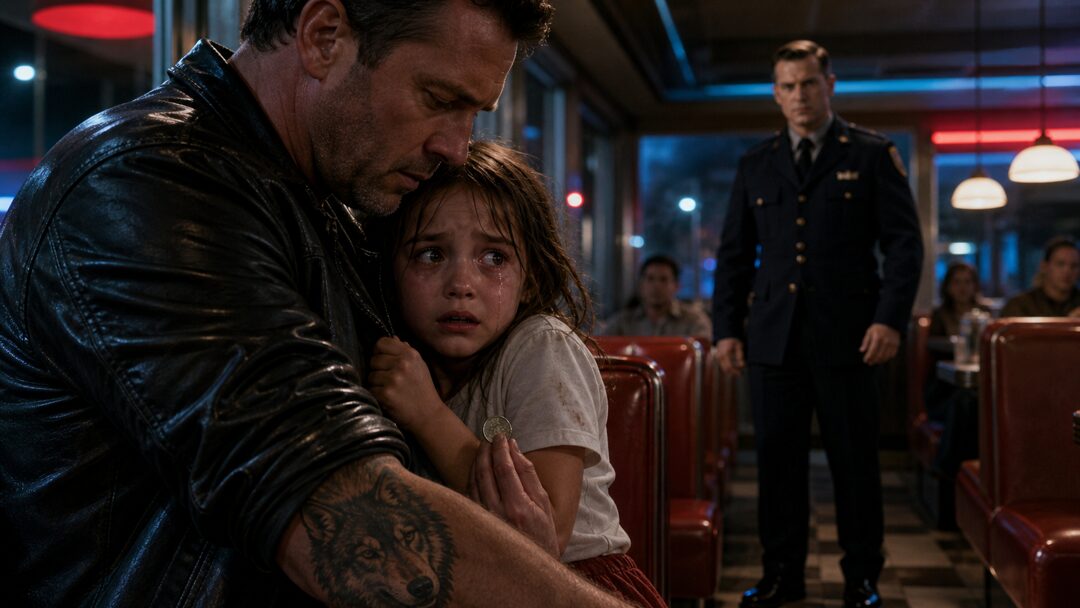
The Coin She Carried
Part I — The Last Booth
The girl came through the diner door so fast the little brass bell nearly tore itself loose.
She was crying before anyone saw her face.
One shoe was gone. Her white shirt was twisted at the collar. Her red skirt flashed between the tables as she ran past truckers, coffee cups, half-eaten pie, and people too stunned to move.
“Hey—sweetheart?” Linda called from behind the counter.
The girl did not stop.
At the last booth, Robert looked up from a cold cup of coffee.
He had chosen that booth because it faced the door. Old habits, old damage. He had his back to the wall, a black leather jacket pulled tight around his shoulders, and the kind of face that made strangers decide not to ask him for directions.
The girl ran straight at him.
For one second, Robert thought she had mistaken him for someone else.
Then she threw herself into his arms.
He caught her before he could think.
Small hands locked around his neck. Her face pressed against his jacket. She shook so hard the table rattled.
“Please,” she sobbed. “Please don’t let him take me.”
Every conversation in the diner died.
Robert’s hand came up slowly, then settled between her shoulder blades. He did not know this child. He did not know why she smelled like rain and gas-station soap. He did not know why her hair was tangled like she had been hiding somewhere too small.
But he knew fear.
Real fear had weight. It made the body choose before the mind caught up.
Robert looked over her head toward the door.
A man stepped inside.
He was clean in a way that made the whole diner look guilty. Pressed dark uniform. Polished boots. Short hair. Calm face. He did not hurry. He did not look angry.
That made Robert colder.
The man’s eyes landed on the girl, then on Robert.
“Captain Hayes,” he said.
Robert had not heard anyone say his rank in five years.
The girl froze against him.
Robert kept one arm around her.
“I’m not a captain anymore.”
“No,” the man said. “You’re not.”
Linda came around the counter, wiping her hands on her apron though they were already dry. “Is there a problem?”
The man showed an ID wallet too quickly for anyone to read. “Military Police. The child is under federal protective custody.”
The girl tightened her grip until her fingers dug into Robert’s neck.
“No,” she whispered.
Robert felt the word more than heard it.
The officer smiled without warmth. “Emily, come here.”
She buried her face deeper.
Robert looked down at her. “Emily?”
Her eyes lifted to his. They were huge, wet, and terrified. Not confused. Not lost.
Looking for something.
Then her gaze dropped to his forearm.
His sleeve had pulled back when he caught her.
The old tattoo showed in the yellow diner light: a wolf’s head, faded at the edges, its mouth open in a silent snarl.
Emily stared at it like someone had turned on a lighthouse.
Her lips trembled.
“Mom said,” she whispered, “the wolf would know the coin.”
Robert stopped breathing.
The officer’s calm face changed by less than an inch.
But Robert saw it.
Linda saw it too.
And Emily, still shaking in his arms, pulled a worn challenge coin from the pocket of her skirt and pressed it into Robert’s palm.
It was cold.
It was old.
And it had Robert’s unit crest on one side.
On the other, scratched so faintly most people would miss it, was a mark he had not seen since the night everything went wrong.
Part II — Clean Boots
Robert closed his hand around the coin.
For a moment the diner was not a diner anymore.
It was dust. Radio static. A green flare burning wrong in the sky. Sarah’s voice in his earpiece saying, Do not take the east road.
Then screaming.
Then silence.
He forced himself back into the booth.
The girl was still clinging to him. The officer was still by the door. Linda was still pretending her hands were not shaking.
Robert looked at the man in uniform.
“What’s your name?”
The man’s jaw moved once. “Mark Willis.”
Robert knew the name before he knew the face. He saw a younger man in desert light, carrying reports, eager to be noticed, always standing a little too straight.
“You were with Third Support.”
“Attached,” Mark corrected.
“That doesn’t answer why you’re chasing a child.”
“I’m recovering a dependent witness from a compromised situation.”
“That what we call it now?”
Mark’s eyes flicked to Emily. “The girl’s mother is missing. Possibly unstable. Possibly involved in unauthorized disclosure of classified material. The child is scared because she’s been coached to be scared.”
Emily shook her head against Robert’s chest.
Linda moved closer. “She’s eight.”
Mark looked at her the way men in offices looked at people who served coffee for a living. “Ma’am, step back.”
Linda did not.
Robert almost smiled.
Almost.
He opened his palm just enough to look at the coin again. The surface was worn smooth at the rim. He remembered handing it to Sarah Morgan in a half-collapsed operations room after she rerouted three convoys and saved thirty-two people command had already written off.
She had laughed when he gave it to her.
A challenge coin? Really?
You earned it, he had said.
No, Captain. I survived your bad ideas.
Sarah had been like that. Sharp. Tired. Smarter than every man giving orders above her.
And then she had disappeared from every official report.
Robert looked at Emily. “Your mom’s name is Sarah?”
Emily nodded once.
Mark stepped forward. “That is enough.”
Robert did not move.
Mark lowered his voice. “You don’t want this reopened.”
The words landed exactly where Mark meant them to.
Robert’s fingers tightened around the coin.
Linda glanced between them. “Reopened?”
Mark kept his eyes on Robert. “Captain Hayes was relieved after a failed classified operation. Civilian casualties. Missing assets. Bad judgment under pressure.”
Emily looked up at Robert as if waiting to see whether the wolf would vanish.
Robert’s throat went dry.
There were lies that sounded like lies.
Then there were lies built from enough truth to make them hard to fight.
“I read the file,” Mark said. “Everyone did.”
Robert said nothing.
Silence had been his shelter for five years. He had lived inside it, worked under it, slept badly beneath it. Silence had cost him nothing except every morning he had to wake up as himself.
Mark took another step.
“Hand me the child and the coin.”
Emily whispered, “Mom said not to trust men with clean boots.”
Linda’s eyes dropped to Mark’s polished shoes.
For the first time, Mark looked annoyed.
Robert looked at Emily. “What else did your mom say?”
Emily wiped her face with the heel of her hand. She was trying not to cry now. That was worse.
“She said if she didn’t come back, I had to find the wolf. She said he would look scary, but scary isn’t always bad.”
Robert looked away.
That sounded like Sarah.
Sharp even in fear.
Mark’s voice hardened. “She also told this child to run from lawful custody in the middle of the night. Think carefully about whose judgment you’re trusting.”
Robert looked down at the coin.
There were three scratches near the rim.
Not random.
Not damage.
A pattern.
His heart kicked once, hard.
Sarah had used scratches like that overseas when she believed radio traffic was compromised. One line meant delay. Two meant alternate contact.
Three meant the route was poisoned.
Robert looked back at Mark.
Mark saw the recognition happen.
And then everyone in the diner understood the night had become something smaller and more dangerous than a public place.
It had become a room with only one door.
Part III — The Mark on the Coin
“Linda,” Robert said quietly, “do you have a phone behind the counter?”
Mark’s hand dropped near his belt. Not to draw anything. Just enough to remind the room that authority had a body.
Linda did not answer.
Robert slid out of the booth with Emily still pressed against his side. She was too light. That angered him in a way he could not afford.
“Sit here,” he told her.
She grabbed his sleeve. “Don’t go.”
“I’m not leaving.”
“That’s what people say.”
The line cut through him cleanly.
Robert crouched so they were eye to eye. He did not soften his face. He had forgotten how. But he made his voice steady.
“I’m going to stand up. That’s all.”
Emily searched his face, then let go of the sleeve but not the coin. Robert had already slipped it back into her palm. Her fingers closed around it like it was bone.
Mark watched every movement.
“You’re making a mistake,” he said.
Robert stood. “I’ve made worse.”
“Yes,” Mark said. “You have.”
The diner’s other customers had begun to understand they should not be there. A young couple near the window slid cash under a plate and moved toward the exit. A trucker put down his fork and lifted both hands as if leaving a poker table.
Mark stepped aside to let them pass.
Too courteous.
Too controlled.
Linda came closer to Emily with a mug of hot chocolate she had not ordered. “Honey, put both hands around this. It’ll warm you up.”
Emily obeyed, but her eyes stayed on Robert.
Robert looked at Mark. “If she’s in custody, where’s the paperwork?”
“Not your concern.”
“Where’s the female officer?”
Mark’s face tightened.
“Where’s the child welfare rep?”
“Classified protective movement.”
“Convenient.”
Mark leaned in slightly. “You were always good at sounding righteous after the damage was done.”
There it was.
Not procedure now.
Personal.
Robert studied him again and found the young man under the uniform. Mark Willis, twenty-eight then, ambitious and brittle, furious when Robert ignored an order to hold position and followed Sarah’s warning instead.
Furious because Robert’s convoy lived.
Furious because another one did not.
Robert remembered a boy from the village, twelve years old, maybe thirteen, who translated for them because his English was better than most adults’. Joshua. That had not been his real name, but it was the one the unit used because Americans liked names they could pronounce.
Joshua had trusted Robert too.
Wolves don’t leave the small ones behind, Sarah had said once, mocking the unit motto painted above the ops-room door.
Then Joshua had been left.
Not by Robert’s hands.
But under his command.
A person could survive that and still not come back.
Emily lifted the mug but did not drink. “He was at our apartment.”
Robert’s focus snapped to her.
Mark said, “Emily.”
She flinched.
Robert turned fully toward her. “Tell me.”
Emily swallowed. “Mom put me in the laundry room. She said count to two hundred. She said if anyone came before her, don’t make a sound.”
Linda’s hand covered her mouth.
Emily kept going because stopping would mean feeling it.
“I heard boots. Mom was talking. Not loud. Then she said, ‘You can tell them I ran, Mark, but you don’t get my daughter.’”
Mark’s face went still.
Robert did not look away from Emily. “Then what?”
“She opened the door later. She was scared. Mom doesn’t get scared.” Emily’s voice shook. “She gave me the coin. She said go to the diner near the highway. She said the wolf comes there when he wants to disappear.”
Robert felt Linda looking at him then.
He had been coming to this diner every Thursday night for eleven months. Same booth. Same coffee. Same silence.
Sarah had known.
Of course she had known.
She had always known where people went when they wanted not to be found.
Mark exhaled. “A frightened child’s memory is not evidence.”
“No,” Linda said softly. “But it’s not nothing.”
Mark turned on her. “You need to clear this establishment.”
Linda’s fear came up visible then. It changed her posture, pulled her shoulders in.
But she looked at Emily.
Then at Robert’s tattoo.
Then back at Mark.
“My late husband wore boots,” she said. “He never kept them that clean.”
For one second, the diner belonged to her.
Robert used it.
He rolled the coin between his fingers and felt the seam.
His stomach dropped.
Hollow.
Not solid.
Sarah, you clever, impossible woman.
Mark saw his face.
“Give it to me,” Mark said.
Robert closed his fist.
“No.”
Part IV — The Hollow Promise
Mark stopped pretending.
“Everyone out,” he ordered.
No one moved.
Then his voice sharpened into command, and old instincts dragged people to their feet. Chairs scraped. A spoon fell. Someone whispered into a phone before Mark pointed at him and said, “Put it down.”
Robert hated how quickly a room obeyed confidence.
Even false confidence.
Especially false confidence.
Linda backed toward the counter with Emily beside her. Robert stayed between them and Mark.
“Robert,” Mark said, low enough now that only the nearest people could hear. “You are one bad decision away from spending the rest of your life as the story they already believe about you.”
Robert almost laughed.
The story they already believed.
That was the cleanest prison ever built.
Mark continued, “Sarah Morgan leaked operational intelligence. People died. Your report was buried to spare the families and the service. Do not mistake silence for innocence.”
Robert’s hand tightened around the coin.
For five years, he had done exactly that.
He had let them bury him with the operation. Let them call him reckless. Let them take his rank, his pension, his name in rooms where it mattered. Because part of him believed punishment was simpler than truth.
Truth had faces.
Truth had Joshua looking back at him from the dust.
Emily stepped out from behind Linda.
“Mom didn’t hurt anyone.”
Mark’s eyes flicked to her. “Your mother put you in danger.”
“She told me the wolf would come back.”
Robert closed his eyes for half a second.
Sarah’s voice returned, dry and tired, from a night full of static.
Wolves don’t leave the small ones behind.
He had heard it as a joke then.
He understood now it had been a demand.
Mark opened his hand. “The coin.”
Robert looked at him. “Who ordered the east route?”
A muscle moved in Mark’s cheek.
“Classified.”
“Sarah flagged it compromised.”
“She exceeded authority.”
“She was right.”
“She was an analyst, not command.”
Robert stepped closer. “And you still think that matters.”
Mark’s control thinned. Beneath it was fear. Not guilt, not enough. Fear of paperwork, recordings, names, the old machine starting up again with him inside it this time.
Robert turned the coin in his palm, found the tiny pressure catch under the rim, and pressed.
Nothing.
His pulse rose.
He pressed again.
The coin clicked so softly only he heard it.
The back shifted.
Inside, thinner than a postage stamp, was a memory card wrapped in clear film.
For a second, Robert could not move.
Sarah had carried the truth all these years.
Not to save herself.
To save Emily when the time came.
Linda saw the card. Her eyes widened.
Robert did not look at her. He only said, “Behind the pie case, there’s a black phone charger plugged into the wall.”
Linda blinked.
Then understood.
Mark’s gaze snapped between them.
“What did you do?”
Robert held up the coin, closed again now. “You want it?”
Mark stepped forward.
Emily made a small sound.
Robert put the coin on the table.
Everyone looked at it.
No one looked at Linda, who had turned slightly, her body blocking the counter as her hands moved beneath it.
Mark smiled.
It was the first honest expression he had shown all night, and it was ugly because it was relief.
“You should have done that immediately.”
“Probably.”
Mark picked up the coin.
Robert watched his thumb rub over the wolf crest.
The old symbol meant nothing in his hand.
That was when Emily saw Linda’s hands under the counter.
Her eyes flicked once to Robert.
A child who had been taught too much fear understood silence better than most adults.
She looked back at Mark and said, “Mom said you’d lie.”
Mark’s head turned slowly.
Emily’s face was pale, but she did not hide.
“She said men like you call it duty when they’re scared.”
The diner went still again.
Robert did not know whether Sarah had truly said it.
It sounded like her.
It also sounded like Emily had earned the right to say it herself.
Mark moved toward her.
Robert stepped into his path.
“Don’t.”
Mark’s hand clamped around Robert’s jacket and shoved him back against the booth.
For a breath, Robert was not forty-five and tired. He was younger, armed with orders, surrounded by men who thought command meant never admitting fear.
Then he saw Emily.
Not Joshua.
Emily.
Here.
Now.
Robert did not shove Mark back.
He did not swing.
He did not give them the violent man they had written down for him.
He planted his feet and raised his voice.
“My name is Robert Hayes,” he said, loud enough for the customers still near the door, loud enough for the phones Mark had failed to stop, loud enough for himself. “Sarah Morgan did not compromise Operation Northstar. She warned command the extraction route was exposed. Her warning was suppressed. The child is being taken because she carried evidence.”
Mark’s face drained.
“Stop talking.”
Robert kept going.
“I signed the report they buried. I stayed silent because I thought shame was the same thing as paying for it.”
Mark grabbed Emily’s wrist.
She cried out once.
Robert moved.
Not like a man attacking.
Like a door closing.
He put himself between Mark and the girl so completely that Mark had to release her or drag him too.
Linda shouted from behind the counter, “Sent.”
One word.
Small enough to fit in a diner.
Big enough to change everything.
Mark looked at the coin in his hand.
Then at Robert.
Then at Linda.
The relief vanished.
Outside, sirens began to rise in the distance.
Mark whispered, “You don’t know what you’ve done.”
Robert looked at Emily, who was shaking again but still standing.
“Yes,” he said. “I do.”
Part V — What Stayed Open
The next few minutes did not feel like justice.
They felt like noise.
Local officers arrived first, confused and cautious. Then came two people in plain coats who did not speak to Mark as if he outranked them. Then a woman with silver hair and a leather folder walked in, took one look at Emily, and knelt without touching her.
“My name is Patricia,” she said. “Your mother sent me.”
Emily stared at her.
Patricia opened the folder and showed her a photograph.
Sarah, younger but unmistakable, stood beside Patricia outside a courthouse. On the back, written in blue ink, were five words.
If she finds the wolf.
Emily’s face crumpled.
Not loudly.
That would have been easier to watch.
She folded inward, as if the part of her that had been holding instructions finally understood it could let go.
Linda reached for her.
Emily let herself be held.
Robert did not.
He stood with his hands visible while a younger officer read him his rights. Mark was already being questioned near the door, still clean, still controlled, but no longer certain the room belonged to him.
When the cuffs closed around Robert’s wrists, Emily pulled away from Linda.
“No.”
Robert turned.
Her eyes were wild again. Betrayed again. As if safety had been a trick after all.
He wished, more than anything that night, that he could lie to her.
He could not.
“Emily,” Patricia said gently, “he’s not going with him.”
“But he’s going.”
Robert crouched as much as the cuffs allowed.
Emily ran to him, stopping just short this time.
That hurt in a way he deserved.
He looked at Linda. “The coin?”
Linda took it from the counter. She had removed the card. The hollow inside was empty now, but the wolf still showed on the face, worn and stubborn.
Robert nodded toward Emily.
Linda placed it in the girl’s hand.
Emily stared down at it.
“It doesn’t have the thing inside anymore,” she said.
“No,” Robert said.
“Then what is it?”
Robert’s throat tightened.
A hundred answers came and went. Unit tradition. Proof. Evidence. Memory. Promise.
He chose the only one that mattered.
“Something to hold when you need to remember you were right to run.”
Emily’s fingers closed around the coin.
“Will my mom come back?”
No one moved.
Even Mark looked away.
Robert held her gaze. He would not steal hope. He would not manufacture it either.
“I don’t know.”
Emily nodded like she had expected that. Like childhood had become a place she could visit only briefly.
Patricia stood. “We need to go.”
Emily backed away, still holding the coin.
At the door, she turned.
Robert thought she would say thank you.
Instead, she lifted her hand and touched two fingers to her own forearm, where no tattoo marked her skin.
A wolf without ink.
A promise without words.
Then she was gone.
Robert let them take him out through the same door she had entered.
The night air was cold.
For the first time in five years, he did not feel invisible.
He felt seen, and it hurt worse.
Part VI — The Good Ones
Three weeks later, Robert sat behind thick glass in a county visitation room that smelled like floor cleaner and old coffee.
He had been moved twice. Questioned more times than he could count. Some questions came with threats. Some came with apologies dressed as procedure. The evidence Sarah had hidden was real. The names on it were real. That did not make the world hurry to become honest.
Truth moved slowly when powerful people had locked doors.
But it moved.
That was more than Robert had believed possible.
Linda came first, carrying a paper cup she was not allowed to give him. She looked embarrassed by her own tears, so he pretended not to notice them.
“You look terrible,” she said through the phone.
“You always this kind to people you visit?”
“Only the ones who ruin my night shift.”
He smiled faintly.
Then Emily stepped into view beside her.
She wore sneakers this time. Both of them. Her hair was brushed, though one side had already started to escape. Around her neck hung the coin on a plain cord.
Robert picked up the phone more carefully.
Emily climbed onto the chair.
For a while, neither of them spoke.
That was all right.
Some silences were hiding places.
Some were bridges.
Finally Emily pressed the coin flat against the glass. The wolf faced him.
“Patricia says Mom left more things,” she said. “For later.”
Robert nodded. “Your mom was good at later.”
“Linda says you might have to stay here awhile.”
“She’s probably right.”
Emily looked down.
He waited.
When she looked back up, her eyes were not as frightened as they had been in the diner. That did not make them less serious.
“Were you scared?” she asked.
Robert could have given her an adult answer. Something polished. Something brave.
Instead he told her the truth.
“Yes.”
Her fingers tightened around the phone. “But you still stood there.”
He looked at the coin between them. “So did you.”
Emily thought about that.
Then she asked, “Do wolves really come back?”
Linda turned away.
Robert looked at the old symbol pressed to the glass. For years, he had thought coming back meant returning whole. Clean. Forgiven. The kind of man who could walk into a room without carrying ghosts behind his eyes.
He knew better now.
Sometimes coming back meant standing in the right place at the right time, even if your hands shook.
Sometimes it meant letting a child believe in the promise before you believed in yourself.
Sometimes it meant paying late.
Robert leaned closer to the glass.
“The good ones do,” he said.
Emily nodded once, as if filing the answer somewhere safe.
When the visit ended, she did not cry.
She lifted two fingers to her forearm again.
This time, Robert lifted his cuffed hands as far as he could and touched the faded wolf on his own.
The guard told him to step back.
Robert did.
Emily walked out with Linda, the coin bright against her shirt.
She did not look safe in the easy way children were supposed to look safe.
But she looked less alone.
And after the door closed behind her, Robert sat in the empty room with the phone still in his hand, feeling the cost of what he had done and the strange, aching mercy of it.
For five years, he had mistaken silence for punishment.
Now the silence was gone.
What remained was harder.
What remained was a promise.
And for the first time in a long time, Robert did not look away from it.