The Girl in the Irrigation Ditch Knew Why the Field Was Dying Before Anyone Listened
Chapter 1: The Water Was Running Where Nothing Grew
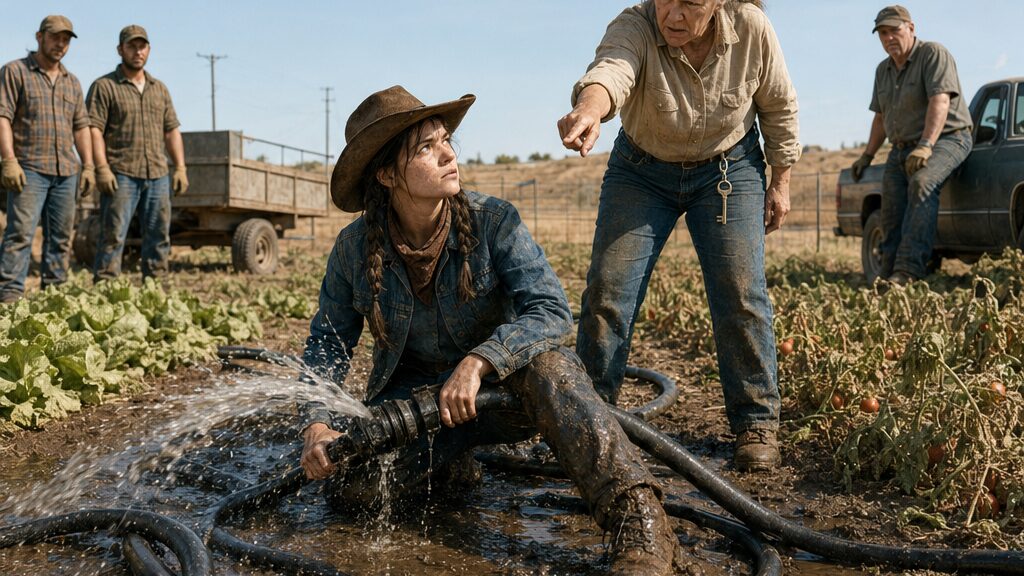
By the time Carolyn Martin found her, the mud had reached the tops of Lisa’s boots.
Water spread in a dark fan across the lower vegetable field, slipping beneath the straw mulch and pooling around rows that should have been dry. Thick black irrigation hoses lay twisted around Lisa’s knees. One coupling rested open in her hand, and a thin stream still spat from it in uneven bursts.
“Step away from that line.”
Carolyn’s voice carried farther than it needed to. The two seasonal farmhands stopped beside the trailer. The neighboring grower, who had come to borrow a crate scale, turned from his truck.
Lisa kept one hand on the hose.
“Now, Lisa.”
“I need you to watch it first.”
Carolyn came down the row with her jaw set. Her gray hair had worked loose from its tie, and the sleeves of her beige work shirt were dark with sweat. She pointed at the spreading water.
“We have restricted hours. You opened a live line in the middle of a dry week.”
“The water wasn’t getting through.”
“It is certainly getting through now.”
“Not where it’s supposed to.”
Carolyn seized the loose coupling and shoved it against the end of the hose. The stream weakened but did not stop. Mud sucked at Lisa’s knees as she rose.
“You were told not to touch the junctions,” Carolyn said.
“You told me not to change anything.”
“That is what touching them means.”
“No, it isn’t.”
One of the farmhands looked away. Lisa knew that look. It was the look adults gave each other when a child had spoken too plainly.
Carolyn lowered her voice. “Do not make this worse in front of people.”
Lisa glanced toward the lower rows. The lettuce there had curled inward despite the morning irrigation. Beyond it, the tomato leaves hung in narrow, tired points. Water glistened around Lisa’s boots, yet thirty yards downhill the soil had cracked into gray plates.
“It was already worse,” Lisa said.
Carolyn reached for the shutoff key hanging from her belt.
“Wait.” Lisa planted her right boot over the hose. “The pump will cycle again.”
“You have done enough.”
“Just watch the line.”
The neighboring grower shifted beside his truck. “Carolyn, maybe kill the pump first.”
Lisa shook her head. “Then you won’t see it.”
Carolyn stared at her. For one sharp second Lisa thought her grandmother would drag her bodily out of the mud.
Then the pump thudded in the distance.
The hose moved beneath Lisa’s boot.
Not much at first. A faint tightening, like a muscle under skin. Then the black rubber swelled hard against the sole and pulsed backward toward the junction. The open coupling coughed twice.
Lisa pointed downhill.
Nothing came from the emitters.
The rows remained dry.
The hose under her boot pulsed again.
Carolyn stopped reaching for the key.
“There,” Lisa said. “Pressure comes down from the pump. It hits this branch and pushes back. If the line was empty, it wouldn’t do that.”
“Or you kinked it.”
“I checked the bend yesterday.”
“You were in this line yesterday?”
“I walked it.”
“That was not the question.”
Lisa pressed harder with her boot. “The pressure has been dropping here for six weeks.”
The farmhands were looking now. So was the neighboring grower. Carolyn folded her arms, not because she had accepted Lisa’s explanation, but because she was no longer certain enough to dismiss it.
“Six weeks,” Carolyn repeated.
Lisa nodded.
“And you said nothing?”
“I did.”
“To whom?”
“To Dad. Twice. I marked it in my notebook. The pump cycles longer on Tuesdays and Fridays. The upper beds get too much. The lower ones get almost none.”
Carolyn’s eyes narrowed. “What notebook?”
“The one in the shed.”
Another pulse ran through the hose. This time the coupling jumped in Carolyn’s hand.
She looked at the line, then at the dry rows beyond it.
“What did you open?” she asked.
Lisa swallowed. This was the part she had hoped the demonstration would make unnecessary.
“The side coupling.”
“Why?”
“To see whether the pressure was trapped before or after the junction.”
Carolyn’s expression changed.
“You opened a pressurized coupling by yourself?”
“I loosened it first.”
“That is not better.”
“I needed to know.”
“You needed permission.”
“You would have said no.”
“That does not make you right.”
Lisa looked down at the water spreading around them. The mud had begun filling the prints left by her knees.
“No,” she said. “It makes me the one who opened it.”
Carolyn held her gaze. The anger in her face had not disappeared, but something else had entered it now—something guarded and unwilling.
She turned to the farmhands.
“Shut down the lower branch. Bring the clamps from the shed.”
Then she pointed at Lisa.
“You are done with the pumps until I say otherwise.”
Lisa’s chest tightened. “But you saw it.”
“I saw a pressure problem and a child opening equipment she was forbidden to touch.”
“The pressure problem came first.”
“And the flood came after you.”
The neighboring grower cleared his throat. “You might have a blockage underground.”
Carolyn did not look at him. “We will inspect it.”
Lisa knew what that meant. The adults would lift the nearest section, replace the coupling, and call the first thing they found the answer. They would not follow the line far enough. They would not ask why the upper beds were wet while the lower field died.
One of the farmhands returned with a clamp. Carolyn stepped back at last, arms folded, watching while Lisa knelt again.
“Don’t touch it,” Carolyn said.
“I’m holding it still.”
“That counts.”
Lisa released the hose.
The farmhand clamped the coupling. The mud stopped widening, but the field did not look rescued. The lower rows remained dull beneath the hard light.
A faint tearing sound came from behind them.
Everyone turned.
A section of lettuce near the bottom of the field sagged sideways. One plant tipped, then another, their shallow roots lifting cleanly from powder-dry earth beneath the surface mulch.
Carolyn walked toward the row and crouched. She touched the exposed roots.
They broke apart between her fingers.
Chapter 2: The Notebook Nobody Had Asked to See
Carolyn dropped Lisa’s notebook onto the kitchen table hard enough to scatter dried soil across the oilcloth.
“Explain this.”
The cover had once been blue. Now it was faded at the corners, swollen from damp, and streaked with mud from Carolyn’s hand. Lisa stood on the other side of the table while Jack washed grease from his fingers at the sink.
“I already did,” Lisa said.
“You told me you marked pressure drops. You did not tell me you had been timing pump cycles, opening valve boxes, and drawing the underground lines.”
“I didn’t open all the boxes.”
“That is not a defense.”
Jack shut off the faucet. He had come home from the repair shop less than ten minutes earlier and still wore his gray work shirt with his name stitched over the pocket. He dried his hands slowly, watching his mother and daughter as if either movement might set off something worse.
Carolyn opened the notebook.
Pages of crooked diagrams filled the first half. Lisa had drawn the pump house, main line, branch junctions, beds, and emitters in pencil. Some arrows were dark, others erased and redrawn. Dates ran down the margins. Beside them she had written short notes.
Upper tomatoes soaked.
Lower lettuce dry.
Pump ran 11 min longer.
Knocking near old cottonwood.
Pressure returned backward.
Carolyn turned another page.
“You have been doing this since June?”
“Since the lower bed started drying.”
“You have been trespassing in the pump station since June?”
“It isn’t trespassing. I live here.”
“Lisa.”
Jack crossed the room and took the notebook before Carolyn could close it.
He read the dates.
His forehead tightened.
“What?” Carolyn asked.
He did not answer.
Lisa saw the moment he recognized them. His thumb stopped beside a Tuesday entry.
Pump cycled 4:17 a.m. Restarted 4:31. Upper line shaking.
Jack turned back three pages, then forward five.
“These dates,” he said.
Carolyn waited.
“They’re the same mornings I replaced the starter relay.”
Lisa leaned closer. “I told you the relay wasn’t the reason.”
“You said the pump sounded wrong.”
“It did.”
“You didn’t say you had all this.”
“You were leaving for work.”
Jack looked at her then, and guilt moved across his face so quickly she nearly missed it.
Carolyn pulled the notebook toward herself. “A twelve-year-old’s drawings do not diagnose an irrigation system.”
“No,” Jack said. “But the cycle times mean something.”
Silence settled over the kitchen.
Outside, a truck shifted gears on the county road. The refrigerator clicked on. Lisa watched her father’s hand remain on the notebook.
“So I noticed it first,” she said.
Jack exhaled through his nose. “Looks like you did.”
The small satisfaction lasted less than a second.
“Then tell her,” Lisa said. “Tell her we have to open the line past the lower junction.”
Jack glanced at Carolyn.
That glance hurt more than if he had refused immediately.
Carolyn saw it too. “The workers are replacing the valve tomorrow.”
“A valve won’t explain the pressure coming backward,” Lisa said.
“It will explain a stuck branch.”
“It isn’t one stuck branch.”
“You do not know that.”
“Neither do you.”
Jack closed the notebook.
“We should check the repair records,” he said.
Carolyn’s mouth flattened. “We have work to finish before dark.”
“That isn’t an answer,” Lisa said.
“No,” Carolyn replied. “It is a priority.”
She picked up the notebook and tucked it under her arm.
“You are not going near the pump station, the junctions, or the valve boxes. You will help sort crates and stay where someone can see you.”
“That notebook is mine.”
“It concerns farm equipment.”
“I made it.”
“And you used it to justify opening a live line.”
Lisa looked at Jack.
He rubbed a hand over the back of his neck. “Let her hold on to it for now.”
The words were gentle. That made them worse.
“You believe me,” Lisa said.
“I believe you found something.”
“But you won’t say she’s wrong.”
“This isn’t about sides.”
“It always becomes that when you don’t pick one.”
Jack flinched.
Carolyn carried the notebook toward the mudroom. “Crates. Now.”
Lisa followed as far as the doorway. “If the valve doesn’t fix it, what then?”
Carolyn did not turn. “Then we find the next problem.”
“One at a time?”
“That is how work gets done.”
“That is how you keep pretending the problems aren’t connected.”
Carolyn stopped.
Jack said Lisa’s name in warning, but she had already seen the stiffening in her grandmother’s shoulders.
Carolyn placed the notebook on a high shelf above the work coats.
“You are done discussing this today.”
For the next two hours, Lisa sorted tomatoes by size while the sun lowered beyond the packing shed. She worked without speaking. Jack repaired a trailer light near the open door. Twice he looked toward her, but each time she turned away.
When Carolyn left to check the upper beds, Lisa carried an empty crate into the equipment shed.
The pump manuals sat in a metal cabinet beneath a row of rusted wrenches. She had searched them before, but only for diagrams. This time she wanted the service record Jack had mentioned.
The oldest manual was thick with loose papers. She spread it across the workbench and turned through oil-stained pages.
A folded sheet slid from the back cover.
It was not a service record.
The paper carried the letterhead of the irrigation-supply company in town. Below it was a six-month-old date and a list of materials: mainline replacement, pressure regulators, branch valves, labor, trenching.
At the bottom, someone had circled the total in blue ink.
Lisa stared at the number.
It was more money than the farm’s old pickup had cost.
Across the top, in handwriting she recognized as Carolyn’s, were four words:
Do not show Jack yet.
Chapter 3: The Repair They Could Not Afford
The produce buyer did not sit down.
He stood in Carolyn’s office with one hand on the back of the chair and the other holding a clipboard against his thigh. Through the open window came the clatter of empty harvest bins and the steady rattle of the cooling unit in the packing shed.
“We can take a partial load Friday,” he said. “But if the lettuce comes in undersized again, we move the shelf space.”
Carolyn kept her hands flat on the desk. “The lower beds will recover.”
“You said that last week.”
“We corrected the valve issue.”
The buyer looked toward the field. “Then why did your crew pull two rows this morning?”
Carolyn did not answer quickly enough.
He closed the clipboard. “One more failed shipment ends the seasonal contract. I’m telling you now so you can plan.”
Plan. The word landed like an accusation.
After he left, Carolyn remained at the desk, listening to his truck cross the cattle guard. A stack of invoices sat beneath her right hand. Payroll was due in three days. The pump company wanted payment on Jack’s last two service calls. Seed for the fall planting had already been ordered.
Inside the desk drawer lay the replacement estimate.
She did not need to unfold it. She knew every line.
Mainline pipe. New regulators. Trenching. Labor.
A clean system.
A cost large enough to empty their operating account and still leave the work half done.
The office door opened.
Lisa stood there holding the estimate.
Carolyn’s breath stopped.
“Where did you get that?”
“In the pump manual.”
“You were told to sort crates.”
“I finished.”
“That does not give you permission to search the equipment records.”
“Why did you write not to show Dad?”
Carolyn rose and took the paper from her.
“That is not your concern.”
“It’s the same system I’m not allowed to touch because you say I don’t understand it.”
“You do not understand this.”
“I understand the number.”
“No, you understand that it is large.”
“Is that why you didn’t fix it?”
Carolyn folded the estimate along its old creases. “Go help your father.”
Lisa remained in the doorway.
“Did you know the lower line was failing?”
Carolyn looked at the girl’s dusty braids, her oversized hat hanging down her back by its cord, the stubborn set of her mouth. For an instant she saw Jack at the same age, demanding to know why a tractor part could not simply be replaced.
Because parts cost money.
Because time cost money.
Because every repair meant something else waited.
“I knew the system was old,” Carolyn said.
“That isn’t what I asked.”
“You are twelve.”
“And the plants are still dying.”
Carolyn stepped around the desk. “Enough.”
Lisa moved aside, but her eyes did not.
At the irrigation-supply store, the clerk pulled the updated estimate from the computer and turned the screen toward Carolyn.
The total had risen by nearly a quarter.
“Pipe costs went up,” he said. “And the trenching crew is booked for three weeks.”
“We do some of the trenching ourselves.”
“You can. Won’t change the regulator cost.”
“What if we replace only the lower branch?”
The clerk rubbed his jaw. “You might get a season. Maybe less. That old mainline is carrying pressure unevenly. Patch one weak place and the next one takes the load.”
Carolyn looked past him toward a rack of new fittings. Clean white couplings sat in rows beside coils of unused black hose. Everything looked simple when it was not yet buried.
“I need a valve and enough line for the lower junction,” she said.
He hesitated. “That is not what I recommend.”
“It is what I am buying.”
By noon, the farmhands had exposed the junction where Lisa had been kneeling. The old valve came out stiff with mineral crust. One side was nearly closed.
The neighboring grower whistled. “There’s your blockage.”
Carolyn felt the relief before she trusted it.
A visible fault. A replaceable part. Something with edges.
Lisa stood beyond the work area carrying a crate of fittings. She watched the valve in the farmhand’s hand.
“That isn’t all of it,” she said.
Carolyn did not look at her. “Set the crate down.”
“The hose pulsed before the valve.”
“The valve was restricted.”
“The pressure came back from farther down.”
One of the farmhands glanced between them.
Carolyn pointed toward the packing shed. “Crates.”
Lisa set the box down harder than necessary. “You’re going to bury it again.”
“We are going to repair it.”
“You’re going to hide it.”
Carolyn turned then. “You flooded a row.”
“I told you I did.”
“And you are still behaving as though being honest afterward erases what you chose.”
Lisa’s face tightened.
For a moment Carolyn nearly softened. Then she saw the buyer’s clipboard in her mind, the payroll envelope, the replacement estimate, and the field that had belonged to her family longer than any of them had been alive.
“Go,” she said.
Lisa left.
The new valve fit cleanly. The workers replaced six feet of brittle hose and clamped the connections. When the pump started, water reached the lower emitters in thin, steady threads.
The neighboring grower smiled. “Looks like she’ll hold.”
Carolyn let herself believe him.
By late afternoon, the soil beneath the lettuce had darkened. The farmhands reburied the junction. Carolyn called the buyer and confirmed Friday’s partial shipment.
She did not mention the old mainline.
At sunset, Jack came home and found Lisa sitting on the tailgate of his truck.
Carolyn watched them from the office window. Lisa spoke without looking at him. Jack listened with his hands in his pockets. After a while he looked toward the lower field, then toward Carolyn’s window.
He knew.
Of course he knew.
Still, he did not come inside.
Darkness settled over the farm. The pump ran its final scheduled cycle, a low mechanical hum moving beneath the quiet.
Carolyn finished payroll at the kitchen table.
At 9:17, something struck the side of the house with a dull, heavy thump.
Jack stood first.
A second sound followed from uphill—not a thump this time, but a long tearing crack.
They ran outside.
Water shone beneath the yard light, streaming down the service track from the upper field. The repaired lower junction remained buried and still.
Farther uphill, where the mainline crossed beneath an old cottonwood root, the earth had split open.
Black hose protruded through the mud like a broken bone, and water surged from it in a white, hammering arc.
Chapter 4: Being Right Did Not Make Her Careful
The pump started again at 11:43.
Lisa heard it through her bedroom wall: a low vibration moving through the pipes, steady for three seconds, then uneven. The scheduled cycle should have ended two hours earlier.
She sat upright.
Outside, water hissed somewhere beyond the yard light.
Jack and Carolyn were still uphill at the rupture. Their flashlights moved between the cottonwood and the pump station. Lisa had been ordered inside after carrying clamps from the shed. Carolyn had pointed at the house and said, “Not one step past the porch.”
The pump stumbled, caught, and kept running.
Lisa pulled on her boots.
She told herself she was only going to the porch.
From there she could see the service track shining with runoff. The broken mainline had been shut down, but water still moved in thin silver ribbons through the tire ruts.
Then the pump cycled again.
That meant one of two things: the shutoff had not seated, or another branch was drawing pressure.
Lisa crossed the yard.
She stayed beyond the lights, following the fence toward the pump station. The door stood open. Inside, the pressure needle shook above its normal mark, dropped, then climbed again.
No one was there.
“Dad?” she called softly.
No answer.
A handwritten tag hung from the lower-field valve: CLOSED.
Lisa touched the pipe beside it. The metal vibrated.
If the lower branch was closed and the mainline uphill was clamped, pressure had nowhere to go. Unless one of the old bypasses was still open.
She remembered the diagrams in her notebook: faded lines copied from marks on the pump-house wall, branches that did not match the current rows. Her grandfather had added them over years—one for the orchard that no longer existed, one for a melon patch abandoned before Lisa was born.
Most had been capped.
Most.
Lisa took the flashlight from the wall hook and followed the vibration to a rusted valve behind the tank. Its handle had been painted red once. Now only a thin stripe remained.
The valve was half open.
She knew she should find Jack.
She also knew that by the time she reached the upper field, the pump might overpressurize another weak section.
Lisa turned the handle a quarter turn.
The pressure needle dropped.
Relief came so quickly that she smiled.
Then the pipe hammered beneath her hand.
The valve jerked backward.
Somewhere outside, rubber snapped.
Lisa ran from the pump station.
Water surged from the ground along the field edge, not at the cottonwood rupture but thirty yards below it. The soil lifted in a narrow ridge before splitting open. A buried hose whipped free, spraying muddy water across the seedlings.
Lisa dropped beside it.
The branch was thinner than the mainline, connected through a sequence of mismatched fittings: black pipe, white coupling, a short section of faded blue hose, then black again. Each repair narrowed the path.
Pressure had not been trapped behind one blockage. It had been moving through years of smaller ones.
She grabbed the loose hose and bent it toward the ground. The spray struck her shoulder and spun her sideways.
“Hold still,” she told it, though the line bucked in her hands.
The seedlings below were already flattening.
Lisa dragged the hose toward the drainage furrow, using her weight to force the water away from the beds. Mud filled her boots. Her hat fell behind her.
The pump continued running.
She could not hold the line and reach the station.
A wooden stake lay near the row marker. Lisa pushed the hose beneath it, drove one knee against the stake, then crawled backward as the rubber strained.
It might hold for a minute.
She ran.
The pressure alarm began chirping before she reached the pump house. Lisa slapped the emergency stop.
The motor wound down.
For several seconds, water continued tearing through the broken branch. Then the hose softened beneath the stake and fell still.
Lisa stood with one hand on the red stop button, breathing hard.
The storage reservoir gauge had dropped below half.
She had stopped it in time.
She had also caused it.
Flashlight beams swung across the field.
“Lisa!”
Carolyn’s voice came from the service track.
Lisa did not move.
Jack reached the rupture first. He took in the exposed bypass, the bent stake, and the trail of Lisa’s footprints leading back to the pump house.
“What happened?” he asked.
She looked at Carolyn approaching behind him. Mud streaked her grandmother’s jeans to the knees. Her face was pale with exhaustion.
“The bypass was open,” Lisa said. “Pressure was building.”
“So you adjusted it?” Jack asked.
“I closed it a little.”
Carolyn stopped beside the broken hose.
“You touched another valve.”
“The gauge came down at first.”
“You touched another valve after I ordered you inside.”
“The pump kept cycling.”
“You should have called us.”
“You were uphill.”
“You should have called.”
Lisa pointed at the exposed line. “Look at it. It isn’t one hose. They kept making it smaller every time they patched it.”
Carolyn stared at the white and blue couplings in the mud.
Jack crouched and ran his hand over the sequence. “This bypass shouldn’t still be tied in.”
“It is,” Lisa said. “And when I changed the valve, the pressure went through it.”
Jack looked up. “You changed where the load went.”
Lisa nodded.
The truth settled harder than the accusation had.
“I thought I could bring it down.”
“You did,” Jack said quietly. “Then it found the next weak place.”
Carolyn picked up Lisa’s fallen hat. Water dripped from the brim.
“You could have been hit by that line.”
“I wasn’t.”
“That is not an answer.”
Lisa looked toward the flattened seedlings. “I moved the water away from the row.”
“And if the stake had slipped?”
Lisa had no reply.
Carolyn’s anger no longer looked mistaken. That made it worse.
The first gray light appeared beyond the eastern ridge. In it, the flooded ground widened into view: the first rupture uphill, the second branch torn open below, and the service road cut by runoff.
A vehicle turned through the gate.
White county markings showed on the door.
The truck stopped near the pump house, and a woman in work boots stepped out carrying a hard case and a clipboard.
“Rebecca Torres,” she called. “County agricultural extension.”
Carolyn looked at Jack. “I canceled this inspection.”
Rebecca glanced at the broken lines, the mud-covered child, and the emergency stop beneath Lisa’s hand.
“Someone called again last night,” she said. “Judging by this field, it was a good thing they did.”
Chapter 5: The First Explanation Was Not Enough
Rebecca Torres set her clipboard on the pump-house shelf and looked directly at Lisa.
“Start with every valve you touched.”
Carolyn opened her mouth.
Rebecca raised one hand. “I’ll speak with everyone. I need her sequence first.”
Lisa stood near the doorway in borrowed coveralls while mud dried cold against her socks. Jack had found her hat and placed it on the bench, but she had not put it back on.
“I opened the lower side coupling yesterday,” Lisa said.
“How far?”
“Half a turn at first. Then more when nothing came out.”
“Under pressure?”
“Yes.”
Rebecca wrote something.
Carolyn folded her arms.
Lisa continued. “Last night I turned the old bypass valve behind the tank about a quarter turn toward closed.”
“Why?”
“The pressure gauge was high, and the pump kept cycling after the mainline was clamped.”
“Did you check the system diagram?”
“There isn’t a current one.”
Rebecca glanced toward Jack.
He nodded once.
“Did you ask an adult before changing the bypass?” Rebecca asked.
“No.”
“Why not?”
Lisa could have said there was no time. She could have said they had ignored her for weeks. Both were true, but neither changed what had happened.
“I thought I understood it.”
“And did you?”
“Part of it.”
Rebecca waited.
Lisa looked through the doorway toward the second rupture. “I lowered pressure at the pump. I didn’t know the bypass narrowed three times underground. When I moved the load, the old branch split.”
“You caused the second rupture.”
“Yes.”
Carolyn’s arms loosened slightly, as if the admission had taken something from her that she had been prepared to fight for.
Rebecca wrote again. “And you stopped the pump before the reservoir drained.”
“Yes.”
“Both things can be true.”
Lisa looked up.
Rebecca closed the clipboard. “A correct observation does not make an unsafe method correct.”
“I know.”
“Do you?”
Lisa thought of the hose striking her shoulder and the stake bowing under it.
“Yes,” she said.
They spent the morning exposing sections of the system. Jack cut the damaged bypass into manageable lengths. Rebecca arranged them in order across the dirt.
The first piece was full diameter.
The next had a thick mineral ring inside it.
The white coupling narrowed the flow again. The faded blue hose was smaller still.
Lisa crouched beside the pieces. They looked less like a single line than a history of decisions no one had written down.
Rebecca tapped the oldest section. “Each repair worked by itself. Together they changed the pressure across the field.”
Lisa retrieved her notebook from the farmhouse after Carolyn silently took it from the high shelf.
She opened to the hand-drawn map.
Rebecca studied the pages. “Who gave you these measurements?”
“No one.”
“The cycle times?”
“I used the clock over the packing shed.”
“The pressure readings?”
“The gauge.”
“You copied the old wall markings for these branches?”
Lisa nodded.
Rebecca compared the notebook to the cut hose.
“The map is not exact,” she said.
Carolyn looked toward Lisa.
“But it is directionally right. The lower branch has been starving while the upper branches absorb the pressure.”
Lisa felt something unclench in her chest.
Then Rebecca added, “And the unauthorized tests made the current damage worse.”
The relief remained, but it no longer felt like victory.
At noon, a county water-district representative walked the field with Rebecca. He measured runoff near the service road and photographed the reservoir gauge.
“We are under restricted allocation,” Carolyn said. “The rupture was accidental.”
“I understand,” he replied. “But the discharge left the property line.”
The neighboring grower’s drainage ditch carried a thin ribbon of muddy water.
The representative wrote a preliminary notice. The amount of any penalty would depend on total loss and whether the farm submitted a correction plan.
Carolyn held the paper without reading it.
Rebecca led them into the office. She placed Lisa’s notebook beside the old replacement estimate.
“When did you request the original assessment?” she asked Carolyn.
Carolyn’s expression hardened. “Months ago.”
“You canceled before I inspected.”
Lisa turned toward her grandmother.
Rebecca continued. “Our office received the supply company’s estimate, but without a site visit we could not evaluate phased repairs.”
“You told them not to come?” Lisa asked.
Carolyn looked at Rebecca instead. “I decided we could manage the existing system through harvest.”
“Based on what?” Rebecca asked.
“Based on the fact that replacing it would have emptied the operating account.”
“That estimate assumed full replacement at once.”
“It was the only number I had.”
“It was the number you kept.”
The room went still.
Jack stood near the filing cabinet with both hands braced on its top. He had not spoken since they entered.
Rebecca spread Lisa’s pages across the desk. “A phased redesign may be possible. I cannot promise it without pressure testing the remaining zones.”
“How long?” Carolyn asked.
“Several days for a workable plan. Longer for installation.”
“We do not have longer.”
The produce buyer’s warning sat unspoken among them.
Rebecca looked toward the lower field. “Then you need to decide what portion of the crop you are willing to lose.”
Carolyn flinched as though Rebecca had suggested burning it.
“We are not abandoning a field.”
“You may lose more by trying to water all of it through a failing network.”
Lisa traced one of her arrows with a fingertip. For six weeks she had wanted someone to say she was right. Now that an adult had said it, the farm looked worse, not better.
“What if we split it into smaller sections?” she asked.
Rebecca turned. “Explain.”
Lisa pointed to the upper line. “Feed the tomatoes separately. Close the old orchard bypass completely. Use the lower branch only for lettuce, but not from the same regulator.”
“That would require new shutoffs.”
“We have two unused fittings in the supply shed.”
Carolyn’s gaze sharpened. “How do you know that?”
“I saw them.”
Rebecca studied the map again. “It may reduce the pressure swings. But no one changes anything until we test and mark every line.”
Lisa nodded.
Not because she liked the restriction, but because she finally understood what the missing permission had been for.
Jack pushed away from the filing cabinet.
“There is something else,” he said.
Carolyn looked at him.
He opened the bottom drawer and removed a bank envelope.
Lisa recognized the logo from the farm statements Carolyn kept beneath the phone.
Jack set it beside the repair estimate.
“The operating loan review is in ten days,” he said. “If we miss the shipment and cannot show a workable harvest plan, the bank can call the note.”
Lisa looked from him to Carolyn.
“You knew too?”
Jack’s face tightened. “I knew the deadline.”
“And you said nothing.”
“I thought I was keeping you out of it.”
Carolyn sank into the desk chair.
The old estimate, the county notice, Lisa’s notebook, and the bank envelope lay in a crooked row between them.
Rebecca touched the notebook.
“Then this is not only an irrigation problem anymore.”
Lisa looked out at the torn hoses drying in the sun.
It never had been.
Chapter 6: What Carolyn Was Really Trying to Save
Carolyn found Lisa digging beside the abandoned pump trench two mornings later.
The shovel was too long for her, so she had shortened her grip and worked in small, stubborn cuts. A row of removed stones marked the trench’s edge. Beside them lay Lisa’s notebook, held open by a wrench.
“What are you doing?”
Lisa drove the shovel into the soil once more before answering.
“Finding the original line.”
“You were told no work without supervision.”
“I’m not opening a live system.”
“That is not the point.”
Lisa rested both hands on the shovel handle. “Rebecca said we need to know where the old branches go.”
“Rebecca said the workers would expose them.”
“They’re testing the south zone.”
Carolyn stepped into the trench and took the shovel.
“You do not get to decide that every useful thing becomes your responsibility.”
Lisa wiped her forehead with her sleeve. “Someone has to decide.”
The words struck cleanly.
Carolyn looked down at the patch of exposed hose. Unlike the later repairs, it was thick-walled and carefully bedded in sand. Her husband had insisted on that. He had spent three summers installing the first system with rented equipment and money they did not have.
He had marked every trench with stakes painted yellow.
Most were gone now.
“This line fed the original melon field,” Carolyn said.
Lisa crouched. “I thought it went toward the orchard.”
“It split at the cottonwood.”
“That split isn’t on the wall diagram.”
“No.”
“Why not?”
“Because he added it later.”
Lisa brushed soil from the hose. “Grandpa?”
Carolyn nodded.
The name was not spoken often in the field. In the house, photographs carried him more easily than conversation did: leaning against the old tractor, holding Jack as a baby, standing beside Carolyn when the first pump began running.
“He built all of this?” Lisa asked.
“The first version.”
“It worked then?”
“For years.”
Carolyn sat on the trench edge. The morning work continued beyond them—tools striking pipe, Rebecca calling pressure readings, Jack answering from the pump house.
“When a section failed, your grandfather repaired it with what we could afford. Sometimes with what we already had. After he died, I kept doing the same.”
Lisa looked at the patchwork line emerging from the dirt.
“You knew the repairs were narrowing it.”
“I knew some were.”
“And you still buried them.”
“We needed water moving that day, not a perfect system next month.”
Lisa said nothing.
Carolyn picked up the wrench from the notebook. It had belonged to her husband. She recognized the worn tooth on the jaw.
“I requested Rebecca’s inspection in February,” she said.
Lisa’s attention sharpened.
“The supply company had already sent the replacement estimate. I thought the county might find a cheaper way.”
“What happened?”
“Rebecca called before the visit. She said the mainline could need to be divided into pressure zones. She said sections your grandfather installed would likely have to come out.”
“That is why you canceled?”
Carolyn turned the wrench in her hand.
“It sounds foolish when you say it plainly.”
“It was also the money.”
“Yes.”
“But not only the money.”
“No.”
A breeze lifted the corner of Lisa’s notebook. Carolyn pressed it flat.
“After he died, people came here and told me what I should change. Sell the equipment. Lease the lower acreage. Pull the orchard. Replace the pump. Every suggestion sounded practical. Every one removed something he had put his hands on.”
Lisa looked toward the old cottonwood.
“So you kept it all.”
“I kept enough.”
“The field is dying.”
“I know.”
The answer came too quickly to defend against.
Lisa sat beside her.
For a while they watched Jack lift another damaged hose from the south trench. Sediment spilled from it in a pale stream.
“Dad knew about the bank,” Lisa said.
“Yes.”
“Did he know why you canceled Rebecca?”
“No.”
“You didn’t trust him?”
“I did not want him choosing between the farm and you.”
Lisa frowned. “What does that mean?”
“Your father has been taking extra shifts to cover the operating payments. If he knew how far behind we were, he would take more. Or he would sell his truck. Or stop saving for whatever comes after you finish school.”
“You decided that for him.”
“Yes.”
“And you decided I couldn’t understand.”
“Yes.”
Carolyn’s honesty seemed to anger Lisa more than an excuse would have.
“You keep calling it protection,” Lisa said. “But it is still deciding for everyone.”
Carolyn looked at the wrench in her hand.
“You opened that line because you believed knowing more gave you the right to act alone.”
Lisa’s face colored.
Carolyn continued, “I kept the estimate because I believed carrying more gave me the same right.”
The farm sounds filled the pause.
Lisa reached for her notebook. “That does not make them equal.”
“No. Your mistake flooded a row. Mine may cost us the land.”
Lisa’s expression changed then—not forgiveness, but recognition sharp enough to hurt.
Carolyn stood.
“The bank deadline is eight days away. The buyer will take only what we can guarantee. The county wants a correction plan. Rebecca’s phased work may save the upper acreage, but the lower field is the most expensive section to reach.”
“What are you saying?”
“I spoke with a land broker this morning.”
Lisa rose so fast the notebook slid into the trench.
“You are selling it?”
“The lower acreage only.”
“That is the part with the best soil.”
“It is also the part the current system cannot serve.”
“My plan can.”
“Your plan is not tested.”
“Then test it.”
“If it fails, we lose the sale window and perhaps everything.”
Lisa climbed out of the trench and snatched up her notebook.
“You already decided.”
“I chose the option that leaves something.”
“You chose the option where nobody gets to prove you wrong.”
Carolyn’s grip tightened around the old wrench.
Lisa walked toward the farmhouse.
“Lisa.”
She did not turn.
That afternoon, the land broker’s papers arrived by courier. Carolyn laid them on the kitchen table but did not sign. The legal descriptions divided the lower field from the pump house by a line so clean it seemed unrelated to soil, roots, or water.
Jack stood at the counter, silent.
Rebecca’s temporary pressure readings lay beside the documents.
Carolyn read the sale price twice.
It would cover the bank deficiency, payroll, and repairs to the upper acreage. It would also end the question.
The screen door opened.
Lisa entered carrying three sheets of butcher paper taped together. Blue, red, and black lines crossed them in measured sections. Each valve had a number. Each branch had a pressure range. Beside the lower field she had written which rows could be watered on alternating cycles.
She placed the plan directly over the unsigned sale papers.
“No secret tests,” Lisa said. “No touching anything alone. Rebecca checks every number. Dad does the fittings. You control the pump.”
Carolyn looked at the map.
Three separate zones replaced the tangled network.
One section of the lower field was crossed out.
“What is this?” Carolyn asked.
“The part we let go dry.”
Lisa’s voice caught, but she did not look away.
“To save the rest.”
Carolyn touched the edge of the paper. Beneath it, the broker’s signature line remained blank.
The choice was no longer between keeping everything and admitting failure.
It was between surrendering the lower field intact and trusting a plan that required each of them to give something up.
Chapter 7: The Field Had to Be Rebuilt Together
Carolyn arrived at the lower field carrying the signed land-sale envelope under one arm.
Lisa saw it before she saw her grandmother’s face.
The envelope was thick, cream-colored, and clean in a place where nothing stayed clean for long. It rested against Carolyn’s work shirt while Jack tightened the final bolts on the new regulator assembly. Rebecca stood beside the pump station with a pressure chart clipped to a board.
No one spoke.
Three new branch lines lay across the exposed ground in straight, separated runs. Each had been marked with colored tape and a numbered tag. The tangled junction where Lisa had once knelt in mud was gone, replaced by shutoff valves arranged within easy reach.
The lowest field waited beyond them.
Half of it still held crops. The other half had already begun to pale.
Lisa wiped her palms on her jeans. “Did you sign it?”
Carolyn looked at the envelope.
“Yes.”
Jack lowered his wrench.
Rebecca did not move. “Has it been delivered?”
“No.”
Carolyn held the envelope out toward Lisa, not offering it, only making its presence impossible to ignore.
“The broker gave me until noon.”
Lisa glanced at the sun. They had less than two hours.
“Then let us test the first zone.”
Carolyn’s mouth tightened. “If the pressure spikes—”
“We stop the pump.”
“If a fitting fails—”
“Dad closes the main valve.”
“If your calculations are wrong—”
“We lose the lettuce section.”
Carolyn looked toward the rows Lisa had crossed out on her plan.
“And if we do nothing,” Lisa said, “we lose the land anyway.”
Jack rose and pulled off his gloves. “The fittings are ready.”
Rebecca checked her watch. “We run one zone at a time. No improvising. No one changes a valve without calling it first.”
Her eyes settled briefly on Lisa.
Lisa nodded. “Understood.”
Carolyn placed the envelope on the hood of the farm truck, weighting it with the old pipe wrench.
The first zone fed the upper tomatoes. Jack opened the main valve while Rebecca watched the pressure gauge.
“Pump on,” Rebecca called.
Carolyn threw the switch.
The motor caught.
The new line shuddered once, then steadied. Lisa walked beside it, watching each coupling. Water reached the first emitters in a clean sequence. The soil darkened row by row.
“Pressure holding,” Rebecca said.
Lisa did not smile. This was the easy zone, closest to the pump and highest on the slope.
Jack shut it down.
The second zone fed the middle beds. One fitting seeped at the thread. Jack tightened it under Rebecca’s direction. The gauge dipped, rose, and settled within Lisa’s marked range.
Water reached the final bed.
Carolyn looked toward her.
Lisa looked back at the gauge.
“Third zone,” Rebecca said.
The lower line carried the entire question.
It had the longest run, the greatest elevation loss, and the weakest remaining section of pipe. Lisa’s plan gave it less pressure for a longer cycle, isolating it from the upper field. If her map was wrong, the final emitters would stay dry. If they raised the pressure too far, the buried hose might fail again.
Carolyn stepped toward the switch.
“Wait,” Lisa said.
Carolyn’s hand stopped.
Lisa walked to the third regulator and checked the setting a final time. The number matched her notebook. She traced the line toward the lower field, following the colored tags.
At the old junction, she paused.
The ground had dried into cracked plates where the mud pool had been. A short section of the original black hose lay beside the trench, cut open and empty.
Lisa remembered how sure she had felt with her boot pressed against it. She had believed the adults needed only to see what she saw.
Now Jack stood at the main valve. Rebecca held the pressure board. Carolyn controlled the pump. The farmhands waited along the line with clamps.
Being trusted had not put Lisa in charge of everyone.
It had made her responsible to them.
She returned to the regulator.
“Set it two pounds lower than the plan,” she said.
Rebecca looked at her. “Why?”
“The soil near the final row is drier than when I measured. It will absorb slowly. If we start high, the pressure may rise before the emitters clear.”
Rebecca considered the gauge, then nodded. “Good adjustment.”
Carolyn moved the regulator.
Lisa called, “Ready.”
The pump started.
For several seconds, nothing happened.
The third line remained slack.
Then it filled, the motion traveling downhill in a low ripple.
“Eight pounds,” Rebecca said.
Lisa watched the first emitters release water.
“Ten.”
The middle of the line tightened.
At the lower beds, the soil remained pale.
Carolyn looked at the envelope on the truck.
“Eleven,” Rebecca called.
A farmhand near the final row shook his head.
“No flow yet.”
Lisa listened.
The hose made a faint knocking sound near the bend. Not the violent hammering from before. A softer interruption.
“Air pocket,” she said.
Jack looked down the line. “Could be.”
Rebecca asked, “What do you want to do?”
The question surprised Lisa.
Not what do you think. Not what did you touch. What do you want to do.
“Hold pressure,” Lisa said. “Do not raise it.”
They waited.
The knocking traveled downhill.
One emitter spat dust.
Then another released a thin thread of water.
At the final row, the farmhand crouched.
“Flow.”
Water appeared beneath the last emitter, no stronger than a clear bead at first. It dropped onto the soil and vanished.
A second bead followed.
Then a steady line.
The dry earth darkened around it.
No one cheered.
Jack closed his eyes for a moment and let out a breath. Rebecca marked the reading. One farmhand walked the line checking for leaks.
Carolyn kept her hand on the pump switch.
Lisa stood beside the pressure gauge and watched the needle remain steady.
The lower field was receiving water.
Not all of it.
Behind the active rows, the section marked for sacrifice remained disconnected. Its plants would not make the buyer’s shipment. Some might not survive the week. Saving the farm had required drawing a line through living things.
Rebecca followed Lisa’s gaze.
“You made the correct call,” she said.
“It does not feel correct.”
“It rarely does when there is a cost.”
The produce buyer arrived before noon.
He walked the fields with Carolyn and inspected the surviving lettuce. The yield would be smaller than promised. Carolyn did not blame the rupture, the county restrictions, or Lisa.
“We deferred repairs too long,” she said. “We lost part of the lower crop. The remaining zones are stable, and the correction plan is filed.”
The buyer studied the new lines.
“I can take the reduced load,” he said. “No guarantee on next season.”
“I understand.”
It was not rescue. It was time.
The county representative accepted Rebecca’s phased plan and reduced the expected penalty after seeing the isolated zones and recorded pressure tests. The bank would still review the loan, but Jack had a crop estimate, repair schedule, and signed buyer commitment to bring to the meeting.
By afternoon, the land-sale envelope remained beneath the wrench on the truck hood.
Carolyn picked it up.
Lisa watched her tear the signature page across the middle.
She did not smile then either.
There was too much still to do.
They worked until the first harvest bins were loaded. Jack repaired the trailer light properly. The farmhands labeled every valve. Rebecca left copies of the pressure chart in the pump house and warned Lisa that an accurate notebook was not permission to work alone.
“I know,” Lisa said.
Rebecca raised an eyebrow.
“I do now.”
When the truck was nearly full, Carolyn called Lisa into the farm office.
The official maintenance log lay open on the desk. It was larger than Lisa’s notebook, with printed columns for dates, pressure readings, repairs, and approvals.
Carolyn pushed it across the desk.
“Your grandfather kept this for the first few years,” she said. “Then the entries became less regular.”
Lisa turned a page. The early handwriting was careful. Later pages held scattered numbers, then long stretches of blank paper.
“What do you want me to do with it?”
“Record the zone readings.”
“By myself?”
“With whoever is operating the pump.”
Lisa looked at her grandmother.
Carolyn placed Lisa’s mud-stained notebook beside the official log.
“These observations go in both places until the system is fully mapped.”
It was not an apology.
It was more useful than one.
Lisa touched the empty column for the third zone.
“I should also record the section we shut off.”
“Yes.”
“So nobody acts like it never existed.”
Carolyn’s eyes moved toward the lower field.
“Yes.”
They returned to the old junction as the light began to lower.
The trench was still open. Straight new lines crossed above older buried hoses, some remaining in use and others cut away. The old pipe wrench hung from Carolyn’s belt.
Lisa knelt where the mud pool had once spread around her boots. She measured the distance to the next valve marker and wrote it in the maintenance log.
Carolyn stood behind her for a moment.
Then she stepped into the trench and knelt beside her.
She picked up the loose end of the next hose and examined the direction Lisa had marked with a wooden stake.
“Where should this line run?” she asked.
Lisa studied the slope, the surviving beds, and the dry section they had chosen to leave behind.
She moved the stake six inches toward firmer ground.
“Here,” she said. “But we test the pressure before we bury it.”
Carolyn held the hose in place.
“All right.”
The story has ended.