They Sprayed His Cedar Farm Fence Gray Without Asking—Then One Work Order Put Every Association Project on Hold
Chapter 1: The Morning Half His Fence Turned Gray
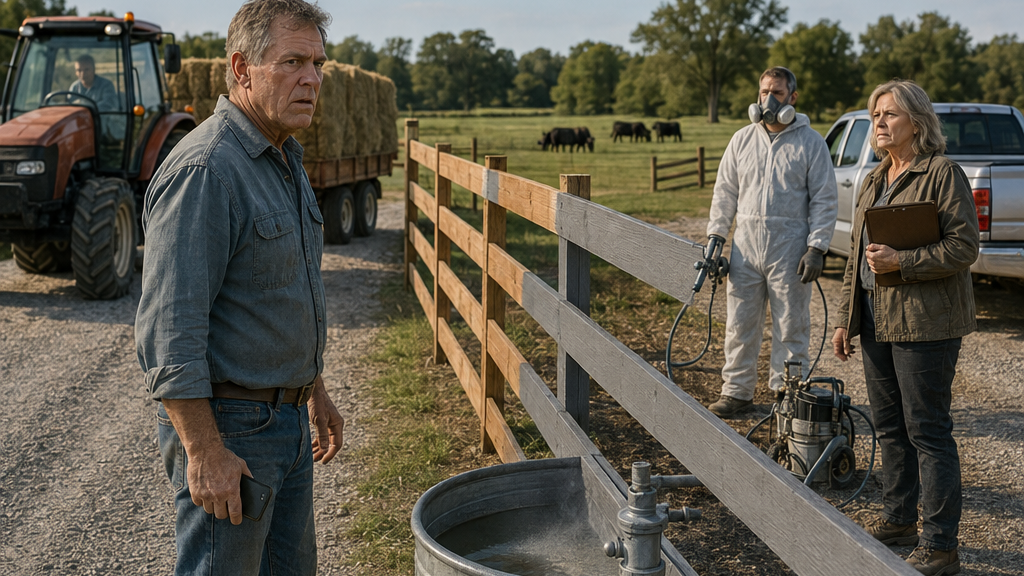
Scott Taylor saw the gray before he saw the man holding the spray gun.
He had just rounded the last bend in the shared gravel lane with a wagon stacked high with square bales when a flat, wet strip of color flashed between the cedar posts ahead. For one second he thought someone had hung plastic along the fence.
Then the mist moved.
A worker in a respirator stood beside Scott’s pasture gate, sweeping a spray wand across the cedar boards in long, even passes.
Scott took his foot off the throttle.
The tractor rolled another few feet before the wagon behind him settled with a creak. Ahead, nearly half of the fence had changed from the warm honey-brown Scott had maintained for years to a dull, opaque gray.
The worker kept spraying.
Scott set the brake and climbed down.
“Hold up.”
The man didn’t hear him through the respirator and engine noise from the small compressor trailer. Scott walked closer, staying outside the spray drift.
“Hold up.”
The worker turned, released the trigger, and lifted one gloved hand.
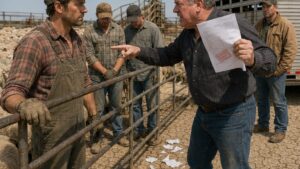
Scott pointed at the fence. “Who told you to do this?”
The man pulled the respirator away from his mouth. “Association job.”
“What association job?”
“Road corridor maintenance.”
Scott looked from the worker to the boards. The coating was still glossy in places. A clean vertical line showed where the spray had stopped: gray on one side, honey-colored cedar on the other.
Scott had set those posts himself.
Not supervised them. Not hired somebody and checked the invoice afterward.
He had laid the line, dug the holes, braced the corners, and stained the boards when the fence was new. He had replaced two rails after a bull pushed against them one winter. Every few years he cleaned the cedar and worked preservative into it board by board.
Now somebody had covered half of it before breakfast.
“Where’s your work order?”
The contractor’s expression changed slightly. “In the truck.”
“Get it.”
The man looked toward the compressor, then down the lane.
Scott took out his phone.
He photographed the transition between the original cedar and the new gray coating. Then the spray equipment. Then the contractor’s truck parked partly on the gravel shoulder.
The worker shifted his weight.
“I’ve got other sections to do.”
“Not this one.”
“I’m supposed to finish to the cattle crossing.”
“You’re not going past that post until somebody proves they have authority to alter my fence.”
The contractor exhaled through his nose.
“I don’t decide that.”
“I know.”
Scott stepped closer to the gate.
That was when he saw the valve.
A galvanized cattle-water shutoff sat low beside the inside fence line, connected to the trough pipe that fed the lower pasture. Gray specks covered one side of the metal housing. A heavier streak had run down the stem.
Scott crouched.
The valve wasn’t beside the gravel. It was several feet inside the pasture side of the fence.
He photographed it from three angles.
The worker came back holding a sheet on a clipboard.
Scott stood.
The page carried the association’s name at the top and a short description of the work below. Scott did not touch it.
“Read me the job number.”
The contractor did.
Scott typed it into his phone.
“Who signed it?”
“Brenda Walker.”
Scott looked up.
“You spoke to her?”
“She’s the contact.”
“When?”
“This morning. She said everything along this stretch was cleared.”
Scott felt the first hard push of anger then, not when he had seen the gray boards.
Cleared.
The word made it sound as though Scott’s fence had been sitting on somebody’s checklist waiting for permission from everyone except him.
The contractor pulled his respirator back up but didn’t resume spraying.
Scott called Brenda.
She answered on the fourth ring.
“Scott.”
“Did you authorize a contractor to coat my fence?”
A pause.
“I authorized corridor maintenance.”
“My fence isn’t corridor property.”
“It borders the association lane.”
“That doesn’t answer what I asked.”
Another pause, shorter this time.
“I’ll come down.”
Scott ended the call.
For the next fifteen minutes he photographed everything the way he used to document commercial job sites when he still took construction work: equipment position, spray pattern, road edge, fence posts, gate hinges, valve, ground cover, contractor truck.
He did not trust anger to remember dimensions correctly.
By the time Brenda’s pickup appeared, the contractor had shut the compressor down.
She stopped on the opposite side of the lane and climbed out carrying a clipboard against her hip.
Brenda was in her early sixties and had the habit of walking into meetings as though she were already halfway through them. She looked at Scott, then at the fence.
“You stopped them.”
“Yes.”
“They’re scheduled for three properties today.”
“They’re not scheduled for mine.”
Brenda glanced toward the gray boards.
“We’ve had complaints about the corridor looking neglected.”
Scott almost laughed.
“My fence isn’t neglected.”
“I didn’t say yours was.”
“You had somebody spray it gray.”
“The board agreed we needed consistent treatment along the maintained lane.”
Scott’s attention sharpened.
“The board agreed?”
“George was in favor. Nobody objected when we discussed maintenance.”
“That’s not the same thing as approving work on my property.”
Brenda’s mouth tightened.
“We maintain that corridor.”
“You maintain the gravel and drainage.”
“And structures affecting the corridor.”
Scott pointed at the valve inside the fence.
“Does that include my water system?”
Brenda looked.
For the first time since arriving, she stopped moving.
Gray overspray dotted the galvanized housing clearly enough to be seen from the lane.
“That shouldn’t have happened.”
“It happened because your contractor is standing on my side of the fence.”
“He shouldn’t have crossed.”
“He crossed because your work order told him he was cleared.”
Brenda looked at the contractor.
The contractor spread his hands slightly. “I was told to treat to the cattle crossing.”
Brenda looked back at Scott.
“We can clean the valve.”
Scott felt his jaw tighten.
“That isn’t the point.”
“The coating protects the wood.”
“It covers the stain I chose.”
“It’s a preservative.”
“It’s gray.”
“It’s what we’re using on the corridor.”
Scott stepped toward the fence and put one hand on an untouched cedar rail.
“This fence was built under my permit, on my parcel, with my lumber. The association has never maintained it.”
Brenda’s expression shifted, but only slightly.
“You have that permit?”
“Yes.”
“I asked you for records when we talked about the corridor walk in the spring.”
Scott knew exactly what she meant.
She had proposed a Saturday walk with the board to identify culverts, shoulders, gates, and private improvements bordering the lane. Scott had declined. He had told her that his property markers had been in the ground longer than the association itself and that he did not need a committee walking his fence line to tell him what belonged to him.
At the time, it had felt like a sensible line to draw.
Now Brenda let the silence sit between them.
Scott did not give her the satisfaction of defending himself.
Finally he said, “Not sending you a permit doesn’t make the fence yours.”
“No,” Brenda said. “But we can only work from the information people give us.”
“You could have called.”
“We were trying to get the work done before the drainage schedule starts.”
“So you skipped the owner.”
“I authorized routine maintenance.”
Scott looked at the gray half of the fence again.
That phrase was doing a lot of work for her.
Routine maintenance.
He had spent enough years around construction contracts to know that arguments often began with ordinary words stretched until they covered something they were never meant to cover.
He turned to the contractor.
“Pack up from this section.”
The man looked at Brenda.
Brenda stared at the fence for a moment, then nodded once.
“Stop here.”
The contractor began coiling his hose.
It should have felt like a victory.
Instead Scott noticed Brenda making a note on her clipboard.
“What are you writing?”
“The incomplete work.”
“On my fence?”
“Yes.”
Scott watched her finish the line.
Then she looked directly at him.
“If the association incurs a return charge because you stopped an approved maintenance job, that cost will be assigned to your parcel.”
Scott stared at her.
“You’re going to bill me for stopping work I never authorized?”
Brenda tucked the clipboard beneath her arm.
“If the board determines the stoppage was the owner’s responsibility, yes.”
The compressor trailer rattled as the contractor hitched it to his truck.
Scott looked at the wet gray boards, the oversprayed valve, then back at Brenda.
The fence was no longer the only thing that had changed that morning.
Chapter 2: The Invoice Arrived Before Any Explanation Did
Three days later, Scott opened his mailbox and found a bill for $148.50.
There was no letter explaining the association’s authority.
No copy of a vote.
No apology for the overspray.
Just an invoice for “mobilization and interrupted treatment,” with payment due at the end of the month.
Scott stood beside the road reading it twice.
Then he laughed once, without humor.
He took the paper inside and laid it flat on the desk in the small farm office off his mudroom.
For most of his adult life, Scott had saved documents other people threw away. Receipts for gravel deliveries. Equipment warranties. Fence material invoices. Old survey copies. Well-service reports. He did not keep them because he enjoyed paperwork. He kept them because thirty years around farms and construction had taught him that memories became very confident after records disappeared.
He placed Brenda’s invoice beside the photographs from Monday.
Gray overspray on the valve.
Gray dots on grass.
Gray mist on the lower leaves of a climbing rose his late wife had planted near the gate years before.
Scott had not noticed the rose damage until the following evening.
Now several leaves had stiffened under the coating.
He went back outside with a tape measure and his phone.
At the fence, the distinction looked worse after drying. The gray section was flat and uniform. The untouched cedar beside it still showed grain, knots, and the amber tone of the oil stain Scott had applied the previous fall.
He photographed every affected board.
Then he measured from the gravel edge to the fence posts.
From the fence posts to the valve.
From the valve to the pasture-side ditch.
He took pictures of the gate hinges, latch, and corner brace. Gray coating had reached the lower hinge plate.
Farther down, a spray fan had dusted the leaves of a weed patch almost four feet inside the fence.
Scott crouched and took another photograph.
The job had not merely touched an object beside the lane.
The spray pattern had crossed the boundary repeatedly.
Back at the office, he called the contractor.
The man answered after Scott identified the job number.
“I need to know what condition photographs you took before starting.”
“Condition photographs?”
“Fence damage. Rot. Peeling treatment. Anything showing the work was necessary.”
A pause.
“I took start photos.”
“What did they show?”
“The fence.”
“Any damage?”
“I don’t remember any.”
“Did Brenda tell you the fence was deteriorated?”
“No. She said it was part of the treatment route.”
Scott wrote that down.
“Did she tell you it was privately owned?”
Another pause.
“No.”
“Did you ask?”
“No.”
The answer was not defensive. If anything, the contractor sounded tired.
Scott understood that part. A subcontractor received a work order, showed up, and did what the document said. That did not absolve him of crossing the fence line, but it narrowed the question.
The real decision had happened earlier.
Scott drove to the association office that afternoon.
The office was nothing more than two rooms attached to a former equipment-storage building near the center of the lane network. Brenda was there with a stack of drainage maps.
She looked at the invoice in his hand before he sat down.
“I assume that’s why you’re here.”
“You charged me before explaining what rule gave you authority to coat the fence.”
“The charge is for the contractor’s remobilization.”
“That isn’t what I asked.”
Brenda leaned back.
“We received a written complaint about inconsistent roadside structures. Your fence was specifically mentioned.”
“One complaint?”
“One written complaint.”
“And one complaint lets you alter private property?”
“It triggered a review.”
“What review?”
Brenda’s expression hardened.
“The board has been discussing corridor conditions for months.”
“Show me the vote approving work on my fence.”
“It wasn’t a fence-specific vote.”
Scott let that answer settle.
“What was it?”
“A general maintenance discussion.”
“Minutes?”
“Ask Amanda.”
“Did the board authorize gray coating on privately owned fences?”
“Scott, you’re trying to turn ordinary maintenance into a legal proceeding.”
“No. I’m trying to find out who decided my fence belonged on your work order.”
Brenda folded her hands.
“The association has treated roadside structures before.”
“Whose structures?”
“Posts. Markers. Gate approaches.”
“That’s not my question.”
She looked toward the window.
Scott knew her well enough to recognize the moment she stopped answering because the next answer would be less convenient.
He placed a printed photograph of the oversprayed valve on the desk.
“That is my cattle-water shutoff.”
Brenda looked down.
“It’ll be cleaned.”
“That valve is inside my fence.”
“I understand.”
“Then explain how corridor maintenance reached it.”
She did not.
Scott put the invoice beside the photograph.
“I want this withdrawn.”
“I’m not withdrawing it today.”
“Why?”
“Because you stopped a scheduled contractor.”
“On my property.”
“That point is disputed.”
Scott stared at her.
“No. That point hasn’t been checked.”
Brenda’s eyes narrowed.
“You could have helped check it in April.”
There it was again.
The boundary walk.
Scott leaned back.
“I declined a voluntary walk.”
“You declined to provide records.”
“I declined to let the association turn uncertainty into jurisdiction.”
“And now you’re angry because there was uncertainty.”
The sentence landed harder than Scott wanted it to.
Not because it made Brenda right.
Because there was enough truth in it to irritate him.
He gathered the photograph and invoice.
“Who filed the complaint?”
“I’m not giving you a member’s name.”
“I didn’t ask for the name. I asked whether there was more than one.”
“One.”
Scott nodded.
That was enough.
Outside, he stood beside his truck and looked at the invoice again.
One complaint.
One general maintenance discussion.
One work order signed by Brenda.
No fence-specific vote that she was willing to produce.
By evening Scott had spread his photographs across the kitchen table.
He added the contractor’s job number, notes from the phone call, and the dates of every conversation.
The old construction habits came back faster than he expected.
Document the condition.
Separate observation from assumption.
Find the governing document.
He went to the hall closet where he kept property papers in heavy binders.
The first binder held taxes and insurance.
The second held pasture leases and equipment records.
The third was older, its black vinyl cracked along the spine.
Scott pulled it out.
Inside were invoices from the year he rebuilt the front fence: cedar posts, rails, concrete, galvanized hardware.
Behind them was a folded county inspection sheet.
Scott opened it carefully.
Near the top, beside the project description, was a permit number.
He stared at it.
Then he went to the drawer where he kept an old parcel sketch.
If the permit file still contained the original layout, the question Brenda kept calling disputed might already have been answered years ago.
Chapter 3: The Permit Line Was Inside His Property
The old permit sketch put every fence post on Scott’s side of the line.
He saw it at the kitchen table just after seven Saturday morning, under the yellow light above the sink.
The drawing was simple: property edge, lane, setback measurement, proposed fence alignment. But the numbers were clear enough.
Scott found his reading glasses and checked them again.
The nearest posts had been placed well inside his recorded parcel boundary, not on it.
He felt satisfaction first.
Then caution.
A twenty-year-old sketch was not the same thing as current confirmation. He had spent too many years watching people lose arguments by treating a useful document as a magic document.
So he did something that annoyed him.
He decided to verify.
By eight-thirty he was at the fence with a tape measure, the old sketch sealed in a clear plastic sleeve.
The lane edge had shifted slightly over the years as gravel was graded outward. Grass had grown over parts of the shoulder. The ditch had been cleaned twice.
But the fence remained where he remembered it.
Scott measured from the surviving iron reference point near the gate to the first corner post.
Then to the next.
The dimensions matched closely enough to make him slow down.
He followed the line toward the oversprayed valve.
Gray flecks still spotted the galvanized housing.
From the nearest post to the valve: more than three feet inside the fence.
From the road shoulder to the post: enough distance that no reasonable lane-maintenance crew should have mistaken the valve for association property.
Scott photographed the tape measure beside the posts.
Then he stopped.
His father had stood near that same line when they planned the rebuild.
Scott remembered the older man tapping the old reference point with the toe of his boot.
“Put it inside,” he had said. “Don’t build a fence people can spend twenty years arguing over.”
Scott had laughed at the time.
Now he looked at the gray boards.
His father had tried to avoid exactly this.
By midmorning Scott drove to the county offices with the permit number.
The records counter was quiet. A clerk entered the number into the system, frowned at the age of the file, and disappeared into the back.
She returned with scanned pages on her monitor.
“This one?”
Scott leaned closer.
The permit described agricultural fencing associated with a reconstructed farm entrance and livestock enclosure. His name appeared as owner and applicant.
“No association?”
The clerk scrolled.
“Not on this permit.”
“Any shared ownership listed?”
“No.”
“Any easement holder listed as responsible for the fence?”
“Not here.”
Scott felt the tightness in his shoulders release.
A little.
The clerk turned the monitor slightly.
“There’s a site sketch too.”
It was the same drawing from his binder, except this copy carried the county intake stamp.
Scott pointed at the fence line.
“That measurement means what I think it means?”
“It shows the proposed fence inside the parcel boundary.”
“Was it inspected?”
She opened another page.
“Final inspection passed.”
Scott sat back.
There it was.
Not absolute proof of every question.
But enough to demolish Brenda’s claim that ownership itself was uncertain.
He asked for copies.
The clerk printed them.
While he waited, another county employee stepped behind the counter and glanced at the pages.
“You having a fence issue?”
Scott hesitated.
“Association contractor coated it without asking.”
The employee looked at the permit.
“Association own the road?”
“They maintain it.”
“That’s different.”
Scott nodded.
“That’s what I’m trying to establish.”
The man tapped the site sketch.
“Any other work going on?”
Scott looked up.
“What kind?”
“Along the corridor. Drainage, grading, structures.”
“There’s drainage work scheduled. Some shoulder work.”
“Same association?”
“Yes.”
“Same authorization process?”
Scott frowned.
“I don’t know.”
The question changed the temperature of the room.
Scott had come looking for a clean answer about one fence.
Now the county employee was asking whether the same practice extended beyond it.
“I’m not trying to shut down their road work,” Scott said.
“I didn’t say you were.”
“They have drainage that needs fixing.”
The employee nodded.
“Then it matters what’s association property, what’s private property, and what authorization they’re working under. That’s all.”
Scott took the copies.
On the drive home, vindication gave way to unease.
He had wanted Brenda to admit she crossed a line.
He had not wanted a county review of every culvert, shoulder, and project the association touched.
The lane served six working farms. Hay wagons, cattle trailers, feed deliveries, fuel trucks. If routine maintenance got frozen because of his fence dispute, people would not remember the permit details.
They would remember the delay.
At home Scott laid the county copies beside the association invoice.
The documents looked almost too neat together.
Permit.
Site sketch.
Inspection approval.
Photographs.
Work-order number.
He called Brenda.
She answered quickly.
“I verified the permit.”
Silence.
“The fence was built inside my parcel. County inspected it. The association isn’t listed anywhere.”
Brenda’s reply was measured.
“That doesn’t necessarily settle maintenance rights beside the lane.”
“No, but it settles ownership.”
“You’re making a broad conclusion from one file.”
“I’m making a narrow conclusion. Your contractor altered something you don’t own.”
Brenda exhaled.
“What are you asking for?”
“Withdraw the invoice. Restore the fence. Repair the valve.”
“And then?”
Scott paused.
“What do you mean?”
“The county called me yesterday.”
That caught him.
“About what?”
“They want information on upcoming work.”
Scott looked at the papers in front of him.
“I didn’t ask them to stop anything.”
“They’re asking whether we have documented authority for each project area.”
“That’s a reasonable question.”
“It’s a question that can stall the drainage work.”
Scott’s satisfaction thinned.
“When does that start?”
“It was supposed to start next week.”
He glanced out the kitchen window toward the lower field.
The drainage ditch along the shared lane had carried badly during the last hard rain. Water had pooled near the crossing and cut ruts into the shoulder.
He knew the work was necessary.
He also knew Brenda was using that necessity to press him.
“You should have had the authority documented already,” he said.
“Yes,” she replied. “And you should have participated when we tried to map private improvements.”
Scott went still.
Neither of them spoke for several seconds.
Finally Brenda said, “A county land-use inspector wants to walk the corridor Monday morning.”
“Fine.”
“Scott.”
“What?”
“If this turns into a full review, it won’t stop at your fence.”
He looked at the honey-colored section still untouched beyond the gray.
For three days he had thought the permit would end the argument.
Instead it had opened a larger one.
On Monday morning, an inspector was coming to walk the lane.
Chapter 4: One Complaint Was Treated Like a Board Vote
Amanda Rivera had checked the association minutes three times before she looked up at Scott.
“There isn’t one.”
Scott stood on the other side of the narrow records-room table with his county permit tucked under one arm.
“No motion?”
“No motion approving your fence.”
“No vote?”
Amanda shook her head.
Through the window behind her, part of Scott’s fence was visible across the lane. Even from here, the difference between the honey-colored cedar and the gray section looked unnatural, as though someone had stopped halfway through erasing it.
Amanda turned another page in the binder.
“There was discussion about roadside appearance at the May meeting. Then drainage, grading, vegetation control.”
“And my fence?”
“Not specifically.”
“What about gray preservative?”
“No.”
Scott pulled out a chair but remained standing behind it.
“Brenda said the board agreed.”
Amanda’s lips pressed together.
“They agreed the corridor needed attention.”
“That’s not the same thing.”
“No.”
It was the first time anyone connected to the association had said it that plainly.
Scott sat down.
Amanda worked carefully, not nervously. She was the kind of person who aligned paper edges before stapling them. Two stacks sat beside her: approved invoices and work orders awaiting reconciliation before the annual financial report.
Scott pointed toward them.
“Can you pull the contractor order?”
“I already did.”
She slid a copy across the table.
Scott recognized the number immediately.
At the top was the fence contractor’s information. Below that, a general description called for coating “weathered roadside wood structures and barriers” along a specified section of the shared lane.
His parcel number appeared in the margin.
At the bottom was Brenda’s signature.
Nothing indicated owner consent.
Nothing identified the fence as private.
Scott looked at the date.
“This was issued two days after the complaint?”
Amanda nodded.
“One complaint?”
“One written complaint.”
“Who reviewed it?”
“Brenda.”
“Anybody else?”
Amanda hesitated.
“George said he thought treating the roadside structures sounded reasonable.”
Scott looked up.
“That was the approval?”
“I’m not saying that.”
“What are you saying?”
“I’m saying that’s the only board-member response I can find attached to this.”
She turned the page around.
A printed email showed a short exchange. Brenda had summarized several maintenance concerns. George had replied that he had no objection to “cleaning up the lane before drainage work starts.”
That was all.
Scott read it twice.
“Does George even mention my fence?”
“No.”
Amanda reached for another folder.
“There’s something else.”
Her tone changed enough that Scott stopped reading.
She pulled out a payment allocation sheet.
The contractor’s deposit had already been entered.
Scott followed the line across the page and saw the account code.
He knew enough bookkeeping to understand what it meant.
“Drainage maintenance?”
Amanda nodded.
“They charged the fence work to the drainage fund?”
“That’s where the initial payment came from.”
Scott sat back.
The issue had just widened again.
“That account is for culverts, ditch clearing, gravel washouts.”
“And shared road surface repairs.”
“Not fence coating.”
“No.”
“Why was it charged there?”
Amanda looked toward the closed door.
“I assumed Brenda had categorized it under corridor preparation.”
“You assumed.”
“Yes.”
Scott heard no defensiveness in her voice.
Only discomfort.
“How long did you know?”
“That the fence work came from that account? Since I entered the deposit.”
“That it might not belong there?”
Amanda folded her hands.
“I noticed it.”
“But you didn’t ask.”
“I handle the books, Scott. I don’t approve projects.”
“That wasn’t my question.”
Her eyes met his.
“No. I didn’t ask.”
For a moment neither spoke.
Scott could have pressed harder. A week earlier, he probably would have.
Instead he looked again at the work order.
One complaint.
One vague discussion.
One casual email from George.
One signature from Brenda.
And money pulled from an account members believed was protecting the road from water.
The door opened.
George Nelson stepped inside with a folded cap in his hand.
“Amanda said you wanted me to see something.”
Scott slid the email toward him.
George read his own words.
His brow tightened.
“That’s not approval.”
“Brenda treated it like approval.”
“I said clean up the lane.”
“Did you mean my fence?”
“No.”
“Did you know they were sending a contractor?”
George looked toward the window.
“No.”
“Did you know they were charging it to drainage?”
His head came up.
“What?”
Amanda turned the allocation sheet toward him.
George read it, then rubbed one thumb along the edge of the paper.
“We’re already short in that account.”
“How short?” Scott asked.
Amanda answered before George could.
“Not enough to stop the scheduled ditch work. But tighter than I’d like.”
George let out a slow breath.
“I told Brenda I didn’t want another assessment this year.”
“That doesn’t make this vote yours,” Scott said.
“No. It doesn’t.”
The admission should have satisfied him.
Instead Scott felt something colder.
Nobody in the room seemed to have intended exactly what had happened.
That made it harder, not easier.
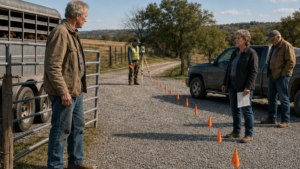
By late morning, two county vehicles were parked near the equipment staging area.
The land-use inspector walked the lane with Brenda, Scott, George, and an erosion-control inspector. They stopped at Scott’s fence first.
The land-use inspector checked the permit sketch, measured from the reference point, and examined the gray valve.
“Private improvement,” he said.
Brenda crossed her arms.
“We maintain the corridor.”
“The corridor isn’t everything visible from the corridor.”
Scott said nothing.
The inspector moved down toward the drainage staging area where a grader and small excavator sat beside stacked pipe.
He asked for authorization documents.
Amanda provided what she had.
Then he asked the same question for a shoulder-stabilization project farther down the road.
The silence that followed lasted too long.
By noon, bright notices had been attached to the equipment.
Temporary pause pending documentation review.
Not the entire road.
Not emergency maintenance.
But two scheduled projects could not proceed until the association demonstrated what property it controlled and what permissions it had obtained.
Scott stood beside the idle grader.
For days he had imagined the moment someone official would tell Brenda she had crossed the line.
Now that it had happened, nobody looked victorious.
George stared at the machinery.
Amanda clutched her files.
Brenda said nothing to Scott.
The gray fence stood behind them like an accusation none of them could put back into a single category.
That afternoon a feed truck came slowly up the lane and stopped near Scott’s gate.
The driver lowered his window.
“Heard they shut the ditch crew down.”
“Paused two projects.”
“Same difference if rain comes.”
Scott looked toward the shallow ditch.
The driver nodded toward the lower bend.
“You know what that section does in a hard storm. Water gets over the shoulder, trucks won’t get through clean. I’ve got deliveries scheduled next week.”
“It’s not supposed to rain hard.”
The driver gave him a flat look.
“You farming by forecast now?”
Scott had no answer.
The truck rolled on.
Behind it, loose gravel rattled into the ditch that was still waiting to be repaired.
For the first time since the contractor touched his fence, Scott wondered whether being proven right might cost more than he had intended.
Chapter 5: Brenda Finally Explained What She Was Afraid Of
Brenda arrived at Scott’s equipment shed without her clipboard.
That alone told him the conversation would be different.
She got out of her pickup, closed the door, and said, “Before we argue, come look at the ditch.”
Scott almost refused.
The answer rose automatically.
My fence first.
Then he saw the mud on her boots.
He followed her.
Two days of intermittent rain had darkened the gravel and filled the lower drainage channel with brown water. At the bend below Scott’s pasture, the ditch narrowed around a collapsed edge. Water pressed against the shoulder and spilled across in a thin sheet.
Brenda pointed.
“That’s what the crew was supposed to open up.”
Scott crouched near the culvert entrance.
He knew the problem.
Sediment had built against one side, and the outlet farther downhill had begun sloughing inward. It was not catastrophic yet.
But another heavy rain could turn the shoulder soft enough to rut under feed trucks and cattle trailers.
“The county didn’t stop emergency clearing,” Scott said.
“No. But they won’t release the full project until we separate what’s association-controlled from what’s private.”
“That should’ve been done before contracts were signed.”
“Yes.”
The quickness of her answer made him look at her.
Brenda stared down at the water.
“I know.”
Scott straightened.
“What changed?”
“Nothing changed. I’m tired.”
“That’s not the same as admitting you were wrong.”
She glanced at him.
“I was wrong to approve work on your fence without confirming ownership.”
He had wanted to hear that sentence for more than a week.
Now it arrived without drama, standing beside muddy water.
It did not feel as satisfying as he expected.
Brenda walked toward the shed.
Inside, Scott had an old steel table between a tool cabinet and the tractor parts shelves. She placed a thin folder on it.
“What’s that?”
“Projected expenses.”
Scott did not open it.
“You brought me a budget?”
“I brought you the reason I was pushing everything.”
He waited.
Brenda rested both palms on the table.
“The drainage reserve is low. The lower culvert needs more work than we thought. The west shoulder needs stone. The ditch project came in higher after fuel and hauling.”
“So propose an assessment.”
“That was the plan.”
“Then what does painting my fence have to do with drainage?”
Brenda looked embarrassed for the first time.
“Members were already complaining.”
“About what?”
“Everything. The road looks rough. One entrance has broken posts. Another has weeds around the culvert markers. Your fence stain had weathered unevenly on the road side.”
Scott’s expression hardened.
“You thought making it look cleaner would make people more willing to pay.”
“I thought if members saw we were maintaining what they already paid for, they might listen when we explained why we needed more.”
“You spent drainage money making the corridor look better so you could ask for drainage money.”
“When you say it like that, it sounds ridiculous.”
“It is ridiculous.”
“It also made sense at the time.”
Scott stared at her.
Brenda’s voice sharpened.
“You think I wanted to spend June arguing over fence color? I have three landowners threatening to vote against any assessment. George said people were tired of paying for projects they couldn’t see. We had a contractor available. I thought we could get the roadside maintenance done before the drainage meeting.”
“And you stopped asking who owned what.”
“Yes.”
The word sat between them.
Scott looked through the open shed door toward his fence.
Gray against cedar.
He had treated the gray as proof that Brenda wanted control.
Now he saw something less clean.
Fear.
Not fear of Scott.
Fear of losing the confidence of people who expected roads and ditches to work but disliked every bill required to keep them working.
It did not excuse what she had done.
But it changed the shape of it.
Brenda opened the folder.
“There’s another thing you’re going to dislike.”
“I’m getting used to that.”
“In April I asked everyone along the east lane to walk the boundary with us.”
“I remember.”
“You refused.”
“I didn’t need the association verifying my property.”
“I didn’t ask to verify your ownership. I asked to mark which improvements were private before we wrote maintenance scopes.”
Scott said nothing.
She continued.
“You told me the iron markers had been there longer than the association and that if we didn’t know where the line was, we should stay off your side.”
“That sounds like me.”
“It does.”
He looked away.
The memory was exact now.
Brenda had stood at his gate with a rolled map under one arm. Scott had barely let her finish.
At the time, he had believed participation itself created risk. Once the association started mapping things near his fence, the next step would be deciding it had authority over them.
So he withheld the permit.
He declined the walk.
He drew his boundary by refusing discussion of the boundary.
“I still didn’t authorize the work,” he said.
“No.”
“And you still signed it.”
“Yes.”
“But I made it easier for you to pretend the uncertainty was unavoidable.”
Brenda’s face tightened.
“I didn’t pretend.”
“Maybe not.”
That was as far as he could go yet.
A pickup stopped outside.
The county erosion-control inspector entered the shed carrying a folder.
“I’ve got a path for the drainage work,” he said.
Scott and Brenda turned toward him.
“If the association submits a revised scope limited to the shared ditch, culverts, and documented easement areas, we can release the urgent portion. Private improvements need to be carved out unless you have written owner consent.”
“How fast?” Brenda asked.
“As fast as you can give me a clean map and clean accounting.”
She glanced at Scott.
“Accounting too?”
“You used one work order across different property categories. We need to know which funds are paying for what.”
After the inspector left, Brenda stared at the folder on Scott’s table.
“There’s the answer.”
“Part of it.”
“What else do you want?”
Scott thought about saying restoration first.
Invoice first.
Apology first.
Instead he looked toward the water running beside the lane.
“The drainage needs to move.”
Brenda’s eyes narrowed slightly.
“So does my fence correction,” he added.
“There it is.”
“I’m not trading one for the other.”
“What are you proposing?”
Scott pulled a clean sheet of shop paper from a drawer.
“We split the work.”
He drew one line down the center.
“Shared drainage, culverts, road surface, documented easements on this side. Private fences, gates, valves, and anything else individually owned on this side.”
Brenda watched.
“Every private item gets an owner confirmation before it goes on a contractor scope.”
“And the drainage?”
“Resubmit it alone. Same week if the county allows.”
“What about the stopped shoulder job?”
“Verify ownership first.”
“That could delay it.”
“Then it gets delayed.”
Brenda looked at him for a long moment.
“You understand what you’re asking me to give up.”
Scott set the pencil down.
“Yes.”
The association had relied on Brenda’s judgment because judgment was faster than procedure.
Now Scott was asking her to put limits around that judgment in writing.
He slid the paper toward her.
“You can save the drainage project,” he said. “But not by keeping the authority that caused this.”
Brenda did not take the paper.
Not yet.
Chapter 6: He Could Stop Everything or Draw the Line Properly
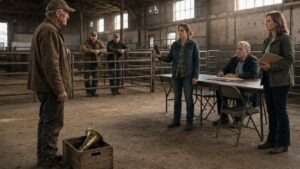
The easiest victory was offered to Scott before the special meeting even started.
One of the association members caught him beside the volunteer fire hall door and nodded toward the county letters in his hand.
“If I were you, I’d tell them nothing moves until your fence is fixed.”
Scott looked through the open doorway.
Folding chairs had been arranged in rows. Brenda sat at the front table with Amanda and George. A county map was pinned to a corkboard behind them.
On the table beside Scott’s papers was one short piece of cedar.
He had sanded the gray coating from it the night before and worked a little of his original honey-colored stain into the grain.
He picked it up.
“I’m not here to stop the road.”
The member shrugged.
“They stopped themselves.”
That was the tempting version.
Simple.
Useful.
And not entirely false.
Scott carried the cedar board inside.
The meeting opened badly.
Two members wanted the drainage work restarted immediately. Another wanted to know why drainage reserves had been used for fence coating. George tried to explain that the original discussion had been informal.
“That’s the problem,” Scott said.
The room quieted.
George looked at him.
Scott continued.
“You thought you were agreeing to clean up the lane. Brenda thought you were approving a maintenance scope. Amanda thought project authorization had already been handled. The contractor thought everything on the work order was cleared.”
He set the cedar board on the table.
“And I thought refusing the spring boundary walk was the safest way to keep the association away from private property.”
Brenda looked up.
Scott had not planned to say that so early.
But there was no use building a new rule around everybody else’s mistakes while hiding his own.
“I was wrong about that part,” he said. “Not about who owns my fence. About thinking silence would make the boundary clearer.”
Nobody spoke.
He turned the board so the restored face pointed toward the room.
“This is what started it. But the fence isn’t the whole problem anymore.”
Amanda distributed copies of the revised accounting.
The contractor deposit for Scott’s fence had been separated from drainage expenses. The remaining drainage balance was lower than members had believed, but not empty.
Brenda addressed the room.
“The county will release the urgent ditch and culvert work if we submit a limited scope with verified property authority.”
“Then do that,” someone said.
“We can,” Brenda replied. “But Scott has proposed changing how we authorize everything else.”
There was immediate resistance.
More paperwork.
More delay.
What happened when an owner did not respond?
What counted as an emergency?
Could one person stop a necessary repair?
Scott listened until the questions began repeating.
Then he stood.
“I’m not proposing permission for the association to fix a washout in the shared road.”
He held up the draft procedure.
“I’m proposing that before a contractor alters a fence, gate, valve, structure, or other improvement, somebody verifies who owns it.”
A board member near the end of the table asked, “And if it’s private?”
“Written owner consent.”
“What if it affects drainage?”
“Then document the easement or negotiate access. Don’t rename private property ‘maintenance’ because that’s easier.”
Brenda’s expression did not change.
Scott continued.
“Second, project money stays with its project. Drainage fund pays drainage. Road account pays road work. Private restoration doesn’t get buried in either.”
Amanda nodded once.
“Third, board approval means an actual recorded vote when the rules require one. Not an email where somebody says they have no objection.”
George leaned back.
“That one’s aimed at me.”
“It’s aimed at all of us.”
George gave a faint nod.
Scott had expected resistance from him.
Instead George looked toward Brenda.
“I should’ve asked what ‘clean up the lane’ meant.”
Brenda said nothing.
George tapped the draft.
“I support this.”
The shift in the room was small but unmistakable.
Scott looked at Brenda.
Under the current arrangement, much of the association’s speed came from her discretion. People called her because she answered. Contractors called her because she made decisions. When a culvert washed, nobody wanted a committee discussion.
The new procedure would keep emergency authority where it was needed, but take private-property assumptions away from her.
One of the members asked the question everyone had been circling.
“Brenda, can you work under this?”
She looked down at the paper.
“If the board thinks I can’t be trusted, elect somebody else.”
“That’s not what this says,” Scott replied.
“It says I need written verification before doing things I’ve handled for years.”
“Yes.”
Her eyes lifted.
“And you think that isn’t about trust?”
“I think trust is what got us here.”
The sentence landed harder than Scott intended.
Brenda’s face closed.
He could have left it there.
Instead he said, “Including my trust in myself.”
She frowned.
“I knew where my fence was. I knew what I owned. So I figured I didn’t need to participate when you tried to document the corridor.”
Scott rested one hand on the cedar board.
“That didn’t give you the right to spray this. But it also didn’t help anybody distinguish responsibility from ownership.”
The room stayed quiet.
Brenda looked at the board.
“What happens if an owner refuses to answer and a private structure is causing a real drainage failure?”
Scott had thought about that.
“You document the problem. Give written notice. Use whatever easement or emergency authority actually exists. If none exists, you negotiate. You don’t invent ownership.”
“And emergency road access?”
“Unchanged.”
“And culvert clearing inside documented association easements?”
“Unchanged.”
Amanda turned several pages.
“That matches the county recommendation.”
Brenda looked toward her.
“You helped draft this?”
“Scott brought the categories. I cleaned up the accounting language.”
For the first time, Brenda almost smiled.
“Of course you did.”
The tension eased just enough for the meeting to move.
They separated the urgent drainage scope from the shoulder-stabilization project.
The ditch and culvert work could restart after county review.
The shoulder job would remain paused until property limits were confirmed.
Scott’s fence restoration would be treated separately, charged neither to drainage nor road maintenance.
Then came the vote on the new procedure.
George voted yes.
Amanda recorded it.
One board member voted yes.
The other hesitated, then did the same.
Brenda had not voted.
Scott watched her.
She could oppose it.
She could resign and make the decision someone else’s burden.
The room waited.
Brenda picked up the cedar sample.
She ran her thumb along the restored grain, then looked at the gray residue still visible along one edge.
“I was trying to keep one bad season from turning into three years of arguments over money,” she said.
Nobody interrupted.
“I made work move faster than the authority behind it.”
She set the board down.
“That was my decision.”
Scott felt the room shift again.
Not absolution.
Ownership.
Brenda looked at Amanda.
“Record my vote yes.”
Amanda did.
The motion passed.
After the meeting, Scott carried the cedar sample outside.
The fire hall parking lot was almost empty when Brenda came up behind him.
“The county should release the ditch crew tomorrow.”
“Good.”
“I’ll have Amanda void your mobilization invoice.”
Scott turned.
“And the fence?”
“I’m getting the contractor’s restoration price.”
“The valve too.”
“Yes.”
“The rose?”
Brenda gave him a tired look.
“Yes, Scott. The rose too.”
He nodded.
She started toward her pickup, then stopped.
“You know this procedure is going to slow us down sometimes.”
“It should.”
“That isn’t always a virtue.”
“No.”
She seemed surprised by the answer.
Scott looked toward the road leading back to their farms.
“Neither is speed.”
The next morning the ditch crew was authorized to return.
But Scott’s gray fence was still standing, and the invoice was still physically sitting on his desk until Amanda’s correction reached him.
The association had finally drawn the line on paper.
Now Scott needed to see whether anyone would honor it on the ground.
Chapter 7: The Cedar Came Back, but the Boundary Meant More
The same contractor came back carrying stain instead of gray coating.
Scott saw the truck from the hay field and shut down the tractor before it reached his gate. For a moment, the sight of the compressor trailer behind it tightened something in his chest.
Then he noticed the difference.
No spray wand was already uncoiled.
No worker had stepped through the gate.
No equipment had been placed on his side of the fence.
The contractor parked on the gravel shoulder, climbed out, and waited beside the truck.
Brenda Walker arrived five minutes later.
She had a clipboard again.
Scott almost smiled at that.
Almost.
He walked down from the field carrying his gloves.
Brenda held out a single-page work authorization.
“The board approved the restoration cost. Amanda separated it from the road and drainage accounts.”
Scott read the page.
The description was specific this time: removal or preparation of the unauthorized gray coating, restoration of the cedar finish to match the owner-approved treatment, cleaning or replacement of affected hardware, and correction of overspray damage.
His parcel was listed as private property.
Below that was a blank line.
Owner authorization.
Scott looked at Brenda.
She pointed toward the fence.
“We stop at your property line until you sign.”
The sentence was simple.
It landed harder than the apology beside the ditch had.
Scott looked at the contractor.
“You understand the scope?”
“Yes.”
“You go nowhere past the gate without asking.”
“Yes.”
“The valve gets cleaned first. If the coating won’t come off without damaging the galvanized finish, replace the affected assembly.”
“That’s what the order says.”
Scott looked back at Brenda.
“And the rose?”
“Replacement cost is included.”
One of the coated branches had survived. Another had not.
Scott had trimmed the dead growth himself rather than wait for somebody else to decide what counted as damage.
He signed.
Only then did the contractor open the trailer.
For the first hour, the work was mostly preparation. The gray coating had bonded unevenly, so the contractor tested a small section before committing to the full restoration. Scott stayed nearby, pretending to repair a gate latch that did not need much attention.
He watched the first board change.
The flat gray surface dulled under preparation, then gradually gave way to visible grain.
When the honey-toned treatment went on, the cedar darkened.
Not exactly as it had looked before.
Scott knew better than to expect that.
Weathered wood remembered what had been done to it.
But the grain was visible again.
That mattered.
By midday, the hard dividing line that had cut the fence into two different stories was disappearing board by board.
Brenda returned carrying two folders.
“The invoice correction.”
She handed him the first.
The $148.50 charge showed a zero balance.
Scott read it once and handed it back.
“You keep it.”
“It’s your copy.”
“I know what zero looks like.”
She gave him a look and pushed it back toward him.
“You’re the one who saves everything.”
He took it.
The second folder contained the revised association project list.
Drainage work had restarted two days earlier. The lower culvert had already been cleared, and additional stone was scheduled for the shoulder.
The stopped stabilization project remained on hold pending property verification.
Scott flipped through the pages.
Beside every project was a new column.
Ownership or easement confirmed.
He tapped it.
“Amanda’s idea?”
“Mostly.”
“Good idea.”
Brenda nodded.
“She enjoys making the rest of us prove things exist.”
“That’s what bookkeepers are for.”
For a moment, they stood without arguing.
The contractor called Scott over to the valve.
Cleaning had removed most of the gray flecks, but the heavy streak on the stem had etched into the finish.
“I can keep working it,” the contractor said. “But I think replacement is cleaner.”
Scott crouched beside it.
Before all this, he might have insisted on replacement simply because replacement meant full correction.
Now he turned the valve once.
It moved smoothly.
He looked at the marked housing.
“How much of the assembly?”
“Top hardware and stem. No need to disturb the line.”
“Then replace those.”
The contractor nodded.
Brenda made a note.
Scott noticed.
“What?”
“Nothing.”
“You wrote something.”
“Owner approved partial valve component replacement.”
Scott stared at her.
Then he laughed.
It surprised both of them.
“You’re going to document me to death now.”
“That was apparently the lesson.”
“No. The lesson was to document before you spray.”
“That too.”
By late afternoon, the fence looked like itself again.
Not new.
Scott was glad of that.
New would have looked wrong.
The restored cedar still carried the small dents from years of farm use, the darker patch near the gate where cattle rubbed against the boards, and the shallow mark where Scott had once dropped a chain over the top rail.
His fence had not been made perfect.
It had been returned to him.
The contractor packed up before sunset.
This time, before leaving, he walked the completed section with Scott.
No gray remained on the hinge plate.
The valve hardware had been replaced.
A new rose plant, still in its nursery container, sat near the gate for Scott to plant where he wanted.
The contractor stopped beside the first fence post.
“That good?”
Scott ran his palm over the cedar.
“Yes.”
The man nodded.
“I should’ve asked more questions the first day.”
Scott looked at him.
“You were working from a bad order.”
“I still crossed the fence.”
Scott appreciated that he did not add an excuse.
“Now you know where it is.”
“Yes, sir.”
After the truck left, Scott expected the whole thing to feel finished.
Instead Brenda remained beside her pickup.
“There’s one more thing.”
Scott looked at her clipboard.
“Of course there is.”
“First boundary inspection under the new procedure is tomorrow morning.”
“I know.”
“You’re on the route.”
“I know that too.”
She waited.
Scott understood what she was asking.
Back in April, he had refused the same kind of walk because he believed participation would give the association an opening.
Now the procedure was different.
Private improvements would be identified as private precisely so nobody could treat them as association property later.
Still, an old resistance rose in him.
He looked at the restored fence.
His father’s advice returned with uncomfortable clarity.
Put it inside. Don’t build a fence people can spend twenty years arguing over.
Scott had always heard that as advice about distance.
Maybe it had also been advice about clarity.
“I’ll be there,” he said.
Brenda nodded once.
The next morning, Scott met the inspection group at his gate.
George was there. Amanda carried the updated asset sheets. Brenda held the corridor map.
Nobody stepped through the fence without asking.
They began with the drainage ditch.
Association responsibility.
Then the culvert.
Association responsibility.
Then Scott’s fence.
Amanda looked at him.
“Private improvement?”
“Yes.”
She marked it.
“Association maintenance authority?”
“No.”
She marked that too.
“Emergency access?”
“Only if the easement or an actual emergency requires it.”
Brenda glanced at Scott.
“That wording work for you?”
“It works.”
They moved to the galvanized valve.
“Private,” Scott said.
Amanda marked it.
At the gate, Brenda stopped.
“The gravel approach overlaps the maintained corridor.”
Scott looked down.
She was right.
Part of the approach served his farm, but its road-side portion lay inside the shared maintenance area.
Months earlier, he would have heard only the first half of that fact and rejected the rest.
Now he pointed with his boot.
“Association maintains to here.”
Brenda studied the map.
“And from there?”
“Mine.”
George looked between them.
“That simple?”
Scott glanced at the fence.
“It could’ve been.”
They continued down the lane.
At the lower bend, fresh stone had already been placed where water used to eat at the shoulder. The ditch carried cleanly beneath the repaired culvert.
A feed truck came through without slowing.
Scott watched it pass.
That mattered too.
The association had not been destroyed.
Brenda had not been driven out.
Scott had not surrendered an inch of ownership.
The repair was less dramatic than the conflict had been.
That was probably why it felt real.
When the inspection group finished Scott’s section, Brenda started toward the next property.
Scott remained at the gate.
For a second, the old habit told him to let them go.
His property had been marked.
His documents were clear.
His fence was restored.
He had what he wanted.
Then Amanda turned.
“You coming?”
Scott looked at the open livestock gate.
Beyond it, the restored cedar caught the morning light. The color was warmer than the gray had ever allowed, but not because it was brighter.
Because the grain showed again.
Scott reached for the gate.
Instead of closing it behind the group, he swung it fully open.
“I’m coming.”
Brenda waited at the edge of the gravel.
Scott stepped onto the lane and fell into pace beside her.
Not behind her.
Not in front.
Beside her.
The fence remained where it had always belonged.
For the first time, so did everyone else.
The story has ended.