When the Bank Called His Sheep Worthless, Joseph Allen Opened the Gate
Chapter 1: The Red Notice Beside the Sheep Pen
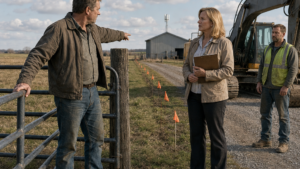
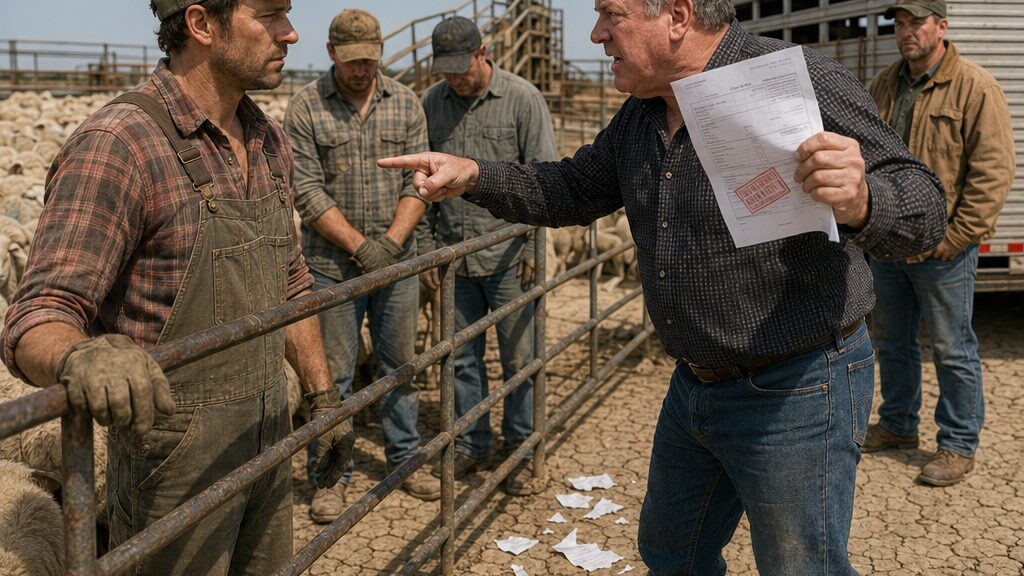
Richard Martin held the paper high enough for both farmhands to read the red word stamped across it.
OVERDUE.
Then he pointed at Joseph with the same hand.
“You’ve had three notices.”
The sheep pressed against the holding fence behind them, their dusty backs shifting like water under wool. A livestock trailer waited at the loading chute with its rear gate lowered. One farmhand stood frozen beside the latch. The other pretended to examine a length of cracked hose.
Joseph looked at the statement rather than Richard’s finger. His own name appeared beneath the bank letterhead in black block type. The amount at the bottom was large enough to buy winter feed and small enough, once, to have seemed manageable.
“I received them,” Joseph said.
Richard’s face reddened. “Then explain why I had to drive out here and find three hundred head ready for market.”
“They aren’t ready.”
“They’re standing beside a sale trailer.”
“The trailer isn’t for them.”
Richard glanced toward the hauler, who lowered his eyes. Beyond the pens, the fields lay yellow and thin beneath a white sky. Each hoofstep lifted powder from ground that should have held spring grass.
Richard shook the statement once. “Your payment was due eighteen days ago. You told the bank the auction proceeds would cover it.”
“They were supposed to.”
“So where are the proceeds?”
Joseph could feel both farmhands listening. They had not been paid for the previous Friday. He had told them the delay was a transfer problem, which was not a lie in the strictest sense. There had been no money to transfer.
Richard stepped closer. “You cannot stand in front of a marketable flock and tell me you have no means to pay.”
Joseph placed one hand on the top rail. The metal was hot through his glove.
“I didn’t say I had no means.”
“What you have is an overdue secured loan.”
Richard turned the page outward. The red stamp faced the yard, the trailer and anyone on the county road who cared to slow down.
Joseph’s neck tightened. He remembered Richard sitting at the Allen kitchen table years earlier, drinking coffee while Joseph’s father argued over lamb prices. Back then Richard had laughed easily and called Joseph “son” even though they were not related.
Now he said, “Until this account is brought current, nothing listed as collateral leaves this property without authorization.”
The hauler looked up. “I’ve got another pickup after this one.”
“You can go,” Richard told him.
Joseph straightened. “The trailer stays.”
Richard turned sharply. “Excuse me?”
“I hired it. I paid the morning rate.”
“With what?”
The question landed harder than the raised voice. One farmhand shifted his boots.
Joseph said, “It’s carrying feed troughs from the lower shed.”
Richard walked to the trailer and ran his palm over the side as if ownership might reveal itself beneath the dust. “This equipment may be included in the inventory.”
“It belongs to the hauler.”
“The bank will determine that.”
“You know it doesn’t belong to me.”
“I know you stopped returning calls.”
Joseph watched a ewe push her nose between the rails. A yellow paint mark crossed her shoulder. Behind her stood six more with the same mark, all separated from the larger flock by a narrow internal gate.
Richard followed his gaze.
“How many marked animals?”
Joseph did not answer.
Richard turned to the farmhands. “How many?”
Neither spoke.
“They work for me,” Joseph said.
“For the moment.”
Silence spread across the yard. Even the hauler stopped moving.
Richard’s expression changed only slightly, but Joseph saw that he regretted the words. The regret did not make him withdraw them.
Instead, Richard took a pen from his shirt pocket.
“I’m arranging a formal collateral inventory. Livestock, tractors, trailers, handling equipment, stored feed and any titled vehicles connected to the operation.”
“You came here for a payment.”
“I came here because the bank’s agricultural portfolio has four delinquent accounts in this county. Two are already beyond recovery.”
“That isn’t my doing.”
“No. Your doing is this one.”
Richard tapped the page against Joseph’s chest. The paper bent between them.
Joseph took it before it fell.
The red stamp looked brighter at close range. Beneath it were late charges, accrued interest and a paragraph authorizing inspection after default. He had read every line before. He had also folded the first two notices and placed them beneath the kitchen phone, where unopened envelopes accumulated like a second stack of feed bills.
Richard pointed toward the flock.
“You sell enough animals today to bring the note current, or I prevent anything from leaving until the bank completes its inventory.”
“You can’t order a sale.”
“I can stop unauthorized disposal of collateral.”
“They’re not disposal.”
“Then pay.”
The ewe at the fence bleated once. Others answered, low and uneven.
Joseph folded the statement in half.
Richard snatched for it. Joseph held on without pulling. For a second, the page stretched between their hands. Then it tore down the center.
One half dropped. The wind caught it and pushed it across the cracked yard. The second half slipped from Richard’s hand and landed under the fence.
Richard looked at the paper as though Joseph had destroyed something more official than a copy.
“Is that how you handle every obligation?”
Joseph bent and picked up the half nearest his boot. “You brought it into a livestock yard.”
“I brought it because you left me no private option.”
“You had my address.”
“I sent notices.”
“You also had my gate.”
“And you kept it closed.”
That was true. Joseph had seen Richard’s truck on the road twice during the past week. Both times he had walked into the lambing barn and waited until the engine sound faded.
The farmhand near the chute lifted the latch. “Should we finish loading the troughs?”
Richard answered before Joseph could. “No one moves that trailer.”
The hauler cursed under his breath.
Joseph looked at the sheep again. The marked ewes had begun crowding toward the internal gate. Their impatience came from habit. At this hour they expected to be moved through the race for inspection.
Richard mistook the motion.
“There,” he said. “They’re standing ready. You have inventory and a buyer’s trailer. You simply don’t want to pay what you owe.”
Joseph put the torn statement in his pocket.
Then he crossed the yard.
The flock stirred as he approached. The marked ewes lifted their heads. One limped half a step before correcting herself.
Richard followed. “Joseph.”
Joseph unhooked the chain from the internal gate.
Both farmhands moved backward.
“What are you doing?” Richard demanded.
Joseph swung the gate inward. The marked sheep surged through the opening, filling the narrow lane between the men. Dust rose around Richard’s polished boots. He stumbled against the fence as wool pressed past his legs.
Joseph stood inside the movement without being struck. He touched one ewe behind the ear, then pointed to the faded paint on her shoulder.
“None of these animals can leave this farm,” he said.
Richard stared at the flock surrounding him.
Joseph opened the gate wider.
“And if you put one of them on that trailer,” he said, “the bank will have a larger problem than my overdue payment.”
Chapter 2: The Flock That Could Not Leave
“Give me the restriction number.”
Richard had moved out of the lane, but dust still coated the knees of his trousers. The marked sheep gathered around the water trough as though nothing had happened.
Joseph closed the gate behind them.
“The paperwork is in the equipment shed.”
“Then bring it.”
“You don’t have authority over animal movement.”
“I have authority over collateral I’ve been told cannot be sold. Either prove your claim or I call the sheriff and the bank’s attorney.”
Joseph looked toward the county road. No cars had stopped, but neighboring farms were close enough that the story would travel by supper.
He walked to the equipment shed. Richard followed, as did both farmhands, though neither had been invited.
Inside, the air smelled of oil, mineral blocks and old plywood. Joseph moved a coil of electric fencing from a cabinet and pulled out a plastic folder. The veterinary inspector’s notice lay on top, creased from being read too often.
Richard reached for it.
Joseph kept hold of one corner. “You can look.”
Richard read silently. His mouth tightened at the county seal and the handwritten identification range.
“Suspected contagious foot condition,” he said. “Temporary movement restriction pending treatment and inspection.”
“Correct.”
“This is dated twenty-six days ago.”
Joseph let go of the page.
Richard looked at him. “Your payment was due eighteen days ago.”
“I know the dates.”
“You knew before the due date that the auction shipment would not happen.”
“Yes.”
One of the farmhands stared at the floor.
Richard lowered the notice. “And you told no one at the bank.”
“I expected the restriction cleared sooner.”
“Expected based on what?”
“The first treatment worked.”
“Apparently not.”
“It worked on most of them.”
Richard flipped to the second page. “Most is not a bank term.”
“No. It’s an animal term.”
The farmhand nearest the door coughed to hide a laugh. Richard glanced at him, and the sound stopped.
Joseph took the folder back. “The inspector returns this afternoon.”
“And if the restriction is lifted?”
“I can move the healthy group.”
“To auction?”
“Not today.”
Richard’s patience broke visibly. “Why not?”
“Today’s consignment closed yesterday.”
“So even if the restriction ends, you have no sale.”
“I have other options.”
“Which you have also chosen not to explain.”
Joseph placed the folder on the workbench. Beside it sat a bottle of antiseptic, hoof shears and a row of numbered ear tags. He preferred those objects. They meant what they appeared to mean.
Richard took out his phone. “Call the county office.”
“You can call.”
“You’re the owner.”
Joseph dialed the number posted above the bench and put the call on speaker. After two transfers, Sharon Lopez answered.
“County agricultural extension.”
“Sharon, it’s Joseph Allen.”
There was a pause. “Is the inspector there early?”
“No. Richard Martin is here from the bank. He wants confirmation of the movement restriction.”
Richard leaned toward the phone. “And the expected release date.”
Sharon’s voice became careful. “I can confirm an active veterinary movement restriction on the identified group. Release depends on the inspector’s findings.”
“Was the restriction in effect before Mr. Allen’s scheduled auction shipment?”
“Yes.”
“And did Mr. Allen know that?”
Joseph looked at Richard.
Sharon said, “He signed the acknowledgment the day it was issued.”
The shed seemed smaller after that.
Richard picked up the veterinary notice again. “Thank you.”
“Richard,” Sharon said, “that restriction applies to the marked group. It doesn’t mean the animals are worthless, and it doesn’t authorize anyone to move them.”
“I understand.”
“Do you?”
Joseph heard irritation beneath her professional tone.
Richard’s gaze stayed on him. “Did Joseph inform your office that the animals were pledged as loan collateral?”
“No. That isn’t part of our reporting requirement.”
“Did he tell you missing the auction would cause a default?”
Another pause.
“No,” Sharon said.
Richard’s expression carried no satisfaction. That made it worse.
Sharon continued, “Joseph, you should have told your lender the shipment was blocked.”
“I was handling it.”
“Apparently several people are handling it now.”
The farmhands looked away.
Richard ended the call after taking the inspector’s arrival time. Then he folded the veterinary notice with precise movements.
“You allowed the bank to believe sale proceeds were coming.”
“I believed they would.”
“You signed this eight days before payment was due.”
“I thought the animals would clear.”
“And when they didn’t?”
Joseph said nothing.
Richard placed the notice on the bench. “You ignored three calls, two certified letters and a message left with your feed supplier.”
“You called my feed supplier?”
“I asked whether you were reachable.”
“You told him I was overdue.”
“I told him I needed you to return a call.”
Joseph’s anger rose, sharp and useful. “You stood in my yard and showed my account to my employees.”
Richard’s eyes hardened. “Because every private method failed.”
The first inspector’s truck appeared beyond the open shed door, white against the dry road. The vehicle turned through the farm entrance and rolled toward the pens.
The veterinary inspector examined each marked ewe while Joseph moved them one at a time through the race. Richard remained beside the fence. He stopped speaking and watched Joseph lift hooves, check tissue and release animals into separate pens.
The work changed the yard. Joseph was no longer a debtor standing beneath a red notice. He was the person every animal followed, the one who knew which ewe resisted pressure and which needed her head turned before she would step forward.
After the final examination, the inspector removed his gloves.
“The primary group is clear,” he said. “Seven remain restricted for another week. The rest can move once the release is entered.”
Richard looked at Joseph. “So you can sell.”
“The cleared animals, yes.”
The inspector pointed toward the seven isolated ewes. “Those do not leave. Any sale records should identify the prior restriction and treatment.”
“I always disclose treatment,” Joseph said.
The inspector nodded. “I know.”
The words gave Joseph a small, unwanted sense of vindication.
Richard heard them too. His face lost some of its anger, but not its purpose.
“You protected the animals,” he said after the inspector left. “That does not explain why you concealed the default.”
Joseph pulled the torn overdue statement from his pocket. He unfolded it on the fence rail and tried to align the two halves. Dust had stained the lower corner.
“I didn’t conceal the default.”
“You concealed everything that would have allowed us to address it before default.”
The distinction struck too close.
An engine sounded at the entrance.
A gray sedan drove past the inspector’s departing truck and stopped beside the loading yard. Angela stepped out before the dust settled. She wore office clothes under a light jacket and farm boots that had not been in the yard for months.
In one hand she held a certified envelope. In the other was a sheet stamped with the same red word as Joseph’s torn copy.
She walked directly toward him.
“This came to my apartment,” she said.
Joseph saw his own unopened handwriting on the forwarded-address line.
Angela held up the second notice.
“Why is my name on your debt?”
Chapter 3: His Sister’s Name on the Debt
Angela placed the loan statement on the kitchen table and pressed one finger beneath a line Joseph had hoped she would miss.
“Angela Allen, co-obligor.”
Her voice was quiet. That was how Joseph knew she was furious.
Richard had left after scheduling a formal call for the next morning. The farmhands had gone home without asking about wages. Outside, the cleared sheep moved in the evening pen, their bells sounding irregularly through the open kitchen window.
Joseph set the records box on a chair.
“You inherited half the property.”
“I know what I inherited. I signed the estate transfer.”
“This loan was already attached.”
“This notice says I’m responsible for payment.”
“You’re responsible through the land interest.”
She looked up. “That is not the same thing.”
“No.”
“Then explain the difference.”
Joseph opened the box. Feed invoices, bank statements and tax assessments filled the top layer. Beneath them lay older folders labeled in his father’s square handwriting.
Angela pulled the chair out and sat. “All of it.”
“It’s late.”
“I drove ninety miles because a bank mailed me a default notice I knew nothing about.”
“I was going to handle it.”
“You keep saying that like it describes an action.”
Joseph removed the current loan file and placed it before her.
Angela read the payment history first. Her finger moved down the page, stopping at late fees, extensions and a principal balance that had barely changed in three years.
“You’ve been paying interest and rolling the operating portion.”
“When lamb prices fell.”
“And when did you plan to tell me?”
“When it affected your share.”
She tapped the red notice. “Try again.”
Joseph sat across from her. The table bore knife marks from their childhood and a pale ring where their father’s coffee mug had rested every morning. Angela had once done homework in that chair while Joseph sat on the floor repairing halters.
“You left the operation to me,” he said.
“I left the work to you. I did not give you permission to risk property in my name.”
“The property was already pledged.”
“By Dad?”
Joseph looked at the box.
Angela followed his gaze. “How long ago?”
“It was refinanced more than once.”
“That isn’t an answer.”
“It’s the one I have tonight.”
She shoved the current statements aside and reached into the box. Joseph caught her wrist.
“Those aren’t organized.”
Her eyes went to his hand.
He released her.
Angela drew out a folder containing livestock sale projections. The top page listed the regional auction date that had passed during quarantine.
“This was the payment plan?”
“Yes.”
“Sale one hundred and eighty head. Apply proceeds to arrears, feed account and transport.”
“That was the plan.”
She turned the page. A handwritten note appeared beneath a buyer’s name.
Private pickup. No auction disclosure. Cash within forty-eight hours.
Angela looked at him. “Who offered this?”
“A buyer Robert knew. I never met him.”
“The amount would have covered the payment.”
“It would have covered more.”
“Then why did you reject it?”
Joseph leaned back. “He wanted the animals before the county reinspected.”
“Were they sick?”
“Some had responded to treatment. Some hadn’t shown symptoms.”
“That isn’t what I asked.”
“I couldn’t certify them clear.”
Angela read the note again. “Did he know about the restriction?”
“He knew there was a delay.”
“Did he know why?”
“He didn’t ask in writing.”
Understanding changed her expression.
“So you refused.”
“Yes.”
“Good.”
The word surprised him.
Then she added, “And instead of telling me, the bank or anyone who could help make a legal plan, you waited.”
“I had another buyer.”
“You had hope.”
“I had livestock.”
“You had quarantined livestock and a payment deadline.”
Joseph’s jaw tightened. “I wasn’t going to sell animals under a cloud and pass the problem to somebody else.”
“I agree.”
He stared at her.
Angela pushed the rejected offer toward him. “That is not the part I’m angry about.”
Outside, a gate clanged. One of the ewes called, and another answered from the far pen.
Angela opened the oldest folder she could reach.
Joseph said, “Don’t.”
She stopped.
“That one isn’t connected to the current payment.”
“They’re all connected if the same land secures them.”
“You don’t know what you’re looking at.”
“Then show me.”
Joseph kept his hands flat on the table. He had spent years turning problems into chores. A broken pump became a seal to replace. Thin pasture became feed to purchase. A dead lamb became a record entry, a burial and work resumed before breakfast.
Angela would not let him turn this into a chore.
She removed the documents.
The earliest loan statement was clean and white, protected from dust inside a plastic sleeve. Their father’s name appeared at the top. Beneath it were the original acreage descriptions and a refinancing amount much larger than Joseph remembered from the farm losses alone.
Angela read in silence.
“What did he borrow this for?”
“Operating costs.”
“All of it?”
“The farm had two bad years.”
She turned to the next page. “This extension was signed four years later.”
“Yes.”
“Why?”
“Feed. Equipment repairs.”
“Joseph.”
He looked toward the dark window.
Angela began arranging documents by date. The overdue statements formed one row. Tax records formed another. Then she found correspondence from a lender whose old logo had later become Richard’s bank.
One page contained a payment schedule. Another listed disbursements.
Angela’s breathing changed.
“There’s a transfer here,” she said. “To the state university.”
Joseph said nothing.
She found another.
“And this one went to the hospital.”
Their mother’s illness had lasted eleven months. Angela had been nineteen, already admitted to college and ready to decline because tuition suddenly seemed obscene beside medical bills. Their father had insisted she leave. Joseph had stayed.
Angela pulled a thin envelope from the folder. Her own handwriting appeared across the front, young and rounded.
Enrollment confirmation.
The date matched the refinancing agreement.
She placed the two pages side by side.
“Dad borrowed against the farm when I started college.”
“It wasn’t only that.”
“How much of it?”
“There were medical bills. The lamb crop failed that spring.”
“How much, Joseph?”
“I don’t know exactly.”
“You know every animal in those pens by ear tag.”
“That was twenty years ago.”
“And you kept the file.”
He had no answer that would not become the truth.
Angela stood so quickly the chair scraped the floor.
“You knew.”
“I knew he refinanced.”
“You knew why.”
“He never wanted you carrying it.”
“So you decided I never would.”
“That was the point.”
“His point, or yours?”
Joseph rose. “He wanted you out of here with a life that wasn’t tied to drought and lamb prices.”
“I have that life.”
“Then keep it.”
Her face went still.
“You think I came back because I want your chores?”
“That isn’t what I said.”
“You think because I work in an office I stopped belonging to this place.”
“You stopped coming.”
“I stopped coming because every time I asked about the farm, you said it was handled.”
“It was.”
She struck the overdue notice with the back of her hand. It slid across the table.
“This is not handled.”
Joseph picked it up before it fell. The red stamp crossed his thumb.
Angela gathered the loan documents, but he placed his hand on the folder.
“Those stay here.”
“I’m a co-owner.”
“They’re farm records.”
“They are records of debt attached to my name.”
“You don’t need to take them.”
“I need copies of everything by morning.”
“No.”
The word came too quickly.
Angela stared at him, and Joseph knew he had confirmed more than he intended.
She stepped back from the table. “Then I’ll get them from the bank.”
“Richard won’t give you the full file without an appointment.”
“I’ll make one.”
“Angela.”
“And if the numbers are what they look like, I’ll petition to divide or sell the jointly owned acreage before you lose all of it.”
Joseph felt the old promise tighten inside him. Their father’s hand had been weak when Joseph gave it, but his voice had not been.
Keep it together.
“You won’t sell this land.”
“You don’t get to make that decision alone.”
“He left it to both of us because he expected us to keep it.”
“He left us debt and silence.”
Joseph took a step toward her. “He gave you a future.”
Angela’s anger faltered, but only for a moment.
“No,” she said. “He gave us both a choice. You’re the one who decided I wasn’t allowed to know its price.”
She picked up the enrollment confirmation and the refinancing agreement. The dates aligned beneath the kitchen light.
Joseph reached for them, then stopped.
Angela looked from one page to the other.
When she spoke again, there was no anger in her voice, which frightened him more.
“Did Dad put the farm under the bank,” she asked, “so I could leave it?”
Chapter 4: What Their Father Put Under the Land
The county clerk unfolded the parcel map until it covered most of the counter.
Angela leaned over it first. Joseph stayed back.
A red pencil line surrounded the farmhouse, the lambing barns, the lower pasture and the dry north parcel beyond the irrigation ditch. It did not stop where Angela expected.
“This is all secured?” she asked.
The clerk adjusted her glasses and traced the legal description with one finger. “The original note covered the home parcel and improvements. The later modification added the northern tract and equipment schedule.”
Angela looked at Joseph. “You said the loan was attached to the farm. You didn’t say every useful acre.”
“I said more than one refinance.”
“That is not the same sentence.”
The clerk placed a second document beside the map. The paper was clean despite its age, the bank logo one Joseph had not seen since childhood. His father’s signature crossed the bottom in heavy blue ink.
The overdue copy in Joseph’s pocket felt damp against his leg.
Angela read the disbursement list.
Hospital balance.
Operating credit.
Tuition transfer.
Equipment repair.
She stopped at each line as if the order might change if she waited.
“The hospital payment was for Mom?”
Joseph nodded.
“And the tuition transfer was mine.”
“It went to the university.”
“That is what I said.”
The clerk gave them a practiced look of sympathy without asking questions. She copied the modification agreement and the lien schedule, then slid the pages through the opening beneath the glass.
Angela gathered them carefully.
“You knew the north parcel was added.”
Joseph looked at the map. “Dad told me.”
“When?”
“After you graduated.”
“You were twenty-one.”
“He needed help with the flock.”
“That wasn’t my question.”
Joseph put both hands on the counter. The laminate had been worn smooth by deeds, divorces and boundary disputes.
“He told me the farm had borrowed through the bad years. He didn’t give me every number.”
“But he told you enough to keep me from seeing them.”
“He didn’t want you quitting school.”
“I didn’t quit.”
“No.”
“Then why hide it afterward?”
The clerk lowered her eyes to her keyboard.
Joseph said, “Because it was done.”
Angela folded the copies. “Nothing about this is done.”
Richard was waiting outside the records office beside his truck.
He wore no tie, but his shirt was pressed, and he held a file beneath one arm. For a moment Joseph wondered whether Angela had called him. Then Richard lifted the file.
“The bank clerk said you requested the historical lien documents.”
Angela answered. “I did.”
Richard glanced at Joseph. “That would have been easier if you had made an appointment.”
“So would the conversation in the sheep yard,” Angela said.
Richard accepted the blow without visible reaction.
“I was wrong to display the notice in front of employees,” he said. “That does not change the account.”
“No,” Angela said. “It changes what kind of man handled it.”
Joseph watched Richard’s jaw tighten. He could have stepped between them. Instead, he let the silence remain.
Richard opened his file on the hood of the truck. “The original loan was not mine. The extension was.”
He found the document and turned it toward them. His signature appeared beneath their father’s.
Angela looked up. “You approved this?”
“I recommended it.”
“The note says the bank’s agricultural committee denied the first request.”
“They did.”
“And then it was approved.”
“After I resubmitted it with additional security.”
Joseph remembered Richard at the kitchen table, younger then, his sleeves rolled to the elbows while their father poured coffee. He had seemed less like a banker than a neighbor who knew which tractors would last another season.
Angela asked, “Why would you go against the committee?”
Richard closed the folder halfway. “Your father had never missed a payment. Your mother’s treatment had taken most of their reserves. The flock had suffered two poor lambing seasons, but the acreage still carried value.”
“And my tuition?”
Richard looked at Joseph before answering.
“Your father said if you came home, the farm would have two children and no future.”
Angela’s face changed.
Joseph turned toward the street.
Richard continued, quieter now. “He believed another season would recover the operating losses. It did not.”
“Did this damage your career?” Joseph asked.
Richard’s eyes sharpened. “That isn’t relevant.”
“You bring it to my gate every time you look at me.”
Richard shut the file.
“The loan performed for years,” he said. “Then the drought cycles shortened. Feed costs climbed. The bank absorbed two losses in the same portfolio. I was moved out of agricultural lending for eighteen months after an internal review.”
“And you blamed him,” Angela said.
“I blamed myself for treating confidence as collateral.”
Richard looked at Joseph.
“Your father could make a bad year sound temporary. You do the opposite. You say nothing and expect silence to count as reliability.”
Joseph pulled the torn overdue statement from his pocket. He placed it on the hood beside the old clean loan agreement.
The two papers showed the same land in different eras. One carried his father’s bold signature. The other carried Joseph’s name beneath a red stamp.
“How much remains after the current arrears?” Angela asked.
Richard opened a balance sheet.
“If the cleared sheep sell near the projected price, the overdue installment, late charges and part of the feed line can be covered.”
“And the secured balance?”
“Remains.”
“How much?”
Richard told her.
Angela did not move.
Joseph had known the number. Hearing it spoken beside the parcel map made it larger.
Angela said, “So even a good sale does not clear the lien.”
“No.”
“What would?”
“Sale of land. Sale of the breeding flock and equipment. Or a restructuring supported by enough new collateral or reduced principal.”
Joseph picked up the old agreement.
“My father paid on this for twenty years.”
“He also refinanced twice.”
“He kept the farm operating.”
“He kept the debt alive,” Richard said.
Joseph stepped closer. “You helped him.”
“Yes.”
The answer carried no defense.
Richard looked toward the courthouse lawn, where sprinklers clicked over grass greener than any field Joseph owned.
“I thought I was saving a family operation,” he said. “Maybe I was. Maybe I only delayed the decision you’re standing in now.”
Angela folded the parcel map along its original creases. “When does the bank act?”
Richard checked his watch, though all three knew the date mattered more than the hour.
“Formal inventory begins Monday morning. If there is no acceptable proposal, the bank will document livestock, equipment and titled assets for the next enforcement step.”
Joseph said, “You could postpone it.”
“I already postponed the account before coming to the farm.”
“You never told me.”
“You never answered.”
Richard placed the old agreement back in his file.
“I will review any written proposal submitted before Monday. Not a promise. Not projected auction prices. A plan with verified numbers.”
Angela looked at Joseph.
He knew what she wanted him to say: that they would prepare one together.
Instead, he asked Richard, “And if I bring the account current?”
“The inventory still proceeds unless the bank accepts a structure for the remaining exposure.”
The successful sheep sale Joseph had been holding in his mind collapsed without sound.
Richard opened his truck door.
“Eight o’clock Monday,” he said. “That is when the inventory team arrives.”
As he drove away, Angela stood with the folded map against her chest.
Joseph looked toward the distant ridge where the north parcel began. His father had walked that boundary with him the week before he died.
Keep it together.
Monday morning had just become the price of that promise.
Chapter 5: The Sale That Looked Like Rescue
Robert Young named his price before the first ewe entered the trailer.
It was high enough to stop Joseph’s hands on the gate chain.
Robert stood beside the loading chute with a folded checkbook in his shirt pocket. He had driven over before sunrise, bringing his own hauler and two men. Behind him, the breeding ewes pressed forward, broad-backed and heavy with the value of future lambs.
“For the whole breeding group,” Robert said. “Payment by noon.”
Angela looked at Joseph.
The amount would cover the overdue installment, the late charges, the feed supplier and enough of the operating line to make Richard listen.
It would also empty the farm of its future.
“You said you wanted surplus stock,” Joseph said.
“I did until I heard the bank was inventorying Monday.”
“Then you heard wrong about what’s for sale.”
Robert rubbed one thumb along the edge of his belt. “I heard you need cash faster than you need sentiment.”
“These aren’t sentimental animals.”
“No. They’re productive animals. That’s why the number is good.”
Joseph watched an older ewe push her way to the front of the pen. She had raised twins four seasons running. Selling her would bring immediate money and remove years of lambs from the farm at once.
Angela held the calculator and the torn overdue statement. She had used the blank back to write transport, commission, feed credit and estimated net proceeds.
“If we take Robert’s offer,” she said, “the current crisis ends.”
“The operating farm ends with it.”
“We would still own the land.”
“With no breeding base.”
“We could rebuild.”
“From what?”
Robert looked away, giving them the appearance of privacy while remaining close enough to hear.
Angela lowered her voice. “You cannot protect the business by allowing the bank to seize it.”
“And I cannot protect it by selling the part that produces income.”
“You keep treating every choice as if one of them preserves everything.”
Joseph took the statement from her. He calculated again, pressing hard enough to tear the paper near Richard’s red stamp.
Robert said, “I’m not trying to strip you.”
“You’re buying at drought price.”
“I’m buying today. That carries value.”
“And risk for you.”
“Yes.”
Robert met his eyes.
“I can winter them cheaper than you can. We both know that.”
Joseph did know. Robert had irrigated pasture and a longer feed contract. The offer was not theft. It was opportunity shaped like mercy.
A truck slowed on the county road, then turned into the yard.
Richard’s equipment appraiser stepped out carrying a clipboard.
Joseph recognized the bank logo on the folder.
Angela walked toward him. “The inventory is Monday.”
“This is a preliminary equipment valuation,” the appraiser said. “Mr. Martin authorized access.”
“Richard authorized you to come onto private property?”
“He said the loan documents provide inspection rights after default.”
Joseph crossed the yard. “You can wait outside the gate.”
The appraiser glanced at the tractors, then at the livestock trailer.
“I only need serial numbers and general condition.”
“You need an appointment.”
“He has one now,” Angela said.
Joseph turned to her.
“We need the numbers,” she said. “Every option depends on knowing what the bank thinks it can recover.”
The appraiser began with the oldest tractor. He photographed the cracked seat, engine plate and worn tires. Each shutter sound seemed to convert work into resale value.
Robert watched for a while, then nodded toward the ewes.
“My offer stands until the trailer leaves.”
Joseph folded the overdue statement into quarters.
They loaded only the cleared surplus animals—older wethers, several open ewes and a group of lambs that had reached market weight. The breeding flock remained behind.
At the regional auction, Joseph stood above the sale ring while the animals moved beneath bright lights and an auctioneer’s rolling voice. Bids climbed, stalled and rose again. The final total was better than Joseph had feared.
For several minutes, it felt like rescue.
Angela calculated the net amount in the cafeteria while Joseph drank coffee that tasted of burned metal.
“Current arrears covered,” she said. “Feed supplier covered if we pay only the oldest invoices. Hauler and commission covered.”
“And payroll.”
“Yes.”
She subtracted again.
The remaining number was too small.
Joseph took the pen.
He wrote the secured balance beneath it, then drew a line.
The difference did not care that he had protected the flock or refused a questionable buyer. It did not care how many nights he had worked through lambing season or how long his father had paid.
Angela watched him.
“The sale worked,” she said.
“It worked on the part due now.”
“That matters.”
“Monday still comes.”
His phone rang.
Richard’s voice was clipped. “I received confirmation of the auction proceeds.”
“Then you know the installment can be brought current.”
“I know current arrears can be paid.”
Joseph looked at the figures.
“What did the appraiser give you?”
“A preliminary recovery range.”
“And?”
“It does not satisfy the secured exposure without livestock or land.”
“You already knew that.”
“I suspected it. Now I can document it.”
Joseph heard papers moving on Richard’s desk.
Richard continued, “Submit the payment today. It will prevent further late charges. It does not cancel Monday’s inventory.”
Joseph ended the call without saying goodbye.
Angela folded the statement along the calculation lines.
“We have one piece left that can be sold without destroying the flock.”
“No.”
“The north parcel.”
“No.”
“It is dry, it has no permanent structure and half the fencing needs replacement.”
“It carries winter access.”
“We use the southern route now.”
“It belonged to Dad.”
“So did the debt.”
Joseph stood. Chairs scraped behind him as auction workers came in for lunch.
Angela remained seated.
“He told us never to divide it,” Joseph said.
“He told you.”
“He told both of us by leaving it whole.”
“He also left it pledged.”
Joseph looked through the cafeteria window at the empty trailer. Dust streaked its sides where the sold animals had pressed against the panels.
Angela placed the folded overdue statement on the table.
“You can sell the breeding flock and keep land with nothing productive on it,” she said. “Or sell the driest parcel and keep an operation that might survive.”
“He made me promise.”
Her expression softened, which made the choice harder rather than easier.
“I know,” she said. “But he made that promise while dying inside a farm his debt had already divided on paper.”
Joseph picked up the statement.
The red word had nearly disappeared beneath their calculations.
Angela stood and pushed the parcel map toward him.
“Sell the north field,” she said, “or stop pretending you are choosing the farm.”
Chapter 6: The Truth Joseph Would Not Share
The bank’s inventory vehicles reached the farm while Joseph was removing the chain from the north gate.
Two white pickups stopped beside Richard’s truck. Men carrying clipboards stepped out and waited near the cattle guard.
Joseph laid the chain in the dust.
Angela stood on the other side of the gate with a folder under one arm. The handwritten repayment schedule inside it had taken most of the night. Every figure had been checked twice: auction proceeds, payroll, feed obligations, projected lamb crop, parcel valuation and a reduced operating line.
The north parcel stretched behind her, pale and open beneath the morning light.
“You are sure?” she asked.
“No.”
“Good. At least that answer is honest.”
Joseph closed the gate without replacing the chain.
Richard walked toward them. His eyes moved from the open boundary to the folder.
“The inventory team is ready.”
“So are we,” Angela said.
In the farmhouse kitchen, the men from the bank remained outside while Richard sat across from Joseph and Angela. The old loan agreement, the overdue notice and Joseph’s handwritten schedule lay in a row.
Richard read without comment.
Joseph had written the proposed parcel sale first, then the use of proceeds, the reduced principal, a seasonal livestock-sale schedule and a reserve requirement. He had added no language about hardship.
Richard stopped at the projected lamb revenue.
“This depends on a normal season.”
“It depends on a below-average season,” Joseph said. “The figures use the five-year low except for the quarantine year.”
“And if feed prices rise?”
“The operating line has a ceiling.”
“Which increases the chance of another shortfall.”
“Which prevents me from borrowing past what the flock can support.”
Richard glanced at Angela. “You prepared this?”
“We both did.”
Joseph heard the slight emphasis.
Richard moved to the parcel valuation. “The north tract must close quickly. A listing is not payment.”
“We have an interested buyer through the county land broker,” Angela said.
“Interested is not contracted.”
“The tract is unencumbered except through your lien.”
“That lien is precisely why timing matters.”
Richard closed the folder.
“This is not enough to stop today’s inventory.”
Angela’s chair moved back.
Joseph remained seated. “It is enough for you to submit.”
“I can submit anything. That does not make it acceptable.”
“What would?”
“A signed sale contract, verified flock release, proof of current payment and full disclosure from both obligors.”
Angela looked at Joseph.
He knew what she had been waiting for.
She took the pen from the table, but did not sign.
“Tell him,” she said.
Richard frowned. “Tell me what?”
Joseph looked at the old loan statement. His father’s signature was still stronger than his own handwriting beside it.
“The refinance was for farm losses, my mother’s hospital care and Angela’s education.”
Richard said nothing.
Angela kept the pen in her hand.
Joseph continued. “My father told me after she graduated. He said she was never to carry the debt as guilt. He made me promise to keep the place together.”
Angela’s eyes stayed on him.
Richard asked, “Why is that relevant to the proposal?”
“Because it is why I did not call when the shipment failed.”
“That does not follow.”
“It does to me.”
Joseph pushed the overdue statement toward Richard.
“I thought if I told Angela, she would sell her interest or come back out of obligation. I thought if I told you, you would treat the farm as something already failing. So I waited for the restriction to clear and planned to solve the payment without anyone knowing.”
Richard leaned back. “You knowingly withheld a material change.”
“Yes.”
“You rejected a buyer.”
“Yes.”
“You allowed the account to default.”
“Yes.”
Each admission removed something Joseph had used as armor.
Angela said, “And he decided I could not handle the truth.”
Joseph looked at her. “Yes.”
She set the pen down.
Richard studied him. “You expect this honesty now to repair the risk?”
“No.”
“Then what do you expect?”
“I expect the bank to price the risk correctly instead of pricing my silence as fraud.”
Richard’s face hardened. “Be careful.”
“I am not saying the default is your fault. I am saying the public scene was yours.”
The kitchen seemed to contract around them.
Outside, one of the inventory men opened a tractor hood. Metal struck metal.
Joseph continued before he could stop.
“You displayed my account to my employees. You threatened their jobs. You used a private debt as a warning to every farmer who might hear about it.”
Richard looked toward the window.
“I had exhausted private contact.”
“You had authority to inspect. You did not have to humiliate me.”
“No,” Richard said.
The answer came quietly.
Angela looked between them.
Richard folded his hands. “I was under instruction to demonstrate active management of delinquent agricultural loans.”
“That explains it,” Joseph said. “It does not excuse it.”
“No.”
For the first time since he had entered the sheep yard, Richard did not defend himself.
Angela picked up the pen again.
“I will sign the restructuring proposal,” she said, “but only if the full debt history is included and Joseph’s sole operating authority ends.”
Joseph turned toward her.
“You want control of daily decisions?”
“No. I want access to statements, notices and major sale commitments. I am not moving back. I am not pretending I can run sheep from an office. But I will not be an owner only when the bill arrives.”
Joseph looked at the empty signature line.
This was not the return he had once feared. It was worse for his pride and better for the farm.
He signed.
Angela signed beneath him.
Richard opened the folder again.
“The parcel sale must close within forty-five days. The current arrears must be wired today. The veterinary release must be attached. And the bank will still inventory major assets while the proposal is reviewed.”
Joseph nodded.
“There is one more document,” he said.
He took a second sheet from beneath the handwritten schedule.
Richard read the first line and looked up.
It was a formal complaint regarding disclosure of private account information and conduct during collateral inspection.
“You want me to submit this with the restructuring request?”
“Yes.”
“That could delay internal approval.”
“Then note that we requested both be reviewed without retaliation.”
Angela said nothing, but she moved the complaint beside her signed proposal.
Richard’s expression closed.
“If I attach this, the file goes beyond agricultural lending. Compliance reviews the contact history, the notices and my conduct.”
“You wanted full disclosure,” Joseph said.
Richard looked at him for a long time.
Outside, the flock began moving toward the water lane. Their bells carried through the window.
Richard could refuse the complaint, submit the proposal alone and let the bank handle the inventory by procedure. Joseph saw the calculation in his face: career, authority, reputation, risk.
Then Richard took his pen.
He wrote a note at the bottom of the complaint.
Borrower account materially delinquent; public display of notice unnecessary and inconsistent with expected private handling.
He initialed it.
Angela exhaled.
Richard placed both documents in the same folder.
“This does not guarantee approval.”
“No,” Joseph said.
“And the parcel must sell.”
“I understand.”
Richard stood.
At the door, he paused beside the men waiting with clipboards.
“Inventory equipment only,” he told them. “No livestock tagging today.”
One of them questioned the instruction.
Richard repeated it.
Joseph walked with him to the yard. The north gate remained unchained in the distance.
Richard held the folder against his side.
“I will submit the package before noon,” he said. “Once I do, I cannot control who reviews the complaint or whether they decide I mishandled the account.”
Joseph looked at the red-stamped notice visible through the folder’s clear cover.
“That is the first honest thing either of us has risked.”
Richard opened his truck door but did not get in.
“The bank may still reject the plan.”
“I know.”
“And if the buyer walks away from the north parcel, there is no second version of this proposal.”
Joseph looked across the dry field his father had made him promise to keep.
“No,” he said. “There isn’t.”
Richard set the folder on the passenger seat.
By the time his truck reached the county road, Joseph’s proposal, his complaint and the offer of the north parcel were traveling together toward the same decision.
Chapter 7: The Gate They Chose to Leave Open
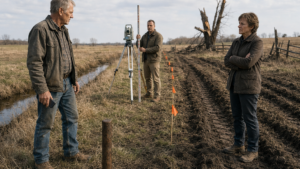
The survey stakes appeared before the bank’s final approval.
White-topped posts cut a straight line across the north parcel, dividing the pale ground with an accuracy the old fences had never managed. Joseph stood beside the nearest stake while a surveyor checked distances against a handheld receiver.
Beyond the marked boundary, the field still looked like his.
That was the difficulty.
Nothing in the grass, dust or low ridge acknowledged that one side would soon belong to someone else.
Angela walked up carrying a thick envelope.
“Payment confirmation?” Joseph asked.
“No.”
She handed him a letter from the buyer’s attorney.
Joseph read the first page. The purchase price matched the contract they had negotiated. The closing date remained unchanged. Then he reached the requested access provision.
Permanent right-of-way through the central sheep lane.
He read it twice.
“They want the lane.”
“They say the north entrance is unreliable during runoff.”
“It is unreliable for six weeks.”
“They want guaranteed access all year.”
Joseph looked toward the lane. It ran between the lambing barn and the lower pens before turning north. Every spring, ewes and lambs passed through it to reach grazing. A permanent road easement would place vehicles in the center of the operation.
“No.”
Angela had expected the answer.
“If we refuse, they can delay closing.”
“Then they can use the north entrance.”
“The buyer says he won’t accept seasonal uncertainty.”
“He is buying dry acreage, not the farmyard.”
Angela folded her arms. “The bank gave us forty-five days.”
“We still have nine.”
“And no second buyer under contract.”
Joseph read the letter again. The requested right-of-way was written in neutral language: ingress, egress, maintenance and access by successors. Words that could outlive everyone involved.
A truck approached along the county road.
Richard parked beside the survey vehicle and stepped out carrying a folder. He looked at the stakes before looking at Joseph.
“The bank approved the restructuring,” he said.
Angela’s shoulders dropped.
Joseph did not move. “Without conditions?”
“With conditions already stated in the proposal. Current arrears paid. Parcel sale proceeds applied directly to principal. Reduced operating line. Quarterly reporting.”
“And the complaint?”
Richard handed him the folder.
Inside was a revised account statement. The red stamp was gone. Near the top, in smaller black letters, appeared one word.
CURRENT.
Behind it was a compliance letter acknowledging that Richard’s public display of the overdue notice had violated the bank’s expected privacy procedures. It recorded corrective action but gave no details.
Joseph looked up.
“What happened to you?”
“I remain employed.”
“That wasn’t what I asked.”
Richard glanced toward Angela. “My lending authority requires secondary approval for the next year.”
The answer was neither punishment nor escape.
“You signed your own statement,” Angela said.
“I signed what happened.”
Joseph returned to the revised account. The numbers were still severe. Approval had not made them light. It had only placed them in an order they might survive.
Richard noticed the attorney’s letter in Joseph’s hand.
“Problem with closing?”
“They want permanent access through the sheep lane.”
Richard’s expression tightened. “If that delays the sale, the restructuring can be withdrawn.”
“I know.”
“The bank cannot extend the deadline again.”
“I know that too.”
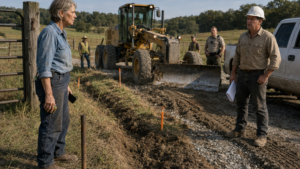
Richard walked toward the lane and studied the route. It was wide enough for a truck but narrowed near the handling pens.
“You could grant it,” he said.
“And have someone driving through lambing operations whenever they please.”
“You could relocate the pens.”
“With what money?”
Richard did not answer.
The buyer arrived that afternoon with the land broker. He wore polished work boots and spoke as if each concern had already been reduced to a contract paragraph.
“I’m not asking to interfere with livestock,” he said. “I need dependable access.”
“You have access from the north road,” Joseph replied.
“Not during spring washout.”
“Then use this lane during spring washout.”
The buyer shook his head. “I need a recorded easement.”
Joseph looked at Angela. She had the sale documents open on the hood of her car, but she did not urge him to surrender.
“What do you plan to do with the parcel?” Joseph asked.
“Hay storage initially. Possibly equipment later.”
“You don’t need daily access.”
“No.”
“Or nighttime access.”
“Not ordinarily.”
“Then you need a route for certain months, not ownership of my lane.”
The land broker began to speak about standard provisions. Joseph raised one hand.
He took the revised bank statement from Richard’s folder and turned it over. On the blank side, he wrote terms.
Seasonal access through the central lane from February through April when the north road was impassable. Forty-eight hours’ notice except emergencies. No access during active lamb movement. Maintenance costs shared only for damage caused by vehicles.
He handed the page to the buyer.
“This is what I will grant.”
The buyer read it. “That is not permanent access.”
“It is permanent seasonal access.”
“You’re splitting words.”
“I’m splitting land.”
No one spoke.
The flock began moving in the lower yard. A farmhand opened the handling gate, and the first ewes entered the lane. Lambs followed close against their mothers, uncertain at the narrow opening.
The buyer watched them pass through the very route he wanted written into his deed.
Joseph pointed toward the moving animals.
“That lane is not empty ground between two fences. It is part of the operation you are buying beside.”
The buyer folded Joseph’s handwritten terms.
“If the north road fails outside those months?”
“Call me.”
“And if you sell?”
“The agreement binds the next owner to reasonable emergency access.”
The buyer looked toward the north parcel, then at the bank representatives and survey stakes.
“Add June after heavy runoff.”
“Only if the county road is officially closed.”
The buyer offered his hand.
Joseph took it.
Closing happened five days later.
The payment moved directly from escrow to the bank. Joseph saw the confirmation on Angela’s laptop at the kitchen table. The secured balance fell by an amount large enough to change the future, though not erase it.
The north parcel no longer appeared on the farm ledger.
For three mornings, Joseph avoided looking beyond the old irrigation ditch. On the fourth, he repaired the south fence because it needed repairing.
Six weeks after Richard had held the overdue notice in the yard, the flock moved through the central gate again.
The seven formerly restricted ewes had recovered. Sharon’s final release was clipped inside the new account file. Robert had purchased the surplus stock under written health disclosures, and the breeding flock remained on the farm.
Joseph stood beside the gate with the revised statement in his hand.
CURRENT.
It was only a bank term. It did not mean safe, prosperous or forgiven. It meant the obligations had been named and met for now.
Richard arrived without a folder.
“I was passing,” he said.
Joseph looked toward the county road. “You weren’t.”
“No.”
Richard watched the sheep fill the lane. “The quarterly report is due in three weeks.”
“Angela already added it to the calendar.”
Richard nodded. “She called the bank clerk yesterday.”
“I know.”
A ewe brushed Joseph’s hip as she passed. The flock flowed through the opening without crowding, each animal choosing the space left by the one ahead.
Richard glanced at the statement.
“You kept that.”
“The first one too.”
“The torn copy?”
Joseph nodded.
“Why?”
“To remember what an incomplete piece of paper can make people believe.”
Richard looked down at his boots.
“And what silence can make them believe,” Joseph added.
Richard accepted that without argument.
When the last lamb cleared the gate, Joseph closed it but left the chain hanging loose from the post.
That evening Angela spread the accounts across the kitchen table. She had color-coded the operating expenses, debt payments and sale projections in a way Joseph found excessive and useful.
“You moved the feed supplier to the wrong quarter,” he said.
“I moved it to the quarter when you actually pay it.”
He sat across from her.
Near the edge of the table lay their father’s original loan agreement. Angela had placed it inside a new folder with the medical bills and tuition records. She did not hide it, and Joseph did not put it away.
“I spoke to the university,” she said. “There’s a scholarship fund for students from agricultural counties.”
Joseph looked up.
“I’m not naming it after Dad,” she added. “Not yet.”
“Why not?”
“Because I’m still deciding what his choice meant.”
Joseph nodded. “Fair.”
Angela closed her laptop.
“I’m not moving back.”
“I know.”
“I can come twice a month. More during lambing if work allows.”
“You don’t have to prove anything.”
“Neither do you.”
She slid a copy of the revised farm accounts into her bag. Then she removed the spare farmhouse key from the ring on the wall.
Joseph watched her turn it once between her fingers.
“You keeping that?” he asked.
“Yes.”
He waited for the old resistance to rise—the sense that access meant interference, that shared knowledge meant loss of control.
It did not come.
Angela put the key in her pocket.
When she left, her copy of the accounts was gone, but another remained open on the table beside Joseph’s. Two sets of notes marked the same figures in different handwriting.
Outside, the north field had become someone else’s property. The loss was visible now in fresh fencing and a new gate near the survey line.
Closer to the house, the sheep settled inside the land that remained.
Joseph picked up the revised statement and placed it over the torn overdue notice. The pages did not match in size, and the red word still showed beneath one edge.
He left both where they were.
Then he went outside, crossed the yard and opened the gate for the evening flock.
The story has ended.