My Neighbor Kept Taking Deliveries From My Farm Gate—Then the Camera Changed What Everyone Believed
Chapter 1: The Box Anthony Said Was His
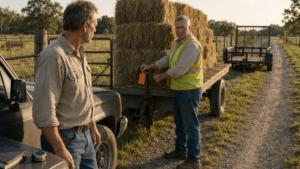
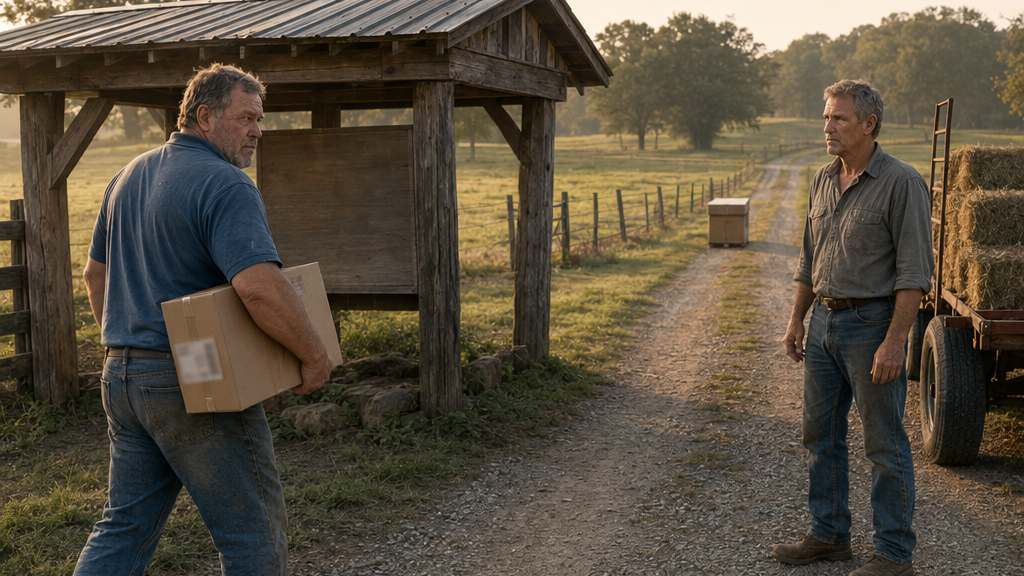
Anthony Hall was already halfway across the gravel lane with William Miller’s veterinary-supply box under his arm when William stepped out from behind the hay wagon.
For a second neither man spoke.
The box was white, long enough to reach from Anthony’s elbow to his hip, and sealed with two bands of clear tape. William could see his own name printed on the shipping label from twenty feet away.
Anthony stopped.
“Oh,” he said, as if William had caught him carrying a stray feed sack blown into the road. “This yours?”
William looked past him toward the delivery shelter beside the gate. The shelter was nothing elaborate: three cedar posts, a sheet-metal roof, and a raised plywood platform his father had built years ago so parcels did not sit in mud. William’s farm number was painted on a board attached to the front.
Anthony’s place sat another quarter mile up the shared lane.
“You got it out of my shelter,” William said.
Anthony shifted the box against his side. “Driver probably dropped it wrong again.”
William did not answer immediately.
That was what Anthony had said about the hydraulic couplers in July.
It was what he had said about the box of electric-fence insulators two weeks later.
And three days ago, when William had found a small feed-store parcel on the passenger seat of Anthony’s pickup while helping him move a fallen limb off the lane, Anthony had laughed and said he had wondered why the store had sent him something he did not order.
Three mistakes could happen.
Four began to feel like a habit.
Anthony held the box out. “Here. No harm done.”
William took it.
The label faced upward between them.
WILLIAM MILLER was printed in block letters above the farm address.
Anthony’s eyes touched the label and moved away.
William felt something tighten behind his ribs, but he kept his voice level.
“Read the farm number.”
Anthony frowned. “What?”
“On the label.”
“Come on, William.”
“Read it.”
For the first time, the easy expression left Anthony’s face.
A feed truck growled somewhere on the county road beyond the trees. Dust hung over the lane from William’s tractor tires. Nothing else moved.
Anthony glanced down.
“Two eighty-four.”
“And yours?”
“You know what mine is.”
“I do.”
Anthony exhaled through his nose. “Two ninety-eight.”
William nodded once.
Anthony gave a small shrug. “Then the driver made a mistake.”
“The driver put it under my roof.”
“Maybe I thought mine was under there too.”
William looked toward Anthony’s delivery box. It stood beside a fence post farther up the lane, a black plastic chest with a hinged lid.
“You walked past yours.”
Anthony’s jaw moved.
Then the smile returned, thinner now.
“You keeping track of where I walk?”
“No.”
It was true, and William disliked how quickly Anthony had found the weak point in that answer.
William had not been keeping track.
That was part of the problem.
For years, the two farms had operated on the kind of informal arrangements nobody wrote down. They pushed each other’s cattle back through broken fence. They pulled trailers from mud. When a delivery driver left mineral tubs at the wrong gate, somebody called somebody.
William’s father had once told him that sharing a lane meant sharing more than gravel.
“You ought to be able to depend on the man using the same road,” he used to say.
William had believed that long after his father was gone.
Anthony pointed at the parcel.
“What is it, anyway?”
“Veterinary supplies.”
“Anything urgent?”
“That isn’t really the point.”
“I know.” Anthony raised both hands slightly. “I’m saying I wasn’t trying to take anything. We’ve had stuff mixed up out here for twenty years.”
That part was also true.
Before online farm suppliers began using delivery photographs and text notifications, packages were sometimes left wherever a driver found solid ground. William had once received a chainsaw chain meant for Anthony. Anthony had gotten William’s calf bottles. They had traded the items back without keeping score.
But William remembered those old mistakes differently.
They had called each other.
They had not carried boxes away first.
Anthony glanced toward his farm.
“I’ve got fencing to finish.”
William stepped aside.
“Then finish it.”
Anthony hesitated as if expecting William to soften the exchange with a joke.
William did not.
Anthony walked away.
Rebecca arrived just before noon.
She parked beside the equipment barn, came into the office carrying two folders, and immediately noticed the unopened veterinary box on William’s desk.
“That finally come?”
“This morning.”
She dropped the folders beside it. “Good. They said Friday.”
William cut the tape.
Inside were syringes, tagging supplies, and replacement tubing for a dosing applicator. Nothing was missing.
Rebecca watched him lay the contents out.
“Why are you checking it like that?”
“Anthony had it.”
Her face changed.
“Had it where?”
“Walking toward his place.”
“Again?”
William put the tubing back into the box.
“He says he thought it was his.”
Rebecca gave a short laugh without humor.
“Dad.”
“I got it back.”
“That isn’t the question.”
“No, it isn’t.”
She folded her arms. “How many now?”
William did not answer.
Rebecca counted for him.
“The couplers. Fence pieces. That feed-store order. This.”
“The feed-store box got returned.”
“After it was in his truck.”
William looked toward the window.
The delivery shelter was visible through a gap between the maple trees. From here it looked almost too small to matter.
Rebecca lowered her voice.
“You keep giving him an excuse because you don’t want to call it what it might be.”
William turned.
“And you’re ready to call it something before we know.”
“I’m ready to stop pretending four coincidences are normal.”
He closed the carton.
Rebecca knew better than to keep pushing when his voice went flat. Instead she opened the bookkeeping folder and began sorting receipts.
For several minutes, neither spoke.
Then she stopped.
“Where’s the birthday package?”
William looked up.
“What birthday package?”
“For Saturday. The one I had shipped here.”
Rebecca’s daughter was turning nine. William had ordered a beginner’s leather tool set with her initials stamped on the pouch because the child had spent half the summer following him through the shop and asking when she could have tools of her own.
“It isn’t here yet.”
Rebecca stared at him.
“It was supposed to be.”
William felt the morning’s irritation return in a different form.
He opened his phone.
The carrier page loaded slowly.
He found the order.
The status read DELIVERED.
Rebecca leaned over his shoulder.
“When?”
William scrolled.
His thumb stopped.
Saturday.
Two days earlier.
A delivery confirmation photo sat beneath the timestamp.
William opened it.
The picture showed the package resting beneath the sheet-metal roof of the farm-gate shelter.
Exactly where it belonged.
Chapter 2: William Removes Every Easy Excuse
The delivery photograph showed Rebecca’s birthday package sitting three inches from William’s painted farm number.
There was no other parcel beside it.
No shadow of a driver carrying it toward the wrong gate.
No reason for anyone to think it belonged anywhere else.
Rebecca enlarged the image on William’s computer.
“There.”
“I see it.”
“You can read the number in the picture.”
“I can read it.”
She leaned back.
“So we know it got here.”
“We know where the driver left it.”
“And now it’s gone.”
William printed the photograph.
Rebecca watched the page come out of the office printer.
“What are you going to do?”
“Ask Anthony.”
“You already know what he’ll say.”
William gave her a look.
“That doesn’t mean I skip asking.”
Anthony was repairing woven wire along his west pasture when William found him.
William carried the printout folded once in his shirt pocket.
Anthony drove a staple into a cedar post before acknowledging him.
“What’s up?”
“A package came Saturday.”
Anthony kept working.
“Okay.”
“It’s missing.”
“That bad luck?”
William took out the photograph.
Anthony looked at it for less than a second.
“Never saw it.”
William studied his face.
“You didn’t pick anything up at my shelter Saturday?”
“No.”
“Nothing at all?”
Anthony set the hammer against the post.
“William, I don’t keep a diary of every trip down that lane.”
“You remembered this morning’s box.”
“Because you were standing there.”
William handed him the photograph.
Anthony took it reluctantly.
“You can see where the driver put it.”
“Looks like your place.”
“It is my place.”
Anthony gave the page back.
“So?”
“So I’m trying to remove the confusion.”
“There isn’t any confusion if I didn’t touch it.”
The answer was smooth enough that William almost wished Anthony had become angry.
Instead, Anthony turned back to the fence.
William stood there another moment.
“Rebecca’s girl was supposed to get what was inside Saturday.”
Anthony’s hammer stopped.
Only for a beat.
Then it struck the staple again.
“That’s unfortunate.”
William walked away.
The next morning he bought a larger board.
He painted the farm number in black letters big enough to read from a truck cab and mounted it across the front of the delivery shelter. Beneath it he added MILLER FARM.
Rebecca stood in the lane with her hands on her hips.
“You planning on aircraft deliveries?”
“I’m making a point.”
“To who?”
“Everyone.”
He also called the feed store, the veterinary supplier, and the two delivery companies most often used by the farm. He confirmed the drop instructions. He asked whether drivers could photograph every parcel when possible.
Then he wrote a short note and placed it in Anthony’s mailbox.
Packages addressed to Miller Farm are to remain at the Miller delivery shelter. If anything is misdelivered to Hall Farm, please call or return it directly.
No accusation.
No threat.
No mention of the missing birthday gift.
For two days, nothing disappeared.
William began wondering whether the whole thing would end without another conversation.
On the third afternoon he found a brown carton leaning against the fence post beside the shelter.
It had not been there at lunch.
There was no delivery notification.
William carried it into the office and found his own name on the label.
The ship date was five days earlier.
Inside were grease fittings he had ordered and already reported missing.
Rebecca turned the carton over.
“No note?”
“No.”
“So someone brought it back.”
“Looks that way.”
“Someone.”
William said nothing.
Rebecca picked up the shipping label.
“You want to keep doing this until everything comes back one box at a time?”
“I want to know before I make an accusation that can’t be taken back.”
She put the box down harder than necessary.
“That sentence is starting to cost us money.”
William’s eyes narrowed.
Rebecca did not retreat.
“The dosing tubing could’ve been urgent. The birthday gift is still gone. Next time it might be something we actually need the same day.”
“You think I don’t know that?”
“I think you know it and still don’t want to do anything that makes Anthony uncomfortable.”
That landed because it was close enough to true.
William turned away.
Two days later, the veterinary supplier sent another shipment.
William received the delivery text at 10:18 in the morning while repairing a gate hinge near the lower pasture.
At 10:41 he drove toward the lane.
Anthony was standing at the delivery shelter.
The new sign was directly behind him.
MILLER FARM.
Anthony had a small padded envelope in his hand.
William stopped the truck.
Anthony looked toward him, then down at the envelope.
For an instant William saw calculation rather than confusion.
Then Anthony raised the package.
“This yours?”
William got out.
“You tell me.”
Anthony turned the envelope over.
“I just saw it sitting there.”
“Where?”
“Your box.”
“My shelter.”
“Fine. Your shelter.”
“And you picked it up.”
Anthony’s mouth hardened.
“I was checking the label.”
William held out his hand.
Anthony passed it over.
The label showed William’s name and the same farm number printed on the sign two feet behind Anthony’s shoulder.
Anthony saw William looking from one to the other.
“You made your point.”
“No,” William said. “I made the sign.”
Anthony stared at him.
William slipped the envelope into his coat pocket.
“The point was supposed to make itself.”
Anthony walked toward his own farm without replying.
That evening Rebecca arrived carrying a small trail camera and a bag of mounting straps.
William looked at them on the kitchen table.
“No.”
“You haven’t even heard where I’m putting it.”
“I know exactly where.”
“Then you also know why.”
William sat down.
“If we put a camera on that lane, it doesn’t just catch Anthony.”
“It catches the delivery shelter.”
“It catches everybody using the road.”
“We own the shelter.”
“We share the lane.”
Rebecca pulled out a chair.
“Dad, you’re treating evidence like it’s more offensive than taking the packages.”
He rubbed one hand over his face.
His father’s old rule about depending on the man who shared the road had never included cameras.
Maybe that was because his father had never needed one.
William looked at the trail camera.
“If it goes up, it points only at our shelter and the approach.”
Rebecca nodded.
“And nobody sees anything from it unless I say so.”
“You.”
“Me.”
She held his gaze, then nodded again.
At dusk they strapped the camera to a maple trunk above the delivery shelter.
The larger MILLER FARM sign filled the lower edge of its view.
William stood beneath it after Rebecca left.
For years, that shelter had meant a driver could leave something there and walk away trusting it would still belong to the same person when he came back.
Now a small black lens watched over it.
William did not know what bothered him more—that the camera might prove Rebecca right, or that part of him still hoped it would prove Anthony innocent.
Chapter 3: The Camera Sees the Route
The first useful clip began with Anthony looking both directions down the empty lane.
William watched it twice before he let himself notice anything else.
The timestamp read 6:43 a.m.
Anthony entered from the upper side of the frame, walking toward the county road. His own delivery box appeared first. He passed within six feet of it without slowing.
Then he stopped.
He looked toward William’s farmhouse.
He looked toward the road.
He crossed the gravel.
The camera captured him stepping beneath the MILLER FARM sign and lifting a small carton from the shelter.
He read the label.
William could see him tilt the box toward the morning light.
Then Anthony tucked it under his arm and walked back the way he had come.
Rebecca stood behind William’s chair.
“Well?”
William did not answer.
The clip ended.
The computer returned to the file list.
“Play it again,” he said.
She did.
On the third viewing William concentrated on Anthony’s hands.
There was no uncertainty.
No moment of realizing he had the wrong package.
Anthony read the label and carried the carton away anyway.
Rebecca touched the screen.
“He walked past his own box.”
“I see it.”
“And he checked whether anyone was coming.”
“I see that too.”
She folded her arms.
“What else do you need?”
William looked at the date.
“One clip isn’t eleven weeks.”
Rebecca’s frustration showed immediately.
“Dad.”
“I said we verify.”
“This is verified.”
“This incident is.”
He opened the supplier account.
The carton in the footage had contained two replacement gate latches.
Not valuable.
Not personal.
Not something Anthony could plausibly need urgently.
William printed the delivery confirmation and wrote the camera timestamp beside it.
Rebecca stared at him.
“You’re making a file.”
“I’m checking dates.”
“That’s a file.”
William did not argue.
Over the next week, the folder grew.
Some footage showed nothing except cattle shadows stretching across the lane, delivery trucks stopping, and dust blowing under the shelter roof.
Other clips showed Anthony.
Once he walked toward the road, stopped beside William’s shelter, and removed a padded envelope.
Another time he arrived in his pickup, backed slightly past his own delivery box, then stepped out and crossed to William’s side.
On that clip he did not even look at the label until he was back beside his truck.
William matched each recording with carrier notifications.
7:12 a.m. delivery.
8:03 a.m. removal.
2:38 p.m. delivery.
4:16 p.m. removal.
The dates began joining incidents William had previously kept separate in his head.
The hydraulic couplers.
The fence insulators.
The grease fittings returned without explanation.
The padded veterinary envelope.
The birthday parcel that had never returned.
When he counted backward through messages and receipts, the pattern stretched almost eleven weeks.
That realization gave him less satisfaction than he expected.
Rebecca had wanted proof.
Now they had it.
But proof did not repair what it replaced.
One afternoon William drove past Anthony repairing a stock tank.
Anthony raised one hand.
William almost kept going.
Then habit won.
He raised his own hand.
The gesture felt false afterward.
Three days later a shipment William had been waiting for failed to appear.
It contained a regulator and replacement tubing for equipment used to administer mineral supplement to several young cattle. The old unit was leaking badly enough that William had already delayed one round of work.
The supplier showed delivery at 1:22 p.m.
Rebecca called from town.
“They sent the picture.”
William was in the barn.
“Where is it?”
“Your shelter.”
He looked toward the open barn door.
It was nearly four.
“I’ll go.”
The shelter was empty.
William stood in front of it with both hands at his sides.
The large black letters above him seemed almost absurd now.
MILLER FARM.
There was no possible improvement left to make.
He went inside and pulled the camera card.
The footage showed the delivery driver setting down two boxes at 1:22.
At 2:07 Anthony’s pickup appeared.
William leaned closer.
Anthony drove past his own box.
He continued toward the county road, then stopped just beyond William’s shelter.
For several seconds he remained inside the truck.
Then he backed up.
Anthony stepped out.
He removed both parcels.
Not one.
Both.
He carried them to his pickup and drove toward his farm.
William froze the image.
One box had a bright supplier stripe down the side. The other was plain brown.
Neither looked remotely like mail.
They looked like exactly what they were: farm supplies placed beneath a sign naming the farm that owned them.
Rebecca arrived twenty minutes later.
William was sitting at the desk with a yellow legal pad beside the computer.
Dates covered half the page.
She did not say she had been right.
That made it worse.
“What now?” she asked.
William looked at the list.
“I’m checking everything.”
They spent the evening working backward.
Rebecca pulled invoices.
William searched texts.
They matched delivery photographs to clips whenever footage existed. For older incidents, they marked uncertainty rather than guessing.
At one point Rebecca tried to add the feed-store parcel found in Anthony’s truck.
William shook his head.
“We didn’t see him take that one.”
“You found it in his truck.”
“That proves where it ended up. Not how.”
Rebecca crossed it off.
They kept only what they could support.
By nine o’clock, eleven disputed incidents sat in chronological order.
Seven had camera footage.
Three had delivery photographs and later unexplained returns.
One—the birthday package—had proof of correct delivery but no footage because the camera had not yet been installed.
Rebecca stared at the list.
“He’s not confused.”
William looked at Anthony’s figure frozen on the monitor.
“No.”
The word was quiet.
Final.
Rebecca sat beside him.
“Then call the sheriff.”
William did not reach for the phone.
“What are you waiting for now?”
He had no answer that sounded respectable.
He was waiting because calling would turn suspicion into accusation.
Because Anthony would know who called.
Because Brenda would know.
Because people who had shared the same lane for years would begin choosing what version of the story they believed.
Because his father had trusted the road to hold neighbors together.
Rebecca watched him.
“You told me you needed proof.”
“I did.”
“You have it.”
“I know.”
“Then don’t change the requirement because you don’t like the answer.”
William looked at her.
That one hurt because it was exactly what he had been doing.
He stood.
“Tomorrow.”
Rebecca exhaled but did not argue.
After she left, William reviewed one final batch of clips.
Most were empty.
Then he opened one recorded three evenings earlier.
Anthony appeared walking rather than driving.
He stopped at William’s shelter.
There were three parcels inside.
Anthony stacked two.
Then the third on top.
For a moment he struggled to hold them.
William expected him to turn toward his own house.
Instead Anthony crossed the lane, passed his delivery box, and continued beyond the pasture fence toward the rear of his property.
The camera caught him until the trees blocked the view.
William enlarged the final frame.
Beyond Anthony, partly visible between two equipment trailers, stood the open door of his machinery shed.
Three unopened Miller Farm parcels disappeared through it.
William picked up the phone.
Chapter 4: Ninety Seconds Changes the Deputy
The deputy looked at William’s yellow legal pad and asked, “You and Anthony having some kind of property dispute?”
William had expected questions about the packages.
He had not expected that one.
They were standing in William’s kitchen the next afternoon. The deputy had set his hat on the table beside a cup of coffee he had barely touched. Rebecca sat near the window with the laptop open in front of her.
“No property dispute,” William said.
“Fence?”
“No.”
“Water?”
“No.”
“Road use?”
“We share the lane. That’s all.”
The deputy nodded as if filing away an answer that did not yet convince him.
“Neighbors call us over a lot of things,” he said. “Sometimes the package is just the thing they point at because it’s easier than whatever the real argument is.”
William could feel Rebecca watching him.
He kept his voice even.
“If I wanted to argue with Anthony, I wouldn’t have waited eleven weeks.”
The deputy glanced at the legal pad again.
“Eleven weeks according to you.”
“According to delivery dates.”
William slid the first printed photograph across the table.
The deputy looked at it.
The image showed a parcel sitting under the Miller Farm shelter.
Beside it was the enlarged farm number.
“What am I looking at?”
“Carrier confirmation.”
“You sure that’s your shelter?”
Rebecca answered before William could.
“The sign says Miller Farm.”
The deputy’s eyes shifted to her, then back to William.
“I’m asking him.”
Rebecca pressed her lips together.
William pointed to the corner of the photograph.
“That’s my gatepost. My shelter. That’s the lower pasture behind it.”
The deputy nodded.
“And that one disappeared?”
“Yes.”
“Could’ve been a delivery error after the photo?”
“No. The photo is taken at delivery.”
The deputy rubbed the edge of the paper with one thumb.
“Then somebody moved it.”
“That’s what I’m saying.”
“Not necessarily Anthony.”
“No.”
The deputy looked up.
That answer seemed to interest him.
William reached for the laptop.
“I didn’t call because I thought somebody had moved one box.”
Rebecca turned the screen.
The deputy leaned closer.
William opened the first camera clip.
Anthony appeared at the upper edge of the frame.
He walked past his own delivery box.
He looked down the lane.
Then toward William’s house.
He crossed.
The deputy watched without comment as Anthony lifted the package from beneath the MILLER FARM sign and carried it away.
The clip ended.
“Could’ve thought it was his,” the deputy said.
William felt Rebecca move beside him.
He did not look at her.
“Watch the next one.”
The second clip played.
Anthony parked beyond the shelter, backed up, got out, took a padded envelope, and returned to the truck.
The deputy’s posture did not change.
“Next.”
William played another.
Then another.
After the fourth, the deputy picked up his coffee but did not drink.
“Dates?”
Rebecca handed him the printed delivery confirmations.
William placed the corresponding list beside them.
“Delivery time on the left. Camera timestamp on the right.”
The deputy compared one.
Then another.
The room went quiet except for the small fan in the laptop.
William clicked the clip from the veterinary shipment.
Anthony drove past his own box.
Stopped.
Backed up.
Took both Miller parcels.
The deputy leaned closer.
“How much of this do you have?”
“Enough.”
“That’s not a number.”
“Seven incidents on video. Three other deliveries that came back later or turned up somewhere else. One birthday package delivered before the camera went up and never returned.”
Rebecca opened the folder of still images.
The deputy stopped speaking.
For roughly a minute and a half, he watched.
William knew because the video compilation ran ninety-four seconds.
It contained no music. No narration. No arrows pointing at Anthony. Rebecca had wanted to add labels, but William had refused.
The footage did not need help.
Anthony walked.
Anthony checked the lane.
Anthony crossed.
Anthony took.
Again.
Again.
Again.
When the final clip ended, the deputy did not immediately sit back.
He reached for the legal pad.
“What was the birthday item?”
“A child’s tool set.”
“Value?”
William told him.
“The veterinary shipment?”
William told him that too.
“What about these others?”
The deputy started writing.
The casual tone was gone.
Rebecca looked at William, but William kept his eyes on the deputy’s pen.
It moved steadily.
Dates.
Values.
Delivery companies.
Description of contents.
The deputy paused over the footage showing Anthony reading one label beneath the enlarged Miller Farm sign.
“You warned him before this?”
“Yes.”
“How?”
“In person. Then in writing.”
“You have the note?”
“Not the original. I wrote it. Put it in his mailbox.”
The deputy frowned.
William realized why.
“I shouldn’t have put it in the mailbox.”
“No, you shouldn’t have.”
“I know.”
“Anything else?”
“I told him directly that deliveries addressed to my farm needed to stay at my shelter.”
The deputy nodded and wrote again.
William felt heat rise into his face.
His attempt to avoid making the conflict official had left him with sloppy edges the moment it became official.
The deputy closed the pad.
“I’m going to talk to him.”
Rebecca leaned forward.
“Are you going to search his shed?”
The deputy gave her a measured look.
“I’m going to talk to him.”
“You saw the clip.”
“I did.”
“The one with three boxes.”
“I saw it.”
“Then they could still be there.”
The deputy stood.
William said, “Rebecca.”
She looked at him.
He shook his head once.
The deputy picked up his hat.
“Stay here.”
William almost laughed.
“This is my farm.”
“I mean don’t follow me up there.”
“I wasn’t planning to.”
The deputy looked at him for a second as if deciding whether he believed that.
Then he walked outside.
From the kitchen window William watched the patrol vehicle turn into the shared lane.
Dust lifted behind it.
The vehicle passed the Miller shelter, passed Anthony’s delivery box, and disappeared around the slight bend toward the Hall farm.
Rebecca stood behind him.
“You think Anthony will let him look?”
“I don’t know.”
“He’ll say the same thing.”
“Maybe.”
“He can’t explain the clips.”
“People explain all kinds of things.”
Rebecca crossed her arms.
William remained by the window.
Five minutes passed.
Then ten.
A tractor started somewhere beyond the trees and shut off again.
Rebecca tried to sit but stood almost immediately.
At seventeen minutes, she said, “This is ridiculous.”
William did not answer.
At twenty-three minutes, the patrol vehicle reappeared.
It moved slowly down the lane.
The deputy stopped beside William’s house.
He got out.
For a moment his hands were empty.
Then he opened the rear door.
William stepped onto the porch.
The deputy reached inside and lifted out a white shipping carton.
William recognized the supplier stripe before he could read the label.
It was one of the three boxes from the machinery-shed footage.
Still sealed.
The deputy carried it toward him.
“We need to go over the rest of your list,” he said.
William looked past him toward Anthony’s farm.
“What else did you find?”
The deputy set the box on the porch rail.
“More than this.”
Chapter 5: Six Sealed Deliveries and One Missing Explanation
The second box the deputy carried from his vehicle was wrapped in brown paper with a strip of faded blue tape across one corner.
William knew it before the deputy turned it around.
Rebecca made a sound behind him.
Not a word.
Just breath leaving her.
The birthday package.
The paper had picked up dust along one edge, but the tape remained unbroken.
William took it with both hands.
For weeks he had pictured the little leather tool pouch opened somewhere, the initials he had ordered for his granddaughter meaningless to whoever had taken it.
Now the parcel was back, still sealed.
Rebecca touched one corner.
“You’re sure?”
William turned the label toward her.
Her daughter’s name appeared beneath his farm address.
Rebecca stared at it for several seconds.
Then she stepped away.
The deputy opened the rear door again.
“There are four more.”
By the time he finished, six packages stood in a row on William’s porch.
Two were veterinary supplies.
One held gate hardware.
One was the birthday package.
Another was a feed-store order William had replaced weeks ago.
The last was a small carton of hand tools William had assumed the supplier never shipped.
Several remained unopened.
That bothered William more than if they had been empty.
The deputy stood with his notebook in one hand.
“Anthony says these got mixed in with his deliveries over time.”
Rebecca looked at him sharply.
“All six?”
“He says some he meant to return.”
“Why were they in his machinery shed?”
The deputy glanced at William.
William understood the warning in it.
Let him ask.
He said, “Did Anthony say why they were all together?”
“He said he’d been setting aside anything he wasn’t sure about.”
William looked at the labels.
Every package carried his name.
Three showed Miller Farm in large print.
One had the farm number printed twice.
“Was he unsure after reading them?”
The deputy’s expression tightened almost imperceptibly.
“I asked him that.”
“And?”
“He didn’t give me a useful answer.”
Rebecca turned away, jaw clenched.
The deputy continued.
“I’m documenting the property. You’ll need receipts or order confirmations for whatever you can provide. Don’t open anything yet if you can avoid it.”
William touched the birthday box.
“What happens to Anthony?”
“That’s not something I’m promising you today.”
“I’m not asking for a promise.”
“No?”
William met his eyes.
“No. I’m asking what happens next.”
The deputy looked toward the lane.
“Next I write what I have. You give me your records. He gives his statement. Then it goes where it goes.”
That answer frustrated Rebecca.
William saw it.
But for the first time since this began, William found he did not need the deputy to sound angry.
The boxes were there.
The dates existed.
Anthony’s explanations had become something that had to survive evidence instead of neighborly politeness.
That was enough for the moment.
The deputy asked whether William wanted the boxes photographed in place before moving them.
“Yes.”
Rebecca looked at him.
William knew what she was thinking.
Weeks earlier he would have carried them inside and tried to solve the matter privately.
Now he waited while the deputy photographed every label.
After the patrol vehicle left, Rebecca opened the birthday package.
William did not stop her.
Inside, beneath a layer of paper, lay the small leather tool roll. The child’s initials were stamped neatly into the flap.
Rebecca ran one finger over them.
“She asked me yesterday whether Grandpa forgot.”
William looked down.
“I didn’t know that.”
“I didn’t tell you.”
“Why?”
“Because you were already carrying enough guilt for something you didn’t do.”
William almost corrected her.
He had not taken the parcel.
But he had delayed.
He had given Anthony more opportunities because he wanted the situation to become innocent if he waited long enough.
Rebecca closed the tool roll.
“You going to tell everyone?”
“No.”
She looked up.
“Why not?”
“Because everyone who needs to know will know.”
“He took six boxes.”
“We recovered six.”
“That we know about.”
“I know.”
Rebecca shook her head.
“You still protect him.”
“No.”
“It sounds like it.”
William glanced toward the line of returned parcels.
“Protecting him would be pretending this didn’t happen. I’m done doing that.”
“Then what is this?”
“Not turning it into entertainment.”
Rebecca was quiet.
William continued.
“The sheriff has it. We keep records. We answer questions. I’m not going to spend the next month driving around telling people what Anthony did.”
She watched him.
Then nodded slowly.
“That’s different from before.”
“Yes.”
He did not say how much he wished it were not.
Near sunset, William carried the remaining boxes into the office.
A vehicle stopped at the end of the drive.
He expected Rebecca returning for something she had forgotten.
Instead Brenda Hall stepped out.
She closed her truck door carefully.
William stayed where he was.
Brenda walked toward the porch but stopped at the bottom step.
“Can I talk to you?”
William did not invite her inside.
“About what?”
She looked toward the lane.
“You know what.”
He waited.
Brenda rubbed her palms together.
“Anthony shouldn’t have taken your things.”
The sentence was so direct that William said nothing.
“He told the deputy it was delivery confusion,” she continued. “Some of it was. At first.”
“At first?”
Brenda looked down.
“Years ago. You remember. Drivers used to leave half the road’s stuff wherever they could turn around.”
“I remember.”
“He brought one of your boxes home once because he thought it was ours. You called. He laughed about it.”
William remembered.
A package of calf nipples, maybe five years earlier.
He had forgotten until now.
Brenda’s face tightened.
“That became the story he kept telling himself.”
William leaned one shoulder against the porch post.
“What story?”
“That anything he took from down there could be called a mix-up until somebody proved otherwise.”
The words landed harder because she did not dramatize them.
William looked toward the Hall place through the trees.
“Why?”
Brenda closed her eyes briefly.
“Our supplier cut off the account in spring.”
William looked back at her.
She continued before he could ask.
“We were behind. Anthony kept saying we’d catch up after hay. Then after calves. Then after the next check.”
William thought of the recovered gate hardware, veterinary supplies, hand tools.
Useful things.
Not random valuables.
“He needed my supplies?”
“Some of them.”
“Then why were half the boxes unopened?”
Brenda’s mouth trembled once.
“He didn’t always know what was inside.”
William stared at her.
“He took them without knowing?”
“He started saying he’d hold them. If it was something useful, maybe we could use it. If it wasn’t, he’d bring it back.”
The returned grease fittings.
The parcel leaned against his fence without a note.
William suddenly understood the shape of the behavior.
Not better.
Worse.
Anthony had created a private system in which possession came first and ownership became negotiable afterward.
Brenda stepped closer.
“He kept saying he’d replace anything before you noticed.”
William’s voice hardened.
“But I noticed.”
“I know.”
“And he kept doing it.”
“I know.”
The quiet admission pulled some of William’s anger sideways.
He looked at her.
“How long did you know?”
Brenda’s eyes filled, though no tears fell.
She looked toward the porch floor.
“I knew he was bringing home packages that weren’t ours.”
William did not move.
“From the beginning?”
“No.”
“When?”
She took a breath.
“Soon enough that I should’ve stopped pretending I didn’t.”
Chapter 6: The Reason Does Not Become an Excuse
The notice from the private-road association arrived six days after the deputy recovered the packages.
William found it clipped beneath the handle of his storm door.
The first line concerned the trail camera.
The second concerned him.
He read it twice.
Then a third time.
The association had received a complaint regarding “unauthorized surveillance of shared access areas” and requested that William either remove the camera or attend the next meeting to explain its placement.
Rebecca read the notice that afternoon.
“You have got to be kidding.”
William took it back.
“No.”
“He steals deliveries and they cite your camera?”
“They didn’t cite me.”
“They’re threatening to.”
“They asked for a meeting.”
“Same difference.”
“It isn’t.”
Rebecca gave him a look.
“You really do enjoy making every bad thing sound three degrees less bad.”
William folded the notice.
“That habit has already cost us enough.”
The answer stopped her.
He placed the paper beside the evidence folder.
The association meeting was held in a converted room beside a volunteer fire station several miles from the farms. Folding chairs faced a long table. The road-association chair sat in the middle with two neighboring landowners beside him.
Anthony and Brenda arrived separately from William.
Anthony looked thinner.
He did not speak to William.
The chair opened with practical matters: gravel invoices, drainage along the north bend, brush cutting.
Then he held up a photograph.
William recognized it immediately.
His delivery shelter.
Above it, partly hidden in the maple branches, was the trail camera.
“We’ve had a complaint,” the chair said, “that this device records people using the shared lane without notice.”
Rebecca leaned toward William.
“Wonder who complained.”
William did not answer.
The chair continued.
“We don’t have a specific camera rule. Never needed one.”
One neighboring landowner said, “That doesn’t mean everybody gets to point cameras at everybody.”
“It points at my shelter,” William said.
Anthony spoke for the first time.
“It catches the road.”
William turned toward him.
Anthony’s face was expressionless.
The chair looked between them.
“We all know why the camera went up.”
That sentence changed the room.
No one needed to say packages.
No one needed to say sheriff.
The subject was already present.
William kept his hands flat on his knees.
“I mounted it after deliveries kept disappearing.”
Anthony looked away.
One landowner said, “Still doesn’t settle whether the road can be recorded.”
“No,” William said. “It doesn’t.”
Rebecca shifted beside him.
The chair seemed surprised.
“You agree?”
“I agree it’s a separate question.”
Anthony looked at William then.
William continued.
“The camera proved something I needed proved. That doesn’t mean I get whatever rule I want afterward.”
The room quieted.
The chair tapped the photograph.
“We could allow yours because of what happened.”
William shook his head.
“No.”
Rebecca turned.
Even Anthony looked confused.
William said, “If the rule is no cameras on the lane, mine comes down. If cameras are allowed with conditions, mine follows the same conditions as everybody else’s.”
The chair leaned back.
“That makes this more complicated.”
“It ought to be.”
Anthony gave a faint, humorless laugh.
“Easy to say now.”
William looked at him.
Anthony’s eyes held his for the first time all evening.
“What’s that supposed to mean?” William asked.
Anthony rubbed both hands over his jeans.
“It means everybody gets to sit here talking about rules after the sheriff was in my shed.”
“You want to talk about why he was there?”
Brenda said quietly, “Anthony.”
He ignored her.
“I already admitted the boxes were there.”
“That isn’t the same as why.”
Anthony’s jaw tightened.
The chair started to intervene, but William raised one hand.
“No. Let him answer.”
Anthony stared at the table.
For several seconds nothing happened.
Then he said, “The first one really was a mistake.”
William knew which one.
The old calf-supply box from years earlier.
Anthony continued.
“Then this year I found another package down there. Thought it might be ours. It wasn’t.”
“You returned it?”
“Eventually.”
William waited.
Anthony’s shoulders lowered.
“I was behind with the supplier.”
No one in the room moved.
“The account got stopped,” he said. “I had work needing done. Things breaking. Every time something showed up at your gate, I’d think maybe it was something I could use.”
Rebecca’s voice was cold.
“So you stole it.”
Anthony looked at her.
“Yes.”
The single word drained something theatrical from the room.
No denial remained to fight.
William said, “Why leave some unopened?”
Anthony looked at him.
“Because once I got them home, I knew what I’d done.”
“Then why not bring them back?”
“Some I did.”
“And the others?”
Anthony swallowed.
“I kept telling myself I would.”
William thought of the shed.
Boxes accumulating while Anthony preserved the idea that each one might still be temporary.
Anthony looked down.
“And once you put that sign up, I knew I couldn’t call it a mistake anymore.”
The room went completely still.
William felt anger rise, but beneath it came something heavier.
Not sympathy exactly.
Recognition.
Anthony had understood the boundary.
He had crossed it anyway.
That mattered more than the lost credit account.
More than the bad season.
More than pride.
William said, “Then why did you keep doing it?”
Anthony’s answer came slowly.
“Because by then I knew you wouldn’t call anybody unless you were sure.”
William felt the words physically.
Rebecca turned toward him.
Anthony continued.
“You always give people another chance.”
There it was.
Not the camera.
Not the deliveries.
The weakness inside William’s restraint.
Anthony had seen it and depended on it.
William leaned back.
For weeks he had told himself he was protecting an old relationship from an accusation that might be unfair.
Anthony had interpreted the same silence as permission to keep testing how much unfairness William would tolerate.
The chair cleared his throat.
“We still need to decide the camera question.”
William looked at the photograph of the shelter.
“No,” he said. “We need to decide the delivery question too.”
The chair frowned.
“That’s between you and Anthony.”
“Not anymore. Not if the lane itself keeps being the excuse.”
One landowner shifted forward.
“What are you suggesting?”
William thought about it.
Not a special exemption.
Not a permanent camera aimed wherever he pleased.
Not another unwritten understanding everyone would remember differently.
“Separate marked delivery points,” he said. “Clear enough that nobody can claim confusion.”
The chair listened.
“If a camera covers one, it gets posted. It points only at the delivery area and immediate approach. No wider than necessary.”
“And misdeliveries?” the other landowner asked.
“Don’t take them home. Call the person whose name is on the label, or leave them where they are.”
Anthony’s expression hardened.
“So now we write a rule because of me.”
William met his eyes.
“Yes.”
Nobody spoke.
William continued.
“And the rule applies to me too.”
The chair looked down at his notes.
“We could probably draft something.”
One landowner said, “Or we could just approve William’s camera and be done with it.”
Rebecca murmured, “That would be simpler.”
William shook his head.
“No.”
The chair looked up.
“You’re refusing the exemption?”
“I am.”
“Why?”
William glanced at Anthony, then at the photograph.
“Because exceptions are how we got here.”
Anthony’s face changed slightly.
William stood.
“I don’t want a rule that says I’m trustworthy and he isn’t. I want one where trust isn’t required to know where the boundary is.”
The chair tapped his pen against the table.
Then he wrote something down.
“We’ll circulate a draft.”
William picked up his folder.
Behind him, Anthony said nothing.
Rebecca followed William toward the door.
At the threshold, the chair called after him.
“William.”
He turned.
“If we do this, every delivery point on the lane follows it.”
William nodded.
“That’s the idea.”
Outside, Rebecca caught up beside his truck.
“You realize you just made your own camera harder to keep.”
“Yes.”
“You could’ve taken the exemption.”
“Yes.”
She studied him.
“Why didn’t you?”
William looked back through the meeting-room window.
Anthony remained seated at the table.
Brenda sat beside him now, though there was still space between their chairs.
William folded the association notice and put it in his pocket.
“Because I’m done asking people to behave well where a clear rule would do the job.”
He opened the truck door.
Behind them, through the open meeting-room window, the chair began reading back the first line of a proposed delivery policy.
Chapter 7: The Gate Gets Rules Instead of Trust
William brought a proposal to the next road-association meeting that limited his own camera before anyone else could ask him to.
The chair had expected a complaint.
Instead, William placed three pages on the table.
Anthony sat across the room beside Brenda. He had not spoken to William since the previous meeting.
The chair read the first page.
“Separate delivery bays?”
“Same shelter,” William said. “Different sides. Different numbers. Different names.”
“And cameras?”
“Only if the owner posts notice at the delivery point. Camera points at the shelter and immediate approach. Not somebody’s pasture. Not somebody’s house.”
One of the neighboring landowners flipped to the second page.
“You put a retention limit in here.”
“Thirty days unless there’s an incident.”
Rebecca, sitting beside William, glanced at him.
That part had been his addition.
The old William would have argued that because the camera belonged to him, nobody had any business telling him how long he kept recordings. The old William also would have preferred no written rules at all.
Both instincts now seemed like different versions of the same mistake.
Depending on discretion instead of boundaries.
The chair tapped the final paragraph.
“And if a driver leaves something in the wrong bay?”
“You don’t take it home.”
Anthony shifted in his chair.
William continued.
“You call the person whose name is on it. If you can’t reach them, leave it where it is unless weather or livestock will damage it. If you move it, you document where you moved it.”
One landowner smiled faintly.
“We’re writing regulations for cardboard boxes now.”
William looked at him.
“We’re writing regulations because we spent twenty years saying everybody knew what decent behavior was.”
The smile disappeared.
William did not raise his voice.
“That worked until it didn’t.”
The chair leaned back.
“Anthony?”
Every head turned.
Anthony stared at the proposal.
William expected an objection.
Instead Anthony said, “My name goes on my side?”
“Yes.”
“Same size as his?”
William answered before anyone else could.
“Same size.”
Anthony nodded once.
Nothing in his expression resembled gratitude.
William had not asked for it.
The chair moved through the proposal line by line.
There were objections.
One landowner worried that posted cameras would make the lane feel less private. Another argued the association should stay out of deliveries entirely.
Rebecca surprised William by siding with the objection once.
“If the association creates the rule,” she said, “it needs to be narrow. Otherwise five years from now somebody uses it to justify cameras all the way up the road.”
William looked at her.
She shrugged slightly.
“Fair is fair.”
Across the room, Brenda lowered her eyes.
The chair amended the language.
Camera coverage would stop at the immediate delivery area.
Recordings could not be routinely shared with neighbors.
Every marked delivery bay had to be maintained by the farm using it.
No association officer could demand access to footage without a specific incident.
The rule became less convenient with every amendment.
William liked it better.
Then the chair reached the final question.
“All in favor of adopting this for every property using the private lane?”
Two hands rose immediately.
The chair raised his.
Rebecca was not a voting member.
William waited.
Anthony did not have a vote either, but Brenda did as co-owner of the Hall farm.
She had been silent through most of the meeting.
Now she lifted her hand.
Anthony turned toward her.
She did not look at him.
The motion passed.
There was no applause.
The chair simply wrote the result in his notes and moved to the next item.
William found that strangely comforting.
Two days later he and Rebecca rebuilt the old delivery shelter.
They did not tear it down.
William could not bring himself to do that.
Instead they added a divider through the center and extended the roof six inches. Rebecca painted two boards.
MILLER FARM.
HALL FARM.
Same lettering.
Same size.
She held the second board against the cedar post.
“Here?”
“Little higher.”
She moved it.
“There?”
William stepped back.
“Good.”
The trail camera remained above the Miller side, but beneath it William attached a small notice explaining that the immediate delivery area was recorded.
Anthony’s side had no camera.
That was his choice.
When they finished, Rebecca wiped paint from her fingers with a rag.
“You think this fixes anything?”
William looked at the two bays.
“No.”
She waited.
“It prevents us from pretending we don’t know where one thing ends and another starts.”
Rebecca studied him.
“That sounds like something Grandpa would’ve hated.”
William smiled despite himself.
“Your grandpa never met a written rule he couldn’t complain about.”
“But?”
William looked down the gravel lane.
“But he liked fences.”
Rebecca laughed once.
“That he did.”
William rested one hand on the old cedar post.
His father had believed neighbors sharing a road had to depend on one another.
For months William had treated that memory like an instruction to avoid conflict.
Now he understood it differently.
Dependence without boundaries was not trust.
It was simply hope.
A week passed.
Then another.
Deliveries stayed where drivers left them.
Anthony and William encountered each other twice on the lane.
The first time they passed in pickups and neither waved.
The second time Anthony slowed beside a washed-out patch of gravel William was filling.
“You need another load?”
William leaned on his shovel.
“Already ordered.”
Anthony nodded.
He drove on.
That was all.
No apology.
No promise that things would return to the way they had been.
William was beginning to understand that they should not.
Late one afternoon, a feed-store truck stopped at the shelter.
The driver climbed out, carried a medium carton beneath the roof, checked the boards, then set it in the Hall bay.
William happened to be replacing a hinge near the gate.
He watched the truck leave.
Ten minutes later Anthony’s pickup came down the lane.
Anthony slowed.
William kept working.
Anthony parked beside the shelter and got out.
He opened the Hall bay.
Then stopped.
The carton was addressed to William Miller.
The driver had put it on the wrong side.
For a moment neither man moved.
William could see the old problem sitting between them in plain brown cardboard.
Anthony looked toward him.
William said nothing.
Anthony picked up the carton.
He did not carry it toward his truck.
He stepped across the divider, set the parcel carefully inside the Miller bay, and turned the label so William’s name faced outward.
Then he closed neither side.
He simply walked back to his pickup.
Before getting in, he looked toward William.
“You had one on my side.”
“I saw.”
Anthony nodded.
William waited for something more.
An apology, perhaps.
An explanation.
Some sentence that would make the last several months fit neatly into the years before them.
Anthony gave him none.
He drove home.
William finished tightening the hinge and crossed the lane.
The parcel sat beneath his name.
Exactly where it belonged.
Above it, the camera watched a clearly marked space no one had to interpret anymore.
William lifted the box.
He looked once toward Anthony’s farm, then closed the Miller bay.
The road between the two farms was still shared.
Trust was not.
Not yet.
But for the first time in months, William did not need uncertainty to pretend otherwise.
The story has ended.