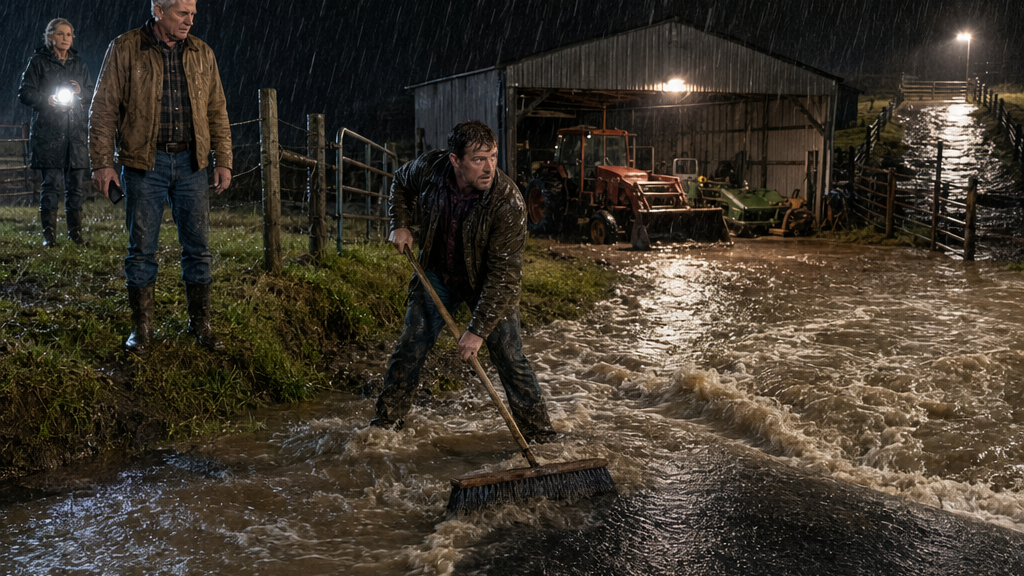
His Neighbor Paved Over the Farm Drainage Swale—Then One Autumn Storm Changed Who Had to Pay
Chapter 1: The New Pavement Cut Across the Old Water Path
The paving roller crossed the low strip of ground at 8:17 on a Thursday morning, and Christopher Hill stopped halfway through latching the cattle gate.
For thirty years, he had watched water use that exact path.
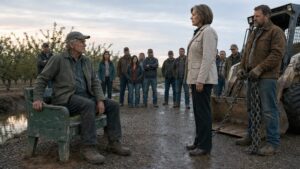
In dry August weather it barely looked like anything at all. Just a shallow green depression between his hayfield and Ryan Miller’s equipment yard, broad enough that a person could walk through it without noticing the change in grade. The grass grew darker there. In spring, frogs sometimes collected near the road end. After hard rains, brown water appeared for a few hours and then vanished beneath the county road through an old culvert.
Now a steel drum rolled across it.
Christopher stood with one hand on the gate chain and watched the machine press gray aggregate into the depression.
He did not move at first.
Across the boundary, Ryan was talking with Daniel Walker beside a dump truck. Ryan wore work jeans and a faded cap. Daniel had a fluorescent vest over a gray shirt and kept pointing toward the machinery shed, where a wide new pad had already been graded.
Ryan had spent most of the summer transforming that side of the farm.
The old gravel parking area had been widened. Brush had been cleared from behind the machinery shed. A row of temporary posts marked where Ryan planned to funnel autumn visitors toward a pumpkin stand and weekend equipment demonstrations. Christopher had watched each improvement from a distance and said almost nothing.
Ryan was forty-two and had inherited the place after his father died. He worked fast. He changed things faster.
Christopher had known Ryan since the boy was small enough to ride on the fender of his father’s tractor. That history made it harder, not easier, to decide when to speak.
The roller reversed.
Christopher looked toward the road.
No pipe.
He scanned the staging area again. Crushed stone. Asphalt equipment. A skid loader. Two pallets of edging material.
No culvert section. No corrugated pipe. No concrete box. Nothing that could carry water beneath the new crossing.
He closed the cattle gate and walked toward the property line.
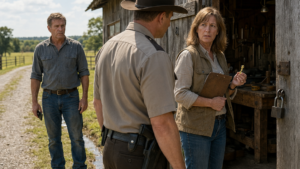
Daniel noticed him first.
“Morning.”
Christopher nodded. “You putting a pipe through there?”
Daniel looked toward the low ground. “Where?”
Christopher pointed.
“The swale.”
Ryan turned.
For half a second, Christopher saw something tighten in his face.
“There isn’t going to be a pipe,” Ryan said.
Christopher looked back toward the roller. “Then what’s carrying the water?”
Ryan gave a short breath through his nose. “Surface grade.”
Daniel stepped closer, perhaps sensing the tone.
“We’ve got fall from the back corner toward the road,” he said. “It’ll shed.”
Christopher crouched at the edge of the aggregate and touched the compacted stone. The new crossing sat several inches above the grass upstream.
“That’s not shedding,” he said. “That’s a dam.”
Ryan’s jaw moved.
“It’s not a dam.”
Christopher stood.
“Water comes off my hayfield, your north strip, and that ground behind the shed. It collects here.”
“I know where water comes from.”
“I’m not saying you don’t.”
“It sounds like you are.”
Daniel looked between them.
Christopher felt the familiar impulse to stop talking.
It had always been easier for him to explain land than people. Water did not take offense when you told it where it would go. Soil did not confuse a measurement with an insult.
He pointed toward the road.
“That depression was shaped when they improved the county ditch. It feeds the culvert.”
Ryan folded his arms.
“You retired from the county eight years ago.”
“Nine.”
“Fine. Nine. This isn’t a county project.”
“No.”
“It’s my yard.”
“Yes.”
“And Daniel says the grade works.”
Daniel raised a hand slightly. “What I said was, based on what we saw—”
Ryan glanced at him.
Daniel stopped.
Christopher noticed that.
“So you looked at the drainage area?” Christopher asked.
“We shot the elevations.”
“How far uphill?”
Daniel hesitated.
“Enough to lay this out.”
Christopher looked over the equipment yard toward the hayfield beyond. In a dry month, the land told very little of the truth. The soil was hard. Dust lifted behind every truck. The swale looked ornamental.
He could understand how somebody unfamiliar with the site might dismiss it.
That did not make the crossing safe.
“You ever see it in a two-inch rain?” Christopher asked.
Daniel shook his head.
Christopher turned to Ryan.
“I have.”
Ryan’s expression changed from irritation to something harder.
“There it is.”
Christopher waited.
“The part where you’ve seen everything.”
“I didn’t say that.”
“You don’t have to.”
A worker nearby slowed while carrying a rake, then deliberately turned away.
Christopher felt heat rise in his neck.
Ryan continued.
“Every time I change something, you’ve got a story about how my dad used to do it. Where he parked equipment. Which fence he kept. How the north lane drained. I’m trying to run this place now.”
Christopher stared at him.
He had mentioned Ryan’s father. More than once.
He had not thought of those remarks as criticism. To Christopher, they were reference points, the way a person might mention an old fence line or a well that had been capped.
Perhaps Ryan had heard something else.
“This isn’t about your dad.”
Ryan looked toward the paving crew.
“Good. Then let me handle it.”
Christopher almost did.
He could have walked back through the gate. He could have decided that one warning was enough.
Then he saw the roller move onto the aggregate again.
“Ryan.”
Ryan looked at him.
“If you pave that flat without a crossing, water will stack behind it.”
“You don’t know that.”
“I know enough to tell you not to do it blind.”
Daniel stepped in.
“The pavement isn’t going to be dead flat. We’ve got crown and fall. Water can move along the edge.”
Christopher pointed to the shallow grass channel disappearing beneath the compacted stone.
“That works until the flow is wider than your edge.”
Daniel’s face remained calm.
“If it becomes an issue, it can be addressed.”
Christopher almost laughed, but nothing about the sentence was funny.
“After asphalt?”
Ryan shook his head.
“This is exactly what I mean.”
Christopher looked at him.
“You think I came over here because I care where you park cars?”
“I think you like being the one who knows the rule nobody else knows.”
The words landed more cleanly than Christopher expected.
For a moment neither man spoke.
A diesel engine idled nearby. Somewhere behind Christopher, one of his cattle bawled from the lot.
He remembered being younger and standing beside a downstream farmer whose pasture had stayed wet for half a summer after a county drainage repair Christopher had approved. The work had met the specifications. The calculations had passed. The farmer had still lost grass.
Christopher had carried that memory longer than he admitted.
He looked at the new crossing again.
“I’m telling you what I see,” he said.
Ryan’s voice softened, though not kindly.
“And I heard you.”
That was the end of it.
Christopher stepped backward.
Daniel gave him a restrained nod. Ryan did not.
Christopher walked back across his hayfield without turning around until he reached the cattle gate.
Then the paving machine started forward.
The first strip of black asphalt spread over the green low ground in a steaming sheet.
Christopher stood beside the fence and watched the swale disappear.
Behind him, the gate chain clicked in the wind.
Across the boundary, Ryan called to the crew.
“Finish it.”
Chapter 2: Christopher Put the Warning on Paper
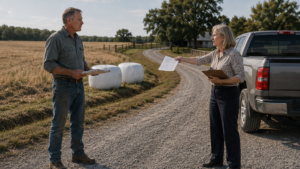
The old drainage map showed a blue pencil line running directly beneath Ryan Miller’s new pavement.
Christopher leaned closer to the county copy spread across the township records counter.
The line began above his hayfield, crossed the boundary, bent through Ryan’s yard, and continued toward the roadside culvert.
He followed it with one finger.
For three days he had told himself he might be remembering the old layout incorrectly.
He was not.
The township clerk stood at the far end of the counter sorting permit folders.
“Find what you needed?”
Christopher straightened.
“I think so.”
The map was older than Ryan, drawn before several farm parcels had changed hands. The original ink had faded to brown-gray. Later drainage notes appeared in blue pencil and black stamps.
Christopher pointed to the marked low area.
“This improvement still active?”
The clerk came over and adjusted her glasses.
“County drainage records would have the current status. We only have the subdivision and road files.”
“It doesn’t end at the Miller line.”
“No.”
Christopher already knew that, but hearing someone else say it changed the weight of the page.
He had gone to the office intending only to verify his memory. Now the line told a larger story.
The swale was not simply a dip Ryan happened to own.
It was part of a route.
Christopher paid for copies and folded them carefully into thirds.
At home, Sharon found him at the kitchen table with the map open beside a legal pad.
She set a basket of invoices near his elbow.
“You went to the township.”
He looked up. “How’d you know?”
“You left your reading glasses in the truck and took your good folder.”
Christopher glanced at the manila folder beside him.
Sharon sat across from him.
“What did you find?”
He turned the map around.
“The line crosses both properties.”
She studied it.
“And?”
“And that’s the drainage route.”
“I can see that.”
“So Ryan shouldn’t have blocked it.”
Sharon looked at him for several seconds.
Christopher disliked that particular silence. It usually meant she was waiting for him to hear something he had not yet said.
Finally she asked, “Are you going back over there?”
“No.”
“Why not?”
“He heard me.”
“That wasn’t my question.”
Christopher picked up his pen.
“I’m writing it down.”
Sharon leaned back.
“Of course you are.”
He looked at her.
“What’s that supposed to mean?”
“It means you’d rather send a piece of paper than have a second uncomfortable conversation.”
“I already had the conversation.”
“You had half of one.”
“He told me to mind my own place.”
“And you came home angry.”
“I came home because there was nothing else to say.”
Sharon touched the edge of the map.
“Maybe there was.”
Christopher capped the pen harder than necessary.
“You think I should walk over there and beg him to believe me?”
“No.”
“Then what?”
“I think you should decide whether you’re trying to stop a drainage problem or win an argument.”
He looked away.
Outside the kitchen window, late-summer light lay flat across the hayfield. From this distance the new pavement on Ryan’s side looked clean and useful.
That irritated Christopher more than it should have.
“I’m not trying to win anything.”
Sharon said nothing.
He began writing.
He kept the letter plain.
He described the swale’s direction. He noted that the new crossing appeared several inches above the upstream grade. He attached the township map and suggested that Ryan contact the county drainage office before the asphalt work was considered final.
He did not write I told you so.
He did not mention Ryan’s father.
He did not mention that Daniel had not seen the site during a heavy rain.
When he finished, Sharon read the page.
“That’s clear.”
Christopher waited.
“But?”
She shook her head. “No but.”
He slipped the letter and map copy into an envelope.
The next morning he placed it in Ryan’s mailbox.
For two days nothing happened.
On the third afternoon, Christopher drove back from checking a pasture fence and saw an envelope sticking halfway out of his own mailbox.
He knew what it was before he stopped.
The flap was still sealed.
Ryan had not opened it.
Christopher sat behind the wheel with the truck idling.
The envelope looked almost ridiculous in his hand. His own handwriting on the front. A small crease across one corner. Nothing more.
He looked toward Ryan’s place.
A pair of seasonal workers were setting up portable fencing near the widened yard. Ryan stood beside the machinery shed holding a tape measure. The new black surface reached cleanly from the building toward the lane.
Christopher could have walked over.
Sharon’s words returned to him.
Are you trying to stop a drainage problem or win an argument?
He put the envelope on the passenger seat.
Then he drove home.
That evening, he unfolded the map again.
The more closely he studied it, the more certain he became that the swale had been deliberately preserved when the county improved the roadside drainage decades earlier.
The blue line did not merely cross Ryan’s property. It tied Christopher’s higher ground to the culvert downstream.
He found an old elevation notation near the road.
There was enough fall to move water safely if the route remained open.
But the route was no longer open.
Christopher photographed the map with his phone and filed the paper copy in the drawer where he kept deeds, field leases, and old drainage correspondence.
He told himself that was enough.
At supper, Sharon asked whether Ryan had responded.
“He returned it.”
“Read?”
“No.”
She stopped cutting her pork chop.
“Unopened?”
“Yes.”
“And you’re leaving it there?”
“He made his decision.”
Sharon looked toward the window.
“So have you.”
Christopher did not answer.
The next morning, while feeding cattle, he noticed moisture collecting in the low grass above Ryan’s pavement from overnight dew and a brief shower.
It was nothing. Barely enough to darken the soil.
Still, he walked the swale from his side to the boundary.
At the pavement, the depression ended abruptly.
The asphalt edge stood higher than he liked.
He crouched and touched the grass.
Then he rose and went back to work.
By evening, a weather system had entered the seven-day forecast.
The first estimate called for an inch and a half of rain.
Christopher looked at the screen, then out toward the black crossing beyond his hayfield.
He did not feel vindicated.
Not yet.
Chapter 3: The First Storm Made Christopher Doubt Himself
By dawn, Ryan’s new pavement was wet, dark, and perfectly intact.
Christopher stood at the kitchen window holding a mug of coffee and stared across the field.
Rain had fallen most of the night.
Not a cloudburst, but enough that the gutters had run continuously and the pasture entrances had softened under truck tires.
He had woken twice listening for water.
Now the yard beyond the boundary looked ordinary.
No pond.
No washout.
No muddy sheet crossing the asphalt.
Nothing.
Sharon came into the kitchen and followed his gaze.
“Well?”
Christopher took a drink.
“Looks fine.”
She waited.
He knew what she was waiting for.
“It looks fine,” he repeated.
Outside, the rain had slowed to a mist.
After breakfast Christopher pulled on boots and walked the boundary.
The swale on his side was damp. A thin ribbon of water sat among the grass stems, but it stopped several yards before the pavement. Most of the rainfall had soaked into the dry late-summer ground before it ever gathered enough volume to run.
He knew that.
He should have expected it.
Still, he had built the night into something larger in his mind.
At the crossing he examined the asphalt edge.
No erosion.
No pooled water.
Daniel’s grading had moved the small amount of runoff along the shoulder exactly as he claimed it would.
Christopher stood there longer than necessary.
Perhaps he had been too certain.
The thought bothered him because it felt familiar.
Years ago, when he worked for the county, he had approved a drainage repair downstream from another farm. Every number had checked. Every elevation met specification. Yet the following spring a pasture remained wet long enough to ruin a cutting of hay.
Christopher had learned then that being technically justified did not make a person infallible.
He had also learned the opposite lesson: fear of being wrong could make a person timid when action was needed.
He had never decided which lesson mattered more.
A pickup approached on the lane.
Ryan was driving.
Christopher stepped aside.
The truck slowed near him.
For an instant, he expected Ryan to lower the window.
Ryan looked directly at him.
Then he drove on.
No grin.
No remark.
No “told you.”
Nothing.
Christopher watched the taillights disappear around the machinery shed.
The silence landed harder than mockery would have.
By noon the clouds broke.
The new pavement dried in wide gray patches.
Christopher spent the afternoon repairing a waterer valve in the cattle lot. He worked more slowly than usual.
When Sharon brought him a clean rag, she leaned against the gate.
“You’ve checked that crossing three times.”
“Twice.”
“I saw the third.”
Christopher tightened the fitting.
“Water didn’t get there.”
“So?”
“So maybe Daniel had enough fall.”
Sharon studied him.
“You believe that?”
“I believe what I can see.”
“That’s new.”
Christopher looked up sharply.
She smiled a little, but not enough to make it a joke.
He wiped his hands.
“I may have pushed too hard.”
Sharon’s expression changed.
He rarely offered sentences like that voluntarily.
“Are you going to tell Ryan?”
Christopher looked toward the boundary.
“For what?”
“If you think you were wrong.”
“I said I may have pushed too hard.”
“That’s not the same thing.”
“No.”
“So if the crossing works?”
He folded the rag once.
“If it works, then it works.”
“And?”
Christopher frowned.
“And what?”
“Would you apologize?”
The question irritated him instantly, which told him more than he wanted to know.
“I warned him based on what I knew.”
“That isn’t what I asked.”
“I didn’t damage anything.”
“No.”
“I didn’t call the county.”
“No.”
“I gave him information.”
Sharon nodded.
“And if the information was right but the conclusion was wrong?”
Christopher looked down at the valve.
Water dripped once from the fitting, then stopped.
He had no answer he liked.
Over the next week the weather turned warmer again.
Ryan’s autumn setup continued.
Portable signs appeared near the road. Stacked straw bales went beneath the shed overhang. A cleared grass strip beside the paved yard was marked for visitor parking. Christopher watched from his tractor but made no comment.
The conflict seemed to shrink.
That should have relieved him.
Instead it left him uneasy in a different way.
He began to wonder whether he had allowed old habits to turn concern into certainty. Perhaps Ryan had been right about that. Perhaps Christopher did enjoy knowing the rule nobody else knew.
One evening he removed the folded drainage map from the drawer.
The blue line still crossed both farms.
The elevations had not changed.
Only his confidence had.
He refolded the paper and put it away.
A few days later, the county weather radio gave a different forecast.
The voice was flat and mechanical.
A slow-moving autumn system was expected to stall over the region. Repeated bands of rain could produce several inches over already saturated ground north of the township.
Christopher turned up the volume.
The first storm had soaked the upper fields without producing much runoff. Then smaller rains had followed.
The soil would not absorb water the same way twice.
Sharon came in from the mudroom.
“What?”
Christopher pointed toward the radio.
She listened.
The forecast mentioned ponding, ditch rises, and rapid runoff in low agricultural areas.
Christopher walked to the window.
Beyond the hayfield, Ryan’s pavement lay clean and black in the lowering afternoon light.
For the first time since the earlier storm, Christopher did not wonder whether he had been wrong.
He wondered whether the first rain had simply arrived too soon to prove anything.
Chapter 4: At Eleven O’Clock the Farm Lane Became a River
Christopher heard the water before he could see Ryan’s yard.
It was not the soft hiss of rain against the kitchen windows or the steady drumming on the metal roof above the mudroom. This was lower, heavier—a continuous rushing sound that did not belong in a field.
He set down his coffee.
Sharon looked up from the table.
“What is that?”
Christopher was already moving toward the back door.
The rain had been falling since midafternoon, first in thin sheets, then in hard bands that rattled the gutters and blurred the fence lines. By ten, the yard lights reflected off standing water in the low spots. By eleven, the upper hayfield had gone nearly black beneath the storm.
Christopher pulled on his rain jacket and stepped outside.
Cold water struck his face immediately.
The beam from his flashlight caught the grass behind the barn bending flat beneath shallow runoff. He crossed the yard, boots sinking into saturated soil, and headed for the boundary.
The sound grew louder.
When he reached the rise above Ryan’s property, he stopped.
The swale was no longer a depression in the grass.
It was moving water.
Brown runoff poured out of Christopher’s higher field, joined by water from Ryan’s north acreage and the land beyond the equipment shed. The streams merged in the channel and rushed toward the new asphalt crossing.
There they stopped.
For only a moment.
Water had backed up behind the raised pavement until the swale widened into a muddy pool. It spread sideways through flattened grass, reached the lip of the black surface, then climbed over it in a broad sheet.
Christopher stared.
Daniel’s edge drainage had vanished beneath the volume.
The water crossed the pavement diagonally and accelerated toward Ryan’s machinery shed.
A light swung wildly near the building.
Then Christopher saw Ryan.
He was outside in jeans, boots, and a rain jacket that had long since stopped keeping him dry. He gripped a wide push broom and shoved at the water as if he could force it toward the road one stroke at a time.
Christopher stood there for half a second longer than he should have.
Part of him felt the cold, hard satisfaction of recognition.
This was exactly what he had warned about.
Not approximately.
Not theoretically.
Exactly.
Ryan shoved the broom again.
The current rolled around the bristles and kept going.
Christopher took out his phone.
He photographed the water stacked behind the crossing.
Then the sheet spilling over the pavement.
Then Ryan fighting it near the shed.
He hated himself a little for how deliberate the pictures felt.
Ryan noticed the flashlight.
He turned.
Even through the rain Christopher could read the anger on his face.
“You taking pictures?”
Christopher lowered the phone.
“Documenting it.”
“Helpful.”
Christopher nearly replied.
Then a metallic bang came from behind the shed.
Both men turned.
A plastic barrel had broken loose and struck the lower fence near the livestock lane.
Ryan dropped the broom and ran.
Christopher followed the line of water with his flashlight.
The flow was no longer confined to the equipment yard. It was cutting toward the lane Ryan used to move cattle between two fenced lots. The lane sat slightly lower than the pavement.
If the water reached it in force, it would carry gravel and manure toward the downstream field.
Ryan came back carrying a shovel.
“It’s getting around the side.”
“I can see that.”
Ryan jammed the shovel into the pavement shoulder, trying to open a notch in the compacted aggregate.
Christopher grabbed his arm.
“You’re not cutting that by hand.”
“What do you want me to do?”
“Move the equipment first.”
Ryan jerked free.
“There’s nowhere to move it.”
Christopher looked toward the higher side of his own property.
There was.
His emergency field gate.
It opened from Ryan’s back lane onto the elevated edge of Christopher’s hayfield. The gate had not been used for years except during fence repairs. Ryan knew it existed.
Christopher knew what opening it would mean.
Heavy trucks crossing his ground in saturated conditions.
Ruts.
Damage.
And, more importantly, helping a man whose last clear message to him had been to stay out of his business.
Another rush of water spilled across the pavement.
A parked utility trailer shifted several inches.
That ended the argument Christopher was having with himself.
“Get the tractor and whatever you can move,” he said.
Ryan stared at him.
“What?”
“I’m opening my back gate.”
Ryan’s expression changed.
“You’ll tear up your field.”
“I know.”
“The ground’s soaked.”
“I know that too.”
Christopher started toward the boundary fence.
Ryan called after him.
“Chris.”
Christopher stopped.
Ryan did not say thank you.
Not yet.
He only nodded once.
Christopher continued.
The back gate chain was rusted tight from disuse. His fingers slipped twice before the hook came free. He dragged the gate inward, mud sucking at his boots.
Ten minutes later Ryan drove the first tractor through.
Its rear tires left deep tracks across the field edge.
Christopher guided him with the flashlight.
“Stay high. Don’t cut toward the swale.”
Ryan nodded.
They moved a skid loader next, then a small utility tractor, then a trailer carrying temporary event fencing.
By the fourth trip, water had reached the base of the equipment shed.
Sharon appeared at the gate carrying another light.
“You need anything?”
“Keep cattle away from the east lot,” Christopher said.
She looked toward the rushing water.
Her face tightened.
“That bad?”
“Worse.”
Ryan came back on foot.
“The lower lane’s going.”
Christopher followed him.
The gravel surface was beginning to unravel. Thin brown channels cut through it, then joined into deeper grooves. Water carried small stones toward the downstream pasture.
Ryan stood motionless.
“This wasn’t supposed to happen.”
Christopher looked at him.
There were several things he could have said.
He said none of them.
Instead he walked to the pavement edge.
The flow was wider now, but the peak seemed to be leveling.
“Nothing we do tonight fixes the crossing,” Christopher said. “Keep the shed clear and keep the cattle out.”
Ryan gripped the shovel.
“I can cut the shoulder.”
“You’ll make it worse if the edge lets go.”
“So I just watch?”
“For tonight, yes.”
Ryan laughed once, bitterly.
“That comes easy for you.”
Christopher turned.
“No. It doesn’t.”
Ryan looked at him but did not answer.
For the next hour they worked mostly in silence.
Christopher opened a second interior fence so livestock could be held on higher ground. Ryan moved equipment and stacked sandbags near the shed doors. Sharon brought towels and coffee neither man drank.
The rain weakened after midnight.
The water did not stop immediately.
It continued pouring out of the upper fields long after the hardest band moved east.
Christopher watched the swale do what it had always done.
Only now the path was broken.
Near two in the morning, Ryan leaned against the shed wall.
“You were right.”
Christopher heard him clearly despite the remaining rain.
He looked over.
Ryan stared at the water instead of him.
Christopher could have taken the sentence and held onto it.
Instead he said, “We’ll know what damage we’ve got in daylight.”
Ryan nodded.
That was all.
At dawn, the storm had passed.
The fields emerged gray beneath a low sky.
Christopher walked the drainage path from his property toward the road.
The upstream grass lay flattened in a broad band. Mud marked the pavement several inches above the edge. The livestock lane had lost a strip of gravel nearly twenty feet long.
Then Christopher reached the lower boundary.
He stopped.
The water had cut beyond Ryan’s property.
A fresh channel ran into the neighboring field downstream, carrying silt over young cover crop and carving a narrow trench where there had been none the day before.
Christopher crouched beside it.
This was no longer only Ryan’s pavement.
He pulled out his phone and took one more photograph.
Chapter 5: The County Notice Was Only Half the Truth
The county drainage inspector measured the asphalt crossing before speaking to either man.
Christopher stood near the fence with his hands in his jacket pockets.
Ryan waited on the opposite side of the pavement.
Neither had said more than hello.
The inspector stretched a level rod across the edge of the swale, took several readings, then walked downstream toward the eroded field. He stopped beside the fresh cut and photographed it.
Christopher had filed the report three days earlier.
He had included only what he could document: the old map, photographs from the storm, approximate rainfall totals, and a short description of the runoff path.
He had not called Ryan reckless.
He had not mentioned the argument.
He had not written that he had warned him twice.
That restraint had not mattered to Ryan.
“You could’ve come to me first,” Ryan had said when the county appointment notice arrived.
Christopher had looked at him.
“I did.”
“That was before.”
“Before what?”
“Before you made it official.”
Now the inspector returned to the pavement.
“Who installed this?”
Ryan answered.
“A contractor.”
“Permit pulled?”
“For paving?”
“For altering the drainage crossing.”
Ryan’s face hardened.
“I didn’t alter a drainage crossing. I paved my yard.”
The inspector looked down at the shallow eroded channel disappearing beneath the asphalt.
“This is a recorded conveyance path.”
Ryan glanced at Christopher.
Christopher said nothing.
The inspector opened a folder.
“The easement description doesn’t prohibit crossing it. But the flow has to be maintained.”
“How?”
“Pipe, box, approved surface design. Depends on capacity.”
Ryan pointed toward the pavement.
“It drained fine in September.”
The inspector nodded.
“That doesn’t establish capacity.”
Christopher felt the sentence settle between them.
The first rain had not proved Ryan right.
It had only failed to prove him wrong.
The inspector continued toward the road, where the old culvert passed beneath the county lane.
Christopher followed.
Ryan stayed behind for several seconds, then came after them.
At the ditch, the inspector checked another elevation.
“This culvert is taking the runoff,” he said. “The issue is getting it here without redirecting flow onto adjacent ground.”
Ryan folded his arms.
“So what happens now?”
The inspector closed the folder.
“I’ll issue a restoration order.”
Ryan blinked.
“A what?”
“You’ll need to restore conveyance through the crossing and stabilize the damaged area.”
“I thought you were inspecting it.”
“I am.”
“I expected a warning.”
The inspector’s expression remained neutral.
“This is the warning and the correction order.”
“How long?”
“Sixty days, unless weather prevents completion. You’ll need an approved plan before cutting the pavement.”
Ryan looked toward Christopher again.
This time the anger was unmistakable.
The inspector returned to his vehicle to print the notice.
Ryan walked toward Christopher.
“You happy?”
Christopher looked at him.
“No.”
“Could’ve fooled me.”
“You think I wanted your lane washed out?”
“I think you wanted somebody official to tell me you were right.”
Christopher’s jaw tightened.
“Those aren’t the same thing.”
Ryan stepped closer.
“You took pictures while my yard flooded.”
“So there’d be a record.”
“You had the record before you opened your gate?”
Christopher did not answer immediately.
Ryan saw the pause.
“That’s what I thought.”
Christopher felt anger rise.
“I opened that gate so you could get your equipment out.”
“I know.”
“Then what are you accusing me of?”
Ryan looked away.
The inspector returned carrying two sheets of paper.
He handed one to Ryan.
The top line read RESTORATION REQUIREMENT.
Christopher did not read farther.
Ryan did.
His expression shifted from anger to disbelief.
“This is going to cost thousands.”
The inspector nodded.
“It may.”
“I just paid for this.”
“I understand.”
“No, you don’t.”
The inspector stayed quiet.
Ryan looked down at the notice again.
The paper shook slightly in his hand.
Christopher had expected satisfaction.
Instead he felt tired.
The inspector pointed to a section near the bottom.
“You can get bids from whoever you want. The conveyance just needs to meet the design requirement. And the downstream erosion will need stabilization.”
Ryan exhaled.
“Fine.”
The inspector left them beside the pavement.
For several moments neither spoke.
Then Ryan laughed under his breath.
“Sixty days.”
Christopher looked toward the damaged lane.
“You should start getting bids.”
“I already know what one costs.”
Christopher turned.
Ryan’s eyes remained on the notice.
“What do you mean?”
Ryan folded the paper once.
“Daniel gave me two options before we paved.”
Christopher said nothing.
“One with a pipe. One without.”
The admission landed more heavily than Christopher expected.
“You knew?”
“I knew there was an option.”
“That’s not the same as knowing this would happen.”
“No.”
“Why didn’t you put it in?”
Ryan’s mouth tightened.
“Because the pipe added nearly six grand.”
Christopher stared at him.
Ryan continued before he could respond.
“I had the paving financed with the yard work. The bank wanted the improvements finished before refinancing. I had autumn events booked. I needed the parking space open.”
Christopher looked toward the machinery shed, the temporary fencing, the stacked straw bales waiting under cover.
For months he had interpreted the activity as Ryan pushing too fast because he enjoyed proving he could change things.
Now he saw another possibility.
Ryan had been racing something.
“How tight are you?” Christopher asked.
Ryan laughed without humor.
“Tight enough that I picked the cheaper bid.”
“You could’ve delayed the paving.”
“And lost the event bookings.”
“You could’ve told me.”
Ryan looked at him sharply.
“Why?”
Christopher did not answer.
“Because you used to work for the county? Because you knew my dad? Because I’m supposed to explain my loan payments every time I change something?”
“No.”
“That’s how it feels.”
Christopher looked down.
The inspector’s notice lay folded in Ryan’s hand like a white blade.
Ryan spoke more quietly.
“My dad left me land and equipment and enough debt that everybody who talks about how well he ran this place somehow forgets the second part.”
Christopher looked up.
Ryan’s face had changed.
The anger was still there, but something beneath it had finally become visible.
“I’m not asking you to feel sorry for me,” Ryan said. “I made the call.”
Christopher nodded.
“Yes, you did.”
Ryan gave a short, bitter smile.
“There. That must feel good.”
“It doesn’t.”
“Why not?”
Christopher thought of the downstream farmer from years earlier. The approved county repair. The pasture that stayed wet despite every number being technically correct.
Because consequences rarely stopped with the person who deserved them.
He looked at Ryan’s yard.
“What are the autumn events worth?”
Ryan hesitated.
“Enough.”
“That’s not a number.”
“Enough that canceling them hurts.”
“And the repair?”
“I don’t know yet.”
Christopher nodded toward the county notice.
“You’ll know soon.”
Ryan unfolded it again.
“If I lose the parking area while they cut this open, I’ll have to cancel the rest of the season.”
Christopher looked at him.
For the first time, Ryan’s problem no longer looked like a simple bill.
It looked like a farm balancing on a decision it had already made.
Chapter 6: Ryan Had Gambled More Than Christopher Knew
Ryan arrived carrying the same drainage map Christopher had mailed him unopened.
The envelope was gone.
The fold lines were not.
Christopher was near the machinery shed greasing a wagon hub when Ryan walked across the boundary lane.
He held the map in one hand and a contractor estimate in the other.
Christopher straightened.
“What’s that?”
“You know what this is.”
Ryan laid the map on the wagon tongue.
The blue drainage line ran between them.
Christopher wiped his hands on a rag.
“What do you need?”
Ryan looked surprised by the question.
Then he unfolded the estimate.
“Daniel came back.”
Christopher glanced at the numbers.
The correction was more complicated than simply inserting a pipe. The asphalt had to be cut. Base material removed. A properly sized culvert installed with stabilized inlet and outlet sections. The downstream erosion required grading and reseeding.
At the bottom was a total Christopher did not comment on.
Ryan tapped the estimate.
“This is the cheapest compliant plan.”
Christopher studied the sketch.
“It’ll work.”
“That’s what the county said.”
“So why are you here?”
Ryan pointed to the equipment access drawn on the side of the page.
“They need to bring the excavator through your back strip.”
Christopher looked at him.
Ryan continued.
“Otherwise Daniel has to come through the event yard, tear up half the parking surface, and rebuild it afterward.”
“You’re asking to use my field.”
“For two days.”
“Ground’s soft.”
“I know.”
Christopher said nothing.
Ryan’s shoulders stiffened.
“If the answer’s no, just say no.”
Christopher picked up the drainage map.
The paper felt different now that Ryan had opened it.
“You rejected this same crossing before.”
Ryan glanced toward the yard.
“I rejected the price.”
“You knew there was a culvert option.”
“Yes.”
Christopher waited.
Ryan’s jaw worked.
“Yes,” he repeated. “I saw the number. I chose the other one.”
“Even after I came over.”
“Especially after you came over.”
Christopher looked at him.
Ryan gave a tired laugh.
“You want the ugly version?”
“I want the true one.”
“I was already six weeks behind. The bank was waiting on the final improvement inspection. Event deposits were spent. Daniel said the surface grade should handle ordinary runoff.”
“He hadn’t seen a storm here.”
“I knew that.”
Christopher did not move.
Ryan looked at the map.
“And you showed up sounding exactly like every person who’s told me what my father would’ve done.”
“I didn’t mention your father that morning.”
“You didn’t have to.”
The words were quieter than before.
Christopher felt the old instinct to defend himself.
He let it pass.
Ryan continued.
“I thought if I changed the plan after you warned me, I’d be admitting you were running the place from across the fence.”
“That’s foolish.”
“Yes.”
The answer came so quickly Christopher looked up.
Ryan met his eyes.
“I know.”
For a moment, neither said anything.
That was the surprise Christopher had not expected.
Not that Ryan had been afraid.
That he knew pride had influenced the decision and was willing, finally, to name it.
Ryan folded the estimate.
“The refinance closes if I finish the county correction.”
Christopher frowned.
“I thought the improvement work was already part of the refinance.”
“It is. But now there’s an open restoration order attached to the property. They want it cleared.”
“And the events?”
“Two weekends left.”
“If the excavator comes through your parking area?”
“I cancel both.”
Christopher looked toward the field.
His own access strip ran along higher ground. The soil there would take damage, but less than the lower yard.
He imagined the tracks.
Then he imagined refusing.
Ryan would still be responsible for the correction. The county would still require it. Christopher would be fully within his rights.
He would also know that his refusal increased the cost for no practical reason except anger.
Sharon’s earlier question came back to him.
Are you trying to stop a drainage problem or win an argument?
Christopher rubbed a thumb along the edge of the map.
“Two days.”
Ryan looked at him.
“You can use the field access for two days.”
Ryan exhaled.
“But,” Christopher said.
Ryan almost smiled. “There it is.”
“You restore the downstream swale yourself.”
The smile disappeared.
“What?”
“Not Daniel. Not one of your workers. You.”
“That’s not in the county order.”
“I know.”
“Then why?”
Christopher pointed toward the eroded strip beyond Ryan’s boundary.
“Because that’s where this stopped being only your problem.”
Ryan stared at him.
“You want me out there with a rake?”
“I want you to see where the water went.”
Ryan looked away.
Christopher waited.
Finally Ryan said, “Fine.”
“Not because I’m punishing you.”
Ryan snorted.
“It sounds a little like punishment.”
“Maybe some of it is.”
The honesty surprised both of them.
Christopher looked down at the map.
“I’m still angry.”
Ryan nodded.
“So am I.”
“That doesn’t mean the work shouldn’t get done right.”
Ryan picked up the estimate.
“No.”
Christopher folded the map along its old creases.
For years he had used documents like this to settle questions.
Elevations. Boundaries. Flow paths. Specifications.
Paper had always seemed safer than conversation because paper did not change depending on who was reading it.
Now the same map had crossed the fence twice.
First as a warning.
Now as a request.
Christopher handed it back.
“Have Daniel call me before he brings the excavator.”
Ryan took it.
“Okay.”
He started to leave, then stopped.
“Chris.”
Christopher waited.
“I should’ve opened the envelope.”
Christopher looked toward the swale.
“Yes.”
Ryan nodded.
No apology followed.
Christopher did not ask for one.
As Ryan walked back toward his farm, the blue drainage line remained visible through the thin paper in his hand.
For the first time, it was no longer being carried as evidence against someone.
It was being carried toward the repair.
Chapter 7: They Put the Water Back Where It Belonged
The excavator bucket bit through the pavement Ryan had been so proud to finish.
Black asphalt cracked in a jagged line, lifted, and broke into heavy slabs that the operator stacked beside the equipment yard. Beneath it, the compacted stone was still stained brown from the storm.
Christopher stood at the edge of his field access with his hands in his coat pockets.
Ryan stood twenty feet away.
Neither man spoke while the machine opened the crossing.
The first cut exposed what had caused weeks of argument: nothing.
No pipe.
No buried channel.
No path for water except over the top.
Daniel Walker climbed down from his truck carrying the approved drawing.
“We’ll set the culvert low enough to catch the existing grade,” he said. “Outlet gets stone protection. Then we rebuild the base over it.”
Christopher took the drawing.
“You checked the upstream elevation?”
“Twice.”
“And the downstream invert?”
Daniel looked at him.
“Yes.”
Christopher nodded.
That was as close as either man came to mentioning the first design.
Ryan walked over carrying a shovel.
“The excavator needs through your side after lunch.”
“I know.”
“I’ll keep them on the marked strip.”
Christopher glanced toward his field.
Orange flags now traced a narrow route across the high ground. He had placed them himself that morning.
“Keep the loader off the lower edge,” he said.
Ryan nodded.
The work moved slowly.
By noon, the pavement had been opened wide enough for a corrugated culvert. The excavator dug down through stone and packed clay until the original swale grade appeared beneath the crossing.
Christopher stepped closer.
The exposed earth showed a darker line.
The old water path.
It had remained there the entire time, buried beneath the new work.
Ryan noticed it too.
“So that’s it.”
Christopher nodded.
“That’s it.”
Ryan stared at the dark soil.
“It doesn’t look like much.”
“It usually doesn’t.”
That sentence might once have sounded like a lecture.
This time Ryan only said, “Yeah.”
The excavator came through Christopher’s access in the afternoon.
Its tracks sank several inches into the soft ground, leaving parallel wounds across the field edge. Christopher watched each pass.
Ryan noticed.
“I’ll fix that.”
Christopher kept looking at the ruts.
“I know.”
“You don’t sound convinced.”
“I’m practicing.”
Ryan almost smiled.
The culvert went in before sunset.
The following morning, Daniel’s crew packed stone around the pipe, shaped the inlet, and rebuilt the crossing above it. The new pavement would come later, after the base settled.
But before they could reseed the disturbed ground, Ryan stopped Christopher near the swale.
“Don’t smooth all of it.”
Christopher looked at him.
Ryan pointed along the shallow depression.
“I want to know where it is.”
Christopher studied his face.
“You’ll know.”
“I mean visibly.”
Ryan walked several steps upstream.
“If we grade everything pretty again, five years from now somebody looks at it and thinks it’s wasted ground.”
Christopher said nothing.
Ryan continued.
“Mark the whole thing.”
“With what?”
“Posts. Stone. Something.”
Christopher looked down the swale toward the road.
For decades, its usefulness had depended partly on being ignored. Nobody planted through it. Nobody built across it. Nobody needed to label it because the people working the land remembered what it did.
That kind of memory had seemed permanent to Christopher when he was younger.
Now he knew better.
“Small marker posts,” he said. “At the bends. Nothing that catches equipment.”
Ryan nodded.
“And leave the grass low through the center.”
“That too.”
Daniel, standing nearby, folded his arms.
“That would’ve helped me the first time.”
Ryan looked at him.
“You had a map.”
Daniel gave him a level stare.
“So did you.”
For one second, Christopher expected the old tension.
Instead Ryan lowered his head.
“Fair enough.”
The downstream repair took another day.
Ryan did it himself, as promised.
Christopher found him after lunch with a rake, shovel, seed, and straw.
The storm had cut a narrow groove through the neighboring field. Ryan filled the deepest section, reshaped the edge, spread seed, and pressed straw into the damp soil.
Christopher watched from the fence.
Ryan eventually looked up.
“You inspecting?”
“No.”
“Feels like inspecting.”
Christopher climbed through the fence opening.
He took the second rake.
Ryan stared at him.
“I thought this part was mine.”
“It is.”
“Then why are you helping?”
Christopher looked at the damaged strip.
“Because it still has to be right.”
They worked side by side for several minutes.
The sound of metal teeth moving through soil filled the silence.
Then Christopher stopped.
“There’s something I didn’t tell you.”
Ryan continued raking.
“That sounds promising.”
Christopher leaned on the handle.
“After you returned the envelope, I could’ve called the county.”
Ryan stopped.
“I know.”
“I didn’t.”
“I know that too.”
“I told myself it was because I didn’t want to make trouble.”
Ryan waited.
Christopher looked toward the restored crossing.
“That wasn’t all of it.”
Ryan’s expression sharpened.
Christopher forced himself to continue.
“Part of me wanted you to learn.”
Ryan said nothing.
“The hard way,” Christopher added.
The words felt worse spoken aloud.
Ryan looked toward the equipment yard.
“Well. I did.”
“That doesn’t make it right.”
Ryan studied him.
“You opened the gate.”
“After the water came.”
“You could’ve left it closed.”
Christopher nodded.
“Yes.”
Ryan rubbed soil from the rake handle with his thumb.
“I probably wouldn’t have listened before the storm anyway.”
“That doesn’t let me off.”
“No.”
Christopher looked at him.
Ryan gave a tired half-smile.
“Guess neither of us gets all the way off.”
Christopher picked up his rake.
“No.”
They finished the damaged strip before evening.
The financial consequences remained.
Ryan paid the county restoration fee. He lost one autumn event weekend while the crossing was under construction and reduced another because part of the parking area stayed closed. The repair invoice sat on the hood of his truck one afternoon while he and Christopher reviewed the final grading.
Christopher never asked the exact amount.
He did not need to.
Ryan folded the invoice and put it away.
“That one hurts.”
Christopher nodded.
“It should.”
Ryan glanced at him.
Christopher added, “Not because you deserve to suffer. Because mistakes that affect other land have to cost enough that fixing them isn’t optional.”
Ryan considered that.
“County answer.”
“Probably.”
“You’re still retired, right?”
“Last I checked.”
Ryan laughed.
It was the first easy sound between them in months.
By late November, the repaired crossing was finished.
Fresh asphalt covered the culvert. Rock armored the inlet and outlet. Short marker posts followed the swale at intervals, visible enough to explain the land without turning it into a fence.
Winter rain arrived two weeks later.
Christopher heard it before daylight.
For a moment, lying in bed, he felt the old tension return.
Then he got dressed.
Sharon found him pulling on boots.
“You going to check?”
“Yes.”
“You want company?”
He looked at her.
“No.”
She smiled.
“Progress comes slowly.”
Outside, the rain was steady but not violent.
Christopher walked the swale from the hayfield.
Water collected between the grass stems.
Farther down, the shallow flow widened and gained speed.
It reached the repaired crossing.
Christopher stopped.
For half a second the water gathered at the stone inlet.
Then it disappeared beneath the pavement.
He walked to the other side.
Clear runoff emerged from the culvert and continued through the grass toward the roadside ditch.
No ponding.
No sideways spill.
No water cutting toward the livestock lane.
Just movement.
Ryan appeared near the machinery shed in a rain jacket.
He did not come over immediately.
He watched from his side.
Christopher looked across the distance between them.
Ryan raised one hand.
Christopher raised his.
Neither man shouted over the rain.
There was nothing left to prove.
Christopher followed the water with his eyes until it reached the roadside culvert and passed beneath the lane.
For years he had thought knowledge meant recognizing where water wanted to go.
Standing there, he understood the harder part.
Knowing the path was only the beginning.
Sometimes you had to mark it.
Sometimes you had to defend it.
And sometimes, even after somebody ignored every warning you gave, you still had to open the gate.
The story has ended.