The Three Inch Lawn Ticket And The Alaskan Fish Fertilizer
CHAPTER 1: THE FOUR O’CLOCK VENTURI
The dry afternoon heat of Scottsdale, Arizona, pressed down upon the manicured cul-de-sac of Willowbrook Green like an iron skillet. At three-fifty-five on a Tuesday afternoon, the thermometer mounted on the stucco wall of Harold Finch’s garage read ninety-eight degrees in the shade. Yet the wide expanse of hybrid Tifway-419 Bermuda grass stretching across Hal’s front lawn was a marvel of agronomic science: dense, deep emerald, and cool to the touch, thriving without a single drop of synthetic nitrogen or chemical herbicide.
Seventy-four years of life, including thirty-five years as a senior turfgrass research agronomist for the University of Arizona’s arid soil extension, had taught Hal Finch that nature never negotiated with arrogance. Dressed in a loose-fitting linen work shirt, faded canvas trousers, and a wide-brimmed straw hat that shielded his sun-creased face, Hal stood beside his external manifold wall. His calloused hand rested lightly on a polished bronze quarter-turn ball valve connected to a heavy polyethylene induction tank.
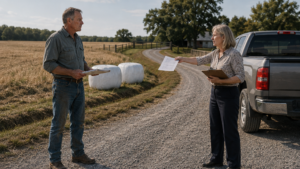
Standing five feet away, planted directly in the center of Hal’s pristine turf, was Brenda Sterling.
Brenda was forty-nine, the self-appointed president of the Willowbrook Green Architectural Review and Landscape Enforcement Committee, and the undisputed terror of the subdivision. She wore oversized designer sunglasses, crisp white linen trousers, Italian leather sandals, and a pastel visor embroidered with the gold HOA crest. In her left hand, she held a hardbound leather clipboard filled with pink carbon-copy citation slips. In her right hand was a calibrated clear acrylic ruler, which she had been thrusting into the turf with predatory relish for the past twenty minutes.
“Section 7, Subsection C, Paragraph 4!” Brenda declared, her shrill voice echoing across the quiet neighborhood. She stood with her arms crossed over her chest, tapping a manicured red fingernail against her clipboard. “Maximum allowable residential turf height across all street-facing lawns shall not exceed three point zero zero inches! I have taken twelve independent cross-sectional measurements across this verge, Mr. Finch. Every single blade along this perimeter measures three point two five inches!”
Hal glanced down at his vintage mechanical wristwatch. The sweep-second hand was ticking steadily toward the twelve.
“The grass was mowed to two point eight inches on Saturday, Brenda,” Hal replied in his slow, patient desert drawl. “Bermuda expands vertically in ninety-degree heat when the root crown takes in deep moisture. That extra quarter-inch is natural leaf canopy. It shades the soil surface, prevents surface evaporation, and keeps soil microbes alive without wasting water.”
“I don’t care about your soil microbes, Harold!” Brenda snapped, her lip curling with contempt. “A rule is a rule. This community was built on visual uniformity, not your crackpot university theories. You are a quarter-inch over code. That is an immediate one-hundred-dollar fine, payable by cashier’s check to the HOA office within forty-eight hours, or it begins accruing twenty-five-dollar daily late fees!”
“I’m not paying a fine for a healthy lawn, Brenda,” Hal said mildly. “And if you check your association charter, routine maintenance cycles take precedence over visual audits. It is three-fifty-eight. My automated deep-root fertilization cycle is scheduled to fire at precisely four o’clock. You need to step off the turf and onto the sidewalk.”
Brenda let out a loud, mocking laugh. She turned, marched four paces toward the center of the lawn, and grabbed a white nylon-mesh folding chair she had brought from the back of her electric golf cart parked at the curb. With deliberate malice, she slammed the four rubber-tipped legs of the chair into the grass, positioning the circular opening of the mesh seat directly over a sunken, heavy-duty commercial brass Toro pop-up sprinkler nozzle.
She sat down squarely in the chair, crossed her legs, and held her pink citation pad on her knee.
“I am not moving one single inch, Harold!” Brenda smirked, waving her gold Montblanc pen in the air. “I know your tricks. You think if you turn on the water, you can wash me off the lawn and claim it was an accident. Well, I am sitting right on top of this nozzle! You touch that water valve, and I will have the county sheriff cite you for assault with a deadly weapon! Now pay the hundred dollars, or sign this ticket!”
Hal checked his watch again. The second hand hit the forty-five mark.
“Brenda,” Hal said, his voice dropping into a calm, resonant register that carried the unmistakable weight of fifty years in civil engineering. “That brass head isn’t connected to the municipal culinary water line right now. The municipal line feeds through a Mazzei high-pressure differential venturi injector mounted behind this stucco wall. At four o’clock, the pressure pump routes through that clear polyethylene tank at my feet.”
Brenda glanced dismissively at the seventy-five-gallon tank, which was filled with a dark, viscous, molasses-like fluid. A bright yellow hazard label on the side read: CONCENTRATED COLD-PROCESSED ALASKAN COD AND HERRING HYDROLYSATE — PURE ORGANIC LIQUID FISH EMULSION.
“I don’t care what you put in your silly compost tea!” Brenda sneered, crossing her arms tighter. “You’re bluffing! You don’t have the nerve!”
“Four o’clock is liquid fish-fertilizer time, ma’am,” Hal said quietly.
His watch clicked to four-zero-zero.
Hal reached down and snapped the heavy brass bypass lever ninety degrees to the left.
Beneath the manicured green turf, an eighty-pound-per-square-inch surge of pressurized hydraulic fluid detonated through the underground schedule-40 PVC lateral lines. The heavy brass Toro nozzle located directly beneath Brenda’s chair rose four inches out of the turf with an explosive, mechanical hiss.
Because Brenda’s two hundred pounds of body weight was sitting directly on the open nylon mesh of the folding chair, the unyielding brass deflector plate had only three inches of clearance. The heavy commercial nozzle vented its full, unrestricted volume straight upward.
A violent, high-velocity geyser of dark brownish-green liquid fish emulsion erupted through the nylon mesh like an oceanic oil well blowout.
The thick, oily slurry—rich in cold-pressed Pacific cod protein, suspended fish bone minerals, and fermented marine nitrogen—hit Brenda with concussive force. The concentrated blast tore through the chair’s porous fabric, striking the seat of her pristine white designer linen trousers and erupting up her spine, instantly saturating her blouse, her gold-trimmed visor, and dripping down her oversized sunglasses in thick, viscous rivulets.
The smell hit the afternoon desert air like a freight train of rotting harbor docks and fermented sardine cannery vats.
Brenda’s mouth opened to scream, but as she inhaled, the suffocating, oily stench of raw liquefied fish gut filled her lungs. She launched herself out of the chair with an unearthly, terrified shriek, leaping three feet into the air like a scalded cat.
“Ugh! Agh! Oh sweet heaven!” Brenda wailed, flailing her arms as dark brown organic muck splattered across her arms, neck, and shoes. “What is that smell?! It smells like three hundred dead rotting sardines baked in an oven! My clothes! My hair! You’ve ruined my five-hundred-dollar linen suit!”
She stumbled backward toward the sidewalk, her designer sandals slipping and sliding in the grass. Her pink citation book lay soaked in brown fish foam beside the sputtering brass nozzle.
Hal stepped forward, adjusted the bronze pressure valve to reduce the spray to a gentle, ground-hugging mist, and picked up her ruined citation book with two fingers.
“Pure Alaskan fish emulsion,” Hal said calmly, tossing the soaked pad into the trash can beside his garage. “Eighty percent organic nitrogen, fifteen trace minerals. Fantastic for developing deep drought-resistant root structures in Bermuda. Terrible for white linen.”
Brenda reached her white golf cart, trembling with fury and retching into the gutter, when a sudden chorus of urgent meows broke through the quiet street.
From across the cul-de-sac, from under front hedges, and from behind three neighboring fences, six stray neighborhood cats—four orange tabbies, a calico, and a massive one-eared grey tomcat—broke into a dead sprint across the asphalt, their eyes wide with manic predatory delight, racing directly toward Brenda’s fish-soaked trousers.
Brenda gave one final, horrified screech, scrambled into the golf cart, and slammed the accelerator to the floor, speeding down the road as the pack of cats pursued her in a desperate, bounding swarm.
Hal watched her disappear around the corner, shaking his head with a quiet chuckle. But as he turned to walk back to his manifold, his eyes caught the small patch of turf where Brenda had been kneeling with her acrylic ruler. Beneath the deep green Bermuda blades, right along the soil surface, Hal noticed an irregular, six-inch ring of dead, bleached-yellow root crowns.
He knelt down, touched the dried blades, and brought his fingers to his nose. It did not smell of natural summer dormancy, heat stress, or fish emulsion. It carried the faint, bitter, unmistakable chemical stench of concentrated industrial glyphosate.