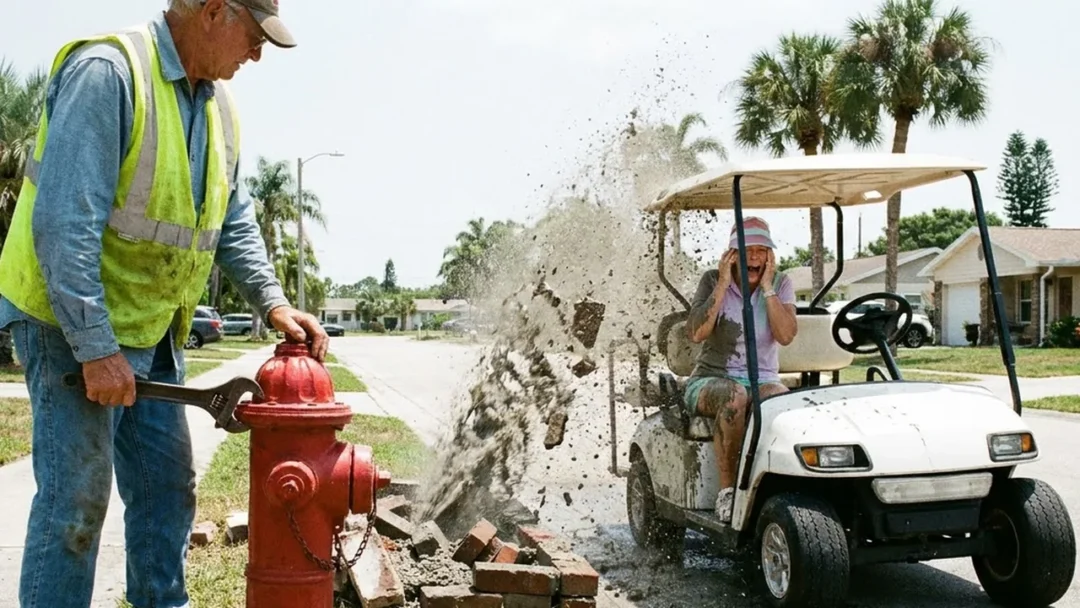
The Wet Cement Flower Box And The Two Hundred Pound Surge
CHAPTER 1: THE TWO-HUNDRED-POUND GEYSER
The midday Gulf Coast humidity hung over the gated streets of Shady Pines Estates like a wet woolen blanket. At one o’clock on a sweltering Sarasota County afternoon, the asphalt along Royal Palm Boulevard shimmered with mirage heat, radiating the sharp, alkaline stench of freshly mixed Portland cement. At the edge of the manicured Bermuda grass curb, Thomas “Mac” MacIntyre stood with his heavy steel-toed work boots anchored into the sandy verge.
Seventy-two years of age, with forty of those years spent in the trenches as the chief distribution engineer for Sarasota County Public Works, Mac possessed the compact, unyielding frame of an old Navy Seabee diver. His chambray work shirt was stained with dried trench mud, his forearms were scarred from decades of handling high-pressure ductile iron mains, and his faded blue eyes held the cold, immovable patience of a man who understood fluid dynamics better than the engineers who drew the blueprints. In his right hand, resting loosely against his thigh, was a thirty-six-inch forged-steel five-sided fire hydrant operating wrench fitted with an auxiliary brass bleeder valve.
Blocking the sidewalk directly in front of him was Candace “Candy” Delacroix, the reigning president of the Shady Pines Estates Homeowners Association.
Candace was fifty-four, dressed in a pastel-pink tennis visor, oversized designer sunglasses, a white linen sleeveless polo, and gold hoop earrings that swung violently as she jabbed an acrylic-tipped finger at Mac’s chest. Parked two feet behind her on the curb apron was her pride and joy: a customized, six-passenger lifted white Club Car golf cart featuring polished chrome wheels, marine-grade white leather seats, and an upgraded high-output stereo system.
Between Mac’s boots and Candace’s golf cart sat a freshly poured, rectangular decorative planter box. It stood eighteen inches high, constructed of red clay bricks and filled to the brim with wet, uncured grey mortar that was still oozing water onto the curb. The planter had been erected directly on top of a heavy, round cast-iron municipal utility cover marked SARASOTA COUNTY WATER — MAIN EMERGENCY AIR RELIEF.
“You are not touching this curb, MacIntyre!” Candace screeched, waving a laminated sheet of paper bearing the gold embossed crest of the Shady Pines Architectural Committee. “I don’t care if you have a county work order! This is private community easement! That rusted, filthy black iron lid was an absolute eyesore on my front lawn! It ruined my curb appeal, it lowered my property appraisal, and my landscapers spent all morning pouring this decorative brick planter over it! I have an architectural exemption right here, signed by the board!”
Beside Mac stood his utility apprentice, twenty-four-year-old Jason Rivera, holding a long steel T-handle valve key. Jason looked nervously between the furious HOA president and the wet cement box. “Mr. Mac… we need to access that chamber. The telemetry alarm at the central pump station says the southern quadrant is pulling an air vacuum. If we don’t bleed the main—”
“I don’t care about your telemetry!” Candace shouted, stepping directly between Jason and the planter box, folding her arms across her chest with an arrogant smirk. “You city workers think you can just drive your dirty trucks into our gated community and dig up our flowers whenever you feel like it. Well, not on my watch! That iron lid is sealed under three hundred pounds of high-early concrete. If you want to remove it, you can petition the HOA board at the annual meeting next November!”
Mac looked down at the wet grey mortar. He didn’t raise his voice. He didn’t blink.
“Mrs. Delacroix,” Mac said, his tone as steady as the tide. “That isn’t a simple pipe lid. That is a twelve-inch municipal kinetic air-and-vacuum relief valve. It sits directly on the high point of the county’s primary twelve-inch ductile iron transmission main. It operates at eighty-five pounds per square inch under normal load. When line pressure fluctuates, that valve exhausts trapped air pockets so the line doesn’t develop a hydraulic water hammer.”
“I don’t speak plumber, old man!” Candace sneered, tapping her foot against the brickwork. “And I don’t care! The concrete stays!”
Mac glanced three feet to his left. Standing on the corner of the curb was a bright red Mueller Super Centurion 250 fire hydrant, connected directly to the twelve-inch main beneath their feet. On the side of the hydrant’s upper barrel was an auxiliary two-and-a-half-inch brass pressure-test port fitted with a digital transducer gauge.
“When I back-flush this hydrant to clear the line sediment, Mrs. Delacroix,” Mac said calmly, “that relief valve has to vent.”
“Vent all you want, grandpa!” Candace laughed mockingly, turning her back to him and leaning against the polished fender of her golf cart. “Concrete doesn’t vent!”
Mac didn’t argue. He stepped over to the red fire hydrant, hooked the five-sided socket of his heavy steel wrench onto the operating nut at the top of the bonnet, and set his boots wide in the grass.
With one smooth, explosive heave of his broad shoulders, Mac cranked the operating stem four full turns counterclockwise.
Beneath the manicured sod of Shady Pines Estates, a deep, subterranean roar awakened. The twelve-inch ductile iron main surged with thousands of gallons of high-velocity municipal water. Trapped within the high-point chamber directly beneath Candace’s freshly poured planter was a massive, fifty-gallon pocket of compressed atmospheric air.
As Mac cracked the back-flush test valve on the side port, an instantaneous pressure wave—a classic hydraulic water hammer traveling at four thousand feet per second—slammed through the subterranean line. The digital transducer on the hydrant spiked instantly into the deep red, registering two hundred and ten pounds per square inch.
Trapped beneath three hundred pounds of uncured, wet grey concrete, the kinetic air-relief valve did exactly what seventy years of American engineering designed it to do: it blew its emergency exhaust seal to prevent the main line from shattering.
The concussive detonation sounded like a five-hundred-pound bomb exploding in a swamp.
The entire decorative brick-and-mortar planter box launched straight up into the air like an uncapped geyser. Fractured red bricks, wooden form-boards, and three hundred pounds of wet, heavy grey Portland cement sludge erupted fifteen feet into the sweltering Florida sky in a violent, bubbling mushroom cloud.
The massive fountain of wet concrete and pressurized groundwater reached its apex and collapsed directly downward.
A tidal wave of thick, viscous grey mortar slammed squarely onto the roof, the hood, and the interior of Candace’s pristine white custom golf cart. The heavy sludge shattered the tinted acrylic windshield into thousands of spiderwebs, caved in the fiberglass canopy, and completely drowned the custom white marine leather seats in four inches of dripping, gravel-filled cement soup. Wet mortar splattered across Candace’s pastel visor, plastered her designer sunglasses to her face, and coated her white linen shirt in a suffocating layer of grey mud.
The cast-iron valve lid beneath the obliterated planter popped cleanly out of the ground, spinning twice on the pavement before settling onto the curb, completely spotless and undamaged.
Candace stood frozen in the puddle of wet sludge, her mouth hanging open, dripping grey cement down her chin as she let out an ear-piercing, hysterical shriek.
“My golf cart!” Candace wailed, clawing frantically at the drying cement on her clothes. “My custom leather seats! Look at my cart! Turn it off! Turn it off!”
Mac reached down with his wrench, closed the hydrant test valve by one turn, and let the clean water wash the street gutter. He pulled a yellow carbon-copy citation pad from his vest pocket, tore off the top slip, and slapped it onto the mud-drenched steering wheel of her ruined cart.
“Municipal utility easement obstruction under Sarasota County Code Section 112,” Mac said evenly. “Plus an immediate two-thousand-dollar county civil fine for sealing a fire-protection valve.”
Jason stepped forward with his valve wrench to inspect the exposed iron chamber. But as Jason cleared away the remaining debris, his face went deathly pale. He looked up at Mac, his voice trembling.
“Mr. Mac… look inside the riser chamber. The main sixteen-inch gate valve spindle… somebody wrapped a heavy steel transport chain around the operating nut and padlocked it shut.”