The Fluorescent Dye That Ruined A Corrupt Suburban Retreat
CHAPTER 1: THE IRON LID AT WHISPER RIDGE
The dry Texas hill country wind rolled off the jagged limestone bluffs of western Travis County, carrying the sharp, medicinal scent of parched mountain cedar and the heavy, heat-baked stench of curing asphalt. At half-past seven on a sweltering Tuesday morning, the sweeping cul-de-sac of Whisper Ridge Trail was quiet except for the low, rhythmic idle of a heavy white utility vacuum-truck belonging to the Travis County Department of Public Works.
Walter Vance stood at the edge of the asphalt gutter, his scuffed Red Wing leather boots planted firmly against the concrete curb apron. At seventy-five years old, Walter moved with the deliberate, unhurried precision of a man who had spent four decades calculating hydraulic gradients, shear stresses, and municipal gravity feeds for the Lower Colorado River Authority. Beneath the sweat-stained brim of his faded canvas field cap, his weathered gray eyes tracked the curb line, consulting a roll of heavy blue drafting linen tucked under his left arm. Beside him, Marco Reyes, a burly county utility operator in high-visibility orange, pulled a pair of heavy drop-forged iron manhole picks from the truck’s external tool rack.
“Line twenty-two trunk,” Walter said, his voice quiet, gravelly, and rock-steady against the dull mechanical hum of the auxiliary diesel engine. “Installed during the summer of ninety-four when the original ranch lands were subdivided. Eighteen-inch vitrified clay conduit with six-inch schedule-forty PVC lateral spurs. We run the closed-circuit robotic camera thirty yards downstream to the trunk junction on Spanish Oaks. If there’s an illegal residential tap siphoning gray water or commercial drainage into the municipal storm bypass, the wide-angle optic sensor will catch the flange in less than five minutes.”
“Right behind you, Mr. Vance,” Marco replied, his thick forearms flexing as he set two bright orange reflective traffic cones on the asphalt and hooked the curved nose of his pick into the lifting notch of the heavy cast-iron manhole cover. The cover rested square in the transition apron between the public street and the newly poured aggregate driveway of Number 44 Whisper Ridge—a sprawling, multi-tiered contemporary villa of polished Austin limestone, black structural steel beams, and floor-to-ceiling plate glass overlooking the steep drop to Lake Travis.
Before Marco could wedge the steel heel of his boot against the pick, the violent roar of a cold-started twin-turbo V8 engine shattered the tranquil morning silence.
From the three-car garage of Number 44, a gleaming, candy-apple-red Italian sports car shot backward down the aggregate driveway. The low-slung coupe did not brake until its wide rear tires brushed the concrete apron. Then, with a sharp, aggressive flick of the leather-wrapped steering wheel and a spiteful screech of warm Michelin rubber, the driver pivoted the vehicle ninety degrees, cut directly across the curb gutter, and planted the wide right-front tire squarely over the cast-iron manhole cover. The undercarriage settled with a hollow, resonant thump, leaving less than four inches of clearance between the painted carbon-fiber front splitter and the iron lid.
The driver’s door swung open with violent force, rebounding against its hinges. Chad Davenport stepped onto the street. He was thirty-four years old, lean, aggressively athletic, impeccably groomed, wearing polarized designer sunglasses, tailored linen shorts, and a lightweight gray performance fleece vest over an expensive pima-cotton polo. In his right hand, he twirled a heavy titanium key fob on an engraved leather lanyard.
“Pack up the circus, boys,” Chad snapped, not bothering to remove his sunglasses as he surveyed Walter and Marco with overt, unfiltered contempt. “You’re done for the day. Clear out of my cul-de-sac.”
Marco paused, holding the heavy steel pick mid-air, his thick dark brows knitting together in disbelief. “Sir, this is a scheduled county infrastructure inspection. We posted the forty-eight-hour easement notices on every mailbox on Monday morning. We need clear, unobstructed access to the junction lid.”
“I don’t give a damn what you posted on Monday morning, buddy,” Chad said, stepping closer, his voice carrying the sharp, abrasive cadence of an executive accustomed to humiliating junior analysts in corporate boardroom conferences. “This concrete apron sits inside my private survey boundary line. My property tax attorney filed a formal boundary dispute with the township and the county commissioners two weeks ago. Until a licensed county surveyor comes out here with a certified laser transit and measures every square inch of this driveway apron, nobody touches that iron lid.”
Walter did not blink. He adjusted his canvas cap, his posture relaxed, his calloused hands resting lightly on the blueprint tube. In his forty years with the river authority, he had encountered oil-field speculators, corrupt subdivision developers, and armed landowners disputing water rights along the Pedernales basin; a thirty-four-year-old venture capitalist throwing a tantrum on a suburban driveway apron barely registered as a disturbance. “The municipal utility easement extends six feet back from the curb face across the entire Whisper Ridge subdivision, Mr. Davenport. That dedication was recorded in plat book seventy-two at the Travis County Courthouse before the foundation of your house was ever trenched. Your car is parked over a critical inspection vault that serves twelve homes downhill.”
Chad let out a short, mocking laugh, taking another heavy stride forward until he stood less than six inches from Walter’s right shoulder. “Listen to me very carefully, grandpa. The engine on this car just developed a serious electronic management fault. It’s completely immobilized. The transmission is locked in park and can’t be shifted into neutral without a proprietary electronic diagnostic tool from the Ferrari dealership in north Austin, and their service bays don’t even open until ten o’clock. And just so you don’t get any bright ideas about hooking a winch cable to my suspension and dragging it onto the asphalt…”
With a sudden, theatrical whip of his wrist, Chad flung his heavy titanium key fob straight upward. The keys arced thirty feet into the morning air, caught the brilliant sunlight, cleared the cedar fascia of his second-story master balcony, and clattered sharply across the Spanish clay roof tiles, vanishing into a recessed copper valley gutter above.
“Oops,” Chad sneered, leaning his hip back against the red front fender and crossing his arms arrogantly over his chest. “Looks like nobody is moving this car today. If you touch one square millimeter of this hand-rubbed Italian clear coat with that filthy iron pick, my corporate litigation team will have your county pensions attached before the sun sets. Now take your noisy diesel rig and get off my street.”
To emphasize his command, Chad drew back his designer leather driving loafer and kicked Marco’s steel manhole pick. The five-foot forged bar clattered violently across the asphalt, skidding twenty feet down the sloping gutter and striking the opposite curb with a sharp, echoing metallic clang.
Marco’s face flushed dark with blood. His hands clenched into heavy fists, his knuckles turning chalky white as he took a menacing step toward the younger man. “You arrogant little punk—”
“Easy, Marco,” Walter said softly, placing a firm, calloused hand on the younger operator’s shoulder. The grip was steady, unyielding, carrying the quiet authority of half a century of field command in utility corridors and construction trenches.
Walter turned his gaze back to Chad. His expression was neither angry nor intimidated; it possessed the detached, analytical focus of a veteran surgeon reviewing an MRI. He looked past the red sports car, past the terraced limestone retaining wall, and noted the faint, telltale hum of a secondary booster pump operating behind the cedar privacy gate of Chad’s rear patio.
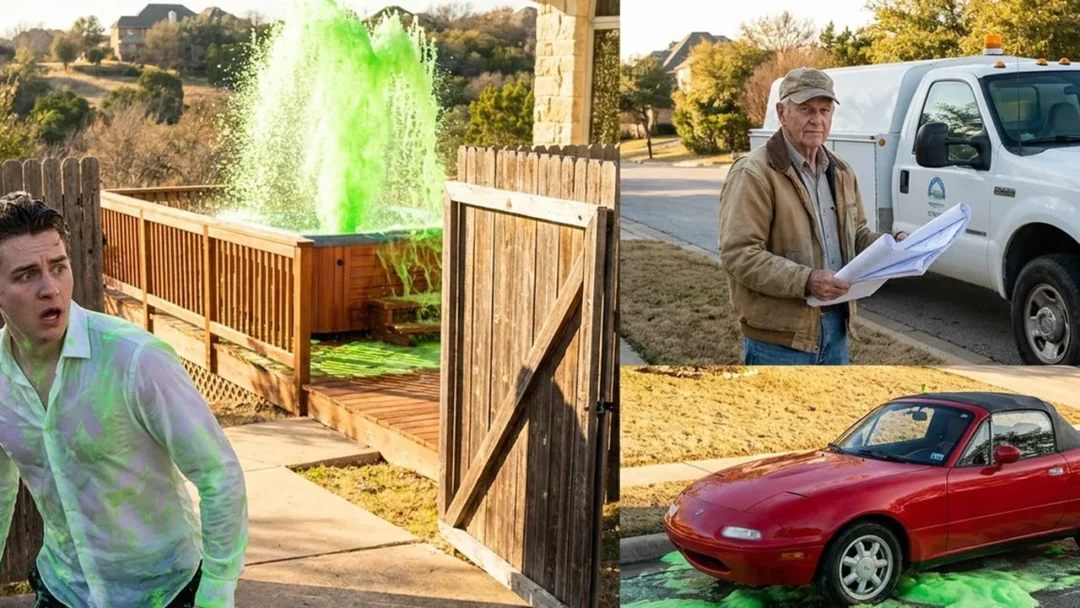
“Mr. Davenport,” Walter said, his tone perfectly even, “just to ensure accuracy in the public works engineering log before we proceed: when you completed your extensive backyard remodel last month—the sunken lounge, the outdoor kitchen, and that custom eight-person redwood hydrotherapy spa—did your contractor pull a master plumbing endorsement to install an approved dual-check backflow preventer on the drainage tie-in?”
Chad scoffed, shaking his head with dismissive arrogance as he backed toward his front stone steps. “My contractors do whatever I pay them to do, old man. And whatever is behind that privacy fence is private property. Go home and play checkers in the park.”
Curiosity Lock: As Chad turned his back and walked up his stone steps, Walter pulled a brass pressure gauge and a surveyor’s compass from his pocket, looked thirty yards uphill toward the quiet cul-de-sac bend, and whispered to Marco, “He thinks water only flows where people tell it to. Let’s walk up to the high junction.”