The Roasted Bone Broth And The Vanished Child Scent Trail
CHAPTER 1: THE MISSING BOY IN BLACKWOOD HOLLOW
The damp October fog hung low across the rugged ridges of Ulster County, blanketing the hemlock hollows of Blackwood Ridge County Park in a cold, suffocating silence. Along the cracked flagstone footpath winding toward the reservoir, eighty-two-year-old Silas Thorne sat peacefully on a weathered cedar park bench. He was dressed in a heavy red-and-black wool mackinaw coat, thick canvas work trousers tucked into oiled leather hunting boots, and a knitted watch cap pulled down over his thinning white hair.
Between his weathered, calloused hands, Silas cradled a heavy two-quart stainless-steel thermos. In these northern foothills, bone broth was more than nourishment; it was medicine, tradition, and an enduring shield against the damp autumn chill that seeped into aging joints. Silas simmered his stock with cracked marrow knuckles, yellow onions roasted in their skins, dried bay leaves harvested from his greenhouse, and whole black peppercorns. The resulting broth was dark as amber honey, thick with collagen, and carried an aroma so deep and restorative that it could revive a frozen lumberjack after a twelve-hour shift in the hemlocks. For sixty-two years, Silas had run a four-hundred-acre dairy operation in the lower Wallkill Valley, waking up before dawn to tend Holsteins, shovel feed, and mend barbed-wire boundaries in freezing rain. He understood the unpredictable rhythms of nature, the subtle body language of animals, and the profound silence of the northern woods. Every morning since his retirement, he walked the perimeter trails of the municipal park, carrying his daily ration of homemade bone broth—simmered for eighteen continuous hours on his wood-fired kitchen range from roasted marrow bones, wild leeks, cracked black pepper, and thyme.
The tranquil stillness of the morning was shattered by the distant, urgent wail of emergency sirens echoing off the limestone cliffs from Route 209.
Within minutes, an olive-green Chevrolet Tahoe patrol unit belonging to the Ulster County Sheriff’s Office bounced up the gravel service drive, its emergency light bar flashing red and amber through the swirling mist. The vehicle braked hard beside the footpath trailhead, its tires spitting gravel against the wooden trail kiosk.
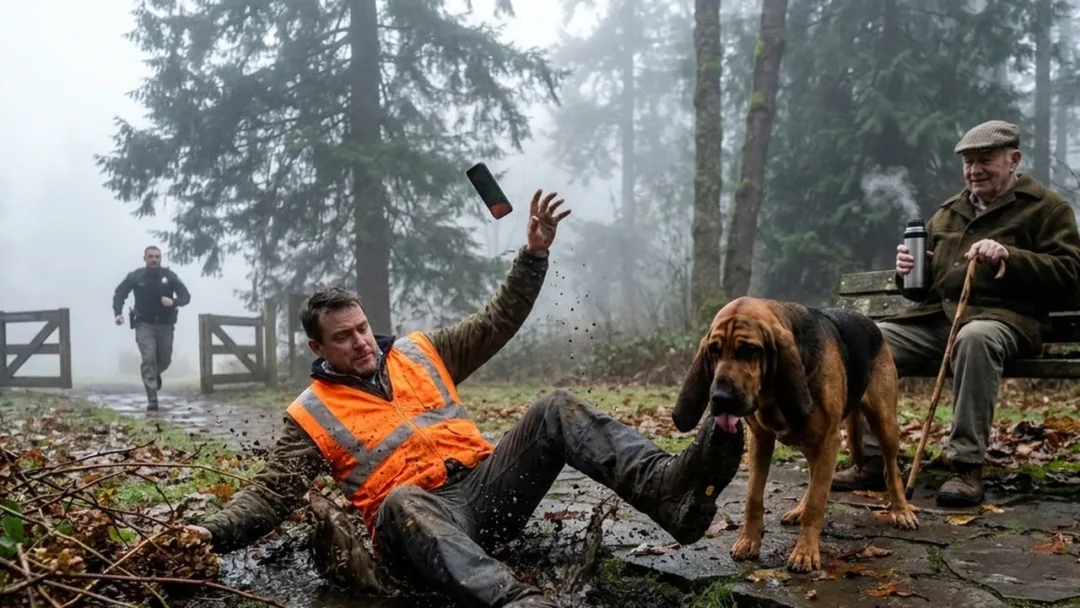
The driver’s door flew open, and Deputy Mark Miller stepped onto the wet asphalt. His breathing was rapid, his jaw set in a hard, grim line of determination as he scanned the dense fog rolling across the ridgeline. He was a broad-shouldered man of thirty-eight, his uniform damp with sweat despite the chilly air, his face pale with raw, paternal anxiety. Behind him, the rear tailgate latch released, and a massive, ninety-pound purebred AKC tracking bloodhound sprang down onto the grass. The dog, named Copper, had long, velvet-soft mahogany ears that nearly brushed the ground, heavy wrinkles draping over his soulful amber eyes, and a broad black nose that instantly pressed into the damp earth, inhaling the complex scent tapestry of the forest floor.
Silas remained motionless on his bench, watching with respectful silence as the deputy knelt beside the hound.
“Easy, boy,” Miller murmured, his voice tight and trembling with adrenaline. He held up an evidence bag containing a tiny, hand-knitted red yarn mitten with small white snowflake patterns. “Find him, Copper. Find Toby.”
Miller let the bloodhound bury his muzzle deep into the opening of the plastic bag. Copper took three long, snuffling breaths, his entire ninety-pound muscular frame quivering with focused canine intensity. A bloodhound’s nasal cavity contains an intricate labyrinth of over three hundred million olfactory receptors and delicate turbinate bones covered in specialized mucus, allowing the animal to detect airborne scent plumes diluted down to parts per trillion. The hound rapidly cross-referenced the unique biological signature—toddler skin lipids, laundry starch from the hand-knit yarn, sweet strawberry jam residues, and trace crushed hemlock needles. When Copper raised his massive head, his amber eyes were locked onto the distant tree line with absolute, unwavering devotion.
Silas set his thermos carefully on the bench beside him and stood up, leaning lightly on a knotted hickory walking cane. The cane had been carved from a fallen shagbark hickory branch after the ice storm of eighty-seven, polished smooth by decades of calloused palms. Every knot in the grain represented a winter survived, a heifer pulled from a snowdrift, or a boundary line surveyed. Silas looked into the young deputy’s eyes and recognized the raw, unvarnished fear that only a parent could comprehend. “You looking for little Toby Gable, Deputy?”
Miller looked up, startled by the old farmer’s presence. “Yes, sir. He wandered away from his mother at the picnic pavilion near the upper playground forty-five minutes ago. He’s only four years old, wearing blue denim overalls and a yellow windbreaker. We’ve got a severe cold front moving in from the Catskills with freezing rain forecast before noon. If we don’t pick up his trail through these laurel ravines in the next twenty minutes, hypothermia will set in.”
Copper raised his massive head, emitted a low, resonant bay that reverberated through the trees, and lunged forward on his twenty-foot nylon tracking line, dragging Miller toward the paved footpath. The bloodhound’s nose swept the flagstones like a precision vacuum, following the faint scent of strawberry juice and cedar needles left by the boy’s rubber boots.
Curiosity Lock: As Copper surged past the bench toward the bend in the trail, a young man wearing a high-visibility neon-yellow safety vest stepped out from behind a massive white oak tree, holding a smartphone mounted on a motorized gimbal in his left hand and a heavy, open gallon jug of industrial chemical cleaner in his right.