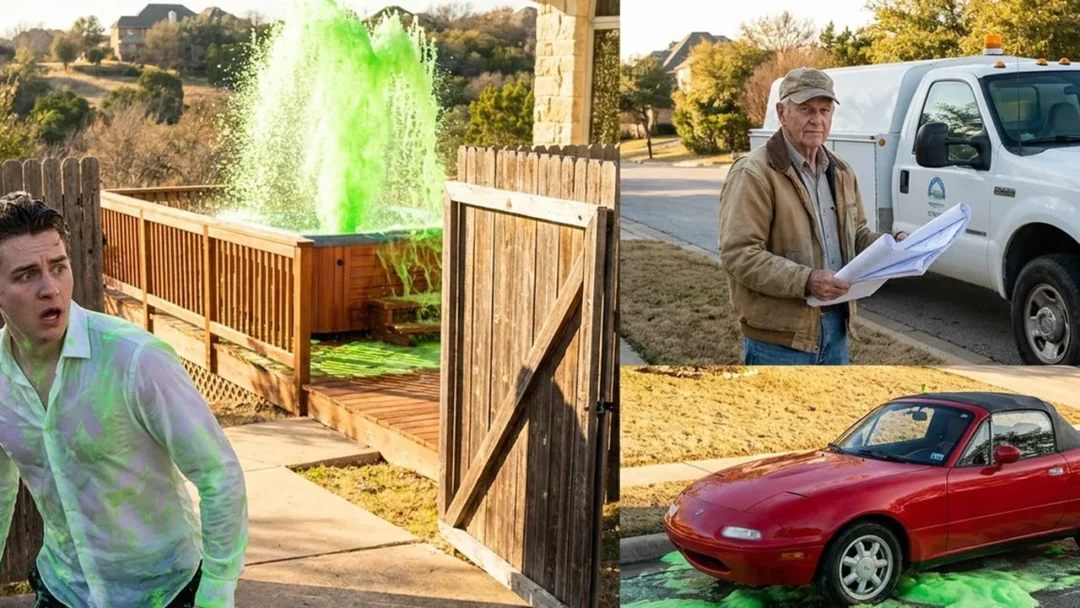
The Fluorescent Dye That Ruined A Corrupt Suburban Retreat
CHAPTER 3: THE FLUORESCENT SURGE
High on his second-floor covered balcony, Chad Davenport reclined on a cushioned wicker chaise lounge, sipping an iced cold-brew espresso from a crystal tumbler. From his elevated perch, he looked down toward the street curb, watching with smug amusement as the two county workers busied themselves around the upper manhole thirty yards away.
“Idiots,” Chad muttered to himself, taking a slow, satisfied sip. “Wasting taxpayers’ money playing with hoses in the street. Let them sweat out there until noon.”
He had already texted his real estate attorney in downtown Austin, instructing him to prepare a scathing cease-and-desist letter to the Travis County Commissioners Court. Chad had spent over two hundred and fifty thousand dollars on his backyard renovation over the past three months. To avoid the tedious delays of city planning boards, architectural review committees, and the Whisper Ridge HOA environmental review, he had hired an unlicensed crew of weekend contractors who worked under tarps and during evening hours. When the head plumber had informed him that installing an approved backflow check valve and running a dedicated discharge line to the lower retention basin would require tearing up three hundred feet of finished landscaping and cost an additional eighteen thousand dollars, Chad had simply laughed in the man’s face.
‘Just core-drill a hole through the retaining wall and tap it straight into the county sewer trunk behind the curb,’ Chad had ordered. ‘Nobody is ever going to open that manhole, and even if they do, they can’t prove whose pipe it is.’
Now, seeing Walter and Marco working thirty yards uphill, Chad felt entirely invulnerable. His car was blocking the inspection cover. His keys were sitting safely in the copper gutter on his roof. There was no way anyone could run an optical camera down the line to find his hidden PVC tee-fitting.
Down at Junction 22-Alpha, Marco Reyes locked the brass air chuck onto the pneumatic bladder valve. The portable compressor on the utility truck thumped steadily, pumping clean compressed air through the reinforced hose until the digital gauge needle settled at exactly twenty-eight pounds per square inch. Deep inside the eighteen-inch vitrified clay pipe below the street, the reinforced rubber cylinder expanded like a massive fist, pressing tight against the smooth inner walls of the municipal conduit and creating a hermetic seal.
“Downstream bladder locked and sealed, Mr. Vance,” Marco called out, wiping sweat from his forehead with the sleeve of his shirt.
“Understood,” Walter replied, standing at the control panel of the truck’s auxiliary water tank. He gripped the heavy brass lever that controlled the hydraulic high-pressure booster pump. “Pour the tracing dye.”
Marco unscrewed the heavy caps on the two five-gallon carboys. He inverted the containers over the open manifold funnel. A thick, concentrated stream of intensely bright, neon-green liquid cascaded into the intake, glowing with an electric, unnatural luminescence under the blazing Texas sun. It looked like liquefied emeralds, so concentrated that a single drop could color an entire municipal swimming pool.
“Ten gallons of fluorescein sodium mixed,” Marco confirmed. “Booster pump engaged to auxiliary reservoir.”
Walter set his jaw, his hand resting on the throttle lever. “Opening hydrostatic injection valve. Bringing line pressure to twenty pounds per square inch.”
The diesel auxiliary engine surged with a deep, throaty growl. Hydraulic fluid hissed through the high-pressure lines as the positive-displacement pump began driving five hundred gallons of water mixed with neon dye down into the sealed section of the sewer line.
At first, the pressure gauge rose smoothly: five pounds, ten pounds, fifteen pounds. In the main pipe below the street, the volume of water expanded, filling the clay conduit from wall to wall. Because the downstream bladder was sealed tight just north of Chad’s sports car, the water had nowhere to go. It began searching the perimeter of the pipe, seeking every branch, every joint, and every lateral line connected to the neighborhood grid.
At Number 42, the home of retired schoolteacher Martha Evans, the pressurized green water reached a heavy cast-iron dual-check valve installed under her foundation in 2019. The stainless-steel spring flapper slammed shut with an authoritative metallic click, completely sealing her domestic pipes from the street surge.
At Number 40, the brass check valve held firm under twenty pounds of pressure without leaking a single drop.
But thirty yards downhill, at Number 44, the situation was entirely different.
Beneath the multi-tiered Burmese teak deck of Chad Davenport’s villa, the unpermitted two-inch schedule-40 PVC pipe ran straight through a rough hole punched in the limestone retaining wall, completely devoid of any check valve, shut-off cock, or backflow barrier.
As the hydrostatic pressure in the municipal trunk reached twenty-two pounds per square inch, the column of neon-green water found the open two-inch orifice. Like a hydraulic ram, the liquid surged backward through the unpermitted pipe, rushing uphill against gravity through the foundation joists, bypassing the quiet drain lines, and slamming directly into the internal distribution manifold of the eight-person luxury hot tub.
Curiosity Lock: Inside the hot tub, the calm, chlorinated surface water began to swirl violently. Then, from deep within the submerged hydrotherapy nozzles, a low, guttural suction sound echoed across the silent teak patio—followed by a violent puff of trapped air that shot a geyser of white foam six feet into the sky.